



Abstract

In recent decades, Chinese cites are increasingly integrated into the global economy through transnational flows of information, people, and goods. For example, leading Chinese cities such as Beijing and Shanghai have climbed rapidly the Globalization and World Cities Research Network (GaWC) ranking over the past decades (Derudder et al., 2013; Liu et al., 2016). This rising connectivity is partly due to the efforts made by both public and private sectors to attract skilled international migration into Chinese cities (Liu and Shen, 2017; Zweig and Wang, 2013). This is consistent with Beaverstock’s (2002: 525) observation that ‘skilled international migration is as an important process of both contemporary globalization and the global city’. One of the most prominent efforts to attract skilled international migration to Chinese cities is the Recruitment Program of Global Experts (the ‘Thousand Talents Plan’) (Zweig and Wang, 2013). The Thousand Talents Plan was established by the Chinese Government in 2008 with the aim of recruiting distinguished university professors, highly skilled engineers, and entreprneurs to China. To date, this program has attracted more than 7000 talents around the world by offering prestigious titles, competitive salaries, generous start-up research fund, and considerable living allowance.
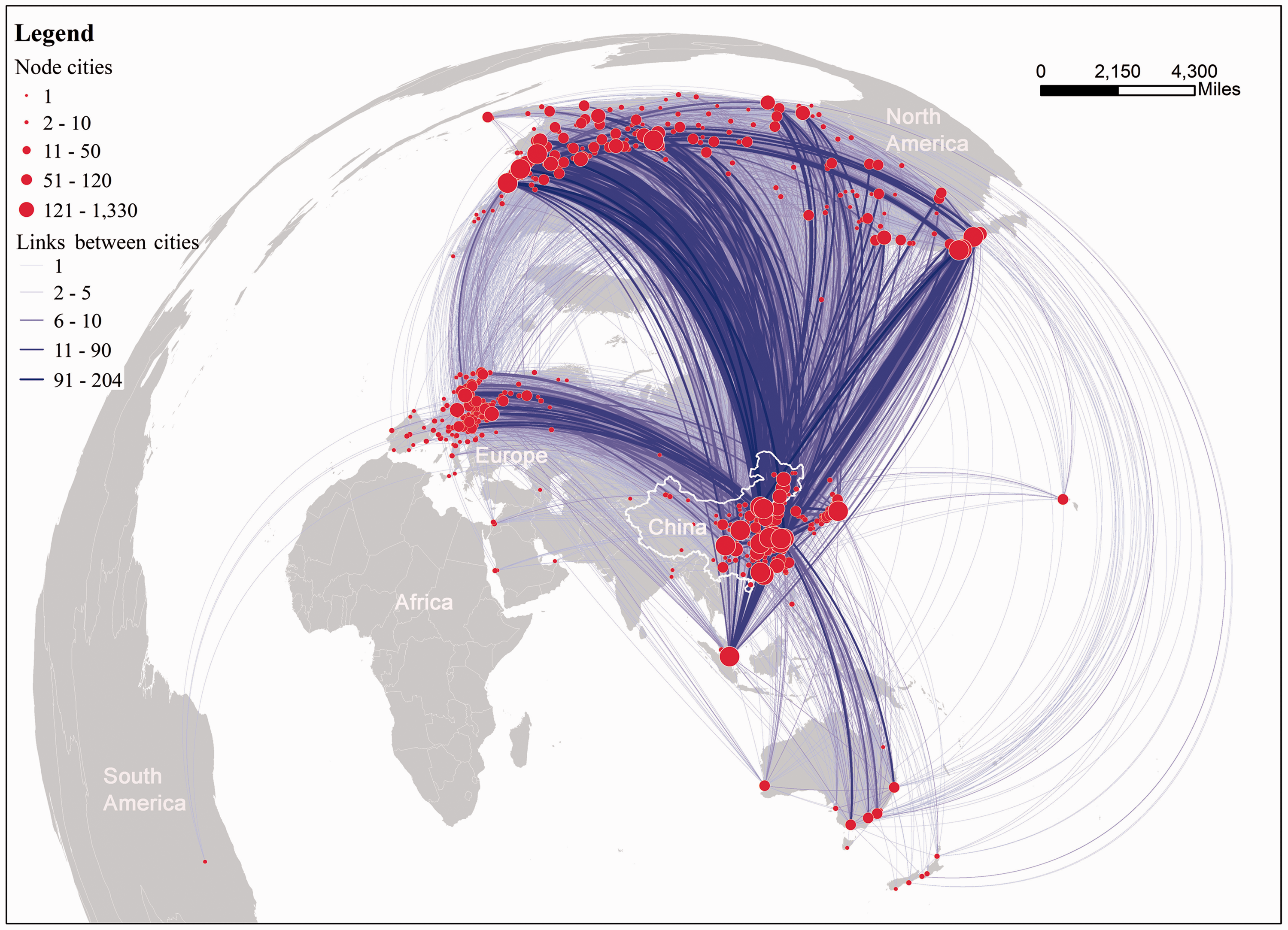
A city network of migration trajectories from home to study to work for Chinese transnational elites involved in ‘Thousand Talents Plan’.
This article aims to visualize the migration trajectories of recruits in the ‘Thousand Talents Plan’. We gathered information on their migration history by accessing the official website of the program (http://www.1000plan.org/wiki/). Our final dataset included inter-city migration records for 3360 talents (accounting for 47.88% of the total). Following Ma’s (2017) analytical framework, we visualized talents’ international migration trajectories from their home to study to work. The graphic clearly displays the potential contribution of Thousand Talents’ migration on the rise of Chinese world cities. Several conclusions can be drawn from this graphic:
The city network formed by the mobility of Chinese transnational elites has a polycentric spatial structure. Specifically, the most important nodes in the network are situated in North America, Western Europe, Japan, Singarpore, and Australia. The 10 most important nodes in China are Beijing, Shanghai, Wuhan, Nanjing, Hangzhou, Hefei, Tianjin, Xi’an, Suzhou, and Hong Kong, and the 20 most important nodes abroad are Boston, Washington, New York, Los Angeles, Singapore, San Jose, Tokyo, Berkeley, San Francisco, Chicago, San Diego, London, Berlin, Paris, Princeton, Austin, Philadelphia, New Haven, Houston, and Ann Arbor. The 10 most important links between two nodes are Beijing–Boston, Beijing–New York, Shanghai–Boston, Beijing–Washington, Beijing–Los Angeles, Shanghai–New York, Beijing–San Jose, Shanghai–Washington, Beijing–Singapore, and Beijing–Chicago. The city network shown in Figure 1 is partly overlapped with the world city network defined by GaWC (http://www.lboro.ac.uk/gawc/gawcworlds.html). For example, among nodes with more than 10 links shown in Figure 1, 52 nodes (24.53% of the total) are listed by GaWC as world cities. Among nodes with more than five links, 66 nodes (31.13% of the total) are listed as world cities. Among nodes with more than one link, 118 nodes (55.66% of the total) are listed as world cities. This suggests that Chinese transnational elites involved in the ‘Thousand Talents Plan’ have accelerated the integration of Chinese cities into the world city network.
Footnotes
Authors’ note
Declaration of conflicting interests
The author(s) declared no potential conflicts of interest with respect to the research, authorship, and/or publication of this article.
Funding
The author(s) disclosed receipt of the following financial support for the research, authorship, and/or publication of this article: This work was supported by the National Natural Science Foundation of China [41571151, 41590842, 71433008, 41501151].