




Abstract
This paper studies redundant workers’ industrial and geographical mobility, and the consequences of post-redundancy mobility for regional policy strategies. This is accomplished by means of a database covering all workers who became redundant in major shutdowns or cutbacks in Sweden between 1990 and 2005. Frequencies of industrial and geographical mobility are described over time, and the influence of some important characteristics that make workers more likely to be subject to particular forms of mobilities are assessed. We find that re-employment rates vary extensively across industries and time. Whereas going back to the same or related industries is the most common re-employment strategy among workers who find a new job in the first year, workers who do not benefit from quick re-employment are increasingly squeezed out to new job fields and regions. Older workers and workers with high vested interest in their original industries usually employ a ‘same-industry/same-region’ strategy. This most frequent, and perhaps often most attractive, same-industry strategy comes at a cost, however. Individuals who instead pursue other mobility strategies have a lower risk of suffering from another major redundancy in the future. Thus, in terms of regional policy, strategies promoting diversification to related industries after major redundancies seem to be much more important than trying to retain workers in their old industry. In this case the route via education (university or vocational training) is important, as it increases the likelihood of successfully changing industry at time of re-employment.
Introduction
Major cutbacks or shutdowns of entire establishments often introduce severe stress on regional labour markets. For example, in 2011, 3064 workers in the Swedish town of Trollhättan, with a population of 56,000, became redundant when SAAB Automobile declared bankruptcy (Trygghetsrådet, 2014). This caused already high unemployment rates in the town to skyrocket to almost 20% (in contrast to the Swedish average of 8%). The Swedish Public Employment Service urged these workers to think through what was more important to them – to remain in the region, or to stay in the industry (Nils Gustafsson, 2011). This suggests that redundant individuals often are forced to perform different kinds of mobilities, to new sectors or to new regions, when trying to adapt and find a new job. It also poses significant questions concerning regional policy: whether, and when and for whom, policy should promote labour mobility.
In the present paper, we ask four questions. First, to what extent do workers engage in sectoral or geographical mobility after becoming redundant? Second, for those who switch industries, are these new industries similar to their original industry, or very different? Third, what types of workers engage in what types of spatial and industrial mobility? Fourth, does the kind of mobility an individual engages in after becoming redundant matter for the stability of future employment? We use a longitudinal matched employer–employee dataset from Statistics Sweden to follow workers who are made redundant in major lay-offs or staff cutbacks between, 1990 and 2005.
We ask these questions because the industrial and geographical mobility trajectories of redundant workers remain relatively underexplored beyond case studies. This is true despite the fact that studies of workers’ labour market outcomes after redundancies have a long history in both geography and labour economics (Bailey et al., 2012; Fallick, 1996; Huttunen et al., 2011; Magnergård, 2013; OECD, 2015). In particular, few, if any, have studied redundancies in connection with geographical and industrial mobility, and how mobility is connected to the stability of future employment. This is the case despite the fact that regional re-employment opportunities clearly reflect the potential for regional resilience and diversification (Diodato and Weterings, 2014; Eriksson et al., 2016). Shedding further light on this issue also has relevance for the growing literature in geography on labour mobility and skill relatedness (Boschma et al., 2009; Neffke and Henning, 2013). While arguing that labour mobility is a key mechanism in allowing new regional combinations of unstandardised knowledge (Boschma et al., 2014), this body of literature has nonetheless devoted little attention to unadjusted labour flows and what types of workers actually perform certain types of labour market moves. The novelty of the present paper lies in the combination of these bodies of literature and in providing new micro-level insights into how individuals (and hence regions) adapt following major lay-offs. In so doing, we contribute new knowledge about how individual benefits or losses of regional labour market moves should be conceptualised at different points in time after redundancy and about when the ‘relatedness’ of industries actually should be measured. These issues are essential to determining how a differentiated regional development policy promoting regional diversification should be implemented (Foray, 2014).
The paper starts with an account of previous literature on work and mobility from both the worker and regional perspectives. We thereafter move on to describe our data and empirical strategy. The empirical results follow. We conclude with a discussion linking the findings of the paper to the broader research literature.
Previous research
The potential outcomes facing an individual who is becoming redundant can be sketched in a simple graphical representation (Figure 1). For an individual becoming redundant at time t0 (left bottom), the axes in the graph represent the mobility options that the individual faces when searching for and finding a new job. For industries (x-axis), we illustrate mobility in terms of distance in skill content from the individual’s original industry to a job in the same, related or unrelated industries (that typically make use of very different types of skills). For geography (y-axis), we illustrate the labour market mobility involved in the re-employment. Outcomes A–F represent combinations of the geographical and industrial mobilities.
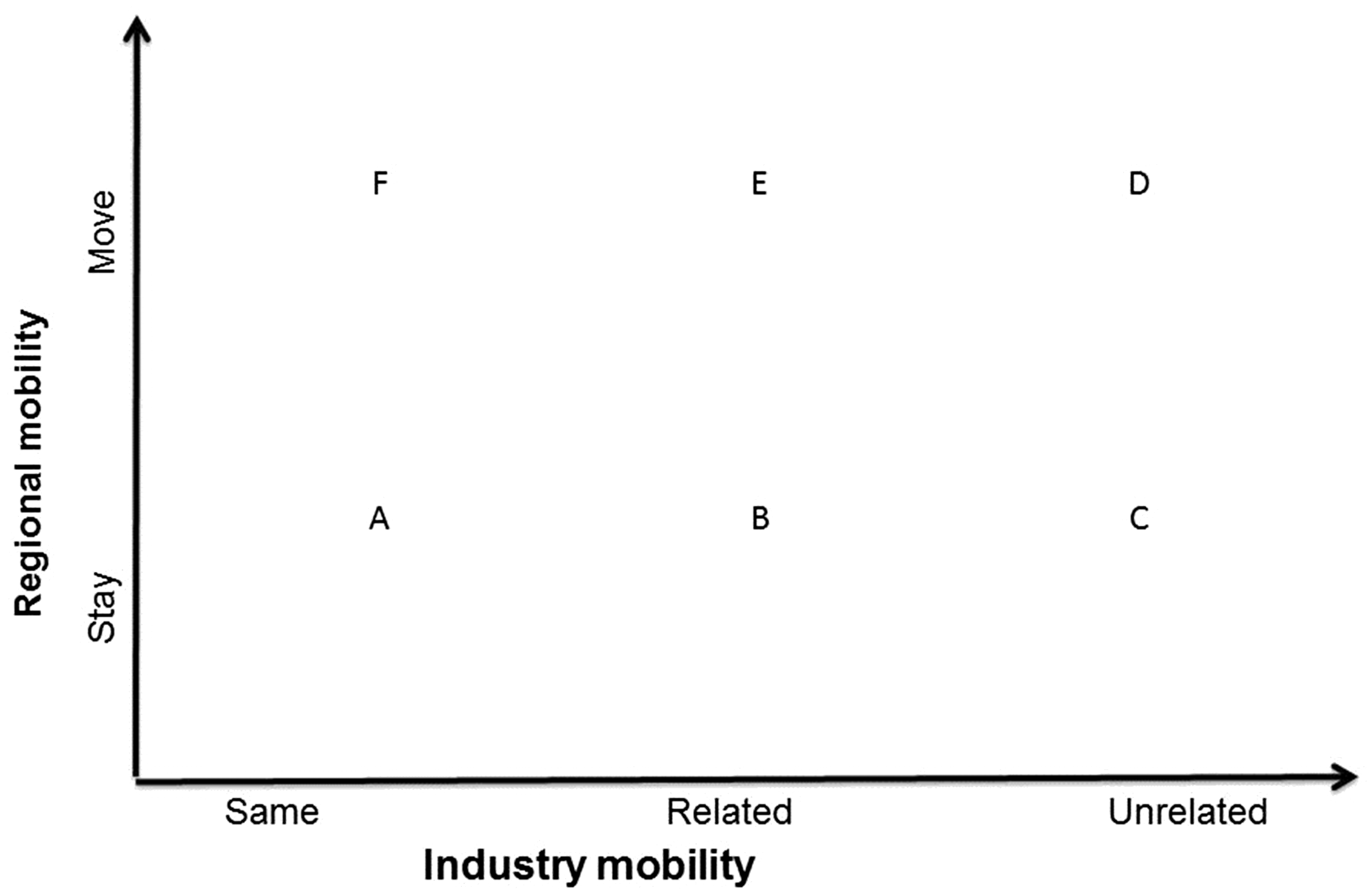
Outcome space for redundant individuals and different mobilities.
There are several reasons why individuals usually have a preference for remaining and working in their original region (outcomes A–C in Figure 1). The literature on work and mobility has repeatedly stressed the regional ‘stickiness’ of individuals in space. Fischer and Malmberg (2001), for example, showed that people (in Sweden) rarely move as far as to another labour market. One important reason for this, apart from a welfare regime that largely allows relative immobility, is social ties. Individuals generally prefer to stay in regions where they have established social networks, and a worker leaving the region to seek employment elsewhere will lose her ‘insider advantage’ (Fischer et al., 1998). The advantages of knowledge, routines and networks that the individual has accumulated in the region mean an increased transaction cost upon leaving (Eriksson et al., 2008). There are also documented gender dimensions to spatial mobility. Previous literature suggests that women are less spatially mobile than men are, which can be explained by the still prominent ‘double burden,’ where many women have the main responsibility for children and domestic work even though they have a paid job (cf. Hanson and Pratt, 1991). Age is also conventionally considered as a main factor influencing migration, where young adults have a much higher migration frequency than do other age groups (Lundholm, 2007).
There are also arguments suggesting why individuals would instead engage in spatial mobility after becoming redundant (outcomes D–F in Figure 1). Long-distance migration often has an employment-related motive (Niedomysl, 2011). Growth differentials and speed of economic transformation on the regional labour markets will serve as pull factors for spatial reallocation of labour (Martynovich and Lundquist, 2016). This is especially true when push factors such as high unemployment exist. A recent stream of research has shown how, and exactly which, regional demand factors or what type of regional industry mix is essential to chances of finding new employment (Eriksson et al., 2016; Neffke et al., 2017; Shuttleworth et al., 2005). In most cases, this literature confirms the notion, already described by Marshall (1920), that a concentration of similar or related industries speeds up the local re-employment process.
Many of these arguments, and how individuals perceive the balance between the costs and benefits of migration, would apply to any type of geographical migration choice. Huttunen et al. (2015), however, argued that less is known about the specific connection between labour displacement and migration, and they found that job displacement is positively related to an increase in geographical mobility.
But geographical mobility is not the only mobility choice that redundant individuals face. Taking a new job could also be thought of as travelling in terms of skill distance, from an old job to a new one. Previous work has approached different mobilities from an occupational perspective (see overview in Gordon, 1995). Complementing this, and in line with a specific set of recent research literature, we are instead interested in mobility between industries. The intuitive tendency of redundant workers is often to seek employment in the same industry they used to work in (outcomes A and F in Figure 1). Both quantitative and qualitative empirical studies have indeed shown that redundant workers’ post-redundancy strategies tend to take them back to new employment in the same industry (e.g. Huttunen et al., 2011; Magnergård, 2013), or that they tend to use very similar skill sets as in the pre-redundancy employment (Bailey et al., 2012). But when experienced workers are forced to seek new employment in other industries or fields, mobility entails potential skill-destruction, or that individual skills will become idle in the new job. Neffke and Henning (2013) argued that workers, when switching industries, are inclined to move between related industries that draw on partly similar human capital resources (outcomes B and E in Figure 1). This type of move also involves lower absorption costs for the new employer (Boschma et al., 2009). On the other hand, the move to an unrelated industry greatly increases the risk that the individual’s skills will not match those needed in the new industry, and that a considerable subset of these skills will be left idle (outcomes C and D in Figure 1).
In defining an individual’s mobility after redundancy and its consequences, the time to re-employment is also of relevance. Many studies of establishment closures and redundancies have shown that a large proportion of workers become re-employed within one year, even though there are regional variations (e.g. Hane-Weijman et al., 2018; Nyström and Viklund Ros, 2014). Huttunen et al. (2011) found that with increased time to re-employment, moves towards unrelated industries become increasingly common. In a case study, Bailey et al. (2012) concluded that 60% of all workers who found new employment 3 years after establishment closure stated that they were using a totally different skill set in their new employment. The longer the time to re-employment, the higher the expected proportion of the re-employed who enter unrelated industries or an occupation that requires a totally different skill set. This indicates that the longer the time to re-employment, the higher the risk that the move to a new job will imply that some of the previously accumulated human capital cannot be as easily used in the new position. Also, in some cases, workers will not immediately reach their reservation wage. Workers who are able to wait until a good match between individual skills and a new job can be achieved are more likely to do so.
One outstanding issue is whether different mobilities are connected to future labour market vulnerability. Although long-term wage effects and qualities of new employment have received a considerable amount of attention in the redundancy literature (Boman, 2011; Couch and Placzek, 2010; Eliason and Storrie, 2006; Gardiner et al., 2009; Gripaios and Gripaios, 1994; Huttunen et al., 2011; Jacobson et al., 1993; Oesch and Baumann, 2014; Tomaney et al., 1999), the issue of how outcomes are associated with long-term employment effects is less well explored. Pike (2005), however, argued that the labour market stability of the new employment is one of the clearest proxies for how well workers adapt to a shock, and Eliason and Storrie (2006) showed that redundant workers in general seem to be more exposed to future crises. Still, as post-redundancy mobility could be regarded as an individual adaptation strategy, we do not know whether future employment stability is influenced by the mobility of redundant workers. In cases where regional economic shocks are industry-specific rather than firm-specific, for example, workers moving back to their original industries may suffer a higher risk of experiencing yet another redundancy (cf. Eriksson et al., 2016).
Re-employment of redundant workers is often seen as one of the most pressing issues in regional development policy. The outcomes displayed in Figure 1 can also be considered from a policy perspective of accommodating redundant workers and stimulating a specific regional development. The tension between promoting the reinforcement of existing paths or stimulating radical change is well described in the evolutionary policy literature (Boschma, 2005). Because so many mechanisms in regional economies stimulate path dependency (Martin and Sunley, 2006), it may be tempting for regional policy to work towards reinforcing existing structures (Boschma, 2005). In the case of individuals and regional labour market policies, this translates into promoting workers’ re-employment back in their original industry in the same region (outcome A). However, striving to re-employ workers in the same industry they left may be associated with problems from the perspective of sustained regional growth. If industry-specific shocks strike the region, the regional economy will likely be better served by integrating mobility strategies with regional diversification efforts (outcomes B and C).
Within economic geography, there is growing recognition of the argument that moves between related industries are often the most realistic and productive way to transform regional economies (Boschma, 2016; Eriksson et al., 2016; Frenken and Boschma, 2007; Neffke et al., 2011). In the words of MacKinnon (2017), the process of labour branching (i.e. the movement of workers from previous forms of employment into new jobs and economic activities after a shock) will influence the recombination of regional capabilities on the micro-scale, and may help create new, more sustainable development paths. In the context of major redundancies, such strategies are better aligned with outcomes B and C, depicted in Figure 1, than with outcome A. The fact that workers leave the region (outcomes D–F) may be seen as one of the most drastic consequences of regional transformation, potentially resulting in a regional competence drain. However, sometimes, it may also serve as an adjustment mechanism, reducing the unemployment rate in quickly transforming regions (Frenken et al., 2007).
Data and measurement issues
Our dataset is derived from the registers of Statistics Sweden, and covers workers who were made redundant in major closures or lay-offs in Sweden during the period 1990–2005. 1 We follow the workers for a five-year period after they become redundant. Inspired by Jacobson et al. (1993), we define a sample of major redundancies based on the following three requirements (see also Hane-Weijman et al., 2018). We only include establishments that (i) make 100 workers or more redundant, situations in which the plant closure or downsizing put severe pressure on the regional labour market. 2 These workers should then comprise at least (ii) 50% of the establishment’s workforce. While we cannot in principle ascertain from the data whether or not job separations are voluntary, the two first criteria makes it likely that we predominantly capture involuntary job separations. We also want to avoid effects of major intra-firm restructuring, where a large part of the workers are directly re-employed within the same firm, but another branch-plant. Therefore, we (iii) exclude all establishments where the firm re-employs more than 75% of the workers laid-off in the previous year in a new establishment in the same region. The regional division used in the present study is 72 functional regional labour markets (FA regions), as defined by the Swedish Agency for Economic and Regional Growth. These spatial units are defined based on inter-municipality commuting patterns and economic coherence. 3
As a guideline to defining re-employment and categorising the worker’s labour market status (LabStatus) in the period between jobs, we use the subsistence level set by the National Board of Health and Welfare (Socialstyrelsen, 2009). The first year a worker has an income from work in line with the subsistence level, she is categorised as ‘re-employed.’ If this criterion is not met, the main source of earnings determines her labour market status. If the main earning comes from labour market policy activities (vocational training or labour market training), this means that a worker is in ‘training.’ If unemployment benefits are the main source of income, the individual is categorised as ‘unemployed.’ Workers receiving study allowance and no other pecuniary benefits that amount to the subsistence level are categorised as ‘students.’ There are also individuals who have no records of pecuniary benefits sufficient to reach the subsistence level. These are assigned the labour market status ‘other.’ We exclude workers who are above the official retirement age (i.e. 65 years old), or have been given any monetary compensation that indicates that the worker is not pursuing a return to the labour market (e.g. entering early retirement).
Our dataset covers 428,594 redundant workers. For these workers, we also record a set of conventional individual variables such as age, sex, income and level of education defined in Table 5 in the Appendix. The latter are particularly important, as both migration decisions and industry switch strategies are partly driven by selection effects. Previous studies have shown, for example, that income and education variables mitigate the selection problem for unobservables (Boman, 2011).
To assess the degree to which the skill profile of the new industry of the worker differs from the old industry, we create an occupation-based relatedness measure. Inspired by previous work in management (e.g. Farjoun, 1994), our industry relatedness measure is calculated on the basis of similarities in occupation profiles of the workers in two industries. This is motivated by the fact that skills tend to be occupation-specific rather than industry-specific (Huttunen et al., 2011), meaning that industry-codes per se may not cover the similarity of skills employed in the production of goods and services (Hane-Weijman et al., 2018). Compared to the measure of skill-relatedness developed by Neffke and Henning (2013), the occupation-specific indicator is not based on observed flows between industries, something that in our case would cause severe endogeneity issues as mobility is one of the key dependent variables. 4 Using the matched employer–employee dataset from Statistics Sweden 2003–2010 (years of available occupation data), we calculated the share of workers in each occupation for all 4-digit sectors. The pairwise correlations between all industries then reveal whether two industries have similar occupational structure. We then categorised two industries as related if they were statistically significant (5% level) with a correlation of at least 0.75. The result gives us 2812 significant links between related 4-digit industries, of 127,260 possible combinations. This enabled us to identify when redundant workers take on new jobs in related industries.
Empirical findings
Industrial and geographical mobility after redundancies
Seventy-eight per cent of the redundant workers we study become re-employed in the year following the redundancy. There is a distinct drop in non-employment rates the first year, followed by much slower decreases in non-employment during the following four years. On average, about 23% of workers who are not re-employed in t + 1 (t0 represents the year of redundancy, and t + 1 means one year after t0) become re-employed each year from t + 2 to t + 5.
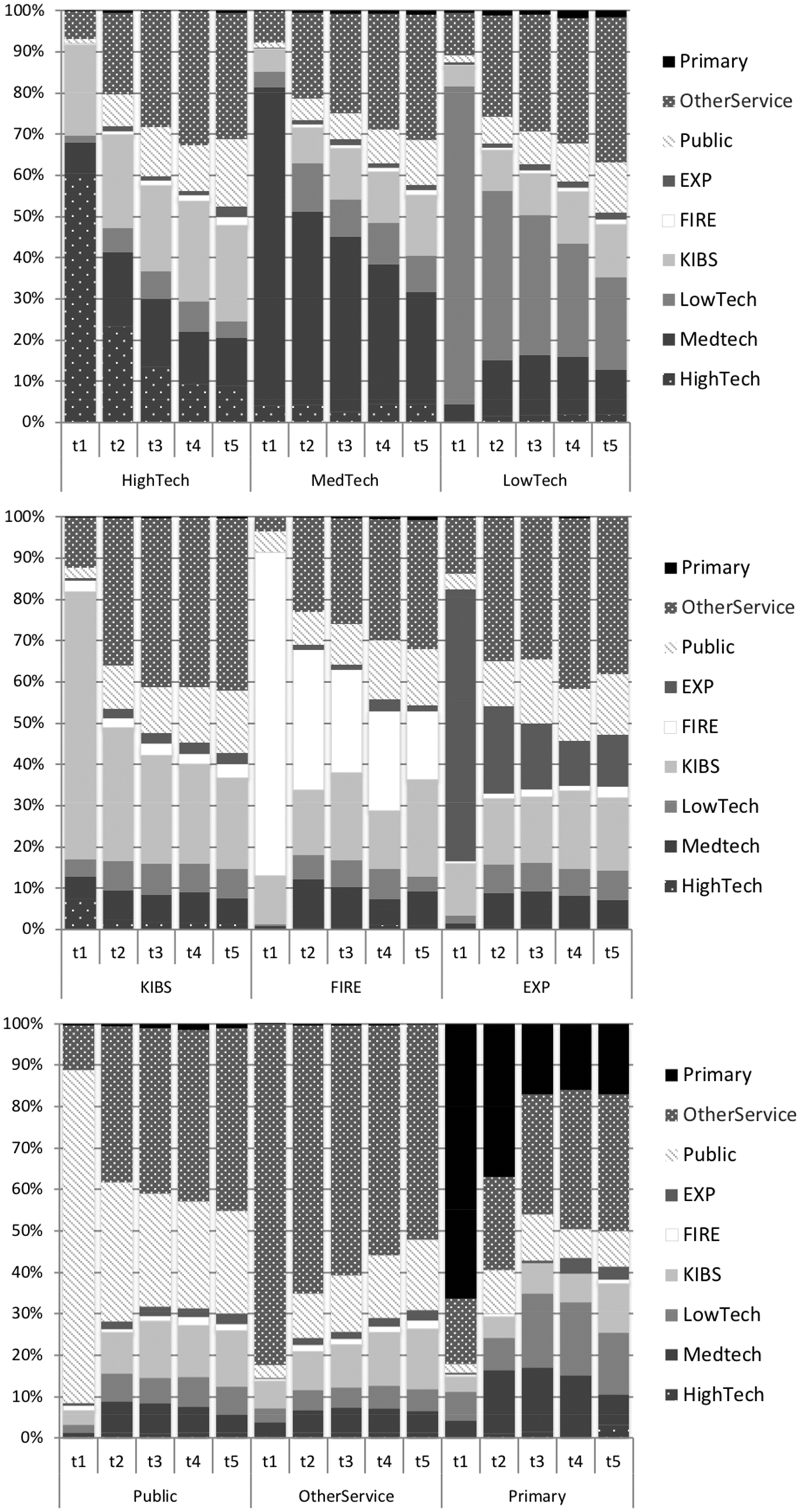
Our first research question concerns to what extent redundant workers engage in mobility after they become redundant. For the workers who do become re-employed, there is a clear structure with regard to their industry mobility. Figure 2 shows the sector of the old job where the redundancy took place, split by the sector of the new job of displaced workers returning to work in t1 to t5. For the workers originating in high-tech manufacturing (as defined by the OECD), for example, 60% returning to work in t1 also obtain a new job in the same sector. A similar pattern is very stable across all of the sectors we study. This same-sector share, however, drops substantially over time. Especially interesting is the role of services as a supplier of new jobs. While the second largest re-employer sector in t + 2 for former high-tech workers is Knowledge Intensive Business Services (KIBS), ‘other services’ (i.e. retail, restaurants and other low-skilled personal services) takes this position for all other sector groups. At t + 3, ‘other services’ is the largest re-employer sector even for the former high-tech workers. There is one clear deviation from the general pattern, and that is for the workers previously employed in ‘other services’. This group contains a diverse set of workers with, generally speaking, one of the lowest re-employment rates – lower than all manufacturing sectors. There seems to be a selection process going on where the portion of workers who do become re-employed change career and become re-hired (in, e.g. KIBS and FIRE), while the remaining part are pushed out of ‘other services’ and into longer spells of unemployment, as laid-off workers from other sectors increasingly become re-employed in ‘other services.’
Figure 2. Sector of re-employment t1–t5 following the redundancy. The x-axis represents each group of sector employed in at the time of redundancy split by time of re-employment t1–t5. Each part of the bar represents the share re-employed in each sector the respective year of re-employment. Own elaborations on data from Statistics Sweden.
While these indications clearly reflect the expected tendency for workers to stay within their original field of work and that there are clear time differences to re-employment patterns, they rest on traditional industry classifications. The second research question in our paper is therefore aimed at those who switch industries, concerning whether the new industries of work are similar to the original industry, or very different. Table 1 uses our industry relatedness indicator and describes the shares of re-employed workers switching to same, related or unrelated industries (at the first instance of re-employment after redundancy). It also records rates of geographical mobility. t + 1 records the individuals who have obtained new employment when we measure their labour market status the year after the redundancy, t + 2 records individuals where we register a new job the second year after redundancy (but not the first), and so on.
Mobility after redundancy. Regional and industrial mobility of redundant workers returning to work, as shares of all re-employed at each time t + 1 – t + 5. Own elaborations on data from Statistics Sweden.

Among those workers obtaining a new job the year after becoming redundant, 53% return to their old (i.e. the same) industry. During the first year, 13% move to related industries, but this number is directly dependent on how restrictive the limit of ‘related’ industries is set. More interesting in this context is instead the sequences over time in the category percentages. The same-industry switches show steeply declining percentages the longer it takes to become re-employed. There is a similar pattern for mobility to related industries. With time after the redundancy, a successively larger part of the redundant workers become re-employed in unrelated industries. In the fifth year after becoming redundant, 85% of the remaining non-employed workers who find new work do so in unrelated industries, compared to 34% in the first year. These figures are in stark contrast to the findings of Boschma et al. (2014) who, when recording voluntary job-switches in Sweden 1998–2002, showed that about 34% move to the same industry, 15% to related industries and 51% to unrelated industries. Hence, as proposed by MacKinnon (2017), related moves tend to be more common when the mobility is voluntary, while if forced upon the worker it tends to be directed towards the same industry in the short-run. Over time, however, these flows increasingly come to be directed towards unrelated industries.
Table 1 also shows the shares of redundant workers who obtain the new job in another regional labour market. In the first year, as expected, the vast majority of re-employed workers stay in their original region, with about 16% of the re-employed taking a job in another regional labour market. With time after redundancy, it becomes increasingly common to take a job in a different labour market.
So far, the findings indicate that, first, the vast majority of redundant workers become re-employed quickly. Second, even after major redundancies, there is a strong tendency for workers to become re-employed in the same industry, but this tendency decreases as the time since redundancy increases. Third, a substantial share of workers move to related industries, and this share also decreases as the time since redundancy increases. This is likely to reflect a preferential pattern on the part of both employees and employers. Those who can get new jobs quickly after redundancy prefer to do so in their old region and in the same industry, or possibly related industries. However, our findings also suggest that, fourth, for all workers who do not find a new job in the first year after the job separation, the risk of skill-destruction is likely to increase each year, as the search for new employment increasingly stretches towards more unrelated sectors and new labour markets.
Individual strategies of re-employment
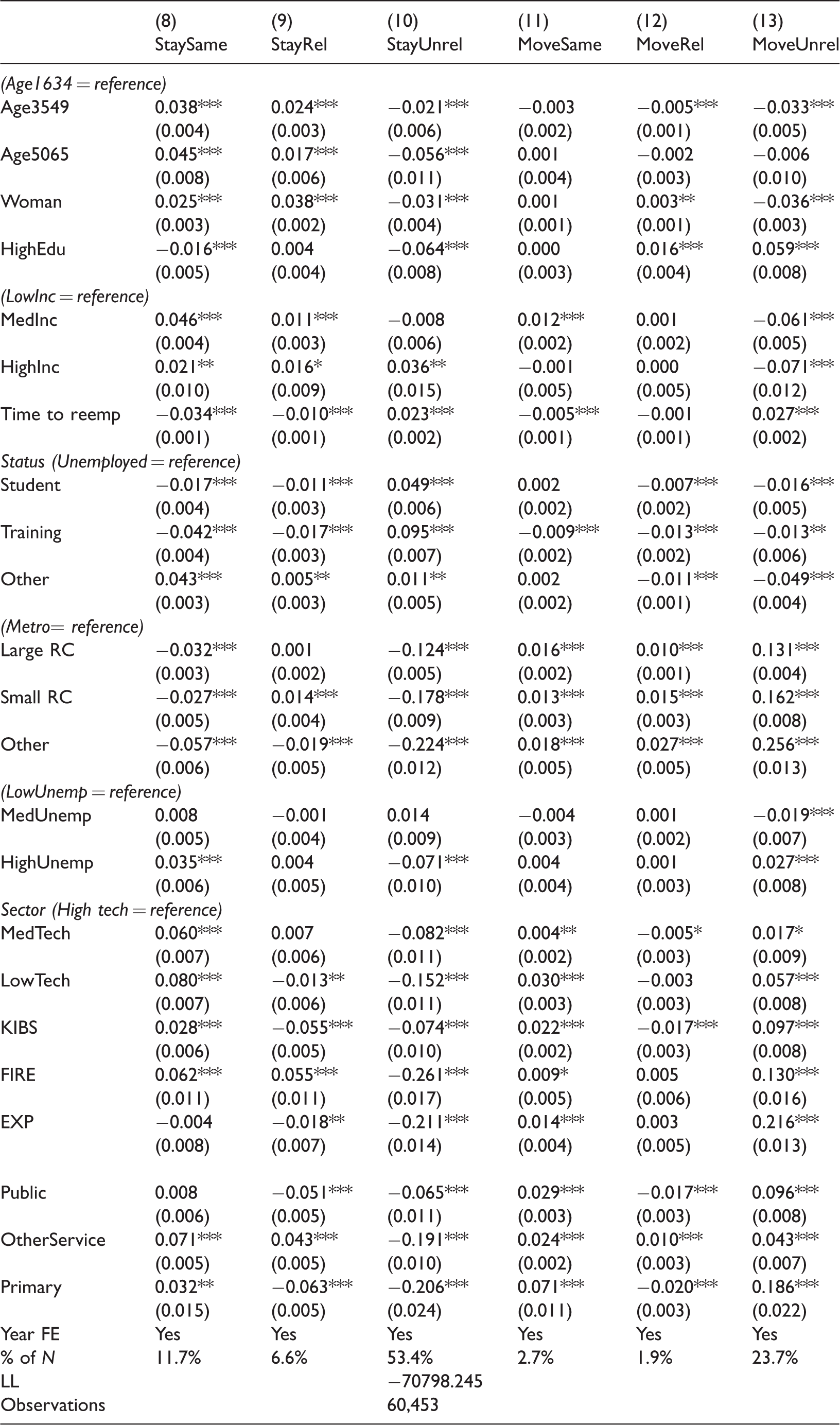
The third research question in the present paper concerns what types of workers engage in what type of spatial and industrial mobility. Tables 2 and 3 summarise our results, and display the outcomes of multi-nominal logit regression models, where the dependent variables are the different outcomes of industry and regional mobility that we registered for the redundant workers (see the Appendix for variable definitions). These are, apart from the first outcome, ‘No work’ (column 1 in Table 2), all linked to the mobility outcomes of Figure 1:
Average marginal effects on outcome the year after redundancy (t1) obtained from multinomial logit model.

Standard errors within parentheses.
*Significant at 10%.
**Significant at 5%.
***Significant at 1%.
Average marginal effects on outcome 2–5 years after redundancy (t2-t5) obtained from multinomial logit model.
Standard errors within parentheses.
*Significant at 10%.
**Significant at 5%.
***Significant at 1%.
StaySame: Obtain work (stay) in the same region, and obtain work in the same industry as before (column 2, outcome A in Figure 1),
StayRel: Obtain work (stay) in the same region, and obtain work in a related industry (column 3, outcome B in Figure 1)
StayUnrel: Obtain work (stay) in the same region, and obtain work in an unrelated industry (column 4, outcome C in Figure 1)
MoveSame: Obtain work in another region (move), and obtain work in the same industry as before (column 5, outcome F in Figure 1)
MoveRel: Obtain work in another region (move), and obtain work in a related industry (column 6, outcome E in Figure 1)
MoveUnrel: Obtain work in another region (move), and obtain work in an unrelated industry (column 7, outcome D in Figure 1).
In the mobility models, we also included three different proxies for regional labour demand. Regional size is frequently argued to increase the chances of finding new employment (Puga, 2010). This is captured by four dummy variables comparing large regional centres, small regional centres and other small regions with metropolitan regions (Stockholm, Gothenburg and Malmö; reference). Second, we include a variable capturing the unemployment level in each region as a general proxy for labour demand (cf. Fallick, 1996). This is defined by three dummy-variables (low, medium, high). We also included sector fixed effects akin to the sector groups displayed in Figure 2, and a full set of year dummies (see variable definitions in the Appendix). As demonstrated by Hane-Weijman et al. (2018), there are distinct differences in the likelihood of becoming re-employed in t + 1 compared to later periods. In Table 2, we evaluate the individual outcomes the first year after the redundancy, including the category No Work. In Table 3, we make similar estimations for the group of workers belonging to the No Work category in Table 2. According to Eurostat, this group of workers, who do not find new employment within a year, is defined as long-term unemployed and therefore warrant a separate analysis. 5 The displayed numbers are average marginal effects, and can be interpreted as the percentage point change in the probability of a dependent variable, for every one unit change in the independent variable.
Apart from lowering the risk of being out of work, higher age is consistent as a factor that decreases the chances of mobility, both in geographical and industrial terms. Older workers are significantly less likely to take on a new job in a new region, and particularly in an unrelated industry, even though older workers generally have greater chances of obtaining a job quickly. The indications that young workers are more mobile could be interpreted in two ways: either the younger part of the workforce is more flexible and quicker to adapt to new circumstances, or they are already, at an early stage, negatively squeezed out into jobs that bear little resemblance to the jobs they had in the past. The older, more experienced workers have, on the other hand, a higher probability of applying the ‘same-industry/same-region’ strategy. As also shown in previous studies (e.g. Hanson and Pratt, 1991), women are less geographically mobile. However, they are also less mobile in an industrial sense, with a higher tendency to become re-employed in the same or related industries (columns 2 and 3). As also noted by Hane-Weijman et al. (2018), in the event of high regional unemployment figures, there is a greater chance of finding employment in a related industry. This is particularly the case outside the metropolitan regions.
A higher probability of geographical mobility is especially linked to highly educated workers. This group also has a much lower risk of becoming out of employment. Workers with higher wages show strong tendencies of returning to the same industry in the same regional labour market (about 26 percentage points more likely than low-income workers), even though they are also more likely to find new employment in all types of industries in the same region, albeit with lower effects. This is not surprising, as income level could be regarded as a representation of vested interest and developed experience in a specific field of knowledge. Highly educated workers show perhaps the highest industrial mobility tendencies, as well as positive and significant tendencies towards moving into related or unrelated industries in new regions.
Table 3 provides a similar account for workers who do not become employed in the first year after redundancy (i.e. long-term unemployed), but in t2 to t5. 6 The models are reminiscent of those in Table 3, with two important additions. For the redundant workers who do not become re-employed in the first year after becoming redundant, we can track their labour market status between the jobs. For the redundant workers who do stay in the region, being enrolled in a training programme once (circa 10%) or studying (circa 17%) significantly improves industry mobility, in particular to unrelated industries in the same region. Investments in human capital can thus create a new type or complementary skill set that opens up new employment opportunities (Eriksson and Hane-Weijman, 2017), which may also diversify the regional economy by allowing new combinations at the micro-scale (MacKinnon, 2017). We also estimated the importance of time to re-employment by creating a discrete time-to-employment variable (1, 2, etc. years to employment). Here, we can see the same push-out effect to unrelated industries and new regions that we showed already in Table 1. Re-employment times are shortest for those who obtain employment in the same industry they used to work in, whereas employment in unrelated industries seems to be much more of a last resort, or alternatively a product of either training or education as the time between jobs is far longer. 7
Mobility and stability of work
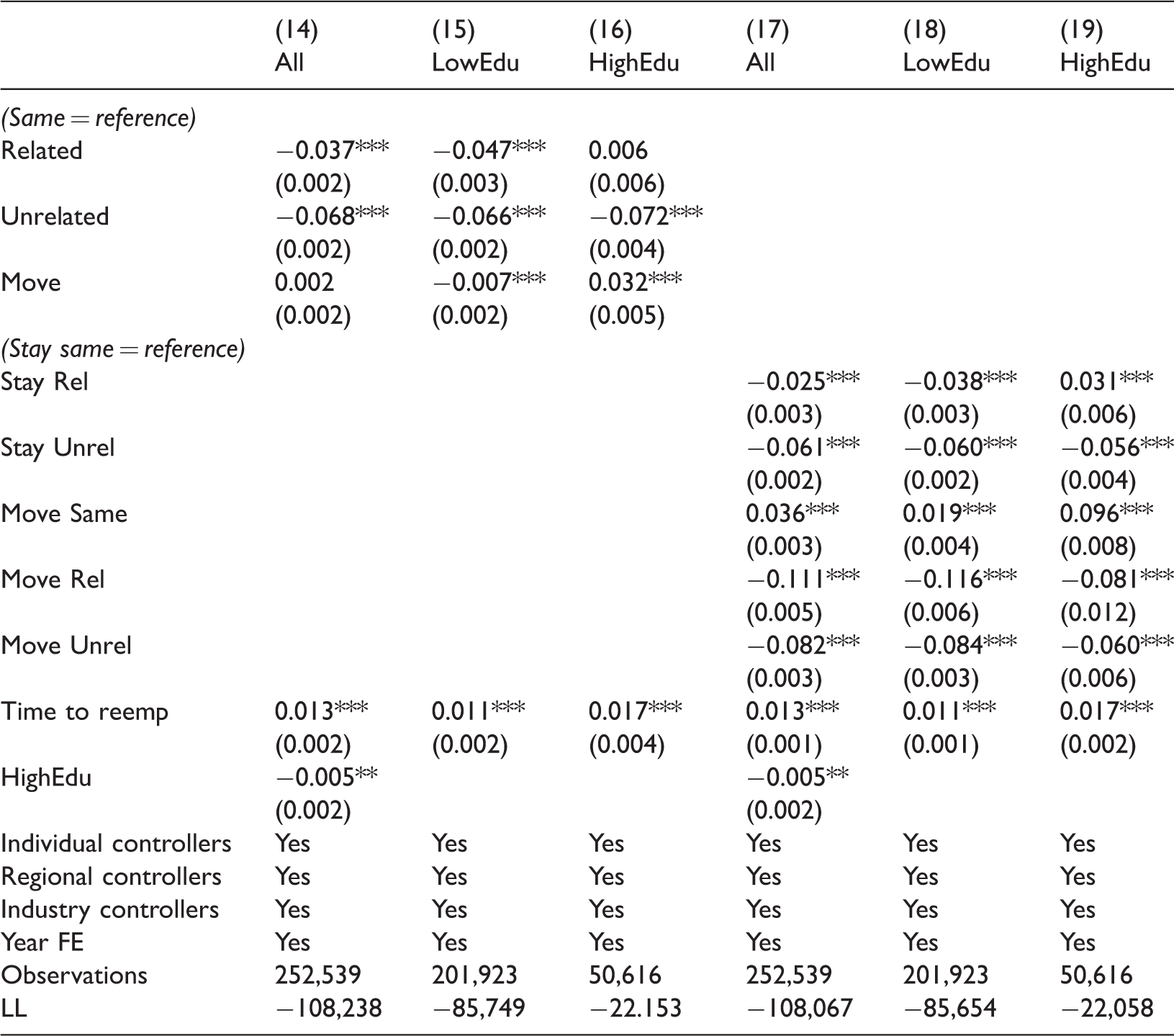
The final research question in our paper was whether the kind of mobility an individual engages in after becoming redundant matters for the stability of employment. Because all observations are gathered on annually, the data are recorded in discrete time. We run a discrete-time survival analysis using a logistic regression, where the time-to-event becomes the probability of experiencing yet another exit. The results displayed in Table 4 (see the Appendix for variable definitions) assess what type of mobility influences the risk of experiencing yet another redundancy due to a mass lay-off within a 10-year period. 8 We display the average marginal effects of the key variables related to mobility and time to re-employment, obtained from the different logit models. All independent variables displayed in Table 3 are also included in the models, including labour status. Because this variable captured the activity between jobs in previous models, we also added the category ‘employed’ to ‘unemployed,’ ‘training,’ ‘student’ and ‘other’ to account for the fact that the majority of workers are re-employed in t1.
Average marginal effects on the risk of being associated with another redundancy 10 years after the first redundancy obtained from logistic regressions.
Standard errors within parentheses.
*Significant at 10%.
**Significant at 5%.
***Significant at 1%.
The outcomes for all workers (14) indicate that time-to-reemployment does increase the risk of vulnerability (cf. Eliason and Storrie, 2006; Pike, 2005). However, our findings also show that the type of industry one becomes re-employed in influences the risk, as mobility to either related or unrelated industries lowers the risk of experiencing yet another redundancy, while changing region per se does not. Apart from the fact that highly educated workers generally face lower risks of experiencing yet another redundancy, there are some distinct differences between low and highly educated workers (15 and 16). Low educated workers benefit relatively more from changing industry and/or region. As a matter of fact, only moves to unrelated industries lower the risk for highly educated workers, while both related and unrelated moves are beneficial for low educated workers. Moreover, while the risk of exiting another employment through mass lay-off is lower for low educated workers changing regional labour market, it is actually higher for highly educated workers. Estimation with a full set of mobilities (17, 18, 19) shows that all types of mobility reduce the risk of facing another exit for the entire sample, except when changing region to work in the same industry as before.
While the majority of workers tend to prefer the same-industry strategy, this may be risky in the long run, because returning to the same industry in the same region, or in another region, is associated with greater risk of redundancy. One exception to this pattern is the increased risk for the about 3% of all highly educated workers who move to a related industry in the same region. Hence, many of the redundancies analysed in the paper could be argued to be associated with processes of structural change in which particular industries are declining. In such cases, the possibility for workers to diversify their human capital to find jobs in other industries seems pivotal. As shown by Eriksson et al. (2016) with regard to the decline of the German and Swedish shipbuilding industries, this is crucial during very drastic industry decline, because industries employing related skills might also be affected by the decline of a key industry.
Conclusions
Labour market mobility after redundancies comes with clear structures, and with particular sequences over time. Our findings support the argument that the common use of resources, such as skills, ties industries together in cross-sectoral inter-industrial relatedness relationships (Farjoun, 1994; Neffke and Henning, 2013; Neffke et al., 2018). The natural inclination of workers to return to their original industries (and for employers to offer workers jobs there) are complemented by opportunities in related industries. Further strengthening the idea of the importance of flows that transcend our traditional industry divisions, service industries of different kinds are important sources of re-employment for previous manufacturing workers.
Using repeated yearly observations of redundant individuals, we find a great difference between those who are employed in the first re-employment wave immediately after the shutdown and those long-term unemployed who remain out of work after the first year. This is true of employment opportunities as well as which kind of mobility they engage in. Our study suggests that not all workers who become redundant are actually genuinely displaced (Fallick, 1996), but do find new employment. For redundant workers who are not re-employed in the first year, we believe that the story is different. The sharp increase in shares taking on new employment in unrelated industries and in other regions between t + 2 and t + 5 represents a crowding out of workers into new skill territories. Among these, related moves tend to be rare. This brings to mind the arguments made by MacKinnon (2017), who claimed that moves to related industries may be more highly associated with voluntary than with involuntary labour mobility. But some individuals are more mobile than others. Higher education and vocational training play a key role in the transformative process and increase the chances of making a longer jump in skills content. Labour market training efforts and education seem to enlarge the sectoral scope of re-employment, which both Essletzbichler (2007) and Eriksson and Hane-Weijman (2017) have argued is of importance for the adaptation and resilience of workers and regions.
While higher age seems to tie workers closer to both their original region and original industry, workers with a higher education and higher income experience greater ease of change. In particular, highly educated workers are less tied to their original industry. A similar argument concerning mobility is reflected in the ‘dual labour approach’ in the migration literature (Gordon, 1995; Lundholm, 2007), where vacancies in lower qualified and less stable jobs have a higher tendency to be filled with local workers, as compared to higher qualified jobs which tend to have a broader geographical search span. Interestingly, gender patterns on the labour market can also be discerned in the present study. Women have a higher probability of becoming re-employed in the same or related industries, which may reflect overall differences not only in mobility frequencies between men and women, but also in directions. Thus far, however, this topic has received little attention in the regional job mobility literature and warrants more detailed future analyses.
While previous studies (e.g. Eliason and Storrie, 2006) have shown that redundant workers face higher labour market vulnerability, our findings suggest that this risk is greatly moderated by the type of industry the workers become engaged in. The attractive same-industry strategy is associated with a longer-term hazard, shown in a higher risk of suffering another large-scale redundancy in the future, while changing industry and/or region decreases that risk. In particular, the findings suggest that low educated individuals should change industry to avoid another redundancy, while highly educated workers may benefit not only from changing industry but from moving further away from their point of departure by looking for work in unrelated industries, or compensating a related industry-move by moving to another region, to reduce the risk of unemployment.
Because the same-industry strategy may not be the most attractive option to promote from a regional perspective, the ambition should instead be to strive for more regional diversification (Boschma, 2016) or even radical structural change (Boschma, 2005). This is well suited to the current policy efforts in the European Union towards Smart Specialization (Foray, 2014), which essentially problematises the deep specialisation focus of previous cluster policies. But our results highlight that, in the context of redundant workers, regional policy clearly needs to work in very different ways with different segments of workers. While the incentives and possibilities for diversification are naturally pervasive among the highly educated and perhaps to some extent for the younger part of the redundant workforce, other parts of the workforce have strong vested interests in the industry and region. It is an interesting initial regional challenge to encourage this part of the workforce to add new complementary skills to their repertoire, despite the tempting benefits of moving back to the same industry. The second challenge is to consider the workers who are not employed in the first wave of re-employment. When the absorptive capacity of the regional labour market becomes exhausted, the window of re-employment opportunity slowly closes for these individuals. The redundant workers are then forced to seek second-best, or less good, alternatives. While regional development policy resources, for example training and education initiatives, may be well spent on these individuals, it remains a vital challenge to include such initiatives in the regional development process.
The present study also comes with a number of important caveats. Foremost, we focussed on rather dramatic, major, closures and events. This leaves open the question of how individual and regional processes of re-employment play out in the context of less dramatic shutdowns, or the daily incremental change in regional economies. Also, we only study the redundant worker him/herself. Of course, a redundancy also affects other persons in the vicinity of the worker, such as spouses and children who also may have to engage in mobility after redundancy. While we do not have the data to study such effects, we believe them to be important and interesting in a social perspective.
The broad literature on regional adaptation, regional diversification, skill-relatedness and regional resilience needs to adopt a complementary focus on worker agency in shaping processes of regional transformation (cf. Bristow and Healy, 2014; MacKinnon, 2017). If indeed the potential for successful regional transformation is channelled through the regional workforce, our results clearly indicate that adaptation in relation to redundancies works differently for different groups of workers. Because we also find that related industries have a greater role to play in re-employment outside the largest metropolitan regions, this implies that the potential for diversification varies across regions. Consequently, there is a trade-off between place-based and people-based policies when handling the successive economic transformation of regional economies. The insights on re-employment paths gained here could help regional policymakers to concentrate efforts following large-scale redundancies to the parts of the workforce most in need of such efforts, still keeping a larger strategic diversification picture for regional development and structural change in mind.
Footnotes
Acknowledgements
We are grateful to Al James and Ola Bergström for comments on earlier versions of this paper. Comments from three anonymous reviewers are also appreciated. The usual disclaimers apply.
Declaration of conflicting interests
The author(s) declared no potential conflicts of interest with respect to the research, authorship, and/or publication of this article.
Funding
The author(s) disclosed receipt of the following financial support for the research, authorship, and/or publication of this article: This research was generously funded by FORTE, the Swedish Research Council for Health, Working Life and Welfare.