



Abstract
Labour mobility is often considered a crucial factor for regional development. However, labour mobility is not good per se for local firms. There is increasing evidence that labour recruited from skill-related industries has a positive effect on plant performance, in contrast to intra-industry labour recruits. However, little is known about which types of labour are recruited in different stages of the evolution of an industry, and whether that matters for plant performance. This paper attempts to fill these gaps in the literature using linked employee–employer data at the plant level for manufacturing and services industries in the Netherlands for the period 2001–2009. Our study focuses on the effects of different types of labour recruits on the survival of new plants. We show that the effects of labour recruits from the same industry and from skill-related and unrelated industries on plant survival vary between different stages of the evolution of an industry. We also find that inter-regional labour flows do not affect new plant survival.
Introduction
The industry life cycle (ILC) provides a stylized description of the evolution of an industry going through various stages (Abernathy and Clark, 1985; Gort and Klepper, 1982). Scholars have investigated whether the role of agglomeration externalities changes during the ILC. Broadly speaking, they found that young industries tend to benefit from Jacobs’ externalities, while mature industries tend to exploit Marshall-Arrow-Romer (MAR) externalities (Henderson et al., 1995; Neffke et al., 2011).
However, little attention has been drawn to the importance of labour market externalities along the ILC. Following the externalities literature, one might expect that a wide set of local industries enables firms to recruit people with different skills that might be advantageous in the early, more experimental phase of the industry (Neffke et al., 2011). This might be very different in the mature phase, when recruitment from the same industry is expected to be more beneficial. In the revitalization phase of the industry, labour recruits from other industries are needed to avoid lock-in and help firms to transform and reconfigure their routines. To our knowledge, there exists no study focusing on the type of labour that is needed for new firms to survive in the context of the development stage of an industry. This paper makes an attempt to fill this gap.
Studies have shown that certain types of labour mobility positively affect firm performance (e.g. Coad et al., 2014; Dahl and Klepper, 2015). Labour recruitment from related industries has been found to enhance plant performance, as compared to recruitment from the same industry or unrelated industries (Borggren et al., 2016; Boschma et al., 2009; Timmermans and Boschma, 2014). Moreover, recruitment from outside the region, as compared to local recruitment, tends to enhance the performance of plants (Boschma et al., 2009; Eriksson and Rodríguez-Pose, 2017). However, these studies did not examine the role of different types of labour recruitment (including workers from skill-related industries) for the performance of new plants in general, and whether that is affected by the various stages in the evolution of an industry.
The objective of this paper is to investigate whether the survival of new plants in young and revitalizing industries relies on different types of labour recruitment, as compared to survival rates of new plants in mature industries. We distinguish between new recruits from the same industry the new plant is active in, from skill-related industries, and from skill-unrelated industries (Neffke and Henning, 2013), and whether the recruitment is made from the same region or from other regions. So, we aim to determine whether it matters for the survival of new plants which types of labour they hire in various stages of the evolution of the industry. Our study on new plants established in the Netherlands between 2002 and 2005 shows that recruitment from other (related and unrelated) industries enhances plant survival in young and revitalizing industries. To recruit labour from the same industry lowers new plant survival in mature industries, in contrast to labour hired from skill-related industries that enhances survival chances of new plants in mature industries. Finally, new plants do not seem to benefit from inter-regional labour flows, irrespective of the stage of the industry.
The structure of the paper is as follows. The next section provides the theoretical embedding of our study. Then, we introduce the data and methods, and present the main findings. The last section concludes and discusses a number of implications.
Labour mobility, skill-relatedness and plant survival across different development stages of an industry
There is an extensive literature on the ILC that provides a stylized description of the evolution of an industry from its infancy (Abernathy and Clark, 1985; Gort and Klepper, 1982; Klepper, 1997). Product characteristics, innovation sources and competitive forces vary between the different life cycle stages. Broadly speaking, the young phase is characterized by non-standardized products, competition on product characteristics, many unexplored technological opportunities and high innovation intensity, and reliance on information from a wide range of industries (Gort and Klepper, 1982; Ter Wal and Boschma, 2011; Utterback and Suarez, 1993). This makes Jacobs’ externalities more important for young industries (Henderson et al., 1995; Neffke et al., 2011). In mature stages, products are more homogeneous, competition shifts to price, focus shifts from product to process innovation, and access to industry-specific specialized knowledge becomes more important. In those circumstances, industries prefer a local environment tailored to their specific needs (such as industry-specific institutions and specialized labour markets), and intra-industry knowledge flows become more prominent than inter-industry knowledge flows (Neffke et al., 2011).
This stylized description of the ILC has been criticized for going against the nature of economic development as open-ended (Balland et al., 2013; Martin and Sunley, 2011). Such a life cycle approach is often treated as too deterministic, as if it is inevitable that industries evolve from a young to a mature phase. Indeed, some industries may rejuvenate, which will cast the industry back into more infant stages, while for other industries it is hard to find such a stylized sequential pattern. Leaving behind such a stylized nature of a life cycle, research shows that industries rely on different types of externalities, depending on the stage of development the industry is in. Neffke et al. (2011) found for 12 Swedish industries that the importance of MAR externalities increases with the maturity of industries, while Jacobs’ externalities is positive in the young and revitalizing phase, and negative in the mature phase.
The role of local labour markets has been prominent in the externalities literature. Marshall (1920) argued that thick specialized labour markets bring benefits to local firms, like lower search costs for employees, better matching of labour supply and demand and access to productive workers (Duranton and Puga, 2004; Glaeser and Resseger, 2009). Labour pooling and mobility of workers are key mechanisms through which knowledge and skills diffuse across firms (Singh and Agrawal, 2011; Song et al., 2003) and within regions (Almeida and Kogut, 1999; Angel, 1991; Breschi and Lissoni, 2009; Dahl and Pedersen, 2003; Eriksson and Lindgren, 2009; Pinch and Henry, 1999). Diodato et al. (2018) showed in a recent paper that co-location of industries is increasingly driven by similarities in skill requirements of industries.
While labour mobility may have positive effects for firms and regions, it may also lower incentives for firms to upgrade the skills of their employees due to labour poaching (Combes and Duranton, 2006; Fallick et al., 2006). Some studies found no positive effect of intra-regional labour mobility on firm performance and regional growth (Eriksson, 2011; McCann and Simonen, 2005; Philips, 2002; Timmermans and Boschma, 2014). To assess the effects of labour mobility, it is important to account for the extent to which the new knowledge and skills (as embodied in the recruitment of new employees) are related to the knowledge and skill base of the hiring firm (Boschma et al., 2009; Timmermans and Boschma, 2014). Such an evolutionary take on labour mobility argues that external knowledge and skills acquired through labour mobility should be close to the firm’s knowledge and skill base, so the firm can absorb and integrate it in its routines (Cohen and Levinthal, 1990), but not too close, to avoid cognitive lock-in within the firm. This is in line with findings of a study (Boschma et al., 2009) on job moves using linked employer–employee data. This study found that the recruitment of new skills related to the existing skill base of a plant had a positive effect on plant performance, while the recruitment of new employees with skills identical to the skill base of the plant had a negative effect on their performance.
So, labour mobility per se is not necessarily beneficial, as worker skills need to match the existing skill base of plants, but not too closely. Circulation of skills in regions is expected to have a positive impact on regional development when it concerns labour flows between related industries in a region. This is because an efficient matching of skills between related industries in a region gives rise to production complementarities and effective labour markets (Duranton and Puga, 2004). Neffke and Henning (2013) proposed the notion of skill-relatedness to refer to industries whose skills are relevant and of high economic value to one another. Ellison et al. (2010) showed that local labour pooling can work across industries if these use workers with similar skills, and that this contributes to further agglomeration and coherence in regional industrial structures (Fitjar and Timmermans, 2017). Boschma et al. (2014) found evidence of agglomeration externalities stemming from the local presence of skill-related industries, lifting regional growth. Recent studies have shown that the local presence of skill-related industries also enhances the resilience of regions (Diodato and Weterings, 2015; Eriksson and Hane-Weijman, 2017; Eriksson et al., 2016; Holm et al., 2017; Neffke et al., 2016, 2017). Neffke et al. (2017) showed that skill-relatedness explains better local industry growth than relatedness measured by value chain or based on co-location.
But apart from the fact that the effect of labour market externalities may depend on the degree of skill-relatedness between industries, the effect of labour market externalities may also depend on the stage of development an industry is in. Studies (Henderson et al., 1995; Neffke et al., 2011) have found that young and revitalizing industries benefit from Jacobs’ externalities, and mature industries benefit from MAR externalities. However, we do not yet know whether this is true for the labour mobility channel through which labour market externalities might operate. To our knowledge, there exists no study to date that tests whether new plants in young and revitalizing industries require different types of labour recruits for their survival than do new plants in mature industries.
Inspired by the Jacobs’ externalities thesis, we expect new plants in young and revitalizing industries that recruit people with different skills to show improved performance, as these recruits might be beneficial in this experimental, more explorative stage of industry development. So, we expect new plants that recruit employees from skill-related and skill-unrelated industries to show a higher survival rate than new plants hiring primarily employees with skills identical to those within the plant (i.e. recruits from the same industry). In contrast, we expect that for industries in their mature stage, that intra-industry recruitment is beneficial for new plants due to the need for exploitation of specialized knowledge and skills. Recruits from skill-related industries might also be beneficial in the mature stage, because they enable new plants to exploit and integrate the skills of new employees more easily, and it is a way to do something different to avoid fierce competition with incumbents. So, we derive the following hypotheses. Hypothesis 1: in Hypothesis 2: in
However, we argue that this depends on the stage of the ILC. In mature industries, we expect intra-regional recruits are still important, because they give access to specialized skills that new plants need to survive. This stands in contrast to new plants in young and revitalizing industries that might benefit from new skills and knowledge through inter-regional recruits. However, recruiting from unrelated industries outside the region is expected to harm new plants in general, as it is difficult to hire and integrate labour that does not share geographical and cognitive proximity (Boschma et al., 2009). In line with this, we adapt hypotheses 1 and 2 as follows. Hypothesis 3: in Hypothesis 4: in
Data and measurements
Data
To test these ideas, we make use of a panel dataset. We have combined two register databases managed by Statistics Netherlands: the Social Statistics Register, which provides detailed yearly information on employees per plant; and the General Firm Register, which provides information on the industrial activity. Through matching these databases (for the period 2001–2009), we have composed an employer–employee dataset at the plant level for all newly established plants in the Netherlands between 2002 and 2005, which we can follow until 2009.
A plant is defined as an organizational unit operating within one of the 431 municipalities of the Netherlands (division of 2010). We observe plants for every year. The initial population includes all plants in 402 industries (four-digit NACE code 2002). However, we have excluded plants in public service industries and all industries without any entering and/or exiting plants. Moreover, in line with the existing literature, we have excluded both new plants without any labour inflow during the period of observation (Boschma et al., 2009; Timmermans and Boschma, 2014) and new plants with spurious labour flows, as those are likely to be affected by extraordinary events such as mergers and acquisitions (Neffke et al., 2017). 1 Finally, we have excluded all plants with fewer than one full-time equivalent employment. After these selections, the sample contains 8786 new plants belonging to 179 industries. 2
To identify the stages of evolution for each selected industry, we use the national information system on labour and plants (LISA) 2011, managed by the LISA Association. Since 1996 this association has integrated information on the address, number of jobs and industry (four-digit NACE code) for all plants in the Netherlands collected by regional registry offices. Using surveys, regional offices update their files twice per year and the LISA Association cross-checks the data with other sources (Chamber of Commerce and Statistics Netherlands). We use LISA data from the period 1996–2010 to identify the stages of an industry.
Due to the relatively short length of the available data period, most industries remain in a particular stage or are subjected to very few changes. The model estimations are limited to the sample of industries that do not change stage during the observed period. 3 The final sample consists of 6277 new plants belonging to 86 industries (64 manufacturing and 22 service industries).
Using the matched employer–employee dataset, we identify the labour inflows for each plant including information on the industry in which the entering employee used to work. In order to distinguish between intra-regional and inter-regional labour flows, we define local labour markets as all municipalities that are within 50 km of the municipality where the plant is located. This way, 431 overlapping local labour markets are defined.
Plant survival
The dependent variable is a binary variable that indicates whether a plant is still active in a certain year after entry (0) or not (1). Both entry and exit of plants are defined using information on the plant’s workforce for 31 December of each year. A plant enters when it reports at least one employee in year t but no employees in t – 1, while a plant exits when it had some employees in year t – 1 but is no longer included in the dataset in year t. 4 Using the longitudinal data for the period 2001–2009, entering plants can be identified from the year 2002 onwards. Although nine yearly cohorts of entering plants could be identified, the analysis is restricted to the first four cohorts (2002–2005) to ensure that each plant can survive for at least five years.
Development stage of the industry
An important measurement issue for the analysis is the identification of the various stages in the evolution of an industry. The ILC literature describes some observed regularities in the evolution over time of industries. One aspect is the nature of the innovative activity and the different roles played by young and old firms over the ILC (Audretsch and Feldman, 1996; Winter, 1984). The earliest period of the ILC is characterized by a technological regime in which young firms are the key sources of product innovations. With the advent of a dominant design (Abernathy and Utterback, 1978), old firms are more able to pursue economies of scale through process innovations. Based on these premises, Neffke et al. (2011) introduced a maturity index to identify stages of an industry using the market share of young firms. The underlying idea is that in young/revitalizing industries, the product innovative advantage of young firms allows these firms to capture large shares of the market, while in mature industries old firms are able to increase their market shares at the expense of young firms.
Due to the lack of data on value added or any other business indicators, we have constructed a modified version of the Neffke et al. (2011) maturity index using the number of employees to capture market shares of old plants (at least five years old). In particular, the maturity index

This way, three independent variables have been generated that represent the development stage of the industry in which a plant is active; that is, a young or revitalizing stage, an intermediate stage and a mature stage. These dummies are constructed according to the maturity index and are set equal to 1 when the industry is in the corresponding development stage. The 86 industries selected are mainly in their mature phase (44), followed by the young/revitalizing phase (27) and the intermediate phase (15). Service industries are mainly identified in the young/revitalizing and intermediate phases, while manufacturing industries are mainly identified in the intermediate and mature phases. 6
Labour inflows
The aim of this paper is to analyse the extent to which labour inflows, that is, the hiring of new employees, affects the survival chances of new plants. We assume that this effect depends on both the prior working experience of the employee and the development stage of the industry in which the hiring firm is active. Therefore, we have composed several independent variables for labour inflows, distinguishing between both dimensions.
Labour mobility is defined as an event in which an employee changes job between two plants in two consecutive years. The affiliated industry of the previous employer is used to identify the working experience of the mobile worker (Boschma et al., 2009; Timmermans and Boschma, 2014).
7
Labour inflows are considered as similar when employees are recruited from the same industry. We also distinguish two other types of labour flows, using information on the skill-relatedness between the industry in which the employee used to work and the industry in which the hiring plant is active. As pointed out by Neffke and Henning (2013), skill-related industries are industries in which the type of skills that the work requires are not identical but do overlap to some extent. Hence, through hiring workers from related industries, a plant will obtain skills that deviate more from their existing skill base compared to hiring workers from the same industry. This increases the probability of new combinations, which is considered to be highly relevant for innovation. Due to the overlap in skills of workers from related industries, the new knowledge brought in by workers from related industries can be more easily integrated and absorbed in the existing knowledge and skill base of the plant than when hiring workers from unrelated industries. To assess whether two industries are skill-related, we follow the method proposed by Neffke and Henning (2013). The index is based on the intensity of labour flows between four-digit NACE code industries in the Netherlands in the period 2001–2004.
8
A skill-relatedness measure for each pair of industries is generated using the following equation

To determine the effect of the development phase of the industry, another set of labour inflow variables are constructed, integrating the previous variables with information about the stage of the industry in which the hiring firm is active. In particular, for each of the three types of labour inflow measures we make a distinction on whether the hiring firm is active in the young/revitalizing, intermediate or mature stage. From this disaggregation, we obtain a new set of nine labour inflow variables.
Finally, we expect the effect of labour inflows on plant survival to differ depending on whether the labour inflow originates from the same labour market or not. Therefore, for each of the labour inflow variables, a new set of two variables has been generated on the basis of the geographical dimension of labour flows. A distinction is made between intra-regional and inter-regional mobility on the basis of the municipality code of the old and the new workplace of the employee that changed jobs. If the labour market in which the two plants are located overlap, labour mobility is defined as intra-regional, otherwise it is considered inter-regional.
In the analysis, all the above labour inflow variables (see Table 1 for the full list) are expressed as the ratio of the total number of inflows and the total number of employees at the plant level (share of labour inflows). 10 The labour inflows observed in the foundation year are disregarded in order to avoid biases in the estimates due to the incorporation in a unique variable of two different measures of plant skills – that is, a measure of stock and a measure of flows. In the foundation year, all the employees of a plant are by definition new employees, while from the second year onwards the plant workforce is given by mixture of pre-existing employees and new employees. This means that the labour inflows observed in the foundation year can be more or less considered as a measure of the plant’s initial stock of skills.
List of the labour inflows variables.
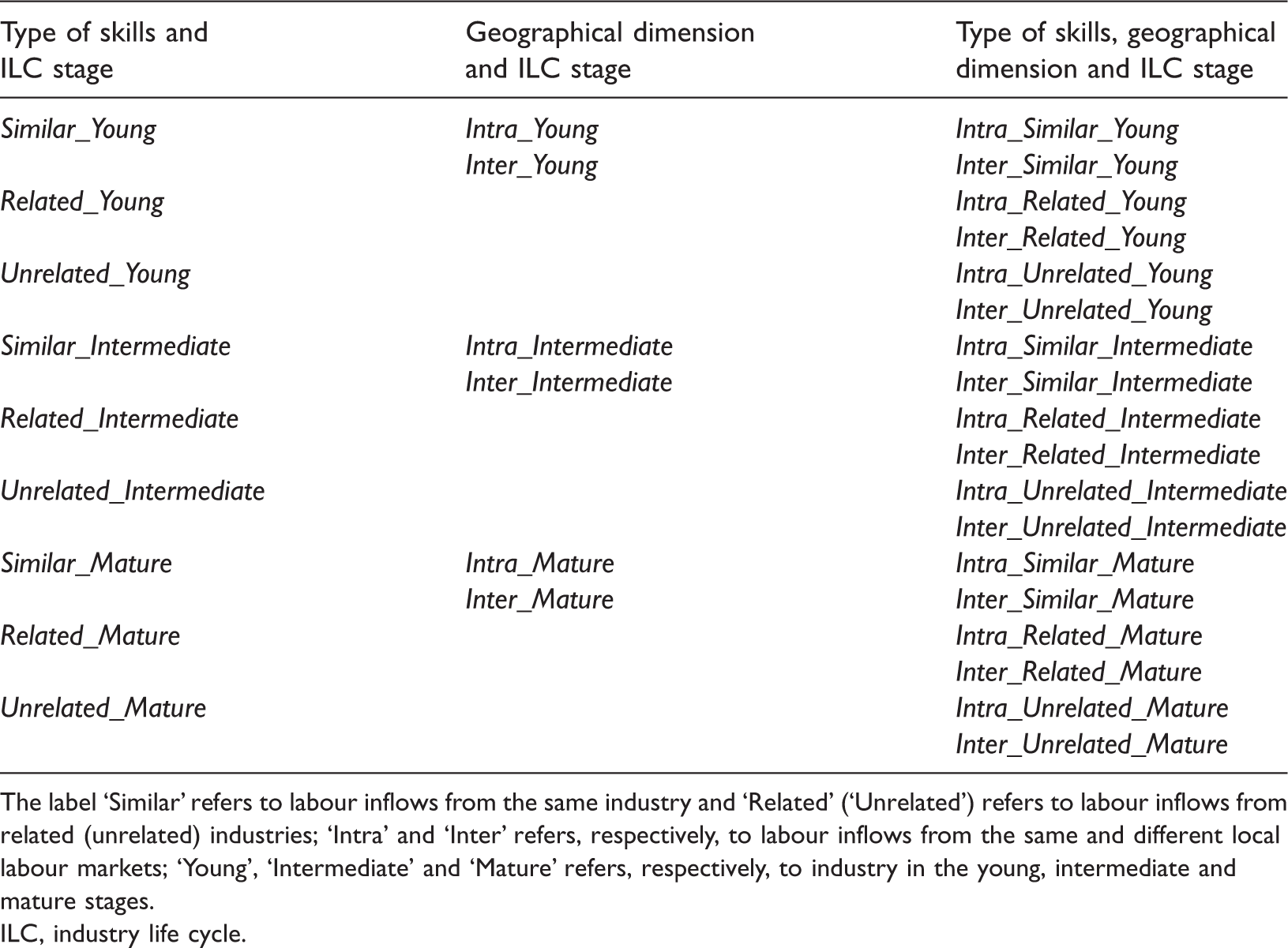
The label ‘Similar’ refers to labour inflows from the same industry and ‘Related’ (‘Unrelated’) refers to labour inflows from related (unrelated) industries; ‘Intra’ and ‘Inter’ refers, respectively, to labour inflows from the same and different local labour markets; ‘Young’, ‘Intermediate’ and ‘Mature’ refers, respectively, to industry in the young, intermediate and mature stages.
ILC, industry life cycle.
Control variables
Apart from the role of external knowledge, a plant’s survival chance may be affected by other factors at plant, industry and regional level. A stylized fact in the literature on survival analysis is that the failure risk falls with firm size (Dunne et al., 1989; Geroski et al., 2010). This is explained by differences in financial constraints (Carreira and Silva, 2010) and cost disadvantages (Audretsch and Mahmood, 1994). To control for plant size, we use the logarithm of the number of full-time equivalent employees. Besides plant size, human capital endowments might positively affect a plant’s productivity and so it might be expected that plants employing more skilled labour have a lower probability to exit (Geroski et al., 2010). We include the share of high-skilled employees to take this into account. Since information about the educational level of employees is not available, we rely on wage data to identify high-skilled people (Groot et al., 2013). In particular, employees are grouped into seven age categories, and we use the median wage value of each category as the cutoff value to distinguish between high-skilled employees and low-skilled employees.
Although new employees are important to renew the human capital of a plant, an excessive labour turnover may be dangerous for plant performance. Several studies (Burgess et al., 2000; Lane et al., 1996) have provided evidence that higher churning flows raise the failure risk of young plants. Therefore, we include a measure of plant turbulence that is calculated as the ratio between the sum of labour inflows and labour outflows and the total number of employees.
Moreover, we control for industry and local labour market characteristics that might affect both the size of labour flows and plants’ survival chances. Our estimates are performed including a set of industry dummies (at the four-digit level) and the logarithm of the total number of plants in the local labour market. 11 Finally, a set of cohort dummies and year dummies are included to control, respectively, for the heterogeneity of each cohort and for the economy-wide shocks like the recent financial crisis.
Since labour inflows and key control variables like plant turbulence can be determined from one year after entry, plants are included in the panel data one year after their entry. 12
Descriptive statistics of the variables used in the models are shown in Table 2.
Descriptive statistics (n = 20,306).

*For each labour inflow variable, the share is computed relative to the plant size; industry dummies, cohort dummies and year dummies are omitted.
Methodology
We estimate the probability that a plant will exit in a certain year. For this, we use event history analysis because that is the most appropriate methodology in the case of censored data (Guo, 1993). While our data are not left-censored as we follow each plant from its year of entry, our data are characterized by right-censoring because not all plants stopped activities in 2009, the last year for which we can observe the plants. Contrary to standard regression, the observations that do not exit during the study period will not be dropped from the event history analysis, which is important since they may have specific characteristics that affect the probability of plant survival.
The methodology adopted to model the event of plant exit is the complementary log–log discrete time hazard function with time-varying covariates. Although a plant can exit at any moment in time and, therefore, in reality an exit occurs in continuous time, our dataset only observes the event of plant exit on a yearly basis. If time is actually continuous but is only observed in intervals, the complementary log–log specification is the most suitable as this is the discrete time representation of a continuous time proportional hazard model (Allison, 1984; Jenkins, 1995; Prentice and Gloeckler, 1978). In all models, duration-interval-specific dummy variables have been included for each year at risk to control for differences in the occurrence of plant exits per year. Furthermore, we have included time-varying covariates in the model since several of the plant characteristics, including labour inflows, change over time.
The general form of this model is

Likelihood-ratio tests signal the presence of unobserved heterogeneity; therefore, all estimates are performed including a random component. Different parametric distributions can be used for the random component. Nicoletti and Rondinelli (2010) show that mis-specification on the distribution does not seriously bias the results. We assume a normal distribution for the random component. The results of estimates performed with and without unobserved heterogeneity are very similar. 13
Empirical results
The estimation results of the survival analysis are shown in Table 3. 14 Model 1 presents the results of the analysis of the probability of new plants to exit in the young/revitalizing and intermediate stage (the mature stage is the reference category). The other models include the variables for labour inflows. Model 2 presents the effects of similar, related and unrelated inflows over the different stages of an industry. The geographical dimension is introduced in Model 3, which presents the results of total labour inflows, distinguishing between intra- and inter-regional inflows. Model 4 makes a further distinction regarding whether these inter- and intra-regional inflows concern similar, related or unrelated labour flows.
Results of survival analysis (coefficient values).

Standard errors are reported in parentheses; *p = 0.1, **p = 0.05, ***p = 0.01.
First, we briefly describe the results for the control variables. As expected, we find a negative effect of plant size (Plant_size) on the probability of plant exit. Moreover, plant turbulence (Turbulence) has a positive effect on plant exit, which confirms that excessive labour turnover raises failure risk. The effect of the size of the labour market (Local_plant) is not statistically significant. Contrary to the expectations, the effect of the share of high-skilled employees (High_skilled) is positive, but it is not robustly significant. 15
The results of the estimate of the probability to exit in the different industry stages (Model 1) show a negative coefficient for the variables Young and Intermediate, but neither coefficient is statistically significant. Thus, the probability of a plant to exit does not seem to depend on the stage of the evolution of an industry. This is in line with prior studies that showed that high plant exit rates can be observed both in contracting and expanding industries (Eriksson and Hane-Weijman, 2017; Essletzbichler, 2007).
Model 2 introduces the variables for the different types of labour inflows. These results show that the effect of labour recruits on plant exits does differ over the various stages of development of an industry. We observe that inter-industry labour inflows, both from related (Related_Young) and unrelated (Unrelated_Young) industries, has a negative effect on plant exit in the young/revitalizing phase. This finding confirms hypothesis 1: in young/revitalizing industries, new plants recruiting from related and unrelated industries show a higher survival rate than new plants recruiting from the same industry. This is also coherent with the literature that stresses the importance of knowledge flows from other industries in these stages of the evolution of an industry (Gort and Klepper, 1982; Neffke et al., 2011).
However, for mature industries, plants’ survival is lower in the case of intra-industry inflows, as shown by the positive, significant coefficient for the variable Similar_Mature. This contradicts hypothesis 2, in which we expected a higher survival rate of new plants recruiting from the same industry. Nevertheless, what is in line with hypothesis 2 is that the results for mature industries show a negative effect of related inflows on plant exit (Related_Mature), although the coefficient is statistically significant only at the 10% level. While the effect of unrelated inflows is positive, as expected, the effect is not statistically significant (Unrelated_Mature). Thus, inter-industry labour inflows enhance the survival chances of plants active in mature industries only when people are recruited from related industries.
The estimates that consider intra- and inter-regional labour inflows (Model 3) show a negative and statistically significant effect for intra-regional inflows (Intra_Young) on plant exit in the young/revitalizing stage. It seems that new plants in general do not benefit from inter-regional labour inflows, irrespective of the development stage of their industry, as none of the coefficients of inter-regional labour recruits (except for Inter_Intermediate) are statistically significant.
Model 4 makes a further distinction, disaggregating the total labour inflows (both intra-regional and inter-regional) into similar, related and unrelated inflows to test hypotheses 3 and 4. The results show that inter-industry inflows are statistically significant in the young/revitalizing stage, but only when new plants recruit employees from the same labour market (Intra_Related_Young and Intra_Unrelated_Young). Hypothesis 3 is rejected, because new plants in young/revitalizing industries hiring from related industries outside the region do not show higher survival rates than new plants recruiting from the same industry and the same region (both Inter_Related_Young and Intra_Similar_Young are not significant). For new plants in mature industries, we observe a negative and slightly significant effect of inflows from related industries on the probability of plant exit, and a positive and slightly significant effect of inflows from the same industry, but only when the employee used to work in the same region (Intra_Related_Mature and Intra_Similar_Mature). This partly confirms hypothesis 4: as expected, new plants recruiting from related industries in the same region (Intra_Related_Mature) show a higher survival rate than new plants recruiting from outside the region (all three Inter-Mature variables), but this does not hold for new plants recruiting from the same industry and same region. On the contrary, they are less likely to survive (positive and significant effect of Intra_Similar_Mature).
We have conducted various checks to validate the robustness of our results. The full results of robustness checks are not reported here but are available from the authors upon request. First, we have tested whether the above-described effects of intra-industry and inter-industry labour flows on plants’ survival chances are affected by the sample of plants belonging to multi-plant firms. The survival of a plant that is part of a multi-plant firm might depend also on the knowledge and, in general, the resources available in other parts of the firm. This effect is tested in two ways. First, we perform additional estimates, including a dummy variable to control for the 965 plants that are part of multi-plant firms. The results are very similar to those reported in Table 3. In addition, we observe a positive and significant effect of the dummy for multi-plant firms. Thus, plants that belong to a multi-plant firm are not more but less likely to survive than single-plant firms. This is in line with the findings of several other studies (Audretsch and Mahmood, 1995; Colombo and Delmastro, 2000; Mata et al., 1995). 16 Second, we estimate the same models only for the sub-sample of single-plant firms. The results are similar to those reported in Table 3, except for some minor changes. Focusing on the most extended model (Model 4 in Table 3), the main difference is that the negative effect of intra-regional related inflows in the mature stage becomes statistically insignificant. Overall, the results of estimates with and without multi-plant firms are largely similar and the observed differences are likely to be related to the sample reduction of about 15% of plants (i.e. from 6277 to 5312 plants).
The recent financial crisis might play a role in explaining the plant exit rates. In 2009, the observed exit rate is about 21.9%, while the average exit rate for previous years is about 13.3%. This difference is statistically significant (the Fischer exact test is significant at the 1% level). The inclusion of year dummies might not completely remove the potential bias due to the recent financial crisis. Hence, as a second robustness check, we have performed additional estimates excluding the year 2009. The results are largely in line with those including 2009. Considering the most extended model, the main differences are that Intra_Unrelated_Young is significant at the 10% instead of the 5% level, and Intra_Related_Mature is significant at the 5% instead of the 10% level.
As a third robustness check, we have verified our results by excluding each time one of the five largest industries from our sample. Almost 54% of all the plants belong to those five industries. This does not result in any changes in the results reported in Table 3.
Conclusion
This article has examined the role of different types of labour recruits for the performance of new plants in the context of various stages in the evolution of an industry, comparing young/revitalizing and mature industries. Our study of the Netherlands shows that the effect of labour recruits on new plant survival depends not only on the type of industries from which new employees are recruited, but also (to some extent) on the development stage of the industry the new plant is active in.
A key finding is that the role of inter-industry labour inflows changes between different development stages of the industry. In the young/revitalizing stage, inter-industry labour inflows enhance new plant survival regardless of the industry of origin of the recruited workers. New plants in young and revitalizing industries have a higher survival rate when hiring new employees from both skill-related and -unrelated industries. Apparently, labour recruitments from other industries contribute more to the performance of new plants in industries that are in an explorative stage. In mature industries, only labour inflows from related industries enhance new plant survival, not from unrelated industries. A relevant issue that needs further research here is whether new plants introduce more radical innovations (like entirely new products) in young and revitalizing industries, and therefore benefit from labour inflows from unrelated industries, while in a mature stage, when incremental innovations along well-defined technological trajectories are assumed to be of key relevance, plants benefit mainly from knowledge from closely related industries. Moreover, we found that in mature industries, recruiting labour from the same industry tends to lower new plant survival, which is not the case for plants in young and revitalizing industries. In young/revitalizing industries, we find that intra-regional labour flows positively affect new plant survival in general (except from the same industry), while in maturing industries intra-regional recruits have a positive effect on survival only from related industries, but a negative effect on survival when recruited from the same industry.
However, our study also shows that new plants in young/revitalizing and mature industries have things in common: (a) intra-industry labour flows do not enhance new plant survival in general, confirming other studies (Borggren et al., 2016; Boschma et al., 2009; Timmermans and Boschma, 2014); (b) new plants show higher survival rates when hiring new employees from skill-related industries (again, confirming the same studies); (c) newly established plants also do not seem to benefit from inter-regional labour flows, irrespective of the development stage of an industry. The latter is in contrast to other studies (Boschma et al., 2009; Timmermans and Boschma, 2014) that have shown a positive effect of (related) inter-regional labour flows on plant performance. This result calls for further investigation of factors explaining the non-significant role of inter-regional labour flows on new plant survival.
These findings may have interesting implications for companies and policy-makers alike. Our findings suggest that labour mobility across skill-related industries should be encouraged through information provision and removal of institutional bottlenecks. Awareness should increase among economic stakeholders that intra-industry recruitment is not necessarily beneficial for their performance, especially in more mature industries. Firms need to know that labour recruited from the same industry may be detrimental to their performance; workers should be aware that changing job within the same industry may not always be in their own interest (see also Eriksson et al., 2018); while labour mediation offices and public employment agencies could consider encouraging companies and workers to make crossovers between industries. It is crucial to inform stakeholders which industries are related to their own industry in order to identify those opportunities. Local policy-makers could exploit the potential of a large local presence of related industries by facilitating local labour mobility across these industries. This also implies that institutional bottlenecks (laws, rules) that prevent companies connecting and exchanging labour across industries should be removed.
Having said that, we also call for careful interpretation of our findings. Although we use one-year lagged values of the labour inflows variables and include several controls at plant, geographical and industry levels, reverse causality cannot be ruled out. The possibility that some plants in the early stage of the development of an industry may be forced to hire workers from other industries because of a shortage of workers with the right skills may cause a bias in the estimates. We acknowledge that our analysis only measures association rather than causal links between labour mobility and new plant survival.
Footnotes
Acknowledgements
Results based on calculations by the authors using non-public microdata from Statistics Netherlands.
Declaration of conflicting interests
The author(s) declared no potential conflicts of interest with respect to the research, authorship and/or publication of this article.
Funding
The author(s) disclosed receipt of the following financial support for the research, authorship, and/or publication of this article: The author(s) acknowledge the financial support of the European Union D.G. Research with grant number 266959 for the research project ‘Policy Incentives for the Creation of Knowledge: Methods and Evidence’ (PICK-ME).