



Abstract
The number of migrants from Mainland China (MC) to Australia have been sharply increasing since 2000 and MC became the largest non-Commonwealth source country in 2011. The integration process of migrants to the host society involves the exposure and movement of migrants to the majority, which is reflected by the settlement pathways of migrants moving from ethnic to non-ethnic communities over time. Most of the existing research regarding migrants’ pathways is constrained by the limitations of cross-sectional data, which are usually available at the community or above levels. Little is known about the individual-level settlement pathways of migrants due to lack of data availability. In order to address this deficit, a 3D visualization is used to express the individual pathways of MC-born migrants based on primary survey data. This enables a more detailed, spatio-temporal picture of how long migrants live at each address and how they move across neighbourhoods.
Keywords
Geographical research on international migration tends to focus on explaining location choices of either the origin or destination as a function of several common variables. However, there is considerably less attention given to the spatial pathways of migrants within their destination country since arrival. Our featured graphic seeks to illustrate the individual settlement pathways of Mainland China (MC)-born migrants in the state of Queensland, Australia. In doing so, it builds upon previous research on migrant settlement pathways through capturing how international settlers’ pathways are shaped over space and time.
MC-born migrants in Australia are now the most significant cohort of settlers, becoming the largest non-Commonwealth ethnic group with a total of 526,000 migrants in 2016, accounting for 7% of overseas-born residents (ABS, 2016). Our research reveals that MC-born migrants in Australia often follow the segmented spatial assimilation model, in that concentration occurs through the early and middle stages of settlement, with spatial assimilation taking place at later stages. Thus the spatio-temporal residency patterns of MC-born populations in Australian cities reflect both that of new migrants desiring to live in neighbourhoods with a higher proportion of MC-born individuals, as well as more established groups whose movements are motivated by a range of factors, including education, employment, lifestyle and marriage (Clark and Maas, 2015).
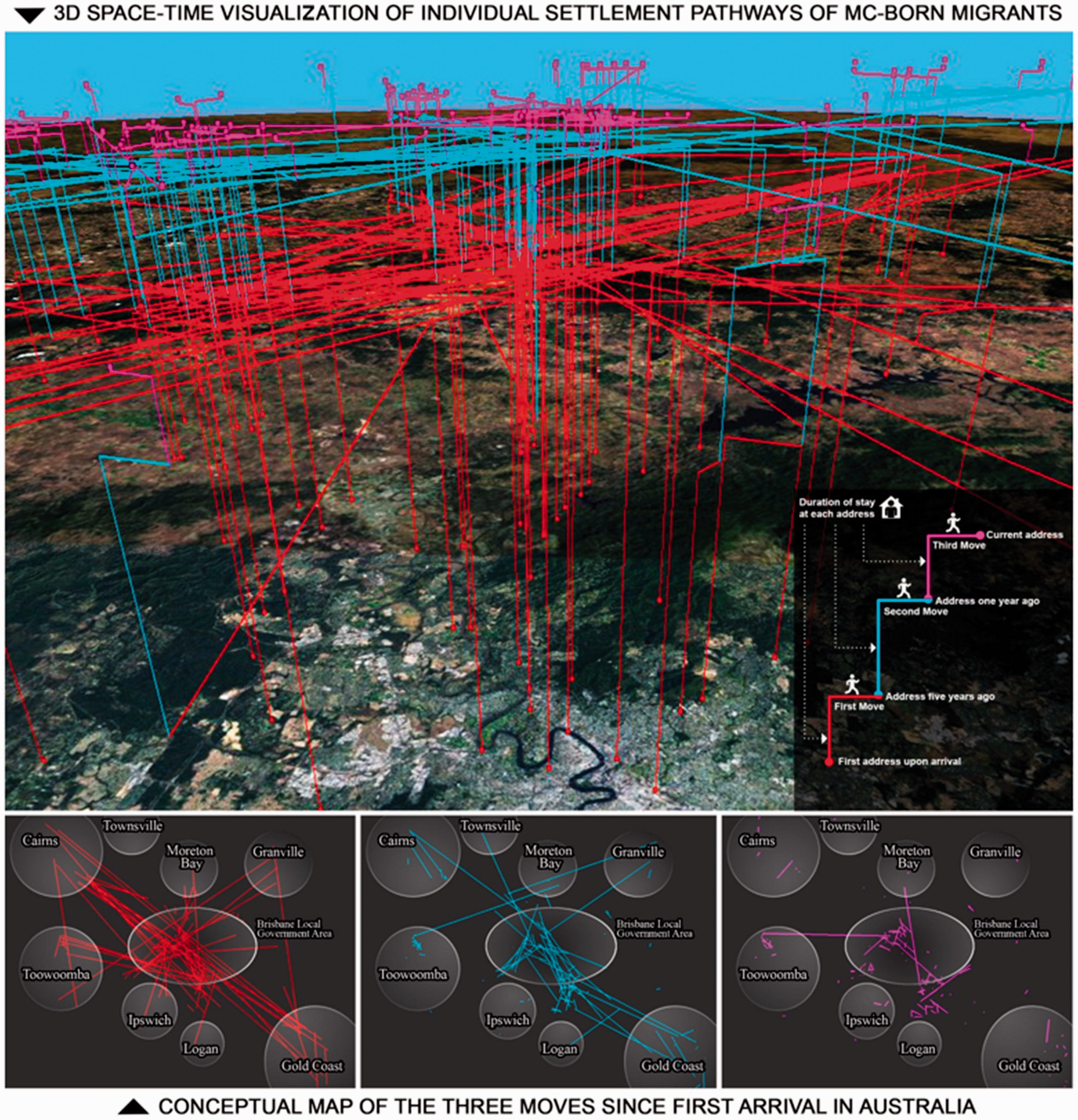
Census-derived migration data are typically cross-sectional and therefore are not able to capture much of the nuance tied to individual-level moves (Hassan et al., 1996). Our graphic illustrates the sequence of residential moves of individual MC-born migrants to provide a disaggregated overview of within-group settlement pathways. It draws upon 125 survey responses collected via a survey administered through WeChat, a Chinese multipurpose messaging and social media application. The survey captured four settlement addresses – on first arrival, five years ago, one year ago and current residential address – representing residential history at four points in time (illustrated with three colour codes). The horizontal lines represent their move between two addresses, while the vertical lines represent the duration of stay at each address. The majority of these addresses are located in the Brisbane Local Government Area (BLGA); the remainder are in cities or towns across Queensland, including Cairns, Townsville, Granville, Toowoomba, Ipswich and Gold Coast, which are represented as ovals. The ESRI ArcGlobe platform was employed to portray the individual space–time pathways and Google Earth was used to integrate the base map.
Our graphic reveals five interesting findings. First, the majority of MC-born migrants live in the BLGA, but those living in regional cities or towns outside the BLGA (including the Gold Coast and Toowoomba) tend to stay in one place longer than those living in the BLGA. Second, within the BLGA, MC-born migrants living in the west and north remain at a single address longer than those in the south. Third, movements occur more frequently during the early stages of settlement (i.e. movement from the first address on arrival to that five years ago). Fourth, the space–time pathways are more spatially scattered outside the BLGA, suggesting that intra-urban migration is more common than inter-urban migration. Fifth, the intra-urban movements more frequently occur in the large MC-born residential clusters in south-eastern locales of the BLGA. The collection of individual-level migration data is important if we are to unpack the real settlement movements of MC-born migrants spatially and temporally, and to showcase the trajectory of how migrants integrate within multicultural Australia.
Footnotes
Declaration of conflicting interests
The author(s) declared no potential conflicts of interest with respect to the research, authorship and/or publication of this article.
Funding
The author(s) disclosed receipt of the following financial support for the research, authorship, and/or publication of this article: This featured graphic is part of Siqin Wang’s PhD research, funded by the International Postgraduate Research Scholarship and the University of Queensland Centennial Scholarships.