



Abstract
This research examines the effect of knowledge spillovers on new firm formation across Greek regions in manufacturing over the period 2002–2010. The econometric analysis results reveal that knowledge spillovers, as proxied by innovation and high-tech labor measures, positively affect regional new firm formation rates. Intra-sectoral spillovers, as captured by geographic sectoral specialization and industrial intensity, also positively affect regional new firm formation. In contrast, inter-sectoral spillovers, as proxied by regional industrial diversity, reduce new firm formation across regions. The examination of other control variables suggests that GDP growth and small firms stimulate regional new firm formation, whereas sunk costs and unemployment have a discouraging effect.
Introduction
This research empirically examines the effect of knowledge spillovers on regional new firm formation for the Greek manufacturing sector over the period 2002–2010.
The theoretical framework that is particularly relevant to the present research is that of the knowledge spillover theory of entrepreneurship (KSTE) that was developed in a succession of research papers over the years (Acs et al., 2009, 2013; Audretsch and Lehmann, 2005). Within this framework, new knowledge is viewed as a source of entrepreneurial opportunities, and entrepreneurship itself works as a conduit that helps the commercialization and business application of the new knowledge. Knowledge externalities are crucial to the extent that the knowledge produced by existing firms and research organizations is not fully appropriated by them. Furthermore, entrepreneurship acts as a mechanism that further reinforces knowledge spillovers. These processes do not take place in a spatial vacuum. Spatial proximity to the knowledge source is of fundamental importance and knowledge spillovers are spatially bounded (Anselin et al., 1997; Bottazzi and Peri, 2003; Jaffe, 1989; Jaffe et al., 1993; Moreno et al., 2005; Sonn and Storper, 2008). According to Qian et al. (2013), the extent to which entrepreneurship facilitates knowledge spillovers depends on the absorptive capacity of regional entrepreneurship, and the quality of human capital is its key ingredient. On the other hand, Glaeser et al. (1992) identify two types of spatial industrial structure that are relevant to knowledge spillovers, one characterized by intra-sectoral spillovers due to spatial concentration of an industry (Marshall, 1920), and one characterized by inter-sectoral industry spillovers owing to the spatial proximity of diverse industries (Jacobs, 1969).
Audretsch and Lehmann (2005: p. 1193) vehemently argue that “while a large literature exists linking new-firm startup activity to region-specific characteristics and attributes…virtually none of these studies provided a theory linking knowledge spillovers to new-firm startup activity”. While things have changed since the emergence of KSTE and the studies have proliferated, the empirical evidence remains limited, especially in the case of less-advanced economies, and it is certainly missing for Greece. 1
In a Greek regional context, there have been empirical studies that have examined the effect of knowledge spillovers on the spatial agglomeration of manufacturing (Vogiatzoglou and Tsekeris, 2013) whereas Alexiadis and Tsagdis (2006) examined the factors that explain the location of R&D labor. Outside Greece, most studies have concentrated on the effects of knowledge spillovers on regional economic development and growth (Rodríguez-Pose and Crescenzi, 2008) and regional innovation (Anselin et al., 1997; Audretsch and Feldman, 1996). Although a number of authors have dealt with the effect of individual aspects of knowledge spillovers, based particularly on R&D and human capital, on new firm formation activity at a spatial level (Audretsch et al., 2010; Bania et al., 1993; Kirchhoff et al., 2007; Lasch et al., 2013; Woodward et al., 2006; Zucker et al., 1998), the literature that analyzes the relationship between knowledge spillovers and regional entrepreneurship is relatively unexplored (Alcacer and Chung, 2007; Audretsch et al., 2005; Audretsch and Keilbach, 2007; Audretsch and Lehmann, 2005).
The present paper differs from other empirical studies in that it uses a wider range of variables to proxy knowledge spillovers that are based on both innovation (e.g. R&D expenditures, R&D personnel, patent applications) and high-tech labor (e.g. scientists and engineers) in order to examine their influence on regional entrepreneurship. In addition, it considers both intra-sectoral and inter-sectoral types of knowledge spillovers that have been underlined in the literature (Doring and Schnellenbach, 2006; Van Stel and Nieuwenhuijsen, 2004). In this way, it attempts to shed more light on the relationship between knowledge spillovers and regional new firm formation rates.
The econometric analysis results obtained suggest that knowledge spillovers measured by indicators related to innovation and high-tech labor create conducive ground for the establishment of manufacturing new firms in Greek regions. Likewise, intra-sectoral spillovers are important drivers of regional entrepreneurial activity as geographic sectoral specialization and industrial intensity measures used reveal their substantial contribution to new firm formation levels. In contrast, inter-sectoral spillovers depicted by regional diversity lead to a reduction of manufacturing new firm formation across Greek regions.
The paper is organized as follows. The following section sets the theoretical background and motivation. The third section offers a description of the model variable construction and the sources of the data used. The fourth section presents the empirical framework along with the econometric methods employed, and the empirical results are described in the fifth section. The final section offers our concluding thoughts and policy implications.
Theoretical background
Knowledge spillovers
Knowledge spillovers are defined as “the external benefits from the creation of knowledge that accrue to parties other than the creator, occur at multiple levels of analysis, be it within or across organizations and networks” (Agarwal et al., 2010: p. 271). The absorption of knowledge from third-party firms takes place at no cost (Agarwal et al., 2010; Varga and Schalk, 2004). This means that the third-party firms do not (fully) compensate the firms that create knowledge for the benefits that they draw. In addition to the public character (Agarwal et al., 2010; Arrow, 1962) of knowledge spillovers, there exists a considerable amount of asymmetries, uncertainty and transactional costs (Agarwal et al., 2010; Arrow, 1962; Audretsch and Lehmann, 2005). Knowledge spillovers have been hard to measure and quantify (Krugman, 1991), and they have been associated with R&D spillovers (Jaffe, 1986) since R&D offers a means to measure knowledge inputs (Audretsch and Stephan, 1999). In turn, R&D spillovers may be either academic or industrial (Audretsch and Stephan, 1999; Carlsson et al., 2009). Apart, from R&D expenses which constitute an input in the innovation process, as an output measure, patent-related data have also been used (Bottazzi and Peri, 2003; Fritsch and Franke, 2004).
There has already been a growing literature on the positive impact of knowledge spillovers on regional economic growth (Rodríguez-Pose and Crescenzi, 2008; Varga and Schalk, 2004), on the reduction of regional productivity growth inequalities (Serrano and Cabrer, 2004), on regional human capital (Abel and Deitz, 2012) and on regional exports (Johansson and Karlsson, 2007).
A significant distinction between two types of knowledge spillovers, intra-sectoral and inter-sectoral spillovers, has been a dominant theme in the relative literature (Doring and Schnellenbach, 2006; Van Stel and Nieuwenhuijsen, 2004). The first relates to knowledge spillovers within the same industry, while the second pertains to knowledge spillovers across different industries. Intra-sectoral spillovers rely upon the MAR externalities theory (Arrow, 1962; Marshall, 1920; Romer, 1986, 1990). Marshall’s (1920) earlier consideration supports the view that the concentration of an industry in a particular location facilitates knowledge spillovers between firms and, consequently, the growth of that industry and that location. Arrow (1962) presents an early formalization of this, while Romer’s (1986, 1990) research is a more recent and influential statement which supports that this type of knowledge spillover is an important factor in the explanation of the differences in economic development across regions. In contrast, inter-sectoral spillovers correspond to the traditional Jacobs externalities notion (Jacobs, 1969). Jacobs (1969) notes that the most significant knowledge flows originate from outside the core industry where the firm operates. In this theory, cities constitute the spatial unit where the diversity of knowledge flows is maximized. This denotes that it is the geographical diversity of industries rather than geographical sectoral specialization that facilitates knowledge spillovers in addition to innovation and growth (Beaudry and Schiffauerova, 2009; Glaeser et al., 1992; Jacobs, 1969).
When it comes to the role of regional industrial diversity as a measure of inter-sectoral spillovers for regional economic growth and innovation, the evidence produced is not unequivocal as far as both positive (Feldman and Audretsch, 1999; Glaeser et al., 1992; Ouwersloot and Rietveld, 2000; Van Stel and Nieuwenhuijsen, 2004) and negative results have been produced (Henderson et al., 1995; Van der Panne, 2004).
The effect of knowledge spillovers on regional new firm formation
Knowledge spillovers create conducive ground to new entrepreneurship at a regional level. Reynolds et al. (1995: p. 391) hypothesize that “where information is readily available and innovation and creativity flourish, the formation rate of new firms is enhanced”. Bania et al. (1993) find that university research positively affects spatial new firm formation, especially in electrical and electronic equipment industries. In the same vein, Kirchhoff et al. (2007) show that university R&D expenditures act favorably towards regional new firm formation activity. Evidence pertaining to clusters of U.S. biotechnological firms suggests that these rely heavily on scientists with highly intellectual human capital (Zucker et al., 1998). In the case of Greece, Fotopoulos and Spence (1999), and Daskalopoulou and Liargovas (2010) find that human capital and skilled labor are critical determinants of regional new firm formation in manufacturing. In their study of German regions, Audretsch and Keilbach (2007) and Audretsch et al. (2010) examine the relationship between knowledge and new firm formation using the share of R&D workers, R&D intensity and the share of regional labor force accounted for by scientists and engineers as their preferred measures of knowledge. The evidence produced demonstrates that knowledge is indeed conducive to regional new firm formation. In Audretsch and Keilbach (2007) and Lasch et al. (2013), this is found to be especially so for knowledge-based industries, such as ICT and high-technology sectors.
Intra-sectoral spillovers appear to increase regional new firm formation rates in a number of studies. First, Lee et al. (2004) find that knowledge spillovers within the private sector encourage the regional new firm formation process. Acs and Armington (2004), and Acs et al. (2007) show that intra-sectoral spillovers are useful for the creation of new firms across regions in services, while Acs and Armington (2002), and Fotopoulos and Spence (1999) emphasize the value of intra-sectoral spillovers for regional new firm formation in manufacturing. Bosma et al. (2008) assess these results mentioning that the knowledge produced from firms of the same sector is the most conducive despite this knowledge being more limited as it refers to a specific sector (Bishop, 2012). Acs and Armington (2004), and Acs et al. (2007) claim that knowledge spillovers across different sectors have negative consequences on the regional formation of new firms in services. Specifically, Acs and Armington (2004) claim that spillovers present more benefits within industry sectors, but across sectors their role is rather negligible.
In this vein, many authors describe the positive role of geographic sectoral specialization in regional new firm formation and spin-off firms (Anyadike-Danes and Hart, 2006; Baltzopoulos et al., 2016; Coll-Martinez and Arauzo-Carod, 2017; Fotopoulos, 2014; Knoben et al., 2011). Anyadike-Danes and Hart (2006) support that business services specialization appears to have the largest contribution to new firm formation across regions of the United Kingdom, while Daskalopoulou and Liargovas (2010) additionally emphasize the benefits of specialization for Greek regional new firm formation in manufacturing.
It has been argued that “the higher the degree of diversification, the higher the variety of skills available locally. Skill and the diversity of working experiences can, in turn, give way to greater entrepreneurial choice and opportunity, especially when there is some degree of mobility of individuals between firms and industries” (Fotopoulos, 2014: p. 656). However, the results produced regarding the effect of regional industrial diversity on new firm formation have been rather contradictory. On the one hand there have been studies offering support for a positive effect of regional industrial diversity on regional entrepreneurship (Corradini and De Propris, 2015; Lasch et al., 2013; Rodríguez-Pose and Hardy, 2015), whereas others produce opposite results (Audretsch et al., 2010; Bishop, 2012; Fotopoulos, 2014). In their account of the results obtained in their study, Audretsch et al. (2010) explain that specialization externalities prevail over diversity. In turn, Bishop (2012) notes that the positive influences of diversity on new firm formation may be somewhat more sector-specific as they occur within the knowledge sector. In such a context, the concept of related variety 2 (Frenken et al., 2007) becomes most relevant. As exemplified by Boschma et al. (2013: p. 31), the concept of industry relatedness is positioned in the literature on spatial externalities and regional growth, and the related variety effect, “concerns externalities that come from a diversity of related industries in a region”. A positive effect of related variety on regional entrepreneurship is found in Bishop (2012), Baltzopoulos et al. (2016) and Bishop and Brand (2014). In the latter study, this positive effect applies to both manufacturing and services. On the other hand, unrelated variety does not appear to be a decisive factor for regional new firm formation in the Baltzopoulos et al. (2016) study and similarly Bishop and Brand (2014) specify that unrelated variety has an insignificant effect on new firm formation in manufacturing. Interestingly, however, a positive and significant impact for services was found in this study. Positive results of unrelated variety have also been produced by Bishop (2012).
Whatever the source of knowledge spillovers may be, it has been supported that these are geographically bounded (Anselin et al., 1997; Jaffe, 1989; Jaffe et al., 1993; Moreno et al., 2005) as the geographical proximity to the source of knowledge plays a key role. The localized nature of knowledge spillovers has also been very recently supported by Grillitsch and Nilsson (2017) and Roper et al. (2017). According to this view, geographical proximity to the source of knowledge plays a dominant role (Acs et al., 2013; Audretsch and Lehmann, 2005; Audretsch et al., 2005). Doring and Schnellenbach (2006) support that spatial proximity leads to lower costs of transmission and hence spillovers may be localized near to the source of knowledge. When the localized aspects of knowledge spillovers are considered, the distinction between codified and tacit knowledge becomes necessary (Acs and Varga, 2005; Audretsch and Lehmann, 2005). Tacit knowledge that pertains to partially codified and developed knowledge and is more sensitive to longer geographic distances and spatial proximity becomes more crucial (Audretsch and Feldman, 1996). Here, elements of social capital such as oral communication, personal contacts, trust and reciprocity facilitate the transfer of tacit knowledge (Acs and Varga, 2005; Audretsch and Stephan, 1996; Audretsch et al., 2005; Maskell and Malmberg, 1999). In contrast, codified knowledge is less sensitive to geographic distance. Indicatively, Varga and Schalk (2004) support that the transportation of codified knowledge over longer distances is materialized by patents and scientific articles. Thus, knowledge spillovers determine the location choice of firms (Alcacer and Chung, 2007; Audretsch and Lehmann, 2005; Audretsch et al., 2005).
The role of universities is crucial, as it has been argued that “universities in regions with a higher knowledge capacity and greater knowledge output also generate a higher number of technology startups” (Audretsch and Lehmann, 2005: p. 1201). Audretsch and Stephan (1996) argue that university-based scientists are responsible for the transfer of knowledge from scientific labs to firms as they can be involved in firms operating locally or take part in the establishment of new firms. Besides this, knowledge goes directly from university labs towards firms through: (a) personal contacts and face-to-face communication between firm employees and university-based scientists; and (b) firm employees who attend university seminars and workshops. This emphasizes the vital role of spatial proximity. Woodward et al. (2006) find that the positive effects of university R&D on regional high-tech new firm formation are limited to a geographic distance of 145 miles. In turn, Desrochers and Sautet (2008) support that firms of the same industry gain from spatial proximity as they exploit the common labor pool, better access to intermediate inputs, increased face-to-face communication and knowledge spillovers on related technologies. These authors, however, also emphasize the value of geographical proximity for firms of different sectors (diversified industries), underscoring that “face-to-face communication between individuals possessing different expertise is even more crucial than for experts in the same field (although the latter is typically considered very important) because they do not share a similar background and technical language. Face-to-face interaction was also deemed crucial to build trust relationships and to select suppliers” (Desrochers and Sautet, 2008: p. 824).
Based on the preceding discussion, the following key hypotheses are thus formed:
The direction of the latter effect cannot be a priori hypothesized as the results that have been previously produced in the relative literature have been mixed.
Data and variables
The data pertaining to the dependent and most of the independent variables, unless lagged, span the 2002 to 2010 period and pertain to 13 Greek Nomenclature of Territorial Units of Statistics (NUTS) 2 regions. 3 In terms of the sector analyzed, this is the one-digit manufacturing sector aggregate. 4 The regional distribution of manufacturing employment shares over the study period is presented in Table 1. The employment in manufacturing sector represents on average the 10% of the total regional employment for all the years of the model. The most industrialized regions are those of Kentriki Makedonia and Attiki, whereas the least industrialized one is that of the Ionia Nisia. By inspecting these employment shares across time, the existence of some temporal fluctuation also becomes evident.
Regional manufacturing employment shares.
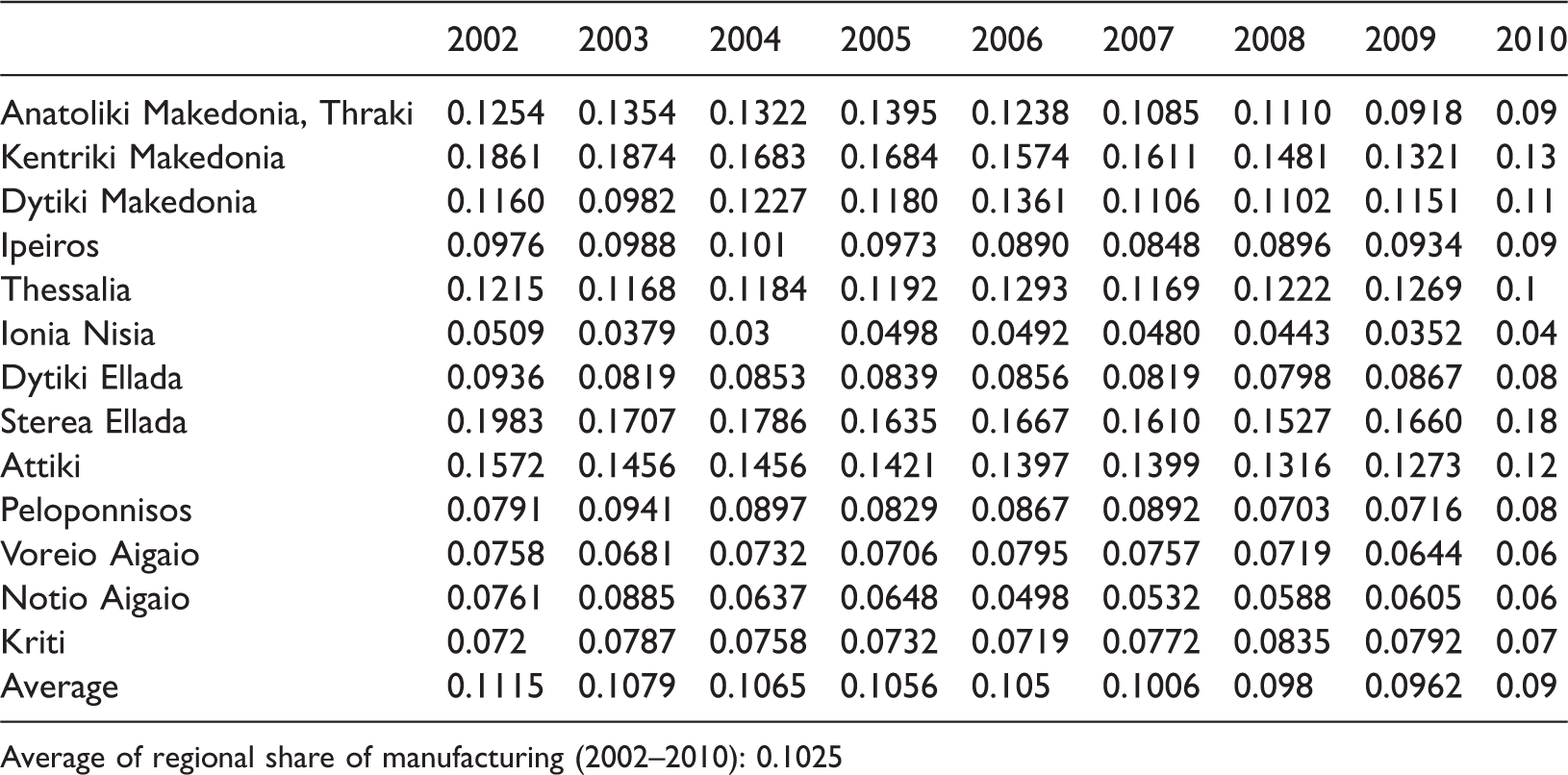
Average of regional share of manufacturing (2002–2010): 0.1025
Share of science and technology regional employment: 2002–2010.
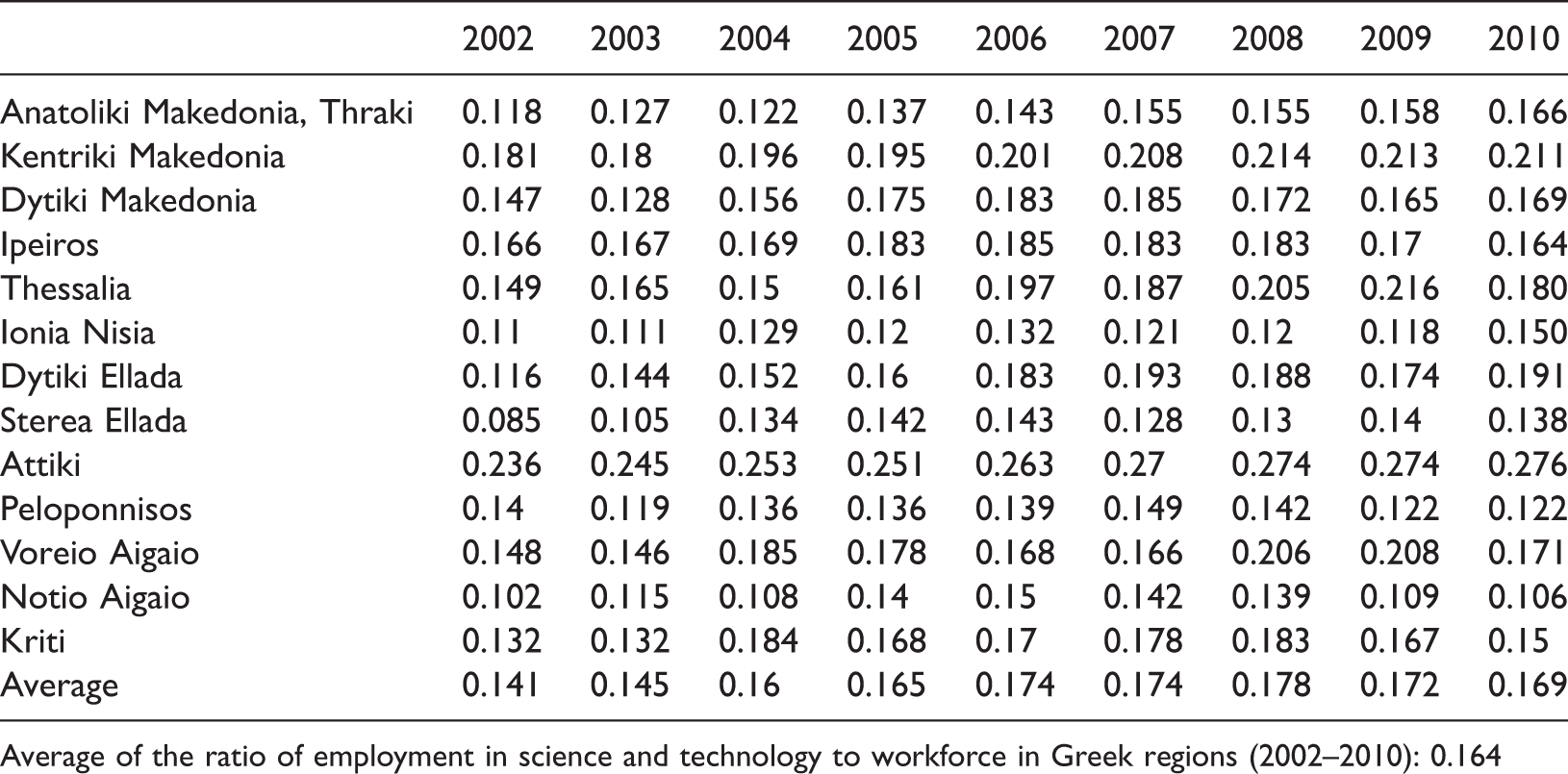
Average of the ratio of employment in science and technology to workforce in Greek regions (2002–2010): 0.164
Patents to GDP ratio: Greek regions 2002–2010.

Average of the ratio of patents to GDP in Greek regions (2002–2010): 0.2546; GDP in million euro.
This helps to give some background information in relation to the varying degrees of industrialization across Greek regions. 5
Dependent variable
The variable of interest and dependent variable of this study is regional manufacturing new firm formation rates
On the other hand, the labor force appears to accord with the fact that it is ultimately real people who establish firms. Fotopoulos and Spence (1999: p. 221) further argue that “the main attraction is that a potential entrepreneur aiming to open a business often draws on previously gained experience as an employee in the same labor market area within which the new establishment is due to become operational”.
The present analysis thus follows the labor force approach 6 in order to express new firm formation rates. These rates refer to the ratio of the number of new firms in each region for manufacturing over the regional employment in manufacturing sector. The data for the number of new firms and employment for the construction of new firm formation rates come from the Firm’s Registry and Labor Force Survey (LFS) of the Hellenic Statistical Authority (EL.STAT.)
Figure 1 shows the Greek regional distribution of new firm formation rates. There, the highest new firm formation rates are observed in the most rural and unindustrialized areas (e.g. Dytiki Makedonia, Ipeiros, Ionia Nisia, Voreio Aigaio, and Notio Aigaio). Similar patterns have also been found in a Greek regional (Fotopoulos and Spence, 1999) and international context (Acs and Armington, 2002; Gould and Keeble, 1984; Keeble and Walker, 1994; Lee et al., 2004).
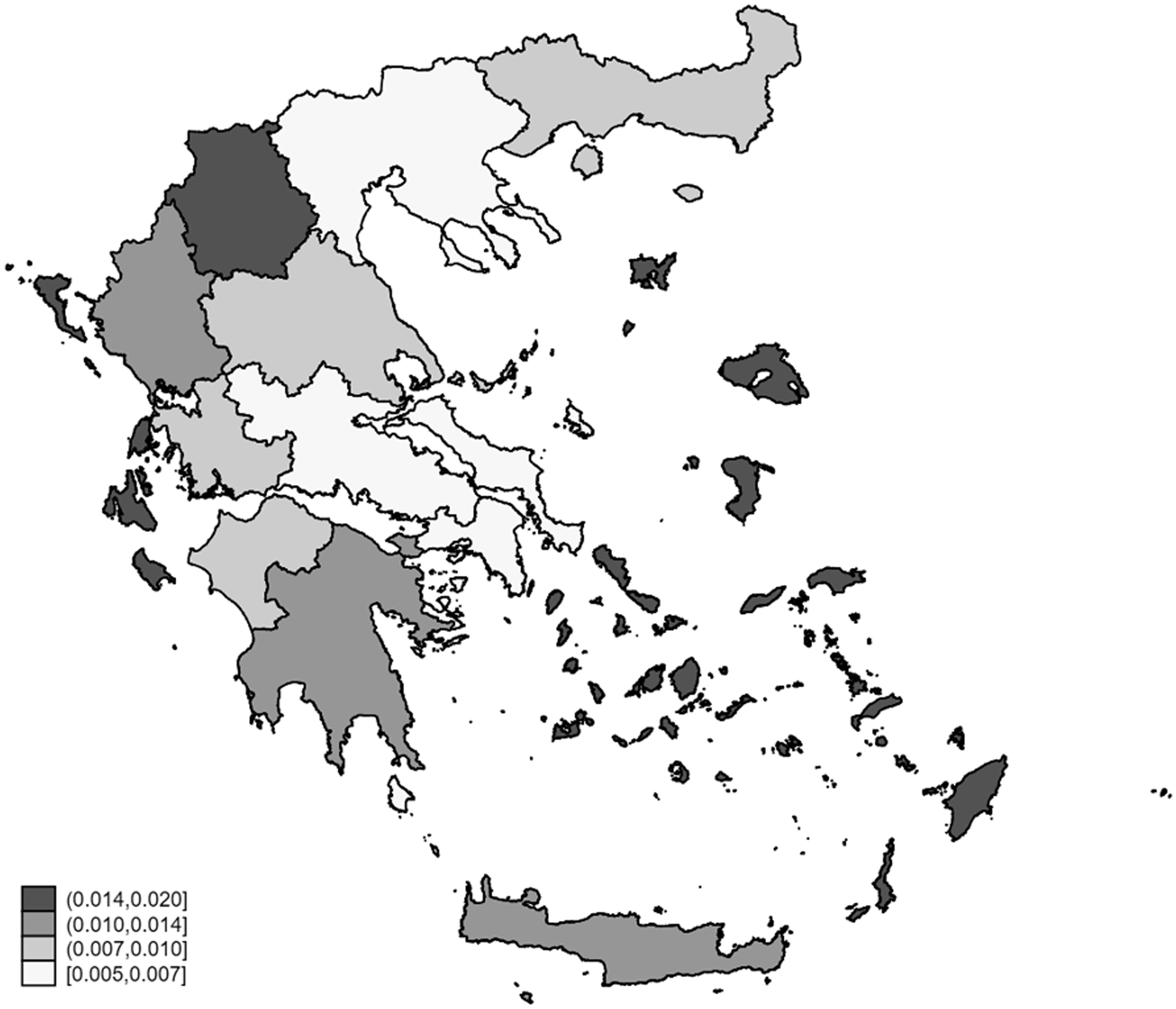
Regional distribution of new firm formation rates: 2002–2010 period averages.
Independent variables
Knowledge spillovers are measured through the use of a number of proxies. The first proxy of knowledge spillovers is manufacturing R&D expenditure intensity (
Following Audretsch et al. (2010), data on R&D personnel have also been used. Here again the R&D personnel number has been expressed in per square kilometer terms to result in an R&D personnel density variable (
Moving from the inputs to the innovation and knowledge creation process to its output metrics, patent intensity (
Two additional variables accounting for the density of scientists and engineers per square kilometer
8
(
Figures 2, 3, 4, and 5 detail the regional distribution of patent intensity, manufacturing R&D expenditures intensity, R&D personnel, and scientist-and-engineer employment intensities. The geographical distribution of all measures exhibits a strong concentration in the Attiki and Kentriki Makedonia regions and is quite revealing about the extent of spatial heterogeneity that these measures exhibit.
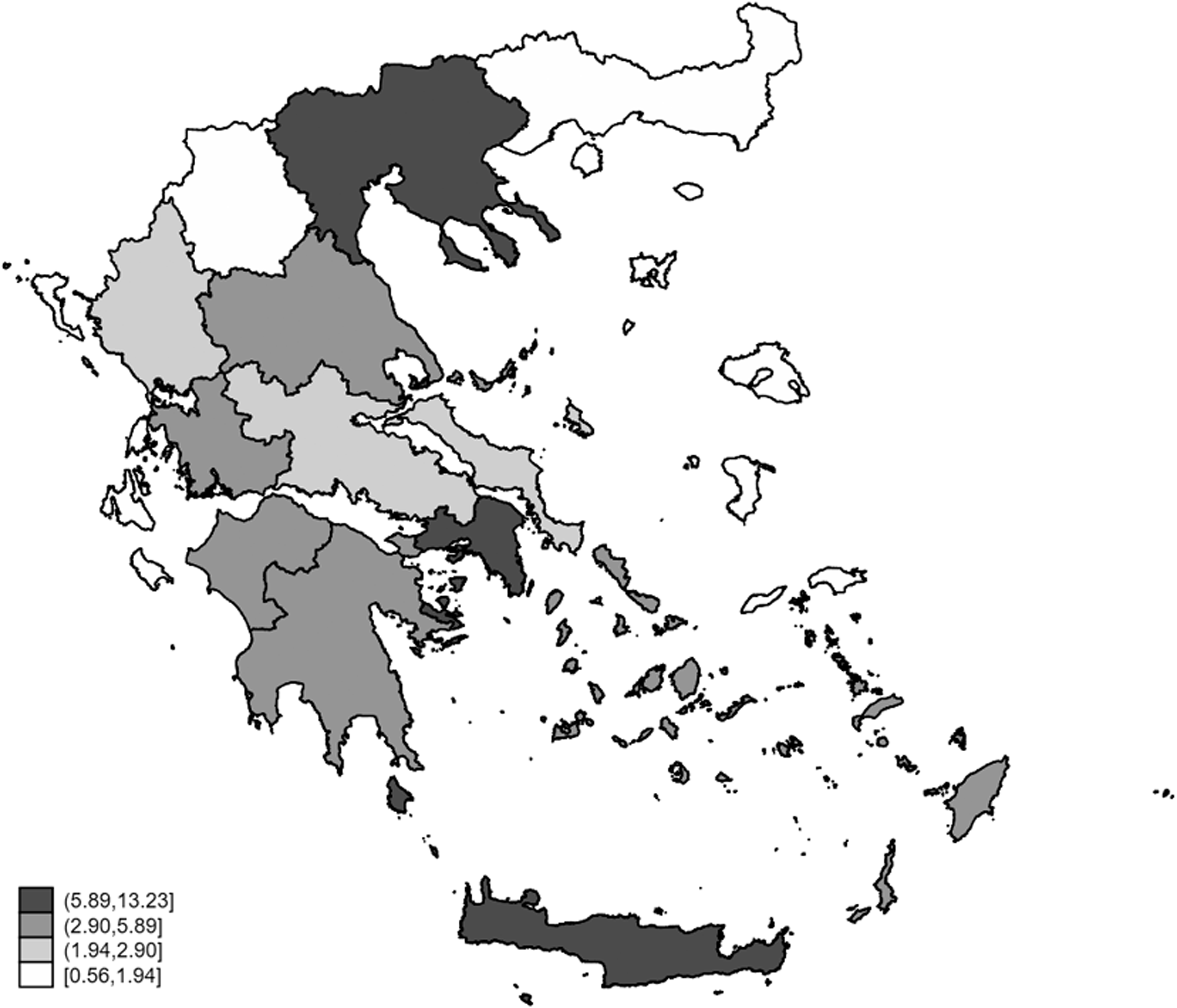
Regional distribution of patent intensity: 2002–2010 period averages.

Regional distribution of manufacturing R&D expenditures intensity: 2002–2010 period averages.

Regional distribution of R&D personnel intensity: 2002–2010 period averages.

Regional distribution of scientists and engineers intensity: 2002–2010 period averages.
Intra-sectoral spillovers are measured by: (a) industrial intensity; and (b) the Hoover specialization index. The industrial intensity variable (
As discussed earlier, regional sectoral-specialization has been often utilized as an additional proxy for intra-sectoral spillovers (Van Stel and Nieuwenhuijsen, 2004). In view of this, the present research utilizes the Hoover specialization (
The data for the construction of the Hoover index come from the LFS. Following Van Stel and Nieuwenhuijsen (2004) who consider the overall regional industrial diversity as a proxy of inter-sectoral knowledge spillovers, a regional diversity index was used by the present research to capture the effect of such spillovers. This is the entropy-based Theil (
This measure takes the value of 0 when only one sector is present in region r and the value
The definition of unrelated (
In our analysis, all two-digit industries 
In turn, related variety is calculated as the weighted sum of entropy within each one-digit sector as


The sum of related and unrelated variety gives the total entropy index (Theil, 1972: p. 20–22; see also Frenken et al., 2007) calculated in (2) such that

Control variables
A sunk costs (
To account for the effect of wider economic conditions, the analysis first considers the effect of the regional unemployment rate
The last control variable considered is one with a long history in regional new firm formation studies, (for a recent discussion see Fotopoulos, 2014), that which accounts for the extent of small firm presence regionally. The corresponding variable (
Empirical framework
As the data in hand have both a cross sectional (regions) and a time (years) dimension, the variables employed in the analysis can have two systematic components of variation: one that pertains to differences between regions and one that pertains to differences between years. As has been suggested by Cameron and Trivedi (2005: p. 709), “with panel data it is useful to know whether variability is across individuals [regions in our case] or across time”. This is important to the extent that the coefficients obtained from fixed-effects estimation of time-variant variables “can be very imprecise if most of the variation in a regression is cross sectional rather than over time” (Cameron and Trivedi, 2005: p. 715).
Table 4 presents the results of a variance decomposition exercise for both the dependent variable and some key independent variables, (for technical details see Körösi et al., 1992: p. 194-197; Fotopoulos and Spence, 1999).
Variance decomposition.
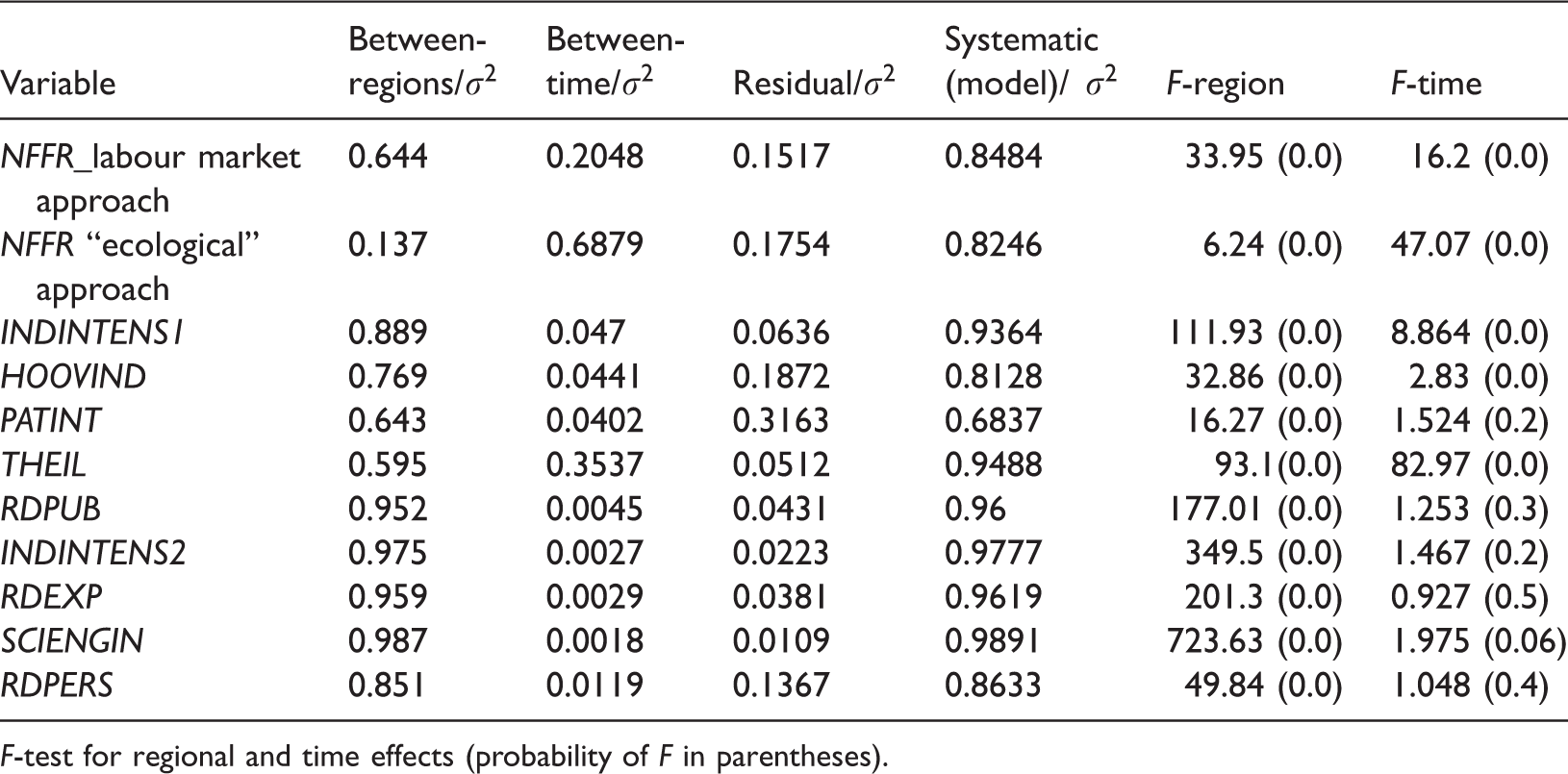
F-test for regional and time effects (probability of F in parentheses).
Taking the new firm formation rate (NFFR) variables, the first striking observation is that in the one based on the labor market approach, the between-regions variation accounts for 64% of the overall variation in this variable, whereas the corresponding value for the between variation in the case of the “ecological” version of the NFFR is just about 14%. In contrast, it appears that 68% of the overall variation in the “ecological” NFFR is accounted by between-year variation.
When it comes to independent variables relating one way or another to knowledge spillovers, in all cases the between-region variation represents the largest, by far, of the systematic components. The only variable for which the between-time variation represents a sizeable proportion (35%) of the overall variation is that of the THEIL diversity index.
As we are interested in accounting for the effect of knowledge spillovers and other regional control variables on new firm formation, these decomposition results leave us with little choice and essentially dictate the adoption of the labor-market-approach-based NFFR.
With the between-time variation being the dominant systematic source of variation in both the dependent and independent variables the regional fixed-effects estimator that would account for unobserved regional heterogeneity will be highly problematic. As Beck (2001: p. 285) very aptly describes, “with slowly changing independent variables, the fixed effects will soak up most of the explanatory power of those slowly changing variables… [and] will make it hard for such variables to appear either substantially or statistically significant”.
Given the results of the variance decomposition exercises and the concerns that have been expressed in the literature regarding the appropriateness of cross-sectional fixed effects estimators, we resort to pooled estimators with heteroscedasticity robust standard errors. The pooled estimator has often been the choice in cases of time-invariant and relatively time-invariant independent variables ( Oaxaca and Geisler, 2003; see also Knack, 1993). The basic pooled ordinary least squares (OLS) model is expressed as

As 20% of the overall variation in the dependent variable is accounted for by between-year variation, a time fixed-effects estimation was also performed.
The time-effects model is described by

Empirical results
Before getting to the actual estimation, Table 5 presents some basic descriptive statistics of all variables in the model while Table 6 gives the correlation coefficient matrix for the explanatory variables involved in the econometric analyses to follow.
Descriptive statistics (N = 117).
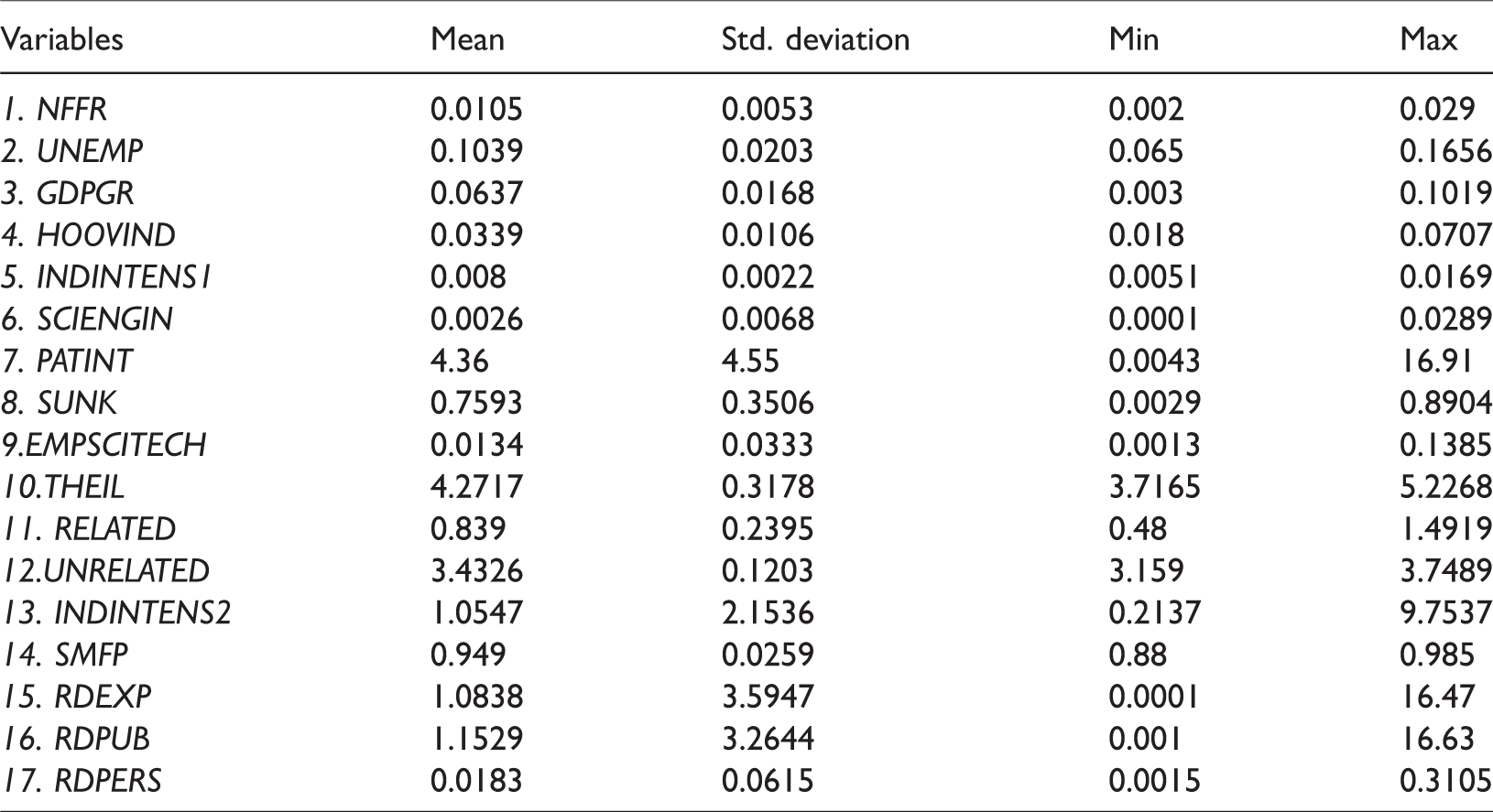
Correlation matrix with correlation coefficients of variables (N = 117).

Some pairs of explanatory variables present a high degree of correlation. The following correlation coefficients stand out: (a) patent intensity and R&D expenditures intensity (0.55); (b) patent intensity and R&D expenditures intensity in public sector (0.61); (c) R&D expenditures intensity and R&D expenditures intensity in public sector (0.93); (d) industrial intensity defined as the number of manufacturing establishments per square kilometer and R&D expenditures intensity (0.96); (e) Theil index (overall variety) and related variety (0.95); (f) Theil index and unrelated variety (0.76); and (g) related and unrelated variety (0.51). As a result, and to avoid multicollinearity, variables that proxy similar economics concepts were kept separate in the different econometric estimation permutations. As an additional measure, the variance inflation factor (VIF) was also used to detect any possible remaining multicollinearity problems. The VIF values of 10 but also of 5 have been suggested in the literature as critical cutoff points above which multicollinearity emerges as a problem (see Kutner et al., 2004; Rogerson, 2001). The average values of VIF for the variables of the model are given for econometric-estimation permutation columns in the results that follow.
The econometric analysis starts off with a pooled-OLS estimation as the regional fixed-effects approach is ruled out for the reasons discussed earlier. The results of the pooled-OLS estimation are presented in Table 7, whereas the results of the time fixed-effects estimation are presented in Table 8. Both tables display the estimated coefficients along with robust standard errors in parentheses.
Pooled-OLS estimations (N = 117) dependent variable: new firm formation rate.
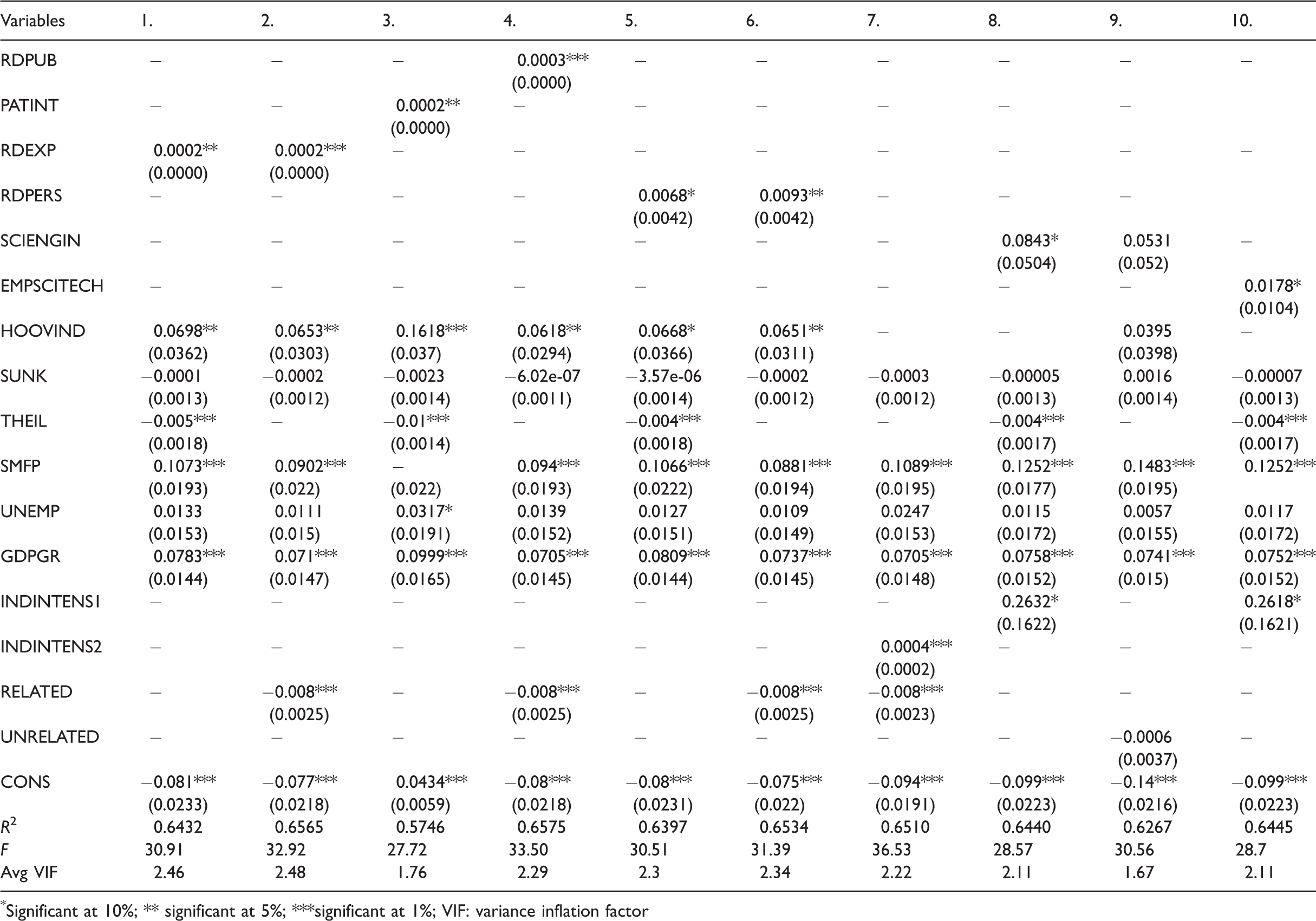
Significant at 10%; ** significant at 5%; ***significant at 1%; VIF: variance inflation factor
Time effects estimations (N = 117) dependent variable new firm formation rate.
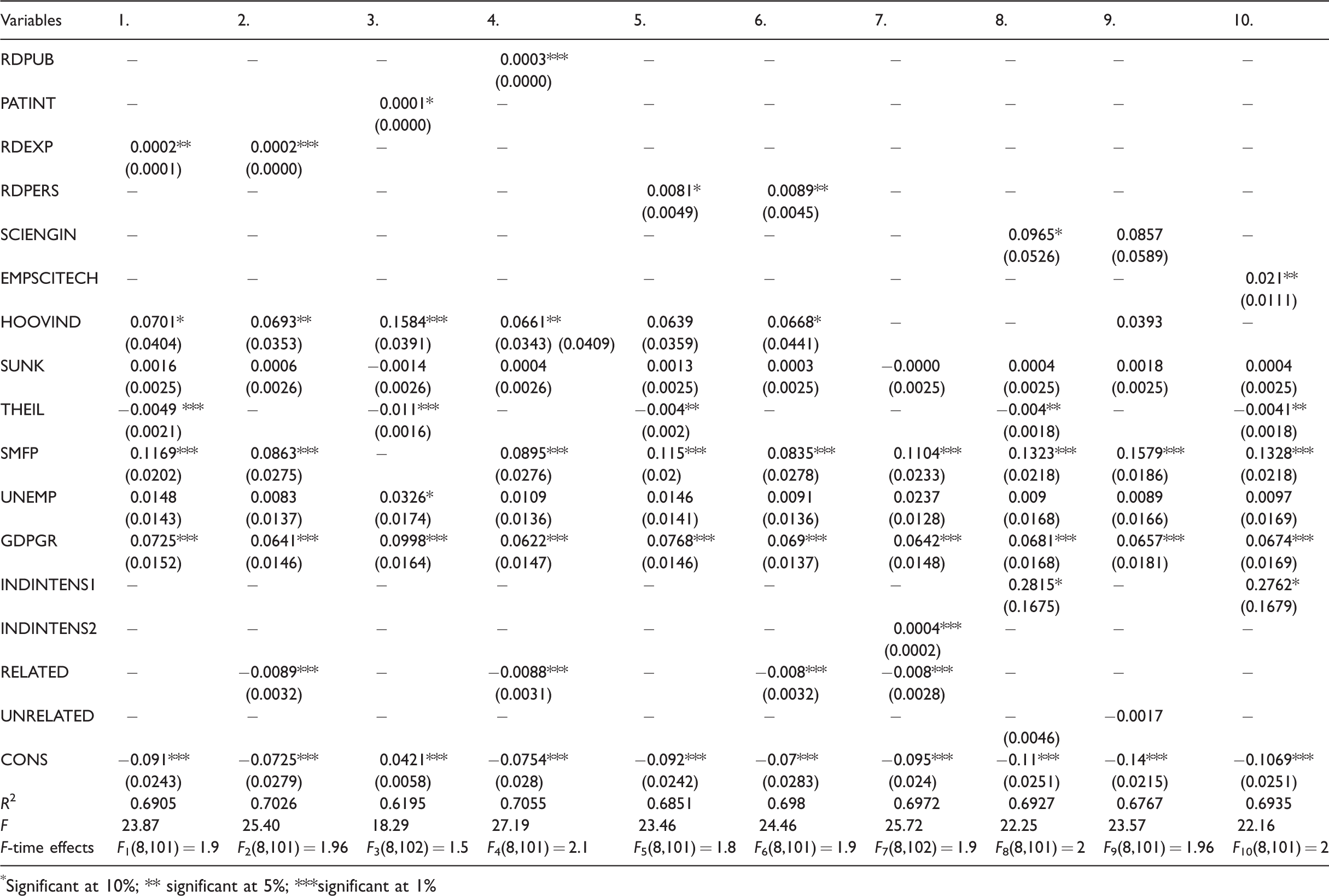
Significant at 10%; ** significant at 5%; ***significant at 1%
The results that cover the period from 2002 to 2010 10 suggest that knowledge spillovers as proxied in the present research form a conducive ground for the establishment of manufacturing new firms across Greek regions. Both innovation-related (e.g. patent intensity, R&D expenditures intensity, R&D expenditures intensity in public sector, R&D personnel intensity) and science and technology employment intensity measures (e.g. scientist-and-engineer intensity, employment in science and technology intensity) are also found to be conducive to regional entrepreneurship. These findings accord with the results of previous studies offering evidence for the beneficial effect of knowledge spillovers on regional new firm formation (Audretsch et al., 2010; Audretsch and Keilbach, 2007; Audretsch and Lehmann, 2005; Kirchhoff et al., 2007).
When it comes to the distinction between intra-sectoral and inter-sectoral spillovers, the former appears to have a positive and significant impact on regional new firm formation rates. This holds for all the intra-sectoral spillovers measures employed in the present analysis. This finding essentially suggests that the benefits of geographic sectoral specialization encourage new firm formation. This result was obtained in both the OLS and time effects models and is in line with those authors who make references to similar findings (Acs and Armington, 2004; Baltzopoulos et al., 2016; Knoben et al., 2011; Lee et al., 2004).
In contrast, inter-sectoral spillovers, as measured by the overall regional industrial diversity (Theil index), were found to have a negative effect on regional entrepreneurial activity. Related and unrelated variety have been used as additional measures of inter-sectoral knowledge spillovers. The related variety measure was found to have a negative effect on regional new firm formation whereas the effect of unrelated variety was statistically insignificant. These results concur with prior research that supports that knowledge spillovers across sectors tend to decrease regional entrepreneurship rates (Acs et al., 2007; Acs and Armington, 2004; Fotopoulos, 2014) whereas they clearly contradict some other findings (Corradini and De Propris, 2015; Rodríguez-Pose and Hardy, 2015). As opposed to regional sectoral specialization, regional industrial diversity has a negative effect on regional new firm formation in manufacturing. This result can be reconciled with Fotopoulos and Spence’s (1999) earlier findings for Greece on the positive effect of production specialization on regional new firm formation.
As far as the effect of other control variables is concerned, GDP growth is found to operate as a significant driver of regional new firm formation employment rates. This result points to the importance of demand-side factors when it comes to creating positive business prospects and through that encouraging new firm formation. On the other hand, the effect of regional unemployment was found to be statistically insignificant in both pooled-OLS and time-fixed effects estimation results.
The extent of small firm presence regionally has been found to have a positive and significant effect on new firm formation, a result that concurs with earlier findings in both Greek (Fotopoulos and Spence, 1999) and other country contexts (see Reynolds et al., 1994 for some early cross-national evidence). Finally, the results on the regional sunk cost proxy was not found to have an effect that is statistically different from zero.
Conclusions
The present paper examines the effect of knowledge spillovers on new firm formation across Greek regions in the manufacturing sector. It employs different measures of knowledge spillovers based on innovation and “high-tech” labor as well as differentiating between intra-sectoral and inter-sectoral spillovers. The distinguishing feature of the paper is that it offers one of the most detailed accounts of knowledge-spillover related variables in manufacturing new firm formation. It also adds to the small but growing literature by offering evidence from a less advanced and recently troubled economy.
The results obtained suggest that overall knowledge spillovers seem to have a positive effect on regional new firm formation rates in Greece. This has been corroborated by the results obtained from different variables used to proxy knowledge spillovers such as patents intensity, R&D expenditures intensity, R&D personnel intensity and high-tech labor measures, all found to be positive and significant in different model estimation permutations. Our findings, however, also suggest that the relevant knowledge spillover concept when it comes to entrepreneurship rates in Greek regions is that of intra-sectoral rather than inter-sectoral spillover. Regional sectoral specialization is more conducive to new firm formation rather than sectoral diversity and variety measures. The significant effect of intra-sectoral spillovers on regional new firm formation has been found to apply not only in manufacturing (Acs and Armington, 2002; Fotopoulos and Spence, 1999) but also in the services sector (Acs et al., 2007; Acs and Armington, 2004). Regarding the other variables, GDP growth and the presence of small firms stimulate regional new firm formation activity as well. Unemployment rate and sunk costs, however, were not found to exert any significant effect.
The key finding of the present research is that of the importance of intra-sectoral knowledge rather than inter-sectoral spillovers. This accords with those studies underlining the industry specific nature of R&D spillovers (Anselin et al., 2000a; 2000b). Our findings on the effect of related and unrelated variety is heavily conditioned on the higher than usual level of aggregation used which was dictated by data availability. It is hoped that future research on regional entrepreneurship in Greece will be able to revisit some of the issues by taking advantage of more disaggregated reliable data, both spatially and sectorally. The results obtained, however, can be reconciled with earlier Greek evidence and it is comparable to evidence obtained in other country contexts.
If specialization is more conducive to regional new formation, then future research needs to examine this in relation to regional structural change and explore its consequences for regional restructuring. This is important if regional entrepreneurship is thought to be a vehicle of regional change and restructuring.
Efforts to increase regional entrepreneurship rates may benefit from a concentration on policy efforts to enhance knowledge-spillover variables. In this direction, one could see efforts facilitating research in universities and encouraging R&D in the private sector as well as by the means of facilitating the collaboration between universities and research institutes on the one hand, and business firms on the other, at the regional level, something in which Greece seems to be lagging behind.
Footnotes
Declaration of conflicting interests
The author(s) declared no potential conflicts of interest with respect to the research, authorship, and/or publication of this article.
Funding
The author(s) received no financial support for the research, authorship, and/or publication of this article.