



Abstract
This paper presents a sociology of housing developers, stressing the contingent, socially and spatially embedded nature of their practices. It complicates prevailing views of developers and demonstrates how urban development is, in fact, a spatial praxis requiring adaptability and capacities to adjust dispositions and practices to suit the particular environments in which it takes place. A growing body of work tries to understand the motivations and practices of property developers. While this has contributed to understandings of developers’ networks, the ways they understand their roles and the ways different national or regional contexts shape approaches, it largely lacks a spatial perspective, and does not account for the contingency, fluidity and adaptability of developers’ actions. Most importantly, it does not theorize how experiences in space shape practices. Developers are still largely presented as powerful actors who are able to exercise domination over space in relatively straight-forward, linear ways. In contrast, in this paper I demonstrate that developers are influenced by competing dynamics and agendas, and actively adapt their strategies and activities in accordance with the demands and realities of particular places. Building on the work of Centner (2008)and Marom (2014), the paper further develops the concepts ‘spatial capital’ and ‘spatial habitus’ and attempts to use them to make sense of the practices of property developers and affordable housing providers working in inner-city Johannesburg
Introduction
This article presents a sociology of affordable housing developers working in Johannesburg’s inner-city. It focuses on the ways they narrate their actions, outlooks and aspirations in the area, and aims to present an account of their habitus – the set of socially inculcated dispositions, motivations and practices that inform social action and shape the processes through which they redevelop the inner-city. The paper presents a spatialized perspective on habitus, emphasizing how dispositions and practices are shaped by prevailing social currents and values, individual and social biographies and class politics and hierarchies, but are also deeply influenced by experiences in particular physical spaces too. The developers that this paper deals with are able to shape space in the inner-city in important ways, but they are also forced to respond to the social and spatial context of the area in order to succeed. They shape space by enacting entrepreneurial values and pursuing commercial goals, but also adjust their practices to pursue more socially inclusive and developmental agendas which arise out of their engagement with the space itself and the broader sociopolitical context of post-apartheid South Africa. It emerges that developers occupy contradictory positions and are motivated by multiple, competing imperatives, outlooks and agendas, and therefore need to be apprehended as socially and spatially embedded actors.
A growing body of work in urban studies and sociology tries to understand the motivations and practices of property developers, who possess significant power and ability to alter urban landscapes. While this work contributes to understandings of developers’ networks, reflections on their roles, and how different national or regional contexts shape approaches (see, for example, Coiacetto, 2000; Kriese and Scholz, 2012; Ley, 2003; Zheng, 2013), writing on developers largely lacks a spatial perspective, and does not account for the ways in which particular spatial settings influence their practices. The urban studies literature dealing with developers and revitalization/gentrification mostly takes its inspiration from Molotch’s (1993)work on ‘growth coalitions’. This important body of scholarship generally presents a monolithic perspective on property developers, focusing on their close relationships with pro-business governments, and the largely deleterious effects that development has on urban spaces and communities (Fainstein, 1994, 2008; Harris, 2008; Harvey, 2006; Lees et al., 2015; Smith, 1996; Zhang and Wu, 2008). While advancing critiques of gentrification, financialization, segregation and displacement processes, this literature generally fails to account for diverse approaches to urban revitalization among developers, nor does it reflect the contingency, fluidity and adaptability of their practices. Most importantly, both strands of literature do not sufficiently theorize the ways in which experiences in space shape actions. Developers are still largely presented as powerful actors who are able to exercise domination over space in relatively straight-forward, linear ways. I wish to complicate this view by stressing the contingent, socially and spatially embedded nature of developers, and demonstrate how urban regeneration is, in fact, a spatial praxis that requires adaptability and adjusting dispositions and practices to suit the particular environments in which it takes place. It is important to note that the paper does not endorse the process and practices that have unfolded in Johannesburg. Nor is it an outright criticism. Rather, my aim is to present a sociological account of the regeneration process and the people who have been at the forefront of it, which requires acknowledging both its successes as well as its problems.
Notes on concepts and methodology
Conceiving habitus and spatial capital
Bourdieu understands social action as taking place within distinct (but overlapping) fields. Within each field, for example the art world (Bourdieu, 1984), education institutions (Bourdieu and Passeron, 1990), networks of consultants and policy-makers (Lingard et al., 2015) and even the professional boxing circuit (Wacquant, 2011), actors attempt to perform the identities and signs of distinction which are valued. To do so, they mobilize various forms of capital (material, symbolic, cultural) which allow them to achieve social dominance. It is possible to consider the city or neighbourhood as a field, in both physical and social senses. The urban is a physical setting that plays a decisive role in influencing where and how people build, renovate, occupy, live and relate to one another (Amin, 2014). A neighbourhood is also social in that it is wrapped up in struggles and competing cultural values and systems of representation (for example, see Ley, 2003; Jackson and Benson, 2014; Sihlongonyane, 2015; Watt, 2009).
Some scholars have begun to explore the spatial dimensions of social distinction, reproduction and domination. Recent work drawing explicitly on Bourdieu’s conceptual framework highlights the clustering of dominant classes in exclusive neighbourhoods, underscoring how the physical space of the city is homologous with and essential to the reproduction of social hierarchies and divisions (Pinçon‐Charlot and Pinçon, 2018). However, this work focuses predominantly on households as sites of reproduction, and fails to account for the influence of other powerful actors, most notably planners, speculators and property developers, and their roles in shaping the cityscape and reinforcing socio-spatial division. Paying closer attention to planning and governance processes, Marom (2014)uses ‘spatial distinction’ to highlight how processes of spatial segregation are, in part, driven by the differential forms of classification and prestige that circulate in society in various periods of time, and actively contribute to the ways in which cities are built and populations are divided within them. Centner (2008)follows a similar approach in highlighting the intertwining of social distinction and the production of space, and uses the term ‘spatial capital’ to explicitly focus on how dominant groups, in his case dot-com entrepreneurs, are able to, literally, take and make place, as their consumption habits, dominant economic position and resulting social prestige come to shape physical locations and, in so doing, displace other social groups.
I intend to further develop the notions of spatial capital and spatial habitus. What is particularly missing from the accounts above, as well as the prevailing urban studies literature on developers generally, is a sense of the dynamism of spatial practice. By drawing on Lefebvre’s (1991)understanding of space as productive, and Bourdieu’s (1990) emphasis on habitus as socially learned, embodied and reproduced through daily life, I aim to highlight how space is not just acted on by dominant groups, but that being able to acquire spatial capital and, in so doing, produce space, means acquiring a habitus that reflects and responds to the contingencies and multiple, dynamic realities of lived space. I therefore use spatial capital, following Centner (2008), as the ability to take and make place, but also as the ability to successfully navigate, inhabit and engage with space. This ability is, therefore, something that is subsumed and enacted through one’s habitus. My use of Bourdieusian concepts is not programmatic. Rather, following Wacquant’s (2018: 98) recent insistence that urban researchers should avoid ‘the forced imposition of [Bourdieu’s] theoretical framework en bloc’, I present a creative, reflexive adaptation of his ideas, and develop them in ways that are more attuned to the realities of contemporary urban South Africa.
Mobilizing concepts
The paper is based on a series of semi-structured, qualitative interviews with various housing developers and employees of companies managing housing developments in inner-city Johannesburg. These interviews were carried out as part of a larger study examining the regeneration process from multiple perspectives, including the roles played by finance agencies, security and private policing in the area, and residents’ experiences. Working with the concepts of ‘habitus’ and ‘capital’ presents some methodological challenges. Habitus is not readily verifiable or observable; it is a hermeneutic device introduced by the researcher in order to identify, describe and analyse certain features and actions within a social setting (Alvesson and Sköldberg, 2009). I did not set out to look for a particular habitus, but rather developed ideas that a collective habitus exists among housing providers by being alert to recurring thoughts, expressions, affective states and actions which interviewees shared with me. Expressions or accounts that were repeated by numerous interviewees form the basis of what I identify as a shared habitus – that is, ‘a unity of style, which unites the practices and goods of a single agent or a class of agents’ (Bourdieu, 1998: 8). As more interviewees used similar language or spoke about certain issues in recurring terms, it became apparent that they had a shared way of looking at and dealing with particular issues.
Recent work has engaged with habitus and affect, and uses the term to refer to a deeply felt inner-state that links individuals’ emotional worlds with external social and structural processes (Reay, 2015: 22). During interviews, I paid close attention to moments when interviewees became particularly animated or emotional. In these cases, they were deemed to be expressing ideas or feelings that are intrinsic to their ways of relating to and working in the inner-city. They are, therefore, deemed to be constitutive of their motivating, guiding habitus. Habitus is also generative, a set of dispositions that translates into practice. Therefore, the effects of the habitus observed during interviews became palpable through the ways spaces are made and claimed. Habitus in this sense is spatialized, for instance through decisions about where offices are located, the types of physical activities that take place in realizing urban regeneration and the material interventions that are made into the built environment.
Importantly, although habitus describes individuals’ affective states and dispositions, it is used by scholars to reference shared identities and hierarchies. While property developers in Johannesburg are a disparate group, including people of varying ages and with different educational and professional backgrounds (interviewees included people with formal education and experience in finance and investment, a former police officer now turned property developer, as well as a former domestic worker who started her own property development and management company), they can be considered to possess a collective identity for several reasons. First, as property owners they share economic interests and class identities, and have common ambitions for the inner-city. Second, they have close professional relationships and well-established forms of social capital. The Johannesburg Property Owners and Managers Association (JPOMA) is an influential lobby group representing inner-city housing developers in negotiations with the city council and also contributes to debates about policies and issues affecting the property sector. Developers also cooperate through City Improvement Districts in the inner-city. Inner-city developers’ social and political capital has been further boosted since the Democratic Alliance’s (DA) electoral victory in 2016. Given that the pro-business mayor has made the inner-city a central focus, private developers in the area have emerged as a highly influential constituency. Within the administration’s first year in office, several high-profile meetings focusing on the inner-city were held between the city council’s executive team and private housing developers, and developers have also been given opportunities, through both formal and informal channels, to influence policy and shape governance agendas.
Inner-city housing developers also share racial and gender backgrounds, as most people running housing companies (with a few notable exceptions, discussed later) are white men. This does not necessarily mean they share all life experiences and outlooks, but in a heavily racialized and gendered society it does point to a relatively strong basis for commonality. Furthermore, three of the largest affordable housing companies in the inner-city are currently run by the original founders’ sons, and some employees of established housing companies have left to start their own, illustrating how close connections, practices and institutional memories are shared across the field. They can, then, be regarded as sharing a particular form of habitus – a set of socially learned, embodied and experiential dispositions, values and ways of being.
Urban regeneration in inner-city Johannesburg
Following Bourdieu (2005), we can think of the inner-city as a smaller field within larger geographic, cultural and economic fields. Housing providers working in the inner-city are thus influenced by the prevailing sociopolitical and economic context in which regeneration is taking place. To some extent, Johannesburg’s inner-city has undergone cycles of disinvestment, decline and attempted revitalization which mirror gentrification processes in other parts of the world. The area originally sprung up as the centre of the city’s booming gold mining economy. Built on foundations of brutal racial exploitation and oppression, it emerged as a site of grandeur, wealth and power, and was made off-limits to the majority of the black population (Beavon, 2004). However, processes of capital flight and residential transition in the late 1980s and early 1990s drastically changed the social and physical landscape. White residents and businesses had already begun leaving the area in the 1980s, as they grew increasingly wary of the political situation in the country and fearful that their positions of privilege were under threat (Morris, 1999a). As white people left and residential segregation became harder to enforce, as the apartheid state weakened under economic sanctions and internal resistance, black people took advantage of new opportunities to occupy the area. The map below (Figure 1) demarcates the area classified as ‘inner-city’ and Johannesburg's Central Business District.
Black people moved to the inner-city in search of stable housing, as conditions in the townships where apartheid laws forced them to live became intolerable (Crankshaw and White, 1995). The apartheid government’s refusal to build more housing and improve living conditions meant these areas grew overcrowded and remained inhospitable, usually lacking basic sanitation and electricity. They also became increasingly violent and unstable as communities embarked on campaigns of resistance against apartheid and were met with intense state brutality. Formal residential segregation was eventually repealed in 1990, allowing black people to move to the inner-city in greater numbers, and prompting the last remaining white residents and businesses to flee. Newcomers to the inner-city were generally poorer than the white communities living there before them. They subsequently had to resort to sharing apartments to be able to afford rents. Quickly, already-ageing infrastructure became overcrowded and overburdened. As the area declined in prestige and was redlined by financial institutions, landlords were left with properties they could not sell or maintain. Some landlords were openly hostile to their new black tenants, and squeezed them for rent while refusing to reinvest in maintenance (Morris, 1999b). Increased densities of people and a state that was preoccupied with negotiating and managing the transition to democracy meant that rising levels of crime and social conflict in the inner-city were left unchecked. Throughout the 1990s, a destructive spiral of slumlording, disinvestment, deteriorating properties and infrastructure, financial red-lining and growing levels of social conflict, crime and violence left the area in a desolate state.
Today, decline has largely been arrested and the area is becoming increasingly stable, although it remains run-down. A diverse population, comprising people from across the African continent, resides and works in the inner-city: blue-collar workers (such as motor mechanics and small-scale manufacturers), white-collar professionals (teachers, police officers and bank clerks), casual service workers (domestic workers, security guards, hairdressers, shop assistants), a substantial population who earn livings in the informal economy, such as through guarding cars, collecting waste material or petty trading, as well as many who are unemployed. Income levels vary accordingly: roughly 17% of inner-city households earn between R6366 and R12,816 per month and can be considered middle-class by South African standards. There is also a sizeable low-to-moderate income population, as 21% of households earn monthly salaries between R3500 and R7500. Alarmingly, 49% of households earn less that R3200 per month and there is a 25% unemployment rate (SERI, 2013).
Map of inner-city Johannesburg.
While the demographics of the inner-city have changed and the area has become a home for many poor and destitute communities, as well as a substantial lower-middle-class population, it has also attracted new rounds of investment. Starting in the early 2000s, local government launched a series of ambitious interventions designed to revitalize the area. These programmes display an inherent tension, and are marked by competing impulses that are central to informing the habitus, forms of capital and distinction and practices of property developers working in the area. Many critics have drawn attention to the overtly neoliberal nature of Johannesburg’s revitalization programmes (see Murray, 2008, 2011; Sihlongonyane, 2015; Winkler, 2009). Fundamentally, the goal of the regeneration agenda is to attract private investment back to the area, leading to increased commercial activities, a more competitive property sector and rising land values. This agenda fits well within the entrepreneurial, neoliberal orthodoxy that has framed a great deal of urban development and revitalization initiatives around the world. In line with this orthodoxy, local government’s role in Johannesburg has focused primarily on initiating infrastructure upgrades, which are designed to attract private investors back to the area. Tellingly, they have focused more on appealing to local and international investors and property developers than meeting the needs of communities residing and making livings there (Winkler, 2009).
At the same time, regeneration in Johannesburg has tried to fulfil developmentally oriented goals. Key features of the regeneration process are commitments to seeing the development of social and affordable housing and increased densification of the city. These goals are vital, given the severe levels of spatial fragmentation and segregation that define Johannesburg (Gotz and Todes, 2014; SERI, 2016), the critical shortages of affordable, well-located housing (Ballard et al., 2017), as well as the inner-city’s symbolic stature as an emerging centre of black urban life. The inner-city is one of the few places where apartheid planning has been reversed (although white flight has meant that a different form of segregation has become embedded) and lower-income households are drawn to the area as it is close to employment opportunities, transport links and social amenities. Despite its problems, the inner-city represents a hopeful space in South Africa’s changing landscape.
While the City’s frameworks for dealing with inner-city regeneration are firmly focused on commercial concerns, steps have also been taken to support the provision of housing to lower-income groups. Recent examples of initiatives include the Better Buildings Programs (BBP) and Urban Development Zone (UDZ). The BBP, which ran between 1997 and 2009, saw the state repossess derelict buildings and sell them at discounts to approved developers, who would provide rents at pre-agreed, affordable levels. The UDZ is an incentive scheme that provides tax breaks for developers who provide housing targeting households in lower income brackets (Dinath, 2014). Additionally, innovative finance mechanisms have been introduced by agencies such as the National Housing Finance Agency (NHFC), the Trust for Urban Housing Finance (TUHF) and the Gauteng Partnership Fund (GPF). These agencies attempt to stimulate the development of social and affordable housing by offering cheaper, more flexible forms of finance, on the condition that developers taking their loans focus on social or affordable housing (Mosselson, 2017a). Commercial considerations generally prevail, but these mechanisms and policies demonstrate how the regeneration process is not simply guided by economic rationales and concerns with profit-making, but also tries to accommodate socially developmental and progressive goals (Mosselson, 2017b).
Social housing is rental housing catering to people earning between R3500 and R7500 per month. It is provided in multi-unit buildings by state-subsidized, non-profit institutions. Rents in social housing developments in Johannesburg range between R700 and R4000 per month. ‘Affordable housing’ is a more contentions category, and generally targets the ‘gap housing market’ (Centre for Affordable Housing Finance in Africa, 2015) – households whose monthly incomes are above the maximum thresholds required to qualify for free state-provided housing or subsidized rents in the social housing sector, but are too small to allow them to gain access to housing in the commercial market. Rents in affordable housing in the inner-city range between R1200 and R7000 per month. These rates are lower than other commercial developments but remain beyond the reach of a substantial proportion of the inner-city population. Although social and affordable housing developers play slightly different roles, they are also part of the same field, compete for the same properties and are shaped by a similar set of concerns and practices. Therefore, I regard them as sharing a collective habitus. Tables 1and 2provide details about the predominant social and affordable housing companies in the inner-city (based on the most recent available figures; given inflation and rising costs of services such as water and electricity, and property rates, these rents have increased in recent years). Interviews were conducted with representatives from all three social housing providers, and with senior personnel from four of the major private companies; interviews were also conducted with smaller private developers.
Social housing providers in the inner-city.

Source: SERI 2013and various company webpages.
Private housing providers in the inner-city.
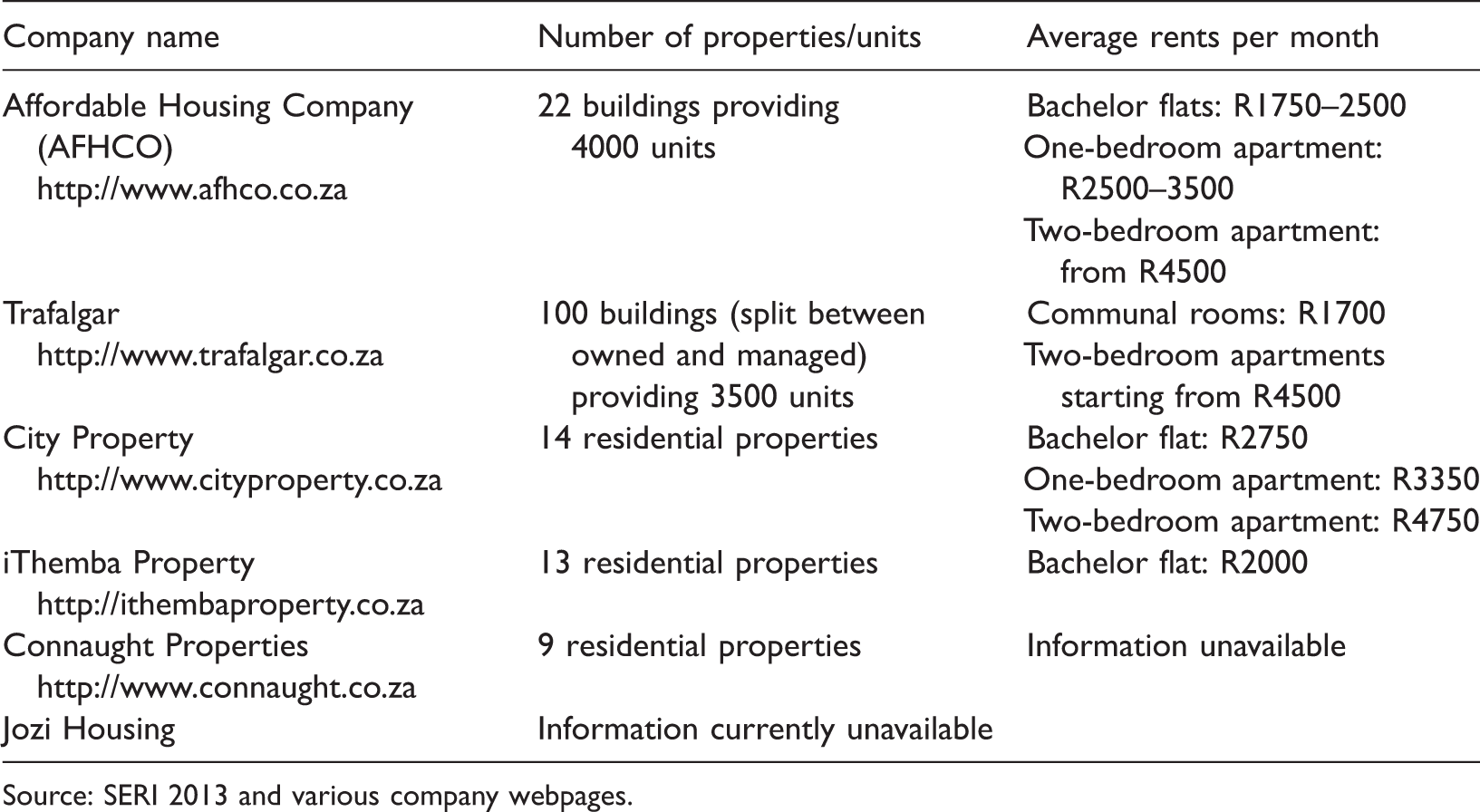
Source: SERI 2013and various company webpages.
The entrepreneurial habitus
Due to the prevailing politics framing the regeneration agenda, private developers are shaped by and enact what can be termed ‘the commercial–entrepreneurial habitus’. This refers to the set of dispositions and actions that embody the values and qualities espoused by neoliberal ideology, including belief in competition, trust in the market as the best mechanism for regulating society and an overtly economistic, calculating view of the world (Bourdieu, 2005; Comaroff and Comaroff, 2012). Because the regeneration project has been conceived broadly in terms of promoting economic competitiveness and placing the impetus for regeneration in the hands of the private sector, the field has been defined as one in which entrepreneurialism, profiteering and abilities to find commercial solutions to urban problems are valorized. What is most significant for the analysis being put forward here, as well as for the class politics playing out in the area, is that these forms of habitus are not only being promoted in official discourse, but are actively producing material, lived space.
The commercial imperatives behind the regeneration process and the distinction enjoyed by those who possess entrepreneurial approaches to developing housing is confirmed by the head of the City of Johannesburg’s social housing company, JOSHCO. In reflecting on the success of recent urban regeneration initiatives, he bases his judgement on commercial considerations, rather than emphasizing the ways in which different communities have been affected by redevelopments in the area. He declares, ‘Now the conversation is about people wanting to buy; they don’t want to get out, they want to get in to the inner-city property market’, and that the process is therefore fulfilling its goals. Even social housing institutions, which are non-profit companies, must abide by and embody the commercial–entrepreneurial habitus. They do not receive ongoing subsidies from the state, and have to sustain themselves through cost-recovery, operational efficiency and strategic investment. Thus, the CEO of the Johannesburg Housing Company (JHC) asserts: The thing is, a lot of people have this idea that if you’re a non-profit you can’t do financial engineering, you shouldn’t look at funding like businessmen – you should! Because that’s the only way. For JHC, our development objectives are crucial, but we cannot achieve our development objectives if we do not make enough money to do so. The only people who can fix it [the housing crisis in South Africa] are the private sector. But we’ve got to be given the tools and incentives because if we’re not going to make money out of it, we’re not going to do it, simple as that.
The commercial–entrepreneurial habitus also plays out in the ways in which developers actively make and control space. All residential housing developments undertaken by social and affordable housing companies employ strict security and access control measures. There has also been a widespread roll-out of privatized policing in inner-city areas where housing companies have concentrated their resources. These tactics allow developers to shape physical spaces and control the behaviours that take place within them. While strict rules and regulations inside residential buildings allow diverse communities to live together in relative peace and quiet, access control is also used to ensure that tenants are governable and docile, and that the commercial imperatives behind housing provision are not interrupted (Mosselson, 2017c).
Housing companies utilize automated access control systems to guard the entrances to residential buildings. When tenants are behind on their rent, their access is deactivated and they are forced to report to companies’ offices and begin repaying what they owe before they will be let in. These tactics mean that all tenants are subject to intense scrutiny, and have no scope to challenge or contest commercial arrangements. Tenants are also forbidden from forming committees or engaging in collective bargaining with housing companies. While these measures keep buildings running smoothly and avoid some of the conflicts over rental payments that have led to buildings falling into disrepair in the past (see Morris, 1999b), they also violate rights and protections designed to regulate tenant–landlord relationships in the commercial sector. Few tenants questioned or complained about these strategies during interviews, demonstrating that housing developers have successfully established their authority. They have thus successfully exercised spatial capital and made spaces that reflect their interests and agendas.
‘We’re here, we live it every day’: acquiring spatial capital
However, while commercial concerns and ambitions certainly are influential in shaping developers’ approaches to regeneration, the socially beneficial and developmental ambitions of housing provision are also key components of their actions and dispositions. Due to local government’s policies, the conditions insisted on by finance agencies and their engagement with the social and spatial realities of the inner-city, developers pursue dualistic agendas. One private housing developer indicates the developmental goals that he and others in the field aspire to when he states: ‘I think we work towards a common goal which is more, yes, the profit is necessary – at the end of the day everyone wants profit – but it’s more of rejuvenating the inner-city.’ Another employee who works for a social housing company emphasizes the developmental ambitions his employer strives to achieve: The definition for us as a whole is seeing lasting impact, changing neighbourhoods and areas. We have done great things where what used to happen and where we are now are worlds apart. We are creating homes, working with communities. We’re a property management company, sure, but overall it’s really about community development.
A range of social problems proliferate in the inner-city. In addition to the large poor population, the built environment is also severely dilapidated; derelict buildings, broken pavements, blocked sewers and litter are spread throughout the area. It also has high rates of crime and is infamous for its lack of social cohesion and tense, transitory social relations (Landau, 2018; Simone, 2008). Operating in this environment requires adjusting to and dealing with these complex, conflictual realities. Housing companies have invested in developing schools, after-care facilities and social services, and upgrading recreation spaces in the inner-city. Giving a clear indication of the extent to which these practices reflect a deeply felt affective state, an employee of a social housing company declares: urban regeneration for me, it has to be in your fibre and your way of looking at things and if you don’t have that positive outlook – you have to have thatin this inner-city. If you look at the amount of people that live here and work here, in absolutely horrendous conditions, why not the inner-city?! So the focus was to try and do two things … it was to try and create quality units where people need it, within the market that we defined [i.e. households earning between R3500 and R7500 per month] and also play a role in urban regeneration. So that was very crucial to us and that was what drove our decision.
Crucially, the habitus that has arisen within housing providers in the inner-city is not only expressed in their well-meaning statements and ambitions, but also through the ways they formulate their operations in the area and actively makeplace. Successful developers are those that have been able to learn from history, embed themselves in the area and adapt their practices to suit its different realities and challenges. All of the housing companies locate their offices on-site and work within the neighbourhoods where they have developments. They also employ personnel who live inside residential buildings and are responsible for day-to-day maintenance, security arrangements and liaising with tenants. These employees allow housing companies to be responsive to tenants’ needs and react immediately to any issues that arise. Their presence is a direct response to the failings of previous landlords, whose absence from the area or conflictual relationship with tenants (see Morris, 1999b) contributed to processes of urban decay, vandalism within inner-city properties and cycles of violence and property theft. A private housing developer emphasizes the spatial capital that housing companies have gained by situating themselves in the area and engaging closely with their tenants. He insists, ‘We’re here, we live it every day.’
Spatial capital and the praxis of regeneration
Reading the market, envisioning regeneration
Spatial capital, in this sense, is the ability to engage with the day-to-day realities of a space and understand its inner workings and multiple worlds. Possessing spatial capital and living the inner-city every day does not only allow developers to become dominant actors, but also affects their habitus and the praxis they engage in. A new upmarket development called Maboneng has arisen over the last few years on the eastern edge of the city centre. Despite the gentrification it has caused and the precinct’s antipathy to the existing residents of the inner-city (Nevin, 2014; Walsh, 2013), it has been heralded by local and international media and has become a cornerstone in the social lives of tourists and the city’s wealthy residents. However, despite the distinction the precinct enjoys in some quarters, developers who are focused on providing for the lower-income populations residing in the inner-city are dismissive of it. For instance, one developer reflects that ‘there is the cool, arty regeneration, but that’s an artificial slice of Joburg’. Another argues that Maboneng is ‘not viable’ or desirable, and what is needed instead is ‘safe, solid, basic accommodation’ which is in line with the needs of the majority of people settled in the inner-city.
In one respect these responses are driven by financial concerns and the demands of the market. Unlike Maboneng, which is attempting to create a new urban lifestyle and thus a new market, social and affordable housing developers capitalize on the demand that already exists. Their spatial and economic capital allow them to recognize that the demand is for affordable, basic accommodation and that providing this will be the most economically viable strategy. On the other hand, they also evaluate attempts at regeneration by the extent to which they create conditions for affordable housing. Another developer reflects: ‘If we get into gentrification where the prices start getting pushed out of the realms of affordable housing, we run into trouble because then where are the masses going to live?’ Thus, in this context, spatial habitus means being able to formulate appropriate development plans for the area and recognizing what the needs of the people inhabiting it are. Doing so translates into economic capital, but this is earned through first acquiring spatial capital and reading the space and the market within it. Through these practices, housing developers also gain more social and cultural capital, and thus reaffirm their dominance in the field. While they do not receive the public acclaim showered on Maboneng and its developer, 1 they are heralded by local government, finance agencies and developmental/donor funders. This recognition creates more economic opportunities for them, and also establishes them as significant and responsible participants in the area’s regeneration. They therefore become aligned with both the commercial, neoliberal agenda and the broader developmental goals that proliferate in the post-apartheid order.
Adapting to a changing context
Maboneng represents the importation of a particular type of worldliness, associated with Western forms of hipster consumer culture. But there is a different form of worldliness (Ong, 2011) present in Johannesburg which is arguably more influential in shaping the inner-city’s trajectory and dynamics. Since the end of apartheid, linkages between South Africa and the rest of the African continent have become stronger and levels of migration have risen dramatically. Many migrants find homes, albeit frequently temporarily, in the inner-city, and have made profound changes to the area (Kihato, 2013). Shops catering to particular national communities are common, and have come to define entire sections of the inner-city (see le Roux, 2014; Prabhala, 2008); new cultural forms are also emerging, as religious, fashion and music styles from across the continent co-mingle with local cultures and livelihoods (Hansen, 2006; Malcomess and Wilhelm-Solomon, 2016; Matsipa, 2017). There is thus a powerful sense that the inner-city is an Afropolitan space, a space which exemplifies the modernity, mutability and hybridity of African cities (Mbembe and Nuttall, 2008). This type of worldliness is in sharp distinction with the city’s history, when it was portrayed as a bastion of European civilization, and some of the present forms of redevelopment, which self-consciously mimic forms of urbanity borrowed from the Anglo-American world. Significantly, the housing developers with whom this study is concerned situate themselves closer to the new Afropolitan city, as evidenced by their rejection of the ‘artificial’ type of development aspired to by Maboneng.
Because they ‘live it every day’, there is a cognizance of and willingness to work with the emerging city. The ability to do so is a significant source of capital, as it allows developers to formulate practices that are more in keeping with the current situation, which can lead to gains in economic capital (as they cater to the substantial demand that exists), but also cultural and spatial capital, as it allows them to be active and engaged members of the inner-city community. An employee at JHC sums up the way the changing city has been absorbed into people’s worldviews, dispositions and practices: There was major panic and hysteria but when the dust settles it’s not all doom and gloom. The more we hold on to the past, the more we don’t succeed. It’s not the old CBD of banks, it’s something different. The people who were able to see that are the ones who benefited and made a difference.
Thus, it is apparent how dispositions translate into practices, which both reflect the contingencies of the space, but also come into effect in making the space. Although informal trading is officially prohibited outside residential buildings, in practice building managers tolerate and actively work with traders, who alert them to potential criminal activity and also inform passers-by about any vacancies inside residential buildings (Mkhize, forthcoming). Because of these attitudes, areas that have undergone regeneration are improved, but are not necessarily ‘cleansed’. Informal traders are still common throughout the inner-city and a diverse assortment of people engage in a range of practices and activities. The changing physical and social space of the inner-city clearly shapes housing providers’ outlooks on and practices of urban management. Rather than seeking to impose a form of social order, they act through a habitus that adapts to the inner-city’s circumstances and spatial realities.
Tensions and contradictions
Between the market and development
While transformative goals are central to the regeneration project, these still have to be pursued within the constraints of the market. Developers cater to a low-income population but also ensure they charge rents that allow them to cover their maintenance and operating expenses, generate profits and grow their investments. They have introduced innovative practices that attempt to make housing more accessible to people coping with fluid, precarious circumstances, such as offering cash incentives to existing tenants who refer new clients to them, providing one month’s free rental to new tenants and, in the case of social housing, offering financial support and covering funeral costs if the main leaseholder dies. They also condone subletting, which enables tenants to divide the costs of rent between multiple households. At the same time, they are pressurized by having to make a profit and ensure their businesses are sustainable. With frustration, one interviewee employed by a social housing company complains: unfortunately the guard costs what it costs, electricity costs what it costs; at the end of the day we don’t get any discount because we’re nice guys, we pay the same for electricity as any commercial landlord … Keeping it sustainable is a major challenge, because, as I said, things costs the same whether your mission says you want to be below the market, it doesn’t give you any discounts. Obviously everyone wants to have free housing and accommodation for nothing, but commercially the building needs to be viable financially and to run at a profit because it is a private sector enterprise. So that tension will always be there.
Racial distinctions
It is therefore clear that, although a social field is constituted by multiple actors engaging in and sharing similar experiences, worldviews and economic conditions, there are competing priorities and dispositions within a single field which push and pull actors in different directions. Fields are also characterized by distinctions, hierarchies and struggles for dominance withinclasses too (Bourdieu, 1984). Housing providers in the inner-city, as should be apparent by now, have a shared set of experiences and habitus, and thus can be thought of in collective terms. At the same time, however, there are conflicts and competing forms of distinction and capital at play. As in all South African social interactions, race (a theme Bourdieu generally neglected) serves as a key point of conflict and marker of difference.
As mentioned earlier, white people (predominantly males) occupy the majority of ownership positions in housing companies. The business backgrounds they brought with them to the affordable housing sector also meant that they brought established stocks of economic capital, and, in a world marked by enduring racial prejudices, social capital too. There is a small cohort of black developers who, particularly through the focused financial and business planning assistance provided by TUHF and the GPF, have been able to enter the field. However, they continue to complain about the prejudice they encounter. Two developers described how commercial bank employees regard black people with suspicion when they apply for finance, and continue to regard property development as a profession for white people. For example, the developer who was previously a domestic worker shares her frustrations and relates how, when she first seized on the idea of purchasing and redeveloping a building, none of the commercial banks were willing to take her proposal seriously. With anger, she recounts, ‘Nobody believed in a black woman! They just saw us like “They must do the washing, cook, bear children”.’ 2
Furthermore, companies that are owned by white people began with advantages in terms of the economic capital their founders came with, as well as the social capital and networks they possessed. Two of the largest companies are headed by what one respondent referred to as ‘big businessmen’, one of whom used to be the financial director of a large insurance company and another who previously worked as the managing director of a publicly listed corporation. They have successfully leveraged their reputations and connections to grow their businesses. As they have done so, they have accumulated more wealth and properties. For instance, AFHCO, the largest housing company in the inner-city, were recently awarded a large grant by the Agence Française de Développement (AFD), which allowed them to acquire more properties and begin to experiment with cheaper forms of rental accommodation. On the one hand, finding innovative ways to provide cheaper accommodation is extremely important. However, this deal also ensures that the company’s stocks of property and market value increases, and thus ensures that their dominant position in the inner-city will expand, shutting out smaller, black-owned firms. The current mayor of Johannesburg has cultivated extremely close relationships with established housing companies. Currently, an initiative similar to the BBP is underway, which aims to allow local government to repossess derelict buildings and either sell or rent them to private housing developers. It is envisaged that this will speed up housing delivery and revitalization in the area – again, laudable and necessary goals. However, questions of racial redress and skewed patterns of ownership are not discussed, and are generally anathema to the liberal party that currently governs in the city. The provision of affordable housing thus serves as another way in which white elites monopolize wealth and property. Therefore, as much as new dispositions and spatial praxis are required and rewarded in the inner-city, racial and cultural distinctions and forms of stratification endure and maintain the prevailing racist structure of South African society.
Conclusion
The framework presented here aims to enhance understanding of both the actions of groups who are dominant or powerful in space, as well as the effects spaces have on shaping their identities and practices. It is hoped that this line of thinking offers a fruitful avenue for exploring developers’ practices and the ways in which these are shaped by and adjust to emerging spatial and political orders and forms of lived reality. Returning to the example used in this paper, the ambitions that developers hold for the inner-city cannot be simply reduced to profit-seeking, extractive goals, nor are the types of spaces they produce simply commodified spaces. Rather, we can see how spatial practices and forms of development hybridize diverse sociopolitical currents and dispositions, which take shape in wider sociopolitical contexts, and then feed into the practices of developers and the types of agendas they formulate. This is a dynamic, lived process and needs to be regarded as one that entails a range of different forms of capital, experiences and habitus coming together. Through attention to these competing imperatives and lived realities, we can arrive at a more complete picture of how processes of spatial domination and production take place, and more accurately account for the factors that shape these.
Going beyond the immediate case study, the hope is that the theoretical insights presented here have utility in other settings and cases too. Part of the ambition behind this paper is to build a theoretical framework from experiences in Johannesburg, and thus demonstrate how Southern societies are not only destinations for theory, but are sites from which theory is generated (Comaroff and Comaroff, 2012; Robinson, 2016). Ideas around spatial habitus and spatial forms of capital have potential utility for a range of other studies. Developers are an under-represented category in urban studies and are generally presented as a homogenous, ruthless group. By drawing attention to variance not just between different types of developers, but within the motivating logics of individuals and groups, it is hoped that complex relationships between habitus and space and emphasis on spatial capital as acquired through contingent, reflexive processes can make a valuable contribution to further theorizing the ways in which developers act and come to influence space. It is also important to understand the broad range of factors that influence developers’ dispositions. These include planning and governance frameworks, financial conditions and considerations, and the professional networks in which they circulate and participate (Adams et al., 2012; Leffers and Wekerle, forthcoming). Furthermore, national contexts, aesthetic tastes and preferences, cultural assumptions and dispositions and race and gender backgrounds also potentially influence developers’ practices and the ways they approach their tasks. Additionally, as this paper has pointed out, specific spatial conditions and material contexts play decisive roles in shaping the ways development projects are conceived and unfold in real time. Research that engages with the spatial and sociopolitical embeddedness of developers is thus urgently required and will shed light on the different forms of urban development that take place in diverse contexts, and can also help us understand how better, more socially beneficial forms of urban development can become possible.
Footnotes
Acknowledgements
I would like to thank the editors of this special edition, Sian Butcher and Richard Ballard, for all their hard work in realizing this volume. I would also like to thank them, two anonymous reviewers, the journal editors and Allison Todes for the constructive feedback they provided on my paper. Appreciation also goes to Mncedisi Siteleki for producing the map which appears, and all those who participated in the research that made this work possible. An earlier version of this paper was presented at the Faces of the City Seminar Series, hosted by the Centre for Urbanism and Built Environment (CUBES), at the University of the Witwatersrand. Thanks to Njogu Morgan for arranging the seminar.
Declaration of conflicting interests
The author(s) declared no potential conflicts of interest with respect to the research, authorship and/or publication of this article.
Funding
The author(s) received no financial support for the research, authorship and/or publication of this article.