



Abstract
The role of developers in shaping the built environment has attracted considerable critical attention, often focussing on the overbearing role of powerful, globalised actors in urban development. But there is also evidence that regulatory pathways shape outcomes. Through the case of a large-scale initiative in Johannesburg, South Africa, the “Corridors of Freedom”, we consider whether there is potential for developmental benefit to be gained from redirecting developer interest to create new kinds of built form. Linked to investment in a bus rapid transit system and agile bureaucracy, a model of closely managed low-income rental housing is emerging, although there is evidence of some displacement of the poorest from more informal housing. The study suggests the importance of reassessing the political complexion and potential of state–developer co-operation in urban development, and of looking more closely at the diversity of developers as well as the array of forms of finance mobilised for urban development beyond financialisation.
Keywords
Introduction
For over 20 years, South African spatial planning has aimed to restructure cities away from their sprawling, racially divided spatial forms towards more compact, integrated and inclusive cities. However, to date this has not been very successful as plans have not generally been supported by private property investment. Apart from a few innovative firms (Mosselson, 2018; Rubin and Harris, 2018), developers have remained locked into very low density high-end suburban developments, or contributed to new low-income housing, predominantly state-subsidised and poorly located on the outskirts of the city in the same relative location as apartheid era townships (Butcher, 2016; Seeliger and Turok, 2015; Todes, 2014). It can seem as if there is little mutual understanding or synergy of interest between property developers and municipal planners in South Africa (Massyn et al., 2015; Oranje et al., 2008).
A wide range of cases point to such apparent disjunctures in interests and objectives between municipal governments and developers (Adams et al., 2012), which can be expressed very sharply where developer concerns are seen to over-ride public interest and overtly influence both plan-making and the wider regulatory context (Haila, 2008; Minton, 2017; Molotch, 1976). This has arguably been exacerbated through the growing financialisation of urban development, in which large globalised flows of money seek a ‘financial fix’ in the built environment (Fernandez and Aalbers, 2016: 84), treating housing, for example, as an asset class (van Loon and Aalbers, 2017). This shapes projects and their management, providing limited room for manoeuvre for municipalities seeking to secure public benefit (Aalbers, 2016; Fernandez and Aalbers, 2016; Guironnet et al., 2016, Halbert and Attuyer, 2016; Weber, 2015). Investment practices can at times lead to extremely cruel and racialised forms of dispossession and accumulation through eviction (Akers and Seymour, 2018; Beswick et al., 2016; Roy, 2017).
However, we also note that there has been an appreciation by some authors of the way in which municipal policies and regulations establish the institutional environment for developers (Adams and Tiesdell, 2010; Healey, 1998; Trevellion, 2002); and that territorialised pathways of regulation and governance require that developers actively ‘localise’ their practices, to some extent re-shaping governance in the process (Brill, 2018; de Magalhães, 2002; Leffers, 2018). In many different contexts, there exists the potential through negotiation, contestation and state power to bring forward benefit to actors who are not the developer: whether this is for occupiers, public benefit, private appropriation by public actors, or redistribution of property gains for political interests (Shatkin, 2017; Weber, 2015). Common models for extracting public benefit are land or development rights auctions, property and land tax-based systems, and ‘planning gain’ type arrangements (Agyemang and Morrison, 2017; Carmona, 2014; Haila, 2015; Weber, 2015). There is also a nascent interest, particularly among policy analysts (CAHF, 2017; World Bank, 2018), in whether land value capture and financialised forms of development might be able to deliver built environment outcomes which meet public interest requirements, such as low-income housing (Berrisford et al., 2018; Beswick and Penny, 2018; Fainstein, 2016).
Different models for public benefit rest on quite different governance relationships and also land value regimes (Goodfellow, 2017). Thus, while the land auction or planning gain models rely on high land values to extract (or share) profit at the point of development, low value land regimes can potentially facilitate the stable rental return model of housing provision at levels which can reach relatively low-income markets, as has been seen in Johannesburg’s inner city (Mosselson, 2018). The case study which we present here of a major development initiative in Johannesburg shows how developer interest can to some extent be redirected through agile state agency and creative use of property-based tax revenue and other developmental sources of financing. Specifically, we consider how developers initiated new models of housing investment in response to Johannesburg’s Corridors of Freedom, an ambitious transit-oriented development project introduced in 2013. This was a flagship urban transformation initiative promoted by the then mayor: the corridors … is the leading edge of an approach that will alter the spatial destiny of the city. Left to the forces of the market alone, the poor would be cast to the edges of the City, trapped there by the cost of mobility. This is exactly what we seek to disrupt and transform when we speak of confronting apartheid spatial patterns (City of Johannesburg (COJ), 2015:13–14).
This links to wider international trends in which the affordable rental housing sector is being ‘discovered’ as a new source of profitability (Butcher, 2016; CAHF, 2017; Wijburg et al., 2018). In addition to highly localised developer interest we have observed some links from this new sector to global investors exploring a new ‘asset class’ of low-income housing provision. Both national and international property investors are therefore expressing interest in a new format of low-income rental housing products. The paper considers these processes and their implications for wider opportunities for city transformation through collaborative relations between developers and planners in the pursuit of policy goals, redistribution and public interest – an aspect of urban development politics which has been relatively under-explored, as we discuss in the following section.
Coalitions or conflict? Governing property developers
Relationships between urban planning, governance and private property development are diverse across different contexts, including situations where private development is strongly limited to realise state-led priorities and returns (Hsing, 2010) or those where the realisation of planning objectives depends, at least partially, on positive response by private property developers to public policy and plans (Fainstein, 2008). The relationship which emerges between states and developers therefore assumes a variety of formats, reflected in changing academic interpretations. Perhaps the most well-established theorisation is that which focuses on the way developers organise with other business and government actors in ‘growth coalitions’ to achieve their ends, shaping planning processes and development outcomes (e.g. Molotch, 1976). However, Cox (2016) argues that these processes are quite contextual and in particular reflect the USA context, where local government has significant autonomy but also costly mandates and a dependence on local property-based revenues (Lauermann, 2018). It is thus forced to be entrepreneurial, promoting property development as a significant source of revenue – a situation which, while differently structured, also influences Chinese urbanisation (Wu, 2003). This position contrasts with European countries where there has historically been a greater centralisation in terms of funding and policy, and hence different relationships with developers, including up-front state investment in infrastructure, or a focus on extracting public benefit through direct planning gain negotiations. This points to the significance of national and local governance systems in shaping relationships between planning and property development (de Magalhães, 2002). Fainstein’s (2001, 2008) work on property developers and mega-projects highlights these national differences, and indicates how more welfarist countries with strong planning institutions such as the Netherlands have been able to influence development towards just city outcomes through infrastructure investment, planning processes and housing subsidies (van Loon et al., 2018).
It is also clear, though, that significant tensions can exist between the interests of states, including planning objectives, and those of property developers. These have been highlighted in several contexts, including in South Africa, as noted in the introduction. Planners often have a weak understanding of the realm of private development (Coiacetto, 2001), and Adams et al. (2012) argue that planning policies too easily assume a ‘notional developer’ who will fall in with their intentions, with little appreciation of what drives and shapes developer behaviour, leading to more conflictual engagements. The search to regulate development and to extract or share value from property development can therefore lead to significant contestations (Minton, 2017; Wainright, 2015). However, although this moves us on from the US growth coalition model, evidence suggests that the story is also more nuanced than this.
Henneberry and Parris (2013: 230) emphasise that property markets are socially constructed and that developers ‘should be understood as socially embedded within distinct markets, composed of complex networks of actors with their own distinct habits and practices framed by the prevailing rules and regulations of conduct’. Even with the internationalisation of property markets a heavily locally dependent process leads to different outcomes across different contexts, with the ‘re-creation and re-affirmation of local specificity’ a frequent outcome (Brill, 2018; De Magalhães, 2002: 243-244). More strongly, Healey (1998) points to the collaborative relationship between planning and property development, noting that planning forms part of the institutional environment shaping the work of developers. And in the other direction, Adams and Tiesdell (2010) note that planners are themselves actors within, and shape, property markets.
However, the financialisation and globalisation of urban development processes has led some to consider that disjunctures between state interests and private developers are being exacerbated (e.g. Fainstein, 2016, Guironnet et al., 2016; Halbert and Attuyer, 2016). This work highlights the huge flows of investment into property following new models of accumulation, global declines in the profitability of primary and secondary production, and particularly following the 2008 ‘global’ financial crisis (Harvey, 2013). This has pushed property further towards a tradeable commodity which must produce returns that compete with both investments in property internationally and other classes of financial assets (Guironnet et al., 2016), and which imposes certain disciplines on investment, such as the need for large-scale assets conforming to investor expectations and generating reliable returns. Both land markets and the type of built environment produced are affected by this process. In Brazil, financialisation has intersected with local socio-spatial dynamics to exacerbate spatial inequalities and fragmentation (Sanfelici and Halbert, 2016) – cities which are seen as ‘safe’ investment environments have attracted significant international financial flows into property, pushing up land rents and property prices, contributing to the crisis of housing affordability (Gallent et al., 2017). Guironnet et al. (2016: 1443) argue that these processes transform built environments into ‘bundles of assets in financial portfolios’ in which investment becomes highly selective in terms of location, type of building and tenant profile, often in ways contrary to urban regeneration plans. Their study of an urban regeneration project on the outskirts of Paris points to how these processes undermined municipal plans for mixed use, sustainable mobility and diverse economic activities. The growth in global flows of investment, which treat the built environment as an asset class, also influences the production and management of housing, placing pressure on social and affordable housing provision and decreasing tenure security (Aalbers, 2019). Rental housing, including social housing, with its potential to offer predictable streams of income to investors, is increasingly targeted by institutional investors (Aalbers, 2019; Bernt et al., 2017; Beswick et al., 2016; Wijburg et al., 2018).
Although much of the financialisation literature suggests that these processes undermine social objectives in relation to planning and urban development, Fainstein (2016: 1507) speculates as to whether there is scope for the flexibility of financialised markets to support an expansion of the right to the city and to achieve an improved distribution of the benefits of urban development, if there is commitment to using state power to these ends. This commitment is often missing though, as Akers and Seymour (2018) point out that simply implementing existing policy could protect against the worst excesses of speculative accumulation through dispossession in the US. Nonetheless, there is growing interest in the potential for processes of financialisation to make available large flows of finance which can be used for development (CAHF, 2017; World Bank, 2018).
But financialisation is not the whole, or even the main process shaping investment in urban development: in any given context there are a diversity of developers – in size, orientation, motivations and objectives – who relate in different ways to planning and governance objectives (Coiacetto, 2001; Leffers, 2018). Thus, we want to suggest that there remains scope in specific contexts to explore a range of possibilities for housing development, including both state-led and collaborative initiatives between states and developers. Furthermore, even within the context of financialised housing practices, in order to operate effectively developers need to understand and embed their operations in specific contexts, responding to varying environments, opportunities and regulatory systems (e.g. Brill, 2018; Coiacetto, 2001; Cox, 2016), as well as wider national and international markets (Bernt et al. 2017; Fernandez and Aalbers, 2016; Fields and Uffer, 2016; Wijburg et al. 2018). Here, comparative studies are needed which can explore diverse emerging development models and assess the extent to which they meet local needs in particular contexts. In the rest of the paper, we put forward one case where co-operation between local planners and specific sectors of developers, including emerging links to models of financialised development, has produced innovation in housing offers which have made some inroads into well-located, low-income housing delivery.
Data and methods
The South African property industry is very poorly documented in academic literature. Nurick et al. (2017, 2018) provide useful analyses on aspects of the industry, but more comprehensive accounts are lacking. The paper therefore draws on primary data including interviews and observations, as well as reports, news articles and other grey material to provide a background on the industry. Research on the Corridors is based on analysis of policy documents; data from the City of Johannesburg on development projects; participation in two workshops with developers and another with municipal officials; and 37 interviews with key respondents. These include five interviews with finance organisations; two with property academics; 11 with City of Johannesburg entities, officials and politicians (Johannesburg Development Agency, Development Planning, Johannesburg Property Company, Paterson Park project, politicians); 12 with private property developers; two with social housing companies; five with consultants, including two consulting to the municipality and three planners and urban designers working with developers. Interviews were conducted from April 2016 to March 2019 and, in some cases, repeat interviews with the same individuals or institutions were conducted. We reference these interviews in the text as Developer1, Financier1, together with the date of the interview. GIS-based data (supplied by firm GeoTerraImage) on the numbers of buildings on the Corridors and in Johannesburg for 2001, 2010 (by which time the first phase of the bus rapid transit system was complete) and 2016 (most recent available) was also analysed, although it provides only an indicative insight since the Corridors project only started in 2013, and it takes several years for planned housing developments to be realised.
Johannesburg’s Corridors of Freedom: Municipal policies to re-shape the city
Overcoming apartheid urban forms
Johannesburg is South Africa’s largest municipality, with a population close to 5 million people, located within the Gauteng city-region, South Africa’s economic heartland, encompassing some 14 million residents. As in all South African cities, historical policies of segregation and apartheid led to a racially divided, socially unequal and spatially fragmented city. The majority black African 1 population – most confined to low paid occupations – was forced to live in poorly serviced ‘townships’ on the edge of the city, at some distance from the main economic centres. Property in these townships was held by the state, which also restricted economic activity there, at least until the 1980s, when apartheid began to break down. This history has resulted in enduring racialised inequalities across the city in terms of the quality of urban environments and access to social and economic opportunities. The main thrust of urban spatial policy post-apartheid (since 1994) has been to redress these spatial inequalities, and the associated sprawling pattern of development through policies to compact and integrate the city, and to improve conditions in the former townships (Harrison et al., 2008). These are reflected in Johannesburg’s strategic spatial plans (Todes, 2014), the most recent being the 2016 Spatial Development Framework (City of Johannesburg, 2016).
While policies have had some success in improving services, and places such as Soweto (Johannesburg’s largest former black township to the west of the central city) are now much more diverse in terms of income and economic activity, the spatial restructuring desired by planners has been much more limited. Expansion on the urban edge has been contained to a degree, and the growing middle-class areas in the north are much more racially mixed than in the past, but development has taken the form of gated communities and large retail and office centres, very different from the more inclusive, transit focused, mixed developments anticipated by planners (Ahmad and Pienaar, 2014; Todes, 2014). Forms of densification have occurred across the city (Todes et al., 2018), especially in the inner city which has come to accommodate a rapidly growing low-income population. However the government’s Reconstruction and Development Programme (RDP) 2 housing projects, providing mainly detached housing for free for low-income South Africans earning under R3500 per month, 3 has largely continued to occur around former black townships or on the edge of the city where land costs are lower (Todes, 2014). While these conditions are recognised as an ongoing challenge, there have been successive layers of policy and projects to address them.
In Johannesburg, the most recent is the ‘Corridors of Freedom’, a municipal project established in 2013, which built on and extended a bus rapid transit (BRT) system, the first phase of which was completed in time for the 2010 FIFA Soccer World Cup. This route ran from the east of Soweto to the city centre. A second phase linking Soweto through a more northern route (Empire-Perth roads) to the city centre, was completed in 2014 and a third phase connecting the inner city along Louis Botha Avenue (an intensive mixed-use corridor) to Alexandra (a high density former township to the east of the city centre) and Sandton (the northern business district) is currently under construction (2018). The system includes feeder bus services linking the fixed line BRT to surrounding areas, and is ultimately intended to bring bus services to within 500 m of all residents (see Figure 1).
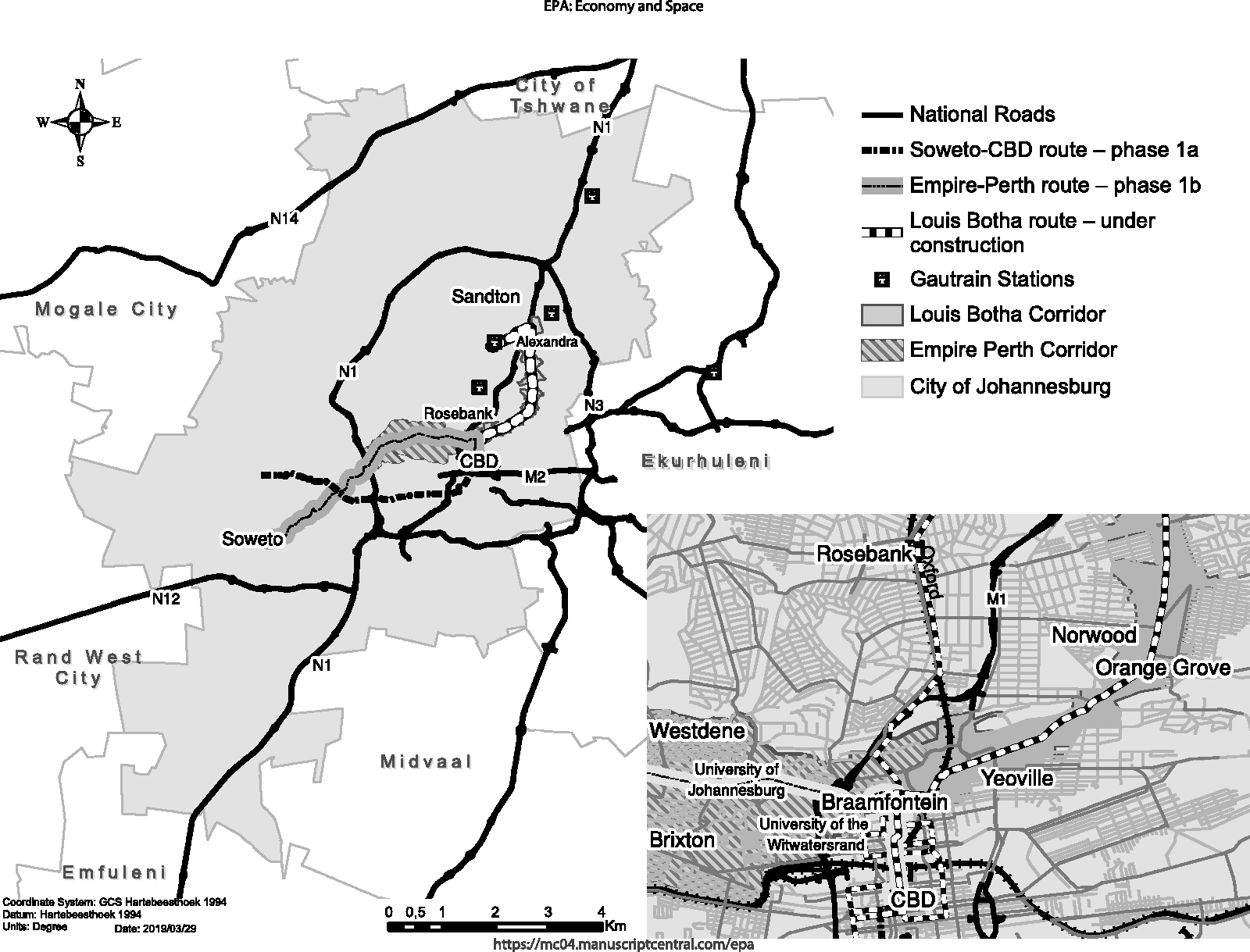
Johannesburg’s Corridors of Freedom.
In terms of wider policy ambitions to create a more compact and accessible city, the project intends to ‘stitch together’ (COJ, 2014) and densify areas of the city that were once racially segregated, to improve links between areas of residence and employment, and to generate stronger interactions among different activities and population groups along the BRT supported corridors. It runs through diverse areas in terms of land use, social class and racial designation under apartheid, including old industrial areas; public housing areas built for black people in the apartheid era; two major universities; high density inner city areas; former white upper and middle class suburbs, some of which have densified as houses and low-rise apartments are occupied by larger numbers of lower income populations. The Corridors of Freedom builds on earlier ideas put forward by South African planners since the late 1970s (Ballard et al., 2017; Wood, 2014), and the notion of restructuring South African cities through densifying along major public transport routes became a key concept in post-apartheid planning (Harrison et al., 2008), including in Johannesburg (Todes, 2014). Aside from the BRT corridors, then, there are a broader set of historic activity corridors, with some developers already focussing their developments on these routes (Developer4, 26 August 2016, Developer10, 31 August 2018).
The shifting political terrain, though, means that the long-term future of the ‘Corridors of Freedom’ project is uncertain. In August 2016 the African National Congress-led municipal government, which championed the Corridors and coined the term ‘Corridors of Freedom’, was ousted by a new regime led by a minority Democratic Alliance government in loose alliance with the radical Economic Freedom Fighters. It is apparent that elements of the Corridors and their planning are changing as they are contested in a politically divided council. Initially the new municipal government seemed set to continue with the Corridors, rebranding them as ‘Transit Corridors’ (State3, 22 September 2017). However, and although significant investment in infrastructure has already occurred, as the political weight of those supporting the initiative has declined, it has lost some of the anticipated capital expenditure (State2, 16 March 2018).
Re-directing developers: Municipal initiatives
One of the critical outcomes of the Corridors of Freedom is to change the urban planning model by providing affordable and social housing along these BRT development corridors, which are adequately serviced by transport, economic and social infrastructure (COJ, 2014: 108).
In the South African context, affordable housing is a loose term referring to housing for income groups ranging from R3500 to R22,000 per month (around 30% of Johannesburg households 4 ), reflecting a ‘gap’ in the housing market above the R3500 per month cut-off for free RDP housing for which 50% of Johannesburg’s population would qualify, but below that which might enable households to secure mortgage financing (Butcher, 2016, StatSA, 2011). With rents calculated at a third of income, ‘affordable rental’ housing might be as high as R7500 per month. Social housing is state-subsidised rental housing for the lowest segment of this ‘gap’ market – R3500–R10,000 income groups (about 20% of households) – provided by social housing institutions, including COJ’s own agency. A new city policy on inclusionary housing (February 2019), the first in the country, explicitly targets developers for the first time, requiring private developers to provide 30% of units in developments of over 20 residential units as inclusionary housing, intended for those on a low but relatively stable income in the range required for social housing (COJ, 2019).
It is in the context of the search for ways to expand housing options for this ‘gap’ market that the Corridors project has sought to facilitate private developers entering the affordable housing market directly, with two parallel sets of interventions:
Financial. The city raised significant funds from its own capital budget through focussed redirection and assembling of scarce resources, including an initial upfront public commitment to deliver an annual capital budget of R100m over 10 years which effectively doubled the proportion of the city budget committed to capital expenditure. This was achieved through a combination of issuing municipal bonds, conventional bank loans and R1.68bn loan funding from the French development agency to address climate change and environmental objectives through city compaction, including the Corridors project. Budgets across different departments were co-ordinated through the planning department to enhance infrastructure and services, including social infrastructure and public space, as well as purchase of some land along the Corridors to support intensification of development (Ballard et al., 2017; COJ, 2014, 2015; Robinson et al., 2019). Central government investment in the transport infrastructure (BRT) was also crucial. Officials estimated around R1.3bn per annum was spent on the Corridor development from 2013 to 2016 (State2, 29 July 2016). Planning. Precinct plans were developed, as well as a detailed set of design codes based on physical and financial modelling of intensified developments which would be feasible on the standard plot sizes found in residential areas along the Corridor (State2, 16 August 2017; Consultant5, 23 August 2017). A fast track approvals system in special development zones (SDZs) was proposed to speed up developments in these areas and permit intensification – although in some areas higher densities were already permitted. This work was concluded just as the government changed, and while they have had some influence (see below), the consequences have not been fully realised: the downgrading of the Corridor policy has limited the provision of infrastructure to make fast track approvals in SDZs possible (State2, 16 March 2018, 1 March 2019).
The initiative has also relied on the extreme personal commitment and capacities of a very small team from the planning department and the Johannesburg Development Agency (JDA), a municipal entity, which has in the past had responsibility for major infrastructure projects, enhanced by some external consultancy work to prepare precinct plans, manage public consultation and develop the modelling (Consultant5, 23 August 2017, State2, 16 August 2017). The team initially included an energetic individual with knowledge of the property industry who engaged with developers and began to work with financial institutions. For some property developers, this interaction was key to their decisions to invest along the Corridors (Developer5, 25 September 2017; Developer6, 23 August 2016). JDA is also working with non-profit social housing companies, which have expressed interest in the project (Social Housing Company1, 10 March 2017; State1, 28 April 2016). For the planners, the focus of their efforts was on opening up and defining feasible opportunities for intensification: ‘at that stage the products that we developed along those Corridors were more to position us and to enable us to manage development that will ultimately come’ (State2, 16 August 2017). The stage as it were was set – how did the developers respond?
Developer response
There have been a range of responses from developers to these municipal initiatives. The vast bulk of developers are not drawn to invest in the Corridors – the core development model for Johannesburg, for both low- and high-income housing developers, is focussed on the outskirts of the city. But very small-scale, emergent neighbourhood-based developers as well as some larger-scale investors are being drawn to new formats of tightly managed, low-income rental housing. We discuss these in turn.
Unswerving suburban development model: Real estate investment trusts and bank financing
According to the Property Sector Charter Council (2015), the size of the South African (SA) property market was R5.8trillion in 2014/15, some 72.5% of which was in formal residential property. However, commercial property (retail, offices, industrial and leisure) has been the main focus of institutional investors due to perceptions of the poor financial performance of residential property, high risks (including management intensity), and the lack of units at the necessary scale (Nurick et al., 2018). Investment patterns in commercial property have been shaped by slow economic growth since the collapse of a property boom (2004–2008), and a cautious approach has developed following over-investment particularly in office space and suburban development during this period (Butcher, 2016; Harrison, 2016; SA REIT Property Journal, 2017). Since the 1980s, when life and pension funds were dominant in the industry, there has been a shift towards property funds listed on the stock exchange and forms of financialisation of property development are evident. From 2013 these listed companies were ‘modernised’ and internationalised through the establishment of real estate investment trusts (REITS), which own and manage income-producing real estate, with shares listed on the stock market. These now account for 54% of the industry, and South Africa is the ninth-biggest REIT market in the world (Nurick et al., 2017). Together, REITS and listed property companies own 62% of commercial properties in South Africa (Nurick et al., 2017). REITS and listed property companies have experienced relatively high growth and returns, sometimes outperforming other classes of investment (Ntuli and Akinsomi, 2017; Nurick et al., 2017). There have been some financial flows into these funds from overseas, including listing of foreign REITs on the Johannesburg Stock Exchange (Anderson, 2015) as well as the use of derivatives to develop property portfolios abroad, notably in Eastern Europe and Australia (Nurick et al., 2017; SA REIT Property Journal, 2017). By 2017, some 40% of REIT earnings were generated from offshore portfolios (Nurick et al., 2018) and over the 5 years to 2016, SA listed property portfolios invested overseas grew from less than 5% to 36% of total assets (Financial Mail, April 2016). Certainly, firms are seeking enhanced profits in undervalued markets elsewhere, but ‘the bottom line is that SA funds don’t have a choice other than to look for new opportunities elsewhere’, given the market conditions in South Africa (Financial Mail, April 2016). Furthermore, there is a growing interest in ‘alternative real estate opportunities including data centres, cell phone towers and affordable housing’ (SA REIT Property Journal, 2017: 12).
However, in the context of slow economic growth, commercial property developers have been conservative, focusing on places such as Sandton, with well-established demand for upmarket office development (Harrison, 2016). There has also been significant investment in what Murray (2015) terms ‘privatised urbanism’ – major new gated communities, including a large new mall, where huge tracts of land are acquired and developed by private developers. The Corridors of Freedom presents a very different type of situation where land ownership is spread across many property owners, generally owning small parcels of land or buildings, and where the municipality strongly drives a redistributive vision. The Corridors of Freedom have therefore been ‘off the radar’ (University2, 7 April 2016) for large institutional commercial property developers (Developer3, 25 November 2016), and for other property developers focused on upmarket areas (Developer2, 31 August 2016, Developer4, 26 August 2016). Likewise, banks argue that they respond to ‘the jockey not the horse’ – to their clients, viable projects and ‘property fundamentals’ (Financier1, 12 September 2016; State1, 8 November 2016). GIS analysis conducted for this study shows much slower growth in the number of buildings, and also of residential buildings, developed along the Corridors compared with Johannesburg as a whole for the 2001–2010–2016 period.
On the face of it, there are limited prospects for the Corridors. However in recent years, there has been a new interest in ‘affordable’ housing and this has been the main focus of those property developers who have been drawn to invest along the Corridors, where land values remain sufficiently low to enable such forms of housing delivery.
Emerging local developers
‘Affordable housing’, filling the ‘gap’ between mortgage-financed and state-supported housing, has been discovered as a new investment sector in South Africa, after the collapse of the 2008 property boom and the exhaustion of investment in higher income suburban housing (Butcher, 2016). This has largely taken the form of private housing for purchase on the urban periphery, supplied by firms with long-term investment strategies in land-holding and its conversion from agricultural use (Butcher, 2016; Developer2, 31 August 2016; Lévy, 2018).
By contrast, the Corridors attract developers specifically interested in creating stocks of affordable rental housing which are leased to tenants. In our research, developers stressed how large this market is and how undersupplied – with demand seen as almost unlimited: ‘we know that there is a huge undersupply of this type of accommodation in Joburg never mind the rest of the country, so we believe that we’re not going to be able to build enough of these’ (Developer8, 1 September 2016; see also Butcher, 2016; Nurick et al., 2018).
In interviews, developers argued that good location and access are increasingly important to consumers in this market. Reduced transport costs (compared with peripheral locations) allow for higher rentals to be charged making the development more feasible and the Corridors, already well served by taxis and with the existence or promise of BRT routes, are attractive for these investors (Developer5, 25 September 2017, Developer6, 19 July 2016, Developer7, 9 February 2017, Developer8, 1 September 2016, Developer9, 30 August 2016). Data on projects supplied by the City of Johannesburg in November 2018 indicated that there were 11,593 residential units in the pipeline in these areas, 5 some 12% of the overall target for the Corridors project. Rentals to be charged ranged from R1500 to R7800 per month for units accommodating one to four people (COJ data sourced from Johannesburg Development Agency, City of Johannesburg, 2017), largely within the ‘affordable’ income range, although little of it is for the very bottom end of this range. The developers we interviewed mentioned rents of, for example, R1590 per month for a 12 m2 studio (Developer1, 1 September 2016); R2800 for a 17 m2 bachelor unit (Developer5, 25 September 2017); R4200 for a 32 m2 one-bedroom unit (Developer7, 2 September 2017); and R6000–7000 for a 2-bedroom unit (Developer6, 23 August 2016). Residents also pay additional consumption-based charges for electricity and water. Most existing and proposed development along the Corridors is residential (GTI, 2016; COJ data, 2017, COJ data sourced from City Transformation and Spatial Planning department, City of Johannesburg, 2018; State1, 8 November 2016), but there is some commercial development, either in a new format of street level micro retail and service uses in predominantly residential buildings or as stand-alone developments in better located areas.
Developers along the Corridors see affordable rental housing as offering an alternative to informal rental housing (cheap shared spaces at high occupancy rates without regularisation or effective management) already occurring along parts of the Corridor and in the inner city. In some respects their developments mimic the informal market in terms of what it offers – small subdivided units within pre-existing suburban houses on small stands, or small three to four storey apartment blocks. While developers argue that this allows greater levels of privacy, maintenance, control and better services than in the informal offer (Developer8, 1 September 2016), we note that for those in the lower income brackets, and with less secure income streams, the flexibility, lighter management and lower cost of the informal rentals make them more accessible (Charlton, 2017). Accommodation on offer or to be developed includes small or very small units (12–24 m2, with some larger family/shared units of around 35–50–65 m2), but with private access, and mainly with their own bathroom and kitchen. Developers stress that they include good finishes and energy efficient pre-paid services to reduce ongoing and maintenance costs for both tenant and owner. Larger units might be shared by two people or a couple with children. They might be occupied by full-time or better paid domestic workers -- perhaps with assistance from their employers -- shop workers, nurses, students, but also professional people seeking a better location, with good access to schools and facilities. In some cases social facilities are planned and larger developments are anticipated to include private schools. Developers saw themselves as providing much needed, decent, affordable, well-located housing, specifically contributing to realising the municipality’s urban vision (Developer6, 23 August 2016; Developer7, 9 February 2017; Developer8, 1 September 2016; Developer9 30 August 2016; Developer10, 31 August 2016; Consultant2, 27 February 2017).
This kind of development builds on existing developer experiences with creating profitable, affordable private rental housing in the inner city, which has been in place for several years, and which is in many respects a similar model (Developer6, 19 July 2016). This has involved the redevelopment of existing office buildings and rundown apartment blocks for affordable rental housing including strong vetting of prospective tenants, close controls of payment, securitised access and intensely supervised use of the property and surrounding areas (Mosselson, 2018). Although the inner city is still a highly attractive location for affordable rental developers, the cost of buildings for conversion has been rising as the market has become more evident – initially it was close to zero as a city programme for rehabilitating hijacked buildings supported investment (Mosselson, 2018). Developers have therefore been alert to new opportunities in the Corridors where land values remain low. However, there are fewer high/medium rise buildings available for conversion than in the city centre and inner city, and a new built form has been developed. This involves intense subdivision of suburban homes, or small-scale new build (two to three stories) along the main roads following – and effectively informing – the city design codes for these areas (Figure 2). Consultants were briefed by the City in late 2015 to explore the kinds of densification which could come forward:
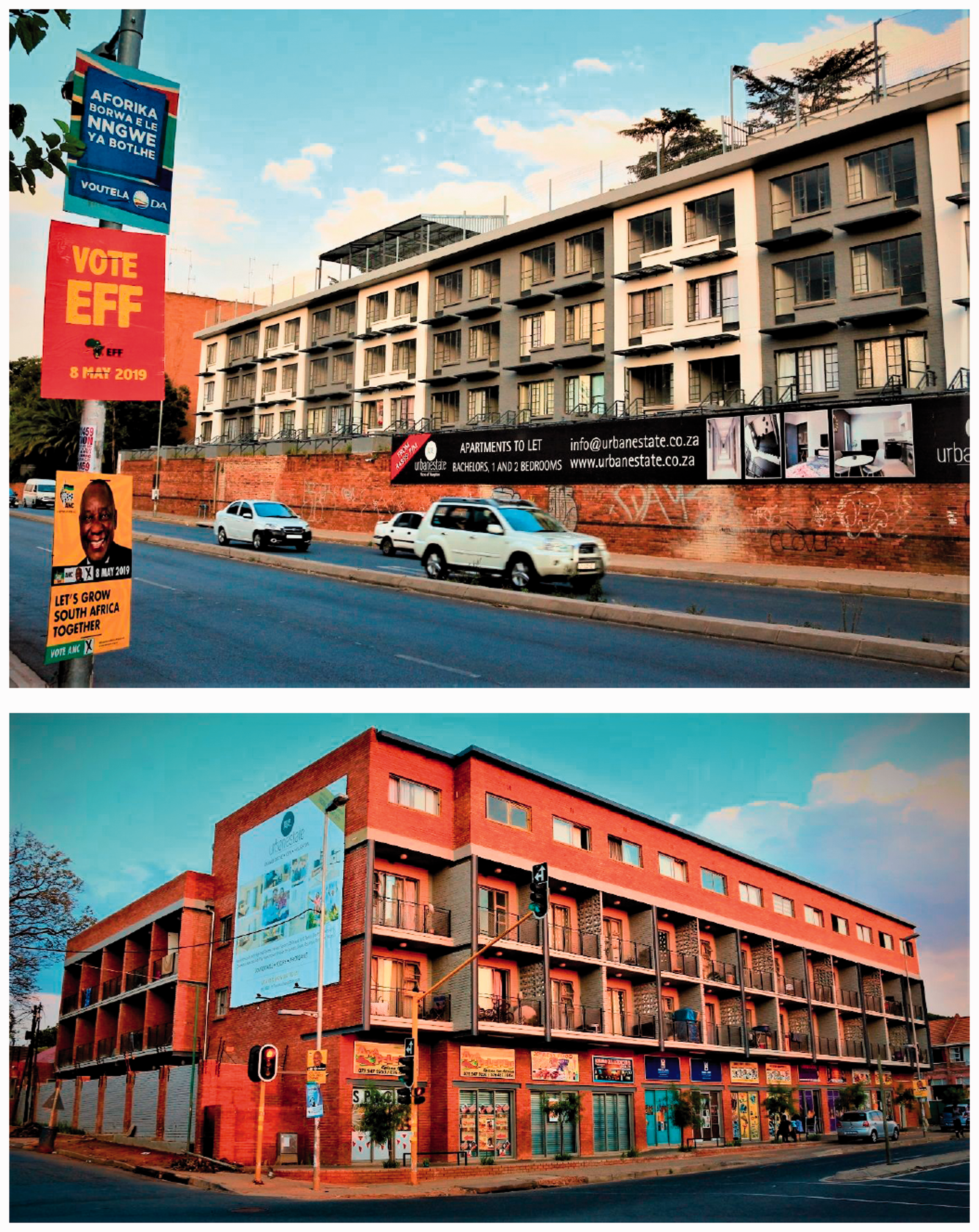
A new format of affordable rental housing. Louis Botha Avenue. Photos by Brian Boshoff.
we then looked into the viability of each typology, each typical unit or shop that can be built, we looked with the space available, the density that we wanted to achieve, can one actually build it and what will you rent it for or sell it for, to see what is the most feasible typology (Consultant5, 23 August 2017).
Given this embryonic format, in terms of financing strategies the Corridors are becoming a focus for a diverse set of small developers, some able to utilise resources from their existing construction or rental businesses to expand developments, while some are linked in various ways to larger firms. Large SA banks are not involved on a significant scale yet – they are risk averse, and wait for the business case to be made, and for a market to establish (State1, 8 November 2016; Developer8, 1 September 2016). Developers therefore work with their own or other sources of finance, notably partners who have access to bank finance (Developer5, 25 September 2017; Developer8, 1 September 2016; Developer9, 30 August 2016). Several developers are locally established firms that, based on their close knowledge of the area, identify opportunities such as cheap or appropriate land and buildings (Developer6, 19 July 2016; Developer7, 9 February 2017; Developer9, 30 August 2016). There are strong social networks among some of these firms – developers, property managers or builders, as well as local financiers including more established property companies that are able to raise finance based on their assets (Developer5, 25 September 2017; Developer6, 19 July 2016; Developer9, 30 August 2016; State1, 8 November 2016).
The financial strategies and approaches of small developers on the Corridor therefore vary. For instance one small firm run by two young men is backed by a wealthy international private equity partner (Developer6, 19 July 2016). This firm is building up a stock of rental housing – it is an ‘asset manufacturer’ building a tradeable portfolio that can eventually be sold. Hence it is linking into international financialisation processes at the same time as providing affordable rental housing according to the locally developed model. Another investor on the Corridor with access to bank finance from a local property company works in partnership with several small developers, providing equity and in some cases management of rental units (Developer5, 25 September 2017; Developer9, 30 August 2019). One of these developers has now managed to access his own bank finance and is developing further on his own (Developer8, 22 February 2018).
Another small firm, not linked into these networks, is subdividing existing houses into smaller units and adding on rooms outside to produce affordable rental housing. In this case, the firm generally acquires property from existing owners, redevelops it and sells it back to the original owner if they choose, but manages the property for them. It becomes a way in which original owners are able to maintain the value of their property and derive returns from it in a context where property values have been declining (Developer7, 9 February 2017). In all cases, firms make arrangements for tight management and control of the building, either internally through their own systems of management or through other agencies (Developer6, 19 July 2016; Developer7, 9 February 2017; Developer8, 22 February 2018; Developer9, 30 August 2019). Not all interviewees were willing to share their yields, but those who did indicated that they were around 12–14% – higher than those from rentals in high income areas.
The influence of municipal policy in attracting these developers to the Corridors and shaping their developments is open to debate. Many of these small developers were already operating there and developing the rental model. However, the municipality’s infrastructure investment, consolidation of the design codes, and acceptance of higher density and low parking ratios has been important in accelerating development (Developer5, 25 September 2017; Developer6, 19 July 2016; Developer8, 22 February 2018; Developer9, 30 August 2019). Direct financial benefits such as proposed rates and tax rebates are seen as less significant in encouraging development, although developers have varying views. And although considered potentially very beneficial, the ‘Special Development Zones’ with scope to enable fast-track development have yet to be realised. In their absence, then, in addition to opposition from neighbouring residents slowing down developments, developers complained about slow processing time for planning and building applications, poor co-ordination between departments within the municipality and poor urban management (Developer6, 19 July 2016; Developer8, 22 February 2018; Developer9, 30 August 2019). Widespread concerns about the reliability of the municipality (Financier2, 1 September 2016) are likely to have been exacerbated by the weakened status of the Corridors project.
There are also some points of disjuncture between the developments and municipal policy. Some developers are building at lower densities than desired in the plans. This reflects the costs of building higher and the ease of simply intensifying the use of existing houses rather than undertaking new builds (Developer7, 19 February 2017). Some still feel the need to accommodate cars to a greater extent than is desired by planners, although in most cases, reduced parking requirements are seen as a significant advantage as this frees up space for more housing units.
In terms of realising the wider policy goals of the COJ, of some concern is the impact of these developments on the neighbouring and existing residents. Those on the lowest incomes or with precarious employment living in existing informal rental housing and who cannot afford the new rental properties or qualify for the tightly managed tenancy contracts face displacement (Charlton, 2017). Developers argue that moving lower down the market would require them to shift towards ‘dormitory’ style accommodation with shared bath and kitchen facilities, which could not be easily converted or sold on within real estate markets, as some hoped to do. Shared units also pose other challenges to the development model in terms of tenant management and family needs (Developer6, 19 July 2016). It is these alternative forms of rental, though, which offer more flexibility to those on the lowest incomes, or with precarious and unreliable incomes, which lead them to rely on more informal housing provision. And there has been considerable opposition from some local middle-class white communities to low-income and denser housing developments (Consultant5, 21 July 2016; State5, 20 August 2016). However, there has also been considerable sympathy with the project, and interest in selling and developing properties from those who have otherwise been trapped owning properties in a rapidly changing, low value environment, especially elderly people (Consultant5, 23 August 2017).
Notwithstanding these limitations and concerns, the proactive stance of the municipality has been important in securing and extending development in the area, and in reorienting developer plans to move them closer to municipal intentions, for example in terms of design and rent levels which fall within their definition of ‘inclusionary’ housing (Developer6, 19 July 2016; Developer8, 22 February 2018; Developer9, 1 September 2016). According to Developer 9 (30 August 2016), We started purchasing about 2 years ago, we only became aware of the corridor about a year ago … [official X] introduced us to the concepts and everything … the Spatial Development Framework [SDF] plan … we work with it now … A lot of designs that we submitted weren’t in line with the Corridors of Freedom designs and were rejected by the city but now we are resubmitting our plans based on that …
Scaling up: Larger-scale providers and financialisation
There is evidence that large firms listed on the Johannesburg Stock Exchange are beginning to move into affordable housing, and some are looking to develop along the Corridors. Some, such as Developer 10, a large developer using a housing delivery model involving large sites and a mix of income groups from low to lower-middle income, are already established along a main arterial which carries a bus feeder service linking to the BRT (Developer10, 31 August 2016; Rubin and Harris, 2018) and has some developments close to the Corridor in Soweto. Developer 12, a large international equity fund with roots in social housing in the USA, and a mandate for social impact, which has also partnered with Developer 10 (Butcher, 2016), is interested in investing in rental housing along the Corridors and has been exploring opportunities there (Developer12, 22 November 2016).
While SA REITS have very limited exposure to residential/rental investments (3%) compared with about 14% globally (Nurick et al., 2018), given the scale of low-income housing need, affordable rental is increasingly seen as an opportunity and new partnerships are emerging involving some of the larger firms in inner city affordable rental housing, as well as others such as Developers 10 and 12 whose developments are more spatially diversified. These firms are building a portfolio of property to generate the scaleable assets required for such investment vehicles (CAHF, 2017). This requires going beyond their previous locations and spreading risk across different locations and sectors, including student housing (Developer10, 31 August 2016; Developer12, 22 November 2016) which is also developing along the Corridor, close to two universities which have an undersupply of student housing (University1, 19 August 2016). REITS previously without exposure to residential property are moving into this space. For instance, Redefine, one of the largest commercial REITs, has bought into Respublica, a large provider of private regulated student housing. A secure, if tightly regulated student housing subsidy supports this investment.
The potential of the Corridors is also being explored by non-profit social housing companies. The City of Johannesburg’s own social housing company is intending to build a large share (around 60%) of its new stock along the Corridors (Social Housing Company 2, 8 August 2017). Two large housing projects partly on municipal-owned land have been mooted by the municipality or provincial government and private developers. One project focuses on RDP (state-subsidised) and affordable housing near Alexandra township, while the other will offer higher end affordable housing, and some inclusionary housing in Norwood, a high-income area close to Louis Botha Avenue. Private developers and investors have expressed interest in both projects (State5, 30 August 2016; Developer11, 31 August 2016; Consultant1, 21 July 2016). These projects have been contested locally, but residents’ objections to the Norwood project were overridden by a Municipal Planning Tribunal in 2018, and the project will go ahead (State2, 1 March 2019).
Overall, the fragmented nature of ownership in the area means that redevelopment is likely to be a slow process, not easily amenable to the very large-scale developments possible on the outskirts of the city (Developer10, 31 August 2016). At the time of the research, there was no evidence that large developers would crowd out smaller ones. Nevertheless, the impact of development so far, and of municipal actions in buying up property (only released onto the market in April 2019) has already driven up land prices (Harrison, 2016), which could affect the long-term prospects for development. However, the Corridors run over a long distance, and development is still quite limited to the most attractive areas, or those benefitting from the local knowledge and interest of individual developers; there remains considerable scope for continuing developments on lower value land.
As with the smaller developers, though, there are concerns with limitations in municipal capacity and commitment to initiatives, holding some firms back from investing in the Corridors (Financier2, 1 September 2016), while others are focused on different localities and markets, and are unlikely to move. The upgrading of infrastructural capacity along the Corridors has made it possible to bring forward denser developments but towards the end of 2017 a decision not to go ahead with the immediate upgrading of one of the power stations along the Corridors significantly limited some developers’ plans, requiring development applications to be put on hold, and they were looking to other parts of the city for their new investments (Developer8, 22 February 2018; Consultant3, 21 February 2018). Thus by early 2018 the weakened position of the Corridors within municipal policy seemed to be the greatest threat to the momentum of property development (State2, 16 March 2018, 1 March 2019) suggesting that municipal policy has indeed been an important consideration for developers.
Conclusions
In several respects, new developments along the Corridors are consistent with municipal objectives and reflect a collaborative approach between planners and developers to addressing housing needs and re-shaping the city. As with some other municipal initiatives (Lipietz, 2008; Mosselson, 2018), developers have generally supported the municipal vision for the Corridors. Although the spatial focus of developers is quite narrow, focussed on only some parts of Corridors while others have not attracted interest, affordable housing is now being built in areas well served with facilities and amenities, and accessible to a range of types of employment. It has diversified the income range and racial composition in these areas and provides an alternative to informal subdivision of housing and informal backyard construction. However one of the main criticisms of the housing that is being produced is that it is too expensive for the majority of the very poor living in the city, and might displace those living in more informal housing along the Corridors (Charlton, 2017). Rentals also often exceed those suggested in the City’s inclusionary housing policy, and some units are smaller than those anticipated in the policy.
In terms of wider understandings of the role of developers in urban development, this case exposes the diversity of private developers involved (Coiacetto, 2001), with varying objectives, approaches and positions in the market, and also different ways of financing the developments: banks, private wealth and small-scale property companies borrowing against their asset base have been most prominent but there have also been nascent efforts to produce financialised models for these low-income housing products, departing strongly from the conventional large-scale commercial property trusts which have characterised the South African investment market. Property development along the Corridors (and low-income housing products in other areas of the city) may be an instance where forms of financialisation are associated with social benefit: rental housing for a low/middle income group in areas with good public transport access to major economic nodes. This adds nuance to discussions on financialisation which are largely critical of their impacts on housing markets (Aalbers, 2017, 2019; Fernandes and Aalbers, 2016; Beswick et al., 2016), and supports Fainstein’s (2016) proposition that this may be a new way of directing finance to affordable housing (see Bah et al., 2018: 95-97). Nevertheless, financialisation – or perhaps the need to generate a reliable return on investment – does appear to place limits in terms of affordability, as well as conditioning the type of product offered. It also strongly shapes the management of housing, as others have observed (Wainwright and Manville, 2017), to conserve value and ‘fix’ a product acceptable to investors (Fernandez and Aalbers, 2016; Halbert and Rouanet, 2014). However, in the Johannesburg case, developers’ practices built closely on their own experience and wider local practices in tightly managing such housing to sustain returns (Mosselson, 2018). The emerging models are somewhat different, therefore, from those documented in the literature, which have mainly focused on large firms moving into well-established rental housing markets (Bernt et al., 2017; Fields and Uffer, 2016; Wijburg et al., 2018).
The Corridors case suggests that in some circumstances collaboration between developers and states seeking to meet objectives for more spatially compact and inclusive cities is possible. There are of course limitations in a highly unequal city with significant levels of poverty, notably, the potential for exclusion and even displacement of very low-income groups who cannot be reached by either the private sector or subsidised social housing in centrally located areas. Equally, in high land value contexts, such initiatives may be very difficult to realise. The municipal plans and developer responses we have documented here nevertheless represent a potentially important achievement in the South African context, and more generally indicate that there is scope for municipal interventions to re-direct developer interest and wider financial flows into affordable housing to achieve public benefit.
Footnotes
Acknowledgements
Mapping was undertaken by Alexandra Appelbaum and Reitumetse Selepe, and photographs by Brian Boshoff. Analysis of GeoTerraImage GIS data on the Corridors was undertaken by Christian Hamann, Gauteng City Region Observatory. We thank Sarah Charlton for her very helpful comments on the draft paper, as well as the referees for Economy and Space. We also acknowledge the contribution of those who were part of the wider comparative research project in which this study was located - Fulong Wu, Katia Attuyer, Zheng Wang, Allan Cochrane - and most especially those working on the Johannesburg case study, Phil Harrison, Margot Rubin and Romain Dittgen. Some interviews were conducted jointly with Kirsten Harrison whose work is reported in Harrison (2016).
Declaration of conflicting interests
The author(s) declared no potential conflicts of interest with respect to the research, authorship, and/or publication of this article.
Funding
The author(s) disclosed receipt of the following financial support for the research, authorship, and/or publication of this article: This paper is part of the research project Governing the Future City, University College London, funded by the ESRC ES/N006070/1. Research was also supported by the National Research Foundation, South Africa.