



Abstract
Abstract
The 2019 novel coronavirus disease (COVID-19) has quickly swept through China, and mass internal migration during the Chinese Spring Festival is now widely blamed for this. This statement, we argue, is misleading. Internal migrants should not be held responsible for the initial spread of COVID-19, as those cities first affected are megacities that connect with the epicentre Wuhan more with regard to business and tourism than migration. The scale of the epidemic can only be partially explained by internal migration. Severe outbreaks are not limited to cities that neighbour Hubei Province and that have large migration to Wuhan. They also occurred in provincial capitals that are neither contiguous with Hubei nor connected with Wuhan in terms of migration. Even though a few cities far away from the epicentre were hit severely by COVID-19 due to migration, the major contributor is not the migrant job seekers but business people. The responsibility of spreading COVD-19 so fast, on such a large scale and so far is by no means fully on internal migrants.
The 2019 novel coronavirus disease (COVID-19) spread from Wuhan to every province in China within 30 days (Gao et al., 2020). When asked why it can travel so far and so fast, it is easy to place the blame on millions of internal migrants returning to their home towns during the Chinese Spring Festival for family reunions (Chen et al., 2020). There is, however, more to it than this. Population movement in China now involves not only internal migrants but also tourism and business travel. Over the past two decades, rail and air passengers in China have increased more than threefold and nearly tenfold, respectively (Li et al., 2019). In spreading the disease, tourism and business travel should now play an equal, if not greater, role than the travel of internal migrants, who simply want to reunite with their families.
Here, we map the spread of COVID-19 and the geography of internal migrants in China. In doing so, we attempt to ask whether these migrants should be so hugely blamed for spreading the virus so fast, so far and on such a large scale. The technique of the cartogram is used to draw these maps (Figure 1). Prefectural-level cities are resized according to their confirmed COVID-19 cases, and are coloured based on the number of citizens working in Wuhan, the origin of the outbreak. Cities in the same province as Wuhan are excluded, as there are significant differences between intra- and inter-province connections. Six time points are chosen to show different phases of COVID-19 spread in China. Epidemic data are collected daily from official websites of provincial health commissions. Data on internal migrants are derived from China’s fourth 1% national sample census conducted in 2015.
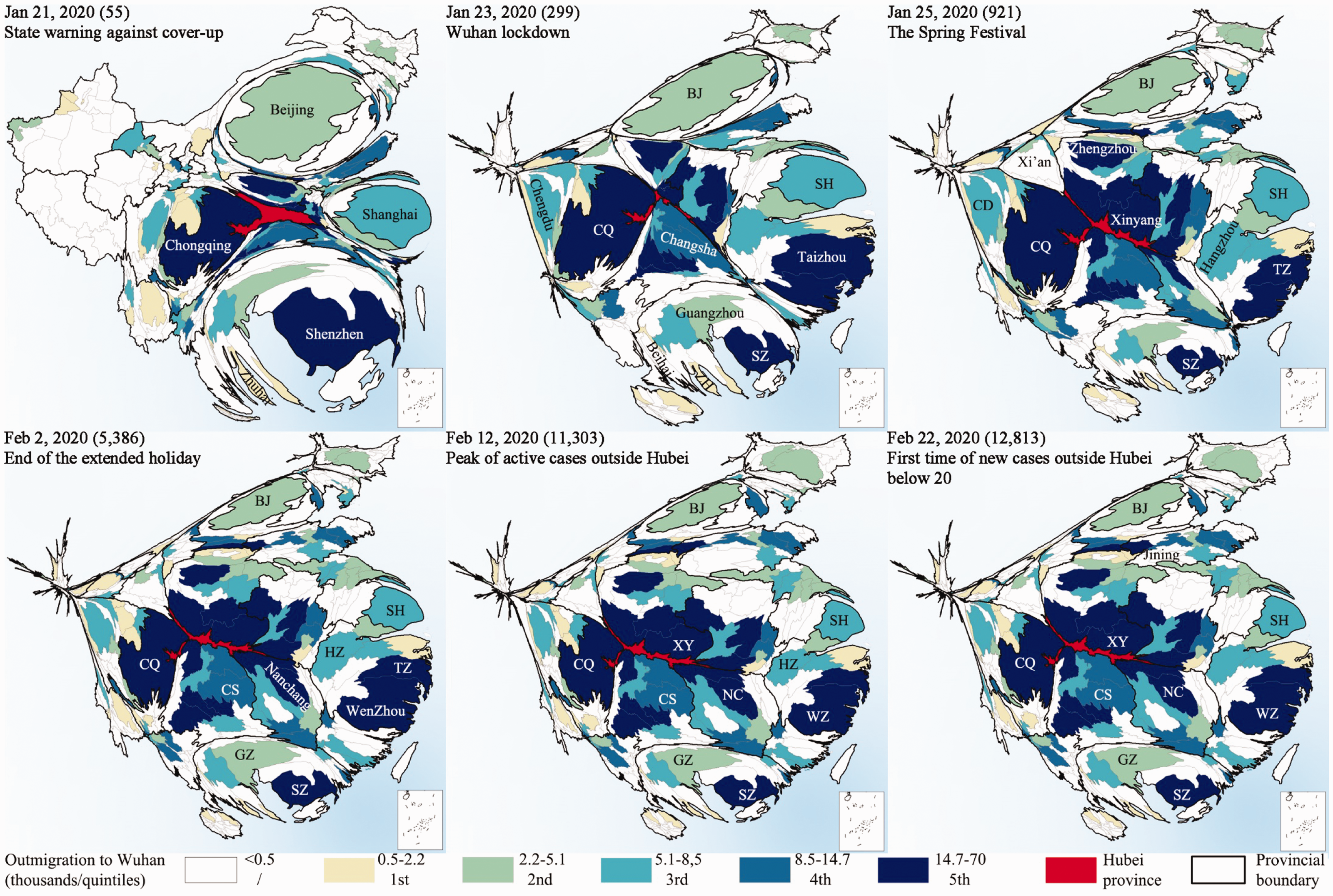
Spread of the 2019 novel coronavirus disease (COVID-19) and geography of internal migrants in China. The area is proportional to the number of confirmed COVID-19 cases. The number in parentheses after each date is the total confirmed cases outside Hubei Province by 24:00 of that day. The top five cities of confirmed cases are labelled for 21 January and top 10 cities are labelled from 23 January. Cities are first labelled with their full names and then as initialisms.
Internal migrants should not be held responsible for the initial spread of COVID-19. The cities first affected are national leading megacities: Beijing, Shanghai, Shenzhen and Chongqing. Their connection with Wuhan is far stronger and closer in terms of business and tourism than of domestic migration. Their leading position with regard to the number of confirmed cases has stayed the same before, during and after the Spring Festival. Irrespective of whether internal migrants travel, these megacities are always highly exposed to epidemics. Internal migrants are only partially responsible for increasing the scale of the outbreak. Admittedly, cities neighbouring Hubei with large migration to Wuhan saw a dramatic increase in confirmed cases throughout the holiday until 2 February. But severe outbreaks have also occurred in these cities’ provincial capitals, some of which, such as Xi’an, are neither contiguous with Hubei nor strongly connected with Wuhan in terms of domestic migration. Business travel between provincial capitals should by no means be ignored. Lastly, Wenzhou and Taizhou, two coastal cities about 800 km away from the epicentre, were hit early and hard by COVID-19 (Xu et al., 2020). Although internal migrants are responsible, the contributors are not the kind of migrants we usually think of. The two cities are famous for their business people, who have greater mobility and larger social networks than the migrant job seekers.
Around two weeks after the Wuhan lockdown, the geography of COVID-19 seemed to begin to stabilise, and active cases outside Hubei reached the peak on 12 February. The current success in China reveals the effectiveness of limiting population movement in general. Now, COVID-19 is spreading quickly in Europe and the U.S., even though both regions are now not in the holiday season. Population movement has become the norm. No one or no group should be particularly blamed for spreading epidemics.
Footnotes
Declaration of conflicting interests
The author(s) declared no potential conflicts of interest with respect to the research, authorship and/or publication of this article: The graphics editor Danny Dorling is the supervisor of the author Qiujie Shi.
Funding
The author(s) disclosed receipt of the following financial support for the research, authorship and/or publication of this article: This work was supported by the National Natural Science Foundation of China (41801146), China’s Ministry of Education Fund for Humanities and Social Sciences (18YJC840022) and the PEAK Urban programme funded by UKRI’s Global Challenge Research Fund (ES/P011055/1).
