




Abstract
This paper is concerned with the socio-spatial and ethical politics of redistribution, specifically the allocation of natural resources rents from political and economic cores to the economic and geographical peripheries whence the resource originated. Based on a case study of the coal seam gas sector in Queensland's Surat Basin, this paper focuses on the operation of the Queensland State Government's regional development fund for mining and energy extraction-affected regions. Employing an environmental justice framework, we critically explore the operation of these funds in ostensibly helping constituent communities in becoming resilient to the worst effects of the ‘staples trap’. Drawing on secondary demographic and housing data for the region, as well as primary information collected from key respondents from mid-2018 to early 2019, we show that funds were distributed across all of the local government areas, and allocated to projects and places primarily on a perceived economic needs basis. However, concerns were raised with the probity of the funds’ administration. In terms of recognition justice, the participation of smaller and more remote towns and local Indigenous communities was hampered by their structural marginalisation. Procedurally, the funds were criticised for the lack of local consultation taken in the development and approval of projects. While spatially concentrated expenditure may be the most cost-effective use of public monies, we argue that grant application processes should be open, transparent and inclusive, and the outcomes cognisant of the developmental needs of smaller communities, together with the need to foster regional solidarity and coherence.
Introduction
This paper is concerned with the socio-spatial and ethical politics of redistribution, specifically the allocation of natural resources rents (aka royalties), or funds derived in part from such rents, from the political and economic core to the economic and geographical peripheries whence the resource originated. Royalties are payments levied by governments – as the notional owners of natural resources within their territory – on those extracting minerals or energy for commercial use and/or sale. As such, royalties represent partial compensation for the alienation of the public's natural capital, which, along with taxes, serve to cover the costs governments bear in the management of the myriad aspects of the extraction process. For those jurisdictions fortunate enough to possess lucrative stocks of natural resources within their administrative boundaries, royalties can also be a source of considerable wealth, and form a substantial plank in the territorial economic base (Eccleston and Woolley, 2014). The levying and re-distribution of royalties, at a range of geopolitical and geographical scales, is therefore a significant public policy issue.
The primary focus of this paper is on the socio-spatial dialectics associated with the reverse flow of capital and power, from the treasury buildings of the metropolitan core to the often far-flung towns and regions that are the sites of natural resource extraction. The intra-state deployment of royalty payments – or funds derived from royalties – is a relatively understudied topic (though see Markey et al., 2019; Ryser et al., 2019). Payments by the state to regions and localities of resource extraction can be justified for a range of reasons, including compensation for the damages and disruption caused in the process of mineral and energy exploration and extraction or the shoring up of a vulnerable political constituency (Eccleston and Woolley, 2014). As noted by others (Bugden et al., 2017; Measham et al., 2019), few forms of industrial development have the capacity to so rapidly and radically transform a physical landscape as the mineral and energy extraction sectors. Mining and drilling companies can – and do – dramatically and swiftly reshape a rural landscape in response to changes in resource demand and, hence, price. While the energy needs of many more developed nations are gradually transitioning away from fossil fuels and towards more renewable and less greenhouse gas polluting sources, rural spaces and places will continue as the sites of solar and wind farms or the mines that produce critical elements for renewable power generation for many years to come. Yet in spite of the continued experience of mineral and energy corporations and governments with rural and remote communities, just and sustainable methods of consultation with them, and compensation and redistribution of the benefits of resource extraction, generally remain elusive.
Underscoring the socio-spatial dialectical perspective employed in this paper, we argue that it is important to appreciate that the social, cultural, demographic and economic implications of new mineral and energy extraction processes both build upon but are also immanent within previous and/or extant ‘impact geographies’ (Gillingham et al., 2016; Haggerty et al., 2018). The concept of impact geographies draws together the ‘constellation of historical, physiographic… economic, and cultural factors that influence the nature of oil and gas development and the character and magnitude of its impacts on local people, ecologies and landscapes’ (Haggerty et al., 2018: 621). In the case of the Surat Basin, the arrival and rapid expansion of coal seam gas (CSG) exploration and extraction from 2012 had a substantial impact on this hitherto farming-dependent, relatively sparsely-settled rural region. The logistical difficulties that the Basin's local governments, town businesses and services and the wider communities grappled with in the immediate wake of the CSG exploration boom stretched local natural resources, infrastructure and markets (e.g. for labour and accommodation; see Cheshire et al., 2014; Fleming and Measham, 2015a, 2015b; Measham et al., 2019). Not surprisingly, the boom fed off but also fed into the extant uneven economic and demographic landscape as the remainder of this paper demonstrates. Crucially, the manner in which local and regional development funds from the Queensland State Government's support scheme for CSG affected areas were distributed arguably reflected extant patterns and processes of accessibility and economic and demographic development across the region and arguably exacerbated divides within it.
Drawing on a case study of the CSG sector in Queensland's Surat Basin, this paper's principal focus is on grant monies and infrastructure development funds allocated to the region. We aim to critically explore the operation of the Queensland State Government's regional development fund for mining and energy extraction-affected regions to communities within the Surat Basin from an environmental justice perspective, and in helping constituent communities in becoming resilient to the worst effects of the ‘staples trap’.
Although this paper has quite straightforward aims, they contain within them a subsidiary set of ideas that warrant further elucidation. For example, when considering the benefits of mineral and energy extraction should only monetary contributions be counted? Issues of geographical and temporal scale are also important: over what time frame and spatial scale should benefits and impacts be gauged? For instance, are immediate cash injections preferred to longer-term investments, typically in infrastructure? Relatedly, is it preferable for funds distributed from the political centre to be spread evenly (if thinly) over recipient regions or is the greatest benefit to be had from more precisely targeted expenditure, even if that seems to advantage extant regional centres at the expense of smaller centres and more sparsely settled areas? Even more importantly for the focus of this paper is a consideration of the optimal mechanisms for ensuring that monies redistributed to regions affected by mining and energy resource extraction are allocated equitably and, as far as possible, produce equitable outcomes ‘on the ground’. The gas companies that established their footprint in the region also outlaid sizeable funds to various infrastructure projects, community activities and ventures – often as co-sponsors of Royalties for Regions (R4R) and Building our Regions (BOR) approved grants – and also directly as compensation to landholders. However, in order to maintain the coherence of the paper the remainder focuses primarily on the distribution of Queensland Government royalty payments to Surat Basin communities.
The remainder of the paper is structured as follows. In the next section, we provide a review of the literature on staples dependence and regional development before introducing the environmental justice framework that forms the conceptual heart of the paper. Following that, we briefly sketch out the historical geography of CSG development in the Surat Basin, noting the impacts of permanent and temporary workforces and populations on local housing markets and labour forces, and the implications of the surge of gas drilling and associated infrastructure building on communities, local governments and informal development institutions (e.g. chambers of commerce). The methods used to collect the primary and secondary data that informs the empirical core of the paper are then outlined, followed by the analysis of the dimensions and impacts of the Queensland Government's grant funds within the Surat Basin. The manner in which the State Government's resource regional funding programme has operated is assessed against the distributional, recognition and procedural justice framework in the penultimate section, which is followed by the paper's conclusion.
Staples dependence, regional development and environmental justice
While there has been increased interest in the virtual geographies of production, consumption and circulation with the acceleration of economic globalisation, there is also a recognition that the economic geographies of staples production, involving the material goods that sustain life and also the basic inputs into industrial processing, remain fundamentally important (Hayter et al., 2003). While food and fibre production is an obvious case, even virtual communication networks rely on materials fabricated from mineral and energy resources that are almost inevitably extracted from non-metropolitan regions somewhere. From a staples theory perspective, natural resource-dependent rural regions tend to be structurally vulnerable to the inevitable booms and busts associated with natural resource sectors, riding the highs of new development phases, commodity price booms and the like as the local labour market and retail sector expands before being jolted back to earth by sudden market collapses, foreign takeover, local resource exhaustion or a combination of all of the above. These dilemmas are also encapsulated in the evocative notion of the ‘resource curse’ (see Watts, 2004; Langton, 2010).
Staples-dependent space economies, whether nations or regions, are seen to occupy a semi-peripheral position in global economic development stakes primarily due to their ‘price taker’ status (Barnes, 1996; Halseth et al., 2014). Seemingly caught in a ‘developed yet dependent’ mode of economic development by historical/political and geographical circumstance, cognitive lock-in and path dependency tend to keep such communities hostage to it, effectively unable to find or construct new strings to their developmental bows (Markey et al., 2019). In the context of this research, cognitive lock-in refers to the circumstance where, inter alia, local business sectors, labour forces, local government and local education system become so economically and psychologically dependent on serving the needs of the dominant industry that they cannot countenance any form of diversification away from that sector. Isolated – both literally and metaphorically – from the epicentres of broader scale government decision-making power by their relative small population sizes and lack of economic clout, many such regions struggle to make their calls for ‘fair shares’ of resource development heard (Markey and Heisler, 2010; Markey et al., 2019; Ryser et al., 2019).
The analysis of the allocation of natural resource rents and, particularly, the fairness or otherwise of that distributional process almost inevitably invokes considerations of natural justice and socio-spatial equity. In Australia, as in many other countries, natural mineral and energy resources are deemed to be the property of the ‘Crown’ – effectively the state – and held, regulated and/or disposed of for the benefit of the public good. The nation's citizens would have every right to expect that such pool resources are managed prudently and responsibly; an assumption that extends to the notion that society earns a fair return on the resource, that is, it is not simply given away or sold for well below market values. Royalty payments are seen as part compensation to the nation for the alienation of the resource and for the many impacts (i.e. costs) – environmental, economic, spiritual – of mineral and energy extraction on the source region. Of course, the host society can expect other benefits from the sale of its natural resources beyond royalty payments, including – but not limited to – increased investment flows, higher levels of employment, renewal of extant or construction of new infrastructure, increased taxation takes and the like (Fleming and Measham, 2015a; Ford et al., 2016).
As the expanding international literature on the impacts of mineral and energy extraction on host communities and ecologies has demonstrated, though, such expectations of ‘fair returns’ and ‘fair shares’ may be somewhat naïve. The concept of environmental justice, itself closely related to the emergence of environmental justice movements around the globe (Otsuki, 2016; Urkidi and Walter, 2011; see also Harvey, 1996; O’Rourke and Connolly, 2003), provides a framework for understanding the role of structural and agency-driven factors and processes in enabling or preventing the achievement of socio-spatial equity in relation to environmental resource exploitation and the spoils thereof.
Environmental justice is effectively an umbrella concept that incorporates three separate if closely related forms of justice. Distributional justice covers perhaps the most easily recognised aspect of socio-spatial equity, encapsulated in the oft-used phrase, ‘who gets what, where, and with what effect?’. It focuses on the relative fairness of goods, services and resources provision within and between areas and how the action of distribution affects the social positioning of recipient populations (see Harvey, 1996; Urkidi and Walter, 2011; Luke and Emmanouil, 2019). A distributional justice perspective is obviously integral to developing an appreciation of the relative fairness of resource apportionment in relation to mineral and energy resource extraction for it focuses on how monies, in the form of royalties and taxation that flow to the Crown, should be allocated. Should they simply be aggregated into consolidated revenue and allocated as standard public expenditure, or should at least some portion of the funds be directed to the regions and communities at the site of extraction in order to compensate local people for the inevitable disruption and actual and potential environmental consequences of exploration and extraction activity?
Over the past two decades or so, and in the context of a thorough-going neoliberal reform of macro-economic and political institutions (O’Neill and Fagan, 2006), a debate has simmered in Australian academic and public policy circles over the most effective approach to regional development strategy and funding, with some arguing in defence of a more place-based approach that seeks to maintain, as far as reasonable, the extant settlement system and communities of interest. However, influential public and private sector bodies, such as the Productivity Commission and the Grattan Institute respectively, contend that the greatest return on public investment for all Australians would come from a people-based strategy that transmits market signals (e.g. job opportunities) directly and clearly to the sovereign, rational individuals that comprise the population (Grattan Institute, 2011; Productivity Commission, 2017). Notably, the Productivity Commission was critical of the underlying principles of the Western Australian and Queensland Governments’ separate programmes to redistribute mining royalties to non-metropolitan regions, along with some of their practices (Productivity Commission, 2017).
In relation to CSG, there is a substantial body of research that has reviewed the environmental and population health hazards that some have argued are associated with it so issues of distribution are neither an abstract nor trivial consideration (Claudio et al., 2018; Haggerty et al., 2018; Keywood et al., 2018). Proponents of the sector often point to the anticipated boon for local employment and, consequently, for the broader local and regional economies, especially in the cases of remote rural areas battling the downward spiral of demographic, service provision and economic decline (Fleming and |Measham, 2015a, 2015b). On the other hand, critics highlight that the benefits emanating from CSG development tend to be episodic and elusive, at least for affected communities (Markey and Heisler, 2010; Fleming and Measham, 2015a). The essentially short-term nature of peak CSG direct employment, together with the propensity for gas companies to rely overwhelmingly on non-local workers employed on fly-in/fly-out, drive-in/drive-out or bus-in/bus-out arrangements and stay in out-of-town workers camps means that resource boom-affected regions and towns need to plan well in advance so as to capture the potential developmental gains on offer (Macpherson-Rice et al., 2020). The extent to which any local Indigenous or First Nations owners are appropriately consulted with and compensated for access to territory held under native title and for any disruption to traditional practices and damage to or destruction of sacred sites and foraging and hunting grounds also falls under this category (Natcher, 2001; O’Faircheallaigh and Gibson, 2012; Trigger et al., 2014; O’Faircheallaigh, 2016; Baker and Westman, 2018; Rodon et al., 2018).
The distributional justice perspective provides important insights into the equity of particular socio-spatial distributions of benefits and harms associated with natural resource extraction over space and time. However, as highlighted above, it arguably neglects some of the more subtle yet systematic factors that influence the formation of this uneven geography. Recognition justice is one solution to this blind spot. This notion, drawing inspiration from the fundamental human right to self-expression and recognition, addresses the potential exclusionary politics – deliberate or accidental – associated with who is accorded rights to be meaningfully involved in discussions and negotiations over the approval for and management of natural resource development projects. For Watts (2004) there is no accident in which population sub-groups and/or administrative areas are considered remote and ‘inaccessible’, or suitable to be consulted, or not, over natural resource developments (see Mercer-Mapstone et al., 2018). Under what he terms ‘oil governance’ global petrocapitalism finds affordances with local authoritarian governments in the creation of particularly exclusionary political spaces and scales in which, overwhelmingly, disenfranchised local populations are effectively prevented from benefiting from the sector's growth. A prevalent theme under this rubric is the influence of historical legacies of forcible displacement and dispossession and ongoing marginalisation that Indigenous communities face in being fully and appropriately recognised as traditional owners and custodians of land on which resource extraction occurs (O’Rourke and Connolly, 2003). While the eventual recognition of Native Title in Australia from 1993 has addressed this key obstacle to some degree the substantial disparities in wealth and political power between Indigenous tribal groups and mining and gas companies can place native title owners at a real disadvantage (Trigger et al., 2014). The lens of recognition justice can also be applied to special interest groups campaigning against the local and extra-local environmental and economic effects of CSG extraction, such as the ‘Lock-the-gate’ alliance that has sprung up and spread across rural Australia (Sherval and Hardiman, 2014; Mercer et al., 2014). Equally, this particular lens can be seen to apply to smaller place-based communities within resource regions who struggle to gain public visibility for their particular developmental issues due to being ‘crowded-out’ from the political agenda by larger and better organised communities.
The third perspective, procedural justice, focuses on the processes by which fair and unfair allocations and outcomes occur. The role and functions of the legal system are obviously pertinent to considerations of how resource projects proceed, who needs to be consulted and who has the right to negotiate, and even if such projects are able to commence (see Witt et al., 2018). This notion also incorporates the roles and functions of the state apparatus in, for example, advocating for certain developments in preference to others. It can highlight the way in which power inequalities and inequities are structured within societies and the extent to which these influence the trajectory of resource projects. Increased market concentration within the oil commodity chain has been argued to lead to the generation of growing power imbalances between lesser-developed nations and oil companies, and increasingly unfair negotiations over the latter's access to the former's oil reserves (O’Rourke and Connolly, 2003). In this sense, procedural justice overlaps with recognition justice. Overall, and in toto, the environmental justice framework provides an effective means of evaluating how equitably the benefits and harms generated by CSG development are spread across affected regions.
A brief anatomy and critical dissection of a boom: CSG in the Surat Basin
The Surat Basin covers an area of ∼300 000 km2 (see Figure 1) and is one of the largest producing coal bed methane basins in the country (Towler et al., 2016). Although the existence of natural (conventional) gas, coal bed methane and CSG in various parts of the Surat Basin has been known of since the early 1900s, exploration and commercial extraction in the region only commenced from around 2006 (Towler et al., 2016). Since the turn of the current century CSG exploration, extraction and associated infrastructure construction has expanded swiftly and with dramatic effects. This heightened activity has been attributed to a range of factors: (1) forecast domestic shortages of natural gas (conventional and unconventional); (2) related price increases domestically and internationally; and (3) the Queensland Government's decision in 2005 to force domestic electricity retailers to generate at least 13% of their power from gas-fired sources (Towler et al., 2016). By 2011, the Surat Basin became Queensland's main supplier of all forms of gas – but particularly CSG – overtaking the Bowen Basin further to the north (Towler et al., 2016; see Figure 2).
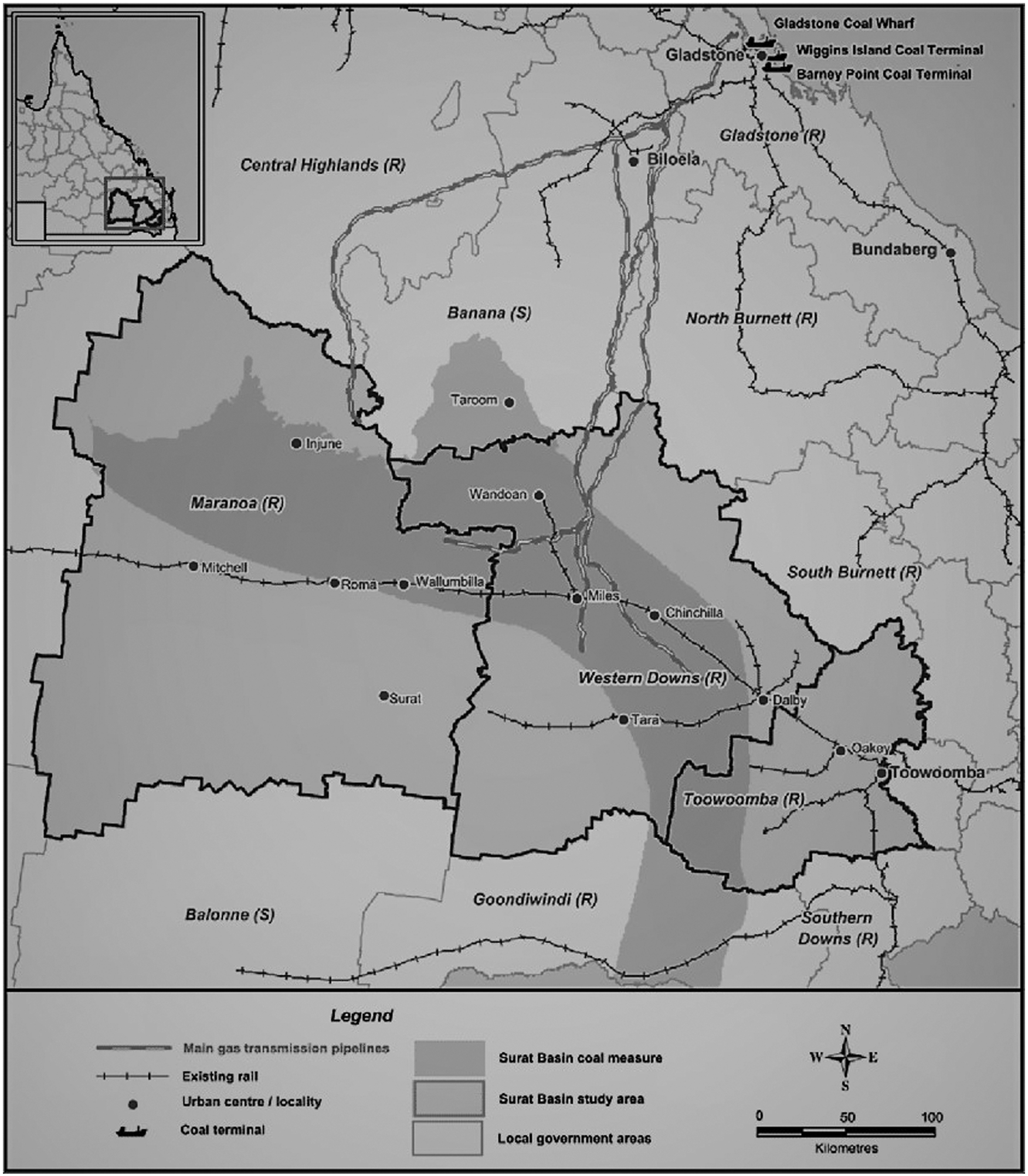
Map of Surat Basin, Queensland.

Historical Queensland gas and CSG production (approx.), 1996/1997–2015/2016.
At a finer degree of spatial resolution, this production boom was indicated by rapid growth in local populations, permanent and temporary, as a sudden influx of drilling teams, pipeline construction crews and associated workers flooded into towns and, more controversially, out-of-town workers camps. Table 1 shows that enumerated resident population levels in the region began to climb slowly across a few of the Statistical Area 2s (SA2s; see definition below) following the Queensland Government’s 2005 legislative stipulation. Prior to this time most SA2s in the region were either quite stable demographically or losing population. However, the final column of Table 1 shows the highly uneven impact of CSG on the regional population. Some areas, such as Miles-Wandoan, Roma and Roma Region turned around periods of population loss to record relatively high rates of growth in the 2011–2016 intercensal period. The opposite was true for the SA2s of Tara and Wambo. To some extent these results reflect the spatially and temporally discontinuous character of demographic and workforce change during the boom. In such relatively small, narrowly based economies, local land and housing markets can be ‘spiked’ by quite small numerical increases in demand (Measham et al., 2019).
Surat Basin SA2 a total populations (place of enumeration), 2001–2016.
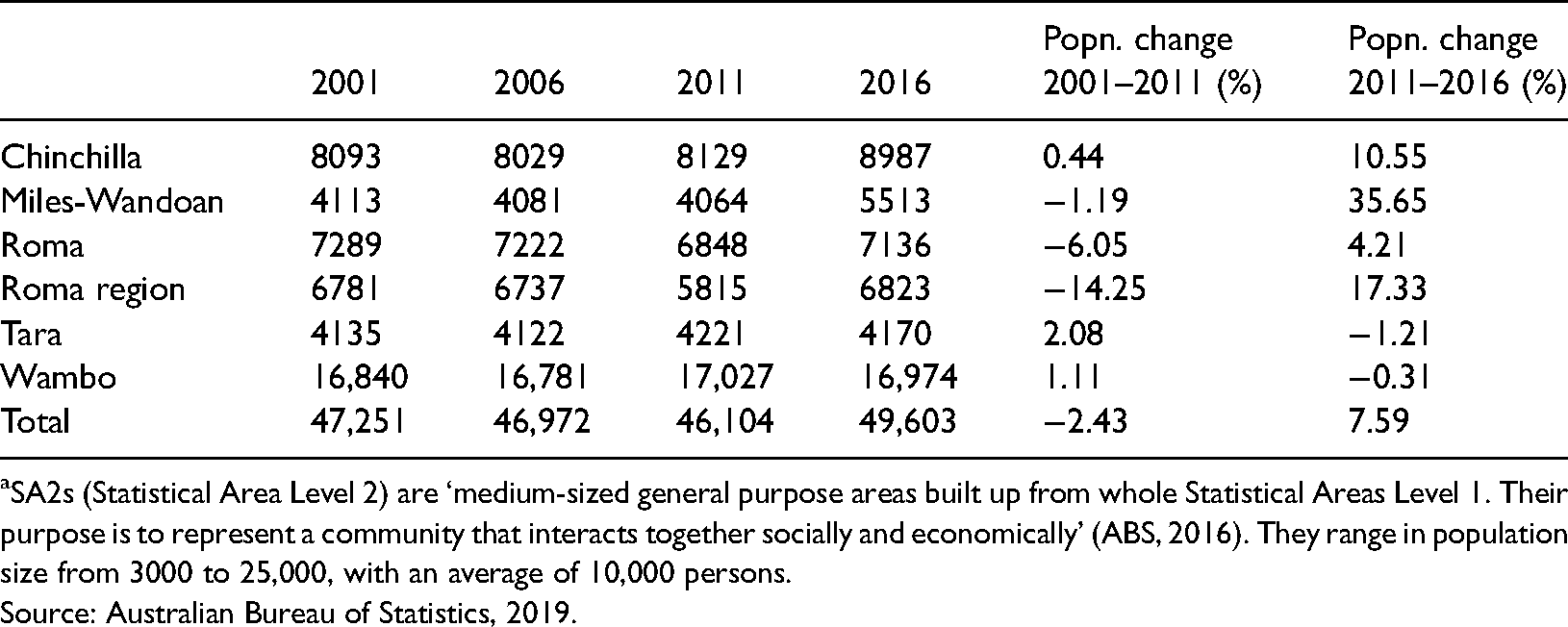
SA2s (Statistical Area Level 2) are ‘medium-sized general purpose areas built up from whole Statistical Areas Level 1. Their purpose is to represent a community that interacts together socially and economically’ (ABS, 2016). They range in population size from 3000 to 25,000, with an average of 10,000 persons.
Source: Australian Bureau of Statistics, 2019.
Figure 3 captures something of this aspect of the boom: it highlights that particularly rapid growth was experienced in Chinchilla SA2 from the onset of exploration to the present, with Wambo SA2 also undergoing a more minor surge in population from 2005 to 2010 before a period of decline. Analysis of Census data for the local government areas and townships within the Surat Basin over the decade from 2006 shows that especially rapid population growth was felt in the Western Downs LGA with an average annual growth rate of 1.8%, compared to .3% per annum in Maranoa LGA immediately to the west. However, the most spectacular population increases occurred in the towns of Chinchilla and Dalby with mean annual growth rates over the decade of 6% and 2.3%, respectively. The remoter SA2s of Roma underwent population growth from about 2005 for a decade before returning to longer term trends of decline. Similarly, the population of the small town of Tara, situated just outside of the zone of most intense CSG exploration activity, grew by a robust 4.4% per annum from 2006 to 2011 before slipping back into decline in the following intercensal period, recording a mean annual rate of −5.8%. Chinchilla's sustained brisk demographic expansion was underpinned by the construction of the Kogan power station and subsequent CSG well construction and related development over 2007/2008 (Witt et al., 2019). As Figure 3 shows, though, the westernmost and more remote SA2s in the region soon returned to pre-boom trajectories of gradual depopulation once the peak drilling and construction phase petered out. Over the same period, the more locationally advantaged SA2s of Chinchilla and Miles/Wandoan also saw their more robust rates of population growth tail off towards longer-term trends pre-CSG expansion.
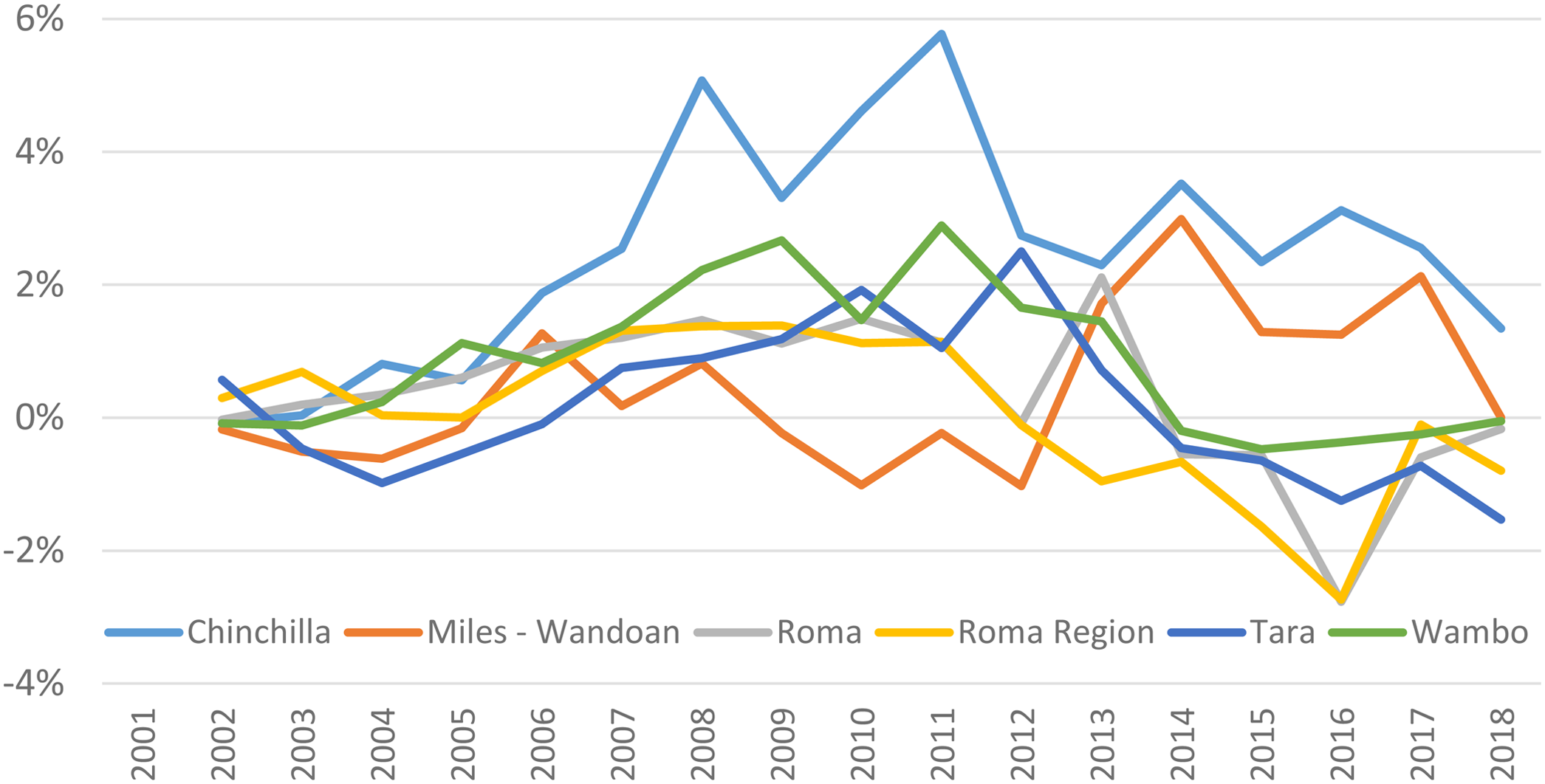
Estimated resident population growth rates (%), Surat basin 2001–2018.
Local housing and other accommodation markets reacted rapidly and predictably to the pulse of permanent and temporary workers arriving in the region. Figure 4 records median sale prices for detached dwellings for various parts of the Surat Basin from the turn of the current century to mid-2019, and demonstrates a sustained rise in sales values for most towns and broader regions to mid-2013. Chinchilla's house sales values roughly quadrupled on 2000 values by this time. Other towns and areas, such as Miles/Wandoan, saw local housing values peak a year or more later. It is noticeable that the greatest sustained increases occurred in the towns rather than the non-urban areas though it is noteworthy that Roma region housing prices saw a jump during 2016 prior to declining towards the longer term trend.
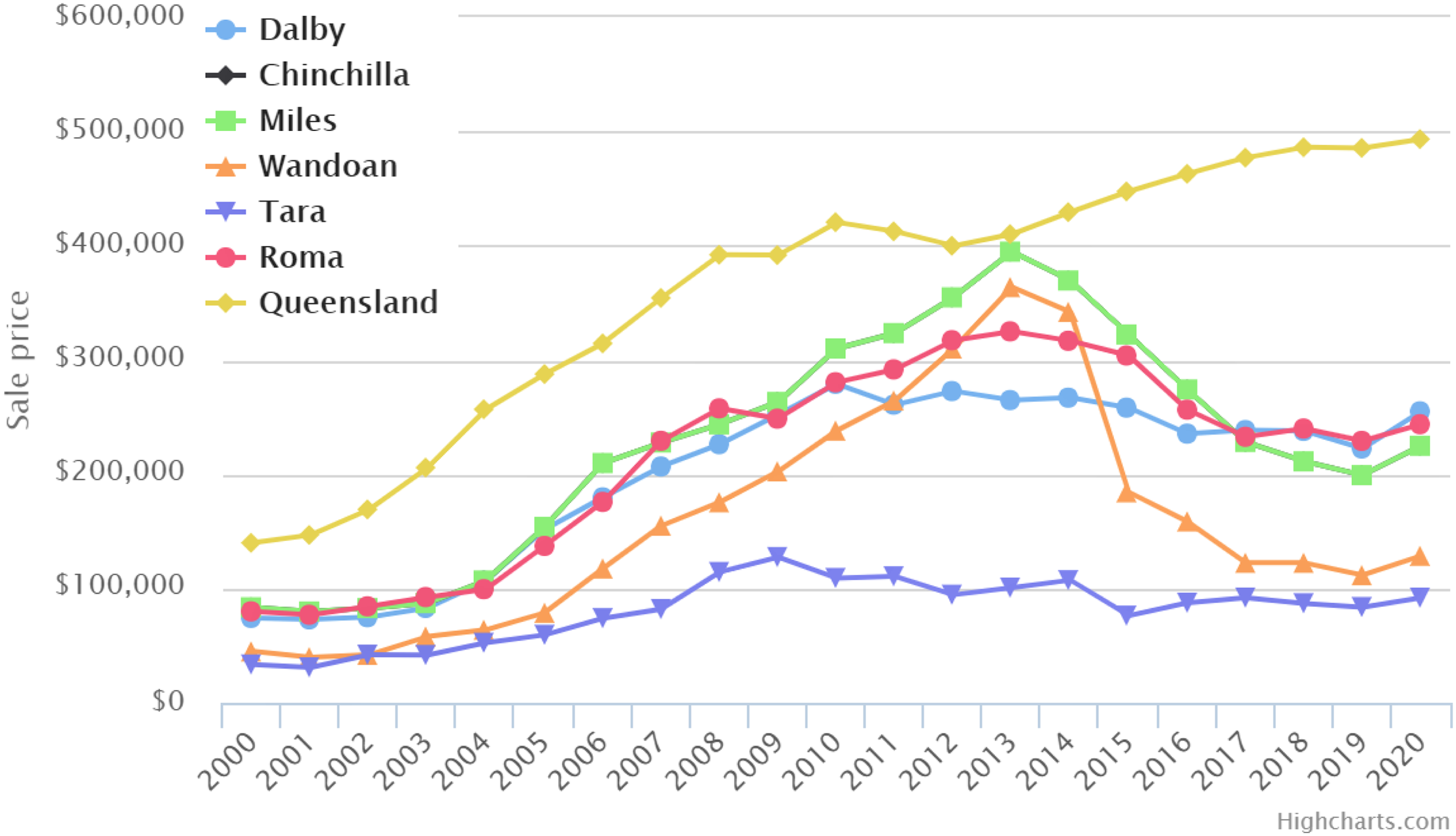
Median house prices for selected Surat Basin towns, 2000–2020.
The continued rise then sudden fall in house sales values shown in Figure 4 do not capture the full dimensions of the impact of the CSG boom on local housing markets, landlords and tenants. Even though rents in towns such as Chinchilla and Roma reached unprecedented levels, and exceeded State medians (Witt et al., 2019), the use of out-of-town workers camps by gas companies did keep large numbers out of local housing markets. Controversial as the use of workers camps has been, this initiative did likely dampen rental values. As noted by Measham et al. (2019) though, the boon of high rents for landlords in these towns was relatively short-lived, whereas rental and sales values in major regional centres like Toowoomba continued to steadily climb from 2014 to 2016.
Methods
This paper provides a case study of the environmental justice implications of the distribution of development funds at least notionally derived from the CSG sector on the communities of Queensland's Surat Basin. It draws on secondary demographic and housing data for the region collated from the Australian Bureau of Statistics, as well as primary information collected by the authors from key respondents within the region. The case study area was selected on the basis that it was one of the few onshore regions in Australia in which CSG exploration and extraction had been permitted. As noted above, the exploration activity had peaked just prior to this project's fieldwork, and this time span facilitated some mature reflections by respondents and researchers alike on the impacts – positive and negative – of CSG on the region. The following analysis is based on 12 interviews conducted with a total of 16 representatives from: the two local governments within the case study area (i.e. Maranoa and Western Downs; n = 3); the local farm lobby, AgForce (n = 1); Queensland State Government agencies (i.e. the Queensland Gasfields Commission (n = 5)); Basin community representatives via the local Chambers of Commerce (n = 3); the Mandandanji people (n = 2); a formal regional development organisation (n = 1) and a regional advocacy and support organisation (n = 1). Identification and selection of potential interviewees was based on our concern to gain informed perspectives from community leaders in the fields of regional and local government, local industry, local Indigenous groups and any community development groupings, along with relevant State Government department and/or agency representatives. Initial discussions with some local government representatives in the region led to further ‘snowball-type’ identification and recruitment of other groups and individuals, locally and within State Government. Interviews were conducted in person during mid-2018 through to early 2019, and were electronically recorded and transcribed prior to analysis. Transcript analysis was primarily guided by the overall research project's aims and objectives but was also attentive to any emergent themes.
Our interviews with the various community stakeholders of the Surat basin elicited a range of impacts – positive and negative – associated with the CSG boom and subsequent downturn. By and large, these were congruent with topics covered in the academic and grey literature. It would be a significant understatement to say that CSG development in the Basin has been controversial for it has engendered strong emotions for and against the resource itself, the various means by which it is extracted, and its taxation treatment at various scales of government (see, e.g. Espig and de Rijke, 2016; Walton et al., 2017). Consistent with the aims of this paper, the following sections explore the role of the Queensland royalty redistribution schemes in ameliorating the worst effects of gas exploration and extraction activity and delivering a ‘fair share’ back to the source region and facilitating its broader social and economic development.
Fair shares for the Surat Basin? Royalties and the politics of their redistribution
The Surat Basin's experiences of the CSG boom could be portrayed as (yet another) case of multinational corporations sweeping into and over another resource periphery, disrupting its communities’ narrow economic bases and fragile social organisations, all effectively within a porous regulatory framework (Watts, 2004; Michell and McManus, 2013; Haggerty and McBride, 2016). However, such a simplified understanding overlooks the important influences of the institutional network, incorporating formal and informal rules and bodies, in guiding the process of development. Equally, such a stark view ignores the benefits and costs that CSG has brought to affected regions and towns (see Ford et al., 2016; Phelan et al., 2017). A complex set of stimuli, including national and international pressure to reduce dependence on greenhouse gas emitting energy sources, and burgeoning demand for ‘clean’ natural gas amongst the major Asian industrial powerhouses (e.g. India, China, Japan) has seen offshore and onshore gas exploration and extraction increase dramatically in Australia over the last decade (Department of Industry, Innovation and Science, 2015).
In contrast, the formation of appropriate regulatory instruments to ensure that the Australian public receives fair and reasonable returns on liquefied natural gas (LNG) exports via taxation and royalty payments has been more piecemeal (see Australian National Audit Office, 2016; Kraal et al., 2020). Current legislative frameworks have largely failed to meet public expectations. As an example, official sources estimated that by 2021 LNG would become Australia's largest energy export commodity by value, at an estimated A$43 billion per annum (Commonwealth of Australia, 2016). In 2019, the country overhauled Qatar as the largest single national producer of the resource (Toscano, 2020). However, due to the patchy application of Commonwealth royalties (i.e. they apply only to some offshore LNG schemes), and the extremely generous industry concessions written into the Petroleum Resources Rent Tax legislation, the nation has seen miniscule and declining revenues flow back to its coffers (Commonwealth of Australia, 2016).
Australian state governments collect royalties for onshore rather than offshore gas developments. In Queensland royalty payments are set at 10% of the resource's value at the well-head. Table 2 displays royalty revenues for the state for the past decade. Over that period natural resource royalties have almost doubled to over A$5 billion annually, with coal royalties comprising the vast majority of that income flow. Nonetheless, royalties from petroleum products (chiefly CSG) have increased in value by over 750% over the decade, and now comprise ∼9% of the State's royalty income from natural resources.
Coal and petroleum (including liquefied natural gas (LNG)) royalties, Queensland, 2010–2019.
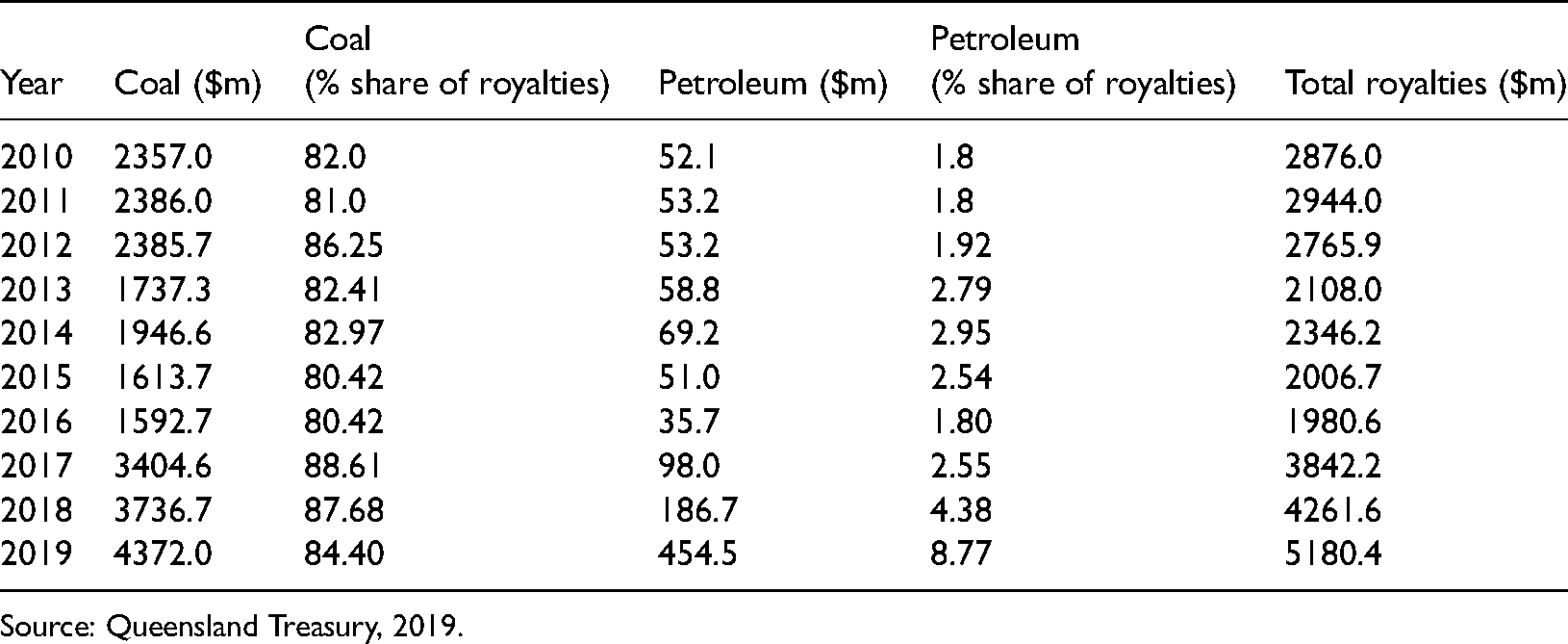
Source: Queensland Treasury, 2019.
In terms of distributional justice, and the redistribution of funds to energy source regions, the Queensland Government has run two regional social and economic development funding schemes for natural resource-dependent regions since the early 2010s. Its ‘R4R’ programme was similar in philosophy to the Western Australian Government's relatively well-known ‘R4R’ programme which redistributed 25% of all natural resource royalties back to rural and remote regions. The Queensland Government's ‘R4R’ fund ran from 2012/2013 to 2015/2016 after which it was replaced by the ‘BOR’ grants programme. ‘R4R’ delivered nearly A$ half-a-billion across 147 projects spread over the major resource provinces of the state, primarily for infrastructure (e.g. road, railway and airport improvements) but also for local medical services, and arts and recreation. The successor funding mechanism, ‘BOR’ distributed $375 million across a small number of component funding schemes: a capital fund; royalties fund (local govt. focused for impacts of resource activity); remote and indigenous fund; and transport infrastructure fund. In spite of the titles of some of these funds or their components it is important to appreciate that they have not and do not directly allocate petroleum royalty payments back to the producing region: ‘All funding distributed through the Building our Regions program is allocated through the Queensland State Budget process from consolidated revenue’ (Department of State Development, Manufacturing, Infrastructure and Planning, 2019).
Consistent with current neoliberal regional development philosophy, ‘BOR’ funds are awarded on a competitive basis and need to be matched by other sources. As of mid-2019 the Surat Basin had received A$62.62 million from the programme as part funding for projects costed at A$174.8 million. In other words, the Queensland Government was responsible for just under 36% of total project costs on average. The funded projects across the region were oriented around the logistical needs of gas companies and other staples producers in terms of marshalling mobile factors of production and bringing them to the region, but also to securely transporting the extracted resource to port. Some of the largest projects by expenditure in the Surat Basin were trunk road improvements, water filtration and reticulation for communities experiencing population growth and developmental expansion, airport upgrades, botanical gardens, flood mitigation works and livestock saleyard improvements. From a distributional justice angle, funds were spread across all of the local governments of the region, and allocated to projects and places primarily on a perceived economic needs basis. That said, so-called ‘soft’ social infrastructure projects were also supported, and in smaller, more remote communities. However, just as there were divided opinions between different town communities over the relative benefits of CSG, so different towns and local governments within the Surat Basin held contrasting perspectives on the merits of these projects, if they were aware of them at all.
The gas companies that had so rapidly and dramatically established their footprint in the region also outlaid sizeable funds to various infrastructure projects, community activities and ventures – often as co-sponsors of R4R and BOR approved grants – and also directly as compensation to landholders. The disbursements that companies such as Shell/QGC, Origin and Arrow made to local infrastructure projects and via council rates could justifiably be regarded as part of these companies’ rightful contribution to the maintenance and/or improvement of infrastructure that their operations had depreciated. Nonetheless, rates revenues from gas company owned and operated land were regarded as something of a bonanza, enabling at least one local government to pay down its debts and build a fund for future investment. Aside from these more or less compulsory financial contributions, gas firms also voluntarily spent varying sums on targeted grants for ‘legacy items’, such as a new kindergarten in Chinchilla, but also smaller amounts to support local sporting and/or social activities, thereby leveraging some social capital within the targeted communities and also securing gas companies’ ‘social licence to operate’ (Brueckner and Eabrasu, 2018) within the region.
One of the major structural impediments to recognition justice for some Surat Basin towns was the creation of regional councils across the State in 2008. In that year the Queensland state government concluded a controversial local government amalgamation process across the state. In the Surat Basin, 11 local government areas – and administrations – were reduced to two: the Western Downs and Maranoa Regional Councils. The process had the potential to increase the centralisation of strategic decision-making power and economic clout in the regional council headquarter towns – Dalby and Roma – and a concomitant diminution in many if not all towns and communities that lost their ‘shire headquarter’ status. Some towns and local government areas were able to extract substantial financial benefits from the upsurge in gasfield development activity, whether from increased rates revenue, expansion of local business sectors and housing markets, corporate sponsorship of community facilities and the like. The smaller and more remote towns have since struggled – doggedly in some cases – to capture and retain many of the economic and demographic stimulus associated with CSG in spite of determined lobbying of their gas companies and their local council. Many have directly witnessed the geographical transfer of value occurring across their region, envisaged what might have been and bemoaned the lost opportunities.
At least one community complained about the lack of transparency in relation to how regional project funding applications were compiled. Having developed its own development strategy just prior to the amalgamation process, the Miles chamber of commerce expressed frustration at the broader regional council administration's apparent ignorance of the document when applying for funds:
Chamber of commerce member: … So, who's got it (the community investment plan)? And what are they doing with it? Is it put in the filing cabinet? And that is my real feeling… is that's what's being done with both these documents. They’re put in the filing cabinet until there's a bucket of money and then it's like, “Oh well, who's made the most noise?”. Or, “Have they got something here that's project ready that we can pull together…” (Interview with Miles Chamber of Commerce, 2018).
For one of the local Indigenous communities, the Mandandanji, recognition has been a fundamental obstacle to them gaining any real benefit from the CSG sector's expansion. In their case, the boom provided some lucrative opportunities for enterprise development and employment generation, ranging from cultural heritage management advice through to gas well maintenance work. However, protracted contestation with other claimants has effectively stymied the Mandandanji's attempts to gain sustained employment and business growth from the boom. While they struck agreements with gas companies regarding access to their lands, and received payments accordingly, dispute within the group over ancestral connection to land (see Trigger et al., 2014) has called the Mandandanji's native title claim into question. In the words of one of the Mandandanji representatives:
[T]he problem is the extinguishment of native title was never recorded anywhere. So on the consent forms they’ve signed, I don't even think they (the native title holder claimants) realized what they were signing. So the difficulty we have now is that the judge has accepted that consent and said, “Okay well there is no longer a native title claim for the Mandandanji people”, which makes our applicants almost irrelevant as far as having any say other than the claim itself. So we’re appealing the process that was taken … And the legislation around what happens as a result of all that now has put us in a position where no one has been before. So, they’re saying there's no identified body for the area that we live in. [But] like I could tell you now, I’m Mandandanji. This is where my people are from. So it puts me in a position … Well, who are we if we’re not from here? … so we’ll still be dealt with as the applicant body because we’re the last man standing and no one else can come in and put a claim on the area but we’re sort of left in limbo (Interview with Mandandanji spokesperson).
At the time of interviewing, the status of the claim had still not been resolved. Although the group's enterprises were still able to provide services to the gas industry and generate income, continuation of the Indigenous Land Use Agreement would provide a far more lucrative flow of funds.
As noted earlier, procedural justice is influenced to greater or lesser degrees by formal legislative institutions and legal structures that enable, and constrain, access to natural resources and the funds that flow from their extraction and sale. In relation to mineral and energy resource development in Australia, and in accordance with the Constitution, State Governments hold primary responsibility for land-use planning, including the allocation and regulation of development licences for resource projects. Being a Federal system of government, though, different states can adopt and enact their own stances regarding particular industries. Thus far, of all the states, only Queensland has fully embraced and encouraged the CSG sector, with most other states banning the industry's activities within their borders. New South Wales has oscillated from being an early enthusiastic supporter of the sector to banning it outright to then, more recently, cautiously permitting the industry's presence via one isolated project.
In relation to the approval and regulation of development rights for mineral and energy resource exploration, the Queensland Government has generally adopted a United States-style market-led stance (Witt et al., 2018) which recognises the primary responsibilities of resource companies to purchase an exploration licence and then negotiate access with landholders. In spite of this largely non-interventionist standpoint, the Queensland Government has been increasingly forced to intervene in the regulation of the CSG industry. In doing so, it has left a legacy of formal and informal regulatory structures to manage the sometimes fraught relationship between resource companies and their sub-contractors (e.g. drilling firms), on the one hand, and land and native title holders, local governments and communities-of-interest, on the other. Included in this expanding architecture are the Queensland Gasfields Commission, Conduct and Compensation Agreements (the last mentioned negotiated between landholders and gas companies) and the 2010 Land Access Code (Witt et al., 2018).
Amongst the Surat Basin communities, negative opinions of the R4R and BOR funds tended to centre on the lack of local consultation taken in the development and approval of projects, together with the haste of the process (see also Scott, 2016). The Queensland Audit Office (2015) condemned the administration of these programmes by the relevant State Government Department, highlighting a lack of transparency in the manner in which funds were distributed to local councils. It found that local governments had:
…applied their resources and time to obtaining data and developing submissions, the content of which were partly or entirely ignored. In the final analysis, many unnecessarily invested their time, resources and money to demonstrate the value of their applications against criteria that were apparently irrelevant. Lack of documentation of the reasons for such decisions means it remains unclear what actual criteria were used to decide which projects were to be funded (Queensland Audit Office, 2015).
Disgruntled local representatives complained about the rush to get the projects completed, how relatively little local businesses were able to gain from them by, say, contracting for some of the work, and the lack of sensitivity to local needs with at least some projects. For one Surat Basin Mayor, whose local airport had been swamped by the influx of FIFO workers at the height of the exploration phase and subsequently underwent a multi-million dollar expansion via the R4R programme, the lack of local sensitivity was a case in point:
…the debacle with the airport was the gas companies put in a million and a half each. That's all they put in. But it was a $10, 12 million build… But you never had to pay to park at the airport, and now there's (paid) parking at the airport. Where's the win there? … I think it's totally unfriendly that you fly into this tiny place with 7 000 people and you pay for parking. It's crazy… (Local mayor on a local airport upgrade).
By the same token, though, other councils saw the local and broader value of more civic-oriented projects exemplified by a botanical garden (Chinchilla), also part funded by the R4R programme:
… so the Chinchilla botanic gardens had been a pursuit of the previous Chinchilla Council. So, there was an amalgamation that was previously six councils were now one. Thirty five years ago, I think it started or something like that … and there is a Chinchilla horticultural club which had been pursuing it for all of that period of time. It was also put on the Chamber of Commerce list of the … Chamber of Commerce every years has a list of priority projects that they’d like to see pursued, and I think it was the top, or top four or top five in there, and that was identified to council as one of the things that they wanted. There was an ability at the time to secure suitable land from Queensland Rail which hadn't previously been the case, so a number of things came together, and council put in 50 per cent of the money with the State Government to build that (Interview with CEO of anonymous Surat Basin shire).
The botanical gardens project might seem to fall into the ‘town beautification’ category of development and to therefore have little to contribute to the economic resilience of the town and the broader community. However, the local shire saw it differently:
… we try and identify things that we think will enhance liveability. So, one of the things is, as I said, we want as a council … have determined that we want more people in the gas industry to actually live here and not fly in/fly out. The gas companies have surveys of their staff to work out what's the impediment to that, and it's clear that the perceived liveability of our towns was an impediment to people moving their families here (Interview with anonymous Surat Basin shire CEO).
Another concerning issue with the R4R and BOR schemes related to the low level of awareness amongst local office bearers and ordinary residents of Queensland State Government-funded projects from either of these schemes. Even some shire mayors were unclear on the funding sources for some quite substantial local investments that their bailiwicks had been recipients of. Although the relevant part of the Queensland Office for State Revenue website contains details on funded projects, out in the recipient regions few respondents could identify what initiatives had been recommended for and had received financial support. In part, this lack of recognition may be a result of how the application process is managed at State and local government scales. In the case of at least one shire:
Well, we don't do community consultation of what we’re going to put in normally because, to be honest, there's just not enough time. They (the funding schemes) open around … and you might have 60 or 90 days to put your submissions in with costing and all that sort of stuff. They don't give you a lot of notice that the round's going to open … (Interview with anonymous Surat Basin shire CEO).
Discussion and Conclusion
As the staples thesis literature reminds us, natural resource dependence can be a source of very considerable wealth, at least for some time, but it can also lead to long-term structural weaknesses in local and regional economies (Argent, 2013; Ellem and Tonts, 2018; Tonts et al., 2013). As demonstrated throughout this paper, with the advent of CSG exploration and extraction, the Surat Basin became an ‘impact geography’ – to use Haggerty et al.’s(2018) term – the sudden and uneven spread of workers and other temporary population, capital, machinery and infrastructure across its towns and rural areas creating a broad mesh of disruption (Measham et al., 2019). The volatile character of CSG markets and extraction activity, in part due to its per unit value being linked to another energy resource – crude oil – means that the difference between creating a bonanza out of a boom and simply missing out can come down to timing. And given the volatility on such energy markets, with regionally-specific conflicts in key source zones affecting supply, and the gradual international move away from fossil fuels affecting demand, many businesses, large and small, were caught out by the sudden cessation of local boomtime conditions.
We have employed the environmental justice framework in this paper to help provide a sharper and critical focus on the social and economic justice – or injustice – of the Queensland Government's various regional development schemes for CSG-affected areas within the state, as applied to the Surat Basin. In particular, the framework's trifocal perspective on the distributional, recognition and procedural aspects of these funding programmes affords important insights into not just ‘who got what, and with effect?’ but also the means and methods by which power is exerted at a range of geographical and governance scales in the application, assessment and allocation stages. From a distributional angle, the funded projects were certainly welcomed by recipient communities. Many of these investments, particularly in areas of core infrastructure, should provide long-term benefits to the individual communities of the Basin, as well as the Basin overall. How distributionally just they were, though, is perhaps another story. As noted earlier, independent reviews of both the R4R and BOR programmes uncovered substantial deficits in their administration, raising concerns over the probity and transparency of the application, assessment and approval processes of the programmes. Local experiences of the programmes – to the extent that Surat Basin residents were aware of them at all – were consistent with a number of the Queensland Audit Office’s (2015) findings.
While environmental justice is an umbrella term for the three subsidiary ‘lenses’ it is important to recognise that the analytical framework should not be applied mechanistically. Certain issues or controversies may involve or imply the overlapping or intertwining of two or more perspectives. For instance, throughout the preceding analysis we have demonstrated that problems in the application process were exemplars of recognition and procedural injustice, which then arguably led to inequitable distributional outcomes ‘on the ground’. These unjust processes were aided and abetted by major structural shifts in the regional institutional framework – implemented by the State Government – that led ultimately to a recentralisation of decision-making power and responsibility that advantaged the larger towns that became shire headquarters under the new regime, but to the detriment, by and large, of the smaller and more remote towns that were marginalised in the local government amalgamation process (Ford et al., 2016). For towns such as Miles and Tara, for instance, their visibility for investment and in-migration within their own region was diminished, an outcome that frustrated local residents and undermined their capacity to capitalise on the many if elusive opportunities presented by the CSG boom, and arguably harmed their long-term economic and demographic prospects. The historically most disadvantaged local group, the Mandandanji, also seem certain to have lost their opportunity to develop sustained economic benefits from the CSG construction boom due to the complex interaction of historical structural barriers together with local contestation. While it could be argued that more spatially concentrated expenditure – targeted on the largest and most robust centres and their hinterlands – is the most cost-effective use of public monies, as we have argued from an environmental justice perspective the grant application process should be open, transparent and inclusive, and the outcomes cognisant of the developmental needs of smaller communities, and the need to maintain, or foster, a sense of regional solidarity and coherence.
Footnotes
Acknowledgements
The research project from which this paper emanates is funded by the Canadian Social Sciences and Humanities Research Council, Project No. 19430. The authors gratefully acknowledge the participation and assistance of the communities of the Surat Basin and relevant Queensland State Government agencies in the research on which this paper is based.
Declaration of conflicting interests
The authors declared no potential conflicts of interest with respect to the research, authorship and/or publication of this article.
Funding
The authors disclosed receipt of the following financial support for the research, authorship, and/or publication of this article: This work was supported by the Social Sciences and Humanities Research Council of Canada (grant number 19430).
