



Abstract
This paper examines the multiple ways that environmental justice scholars and activists understand the task of creating real change. It asks what forms of social movement organising, strategy, and tactics create the enabling conditions for environmental justice. Reporting on a large international study using Q methodology to empirically examine the discourses emerging and circulating about EJ globally, we outline the patterns of thinking and practice that EJ activists and academics identify as enabling their work. Not surprisingly, our findings highlight broad agreement on a strategic focus on racial and socioeconomic injustices for successful EJ movement strategy. Yet within that broad agreement, three distinct approaches were identifiable: (1) An ontological focus, addressing decolonial and redistributive visions of racial and socio-economic justice in solidarity with Indigenous peoples and other marginal social groups; (2) a strategic systems focus on political disruption, based on networked power from below and transformative practical strategies; and (3) a methods focus, using tools, tactics, and techniques for prioritising local knowledges, participation, recognition, and inclusion in public, political, and legal forums. In addition, we found most disagreement with, and disillusion about, the value of more mainstream strategies that target policy frameworks and legal institutions. The paper concludes with reflections on the implications for EJ movement praxis in this moment when EJ faces political and corporate attacks.
Introduction
Environmental justice (EJ) movement strategies and tactics have proliferated and diversified over the past 40 years. Movements seeking EJ span multiple sites and spheres of political contestation, and exist across the globe. They are visible in struggles against mining, polluting industry, pipelines, incinerators, highways, hydroelectric dams, and often against large-scale wind and solar developments. Increasingly, EJ movements have engaged with questions of climate impacts, resilience, and adaptation strategies (Murphy-Greene 2022). Within the complexity of diverse experiences across the local-global and north-south divides, EJ practitioners and theorists generally express a cohered, historical-structural critique of the sources of environmental injustice and barriers to change, with a commitment to pluralism and careful attention to intersectional differences. This more critical approach to understanding the root causes of environmental injustice, such as argued by Pellow (2018), has recently been found to be central to the discourse of EJ activists and scholars in the field (Schlosberg et al., 2024). However, less clear are the movement strategies and tactics being deployed to address these systemic barriers in order to enable change; that is the focus of this study.
What has the breadth of EJ movement experience led activists and scholars to prioritise when reflecting on movement strategies and tactics? What do these movement actors believe enables change? How do beliefs about such enablers differ across the movement – and how do they come together? Much of the work on EJ movement strategy is based on case studies of environmental injustice (e.g. Cole and Foster, 2001; Gugliotta, 2000; Leonard, 2018; Norgaard, 2006; Temper, 2019) or overviews that provide conceptual analysis of movement critiques and demands (e.g. Pellow, 2017; Schlosberg, 2004; Sze and London, 2008). We aimed to bridge these types of insight by asking a global group of EJ scholars and practitioners to reflect on the ways they think about what actually enables change. In an era where environmental justice is under attack as both a concept and a movement, we focus here on ways both activists and academics understand the potential for the success of EJ concerns.
This paper draws on an extensive content analysis of recent EJ literature, followed by a Q survey, interviews, and focus groups with people working across EJ academic and activist realms. While a related study focuses specifically on the range of perceived barriers to the achievement of environmental justice (Pearse et al., 2025), this inquiry focused on the ideas these scholars and activists prioritised when reflecting on the enabling conditions required to achieve EJ. We begin with a brief overview of the strategies and tactics for change documented in EJ praxis and social movement literature, as well as the challenges and ambiguities associated with them. We then document our research methodology and present an overview of our results, identifying points of consensus among our participants as well as their focus on three key enablers of successful EJ campaigns: an ontological focus on decolonisation, a strategic focus on political disruption, and a methodological focus on tools to centre community knowledges. We conclude the paper by reflecting on the findings and implications of this work.
Realising environmental justice: Strategy, tactics, power
Environmental justice movements worldwide are seeking transformative change. While originating in the US and North America more broadly, EJ movements and scholarship has brought together diverse streams of civil rights and anti-racism (Taylor 2014), labour (Perkins 2022), Indigenous (Gilio-Whitaker 2019; Whyte 2020), and environmental movements and their confluence (Cole and Foster 2001). The resonance of the EJ idea meant that movement discourse and organisations quickly developed across the globe, though from varied and home-grown concerns and movements across all continents (Holifield et al., 2018; Martínez-Alier, 2020). EJ as a discourse and framework expanded topically from its origins in specific pollutants to a range of environmental and social indicators, horizontally across numerous countries and regions, and vertically to become an organising principle of multiple global issues, most obviously climate justice (Schlosberg, 2013). It is not our purpose to examine the diversity of the movement in all of the localities, regions, and contexts in which EJ has been taken up, but it is crucial to note this diversity in our discussion of overlapping consensus and concerns about movement strategy.
For many, transformative change requires a wholesale re-embedding of capitalist production systems within planetary and regional/local ecological limits; a range of multi-scalar political economic reforms that would see the world’s society’s reckon with the colonial past and present; and a redistribution of wealth, power, and opportunity to the majority world and oppressed communities everywhere (Pulido 2017; Rosemary-Claire et al., 2015; Sultana 2022a). Pursuing these transformational EJ movement goals requires diverse strategies of collective action, and coordinating such strategies at scales significant to the global social/environmental order presents key challenges. EJ analysis illustrates that the barriers to change remain structural and multi-dimensional (Pearse et al., 2025). Accordingly, social movements like EJ have long recognised the limitations of rigid organising logics that privilege singular and unified positions at the expense of plural identities, alliance-building, and solidarity.
Various modes of collective action and mobilisation are evident throughout the history of EJ organising, from its origins in the US to its broader application globally. Central to this is direct action, including protests, blockades, and occupations, that have been used to disrupt business-as-usual practices since the inception of the EJ movement (Murdock, 2020). Other forms of action, used alone or in combination, include engagement with formal state planning processes, forms of legal action, community-based research and documentation, formal networking between organisations at different scales, informal alliance building, social media campaigns, and cultural campaigns through art, music, and theatre. Although such tactics remain central to movement operations, the field has also evolved and differentiated. For example, youth engagement is far more prevalent than even a decade ago (Hilder and Collin, 2022; Schusler et al., 2019), voter turnout is increasingly targeted in campaigns in the global north (Perkins, 2022), and issues of race and Indigeneity are more distinctly central in varied socio-political contexts (Pulido, 2018). A significant contribution of EJ organisations has been the identification and coining of terminology, which in turn has been taken up in scholarship and policy, as a way of recognising patterns of oppression and conceptualising systemic impacts globally (Martinez-Alier, 2018; Martinez-Alier et al., 2016). This includes not only EJ itself, but concepts of environmental racism, biopiracy, food sovereignty, land grabbing, corporate accountability, ecocide, and Indigenous territorial rights, for example. Such terminology has often developed from direct actions in ways that cut through official press and academic writings to engage with wider audiences.
One of the most significant developments in gauging broad trends in EJ organising beyond individual case study analyses is the EJ Atlas, a living archive that maps global EJ conflict and strategies of resistance across the world (Temper et al., 2015). Drawing on 2743 examples of community-reported EJ conflict from the EJ Atlas, Scheidel et al. (2020) found non-violent grassroots organising to be the central mode of organising across regions in the Global South and North, and across all income groups. This most often takes the form of formal petitions, public campaigns, and street protests, and increasingly, the creation of collective action networks, involvement of NGOs, and media-based activism (Scheidel et al., 2020). Legal strategies such as lawsuits and objections to environmental impact assessments are drawn on where possible, and scientists and professionals are often involved in creating community-directed evidence bases for impacts or alternative proposals. Direct actions such as road blockades, occupation of public buildings, land occupation, and self-sacrifice tend to be drawn upon when other strategies have failed to gain traction. While only 11% of the cases examined resulted in successful outcomes, a combination of preventive mobilisation, protest diversification and litigation saw this increase to 27%. In considering EJ victories and success, it is also important to note that there is significant variability in how activists perceive EJ successes or failures, and that different activists have different values and objectives for campaigns (Pulido et al., 2016; Özkaynak et al., 2021).
The ability of organisations to engage with communities, build alliances, and activate effective tactics of resistance is fundamentally shaped by the legal, political, economic, and social systems they are operating within. For this reason, it is often difficult to disentangle particular strategies of resistance from the specific challenges and opportunities, and there may be contextual paradoxes present in particular strategies. For example, case studies from Latin America note that legal strategies may be simultaneously drawn on and challenged as appropriate throughout campaigns (Correia 2023; Hernández Vidal et al., 2023). Similarly, activists in the USA may advance their work through legal formalisation or draw on state mechanisms while simultaneously seeking to destabilise existing governance practices (Milligan et al., 2021; Perez et al., 2015; Perkins, 2022; Rios, 2015). Williamson et al (2020) scoping review of EJ movement capacity building in in the USA found that scholarly work focuses on issues of participation, community power, leadership, and networks, and that attention tends to be paid to potential rather than actual policy change. More broadly, Harley and Scandrett (2019) edited collection of scholarly and activist writing on EJ organising around the world documents a range of dilemmas faced by activists. These include the funding support of philanthro-capitalism that is itself created through forms of dispossession, the presence of outright state violence, and the need to reckon with internal disputes around power within movements. They point out that ultimately, solidarity and agency in EJ organising is determined by “the extent to which multiple communities engaged in particular struggles are able to link together to challenge the interests of structural power, such as capital, colonisation or patriarchy” (Harley and Scandrett, 2019: p.216). Reflecting on radical, future-oriented organising, Correia (2023, p.4) states that EJ organising is ultimately dependant on “the ability to maintain collectives in the face of existential threats,” something it continues to demonstrate.
Dilemmas and difficulties creating change at scale
Past research has illustrated that environmental justice organisations face a range of dilemmas and difficulties, existential and otherwise, in creating change at different scales. At the local level, organisations often struggle with limited resources, lack of political power, and the challenge of mobilising marginalised communities who may face multiple barriers to participation. Grassroots organisations may find that funding sources come to influence the goal setting and strategy of the movement (Frey, 2021), while operations reliant on the time and capacity of volunteers struggle with burn-out over time (Harley and Scandrett, 2019). Moreover, a central concern at the local scale is the spectrum of violence faced by activists mobilising in different parts of the world. While activists in the Global North are not immune to violence at the hands of the state or corporate forces, myriad forms of surveillance, intimidation, violence and lethal force are experienced daily by activists throughout South America, Africa, and Asia (Scheidel et al., 2020).
At the state or national level, EJ organisations face the challenge of navigating complex political landscapes and policy-making processes, often dominated by powerful interest groups and corporate lobbying (e.g. Ravikumar et al., 2018). Schlosberg (2013) argues that EJ organisations in the US have faced challenges in effectively engaging with federal and state regulatory agencies, which often have a narrow focus on technical solutions and fail to adequately address the social and economic dimensions of environmental justice issues. For example, aspects of national agendas for renewable energy policies and projects were increasingly challenged as a legitimating discourse for ongoing issues of land dispossession, extraction, and capitalist consumption (Okereke and Ehresman, 2015). Additionally, while state or national regulations are often targeted by EJ campaigns, officials or departments may lack the political will or capacity to monitor operators or enforce existing laws (Pulido et al., 2016). Harrison (2019) work on the ambiguous and often racist organisational cultures in offices of environmental enforcement, and Milligan et al. (2021) analysis of the multi-level challenges the racial state poses for EJ organisations in Atlanta, viscerally illustrate this problem. Such obstacles have obviously increased with the outright racism and demonisation of EJ by the Trump administration.
Globally, EJ struggles in the Global South often face advocating for the needs of marginalised communities in the face of powerful global institutions and corporations. They are also often marginalised in both local and global environmental governance structures. For example, the UN and its attendant mechanisms tend to prioritise the interests of its industrialised nation members and the corporations they are associated with. In the context of international climate negotiations, Jacobsen and Hunt (2022) argue that for justice-based ethical agendas become diluted and less potent in the development of policy-oriented outcomes. While international forums such as the UNFCCC have formed as sites of environmental governance, sometimes with justice as a focus, it is clear that this process is dominated by the agendas of powerful petro-states and transnational corporations, and that many countries remain unwilling to implement social or environmental agendas that threaten their international economic growth (Brad et al., 2022). While the UNFCCC have incorporated EJ notions into their frameworks, it is often through a “resignification of the meaning of environmental justice, emptying it of its more radical bent” (Asara, 2022: p.492). The failure of COPs to commit to tangible climate targets and funding has resulted in rising distrust in this forum on the part of EJ and CJ movements (Asara, 2022).
Strategy and tactics in environmental justice praxis
One way to inquire into social movement praxis is to evaluate the extent to which movements aim to compel a change or break from the prevailing system of social relations (Melucci, 1989), yet the politics of knowledge can be fraught. Scholars need to be wary of dualism in social movement analysis, particularly in studies that presume stark distinctions between reformism/radicalism, local/global, plural/unified forms of praxis in movements (Johnston and Goodman, 2006). Our survey of the literature signals that EJ movements sit with these tensions carefully and thoughtfully, though not without practical difficulty.
Significant here is a recognition that social movement strategy and tactics are often conflated (Smithey, 2009). In our review of EJ academic literature and activist writing, we noted that many authors blend broad strategic intent with the tactical choices available to movements. For this reason, we offer a brief definition of strategy and tactics and further commentary on what binds these elements of EJ praxis together.
We take EJ movement strategy to mean the ways movement groups link concrete actions and techniques for mobilising shared resources with shared goals they hope to achieve (Ganz, 2000). Strategy then, links means to ends. EJ movements tend to seek transformatory social change through practices that aim to embody and popularise EJ. For social movement theorists influenced by Gramsci et al. (1971), strategy is a war of position between social movements and counter-vailing state/capital forces. In this view, EJ movement strategy aims for hegemony in the prevailing material and ideational structures of society.
Tactics, on the other hand, are the specific actions that EJ movement organisations use to influence change. Public protest is a key unit of analysis, but so are the fuller range of tactics that build shared meaning and identity for movements (Polletta and Jasper, 2001). EJ movements have long used a broad array of tactics including and beyond protest, from occupation to citizen science.
The political opportunity structure (POS) model of social movement activity seeks to explain how strategy and tactics come together in social movement mobilisation over time (McAdam et al., 2001; Tarrow, 1996). The POS emphasises structural-institutional determinants of social movement action and opportunities to create change, shaped by the relative stability or instability of power dynamics in political institutions and elite networks. Reflecting on what this means for EJ movement analysis, Pellow (2007) argues that the POS model echoes the strategic impulses of EJ movements in some important senses, but also fails to account for the commitment to plural identities and intersectional perspectives on racial and gender oppression. He also flags that POS models don’t thematise systematic exploitation and harms to non-human natures.
Pellow (2018) approach to Critical EJ is characterised by a historical-structural critique of the political economic causes of environmental harms and inequalities. Critical EJ informs an overall strategic impulse to resist global sources of power – particularly governments, multi-national corporations, financial institutions, and some movement practices that can hinder transformatory change. Unlike traditional POS, Critical EJ helps to incorporate insights of anti-colonial and feminist thought into the barriers and opportunities for change. Such an approach helps EJ scholars and practitioners see the structure and occasional moments of conjuncture and instability that might allow EJ movements to realise change.
In order to consider the applied utility of these frameworks, we surveyed and interviewed EJ activists and scholars about their priorities regarding the strategic goals and tactical choices documented by diverse movements in recent years. Our approach is structured by Q methodology, as detailed in the following sections.
Methodology: Examining enabling discourses
The goal of Q methodology is to uncover the subjective priorities that inform different perspectives, or discourses, on a given topic. The method draws on three types of data: two qualitative (literature analysis and interviews) and one quantitative (factor analysis). Q has three distinguishing features that made it an appropriate research method for this study. First, it provides a systematic way of engaging with both individual and population-wide perspectives. Q enables big picture discourse analysis as well as a focus on the lived experiences of individual participants, enabling two interrelated scales of analysis. Second, it allows researchers to engage with the priorities that underpin multiple or competing perspectives on a particular topic, allowing us to identify granular differences between participant perspectives. And third, Q allowed us to pinpoint areas of consensus and difference within the EJ community, and provided us with a systematic way to elevate activist voices within the methodology itself. These capacities allow us to uncover insights on contested or complex issues, which is particularly valuable in engaging with the diversity of the EJ field. Our use of Q is briefly outlined here; those interested in the methodology should refer to more comprehensive guides (see Brown, 1993; Watts and Stenner, 2012). 1
Q research is a multistep process that involves gathering diverse statements on a particular topic from the public domain (a concourse), establishing a representative statement list (a Q-set), and then asking a group of participants to sort these statements according to their own agreement (a Q-sort). Our concourse was composed of statements about EJ from academic and activist publications from nine world regions, from which we developed a Q-set list with equal academic and activist statements. Participants ranked these statements according to their own level of agreement, producing distinct Q-sorts. Participants were briefly interviewed by researchers to better understand why they prioritised particular statements. Once all Q-sorts had been completed, they were analysed using factor analysis to group together similar responses and provide information on what makes that type of response distinct from others in the participant group. This produced a series of factors – shared discourses or perspectives – which reflect the identifiable trends in priorities that underpin individual responses. It is important to note that in Q analysis, some participants align primarily with one specific factor or perspective, while others are more evenly aligned with two or more.
In this study, we wanted to know which enabling values and strategies were prioritised by both activists and academics. The participants involved in this study were identified through their public affiliation with an EJ cause (e.g. climate, food, land rights, energy) working at a range of scales from individual grassroots causes to regional or national organisations. Q requires ideologically or experientially diverse but relatively small-n participant groups, and for this study we had 25 participants, which is normal for the method. All participants were activists or scholars, and many identified as ‘scholar-activists’ or ‘activist-scholars’ (though we stuck with their primary label for the purposes of this work). They were residents of Australia, Fiji, Germany, Madagascar, Norway, Philippines, South Africa, Togo, Uganda, UK, and USA. During the Q process, we gathered demographic information and feedback on the sorting process and statements provided, and held both individual interviews and follow-up focus groups with participants in order to gather feedback and adjust our analysis accordingly.
Similarities and differences between activist and academic literature on enablers of environmental justice.
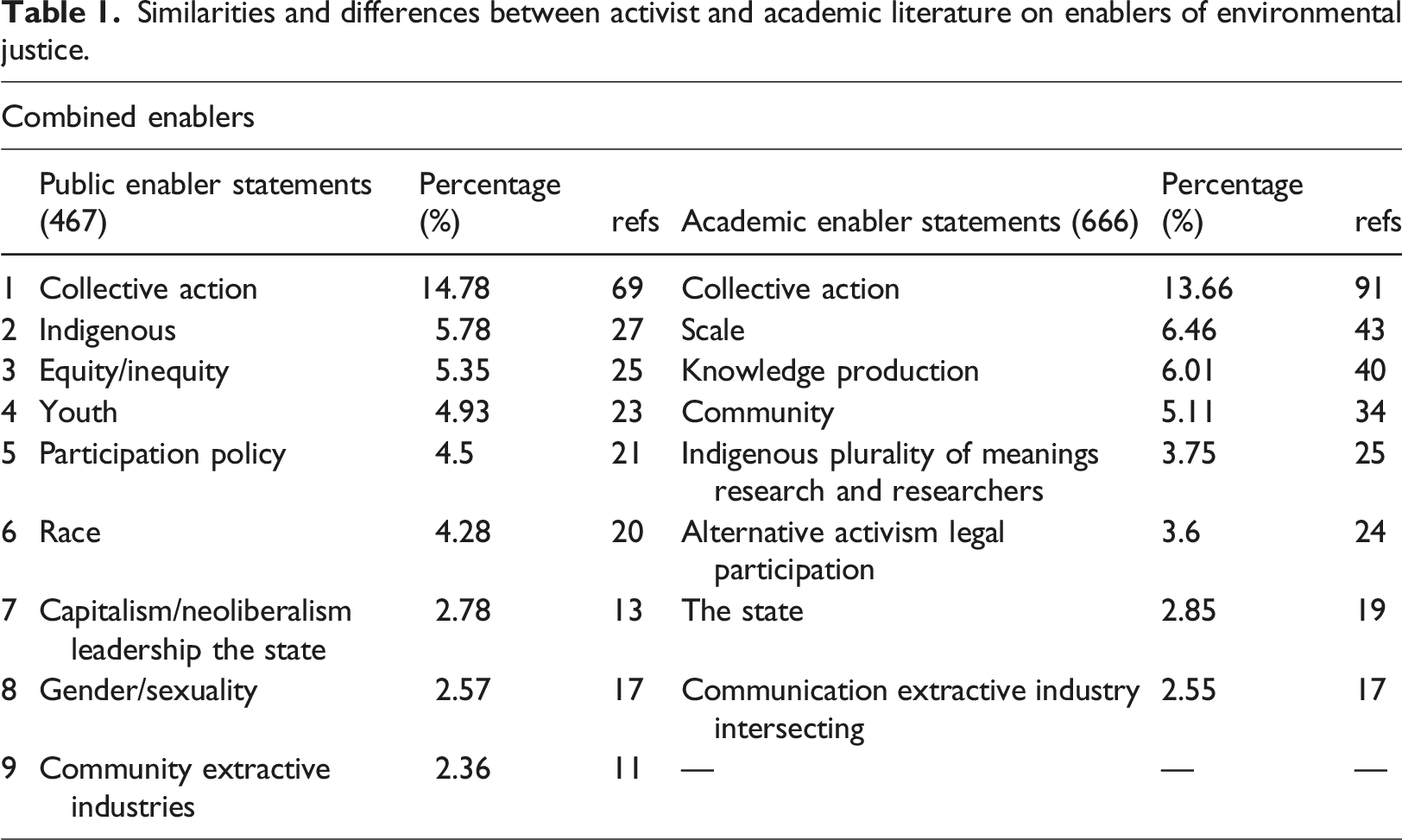
Q-sorts and consensus
Of the 25 participants that completed this study, 15 identified primarily as academics and 10 as activists. It should be emphasised that the nature of the Q sort is to force participants to reveal their own priorities within a field of statements they may broadly agree or disagree with. The ranking given to each statement is a reflection of each participant’s opinion of what works for EJ in this moment, rather than an evaluation of each statement’s ultimate role in the cause itself.
While Q helps identify distinct shared priorities, the results reveal far more nuanced alignments in participant responses. Of the 25 participants, 13 demonstrated response patterns that can be characterised as sitting fully within one of the identifiable approaches outlined below. However, 11 participant responses aligned with two or more of these approaches, and therefore held more pluralistic or permeable strategic and tactical foci in their own work. The purpose of this research is not to pigeonhole participant views into a particular discourse, but rather to better understand trends in the priorities and values informing EJ activism and scholarship more broadly (see Figure 1, below). Intersections of support for different enablers.
A key part of our analysis focused on the broad trends evident in all participant responses as a way of identifying areas of consensus around particular strategies and approaches. We conducted a preliminary assessment of trends in the raw participant scores, prior to the factor analysis that distinguishes participants by similar patterns of response. Importantly, the majority of statements receiving the highest levels of consensus were from activist sources. Key statements that received the strongest level of agreement were “Racial and socioeconomic justice must be incorporated into the way we fight for the protection of our planet” (Greenpeace USA, 2022) and “Women should be enabled to play a central role in the processes of struggle and resistance” (Villarreal and Echart Muñoz, 2020).
Participants most strongly disagreed with the statements “Tackling systemic racism is no longer fundamental to achieving environmental justice” (modified to the negative from Lakhani and Watts, 2020), “Visual storytelling and art are not effective activist tools and have little role to play in collective forms of environmental justice” (modified to the negative from Spiegel et al., 2020), and “Intergenerational equity within environmental policy is not an important part of achieving environmental justice” (modified to the negative from OECD, 2020). Participants’ rejection of these statements underscores the enduring relevance of these core issues within contemporary EJ praxis and research. While there is recognition of the role of visual storytelling and art as a means of self-determination and representation in environmental justice activism (Bladow, 2019; Brower, 2018), the high level of priority and near total consensus given to this statement emphasise that this mode of cultural campaigning is considered by participants to be a highly relevant enabler.
Our results also reveal more nuanced trends within the participant sample. Some statements received broad consensus but exhibited a high rate of variation in the level of priority given by participant responses. For example, “Environmental justice alternatives must be based in community solidarity rather than capitalism” (Blasingame, 2020), “Partnerships between local organisations and academic institutions enable wider participation in data collection and analysis” (Mena et al., 2020), and “Protecting environmental defenders is crucial to halting the destruction of the environment” (McCarthy, 2020) received general agreement, but saw a wide variation in the degree of priority they were allocated.
Other statements had a more consistent pattern of response that resulted in a moderate-low level of priority. For example, “Knowledge and data gathered by communities to document adverse health effects from toxic exposures is valuable” (Hollis, 2019), “Intersectional solidarity can help researchers and activists hold powerful actors to account” (Malin and Ryder, 2018), and “Including the perspectives of people with disabilities is necessary and beneficial to environmental and social justice movements” (Jampel, 2018) received complete agreement, but responses revealed an overall trend of moderate to low priority. “The joint mobilisation of organisations with similar interests does not empower local communities” (modified to the negative from Garnett, 2018) was disagreed with, however most participants assigned it a moderate level of priority. Similarly, the statements “Environmental justice advocates and scholars do not drive policy changes that aid communities” (modified to the negative from Yang, 2020) and “It is not necessary for local activist groups to form communities of interest with well-resourced national organisations” (modified to the negative from Garnett, 2018) received broad disagreement, but with a high rate of variation that tended towards low to neutral priority.
The statements “Crowdsourcing, citizen science, and other participatory approaches do not enrich environmental justice research” (modified to the negative from Hendricks et al., 2018) and “Mapping, drone, and smartphone technology do not help community members produce evidence of environmental injustices” (modified to the negative from Pellegrini, 2019) received similar patterns of moderate disagreement across the participant sample, but, as we will see, came together in a key way.
Overall, we see a broad consensus on the enablers of environmental justice – not surprisingly a strategic focus on racial, gender, and intergenerational justice. But going beyond this initial agreement, we used Q’s factor analysis to identify more distinct patterns of participant response. By grouping participants with similar overall response patterns together, Q can help reveal the nuanced but distinct and collective sets of priorities that characterise the way participants responded to enabling strategies and tactics. In examining this data, we found three clear perspectives, discourses, or priorities.
Enabler perspectives/discourses
Community focus: A decolonial/Indigenous approach
One distinct approach to enabling the achievement of EJ emphasises in particular the importance of decolonial and Indigenous discourses and ontologies, along with core ideas of critical EJ. Participants with this view were mainly academics, but also included activists, from both the global north and south. The statements highly prioritised by this group of participants alone were that “Environmental justice and Indigenous rights are deeply connected in prioritising care for the land over capitalist production” (Wikler, 2019), and “Decolonial analysis and practices help transcend the Western roots of environmental justice theories” (Temper, 2019).
The statements receiving a moderate level of priority in this group were “Environmental justice alternatives must be based in community solidarity rather than capitalism” (Blasingame, 2020), “Protecting environmental defenders is crucial to halting the destruction of the environment” (McCarthy, 2020), and “EJ advocates must incorporate the priorities and knowledge of communities facing environmental injustice” (Svarstad and Benjaminsen, 2020). There was also a moderate agreement with statements on the empowerment gained by joint mobilisation of organisations with similar interests (Garnett, 2018), on the effectiveness and use of visual storytelling and art as activist tools (Spiegel et al., 2020) and the importance of empirical data as key to assist grassroots organisations effect policy change (Mohai et al., 2020). These statements represent the tactical and practical applications of the values this group prioritises, though their moderate ranking suggests that values rather than specific tactics most strongly define and characterise the approach.
Of the consensus statements of all participants in the study, participants in this particular approach most strongly agreed with statements on the crucial role of systematic racism, socioeconomic justice and equity, intergenerational equity, and the role of women. Taken together, this approach prioritises decolonial social values through solidarity, anti-racist and anti-capitalist praxis at the community level. It presents as an agenda-setting approach to change, focused on building a counter-hegemony based in intergenerational, racial and socioeconomic justice, in keeping with the critical EJ tradition. The emphasis on women’s leadership and care also indicates the importance of feminist ideas to this EJ praxis, and the focus on community knowledges illustrates a lower priority on work with global movements.
Systems focus: A structural disruption approach
Another consensus group focused on the value of political and structural disruption in enabling environmental justice. Responses here again included both academics and activists in the North and South. The single strongest agreement in this group was for the statement “Environmental justice transformation requires activists and scholars to disrupt and re-set the terms in which policy and action take place” (Yang, 2020). This approach was also the only one to highly prioritise “Including the perspectives of people with disabilities is necessary and beneficial to environmental and social justice movements” (Jampel, 2018). The strongest disagreement was evident for the statements “The use of social media (such as viral hashtags) is not an effective form of activism” (modified to the negative from Bladow, 2019) and “It is not necessary for local activist groups to form communities of interest with well-resourced national organisations” (modified to the negative from Garnett, 2018). There was more moderate support for prioritising the influence of frontline communities in the policy process, and for the role of advocates and scholars in driving policy change.
Of the consensus statements identified throughout the whole group of participants, participants in this approach strongly agreed with statements that centred community solidarity rather than capitalism, the role of women in struggle and resistance, and the importance of racial and socioeconomic justice and intergenerational equity.
Taken together, these statements link inclusive movement organising work with the goal to disrupt formal politics. Most statements emphasised by this group also focused on alliance building between organisations and inclusive practices. Here, the means of EJ are emphasised as essential to the ends of the movement, and there is most agreement with the need for disruption to the status quo to reset the terms of policy and broader action on the environmental issues. In addition, a community and solidarity focus is evident, with an emphasis on local and national groups working together and on effective online communications. The focus on community inclusion, particularly of people living with disability, as well as a stronger emphasis on anti-capitalist values, shows that disruption is about collective work spanning local and national campaigns.
Methods focus: A tools for local knowledge approach
Finally, numerous participants prioritised statements around the importance of, and tools for, highlighting local knowledges. Here, we found agreement with “EJ advocates must incorporate the priorities and knowledge of communities facing environmental injustice” (Svarstad and Benjaminsen, 2020), followed by “Protecting environmental defenders is crucial to halting the destruction of the environment” (McCarthy, 2020). This approach also prioritised a focus on “mapping, drone, and smartphone technology” for the production of evidence of injustice (Pellegrini, 2019), and the importance of “crowdsourcing, citizen science, and other participatory approaches” in EJ research and action (Hendricks et al., 2018). Importantly, and in contrast to the other two areas of consensus, this particular perspective or discourse was held as a singular focus only by Northern academics, whereas activists who held this position did so only in concert with one of the other above perspectives.
In the more moderate group of priorities for this group was agreement that “Frontline communities and EJ activists must influence and guide strategic policy solutions and interventions within the policy and governance landscape” (Ludwig, 2019), “Knowledge and data gathered by communities to document adverse health effects from toxic exposures is valuable” (Hollis, 2019), and “Women should be enabled to play a central role in the processes of struggle and resistance” (Villarreal and Echart Muñoz, 2020). Moderate disagreement was also evident for statements that dismissed both tackling systematic racism and the value of visual storytelling and art as activist tools.
In terms of the consensus statements, participants in this group strongly agreed with others on the importance of racial and socioeconomic justice and intergenerational equity. Taken together, the priority statements for this group reflected a methods-based, community-oriented strategy focus for boosting the knowledges and power of impacted groups and activists on the frontline. The content of this knowledge praxis reflects both traditional EJ’s focus on listening to local knowledges, as well as the critical EJ focus on racial, socioeconomic, and intergenerational axes of justice, and creativity in engaging with corporate and state actors.
Discussion and conclusions
Through an engagement with the written discourses produced by EJ activists and academics, we asked movement actors to reflect upon, and prioritise, what they believe enables actual change. We explored similarities and differences in focal priorities for different people across the movement, and our findings illustrate both significant consensus and key divergences in the understanding of successful tactics and strategies for EJ. Our analysis suggests that participants generally aligned with a more critical environmental justice approach to understanding EJ (Pellow 2018; Pulido, 2017), but building on critical EJ as a form of critique, they also saw a focus on racial, social, economic, and intergenerational justice as key enablers to achieving environmental justice in practice. This aligns with the evolution of the movement as a whole toward a more critical EJ understanding of the very meaning of environmental justice (Schlosberg et al., 2024).
Within this consensus, however, we see a set of distinct approaches to the question of what, exactly, is required to enable environmental justice processes and outcomes. Substantively, a decolonial approach to enabling EJ actually illustrates a sense of what decolonising strategies would entail in some detail – a focus on Indigenous rights and care for the land, recognition of community knowledges, and a shift away from western academic frameworks of justice. This approach illustrates the resonance of, and support for, the kind of decolonial approach to environmental and climate justice laid out by scholars such as Sultana (2022b), and long central to organising in Indigenous communities and much of the global South.
A structural disruption approach demonstrates the perceived need to reset the terms of political engagement and disrupt the status quo as a route to EJ, likely reflecting the lack of action and success on EJ issues and campaigns within the existing liberal political system. But, crucially, disruption is not advocated for the sake of disruption; it is seen as part of a broader strategy of community, solidarity, and collective action. It is important to note that such an approach is not new to EJ, but rather part of its DNA; the birth of the movement in the United States came with the kind of protests and principled opposition seen in earlier civil rights and Indigenous rights campaigns (Cole and Foster 2001). Blockades and the disruption of unsustainable and unjust commercial and political incursions remain key to the tactics of EJ movements globally (Temper 2019), even in the face of violence and political crackdowns on protest.
And a third approach prioritised tools for engaging and bringing local knowledges into EJ practice, including smartphones, drones, mapping, crowdsourcing, and citizen science more generally as a key way to enable the achievement of EJ aims. Again, such elevation of local knowledges via citizen science has been a part of environmental justice organising since Lois Gibbs and her neighbours collected data to illustrate the extent of underground toxic waste movement in Love Canal in the 1980s. This has continued with demands for local experiences of air and water pollution to be taken, and taken seriously, both through citizen science and storytelling (Ottinger 2010, 2017).
What we find here, then, is not a set of new strategies and tactics, but rather support for key approaches that are seen by scholars and activists as central to the enablement and success of environmental justice campaigns. Interestingly, and we think importantly, these approaches illustrate three distinct but complementary types of enablers, with their focus on ontological, strategic, and methodological processes, interventions, and innovations respectively.
It is also crucial to reiterate that while these approaches are labelled as distinct, many of the participants in this study rarely held a singular view about such enablers. Figure 1 shows these intersections and plurality. Nearly as many of those that engaged the survey sat at the intersection of two or more perspectives rather than solely in one – 13 in a distinct position, 11 in more than one – and activists were more likely to sit at those intersections than academics. This illustrates not only a strategic and tactical pluralism in the movement, but also a reiteration of the political and ontological pluralism that has long been seen at the heart of environmental justice thinking and organising (Martin et al., 2020; Schlosberg 1999). Here, we see this pluralistic approach in scholar and activist valuation of successful approaches and strategies for enabling success for environmental justice campaigns.
This discussion focuses on the sets of priorities participants clustered into when reflecting on movement strategies and tactics. Beyond this, it is important to close with a note that our data revealed fairly generalised disagreement on strategies that target policy frameworks and legal institutions. In other words, we found a real lack of belief that working in concert with the existing forms of the state enabled environmental justice outcomes – and this held across the numerous countries of our participants. This finding illustrates both movement and academic concern around one of the key questions currently being debated in the EJ literature: whether it is possible, or even desirable, for EJ campaigns to engage with the racialized, capitalist state (see Pulido 2017 for a critique). A contrasting view is that the state could become a more nuanced environment with potential for successful intervention in some ways/places (Harrison 2023). Our findings here make clear that there is a desire, in both the movement and scholarship, to seek and understand enablers of change outside of formal government, and in creative methods of getting states to act, in line with current disillusionment with EJ governance.
Hesitation about working with the state as an avenue to enable EJ outcomes is quite global. For example, writing about Taranto, Italy, Ippolito (2024) describes how legal institutions seem to offer citizens a way to make the pollution visible and legitimate, but in practice often let people down, leading to a ‘diffused sense of political resignation’ (p.31). Patsias (2021) identifies a focus on procedural justice at the expense of substantive issues as one reason that environmental injustices are able to remain invisible within Montreal borough councils. Similarly, in Northern Ireland procedural justice mechanisms seem to offer citizens a means of protesting the pollution but are ‘reduced to an empty ritual’ and do not ‘translate into a genuine impact on the decision-making outcome’ (Gladkova 2024: p.1). In other words, formal processes of engagement with the state tend to be implemented in such a way that their potential to advance EJ is curtailed. Such experiences may have informed our similar findings.
For EJ movement praxis and strategic development, then, there is a need to reflect on the implications of the state being an ambivalent, and often resistant target and tool for EJ claims. The findings in this paper contribute to such reflection by indicating that for activists and academics alike a more specific focus on decolonial, disruptive, and methodological innovations is seen as central to the potential enablement and success EJ organising in the face of an often oppositional state. These methods include alternatives to the state, new ways of getting governments to act, and about strengthening community. We look forward to further reflections on such strategies and tactics for environmental justice.
Footnotes
Acknowledgements
This work is part of a larger project funded by the Australian Research Council, DP200102599. David Schlosberg would also like to thank the Helsinki Collegium for Advanced Studies for time and support to complete this paper.

Funding
The authors disclosed receipt of the following financial support for the research, authorship, and/or publication of this article: This work is part of a larger project funded by the Australian Research Council, DP200102599.
Declaration of conflicting interests
The authors declared no potential conflicts of interest with respect to the research, authorship, and/or publication of this article.