



Abstract
This paper examines urban regeneration outcomes for homeowners through a mixed-methods analysis of population change in six redevelopment sites. Israel's national urban regeneration policy presents itself as a ‘win-win’ mechanism, claiming that it mitigates displacement. This claim is tested and discussed through the theoretical lens of state-led gentrification and displacement. The Israeli program relies on contractual agreements between private homeowners and developers and provides homeowners with newly built high-rise condominium units. Consequently, homeowners can choose how to capitalize on their new property – whether to inhabit, let or sell. We argue that their choice reflects the preferences and varied capabilities of owners. While homeowners are relatively protected from direct displacement, the variance in owner capabilities may lead to economic pressures that chiefly impact vulnerable low-income owners. We suggest that the Israeli model of sharing the benefits from housing commodification glosses over the capability gap and frames potential displacement pressures as market choice features.
Introduction
Since The late 1990s, urban regeneration policy in Israel has been promoted as part of a governmental effort to renew devalorized neighborhoods and create additional housing within a context of land scarcity and increasing population (Carmon, 1999; Hananel, 2010; Orenstein and Hamburg, 2009). ‘Raze and Rebuild’, the national flagship regeneration program, targets the country's extensive stock of aging housing blocks deemed inefficient due to low densities and small unit size. These blocks are demolished and replaced with modern condominium towers to provide additional housing and attract new populations into regenerated areas (Kainer Persov and Carmon, 2020; Margalit and Mualam, 2020; see Figure 1). In line with broader neoliberalization trends in Israeli policy (Alfasi and Ganan, 2015; Charney, 2017; Eshel and Hananel, 2018; Friedman and Rosen, 2020), the program employs a market mechanism in which the government provides incentives and relies on the private sector for implementation.
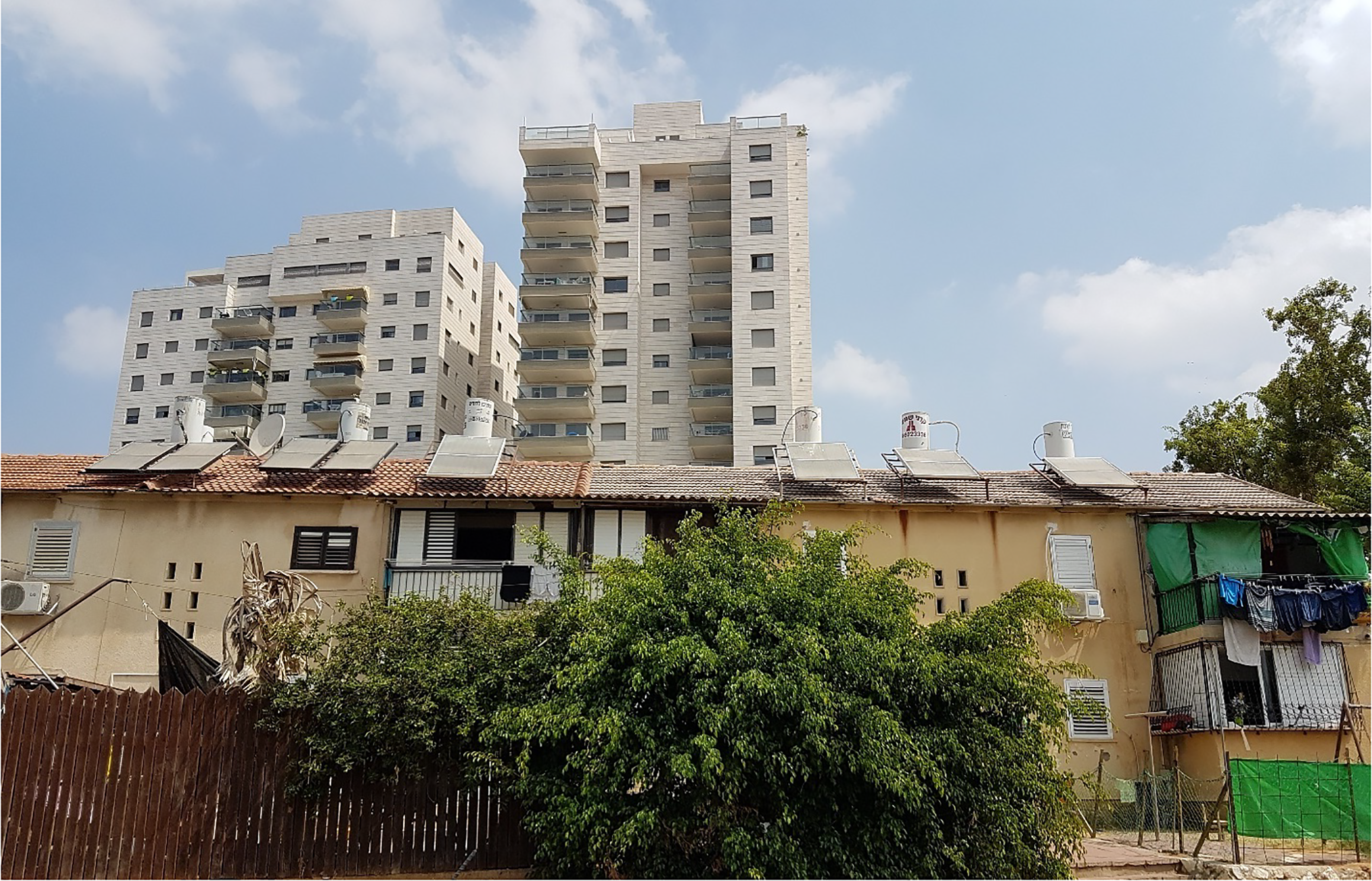
A raze and rebuild site in kiryat Ono (site no. 5).
Since individual households own almost all housing in Israel, the regeneration program relies on private contractual agreements between owners and developers – ‘Regeneration Deals’ (Geva and Rosen, 2018). Owners can decide collectively whether to initiate redevelopment of their properties. Those who choose to do so strike a deal with a developer and receive new, larger units in the redeveloped site at no cost and coverage of all related expenses. After redevelopment, owners choose how to capitalize on their new units – to inhabit, let or sell them. The compensation and freedom of choice have allowed policymakers to define the program as a ‘win-win’ situation, in which owner-occupiers benefit from the gentrification of their neighborhood without being exposed to displacement. Policymakers and developers have maintained this framing despite growing concerns that homeowners may be experiencing economic pressure, marginalization, and displacement (Fenster and Kulka, 2016; Kainer Persov and Carmon, 2020; Margalit and Kemp, 2019; Rosen and Avni, 2019).
Israel's urban regeneration model follows a global trend of state-sanctioned programs that replace ‘obsolete’ housing with ‘socially mixed’ developments through public-private mechanisms (August and Walks, 2017; Verhage, 2005). Such programs include the HOPE VI program in the United States and other public housing regeneration schemes, e.g., in Britain, the Netherlands, and Canada (August, 2016; Baeten et al., 2017; Elliott-Cooper et al., 2020b; Goetz, 2013). Urban scholars have criticized such ‘state-led gentrification’ policies for prioritizing financial profits over social benefits and inducing displacement (Aalbers, 2019; Davidson, 2008; Hackworth and Smith, 2001). Although some programs advance ‘gentrification without displacement’ by rehousing residents on-site, they often perpetuate the stigmatization and marginalization of those returning to live in the new ‘mixed’ communities (Chaskin and Joseph, 2013; Shaw and Hagemans, 2015; Uitermark and Loopmans, 2013).
Displacement following urban regeneration is commonly associated with the affected residents’ tenure insecurity (Hackworth, 2019; Rolnik, 2019), which allows state and market actors to advance the commodification of housing at the expense of residents and without their consent (Madden and Marcuse, 2016). In contrast, Israel is one of the few countries that promote large-scale urban regeneration of formal, privately-owned housing (cf. Sim et al., 2002; Yang and Chang, 2018). This means that owners are parties to the commodification of their homes and stand to benefit from it. The propensity and nature of resident displacement in this context, we argue, has been relatively underexplored and requires further theorization.
The paper examines urban regeneration outcomes for homeowners in Israel by studying six redeveloped sites. Specifically, we test the framing of urban regeneration as a ‘win-win’ situation that does not lead to displacement. We build on a conceptualization of displacement as a spectrum of causes and experiences, ranging from direct, involuntary out-moving to more implicit experiences of pressure and stigmatization (Atkinson, 2015; Elliott-Cooper et al., 2020a; Hirsh et al., 2020; Marcuse, 1985; Shaw and Hagemans, 2015; Yiftachel, 2020; Zuk et al., 2018). To address the methodological difficulty of measuring and contextualizing displacement (Atkinson, 2000; Easton et al., 2020; Kearns and Mason, 2013), we employ a mixed-methods approach that explores both quantitative measures of displacement (e.g. involuntary out-moving) and qualitative experiences of residents. Data sources include door-to-door surveys (n = 413), 20 interviews, two focus groups, and a comparative analysis of tax, planning, and property records.
We argue that the material benefits and freedom of choice given to owners should be understood both as an expression of individual preferences and as an outcome of varying socioeconomic capabilities. For example, some homeowners treat urban regeneration solely as a real estate venture. For others, especially low-income owners and former public housing residents, the redeveloped unit represents their home and a place where all of their savings and loans are stored. In contrast with renters, who were all displaced by redevelopment, we find that many owner-occupiers returned to live on-site. While this implies that most owners were not subject to direct involuntary displacement, other expressions of displacement arise when examining how the varied capabilities of owners affect their choice of capitalization mode.
First, out-moving owners capitalize on the market value of their properties. Still, this choice may come at the expense of regeneration's purported quality-of-life benefits for low-income owners. Second, owners who choose to live in their new units enjoy an upgraded living environment. However, it is far from the ‘cost-free’ image the program attempts to project since the added costs of living are a burden on those staying. Third, the policy's exclusive focus on homeowners perpetuates the marginalization and extensive displacement of renters in redeveloped sites. Thus, we suggest that the conceptualization of displacement, which originates from studies of tenure-insecure residents, does not fully reflect the implication of urban regeneration for homeowners.
Our findings contribute a novel perspective on the relationship between urban regeneration and displacement outside the oft-researched venues of North America and Europe. By focusing on private property, we show that homeownership does not necessarily protect from the exclusionary outcomes of urban regeneration. We discuss this finding as a manifestation of what Smith (2015) defines as a paradox of homeownership: the expectation that an owned property can simultaneously provide everyone with a safe and adequate dwelling as well as financial returns. The varying capabilities of owners suggest that owners may be required to choose between the two.
A second contribution concerns the theoretical debate regarding measurement and quantification of displacement and its policy implications. Recently, there have been calls to shift the focus of displacement studies from narrow quantitative indicators of marginalization and exclusion toward experiences and conditions of displaceability (Easton et al., 2020; Hirsh et al., 2020; Yiftachel, 2020). Following this call, we extend our analysis and discussion to a relatively privileged social category – property owners, suggesting that the responsibilization (Ferguson, 2010) of homeowners as market actors is used to gloss over broad variances and vulnerabilities.
The remainder of the paper is structured as follows. Section 2 reviews the scholarship on urban regeneration-induced displacement, highlighting intangible dimensions that specifically endanger owners, such as economic pressures. Section 3 presents the research design and discusses the methodological challenges of studying displacement. Section 4 details our findings on the outcomes of urban regeneration for owners, followed by a conclusion in section 5.
Urban regeneration is increasingly promoted through public-private mechanisms in which governments provide financial incentives and streamline regulation, while private developers implement plans (August and Walks, 2017; Goetz, 2013; Tasan-Kok, 2010; Verhage, 2005). Regeneration programs aim to physically upgrade neglected areas and socially change local communities’ socioeconomic composition by advancing ‘social mix’. Social mixing has gained international ‘political success’ (Newman and Goetz, 2016) as an effective redevelopment instrument. It identifies incoming capital and affluent residents as key indicators of urban change (Chaskin and Joseph, 2015; Vale and Shamsuddin, 2017). Affluent newcomers are expected to increase social capital in the neighborhood, promote prosocial behavior, and improve local communities’ political power (Joseph et al., 2007). At the same time, this model has been deemed a form of state-led gentrification (Aalbers, 2019; Hackworth and Smith, 2001; Lees et al., 2016) and criticized for displacing incumbent residents in the name of financial profit (Aalbers, 2019; Davidson, 2008; Hackworth and Smith, 2001; Mösgen et al., 2019).
Urban regeneration-induced displacement is frequently mentioned regarding public housing redevelopment in North America, Europe, and Australia (Aalbers, 2011; Allen, 2008; Arthurson et al., 2015; August, 2014; Baeten et al., 2017; Goetz, 2013; Morris, 2019; van Kempen et al., 2005), or informal housing in the Global Southeast (Doshi, 2013; Ghertner, 2014; Yiftachel, 2020). In contrast, Israel is one of a few countries – including Singapore, Taiwan, and Chile – in which regeneration affects owners with formal tenure (López-Morales, 2011; Shih, 2010; Teo, 2015; Yang and Chang, 2018). The concept of displacement is not readily applicable to this context since owners’ property rights are supposedly protected, allowing them to negotiate their stake in redevelopment. However, the scholarship on the varied expressions of displacement offers three interrelated dimensions that apply to property-owning residents. Firstly, displacement is more than involuntary out-moving; secondly, resident consent is not always sincere; thirdly, not all owners subscribe to the profit-maximizing logic of urban regeneration.
The main point of debate regarding urban regeneration-induced displacement revolves around its measurement and definition. Cognizant of the historical association between urban regeneration and displacement (Hyra, 2012), policymakers often describe urban regeneration as a ‘positive’ and planned form of gentrification that minimizes the loss of place (Davidson, 2008; Shaw and Hagemans, 2015). Residents’ relocation is done in the name of ‘poverty deconcentration’ on a metropolitan scale. Hence, low-income households are relocated to more affluent neighborhoods with better housing and employment opportunities, and the share of disadvantaged residents remaining in post-redevelopment sites is limited (August, 2014; Elliott-Cooper et al., 2020b; Newman and Goetz, 2016). Other programs employ a ‘gentrification without displacement’ approach in which residents are rehoused on-site (Shaw and Hagemans, 2015; Uitermark and Loopmans, 2013).
However, definitions of displacement that emphasize the quantification of direct involuntary out-moving may obscure intangible experiences that undermine people's connection to their place of dwelling (Atkinson, 2015; Hirsh et al., 2020; Yiftachel, 2020). A growing body of scholarship builds on Marcuse's; (1985) conceptualization of displacement as a range of market-related outcomes that include any ‘form of un-homing that violently severs the connection between people and place, undermining the right to dwell’ (Elliott-Cooper et al., 2020a, 496). Rather than a one-time event, displacement may be experienced as ‘a series of attritional micro-events that unfold over time’ (Elliott-Cooper et al., 2020a, 502), occurring long before or after the immediate moment of relocation (Easton et al., 2020; Hirsh et al., 2020). In the context of urban regeneration, this approach has revealed the continued marginalization and alienation of residents who return to live in ‘socially mixed’ communities (Arthurson et al., 2015; Chaskin and Joseph, 2015; Morris, 2019; Vale and Shamsuddin, 2017).
Another point of focus relates to owners’ consent to participate in redevelopment. Some argue that residents’ satisfaction from relocation is not tied to their consent (Kearns and Mason, 2013). Others suggest that residents’ experience of displacement is shaped by other elements of choice, ‘such as when to move and how to move’, or the ability to negotiate compensation (Hirsh et al., 2020, 396). When consent is required, residents may experience explicit or implicit pressures stemming from the power imbalances between them and the redeveloping authorities, such as threats of reprisal from housing authorities (August, 2016) and redevelopment-related rent increases (Baeten et al., 2017).
Pressures and power imbalances also affect residents with secure tenure. An extreme example comes from the redevelopment of UK council estates, where compulsory purchase orders (CPOs) are used to reverse the property rights of leaseholders (Elliott-Cooper et al., 2020b). Even when consent is sought, e.g., in Santiago and Taipei, property owners are pressured to agree to unfair deals (López-Morales, 2011; Yang and Chang, 2018). In Israel, too, pressure on owners has been a significant policy issue, leading to greater regulation over Regeneration Deals in recent years (Fenster and Kulka, 2016; Geva and Rosen, 2018; Rosen and Avni, 2019). The legal amendments provided partial acknowledgment that owners’ choices are not an absolute sign of consent. Nevertheless, under certain conditions, Israeli law allows 80% of owners to sue the objecting minority for damages. This legal remedy discourages extortionist practices of the minority but does so through a threat of financial repercussions.
Owners’ experience in urban regeneration also relates to their attitude toward their homes’ commodification (Madden and Marcuse, 2016). Commodification is underpinned by a cultural idealization of homeownership and the belief that owners are tied to place through a use-value attachment to their home and through its exchange-value as a commodity (Christophers, 2021; Zaban, 2020). Thus, owners’ involvement in urban regeneration is sometimes defined as incumbent upgrading rather than gentrification, meaning that incumbents benefit from neighborhood improvements and rising property values (Carmon, 1999; Zuk et al., 2018). In this respect, theorizations of gentrification and displacement, which assume residents’ antagonism to commodification, do not fully encompass owners’ experience in urban regeneration. Rather, owners’ experiences of displacement – especially low-income owners – may occur when commodification requires them to forgo other benefits their dwellings provide (Rolnik, 2019).
Smith (2015) defines the trade-offs of low-income owners as paradoxes of homeownership. Specifically, urban regeneration relates to the paradoxical expectation that housing ‘must deliver sufficient investment returns to underwrite households’ wider well-being, and insure a range of risks. Whether, when, where and for whom this works is a moot point.’ (Smith, 2015, 67). Accordingly, studying urban regeneration should examine how commodified approaches to housing are accepted by owners (or imposed upon them) and how they vary in their perceptions of redevelopment benefits. For example, Allen's; (2008) study of the Housing Market Renewal program in Liverpool shows how the perception of housing as a market good is imposed upon working-class residents, who perceive their homes in practical terms of dwelling and security. In Israel, Margalit and Kemp (2019) demonstrate this perceptional gap in a study of Raze and Rebuild objection hearings. Planning officials were dismissive of low-income residents’ concerns over the program's individual benefits and presented gentrification as a net benefit based on its contribution to property values.
Applying the displacement concept to a property-owning context requires an examination that looks beyond homeowners’ relative privilege in society (Christophers, 2021) and considers the paradoxes and power imbalances within this tenure category. For Israeli urban regeneration, our conceptual framework draws upon several factors: addressing both quantitative and qualitative displacement indicators, paying attention to the mobilization, subversion, and constriction of resident choice, and searching for the trade-offs and concessions required from residents as they accept the commodified logic of urban regeneration.
Measuring The displacement of homeowners
This study analyzes expressions of displacement following the redevelopment of privately-owned housing. Data were collected from six sites in the Tel Aviv metro area, situated in mostly middle- to high-income neighborhoods and municipalities (ICBS, 2019), comprising 1292 completed housing units (see Table 1). The sites were among the first to be built and completed under the Raze and Rebuild urban regeneration program. 1 From the program's announcement in 1999 until 2017, approximately 20 sites received permits, and 3300 units were inhabited. 70% of the completed units are in the Tel Aviv metro area. Thus, the case sites represent more than a third of the housing units completed under Raze and Rebuild at the time. On average, 25% of units in the redeveloped sites were allocated to returning homeowners. The number of housing units in each project reflects market value (as defined by government appraisal): in higher-demand areas (e.g. Tel Aviv), fewer new units are needed to reach financial viability, and thus the share of ‘replacement’ units in the site is higher.
Details of study sites.
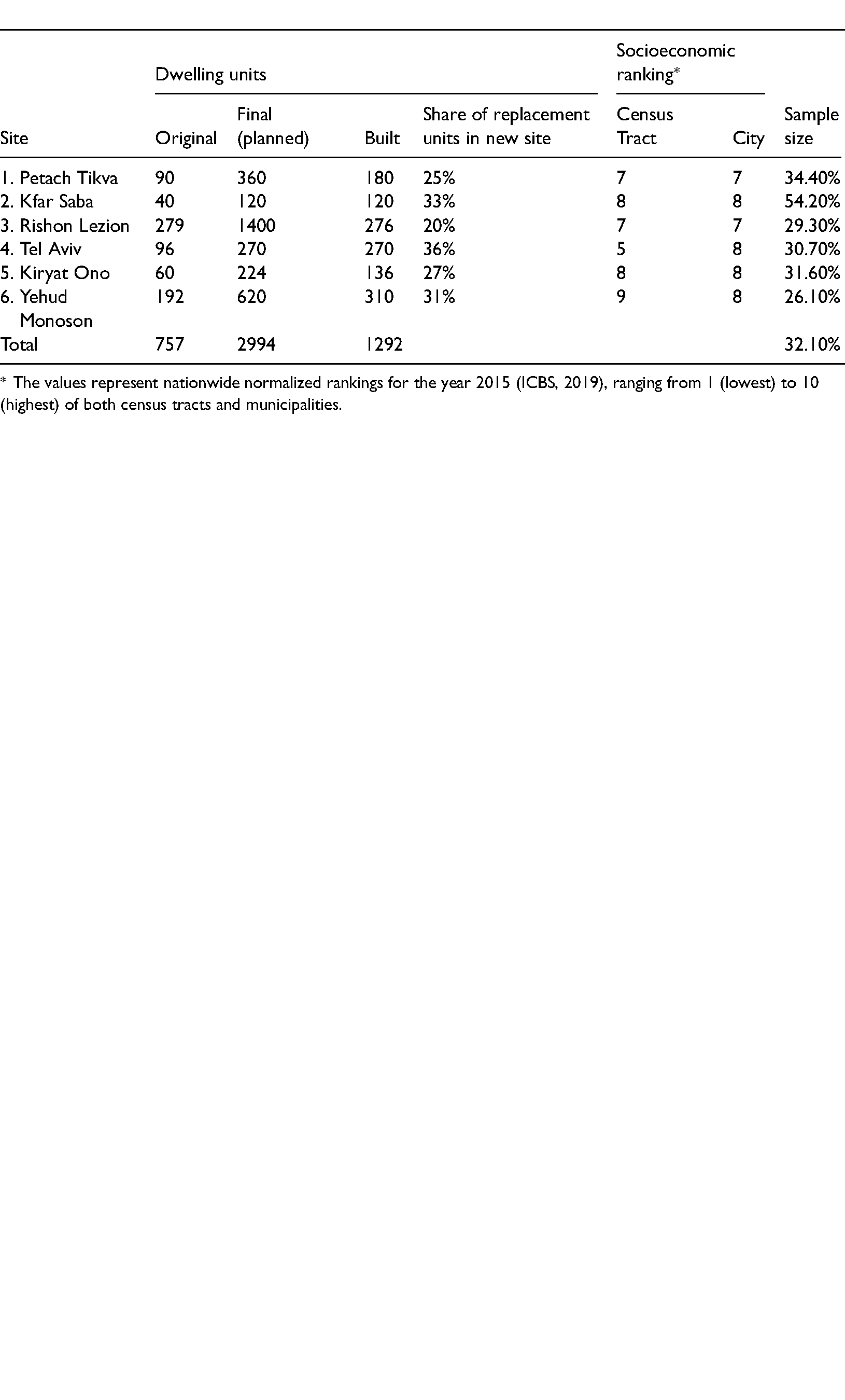
Details of study sites.
* The values represent nationwide normalized rankings for the year 2015 (ICBS, 2019), ranging from 1 (lowest) to 10 (highest) of both census tracts and municipalities.
Displacement is examined in this study at the scale of individual households, i.e., a micro-scale. In general, measuring displacement is notoriously challenging due to the difficulties in tracking down displaced households, distinguishing between out-moving motivations, understanding local context, and determining causality (Atkinson, 2000; Easton et al., 2020; Kearns and Mason, 2013; Zuk et al., 2018). The issue of scale is also crucial. Studies are usually conducted at the meso-scale (neighborhood, census tract) or macro-scale (cities and regions), for which more data are available (Easton et al., 2020). Therefore, studying individual redeveloped sites required us to collect primary data on individual households. This approach overcomes some of the ambiguities associated with using aggregate data, yet the small sample limits statistical analysis possibilities.
To address these challenges, we pursued a mixed-methods approach comprised of three data sources. First, we built a dataset of household-level population changes and replacement units’ locations in each site. Data were retrieved from municipal tax registry reports, property sales and land registry records, developers’ shareholder reports, and resident registries obtained from the Central Bureau of Statistics. These sources provided an initial indication of out-moving owners, and was used to map the location of replacement units in each site, as preparation for the next phase.
The second and primary data source is a door-to-door survey (n = 413) conducted between May 2017 and April 2018 (see sample breakdown in Table 2) 2 . A purposive sampling method was employed to achieve a maximal sampling of replacement units, indicating population changes. Respondents were asked about their tenure status (owners, renters, or public housing tenants), ages, and living expenses. To identify which units were rented or sold by the original owners, renters were asked about their landlords’ identity, and current owners were asked about previous owners. To assess future out-moving, respondents were asked whether they expect to stay in their existing home in five years. This question was chosen to correspond with the Israel Social Survey on social capital and residence satisfaction (ICBS, 2016), allowing us to examine responses relative to a benchmark of residential stability.
Survey sample, by site name and tenure group.
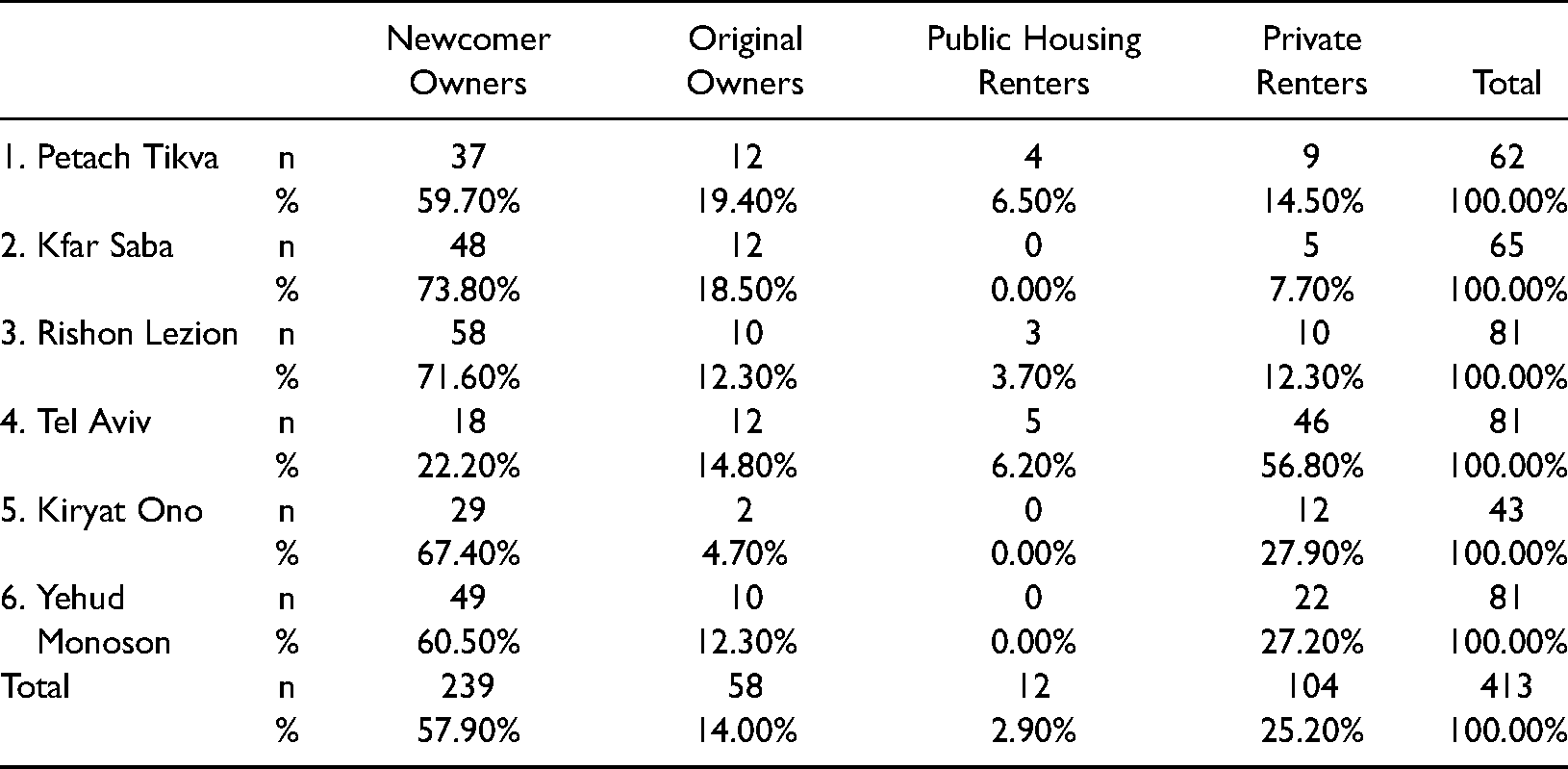
The third data source was qualitative. We conducted interviews with residents, developers, municipal planners, and central government officials (n = 20, at least two from each site) and two focus groups with returning owners in two sites. Respondents corroborated some quantitative findings and reflected on the changes experienced by individuals and communities before, during, and after redevelopment.
This research has its limitations. First, studies of post-redevelopment sites cannot reveal expressions of displacement that occurred before renewal and do not reveal motivations for out-moving (Easton et al., 2020; Kearns and Mason, 2013). To address this limitation, we focus on observed measures of out-moving after redevelopment and qualitative data from interviews to interpret their meaning. Second, our findings refer to a sample of approximately a third of the redeveloped sites’ population (and 29% of the replacement units) and not to the entire redeveloped sites population. However, by examining six sites, we can discuss findings that are repeated across settings. Third, while we examine some intangible aspects, we do not directly address the psychological pressures associated with redevelopment, such as ‘displacement anxiety’ (Morris, 2019; Watt, 2018) or the loss of place (Shaw and Hagemans, 2015). Hence, the results’ interpretation is limited to the two aspects of displacement defined by the research questions.
The six surveyed sites comprised 757 housing units before redevelopment and will eventually include 2994 units when construction is completed. Based on information gathered from survey respondents and interviewees, we estimate that about half (40%-60%) of the units in pre-redevelopment sites were owner-occupied, while the rest were rented out. This estimate fits the information acquired from social impact assessments in other projects, as well as other studies of displacement in Raze and Rebuild projects (see Kainer Persov and Carmon, 2008; Kainer Persov and Carmon, 2020). However, respondents also noted that population turnover began well before the projects reached the development phase. One resident noted ‘Some [elderly owners] didn’t live to see [the new buildings]. some moved out even before we evacuated the previous buildings’ (Interview, November 2017). An attorney representing owners noted that property investors bought the units sold by the families of deceased owners (Interview, June 2017). Hence, the actual number of owner-occupiers at the time of demolition may have been lower.
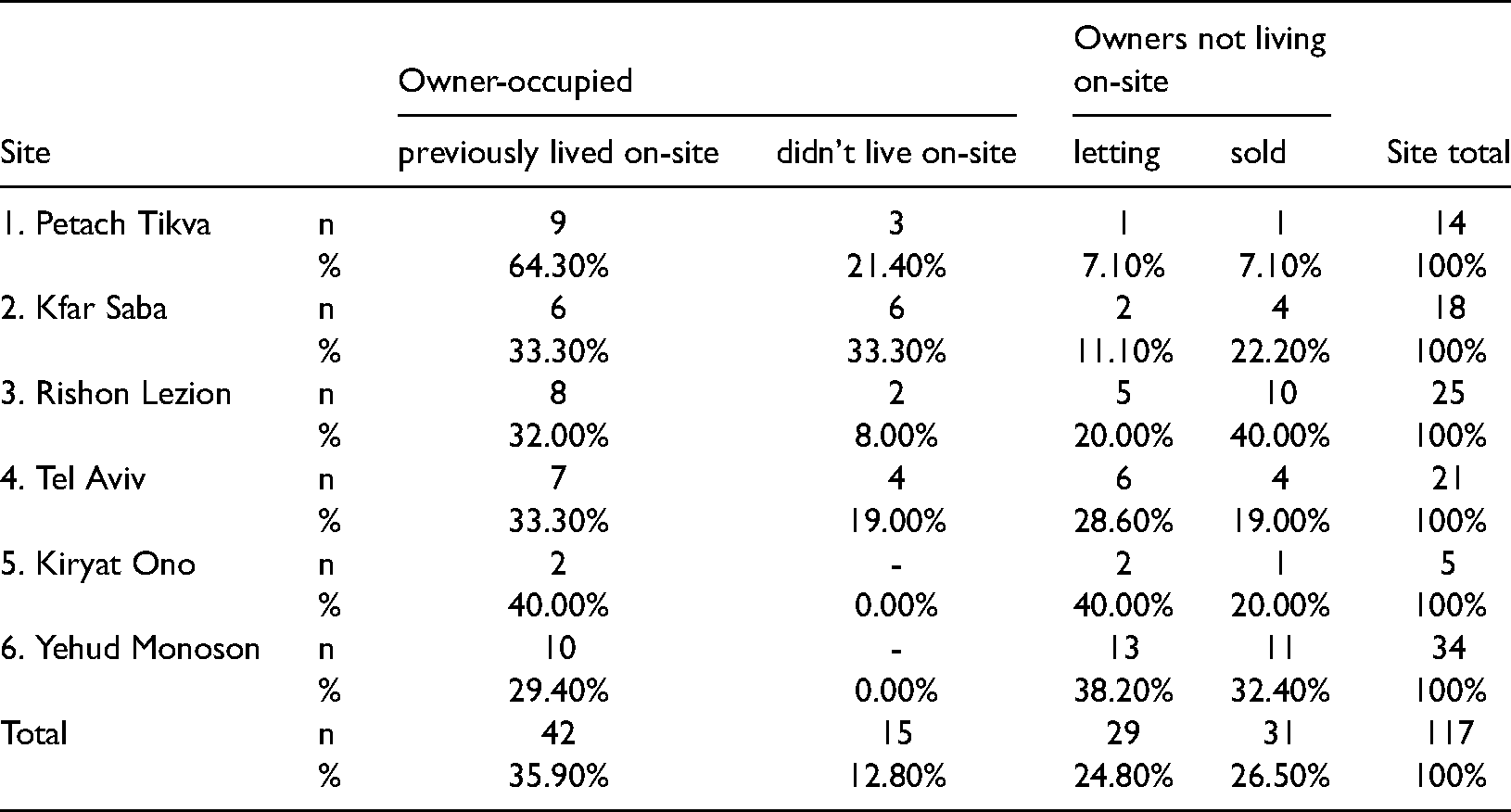
In our sample of 117 replacement units, 48.7% were owner-occupied, 24.8% were let by their original owners, and 26.5% were sold to new owners (see Figure 2 and Table 3). These findings reflect the proposition that Israeli urban regeneration gives owners a choice of inhabiting, selling, or letting, rather than imposing an outcome upon them. However, a closer examination of the variance between people and sites reveals that these choices may be guided by owners’ varying capabilities, not only their varied preferences. Therefore, to explore less explicit dimensions of displacement in the redeveloped sites, we break down the findings to owners who do not live on-site, owner-occupiers, and non-owners.
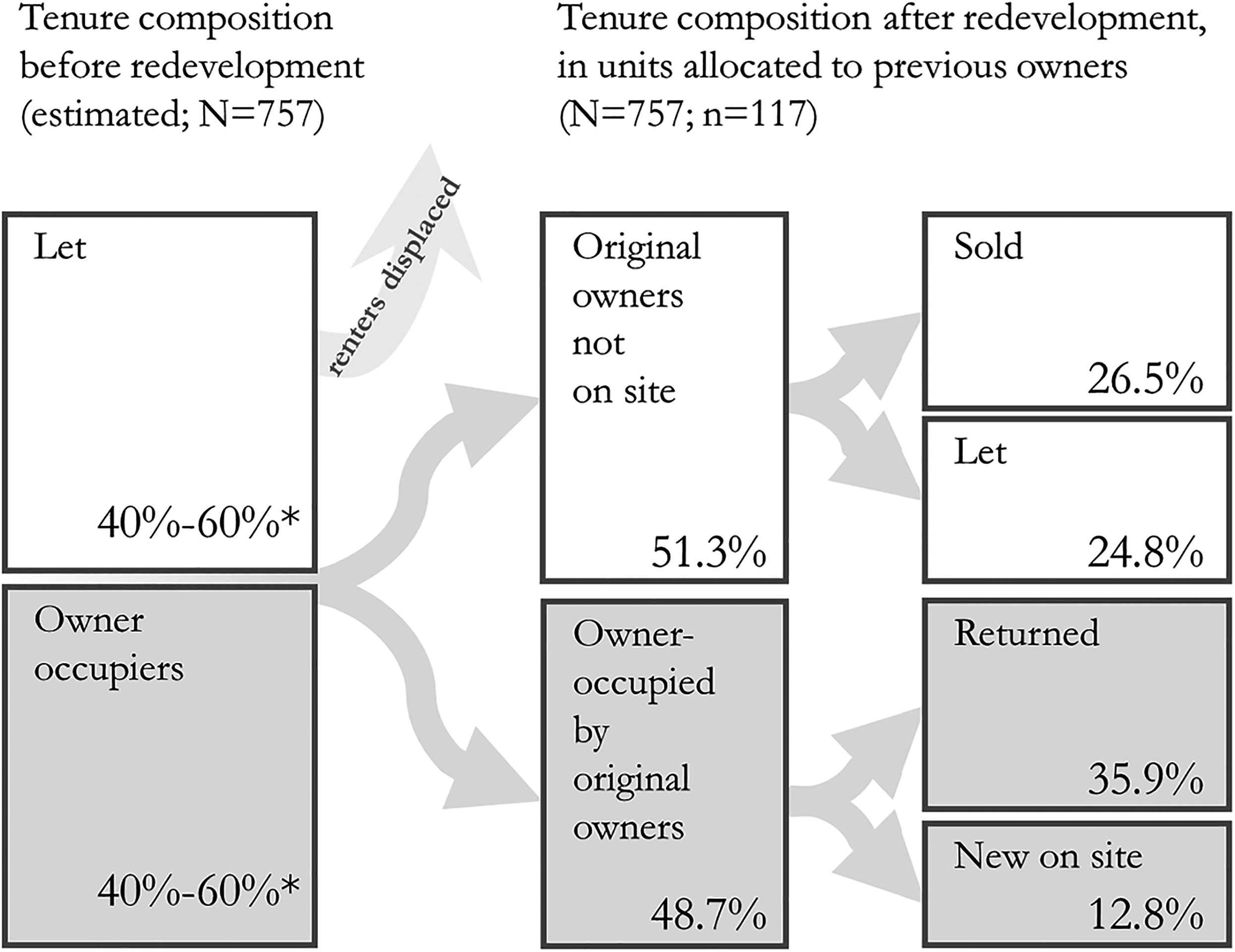
Original owners’ usage of their units before and after redevelopment.
Current usage of replacement units in the sample.
The use of out-moving as an indicator for displacement has attracted some criticism from stakeholders in the Israeli urban regeneration arena. One city planner explained: All these sociologists, no disrespect, always count how many of the residents returned, thinking that a low return rate is some kind of failure. But that's not necessarily true, since some people see this as an opportunity to move or even sell and get some cash in hand. (Interview, March 2020)
Original owners who let their new units (24.8% of the sample) benefit from their new apartments as a regular income source, i.e., from its exchange value. The variance between sites supports the claim that an understanding of the rental market guides letting. Table 4 presents the reported rent yields and share of renters from the survey. In our sample, the highest percentage of renters in the replacement and overall units was found in sites 4, 5, and 6. However, the choice to let one's unit may also be a result of implicit displacement. Aside from owners who originally bought their units as investments, some owners let their units while living as renters elsewhere. One developer described a retired owner who remained in the temporary apartment they had rented during construction and profited from the extra income generated from letting their new luxurious apartment (Interview, July 2016). This could conversely be perceived as a form of displacement, as the elderly resident was compelled to leave the neighborhood and does not benefit from the new upgraded home, or the overall upgrading of the neighborhood.
Share of renters in the sample, by site and identity of owners.
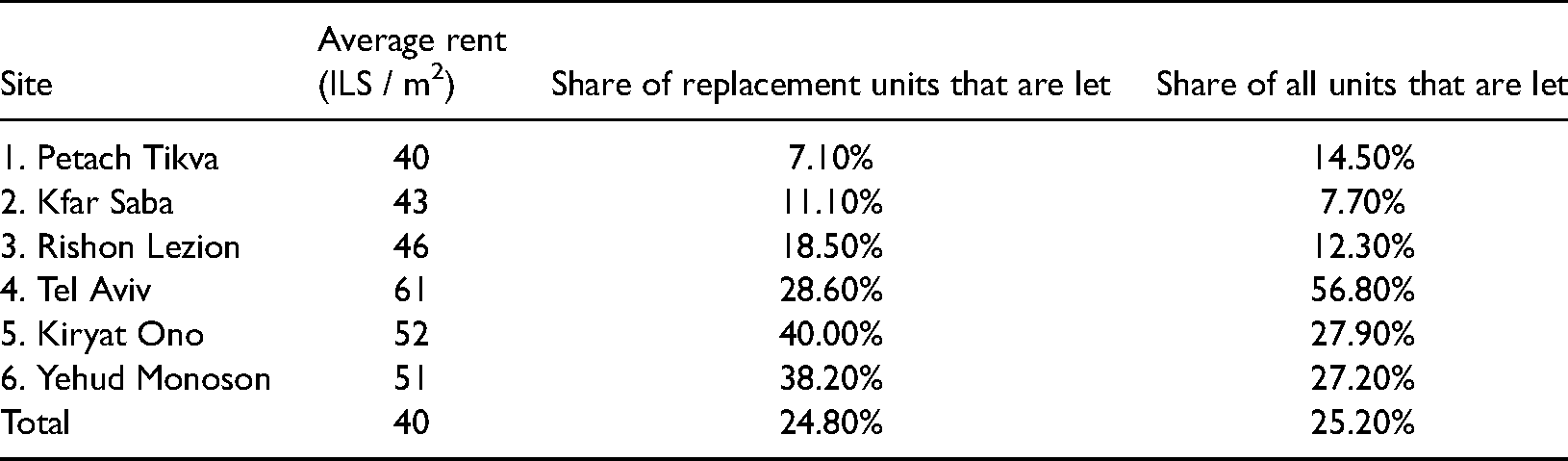
Share of renters in the sample, by site and identity of owners.
The second group consists of pre-redevlopment owners who chose to sell their units (26.5% of the sample, see Figure 2 and Table 3). 3 Selling allows owners to use urban regeneration's financial benefit towards a home more fitting of their needs. For example, in site 6, a large share of original owners sold their units. One owner, who played a key role in organizing the Regeneration Deal, said he and other owners had entered the redevelopment process knowing that they would immediately sell their replacement units (Interview, January 2019). Another owner whose unit was still under construction said he already bought another home ahead of the project and was now waiting to sell his new unit (Interview, October 2018). Thus, out-moving, in this case, represents an explicit financial action.
As owners’ varying actions and intentions suggest, redevelopment has allowed them to capitalize in different ways. However, owners whose unit is their only property have a limited ability to alternate between upgrading their living environment and capitalizing on its market value, compared to owners of multiple properties. Owners that cash out on the benefits of urban regeneration and ‘downgrade’ to older apartments elsewhere raise questions over redevelopment's quality of life contribution. As discussed in the next section, this inequality is accentuated when considering the added costs of living in new buildings.
Owners inhabiting their units (48.7% of the sample) are divided into two groups (see Figure 2): former owner-occupiers who returned to live on-site post-redevelopment (35.9%) and owner-occupiers who moved in post-redevelopment but did not live on-site beforehand (12.8%). Returning owners seemingly fulfill the envisaged benefit of urban regeneration as a mode of incumbent upgrading. One returning owner expressed this view: ‘My main concern was getting a larger apartment that fits my needs […] some people look at their bottom-line [but] that didn’t interest me’ (Interview, August, 2016). Returning owners comprise between 30% and 40% of replacement units in most sites, representing a relatively small change from the approximated 40%-60% owner-occupation pre-demolition. Given that some older owners have passed away during redevelopment (Interviews, August 2016), this supports the view that direct owner displacement is rare. However, it also implies that only a minority of owners benefit from the use-value appreciation created by urban regeneration.
The second group of owner-occupiers, who did not live on-site before redevelopment, was found in four sites (see Table 3). Since these owners presumably had another dwelling option to choose from, their choice to inhabit their redeveloped unit may be interpreted as a vote of confidence in the development and the changing neighborhood. For example, two owners noted that they decided to move in only after seeing their new units. One of them said that she had initially bought her apartment before redevelopment, intending to ‘flip’ it, but ‘in the last minute’ changed her mind and decided to move in (focus group B, July 2018). Despite their small number, the presence of such owners supports the framing of urban regeneration as a catalyst of neighborhood revitalization.
Despite the claim that urban regeneration is a cost-free mechanism for owners, staying in place requires owners to incur increased living costs in new and often luxurious buildings. The threat of displacement due to economic pressures played a central role in the criticism of Raze and Rebuild (Rosen and Avni, 2019). Survey findings show that the average monthly maintenance fee for returning owners is 392ILS (approximately US$115), while average maintenance fees in Israel are usually around 50-150ILS (see Table 5). Since fees are calculated based on floor space, returning owners’ fees are somewhat lower than for new owners whose units are typically larger. Still, this rate is significantly higher than the fees in old buildings (typically around 50ILS). Municipal taxes have also risen steeply after redevelopment due to rezoning and unit size increase (Interview, August, 2016).
Average monthly maintenance fees, in Israeli shekels (ILS).
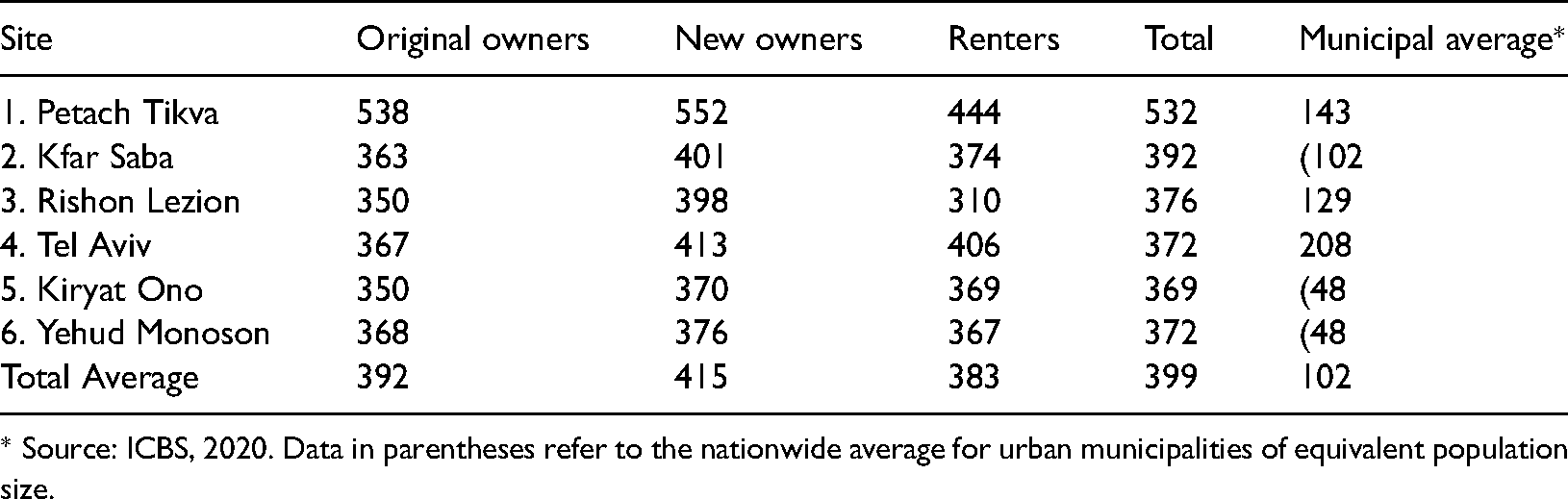
Average monthly maintenance fees, in Israeli shekels (ILS).
* Source: ICBS, 2020. Data in parentheses refer to the nationwide average for urban municipalities of equivalent population size.
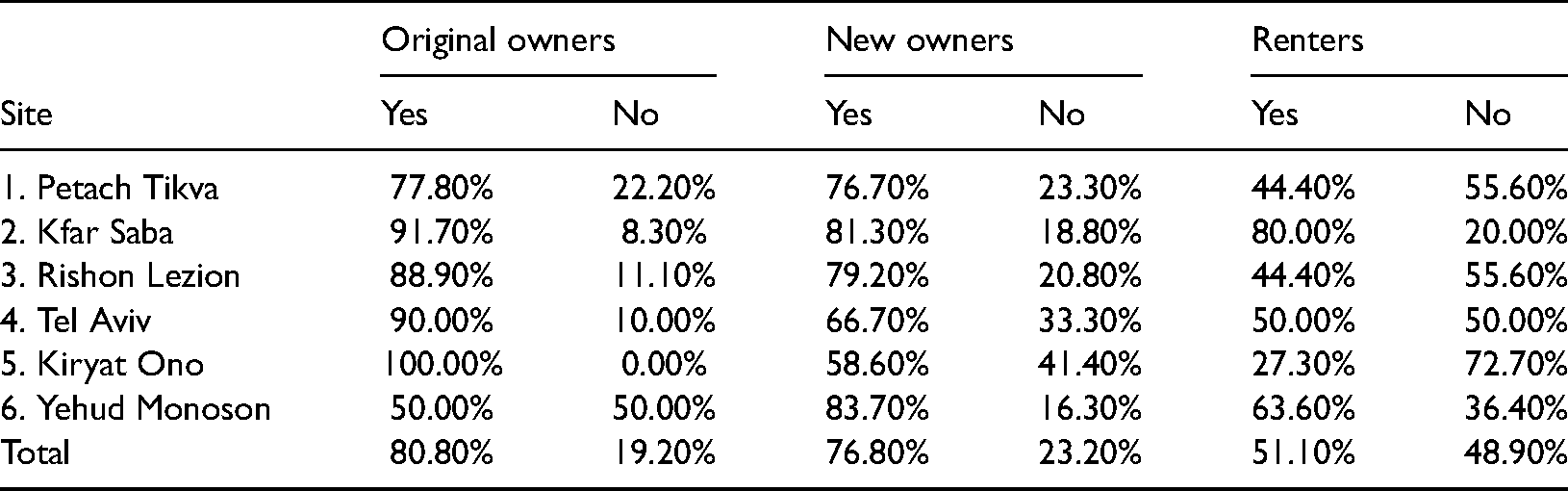
To measure general satisfaction with the new project and to receive an indication of displacement pressure perceptions, residents were asked whether they expect to remain in their apartments in the foreseeable future (see Table 6). In the Israeli Social Survey (ICBS, 2016), 77.1% of owners and 57.4% of renters responded positively to a similar question, corresponding closely to new owners and renters’ responses in the sample. Returning owners answered positively in slightly higher numbers (80.8%), suggesting that they do not perceive displacement as an immediate threat. However, some owners do struggle with living expenses. For example, one focus group respondent, who sits on the building management committee, noted that elderly owners who live on pension payments and social security ‘are the first to pay each month’ despite their low income. An elderly participant in the group explained, ‘I'd rather pay and be in debt. [Other than my home], what else do I have to live for?’ (Focus group A, July 2018). On another site, a survey respondent remarked that their financial situation has worsened after redevelopment because of the increased costs, but that the new unit ‘increased the value of their children's inheritance’. This ambivalence was evident in some cases even before redevelopment, as one owner recalled: I found out that living expenses will rise more than tenfold: maintenance costs, city taxes, electricity, and such. I said, guys, you’re putting yourselves in a position that you might not benefit from. My analogy was, ‘you’ll get a free Mercedes, but you won’t be able to pay the insurance, you won’t be able to take it out of the garage.’ But then an elderly neighbor told me: ‘I won’t let you withhold a brand-new home from me’. I’m not sure that she would get to live in her apartment (Interview, July 2016).
Responses to the question: ‘Do you expect to live in your apartment in 5 years?'.
The starkest expression of displacement in Israeli urban regeneration occurs outside the realm of property ownership. None of the renters in the sample (n = 104) had lived on-site before redevelopment, suggesting that the displacement of renters was complete. In general, private market renters are not eligible for compensation or relocation options. This reflects the unregulated nature of the Israeli rental market, in which most renters renegotiate their lease terms annually (Friedman and Rosen, 2020). Thus, while all owners, either occupying or holding their units for rent, received an equal share in the Regeneration Deal, the renters, who comprised half of the original community, were eventually displaced (see also Kainer Persov and Carmon, 2020).
Multiple interviewees noted an increase in resident turnover ahead of redevelopment, and some units were let as dorms for construction workers (Focus group B, July 2018; Interview, October 2018). This raises the possibility that renters experienced chain displacement (Marcuse, 1985) as the projects materialized. Finally, the new sites offer some private renting options (approximately 25% of our sample households were renters), but with rents inevitably higher than in the old buildings. Hence, the loss of low-rent options leads to the exclusionary displacement of renters if large swathes of the neighborhood are redeveloped (as is the case in Rishon Lezion and Tel Aviv, for example).
Another underrepresented group of residents in Regeneration Deals was public housing tenants. Sixty-eight public housing units existed in sites 1, 3, 4, and 5 pre-demolition, according to the national public housing company Amidar. Public housing tenants in Israel are protected from regeneration-induced displacement by a law passed in 2016. However, in all surveyed sites, demolition occurred before the law was passed, and residents received no guarantee regarding their right to return (Interviews, July 2016; October 2016). To avert the threat of direct displacement, 36 of the residents exerted their right to buy ahead of redevelopment, thus becoming low-income owners.
Conclusions: Tenure security or social vulnerability?
This paper examined displacement expressions of property owners in Israel through a study of six post-redevelopment sites. Looking beyond contested public housing redevelopment cases, we studied how displacement affects homeowners who are not inherently opposed to their homes’ regeneration and commodification. Israel's national urban regeneration program advances the promise of ‘gentrification without displacement’ (Davidson, 2008) by providing owners with substantial incentives, specifically new, larger owned homes at no cost Moreover, it guarantees a choice of how to capitalize on the new units.
In contrast to non-owning residents who experience significant direct displacement following redevelopment (Kainer Persov and Carmon, 2020), our findings suggest that most homeowners who lived on-site pre-redevelopment returned to their replacement units. However, in terms of the gentrification debate (Elliott-Cooper et al., 2020a; Zuk et al., 2018), our findings indicate that urban regeneration may create a hybrid form of gentrification and incumbent upgrading. Some of the original homeowners take part in the gentrification process by selling their apartments. Some return and live in the newly redeveloped project. Others spatially detach themselves from the site, but retain their units as investment assets let at market-rate. Thus, some of the incumbent upgraders contribute to the gentrification of their neighborhood.
However, we also find that foregrounding owner choice obscures other aspects of displacement, as owners are deemed responsible for their individual decisions, especially out-moving. The findings demonstrate that owners’ choice itself is an outcome of varied preferences and uneven capabilities. For example, those who inhabit the new units enjoy improved use-value. Yet, a minority of owners may experience the increased expenses in the new developments as a form of displacement pressure (Marcuse, 1985). Similarly, owner out-moving through letting or selling the new units is framed as a market-conscious choice, even if they may have been a result of economic pressures.
The capability gap between owners reflects the paradox of homeownership (Smith, 2015), under which a single indivisible asset is expected to provide use-value and exchange value benefits simultaneously. Ownership-based regeneration accentuates an income- and class-based ‘mismatch between needs and resources’ (Smith, 2015, 69). Although owner-occupiers enjoy some degree of choice, they are a heterogeneous group with varying access to use-value and exchange value. At the one end of the capability spectrum are affluent non-occupying owners, for whom urban regeneration is strictly a financial venture. At the extreme opposite are low-income owners, including the 36 public housing residents who exercised their right-to-buy. For them, the choice between exchange value and use-value may become binary, as in the case of owners who capitalize on the financial benefit of redevelopment by ‘downgrading’ back to older and cheaper housing. Positioned in the middle are owner-occupiers who can afford to stay and live in the post-renewal project, creating a link between the use-value and potential exchange value.
It is now clear that more research is needed to explore the long-term and ‘slow’ (Elliott-Cooper et al., 2020a) effects of regeneration, both for individual homeowners and homeowner communities. Specifically, the unresolved distinction between voluntary out-moving and involuntary displacement requires closer examination beyond quantitative measurement. Moreover, research must consider regulatory and organizational changes that are introduced to the urban regeneration arena, namely more emphasis on residents’ rights and greater involvement of local authorities in the regeneration process. Finally, the implications of the capability gap require further attention given the national scale of Israel's urban regeneration program and its social change aspirations.
Footnotes
Acknowledgements
The authors thank Nufar Avni, Noga Keidar, Merav Keddar, Hila Zaban, Azri Amram, Rachel Friedman and the two anonymous reviewers for their thoughtful comments on this paper.
Declaration of Conflicting Interests
The author(s) declared no potential conflicts of interest with respect to the research, authorship, and/or publication of this article.
Funding
The author(s) disclosed receipt of the following financial support for the research, authorship, and/or publication of this article: This work was supported by the Israel Science Foundation (grant number 789/15).
