




Abstract
Social impact investment for microfinance has become a dominant form of poverty regulation in the global south. These investments aim to alleviate poverty by extending financial services like credit to the world's poor, particularly smallholder farmers. The International Finance Corporation is a major player in this effort. It has channeled finance capital to microfinance institutions around the world through its Social Bond Program, among other mechanisms. In this paper, I analyze how the International Finance Corporation's impact investments depend on an ideological “way of seeing” poverty, informed by representations of agrarian landscapes, which mystifies the exploitative relations of microfinance debt. I term these representations duplicitous debtscapes. My analysis is based on research about Cambodia, where the International Finance Corporation is a key supporter of the country's biggest microfinance institutions. I argue that the duplicitous debtscapes of the International Finance Corporation and its Cambodian partners veil the conditions of production and social reproduction faced by indebted smallholder farmers, thereby legitimizing capital accumulation for impact investors. Yet these debtscapes are also contested. Thus, I further argue that the outcomes of debtscapes are shaped by the struggle over their representation. By studying impact investment in terms of the visual politics of debt, this paper contributes to scholarship about the financialization of poverty in development and financial geography.
Introduction
In the past decade, social impact investment has become a powerful mechanism for regulating poverty by extending financial markets into people's everyday lives. Pitched as a response to the 2008 financial crisis by leading philanthropic and financial institutions, impact investors claim to combine social goods with return on investment (Langley, 2020; Rosenman, 2019). In the global south, social impact investors regularly support the microfinance sector in order to provide formal financial services, notably credit, to farm households (GIIN, 2020; Stolz and Lai, 2019; Watts and Scales, 2020). In fact, microfinance was one of the first sectors in the world to tout that financial investors can both earn a profit and promote social goods like poverty reduction (Mader, 2015; Roy, 2010; Schwittay, 2014).
Geographers have begun to examine how these financial markets are built on the politicized knowledge about the poverty of others. Alongside mapping flows of finance capital, they have shown that studying the geography of social impact investment requires analyzing how investors come to know their supposed beneficiaries. This entails, for example, investigating the geographical imaginaries of investors (Rosenman, 2019), the metrics of valuation that translate social impacts into economic value (K. Mitchell, 2017), the creation of ethical investor subjects (Langley, 2020), and the performative narratives that legitimize impact investment as a moral endeavor (Kish and Fairbairn, 2018). However, this scholarship has yet to focus on the visual representations of rural poverty that inform the imaginaries of social impact investors, nor how these representations function as ideology. This is crucial, because such representations inform the “common sense” notion that impact investment for microfinance can solve intractable problems faced by farmers across the global south (Stolz and Lai, 2019; Watts and Scales, 2020). This common sense veils how microfinance debt actually allows “financial institutions to further capitalize on poverty” (Kar, 2018: 17). Interrogating the visual ideology of social impact investment can help to resolve the puzzle of why microfinance continues to be presented as the solution to rural poverty, even though debt persistently reinforces social and spatial inequalities (Mader, 2015; Roy, 2010). With impact investment markets on the rise, there is an urgent need to interrogate how such an ideology circulates through representations of the rural poor.
To address this need, I examine the social impact investment programs of the International Finance Corporation (IFC) and its microfinance partners in Cambodia. The IFC is one of the largest social impact investors for microfinance around the world. It has been involved in Cambodia's microfinance industry for over two decades, providing financial and technical support to the largest microfinance institutions (MFIs) and banks in the country. Since 2014, following the global rise in impact investment, the IFC has directly funded these financial institutions through a variety of mechanisms, including its Women in Business and Inclusive Business Platform bond programs, which merged into the Social Impact Bond program in 2016. The IFC and its Cambodian partners argue that these programs benefit poor smallholder farmers, particularly women. As a global development leader, the IFC's social impact investment agenda has expanded the scale of microfinance, deepening the financial relationship between Cambodian farmers and impact investors, most of whom are located in the global north.
To analyze IFC impact investments into Cambodian microfinance, I turn to an established tradition of critical landscape studies in cultural geography (Cosgrove, 1985; D. Mitchell, 1996; W.J.T. Mitchell, 2002; Rose, 1993). I propose studying impact investment as a “way of seeing” rooted in the ideological function of landscape representation (Cosgrove, 1985: 46). Specifically, I argue that representations of agrarian landscapes within Cambodia's microfinance industry veil the conditions of production and social reproduction faced by indebted smallholder farmers, thereby legitimizing capital accumulation for impact investors. I refer to these representations as debtscapes, building on work that views debt as an inherently socio-spatial relation interwoven with processes of uneven development (Chaudhry, 2016; Harker, 2020; Walks, 2013). Debtscapes inform how social impact investors know their targeted microfinance beneficiaries, reproducing imaginaries of a rural idyll. Yet such representations are “duplicitous” because they mystify how poverty is produced by exploitative agrarian political economies (Daniels, 1989: 206). Debtscapes also reinforce imperial and masculinist ways of seeing Others. Borrowers, often women, are represented as timeless, hardworking, close to nature, and lacking the money that only a global north impact investor can provide. By imagining a normative ideal of a microfinance borrower, yet erasing the conditions of production and reproduction in the countryside, debtscapes operate as a mechanism of control for the appropriation of value for investors. This appropriation in turn undermines the agricultural practices, social relations, and norms that debtscapes purport to represent.
Yet debtscapes can also be contested through struggles over their representation (D. Mitchell, 1996, 2003). In this sense, people mobilizing against onerous debt can shape the outcomes of duplicitous debtscapes. I build this second dimension of my argument through an analysis of the Right to Relief campaign launched by two human rights organizations in Cambodia in June 2021. Through published reports and an interactive website, this campaign aims to raise awareness of social and economic problems in communities heavily indebted to Cambodian MFIs, many of which are financed by the IFC and its social impact investment programs. A strategy of the Right to Relief campaign is to provide counter-representations of debtscapes, highlighting the abuses of the for-profit microfinance industry. I thus examine debtscapes as a field of force, in which competing groups contest the representations of rural poverty that inform the imaginaries of social impact investors.
The concept of duplicitous debtscapes advances geographic scholarship about debt, microfinance, and social impact investment in several ways. First, analyzing debt in terms of visual representation offers a strategy for unveiling the ideological work of the microfinance industry and its investors, like the IFC. Contesting this ideology is necessary to unseat microfinance as one of the most dominant forms of poverty regulation today. Moreover, by attending to the visual politics of debt, I extend existing geographic studies of debtscapes beyond the spatial distribution and lived experiences of debt. These visual politics help to explain how the expansion of debt across the global south is directly linked to the imaginaries of social impact investors. Finally, a focus on the duplicity of debtscapes provides an analytical apparatus for critical geographers who want to explain how impact investment into agrarian landscapes mystifies the production of uneven geographies of development.
In the remainder of the paper, I develop my argument in several steps. I begin by further defining the concept of duplicitous debtscapes in relation to social impact investment and microfinance. I then discuss my critical visual methodology, before turning to a brief discussion of the work of the IFC in Cambodia. I trace the IFC's support for the Cambodian microfinance industry, particularly through its Social Bond Program. In the second half of the paper, I analyze Cambodia's debtscapes, first by interrogating their duplicity, and then through a discussion of the Right to Relief campaign's contestation against duplicitous debtscapes. I conclude the paper by discussing the implications for future studies of debtscapes.
Microfinance and debtscapes
Social impact investment has opened up new territories of financial accumulation in agrarian spaces of the global south. A nexus of financial, philanthropic, and development institutions have together created “dense webs of connections between farmers in the global south to boardrooms in the global north” (Stolz and Lai, 2019: 294). These institutions have built professional networks, designed policy and guidelines, and developed technological infrastructure necessary to channel finance capital from impact investors to their target beneficiaries (Bernards, 2019; Bhagat and Roderick, 2020; Gabor and Brooks, 2017; Johnson, 2013). This capital is channeled through diverse types of financial instruments, including microfinance. Overall, proponents of impact investment claim that private finance is better suited to address social problems like poverty than other governance tools like state welfare, development aid, or charity (Langley, 2020; Rosenman, 2019).
Social impact investment fits into a larger trend of the financialization of development. According to Roy (2010: 31), the “financialization of development” refers to the creation of markets to benefit the world's poor, primarily by extending the spatial reach of microfinance. This form of development follows in the wake of the policy failures of the World Bank and the International Monetary Fund during the 1980s and 1990s (Mitchell and Sparke, 2016). During those decades, the World Bank saw poverty as a residual element to market growth, which was to be promoted through fiscal austerity, stable monetary policy, and the privatization of public assets. However, these policies led to growing immiseration among the world's poor following welfare retrenchment and increased labor precarity (Best, 2013). In this context, the World Bank prescribed scaling up, and commercializing, microfinance as a pro-market solution to address these policy failures. The World Bank launched the Consultative Group to Assist the Poor, which became a global leader in the production of knowledge necessary to commercialize the microfinance industry (Mader and Sabrow, 2019; Roy, 2010). Microfinance helped to legitimize the structural adjustment policies of the World Bank and IMF by liberalizing financial markets and shifting responsibility of poverty alleviation away from the state (Weber, 2002). Private microfinance has since become a powerful technology for regulating poverty through the market (Kar, 2018; Mader, 2015; Schwittay, 2014).
The financialization of development has also fostered the creation of new market subjects willing and able to participate in the development process through the management of their financial lives (Mitchell and Sparke, 2016; Roy, 2010). On the one hand, in the context of fiscal austerity in the global south, microfinance borrowers, primarily women, have been compelled to manage the risks of debt on their own, or in collaboration with kin, by disciplining their behavior, selling their labor power, and exploiting the relations of dependency within communities. This new financial discipline has been promoted through moral discourses of individual thrift, entrepreneurialism, and women's empowerment (Elyachar, 2005; Federici, 2014; Green and Estes, 2019; Kar, 2018). On the other hand, social impact investment for poverty alleviation requires the creation of ethical investor subjects, particularly in the global north. These investor subjects see a direct connection between taking care of themselves, particularly their financial futures, and the resolution of intractable social problems like poverty, healthcare, education, and more (Rosenman, 2019; Schwittay, 2019). The discourse of social impact investment is essential for this task. Through impact metrics, statistical picturing, and performance guidelines, this discourse creates a framework of intelligibility in which the social impacts of investments are equated with economic value (Langley, 2020; K. Mitchell, 2017; Muniesa, 2017).
Importantly, social impact investment relies on emotive storytelling to turn an unequal relation of power between investors and “beneficiaries” into an ethical form of trusteeship. The use of storytelling is particularly evident with microfinance. Consider Kiva, a well-known microfinance institution famous for supposedly enabling person-to-person lending. Kiva's website provides promotional maps that purport to track real-time flows of money between investors and borrowers who are separated by continents and oceans. These cartographic representations are effective at mobilizing investors because they combine the appearance of objective knowledge about poverty with intimate feelings for a stereotyped, poor Other (Elwood, 2015). These intimate feelings are reinforced by Kiva's entrepreneurial ideology of lending to the “working poor,” helping investors recognize in Others “a set of shared entrepreneurial qualities, interests and ambitions” (Bajde, 2013: 14). Moreover, Kiva's emotional storytelling and visual images of microfinance borrowers, captured in the photographs of smiling faces hard at work on Kiva's website, create a paternalistic relationship between “undeveloped” and “developed” societies, reinforcing a neocolonial ideology of Western progress (Carr et al., 2016; Schwittay, 2014). Together, these representations enable finance capital to benefit from “potentially vast opportunities for accumulation by mobilizing and harnessing the labor power of the poor together with the developmental imaginaries of the rich into the financial system” (Mader, 2015: 7).
Until now, however, few geographers have studied the imaginaries of agricultural development that inform social impact investment for microfinance (cf. Kish and Fairbairn, 2018). This is surprising given that smallholder farmers are a key target group of microfinance across the global south (Green, 2020a, 2022a; Stolz and Lai, 2019; Watts and Scales, 2020). In fact, proponents of microfinance claim that only with access to finance can farmers develop their livelihoods and address food insecurity. These arguments are often animated by images of farmers at work in agrarian landscapes, accompanied with narratives of farmer improvement. If social impact investment rests on the politicized knowledge about the poverty of others, then to understand how microfinance informs the developmental imaginaries of impact investors requires an analysis of agrarian landscape representations, or what I call debtscapes.
Duplicitous debtscapes
Cultural geographers have long argued that the representation of landscape went hand-in-hand with the development of agrarian capitalism. According to Cosgrove (1985: 46), landscape is a “way of seeing” with origins in the mathematical techniques essential for governing capitalist life, such as bookkeeping, surveying, and mapping land. Through his analysis of Italian renaissance painting in the 15th and early 16th centuries, particularly its relation to emergent capitalist class formations in the countryside, he argued that, “landscape achieved visually and ideologically what survey, map making and ordinance charting achieved practically: control and domination over space as an absolute, objective entity; its transformation into the property of the individual or the state” (Cosgrove, 1985: 46). Landscape operates as a technology for controlling land and labor, and for legitimizing capitalist authority and appropriation. As a way of seeing, landscape representations are also deceptive, because they hide the relations of labor that produce agrarian landscapes. By depicting landscape as natural and idyllic, labor is either erased from the land or depicted as timeless and industrious, such that landscapes function as “a curtain behind which [people's] struggles, achievements and accidents take place” (Daniels, 1989: 212). To capture this mystifying function of landscapes, Daniels (1989: 206) labeled them duplicitous. For this reason, studying landscape as an ideological way of seeing can be used to unveil, and challenge, the structures of capitalist class power and authority operating behind the facades of landscape representation.
Landscape representations are not solely limited to veiling class relations, however. Landscape was also “an instrument of cultural power,” wielded by European imperialists in their efforts to know non-European spaces (W.J.T. Mitchell, 2002: 2). Landscape images were part of a larger discursive repertoire of empire, associated with mapping and scientific exploration, which rendered visible far-flung territories, resources, and people to the European explorer. Landscapes informed an orientalist imaginative geography, which mapped out the non-Western world in terms of negative contrasts with a pre-given Western self (Said, 1978). Though landscape as instrument of power was always contested, it was an important means by which Europeans sought to order, and control, non-Western people. Indeed, landscape as an imperial way of seeing privileged the gaze of the European subject, “whose imperial eyes passively look out and possess” (Pratt, 1992: 7). Importantly, these imperial eyes were of the male European, who associated distant, non-Western landscapes with the female body. Such gendered landscapes were defined by both natural beauty and by what they lacked. As such, according to Rose (1993: 92), landscapes constituted a terrain of desire, in which “women represent the enticing and inviting land to be explored, mapped, penetrated and known” (Rose, 1993: 92). Given such imperial and gendered relations of power, cultural geographers have argued that it is important not only to critique the duplicity of landscape representation, but to ask what work landscape does, and for whom this work is being done.
Drawing on this diverse critical scholarship on landscape, I propose the concept of duplicitous debtscapes. Scholarship about debtscapes has already examined how the spatial distribution of debt is a key driver of urban inequalities and how lived experiences of debt are wound up with the space of the home and body (Chaudhry, 2016; Harker, 2020; Walks, 2013). However, this work has not yet engaged with the visual politics of debt. Like landscape representation, I argue that debtscapes are a way of seeing agrarian debt relations from a privileged position of power. They inform the gaze of the social impact investor, who claims to know the poor, indebted farmer. These debtscapes are duplicitous, because they reinforce unequal, intersecting relations of power. First, the symbolic imagery of debtscape veils capitalist class relations in the landscape, as well as the exploitative relation between impact investor and their “beneficiaries.” Second, debtscapes reinforce an imperial way of seeing the distant Other. The combination of “objective” representations of poverty, alongside the production of intimate feelings about borrowers, underpin relations of control and domination. Third, debtscapes are rooted in a masculinist gaze. This is seen most clearly in the image of “unbanked” female farmer, who is claimed to lack access to formal credit, which can only be supplied by the global north impact investor. In these ways, duplicitous debtscapes produce a classed, imperial, and gendered way of seeing, informing the imaginative geographies of impact investment for microfinance.
And yet, just with representations of landscape (D. Mitchell, 2003), debtscapes are subject to contestation. Indeed, impact investment markets, particularly into agrarian landscapes, often succeed or fail based on their ability to establish their legitimacy (Kish and Fairbairn, 2018; Ouma, 2020; Sippel, 2018). Thus, those who live in debtscapes are not passive victims of the immiserating force of financial markets. They can, and do, challenge the representations of microfinance. Debtscapes are a “field of force,” containing competing claims to representation (Daniels, 1989). As such, the concept of duplicitous debtscape foregrounds those efforts to mobilize alternative representations that challenge how social impact investors know about the poverty of others. The visual politics of debtscapes are not dominated solely by top-down power, emanating from global sources of finance capital. Such relations of exploitation can be, and are, contested by those who produce and live within debtscapes.
Methodology
My analysis of duplicitous debtscapes draws on Rose's (2001) critical visual methodology. I structured my analysis around three sites of interest: the production, content, and audience of images. The analysis of an image's production requires studying when, where, and by whom it was made, as well as the kinds of relationships between the maker, owner, and subject of an image. Analyzing the content of an image entails noting what is being shown, its components, color, genre, and the vantage point of the image (i.e., from what and whose perspective). Finally, critical visual analysis requires studying how an image is circulated, the technologies of its circulation, which audience it targets, and the relation between the image and its viewers. In each step, it is crucial to note contradictions and mechanisms through which alternative ways of knowing and seeing are silenced.
Using this methodology, I analyzed publications related to microfinance produced by the International Finance Corporation (IFC) and its partners in Cambodia. Specifically, I investigated the annual reports, Social Bond Program reports, and websites of the IFC. I also examined the annual reports and websites of the investment funds through which the IFC has channeled capital to the Cambodian microfinance industry, as well as the six financial institutions that have received IFC funds directly or indirectly. 1 Finally, I looked at the published materials and websites of the organizations involved in the Right to Relief campaign, which have contested the IFC's involvement in Cambodian microfinance for the past three years. Altogether, I collected 116 publications, which I imported into NVivo for qualitative analysis. Using NVivo, I coded images for themes, focusing specifically on images related to agriculture in Cambodia. These images fell into two main themes: close-ups of farmers harvesting produce and landscape perspectives of farmers in their fields. Given my focus on debtscapes, I chose to analyze the latter set of images, because they allowed me to assess how farmers are presented in their social, economic, and environmental context.
Finally, to inform my visual analysis, I drew on my prior and ongoing research about Cambodia's microfinance industry. I have previously published about the relationship between microfinance and Cambodia's agrarian transformation. This research was based on long-term ethnographic research within a farming community and a local microfinance institution (Green 2019, 2020a, 2020b; Green and Bylander, 2021; Green and Estes 2019, 2022). More recently, I have conducted interviews with national regulators, financial executives, investors, and civil society organizations involved with microfinance. These interviews investigated issues related to foreign investment and regulation of the Cambodian microfinance industry.
The International Finance Corporation in Cambodia
The International Finance Corporation (IFC) is a key player in the philanthropy-finance-development nexus of social impact investment for microfinance. Founded in 1956 as the private-sector arm of the World Bank Group, its mandate is to promote development by fostering private markets, particularly related to finance (Funke, 2022). Since 2010, it has launched global financial inclusion networks to promote the expansion of microfinance services, such as the G20's Global Partnership for Financial Inclusion and the SME Finance Forum. It also helped write the Operating Principles for Impact Management, which set industry principles for social impact investment. Moreover, the IFC mobilizes finance capital from sovereign wealth funds, institutional investors, and retail investors, which it on-lends to microfinance institutions (MFIs) around the world. Between 2000 and 2020, the IFC invested $6.9 billion into more than 650 microfinance investment projects, reaching 59.6 million borrowers globally (IFC, 2021: 19). Alongside these direct investments, the IFC holds equity shares in several global investment funds, including the Microfinance Enhancement Facility and the Microfinance Initiative for Asia, which both lend to MFIs in Cambodia. These investments help generate the IFC's own financial resources, achieving the World Bank Group's long-term agenda to make institutions self-sustainable, as well as the bank's more recent efforts to unite public and private finance to leverage impact (Mawdsley, 2018).
In Cambodia, the IFC has promoted microfinance since the early 2000s, providing both equity and debt capital to several of the largest MFIs in the country. As an equity shareholder in these MFIs, it has supported their transformation from non-governmental organizations into commercial banks (IFC, 2014). By the early 2010s, most MFIs in Cambodia had transitioned from donor-funded organizations to private, commercial financial institutions (Bevacqua, 2017). In recent years, the IFC has helped some of these institutions go public on Cambodia's stock exchange. Alongside this equity investment and technical support, the IFC is a major lender to Cambodia's microfinance and banking sectors. In the past five years, the IFC's Social Bond Program has loaned hundreds of millions of dollars to several of the country's leading MFIs and banks (Finch and Kocieniewski, 2022). Launched in 2016, this bond program combined two previous programs, the Women in Business and the Inclusive Business Platform bond programs. These programs raise capital by selling bonds to institutional and private impact investors, which the IFC then lends to enterprises with a social or environmental mission, with MFIs receiving the largest of these impact investments. Between 2017 and 2020, the Social Bond Program disbursed $1.05 billion to MFIs globally, more than any other sector (IFC, 2021). Through its impact investments, the IFC has provided the seed capital that has enabled Cambodia's largest MFIs to raise private capital on international financial markets. In fact, several of the largest Cambodian MFIs that received loans from the IFC have been acquired by regional banks in East Asia in recent years.
With access to international capital, Cambodian MFIs and commercial banks have expanded their financial services, particularly rural credit, at breakneck speeds. In 2010, there were 1.25 million Cambodian borrowers holding $1.2 billion in microloans. By mid-2022, just over three million Cambodians held $16.4 billion in microloans (CMA-NIX, 2022). Average loan sizes have grown far faster than per capita incomes. Since 2010, for example, the average-sized outstanding loan grew from $931 to $4,779, which is greater than 95% of household incomes in the country (Equitable Cambodia and LICADHO, 2021; Green and Bylander, 2021; Pheakyny and Kosal, 2021). Not surprisingly, this growth has produced widespread over-indebtedness across the country. Between one-fifth and one-half of households over the past decade have struggled to meet monthly loan repayments that were larger than their incomes (Green and Bylander, 2021). Interest rates remain high, at 18% per year, with effective interest rates often much higher. As a result, to repay their loans, households are eating less food, taking children out of school to work, migrating to precarious labor markets, and selling their land in distress (Bliss, 2022). These problems have only been exacerbated during the Covid-19 pandemic, when many households lost much of their income (Brickell et al., 2020; Res, 2021). Despite these challenges, the IFC has continued to invest in the country's largest MFIs and banks, which listed record profits during the pandemic (Finch and Kocieniewski, 2022).
Cambodia's duplicitous debtscapes
In this section, I analyze the debtscapes found in the publications of the IFC and its Cambodian microfinance partners. These publications, particularly annual reports, inform investors about the social impact of their investments. These investors include European development finance institutions as well as microfinance fund managers like the Microfinance Enhancement Facility, Microfinance Initiative for Asia, and Advans Group. Together, these various institutions channel money from European governments, pension funds, and individual investors who want to make a social impact through microfinance. Importantly, the annual reports of banks and MFIs provide key performance indicators to help investors make decisions about the Cambodian microfinance industry. Images of Cambodian farmers frequently accompany such reports, providing a visual window into the sector alongside quantitative metrics and impact narratives.
Consider the debtscapes in Figure 1, which portray a common genre in Cambodia's microfinance industry. The image on the left comes from the cover of an IFC report from 2015 that detailed plans to promote consumer protection for Cambodia's over-indebted borrowers (IFC, 2015). The image on the right adorned the inside cover of the 2015 annual report of Amret, one of the largest and oldest MFIs in Cambodia. The IFC is a major supporter of Amret, owning 20% of its shares directly. The IFC is also a shareholder of Advans Group, a European-based microfinance investor that owns a 53% stake in Amret (Amret, 2015).

Depictions of labor in Cambodia's debtscapes. Left image source: IFC (2015). Right image source: Amret (2015).
Both images in Figure 1 foreground borrowers in agrarian landscapes. The farmers are shown engaged in manual labor, with the men holding wooden hoes for weeding, evoking a sense of the rural idyll. The farmers are placed inside their fields; the man on the left stands in a field of cassava, while the man and woman on the right wade through a rice field during the monsoon season. This placement of labor in the landscape suggests that these microfinance borrowers are close to nature. They are stewards of the land, a relationship to nature that microfinance will help to improve by making them more productive. From their smiling faces, these images produce imaginaries of industrious workers, an ideal which underpins the discourse of the successful microfinance entrepreneur. Those who work their land will benefit from their indebtedness; those who fail to improve from their debt do so because they are lazy. Like with Western landscape depictions of laborers at work on the land, these debtscapes “fulfill a morally prescriptive desire to condemn ‘idleness’” (Wylie, 2007: 64). Furthermore, the use of hand tools, such as the hoe and basket slung over the shoulder of the man in the rice field, evokes an imagined peasantry existing outside of time, separate from the technologies of industrial farming. This sense of timelessness is reinforced by the kroma scarf on the heads of two of the farmers, a symbol of traditional Cambodian rural life. The temporal coding of timeless labor is a motif characteristic of imperial landscapes that have historically portrayed a remote, undeveloped Other (W.J.T. Mitchell, 2002). Such debtscapes reinforce an ideology of Western progress, whereby only finance can unlock borrowers from the imaginary waiting room of history (Chakrabarty, 2000: 8).
Despite such idyllic and timeless imaginaries, these debtscapes mystify the challenges faced by farmers in a rapidly changing climate. Alongside rising average temperatures, seasonal rainfall patterns have shifted, disrupting traditional farming practices dependent on the monsoonal rains. In particular, shifting rainfall patterns have caused more intense droughts and floods, which has exacerbated farmer vulnerability. However, the debtscapes in Figure 1 give no indication of such climatic conditions. For example, in the righthand image, the color of the image has been digitally enhanced, highlighting the greens and blues of the landscape. It thus creates an imaginary of natural consistency and perfection, belying the risks that Cambodian farmers now face. Indeed, with household microfinance debts for agriculture climbing, many smallholder farmers find themselves trapped in debt as a result of extreme weather events (Guermond et al., 2022).
Such risks of debt-financed agricultural production are structured by the political-economic transformations in the Cambodian countryside. While such transformations vary across the country, a common trend is farmers’ growing dependence on agricultural commodity markets. Cassava and rice are two of the more important commodity crops for smallholder farmers in Cambodia, both deeply integrated into national and global production networks (Green, 2022b; Mahanty, 2019). As agrarian households become more dependent on the sale and consumption of commodities, they must take on more debt to finance their costs of production, often using loans obtained from MFIs and rural banks (Green 2020a; Guermond et al., 2022; Natarajan and Brickell, 2022). This dependence means that their ability to repay loans is shaped by commodity prices beyond their control. Cambodia's agricultural commodity markets, particularly for rice, are structured by a powerful bloc of traders, processors, and distributors, who set the terms of trade for smallholder farmers (Green, 2022b). Yet like with a changing climate, these relations of production, exchange, and distribution are absent in the debtscapes of the cassava farmer and two rice farmers seen in Figure 1. By erasing these political-economic conditions of production in the debtscape, microfinance investors construct the problem of smallholder farmers simply as a lack of credit.
That said, microfinance debtscapes sometimes do acknowledge the dependence of farmers on international commodity markets. In these cases, debtscapes privilege a classed way of seeing Cambodia's agrarian transformation. From this perspective, access to finance leads to upward mobility and livelihood improvement. This is evident in Figure 2. In this image from the IFC's 2017 annual report, titled Creating Markets, there is a Cambodian man working alongside a combine harvester as it pours out threshed rice onto a tarpaulin in the middle of a recently harvested rice field (IFC, 2017). The rice is the central feature of the image: it dominates the field of vision, forming a large, golden pyramid on the tarpaulin. The debtscape highlights the grain as commodity—abstracted from its social and agro-ecological context, it is ready for the market (Cronon, 1991). In contrast, the man's face is barely visible, his body positioned on the periphery of the photo. This bodily positioning contrasts with the debtscapes of Figure 1, where the borrowers are centered in the frame. In this case, the focus on grain as commodity is reinforced by a textual narrative that overlays the image. It begins with the statement that, “More than three-quarters of the world's poor live in rural areas, toiling on tiny plots of land that yield barely enough to support their family's basic needs.” It then goes onto praise how the IFC has developed Cambodia's rice industry by promoting rice export markets and providing microfinance loans to farmers. By writing out this narrative on the image, the IFC creates a rhetorical connection between microfinance, agricultural development and mechanization.
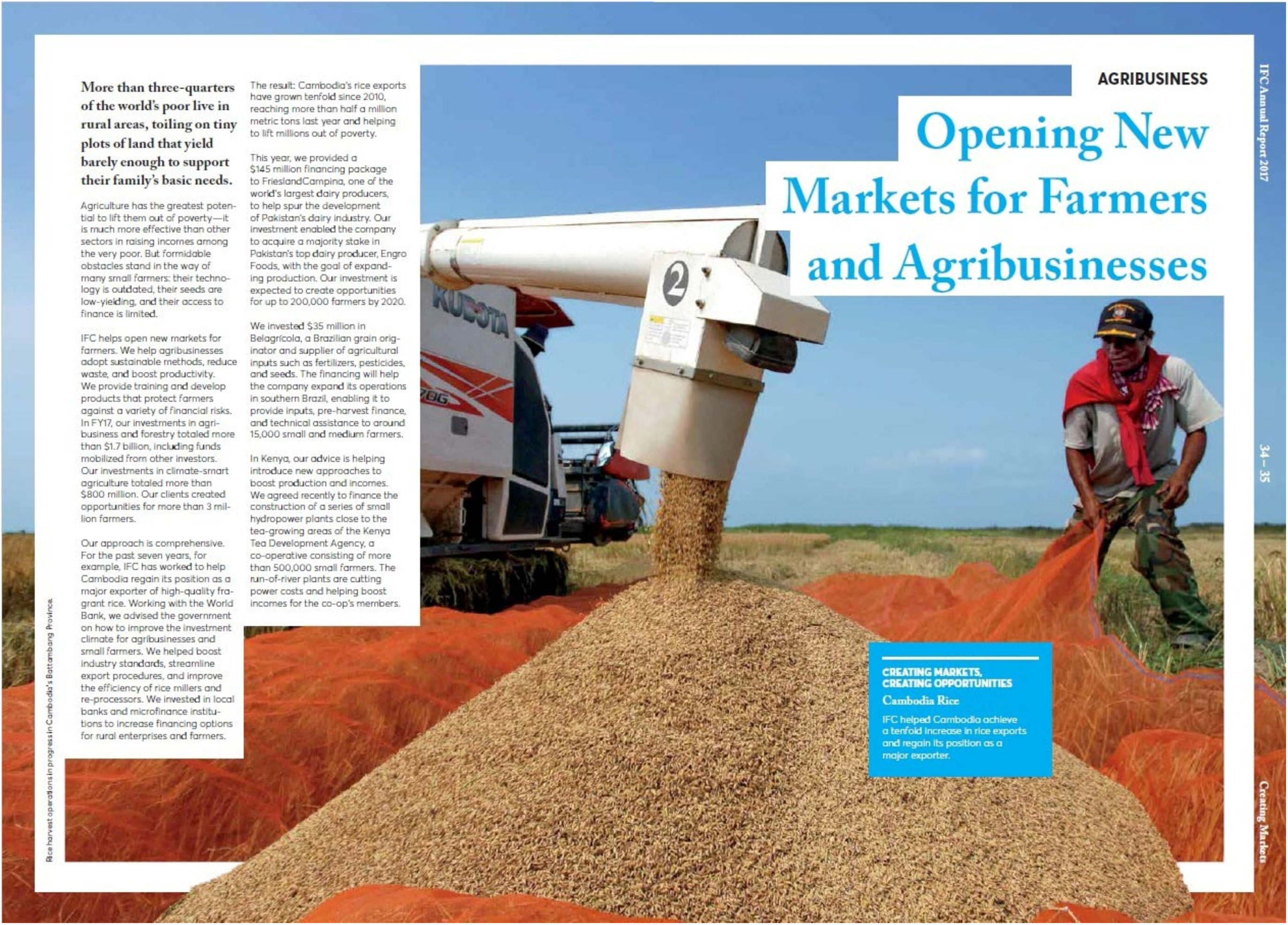
Microfinance debtscapes often celebrate the mechanization of agriculture. Source: IFC (2017).
Indeed, like in Figure 2, agricultural machinery is a recurring symbol of microfinance debtscapes. Banks and MFIs often celebrate successful borrowers by describing the harvesters and tractors that their borrowers purchased with a loan, which in turn allowed them to generate more income by renting out the machinery. The developmental potential of microfinance is represented by those individuals, almost always men, who have access to finance to purchase machinery to compete on international commodity markets. Yet nowhere do these success stories mention that most farmers borrow money not to own their means of production, but to rent it (Green 2020a, 2022b). Celebrating the purchase of machinery privileges only one side of a class relation: that of the wealthier, more well-connected farmer. Those farmers who must rent combine harvesters using borrowed money are rarely considered, as this might open imaginative space to consider how debt is a mechanism for the concentration of the means of production. The debtscape of Figure 2 is thus a hegemonic way of seeing, treating the former position as a general condition of microfinance borrowers rather than a dominant, classed position.
The duplicity of microfinance debtscapes arises not simply through such mystification, but by romanticizing those relations of production actively undermined by microfinance. For example, the combine harvester in Figure 2 has largely replaced the manual labor depicted by the two rice farmers in the righthand picture of Figure 1. In the past, rice farming in Cambodia was labor intensive. Farmers worked in large groups, organized around mutual aid or wage-labor, to transplant and harvest rice by hand. Yet the growth of machinery in the countryside has made those practices less economically viable (World Bank, 2015). Renting machinery is both cheaper, and quicker, than hiring labor or engaging in mutual labor exchange. The rising cost of farm labor has been driven in part by people migrating out of the countryside to find work in urban areas or abroad. And although rural out-migration has many causes, a significant number of households report that they must migrate to repay microfinance debt (Bylander, 2014; Green and Estes, 2019, 2022).
Cambodia's debtscapes never show this relationship between microfinance debt and migration. This is particularly true in representations of female microfinance borrowers. The majority of microfinance borrowers in Cambodia, like elsewhere in the world, are women. The IFC has justified many of its Cambodian investments by claiming that the country faces a “financing gap” of $4.2 billion for women-owned enterprises, roughly two-thirds of Cambodia's national budget (IFC, 2019). Debtscapes thus celebrate women entrepreneurs as agents of development in the countryside, as seen in Figure 3, found in Amret's 2017 annual report.
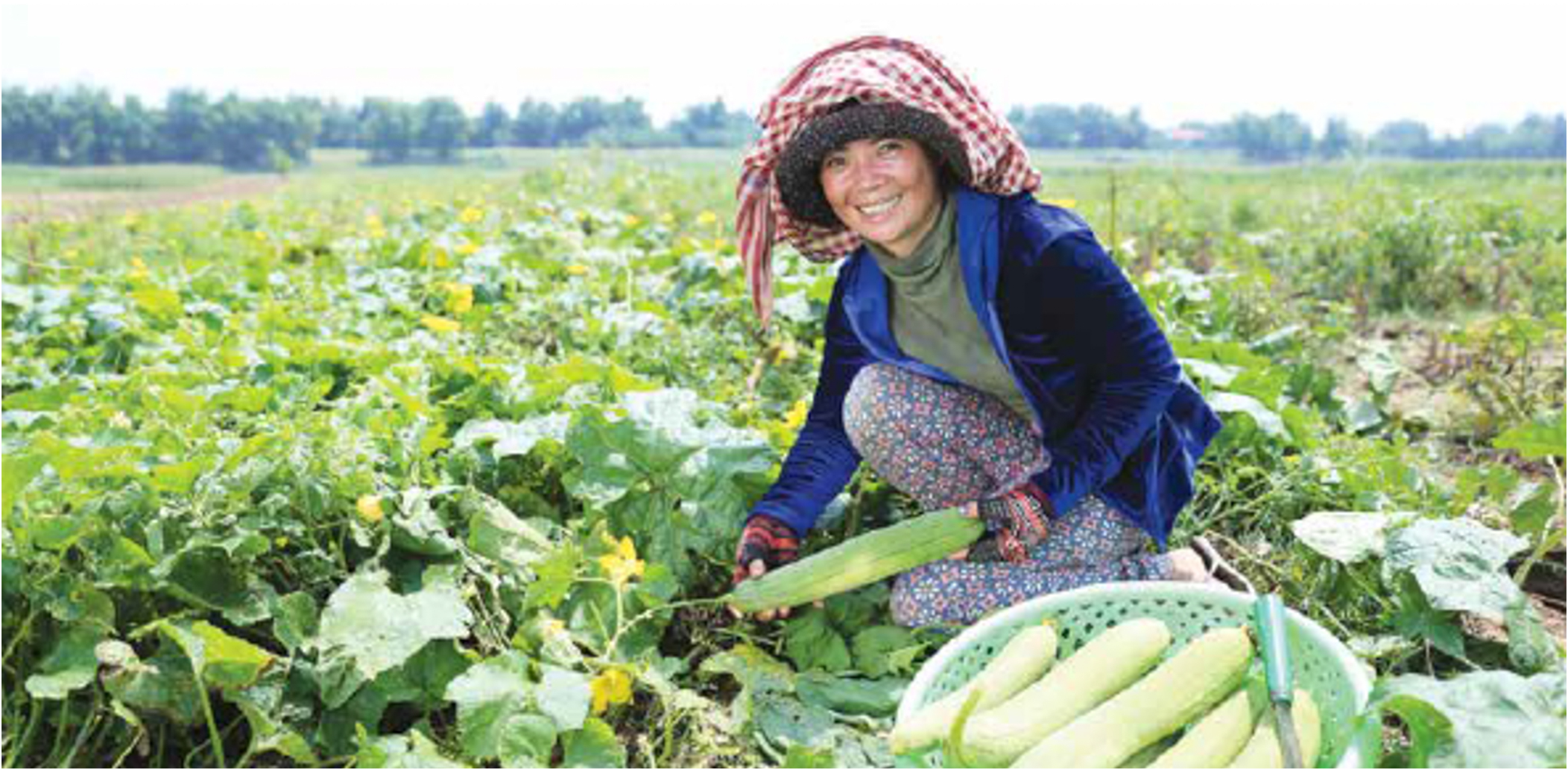
A female farmer and microfinance borrower harvests vegetables. Source: Amret (2017) Annual Report.
In this image, a woman is shown working in her agricultural field, smiling and wearing a kroma scarf. She is harvesting large, ripe luffa gourds, which she has placed in a basket. The representation of women harvesting fruit and vegetables is a common motif of microfinance debtscapes, symbolically linking women with the fecundity of the land (Rose, 1993). Moreover, this gendered landscape depicts the woman by herself, alone in the field, separated from her social networks of kin, friends, and neighbors. This representation of the individual woman underpins what Rankin (2001) identified as the quintessential microfinance subject, a “rational economic woman,” who is responsible for lifting herself out of poverty, nurturing her family and community, and developing the nation. The only thing this female farmer needs to become a successful vegetable farmer is a microfinance loan. She is thus defined by what she lacks—a microfinance loan—precisely what the social impact investor has to offer. By representing women close to nature, nurturing, and passively waiting for a loan from a distant impact investor, microfinance debtscapes reinforce a masculinist way of seeing (Rose, 1993).
Despite the industry's celebration of the female entrepreneurial farmer, many of the women repaying microfinance debt in Cambodia actually labor in the country's garment industry (Brickell et al., 2022; CATU et al., 2020). For the past decade, young women migrating to work in this industry have supported the microfinance sector's growth by remitting their wages to help repay loans taken out by their family members to pay for the costs of production and social reproduction (Green and Estes, 2019, 2022; Bevacqua, 2017; Natarajan and Brickell, 2022). So while the IFC and its Cambodian partners celebrate the female entrepreneur, debt has actually hastened the footloose proletarianization of the countryside (Brickell et al., 2022; Bylander, 2014). Moreover, rural household social reproduction, financed by microfinance debt, is now connected to distant, precarious labor markets. This precarity travels home when workers lose employment, such as during the Covid-19 pandemic. Without regular remittances, rural households face hardships repaying their loans. They are forced to take their children out of school, reduce food consumption, or sell land in distress to repay their loans (Green and Estes, 2022; Brickell et al., 2020).
Not surprisingly, these hardships, particularly distress land sales, are absent in the depiction of the female farmer in Figure 3. Yet for nearly two decades, the microfinance industry has required land-based collateral to issue the majority of its loans. With land titles held by MFIs and banks as collateral, borrowers who face loan default may feel compelled, or coerced, to sell their farmland to repay their debts (Green, 2020b; Green and Bylander, 2021; Bliss, 2022; Ovesen and Trankell, 2014). As such, microfinance has become a driving force of rural land dispossession in Cambodia, with 167,400 households selling land to repay their debt in the past five years alone (Bliss, 2022: 83). Cambodia's romanticized debtscapes elide this exclusionary power of microfinance, instead creating a spectacle for impact investors that legitimizes the use of finance to address rural development and poverty. Uncovering this ideology is possible—as the next section discusses, it has become a central goal of those contesting microfinance in Cambodia.
Right to Relief: contesting Cambodia's debtscapes
In the past three years, several human rights organizations in Cambodia have campaigned against the abuses of the microfinance industry. In a series of reports published between 2019 and 2021, the Cambodian human rights group LICADHO, working with other local organizations, has documented how microfinance has caused land dispossession, forced migration, and hardship among female garment workers (see Equitable Cambodia and LICADHO, 2021). These reports helped bring the abuses of Cambodian microfinance to the light of global investors and media.
Building on the successes of these reports, LICADHO launched the Right to Relief campaign in June 2021 with Equitable Cambodia to further contest the abuses of the microfinance industry and its investors. The campaign combines elements of participatory action research, community organizing, and international advocacy. It is based on research about microfinance over-indebtedness among 14 communities located across the country. The campaign organizers created a profile of each community's debtscape in an online, interactive website (https://www.mficambodia.com/), as well as a published report (Equitable Cambodia and LICADHO, 2021). Visitors to the website are able to navigate around a map of Cambodia, selecting a community profile to investigate in detail. These profiles provide images of communities protesting, descriptions of the communities, and videos of people talking about their debt troubles.
A primary aim of the Right to Relief campaign is to advocate for communities’ rights within Cambodia and abroad. It does so by targeting foreign social impact investors, particularly the IFC, in order to raise their awareness about the problems faced by indebted communities. One way the campaign has raised awareness is by creating counter-representations of Cambodia's debtscapes. This is demonstrated by the illustrated image in Figure 4, which is the cover of the Right to Relief report and website. This image depicts a composite landscape made up of a series of events that together tell a critical story of over-indebtedness in Cambodia. On the lefthand side of the image, two microfinance credit officers, dressed in white shirts and black slacks, pound a “for sale” sign into the ground in front of a golden rice field as a family with packed bags stands by watching. Behind this family, another “for sale” sign hangs on a traditional wooden house on stilts, depicting how debtors are selling not only their farmland, but their homes as well. To the right of this house, in the bottom corner, a number of people ride in the back of a pickup truck packed with belongings. The truck is passing by a red and white road marker, which points the way to the Thai border. This scene represents those millions of Cambodians who have migrated to Thailand in the past couple of decades, many to repay their microfinance debts (Bylander, 2014). Finally, in the upper right corner of the illustration, a group of people stand together holding up signs, protesting in front of an imposing block of buildings. These buildings flag the ubiquitous presence of MFIs and banks in rural Cambodia's physical debtscapes. Logos of Cambodia's largest MFIs and banks, all supported by the IFC and other Western impact investors, adorn the facades of the buildings.
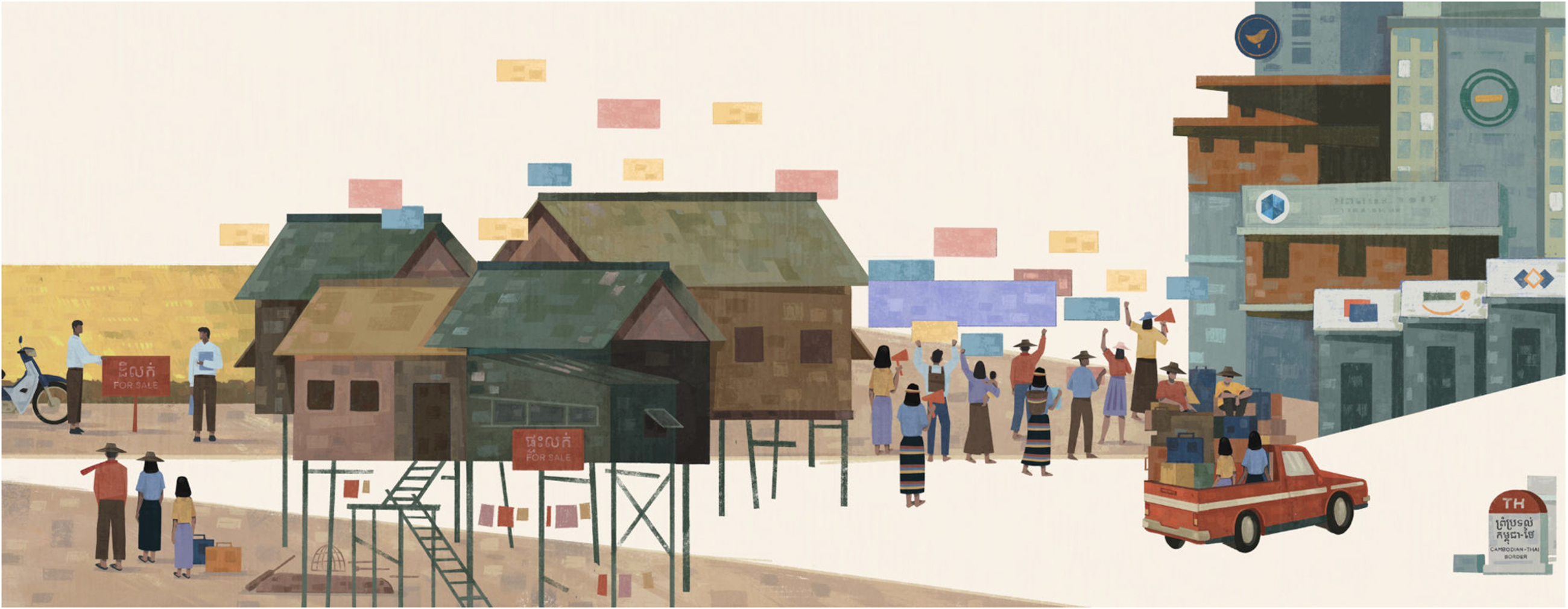
The cover image of the Right to Relief campaign's report and website. Source: Right to Relief (2021).
The Right to Relief's report and website further elaborate upon the stories illustrated by this debtscape illustration. On the campaign's website, the organizers quote a community representative, who said, “I’m happy that our sadness is finally being publicized. We have kept it hidden for so long. The way [the MFIs] act is the opposite of the way they speak. Debt is the biggest problem faced by communities across the country” (Right to Relief, 2021). Similarly, in a community served by three MFIs, all with long financial ties to the IFC, another person said, “International banks that came to help Cambodia, they didn’t come and help Cambodia. They came and killed us” (Equitable Cambodia and LICADHO, 2021: 22). Drawing on the stories of indebted communities, the Right to Relief campaign challenges the moral narratives that underpin the IFC's and its partners’ representations of Cambodian debtscapes. They do so by adopting a discourse of human rights, which articulates a different moral conception of microfinance. According to the Right to Relief campaign, MFIs and their international investors have “a moral obligation to address the human rights abuses” suffered by their over-indebted borrowers (ibid., 1).
This human rights discourse imbues the debtscapes in the Right to Relief campaign. For instance, many of the indebted communities are represented by photos of people holding up signs celebrating human rights. In Figure 5, one of the banner images in the Right to Relief report, community members from Boeung Pram village stand behind a large, blue banner that reads “Celebrating the 109th anniversary of International Women's Day,” an event that emerged out of the women's rights movement. Those holding up the banner are mostly women, several of whom are thrusting their fists into the air, recalling the radical action that marks International Women's Day in some parts of the world. This image stands in stark contrast with the depiction of women in most microfinance debtscapes, such as in Figure 3. Whereas the microfinance industry celebrates the individual, female entrepreneur, this image from Boeung Pram foregrounds gender solidarity in the face of over-indebtedness. In fact, over the past two decades, Cambodian women have led many of the country's largest protests against violent land dispossessions driven by the country's economic development (Brickell, 2020).
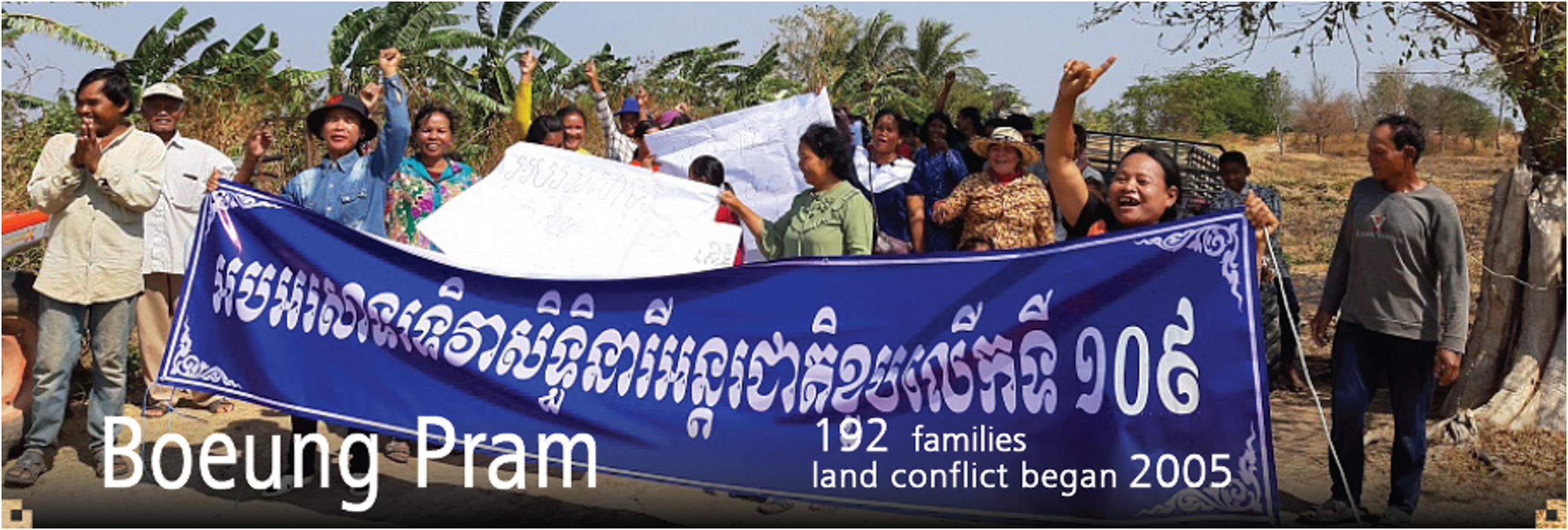
A community in the Right to Relief campaign celebrates International Women's Day. Source: Equitable Cambodia and LICADHO (2021).
Given Cambodia's history of land conflict, the organizers of the Right to Relief campaign were strategic in how they represented community debtscapes. The communities participating in the campaign have contested against land grabs for many years, often collaborating with LICADHO or Equitable Cambodia. The campaign organizers have explicitly linked the outcomes of microfinance debt to these land conflicts, a link captured by the campaign's debtscapes. Hence, on the image of Boeung Pram in Figure 5, it is stated that land conflict began in 2005. By using images of communities advocating for their land rights, the Right to Relief campaign reframes microfinance as a driver of land dispossession. These counter-representations of debtscape, highlighting the link between debt, human rights, and dispossession, directly challenge the imaginaries of impact investors.
The IFC has responded to the Right to Relief campaign with both skepticism and outright denial. While the IFC stated in 2019 that it would “review the NGOs’ analysis of the Cambodian microfinance sector” following LICADHO's first report on distress land sales (Bopha and Khan, 2019), the IFC continued to support the industry throughout the Covid-19 pandemic, lending tens of millions of dollars to institutions listing record profits as borrowers struggled (Finch and Kocieniewski, 2022). The IFC defended its investments by stating that it has helped to set up a national credit bureau and strengthen the industry's consumer protection framework (Hutt, 2021). However, these self-regulatory measures have largely failed to protect Cambodia's borrowers: Cambodia now ranks at the bottom of the global microfinance industry in terms of client protection (Equitable Cambodia and Licadho 2021, 2). Moreover, Cambodia has a history of human rights abuses, with a government that is both complicit in, and perpetrator of, land dispossession (Brickell, 2020). To assume that a self-regulated market is capable of protecting clients facing over-indebtedness in this political-economic landscape is duplicitous.
The debtscapes of Cambodia are thus a field of force, in which competing claims about poverty and social impact investment come together. In this field, the Right to Relief campaign is one effort to contest the ideology of microfinance espoused by the IFC and its partners. It has done so through an ongoing project to both raise awareness, and challenge, the existing practices and abuses of the industry by deploying counter-representations of debtscapes informed by community-based research and activism. These struggles have shaped the geography of impact investment in Cambodia. In June 2022, for example, the Right to Relief campaign won a major victory against the IFC, when its internal Compliance Advisor Ombudsman agreed to accept a complaint filed by LICADHO and Equitable Cambodia on behalf of indebted communities (LICADHO, 2022). This ombudsman is now in the process of determining whether the IFC violated its own investing rules, marking the first investigation into the IFC's social impact investment for microfinance—not only in Cambodia, but in any country in the world.
Conclusion
In this paper, I introduced the concept of duplicitous debtscapes to analyze how landscape representations legitimize social impact investment for microfinance in the global south by veiling the exploitative conditions of debt-financed agrarian transformation. In the past decade, a range of philanthropic, developmental, and financial institutions have channeled finance capital from impact investors to the rural poor through technologies like microfinance. These institutions claim that impact investment is the best way to solve social problems like poverty, a claim based on a discursive repertoire that equates return on investment with social impact. An important element of this repertoire are the developmental imaginaries that impact investors hold about agriculture and smallholder farmers.
By drawing on evidence from rural Cambodia, I argued that the microfinance debtscapes of the IFC and its Cambodian partners produce a developmental imaginary that obscures the transformations underway in the countryside. On the one hand, debtscapes romanticize a rural idyll, such that impact investors’ imagine that they are helping industrious, timeless, and close-to-nature farmers. On the other hand, debtscapes legitimize rural differentiation and agrarian class formation by celebrating the concentration of the means of production into the hands of successful microfinance borrowers. In this way, debtscapes actually reinforce a much older way of seeing, long associated with capitalism. Moreover, as a way of seeing, debtscapes render visible distant Others to European investors. This gaze sees farmers in terms of their lack of money, particularly women, who might unleash their entrepreneurial potential if only with the help of the global north investor. In this sense, debtscapes reinforce an imperial and masculinist gaze that reinforces control over the land and labor of microfinance borrowers.
Duplicitous debtscapes in Cambodia have not gone unchallenged, however. In the Right to Relief campaign, a group of human rights organizations have worked with communities to contest the debtscapes of the IFC and its Cambodian partners. Based on participatory research, the Right to Relief campaign built an interactive website, with an accompanying published report, documenting the abuses of Cambodia's microfinance industry. This campaign uses the images and stories of indebted communities to craft counter-narratives and representations of financial inclusion, which directly undermine the moral claims of social impact investment. Thus, debtscapes are also a field of force for the struggle over representations of debt.
The study of debtscapes can inform work in development and financial geography seeking to understand the exploitative relations within social impact investment markets. These markets produce value for financial investors by coercing changes in debtors’ behavior, exploiting women's work, and proletarianizing the countryside. Moreover, studying the struggle over debtscapes is one strategy for transforming financial markets. The critical study of debtscapes can unveil the structures of power and ideology that underpin finance capital, thereby challenging, deconstructing, and modifying dominant representations of debt (Soederberg, 2013: 538). This is especially paramount as social impact investment adopts a hegemonic position as the most moral, and effective, way to regulate poverty. A future critical research agenda on the financialization of poverty for geographers would be to de-fetishize representations of impact investment in order to contest this hegemony.
Footnotes
Acknowledgments
I wish to thank Dr Jennifer Estes for her helpful suggestions on multiple drafts of this paper. I also greatly appreciate the feedback of four anonymous reviewers and the editor, Prof. Susanne Soederberg, for their constructive suggestions. Last, I am grateful to my interlocutors in Cambodia, who provided me with invaluable insight into the country's microfinance industry.
Declaration of conflicting interests
The author(s) declared no potential conflicts of interest with respect to the research, authorship, and/or publication of this article.
Funding
The author(s) received no financial support for the research, authorship, and/or publication of this article.
