




Abstract
Drawing on the Bourdieusian concept of ‘field’ and the theorization of ‘intersectionality’, this paper proposes a concept ‘intersectional field’ to disentangle the complex interrelations between housing and education in China, where they mutually constitute and co-produce yet trouble and counteract with each other, whereby exerting simultaneous exclusion in cultural and economic (re)production. Drawing on policy documents and 38 in-depth interviews with various stakeholders in China, we first delineate the genesis and evolvement of this intersectional field. We then demonstrate how middle-class parents rationalize and strategize their heavy investment in cultural and economic reproduction against the most recent policies that seemingly aim to de-intersect/decouple these two fields. We show that the intersectional field of housing and education in China emerges from state-imposed rules while being increasingly self-reinforced. It was also temporarily counteracted and suspended responding to the escalated crises of housing unaffordability and over-competition over quality schooling opportunities, through policies like franchising key schools from the city centre to the suburb and random allotting enrolment. These changes in the ‘rules of the game’ indeed bring uncertainties to the intersectional field. However, while discontent to this intersectional field abound, these actions are self-constrained by the internal logic of the intersectional field and thus unable to bring fundamental changes. Those with limited socio-economic capacities remain extremely disadvantageous in both fields. The policy intervention turns out to be merely a spatial reordering that relocates and expands the fierce competition from the city centre to the suburbs while repositioning the suburbs to be the focal point for strategic investment in the intersectional field.
Introduction
Numerous studies have detailed how housing and schooling choices entangle with and inform each other. This entanglement is commonly observed both in such contexts as the UK with catchment areas policies (Butler and Hamnett, 2007) and ‘free-choice’ contexts with a higher degree of personal choice and few geographical constraints, for example, the Netherlands (Boterman, 2019). This entwinement has been increasingly intensifying housing and educational inequalities in a complex and wicked manner (Boterman and Walraven, 2024) and reshuffling socio-spatial inequalities in wider contexts (Boterman, 2019; Reardon and Owens, 2014).
This entanglement of housing and schooling choices also prevails in China. Highly priced school district housing frequents headlines and is mainly preserved for those with higher levels of economic and cultural capital (Wu et al., 2018; Wu and Waley, 2018). As shown in Wu et al. (2016), housing prices within top public school zones are significantly higher than those outside; the majority of these residents are highly educated and work in professional, managerial or government positions (p. 3522). These housing-schooling unaffordability and inequality loom large and increasingly become the centre of vortex where the aspirations and anxieties of middle-class coalesce. In response, a host of educational and housing policies have been deployed. The problems nonetheless linger across the decades. More recently, state-initiated policies are incorporated into the toolkit including franchising key public schools predominantly from the city centre to the suburbs (jiao yu ji tuan hua), and implementing ‘random allotting (yao hao)’ in school admission. These measures aim to expand access to high-quality schools and reduce the link between housing and education by introducing uncertainties. But their actual effects remain to be unfolded.
Scholarly attention has also been paid to these burning issues, including geographies of social reproduction (Wu et al., 2018; Wu and Waley, 2018), displacement (Hu et al., 2019), educational capitalization (Cai et al., 2022; Hu et al., 2020; Peng et al., 2021). More recently, research on education-featured gated communities, in which access to k-12 school is packaged with upmarket residential services, has cogently shown that these schooling-cum-housing products are deriving from the nexus of the entrepreneurial state, profiteering real estate developer and the enterprising middle class (He, 2022). However, a more fundamental question has thus far escaped sophisticated scrutinization and theorization: how should we understand the fundamental nature and deep-seated socio-spatial relations underpinning this housing-schooling interaction in China?
Answers to this question have both theoretical and practical relevancies. On the one hand, it demands a more calibrated and grounded theorization of the essential manners and dynamics through which the ‘rules of the game’ in the housing field and those in the education field entwine, clash with and trouble each other. In so doing, it’s also well positioned to advance the Boudieusian field analysis (Savage, 2011) in a situated manner. The housing-schooling entanglement is dynamic and relative across space and time. For instance, countries like the Netherlands are moving from ‘free choices’ towards more intertwined neighbourhood-school relations (Boterman and Walraven, 2024). Dissecting how such a complex system evolves in China will offer a better understanding of these two intersected fields. On the other, it will provide a deeper understanding of the entanglement of differentiated actors, dynamics and relations embroiled within the perplexing issues, and unleash the potential for profound discoveries and solutions using innovative conceptual tools.
This paper takes up this thorny task. Drawing on the Bourdieusian concept of ‘field’ and the theorization of ‘intersectionality’ geographical studies (Crenshaw, 1989, 1991, 2013; Harvey, 1993; Hopkins, 2019; Valentine, 2007), we proposed a concept ‘intersectional field’ to understand the interdependence, concurrence as well as tensions and contestations of the housing and education fields. Our central argument is that we should understand the field of housing and that of education, not as two singular fields with two separate vectors of actors, relations and practices; rather, they interact so intensively that they form an ‘intersectional field’ where the logics of two fields mutually constitute and co-produce yet at the same time trouble, clash and counteract with each other. With this concept, we also foreground the role of the state in (re)configuring the ‘rules of the game’ in the intersectional field, which was underplayed in field studies (Jenkins, 2006; Savage, 2011). Nonetheless, we do not aim to either denounce the theorization and critiques within each field or to provide direct solutions to housing/education inequalities. We aim rather to provide a coherent and critical conceptualization to crystalize what has remained inchoately articulated and to expound the deep-seated problems associated with the nature of these fields. In so doing, this research also fits well into the Bourdieusian education research (see a review by Yoon, 2020), and goes beyond it by foregrounding the intersection of ‘fields’ and their ‘rules of the game’, which were largely taken as the taken-for-granted background before.
In this paper, we draw on the empirical case of Guangzhou, one of the largest Chinese cities, where the interactions of housing and education fields played out intensively, epitomized by the prevalent education-featured gated community (He, 2022). In the next section, we elucidate the conceptual construction of ‘intersectional field’, followed by a data and method section. Thereafter, we present the genesis and evolvement of this intersectional field of housing and education in Guangzhou, focusing on a complex set of actors – the state in particular – processes and socio-spatial relations. We then reveal how middle-class parents, as the main education and housing consumer, rationalize, strategize over and reinforce the rules in the ‘intersectional field’. This paper ends with a conclusion and discussion section.
Conceptualizing the ‘intersectional field’
A field is a specific social space, where actors struggle and compete for the specific forms of capital at stake in the field; it has its own specific logics, taken-for-granted structures of necessity and relevance, and struggles for usurpation and exclusion (Bourdieu, 1984; Jenkins, 2006). Fields are fewer in simpler societies and more in complex and socially differentiated societies (Jenkins, 2006: 52). Fields also tend to be relatively independent and autonomous, in relation to each other and to the broader social environment (Bourdieu, 1996). Different fields are also homologous. All fields are governed and structured by the field of power, the preeminent field of any society (Jenkins, 2006: 53). People also translate their habitus, an enduring set of dispositions structuring behaviours, into practices in varying fields they partake in, including but not limited to those of housing, education, employment and parenthood (Boterman, 2012). In Bourdieu’s conception, the field tends to inherit the pre-existing structures, is constantly (re)produced through the interaction between habitus and the constraints and opportunities determined by the structures of the field, and tends to reinforce the structure, hierarchy and domination within (Bourdieu, 1996). This indicates that Bourdieu’s model of fields is essentially about (re)establishing equilibrium and stability. Social disruption and changes are peripheral to the model. ‘External determinations’ are introduced as the motor force; internally generated changes are difficult to account for. In particular, the state is largely missing from the configuration of the structure of the field (Deer, 2003) and the institutionalized nature of the field is largely omitted (Jenkins, 2006: 56).
The concept ‘intersectional field’ also taps into the conceptualization of intersectionality as both an analytical lens and a liberation/political tool (Jordan-Zachery, 2007). This is embedded within such critical theorization of ‘intersectionality’ as in feminist geographies and inequality research (Crenshaw, 1989, 1991, 2013; Harvey, 1993; Hopkins, 2019; Valentine, 2007). Intersectionality is an approach to frame interactions (Crenshaw, 1989, 1991) that highlights multiple dimensions of co-constitution, modification and contestations rather than a linear adding up. The exclusion a black female experiences does not equal to adding that experienced by a black person and that by a female, but is a unique experience at the intersectional space of these two dimensions (Crenshaw, 2013). Additionally, it is historically committed to render apparent the otherwise hidden and normalized exclusion, marginalization and struggles, and to provide potentialities to challenge oppressive structures (along dimensions of race, gender and class for instance) (Crenshaw, 2013). Revealing the simultaneous exclusions is a first step towards emancipation and liberation.
Building on Bourdieu’s conceptualization of ‘field’ and the theorization of ‘intersectionality’, the concept ‘intersectional field’ well depicts how (the rules/logics of) fields co-constitute and co-produce yet trouble, clash and counteract with each other. The taken-for-granted structure of necessity and relevance in the respective fields change with their intersection. The meanings of the objects of struggle in each field could only be understood together with those of other interlocked fields. More pertinently, the struggles are not located in the space between fields, but in the overlaying spaces of both fields that are by no means fixed but constantly changing along with the dynamics in both fields, based on intersecting rules. The ‘rules of the game’ in respective fields may cease to, or may change their manners, to inform practices; stakes and logics in each field may contradict in these overlaying spaces. The intended effects in one field may be blocked by logics in another; unintended consequences may emerge if the logics in the other field or the intersectionality are not considered. In this interconnectedness and co-constitution, dual, if not multiple, simultaneous exclusions are at play and reinforce (or mitigate in some other cases) each other. Different social groups, of varying demographic and socioeconomic statuses, are differently positioned in respective fields, as well as the intersectional field. They have different sets of dispositions that structure their behaviours and practices, and possess different power in reinforcing or reshaping the hierarchy and domination of the intersectional field.
In this sense, the ‘intersectional field’, encompasses the structural ‘rules of the game’ and ‘structure of possibilities’, and the household-level practices and strategies which are to a large extent structured by the former. This positions the conceptualization of the ‘intersectional field’ of housing and education, well connected with the school choice literature.
Indeed, the interconnections between housing and education has been extensively studied in various contexts. Research show that access to high-quality (public) education, in the Dutch free-choice context (Boterman, 2019) and British catchment area policy context (Butler and Hamnett, 2007), is still largely determined by residential proximity and contingent upon the conditions of the housing market (Hamnett et al., 2013). Moreover, where individuals reside has significant impacts on schooling outcomes. For example, Reay and Lucey (2003) demonstrated how economically disadvantaged individuals living in disadvantaged neighbourhoods in England are deprived of opportunities to attend high-ranked schools because they cannot afford to live in those neighbourhoods nearby. On the policy and rule-making side, there is a prevalence of intensive policy adjustments in school enrolment rules in relation to the housing field across different contexts. For instance, the Netherlands may transit from a free-choice context, which is considered as the culprit of intensive schooling strategizing and segregation, to linking residential neighbourhoods with schooling opportunities (Boterman and Walraven, 2024).
Despite being widespread, the intersectional fields of housing and education are idiosyncratic according to the national and local housing and educational landscapes. In the Chinese context, the rule of ‘attending schools nearby’ 1 binds schooling opportunities to homeownership, meaning that individuals can only attend schools in the corresponding school districts where they own a house. The catchment area policy in UK seems similar, but it does not require homeownership (Hamnett and Butler, 2013). This leads to a much stronger competition over houses affiliated with good schooling opportunities which in turn drives up the housing prices (Wu et al., 2016), resulting in a mutually and simultaneously reinforced exclusion in cultural and economic (re)production.
To sum up, the conceptualization of the ‘intersectional field’ has both theoretical and empirical values in explicitly highlighting the importance of examining the widely recognized entwinement between the housing and schooling fields. This includes not only how these fields co-shape and co-constitute but also trouble and counteract each other, and how such interconnections result in simultaneously and mutually reinforced exclusion. Moreover, it emphasizes that effective policies can only be formulated at the intersectional space where the intersectional logics of housing and education, rather than the education or housing logics alone, shape relevant practices and strategies.
While Bourdieu emphasized that individual practices, structured by enduring dispositions, are an essential part of the equilibrium and disruption of fields (Bourdieu, 1996), we foreground the integral and active role of the state in an intersectional field. With its all-encompassing symbolic violence, it is powerful in enacting strategic intersectionality, reinforcing and transforming the intersectional ‘rules of the game’, intentionally (for social stability, economic development and justifying its legitimacy) as well as unintentionally. Nonetheless, the efficacy of state power demands the ‘complicity’ of individuals. They consider it natural to play the game, internalize, strategize over and reinforce the rules. Misrecognition is an important mechanism in sustaining the rules of the game: they recognize the rules but misattribute the real meanings and causes of it (Bourdieu, 1996). However, they could also actively challenge the game and disrupt the field through acts like unlearning the rules and social protests. Embedded within the inherently unequal social and spatial distribution of relevant stakes, tensions are constantly being accumulated and will never disappear. They are usually temporarily resolved by shaping a differentiated contract between the state and individual practices (Raco, 2009), or by shifting the problem framing and its entailed solutions in a circular manner.
Data and method
As the third largest city in China, Guangzhou typifies intensive housing-schooling intersections amidst rapid urban (re)development. The city witnessed the earliest emergence in 1994, and subsequently the growing prevalence of, education-featured gated communities, a culmination of such intensive entanglement (He, 2022). It is also avant-garde in education and housing policy reform, hence providing a good case in point to observe the evolving intersectionality of housing and schooling in China.
Empirical data comprise policy documents from education and planning bureaus of Guangzhou and its districts, both central and suburban, documents from the official websites of schools and real estate developers, media reports, as well as 38 semi-structured interviews (Table 1). Major stakeholders were carefully selected and approached including officials of education bureaus, planners, school teachers and administrative staffs, real estate developers, as well as middle-class parents. Interviews with educationists and planners concerned the policy of compulsory school construction as supporting public service facilities in accordance with housing development (pei jian), school admission policies, urban (re)development strategies and their relationships with education. These interviews were conducted together with local scholars, who have established long-term cooperative relationships with these bureaus. We were thus able to build rapport with our interviewees and solicit important information and honest opinions. Real estate developers were approached through personal connections. We delved into their rationales, strategies and challenges in combining the education and housing fields during the last two decades. These Interviews lasted from 1 to 2 hours depending on the range of topics covered.
Interviews with key stakeholders.
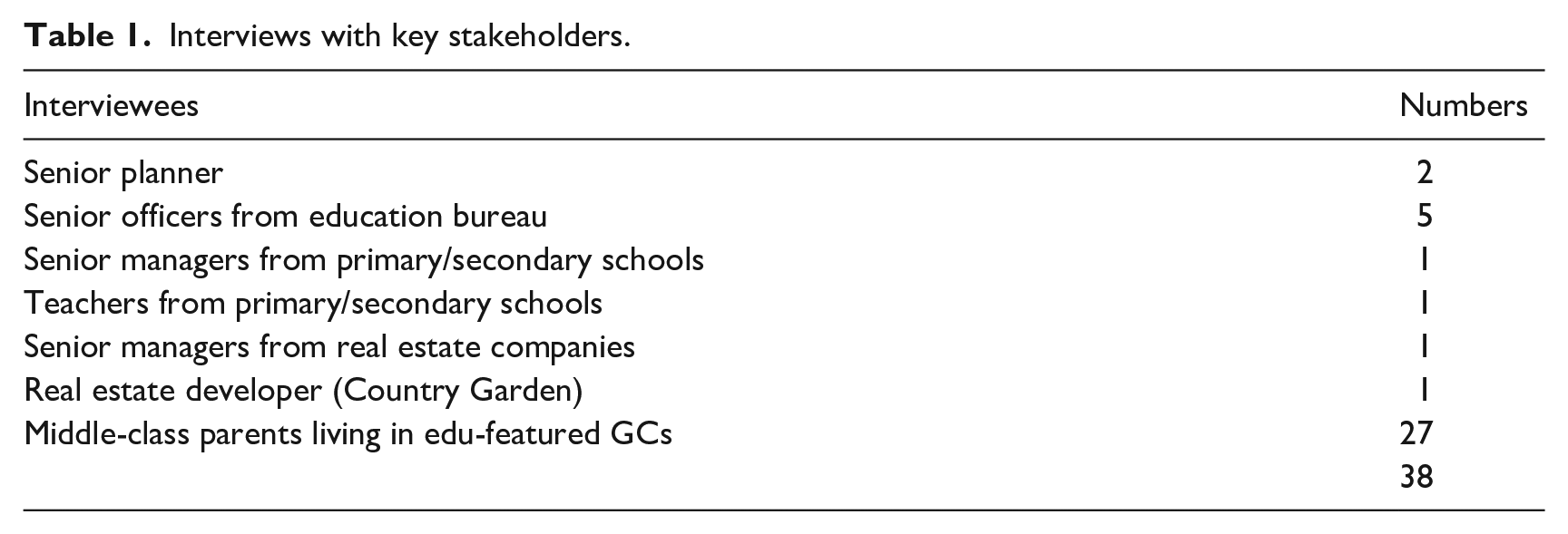
Additionally, 27 semi-structured interviews were conducted with middle-class households that have at least one child at the compulsory education stage (K-9). The parents interviewed were mostly in their 30s and 40s. We mainly asked about their schooling attitudes and their choices regarding schooling and residential locations. They were selected based on various factors, including their residential locations (18 suburbs, 9 city centre), education levels (23 with a university degree and 4 without), as well as their Hukou status 2 (19 with a local hukou and 8 without). The overrepresentation of suburbanites is due to the concentration of the education-featured gated communities, which are the focus of this study, in the suburbs (He, 2022). Additionally, highly educated and local-Hukou residents are overrepresented in these predominantly middle-class neighbourhoods.
Most of the interviews were recorded and subsequently transcribed; notes were jotted down for those that were not recorded. A thematic analysis of the interviews was then conducted using Atlas.ti. The analysis process began with inductive coding, allowing themes to emerge directly from the texts. With these themes in mind, we referred to relevant literature. We then engaged in a deductive reading of the empirical materials, paying particular attention to evidence that supported or challenged existing theorizations, as well as inductive exploration for identifying any additional emerging themes. These iterative processes continued until we were confident that the empirical materials were fully utilized.
Empirical analysis
In this section, we first expound the emergence, evolvement and the most recent transition of this intersectional field of housing and education. We reveal that the state plays a dominant role in enacting, shaping and transforming its rules. We then move to unravel how middle-class parents rationalize, strategize over and reinforce the intersectionality, though not without discontent especially during the most recent transitional period of housing-education intersectionality.
The emergence and evolvement of the intersectional field of housing and education in Guangzhou, China
The present is embedded within the past (Koopman, 2013). We start from our present observation of the intensive intersection between the housing and schooling fields in Guangzhou, and trace its genealogy since the establishment of the People’s Republic of China. We show four stages including (1) ostensible intersectionality (1949–1978), (2) emerging, intensifying and suburbanizing intersectionality (1979–2002), (3) self-reinforcing and pervading (2003–2016) and (4) de-intersecting? (2017-). We use major events or policies to demarcate the evolving main themes. Nonetheless, by no means do we assume a clear-cut demarcation of historical development (Brenner et al., 2010). The analytical approach is to look at the changing predominant structural oppositions (such as suburb vs city centre, state vs market, public vs private in Figure 1), which are strategically enacted, (re)emphasized or filtered out by powerful players at critical junctures to (re)structure the intersectional field. We also examine the roles of various stakeholders, including the state, real estate developers, schools and middle-class parents, in shaping the historical trajectory of the intersectional field of housing and education in China, with a particular emphasis on the role of the state in this process.

The historical emergence and evolvement of the intersectional field in Guangzhou.
1949–1978: Ostensible intersectionality
When China was established in 1949, people still struggled over existential insecurities. Education was not attached with great importance. Only 20% of school-age children were registered in schools. To enlarge schooling coverage, ‘attending school nearby’ was incorporated as the main principle for school admission. It was convenient for pupils to attend schools and efficient for educational planning and monitoring. Contextualized in a lagging economy, underdeveloped transportation and indiscriminately poor educational quality, this principle was widely practised with high efficiency.
In 1953, the government decided to pool resources to develop key schools, for education to train better-skilled people and better serve economic development. 3 They are prioritized in the distribution of educational resources by the state, including fiscal support, high-quality teachers and facilities. Since then, the opposition between key 4 and ordinary schools became the main site for struggles in the education field and later on the intersectional field of education and housing. The education field was heavily interrupted during the Great Leap Forward (1958–1962) and Cultural Revolution (1966–1976).
In the socialist era, housing and schools were largely provided through collective consumption by work units with which individuals were affiliated and the local governments. Houses, typically in a state of disrepair, belonged to the state or work units; they were rented to the workers at nominal prices and cannot be traded as commodities. Housing quality was decided by individuals’ political status, seniority and positions in the work units (Wu et al., 2016), while education quality depended on the provider, either the work unit or local governments. No education or housing market existed (Wang and Murie, 2000). Consequently, housing and education did not directly impact (e.g. shape, produce and cancel out) the outcomes of each other and they largely operated independently with their own ‘rules of the game’. They were indeed related to each other, but their ‘intersectionality’ was merely ‘ostensible’.
1978–2002: Emerging, intensifying and suburbanizing intersectionality
The intersectionality of housing and education fields emerged and was reinforced along with housing commodification in the late 1980s and the increasing importance of education in economic returns. This intersectionality was first and foremost enacted and enhanced by the omnipotent power of the state over the fields (Bourdieu et al., 1994) through state regulations. Secondly but equally importantly, it was also embedded within the emergent and encompassing power of economic logics in governing housing and educational behaviours in both fields. Additionally, the state played an important role in the late 1980s, while the market including the real estate developers and schools took the lead in intensifying such intersectionality through the period of 1990s, with the support of the state and catering to the desire of middle class for better housing and education qualities. This had a notable spatial dimension featuring the suburbanization of such intersectionality.
Since 1978, ‘attending school nearby’ 5 and developing key schools 6 were also resumed. Along with economic development and globalization, education was increasingly related to highly-skilled occupations and higher economic returns. The desire for better education was augmented and competition over key schools amplified. Socialist vestiges, social capital and ‘guanxi’ (connections with powerful and important stakeholders) still played an important role in school admission. As many as one-third of the places in key schools were reserved for students registered through tiaozi (a note mostly by very powerful figures for their grand/children in the 80s and 90s) and co-establishment (government departments and public institutions sponsoring the school development in exchange for schooling opportunities for their employees’ children). 7 Additionally, piaozi (money) and ze xiao (school selection, i.e. to pay for the schooling opportunity of good school districts with lower than required grades) were also important in accessing key schools. 8 To oust these ‘games’, Compulsory Education Law of the People’s Republic of China in 1986 decreed, for the first time in law, the rule of ‘attending school nearby’. It demanded that people attended schools nearby 9 in the school district where they owned properties, and thus coupled schooling opportunities with housing under more stringent regulating power.
On the provision side, schooling was considered a state responsibility. However, state-owned enterprises were privatized and financial sources of the state decreased along with the deepening of the Reform and Opening (Wang and Murie, 2000). To relieve its financial burden, the state decreed in 1988 10 that the real estate developers should take their ‘social responsibilities’ to construct schools with houses they built; this was pre-conditional for granting land and other planning and building permits. The land for education was provided by the state for free.
At the same time, housing marketization through series of reform programmes and particularly the comprehensive housing commodification in the late 1980s started to establish a housing market. Socialist housing was sold to their sitting residents at a discounted price (Wang and Murie, 2000). Houses could be traded as a commodity. Real estate developers were established, exemplified by Vanke formed in 1984 in Shenzhen (Wang, 2001), and became increasingly important players in the intersectional field.
Through these processes, the education and housing fields increasingly converged with each other based on an economic return logic and economic capital as relevant stakes (also see Deer, 2003). Combined with the policy-enforced coupling, they started to impact household choices and behaviour in a significant fashion simultaneously as a bundle.
Such a convergence process also had a particular spatial register in the suburbs. Up until the early 1990s, most of the houses and schools were confined within the boundaries of relatively small urban built-up areas. These houses tended to be small, dilapidated and concentrated, leaving people’s desire for more spacious and modern living unsatisfied (Xu and Yeh, 2005). The suburbs were largely undeveloped due to border censors (highway toll fees for instance) and underdeveloped transportation connections with the city centre. Added to this background, people also started to attach importance to lifestyles and became pickier and more rational homebuyers. Furthermore, education accumulated growingly more importance and became a relevant stake when buying houses. The market (the real estate developers and schools) internalized the logics and strategized at the intersectional field of housing and education from the provision side. They took the lead in proactively integrating housing and education, catering to people’s desires for both better housing and education. They turned their eyes to the suburbs. They deployed a ‘Housing+’ strategy and ‘dapan’ model (large estate literally) (Wang, 2001). Instead of residential blocks, they built new towns including variegated facilities and infrastructures (Li et al., 2020). Schools were (one of) the most important social infrastructures. Key schools were attracted to build branches. This attracted young families with children to buy there without worrying about schooling (Wang, 2001). But this process was facilitated by the state through land provision for housing at a low price in those urbanizing suburbs (Wu and Phelps, 2011; Li et al., 2020); the state also supported such market-led suburban development by adjusting southwards the urban planning decrees, rather than eastwards as originally planned, following where the market players were or wanted to go (Wang, 2001); urban planning was supposed to regulate market development. Additionally, though the epic centre for this intersectionality of housing and education was the suburbs since the 1990s, some small urban redevelopment projects were also happening in the city centre (He, 2012; Wang, 2001).
2003–2016: Self-reinforcing and pervading intersectionality
At this stage, the intersectionality increasingly became an autopoietic system which produced and reproduced its own elements and structures in both suburbs and city centre, alluded to by the state (for selling lands and economic development), real estate developer (profits), schools (increasing student intakes, reputation and qualities) and middle class (economic and cultural reproduction). In addition to the well-established ‘attending schools nearby’ and ‘(real estate developers) constructing schools in neighbourhoods’ policies by the state, this was mainly built on increases in housing commercialization and economic return in educational obtainment. The main stakes in these two fields further converged to economic capital; advantages in one field ensued simultaneously and consequently reinforced those in the other.
In 2004 Guangzhou was selected as the host city for the 16th Asian Games. Since then, property prices in Guangzhou soared, instigating widespread housing speculation. Real estate was decreed as the pillar industry in China in 2003, 11 and since played an essential role in promoting economic development and urbanization. The real estate industry accounted for 15.1% of the total GDP in 2000 and increased to 23.8% in 2017 in Guangzhou (Figure 2). In 2019, more than 70% of the household wealth was in housing. 12 Education became the main way towards upward social mobility. Having a university degree was preconditional to the entry to middle-class (Goodman, 2014). This increasing commercialization of the housing field and the growing exchange rate of cultural capital to economic capital implied a greater homology in the logics of the education and housing fields.

The increasing importance of real estate industry in China and Guangzhou.
At this stage, the main stakes in the educational field for the middle class, or rather in the intersectional field of education and housing, were schooling opportunities in key schools, or rather houses with accessibilities to these key schools. Since 2006, the enrolment rate of primary school students to junior high schools surpassed 98%. The obligatory education achieved nearly full coverage. What mattered were not merely school opportunities, but good ones. However, key schools were historically concentrated in the city centre, even after the last round of school suburbanization in the 90s. This uneven spatial structure was embedded with potential crises and conflicts. Purchasing apartments, often dilapidated and small, in the catchment zones of key schools in the city centre during the schooling period of the children at an inflated price, and selling it at a profit later, were highly popular in many Chinese cities (Wu et al., 2016). This pursuit for simultaneous cultural reproduction and capitalization over educational spillovers reinforced the schooling competition and housing unaffordability issues. In contrast, the suburbs were considered comparatively ‘undesirable’ in both cultural and economic reproduction.
The policy of (real estate developers) constructing schools as supporting public service facilities with housing was also spatialized. Suburban development was important for capital accumulation, underpinned by the land finance system (Shen and Wu, 2017). However, it also raised concerns over arable land protection and sustainable urban growth. Urban redevelopment in the centre was reconsidered as an urban growth strategy by the Guangzhou government since 2005 and instigated a second wave of gentrification focusing on three-old development (san jiu gai zao in Chinese), including old factory areas, dilapidated urban districts and urban villages (He, 2012), as shown in Table 2. Embedded within these spatial processes, different policies were out regulating school provisions in new (re)development projects for varying purposes, For example, to satisfy the basic educational needs, to equalize educational resources in the suburbs, and to mitigate educational shortage in the city centre (the 2003–2016 period in Table 2).
Spatialized construction of new schools with housing during 2003–2016 and after 2017.

Source: Made by the authors based on interviews with educationalists and urban planners, and policy documents.
Old factory areas refer to former industrial parks which are transformed into ‘creative and cultural districts’ and mixed-use districts during the transitional period, and later turned into real estate development. Dilapidated urban districts encompass the old residential buildings, shops and factory spaces located in the central areas of districts and subdistricts. Urban villages are (old) former villages surrounded by urbanized areas, with collective land ownership and not being fully integrated into the urban system institutionally and physically (e.g. lacking infrastructure development) (see Liu et al., 2010). The approaches to providing schooling opportunities in these areas during 2003–2016 have been largely carried forward into the current stage (2017-present) and are working in conjunction with the newly adopted ‘strategic resources at strategic places’ principle.
These state regulations did not differentiate between key and ordinary schools. The real estate developers, however, in response to the middle-class demand for better school opportunities, paid special attention to key schools and built varying types of education-featured gated communities (He, 2022), through co-locating houses nearby existing key schools (mostly in the city centre), or building key school branches in the suburbs along with houses. While this residential form was somewhat elitist and rare in the 1990s, it was commonly practised now among real estate developers.
This intensified intersection between the housing and education fields, against the backdrop of housing price surge at this stage, inflicted serious issues of reinforced housing unaffordability due to the competition over quality education, educational inequality, intersectional exclusion and potential social conflicts. Those who are economically capable are able to secure both wealth accumulation and cultural (re)production through buying into desirable areas, while those who are not are largely excluded from the game and left behind.
2017-present: De-intersecting?
This most recent stage focuses on dis-entangling the intersectional field of education and housing in response to these crises through various approaches, including but not limited to the state-led suburbanization of key schools to increase accessibility of high-quality schools through school franchising (jiao yu ji tuan hua in Chinese), asserting uncertainties unto housing-schooling interactions and weakening the housing-schooling ties by random allotting (yao hao) policy, as well as the (re)municipalization of private schools (min zhuan gong). The state plays a decisive role through policy making and granting new rules in this intersectional field. However, the fields being intersectional, rather than independent, complicate the situations. Failing to fully consider the integral contradictions, tensions and counterbalances within (the logics of) the intersectional field render some measures invalid at best, and harmful at worst.
The rationale behind the state-led suburbanization of key schools is to dis-entangle the intersectional field through an intervention in the number and location of key schools: if key schools are everywhere (in both the city centre and suburb), it does not matter where you buy the houses, as the schooling qualities are the same (interviews with urban planners and educationalists). This process is meticulously calibrated and promoted by the state, and public key schools are ‘obligated’ to participate in this process (interviews with urban planners and school presidents). Since 2017, key schools are ‘reproduced’ rapidly through building key school branches in the suburbs, as well as incorporating other weaker schools through trusteeship in the suburb (interviews with school presidents). In this process, schools are still built by the real estate developers as ‘social responsibilities’, which then transfer the ownership to the state. At the core are naming affiliation and branding, though other mechanisms also exist like exchanges of teachers between the home school and branches. Nonetheless, the reputation and quality of key schools require decades of cultivation, rather than being conjured up overnight.
This process is mainly led by the state, in particular the district-level governments, which are responsible for managing obligatory-level education (Interviews with officials from education bureaus). They determine what to relocate from the city centre to the suburb, and where to relocate (the period of 2017-present in Table 1). Strategic locations are preferred for strategic educational resources, including high-tech industrial parks and new towns. In so doing, this suburbanization of key educational resources goes beyond a passive response and temporary resolution, but rather being strategically incorporated in the blueprints of urban (re)development (He, 2022). As we elaborate in the following sub-section, this indeed reconfigures the mental map of schooling and attracts people to settle down in the suburbs. However, the city centre is still considered a better space for the simultaneous reproduction of cultural and economic capital and remains highly sought after. Fundamentally, it is a state-led spatial dispersion and suburbanization of the intersectional field. The suburbs are repositioned as better spaces than before for economic and cultural reproduction; the intersectionality is attenuated in the city centre, but far from being disentangled.
Additionally, random allotting, combined with the ‘bigger school districts’ (da xue qu) was also introduced to decouple housing and schooling intersectionality in 2021. This means that if applicants outnumber the school capacity, the admission opportunities are randomly allotted; the rest applicant are coordinated (tong chou) into other ordinary schools within the expanded school district. This adds uncertainty into the schooling opportunity system and intends to intercept the pathway of reciprocal reinforcing of housing and education fields: a big investment may end up with no good schooling opportunities which make people hesitate to buy the houses. As we show later, this seems to be functioning.
Several other policies are also incorporated, including the simultaneous admission policies of both public and private schools (gong min tong zhao) and re-municipalizing (Becker et al., 2015) private and semi-public into public schools. The former policy annuls the privileges of private schools to select students through exams prior to public schools, which are also supposed to indiscriminately admit students. The aim of the later policy is to convert schools with mixed public and private assets, a situation that arose primarily during the initial period of marketization when private investment was sought to alleviate the state’s financial burdens in education, into either public or private schools. As a result, the majority of these schools have been converted into public schools. This remunicipalization of the education system seems to transcend the market logic and tends to reduce educational inequality across different socioeconomic groups. However, these intentions may fail to be achieved and at worst strike reverse effects. This relates to that educational choices are not conducted in its own field, but rather at the intersectional field comprising both the education and housing fields. With fewer chances to go to private schools where ‘attending schools nearby (houses)’ policy is exempted, and with the shrinking number and declining quality of the private schools, more people will have to compete to buy houses with good schooling opportunities. This reinforces the interdependent cultural and economic reproductions and relatedly simultaneous exclusions. In this intersectional field, the remunicipalization of the education field, is counterpoised by the exacerbated accessibility of housing with such good public-school opportunities; the ‘total effect’ of these educational policies could only be understood through the intersectional logics, rather than those in each independent field.
However, how this transitioning intersectionality is played out by the middle-class parents, as one of the main stakeholders and primary housing and education consumers, remains to be seen. Nonetheless, as indicated by Bourdieu, the efficacy of state power and symbolic violence needs the ‘complicity’ of the individuals; their practices, structured by the enduring dispositions, are essential parts of the equilibrium and disruption of the field (Bourdieu, 1996). How do people internalize and strategize over the changing rules in this transitioning period, and how do these practices implicate in this intersectional field? Is this de-intersecting well-received and practiced by the middle class? It is also in this transitioning and disrupting period, that the extant structure of relevance and necessity of stakes (housing qualities and schooling opportunities for instance) is challenged, and that people struggle the most among these stakes and render them emphatically conspicuous. We now turn to that.
Strategizing, misrecognizing and discontent in the intersectional field of education and housing
This subsection focuses on how middle-class parents strategize over the intersectional filed, which is structured and ‘harmonized’ by the economic logics. Though discontent with such intersectionality and its simultaneous cultural (education) and economic (housing) reproduction and exclusion, they misrecognize it as ‘nature’ and the state as ‘neutral’. Although the recent educational reforms as indicated in the last section expand the coverages of high-quality schools and introduce some uncertainties into the intersectional field, they do not fundamentally restructure it. Instead, these reforms primarily involve a spatial reordering, relocating and expanding the intense competition from the city centre to the suburbs (Cai et al., 2022), and repositioning the suburbs as a focal point for strategic investment in the intersectional field for the middle class parents.
First and foremost, middle-class parents strategize over the intersectional field rather than independent fields of housing and education. They aim for a simultaneous (re)production of both cultural and economic capital. A taken-for-granted choice is not one of either (good school) or (good houses), but of both. Comments as below are repeated themes among middle class parents.
I am buying here, because the school here is good. With this school, the houses will also be promising in value increase.
This intersectionality comes to existence when people start to strategize their housing investment with a clear goal in the educational field. It typically happens several years before their children go to primary schools, as several years of home-owning are usually required for the children to register in the correspondent school. Typical stakes in the housing field include housing size, location, greenness and lifestyle (also see Cui et al., 2015; Li, 2017). When people enter the field of education, these stakes become less important, if not trivial; the logics in the housing field may lose its power and change its manner in structuring practices. The living function of houses is taken over by the schooling function. Houses could not be compared in an essentialist manner based on a set of separate and fixed differences added incrementally to one another.
Since you have children, you could not only think about the comfort of living. Rarely, parents do that. We put their children’s schooling opportunities first. (a mother who moved from the suburb to the city centre; Aug 2022) I am from the city centre. I used to think that as long as I have a place to live, and my child has a school to go to that would be fine. However, I found only later that there are huge gaps between my child and other children, in their ways of talking and thinking. . .I spent tremendous effort in buying this house. . .if it is not for my child’s schooling opportunity, I would not choose to live here. . .the house is quite small and old. . .I’d rather not to say the specific size of it. . .yes, Haizhu (a central district but with fewer key schools) also has relatively good schools. But Yuexiu is better. I thought it is a better investment and wealth preservation and growth. (a father who bought in 2021 a 11,000 euro per square meter house in Yuexiu, a central district with most concentrated key schools; Sep 2022)
Research has long shown middle class parents strategize for their children’s education and houses (Butler and Hamnett, 2007; Butler and Robson, 2003; Reay et al., 2011). Chinese middle-class parents stand out with their all-pervasive economic rationality, epitomized by the housing investment strategy integral to and co-constitutive of the schooling choice as shown in the above quote. The absence is equally revealing of such rationales as social connections of the schooling kids (Bridge, 2006), and the adults themselves (Bridge, 2003), aesthetics (Butler and Robson, 2003) and lifestyles (Boterman, 2012). This implies the homologizing effect of economic logics and the submission of the school/cultural field to the economic field. Middle class parents complicitly subject to the structural forces in this intersectional field.
These middle-class parents feel it ‘pu bian (common)’, ‘zheng chang (normal)’, ‘tan ran (at ease)’ and (mis)recognize it as ‘tian xing’ (innate dispositions), to move for children schooling and to buy into these highly priced education-featured gated communities. While acknowledging the ‘commonness’ of this residential mobility strategy, it is also admitted that not everyone, in particular those non-local people, could do that. Corresponding to the interdependent and simultaneous cultural and economic reproduction, are dual exclusions: those who do not have enough economic capital to buy into a house with a good school will be excluded from both cultural and economic reproduction. The aforementioned father who moved from Haizhu to Yuexiu continued: Since my child started kindergarten, I communicated with some parents. They are very willing to invest in their children. Even those with the worst family conditions also try to find a way to provide tutoring for the children and to move for their children. It’s all like this [. . .] Needless to say, it’s subconscious. it is in Chinese parents’ tian xing (innate disposition). I was treated by my parents as such. People surrounding me are doing that. I am doing the same for my children [. . .] But if the family condition is really average, they really cannot do much (rather than attending schools nearby). These people are mostly those who are not born in this city. They usually go to the suburbs and trying to find a good schooling opportunity there.
This father mistakes a family and societal socialization as a ‘born nature’. This misrecognition naturalizes related rules and practices, and passes down the embedded inequality and marginalization as unnoticed and taken-for-granted in this intersectional field. In other cases, the manufactured differences (based on socioeconomic status and hukou etc) and exclusions are rationalized through misrecognizing the state as neutral and for the universal good. In return, they subordinate to existing rules, considering the situation as ‘unavoidable’ and ‘tolerable’. Hukou status serves as a significant dimension of discrimination in the Chinese context, as it determines individuals’ access to educational and housing resources based on their places of registration. Those with non-local hukou status often find themselves in a disadvantaged position within the intersectional field, facing simultaneous discrimination in the cultural and economic spheres of reproduction. A mother told us: We did not think about buying in the city centre when considering moving. We do not have a local hukou and we are simply not qualified [. . .] What can we (as migrants) do? The government stipulates this. It should have its own reason and logic. What we ordinary people can do is to follow the rules.
This strategy, that is, the interdependent and simultaneous reproduction of cultural and economic capital, in this intersectional field works perfectly for the middle-class parents until the recent reforms. They do not always win ‘the game’ of simultaneous cultural and economic reproduction when the random allotting enrolment rule is incorporated. It unsettles the entanglement of the two fields by incorporating an element of uncertainty: buying in a good education featured gated community may not ensure a good schooling opportunity, which is in return potential to undermine housing value increase. The same father quoted above told us that his kid was allotted to a not-so-good public school after the huge housing investment. The housing price also dropped slightly after he bought it, though mostly due to the lack of housing demand and mobility during COVID: I thought it was a good strategy. Houses with good schooling opportunities falls into the supply-demand principle you know. Housing supply was fewer than the demand and so are schooling opportunities in key schools (gong bu ying qiu, yi wei nan qiu). However, it is not always as good as expected. . .it is a bit unlucky that my kid is allotted to DP junior high (a relatively weak public junior high). There is nothing else I could do. But the rules of the game are like this. I have to live with it.
Indeed, people started to hesitate before buying in the city centre in this transitioning period. The huge loss above, epitomizes this impact. However, this may not necessarily mean the break-down of the intersectional field, but rather a reordering of the spaces in terms of the suburb and city centre within this intersectional field. Increasingly, the suburb becomes the main space for strategizing over this intersectionality for middle class parents. A mother who moved from the city centre to the suburb well summarized that for us: Now the schools all have to randomly allot the schooling opportunities. You spend all your money buying a house in the city centre. In the end, your child may still go to an ordinary school. Since the state started the school franchising, there is no bad schools anymore. The suburb has almost the same schools in the city centre. Imagining a school in the city centre, the teachers there are also newly hired. So are the schools in the suburb. Why should I spend so much money to buy in the city centre then? (Sept 2022)
This indicates that the intersectionality is still there, but nonetheless, attenuated in the city centre, accompanied by an intensification and re-stratification within the suburbs. Nonetheless, not every school in the suburbs are key schools. One comment of a father, who bought a house in the suburb and whose kid is in a franchised school nearby, is revealing: As long as people need to buy houses for schooling opportunities, and good schooling opportunities are rare, this competition will never end (Oct 2022)
At the core, is the ‘attending school nearby’ policy as well as the rarity of the good schooling opportunity. Space, the suburb and city centre here, is an integral element of the intersectional field; its spatial reordering works to strength or attenuate the link but is not able to eradicate it.
Tensions and contestations are also concurrent within this intersectional field. Schooling opportunities (xue wei) attached to houses are the major site of contentions. This is intensified particularly since the random allotting policy is incorporated. It is also supposed to be a general trend along with the increasing number of schooling children in those education-featured gated communities, due to the two-children policy in 2016 and three children in 2021. Their dispositions and related expectations are disrupted by the new rules. A mother who participated in one protest for schooling opportunities in a suburban education-featured gated community complained: We have plenty of schooling opportunities in 2016. Why did not the state and schools plan? Why did not they tell us one or two years ahead to prepare for this shortage of schooling opportunities? We also spent money to buy a house here. So why can’t we enjoy the schooling opportunities? (Aug 2022)
This narrative, demanding the schooling opportunity based on the homeownership, indicates that the protest still falls into, and reinforces the structure and logics of the intersectional field. This corresponds with the taken-for-granted ‘naturalness’ of strategizing in this field and seems unable to shake the structure of this intersectional field.
However, we should not consider it a no-escape from this intersectional field. The increasing unwillingness of the highly educated and skilled people to work in first-tier cities in China due to the huge pressure and anxieties on housing and education, exerts pressure on disentangle the intersectionality of this field.
Conclusions and discussion
This paper proposes a concept intersectional field to understand the interdependence, simultaneity and reinforced exclusion of the education and housing fields in China, drawing on the Bourdieusian concept of ‘field’ and borrowing from the theorization of ‘intersectionality’ in feminist geographies. Rich empirical evidence, including policy documents and 38 in-depth interviews with various stakeholders are used. We present the historical evolvement of this intersectional field and unravelled that it emerged from state-imposed rules based on its meta granting power and was increasingly reinforced through a marketization process. The most recent years witnessed a tentative de-intersecting process in response to the crises accumulated, through policies like franchising key schools from the city centre to the suburb and random allotting enrolment. We also show that in this transitional period, middle-class parents strategize simultaneously for cultural and economic reproduction. When they enter the education field, the logics and stakes in the housing field start to reduce their necessity and relevance. They (mis)recognize moving for children schooling as natural and the state ‘neutral’ for the universal good. Discontent in this intersectional field still fall into the logic of the intersectional field and are not able to restructure it. Those with insufficient economic capital are excluded from both reproductions. Recent changes in the ‘rules of the game’ indeed insert uncertainties in the intersectional field, but fundamentally are merely a spatial reordering to dislocate the competition from the city centre to the suburb and reposition the suburb as the focal point to strategize over the intersectional field.
In this paper, we argue that the concept ‘intersectional field’ is well poised to unravel the relationship of the fields where their logics co-constitute, co-produce but also clash with, trouble and undone each other. In so doing, we reveal the resultant dual-privileges, and consequently dual-exclusion and marginalization, in cultural reproduction and economic reproduction, premised on the simultaneity and interdependency of housing and education opportunities. This presents caveats for countries like the Netherlands moving towards connecting neighbourhoods and schooling. Through this theorization, we also reveal vividly how this intersectionality adds to the complexity and ‘wickedness’ of schooling and housing issues. Policies which fail to consider them may counter unintended consequences and require a more holistic approach (also see Boterman and Walraven, 2024). Potentialities in disrupting the interdependent educational and housing inequality and exclusion lie not in independent fields, but in the inner workings within the ‘in-between’ spaces, for instance, by disentangling and calibrating the boundaries of the two fields which are generative of practices, exclusion and inclusion processes.
The state is largely missed in Bourdieu’s mapping of the field. We showed that in this intersectional field in China, the state worked as the main ‘external determinations’ (Jenkins, 2006: 54) in (re)structuring the ‘rules of the game’ and their ruptures and disruptions based on its meta-granting power (Bourdieu et al., 1994). Its efficacy also lies in its capacity to cultivate unconsciousness and codify people’s practices in tandem. The imposed rules are (mis)recognized (Bourdieu, 1996) as intrinsically legitimate and normalized. These capacities of the state lie at the heart of the ‘neoliberalization with Chinese characteristics’ as many scholars have theorized (Harvey, 2005) and as verified in various fields including gentrification and suburbanization (see for instance He and Wu, 2009). This also corresponds with the call for a more situated ‘field analysis’ (Savage, 2011). In a context where the state is incarnated as objective, natural, legitimate and omnipotent, it is particularly important to pay closer attention to the potency of the state and the ‘institutionalized natural of the fields’ (Jenkins, 2006: 56).
We also excavated the historical and geographical contingencies of the intersectional field of education and housing. It presented a history of the present ‘intersectional field’, through articulating its conditional historical emergence, evolution intensification, as well as a temporary suspension in its latest development. Rules in the fields are not naturally there, but rather socially constructed, and hence are not ‘unavoidable’ and inevitable. This situated and contingent understanding of the intersectional field unsettles the normality that we take for granted and contrasts with the ‘tian xing’ (inner disposition) as indicated by our interviewees in their strategies to move and buy houses for children’s schooling. It hence provokes consciousness and reflexivity and provides critical materials to reconstitute the present, embedded within their conditioning contingency and complexity (Koopman, 2013). In so doing, we add historicity and contingency to the geography of education (see also Gamsu, 2016).
Spatial location is a constitutive and integral part of the intensification and tentative disentanglement of the intersectional field, in particular that of the suburb and city centre. The intersectional field is spatialized, with a higher intensity in the city centre than in the suburb. Spatial restructuring is also deployed as a powerful response to the accumulated crises, in particular the suburbanization of the key educational resources most recently. Nonetheless, this geographical strategy is anything but a once-for-all fix. Fundamentally, it is a state-led spatial reordering and geographical displacement of the unaffordability crises, contradictions and tensions to the suburb. This epitomizes the potency, as well as the impotence of the role of space in resolving crises and (re)shaping social spatial structure. This nonetheless indicates the importance of geography and space in understanding the field of education, housing as well as the intersectional field.
As indicated by the intersectionality research, there is usually fluid coming together of the ‘intersectionality’ (Crenshaw, 2013; Valentine, 2007). While the concept ‘intersectional field’ implies a generalizable logic of interdependence, simultaneity and reinforced exclusion across fields, the history of, the interconnectedness, as well as the conflicts and discordances within this intersectional field demands a localized dissection. There may exist heterogeneous and variegated ‘intersectional fields’. Residential strategies at the intersectional field are also situated, depending on the grade of the children, level of economic capital, tastes and former residential locations, hence allowing for heterogeneity. Future research could pay more attention to these heterogeneities. As the suburb becomes increasingly the space to strategize on the intersectional field, how it reconfigures the education and housing field remains to be further investigated. Additionally, how this intersectional field shapes housing and educational identities is also an important topic to work on.
Footnotes
Declaration of conflicting interests
The author(s) declared no potential conflicts of interest with respect to the research, authorship, and/or publication of this article.
Funding
The author(s) disclosed receipt of the following financial support for the research, authorship, and/or publication of this article: This research is supported by the Research Grants Council of the Hong Kong SAR, China [Grant number: 17614720].
