



Abstract
There is little research into planning for separated siblings in care even though in the UK approximately 75% of such children have lived apart from a brother or sister. Most contact arrangements comprise time-restrained meetings, often in contact centres and observed by social workers. This article discusses caregivers’ and young people’s experiences of a novel approach to sibling contact, Siblings Forever, an event devised to overcome some of the tensions and frustrations in usual arrangements. It involves a residential weekend when brothers and sisters living apart come together along with their kinship and foster carers. Interviews with six participating young people and six of their caregivers were analysed thematically. Five dominant themes were identified which encompassed young people’s views on the occasion and their perceptions of differences from typical contact arrangements. They highlighted its unique atmosphere, the importance of having ‘normal’ experiences with their siblings, how old dynamics affected current interactions, caregivers’ commitment to sustaining sibling relationships and the effort required to make the project work. The findings are discussed in the context of relevant theory and systemic concepts, and the pros and cons of managing sibling contacts in this way are identified.
Introduction
Sibling relationships are complex and dynamic with multiple definitions and different meanings across time, culture and context. They are typically the longest relationships people have. The complexity for practitioners of capturing meaningful information on these relationships for looked after children has been well documented. The term ‘sibling’ carries many different meanings and is difficult to define – there are not only birth, half- and step-siblings but others who play a sibling role in children’s lives or are perceived by them as such (Drapeau, et al., 2000; Kosonen, 1996; Washington, 2007; Whiting and Lee, 2003). Leathers (2005) identifies a gap in the literature regarding how children perceive and understand sibling bonds and Lord and Borthwick (2008) emphasise the importance of helping young people describe their own sibling group rather than predefining this or making assumptions.
There are also methodological challenges for researchers. Shlonsky and colleagues (2005) and Washington (2007) discuss the research designs needed in sibling studies to control for all the confounding variables and reduce sampling bias and conclude that a nationally representative and longitudinal study, combined with comprehensive background information on the individuals involved, would be required to address all of the issues they identified.
Siblings in the looked after system
On 31 March 2017 there were over 96,000 looked after children in the UK (Department for Education, 2017). The statistics provided by each national government provide a plethora of data on reasons for children entering the care system, legal status, placement type and number of placement moves but are noticeably sparse regarding whether siblings are separated or placed together.
While most looked after children understand the need for them to live apart from their birth families, many describe the separation in terms of loss and trauma. This is increasingly recognised in the literature (Wojciak, 2017), as is their legal right to live with their siblings when it is safe and possible. Moreover, if this is not an option the corporate parents have a responsibility to promote sibling contact in a way that safely supports their relationships (Children Act, 1989, section 41). Consequently the lack of reliable data on sibling separation is somewhat surprising.
At the same time, it is difficult to gain a clear picture regarding the number of children placed with and without their siblings due to the complexity of relationships and variety of family structures. There are also confusing variations in the way that different agencies record sibling placements. A report by the Children’s Rights Director for England in 2014 quotes a survey of 1417 young people in care (Children’s Care Monitor, 2014) which found that 63% had siblings in care and that 71% were separated from some of them. However, they tended to accept the situation in which they found themselves, with 91% of those placed together and 45% of those separated agreeing that it was the right decision. Children most likely to be placed separately were those with disabilities and boys over the age of 14 years living in residential homes. The study also noted that decisions about family contact is one of the top three issues in which children would like to have more say. Whatever the details, it is therefore clear that a high proportion of looked after children experience the loss of one or more siblings as a consequence of entering care and this can be felt as a traumatic and profound loss (Cooper, 2013; Herrick and Piccus, 2005; Lundström and Sallnäs, 2012).
Theoretical considerations
Whiteman, McHale and Soli (2011) provide an overview of research on sibling relationships drawing on psychoanalytic-evolutionary, social-psychological, social learning and family-ecological system theories. They conclude that they are multidimensional and vary across time and place, and owing to this complexity emphasise the importance of drawing on intra-psychic and relational theories as well as considering ecological and environmental factors.
The link between children’s emotional well-being and their sibling relationships over the course of their lives is well established (Gass, Jenkins and Dunn, 2007; Kramer and Bank, 2005; Waldinger, Vaillant and Orav, 2007; Yeh and Lempers, 2004). Research tentatively suggests that placement together usually promotes placement stability (Hegar, 2005) and the majority of practice literature supports the placement of siblings together wherever possible (Mullender, 1999).
Research into sibling contact
In 2011, the Australian office of the Guardian for Children and Young People published a literature review as part of the systemic inquiry titled ‘What children in care say about contact with their siblings and the impact sibling contact has on well-being’. It confirmed the dearth of research already mentioned and highlighted the considerable effort required by carers and social workers to maintain sibling ties once children have been separated. It stressed the importance of considering contact on an individual and developmental basis as children’s relationships and circumstances are diverse and dynamic.
Three other studies that specifically explore sibling contact for looked after children are significant. Cooper (2013) undertook a retrospective qualitative survey of adult care leavers and found that they emphasised the importance of having a voice in contact arrangements, saw foster carers as ‘gatekeepers’ and experienced feelings of loss and pain that were reinforced by the lack of normality in arrangements made for time spent together. These results echo those of Harrison (1999) who, in a larger study of birth family experiences of the care system, noted the pain of separation and loss, the lack of normality in contact arrangements and the intrusion of supervision.
James and colleagues (2008) undertook a grounded theory analysis of interviews with the carers of 14 young people specifically to explore how sibling relationships are maintained. They identified four factors affecting the extent of contact between siblings: living arrangements; complex family relationships; caregivers’ experiences and perceptions; and the nature of the sibling relationship itself. They report that regardless of other factors, caregivers played a crucial role in what happens.
Finally, Cossar and Neil (2013) carried out a qualitative study of the experience of post-adoption direct sibling contact from the perspectives of the adoptive parents and birth relatives, including adult siblings. They identified as key considerations for professionals: how contact happens; planning and preparation; supporting open communication; and listening to what children say.
Most of the remaining literature in this area comprises review articles (Fox and Berrick, 2007; Groza, et al., 2003) or accounts of working with the siblings of looked after children (Silverstein and Smith, 2008; Smallbone, 2014). A slightly different one is Herrick and Piccus’s (2005) overview of contextualised stories based on children’s personal experiences of growing up in care.
Intervention studies
Two recent studies from the US sought to evaluate interventions to improve the quality of sibling relationships for looked after children separated from their brothers and sisters. A programme called Supporting Siblings in Foster Care (SIBS-FC) was trialled with 164 dyads, each comprising an adolescent and pre-adolescent sibling. Approximately 32% of them were not living in placements together. The intervention consisted of a 12-session curriculum to build social skills and give opportunities to practise these in community-based activities. It was found to be effective in improving relationships across a diverse range of young people in care, including those who were living in separate placements. The authors also noted that for some children, living apart from a sibling was a significant predictor of positive relationship quality as it reduced opportunities for conflict and led to a greater appreciation of a common heritage and one another’s needs (Kothari, et al., 2017).
In the second study, Waid and Wojciak (2017) evaluated the impact of attending a short-term reunification camp (Camp to Belong) for children in care separated from siblings. The focus was on sibling support and conflict. Six geographically distinct events were organised and 354 young people attended. Data were collected pre- and post-attendance using self-report surveys. Results post attendance indicated a small reduction in sibling conflict, as might be expected, but also a decline in sibling support. The authors hypothesise that this might have reflected the timing of the data collection. In the beginning, young people often held optimistic and idealised views of their sibling relationships but these were challenged during the time they spent together. Young people were also asked to provide data at the point when they were preparing to separate again from their siblings, which may have influenced their responses.
Residential contact projects
As far as we know, only one other programme in the UK is specifically designed to work with siblings separated in care. This is Siblings Together (2017), a national charity that promotes positive contact between brothers and sisters separated in foster, kinship and residential care, or by adoption, by organising residential breaks and activity days.
The messages from practice guidance
The emerging practice messages from all this work are largely consistent, emphasising the importance of consultation with children and young people about plans for placement and contact arrangements and charting their definitions of who is included as a ‘sibling’. For professionals, there is a need to seek sibling placements nearby, whenever possible, plan for family reunification – or at least hold it in mind – and discuss sibling relationships at each review. Macaskill (2002) was one of the first people to produce a code of practice and the publications by Argent (2008) and Lord and Borthwick (2008) were landmarks in developing thinking. They stressed the importance of siblings being able to bear witness to one another’s experiences, even when they have included neglect or abuse, and clearly identify the benefits of contact, even under difficult circumstances, for building lifelong relationships, preserving continuity and confirming identity. These ideas have been further expanded in the US by Silverstein and Smith (2008) who lay out the core principles underpinning creative strategies designed to meet the challenge of honouring connections between siblings, despite the likely emotional and practical difficulties.
It was these combined influences that shaped Siblings Forever, the residential sibling contact event that will now be described.
Siblings Forever
The ethos underpinning Siblings Forever grew out of familiarity with the research and practice publications and from the experience of social workers involved in bringing siblings together, who saw the need to do it in a different way. It is a local authority initiative, an activity-based residential weekend designed to bring together siblings placed separately in foster care. The participating children are identified by their social workers as likely to benefit and there are no fixed eligibility criteria outside of being looked after. The young people initially identify those they consider to be their siblings whereupon the lead social worker and youth worker for the programme undertake a risk assessment. Consent is then sought from the caregivers depending on the young people’s looked after status and parental authority arrangements.
The project is not designed to influence the quality of sibling relationships but to offer children an alternative experience to the brief, supervised contact sessions usually available to them. Adventurous outdoor activities, such as kayaking and climbing, are timetabled each day and there is also considerable free time and some structured craft activities during which young people make items to remind them of their time together.
Research aims
This small-scale, qualitative study seeks to highlight differences between the young people’s typical experiences of contact and the residential event. It also explores children’s and carers’ views about sibling relationships in general and how these affect the nature and quality of the contact arrangements available to them.
Research design
A qualitative approach was chosen as the most appropriate methodology for the research due to the exploratory nature of the study and the emphasis on developing an understanding of relational and contextual factors. To enhance the credibility, trustworthiness and validity of the findings, the design was informed by the guidelines governing qualitative research by Elliott, Fischer and Rennie (1999) and Yardley (2000).
The epistemological position underpinning the research can be described as ‘critical realist’. This was felt to be consistent with the aims of the study as it allowed for an understanding of the process of contact between siblings as an objective reality while acknowledging the importance of each individual’s perceptions and how these are shaped and constrained by context and culture. Ethical approval was obtained from the local authority.
All young people and their carers who took part in the residential trip were eligible to participate in the research, giving a potential sample size of 20. The single inclusion criterion was attendance at the event or caring for a child who did. Sixty percent of those eligible participated: six adult carers (two kinship carers and four foster carers) and six young people (two male and four female). Two of the young people were in kinship care and four in long-term foster care. Their ages ranged from 10 to 17 years and all identified themselves as White British.
Data were collected using semi-structured interviews, carried out by each participant’s allocated member of the research team. All of them were conducted in an open-ended, exploratory style, at a time and place convenient for the interviewee. The analysis and identification of themes followed the principles of Braun and Clarke’s (2006) inductive thematic analysis and their six-step approach. Five discrete themes emerged from this exercise, as follows.
Findings
Young people’s experience of the residential trip
The young people provided vivid feedback regarding their own experiences of the residential trip in comparison to their typical contact arrangements. They were generally positive and spoke about the importance of having fun together without being watched by adults, which is usual during typical contact. They also noted the significance of having ‘normal’ experiences with their siblings, including having arguments and being given time to resolve them in their own way.
Comments included: Yeah, ‘cos when we got there me [young person] and [young person] was doing each other’s hair and make-up and I was doing [sibling]’s hair, but we all stayed up till like really late in the morning, like we stayed up till like three o’clock in the morning all night. I’d love to just sit round ours and watch DVDs but because them two get awful because [sibling] gets jealous of how close me and [siblings] are, I think that I know that it won’t work but it would be nice if we could just watch a film but because of how them two are that would never work. It was just nice being there, like all the instructors was nice, [social worker] was funny, it just felt like we should all, we all belonged in there somewhere just for once in our life. Like if people find out they say horrible things like, ‘Ha ha, your mum and dad don’t love you’ – that’s one of the many comments I used to get. I was like, yeah I know that, I don’t need you to rub that in my face anymore thank you very much. They would take the mick out of you, saying, one person said to me, ‘Oh well, at least I know, at least I live with my real mum and dad.’ Just horrible people out there. We was both like, our mums don’t want nothing to do with me and her so we get on so well … so I can understand like [young person]’s point of view … and by understanding how it feels it helps me understand how I felt about myself, why I was upset about it like, because it’s taken me nearly five years to get over what my mum and dad done to me, like the way they chose my [siblings] over me and yeah, it’s not a nice feeling when you get told that you are not wanted. You can tell your social worker but they will never understand you as well as someone that has had the same experience. Emm, I think it was good how it was set up and all the activities we done in the evening. We did like crafts and we made photo frames so like we had something to remember it all and like the certificate and the group pictures. It was just like loads of fun and even though we all had different like, tastes and things we all sat round telly watched EastEnders together.
Coming together and separating
A second theme captured the descriptions and accounts of the carers and young people of what typically happens when siblings in care see one another and what affects the quality of the time they spend together. Although they recognised clear individual differences, the flexible arrangements and being able to shape those plans seemed particularly important to everyone involved. The young people often highlighted their frustration during usual contact of feeling awkward and nervous, as though ‘being watched’ by social workers, a situation that seemed markedly absent during the residential trip: I think that’s what made the big difference; you didn’t have somebody constantly watching what you were doing, you could go into your room and have a bit of privacy. You didn’t have that, emm, not being watched by social workers, but you didn’t have them sitting there constantly watching you, staring and listening to your conversations and everything. You didn’t feel nervous when you're sitting there and there's somebody listening and you can’t talk to them properly. You just feel like a bit of an outsider to be honest, like being able to see them without other people there, just me and my sister. Like when there’s a social worker there it feels like you’re still an outsider because you’ve still got social services there.
Carers’ beliefs and experiences
The beliefs of carers regarding the benefits and constraints of maintaining relationships between siblings played a significant role in determining the children’s experiences. Carers often stressed that it is vital to support the young person to maintain contact due to the importance of sibling relationships later in life: We feel it is really important that that relationship is developed and not only maintained but developed, which is why we have been saying it should be concentrated on the siblings because in time, when they’re adults, those relationships might be the only relationships that are around to support each other. Once they get beyond 18 it’s nice because it’s quite important for them to have a relationship with their family members, whether they end up sort of going back – some do don’t they? – with parents. At least having that contact because, if not, they become quite strange with each other. They are sort of strangers and it’s hard to build that relationship up, and the children that come out of care, you know it’s, well, who have they got? I think in all families there’s always good experiences, bad experiences. It’s a good thing really for them to have that experience, to have times when things are not so good because they have all got to learn to deal with things in and out of school, social lives and day to day, so you know if they never experience bad things then how are they ever going to learn to deal with them.
Nevertheless, carers also said that maintaining sibling relationships was never easy. Even when they believed strongly that it was in the child’s best interest to see their brothers and sisters regularly, it was often difficult to manage; they often shared their children’s sense of loss and yet were encouraged to help them come to terms with what was happening.
Old dynamics
Many children and carers recalled how past experiences affected their contact with siblings after coming into care. They described how older children often fell back into the role of caring for younger ones and feeling responsible for them. They also described their experience of reconnecting with siblings when they had changed or moved on, and how old alliances they expected to be in place were not as they remembered them. Older children described the pressure they experienced at being relied upon by younger siblings and the importance of having trusted adults present to help them manage this: I felt I missed [carers] a lot but I didn’t get upset because I knew how upset [younger sibling] was, so I was being brave for her, trying to like stop her from being upset and then really I was upset inside but I was not showing it to her. It took me two hours to sing her to sleep. I was singing little nursery rhymes to her. And then the next day we had an argument. I felt really like upset about it ’cos I felt like I said to [young person] after doing that last night and then she treated me like this, that’s what I said to her and then I got really annoyed with her but we got over it. My [sibling] is an extraordinarily shy person, he doesn’t talk much. If there is people he knows then he can talk, but he generally keeps to himself but at [residential] he was generally open, quite loud and I saw another side of him I had hardly ever seen before, so it was really good. That was quite difficult because of the dynamics; [sister] and [brother] would go off being the older siblings; [sister] would go back into the baby role and generally it was just like food fights, general chaos, old behaviours type stuff, you know. Anyway, the children are developing and getting older so hopefully we will retry that and see if it works and there might be some changes following the residential. I don’t know.
Making it work
A final theme focused on the challenges that contact arrangements pose for young people and carers and how these can be overcome. Sibling contact places considerable demands on carers, both practically and emotionally. The options to adapt contact flexibly can be constrained by decisions about supervision, particularly when birth parents or other relatives are present. The reality of organising activities for children at different stages of development and with a variety of needs is considerable. Alongside this, consideration must be given to financial issues, travel time, impact on carer family routines and the evolving and changing needs of each child: It can be a hassle if I’m being really honest. You know what we’ve found because the contact was working at the foster carers in [location]. That’s a three-hour round trip, plus the contact itself, so that’s like five hours, three hours in a car. Generally the coming home in a car is not great, you know emotions are stirred up, an hour-and-a-half in the car with arguing children. I think I do get a say in it ’cos like, the younger girl I’ve got I think all her actual contacts had all been supervised, but I specifically said would it be OK if we actually supervised it? … I feel it’s quite important to do that because if not, you never get the chance to meet the parents and at some point along the line, you know, these children are going to sort of start to have unsupervised contact and so it’s quite, I think it’s quite beneficial to the children to actually, for you to have a little bit of insight on how things are actually. I don’t know. I think we should definitely have a say. We might not get listened to but it would be nice to be able to tell them what you want. Yeah, that is definitely important.
Summary of themes and categories relevant to sibling contact
The five themes and 24 sub-themes that emerged from this study are illustrated in Figure 1.
Themes, subthemes and factor categories relevant to sibling contact for young people and carers.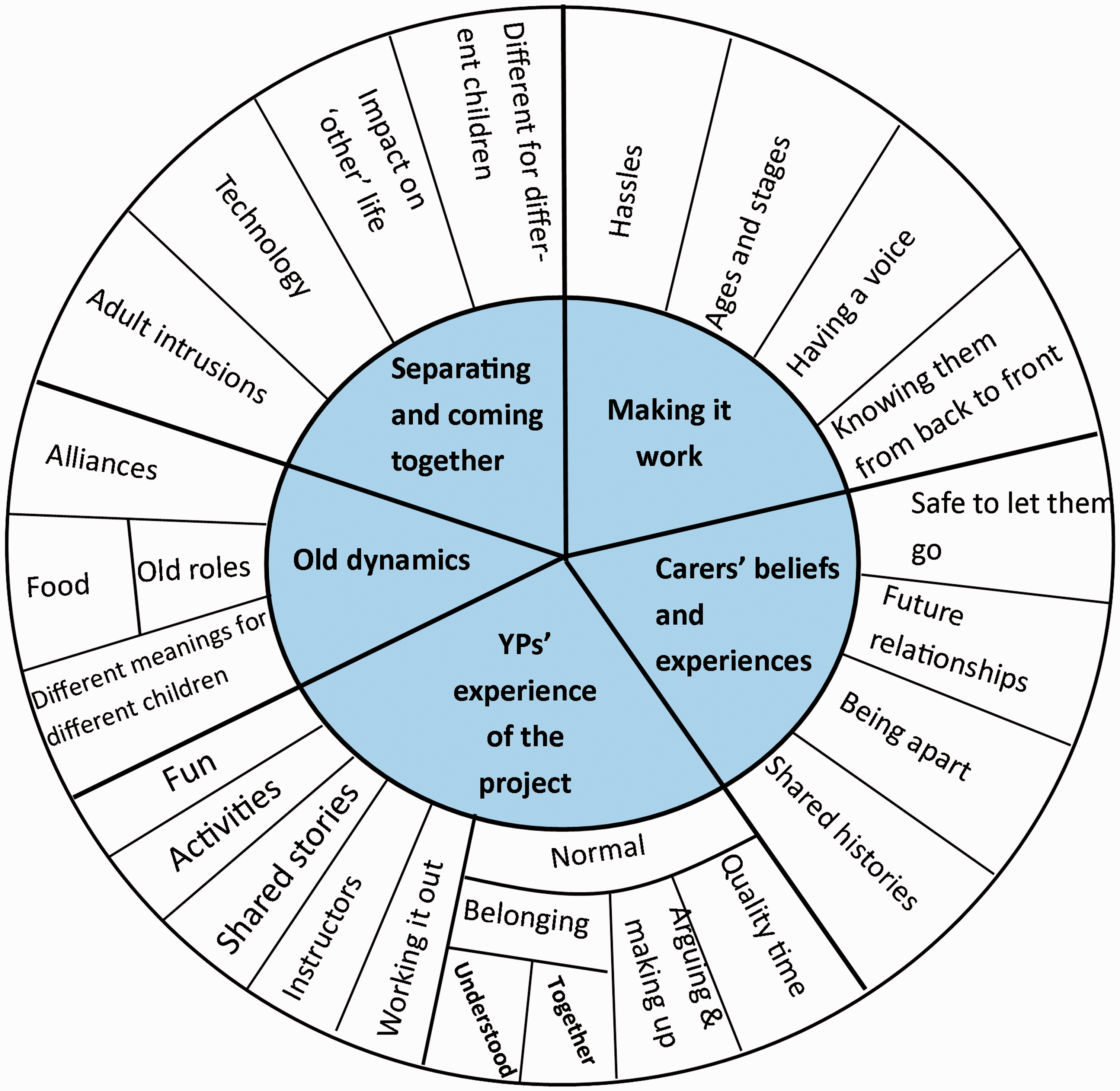
Discussion
The young people who took part in this study were very positive about their experience of the residential trip. They spoke about the importance of having extended time together with their siblings to do normal things that included having arguments and opportunities to repair relationships. They also liked the chance to challenge themselves through adventurous activities. This created a context in which they experienced themselves and their siblings differently, opening up new possibilities for relationships and allowing dialogue with others who understood their situation. All of this was seen as markedly different from typical contact meetings, which are often characterised by intrusion, supervision and artificiality.
Silverstein and Smith (2008) identify several key practice principles in preserving sibling bonds. These include: recognising the importance of relationships; allowing quality time; reducing pressure; ensuring flexibility; and promoting creativity. The success of the residential trip appears to be based in no small part on the presence of these factors, combined with the commitment of the carers and the courage of young people to take relational risks.
The carers who took part appeared to benefit too, as their frustrations with typical contact arrangements echo those of the young people. In establishing the factors contributing to successful sibling contact, Argent (2008) identified as important their positive regard for other siblings, proving models of co-operation and giving consistent support, all of which were salient in this study. This is encouraging as they all influence the carers’ gatekeeping role that has been stressed throughout.
Implications for practice
The practice implications that can be drawn from this study are limited by the size and nature of the sample. However, it is reasonable to assume that the voices of the children and carers can contribute something to practice developments in this area. Indeed, the findings add flesh to existing guidance about contact arrangements, such as that produced by the British Association for Adoption and Fostering (now CoramBAAF) (Lord and Borthwick, 2008).
Many older siblings referred to the pressure to be available to their younger brothers and sisters, to comfort them and resolve the difficulties they face. As this was experienced in the context of their developmental stage, this demand sometimes competed with their own needs in ways that resulted in conflict and distress. They all said that they found it hard to resist the invitation to perform this role, regardless of the anticipated fears. Some protection from this was offered by the presence of trusted attachment figures and structured activities that offered a different kind of containment.
The caregivers who were interviewed all held firm beliefs about the importance of preserving sibling relationships. This fits with findings regarding the significance of caregivers as gatekeepers for contact and reinforces the notion that when ‘other’ siblings are well regarded by carers, contact is more likely to occur (James, et al., 2008). Therefore, it would be helpful for practitioners thinking about what support is beneficial for young people for successfully negotiating contact to explicitly consider the importance of entertaining complementary models of care and establishing procedures for conflict resolution when children are living in different households.
The importance of sibling contact being ‘normal’ cannot be overstated. Such arrangements have to be considered in a systemic, ecological and relational framework if carers and professionals are to protect and support children’s sibling bonds. In addition, commitment, creativity and sensitivity are required to make contact successful. It was apparent in the research that carers draw on relevant personal and professional experiences in managing these issues and that their own beliefs about the importance of sibling relationships play a key part in the decisions they make. This seems to be an important factor to include in the initial assessments of foster carers and subsequent matching procedures. None of the participating carers said they had specific training, supervision or consultation to further their understanding of sibling contact.
Foster carers referred specifically to their confidence in local authority staff to run the residential trip safely so that they could feel happy about allowing the children to attend. As decisions about separating siblings are complex, so the risk assessment and management of bringing them together require careful thought. This has implications for the ways in which the facilitators of residential trips for siblings work with carers to access their expertise and knowledge, how they gain acceptance from carers and achieve successful participation by the children.
There are also lessons from the findings for managing contact between separated family members in general. Young people were remarkably reflective and understanding about the restrictions resulting from being in care and some said they saw these as protective. However, the benefits of creativity, flexibility and normality were repeatedly stressed, regardless of the context in which contact occurred. The young people appreciated the help to successfully negotiate time with their siblings and emphasised the importance of the nature, sensitivity and playfulness of the arrangements that helped them.
The residential trip opened up possibilities for siblings to be together in a way that was seen as extremely important to those who took part. They spoke about experiencing each other differently, describing their longing to stay overnight, the significance of both ordinary and extraordinary conversations and the possibilities created when formal supervision is relaxed. They valued talking to others with similar histories. When asked about whether the trip should happen again, one young person responded: I think if it didn’t happen again it would be a tragedy I don’t want to be dramatic but it would be a tragedy. Because a project like that brings siblings that have been separated by care to see each other and that made all the difference to me.
Footnotes
Acknowledgements
The authors wish to thank Olly Grant (consultant social worker) and Victoria Bartle (area youth inclusion worker) for inviting us to be part of the project they have worked so hard to develop. We are also very grateful to the children and carers who agreed to participate in this study.