



Abstract
Research has highlighted the potential tensions and risk of disruption to care placements when foster carers have birth children living at home. Given the limited research attention given to these young people and the importance of retaining carers, it seems important for policy and practice to investigate the parent–child relationship in this context. Therefore, this study seeks to explore how the birth children of foster carers experience their relationship with their parents. Interpretative phenomenological analysis was used to analyse semi-structured interviews with eight such young people (aged 14–16 years). Three superordinate themes emerged: (1) relational processes that give value to my role in the family; (2) threats to our relationship; and (3) making sense as a way of managing the threats. Each of these contained several subthemes. While there were consistent patterns of experience, there was also individual variation. The findings suggest that the processes of ‘making sense’ and ‘feeling valued’ serve to buffer the impact of potential threats to the parent–child relationship. Theoretical implications include the application of a model that elucidates the relationship between the themes. This has clinical implications for understanding and informing the way services support both foster carers and their children.
Introduction
Background and context
In the UK, there has been a recent increase in the number of children and young people placed in out-of-home foster care, coupled with a reduction in the overall number of foster carers offering placements (Ofsted, 2015). This has led to a discrepancy between the need for placements and the recruitment and retention of foster carers.
For children who have been removed from their birth families, a good quality foster placement provides a valuable opportunity for intervention and rehabilitation (Ciarrochi, et al., 2012) and increases the likelihood of children developing secure attachments (Smyke, et al., 2010). Thus, it is crucial to ensure that these opportunities are available and that foster carers are supported and fully understood when it comes to their motivations to offer and continue to offer placements.
Foster carers’ perspectives
Research investigating the motivations for fostering has previously identified that foster carers facing higher levels of tension in their family are more likely to decide to discontinue fostering (Geiger, Hayes and Lietz, 2013). Indeed, Wilson, Sinclair and Gibbs (2000) found that of all the stressful experiences identified by foster carers, only in the case of family tensions was there a significant association between this type of difficulty and feelings about continuing to foster.
Foster family systems and attachment
Systemic theory provides a useful framework for understanding the processes involved in fostering (e.g. McCracken and Reilly, 1998) as it places emphasis on the way in which individuals function as part of systems rather than in isolation; it also gives due attention to all parts of the system including wider statutory requirements. Family systems theory (Minuchin, 1974) proposes that the way in which family members interact is influenced by an underlying family structure and highlights the importance of relationship patterns at individual, dyadic and systemic levels, emphasising that all levels and subsystems are interconnected. Having a foster child in the family will affect all family members and all relationships within the family as roles, relationships and boundaries are renegotiated; indeed, it has been argued that it is the whole family that takes on the task. If we adopt this systemic perspective, the involvement of the foster carers’ children has to be acknowledged (Martin, 1993).
Parent–child dyad
Attachment theory can be understood as a framework for understanding processes in the parent–child dyad, a microcosm of the larger family system (e.g. Demby, Riggs and Kaminski, 2017). Bowlby (1969) suggested that a secure attachment relationship with a parent allows a child to explore, develop and grow, and the parent–child relationship is a template for subsequent relationships. Thus, there is a bidirectional relationship between the parent–child attachment relationship and interactions in the wider family system. Regarding the parent–child relationship in the context of fostering, Höjer (2006) found that many biological children of foster carers reported spending less time with their parents. But this experience is not universal. For example, Thompson and McPherson (2011) found both positive and negative relationship changes, with some children reporting a loss of family closeness and others noting closer relationships. Secure attachment to parents may enable children to develop coping strategies to allow another child to ‘share’ their parents.
The birth children of foster carers
Foster carers’ birth children have been referred to as ‘quiet voices’ (Sutton and Stack, 2012: 1) and ‘unknown soldiers’ (Twigg, 1994: 297) due to their limited presence in the research on fostering (Höjer, Sebba and Luke, 2013). Yet, Younes and Harp (2007) report that the structure and roles for the family members changed when parents began fostering and this not only affected parent–child relationships but also relationships between the birth siblings, with positive and negative consequences. Serbinski (2017) also found that fostering influenced birth children’s relationships with friends and partners, suggesting that the experience of fostering for these children can shape their relationships in the future.
But not all is negative. Nuske (2010) argues that the nature of the experience for birth children is varied. She found that most of the children studied were unable to talk to parents about some of the negative experiences, leading to a feeling of emotional turmoil, but like Williams (2017) and Sutton and Stack (2012) reported that some young people viewed themselves as a source of support and advocate for their parents rather than the more usual opposite, and adopted a variety of strategies to make this possible.
Rationale for research
At the moment the relationship between placement breakdown and whether foster carers have children of their own is equivocal. Some research does suggest that there is an increased risk of placement breakdown in these situations (e.g. Kalland and Sinkkonen, 2001) and that foster carers who feel that fostering is a difficult experience for their own children are more likely to give up (e.g. Triseliotis, Walker and Hill, 2000). However, these findings are less salient in other studies (Höjer, 2006; Poland and Groze, 1993; Twigg and Swan, 2007; Walsh and Campbell, 2010; Watson and Jones, 2002) and in some cases, the presence of birth children has proved beneficial. For instance, Sinclair, Gibbs and Wilson (2004) found that a perceived negative impact on their own children was a minor factor in foster carers’ decision to give up. In fact, in a later study (2005) they concluded that those carers whose own children lived with them had lower rates of disrupted placements.
With regard to the children affected, Sutton and Stack (2012) found that when they experienced a change in their relationship, such as having to share parental time, being able to have open, honest discussions with parents about this produced an overall positive attitude towards fostering. Consequently, exploring the meanings that children themselves make of their relationship with their parents is especially important in understanding the potential effect of fostering.
Although some current research has begun to explore the experiences of foster carers’ birth children, much of this is retrospective in design and focuses on carers or children recalling past experiences, a serious limitation to the current evidence base (Höjer, Sebba and Luke, 2013). In addition, while the need to focus on the family relationships experienced in the context of fostering has been highlighted, to date the only study specifically addressing the relational changes between foster carers and their birth children did not interview the latter (Thompson, McPherson and Marsland, 2016).
The contribution of this study, therefore, is that it consists of interviews with the birth children of foster carers living with children in current foster placements and aims to chart their experiences.
Method
Design
A qualitative design using interpretative phenomenological analysis (IPA) was used to explore how individuals make sense of their experience (Smith, Flowers and Larkin, 2009). In-depth semi-structured interviews were utilised to provide a personal account of the participants’ experience.
Participants
Participant demographic information.
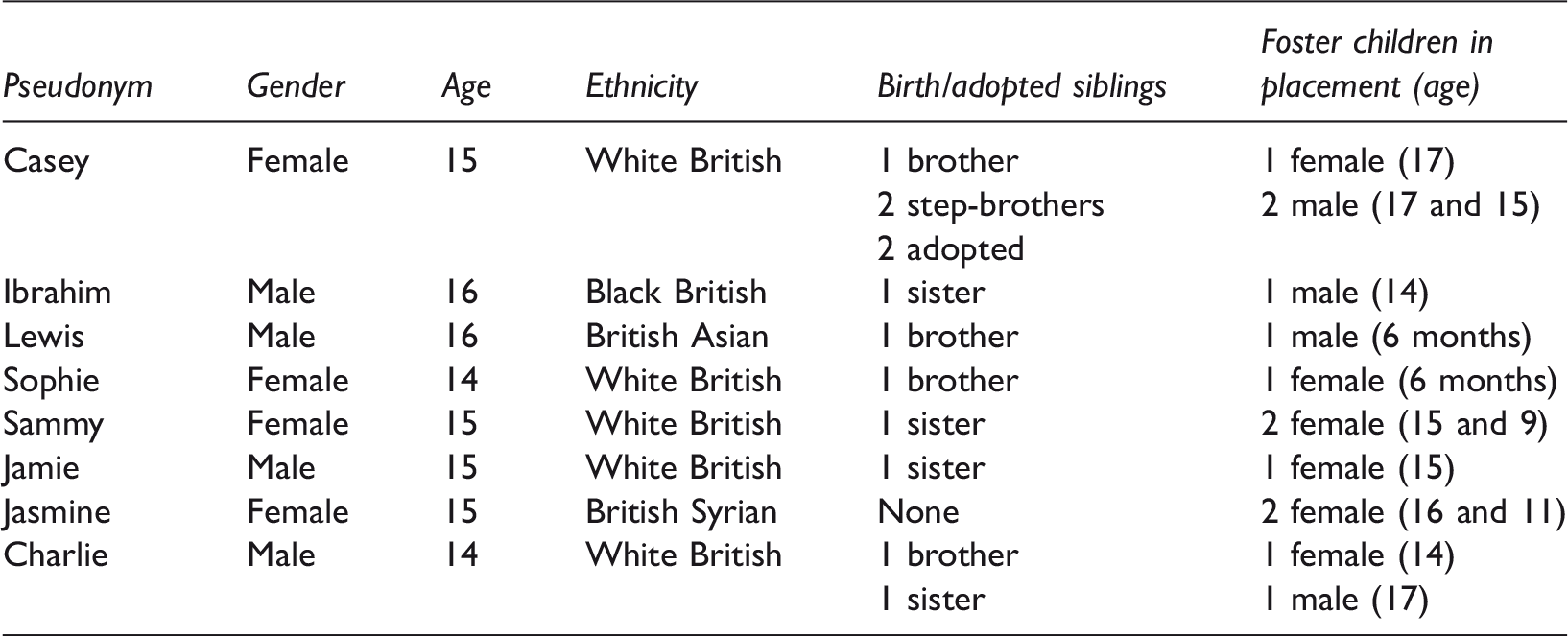
To be eligible for the study, the inclusion criteria were:
aged between 13 and 16 and the birth child of foster carer/s; currently living with a foster child in placement; parent/s with a minimum of one year’s fostering experience in order to ensure the young person has sufficient experience of fostering and to address ethical issues described below; parent/s fostering through the local authority; fostering social worker for the parent/s based within the teams that had received ethical approval from the local authority to be involved in the study.
Participants were excluded if they met the following criteria:
The foster child was currently receiving services from the child and adolescent mental health service (CAMHS) where the supervising researcher was based (in order to avoid any conflict of interest). They were the adopted child of foster carer/s.
The researchers approached local authority social workers and attended a foster carer support group. Young people were recruited via these methods. The researchers offered a £10 voucher to each participant as an incentive and thank you for taking part in the study.
Interview schedule
The interview schedule was piloted with an adult who had been the birth child of foster carers and a 16-year-old not in care. The questions included:
What it is like to be in a family with foster children? How would you describe your relationship with your parent/s? How are (other) relationships in your family different because your parents foster? What do you think might help you or other young people whose parents are foster carers? What advice would you give to another young person in your situation? What things would you like to have known before your parents started fostering?
All interviews took place at a NHS clinic and lasted for between 40 and 69 minutes; they were digitally recorded and subsequently transcribed and anonymised for analysis.
Data analysis and quality assurance
Data were analysed using IPA methods (Smith, Flowers and Larkin, 2009). This initially involved repeated reading of each transcript and analysing the data, followed by recording the descriptive, linguistic and conceptual aspects of each transcript. Themes from each individual transcript were then classified into clusters to explore spatial representations of how the emergent themes related to one another; the clusters were sub-divided into superordinate themes and given representative titles. The quality of the study was ensured by following guidelines for managing qualitative research outlined by Mays and Pope (2000) and Yardley (2000) and a bracketing interview (Fischer, 2009) was conducted in order to identify any pre-existing assumptions that might have biased the interpretation of the results.
Results
Superordinate themes and subthemes identified.
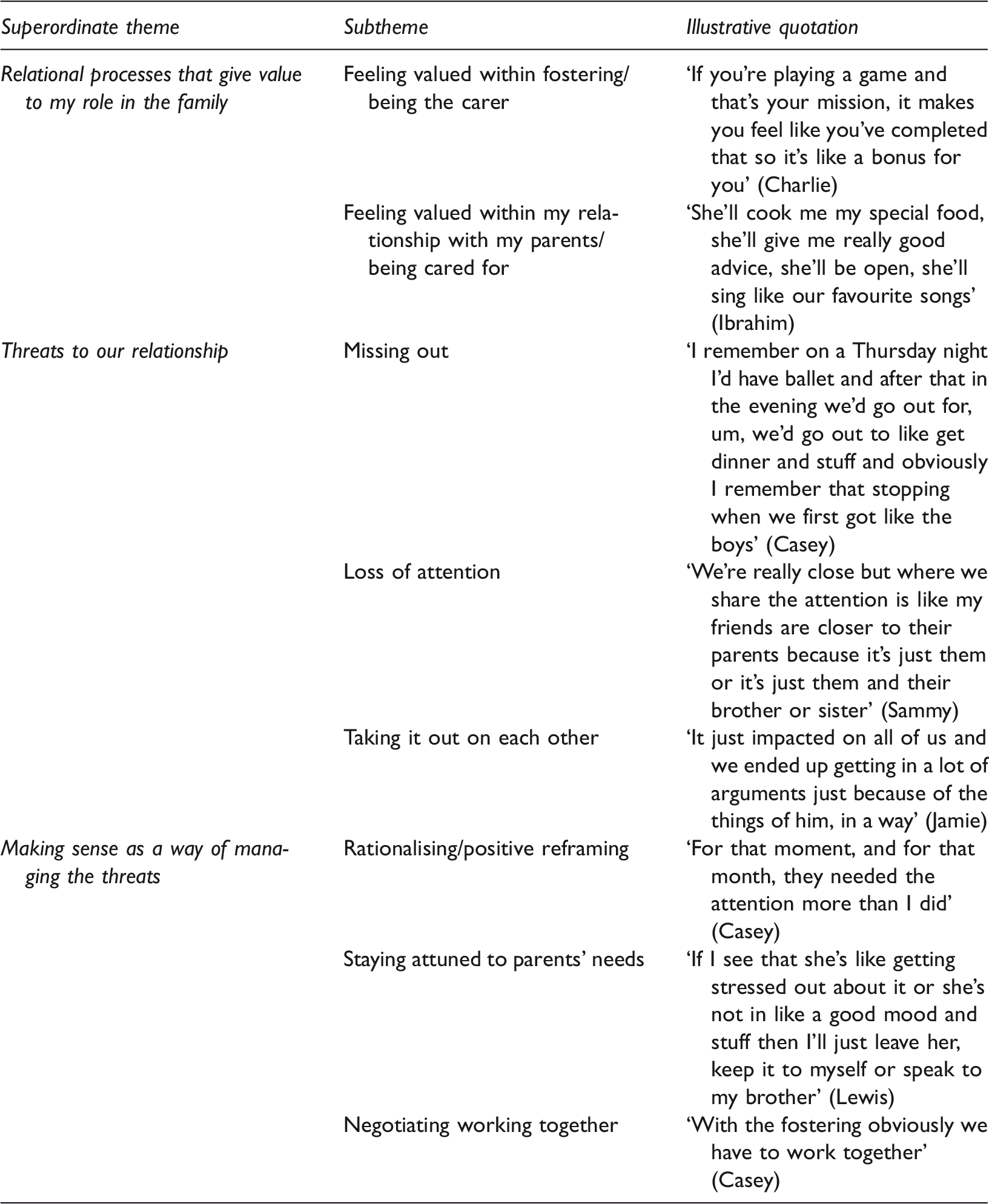
The results demonstrated that although there were some negative perceptions of fostering that posed a threat to the parent–child relationship, these were buffered by the ways in which the young people tried to make sense of them. In addition, the feeling of a sense of value in their role, both in their relationship with their parents and in the family, served to alleviate difficulties. By utilising both of these processes, participants were able to effectively manage potential threats to their relationship with their parents (see Figure 1).
A preliminary model of managing threats to the parent–child relationship.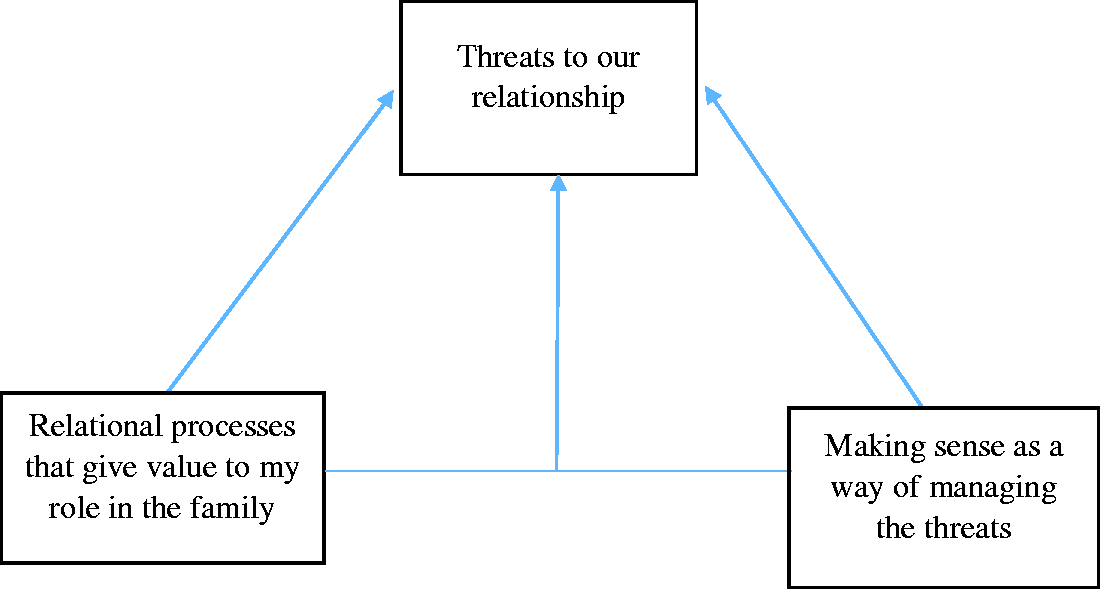
This model will now be elaborated by considering the themes and subordinate issues that emerged in more detail.
Relational processes that give value to my role in the family
This superordinate theme reflects the relational processes that enabled participants to experience a sense of value and importance within their family.
Feeling valued within fostering/being the carer
Participants reported a sense of their role in the family in relation to fostering, at times almost taking on the role of the carer and appearing to gain a sense of value from this. Some spoke about experiences where the foster children had opened up to them and the meaning they assigned to this: I remember like two weeks after he came he told me about his situation and all the stuff and ever since then I was like wow, this guy’s opened up to me! (Ibrahim)
Casey recounted a similar experience: I think to myself if I hadn’t done that he probably wouldn’t have spoken which would have like stopped the development of him opening up.
Other participants expressed similar positive feelings around taking a role in fostering. In Charlie’s words: ‘If you’re playing a game and that’s your mission it makes you feel like you’ve completed that so it’s like a bonus for you.’ He used the metaphor of a computer game to express his sense of achievement in taking an active role. The expression ‘playing a game’ denotes something pleasurable and Charlie referred to his enjoyment of games and computer games throughout the interview. Describing this as a ‘mission’ could be related to the language of computer games, but it also gave a sense of a higher purpose and an experience of something that while challenging is highly rewarding.
Feeling valued within my relationship with my parents/being cared for
In addition to feeling valued in taking on the responsibility and rewards of caring for a foster child, the young people also expressed the ways they felt valued by their parents in their role as a son or daughter and being in a situation where they were cared for. Through parents making special time, being available and doing regular activities with their children, the participants were able to still experience value in their relationship, thus softening the impact of any difficult experiences (Figure 1).
Some participants expressed the ways in which their parents are still available to them: I mean if I really said to her like, ‘Next Tuesday, can we go out for a meal?’ unless she had something really big planned she wouldn’t be like ‘no’. (Jasmine) Yeah, I was like well, I can’t actually say it otherwise I’m going to get told off and now it’s just like I can say what I want when I want to say it [laughs]. (Sammy)
Ibrahim also spoke of special time with his mother being important: ‘She’ll cook me my special food, she’ll give me really good advice, she’ll be open, she’ll sing like our favourite songs.’ He emphasises the personal significance of his mother’s actions in terms of ‘my special food’, ‘me really good advice’ and ‘our favourite songs’. Through these personal connections, he is still experiencing value in his relationship with his mother.
Threats to our relationship
This superordinate theme highlighted the negative aspects of fostering that have the potential to threaten the parent–child relationship. They were organised into three subthemes.
Missing out
Participants spoke about experiences that they were not able to have or things they could not do with their parents due to fostering. For instance, Lewis commented: If they have like contact or if they like have meetings or my mum has meetings and this sort of thing that she can’t cancel, then we can’t go. I remember on a Thursday night I’d have ballet and after that in the evening we’d go out for, um, we’d go out to like get dinner and stuff and obviously I remember that stopping when we first got the boys. (Casey) I mean if the girls are on respite then obviously we can go up as a family just like me, my step-dad and my mum, but with the two girls here we can’t really because there’s too many of us. (Jasmine)
Loss of attention
Some participants reported a loss of attention from their parents as a result of fostering, particularly when the children first moved in: … sometimes it’s really hard because especially when they first move in, a lot of the time, for Mum and Dad their sort of sole focus is on those children. (Casey) Well, the attention thing like when the first children came it was very much you had to be with them all the time. (Sammy) I’d make up things like I’ve got homework and I need help with it, I would make up things so I get to spend time with them – like one time I said I’ve got to make a globe thing out of paper mâché just so I could spend time with my dad.
Lewis similarly described the effect of taking a foster baby to events, such as a recent family wedding they had attended: It’s just like having the pushchair, having to like push the pushchair around, make sure the baby’s eating and my mum even said that you know she would have liked to have spent a bit more time with like family and things … everyone just put their handbags on the pushchair so you have like, random women’s handbags on the pushchair and stuff and then it’s just like you have to push this thing around and fold it up, upstairs, downstairs, make sure the baby’s eating, make sure he’s not crying, nappy change, as well as like, looking after us.
Taking it out on each other
This subtheme related to young people recognising that they would often take their annoyance or frustration out on their parents rather than expressing negative emotions to the foster child. This was not necessarily an overt action but was a negative aspect that they had noticed. To quote Sophie and Jamie: ‘If I’m getting annoyed with like the child or something like I would take it out on them’; ‘It just impacted on all of us and we ended up getting in a lot of arguments just because of the things of him, in a way.’
Sophie described taking out her annoyance on her parents, perhaps as a way of protecting the foster child, especially as the family fostered very young children. Jamie recognised that he and his siblings would argue more with his parents and attributes this to the foster child’s presence and difficulties with their behaviour.
Some participants felt blamed for situations when this involved the foster children, leading to arguments with their parents: Like I won’t get let off as easily as they would, I know my mum will, you know, punish them by doing whatever they will get off a bit easier, whereas with me she’ll be harsher and it kind of annoys me. (Jasmine) If I’ve had an argument with anyone it’s always I’m in the wrong. (Sammy) If one of, like one of us is annoyed obviously we can’t take it out, well not that we would, but we obviously can’t be like, ‘Oh, you’re really annoying me [foster child’s name]’ because he wouldn’t understand.
Making sense as a way of managing the threats
The third superordinate theme reflects the approaches the young people took in order to make sense of the potential threats to the parent–child relationship. They were able to utilise different ways of managing these, which served to buffer the impact of the difficulties (Figure 1).
Rationalising/positive reframing
Several young people explained or justified difficulties by rationalising or framing them positively: ‘For that moment, and for that month, they needed the attention more than I did’ (Casey); ‘Not all the attention is on me so I kind of do get a bit more freedom’ (Jasmine).
Both Casey and Jasmine are considering the impact of loss of attention. Casey attributed this to a reason that is understandable to her and thus makes sense and is no longer a negative aspect of her relationship with her parents. Similarly, Jasmine viewed less attention as a positive feature of her life as a 16-year-old girl as it gave her more freedom.
In thinking about the experience of missing out on a family weekend away due to contact visits for the foster children, Charlie also utilised this way of making sense of his experience: If they want to see their family I’m fine with it, don’t get me wrong; there’s 52 weeks in a year, we go down every weekend so it doesn’t really bother me, we’re seeing them most of the time.
Staying attuned to parents’ needs
The participants also showed an ability to stay attuned to their parents’ needs and take these into account, sometimes meaning that they put their parents’ needs before their own: If I see that she’s like getting stressed out about it or she’s not in like a good mood and stuff then I’ll just leave her, keep it to myself or speak to my brother. (Lewis)
Sophie spoke similarly about feeling the need to help her parents if they were having any problems with the foster children: ‘I don’t want my mum just to have to deal with it all or my dad.’ She felt an obligation to help her parents as a result of staying attuned to their needs and said she felt excited when a new foster child was due to stay because it would be positive for her mum: I get excited because, um … and also it’s just like, if we don’t have a child for a few months and then we like someone and they tell us that we’re going to get another one like, um, it’s really good because my mum, like my mum hates being bored and, um, like with a child like, having a child there like she never gets bored.
Negotiating working together
This theme reflected the way participants, like Ibrahim, would sometimes explicitly negotiate working together with their parents: ‘Yeah, we all talked about it and we all talked find or tried to find solutions’. He discussed the approach his family took when considering hypothetical scenarios of what might be difficult with fostering. It sounded like a team effort and appeared quite methodical in the way that they worked together to solve expected difficulties.
Some of the young people also spoke about internally negotiating working together, for example when a foster child had told them something they thought their parents needed to know: ‘Sometimes I would tell them but sometimes I would just handle it myself; if that doesn’t work, then I’ll go and tell mum’ (Sophie).
Sophie considered whether she could manage things alone, whether she needed to involve her parents and work together or whether to take a trial and error approach to managing situations.
This was also reflected by Charlie: They may ask me, er can you not tell [mum’s name] but I think it’s better to let the parents in on it, then they can help deal with the situation. I’d go into the office and ask to use my phone to call my mum to just say could you pick us up after school, there’s a problem and then like explain it to them after, like when we get home.
Discussion
The study revealed that although some effects of fostering were identified that threatened the parent–child relationship, the young people were able to utilise processes that served to buffer their impact. Participants were able to make sense of the threats as a way of managing these. In addition, they experienced a sense of value in their role, both in their relationship with their parents and in the family as a whole. These processes, both individually and combined, enabled the young people to maintain their parent–child relationship and the variation revealed in this study might help explain why research has found it so difficult to reach clear conclusions about the effects of birth children living in the foster home. These concepts are explored further in relation to relevant theory and existing literature.
Foster families have been described as representing an open system rather than the semi-closed traditional nuclear family (Fanshel, 1966) and in this way it is possible to recognise how fostering might pose a threat to the parent–child relationship. Participants described missing out on experiences with parents or ‘family time’ and having to share parental attention, with one young person making up a homework project in order to gain time with her father. Some recalled what their relationship had been like before fostering and reflected specifically on the changes to their old routines or losses due to the number of people now living in the family. This supports previous research by Poland and Groze (1993) who found that sharing parents’ time was one of the most tangible impacts on children’s lives when their parents decide to foster. The carers face pressures too and this study echoes Thompson, McPherson and Marsland (2016), who identified the problem of ‘feeling overstretched’ with specific reference to the competing demands on parental resources between birth and foster children.
Where the young people experienced frustration, it was often directed towards their parents, leading to family disputes. Some also said they sometimes felt blamed for arguments with the foster child or foster children sometimes lied and they got punished for things they had not done (Höjer and Nordenfors, 2004). Indeed, they observed that foster children sometimes got away with things for which they would have been told off (Spears and Cross, 2003). However, in general, participants protected the foster children from their negative feelings and took responsibility for and worried about their welfare. It was significant that most of the young people also welcomed their role in living in a foster family as a useful experience for the future.
Although these adaptations can be viewed as positive in enabling the young people to ‘cope’, Höjer, Sebba and Luke (2013) urge caution in that the children of foster carers can put their own needs behind those of the foster children and view them as less important. They also found that the children put the needs of their parents before their own. It is perhaps surprising, given their age, that so many of the young people in this study were able to skilfully acknowledge and consider the perspectives of others as well as attribute reason and rationalise their own and their parents’ responses. An important finding was that the impact of threats appeared to be buffered by relational processes that gave the young people a sense of value and purpose.
Pugh (1996) has highlighted that foster children may find their identity confusing in terms of whether they are taking a caring role or that of an equal peer with a foster child but, again, the current findings suggest a more optimistic picture. The experience for these young people was that by taking on the caring role and feeling some value from this, they were able to stay motivated and involved in the fostering process. Through the lens of family systems theory this could be interpreted as the birth child becoming part of the parental subsystem as a way of responding to the presence of foster children in the wider family network. It is a means of protecting the parent–child attachment as the caring role aligns participants with their parents in a positive way, which, together with feeling value in their relationship, enables them to consistently manage the impact of negative experiences. Some previous research has found that being involved in fostering had a positive effect for young people as they saw it as giving them a purpose (Swan, 2002), but this study emphasises that to stay motivated they also need to experience value in their relationship with their parents. This is explained by Bowlby’s attachment theory in that participants felt secure through this process as it allowed them to develop ways of coping that further boosted their sense of security, thus reducing any tensions caused by the fostering. As Williams concluded in a recent article (2017: 1394): … birth children are not passive observers in how fostering influences their daily lives. Instead they use strategies to influence fostering processes, in particular to protect their parents and birth siblings, while also having feelings of responsibility for their foster siblings.
Limitations of the study
The study is limited insofar as only the children of carers who put themselves forward for the research took part. Thus, it is possible that the sample represented young people who were more outgoing or confident. The study also only represents views of young people of a limited age range (14–16 years) and there was variation between the participants in terms of their experiences. In addition, the interviews were a snapshot of one point in time and interpretations cannot be made about temporal aspects of experience.
Clinical implications
Although this research utilised a small sample, the results provide several messages for practice. Cairns (2002) argues that foster carers need theories and models to make sense of the challenges they face in caring for children who are looked after. These results suggest ways of managing some of the threats. The findings support the value of a systemic approach and application of attachment theory for understanding the processes of fostering; they not only provide illuminating frameworks but also lend weight to the value of systemic family therapy as it ‘pays acute attention to language and the narrative by which people strive to make sense of and bring meaning to their world’ (McCracken and Reilly, 1998: 21) and how these meanings can act as protective buffers.
The finding that participants experience a sense of value from fostering point to the significance of events that promote the importance of the whole foster family system and recognise the contribution of birth children to the foster care process. Some participants explained that they were not able to attend events organised for the foster children, which seemed to evoke a sense of unfairness and exclusion, despite an ethos that they be ‘together’ as the foster family.
One young person also suggested it would be helpful to meet with other birth children of carers in order to share experiences and learn from one another. A practical implication of this finding could be to formalise avenues by which the birth children of foster carers could share their insights with families who are beginning the fostering process. They would have the benefit of making good use of the information but also ensuring that carers’ birth children feel valued for their contribution.
Given the clear need for young people to feel valued in their relationship with their parents and the importance of services taking a role in supporting this, foster carers must be sensitive to the developing needs of their own children, which may be less apparent than those of the foster child. The research also highlights the need for social workers to monitor the impact of fostering on the relationship between foster carers and their birth children in order to identify any potential difficulties. This could involve specifically asking young people about the extent to which they feel valued in their family situation.
Finally, given the apparent benefits for the birth children of foster carers of being able to see situations from the perspective of another (e.g. parent, foster child), it may be valuable to use techniques such as systemic circular questions that elicit the perspectives of others as part of introducing birth children to fostering and as a means of resolving any difficulties that arise.
Future research
Future research could expand on the current study by exploring the views of service professionals and investigating the ways in which they might support the relationship between foster carers and their birth children. If children are motivated to take an active role in fostering through experiencing a sense of value, studies could scrutinise ways of enhancing this. Further enquiry could seek to explore the views of young people of different ages to investigate whether the ways they make sense of their relationship with their parents fit with the themes identified here. Focus groups could be employed to welcome young people who are reluctant to be interviewed. Finally, it might be fruitful to develop ways of measuring the factors identified in this research, such as the impact of threats and feeling valued within the fostering process. These elements could be measured at different times to further explore their interaction and evolution.
Conclusion
This research aimed to explore ways in which the birth children of foster carers experience and make sense of the relationship with their parents. The findings suggest that these young people actively participate in complex processes that enable them to manage the impact of the threats that fostering poses to this relationship. These processes include making sense as a means of managing the threats and experiencing value in their relationship with their parents and the fostering process as a whole. The study provides the beginnings of a model for understanding these processes, which could be used to inform the way foster carers and their children are supported by services. However, it only provides an account of the experience of a select group of young people at one time and further work is required to expand these ideas and develop the model outlined.