



Abstract
Research has highlighted the many challenges that foster carers face in caring for children who have experienced adversity and has charted a growing mismatch between the numbers of children needing placements and the availability of carers. This review synthesises and evaluates the current empirical evidence on the causes and consequences of stress experienced by foster carers and the factors that lessen or increase it. PsychINFO, ASSIA, Web of Science and Google Scholar were searched for relevant studies, 15 of which met the specific inclusion criteria. The factors identified included both system variables, such as working in a wider service framework, and individual ones, such as children’s behaviour. One consequence of this stress was reduced foster carer retention. Scrutiny of the papers also revealed methodological issues related to sampling, research design and cultural variability. Topics for future research were identified, especially an analysis of the perspectives of people involved in the system around foster carers, such as social workers and the carers’ birth children. Clinical implications were also highlighted, most notably the promotion and provision of effective training and support and the development of integrated ways of working with services and foster carers’ families.
Introduction
Layout of review
This article offers a review of the literature exploring the causes and consequences of stress experienced by foster carers. The methodology used to identify papers for the review is outlined and 15 papers were subsequently scrutinised. A summary of the emerging themes is provided, along with recommendations for further research and implications for clinical practice.
Foster care
The number of children looked after by local authorities in England on 31 March 2017 was 72,670. This was an increase of three per cent since 2016 (Department for Education, 2017). At the same time as this growth in need, the number of fostering households is falling (Ofsted, 2015). These trends are also apparent in the USA and other countries around the world (Ciarrochi, et al., 2012), highlighting a concerning discrepancy between the number of children requiring foster placements and the recruitment and retention of carers.
Parenting a child in foster care has been described as going well beyond a normative experience of parenting (Tarren-Sweeney, 2008). Frequently the children involved have experienced neglect and abuse and as a result of separation from their birth family are likely to display disrupted attachment. This experience of recurrent interpersonal trauma is often referred to as ‘complex trauma’ and is recognised as negatively affecting all domains of a child’s development and functioning (Greeson, et al., 2011). This potentially leads on to physical and mental health difficulties and, in particular, reduced capacity for self-regulation and interpersonal relatedness (Cook, et al., 2005). In addition to these problems, children may communicate about their experiences through their behaviour, which can lead to varied and at times unpredictable challenges for foster carers. Gibbs and Wildfire (2007) point out that a shortage of foster placements can result in several children with complex needs being placed in the same foster home, which clearly places further demands on carers and a risk that they will want to give up the task.
It has been established that when foster carers are supported and trained to cope with children with increased individual needs, placements are more likely to be stable (Redding, Fried and Britner, 2000) but many also report that their needs for support and training go unmet (e.g. Murray, Tarren-Sweeney and France, 2010).
Several research studies have identified that careful matching of foster carer and child with regard to child and parent temperament and parental expectations is linked to stable placement outcomes (Redding, Fried and Britner, 2000). However, with an increasing number of children in need of a placement and a decreasing number of available carers, it is becoming more difficult to achieve this. Thus, there is an ever-growing risk of placement disruption.
Early experiences
Bowlby (1973) described how the early relationships and interactions with attachment figures lead children to build assumptions about themselves and others and that these form the basis of an internal working model for the child. This serves as a template for relationships and subsequently influences the child’s interactions and behaviours.
Developing a secure attachment with a foster carer can greatly benefit a child and serves as a protective factor against the difficulties he or she is likely to face (Sroufe, et al., 2005). But, due to their early experiences of abuse and neglect, looked after children are more likely to develop internal working models marked by low self-esteem and an expectation that they are not worthy of care. They thus expect insensitive and indifferent caregiving (Gabler, et al., 2014). This can make it difficult for both themselves and foster carers to develop a secure attachment with one another, a problem that is compounded when children experience multiple placements and frequent changes of social worker. Jarvis and Creasey (1991) showed that the quality of every child’s attachments is negatively affected by parenting stress but that in the context of foster care, these effects are even more substantial; attachment is already problematic and foster carers are more likely to experience increased strain.
The impact of trauma on the developing brain
There is also growing evidence highlighting the neurological impact of complex trauma on the child’s developing brain and the subsequent effect this can have on functioning for those who have been maltreated (Child Welfare Information Gateway, 2015). While this finding is still tentative, one suggestion is that traumatised children have had to focus their cognitive resources on survival, meaning that the regions of the brain involved in the fear response are frequently activated. In contrast, other regions of the child’s brain, such as those involved in complex thought and cognition, are less often stimulated and become less utilised (Perry, 2001). As a consequence, children may experience a decreased ability to differentiate between danger and safety. To complicate matters further, other research in this area has identified that structural and neurochemical damage to the brain caused by maltreatment may lead to a range of executive functioning difficulties which can lead to decreased IQ, lower academic achievement and attention difficulties (Wilson, Hansen and Siegel, 2011).
Whatever the validity of the detail, it is likely that these factors all contribute to the later psychological presentation of children in foster care and add to the challenges that carers face. These accumulations have been explored in several studies and Cairns (2002) argues that if carers are to be effective, they need access to the theories and models that make sense of the children’s behaviour.
Caregiver stress
Stress is described as the feeling of being under too much mental or emotional pressure (NHS, 2017). Although responses evolve as adaptive processes, when stress is prolonged it can damage both physical and mental health. Stressors have a major influence on mood, sense of well-being and behaviour (Schneiderman, Ironson and Siegel, 2005).
Psychological theories of stress emphasise the concepts of ‘appraisal’ and ‘coping’ (Krohne, 2002). Appraisal refers to the individual’s evaluation of the significance of an event in terms of its impact on his or her well-being. Coping is viewed as an individual’s efforts to manage the demands created by the event (Krohne, 2002) and has been defined as ‘cognitive and behavioural efforts to master, reduce or tolerate the internal and/or external demands that are created by a stressful transaction’ (DeMaeyer, et al., 2015: 71). Lazarus (1991) synthesises these perspectives, arguing that stress is a relational concept and should be viewed as an interaction between individuals and their environment, specifically between an individual’s cognitive appraisal of the surrounding situation and their resources to cope with the demands it makes.
It has been suggested that parents experiencing high levels of stress are more at risk of experiencing ‘blocked care’ where the higher brain functions needed to support reflection, flexibility and self-regulation are suppressed (Baylin and Hughes, 2016). This phenomenon has also been termed ‘compassion fatigue’ and Ottaway and Selwyn (2016) argue that it is important for agencies to recognise this as a real and common experience and address it effectively. These processes are obviously significant if carers are to respond sensitively to a child’s distress.
If foster carers are experiencing higher levels of stress, it is therefore important to explore what factors contribute to this and how it affects them. This is crucial for achieving the aims of good substitute care, namely promoting secure child-carer attachments, achieving positive placement outcomes and recruiting and retaining foster carers (Redding, Fried and Britner, 2000; Sroufe, et al., 2005).
Review aims
Given the gravity of the problems described, this review aims to provide an overview of the relevant literature on the causes and consequences of stress experienced by foster carers and the factors that lessen or increase it. It draws out the clinical implications of the findings and suggests areas for future research.
Method
An electronic literature search was conducted using the databases PsychInfo, ASSIA, Web of Science and Google Scholar. Search terms selected were ‘foster carer’ or ‘foster parent’ or ‘looked after’ or ‘looked-after and stress or strain or pressure’, and all terms that mapped on to these headings. Searches were conducted between August and December 2016.
The title and abstracts of all identified journal articles were screened by hand in order to identify relevant research. Searches were limited to peer-reviewed journal articles written in English. Papers were included where the participants included foster carers with a specific focus on the stress or strain they experienced. Studies were also included where the research used measures of well-being, coping or satisfaction with fostering, provided the findings were relevant to the aims of the review and its definition of stress.
Samples that included birth parents or adoptive parents were not included as the focus of the review was on out-of-home foster care. Studies that included kinship carer samples were also excluded due to the different challenges they faced, for example receiving fewer services (Farmer, 2009) or having had long-term relationships with the child and the birth family.
As the aim of the review was to provide an in-depth analysis of foster carers’ experiences, studies were also excluded when stress was scrutinised in relation to foster carer characteristics, such as their ethnicity or sexuality, and where the research evaluated therapeutic parent training interventions to manage stress as this has been explored by Rork and McNeil (2011).
Fifteen papers met the inclusion criteria. Figure 1 provides a flow diagram illustrating the process of identifying them
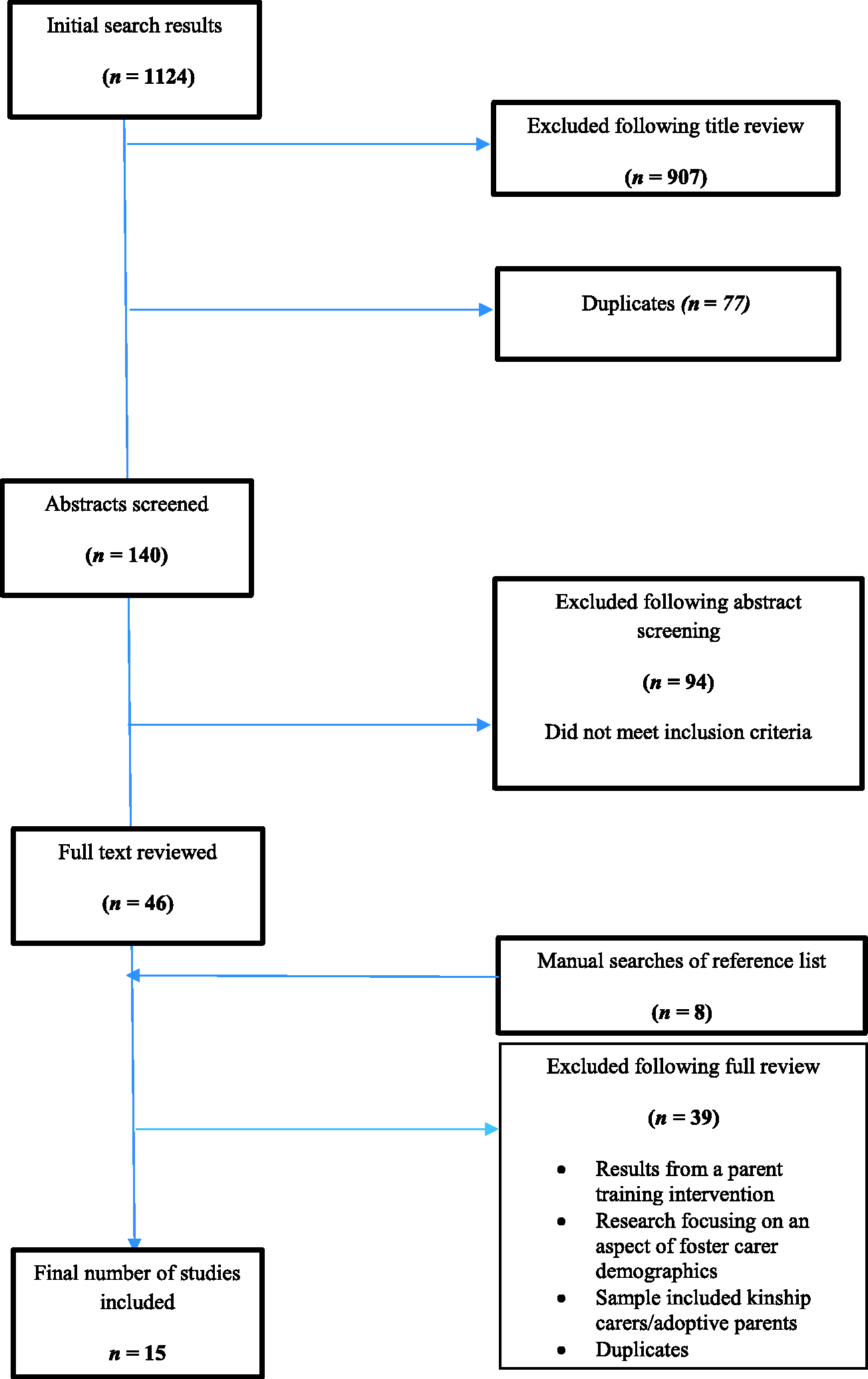
Flow diagram of literature search strategy.
Assessing the quality of the studies
Each article was read and summarised and various standards of evaluation applied, depending on the type of methodology employed. Thus, qualitative studies were assessed using the characteristics of good qualitative research outlined by Mays and Pope (2000) and Yardley (2000); quantitative research was judged on the criteria outlined by the Critical Appraisal Skills Programme (CASP, undated) and cross-sectional studies were subjected to the Strengthening the Reporting of Observational Studies in Epidemiology checklist (STROBE, 2007). A combination of all these was used in the case of a mixed-methods approach.
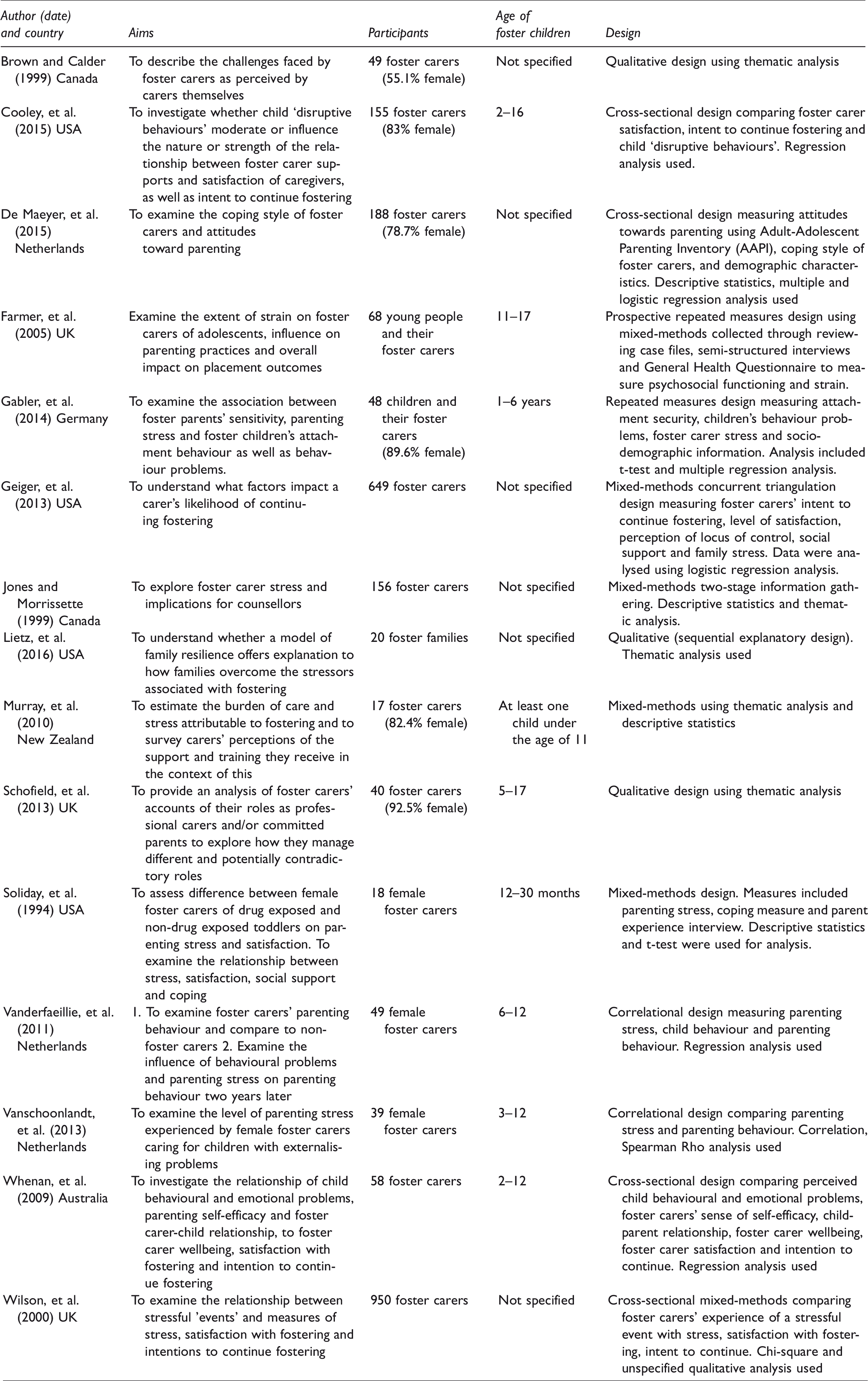
The results of this exercise are laid out in Table 1.
Summary of included studies.
Observations on the quality of the research
Over half of the studies scrutinised included a qualitative element in the research design. Although this can provide a detailed view of a particular group’s experience, many of the articles chart the perspectives of foster carers in different countries and thus in different cultural and social care settings, making it difficult to transfer the findings across national borders.
Some studies utilised a mixed-methods design and cannot be rigidly evaluated on qualitative criteria alone. However, only three of the seven studies examined referenced any such quality criteria, with Lietz and colleagues (2016) providing the best example in a transparent account of how the researchers had demonstrated the quality of the work.
In terms of quantitative elements, many of the study samples could be viewed as biased, with the researchers utilising convenience and snowball compilation methods and the majority of the participants being female. In addition, many studies use self-report measures and it is often unclear whether these have been validated for use with foster carers. Few of the studies report the age of foster children ‒ a weakness as this influences the difficulties that carers experience, particularly when considering the impact of trauma on brain development. It would be helpful if researchers could not only give the ages of the children when studied but also when admitted to care.
The majority of the research surveyed utilised a mixed-methods cross-sectional design, thus capturing data at only one time point. This is another deficiency as some issues require a longitudinal design, such as those exploring the relationship between child behaviour and attachment. Both of these are likely to vary and affect the stress experienced by carers in different ways and at different times.
Literature review and discussion
The 15 studies scrutinised identified a variety of factors common to all studies and some findings that were indicative rather than authoritative and so need further exploration. To structure the analysis, the emerging themes are discussed under five headings with descriptions and links to other literature when appropriate. They are: dealing with authorities; family tensions; child behaviours; social support; and attachment.
Dealing with authorities
Several of the studies highlighted that managing the relationship with, and the commitments from, the children’s social care system were major sources of stress for foster carers (Brown and Calder, 1999; Jones and Morrissette, 1999; Lietz, et al., 2016) and were a common reason for them resigning (Rodger, Cummings and Leschied, 2006). Interestingly, this finding questions a commonly held assumption as it suggests that parenting a traumatised child is less of a problem than dealing with social services and coping with inadequate resources to do the job (Geiger, Hayes and Lietz, 2013).
But in considering these conclusions, it is important to recognise that due to studies being conducted in different countries, the findings reflect the characteristics of national care and health systems (Robertson, Gregory and Jabbal, 2014). Certainly, this has been shown to be the case for research into care leavers (Stein and Munro, 2008).
Family tensions
A second contributor to stress and poor retention rates was the effect of fostering on the carer’s birth family (Brown and Calder, 1999; Geiger, Hayes and Lietz, 2013; Wilson, Sinclair and Gibbs, 2000). Geiger and colleagues (2013) identified that carers with higher levels of tension in their families were more likely to report intentions to discontinue. Wilson and colleagues (2000) found that although the most common stressful experience was placement breakdown, the second was carers experiencing severe family difficulties. Some of the participants highlighted the impact of looking after young people who had been sexually abused and the effect of this on their own children.
The researchers all acknowledged that stress factors interact and affect one another but the processes by which this occurs are often unclear and conclusions can be inconsistent. For instance, it seemed reasonable to expect that when the carers have children of their own living in the home, placements are more likely to break down, and this has been found in several studies (Kalland and Sinkkonen, 2001). On the other hand, a major piece of research by Sinclair and colleagues (2004) found no such relationship, suggesting that the impact of numerous contextual variables makes generalisation difficult, despite the importance of the issue.
One contextual factor can be the point at which difficulties arise, as illustrated in a study that interviewed the adult birth children of foster carers (Lietz, et al., 2016); out of the 20 participating families, four included adult birth children. The most difficult time was found to be early on, described by the authors as the ‘survival stage’, during which an important family strength was members being connected with each other and providing mutual support. Later, when carers were more confident, these intra-family variables became less significant and carers were often able to ‘help other carers’, so highlighting the contribution of wider family members at various times in a foster care episode.
Nevertheless, it is a matter of concern that this important issue remains poorly informed by robust evidence and that discussions about birth family involvement tend to be ‘for and against’, with case examples selected to fit. There is a pressing need for research that disaggregates the relevant variables and conducts a long-term follow-up of a representative sample of children.
Child behaviours
Four studies investigated the impact of children’s behaviour on the stress experienced by foster carers. Cooley and colleagues (2015) found that carers who reported less disruptive behaviours were more likely to perceive a link between parental resilience and fewer caring challenges. However, when very difficult behaviours were reported, parental resilience did not appear sufficient to reduce the challenges they faced, suggesting that beyond a certain point children’s extreme behaviour overwhelms the internal resources of carers that in most situations protect them from the effects of stress.
Vanschoonlandt and colleagues (2013) examined the levels of stress experienced by foster carers caring for children with externalising problems and found that 72% scored in the clinical range for at least one parenting stress subscale. Although their sample was small, comprising only females, the results are consistent with Cooley, Farineau and Mullis’s findings (2015) that children’s challenging behaviour increases foster carers’ experience of stress. In another study, Vanderfaeillie and colleagues (2011) gave further confirmation to this relationship in a long-term follow-up that showed how raised stress leads to less effective parenting, thus establishing a link between children’s behaviour, parenting stress and the quality of care.
Whenan, Oxlad and Lushington (2009) extended this discussion by highlighting other factors that affect foster carer well-being. The strongest prediction was a combination of training, parenting self-efficacy and the carer–child relationship, with poor carer well-being associated with lower self-efficacy in relation to the child’s challenging behaviour and the warmth of the relationship. But other variables were also at play and perceived child behavioural and emotional difficulties alone did not fully account for foster carer well-being, satisfaction with fostering or intention to continue.
To summarise, the review identified mixed findings on the impact of child behaviour as a stressor. While this can obviously act as a source of stress for carers, the findings also highlight an important interaction between perceived self-efficacy and the quality of the relationship between the carers and the children (Whenan, Oxlad and Lushington, 2009).
In the light of these findings, Murray and colleagues (2010) emphasised the role of support and training around these issues. They concluded that there is a need to develop specialised behavioural management programmes that address the complexity of trauma and attachment-related difficulties. This idea is supported by others such as Cairns (2002), who as previously mentioned, argues that foster carers need to have access to helpful theories and models of child development.
Social support
Social support was identified as a fourth factor in increasing fostering satisfaction (Geiger, Hayes and Lietz, 2013) and decreasing stress (Farmer, Lipscombe and Moyers, 2005; Lietz, et al., 2016; Murray, Tarren-Sweeney and France, 2010; Soliday, McCluskey-Fawcett and Meck, 1994).
Although it is difficult to ensure that every carer receives social support from friends and family, other literature recommends more structured models whereby it is provided by other carers. For example, MacGregor and colleagues (2006) reported that carers welcomed an opportunity to help others via support groups or coffee mornings and this was found to improve retention rates. Indeed, in a review of the international literature on peer contact between carers, the situations most valued were the opportunity to meet others, to offload worries, to talk to people with a shared understanding and to learn from one another (Luke and Sebba, 2013).
Referring back to the stages of foster care described by Lietz and colleagues (2016), foster care support groups are important for carers at different stages of coping, whether providing a source of support or an opportunity to give it to others.
Attachment
Considering the likely impact of attachment difficulties in children who have been removed from their birth parents, it is perhaps surprising that only one study looked at this as a factor in relation to carer stress. Gabler and colleagues (2014) found that attachment security and behaviour problems were closely associated with foster carer stress and the support they received but point out that this remains little explored.
Summary
This review of the literature has found considerable variation in stressors and levels of stress experienced by foster carers. Moreover, these are affected not only by the early experience and individual characteristics of the children but also the individual circumstances of the carers. Thus, no single remedy is likely to be effective in every case. However, there was universal agreement on the benefits of paying particular attention to difficulties of dealing with the social care system, managing the involvement of birth families and the buffering role of social support. All of these findings suggest that placing more emphasis on a systemic view of the care around a child and exploring the way in which these factors interact, provide a helpful entry point for examining the causes and consequences of stress for foster carers.
Implications for future research
Qualitative research can undoubtedly provide a rich and detailed perspective but future studies of this kind must include clear outlines of how quality is assessed and ensured.
It would also be fruitful to examine more closely the relationships between foster carers and children’s social workers and consider ways of improving them. In addition, there may be some benefit in charting in more detail the perspectives of all those involved in the process, including male carers and older foster family children. There is an especial need for greater clarity about the impact of birth children on placement success and foster carer retention.
Clinical implications
This review offers four messages for clinical practice. Firstly, a more systemic approach would engender a holistic perspective of the professionals around the foster carer. This applies especially to facilitating a more fully integrated way of working, for example between mental health and children’s services. The aim of this would be to lessen the stressors associated with navigating social care systems and dealing with the demands of other professionals working with the child. It would also promote a way of working together as a team that very much includes the foster carer.
Secondly, the findings indicate that there may be benefits in adopting a social pedagogical approach within foster care. This would recognise the pivotal role that foster carers play and utilise academic knowledge and child development theory, in combination with an emphasis on relationships and practical tasks and activities to help children to reach their potential. It is commonly practised in education and social care in many countries in continental Europe, but there is not yet a strong tradition in the UK (Oxtoby, 2009) although one promising programme, ‘Head, Heart, Hands’, has been able to demonstrate its relevance to UK foster care (McDermid, et al., 2016).
Thirdly, it is important for services to recognise the barriers that foster carers experience in reporting difficulties and openly admitting problems, and for agencies to acknowledge these and deal with them in a way that makes carers feel comfortable. As suggested, this could be delivered through foster carer support groups.
Finally, foster carers wish to be more involved in supporting their child and thus some forms of working, such as dyadic developmental practice (Hughes, 2011), may be worth considering to strengthen the carer‒child relationship. This could involve an element of psychological work with carers that would allow them to express stressors and explore them in a way that contributes to wider therapeutic work. Hughes highlights the importance of a trusting relationship for open exploration of the demands that looked after children make on carers.
Limitations of the review
There are a number of limitations to this review that should be considered. It emphasises the multifaceted nature of stressors experienced by foster carers and thus covers a number of different topics. The variability between the research designs and measures used also makes it more difficult to compare the findings and quality of the studies. In addition, it is clear that it would not be appropriate to consider any single set of quality guidelines as definitive (Mays and Pope, 2000), so when assessing the quality of research, it is important to consider critically the evaluation criteria that are being applied.
Conclusion
This review explored the causes and consequences of stress for foster carers and what factors serve to lessen these. The papers reviewed identified a variety of factors that foster carers have to manage and have the potential to contribute to stress. They include managing the impact of the wider systems around the carer, such as social care processes and members of the foster carer’s family, as well as the impact of individual factors like the child’s behaviour.
The consequences of these difficulties include the direct impact on foster carers’ decisions about whether or not to continue fostering, and are significant for ensuring carer retention. Factors that served to lessen stress included the social support of others in terms of giving and receiving. A programme of future research that would inform these issues should include robust qualitative studies which further explore the impact of stressors on the wider systems around the foster carers, particularly social workers and foster carers’ birth children.