



Abstract
This article argues that the contrasting attitudes toward tricksterism in Genesis 38 and 39 are relevant to the position of these chapters in the overlapping Jacob and Joseph narratives. The juxtaposition of Genesis 38 and 39 invites comparisons between the four main characters, but these characters have often been matched by gender—Judah and Joseph, Tamar and Potiphar's wife. For this reason, the contrast between Tamar and Joseph has been largely overlooked. The Jacob stories feature several prominent trickster tales, and Tamar is also celebrated as a trickster. In contrast, Joseph is presented as a ‘wisdom’ hero who maintains the status quo. Joseph's ‘victory’ over Potiphar's wife counterbalances Tamar's success in the previous chapter, therefore, which also contributes to the goal of taming the earlier tricksters of the Jacob narrative.
1. Introduction
The story of Judah and Tamar in Genesis 38 is fascinating on a number of levels, and it has inspired an abundance of secondary literature. Generations of readers and interpreters have been particularly puzzled by the position of the story within the Joseph narrative. Not only is the episode disconnected in time and space from the surrounding chapters, but the disjunction is made more noticeable by the fact that the Joseph ‘novella’ otherwise forms one of the longer sustained narratives to follow a single plot within the Hebrew Bible. Following Robert Alter's discussion of the chapter as his opening example in The Art of Biblical Narrative, narrative studies have given renewed attention to the question, arguing that the story should not be read as an intrusion into the Joseph story but an interlude. 1 In this sense the chapter may not directly affect the Joseph plot, but it still contributes to the narrative as a ‘story-in-a-story’ that underscores important elements of the Joseph story while also developing the character Judah. 2
Perhaps due to the interest in its neighbor, less attention has been paid to the story of Joseph and his master's wife in Genesis 39. This episode appears to resume the Joseph narrative after the digression, and it is generally treated as a part of the frame into which the story of Judah and Tamar has been integrated. The story does share thematic elements with the preceding two chapters. For instance, the plot turns on deception and Joseph's garment is used as ‘proof’ in the climax in a similar manner to Judah's staff and seal in Genesis 38 and Joseph's coat in Genesis 37. There are a number of features that mark Genesis 38 and 39 as a distinct pair, however, and the juxtaposition of the two stories also creates an interesting ideological contrast that echoes a larger distinction between the Jacob and Joseph narratives. Namely, the hero of Genesis 38 is Tamar, a trickster who subverts the status quo in the mold of Jacob, while Joseph finds success through his respect of authority and strict observance of social norms.
The prominence of the trickster in the Jacob narrative suggests that such characters were an important component of early Israelite identity, though others seem to have been less comfortable with this type of hero. For instance, the ancient Song of Deborah (Judg. 5) celebrates Jael as a trickster hero, but Hosea portrays the Jacob stories in a negative light with the pronouncement that ‘[Y
Consequently, the tension between the trickster and the status quo hints at the multiple voices that have been incorporated into the text as the literature has been reproduced in new social contexts.
5
Indeed, the narrative of Judges 4 softens Jael's tricksterism by giving it divine sanction—‘The road on which you are going will not lead to your glory, for the L
The premise of the following study is that this conversation concerning tricksterism is relevant to the relative positions of Genesis 38 and 39. In short, the significance of the story of Judah and Tamar is best understood in the framework of the combined Jacob and Joseph narrative. The literary structures that bind the interpolation in Genesis 38 to its frame invite the strongest comparisons between Jacob and Judah rather than Judah and Joseph, and the major components of the story, such as the trickster tale and the concluding birth narrative with an etiology, are similar in form to the earlier Jacob stories. The insertion likely had the socio-political goal of elevating the southern ancestor Judah within this combined narrative, which served in part as a foundation myth for the origin of the nation and its power structures. The integration of the story of Judah and Tamar into the Jacob and Joseph narrative also has an ideological side effect, however, as the successful trickster is reintroduced precisely at the point where the wisdom hero had taken over. For this reason, this potentially subversive voice is answered immediately by the story of Joseph's ‘victory’ over another female trickster, his master's wife. In this manner, Joseph is presented as the official counterbalance for Tamar and the earlier tricksters of the Jacob stories.
2. Jacob and Joseph
Genesis 37–50 generally follows a single storyline from Joseph's dreams until his death, with each individual episode leading directly to the next. While the narrative has its share of inconsistency and redundancy, it lacks the type of obvious seams that betray antecedent literary sources in other parts of Genesis. In fact, the narrative actually uses doubling to great literary effect. This is most obvious in the double-dream motif that binds ch. 37 with chs. 40–42, and the doubling is explicitly acknowledged when Joseph interprets Pharaoh's dream: ‘And concerning the doubling of the dream to Pharaoh, it is because the matter has been fixed by God and God will do it quickly’ (Gen. 41.32). For these reasons, the core Joseph narrative in Genesis 37 and 39–45(?) has been widely characterized as a short story, comparable with Jonah, Ruth, or Esther. 7 Most commentators consider this to be the work of a single author who developed traditional stories and motifs into a new complex whole. 8 Further, many of the narrative inconsistencies mentioned above are best explained as products of subsequent stages of expansion as the story was integrated into the larger patriarchal narrative.
For instance, Rendtorff and Blum have suggested that a northern Jacob–Joseph story was formed by integrating the core Joseph narrative with the Jacob narrative prior to its incorporation into the larger patriarchal narrative and the broader Exodus narrative. 9 This conclusion is based on the strong patterns of symmetry and literary cohesion between the Jacob and Joseph narratives. For instance, the Joseph plot has been incorporated into the life of the patriarch Jacob through the addition of the deathbed traditions in Genesis 48. The blessing scene in this chapter mirrors similar events from the beginning of the Jacob narrative in Genesis 25 and 27, which forms a frame around the combined Jacob-Joseph narrative. Jacob's role as the blind patriarch who is performing the blessing in Genesis 48 rather than the son being blessed, as in Genesis 27, also brings the narrative arc full circle. If the Joseph story was indeed an independent literary unit, then these elements could only be the result of its subsequent merger with the Jacob narrative.
Further, Susan Niditch has noted that the repetition of standard narrative patterns across multiple episodes, which she calls multiformity, provides strong literary cohesion in the combined narrative. 10 As illustrated below, the core Jacob and Joseph narratives have a high degree of symmetry, and both are composed of three acts with similar plots organized around the separation and reconciliation of brothers. This pattern of family conflict and resolution surrounding a transformative journey is typical of a traditional hero pattern. 11
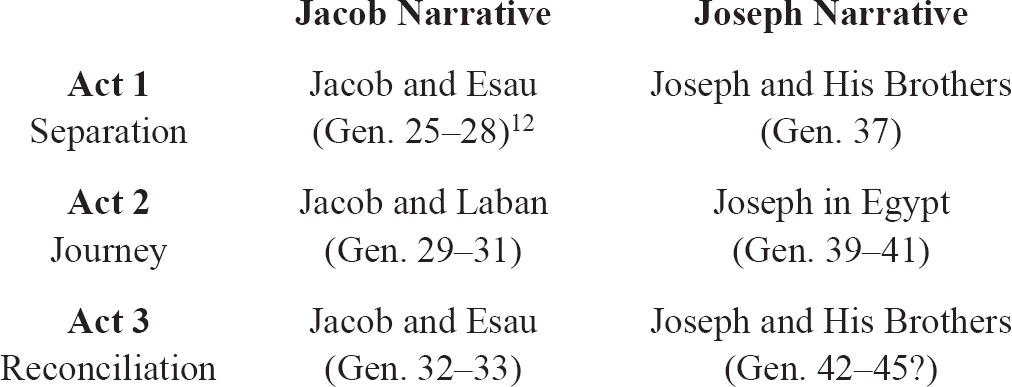
Blum characterizes the later scribal hands not simply as editors or redactors but creative performers of the text in their own right, and the combined Jacob-Joseph narrative both preserves and (re)interprets the component pieces in light of the new whole. 13 For instance, a hero story about Joseph gains new significance when it is read in parallel with Jacob, the eponymous hero of Israel. The repetition of the hero pattern underscores Joseph's preeminence and fits with the emphasis on his destiny to rule over his brothers within the Joseph narrative itself. 14 Likewise, the tricksterism of the Jacob stories is answered to a certain extent by the rise of Joseph, a wisdom hero who respects authority and the status quo, and this development is also reinforced in the broader narrative. For instance, in contrast to the reversal of Jacob and Esau, the elevation of the younger Ephraim over Manasseh in Genesis 48 is not accomplished through tricksterism but by the legitimate authority of the patriarch. 15 Further, Joseph's rise to prominence occurs within the royal court and his wisdom is expressed through monarchical power to the benefit of his clan. In sum, this combined Jacob-Joseph narrative forms a fitting foundation myth that recognizes the underlying tribal structure within Israel while also supporting the structures of monarchical power. 16
3. Jacob and Judah
The story of Judah and Tamar has been almost universally excluded from the core Joseph narrative by the commentators. 17 The most obvious markers of discontinuity are the chronologically ambiguous transition statement, אוהה תעב יהיו (‘It happened at [about] that time’, Gen. 38.1), and the use of resumptive repetition to frame the chapter as a digression (Gen. 37.36 and 39.1). The classic historical-critical approach has explained the presence of the chapter by the ancient scribal instinct to preserve tradition, while its position has generally been attributed to the lack of any better options. 18 At the same time, the chapter has become something of a test case for new literary-critical approaches, and a number of studies have proposed parallels in vocabulary, motif, and theme that allow the story to be read together with the surrounding Joseph narrative as an integrated whole. 19 Others have suggested, however, that the story makes better sense if it is read in the context of the broader Jacob-Joseph narrative, rather than as a digression from the Joseph narrative alone. 20
For instance, the literary features that bind the story to its frame suggest the strongest parallels between Judah and Jacob rather than Judah and Joseph. The almost identical sequences in chs. 37 and 38, as illustrated below, provide the most convincing literary link between the Judah story and the surrounding chapters of the Joseph narrative: 21

They sent the sleeved robe … to their father … And they said … ‘Identify, please …’ Then he identified it … (Gen. 37.32–33)

She sent to her father-in-law … And she said, ‘Identify, please …’ Then Judah identified [them]. (Gen. 38.25–26)
The repetition of the phrase אנ־רכח (‘identify, please’) is particularly interesting because the verb רכנ (hiphil) will also play a role later in the Joseph narrative. When Joseph is reunited with his brothers, the narrator notes that םרכיו (‘he recognized them’, Gen. 42.7). 22 In the immediate context, however, the repetition of the אנ־רכה formula invites direct comparison between the addressees of these commands—notably, Jacob and Judah rather than Judah and Joseph. 23 Further, Leuchter has noted that Tamar's command to Judah, אנ־רכה (‘identify, please’), creates a fitting symmetry with Judah's earlier request to Tamar, ךילא אובא אנ־הבה (‘Come now, let me come in to you’, Gen. 38.16). 24 Since there are features internal to Genesis 38 that explain the presence of the phrase, it is likely that Gen. 37.32–33 was shaped in response to Gen. 38.25–26 in order to point the reader back to Jacob more than forward toward Joseph.
As a story of one of Jacob's other sons Westermann also notes that the tradition of Judah and Tamar fits with the story of the rape of Dinah (Gen. 34) involving Simeon and Levi, and the fragment of a tradition concerning Reuben's indiscretion with his father's concubine (Gen. 35.22). 25 Indeed, David Carr has proposed that the stories involving Simeon, Levi, and Reuben in Genesis 34 and 35, the story of Judah and Tamar in Genesis 38, and the tribal sayings in Genesis 49 were actually part of a broader southern revision of a previously combined Jacob–Joseph narrative. This southern ‘composition layer’ was likely designed to elevate Judah within the national origin myth in support of southern hegemony. 26 Notably, the sayings in Gen. 49.3–12 promote Judah over his three older brothers, Reuben, Simeon, and Levi, which seems to be anticipated by the role of Simeon and Levi in the massacre of the inhabitants of Shechem and Reuben's indiscretion with Bilhah.
The southern provenance of this group of stories may also be supported through intertextual links with the succession narrative, particularly the stories of David and Bathsheba (2 Sam. 11) and Tamar and Amnon (2 Sam. 13). 27 In this respect, it is interesting to note that the stories of Tamar and Amnon (2 Sam. 13) and Dinah and Shechem (Gen. 34) are linked by a parallel verbal sequence in a similar manner to the sequence linking Genesis 37 and 38 described above:

He [Amnon] was stronger than her [Tamar]; he overpowered her; he laid her. (2 Sam. 13.14)

He [Shechem] took her [Dinah]; he laid her; he overpowered her. (Gen. 34.2)
At first glance, the inclusion of the story of Judah and Tamar would seem to counteract any program to elevate Judah within the broader narrative. While the genealogy of Zerah and Perez does anticipate the Davidic dynasty, their births are explained as the result of Judah's indiscretion with a prostitute who turns out to be his neglected daughter-in-law. Indeed, this tradition seems to be either unknown or obscured in other standard genealogies. 28 Judah is differentiated from his older brothers, however, in one important respect. The transition statement, ‘Judah went down from with his brothers’ (Gen. 38.1), has been used to recast the ancestor tradition lying behind the story as Judah's own transformative journey. 29 As Clifford has remarked, ‘Like Joseph (and many another hero in literature), he too must leave home and undergo testing before he can return to lead his own people’. 30 Further, in the traditional hero pattern, the central journey functions as a time of maturation and growth, which prepares the hero for the resolution of the narrative. In Judah's case, that transformation comes with his ultimate recognition that Tamar is in the right and not him (Gen. 38.26), and Judah subsequently takes the lead among his brothers in the reconciliation with Joseph (Gen. 43–44). 31
Since Judah does not have his own first and third acts, his plot relies on the Joseph narrative to provide conflict and resolution. As illustrated below, this helps to explain the position of the chapter at the transition to Joseph's own central journey:
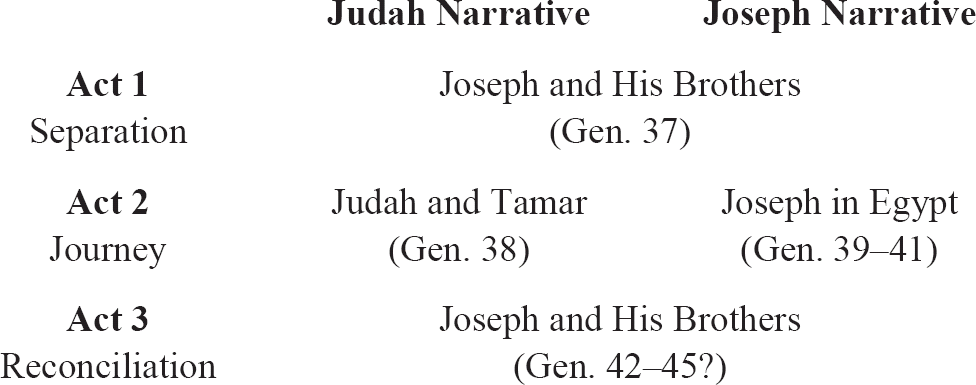
The derivative nature of Judah's story may also explain some of the odd features of the chapter with respect to genre. For instance, the birth narrative and etiology at the end of the chapter (Gen. 38.27–30) have presented a problem for form-critical analysis because they create something of a mixed genre. 32 Since this is the only distinct Judah story within the broader narrative, however, it would be necessary to fit other relevant information about Judah's biography into the chapter. Like Jacob and Joseph, for instance, Judah is married during his journey. The untimely deaths of his oldest sons then provide the setting for the Tamar story, which is ultimately resolved in the birth of Perez and Zerah. This birth narrative has a strong resemblance to the birth of Jacob and Esau (Gen. 25.21–34) and the blessing of Ephraim and Manasseh (Gen. 48.8–20) with respect to the prediction of the future dominance of the younger son. As mentioned above, these two episodes in Genesis 25 and 48 frame the combined Jacob and Joseph narrative, and the presence of similar material in the story of Judah and Tamar contributes to the goal of integrating Judah's biography into the whole. Consequently, the blending of genres in the chapter is more likely a product of this process of composition than an antecedent independent form of the tradition that has simply been spliced into place. 33
4. Joseph and his Master's Wife
The story of Joseph and his master's wife in Genesis 39 has not received nearly the same amount of attention as its more interesting neighbor. The chapter follows a stereotypical plot, also notably represented in the Egyptian ‘Tale of Two Brothers’, and the narrative style of the chapter has been characterized somewhat unfavorably as ‘shoddy’ and ‘long-winded’. 34 While there are elements of discontinuity with the surrounding chapters, supporters of the literary unity of the Joseph narrative have been reluctant to separate it from the core Joseph story, and Genesis 39 has typically been considered an integral part of the ‘Joseph in Egypt’ traditions found in Genesis 39–41. 35 Consequently, narrative approaches to Genesis 38 often begin with the assumption that Genesis 37 and 39 form a frame around the Judah and Tamar interlude. While there are some broad thematic elements linking chs. 37–39, however, Genesis 38 and 39 form an interesting pair on their own.
For the most part, the specific structural parallels that bind Genesis 37 and 38 do not extend into Genesis 39. As mentioned above, the almost identical sequences that culminate in the אנ־רכה (‘identify, please’) formula provide the strongest link between chs. 37 and 38, but this phrase is not repeated in ch. 39. Moreover, Genesis 38 and 39 stand out as a matched pair within Genesis 37–50 in a number of respects. For instance, the parallel that most strongly connects the two chapters—the presence of the seductress—is not an important theme in the Joseph narrative. In fact, these are the only two chapters in Genesis 37–50 that feature prominent female characters at all. The two are also distinguished from the Joseph narrative by the degree of overt involvement of the deity and the use of the divine name Y
Genesis 39 is also isolated to a certain degree from the following episodes through disjunctive literary structures and significant plot inconsistencies. For instance, the episode in Genesis 39 is characterized by a high degree of redundancy and repetition. First, the chapter is framed by the almost exact repetition of the introductory description of Joseph in the conclusion (Gen. 39.2–6 and 39.21–23), which particularly emphasizes Joseph's success—‘the L
These elements produce a large degree of narrative stasis that retards the plot unnaturally right at the point where we would expect the action to begin rising. Indeed, we find Joseph basically in the same situation at the beginning of ch. 40 as the one in which he started ch. 39. 39 At the end of ch. 39, Joseph had been put in רהסה תיב (‘the prison’) under the control of רהסה תיב רש (‘the chief jailer’, Gen. 39.20–21). In ch. 40, however, Joseph is under watch in םיחבטה רש תיב (‘the house of the captain of the guard’, Gen. 40.3). This character is also referenced as וינדא (‘his master’), the same title used for Potiphar in ch. 39, while ‘the chief jailer’ drops from the narrative without explanation. 40 In both episodes, therefore, Joseph is in the service of an Egyptian official who is described as םיחבטה רש (‘the captain of the guard’).
There are also literary clues that chs. 37 and 40 may have been in much closer proximity at a previous stage. As mentioned above, the double-dream motif that binds chs. 37 and 40–42 is conspicuously absent in both Genesis 38 and 39. Further, after interpreting their dreams, Joseph begs the officials to remember him to Pharaoh because, ‘In fact I was stolen out of the land of the Hebrews; and here also I have done nothing that they should have put me into the dungeon’ (Gen. 40.15). Not only is this the first explicit reference to the events of Genesis 37 after the Joseph plot resumes, but the word commonly translated as ‘dungeon’ is actually רוב (‘pit’), a bit of word play that would be more obvious were the climax of ch. 37 still fresh in the audience's mind.
For these reasons, some have concluded that Genesis 39 was actually a secondary insertion into the core Joseph story. 41 As Levin has noted, however, the seduction scene is necessary to the ‘Joseph in Egypt’ plot since it provides the circumstances under which Joseph can meet the cupbearer and baker within the jail. 42 Rather than an insertion, he has argued that the elements discussed above are more characteristic of an expansion. 43 When these are stripped away, a much shorter seduction scene is left, which was likely only a brief part of the rising action leading to the more important encounter between Joseph and Pharaoh's officials within the prison that is narrated in Genesis 40.
The main effect of the expansion was to shift the immediate focus in the opening scene of the ‘Joseph in Egypt’ section from plot development to character development. Namely, the episode has been recast as a test scene, which serves to establish the moral virtue of the hero. 44 As Levin notes, the expansion also adds two significant details to the story. 45 First, in the narration of the encounter (Gen. 39.13–14) it is only after Joseph has fled that the wife cries out to her servants, but in her retelling (Gen. 39.14–15 and 18) she claims to have cried out first before he fled. Second, the temporal clause added in Gen. 39.13 emphasizes that not only did Joseph leave his garment in the wife's hand but that she saw that he had left the garment in her hand. In her retelling (Gen. 39.15 and 18), however, she claims that he left the garment ילצא (‘beside me’). Both of these additions evoke the laws of Deut. 22.23–27, in which a woman is required to cry out if a man seizes her and attempts to lie with her ‘in the city’. The additions have also transformed the wife of Joseph's master into a full-blown trickster rather than simply a seductress. 46
In short, Genesis 39 is marked by a number of disjunctive elements that retard the plot and isolate the chapter from the subsequent episodes. This is best explained as the result of expansions that have transformed a shorter component of the rising action into a distinct episode. Consequently, the Joseph narrative does not fully resume until Genesis 40, leaving the digression in Genesis 38 and the semi-independent episode in Genesis 39 as a complementary pair.
5. Joseph and Tamar
To this point, it has been argued that the current shape of the Joseph narrative is best explained by a supplementary model of expansion and development designed both to preserve the core story and reinterpret it as it was brought into conversation with broader themes and patterns within the patriarchal narrative. Genesis 38 and 39 are a particularly interesting pair in that they sit near the transition from the Jacob to the Joseph narrative, and the juxtaposition of the two chapters mirrors a contrast between the two narratives with respect to their heroes. Tamar is a trickster in the mold of Jacob, but Joseph represents the ideal wisdom hero. The obvious parallels among the main characters in Genesis 38 and 39 have not gone unnoticed in the literature, but the analysis has often been guided by gender more than the literary structure. 47
Since Judah is explicitly equated with Jacob through the אנ־רכה (‘identify, please!’) formula that was repeated in Genesis 37 and 38, a contrast between Joseph and Judah in Genesis 38 and 39 is natural in light of the larger contrast between the Jacob and Joseph narratives with respect to tricksterism mentioned above. Indeed, by resisting the adulteress, Joseph seems to have succeeded where Judah failed. Outside of the broader hero pattern discussed above, however, the specific parallels between Joseph and Judah are not particularly strong. While Judah may have been embarrassed by losing his corded staff and seal to a prostitute, he is not specifically condemned in Genesis 38 for the encounter itself; the Strange Woman is not a test for Judah in the same way as for Joseph. 48 For instance, when Judah declares Tamar to be in the right, he cites his mistreatment of her as daughter-in-law as his offense: ‘I did not give her to Shelah, my son’ (Gen. 38.26a). The assurance that ‘He did not ever know her again’ (Gen. 38.26b) suggests that it is the fact that the prostitute happened to be his daughter-in-law that is most distressing, but nothing is said about Judah also abstaining from prostitutes in the future.
The prominent role of the seductress in both chapters also naturally leads to the interesting contrast between Tamar and the wife of Joseph's master. 49 As mentioned above, both women are trickster characters, and both obtain evidence from their male counterparts as part of their deceptions. Tamar is ultimately vindicated for her actions, however, while the unnamed wife is foiled in her attempt to seduce and then ruin Joseph. The lack of a proper name for the wife of Joseph's master is particularly interesting in light of the fact that she clearly drives the story in its expanded version and is referenced by the narrator fourteen times in the span of only twelve verses. Despite her prominent role, she is left unnamed as the archetypal seductress. As Alice Bach remarks, ‘While the wife of Potiphar seems to be the subject of the story, it is not told from her viewpoint. It is not her story.’ 50 Tamar's subversion of the social hierarchy is all the more striking, therefore, when placed in relief by Genesis 39. Tamar is portrayed as a sympathetic character. She is to be engaged rather than escape, and Mieke Bal has suggested that Tamar prepares the reader to meet Potiphar's wife by correcting a fault against women: ‘the fault of being afraid of her, and of institutionalizing that fear, that horror feminitatis’. 51
It is, in part, this imperfect symmetry between the two female characters that pushes the reader to look further to the comparison between Tamar and Joseph, the heroes of their respective stories. Genesis 38 and 39 both follow the basic morphology of an underdog tale, which involves a threat to the hero's social status that is solved through an exercise of ‘wit’. 52 The tales differ, however, in the nature of their heroes. In Genesis 38, Tamar uses deception to achieve a reversal in her status, while Joseph is able to maintain his own status through his strict observance of social norms in Genesis 39.
Judah is clearly introduced as the main character in the opening scene of Genesis 38, and the concluding genealogy is also concerned with Judah's progeny.
53
As the story unfolds, however, it is Tamar who plays the role of underdog hero.
54
With the death of her husband, Er, Tamar is left as a childless widow—a social misfit without patriarchal protection.
55
The accepted solution is for Er's brother, Onan, to father a son for her, through whom she would again be connected to the social institutions of family and tribe.
56
Onan is unwilling since any son born to Tamar will be counted as his brother's and compete with his own estate, though he is apparently not unwilling to sleep with Tamar. Judah also seems too concerned with his own estate to take up Tamar's plight. After Onan is put to death by Y
The issue of Tamar's social status is particularly evident in the emphasis placed on the respective social roles of Judah and Tamar. Tamar is repeatedly referenced by the term הלכ (‘daughter-in-law’, Gen. 38.11, 16, and 24), while Judah is םח (‘father-in-law’, Gen. 38.13 and 25). 57 As Tamar is a trickster, her exercise of ‘wit’ to solve her problem involves the deception of her father-in-law and the subversion of the boundaries associated with these roles. Indeed, in the midst of their encounter at Enaim, the narrator emphasizes that Judah ‘did not know that she was his daughter-in-law’ (Gen. 38.16). Having been pushed into the social margins by Judah's deceit—he does not seem to intend to marry her to Shelah at any point in the future—she takes on the role of marginalized woman by identifying as a prostitute.
What is interesting about Tamar is that her actions are not left morally ambiguous, but her deception is explicitly approved by the narrator. First, in contrast to the wife of Joseph's master, it is notable that Tamar is introduced as a named character and then given a backstory to provide the basis for her deception (Gen. 38.6–11). 58 Further, when Judah ultimately recognizes the deception, after having previously called for Tamar to be burned, he pronounces ינממ הקדצ (‘she is right, not I’, Gen. 38.26). Finally, the deity who shows such a quick trigger finger with Er and Onan also seems to give implicit approval to her actions by providing twin sons.
The crisis of Genesis 39 also revolves around a threat to Joseph's social status. Joseph has been appointed over his master's house, but his master's wife regularly attempts to seduce him. The pattern continues until Joseph finds himself alone with her in the house, presumably by her design, and he is forced to flee, leaving his garment in her hand. She then uses the garment as proof against Joseph, as mentioned above, who is thrown into jail by his irate master. Just as the terms הלכ (‘daughter-in-law’) and םח (‘father-in-law’) foreground the social relationship between Tamar and Judah in Genesis 38, the main characters in Genesis 39 are defined in relationship to Joseph through the use of labels like וינדא (‘his master’, Gen. 39.2, 3, 16, and 19) and וינדא־תשא (‘the wife of his master’ (Gen. 39.7 and 8). 59 In contrast to Tamar, however, Joseph responds to the threat by acting within the social boundaries defined by these roles. When propositioned by his master's wife, he explicitly points to the social hierarchy, ‘He [my master] has not kept back anything from me except yourself, because you are his wife’ (Gen. 39.9a), which is followed by a religious appeal, ‘How then could I do this great wickedness, and sin against God?’ (Gen. 39.9b). As with Tamar, the story concludes with a restoration of Joseph's status as overseer, albeit in service to the chief jailer rather than in the house of the captain of the guard. 60
As mentioned above, the episode in ch. 39 functions as a test scene, which serves to establish the moral virtue of the hero. 61 In this regard, the chapter is not out of place at the beginning of Joseph's transformative journey, and his success also mirrors his later rise within Pharaoh's court. 62 In its position following the story of Judah and Tamar, however, it is conspicuous that the test comes in the form of a seductress and trickster. Further, as mentioned above, the use of framing and repetition in Genesis 39 slow the plot, which invites the reader to look backward before continuing with the narrative. In this sense, Joseph's victory over the unnamed archetype may be seen as a victory over Tamar herself, and any conversation that might have been opened by the return of the successful trickster in Genesis 38 has effectively been closed at the end of Genesis 39. Indeed, while Tamar is justified for her actions, her victory clearly comes within the patriarchal frame provided by Gen. 38.1–5 and 27–30. She is reconnected to the family and tribe by providing the requisite sons, and her subversion is only temporary. 63 It is this move back to the status quo that ultimately prepares the reader for the story of Joseph and his master's wife.
Before proceeding to the conclusion, it is interesting to note that the use of a more conventional story to guide the reinterpretation of an earlier trickster hero can also be found in the sister-wife incidents in the Abraham narrative. For instance, in Genesis 12 it is left ambiguous at best whether Pharaoh and Sarai consummated their marriage, but Genesis 20 states explicitly that Abimelech ‘had not approached her’ (Gen. 20.4). Further, in a manner similar to Gen. 39.9, this social boundary is given a religious legitimization as the potential adultery is framed as a sin against God rather than against Abraham (Gen. 20.6). John Van Seters has argued, therefore, that Genesis 20 presupposes and expands on Genesis 12. 64 As in Genesis 38 and 39, the strong thematic parallels between these sister-wife stories invite an intratextual reading in which Genesis 20 counterbalances the tricksterism of Genesis 12. This interpretive trajectory was taken to its proper end in the Genesis Apocryphon, which not only rewrote the Genesis 12 incident in light of Genesis 20 (i.e., by stressing that Pharaoh did not sleep with Sarah) but also presented Abram as a proper wisdom hero and dream interpreter in the mold of Joseph and Daniel. 65
6. Conclusion
The juxtaposition of Genesis 38 and 39 reflects the tension between conservation and innovation in the production of traditional literature. While the product may be organized around a central literary framework, there is no systematic harmonization of the component parts, leaving the layers slightly exposed. The result is a composite work with many voices, which may be interpreted in light of the whole. Reading these voices in dialogue with one another has the benefit of balancing the integrity of the individual stories with their place in the larger whole. At the same time, this conversation may reveal something about the changing social contexts in which the literature was being (re)produced. Genesis 38 and 39 reflect such a conversation concerning tricksterism and the importance of maintaining the status quo.
The symmetry between the biographies of the patriarch Jacob and his son Joseph within the northern Jacob-Joseph narrative supports the superiority of Joseph over his brothers, particularly with respect to his divine right to rule. Further, while the Jacob stories generally celebrate tricksters, the portrayal of Joseph as the ideal ‘wisdom’ hero serves as a counterbalance to these earlier trickster characters. The subsequent insertion of the story of Judah and Tamar, as part of a broader southern composition layer, elevates the eponymous southern ancestor within this narrative by evoking a similar hero pattern for his biography. The tradition that was recast as Judah's transformative journey fits well with the themes and motifs of the Jacob stories, but the presence of Tamar conflicts with the goal of displacing the trickster. This tension is resolved by juxtaposing the episode with the expanded story of Joseph and his master's wife in Genesis 39. If the insertion of Tamar's story could be seen as an attempt to reopen the conversation between the trickster and the ‘wisdom’ hero, Joseph's ‘victory’ over Potiphar's wife closes it. Indeed, Joseph's vindication, on his way to even greater success, would seem to be an implicit argument for the superiority of the ‘wisdom’ hero over the trickster. In this manner, Joseph is presented as the official response to Tamar and the previous tricksters encountered in the Jacob narrative.
Footnotes
1.
Robert Alter, The Art of Biblical Narrative (New York: Basic Books, 1981), pp. 3–22. Yairah Amit (‘Narrative Analysis: Meaning, Context, and Origins of Genesis 38’, in Joel M. LeMon and Kent Harold Richards [eds.], Method Matters: Essays on the Interpretation of the Bible in Honor of David L. Petersen [Atlanta: SBL, 2009], pp. 271–91) also recently chose Gen. 38 as her model text, and Esther Marie Menn (Judah and Tamar [Genesis 38] in Ancient Jewish Exegesis: Studies in Literary Form and Hermeneutics [JSJSup, 51; Leiden: Brill, 1997], pp. 75–78) provides a helpful survey of the question.
2.
For instance, Judy Fentress-Williams (‘Location, Location, Location: Tamar in the Joseph Cycle’, in Roland Boer [ed.], Bakhtin and Genre Theory in Biblical Studies [Atlanta: SBL, 2007], pp. 59–68) develops the idea of Gen. 38 as a ‘story-in-a-story’, while Jonathan Kruschwitz (‘The Type-Scene Connection between Genesis 38 and the Joseph Story’, JSOT 36 [2012], pp. 383–410 [385]) has recently discussed the idea that the story of Judah and Tamar provides ‘a lens through which the audience might better understand the longer—but similarly shaped and irony-filled—plot of the Joseph novella’. See Richard J. Clifford, ‘Genesis 38: Its Contribution to the Jacob Story’, CBQ 66 (2004), pp. 519–32, for the role of Gen. 38 in the characterization of Judah.
3.
Susan Niditch, A Prelude to Biblical Folklore: Underdogs and Tricksters (San Francisco: Harper & Row, 1987; repr., Chicago: University of Illinois Press, 2000), p. 117.
4.
Niditch (Underdogs and Tricksters, p. 125) proposes that the Jacob stories reflect a popular setting and originated in early Israel—a marginalized people with lower social class. The Joseph story, in contrast, is both pro-establishment and positive toward monarchy, presuming the existence of an upper-class elite within Israel.
5.
David Carr (Reading the Fractures of Genesis: Historical and Literary Approaches [Louisville, KY: Westminster/John Knox Press, 1996], pp. 12–13) refers to this as intratextuality rather than intertextuality due to the manner in which stories within a single composite work seem to have been shaped in light of each other.
6.
For discussion of the ‘taming of the trickster’, in the Jacob narrative, see Carr (Fractures, pp. 300–301). The terminology of the ‘wisdom’ hero follows Niditch (Underdogs and Tricksters, p. 121) who notes that Joseph follows the conventions of ‘courtly wisdom’ such as knowing when to be silent and when to speak. I use the term generically, however, as the characterization of the Joseph story as a ‘wisdom novella’ (see Gerhard von Rad, ‘Josephgeschichte und altere Chokma’, in Congress Volume: Copenhagen, 1953 (VTSup, 1; Leiden: E.J. Brill, 1953], pp. 121–27) is more complicated. For instance, wisdom themes are not as prominent within the broader Joseph story as it first appears, and Michael V. Fox (‘Wisdom in the Joseph Story’, VT 51 [2001], pp. 26–41 [30]) has shown that the link between Joseph and a specific Israelite wisdom tradition, as represented in Proverbs, for instance, is not particularly strong. Consequently, the broader ‘wisdom’ elements in the Joseph story can be attributed to the ‘official’ social context in which it was produced more than to a core didactic function of the narrative.
7.
There is disagreement, however, on the extent of the core Joseph narrative. Westermann (Genesis 37–50: A Commentary [trans. J.J. Scullion; Minneapolis: Augsburg, 1986], p. 22) is only confident in speaking of the core narrative through Gen. 45, while he considers chs. 46–50, which are characterized by inconsistency and disjunction, to belong more properly to the Jacob story. Chapter 46, in particular, has a number of insertions characteristic of P. Omitting this P-material, George Coats (‘Redactional Unity in Genesis 37–50’, JBL 93 [1974], pp. 15–21 [17]) still identifies elements of the core narrative through Gen. 47.27. Konrad Schmid (‘Die Josephsgeschichte im Pentateuch’, in Jan Christian Gertz, However, Konrad Schmid, and Markus Witte [eds.], Abschied vom Jahwisten: Die Komposition des Hexateuch in der jüngsten Diskussion [Berlin: W. de Gruyter, 2002], pp. 83–118 [105]) suggests that elements of the core Joseph narrative can be found through ch. 50, since ch. 45 lacks a proper reconciliation between Joseph and his brothers.
8.
As Christoph Levin (‘Righteousness in the Joseph Story: Joseph Resists Seduction [Genesis 39]’, in Thomas B. Dozeman, Konrad Schmid, and Baruch J. Schwartz [eds.], The Pentateuch: International Perspectives on Current Research [FAT, 78; Tübingen: Mohr Siebeck, 2011], pp. 223–40 [223–24]) notes, the literary unity of the Joseph story has ‘presented a particular challenge for pentateuchal criticism’. Julius Wellhausen (Die Composition des Hexateuchs und der historischen Bücher des Altens Testaments [Berlin: W. de Gruyter, 4th edn, 1963], p. 52) delineates J and E strands within the narrative (and more recently, see Joel S. Baden, The Composition of the Pentateuch: Renewing the Documentary Hypothesis [New Haven: Yale University Press, 2012], pp. 39–43), but later scholars working within the framework of the documentary hypothesis have accepted the characterization of the Joseph story as the work of a single author, which was integrated into Genesis by the Yahwist (see Gerhard von Rad, Genesis: A Commentary [trans. John H. Marks; OTL; Philadelphia: Westminster Press, 1961], p. 439). A distinct approach is represented by Martin Noth (A History of Pentateuchal Traditions [trans. B.W. Anderson; Englewood Cliffs, NJ: Prentice-Hall, 1972], pp. 208–13), who sees the Joseph story as a ‘redactional link’ between the patriarchal narratives and the Exodus. John Van Seters (Prologue to History: The Yahwist as Historian in Genesis [Louisville, KY: Westminster/John Knox Press, 1992], pp. 311–24) has also explained the insertion of the Joseph story in relation to the ‘historiographic structure of the Pentateuch’—namely, it establishes continuity between the patriarchal traditions and the Exodus.
9.
This model is pursued in the work of Rolf Rendtorff (Das überlieferungsgeschichtliche Problem des Pentateuch [BZAW, 147; Berlin: W. de Gruyter, 1977]) and its extension by his student Erhard Blum (Die Komposition der Vätergeschichte [WMANT, 57; Neukirchen-Vluyn: Neukirchener Verlag, 1984], pp. 258–59), who posits independent Abraham, Isaac, Jacob, and Joseph compositions, which subsequently were connected and juxtaposed as the patriarchal narrative was gradually expanded.
10.
Niditch, Underdogs and Tricksters, p. 72.
11.
Niditch, Underdogs and Tricksters, p. 72.
12.
The sister-wife incident (Gen. 26) should, of course, be excluded from the core Jacob narrative (Erhard Blum, ‘The Jacob Tradition’, in Craig A. Evans, Joel N. Lohr. and David L. Petersen [eds.], The Book of Genesis: Composition, Reception, and Interpretation [Leiden: Brill, 2012], pp. 181–212 [181–82]).
13.
Blum, Vätergeschichte, p. 171. See also David Carr (The Formation of the Hebrew Bible: A New Reconstruction [Oxford: Oxford University Press, 2011], pp. 5–7) for discussion of the tension between preservation and innovation in the transmission of traditional literature.
14.
Joseph's destiny to rule is particularly emphasized in the opening scene (Gen. 37) with the symbol of the םיספ תנתכ, traditionally ‘coat of many colors’, but likely a robe with long sleeves that was associated with royalty (see 2 Sam. 13.18), as well as Joseph's dreams about his brothers (Westermann, Genesis 37–50, pp. 37–38).
15.
Carr, Fractures, p. 302.
16.
Some have objected to such a political reading of the Joseph story. For instance, Van Seters (Prologue to History, p. 312) argues that ‘its nature as a “wisdom” novella means that it was not concerned to reflect tribal or national history or the future destiny of the descendants of the ancestors’. As mentioned above, however, the characterization of the Joseph story as a ‘wisdom’ novella is problematic. Further, Blum (‘The Jacob Tradition’, p. 186) nuances the ‘political’ nature of the story by observing that, from the perspective of the community in which the story is (re)told, it is part of their collective ‘biography’. The narrated world and the present world are ‘etiologically correlated’; consequently, the characters do not simply stand for tribes or people groups in an allegorical sense but ‘they are those tribes or peoples’ (emphasis original).
17.
For instance, Westermann (Genesis 37–50, p. 20) characterizes the chapter as ‘a self-contained individual narrative’. Likewise, George W. Coats (Genesis, with an Introduction to Narrative Literature [FOTL, 1; Grand Rapids, MI: Eerdmans, 1983], p. 273) observes that the chapter ‘is completely isolated from the Joseph story’.
18.
For instance, E.A. Speiser (Genesis [AB, 1; New York: Doubleday, 1964], p. 299) concludes that ‘the narrators acted in the main as custodians of diverse traditions which they did not attempt to coordinate and harmonize when the respective data appeared to be in conflict’. In this view, the position of the chapter was largely constrained by chronology since Judah is portrayed as the head of his own house living separate from his brothers, but these events can only be narrated before the entire Jacob clan moves down to Egypt with Joseph (Gen. 46).
19.
For a summary, see Amit, ‘Narrative Analysis’, pp. 271–91.
20.
For instance, Westermann (Genesis 37–50, p. 20) states that ‘the narrative of Judah and Tamar has not been inserted into the Joseph story; it has nothing to do with it but rather is an insertion into the Jacob story, into its conclusion’.
21.
This presentation is adapted from Clifford, ‘Genesis 38’, p. 521.
22.
Alter (Biblical Narrative, p. 10) concludes that ‘This precise recurrence of the verb in identical forms at the ends of Gen. 37 and 38 respectively is manifestly the result not of some automatic mechanism of interpolating traditional materials but of careful splicing of sources by a brilliant literary artist’. Clifford (‘Genesis 38’, p. 521) also notes Gen. 42.21 and 45.5–8 as important moments of recognition within the later Joseph plot, though they do not specifically involve the verb רכנ (hiphil).
23.
Clifford (‘Genesis 38’, p. 521) has also observed that garments and goats, two motifs that have been commonly identified among the parallels linking Gen. 37 and 38, are prominent within Jacob's most famous deception in Gen. 27. Likewise, J.P. Fokkelman (‘Genesis 37 and 38 at the Interface of Structural Analysis and Hermeneutics’, in L. de Regt, J. de Waard, and J. Fokkelman [eds.], Literary Structure and Rhetorical Strategies in the Hebrew Bible [Assen: Van Gorcum, 1996], pp. 152–87 [166–67]) has suggested that the sequence points the reader back to incidents in Gen. 27 and 31 from the Jacob narrative where recognition (or lack thereof) played a role in deception.
24.
Mark Leuchter, ‘Genesis 38 in Social and Historical Perspective’, JBL 132 (2013), pp. 209–27 (211).
25.
Westermann, Genesis 37–50, p. 49.
26.
Carr, Fractures, pp. 252–53. Carr's view is indebted here to Blum, particularly the concept of a ‘composition layer’.
27.
C.Y.S. Ho (‘The Stories of the Family Troubles of David: A Study of their Literary Links’, VT 49 [1999], pp. 514–31) argues that the direction of influence suggests that the Genesis stories were shaped in light of the David stories. The idea has been developed by Gary Rendsburg (‘David and his Circle in Genesis 38’, VT 36 [1986], pp. 438–46) and Graeme Auld (‘Reading Genesis after Samuel’, in Thomas B. Dozeman, Konrad Schmid, and Baruch J. Schwartz [eds.], The Pentateuch: International Perspectives on Current Research [FAT, 78; Tübingen: Mohr Siebeck, 2011], pp. 459–70). Carr (Fractures, p. 304) reaches a similar conclusion, suggesting that the David stories were a model for the composition of the Judah stories. Paul Noble (‘Esau, Tamar, and Joseph: Criteria for Identifying Inner-Biblical Allusions’, VT 52 [2002], pp. 219–52) has objected, however, that the connections between the stories proposed by Rendsburg and Ho are often peripheral rather than central plot elements.
28.
For instance, Coats (Genesis, p. 275) notes that Gen. 46.12 simply lists Er, Onan, Shelah, Perez, and Zerah as children of Judah, while Ruth 4.18–20 begins the genealogy of David with Perez, curiously omitting any reference to Judah or Tamar (cf. Ruth 4.12).
29.
See J.A. Emerton (‘Some Problems in Genesis 38’, VT 25 [1975], pp. 338–61 [345–46]) for a detailed discussion of the settlement tradition behind Gen. 38. In short, the story seems to preserve a memory in which the Judah tribe was already settled independently in Canaan during the patriarchal period. Van Seters (Prologue, p. 324) has argued that the primary function of the insertion of Gen. 38 was to accommodate this alternate Judah tradition to the Exodus narrative, so that the Judah tribe also participates in the Exodus event, which aligns with his view that the Joseph story provides continuity between the patriarchs and Exodus. As discussed above, however, the literary structures suggest that the story of Judah and Tamar is most significant within the combined Jacob and Joseph narrative. Consequently, it is more likely that the alternate Judah tradition is being accommodated to the patriarchal settlement traditions than to the broader Exodus tradition.
30.
Clifford, ‘Genesis 38’, p. 522.
31.
Clifford, ‘Genesis 38’, p. 531. A similar conclusion is reached by Thomas Brodie (Genesis as Dialogue: A Literary, Historical, and Theological Commentary [Oxford: Oxford University Press, 2001], pp. 354–55) who describes Gen. 38 as a ‘conversion story’.
32.
Westermann (Genesis 37–50, p. 49) suggests that the genealogical frame was necessary to give the story context when it circulated independently, while Coats (Genesis, p. 275) considers the etiology to be an appendix. In contrast, Van Seters (Prologue, p. 208) describes the chapter as a ‘genealogical story’, in order to emphasize the centrality of the genealogical and ethnological elements.
33.
Indeed, Coats (Genesis, p. 275) tentatively characterizes the chapter as a novella, noting that the basic narrative structure mirrors that of the broader Joseph narrative. Kruschwitz (‘Type-Scene’, p. 385) also notes a strong symmetry between the two narratives with respect to plot development and characterization: ‘Indeed, in both stories one confronts a dramatic reversal of circumstances through which a host of ironies emerge. Roles are reversed, positions of authority are exchanged, expectations are confounded, and resolution for all parties is achieved in most unexpected ways.’ He attributes the symmetry to a shared type-scene, but it may be the product of the influence of the core Joseph narrative on the specific realization of the Judah and Tamar story within Gen. 38.
34.
See Donald Redford, A Study of the Biblical Story of Joseph (Genesis 37–50) (VTSup, 20; Leiden: Brill, 1970), p. 77, and Levin, ‘Righteousness’, p. 232.
35.
See Westermann, Genesis 37–50, pp. 60–61, and Coats, Genesis, pp. 282–83.
36.
Jean-Louis Ska, Introduction to Reading the Pentateuch (trans. Sr. Pascale Dominique; Winona Lake, IN: Eisenbrauns, 2006), p. 206. There is a single occurrence of the name Y
37.
This also contrasts with the more precise transitions in the subsequent episodes, such as ‘It happened on the third day’ (Gen. 40.20) and ‘It happened at the end of two years’ (Gen. 41.1), but it matches the ambiguous transition into the Judah and Tamar insertion, ‘It happened at (about) that time’ (Gen. 38.1; see above).
38.
Levin, ‘Righteousness’, p. 232.
39.
Ska, Introduction, pp. 206–207.
40.
Note that the name Potiphar only occurs in the resumptive repetition framing the Judah and Tamar story (Gen. 37.36 and 39.1) but not within the story of Joseph and his master's wife itself. Further, none of the other Egyptian characters, such as ‘the cupbearer of the king of Egypt and his baker’ (Gen. 40.1), are named. For this reason, the name ‘Potiphar’ has usually been explained as a later gloss, perhaps influenced by Potiphera, the name of the father of Joseph's Egyptian wife (Gen. 41.45).
41.
For instance, Redford (Joseph, p. 245) considers the chapter to be a secondary addition, noting that it is ‘the one episode in the present narrative which can with ease be shown not to be an integral part of it’. Ska (Introduction, p. 207) also judges the chapter to be secondary, while Carr (Fractures, p. 288) refers to Gen. 39 and 40–41 as distinct stories, but attributes their integration to the author of the core Joseph narrative rather than a later reviser.
42.
Levin, ‘Righteousness’, p. 229 n. 29.
43.
Levin, ‘Righteousness’, pp. 232–33. Note, however, that he proposed two stages of expansion. He attributes the frame of the chapter (Gen. 39.2–6 and 39.21–23) to J, but the further expansions to a later ‘righteousness edition’ that extends more broadly across the patriarchal narrative.
44.
See Fox, ‘Wisdom’, p. 31, who notes the particularly strong parallels with Daniel in this regard. Indeed, it is primarily Gen. 39 that promotes Joseph as a moral exemplar. His later success in Egypt is attributed to his skill as a dream interpreter and shrewdness as an administrator.
45.
Levin, ‘Righteousness’, pp. 233–44.
46.
As Ska (Introduction, p. 206) has noted, it is also conspicuous in this regard that the narrator's attention turns fully to Joseph at the conclusion of the scene, since this leaves the episode ultimately unresolved. The deception of Potiphar's wife neither succeeds nor is it brought to light and punished as we might expect in an independent trickster tale. This supports the conclusion that the prominence of the trickster elements within the chapter are a result of a secondary expansion.
47.
Menn, Judah and Tamar, pp. 77–78.
48.
Susan Niditch, ‘The Wronged Woman Righted: An Analysis of Genesis 38’, HTR 72 (1979), pp. 143–49 (147). Hirah's inquiry into the whereabouts of השדקה (‘the cult prostitute’) rather than הנוזה (‘the prostitute’) may indicate some variance in the social acceptability of the various forms of prostitution, but the negotiation in Gen. 38.16–18 is presented as a fairly ordinary business transaction. It is Tamar who has disregarded the social norm by ‘playing the harlot’ (Gen. 38.24) and who risks capital punishment.
49.
Both characters also seem to represent the dangerous foreign woman. However, while it is strongly implied that Tamar is a Canaanite, the narrative never makes this explicit. The issue is discussed in detail by J.A. Emerton, ‘An Examination of a Recent Structuralist Interpretation of Genesis 38’, VT 26 (1976), pp. 79–98 (90–93). Amit (‘Narrative Analysis’, p. 285) has suggested that the Tamar story may have participated in the post-exilic social conversation regarding foreign wives, taking the ‘anti-isolationist’ position also found in Ruth. Yet, the silence about Tamar's specific ethnic background would seem to downplay this aspect of the story (see also Menn, Judah and Tamar, p. 54).
50.
Alice Bach, Women, Seduction, and Betrayal in Biblical Narrative (Cambridge: Cambridge University Press, 1997), p. 48.
51.
Mieke Bal, Lethal Love: Feminist Literary Readings of Biblical Love Stories (Bloomington, IN: Indiana University Press, 1987), p. 86.
52.
Niditch, Underdogs and Tricksters, p. 149.
53.
Menn (Judah and Tamar, p. 34) has observed that Tamar is ‘virtually absent’ from the birth scene in Gen. 38.27–30, signalling that ‘although Tamar has an important role in the plot of the story, she is not necessarily the narrator's central interest’. While Tamar is referenced twice with a pronoun, she is not specifically named in this section and does not occur as the subject of an active verb.
54.
There is some discussion in the literature concerning whether Judah or Tamar is more properly the main character. Adele Berlin has argued that Tamar is a subordinate character based on the use of relational terms such as ‘wife’ and ‘daughter-in-law’ (Poetics and Interpretation of Biblical Narrative [Sheffield: Almond Press, 1983], pp. 60–61). As Esther Marie Menn has observed, however, this ‘fails to take into account Tamar's role in the narrative plot’ (Judah and Tamar, p. 29 n. 23). Notably, it is Tamar who achieves a reversal in status and is justified in the conclusion of the narrative. Tamar is clearly the hero of the underdog story, though Judah also undergoes some character development and seems to be of greater interest to the narrator in the broader context.
55.
Niditch, ‘Wronged Woman’, pp. 144–45.
56.
Many scholars have suggested that the independent Tamar story may have served to support the social institution of levirate marriage; see George W. Coats, ‘Widow's Rights: A Crux in the Structure of Genesis 38’, CBQ 34 (1972), pp. 461–66. It is not clear that the custom reflected in Gen. 38 is identical to the provisions for levirate marriage found in Deut. 25.5–10, however, as there is no indication that Onan is expected to marry Tamar (see Dvora Weisberg, Levirate Marriage and the Family in Ancient Judaism [Waltham, MA: Brandeis University Press, 2009], pp. 28–30). Further, as much as a polemic for the practice of levirate marriage, the story reads as a social commentary on the defects of the system. Namely, besides the threat of divine wrath, there is actually no social incentive for the brother-in-law to fulfill his duty.
57.
Tamar is also referenced once as ךיחא תשא (‘the wife of your brother’, Gen. 38.8).
58.
The narrator references Tamar by proper name three times (Gen. 38.6, 11, and 13), and she is also named in the anonymous message to Judah (Gen. 38.24). Menn (Judah and Tamar, pp. 29–30) has observed that it is the male characters, in contrast to the narrator, who consistently refer to Tamar using descriptive terms rather than a proper name, which may reinforce the negative evaluation of their treatment of Tamar.
59.
See also ינדא (‘my master’, Gen. 39.8) and ףסוי ינדא (‘Joseph's master’, Gen. 39.20).
60.
Though see above concerning the shift back to the captain of the guard in ch. 40.
61.
Fox, ‘Wisdom’, p. 31.
62.
Niditch, Underdogs and Tricksters, p. 110.
63.
The presentation of Tamar accords with a general pattern in the Hebrew Bible. Gail C. Streete (The Strange Woman: Power and Sex in the Bible [Louisville, KY: Westminster/John Knox Press, 1998], 19) has observed that the Strange Woman was viewed positively when deceiving outsiders or benefiting the community and its males, but negatively when she threatened to undermine the males of the community. Judah's mistreatment of Tamar had the secondary effect of endangering his posterity; therefore, Tamar's deception did not only ensure her place within the clan, but it also provided the sons who would further the line of Judah.
64.
John Van Seters, Abraham in History and Tradition (New Haven: Yale University Press, 1975), p. 171. Samuel Sandmel has similarly described Gen. 20 as an inner-biblical aggadic expansion of Gen. 12 (‘The Haggadah within Scripture’, JBL 80 [1961], pp. 105–22).
65.
Daniel Falk, The Parabiblical Texts: Strategies for Extending the Scriptures Among the Dead Sea Scrolls (CQS, 8; LSTS, 63; London: T&T Clark International, 2007), p. 89.