



Abstract
Scholars have long perceived a relationship among Genesis narratives involving Reuben and Judah. Most treatments, historical in orientation, focus on the authorial and editorial processes that produced two episodes in which ‘competing’ Reuben and Judah narratives are preserved: the sale of Joseph (Gen. 37) and the guardianship of Benjamin (Gen. 42-3). Even literary studies of the Reuben and Judah characters typically address only some of the relevant narratives and reach limited conclusions about the characters’ import. This study, in contrast, contends that all of the Reuben and Judah narrative passages in Genesis—whatever the processes leading to their inclusion—comprise a latent complex with a literary purpose. Reuben and Judah compel Jacob to reconsider behaviors from his own life, reminding their father—respectively—of his failings and his nobler aspects. I dub this dynamic a ‘reflection complex’, consisting of multifarious intertextual links, including multiple instances of the ‘reflection stories’ described by Yair Zakovitch.
1. Introduction
Biblical scholarship has long posited some sort of relationship between narratives in Genesis involving Reuben and Judah. The most influential studies to address the relationship have been historical in orientation and have generally treated the passages in one, or some combination, of three ways: (a) as vestiges of antecedent Pentateuchal sources E and J (e.g. Noth, 1981: 28-32, 35-36; Schmidt, 1986: 137-138; Schwartz, 2012); (b) as the products of Reubenite and Judahite versions or expansions (e.g. Dietrich, 1989: 59-67; Kugel, 2008: 183; Loewenstamm, 1969; Redford, 1970: 178-186); or (c) as typological remnants of Israel’s early tribal history, during which the tribe of Reuben purportedly enjoyed early hegemony before being supplanted by the tribe of Judah (e.g. Brettler, 1995: 48-61; Cross, 1998; Levin, 2004).
Such studies primarily focus on two episodes, the sale of Joseph (Gen. 37) and the contest to bring Benjamin to Egypt (Gen. 42.37-43.10), which juxtapose the behaviors of Reuben and Judah and thus invite historical speculation regarding the authorial and editorial processes that produced the competing narratives. However, little or no attention is devoted to the remaining, assumedly unrelated, ‘Reuben’ and ‘Judah’ episodes, let alone to any overarching literary dynamic governing their inclusion in Genesis.
Indeed, even the literary studies that address the Reuben–Judah dynamic typically offer only limited insights on select episodes. Berlin, for instance, aptly cites the contrast of Reuben and Judah as a characterization technique, but she admits evidence only from ‘the Joseph story’ and only briefly explores its import: ‘The Joseph story contains a contrast between Reuben and Judah … in which Reuben, although he means well, is always less effective than Judah’ (1994: 40). Similarly limited, if perceptive, evaluations appear in many other literary treatments (e.g. Alter, 1981: 70; Humphreys, 1988: 83-84; Green, 1996: 62; Pirson, 2002: 98; Sternberg, 1985: 296; Syren, 1993: 132; White, 1985).
This study, in contrast, contends that all of the Reuben and Judah narrative passages in Genesis—whatever the historical processes leading to their inclusion—comprise a latent but unmistakable complex with a distinct literary purpose. To wit, the Reuben–Judah pair of characters compels Jacob to reconsider dilemmas and behaviors from his own early life. Serving as literary antipodes, Reuben and Judah remind their father, respectively, of his own prior failings and the nobler aspects of himself. This ongoing dynamic, which I dub a ‘reflection complex’, consists of a variety of intertextual links—including, notably, multiple instances of the ‘reflection story’ phenomenon described by Yair Zakovitch (1993, 1995).
After first introducing Zakovitch’s model, I present the Reuben–Judah–Jacob ‘reflection complex’, demonstrating how it illuminates Jacob’s relationships with his two sons and presages the elevation of Judah at Reuben’s expense. However, I also show that the complex, simultaneously, signals to readers that Jacob’s moral evaluation of his two sons remains incomplete. I conclude by analyzing the purpose of the ‘reflection complex’ and suggesting avenues for future research.
2. Zakovitch’s ‘reflection stories’
Expositors ancient and modern have noted that biblical narrative frequently features textual links binding disparate episodes. These multifarious links, assigned varied appellations by scholars, can be roughly subsumed within the category of ‘intertextuality’, which may serve as ‘a covering term for all the possible relations that can be established between texts’ (Miscall, 1992: 44).
1
One species of deliberate
2
intertextual reference has been termed the ‘reflection story’ by Zakovitch (1993), who defines it as follows:
[Reflection stories are] instances where the biblical narrator shaped a character, or his or her actions, as the antithesis of a character in another narrative and that character’s actions. The new creation awakens in the reader undeniable associations to the source-story; … the reflection inverts the storyline of the original narrative. (p. 139)
3
Zakovitch (1993) cautions that identifying the components of reflection stories requires ‘firm evidence’, usually of two primary types: (a) ‘plots with similar themes and which are constructed in parallel or similar fashion’ and (b) ‘common expressions (which are not otherwise common in the Bible)’ (p. 140). 4
The dominant objectives of the reflection story are to contrast the (im)moral activities and attitudes of biblical characters and to implicitly condemn corrupt behaviors exhibited in a source-story by detailing comeuppance in its reflection:
The arrangement of measure-for-measure punishment is a fitting role for the reflecting character, who illustrates the symmetry between the sin and the punishment … [thus] expressing the attitude of the biblical writers toward the behaviors of the [source-]character, without explicit verbalization. (Zakovitch, 1995: 16)
5
As he readily concedes, Zakovitch is not the first to notice latent patterns of sin-and-punishment in biblical narrative (cf. Berger, 1996; Jacobs, 2006: 19-22). But his treatment represents the most comprehensive, penetrating exploration of the ‘reflection story’ dynamic, which plays a crucial role in the ‘reflection complex’ here advanced. Accordingly, his delineation of the phenomenon serves as a prologue that helps highlight both the methodological continuity and expansion that my argument represents.
3. Contentions: Reuben and Judah, antithetical reflections of Jacob
Genesis records six narrative episodes that differentiate Reuben and/or Judah from Jacob’s other sons: two involving Reuben alone, two involving Judah alone, and two in which Reuben’s and Judah’s actions are juxtaposed. For convenience, I designate these six cases, in the order of their appearance in Genesis, as follows:
(R1) Reuben and the Mandrakes (30.14-16)
6
(R2) Reuben and Bilhah (35.22) (RJ1) Reuben/Judah and Joseph (37.21-30+42:22) (J1) Judah, Wife, and Sons (38.1-11) (J2) Judah and Tamar (38.12-26)
7
(RJ2) Reuben/Judah and Benjamin (42.36-43.10+44.14-34)
8
These six narrative passages constitute a ‘reflection complex’, composed of myriad intertextual links, that operates relative to two perspectival levels. 9 On the primary level—namely, Jacob’s internal perspective as a character—five of the episodes uniformly support divergent moral evaluations of Reuben and Judah. Both (R1) and (R2) are classic reflection stories of comeuppance. In each, Reuben behaves dishonorably in ways that remind Jacob of, and provide retribution for, moral deficiencies from Jacob’s past. The (J1) and (J2) episodes represent intertextual stories with the opposite dynamic: that is, Judah’s experiences and honorable behaviors recall or foreshadow—in his father’s mind—Jacob’s faithfulness and compassion. Jacob’s perception of these four episodes, only partially matching the reader’s, is cemented in the climactic (RJ2) episode, which reinforces the dynamic of the prior four episodes and clinches Jacob’s acceptance of Judah as leader of the family.
However, (RJ1)—the sale of Joseph—is sui generis in two respects that combine to drive a sizable wedge between Jacob’s perspective and the reader’s. First, (RJ1) should pre-empt the consistent evaluation that Jacob eventually reaches based on the other five episodes. For in (RJ1), it is Reuben who admirably pursues Jacob’s interest and Judah who disgracefully works against it—again tracking Jacob’s behaviors, I will show, but this time in opposite roles. However, only the reader is aware of the reversal because, unlike the other five episodes, (RJ1) is concealed from Jacob, who learns neither of Reuben’s attempt to rescue Joseph nor of Judah’s leading role in Joseph’s sale.
Thus, the two perspectival levels of the ‘reflection complex’ are meaningfully misaligned. On the primary level, the reflections are internal to the story; it is Jacob who perceives Reuben and Judah as mutually antithetical reflections of himself, based on the five episodes known to him. However, on another plane, the reader observes the complex—or, more precisely, observes Jacob’s perception of the complex—and questions its validity, aided by privileged knowledge of (RJ1) and an outsider’s objectivity, both of which Jacob lacks.
4. Six reflective episodes, one ‘reflection complex’
In this section, I support my contentions, treating the six episodes both independently and as components of the overall reflection complex or meaningful units within it. I begin with the two episodes involving Reuben alone, continue with the two episodes involving only Judah, and conclude with the two episodes that juxtapose the behaviors of both brothers. For heuristic reasons clarified below, the episodes of the latter two categories will be treated in reverse order of their appearance in Genesis.
4.1 (R1) Reuben and the Mandrakes—Gen. 30.14-16
Ben-Reuben (1983) was first to recognize that the story of Reuben and the mandrakes reflects and serves as implicit retribution for, the coerced sale of the birthright engineered by Jacob in Gen. 25.27-34. 10 Zakovitch (1995: 16-17) largely accepts her analysis, as do I. Tables 1 and 2 summarize the intertextual links of plot and language, respectively, which bind the two episodes in a ‘reflective’ relationship.
Plot links between the sale of the birthright and (R1).

Language links between the sale of the birthright and (R1).
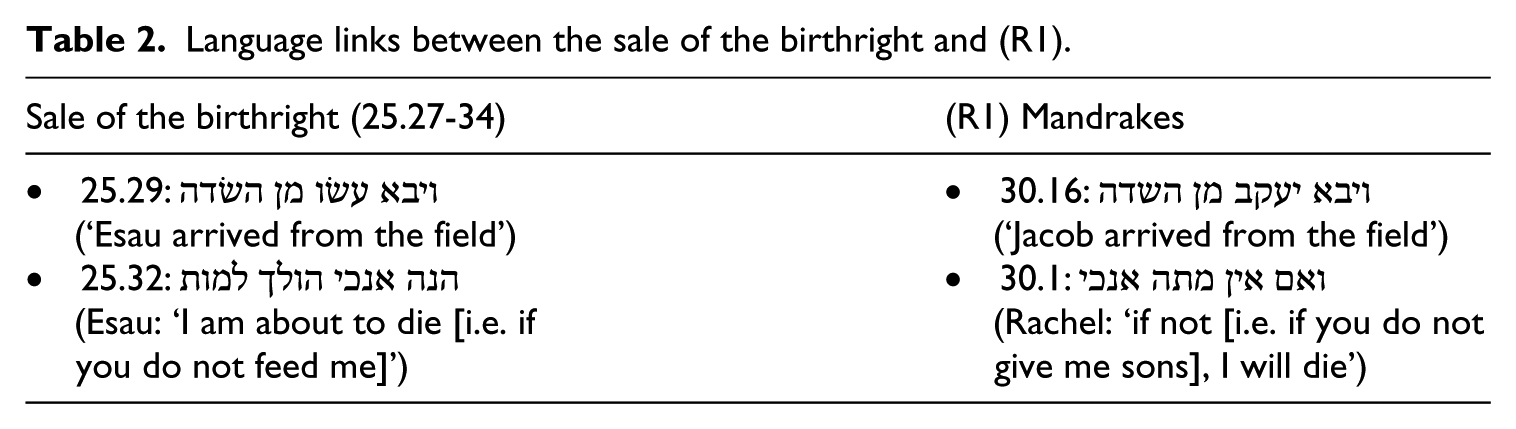
As Table 1 illustrates, the plot of (R1) both reprises and inverts the plot of the sale of the birthright. Each episode includes an opportunistic transaction between siblings, but the corresponding parties in the respective transactions differ in gender and relative age. And whereas Jacob perpetrates the inequitable transaction in Gen. 25, in (R1)—although he is neither buyer nor seller—Jacob is portrayed as the primary victim of the transaction, forced to copulate with (and impregnate) a wife he does not love:
Jacob, the seasoned merchant in the first story, turns into merchandise in the second: he is completely passive—his wife Leah informs him of his ‘assignment’ for the evening. Jacob is essentially transformed into nothing more than a supplier of sexual and reproductive services. (Zakovitch, 1995: 17)
11
As Table 2 indicates, both victims arrive from the field, introduced by a unique biblical idiom. Moreover, the desperation fueling both transactions is equated, as both Esau and Rachel foretell their own deaths if Jacob does not provide what they request. 12 Based on such links of plot and language, Ben-Reuben and Zakovitch rightly conclude that (R1) reflects and tacitly condemns Jacob’s behavior in Gen. 25.
However, unnoticed until now, (R1) simultaneously reflects and condemns Jacob’s deception of Isaac and expropriation of Esau’s blessing in Gen. 27. Tables 3 and 4 detail the reflective links of plot and language supporting this conclusion.
Plot links between Gen. 27 and (R1).

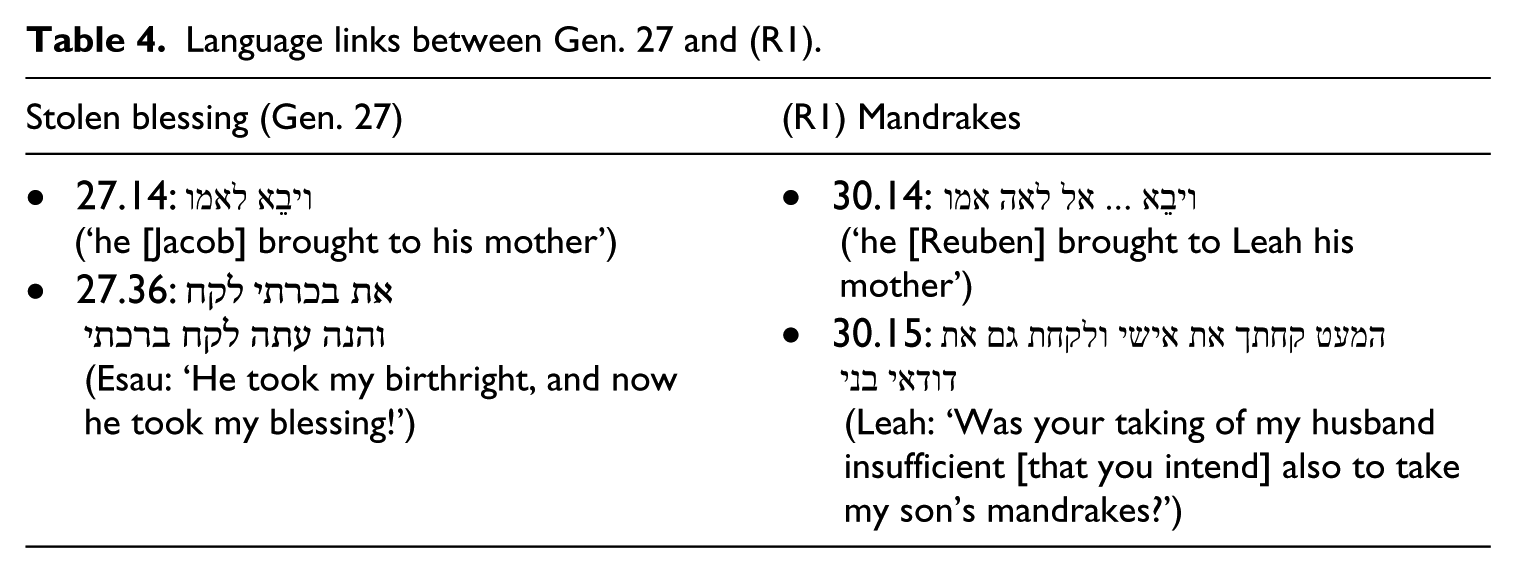
Language links between Gen. 27 and (R1).
As Table 3 illustrates, the plot of (R1) both echoes and inverts that of Gen. 27. In each case, a mother–son pairing cooperates (consciously or not) to secure a privilege for an unfavored sibling, preempting its intended bestowal upon the beloved. And once again, the categories of age and gender serve as markers of inversion. 13
Table 4 highlights the parallel language describing how Jacob and Reuben bring to their mothers, respectively, the goats and mandrakes with which Esau and Jacob are victimized; indeed, no other biblical characters bring anything to their own mothers. In both stories, moreover, the older siblings accuse the younger of two acts of (attempted) thievery, uniquely employing the root לקח (‘to take’) twice in quick succession to level the accusations. 14
Thus, (R1)—in which Leah prevails and Jacob is victimized—actually symbolizes condign punishment for both of Jacob’s earlier victimizations of Esau. Leah’s triumph in Gen. 30 restores, as it were, the rights of the firstborn that Jacob had twice undermined. Of course, as a literary character, Jacob cannot recognize the narrated textual links to which readers enjoy access. However, on the level of plot or ‘event’, 15 Jacob can, and does, perceive the manner in which (R1) represents damning turnabout of his prior behaviors (Ben-Reuben, 1983: 231).
Jacob notices, moreover, that it is specifically Reuben who instigates the events leading to his humiliation. Hence, beyond its status as a two-pronged reflection story, (R1) also opens our reflection complex by first implanting in Jacob’s mind an association between Reuben and his own moral failings. To the reader, presumably, this association appears unjust, for there is no compelling evidence in (R1) that Reuben intends to injure Jacob. Yet, for Jacob, Reuben’s involvement in the incident tars his eldest son and commences a pattern of offensive behavior that Reuben will reinforce in (R2) and (RJ2).
4.2 (R2) Reuben and Bilhah—Gen. 35.22
This brief episode relates that Reuben copulates with Bilhah, his father’s concubine, and that Jacob hears of the incident. The story ends abruptly, without denouement or resolution, but later pseudepigraphic and rabbinic texts, and I Chr. 5.1-2, fill in some of the ‘missing’ details. Given the surfeit of later interpretation and spare detail in (R2), modern scholars largely focus either on the later materials or on the apparent textual allusions to (R2) in Gen. 49.4 (e.g. de Hoop, 2007; Gevirtz, 1971; Grossfeld, 2006; Kugel, 1995; Rosen-Zvi, 2006). They thus entirely overlook the fundamental literary import of the episode: its role as a reflection story condemning Jacob’s passivity following the recent rape of his daughter Dinah.
Sternberg (1985) has convincingly shown that Jacob is ‘the least sympathetic character’ in Gen. 34 (p. 473). Jacob’s silence following Dinah’s violation compares poorly with the brothers’ righteous outrage at the assault (34.5-7). Furthermore, Jacob’s admonishment of Simeon and Levi (34.30) expresses not moral revulsion at their brutality but, rather, melodramatic concern for his own safety. Finally, by ‘giving the last word—and what a last word!—to Simeon and Levi’, the narrator ‘leave[s] no doubt where his sympathy lies’ (Sternberg, 1985: 475). 16
As a reflection story, (R2) implicitly condemns Jacob for his acquiescence to Dinah’s violation. The two episodes share multiple levels of plot links, presented here in three distinct, if somewhat overlapping, dimensions. The most basic plot parallels are illustrated in Table 5: women related to Jacob are sexually violated, and Jacob takes no action. The plot inversions include the identities of the female victims—first Leah’s daughter, then Rachel’s surrogate—and the transition of Leah’s family from (female) victim to (male) victimizer.
Basic plot links between Gen. 34 and (R2).

A related but somewhat broader dimension of plot symmetry incorporates from Gen. 34 not only the rape of Dinah but also the role of Simeon and Levi in its aftermath. This reflectivity is best expressed as a chiastic arrangement, as Table 6 illustrates.
Broader plot links between Gen. 34 (A-B) and (R2) (B′–A′).
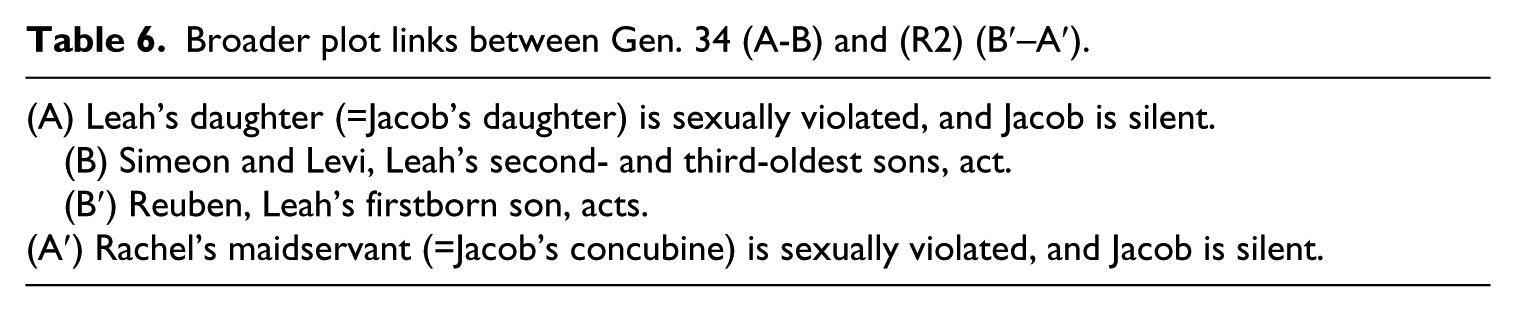
This pattern, which juxtaposes Simeon and Levi’s behavior with Reuben’s, suggests that perhaps the former events inspired the latter. That is, perhaps Reuben violated Bilhah specifically (a) to degrade Rachel’s branch of the family as Leah’s daughter/his sister Dinah had been degraded and (b) to reassert himself as the defender of Leah’s honor, a role that Simeon and Levi had seized in Gen. 34. However, since, as in (R1), Reuben’s motivation is not revealed, alternative interpretations—not mutually exclusive—remain plausible. 17
Jacob’s callousness toward Dinah in Gen. 34 also drives a broader reflective plot pattern, as Gen. 35 actually details the loss of three women close to Jacob. In 35.8, the Bible rather enigmatically records the death of Rebekah’s wet-nurse Deborah and the naming of a shrine—ostensibly by Jacob—in her memory (Roth, 2003). Verses 16-20 detail the death of Rachel, followed by (R2) in v.22. Thus, in Gen. 35, Jacob is in quick succession dispossessed of his remaining mother figure, his one true love, and the latter’s closest surrogate.
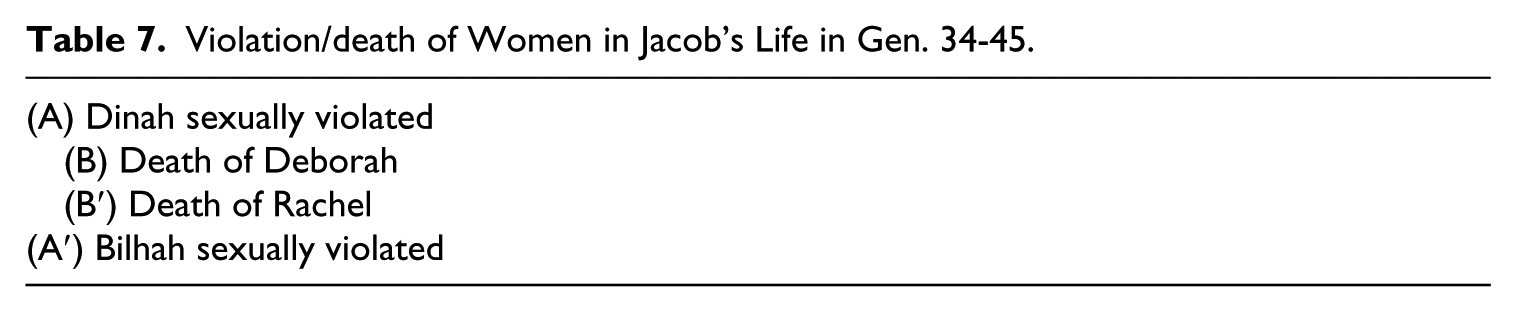
This excruciating sequence, too, reflectively indicts Jacob for his insensitivity toward Dinah. Having proven himself unworthy as a protector of his own (unfavored) female offspring, Jacob cannot protect the remaining (favored) women in his life. These events, spanning Gen. 34-35, also form a chiastic sequence, as Table 7 highlights.
Violation/death of Women in Jacob’s Life in Gen. 34-45.
Shifting now to parallel language, we note in Table 8 that both the Dinah and Bilhah episodes include the sequence שכב את, which always connotes illicit sexual activity. 18 Both violated women, moreover, are identified by their relationships with Jacob. Finally, Jacob ‘hears’ both reports but takes no action. 19
Language links between Gen. 34 and (R2).

Thus, (R2) constitutes another reflection story in which Jacob receives comeuppance for past misdeeds. And once again, it is Reuben whose actions remind Jacob of his prior failings, thus perpetuating—in Jacob’s mind—the pattern begun in (R1). 20 This time, however, Jacob’s perception matches the reader’s, for Reuben’s behavior appears wholly dishonorable, even if his precise motivation remains obscure.
4.3 (J2) Judah and Tamar—Gen. 38.12-26
Whereas the two Reuben-only episodes reprove Jacob for his earlier misdeeds and alienate him from his firstborn, the two Judah-only episodes foster Jacob’s identification with and appreciation of Judah’s character. Thus, rather than echoing and inverting the original plot lines, the Judah stories—in Jacob’s estimation—instead run strictly parallel to those involving Jacob himself. 21
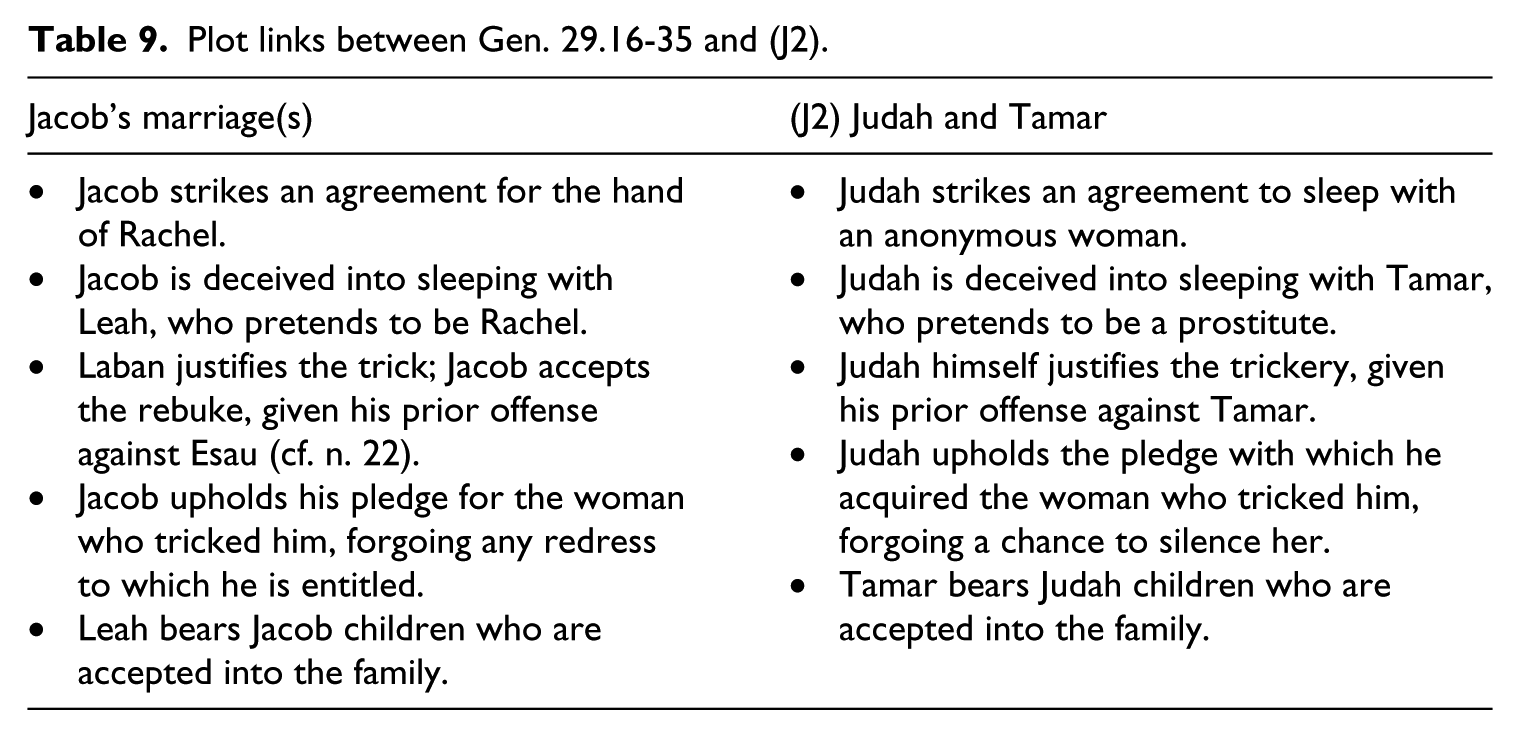
Accordingly, the episode in which Tamar disguises herself and seduces Judah triggers Jacob’s memories of his own wedding night decades earlier (29.16-35), when he, too, had been duped into sleeping with a woman who misrepresented her identity. Table 9 exhibits the pervasive plot parallels between the two episodes. And Table 10 highlights the unique idiom with which Jacob and Judah claim the women they desire just before being deceived.
Plot links between Gen. 29.16-35 and (J2).
Language links between Gen. 29.16-35 and (J2).

Given their similar experiences, Jacob sees Judah as a kindred, noble victim who—like himself—endures the sexual deception of a crafty kinswoman yet upholds the deal he struck for her nevertheless. 22 Indeed, the sexual misadventures of Judah and Jacob, which were visited upon them unwittingly, stand in bold relief with Reuben’s deliberate, malicious act of incestuous adultery. By honoring his obligation to Tamar despite her deceit, Judah—in Jacob’s mind—embodies the same honorable ideals that his father has upheld, a perception that is reinforced in (J1) and (RJ2). 23
Of course, objective readers might—once again—reject Jacob’s view (wholly or partially) and criticize Judah for his harsh judgment of Tamar or his very attempt to engage the services of a prostitute. However, as we have emphasized, the ‘reflection complex’ operates principally within the perception of Jacob, a man who views sex as a business transaction (29.18-21) and has proven rather unconcerned with the wronged kinswoman in his midst (34.5). Accordingly, the contention that Jacob would identify positively with Judah’s behavior appears sound. 24
4.4 (J1)—Judah and sons—Gen. 38.1-11/12 25
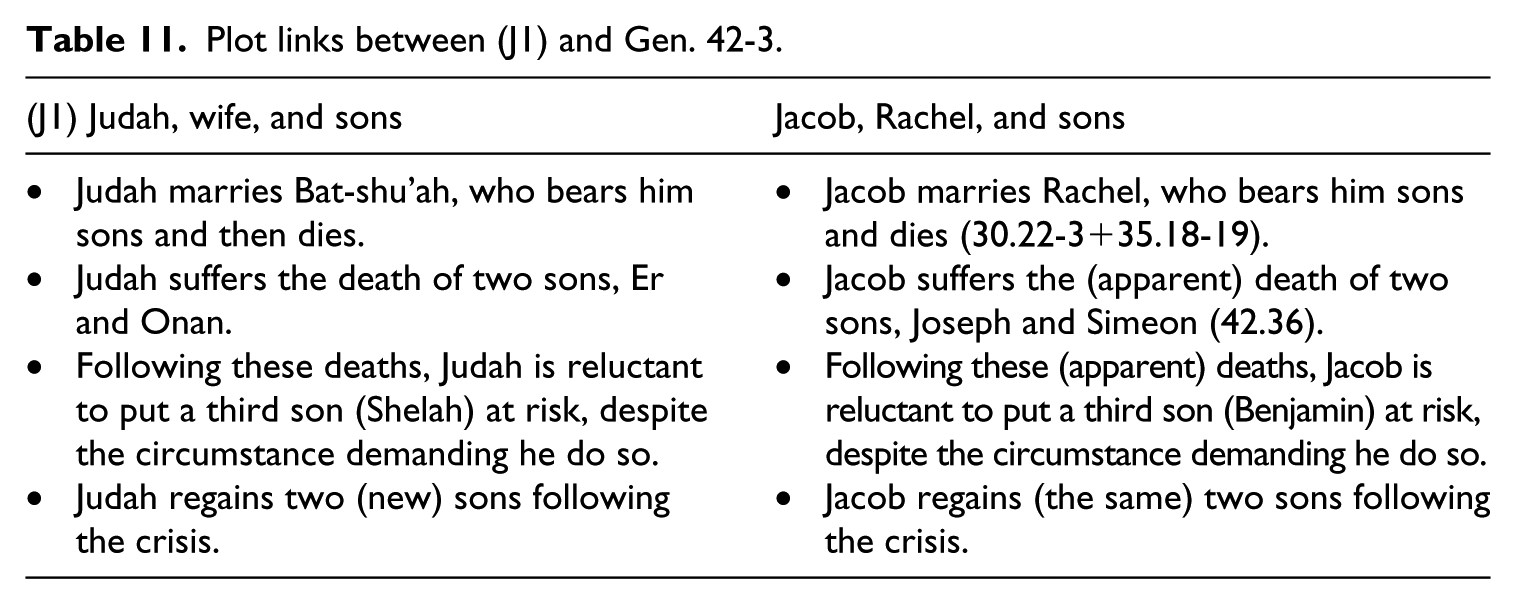
In this episode, too, the trying experiences of Judah share links of both plot and language with those of Jacob, once again establishing flattering parallels that ingratiate Judah to Jacob. However, rather than reflecting events that have already occurred in Jacob’s life, the episode of Judah and his sons primarily foreshadows events that will occur later in Jacob’s life—specifically, in (RJ2). Consequently, Jacob’s recognition of these parallels emerges only later, during the events of (RJ2) itself.
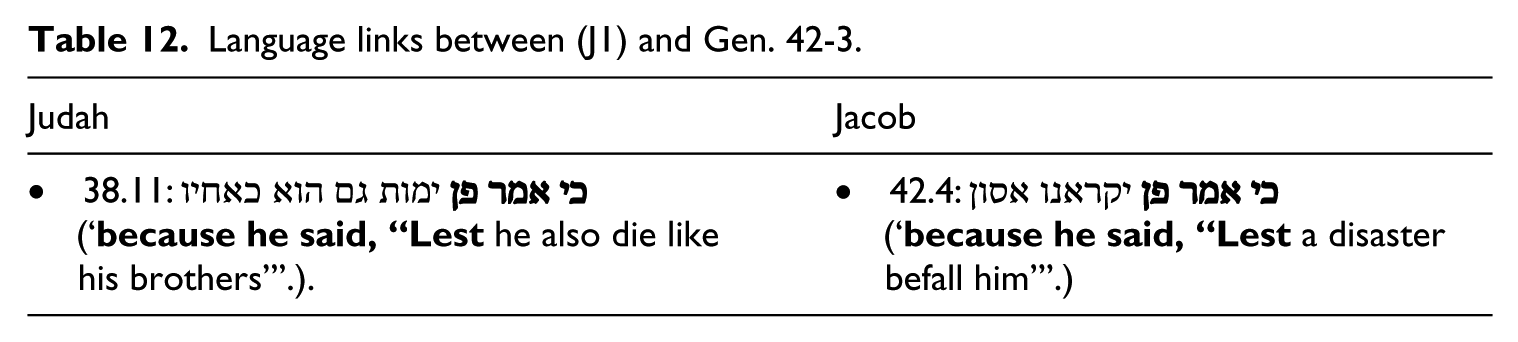
Table 11 illustrates the parallel familial tragedies and challenges that Judah and Jacob share. 26 Table 12 highlights the unique three-word sequence that expresses both Jacob’s and Judah’s reluctance to put their respective sons at risk.
Plot links between (J1) and Gen. 42-3.
Language links between (J1) and Gen. 42-3.
Just as in (J2), in this case, too—once the circumstances of (RJ2) arise, as we examine in detail just below—Jacob identifies with and admires the honorable way Judah has (earlier) conducted himself. Judah protected his endangered offspring at all costs, a stance that Jacob himself adopts in (RJ2). Objective readers, once again, might remain more skeptical of Judah’s uprightness and fault him for withholding his third son from Tamar. However, most would likely sympathize, at least to some degree, with Judah’s desire to protect Shelah. 27
4.5 (RJ2) Reuben/Judah and Benjamin—42.36-43.10
This episode pointedly contrasts the behaviors of Reuben and Judah and represents the capstone of the complex we have tracked to this point, decisively sealing Jacob’s, if not the reader’s, perception of his two sons’ divergent characters. Because of the complexity of (RJ2) and (RJ1), our discussion of them will be more detailed, interspersing analysis of plot and language, and addressing the roles of Reuben and Judah both independently and in comparison.
4.5.1 Reuben—42.36-7
In (R1) and (R2), we saw Reuben take actions that implicitly condemn Jacob for his failings. In this climactic episode, we might expect a similar dynamic to emerge, and Reuben does not disappoint. When the brothers explain to Jacob that Simeon is imprisoned and cannot be retrieved unless they bring Benjamin to Egypt, Jacob laments his two (presumed) dead sons and balks at releasing Benjamin, to which Reuben counters with the clumsiest imaginable proposal:
(Jacob: 42.36) אתי שכלתם יוסף איננו ושמעון איננו ואת בנימין תקחו Me you are making childless! Joseph is no more and Simeon is no more, and you would take Benjamin? (Reuben: 42.37) את שני בני תמית אם לא אביאנו אליך My two sons you may kill if I do not bring him to you!
Levenson (1993) pithily captures the ironic absurdity of Reuben’s offer (emphasis added): ‘As the previous verse clarified with poignance, the loss of two sons is precisely Jacob’s problem. The loss of two grandsons will hardly solve it’ (p. 162). Thus, he and many others dismiss Reuben’s pitch as rank foolishness, which it certainly is. 28
However, having already identified the underlying dynamic in (R1) and (R2), we can appreciate more deeply the import of Reuben’s proposal. Its absurdity represents the climax to Reuben’s consistent history of poisoning his relationship with his father, even unintentionally, by reminding Jacob of his own failings. Confronted with Jacob’s anguish over the two sons whose apparent deaths he unwittingly facilitated—it was Jacob, after all, who ordered the journeys from which Joseph (37.13-14) and Simeon (42.1-2) have not returned—Reuben inadvertently compounds his father’s distress, again, inviting the grief-stricken Jacob to murder two additional members of his progeny. 29 Little wonder that Jacob roundly rejects Reuben’s appeal. Indeed, with this final act, Reuben is definitively, irredeemably discredited in Jacob’s eyes. Whether the reader at this point ought to share Jacob’s verdict remains to be adjudicated.
4.5.2 Judah—43.1-10
While Reuben’s graceless offer in Gen. 42 represents the nadir of his relationship with Jacob and signals the latter’s rejection of his firstborn, the interaction between Judah and Jacob in 43.1-10, conversely, represents the apex of Jacob’s identification with Judah and, thus, heralds Judah’s elevation to the role of family leader.
As noted in our discussion of (J1), Judah encounters two tragedies and a challenge in his personal life: the death of his wife, the death of two sons, and a threat to the life of his third son. In (RJ2), Jacob faces a triply parallel situation: Rachel is long dead, Joseph and (now) Simeon are presumed dead, and circumstances demand that Jacob risk Benjamin’s life as well. These correspondences establish a reciprocal level of sympathy and trust between Judah and Jacob. Judah truly grasps Jacob’s horror at the prospect of losing a third son, and Jacob, having observed Judah’s efforts to protect his third son, imputes to Judah credibility that no other son could inspire. 30
Moreover, the contrast with Reuben is stark. Reuben, who has never grieved his own offspring, responds to Jacob’s anguish over two sons presumed dead by soliciting two additional deaths. Judah, however, who has lost two sons of his own, tailors his words to match Jacob’s desperate desire to preserve life. In 42.2, Jacob had bid his sons purchase food, ונחיה ולא נמות (‘that we may live and not die’). In his proposal to Jacob, Judah echoes and expands upon Jacob’s words (43.8), asking to be appointed Benjamin’s guardian so that three generations may live:ונחיה ולא נמות גם אנחנו גם אתה גם טפנו (‘that we may live and not die—including us, also you, also our young ones’). 31
However, the identification between Judah and Jacob extends much further. Virtually every clause in Judah’s statement in 43.8-10 resounds with meaningful echoes of earlier episodes from his and Jacob’s lives. Judah continues (43.9a-b), אנכי אערבנו מידי תבקשנו (a) אם לא הביאתיו אליך והצגתיו לפניך וחטאתי לך כל הימים (b) (a) I myself will be surety for him; from my hand you may demand him. (b) ‘If I do not bring him to you and present him before you, then I have sinned against you forever.
Judah’s words in 43.9 are doubly resonant. First, his offer to stand as surety (root: ערב) for Benjamin rings true, as Judah has already proven that he takes seriously the duty to honor his collateral. In (J2), when Tamar presents the collateral (ערבון) to Judah, proving that he had impregnated her, Judah immediately admits responsibility. Jacob knows, therefore, that he can trust Judah’s offer to stand as guarantor for Benjamin. 32
However, Judah’s statement in 43:9 reverberates as well with echoes of a dramatic moment from earlier in Jacob’s life. When Laban cannot substantiate the charge that Jacob has stolen from him, Jacob launches an impassioned soliloquy contrasting his own loyalty with Laban’s continued duplicity (31.38-42). Describing his trustworthiness as a shepherd, Jacob insists that he always took responsibility for Laban’s livestock (31.39aα-aβ):
טרפה לא הבאתי אליך (α) אנכי אחטנה מידי תבקשנה (β) (α) One [animal] torn to shreds I never brought to you. (β) I would make good the loss of it; from my hand you would demand it.
There are numerous similarities between Jacob’s words in 31.39a and Judah’s words in 43.9. The key to identifying the parallels lies in the realization that the four main components of their statements form a distinct chiastic pattern, as indicated by the versification and special fonts in Table 13.
Language links between 31.39a (A–B) and 43.9 (B′–A′).
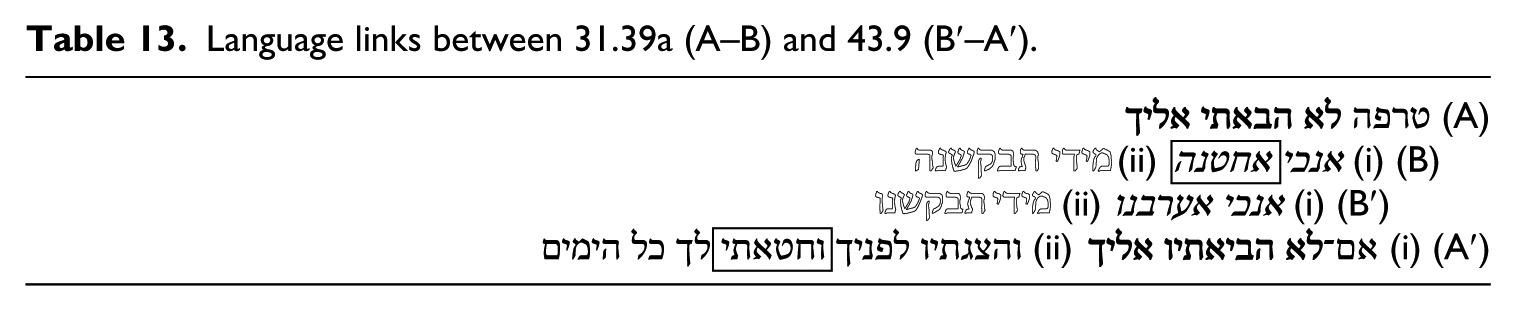
As the table illustrates, the following links of language are evident:
(B.i) and (B′.i) begin with the independent pronoun אנכי, followed by a 1-cs imperfect verb + object suffix: אנכי אחטנה // אנכי אערבנו. 33
(B.ii) and (B′.ii) are nearly identical. Both begin with the word מידי, followed by a 2-ms imperfect form of בקש + object suffix: מידי תבקשנה // מידי תבקשנו. 34
The final three words in (A) are almost exactly repeated in (A′.i), including perfect 1cs Hiphil forms of the root בוא: לא הבאתי אליך // לא הביאתיו אליך. 35
Jacob’s root חטא in (B.i) is not discarded but deferred until (A′.ii).
Also embedded within these lines are pervasive links of plot. In the parallel (B) and (B′) lines, Jacob (retrospectively) and Judah (prospectively) profess their dedication to the vulnerable in their charge: Laban’s flocks and Benjamin, respectively. Antithetical parallelism binds lines (A) and (A′). Just as Jacob claims that he has never brought a damaged member of the flock to Laban, so Judah attests that he will not fail to bring an intact Benjamin to Jacob. 36 And both Jacob and Judah—employing the root חטא—accept personal responsibility for any losses incurred.
Finally, Judah’s closing words in 43.10 echo the closing of Jacob’s invective against Laban:
(Jacob: 31.42) היה לי כי עתה ריקם שלחתני … לולי אלהי אבי Were it not for (lȗlê) the God of my father … being with me, then now (kî ‘attâ) you would send me away empty-handed. (Judah: 43.10) לולא התמהמהנו כי עתה שבנו זה פעמים Were it not for (lȗlē’) our delay, then by now (kî ‘attâ) we could have returned twice over.
37
In this case, too, antithetical parallelism links Jacob’s and Judah’s words. Jacob avers that if not for God’s intervention, Laban would now send Jacob away without the wealth he had earned. Judah, in contrast, laments that if not for their delayed departure, they would by now have returned with Benjamin (and Simeon and provisions). 38 Once again, the message is analogical and predictive: just as Jacob’s past initiative proved successful despite Laban’s obstacles, so will Judah’s initiative prove successful if only Jacob allows him to proceed.
These unremitting verbal connections, coupled with their common life experiences, foster within Jacob a profound sense of identification with Judah. Thus, Jacob relents and entrusts Benjamin to Judah’s care, and this appointment marks a turning point: henceforth, Judah is continually tagged as leader of the family. In 44.14, the narrator singles out Judah even when the brothers act collectively. Judah alone begs the Egyptian viceroy for Benjamin’s release (44.16-34). Later, Jacob sends Judah ahead of his caravan to lead the way to Egypt (46.28). 39 And in his deathbed declaration, Jacob recognizes Judah’s supremacy; Judah will receive his brothers’ obeisance and enjoy everlasting hegemony (49.8-10).
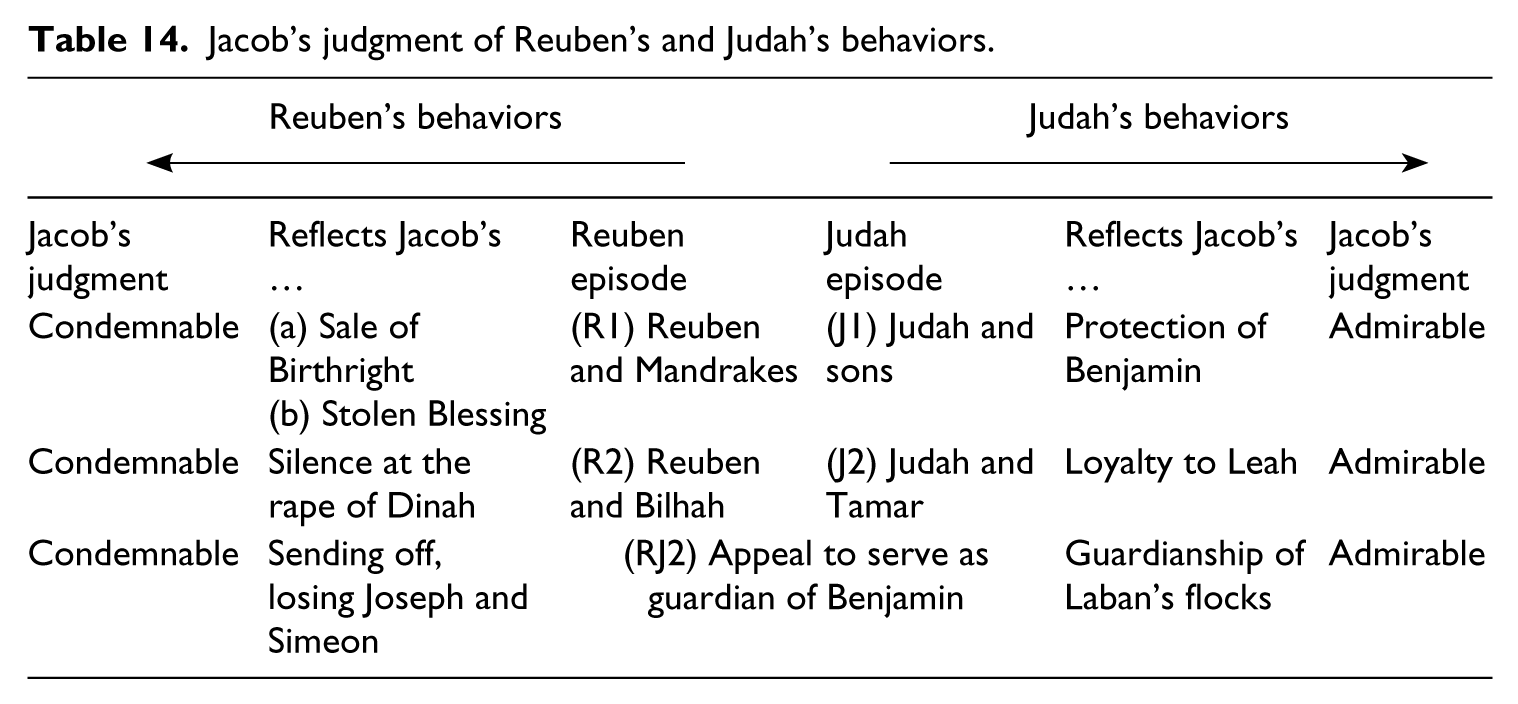
Thus, (RJ2) represents the climax of the primary level of our reflection complex: from Jacob’s internal perspective, Reuben and Judah’s behaviors—without exception—embody morally antithetical reflections of Jacob’s negative and positive behaviors, respectively. This consistent dynamic is represented in Table 14.
Jacob’s judgment of Reuben’s and Judah’s behaviors.


4.6 (RJ1) Reuben/Judah and Joseph—Gen. 37.21-30
To this point, we have examined five narrative episodes that, in Jacob’s mind, advance a consistent moral dynamic between Jacob, Reuben, and Judah. The remaining episode, however—sequentially, the third of the six Reuben/Judah episodes—appears on its face incompatible with, or even ruinous to, the complex we have identified. For in Gen. 37, it is Reuben who reflects the honorable aspects of Jacob’s character and Judah who reflects his father’s more ignoble characteristics. However, the key to this renegade episode lies in Jacob’s ignorance of its occurrence, through which the narrator injects a potent dose of dramatic irony into the overall reflection complex.
4.6.1 Reuben’s role reversal in Gen. 37
At the time of the events in Gen. 37, Reuben has twice encroached upon Jacob’s marital relationships, with Rachel and her handmaiden, to the detriment of his own relationship with his father. Thus, when the opportunity arises to rescue Joseph and prove that he harbors no (further) animus toward Rachel’s branch of the family, Reuben attempts to seize it. 40
Indeed, in this one instance, Reuben’s behavior aligns, affirmatively, with Jacob’s noble past behavior and current interests. First, just as Jacob maximally protected Joseph (and Rachel) while confronting Esau, an older brother presumed murderous (33.1-3), so Reuben braves the hostility of Joseph’s murderous older brothers in order to protect Joseph. 41 This commonality is highlighted by the two episodes’ unique employment of the idiom להציל מיד (32.12; 37.21)—among some 60 biblical appearances—to reference ‘salvation from the hand’ of menacing brothers.
Second, unlike (R1) and (R2), which do not report Reuben’s motivation, (RJ1) specifically reveals (37.22) that Reuben acted with his father’s benefit in mind: למען הציל אתו מידם להשיבו אל אביו (‘in order to save him [Joseph] from their hand, to return him to his father’). Indeed, as Levenson (1993) observes, Reuben unwittingly attempts to fulfill the very mission Jacob had just assigned Joseph: Jacob’s instructions were to (37.14) ‘bring me back word/something’ (והשבני דבר), but ‘the one who will attempt to "bring something back" to Jacob is not Joseph, but Reuben, who tries but fails to restore the beloved son to his father’ (p. 148).
Finally, the narrative signals the moral alignment of Reuben and Jacob by highlighting their analogous responses to Joseph’s disappearance. Upon discovering that Joseph is missing and presumably dead, both Reuben and Jacob rend their clothing and emit anguished exclamations (37.29, 34-5). 42
All of this evidence demonstrates that in (RJ1), Reuben’s actions and motives match those that Jacob himself has demonstrated or would wish Reuben to uphold. However, tragically for Reuben, Jacob never learns of this one occasion when his firstborn strived to fulfill Jacob’s will.
4.6.2 Judah’s role reversal in Gen. 37
Gen. 37 is the first episode in Genesis to feature Judah as a differentiated character. In it, Judah engineers the sale of Joseph into slavery and the deception that covers up the crime. 43 Judah thus adopts a role that, to this point in Genesis, Reuben alone had borne: reflecting and providing comeuppance for Jacob’s prior misdeeds—specifically, Jacob’s two major offenses against Esau.
First, just as in Gen. 25 Jacob took advantage of his older brother (Isaac’s favorite) by inducing Esau to sell him the birthright, so in (RJ1) Judah enacts a plan that takes advantage of his younger brother (Jacob’s favorite) by inducing the brothers to sell Joseph into slavery. 44 These are the only two transactions in biblical narrative, moreover, whose narration includes wayyiqtol forms of the root מכר (25.33; 37.28). 45
Second, just as Jacob deceived Isaac by bringing his older brother’s clothing and slaughtered goats (Gen. 27), so in (RJ1) Judah and his brothers deceive Jacob by bringing their younger brother Joseph’s clothing and a slaughtered goat. This parallel is underscored by two language links: (a) the root נכר indicates that Isaac ‘did not recognize’ Jacob in 27.23 (ולא הכירו) and that Jacob ‘did recognize’ Joseph’s tunic in 37.33 (ויכירה) 46 and (b) in 27.31, Jacob ‘brought to his father’ (ויבֵא לאביו) the goat-meat that would deceive Isaac, just as in 37.32, Judah and his brothers ‘brought to their father’ (ויביאו אל אביהם) the tunic soaked in goat-blood that would deceive Jacob. Indeed, Gen. 27 and Gen. 37 are the only biblical narratives in which children bring anything to their fathers, 47 including the beloved sons—Esau and Joseph, respectively—who themselves bring something to their fathers (27.31; 37.2) but are victimized by the clothing and goats brought by their plotting brothers.
Thus, in (RJ1), while Reuben diverges from the odious behavioral pattern that Jacob already perceives based on (R1) and (R2), Judah (preemptively) diverges from the honorable behavioral pattern that—in Jacob’s view—he later establishes in (J1), (J2), and (RJ2). But, unlike the luckless Reuben, Judah benefits from Jacob’s ignorance of (RJ1), as Judah’s shameful behavior remains ever concealed from his father.
4.6.3 (RJ1) and (RJ2): antithetical reflections of Gen. 31.38-42
One final set of reflective links underscores the subversive role of (RJ1) in our reflection complex and marks the episode—for readers, though not for Jacob—as a pre-emptive counterpoint to (RJ2). Above, we noted the extensive textual and conceptual connections between Judah’s words in (RJ2), that is, 43.8-10, and Jacob’s self-justification to Laban in Gen. 31.38-42. However, until now we have omitted mention of an important feature of Judah’s discourse: namely, that in recasting his father’s soliloquy, Judah is decidedly selective, variously truncating or omitting pieces of Jacob’s original statement.
In light of our discussion of Judah’s appalling role (reversal) in (RJ1), we are now equipped to re-examine and better comprehend Judah’s editorial selectivity in (RJ2).
Perhaps most noticeably, while Judah reprises much of 31.39 in (RJ2)—see Table 13—he provides no correspondences to the verse’s first word or to 31.39b, as Table 15 illustrates.
Correspondences and omissions—31.39//43.9 (RJ2).
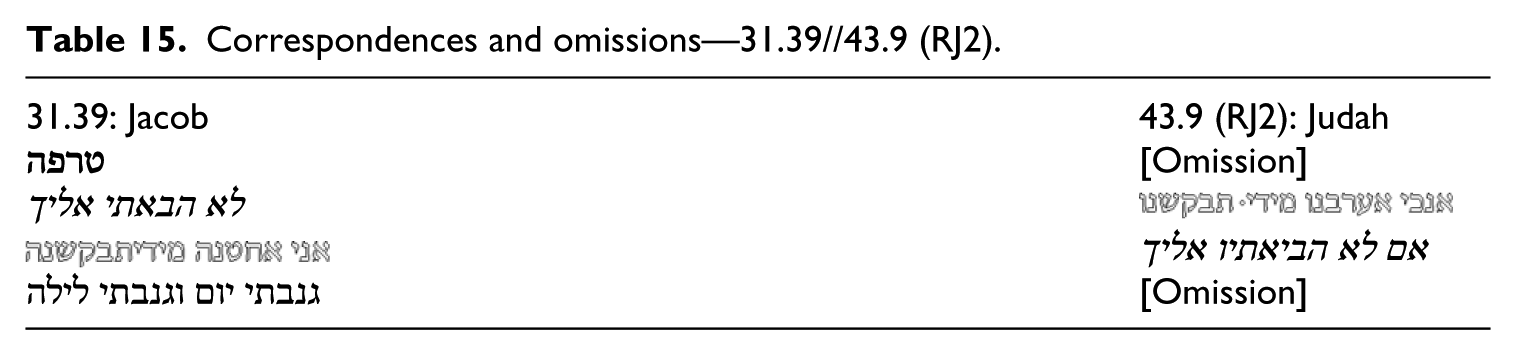
These omissions do not appear accidental. In (RJ2), Judah cannot fully reprise Jacob’s claim, טרפה לא הבאתי אליך (‘one torn to shreds I have not brought you’), precisely because in (RJ1) Judah had brought a טרפה to Jacob: the remains of a shredded goat, eliciting Jacob’s grieved cry (37.33), טרף טרף יוסף (‘Joseph has been torn to shreds! ’).
Moreover, having led the charge in (RJ1) to steal Joseph away from his father and sell him into slavery, Judah in (RJ2) can hardly replicate Jacob’s claim that he made good on losses, ‘stolen by day or stolen by night’ (גְּנֻבְתִי יום וּגְנֻבְתִי לילה). Indeed, the only apparent purpose of affixing the obscure ḥireq campaginis onto Jacob’s words—‘probably … the only example of the paragogic ־י in prose’ (Joüon-Muraoka §93m; cf. GKC §90.3.a)—is to foreshadow Joseph’s similar-sounding lament (40.15) at having been kidnapped: גֻנֹּב גֻּנַּבתִּי מארץ העברים (‘I was stolen away from the Land of the Hebrews’). 48
Judah’s speech in (RJ2) also includes no parallels to Jacob’s initial claims (31.38) of conscientious service: זה עשרים שנה אנכי עמך רחליך ועזיך לא שכלו ואילי צאנך לא אכלתי (‘These twenty years I have been with you, your ewes and she-goats have not miscarried; nor have I consumed the rams of your flock’). Each clause of this verse, too, resonates with the sale of Joseph, which accounts for Judah’s disinclination to reprise it in (RJ2). First, while Jacob had served Laban faithfully for 20 years, Joseph—at the time of (RJ2)—has been missing for 20 years, thanks to Judah’s initiative in (RJ1). 49 Indeed, in Judah’s mouth, Jacob’s temporal clause would bear a decidedly incriminating undertone: ‘These twenty years I have been with you [but Joseph has not!]’
Second, although in its original context Jacob’s claim, רחליך ועזיך לא שכלו, referred to his care for Laban’s ewes, the words can also be rendered: ‘your “Rachels” and your goats have not caused bereavement’. 50 This claim cannot be fairly advanced in (RJ2) by Judah, who in (RJ1) expressly bereaved Jacob of his firstborn ‘Rachel’ (i.e. Joseph)—through a deception involving Jacob’s goat—and now seeks to separate Jacob from his younger ‘Rachel’ (i.e. Benjamin) as well. Indeed, in two laments that bracket (RJ2), Jacob twice uses the root שכל to highlight the threat that Judah and his brothers pose to Rachel’s offspring: (a) in 42.36, Jacob levels an unwittingly damning accusation at the brothers over the apparent or potential losses of Joseph, Simeon, and Benjamin: אתי שכלתם (‘Me you are making childless!’) and (b) in 43.14, Jacob resignedly agrees to release Benjamin into Judah’s care, ואני כאשר שכלתי שכלתי (‘And as for me, however I am bereaved, I shall be bereaved’).
Similar wordplay reveals that Judah has also figuratively transgressed Jacob’s final claim in 31.38: ואילי צאנך לא אכלתי. While in its original context this declaration ostensibly refers to Jacob’s care for Laban’s rams, the more frequent meaning of אילי suggests an alternative translation: ‘the leaders/elite of your flock I have not consumed’. 51 This assertion, too, Judah contravened in (RJ1), deceiving Jacob into believing of Joseph, the prize of his flock, that (37.33) ‘an evil animal has consumed him! (חיה רעה אכלתהו)’.
Above, we noted how Judah painstakingly injected his oration in (RJ2) with assurances redolent of Jacob’s and his own prior honorable conduct. However, in doing so—we now see—Judah also studiously avoided invoking the noble behaviors of Jacob that he has failed to uphold. Of course, ignorant of (RJ1), Jacob cannot appreciate the import of Judah’s omissions.
The reader, however, possesses knowledge enough to see through the sanitized self-portrait that Judah presents in (RJ2). Indeed, the reader knows full well that if anyone is qualified to wholly reprise Jacob’s claims in Gen. 31.38-39—one who can truthfully claim that he sought to prevent Jacob’s two-decade bereavement, that he never wished to deliver a טרפה to Jacob, that he attempted to make good on the stolen prize among Jacob’s flock and thwart its consumption—that person is not Judah but Reuben. It is Reuben, not Judah, whose past most directly qualifies him to assume responsibility for Benjamin in (RJ2). Ignorant of Reuben’s finest moment, however, Jacob never sees the honorable aspects of his firstborn that would salvage Reuben’s reputation. Reuben, thus, pays the price for Jacob’s ignorance, while Judah reaps its reward.
5. Conclusion/further research
Our discussion has revealed that the six narrative episodes involving Reuben and/or Judah comprise a ‘reflection complex’ operative on two distinct levels. In their father’s perception, Reuben and Judah function as completely antithetical reflections of Jacob himself; the dynamic consists exclusively of five episodes in which, always, Reuben channels Jacob’s more ignoble instincts and Judah his more honorable characteristics. However, on a second plane, armed with an awareness of (RJ1) that Jacob lacks, readers more accurately observe Reuben and Judah as complex, multifaceted characters who—like Jacob—sometimes shine and other times stumble.
The existence of this reflection complex prompts questions about its import that can be addressed here only preliminarily. A more comprehensive assessment would require first determining whether our reflection complex represents an isolated occurrence or—as I suspect—merely one example of a recurrent phenomenon. 52 Accordingly, I here offer only provisional thoughts about both our specific reflection complex and the phenomenon more generally.
One purpose of the Reuben–Judah–Jacob reflection complex would seem to be the perpetuation among Jacob’s offspring of a pronounced, if disquieting, pattern that suffuses the life of Jacob himself: namely, the unfolding of God’s plan despite, and even through, the moral imperfections of His chosen agents. As Sternberg writes of Gen. 27, although ‘Isaac and Esau have all the pity on their side’, the ‘national solidarity’ enjoyed by Rebekah and Jacob (1985) ultimately proves decisive (p. 55). 53 Indeed, it is their deception that occasions Jacob’s flight and the flowering of his wealth and family.
Along similar lines, while Reuben certainly deserves more sympathy than he is accorded by either his family or overhasty readers, Judah’s odious role in the sale of Joseph cannot derail his divinely ordained destiny to rule. Indeed, that very crime thrusts Joseph aside and facilitates Judah’s ascent to leadership. Nevertheless, as even Judah’s victim recognizes (50.20), God’s will transcends and confounds human machination; God may harness even the illest of intentions toward His own beneficent ends.
More generally, if the reflection complex is indeed a recurring phenomenon in biblical narrative, it would appear that its underlying dynamic—fathers sire sons who perpetuate both their sublimest and basest tendencies—illustrates some truth or object that the Bible wishes to emphasize. Two, somewhat paradoxical, concepts seem to be in evidence. On one hand, the reflection complex suggests that fathers inevitably shape the moral character of their children; the righteous father cannot but inspire virtuous imitation, but so must moral defects in the father find corrupt echo in the behavior of his offspring. However, the reflection complex simultaneously highlights a less fatalistic perspective. For, from the standpoint of the son, all moral avenues remain available; he need only choose the path of righteous conduct or its opposite.
More definitive conclusions about the purpose of this reflection complex—as well as a diachronic investigation of its origins and development, among various other issues—must await a broader treatment of the phenomenon. 54 Still, the establishment of the Reuben–Judah–Jacob reflection complex itself represents progress. We have shown that, far from mere remnants of textual or national pre-history, or a minor literary curiosity, the Judah and Reuben episodes disclose higher levels of organization and literary sophistication than have been heretofore detected. Indeed, we have demonstrated that Zakovitch’s ‘reflection stories’ are not necessarily discrete literary phenomenon. Rather, they may function within a larger mosaic of intertextual links that bind disparate episodes into a broader narrative pattern. This work has elucidated one such pattern; many, undoubtedly, still await discovery and exploration.
Footnotes
1.
‘Text’ is here defined narrowly as ‘written and preserved material’ (Penchansky, 1992: 77), as elements such as social context and interpretive reception lie beyond our scope.
2.
3.
4.
Below, we refer to such evidence as ‘plot links’ and ‘language links’, respectively.
5.
Translations of modern and rabbinic Hebrew are my own, as are unattributed translations of MT that deviate from NJPS.
6.
Throughout, all biblical verses cited are from Genesis unless otherwise indicated.
7.
I separate Gen. 38.1-26 into two episodes based on the temporal marker beginning 38.12—which, as in 38.1 and 38.27, signifies a new section—as well as on the transformation of Tamar’s character in 38.12-26. Many reach similar conclusions on these and additional grounds: for example, Andrew (1993: 263), Westermann (1986: 38),  : 79, n. 6), and n. 6.
8.
As Reuben’s words in 42.22 and Judah’s advocacy for Benjamin depend upon (RJ1) and (RJ2), respectively, I consider them addenda to the earlier episodes.
9.
As I document below, many of these links have been haphazardly noticed but never comprehensively compiled or explicated.
11.
Jacob’s status as victim is further evident from the way that Leah mocks him. In 29.15, Laban had asked Jacob, מה משכרתך (‘What shall be your hire?’), after which Jacob served Laban in return for Rachel’s hand and then (29.21) demanded her, ואבואה אליה (‘that I may enter her’). In 30.16, Leah sardonically mimics Jacob and Laban while beckoning her unloving husband, אלי תבוא כי שכר שכרתיך (‘Me you shall enter, for I have hired you!’), and—again—appropriates Rachel’s place in Jacob’s bed. Rachel suffers only as a secondary victim, sacrificing merely one night of many in Jacob’s bed.
12.
Rachel’s demand precedes the mandrake story proper—perhaps explaining Zakovitch and Ben-Reuben’s omission of this parallel—but as the mandrakes ostensibly are a reproductive aid, Rachel’s desperation in 30.1 appears to motivate her in 30.14-15.
13.
I conclude that Rebekah is younger than Laban because, in Gen. 24, Rebekah’s family, including an authoritative Laban, repeatedly calls her [ה]נער (‘girl’), as does the narrator, and negotiates on her behalf. Conversely, Laban’s youth is never invoked or suggested.
14.
The ‘beloved’ intended recipients—Esau and Rachel—are also linked by an identical idiom: ‘PN2 את PN1 ויאהב’ (25.28; 29.18; cf. I Kgs 3.3; Est. 2.17). Perhaps, too, Esau’s peculiar description of the red stew he requests—’adōm hā’adōm (אדם האדם)—is intended to resonate with Rachel’s request for Leah’s dūdā’im (דודאים).
15.
16.
Sternberg argues that the unstated subject of יעשה in 34.30 likely is Jacob himself (i.e. ‘shall he [Jacob] make our sister a harlot’).
17.
Many argue that Reuben’s indiscretion represents an effort to usurp his father authority, claim his birthright as firstborn, or induce Jacob to favor Leah (Wenham, 1994: 327).
18.
This sequence occurs four additional times in narrative—Gen. 19.33; 26.10; 1 Sam. 2.22; 2 Sam. 13.14—and six times in legal prohibitions.
19.
Wenham (1994) notes, ‘here, as in chap. 34, Jacob is strangely silent’ (p. 327). argues that וישמע in 35.22 ‘suggests impending action but none occurs here’ (p. 245), an observation that applies as well in 34.5. Indeed, the ‘biblical rule’—as Sternberg (1986) deems it—is that ‘hearing always affects the march of action’, such that exceptions bear particular significance (p. 301).
20.
Nicol finds ‘poetic justice’ in Reuben’s violation of Bilhah, which purportedly punishes Jacob for withholding love from Leah (: 538-39). While I applaud Nicol’s intuition concerning Reuben’s retributive literary role, his thesis—conceivable secondarily—lacks the links of plot and language that would render it more persuasive.
21.
Zakovitch’s definition seemingly would exclude such pairs of parallel episodes from the category of ‘reflection stories’, which must be fundamentally contrastive. I question whether such a distinction is truly useful, but if it is maintained, Noble’s ‘type-narratives’ (Noble, 2002: 233) suffices as an alternative label for such pairs of episodes.
22.
I here expand on , who notes (with many others) the implicit condemnation of Jacob in Laban’s words in 29.26—that is, unlike you, we do not allow the younger to usurp the rights of the firstborn—but adds that this rebuke stuns Jacob into silence (p. 205). I would add that Laban’s rebuke also spurs Jacob’s unwarranted compliance with Laban’s outrageous demand that he work an additional seven years for Rachel.
23.
Of course, (J1) has—in narrative-time—already occurred. However, as we detail just below, Jacob only senses the parallels between (J1) and his own experiences retroactively, once the circumstances of Gen. 42-3, i.e. (RJ2), emerge. Accordingly, we have dealt first with (J2), which Jacob immediately recognizes as matching his prior experience, and then continue with the intricately linked (J1) and (RJ2) episodes.
24.
My assumption that Jacob is familiar with the events of (J2) is based on multiple considerations: (a) Tamar’s sentence, impending execution, and exoneration are expressly portrayed as public events, so it is logical to assume that Jacob has heard of them. Indeed, the Bible’s description of Judah’s public exposure in (J2) contrasts with its account of (RJ1), in which the brothers—led by Judah—intentionally conceal their actions from Jacob; (b) Judah and Tamar’s sons are accepted into Jacob’s family and descend to Egypt (46.12), rendering it implausible that Jacob remains unaware of their pedigree and background; (c) Jacob’s ‘blessing’ of Judah in Gen. 49 includes, according to many scholars, subtle references to the Judah and Tamar episode, which—in a synchronic reading—indicates that Jacob is aware of the events of (J2). See esp. : 83-86), who counts 17 shared theme-words and other parallels.
25.
26.
27.
Indeed, God’s displeasure with Er and Onan is communicated only by the narrator—that is, to the reader alone—so Judah’s suspicion that Tamar caused his sons’ deaths appears more justified than is often alleged by those who overlook this dramatic irony.
28.
Gen. Rab. 91.9 labels Reuben ‘The Foolish Firstborn’ (הרי זה בכור שוטה).
29.
Whether Reuben intended his offer literally or rhetorically, and how Jacob interpreted it, is debatable. Regardless, Jacob finds Reuben’s words odious, and characteristically so.
30.
31.
Westermann (1986): ‘Judah cleverly takes up the words of his father … extending them … triply underscoring the urgency’ (p. 121). Cf. : 102).
32.
Indeed, ערב in this sense appears in the Pentateuch only regarding Judah (38.17, 18, 20; 43.9; 44.32).
33.
As just discussed, Judah’s substitution of the root ערב is apposite.
35.
These three words appear in such close proximity only once more, in Reuben’s failed effort to convince Jacob to entrust Benjamin to him (42.37).
36.
The ‘two contrastive elements’ in antithetic parallelism present ‘opposite sides of the same coin, not … two contradictory thoughts’ (Tsumura, 2009:170).
37.
38.
Three pairs of antithetical elements appear: (a) ‘now’ versus ‘by now’ (i.e. hypothetical future vs hypothetical past); (b) casting out versus returning; and (c) failed empty-handedness versus successful procurement.
39.
40.
So Gen. Rab. 84.15 and, tentatively, Sarna (1989: 259) and : 354).
41.
On the many plot links between Jacob and Joseph—including surviving murderous brothers—see Miscall (1978). Cf. Rashi on 37.2; Gen. Rab. 84.6; : 349-57).
42.
43.
44.
Moreover, the victim in Gen. 25 and 27—Esau, progenitor of one rejected branch of Abraham’s descendants—is avenged in Gen. 37 by descendants of Ishmael, another rejected branch of Abraham’s family. Indeed, this reflectivity perhaps helps explain the notorious appearance of Ishmaelites, Midianites, and Medanites in Gen. 37: Ishmael, Medan, and Midian were sons expelled by Abraham to benefit Isaac (21.9-21; 25.5-6). These expulsions find historical echo in Gen. 37, as Joseph is banished from Jacob via the cooperation of his jealous brothers and descendants of Abraham’s rejected offspring.
45.
Elsewhere in narrative, the form uniformly signifies subjugation. But cf. Prov. 31.24.
46.
Wenham (1989): ‘There is of course an irony in their choosing their brother’s clothing and a kid to deceive their father, for it was with his brother’s clothes and … kid[s] that Jacob had deceived his father’; ‘(נכר) provides another link with 27:23 … Once again, Jacob is finding the sins of his youth being visited upon himself’ (p. 356). Cf. : 159).
47.
This dynamic parallels that noted above with regard to Gen. 27 and (R1), the only biblical narratives in which children bring items to their mothers.
48.
This similarity is noted in Bam. Rab. 14.5; Tanḥuma Buber, Wayyēšeb§5. No other biblical clause features multiple appearances of the root גנב.
49.
Joseph is kidnapped at age 17 (37.2) and appears before Pharaoh at age 30 (41.46), followed immediately by 7 years of plenty (41.47). The next chronological reference appears in 45.6.
50.
I thank a colleague for this suggestion.
51.
The word אילי appears four additional times (excluding the divergent root in Isa. 61.3). Three times it unequivocally refers to the leaders or elite of a population: Exod. 15.15; 2 Kgs 24.15; Ezek. 17.13 (and, likely, so does אֵיל in Ezek. 31.11). Admittedly, in the fourth instance—Isa. 60.7—the surface meaning of אילי נביות is ‘the rams of Nebayot’, as the phrase is collocated with the ‘sheep of Qedar’ (צאן קדר). But here, too, wordplay is evident. The full clause, addressing Jerusalem, reads: אילי נביות ישרתונך (‘The rams/leaders of Nebayot shall serve you’), an activity more readily performed by leaders than rams, as demonstrated by the parallel clause in 60.10, ומלכיהם ישרתונך (‘and their kings shall serve you’). Thus, in both Isa. 60.7 and Gen. 31.38, the multivalence of אילי is apparently employed to meaningful effect. Indeed, BDB (s.v. אַיִל III) speculates that the root’s multivalence may stem from the ‘ram, as leader of flock’.
52.
The only comparable, though narrower, argument I have seen is Angel’s exploration of Gideon’s positive and negative character traits, as reflected in the behaviors of his sons Jotham and Abimelek (), kindly brought to my attention by my sister. My own initial research indicates that several additional cases merit examination.
53.
54.
Some issues worth exploring, among others, include (a) the identification of additional reflection complexes; (b) whether any reflection complexes include mother and/or daughter characters; (c) whether all (or only some) reflection complexes involve multiple perspectival levels; and (d) the apparent resemblance between the roles within the reflection complex—father, noble son, corrupt son—and the Jungian concepts, respectively, of the ego, persona, and shadow.