




Abstract
The book of Proverbs is filled with poetic devices, many of which are used to didactic ends. One such device is the ‘false lead’ or ‘garden path’. When reading a false lead proverb, one interpretation immediately occurs to the reader, but this interpretation jars with the worldview espoused in the book. The reader finds it unacceptable and realizes they have been led ‘up the garden path’. They must go back and reanalyse the proverb, searching for a better interpretation. This article analyses five proverbs containing this device, and suggests that it is a deliberate pedagogical strategy. The technique teaches the reader the limits of their own wisdom, and also their capacity to rectify mistakes. They are forced to exercise their skills of discernment and moral reasoning.
Keywords
Squad Helps Dog Bite Victim
Red Tape Holds up New Bridge 1
These are the titles of two anthologies of humorous (and genuine) newspaper headlines published by the Columbia Journalism Review. Gloria Cooper (ed.), Squad Helps Dog Bite Victim, and Other Flubs from the Nation's Press (Garden City, NY: Dolphin Books, 1980); Gloria Cooper (ed.), Red Tape Holds Up Bridge, and Other Flubs from the Nation's Press (New York: Perigee Books, 1987).
These headlines make us laugh because our initial interpretation of them is (thankfully) wrong. The squad did not help the dog to attack, and the bridge's structure does not consist of scarlet Gaffa. They inadvertently lead their readers ‘up the garden path’ to an incorrect and comical interpretation, before the mistake is spotted and the interpretation rectified. An analogous phenomenon can be found in the book of Proverbs. Like newspaper headlines, individual proverbs are terse and elliptical, so leave room for grammatical and syntactic ambiguities. Sometimes the reader follows a false lead and interprets the proverb incorrectly before noting the mistake. I suggest that the ‘garden paths’ in Proverbs are not inadvertent blunders of the writer, but carefully constructed. Their effect is not comical but serious, and they serve as an important and effective didactic strategy.
1. Literary Techniques as Pedagogical Strategies in Proverbs
Paremiologists (proverb specialists) have long realized the pedagogical value of proverbs. Their short form means they are memorable, thought-provoking, and easily slipped into conversation. They are commonly used as tools for formal and informal education in traditional societies across the world. Equally, recent scholarship on the book of Proverbs has stressed its didactic features. It addresses its reader 2 as a father to a son, or a teacher to a pupil, with the fundamental aim of instilling wisdom (Prov. 1.1-7). It wants to influence its reader's behaviour, and shape their character. Reading the book becomes a process of moral formation. 3
In this article, I refer to a ‘reader’, and my primary concern is with the original rather than modern reader. I use ‘reader’ rather than ‘hearer’ for the sake of ease, though my argument does not depend on a written context. I use the gender-neutral pronoun ‘they’ to refer to this reader.
Formation of moral character has been a popular topic in recent Proverbs scholarship (e.g. Dave Bland, Proverbs and the Formation of Character [Eugene, OR: Wipf & Stock, 2015]; William P. Brown, Character in Crisis: A Fresh Approach to the Wisdom Literature of the Old Testament [Grand Rapids: Eerdmans, 1996]; Anne W. Stewart, Poetic Ethics in Proverbs: Wisdom Literature and the Shaping of the Moral Self [New York: Cambridge University Press, 2016]).
The book of Proverbs employs various techniques to fulfil its pedagogic aims. Not just what is said is important, but how it is said. The book exemplifies the power of language, and is filled with literary devices—parallelism, imagery, terseness, wordplay, figures of speech, soundplay etc. And these poetic features are not just for aesthetic effect, but help to teach the reader lessons. As Stewart puts it, ‘the features of poetry are in fact themselves didactic strategies’. 4
Stewart, Poetic Ethics, p. 43.
For example, poetic techniques like soundplay, repetition, and humour make proverbs memorable. Their use of hyperbole (particularly the exaggeration of consequences) contributes to their motivational force. Fundamentally, poetic techniques force the reader to engage deeply with the text. Proverbs are often dense and elliptical, containing ambiguities or polyvalency. Their meaning is not obvious, or may be in surplus. The reader cannot skim over them, but must think deeply, searching for or constructing interpretations, imagining possibilities. The striking and sometimes bizarre imagery invites the reader to imagine and inhabit a new world. Often, proverbs contain contradictions or paradoxes, which catch the reader up in a search for resolution. 5 Sometimes their logic is incomplete, and the reader must work it out for themself. 6
Esp. Peter Hatton, Contradiction in the Book of Proverbs: The Deep Waters of Counsel (SOTSMS; Hampshire: Ashgate, 2008); Christine R. Yoder, ‘Forming “Fearers of Yahweh”: Repetition and Contradiction as Pedagogy in Pro verbs’, in Ronald L. Troxel, Kelvin G. Friebel, and Dennis R. Magary (eds.), Seeking Out the Wisdom of the Ancients: Essays Offered in Honor of Michael V. Fox on the Occasion of His Sixty-Fifth Birthday (Winona Lake, IN: Eisenbrauns, 2005), pp. 167–83.
Fox has explored this in ‘disjointed parallelisms’. Premises or conclusions are gapped, and the readers have to construct the proofs themselves. See Michael V. Fox, ‘The Rhetoric of Disjointed Proverbs’, JSOT29 (2004), pp. 165–77.
The process in Proverbs is as important as the product. Proverbs do not just tell students to become wise and discerning. Through their poetic techniques, they force them to practise wisdom and discernment. They train them how to think. One particularly effective way to do this is through a technique that has received little attention in scholarship: the ‘false lead’ or ‘garden path’. 7
I have adopted these terms from general scholarship on literature and linguistics, and use them interchangeably. As far as I know, this terminology has not yet been applied to Proverbs, nor has there been a systematic study of the technique in the book, though scholars sometimes describe it in isolated articles and commentary entries. For example, in the commentaries of Clifford and Fox, the technique is noted in Prov. 11.30; 14.34; and 29.10 (studied below). Richard J. Clifford, Proverbs: A Commentary (OTL; Louisville, KY: Westminster/John Knox Press, 1999); Michael V. Fox, Proverbs 10–31 (Anchor Yale Bible; New Haven: Yale University Press, 2009).
A ‘false lead’ or ‘garden path’ sentence contains a particular species of double meaning. One interpretation immediately occurs to the reader, but is subsequently recognized as implausible. They must go back and reanalyse the sense, searching for a less obvious, but more satisfactory meaning. 8 For example, in ‘Squad Helps Dog Bite Victim’, ‘helps’ is first parsed with the object ‘dog’, and verbal complement ‘bite’. ‘Victim’ is the object of ‘bite’. Thus: ‘A squad helps a dog to bite its victim’. This sense, however, jars with common sense, and the sentence is quickly reanalysed, now parsing ‘dog bite victim’ as a noun phrase: ‘A squad helps the victim of a dog bite’. In ‘Red Tape Holds Up New Bridge’, ‘red tape’ and ‘holds up’ are first taken in their literal, physical sense, but this results in an absurd interpretation. It is quickly reanalysed, ‘red tape’ as a common synecdoche for the powers of bureaucracy, and ‘holds up’ as ‘delays’.
‘Garden path’ is also often used to refer to sentences which readers interpret according to one grammatical parsing, which ultimately turns out to be nonsensical. For example, ‘The horse raced past the barn fell’. I have not found proverbs which employ this technique.
Studying the garden path phenomenon, linguists draw attention to language comprehension as an ‘on-line’ process. 9 We construct interpretations as we read, not after the whole has been read. This means that we often make mistakes in interpretation and have to re-evaluate in light of new information or realizations. In a garden path sentence, our mistaken ‘initial interpretation’ is replaced by a ‘corrected interpretation’.
Marta Dynel, Humorous Garden-Paths: A Pragmatic-Cognitive Study (Newcastle: Cambridge Scholars Publishing, 2009), pp. 17–18.
Linguists have shown that the initial interpretation of a garden path sentence is the one most salient to a speech community. R. Giora explains that the salience of a word or phrase depends on its frequency, familiarity, conventionality, and prototypicality to speakers. 10 A salient interpretation is immediately accessible, and springs readily to mind, even if later discovered to be incorrect. For example, the English word ‘air’ will usually be interpreted as what we breathe, not what we sing. Salient interpretations depend very much on the wider experiences and knowledge of the speech community, as well as the immediate literary, social, and physical context. In conversation with choristers, ‘air’ may receive an automatic interpretation as ‘song’.
Rachel Giora, On Our Mind: Salience, Context, and Figurative Language (Oxford: Oxford University Press, 2003), pp. 15–18.
This throws up the problem of how to know what was salient to the original proverb readers, in a context so different from our own. Though not infallible, the criteria of frequency and context can be helpful in discerning this. In the examples below, the salient interpretation of the word, phrase or construction is one which appears frequently in Biblical Hebrew, and is intelligible in the immediate literary context of the proverb.
In a false lead sentence, this salient interpretation is found to be deceptive. It proves incongruous either with new information revealed in the text, or with a realization from extra-linguistic knowledge. 11 In the false lead proverbs discussed below, the initial interpretation, though linguistically possible, jars with the worldview espoused by the book. Again, what is found jarring depends on context. Here, the context is the wider moral system proposed by Proverbs. A reader with no knowledge of the system may not be struck by any incongruity.
In garden path proverbs, the initial interpretation generally jars with worldview. In ‘garden path jokes’, however, the initial interpretation of the ‘lead-up’ is often incongruous with something revealed in the punchline, provoking reinterpretation. For example, ‘Don't drink and drive [lead-up]. You might hit a bump and spill your drink [punch-line]’ (Dynel, Humorous Garden-Paths, p. 1).
But those with some such knowledge (like the intended reader of the book) must reject the false lead. They have been led up the garden path, and are forced to retrace their steps. They must go back over the proverb, reanalysing its component parts, searching for rare word meanings or possible syntactic constructions not noticed before. Through this process they arrive at a ‘corrected interpretation’.
Forcing the reader to walk up and down the garden path is an important pedagogic strategy. It means they spend a lot of time in the proverb, making it more memorable. They are forced to practise the important skills of analysis and discernment. They become aware of their own propensity to make mistakes, and capacity to fix them.
In what follows I will consider five proverbs containing false leads, taken from the collections in Prov. 10.1-22.16 and 25–29. For each example, I will show how the false lead is created: two proverbs effect it through lexicon (14.34 and 14.12[=16.25]), one through syntax (10.23), two through set phrases (29.10 and 11.30). My concern is with what original readers would have understood. I refer, however, to the Versions and scholars’ suggested emendations. This is for two reasons: to show that these proposed emendations are not necessary; and as evidence that there is a perceived difficulty in the text, that something is amiss in the initial interpretation. None of the difficulties are irresolvable and I offer a ‘corrected interpretation’ of each. I will also consider the effect the false lead has on the reader, and how this contributes to pedagogy.
3. Examples
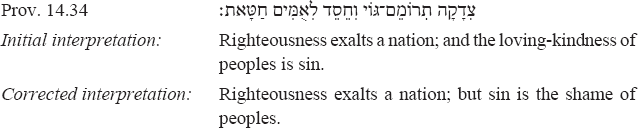
The false lead in this proverb is established by the word דסח. This has a particularly salient (frequent, familiar, and conventional) interpretation in Biblical Hebrew as ‘loving4dndness’. The proverb also primes the reader for this meaning by structurally paralleling it with its synonym ‘righteousness’ (הקדצ; cf. Prov. 21.21). However, as the end of the proverb is read, it becomes clear that this initial interpretation is not correct. Loving-kindness is a morally good and desirable attribute in Proverbs (11.17; 14.22; 16.6; 19.22; 20.28; 21.21). It is not ‘sin’ (תאטח).
Some modern interpreters try to solve the problem by emendation, changing דסח to דסח (‘want, poverty’), 12 and assume orthographical corruption due to the visual similarity of ד and ר (in Phoenician as well as Aramaic square script). This was possibly the reading of the LXX which has ἐλασσονοῦσι δὲ ϕυλὰς ἁμαρτίαι (‘sin diminishes tribes’), and Syr. wmz'ryn ‘mwt’ ḥṭh’ (‘but sin makes a people small’). 13
The noun רסֶחֶ only occurs elsewhere in Prov. 28.22; Job 30.3, but the verbal form (‘to lack’) is common.
The Targ. follows the MT. In DJD, Skehan also claims that this is the reading of DSS, but the MS evidence is far from clear. Patrick W. Skehan and Eugene Ulrich, ‘Proverbs’, in Eugene Ulrich et al. (eds.), Qumran Cave 4: 11. Psalms to Chronicles (DJD, 16; Oxford: Clarendon Press, 2000) pp. 181–86. For images, see http://www.deadseascrolls.org.il/explore-the-archive/image/B-284591
However, the MT may well be sound. Having rejected their initial interpretation, the reader seeks to correct it. There is a homophonic root, common in Aramaic but rare in Biblical Hebrew, occurring elsewhere only inProv. 25.10 (verbal form); Lev. 20.17 and Sir. 41.22 (noun form). The noun means ‘shame, reproach’, hence ‘sin is the shame of peoples’. The sense is that the moral behaviour of a people—their sinfulness or righteousness—leads to their disgrace or exaltation on the world stage, and before Yahweh. As the prophets frequently warn, the act-consequence connection operates on a national as well as a personal level.
The false lead in this proverb has an important pedagogical effect on the reader. It slows down the reading process, ingraining the message into them and teaching them skills of discernment. Though they ultimately reject the interpretation of דסח as ‘loving-kindness’, they nonetheless learn a lesson about loving-kindness—it is not sin. They also learn a lesson about themself—they have a propensity to make mistakes. Not just the ultimate destination is important, but what is learnt along the garden path as they got there.

Though המז once refers generally to a plan/device (Job 17.11), everywhere else it has a negative import, often referring to sexual immorality such as prostitution (e.g. Jer. 13.27) or incest (e.g. Lev. 18.17).
The false lead in this proverb is syntactic rather than semantic. The structure of the first colon is clear: like [Pred.]—to [Ind. Obj.]—is [Subj.]. The reader expects the same structure to be found in the second colon (cf. Prov. 21.15). Because of their expectation of parallelism, the reader begins to parse the second colon in the same way, assuming the final subject to be gapped: [like] wisdom—to a man of understanding—[is acting wickedly]. However, this interpretation entails that wickedness is wise. This is a clear violation of wisdom ethics, according to which wisdom is co-referential with righteousness, and wickedness with folly. 15 The proverb reader cannot accept it. Down the garden path, they affirm this fundamental message: wickedness is not wise.
Knut M. Heim, Like Grapes of God Set in Silver: An Interpretation of Proverbial Clusters in Proverbs 10.1–22.16(BZAW, 273; Berlin: W. de Gruyter, 2001).
The difficulty is once again witnessed by scholars’ attempts to emend the text. To acquire an antithetical parallelism, and drawing on Prov. 16.12, Toy emends המבחו to הבעחו, ‘but an abomination…’. 16 This is supported by Fichtner (BHS), who also offers a textually more likely solution based on metathesis: המחבו, ‘like poison’ (citing Deut. 32.24). However, these are speculative and not necessary. What these modern scholars try to solve through emendation may have been solved otherwise by the original reader. It is possible, once the initial interpretation has been rejected, to deduce a corrected interpretation. The reader must stop and think, practicing their skills of discernment. This process gives time for the message to ingrain itself in their mind, and convince them of its accuracy. Probably, they will reparse the syntax of the second colon. 17 Instead of being parallel to קוחשֹ, we can understand המבח as equivalent to המז תושׂע. Now the proverb is a chiasmus, with the predicate in the second colon gapped: [like laughter]—is wisdom—to a man of understanding.
Crawford H. Toy, A Critical and Exegetical Commentary on the Book of Proverbs (ICC; Edinburgh: T. & T. Clark, 1899).
As well as the solution given here, it is possible to understand this colon as ‘The understanding man has wisdom’ (so KJV) or ‘Wisdom to a man is understanding’ (so Vulg.). But these interpretations are tautologies, and ignore the parallelism altogether.
The gapped קוחשֹ usually means ‘laughter, sport’. In the initial interpretation, it may have some negative connotations. Elsewhere both noun and verb forms suggest derision and contempt (e.g. Jer. 20.7), or joking and sporting, not to be taken seriously (Judg. 16.25, 27; Prov. 26.19). These connotations must be abandoned in the corrected interpretation, as they are not congruent with wisdom. Wisdom is to the wise as full-bodied an expression of joy as the godly laughter filling the mouth of the psalmist (Ps. 126.2). This corresponds with an important theme in Proverbs: wicked fools take pleasure in their wickedness and folly, the righteous and wise in their righteous wisdom (13.2; 15.21; 18.2; 21.10). Our pleasures dictate our behaviour, and reveal much about our character and desires.
In the corrected interpretation, המבח is set in parallelism with המז תושׂע. This structure tells us that the terms must be antithetical, and the two concepts must exclude each other. It is impossible to ‘do wickedness’ and ‘be wise’. This reaffirms the message discovered through the rejection of the initial interpretation—it is not wise to do wickedness. Again, this same lesson is communicated by the explicit statement of the a colon: it is the fool who acts wickedly. This proverb ingeniously combines these three strategies to drum home this point, basic to the worldview espoused in the book.

In this proverb, the reader is led up the garden path by the set phrase שׁפנ שׁקב, which probably had one particularly salient interpretation to its original readers. It is very common, and in its 28 other biblical occurrences always means ‘to seek the life of’, in the sense of ‘seek to kill’, always implying malicious intent. 18 The reader initially parses the second colon with םירשׁי as its subject: ‘the upright seek his [the blameless man's] life’. The implication that the upright maliciously kill the blameless sets off alarm bells for the reader with understanding of wisdom ethics. Surely it cannot be so.
Bruce K. Waltke, The Book of Proverbs: Chapters 16–31 (NICOT; Grand Rapids: Eerdmans, 2005), p. 438.
This seems to have caused some problems for the translators of the Versions. The LXX and Targ. make minor changes: the LXX has ‘seek out his soul’ (ἐϰζητήσουσιν ψυϰὴν αὐτοῦ); 19 and Targ. has ‘seek him’ (ןייעבהיל). Syr. completely alters the sense: ‘but the righteous love him’, wzdyq’ rḥmyn lh. Fichtner (BHS) and Toy suggest changing םירשׁיו to םיעשׁרו, ‘the wicked seek his life’, 20 providing a synonymous parallel with the first line, or emending ושׁקבי to ורקבי, ‘seek out (protectively)’ (so Gemser, Scott). 21 However, usually, this verb means ‘to enquire, conduct an investigation’, which does not fit here. 22
The εϰ prefix does not occur in the LXX's translation of this phrase elsewhere.
Toy, A Critical and Exegetical Commentary.
Berend Gemser, Sprüche Salomos (HAT; Tübingen: J.C.B. Mohr, 1963); Robert B.Y. Scott, Proverbs: Ecclesiastes. Introduction, Translation and Notes (AB, 18; New York: Doubleday, 1965).
Unless possibly in the sense of Ezek. 34.11-12.
But sense can be made without emendation, either by literalizing the set phrase, or by reanalysing the syntax. Rejecting their initial interpretation, the reader ponders what else ‘seek his life/soul’ might mean. The phrase is open, facilitated by the polysemy of שׁפנ (‘life, soul’). Some suggest that it refers to seeking a reckoning for the blameless man's blood, like the similar phrases םרשׁקב (Ezek. 3.18,20; 33.8; 2 Sam. 4.11) and שׁפנ שׁרד (Gen. 9.5). 23 However, elsewhere in Proverbs seeking vengeance is not commendable (e.g. Prov. 20.22). Barucq relates the phrase to םינפ שׁקב, suggesting that the upright hold the blameless in high esteem, and translating as ‘fréquenter’. 24 G. R. Driver associates Hebrew שקב with Akkadian baqāšu, ‘to be large’, and suggests that this verse means ‘the upright amply esteem, i.e. make much of his life’. 25 Alternatively, it might be interpreted as ‘care for his life/soul’, 26 in the sense of Ps. 142.4 (MT 5), ישׁפנ שׁרד ןיא ‘no-one cares for my soul’. This is a semantic stretch, but possible, as the reader strives to resolve the difficulty.
Cited, though rejected by Franz Delitzsch, Biblical Commentary on the Proverbs of Solomon (CFTL, 45; Edinburgh: T. & T. Clark, 1884); Fox, Proverbs 10–31; Waltke, The Book of Proverbs: Chapters 16–31.
André Barucq, Le Livre des Proverbs (Sources Bibliques; Paris: J. Gabalda, 1964).
Godfrey R. Driver, ‘Problems in the Hebrew Text of Proverbs’, Biblica 32 (1951), pp. 173–97; Godfrey R. Driver, ‘Review’, JSS 12 (1967), p. 108.
This is the interpretation of William McKane, Proverbs: A New Approach (OTL; London: SCM Press, 1970); Clifford, Proverbs; Fox, Proverbs 10–31; JPSV, REB, JB, RV marg.
The search for resolution forces the reader to exercise their faculties of discernment. If literalizing the set phrase does not provide a satisfactory correction, they may instead reanalyse the syntax, 27 to my mind a more satisfactory solution. Instead of םירשׁי being the subject of the second clause, it is taken as an accusative casus pendens: ‘as for the upright, they (the bloodthirsty) seek his life’ (for the construction, e.g. Gen. 47.21). 28 םירשׁי is plural, and the suffix on שׁפנ is singular, but this can be explained: a singular noun suffix may have a plural referent in a distributive sense (cf. esp. Hos. 4:8—וֹשׁפְנַ וּאשְׂיִ, ‘they lift up, each his soul’). 29 As Waltke translates: ‘and as for the upright, they seek to kill each of them’. 30 ‘Bloodthirsty men’ is then the subject of both cola, and ‘hate the blameless’ is chiastically parallel with ‘seeks the life of the upright’. The parallelism is synonymous and developmental, with a dramatic heightening from hatred to murder.
So Delitzsch, Proverbs; Waltke, The Book of Proverbs: Chapters 16–31; Christine R. Yoder, Proverbs (Abingdon Old Testament Commentaries; Nashville: Abingdon Press, 2009), NRSV, NIV.
GKC P.143.c.
GKC P.145.5, citing Isa. 2.8; 30.22; Jer. 31.14; Hos. 4.8; Zech. 14.12; Pss. 5.10; 62.5; 141.10; Job 38.32; Eccl. 10.15.
Waltke, The Book of Proverbs: Chapters 16–31, p. 400.

The full thought can be understood as ‘The fruit of the righteous is (the fruit of) a tree of life’ (GKC 141d; cf. Ps. 72.16, Song 1.15).
The metaphor in the first colon of this proverb depicts the life-giving actions of the righteous. The ‘tree of life’ occurs four times in Proverbs as a source of healing, vitality, and joy. 32 Through his teaching and behaviour, the righteous man provides these for himself and others. The second colon contains a false lead similar to the above. Like שׁפנ שׁקב, שׁפנ חקל is a set phrase with one particularly salient interpretation—‘to take a life, to kill’. 33 The reader's initial interpretation, that the wise man kills, is alarming and must be rejected.
Prov. 3.18; 11.30; 13.12; 15.4. On the possible mythological roots of this image, see e.g. Peter T. Lanfer, Remembering Eden: The Reception History of Genesis 3:22-24 (Oxford: Oxford University Press, 2012).
1 Sam. 24.12 (MT 11); 1 Kgs 19.10,14; Ps. 31.14 (MT 13); Prov. 1.19; Ezek. 33.6.
Again, some scholars resort to emendation. On the basis of LXX and Syr., םבח is commonly changed to סמח, ‘violence’ (though there is no Heb. MS evidence for this reading), סמח may then be taken as the subject—‘violence takes away lives’, 34 or ־ידפ may be gapped from the first colon—‘[the fruit of] the one who takes lives is violence’. 35 However, this emendation is problematic. A scribal error due to misreading of letters is unlikely. Furthermore, the Versional evidence is complex. The LXX reads ‘the souls of transgressors are taken away untimely’ (ἀϕαιροῦνται δὲ ἄωροι ψυϰαὶ παρανόμων), which is not a direct translation of סמָחָ חוׄשׁפָנְ חַקֵלֹוְ. It would entail a metonymic extension of סמח, violence’, as סמח שׁיא, ‘man of violence’, an uncomfortable shift which does not take place elsewhere. This would then be translated as παρανόμος, even though LXX usually uses ἀνὴρ ἀδίϰος for this phrase elsewhere. 36 Presumably, the Greek translator is thought to have read qal passive participle חַקֻלָ 37 or pual perfect חקַּלֻ for ‘taken away’ (ἀϕαιροῦνται), and to have ignored the singular-plural discrepancy. Syr. does not even represent this verb, having ‘the souls of evildoers are scattered [mtbdrn]’.
RSV, NRSV, REB, HCSB; Luis Alonso Schökel,Proverbios (Nueva Biblia espagńola; Madrid: Cristiandad, 1984); Roland E. Murphy, Proverbs (WBC, 22; Nashville: Thomas Nelson, 1998); Toy, A Critical and Exegetical Commentary.
Berend Gemser, Sprüche Salomos (HAT; Tübingen: J.C.B. Mohr, 1963); McKane, Proverbs.
סמח שׁיא occurs seven times. Grk. has ἀνηρ ἀδιϰος everywhere but Prov. 3.31 (ϰαϰῶν ἀνδρῶν) and 16.29 (ἀνἠρ παράνομος).
Only occurs once elsewhere—Prov. 24.11.
It is better to interpret the text as we have it. The reader searches for another interpretation of ‘takes souls’, חקל is quite a ‘general’ verb, 38 lacking in specific semantic content and applicable to many domains of life. The reader is called upon to imagine new ways that it could relate to שפנ. A common suggestion is that it means ‘wins souls’, 39 in the sense of captivating them, persuading them. Proverbs 6.25-6 warns of the foreign woman who might seduce you—‘taking’ (חקל) you by her eyelashes, and ‘hunting your soul’ (שפנ דוצ). A positive version of this seduction may be intended here. The good that the wise man teaches is highly desirable. He captivates and persuades others, and becomes as a tree of life for them.
For a linguistic explanation of ‘general’ verbs, see, e.g., Grace Zhang, ‘Fuzziness–Vagueness–Generality–Ambiguity’, Journal of Pragmatics 29 (1998), pp. 13–31.
KJV, ESV, NKJV, NASB, JPS; Delitzsch, Proverbs; Helmer Ringgren and Walther Zimmerli, Sprüche/Prediger (ATD; Göttingen: Vandenhoeck & Ruprecht, 1962); Clifford, Proverbs; Fox, Proverbs 10–31; Robert G. Bratcher, ‘A Translator's Note on Proverb 11.30’, Bible Translator 34 (1983), pp. 337-38; Antonio Bonora, “Accogliere la vita” in Pr 11,30’, Rivista Biblica 37 (1987), pp. 313–16.
Other scholars draw attention to the intellectual sense of the noun חקַלֶ, ‘instruction, teaching’, which may have resonated for original readers. Plöger suggests revocalizing in this way (‘the wise [give] instruction to souls’), 40 and Snell (following Qimḥi) thinks of a verbal form ‘to understand’, corresponding to the colloquial ‘I get what you mean’, translating ‘the one who comprehends souls is wise’. 41
Cf. Czech Bible Kralicka (1613), which has ‘vyučuje duše'—‘teaches souls’.
Though one would assume that a verb from a noun meaning ‘teaching’ would mean ‘to teach’, not ‘to understand’. Snell asserts that the noun means ‘understanding’. See Daniel C. Snell, ‘“Taking Souls” in Proverbs XI 30’, VT 33 (1983), pp. 362–65.
It is also possible that readers interpreted the phrase in direct opposition to its usual usage—‘saves lives’ instead of ‘kills’. 42 This is the interpretation of Gen. Rab. 30.6, which applies it to Noah sustaining (סנרפ) the creatures on the ark. Irwin notes that in connection with fruit, חקל means ‘to pick, gather’, 43 and argues that the ‘tree of life’ metaphor is carried into the b colon. The wise ‘gather life’ for themselves from the tree of life (though taking חושפנ in this abstract sense is dubious). 44 By their teaching they also ‘gather lives’ of others and save them. However, removing lives from the tree of life would surely destroy them, not save them. I consider an interpretation as ‘wins souls’ most likely. But more important, I suggest, than the ultimate interpretation we reach, is the process of walking along the garden path to get there.
Bruce K. Waltke, The Book of Proverbs: Chapters 1–15 (NICOT; Grand Rapids: Eerdmans, 2004); see also NIV.
E.g. Gen. 3.6, 22; 40.9-11; Num. 13.20.
This is similar to the speculative interpretation of Dahood, who thinks this is a plural of excellence, meaning ‘eternal life’. Citing the Ugaritic text 2 Aqht: VI:35–36, he translates the phrase as ‘the wise man attains eternal life’. Mitchell Dahood, Proverbs and Northwest Semitic Philology (Scripta Pontificii Instituti Biblici, 113; Rome: Pontificum Istitutum Biblicum, 1963), pp. 24–25.

The referent of the feminine suffix on חירחא is slightly problematic. Though ךרד can be feminine, it occurs with a masculine adjective in the a colon. Most likely, the suffix functions as a neuter, referring back to the whole situation of the a colon (Waltke, The Book of Proverbs: Chapters 1–15; Bruce K. Waltke and Michael Patrick O'Connor, An Introduction to Biblical Hebrew Syntax [Winona Lake, IN: Eisenbrauns, 1990], §6.6d).
In this proverb, the first colon asserts that ‘There is a straight path before a man’. In Proverbs, the ‘straight path’ entails both ethically upright behaviour, and beneficial consequences. Righteous men make their paths straight (Prov. 9.15; 11.5; 15.21), while the wicked have ‘crooked’ paths (שׁקע, Prov. 10.9; 22.5) and ‘go astray’ (העת, Prov. 7.25; 14.22; 21.16) both morally and into disaster. The reader with knowledge of these tropes expects the ‘straight’ path to lead to life (cf. Prov. 10.17; 12.28; 15.24). When the proverb asserts that it leads instead to death, they do a double-take.
Readers must reanalyse and correct their initial interpretation. The path cannot really be straight; it must only seem straight. The initial interpretation of ינפל concerns the physical direction of the path—it stretches out ‘before’ a man (so Fox; NBS; 46 cf. Ezek. 41.11; Mal. 3.1). The spatial interpretation is continued and reaffirmed by the reference to the path's ‘end’ (החירחא) in the second colon. However, this may be challenged in the second reading. Instead, ינפל may be equivalent to יניעב, an exchange attested in some late texts (e.g. Neh. 2.5-6; Est. 5.14). A number of proverbs speak about a man's path being ‘straight (i.e. right) in his own eyes’ (זיניעב רשׁי), not in reality (12.15; 16.25; 21.2). Accordingly, Barucq translates here ‘Telle route paraît droite aux yeux d'un homme’. 47 Even without this explicit substitution, many translators supply ‘seems’ or equivalent into the first colon (so LXX, Syr., Vulg. and Targ., along with, e.g., KJV, ESV, NASB, NRSV, NIV). 48 Occasionally, translations seem to take ינפל according to both interpretations simultaneously—‘A course may seem straight before a man’ (italics mine). 49 In Proverbs and the Hebrew Bible more generally, such personal ethical standards often do not accord with God's justice. 50 As well as this path not being morally good, it cannot be beneficial. The path that seems straightforward to traverse, the ‘easy option’, will not always have the best outcome. It may even lead to death (cf. Mt. 7.13-14).
Fox, Proverbs 10–31; La Nouvelle Bible Segond (2002).
Barucq, Le Livre des Proverbs.
LXX: ἔστιν ὁδὸϛ ἣδοϰεῖ ὀρθὴ εἶναι παρὰ ἀνθρώποις; Vulg: est via quae videtur homini iusta; Syr. (Targ. equivalent): ‘yt ‘wrḥ’ dsbryn bny ‘nš’ dtryṣ’ hy. Some translations (e.g. NASB) italicize ‘seems’ to show it is an addition.
Ferrar Fenton, The Holy Bible in Modern English (Merrimac, MA: Destiny Publishers, 1903).
Cf. Deut. 12.8; Judg. 17.6; 21.25, where the Israelites each do ‘what is right in his own eyes’.
This proverb emphasizes the limits of human understanding, an important theme in Proverbs. In the ambiguities and vagaries of this life, humans cannot see the whole picture, only what is directly before them, and even then they might be mistaken. Yahweh alone knows what will happen in the end. The proverb teaches that a man can be mistaken in his judgments. It also exemplifies this principle through its false lead, for it forces its reader into an initial incorrect interpretation. The proverb says and shows that its reader can be wrong, embodying its own message. The reader must go back and reanalyse their initial conclusions, just as they must be constantly critical of the path they take in life, aware at once of their own limitations, and their capacity to rectify situations.
4. Conclusion
The false lead or garden path is an important and effective pedagogical technique in the book of Proverbs. The rejection of the initial interpretation provides a subtle hidden message in each proverb. Loving-kindness is not sin (14.34); wickedness is not wise (10.23); the killer is not wise or upright (11.30; 29.10); what appears straight may not be so (14.12 = 16.25). These lessons are not apparent in the final interpretation or translation of the proverb, but only emerge through the false lead in the reading process.
Slowing down this reading process, making the reader walk up and down the garden path, gives them time to absorb the proverb. It is memorable and becomes ingrained, a tool to deploy in difficult situations in life. The process fosters alertness, and trains the reader to think, coaching them in moral reasoning. The initial interpretation is rejected because it is morally abominable. The proverbs teach the reader how to navigate Proverbs’ ethical system and thus contribute to their moral development, a main pedagogical aim of the book.
The reader learns to consider instruction, rejecting bad advice and accepting wise counsel. The sages welcomed critical appraisal of even their own words. Sometimes, for example, they put direct contradictions side by side (26.4-5), to provoke critical assessment. Here, they make a suggestion which must not be accepted naively, but appraised with wisdom. Receiving bad advice is a constant possibility: Lady Folly will try to seduce you with her smooth words (esp. Prov. 7) and many on the road want to lead you astray (10.17; 12.26). The path may look straight, but end up as the ways to death (14.12 = 16.25).
This technique makes the reader aware of the limits of their wisdom. 51 In fact, it exemplifies the limits by forcing the reader to come up against them in their own mistaken interpretation. No-one in Proverbs has exhaustive wisdom. Indeed, it is characteristic of ‘the wise’ that they seek after more knowledge (15.14; 17.24; 18.15) and accept the advice of others (10.8; 12.15; 13.1; 15.5). It is utter folly to be ‘wise in your own eyes’ (12.15; 26.5, 12; 18.11). Pride is condemned in favour of sober humility (11.2; 16.18-19; 18.12; 21.4; 29.23), particularly before your maker (15.33; 16.5; 22.4). In the face of Yahweh, all human knowledge shrivels to insignificance. There is, in fact, ‘no wisdom, no understanding, no counsel before the Lord’ (21.30; cf. also 16.1, 2, 9; 19.21; 20.24).
On the limits of wisdom, see especially Gerhard von Rad, Wisdom in Israel (London: SCM Press, 1972), pp. 97–110.
These proverbs are a powerful reminder of the human propensity to fail and make mistakes. However, neither this strategy, nor the overall message of Proverbs, finishes on this negative: the reader can correct their interpretation. Mistakes are not final in Proverbs—it is what you do about them that matters. When wise men are mistaken, they receive discipline and become wiser (17.10; 19.25; 21.11). When the righteous sin, they bring a guilt offering and are accepted (14.9). Proverbs always offers the possibility of rectification and growth.
When we discover that the way we were walking was a twisting and misleading garden path, it is in our interest and capacity to back-track along it. We can consider the garden path as an opportunity to acknowledge our own limits, to hone our skills of navigation and discernment, and to discover new and straighter roads ahead.