




Abstract
This article responds to the innovative and stimulating research by Ellen van Wolde in a previous volume of Journal for the Study of the Old Testament. She claims that the Niphal is middle voice and can be passive, ‘if (and only if) an external argument, coded as an external Agent, is present’. My research however, demonstrates that such a description of the passive is both inadequate in view of the world’s languages and incongruent with Niphal. In addition, my response lays bare how such a prescription of the middle voice to the Niphal in the Hebrew Bible is circulus probando and unconvincing.
Ellen van Wolde is well known for her innovative scholarship on the Hebrew Bible. 1 Her recent article in the Journal for the Study of the Old Testament, ‘The Niphal as Middle Voice and Its Consequence for Meaning’, is no exception. Yet it is not the claim of the Niphal having middle semantics that demonstrates novelty. 2 Rather, it is how she distinguishes between middle and passive Niphals that proves to be pioneering and—as she claims—the primary contribution of her work. Van Wolde argues that the Niphal can be passive, ‘if (and only if) an external argument, coded as an external Agent, is present’. 3 She then applies her theory of middle and passive semantics to the Hebrew Bible to produce what she calls ‘considerable consequences’ of meaning. 4
It is here—at the nexus of theory and exegesis—that the proposed contribution primarily falls short. In terms of theory, there is not adequate accounting for the complexity of the passive voice. What is more, in application to the Hebrew Bible, the theory does not accord with the grammatical intricacies or syntax of the Niphal. The present response will demonstrate how Van Wolde’s description of the passive is both inadequate in view of the world’s languages and incongruent with Niphal (§1). This response will then show how her prescription of the middle voice to the Niphal in the Hebrew Bible is circulus probando and should be refined (§2).
1. A Square Peg and a Round Hole
The Niphal, according to Van Wolde, marks the middle voice—to the exclusion of reflexive and passive. In the middle voice, the subject of the Niphal serves as both Agent and Patient. Van Wolde’s account of the middle voice includes various subsets, but the most important is the medio-passive. Medio-passive designates facility, disposition, quality, quantity, condition, resultative state, or impersonal situation type (e.g., the book reads well). 5 In contrast, the passive is a transitive verb that implies ‘reference to external Agent’. 6 To further juxtapose medio-passive and passive, Van Wolde writes a linguistic rule: a Niphal is passive, ‘if (and only if) an external argument, coded as an external Agent, is present’. 7 Her definitions and demarcations, however, are quite problematic.
First, Van Wolde’s definition of the passive voice is inexact and (at least) potentially misleading. It is unclear, at least to me, what ‘present’ means in her linguistic rule. It could refer anaphorically or cataphorically to a referent outside of the immediate clause. If so, how far backward/forward can a passive make reference to an Agent? Van Wolde clarifies slightly when she writes, ‘This referent [Agent] is conceptually present, but pragmatically de-emphasised. The main function of a passive construction is to “defocus” the Agent’. 8 Yet I find the meaning of ‘conceptually present’ and the implications of defocused Agent to be quite enigmatic. 9
Second, the absence of an Agent does not prove middle semantics. For example, Van Wolde claims the Niphal עלה ‘is always (18 times) used to express a middle voice’. 10 Thus, the Niphal in (1) should be translated as middle ‘when the cloud lifted from the Tabernacle’—not passive ‘be taken up’. 11
(1) וּבְהֵעָל֤וֹת הֶֽעָנָן֙ מֵעַ֣ל הַמִּשְׁכָּ֔ן Exod. 40.36
Yet, on this same example (1), R. Benton comes to a similar conclusion using different evidence: One could assume that the cloud would need an Agent, namely Yhwh, to be lifted off of the tabernacle. However, the surrounding context presents the cloud as an Agent on itself—or at least as a Cause; in 40.34 the cloud ‘covers’ (Piel) the tent. Thus we do not need to imagine a separate Agent . . . .
12
Benton here builds his case for the middle voice not by means of grammar (Niphal binyan is always middle), but by means of context. Contextually, he does not appeal to the lack of external Agent as proof; he draws from the use of ‘cloud’, and in particular its agency, in Exod. 40.34.
For those who have studied the Niphal in depth, there is a consensus that the binyan itself is only concerned with the subject: The Niphal refers to an event or the state resulting from an event. This situation may involve any number of participants, but the Niphal presents this situation with respect to only a single participant and without regard for any other participant which may be involved in this situation. The presence or absence of other participants in the situation as well as the volitionality of the single participant which is specified is determined by the context in which the Niphal occurs and by a reader/writer’s knowledge of the real world.
13
In short, context and world knowledge play a significant role in uncovering the semantics of the subject (e.g., Agent or Patient). To illustrate, let us consider Figure 1 below.
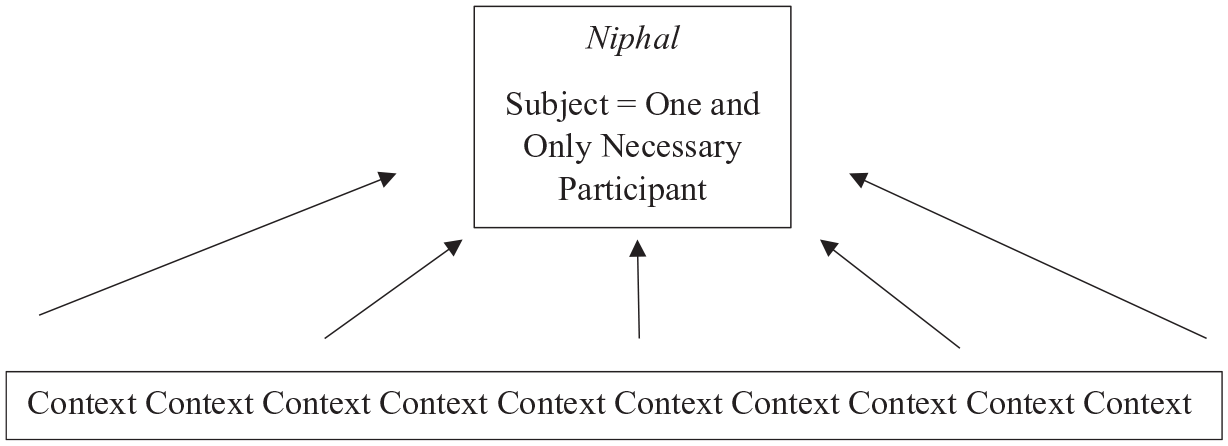
Creason’s Model of the Niphal
Once the surrounding context is taken into account, the Niphal demonstrates that it has various meanings—the middle and passive being only two examples. The surrounding context, generally speaking, assumes a large stretch of text both before and after the Niphal clause in question. Thus, the semantics of the subject in an earlier verse (so ‘cloud’ in Exod. 40.34) gives a clue regarding how to understand the semantics and number of participants in the Niphal clause (so Exod. 40.36)—keeping in mind, of course, that עלה itself can have middle semantics in the first place.
Yet Van Wolde’s scheme seems reductionistic (Figure 2). This narrowing of the context demonstrates the overriding influence of the binyan itself on the meaning of any given Niphal verb. This is in opposition to the significant role that context has for most Hebraists in determining the possible meanings of the binyan.
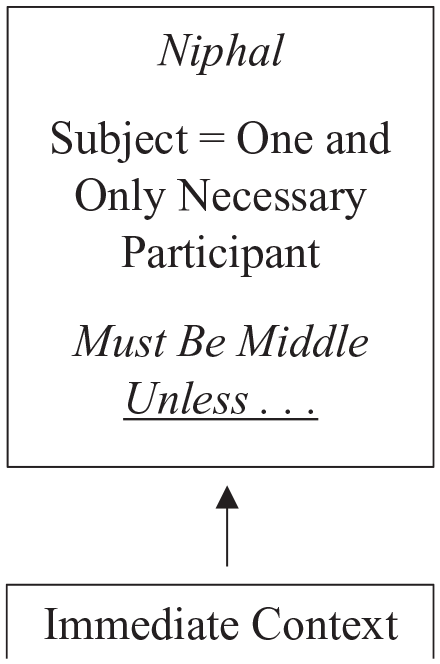
Van Wolde’s Model of the Niphal
Third, Van Wolde’s linguistic rule for distinguishing middle and passive does not account for the complexity of the passive voice. For example, ‘Demotion of A[gent] occurs universally in passives’. 14 Most frequently, this demotion means that the Agent does not appear at all in the passive sentence. Speaking broadly on the passive, M. Shibatani states that it is a ‘well-known fact that passives generally do not express agents’. 15 In his discussion of syntax, Givón gives specific, pragmatic reasons that the Agent is not expressed: 16
Agent is unknown or unrecoverable. 17
Agent is given anaphorically, requiring no further mention. 18
Agent is given cataphorically, making it superfluous in the present clause.
Agent may be predictable on universal grounds. 19
Agent may be generically-predictable and stereotypical. 20
Agent may be predictable as author of the text.
Givón surmises from evidence ranging from Modern Greek to English that the reason the passive voice exists is to suppress the Agent. 21 Such an observation proves troublesome for Van Wolde’s linguistic rule. Put differently, if one of the primary functions of the passive is to suppress the Agent (so Givón), how then can we label a verb as passive if our linguistic rule requires an Agent to be present?
Moving to the Hebrew Bible specifically, Van Wolde’s rule of delimiting the passive seems to misconstrue how the Agent can be omitted from the immediate context of the Niphal. Using Givón’s typological observations, we discover that most of his categories are readily present in the Hebrew Bible:
1.a Unrecoverable Agent (Animate Subject)
וְכִֽי־יַכֶּה֩ אִ֨ישׁ אֶת־עַבְדֹּ֜ו א֤וֹ אֶת־אֲמָתוֹ֙ בַּשֵּׁ֔בֶט וּמֵ֖ת תַּ֣חַת יָדֹ֑ו נָקֹ֖ם יִנָּקֵֽם׃ When a slaveowner strikes a male or female slave with a rod and the slave dies immediately, וַיְהִ֗י בְּהִשָּׁמַ֤ע דְּבַר־הַמֶּ֨לֶךְ֙ וְדָתֹ֔ו וּֽבְהִקָּבֵ֞ץ נְעָר֥וֹת רַבּ֛וֹת אֶל־שׁוּשַׁ֥ן הַבִּירָ֖ה אֶל־יַ֣ד הֵגָ֑י וַתִּלָּקַ֤ח אֶסְתֵּר֙ אֶל־בֵּ֣ית הַמֶּ֔לֶךְ אֶל־יַ֥ד הֵגַ֖י שֹׁמֵ֥ר הַנָּשִֽׁים׃ So when the king’s order and his edict were proclaimed, and
Concerning לקח, the Agent in Esth. 2.8 is unrecoverable. 24 There was a specific person who brought Esther to the king’s house. That person, however, is irrelevant to the purpose of the author. The action (taking Esther) and the location (the king’s house) serve as the critical points of information. 25
1.b Unrecoverable Agent (Inanimate Subject)
וְנָתַן֩ בַּיּ֨וֹם הַה֤וּא מוֹפֵת֙ לֵאמֹ֔ר זֶ֣ה הַמּוֹפֵ֔ת אֲשֶׁ֖ר דִּבֶּ֣ר יְהוָ֑ה הִנֵּ֤ה הַמִּזְבֵּ֨חַ֙ נִקְרָ֔ע וְנִשְׁפַּ֖ךְ הַדֶּ֥שֶׁן אֲשֶׁר־עָלָֽיו׃ He gave a sign the same day, saying, ‘This is the sign that the LORD has spoken: “The altar shall be torn down, and
The focus on ashes that ‘will be poured out’ (וְנִשְׁפַּ֖ךְ, v. 3) and then ‘were poured out’ (וַיִּשָּׁפֵ֥ךְ, v. 5) overshadows any concern of the Agent who is doing the pouring. 27 Despite the absence of an Agent, however, there is no evidence to suggest that the ashes have some type of middle agency.
2.a Anaphoric Agent (Animate Subject)
הַצִּילֵ֣נִי מִ֭טִּיט וְאַל־אֶטְבָּ֑עָה אִנָּצְלָ֥ה מִ֝שֹּֽׂנְאַ֗י וּמִמַּֽעֲמַקֵּי־מָֽיִם׃
In Ps. 69.14, the Hiphil imperative and the context show that the psalmist is pleading for the addressee (i.e., God) to deliver him. The participants stay the same in the Niphal. The difference is that the object in the Hiphil becomes the subject of the Niphal. 28 The subject of the Niphal is not delivering itself, however. Rather, the subject is requesting (Cohortative) that he be delivered. The Agent is not mentioned explicitly because it is abundantly clear from the context who would be the deliverer. 29 This reality is most noticeable in the beginning of the psalm: הוֹשִׁיעֵ֥נִי אֱלֹהִ֑ים (Ps. 69.1).
2.b Anaphor Agent (Inanimate Subject)
וַאֲר֥וֹן אֱלֹהִ֖ים נִלְקָ֑ח וּשְׁנֵ֤י בְנֵֽי־עֵלִי֙ מֵ֔תוּ חָפְנִ֖י וּפִֽינְחָֽס׃
There is little doubt that the subject (the ark) serves as the Patient in 1 Sam. 4.11. The Agent, however, is unexpressed. Such an observation would move Van Wolde to consider לקח a middle verb in the narrowest sense or (at best) medio-passive. The context, however, makes plain the semantic participants of capturing.
It is evident that the Philistines fight (וַיִּלָּחֲמ֣וּ) the Israelites, leaving thirty thousand dead (1 Sam. 4.10). Given the close proximity of the primary actors—the Philistines—the narrator need not express who captured the ark. Furthermore, the ark becomes the concern of the narrative attention in v. 11, making the passive Niphal an excellent choice for stressing that the ark ‘was captured’. 30 Thus, the Agent of לקח is non-overt and has an anaphoric referent in the context. 31
3. Cataphoric Agent (Inanimate Subject)
וַיְּשָּֽׁמְעוּ֙ הַדְּבָרִ֔ים אֲשֶׁ֖ר דִּבֶּ֣ר דָּוִ֑ד וַיַּגִּ֥דוּ לִפְנֵֽי־שָׁא֖וּל וַיִּקָּחֵֽהוּ׃ When
The context of 1 Sam. 17.31 illustrates that the Agent of the hearing follows the passive Niphal. The narrator has no reason to explain that ‘When the words that David spoke were heard by them, they repeated . . .’.
4.a Universalized Agent (Animate Subject)
וּשְׂעִ֨יר עִזִּ֥ים אֶחָ֛ד לְחַטָּ֖את לַיהוָ֑ה עַל־עֹלַ֧ת הַתָּמִ֛יד יֵעָשֶׂ֖ה וְנִסְכֹּֽו׃ And there shall be one male goat for a sin offering to the LORD;
The context of Num. 28.15 clarifies that the subject of the Niphal is by no means affecting. Rather, it is only the Patient of the action (עשׂה). 33 The context also suggests that there is a universalized Agent ‘anyone’.
4.b Universalized Agent (Inanimate Subject)
וְעַתָּ֗ה שְׁלַ֤ח הָעֵז֙ אֶֽת־מִקְנְךָ֔ וְאֵ֛ת כָּל־אֲשֶׁ֥ר לְךָ֖ בַּשָּׂדֶ֑ה כָּל־הָאָדָ֨ם וְהַבְּהֵמָ֜ה אֲשֶֽׁר־יִמָּצֵ֣א בַשָּׂדֶ֗ה וְלֹ֤א יֵֽאָסֵף֙ הַבַּ֔יְתָה וְיָרַ֧ד עֲלֵהֶ֛ם הַבָּרָ֖ד וָמֵֽתוּ׃ Send, therefore, and have your livestock and everything that you have in the open field brought to a secure place;
The Agent of יִמָּצֵ֣א in Exodus 9.19 is certainly de-focused and plays no pragmatic or syntactic role in the relative clause. This is evident by the NRSV translation above that transforms יִמָּצֵ֣א into a ‘to be’ verb.
The kinds of omissible Agents in passive Niphals (§1) demonstrate that we cannot merely note the presence or absence of an Agent to discover whether a Niphal is middle or passive. Furthermore, animacy of the subject does not play a decisive role in distinguishing middle and passive. We might, for example, expect an inanimate subject in the Niphal to be passive (וַיְּשָּֽׁמְעוּ֙ הַדְּבָרִ֔ים). The above analysis confirms that to be true. However, we might also anticipate that an animate subject would be narrowly middle (subject as Agent and Patient)—at least based on Van Wolde’s argumentation. Yet our data from the Hebrew Bible disabuse us of such a notion.
In sum, the typological evidence from Givón as well as the specific examples from the Hebrew Bible prove problematic for the division of the passive and middle Niphal. The survey above has shown the necessity of considering the surrounding context and world knowledge for discovering the semantics of the binyan. While there are certainly a number of Niphal verbs that do have middle semantics, it does not follow that the subject must serve as Agent and Patient. 35 Such an argument proves to be a square peg in a round hole.
2. Reconsidering ‘Considerable’ Consequences
It needs to be clear that my quibble with Van Wolde is not over labels (e.g., medio-passive or passive)—as frequent as such things are in linguistics. Rather, I take issue with how theory and text intersect in her contribution. In §1, I detailed how such a theory of the Niphal, especially in terms of passive voice, was insufficient and unpersuasive. In this section (§2), I will demonstrate how said theory constrains an interpretation of the Niphal that is often not necessary and at times improbable.
Given that the aforementioned theoretical construction of the passive Niphal does not stand, the exegetical examples used to illustrate the theory become suspect. Let us take, for example, the claim that גמל (Niphal) must be middle:
36
(2) 1 Sam. 1.22–23 וְחַנָּ֖ה לֹ֣א עָלָ֑תָה כִּֽי־אָמְרָ֣ה לְאִישָׁ֗הּ עַ֣ד יִגָּמֵ֤ל הַנַּ֨עַר֙ וַהֲבִאֹתִ֗יו וְנִרְאָה֙ אֶת־פְּנֵ֣י יְהוָ֔ה וְיָ֥שַׁב שָׁ֖ם עַד־עוֹלָֽם׃ וַיֹּ֣אמֶר לָהּ֩ אֶלְקָנָ֨ה אִישָׁ֜הּ עֲשִׂ֧י הַטּ֣וֹב בְּעֵינַ֗יִךְ שְׁבִי֙ עַד־גָּמְלֵ֣ךְ אֹתוֹ֔ אַ֛ךְ יָקֵ֥ם יְהוָ֖ה אֶת־ דְּבָרֹ֑ו וַתֵּ֤שֶׁב הָֽאִשָּׁה֙ וַתֵּ֣ינֶק אֶת־בְּנָ֔הּ עַד־גָמְלָ֖הּ אֹתוֹֽ׃ But Hannah did not go up, for she said to her husband, ‘As soon as
Let us now look at the argument for a middle Niphal in (2). First, Van Wolde observes that the child is the Patient in the transitive Qal (marked by את). 37 Second, and in what appears to be a non sequitur, she claims the Niphal of גמל is not transitive. Rather, ‘the action of weaning is conceived as a middle situation, in which the anti-causative Niphal marks it as an event in its affect on the child, without indicating the cause’. 38 Here, the logic of the linguistic rule is illustrated.
The above rendering of יִגָּמֵ֤ל, however, does not account fully for the immediate context. First, Hannah is speaking. Thus, it would be particularly unusual for her to say ‘be weaned by me’. Second, Hannah’s agency is obvious in the clause immediately following the Niphal, ‘I [Hannah] will bring him’ (וַהֲבִאֹתִ֗יו). Moreover, the two occurrences of Qal גמל in the following verse demonstrate that the lexeme has transitive semantics (Agent and Patient), which Van Wolde acknowledges. Therefore, it is possible that גמל is middle (subject serving as Agent and Patient), but it is unclear both theoretically and contextually why this must be so. In fact, the context and the lexeme itself strongly suggest passive semantics: the subject of יִגָּמֵ֤ל serving only as Patient. 39 Nevertheless, Van Wolde’s middle reading of גמל is of no great consequence here. The same, however, is not true for the following examples. 40
The most provocative—or ‘possibly most remarkable’
41
—of the examples ushered forth by Van Wolde come in the context of death:
42
(3) Gen. 25.8–9 וַיִּגְוַ֨ע וַיָּ֧מָת אַבְרָהָ֛ם בְּשֵׂיבָ֥ה טוֹבָ֖ה זָקֵ֣ן וְשָׂבֵ֑עַ וַיֵּאָ֖סֶף אֶל־עַמָּֽיו׃ וַיִּקְבְּר֨וּ אֹתוֹ֜ יִצְחָ֤ק וְיִשְׁמָעֵאל֙ בָּנָ֔יו אֶל־מְעָרַ֖ת הַמַּכְפֵּלָ֑ה Abraham breathed his last and died in a good old age, an old man and full of years, and
Intending to correct misunderstandings, Van Wolde claims that ‘in none of its [אסף Niphal] contexts of use is an external Agent introduced, and the verbs do, therefore, not express a passive voice, but a middle voice’. 44 Having said that, she concludes that the deceased (Abraham) must be the one doing the action. 45
A similar line of argumentation appears for קבר (Niphal). While most render this Niphal as passive ‘was buried’, Van Wolde states: ‘Following the line of reasoning presented above, the Niphal has to express a middle voice . . .’. 46 Focusing specifically on the 27 occurrences of the pattern (location ב + קבר [Niphal]), she claims that these texts ‘consider it important to recount explicitly both the burial and the locale and construe this event not as an activity performed by a still living family member, but as an action in which the deceased participates himself’. 47 Her evidence is that no ‘terms for grave or ancestors/fathers [are] used. Only the place is mentioned’. 48 Van Wolde then concludes that the transitive קבר (Qal) ‘putting a body in a grave’ transforms in the middle Niphal to mean ‘find one’s final (resting) place on a certain location’ or ‘lie down on . . .’. 49 There are, however, several difficulties with her argument and her reading of the context.
First, it is not so—a priori—that the Niphal must express the middle voice (see §1). 50 Second, the claim that these texts demonstrate some activity not done by living relatives runs roughshod over Givón’s typology of passives (§1). Any number of these Niphals could have an Agent that is unknown, unrecoverable, anaphoric, cataphoric, or stereotypical. 51 Third, her claim that the pattern (location ב + קבר [Niphal]) does not mention grave or ancestors but only denotes place is false. There are references to the grave alongside place (4), the grave of a father (5), the graves of fathers (6), place with kings (7), and place with fathers (8).
(4) וַיִּקָּבֵ֗ר בְּקֶ֨בֶר֙ יוֹאָ֣שׁ אָבִ֔יו בְּעָפְרָ֖ה אֲבִ֥י הָֽעֶזְרִֽי and was buried (5) וַיִּקָּבֵ֖ר בְּקֶ֥בֶר אָבִֽיו and was buried (6) וַיִּקָּבֵ֖ר בְּקִבְר֣וֹת אֲבֹתָ֑יו and was buried (7) וַיִּקָּבֵ֤ר יוֹאָשׁ֙ בְּשֹׁ֣מְר֔וֹן עִ֖ם מַלְכֵ֥י יִשְׂרָאֵֽל Joash was buried in Samaria (8) וַיִּקָּבֵ֤ר עִם־אֲבֹתָיו֙ בְּעִ֣יר דָּוִ֔ד and was buried
These incongruences and contextual misreadings, therefore, prove that these theoretical consequences of קבר (Niphal) rest on shaky ground. 54
Furthermore, it is here, in the application of her linguistic rule in examples of גמל, אסף, and קבר, that the circulus probando becomes apparent. The three components of this circular argumentation are all valid in and of themselves (Figure 3.a). It is true that middle verbs do not have an external Agent (the door closes). It is also true in almost every case that the Niphal does not have an external Agent. And finally, it is not really disputed the Niphal is (at least at times) middle voice. 55 The movement of the argumentation begins and ends with the claim that the Niphal is middle.
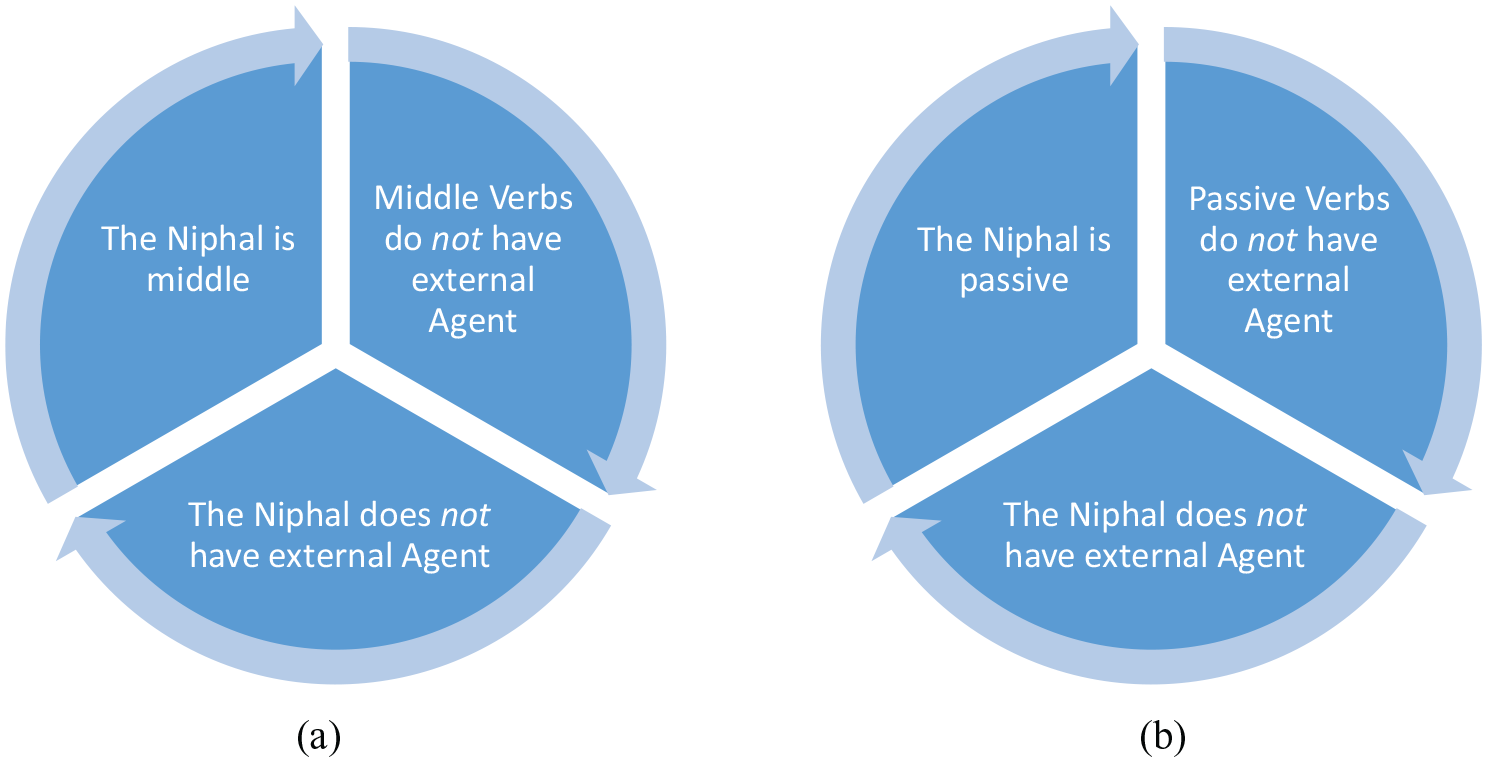
(a) Niphal as Middle; (b) Niphal as Passive.
Van Wolde introduces her analysis of the middle in Hebrew with the acceptance of Alexiadou and Doron’s view of the binyanim in Modern Hebrew. Most relevant is their conclusion that the Niphal in Modern Hebrew ‘(1) is affecting its subject without indicating the cause and (2) is lacking an external Agent’. 56 Van Wolde takes that as her starting point and uses the linguistic rule to distinguish the middle from the passive in Biblical Hebrew. From there, she can conclude that a specific Niphal and also the binyan itself is middle—not passive.
The circularity is seen most easily in the exegesis of 1 Sam. 1.22–23—one of the select examples Van Wolde gives to illustrate the consequences of her theory. There the Agent of the transitive Qal (Hannah) is present within the context: עַד־גָּמְלֵ֣ךְ אֹתו֔ ‘until you wean him’. Yet in the Niphal, according to Van Wolde, the boy (Samuel) serves as both Agent and Patient: עַ֣ד יִגָּמֵ֤ל הַנַּ֨עַר֙ ‘when Samuel will have “gone off” his mother’s breast’. 57 The evidence for her claim is the lack of an external Agent. This flow of argumentation ends up where her research on Hebrew begins—the Niphal is middle.
However, no component of Van Wolde’s argument (Figure 3.a) can substantiate that any individual Niphal verb or the binyan as a whole is middle voice. For example, absence of an Agent is not sufficient evidence to discern with any certainty (or probability) that a Niphal subject is both Agent and Patient (§1). Furthermore, Van Wolde’s application of Alexiadou and Doron’s research to the Niphal in Biblical Hebrew fails on two accounts. First, their conclusions are only a generalized template of how the binyanim operate—not a prescriptive system for how the binyanim must always work with all lexemes in every context. The binyanim—especially the Niphal—are much more nuanced in Biblical Hebrew than they suggest. Second, Alexiadou and Doron’s template is of Modern Hebrew and not of Biblical Hebrew. Thus, as insightful as their research is, it cannot be assumed that the Niphal binyan behaves in the exact same manner in both Modern and Biblical Hebrew. 58
To illustrate how malleable each component of Van Wolde’s argumentation is and how the logic of the argument does not confirm the voice of the Niphal, let us turn to Figure 3.b. We can begin with the assertion that the Niphal is passive. This assertion for what the binyan is finds support in various studies and grammars. In terms of passive verbs in general, typological studies demonstrate that these verbs across the world’s languages rarely (at best) have an external Agent (§1). For the Niphal in Biblical Hebrew, it is quite obvious that the binyan does not have an external Agent. Therefore, per this line of argumentation, when we analyze a specific Niphal in Biblical Hebrew that does not have an external Agent, we would consider it as passive voice.
To illustrate, we can run 1 Sam. 1.22–23 through Figure 3.b. As before, we recognize that the Agent of the transitive Qal is present within the context: עַד־גָּמְלֵ֣ךְ אֹתו֔ ‘until you wean him’. Thus, גמל has an Agent (Hannah) and a Patient (Samuel). Again, as above, the Niphal does not have an external Agent: עַ֣ד יִגָּמֵ֤ל הַנַּ֨עַר֙. Therefore, per Figure 3.b, we can label the Niphal as passive ‘when the child is weaned’ (see NRSV; ESV; NASB; NIV). As in Figure 3.a, each component in Figure 3.b is valid—at least to some degree. However, these valid components cannot be used as definitive proof that any given Niphal is passive.
3. Conclusion
Despite the above criticisms, Van Wolde is quite right to state that better knowledge of Hebrew grammar, particularly the Niphal, enhances our ability to ascertain the meaning of texts in the Hebrew Bible. 59 Her attempt to demonstrate this improved knowledge of the Niphal, however, is ultimately unsuccessful. 60 First, the rule to distinguish the middle from the passive comports neither with the world’s languages broadly nor with Biblical Hebrew specifically (§1). Second, the presumed reading of the Niphal disregards the complexity of the context (§§1–2). Third, the application of the linguistic rule produces readings that are not defensible from the context or the grammar of the Niphal itself (§2).
Nevertheless, her analysis encourages further research on passives, middles, and the Niphal binyan. The field of Hebrew studies benefits from Van Wolde’s innovative scholarship in which she brings linguistic theory and exegesis into the same conversation. Assumptions, labels, and implications of Hebrew grammar are questioned on account of her research. And for that, this author is grateful.
In sum, the present response is but an attempt to listen more carefully to the binyan. Van Wolde hears only one voice of the Niphal—the middle. 61 Yet here, with our ears now attuned to the complexities of the context, lexemes, and the binyan itself, we perceive more than one voice. Nonetheless, there is much more to the Niphal than its semantics (e.g., roles such as Agent and Patient). The present author anticipates providing a more comprehensive taxonomy of the Niphal in the future—one that gives ear to the voices of the binyan but also keeps an eye on its syntax and pragmatics.
