




Abstract
The rhetorical movement throughout Lamentations 3 is difficult to describe and scholars disagree on how to characterize the acrostic poem. Much hinges on how we interpret the sequence of qatal verbs throughout 3.56-61. Most scholars understand this section as a Danklied, and so translate the qatal forms in the past tense. Another option is to understand the qatal verbs as precatives, expressing a wish or command. However, this is a contested form in the linguistic study of classical Hebrew. Many Lamentations scholars cite this uncertainty in arguments against a precative reading of Lam. 3.56-61. This article builds a fresh case for understanding the precative qatal as rhetorically and linguistically plausible. After working through the rhetorical arguments that support this reading, special attention is given to a recent argument in favor of the precative hypothesis from linguist Alexander Andrason. Brief comments are also offered on the oral-performative dimension of this interpretation.
Keywords
1. Introduction
With its jarring alternation between complaint and theodicy, Lamentations 3 remains a puzzle. How should we characterize the chapter as a whole: theodicy, antitheodicy, or some mixture? Even though there is a discernible trend in Lamentations studies towards antitheodicy, opinions vary widely on this particular question. 1 The rhetorical movement throughout the last section of Lam. 3—typically seen as 3.42b-66—plays a significant role in determining how we answer this. But there has been significant disagreement here, especially on how to interpret the qatal forms in 3.56-61. The issue is one of chronology: Is the poet claiming Yhwh has in fact delivered him from the torment described in 3.1-21, 42b-54 in order to bolster present faith, or does he rather cry out for such deliverance precisely because it has not yet been experienced? If the former, one would translate each qatal form in the past tense. Historically this has been the most popular approach, as seen in the LXX, Targum, Peshitta, Vulgate, the major English translations, and important commentaries. 2 A minority translate each qatal in the present tense. 3 The other option is to translate the qatal forms as precatives, a form variously described as carrying the force of an optative or imperative, so that the poet implores the deity to intervene into a situation of current suffering. With eight possible occurrences throughout Lam 3.56-61, if the precative hypothesis is true this would constitute the longest stretch of precative forms in the entire Hebrew Bible and would therefore be an exemplary case. This article will update the discussion surrounding the precative qatal in Lam. 3.56-61 by synthesizing rhetorical arguments with recent research in linguistics. There is also a brief discussion of how a performative interpretation may bolster the argument for a precative qatal.
Already in 1877 August Müller considered the precative qatal one of the most contested issues in Semitic linguistics. 4 More recently, in an oft-cited Vetus Testamentum article on the topic, Iain Provan stated, ‘The reaction of the majority of scholars […] has from the very beginning been one of scepticism’. 5 However, while the debate over this elusive form has undoubtedly persisted, 6 the tide has shifted among Hebraists: Alexander Andrason recently characterized the pro-precative view as ‘dominant among scholars, […] whereas the other, less standard approach rejects it’. 7 Since the early 19th century, noteworthy Hebraists have explicitly argued for the existence of a precative qatal, though for diverse reasons and with varying levels of confidence. 8 Since then, Waltke and O’Connor revitalized a defense of the precative qatal, calling it a ‘perfective of prayer’ and numbering twenty instances in the Psalms. 9 A similar conclusion is reached in both editions of A Biblical Hebrew Reference Grammar. 10 Comparative evidence has also been marshaled (though not without controversy) in Akkadian, Amarna Canaanite, Phoenician-Punic, Ugaritic, Syriac, Mandaic, Arabic, Old Southern Arabian, and Geʻez. 11
On the whole, however, biblical exegetes have been reluctant to embrace this rare verbal phenomenon. Provan expressed frustration that, among the few scholars writing on Lamentations that do address the linguistic debate, those who reject the precative qatal feel content simply to cite S. R. Driver and GKC. 12 Recent studies by Villanueva and Parry each devote several pages to the precative qatal without discussing any linguistic research whatsoever. 13 Many scholars working on Lam. 3 have failed to even note the issue: At the time of Provan’s 1991 article, he cited as exceptions Wiesmann, Rudolph, Lamparter, Gordis, Hillers, and Gottlieb (the last three of which explicitly support reading the precative qatal in Lam 3.55-66). 14 Among those in favor we may now add at least eleven more scholars. 15 Only Dobbs-Allsopp, Villanueva, Parry, and Thomas devote more than a passing reference to the issue.
However, in their published arguments these scholars simply assume the linguistic (in)validity of the precative qatal and cite important but dated literature: If one prefers the precative qatal, simply point to Provan and IBHS; if one finds it linguistically implausible, appeal to S. R. Driver and GKC. This has done little to move the debate forward, and scholars working on Lamentations would do well to incorporate recent advances in linguistics. Happily, in the nearly thirty years since Provan’s VT article, linguistic research on biblical Hebrew has made substantial advances and the resources are more accessible than ever.
This article will bolster the argument that reading the precative qatal in Lam. 3.56-61 is not only plausible but preferable. The argument will proceed in three stages: First, Provan’s argument from chronology and rhetoric will be summarized and expanded. Second, a recent argument from usage-based linguistics for the precative qatal will be highlighted and its application contextualized to Lam. 3.55-66. Finally, there will be some brief comments on the importance of a performance-critical dimension when judging the viability of the precative hypothesis.
2. The Argument from Chronology and Rhetoric
At first glance, the traditional view is appealing: The poet’s dismal situation described throughout 3.1-21 is ostensibly reversed with the theodicy in 3.22-42a, and he then capitalizes on this newfound confidence with a Danklied (3.55-61), ultimately requesting that the deity enact vengeance upon those responsible (3.64-66). A recurring objection to the precative hypothesis is that since the qatal verbs in question can be understood perfectly well in context as simple past perfectives, why complicate matters by theorizing about a rare and contested verbal form? The very use of the qatal, after all, may cue a temporal shift. Robin Parry, for example, recently raised the point that not only did the ancient versions translate this way, but the poet risked a great amount of misunderstanding if he had indeed intended an optative mood. Furthermore, the much stronger imperative form (3.59, 63) would carry more rhetorical punch than the (ostensibly) weaker precative. As the section below on oral performance will discuss, however, this objection carries little weight once we account for a capable orator. Parry goes on to complain that if we read the entire section of 3.55-66 as a plea for Yhwh’s intervention (Figure 1), ‘then we are in danger of evacuating the section of the confidence in Yahweh that is expressed by taking the perfects as past tense’. He sees such confidence to make great sense in the light of the paraenesis in 3.22-42a, and protests that ‘to empty this section of faith is to imagine the man forgetting what he earlier remembered’. 16 But this seems quite an odd demurral, for the same point can be made in reverse: Could we not also complain that, with the theodicy of 3.22-42a, the man unreasonably forgets the bitter reality of his present distress in 3.1-21? Or what of the harsh shift back to complaint in 3.42b-54?
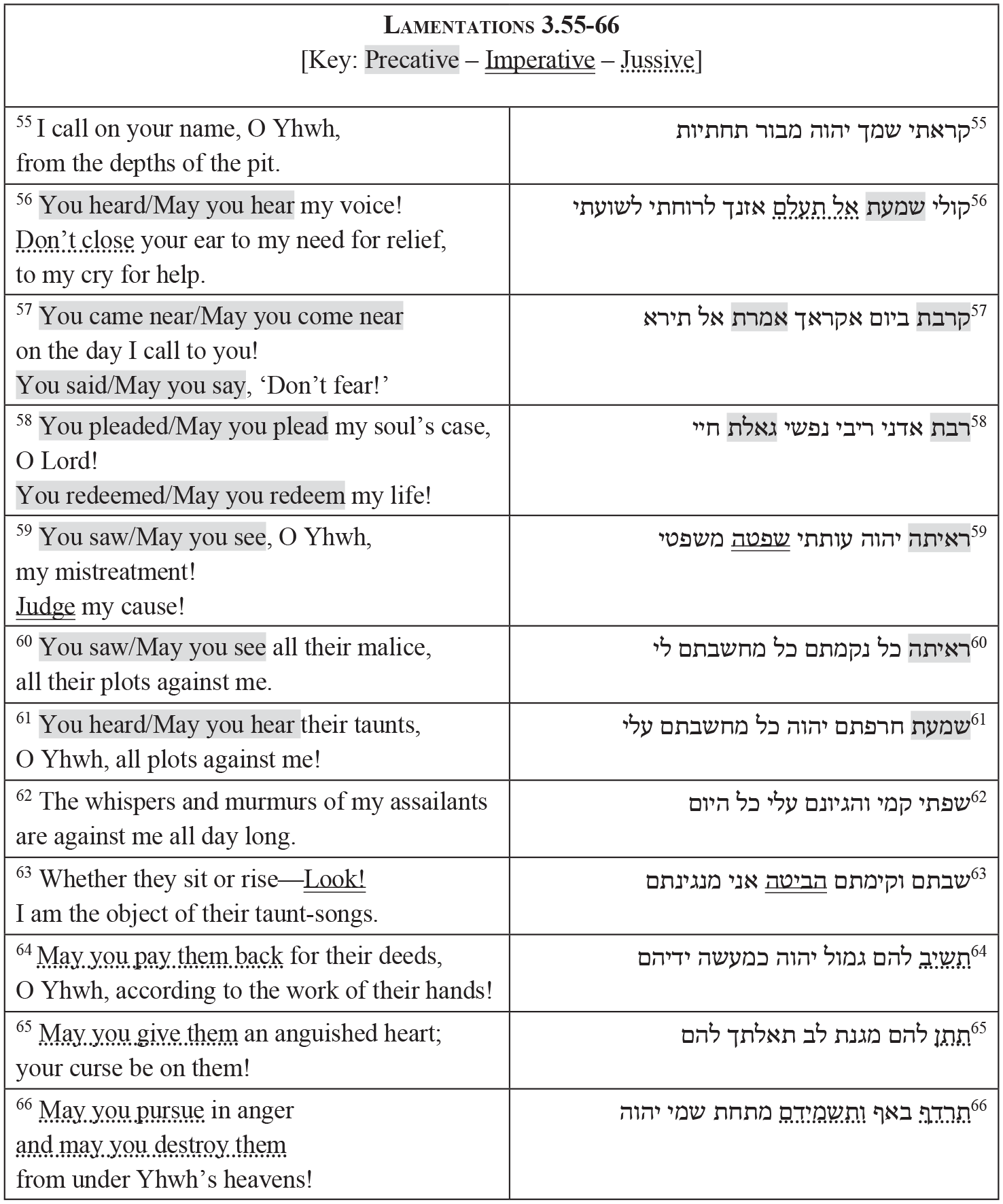
To date, Provan’s 1991 Vetus Testamentum article remains the most thorough defense of the precative hypothesis for Lam. 3. 17 His main objection to the simple past tense view is the lack of obvious extra-verbal cues that would suggest a temporal shift from present suffering to thanksgiving for past deliverance. One option is to view the transition as occurring between v. 58 and v. 59. Provan raises two criticisms: First, ‘it is not a natural reading of the text to break it at this point, differentiating between “You have taken up my cause” in v. 58 and “You have seen the wrong done to me” in v. 59’. 18 Second, Provan notes that in the thought world of ancient Israelites, for God to ‘see’ is synonymous with God ‘acting’. Therefore, if God has seen, it would be the same as saying God has acted to deliver. 19 So, if the speaker actually believes Yhwh ‘has seen’ his current suffering (3.59), it would follow that God has in fact rescued him from it.
But this is obviously not the case, or else the poet would not issue an imperative for God to ‘consider’ (הביטה 3.63; cf. 3.50). Compounding this is the presence of another imperative, שׁפטה, in Lam 3.59. If someone has experienced actual deliverance, then why does there remain a need for Yhwh to ‘judge’ or ‘consider’ the crisis? Wiesmann actually notes this awkwardness and attempts to resolve it by saying there is a past crisis spoken of by Jeremiah (Lam. 3.52-58), to which Zion responds that God has in fact seen (3.59-61) but not yet fully responded and therefore the crisis endures (3.64-66). 20 But the interweaving voices are not so simply unraveled, and we remain without any explicit cues to signal such a solution.
The traditional view also lacks a convincing explanation for 3.56. Traditionally it is translated, ‘You heard [שׁמעת as a simple past perfective] my voice, do not shut [אל־תעלם imperfect, jussive in meaning] your ear to my need for relief, my call for help!’ According to the traditional view, the second sentence occurs in a section about past rescue, yet it occurs here as a plea for present deliverance. This is intelligible, and referencing embedded speech also occurs in Lam. 3.18 and 57. The issue, suggests Provan, is a lack of parallel constructions elsewhere: ‘In no other address to God in the OT of which I am aware, however, is a statement that he has heard (šmʿ) a petition followed by a citation of that petition’. 21 Unique forms are not in and of themselves a problem—we are dealing, after all, with the precative qatal. However, the flow into 3.57 casts further doubt on translating the qatal forms in the simple past: Elsewhere, the phrase ביום אקרא always refers to a present situation, never to the past (Pss. 56.10, 86.7, 102.3). 22
If 3.55-63 represents actual deliverance, why does 3.64-66 return to a present description of threats? Why is Yhwh appealed to again, this time to destroy enemies who are obviously an enduring danger? Provan concludes that ‘only a future reference for the perfect verbs of vv. 56-61 really does them justice’, and suggests that taking the perfects as requests (viz., precatives) removes all these difficulties.
23
As for the perfect verb ‘I call’ (קראתי) in 3.55, we may simply translate statively: ‘I call/am calling’. Hillers and Provan note a similar structure in Ps. 130.1-2 (cf. Pss. 17.6, 88.9, 119.145-46, 141.1):
24
Out of the depths I call you, O Yhwh;
ממעמקים קראתיך יהוה
Adonai, hear my voice!
אדני שמעה בקולי
Let your ears be attentive to the sound
תהיינה אזניך קשבות
of my supplications!
לקול תחנוני
As for Lam. 3.56, Provan points to a similar alternation of moods between imperatives and imperfects in Ps. 102.2-3:
25
O Yhwh, hear my prayer,
יהוה שמעה תפלתי
let my cry for help come to you;
ושועתי אליך תבוא
Do not hide your face from me
אל תסתר פניך ממני
in the day of my distress.
ביום צר לי
Incline your ear to me in the day I call –
הטה אלי אזנך ביום אקרא
answer me swiftly!
מהר ענני
Furthermore, as Figure 2 shows, there is a sequence of intentional echoes throughout Lam. 3.55-66 that reinforce a situation of present suffering and support the precative reading.

All this evidence suggests, at the very least, the plausibility of seeing the qatal verbs in Lam. 3.56-61 as precatives depicting a situation of present distress from which the speaker demands rescue that has not yet occurred.
3. Incorporating Linguistics: A Recent Case for the Precative Qatal
The problem of the precative qatal is rooted in the deeper question of how the biblical Hebrew verbal system behaves in general. When it comes to the qatal, precisely which sense is dominant remains a matter of deep disagreement. While it is uncontested that the suffix conjugation expresses numerous senses, what governs this polysemy? The two most popular theories opt either for a tense or aspect system, though there are of course other approaches that don’t fall neatly into one of those camps. 26 Presently, we will explore one of those alternatives, namely that the perfect value should be formally distinguished from the perfective, and that the former is best explained by what Christo van der Merwe and Alexander Andrason recently referred to as the ‘meta-category’ of taxis. 27 Andrason in particular has offered a fresh argument for the precative qatal by applying an evolutionary approach to the grammar of the biblical Hebrew verbal system. Because Andrason’s work and the linguistic methodology from which he draws have rarely been employed by biblical exegetes, and not at all in studies of Lamentations, I engage here with his proposal in some detail. 28 The hope is that biblicists will incorporate this approach alongside other necessary lines of argumentation, for ultimately the precative qatal in the Hebrew Bible must be decided on a case-by-case basis. 29 Specifically, this evolutionary scheme is based on the insights of cognitive linguistics and draws heavily on grammaticalization and path theories. 30 A brief elucidation of this approach will help contextualize our treatment of the precative qatal and reveal it as cognitively, diachronically, and typologically justifiable and coherent. Though necessarily brief, I hope this overview will whet the appetites of biblical exegetes, and Lamentations scholars in particular, to engage this important subfield of linguistics.
3.1 Verbal Evolution, Grammaticalization, and Path Theory
First, it is important to point out that a primary element in this linguistic approach is the conviction that meaning is embodied and results in what cognitive linguists have called prototype effects.
31
This is the idea that meaning is mentally categorized around prototypical exemplars of a particular class.
32
A classic example comes from George Lakoff, who asks us to consider the English word mother.
33
The prototype of this word seems to denote a woman who conceives, gives birth to, and nurtures a child. But, of course, there are all sorts of mothers: stepmothers, adoptive mothers, birth mothers, surrogate mothers, foster mothers, genetic mothers (egg donors), and so on. Importantly, there is no one feature shared by all these mothers. Laura Janda explains: None of the features of the prototype is necessary or sufficient to define all these people as mothers, since there is no one feature that they all share (a birth mother usually does only the conceiving, gestating and birth, but none of the nurturing, whereas the opposite is true of an adoptive mother; a stepmother is not required to perform biological or nurturing functions—she need only be married to the father). And the category of mother is a dynamic one, showing growth at the periphery in response to fertility technologies and new legal and ethical precedents.
34
So, which mother is the ‘real’ mother? Like any term, meaning is bound up in context: There is no semantic core, a ‘true’ mother from which all mothers derive as they wallow imperfectly in the simulacra. 35 Which type of mother listed above first comes to mind can in fact differ, and therefore we have ‘prototypes’. 36 These can vary widely according to unique experiences as frequently encountered contexts become entrenched in the mind, or more broadly as a language and the society that uses it evolves. The study of words, then, is not an investigation into a lexeme’s ‘semantic core’ but rather a consideration of networks of concepts. When we examine the verbal system of biblical Hebrew, we are not investigating whether the precative usage ‘aligns with’ or ‘transgresses’ the ‘semantic core’ of qatal. Instead, the goal is to understand whether the precative function is cognitively plausible, diachronically explainable, and harmonious with the evolution of the entire biblical Hebrew verbal system.
Grammaticalization theory, put quite simply, is the observation that, over time, frequently used lexemes come to be used more abstractly. More properly, it is ‘the development from lexical to grammatical forms and from grammatical to even more grammatical forms’. 37 A simple English example is the reanalysis and extension of the verb ‘to go’ as a future auxiliary in ‘I am going to buy clothes’, and even further in ‘I’m gonna buy clothes’ > ‘I’mma buy clothes’. Closely wedded to this is path theory, which more narrowly focuses on the functional growth of verbal formations. This approach posits that, cross-linguistically, any given verbal gram can be mapped onto an idealized framework of semantic-functional development. So, a ‘semantically transparent’ periphrastic source (e.g., Proto-Semitic *qatal-PN) develops into ‘untransparent’ grammatical categories such as aspect, relative tense, absolute tense, or mood. Over time, inputs ‘decay’ and lose the original prototypical meaning and eventually disappear altogether or are recycled into new grammatical expressions. Linguists typically recognize four, empirically established major pathways (‘diachronic clines’) that correspond to the formation of aspectual, temporal, and modal categories:
(1) The perfective aspect and past tense (‘the anterior cline’);
(2) The imperfective aspect and present tense;
(3) Moods
(4) The future tense
Importantly, these paths are contextually induced: How a language is actually used determines its evolutionary path. A result of this methodology is that all verbal meanings are expected to be diachronically and cognitively explicable from the original locution. Furthermore, this means that verbal grams should be understood in light of diachronic clines and not inferred from an inherent, abstract ‘core’ meaning. For the present investigation, the anterior and the related sub-clines are most relevant to the precative qatal and will be explored below.
3.2 Diachrony, Synchrony, and Panchrony
This evolutionary approach, while clearly diachronic in orientation, can help explain the synchronic realities of languages. For instance, since grammatical units are located at diverse stages on a grammaticalization path, this illuminates why a single verb form can exhibit a variety of functions. Even though grammatical paths blossom into such diverse values as the present, past, future, and moods, such phenomena cannot be reduced to simple binary oppositions. This has led to one of grammaticalization theory’s most distinctive (and contested) conclusions, namely, panchrony. Any synchronic meaning provided by a gram should reflect the unidirectional and successive diachronic stages laid out in path theory. That is, every function of a given gram can be mapped with the determined phases of a particular path. In our case, this means mapping the precative function of the qatal onto the empirically established anterior path, revealing it as cognitively, typologically, and diachronically coherent. Andrason explains further how a form like the qatal could display highly diverse, even contradictory, functions: Due to its global perspective, the panchronic method enables us to embrace all synchronically incompatible or highly heterogeneous functions of a construction and explain them as a homogenous manifestation of a given diachronic path. Put differently, the gram which from the synchronic perspective is an amalgam of random functions that cannot be reduced to one clear and unique aspectual, temporal, taxis, or modal value, may be understood as a prototypical homogenous diachrony (a path) and thus, as a realization of a single linguistic input.
38
The panchronic methodology, then, aims to re-describe synchronic grams in terms of dynamic trajectories; portray the grammar as part of broader cognitive processes; and incorporate synchronic empirical data collection, followed by a panchronic hypothesis, and verified by diachronic-comparative corroboration. 39
To summarize thus far: We must recognize that (1) the semantic potential of a verbal gram is an amalgam of meanings from earlier stages along its evolutionary path; (2) though we may classify more frequent meanings as ‘prototypical’, and rare meanings as ‘peripheral’, all such meanings are equally relevant and viable and dependent upon usage-in-context; 40 (3) a given form should be probed for its ‘semantic potential’ rather than its ‘core meaning’; (4) the entire system is inherently emergent, the ‘active co-evolution of various trajectories’ that is comparable to a dynamic biological model, or chaos theory; 41 and (5) paths should be determined by the panchronic methodology. 42
3.3 The Precative Qatal in Biblical Hebrew
We may now ask how the precative qatal fits within the biblical Hebrew verbal system. This form, a ‘real factual optative’, corresponds to the English imperative, or to an optative periphrasis with the auxiliary may. The most important contextual markers often proposed for the precative qatal include:
(a) When it is introduced by or alternated with an overt deontic form, i.e., an imperative (e.g., Ps. 22.22)
(b) When it is introduced by or alternated with a deontic modal yiqtol (e.g., Ps. 31.5-6)
(c) When it occurs with weak modal particles 43
(d) The so-called “independent” precative, no heading by any overt modal optative or deontic form, but recognized solely by genre or context (e.g., Ps. 116.16)
(e) When the rhetorical logic seems to make better sense (e.g., Lam. 3:56-61)
(f) The most common (but not exclusive) usage is directed to the second person singular (usually the deity), and it seems to occur more often, if not exclusively, in poetry. 44
Three exemplary cases will suffice: 45

As for Lamentations 3.56-61, the precative forms fulfill all but one of the typical contextual markers and seem a prime candidate. 46 However, even if we find such examples reasonably compelling, we still need to ask how they are linguistically possible. The qatal clearly functions prototypically as an indicative perfect or perfective past—is it even coherent to propose it could likewise express wishes and orders in the present or future? How is it that an originally indicative input can acquire modal meanings?
There is widespread agreement that the biblical Hebrew suffix conjugation is the successor of a Proto-Semitic resultative verbal adjective employed in a predicative function, viz., Proto-Semitic *qatal(a)–PN (Figure 3). 47 Keeping in mind the contextually determined paths for grammaticalization, this form would inevitably be employed in various modal contexts. As shown above, the optative value is heavily determined by external factors: determined particles, proximity of modal lexemes and/or deontic verbal forms, genre considerations (e.g., prayers, curses), and so on. The precative sense of the qatal is therefore highly deictic and constitutes a ‘modal contamination’ of a non-modal Proto-Semitic input.

The modal contamination path contains various stages, and we may view the precative qatal as simply a synchronic snapshot of this diachronic process. This helps explain the typologically common indicative-optative split of post-resultative grams. In other words, many cross-linguistic examples have been put forth of verbal forms that—despite prototypical perfect, perfective, and past usage—may be used with strong imperatival or optatival force referring to a present or future state of affairs. 48 The proposed evolutionary behavior of the biblical Hebrew precative qatal (and its Semitic counterparts) is far from linguistically unique.
The precative qatal, then, corresponds to an extremely early stage of the post-resultative cline, acquiring its modal nuance from the primitive taxis stages available on the anterior path. Specifically, the precative value should be located between the resultative proper and resultative perfect stages on the anterior cline, in close proximity to the inclusive perfect but modally contaminated with deontic value. As represented in Figure 4, within the very early stages of the anterior cline, the semantic potential of the qatal could be exploited in explicitly modal contexts to acquire precative force.

Given all the above, then, the biblical Hebrew precative qatal is cognitively, diachronically, and typologically justifiable and coherent. 50 It is also worth noting that a very similar case can be made for the development of the weqatal, the ‘long’ yiqtol, and the ‘short’ yiqtol (i.e., jussive): 51
As seen in Figures 4–6, in each situation we have an originally resultative-proper indicative input acquiring modal meanings. It is uncontroversial to recognize the modal senses of the weqatal and yiqtol, and if one is willing to accept these forms one should also be prepared to accept the precative qatal hypothesis.


4. Incorporating Textual Performance
At the beginning of Provan’s precative article, he quotes the fifth edition (1844) of Ewald’s Hebrew grammar, in which the latter claims that ‘nothing but the livelier color of speech’ may distinguish the precative sense. 55 The overstatement notwithstanding, Ewald’s remarks were rather prescient: In our textually saturated culture, the informing orality of ancient texts is difficult to appreciate. This last section aims to make a simple point: If we read Lam 3.55-66 with our ears attuned to its oral actualization, the precative hypothesis becomes all the more plausible.
The field of performance criticism calls for a sustained attention to the oral-performative realities of biblical literature. 56 For our purposes, the study of nonverbal communication is also relevant. Research suggests that 60-65% of social meaning is generated by various nonverbal cues such as: (1) kinesics (bodily cues, facial expressions; eye behavior is sometimes a separate category—oculesics); (2) physical appearance; (3) olfactics (codes of smell like incense, oils, perfume); (4) vocalics (changes in voice—tone, rhythm, etc.); (5) proxemics (codes of space and proximity); (6) haptics (codes of touch); (7) chronemics (codes of time); and (8) environmental features (given or contrived). 57
Among recent offerings, of note is F. W. Dobbs-Allsopp’s intensive study of Hebrew poetry. Though not explicitly informed by a performance-critical method, he offers a lengthy chapter on orality. 58 Kelly Wilson also completed a dissertation on a performance-critical analysis of Lamentations, and her work is full of many helpful insights which I aim to expand. 59 It is hoped that the following comments can serve as a small step towards a thicker description of the ANE performative context of Lamentations. In this final section, I will advance a two-pronged argument. First, we will briefly explore the performative aspects of first millennium BCE Mesopotamian laments written in the Sumerian Emesal register, namely, the balag, ershemma, and ershaḫunga. Instead of repeating arguments for a literary relationship between these texts and Lamentations, I will argue for a ‘performance relationship’. That is, I submit that a description of Mesopotamian performances of Emesal prayers should inform and expand our historical reconstructions for how Lamentations might have been performed. Second, an overview of the oral-performative dimensions of Lamentations will be offered in order to strengthen a preference for the precative qatal in Lam. 3.56-61.
4.1 Orality and Textuality in Balags, Ershemmas, and Ershaḫunga
In the ancient Near East, texts were often perceived as aides-mémoire, with the goal of substantially buttressing, not replacing, orality—to memorialize in writing a living oral tradition. This is not to claim that behind every text one may uncover an originally oral composition. With Konrad Schmid (following Rendtorff) we can posit that portions of the Hebrew Bible were ‘written by scribes for scribes’. 60 In fact, while most Sumerian Emesal tablets were written ‘for singing’ or ‘for recitation’, in some colophons texts are explicitly designated ‘for reading, viewing’. 61 In her dissertation on Lamentations, K. Wilson rightly mentions the importance of balags and ershemmas, but unfortunately—in a project devoted to performance criticism—restricts her analysis to the literary and generic relationship between those texts and Lamentations and discusses only in passing the Mesopotamian performance of such texts. 62
Several scholars have sought to demonstrate a generic, and potentially literary, relationship between the six extant Mesopotamian city laments, the balag, the ershemma, and Lamentations. 63 These works emphasize the destruction of cities and temples, and similar to Lamentations, some of these works might have originated as commemorative texts in the wake of concrete events. But especially in the case of balags and ershemmas—whose literary relationship to the much earlier city lament is admittedly quite complex 64 —they became thoroughly decontextualized and were performed in the regular temple cult. We should also include the Emesal individual lament known as the ershaḫunga, rarely discussed in Lamentations studies.
We have numerous descriptions of how these compositions were performed. 65 The genres date back to Old Babylonian times, but the majority of extant texts come from the first millennium BCE. 66 Ritual instructions often prescribe a performance of all three genres. The current evidence suggests that the recitation of the ershaḫunga was exclusively connected to the king (or a ‘substitute-king’). Explicit direction for the monarch to recite an ershaḫunga occurs in some ritual texts, though if the king wasn’t present the kalû (cult singer; Sumerian gala) took over recitation and did so ‘over’ the king’s garments. In order to ‘humble’ the king before the gods, sometimes his hands were bound and his crown removed, and different texts describe various postures for the king at different intervals during the performance of texts (e.g., sitting, standing, prostration). Performative actions taken by the kalû include: change of clothing; uncovering the head or tearing his linen garment; beating the chest; sitting or prostrating himself. Other general performative actions or actors mentioned include processions, acrobats, wrestlers, and various offerings and libations. Some balags were even specified to be performed not from the beginning but instead at a designated section. 67
The raison d’être of these works was to appease an angry deity. Typically, the intercession involved three elements: 68 (1) The presence of the gala—a Sumerian term that possibly refers to intersex individuals and/or eunuchs—who were perceived to inhabit a special ontological interval between humans and deities. 69 (2) The playing of the musical instrument (balag̃), the pleasing sound of which soothes the deity. (3) The actual linguistic content of the prayer, which in the closing ‘heart pacification unit’ explicitly asks the god to calm down. Ershaḫungas attribute personal suffering due to sin, but oftentimes the specific sin remains unknown—an ambiguity often noted in Lamentations. 70
In summary, we can offer the following observations: If Emesal prayers belong to the same general literary milieu as Lamentations, then it is plausible they shared performative aspects as well. 71 This is not an attempt to specify the particulars of a performance of Lamentations, but rather to enlarge our imagination and nuance our reading as to the general types of performance that most certainly did take place with these poems. The mixing of balags, ershemmas, and ershaḫungas in a performative setting might also shed light on the curious mixture of poetic genres throughout Lamentations. Balags were often performed by more than one singer, and some performative indications might be applicable to choral performance; this parallels the frequent shifting of personifications throughout Lamentations. Furthermore, the connection of the king with ershaḫungas is strikingly analogous to the singular male personification and royal overtones in Lam. 3. 72 Finally, the fact that performative indications are only present in Late Babylonian texts may reflect a fear of losing touch with the vocalized performing tradition—a phenomenon clearly witnessed in, e.g., the Masoretic tradition.
4.2 Towards a Performative Contextualization of Lamentations
In comparison to the Mesopotamian evidence, explicit discussion of textual performance among ancient Hebrew literature is quite meager. Still, there are enough clues to sketch a rough picture of the interplay between orality and textuality for the Hebrew Bible, and especially Lamentations.
The purely consonantal nature of the old Hebrew script required active vocalization in order to render concrete meaning. 73 While both final and internal matres can be increasingly found in Hebrew inscriptions from the late ninth to early sixth centuries, 74 it is often argued that reading the old Hebrew script was quite difficult for most literate consumers unless one had prior knowledge of the text. One of the biblical Hebrew idioms for the ability to read, after all, is ספר + ידע ‘to know the document’ (Isa. 29.11-12). 75
The acrostic poems of Lamentations are an excellent example of this interplay. Modeled after abecedaries, the acrostic works primarily on the eyes (an actual ‘reader’) instead of the ears since the phonemic inventory of biblical Hebrew is not restricted to twenty-two characters. The acrostic undoubtedly operated also as a mnemonic device. Alongside parallelism, word play, rhyme scheme, etc., these may all greatly assist in the performance of a text, and the acrostic is therefore not indicative of a purely literary text. 76 In Lamentations, then, the medium simultaneously provides visual pleasure to the literate reader through the acrostic trope and aural pleasure afforded to the listener through techniques like euphony (the /ay/ sound through Lam. 1.15), internal rhyme (1.10), alliteration (3.52), and much more. Enjambment—affecting over two-thirds of the couplets in Lamentations—would undoubtedly be performed to great effect. 77
The historical setting of Lamentations also reveals performative contexts. Most place the bulk of the composition in the aftermath of Jerusalem’s destruction in 586 BCE. The most prominent genres in the poems are the communal lament, the individual complaint, and the qinah. The actual public performance of the qinah is shrouded in mystery, but it seems clear that it was a well-established genre of poetry used for public mourning. On that broader score, consider Jeremiah 41.5, which records that in the time of Gedaliah eighty men came from Shechem, Shiloh, and Samaria in a state of mourning—shaven beards, torn garments, and gashes on their bodies—to bring offerings to ‘the house of Yhwh’. Zechariah 7.5 testifies to the persistence of ritual, communal fasting throughout the sixth century, and this would have been accompanied by other outward signs of mourning: wearing sackcloth, smearing ashes on the head, sitting on the ground, abstaining from sex, and so on.
Within Lamentations, the addressees shift throughout, but there is an internal sense that the complaints take place in the public square (e.g., Lam. 1.1-11), and this gives us a hypothetical, performative audience. Hans-Joachim Kraus imagined the shifting personifications throughout Lamentations as evidence of a ‘performing cult act’ (darstellende Kulthandlung). 78 It is quite feasible that, as indicated in Jer. 37-43, at least some members of the priestly class remained in exilic Judah and continued some form of cult worship, however rudimentary, either in the remaining portions of the city or at various cultic sites in its environs. Among the plausible social contexts for the earliest poetic recitations, the local evening assembly (סוד) is a possibility. 79 It has also been suggested that Lamentations was composed on the occasion of the rebuilding of the temple; 80 however, both the dating of the poems and genre considerations speak against this. 81 Still, it seems reasonable to assume that the realities of public, oral performance played a vital role in its use. The remarkable fact that, canonically, Lamentations has undergone recontextualization to the point of decontextualization opens a vista of nearly endless performative possibilities. Especially as we move into the Persian and Hellenistic periods, there were myriad other contexts in which the editing and performance of the poems of Lamentations could have been undertaken. Indeed, among the DSS fragments of Lamentations, the acrostic stichography (3QLam, 5QLamb), vacats (5QLama), and the paleo-Hebrew tetragrammaton (3QLam; cf. 1QS 6.27-7:2) may all be read as oral-performative indicators. 82
5. Conclusion
While we may lack a definitive answer as to why and how Lamentations was composed and used, the poems bespeak orality and nonverbal performance cues associated with public mourning. The audience would have experienced a performance of these poems as both an aural and visual feast, irrespective of reading knowledge, and all of this would greatly assist in the oral actualization of the precative qatals in Lam. 3.55-66.
The payoff of this observation for exegeting Lamentations extends well beyond Lam. 3.56-61. Consider the beginning of Lam. 3, where the poet’s miserable state lasts until 3.42a. Already oral performance plays a crucial role: How do we account for the harsh shift from complaint to theodicy? If we take into account the possibility of dramatic performance, as the orator approaches 3.22, one simply needs to adjust tone, or add in a pregnant pause, change posture, perhaps wash one’s face of ashes, and so on. The paratactic outburst of 3.42b—‘…but you have not forgiven!’—marks a clear shift back to complaint that lasts until (at least) 3.54, and this may be explained in the same way. The orator could effectively reach a rapturous crescendo throughout 3.22-42a, and as the jarring transition approaches, adjust tone, pacing, posture, facial expressions, etc. These simple adjustments in performance clarify the transitions between 3.21-22 and 3.42a-42b. What seems so strange in our unvocalized text is in fact a powerful rhetorical tool in the hands of a capable orator.
The same performative approach may be applied to the transition from 3.54-55: With a final line of defeated complaint—‘Water closed over my head; I thought, “I’m finished”’ (3.54)—the orator could capitalize on this momentum and utilize ‘rhetorical enjambment’ (if you like) to ‘flow’ into a section of poetic pleas. The mix of verbal forms—performative qatal, precative qatal, jussive, imperative—are significantly clustered and provide varied texture for the desperate requests. The use of /tā/ and /tām/ endings occurs seventeen times in just eight verses, and by exploiting the repetition and rhythm a sense of forward movement is intensified through the poet’s rhymed speech. 83 Much more could be said about the exegetical payoff, but it is hoped the present essay will suffice to fuel future performative exegesis in biblical Hebrew poetry.
The precative hypothesis allows us to experience all of 3.42b-66 as a seamless final section, resulting in a threefold movement throughout Lamentations 3 where the central hope is buffeted on either side by distress: (i) 3.1-21 Complaint; (ii) 3.22-42a Theodicy; (iii) 3.42b-66 Complaint/Petition. 84 In terms of oral performance it is no more difficult to imagine a heavy reliance on nonverbal cues in the transition from Lam. 3.1-21 to 3.22-42a than the precatives in 3.55-66. While morphologically identical to the indicative sense, the precative qatal could, like any spoken language, be easily distinguished and communicated through a combination of tone, pacing, posture, context, and much more. This all fits very well within a poetic register. The original pronunciation of the precative qatal remains unclear, but an orator could have easily indicated it through vocal pitch, unique accentuation, or both. Far from risking confusion or diluting the rhetorical punch, by mixing this form with the clear imperatives and jussives, complex layers of nuance are added. Lamentations 3 is full of rhetorical contours that demand prosodic sensitivity for a worthy performance. Given the linguistic, rhetorical, and performance-critical clues, we should view the oral actualization of the precative qatal throughout 3.56-61 as a formal interpretative possibility.
Footnotes

1.
C. W. Miller, ‘The Book of Lamentations in Recent Research’, CBR 1 (2002), pp. 9-29; Heath A. Thomas, ‘A Survey of Research on Lamentations (2002-2012)’, CBR 12 (2013), pp. 8-38.
2.
Artur Weiser, Klagelieder (Göttingen: Vandenhoeck & Ruprecht, 1958), pp. 76-77, 87-91; Hans-Joachim Kraus, Klagelieder (Threni), 3rd ed. (Neukirchen-Vluyn: Neukirchener Verlag, 1968), pp. 53-59; Otto Kaiser, Klagelieder, in Helmer Ringgren, Walther Zimmerli, and Otto Kaiser, Sprüche, Prediger, Das Hohe Lied, Klagelieder, Das Buch Esther, 3rd ed. (Göttingen, 1981), pp. 349-51, 357-58; F. B. Huey, Jr., Jeremiah, Lamentations (Nashville: B&H, 1993), pp. 477-78; Kathleen O’Connor, Lamentations & The Tears of the World (Maryknoll, NY: Orbis Books, 2002), pp. 55-56; Robin A. Parry, Lamentations (Grand Rapids, MI: Eerdmans, 2010), pp. 90-91, 120-26; Klaus Koenen, Klagelieder (Threni) (Neukirchen-Vluyn: Neukirchener Verlag, 2016); Christian Frevel, Die Klagelieder (Stuttgart: Verlag Katholisches Bibelwerk, 2017).
3.
Bertil Albrektson, Studies in the Text and Theology of the Book of Lamentations: With a Critical Edition of the Peshitta Text (Lund: Gleerup, 1963), p. 163; Johan Renkema, Lamentations (Leuven: Peeters, 1998), pp. 448-73.
4.
August Müller, Zeitschrift für die gesammte lutherische Theologie und Kirche, eds. Franz Delitzsch and Heinrich Guericke (Leipzig, 1877), p. 201; cited in Max F. Rogland, Alleged Non-Past Uses of Qatal in Classical Hebrew (Assen: Van Gorcum, 2003), p. 132.
5.
Iain Provan, ‘Past, Present and Future in Lamentations III 52-66: The case for a Precative Perfect Re-examined’, VT 41 (1991), pp. 164-75 (quoting p. 165); see also idem, Lamentations (Grand Rapids, MI: Eerdmans: 1991), pp. 105-9.
6.
Those who reject the Hebrew precative qatal include: S. R. Driver, A Treatise on the Use of the Tenses in Hebrew and Some Other Syntactical Problems (Oxford: Clarendon, 1892); GKC §106; Carl Brockelmann, Grundriss der vergleichenden Grammatik der semitischen Sprachen: Bd., 2: Syntax (Berlin: Reuther & Reichard, 1913), §16b; Gotthelf Bergsträsser, Hebräische Grammatik (2 vols; Leipzig: Vogel, 1918 and 1929). Recent scholars include Rogland, Alleged Non-Past Uses of the Qatal; and John A. Cook, Time and the Biblical Hebrew Verb: The Expression of Tense, Aspect, and Modality in Biblical Hebrew (Winona Lake, IN: Eisenbrauns, 2012), p. 250 n. 87.
7.
Alexander Andrason, ‘An Optative Indicative? A Real Factual Past? Towards a Cognitive-Typological Approach to the Precative Qatal’, JHebS 13/4 (2013), pp. 1-41 (quoting p. 3).
8.
Wilhelm M. L. de Wette, Kommentar über die Psalmen (Heidelberg: Mohr und Zimmer, 1811), p. 122; Georg H. A. Ewald, Ausführliches Lehrbuch der hebräischen Sprache des Alten Bundes, 5th ed. (Leipzig: Hahn, 1844), p. 501; Friedrich Böttcher, Ausführliches Lehrbuch der hebräischen Sprache (Leipzig: J. A. Barth, 1868), pp. 149, 159-60; Friedrich E. König, Historisch-kritisches Lehrgebäude der hebräischen Sprache, Bd. 3 (Leipzig: J. C. Hinrichs, 1897), §173; Andrew B. Davidson, Hebrew Syntax (Edinburgh: T&T Clark, 1902), p. 63; Paul Joüon and Takamitsu Muraoka, A Grammar of Biblical Hebrew (Rome: Gregorian & Biblical, 2011 [1923]), pp. 336-37; Mayer Lambert, ‘Du passé optatif en hébreu’, REJ 80 (1925), pp. 218-19; Israel Eitan, ‘Hebrew and Semitic Particles—Continued: Comparative Studies in Semitic Philology’, AJSL 46 (1929), pp. 22-51; G. R. Driver, Problems of the Hebrew Verbal System (Edinburgh: T&T Clark, 1936); Harold L. Ginsberg, ‘The Rebellion and Death of Baʻlu’, Or 5 (1936), pp. 161-98; Moses Buttenwieser, The Psalms: Chronologically Treated with a New Translation (Chicago: University of Chicago Press, 1938), p. 21; Frithiof Rundgren, Intensiv und Askpektkorrelation: Studien zur äthiopischen und akkadischen Verbalstammbildung (Uppsala: Uppsala Universitets Årsskrift, 1959); William L. Moran, ‘The Hebrew Language in Its Northwest Semitic Background’, in G. E. Wright (ed.), The Bible and Ancient Near East: Essays in Honor of William Foxwell Albright (New York: Doubleday, 1961), pp. 54-72; Mitchell Dahood, Psalms, 3 vols. (Garden City: Doubleday, 1965-1970; idem, ‘Ugaritic-Hebrew Syntax and Style’, UF 1 (1969), pp. 15-36; Anton C. M. Blommerde, Northwest Semitic Grammar and Job (Rome: Pontifical Biblical Institute, 1969), p. 79; James A. Hughes, ‘Another Look at the Hebrew Tenses’, JNES 29/1 (1970), pp. 12-24; T. L. Fenton, ‘The Hebrew ‘Tenses’ in the Light of Ugaritic’, in Proceedings of the Fifth World Congress of Jewish Studies (Jerusalem: Union of Jewish Studies, 1973), pp. 4.31-39; Ronald S. Hendel, ‘In the Margins of the Hebrew Verbal System: Situation, Tense, Aspect, Mood’, ZAH 9 (1996), pp. 152-81; Hans-Peter Müller, ‘Zu den semitisch-hamitischen Konjugationssystemen’, ZAH 11 (1998), pp. 140-52; Josef Tropper, ‘Althebräisches und semitisches Aspektsystem’, ZAH 11 (1998), pp. 153-90; Andy Warren, ‘Modality, Reference and Speech Acts in the Psalms’ (PhD diss., Cambridge University, 1998), pp. 145-209; T. David Andersen, ‘The Evolution of the Hebrew Verbal System’, ZAH 13 (2000), pp. 1-66; Hélène Dallaire, The Syntax of Volitives in Biblical Hebrew and Amarna Canaanite Prose (Winona Lake, IN: Eisenbrauns, 2014), pp. 141-42.
9.
IBHS, pp. 494-95.
10.
Christo H. J. van der Merwe, Jackie A. Naudé, and Jan H. Kroeze, A Biblical Hebrew Reference Grammar (New York: T&T Clark, 2017), p. 160.
11.
For numerous references in addition to the material in n. 8, see especially Amikam Gai, ‘The Connection between Past and Optative in the Classical Semitic Languages’, ZDMG 150 (2000), pp. 17-28.
12.
Provan, ‘Past, Present and Future’, pp. 165-66.
13.
Parry, Lamentations, pp. 120-24; Federico Villanueva, The ‘Uncertainty of a Hearing’: A Study of the Sudden Change of Mood in the Psalms of Lament (Leiden: Brill, 2008), pp. 238-41.
14.
Hermann Wiesmann, Die Klagelieder: Übersetzt und erklärt (Frankfurt am Main: Philosophisch-theologische Hoschule Sankt Georgen, 1954), p. 194; Wilhelm Rudolph, Das Buch Ruth, Das Hohe Lied, Die Klagelieder, 2nd ed. (Gutersloh: Gern Mohn, 1962), pp. 236-37; Helmut Lamparter, Das Buch der Sehnsucht, Das Buch Ruth, Das Hohe Lied, Die Klagelieder (Stuttgart: Calwer, 1962), p. 171; Robert Gordis, ‘Commentary on the Text of Lamentations (Part Two) ’, JQR 58 (1967), pp. 26-27; idem, The Song of Songs and Lamentations, rev. ed. (New York: Ktav, 1974), pp. 170-71; Delbert R. Hillers, Lamentations: A New Translation with Introduction and Commentary, rev. ed. (Garden City: Doubleday, 1992), pp. 117-19; Hans Gottlieb, A Study on the Text of Lamentations (Århus: Århus Universitet, 1978), pp. 57-60. We should also add Thomas F. McDaniel, ‘Philological Studies in Lamentations, II’, Bib 49 (1968), pp. 199-220.
15.
W. Lemke, ‘Lamentations’, in W. Meeks (ed.), The HarperCollins Study Bible: New Revised Standard Version (New York: HarperCollins, 1993), p. 1217; John M. Bracke, Jeremiah 30-52 and Lamentations (Louisville: Westminster John Knox, 2000), pp. 224-25; Paul M. Joyce, ‘Lamentations’, in John Barton and John Muddiman (eds.), The Oxford Bible Commentary (Oxford: Oxford University Press, 2001), p. 531; Adele Berlin, Lamentations: A Commentary (Louisville: Westminster John Knox, 2002), pp. 83, 97; F. W. Dobbs-Allsopp, Lamentations (Louisville, Westminster John Knox, 2002), pp. 126-28; Archie Chi Chung Lee, ‘Mothers Bewailing: Reading Lamentations’, in Caroline Vander Stichele and Todd C. Penner (eds.), Her Master’s Tools? Feminist and Postcolonial Engagements of Historical-Critical Discourse (Atlanta: SBL, 2005), pp. 195-210; Elizabeth Boase, Fulfilment of Doom? The Dialogic Interaction between the Book of Lamentations and the Pre-exilic/Early Exilic Prophetic Literature (New York: T&T Clark, 2006); Jerry A. Gladson, ‘Postmodernism and the Deus absconditus in Lamentations 3’, Bib 91 (2010), pp. 321-34; Heath A. Thomas, Poetry and Theology in the Book of Lamentations: The Aesthetics of an Open Text (Sheffield: Sheffield Phoenix, 2013), pp. 198-204; Walter C. Bouzard, ‘Boxed by the Orthodox: The Function of Lamentations 3.22-39 in the Message of the Book’, in LeAnn Snow Flesher et al. (eds.), Why?…How Long? Studies on Voice(s) of Lamentation Rooted in Biblical Poetry (New York: T&T Clark, 2014), pp. 68-82; Miriam J. Bier, ‘Perhaps There is Hope’: Reading Lamentations as a Polyphony of Pain, Penitence, and Protest (New York: T&T Clark, 2015), pp. 130-32. See also CEB.
16.
Parry, Lamentations, pp. 123-24; similarly, Renkema, Lamentations, pp. 451-52.
17.
Heath Thomas (Poetry and Theology, pp. 198-203) has also recently rehearsed and nuanced Provan’s arguments.
18.
Provan, ‘Past, Present and Future’, p. 169.
19.
Ibid., p. 169.
20.
Wiesmann, Die Klagelieder, pp. 197-98.
21.
Provan, ‘Past, Present and Future’, p. 171.
22.
Ibid., p. 171.
23.
Ibid., p. 172.
24.
Hillers, Lamentations, p. 118; Provan, ‘Past, Present, and Future’, p. 172.
25.
Provan, ‘Past, Present and Future’, p. 174. Cf. Tg. Lam. at 3.56, ‘My prayer you received at that time, so do not cover your ear now, in order not to receive my prayer, to give me respite because of my plea’.
26.
For tense, see e.g., Rogland, Alleged Non-Past Uses of Qatal; O. Cohen, The Verbal Tense System in Late Biblical Hebrew Prose (Winona Lake, IN: Eisenbrauns, 2013). For aspect, see e.g., Waltke & O’Connor, IBHS; Cook, Time and the Biblical Hebrew Verb.
27.
Alexander Andrason and Christo H. J. van der Merwe, ‘The Semantic Potential of Verbal Conjugations As a Set of Polysemous Senses: The Qatal in Genesis’, HS 56 (2015), pp. 71-88.
28.
In addition to the already cited ‘An Optative Indicative?’, see esp. Andrason’s following articles: ‘The Panchronic Yiqtol: Functionally Consistent and Cognitively Plausible’, JHebS 10/10 (2010), pp. 1-63; ‘Making It Sound—Performative Qatal and Its Explanation’, JHebS 12/8 (2011), pp. 1-58; ‘The Biblical Hebrew Verbal System in Light of Grammaticalization: The Second Generation’, HS 52 (2011), pp. 19-51; ‘The BH Weqatal: A Homogenous Form with No Haphazard Functions’, Two Parts, JNSL 37/2 (2011), pp. 1-26 and 38/1 (2012): 1-30; ‘The Dynamic Short Yiqtol’, JSem 21/2 (2012), pp. 308-39; ‘The Gnomic Qatal’, Orientalia Suecana 61 (2012), pp. 5-53; ‘Against Floccinaucinihilipilification of the Counterfactual Sense of the BH Suffix Conjugation—Or an Explanation of Why the ‘Indicative’ Qatal Expresses Conditions, Hypotheses and Wishes’, OTE 26 (2013), pp. 20-56; ‘Future Values of the Qatal and Their Conceptual and Diachronic Logic: How to Chain Future Senses of the Qatal to the Core of Its Semantic Network’, HS 54 (2013), pp. 7-38; ‘Toward the Ocean of the Biblical Hebrew Verbal System’, FO 52 (2015), pp. 15-36; ‘The Complexity of Verbal Semantics—An Intricate Relationship Between Qatal and Wayyiqtol’, JHebS 16/4 (2016), pp. 1-94.
29.
See esp. Warren, ‘Modality, Reference and Speech Acts in the Psalms’, pp. 145-209; IBHS, pp. 494-95.
30.
Joan Bybee, Revere Perkins, and William Pagliuca, The Evolution of Grammar: Tense, Aspect and Modality in the Languages of the World (Chicago: University of Chicago Press, 1994).
31.
For an orientation to cognitive linguistics specifically for biblical scholars, see Ellen van Wolde, Reframing Biblical Studies: When Language and Text Meet Culture, Cognition, and Context (Winona Lake, IN: Eisenbrauns, 2009).
32.
Dirk Geeraerts, ‘Prototype Theory: Prospects and Problems of Prototype Theory’, in Dirk Geeraerts (ed.), Cognitive Linguistics: Basic Readings (New York: de Gruyter, 2006), pp. 141-66.
33.
George Lakoff, Women, Fire, and Dangerous Things: What Categories Reveal about the Mind (Chicago: University of Chicago Press, 1987), pp. 74-84. I was first drawn to this example by Laura A. Janda, ‘Cognitive Linguistics in the Year 2015’, Cognitive Semantics 1 (2015), pp. 131-54.
34.
Janda, ‘Cognitive Linguistics’, p. 136.
35.
Dirk Geeraerts, Theories of Lexical Semantics (Oxford: Oxford University Press, 2010), pp. 203-22.
36.
Lakoff’s ‘prototype mother’ example is not without detractors. See especially, Anna Wierzbicka, ‘‘Prototypes Save’: On the Uses and Abuses of the Notion of “Prototype” in Linguistics and Related Fields’, in Savas L. Tsohatzidis (ed.), Meanings and Prototypes: Studies in Linguistic Categorization (London: Routledge, 1990), pp. 347-67. In response, cf. Joseph Hilferty, ‘Mothers, Lies, and Bachelors: A Brief Reply to Wierzbicka (1990)’, Word 48 (1997), pp. 51-59.
37.
Bernd Heine and Tania Kuteva, World Lexicon of Grammaticalization (Cambridge: Cambridge University Press, 2002), p. 2. Cf. Olga Fischer, ‘Grammaticalization as Analogically Driven Change?’, View[Z] 18/2 (2009), pp. 3-32.
38.
Andrason, ‘The Panchronic Yiqtol’, p. 19.
39.
Andrason notes that panchrony ‘is a combination of diachrony and synchrony but not a reduction or deduction of the former to the latter’ (‘The Panchronic Yiqtol’, p. 19 n. 27, his emphasis).
40.
On frequency within a limited corpus, see Andrason and Van der Merwe, ‘The Semantic Potential’.
41.
Alexander Andrason, ‘Grammaticalization Paths and Chaos: Determinism and Unpredictability of the Semantic Development of Verbal Constructions’, Three Parts, Studia Linguistica Universitatis Iagellonicae Cracoviensis 133 (2016): pp. 245-57, 319-35; and 134 (2017), pp. 53-66.
42.
Andrason, ‘The Second Generation’, p. 50. For further discussion see Andrason, ‘Toward the Ocean’, pp. 15-36.
43.
See the many examples and discussion in Warren, ‘Modality, Reference and Speech Acts’, pp. 87-100, 145-209.
44.
The common phenomenon of Tense-Aspect-Mood (TAM) alternation in biblical Hebrew poetry is a well-known issue; for Buttenwieser (Psalms, pp. 18-25), Dahood (Psalms I, p. 20), and IBHS (pp. 494-95), this common TAM alternation in close proximity to second person qatal forms was believed to be the most reliable indicator of the precative function. However, it is better to consider a cumulative case than to be overly focused on only one phenomenon. For a recent attempt at describing verbs used in biblical Hebrew poetry as a coherent system rather than a free-for-all of poetic license, see Gino Johnny Kalkman, ‘Verbal Forms in Biblical Hebrew Poetry: Poetic Freedom or Linguistic System?’ (PhD diss., Vrije Universiteit, 2015).
45.
Other commonly cited examples include Pss 4.2; 10.15-16; 22.22: 57.7; 71.13; Isa 26.15; 43.8-9; Job 21.16, 18. A few text-critical situations also potentially reflect scribal confusion of this rare form. First, Micah 1.10 ketiv התפלשתי (qere התפלשי) should probably be read as a precative qatal second fem. sg., ‘In Beth Leaphrah, roll yourself in the dust!’ (cf. Mic 4.13; Jer 2.20, 27, 33, 34; 3.4, 5; 4.19; 15.10; 31.21; 46.11). Second, יאל hiphil in the synoptic prayers of 2 Sam 7.29 (imperative)//1 Chr 17.27 (precative).
46.
Criteria (c): there are no modal particles.
47.
John Huehnergard, ‘Stative, Predicative Form, Pseudo-Verb’, JNES 46 (1987), pp. 215-232, esp. pp. 221-23; Edward Lipiński, Semitic Languages: Outline of a Comparative Grammar (Leuven: Peeters, 2001), pp. 336-37, 341; Andersen, ‘The Evolution of the Hebrew Verbal System’.
48.
Two of the most commonly noted Semitic examples are Akkadian iprus and Arabic yaqtul. See Andrason, ‘An Optative Indicative?’, pp. 15-27 and sources cited.
49.
The vertical arrows represent diachronic stages along the path. Slightly adapted from Alexander Andrason, ‘Making It Sound’, p. 21; see also Andrason and van der Merwe, ‘The Semantic Potential’, p. 87.
50.
For further discussion see Andrason, ‘An Optative Indicative?’
51.
Obviously, the following diagrams are extremely simplified. I also acknowledge that linguists disagree on the evolution of the long vs. short yiqtol.
52.
Adapted from Andrason, ‘The Panchronic Yiqtol’, p. 55.
53.
Adapted from Andrason, ‘The Dynamic Short Yiqtol’, p. 336.
54.
Adapted from Andrason, ‘An Optative Indicative?’, pp. 22, 29; idem, ‘The BH Weqatal’, p. 25.
55.
Provan, ‘Past, Present and Future’, p. 164. Citing Ewald, Ausführliches, §223b.
56.
On biblical performance criticism, see e.g.: William Doan and Terry Giles, Prophets, Performance, and Power: Performance Criticism of the Hebrew Bible (New York: T&T Clark, 2005); James Maxey, From Orality to Orality: A New Paradigm for Contextual Translation of the Bible (Eugene, OR: Cascade, 2009); James Maxey and Ernst R. Wendland, Translating Scripture for Sound and Performance: New Directions in Biblical Studies (Eugene, OR: Cascade, 2012); The Bible Translator 66.3 (2015), the entire issue of which is devoted to performance criticism; Peter S. Perry, Insights from Performance Criticism (Minneapolis: Fortress, 2016). On the issue of methodological controls in reconstructing ancient performances of texts, see also esp. J. E. Botha, ‘The Potential for Speech Act Theory for New Testament Exegesis: Some Basic Concepts’, HvTSt 47 (1991), pp. 294-303; Richard Briggs, ‘The Use of Speech Act Theory in Biblical Interpretation’, Current Research in Biblical Studies 9 (2001), pp. 229-76; idem, Words in Action: Speech Act Theory and Biblical Interpretation: Toward a Hermeneutic of Self-Involvement (Edinburgh/New York: T&T Clark, 2001).
57.
J. K. Burgoon, ‘Nonverbal Signals’, in Mark L. Knapp and Gerald R. Miller (eds.), Handbook of Interpersonal Communication, 2nd ed. (Thousand Oaks, CA: Sage, 1994), pp. 43-285; cited in Laura K. Guerrero et al. (eds.), The Nonverbal Communication Reader: Classic and Contemporary Readings, 2nd ed. (Prospect Heights, IL: Waveland, 1999), p. 4.
58.
F. W. Dobbs-Allsopp, On Biblical Poetry (Oxford: Oxford University Press, 2015), pp. 233-325. See also Marvin Lloyd Miller, Performances of Ancient Jewish Letters: From Elephantine to MMT (Göttingen: Vandenhoeck & Ruprecht, 2015).
59.
Kelly M. Wilson, ‘A Performance-Critical Analysis of Lamentations’ (PhD diss., Catholic University of America, 2013). On pp. 240-41, 276, Wilson briefly suggests that a performer could easily choose whether to vocalize perfective or precative qatal forms based on the situation but says no more.
60.
Konrad Schmid, The Old Testament: A Literary History, trans. Linda M. Maloney (Minneapolis: Fortress Press, 2012), p. 38 (his emphasis).
61.
Uri Gabbay, Pacifying the Hearts of the Gods: Sumerian Emesal Prayers of the First Millennium BC (Wiesbaden: Harrassowitz, 2014), pp. 229-30.
62.
Wilson, ‘A Performance-Critical Analysis’, pp. 80-87, 166-69.
63.
See, e.g., W. C. Gwaltney Jr., ‘The Biblical Book of Lamentations in the Context of Near Eastern Literature’, in William W. Hallo et al. (eds.), Scripture in Context II: More Essays on the Comparative Method (Winona Lake: Eisenbrauns, 1983), pp. 191-211; F. W. Dobbs-Allsopp, Weep, O Daughter Zion: A Study of the City-Lament Genre in the Hebrew Bible (Rome: Biblical Institute Press, 1993), pp. 97-156; idem, ‘Darwinism, Genre Theory, and City Laments’, JAOS 120 (2000), pp. 625-30; Edward L. Greenstein, ‘The Book of Lamentations: Response to Destruction or Ritual of Rebuilding?’, in Henning Graf Reventlow and Yair Hoffman (eds.), Religious Reponses to Political Crisis (New York: T&T Clark, 2008), pp. 52-74.
64.
See Steve Tinney, The Nippur Lament (Philadelphia: Samuel Noah Kramer Fund, 1996), pp. 47-53.
65.
For the following section, see Uri Gabbay, Pacifying the Hearts of the Gods; The Eršema Prayers of the First Millennium BC (Wiesbaden: Harrassowitz, 2015). For the ershaḫunga, see Stefan M. Maul, ‘Herzberuhigungsklagen’: Die sumerisch-akkadischen Eršaḫung̃a-Gebete (Wiesbaden: Harrassowitz, 1988).
66.
These were written in the Emesal register of Sumerian and, in our numerous first millennium versions, appended with an Akkadian interlinear translation.
67.
Gabbay, Pacifying the Hearts, pp. 173-76.
68.
Gabbay, Pacifying the Hearts, pp. 19, 67-68, 78-79, 108-9.
69.
Mary R. Bachvarova, ‘Sumerian Gala Priests and Eastern Mediterranean Returning Gods: Tragic Lamentation in Cross-Cultural Perspective’, in Ann Suter (ed.), Lament: Studies in the Ancient Mediterranean and Beyond (New York: Oxford University Press, 2008), pp. 18-52.
70.
A rather extreme example of this can be found in the composition ‘An Ershaḫunga to Any God’, wherein the petitioner confesses ignorance about which deity has taken offense and therefore appeals to ‘whichever god’ or ‘whichever goddess’, even referring to the god or goddess ‘who I do not know’ (lines 2-3). C. Halton has also noted literary connections between this particular ershaḫunga and Lamentations: Halton, ‘An Ershaḫunga to Any God’, in Alan Lenzi (ed.), Akkadian Prayers and Hymans: A Reader (Atlanta: SBL, 2011), pp. 447-64 (pp. 460-61).
71.
See n. 60.
72.
Dobbs-Allsopp, Lamentations, p. 108.
73.
Jean-Marie Durand likewise describes Akkadian literature as in need of ‘oral actualization’ in ‘Écrit et parole au Proche-Orient ancien’, in Danielle Hébrard and Annie Prassoloff (eds.), L’Appropriation de l’Oral (Paris: Université Paris Diderot, 1990), pp. 51-56.
74.
Christopher A. Rollston, ‘Scribal Education in Ancient Israel: The Old Hebrew Epigraphic Evidence’, BASOR 344 (2006), pp. 47-74.
75.
See also Deut. 31.19; 2 Sam. 1.18; Jer. 36.9-10; Ezek. 3.1, 33.32; Hab. 2.2; Ps. 1.2.
76.
Athalya Brenner-Idan, ‘Lamentations as Musical Performance, Its Origins and Life Occasions: Some Reflections’, in Athalya Benner-Idan et al. (eds.), The Five Scrolls (New York: T&T Clark, 2018), pp. 174-86.
77.
F. W. Dobbs-Allsopp, ‘The Enjambing Line in Lamentations: A Taxonomy (Part 1)’, ZAW 113 (2001), pp. 219-39; idem, ‘The Effects of Enjambment in Lamentations (Part 2)’, ZAW 113 (2001), pp. 370-85.
78.
Kraus, Klagelieder, p. 25.
79.
Rainer Albertz, Israel in Exile: The History and Literature of the Sixth Century B.C.E., trans. David Green (Atlanta: SBL, 2003), pp. 140-66, 192-94, 403-4.
80.
W. C. Gwaltney Jr., ‘The Biblical Book of Lamentations in the Context of Near Eastern Lament Literature’, William W. Halo et al. (eds.), Scripture in Context II: More Essays on the Comparative Message (Winona Lake, IN: Eisenbrauns, 1983), pp. 191-212.
81.
Dobbs-Allsopp, Weep, O Daughter of Zion, pp. 92-94. For a recent disagreement, see Greenstein, ‘The Book of Lamentations’.
82.
Shem Miller, ‘The Oral-Written Textuality of Stichographic Poetry in the Dead Sea Scrolls’, DSS 22 (2015), pp. 162-88; idem, ‘A Scribe Speaks: The Oral Register of Scribal Practices as Reflected in the Dead Sea Scrolls’, KUSATU 22 (2017), pp. 75-100; Mladen Popović, ‘Reading, Writing, and Memorizing Together: Reading Culture in Ancient Judaism and the Dead Sea Scrolls in Mediterranean Context’, DSD 24 (2017), pp. 447-70.
83.
Lam. 3.56[1x], 57[2x; potentially 3x with the similar sounding תִּירָא]; 58[2x]; 59[2x]; 60[3x]; 61[3x]; 63[4x].
84.
Psalm 74 (ca. 582 BCE) has a similar threefold structure: (i) 74.1-11 Complaint; (ii) 74.12-17 Praise/Retrospect; (iii) 74.18-23 Petition.