



Abstract
Cities in the Global South are quintessential sites for climate adaptation; many are rapidly expanding, struggle with increasing inequalities and experience unprecedented harm from climatic extremes. Despite scholarly recognition that adaptation pathways should reduce multidimensional vulnerabilities and inequalities, current adaptation efforts largely preserve the status quo. Many benefit powerful actors while further entrenching the poor and disadvantaged in cycles of dispossession. We bring together scholarship on adaptation pathways, politics and practice to deconstruct adaptation trajectories. We propose three conceptual steps – acknowledging injustices, embracing deliberation and nurturing responsibility for human and more-than-human others – to chart inclusive pathways towards just climate futures.
I Introduction
Cities in the Global South are vital and urgent sites for climate adaptation. The urban South is expanding at an extraordinary pace. Of the 6.7 billion people expected to inhabit urban areas by 2050, 83 per cent will concentrate in Africa, Asia, Latin America and the Caribbean (United Nations, 2019). Due to ongoing development challenges, a significant proportion of this uneven growth will likely take place in informal settlements (Bai et al., 2018; Dodman et al., 2019), where millions of low-income residents 1 already experience intersecting structural disadvantages, sociopolitical exclusion and high exposure to climate-induced hazards (such as floods, droughts and heatwaves) (Huq et al., 2007; Olsson et al., 2014; Winsemius et al., 2015). Ever more intense climatic conditions are expected to compound informal residents’ pre-existing vulnerabilities and risks to being harmed from exogenous pressures, environmental and otherwise (Gore, 2015; Jiang and O’Neill, 2017; Parnell and Walawege, 2011; Pelling et al., 2018; Solecki et al., 2018).
The global climate crisis has laid bare the unjust implications of ongoing (urban) development trajectories (Roy et al., 2018). Today, there is widespread recognition that adaptation must simultaneously address the root causes of vulnerability, strive for societal transformation and achieve climate justice (O’Brien, 2017; Pelling, 2010; Ziervogel et al., 2016). Yet, transformational adaptation remains largely elusive in practice. Incremental techno-managerial adjustments that preserve existing systems and development trajectories continue to prevail (Ajibade, 2017; O’Brien, 2012; Pelling and Manuel-Navarrete, 2011), even if they fail to improve the living conditions of the poor (Birkmann et al., 2010; Shi, 2020), or worse, risk further entrenching modes of structural domination and dispossession (Porter et al., 2020).
For the past two decades, global environmental scholars, often spearheaded by human geographers, have consistently dealt with questions of equity, informality, poverty and marginalisation to address the pervasive blind spots of adaptation governance (Castán Broto and Westman, 2020). This budding scholarship explicitly queries adaptation for whom, by whom and at what cost (Anguelovski et al., 2016; Fainstein, 2015; Shi et al., 2016). It examines why particular adaptation practices persist while locating strategic entry points for contestation, shared learning and inclusive deliberations (Harris et al., 2017; Robinson and Shine, 2018; Ziervogel et al., 2017), advancing adaptation knowledge on at least three distinct fronts.
First, practical and conceptual studies position seemingly independent adaptation efforts within broader pathways of change and response, identifying path dependencies that impede just transformations (Fazey et al., 2016; Haasnoot et al., 2013; Wise et al., 2014). Second, several recent theoretical and empirical contributions focus on adaptation politics and the workings of power to expose who benefits and loses from persistent adaptation trajectories and their uneven outcomes (Eriksen et al., 2015; Mikulewicz, 2018; Nightingale, 2017; Taylor and Bhasme, 2020). Third, a number of case studies illustrate how top-down adaptation trajectories unfold on the ground within the lived landscapes of informality. This rich empirical scholarship provides much needed insight onto the adverse (and perverse) lock-in effects of adaptation practices for those living at the margins of urban development across the Global South and their consequences, often detrimental, for urban lives and livelihoods.
In this article, we identify synergies and draw linkages between these bodies of literature to unpack how efforts to adapt cities to a changing climate materialise in the context of informality and to theorise a shared adaptation trajectory across the urban South. By scrutinising the entwined logics of adaptation pathways, politics and practice, we demonstrate how power often operates to systemically dispossess the poor through adaptive action. Figure 1 illustrates our progression through this literature, first focusing on the mechanics of adaptation pathway thinking and the danger of dominant pathways, then addressing the role of power and authority in shaping uneven outcomes along such pathways, and finally exposing the cycles of dispossession that often go hand in hand with dominant adaptation trajectories. After having rendered visible the various pitfalls with current adaptation thinking and practice, we theorise a common dominant adaptation trajectory applicable to cities across the Global South. We then advance three conceptual steps needed to enact inclusive adaptation, transform current trajectories and achieve urban climate justice: acknowledging injustices, embracing deliberation and nurturing responsibility for human and more-than-human others.
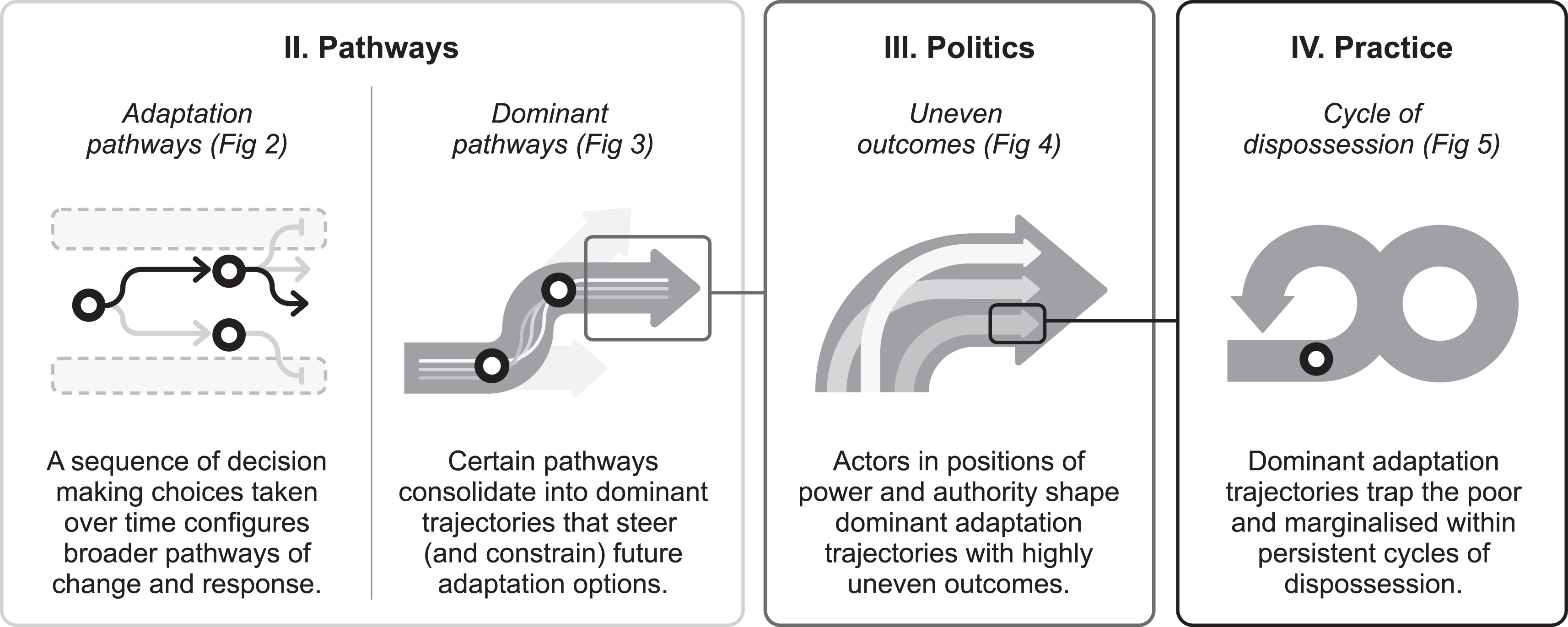
Schematic deconstruction of the logics of adaptation as processes and pathways.
II Adaptation Pathways: Envisioning Adaptation in Theory and Practice
Pathway thinking has gained considerable traction within scholarly debates on climate change adaptation and transformation (Lin et al., 2017; Maru and Stafford Smith, 2014). Broadly defined, the concept of pathways consists of solution-oriented trajectories that are charted from today’s world to achieve desirable climate futures. In addition to quantitative pathway studies and model simulations (e.g. see O’Neill et al., 2017), a more critical body of scholarship examines adaptation, transformation and sustainable development as entangled trajectories by foregrounding equity and justice towards low-carbon and ecologically safe transitions (IPCC, 2018; Roy et al., 2018). Arguably, the most progressive example of such trajectories is encapsulated in the aspirational notion of climate-resilient development pathways, ‘addressing structural and intersecting inequalities, marginalization and multidimensional poverty’ (Roy et al., 2018: 450). The ultimate goal of such pathways is to ‘transform […] the development pathways themselves toward greater social and environmental sustainability, equity, resilience, and justice’ (Olsson et al., 2014: 818).
Applied to practical climate adaptation efforts from households to nation states, pathway thinking allows for identifying and deliberating socially salient solutions in sequences of adaptation options, involving short- and long-term goals, values and inevitable trade-offs (Abel et al., 2016; Barnett et al., 2014; Fazey et al., 2016; Reisinger et al., 2014; Wise et al., 2014). Initially conceived as a ‘route map’ with trigger points (evaluation of existing paths) and thresholds (tipping points beyond which trajectories become unviable) (Haasnoot et al., 2013; Reeder and Ranger, 2011), the pathways metaphor is employed as a decision-making tool to help practitioners identify, sequence and implement adaptive actions in response to dynamic conditions, climatic and otherwise (Lawrence and Haasnoot, 2017; Lin et al., 2017). Decision points guide users of this tool to navigate decision cycles through consultations and remain within an adaptive space while avoiding spaces of maladaptation (Figure 2) (Reisinger et al., 2014; Wise et al., 2014) where existing vulnerabilities are deepened and new ones created (Barnett and O’Neill, 2010). The dynamic, flexible and iterative nature of the pathway approach makes it possible to collectively visualise and deliberate adaptation options and reassess them as new knowledge becomes available.

Adaptation pathways.
Despite a proliferation of adaptation pathway studies, their practical translation into just urban transformations remains poorly understood. Although a large portion of this body of work employs pathways thinking in contexts where a limited set of decision makers seem to have ample access to resources and work towards unequivocal goals (Haasnoot et al., 2013; Ranger et al., 2013; Rosenzweig and Solecki, 2014), the tool’s potential to guide diverse and politically fractured stakeholders in complex and contested environments remains a challenge (Abel et al., 2016; Bosomworth et al., 2017). Such unevenness in application and success may stem from the fact that adaptation pathways continue to be largely charted by recognised government authorities and experts (Lin et al., 2017), predominantly in the Global North. They often fail to effectively engage with and resolve contested objectives (including development priorities), diverse and unequally valued knowledge frameworks, and asymmetric power relations (Bosomworth et al., 2017). These challenges, however, are part and parcel of adaptation governance in the context of informality (Jordhus-Lier et al., 2019) and hence require explicit attention.
Recent scholarly work has attempted to address the analytical and practical challenges encountered in the pathways approach. We draw attention to three insights from this literature. First, by acknowledging the sociopolitical dimension of adaptation in practice (Fazey et al., 2018; Grandin et al., 2018; Pelling et al., 2016), more attention can be devoted to the interplay between power, knowledge, values and agency (Wise et al., 2014) as these interact over space and time and privilege certain adaptation options over others (Fazey et al., 2016). Such privileging is seen, for instance, in some adaptation projects in the US that favour the outside perspective of professional experts over the lived experiences of local residents to appease government agencies and international donors (Fazey et al., 2018; Murphy et al., 2017).
Second, an explicit focus on the role of historic legacies and institutionalised practices in shaping current and future adaptation choices, either by facilitating or inhibiting new paths toward transformative outcomes (Fazey et al., 2018; Wise et al., 2014), makes it possible to demonstrate when and how past decisions have generated lock-ins (Gajjar et al., 2018). Over time, these path dependencies consolidate into dominant trajectories (Figure 3) that prevent alternative pathways from being considered and taken, thus configuring a self-fulfilling business-as-usual trajectory that sustains the status quo (Fazey et al., 2016; O’Brien, 2016; Wise et al., 2014).

Dominant pathways.
Third, not all paths are available to all individuals, communities or interest groups (Abel et al., 2016; Gajjar et al., 2018; Warner et al., 2015), even if theoretically there are many different possible pathways that may lead to just and climate-resilient futures. Instead, future adaptation options become trapped within normative trajectories that emerge out of and reinforce existing hierarchies of power and influence. Such hierarchies tend to benefit the most powerful while engendering undesirable trade-offs for those less privileged (Câmpeanu and Fazey, 2014). This dynamic, in turn, sustains and even deepens structural inequalities that render alternative pathways unattainable.
In summary, the critical literature on adaptation pathways makes visible the sociopolitical and power dynamics of adaptation in deliberating and enacting future possibilities. It pinpoints often reinforcing spatial and temporal scalar dependencies that not only reflect mere subsets of possible trajectories but also determine which adaptation policies are developed, for whom and through which funds. Moreover, this emerging literature shows how dominant trajectories are often delineated according to the adaptation capacities of privileged groups and entities that occupy positions of authority or high social standing and steer adaptation decisions to their own benefit. Hence, such dominant trajectories have the tendency to reproduce the status quo, reinforce rather than reduce vulnerabilities and inequalities, and inhibit inclusive and dignified future options. Despite the vast potential of adaptation pathway approaches to overcome unjust conditions, complex and power-ridden relations that transcend adaptation options illustrate that pathway thinking in itself does not assure fair outcomes. In fact, by obfuscating power dynamics, it often curtails just trajectories and transformations for those who would have most to gain – the focus of this review.
III Adaptation Politics: Uneven Power Relations and the Articulation of Political Authority
As the contributions reviewed thus far indicate, power plays a central role in the development and persistence of dominant adaptation trajectories, as well as the emergence of alternative pathways. Such attention to power resonates with that of human geographers working at the forefront of scholarship on the politics of climate governance (e.g. Eriksen et al., 2015; Mikulewicz, 2018; Ribot, 2014; Taylor and Bhasme, 2020; Tschakert et al., 2016). As this burgeoning literature contends, adaptation is not a temporarily fixed measure employed to address particular climate pressures. It is rather a sociopolitical process of prioritisation, trade-offs and exclusion (i.e. of choosing one option over another) (Ajibade, 2017; Archer and Dodman, 2015; Pelling, 2010; Swyngedouw, 2013), which involves the (often asymmetrical) distribution of benefits and burdens across geographical space (Castán Broto and Westman, 2020). This prioritisation process never unfolds on politically neutral grounds (Sovacool, 2018). Decisions over adaptation choices are oriented by, as much as they reinforce, existing socio-spatial relations and the relative positioning of various actors, groups and institutions within society. Such a political entry point to adaptation draws attention to who has the power and authority to govern environmental change and climate action today, as well as the mechanisms through which this authorisation is sought and sustained into the future.
A multitude of actors and organisations are involved in and compete over the right to make decisions concerning adaptive action. However, it is usually certain individuals and institutions that control the prevalent political discourse who are also able to legitimise and prioritise what they see as desirable policy options (Ajibade, 2017; Pelling, 2003). Actors with significant political presence and clout often have greater sway over how climate problems are framed and solutions presented (i.e. knowledge frameworks); they also determine how different groups are positioned in relation to this framing (e.g. as agents of change or powerless victims) and are thus able to steer adaptation choices (Eriksen et al., 2015; see also Barnett, 2020; Vij et al., 2019). Although urban climate governance involves many state and non-state actors, including NGOs, the private sector, international funding bodies and communities (Castán Broto, 2017), local (municipal) governments remain the central actors that shape (short-term) adaptation planning (Bulkeley and Betsill, 2013), particularly in the Global South. Commonly, they envision and enact projects, oversee the distribution of funds, and liaise with national and international agencies and local citizens over development priorities (Gore, 2015; Ziervogel, 2019).
This does not mean, however, that the authority of political actors to govern is ever fixed or stable. Authority presupposes legitimacy and recognition ‘whereby actors within a given community come to regard institutions, rules, and norms as those with which they ought to comply because they are right, proper, or appropriate’, and as such, it involves concerted efforts (e.g. articulation, persuasion and negotiation) to be maintained (Bulkeley, 2012: 2429). Put simply, authority is always in the making. As Nightingale (2018) contends, governments do not have power but instead exercise power through institutions, procedures and programmes, and it is the recognition of power that produces ‘stateness’ as the authority to govern. Conceptualising state power as performative invites a more fluid understanding of authority as a relational and dynamic category that requires continual renewal through government–citizen engagements (Nightingale, 2017).
Such a dynamic and relational approach to authority complicates analyses that characterise current political failures in addressing climate vulnerabilities as solely a product of the scale and pace of urbanisation in under-resourced cities. This is by no means to underplay urban development challenges – these challenges are real and tangible. In many parts of the Global South, the persistence of structural vulnerabilities can be attributed to governments’ lack of resources and capacity to adequately accommodate and service rapid urban growth, dysfunctionality in formal housing and land administration systems and protracted endogenous tensions between various levels of governance (Ajibade et al., 2016; Gore, 2015; Parnell et al., 2007; Satterthwaite, 2011; Satterthwaite et al., 2018). However, a more critical focus on relational authority reveals how, by whom and under what conditions adaptation is enacted to reassert political power (Nightingale, 2017), preserve elite interests (Sovacool, 2018) and reinforce the ‘state political machinery at the expense of vulnerability reduction’ (Eriksen et al., 2015: 526; building on Nelson and Finan, 2009). At the same time, attention to relational authority may also reveal how to force open spaces for transformation (a point to which we return later in this article).
Political authority is reaffirmed in a myriad of ways through adaptive action. Authority is reasserted, for example, when decision makers refuse to engage with ‘if not outright downplay the political elements of social life’ (Mikulewicz, 2019: 276), opting instead to focus on techno-managerial interventions (e.g. climate-proof infrastructure and value-adding activities for economic development). These are celebrated as politically neutral (Nightingale, 2017), are usually highly visible (Pelling et al., 2015) and provide a quantifiable measure of success, all the while diverting attention away from deeper grassroots struggles and knowledge contestations. As Nagoda (2015) demonstrates in the context of climate adaptation policies in Nepal, these technical measures tend to align with the preferences of groups who are already better off.
Authority is also negotiated and sustained through the parcelling out of benefits to certain populations, sometimes even among the marginalised, to strengthen existing and establish new political alliances. This is achieved, for example, through the strategic deployment of assets, favours and rewards in exchange for political loyalty and votes, as documented, for instance, in Nepal (Nightingale, 2017) and Mexico and Brazil (Coates and Nygren, 2020). Finally, authority can also be reasserted through adaptation choices that minimise environmental risk for some groups by purposefully redirecting hazards and the financial burdens of adaptation to others. Mullenite’s (2019) work in Guyana exposes how flood control has been manipulated to increase vulnerability and economically disenfranchise marginalised populations through tax burdens to ensure they lack the resources to revolt, both directly and indirectly, against authoritarian colonial and post-colonial rule. Through these various processes, adaptation becomes a tool for intervention, improvement and control through which political authorities govern not only people’s lives but also the possibility for a different future; thereby they protect the existing hierarchical order against ever greater climatic threats (Anderson et al., 2019; Grove, 2014).
While adaptation efforts are urgently needed to limit current and future harm from climate change, with a plethora of adaptation programmes under way in both the Global South and North, little systematic attention has been paid to these various forms of deploying, negotiating and reasserting political authority through adaptation. Yet, they are central to understanding why political leaders and other powerful social actors and institutions may support and embark on particular adaptation trajectories while disregarding others. They also expose how the same adaptation trajectories can produce highly uneven outcomes for different population groups as these trajectories unfold (and persist) in practice, squeezed by political authority from multiple angles (Figure 4).

Uneven outcomes.
IV Adaptation in Practice: Dominant Dynamics Across the Urban South
Numerous studies assess the relationship between adaptation, political authority and systemic disadvantage as these are (re)produced in practice across the Global South, particularly in relation to the increasing risk of flooding. 2 Although several of these studies focus on flood adaptation outside the realm of climate change, or at least outside detection and attribution measures, they identify institutionalised policies and practices that are likely to inform future adaptive action (cf. Thomas, 2020) and thus provide crucial insights into the (re)production of adaptation and development trajectories. Here, we review selected cases from this literature to examine how political authority enters informal housing landscapes to produce dominant adaptation trajectories. We highlight the adverse effects of these intersections for those arguably most vulnerable.
Contesting the common trope frequently reiterated by governments and the media alike (Arabindoo, 2016; McFarlane, 2009; Rinne and Nygren, 2016) that flooding is simply a natural disaster, several studies emphasise the role that official authorities play in the uneven distribution of risk (Ajibade and McBean, 2014; Amoako, 2016; Chatterjee, 2010; De Sherbinin et al., 2007; Douglas et al., 2008; Mustafa, 2005; Wisner et al., 2003). Without appropriate financial resources and coordination (Ajibade et al., 2016; Pelling et al., 2018), at times guided by opportunistic leaders (McFarlane, 2009; Revi, 2005), local governments simultaneously encourage and protect upper-class development (Douglas et al., 2008) while neglecting rapidly growing informal settlements in risky areas, without infrastructure, services and housing rights. As a result, the urban poor become acutely exposed and, given their lack of proper resources to prepare to and recover from flood events, experience poverty and marginalisation in even more pronounced ways, which, in turn, undermines their future adaptive capacity 3 (Ajibade et al., 2016; see also Hallegatte and Rozenberg, 2017; Padawangi, 2014; Patankar, 2015).
As climate-induced events become more frequent and intense, governments across the urban South are capitalising on the threat of flooding and its aftermath as an opportunity for ‘building back better’ (Alvarez and Cardenas, 2019) and ‘making room for water’ (Anguelovski et al., 2016). Such a tendency is visible in a number of urban (re)development projects, often funded in collaboration with international agencies, to reconfigure urban land use under the auspices of disaster risk management. These include, for example, initiatives in the Philippines (Alvarez and Cardenas, 2019; Padawangi, 2014), Indonesia (Betteridge and Webber, 2019; Colven, 2017; Goh, 2019; Padawangi, 2014) and Brazil (Henrique and Tschakert, 2019a; Millington, 2018).
Despite their innovative and eco-friendly allure, studies show how these initiatives might not benefit everyone. On the contrary, efforts to adapt cities to climate-related hazards often revive and repackage old planning practices that might (re)produce profoundly unjust outcomes for marginalised groups (Anguelovski et al., 2016; Kaika, 2017). Commonly, these practices centre on the removal and relocation of poor urban dwellers who are blamed for encroaching along waterways and clogging drainage networks (Alvarez and Cardenas, 2019; Henrique and Tschakert, 2019b; McFarlane, 2009). Forcefully evicted from the spaces they inhabit, informal communities frequently find themselves with insufficient compensation (if any) or are relocated to peripheries that impose new financial burdens (e.g. costs for transportation) (Anguelovski et al., 2016; Huq et al., 2007; Mustafa, 2005). As a result, many families return to improvised houses in hazardous environments closer to jobs and other livelihood opportunities.
This failure to address flood impacts among the poor and marginalised is symptomatic of top-down decision-making processes that privilege technological prowess, modern aesthetics and economic growth over the needs and desires of affected residents (see Blok, 2016; Ramalho, 2019). For example, in Indonesia, the government deploys infrastructure (e.g. sea walls and land reclamation) and the removal of low-income settlements to mitigate flood risk and ‘transform Jakarta into a modern, world-class city’ (Colven, 2017: 257; see also Betteridge and Webber, 2019; Goh, 2019). These strategies aim to reclaim new spaces for revenue-oriented investments and generate economic growth but also dismantle social ties and curtail livelihood opportunities for vulnerable communities (Betteridge and Webber, 2019).
Alternative, bottom-up flood adaptation approaches do exist. These include, inter alia, local networks of care to cope with flood disasters and restore disrupted livelihoods (Betteridge and Webber, 2019) and community planning exercises that build upon situated knowledges to design context-relevant solutions and minimise unwarranted removals (Goh, 2019; Padawangi, 2014). Yet, even if arguably more effective in countering individual vulnerability, building agency and facilitating adaptation in situ, such approaches fail to gain traction because they are stifled by dominant adaptation trajectories that operate at larger scales of governance.
Lessons learned from this rich literature allow us to theorise a common dominant adaptation trajectory shaped by political authorities and other powerful actors and institutions across cities of the Global South. Even though each case presents unique contextual specificities, they all point to similar dynamics centred on two core pillars of top-down flood risk management. First, they identify an inactive government, largely absent from informal communities who must construct their livelihoods amid precarious and environmentally volatile circumstances (Coates and Nygren, 2020). Second, flooding ignites a hyper-active government that mobilises selective flooding narratives to remove informal communities and replace them with urban spaces deemed modern, sustainable and resilient. Such practices, however, often fail to improve (and sometimes worsen) the living conditions of those already most vulnerable.
Seemingly diametrically opposed, these two modes of government action – inaction and hyper-action – described by Amoako (2016) as ‘convenient absence and brutal presence’ and by Anguelovski and colleagues (2016) as ‘acts of omission and commission’, constitute a dominant adaptation trajectory that traps the poor into a vicious cycle of dispossession (Figure 5). This cycle reproduces institutionalised urban development processes based on the exclusion of destitute residents who are denied their right to city space (cf. Harvey, 2012). Conceptualising adaptation through this dominant pathway illuminates the dynamics through which flood risk is produced and reproduced and possible pathways towards transformation are stifled. It reveals that not all adaptation trajectories are forward-looking and that maladaptation is not (only) something to be avoided as marginalised groups may already be confined to regressive pathways that unfold within persistent maladaptive spaces.

Cycle of dispossession.
We argue that any effort to address and potentially overcome the structural dynamics of risk and vulnerability to flooding, and other climatic hazards, must first acknowledge the ubiquity of this dominant and often regressive trajectory. Yet, ubiquity should not be equated with homogeneity as only close attention to contextual specificity harbours hope of identifying and nurturing alternative pathways towards just and inclusive urban futures.
V Enacting Just and Inclusive Adaptation Pathways
Having exposed a series of systemic adaptation challenges tied to pervasive power asymmetries in cities of the Global South, we now ask: how should we envision and make possible climate-just cities and inclusive urban transformations? To answer this question, we draw upon fundamental geographical contributions that scrutinise how environmental problems are framed and addressed, how power is enacted and contested and how the human/nature binary is ultimately dismantled. Our goal is to provide the long overdue space, recognition and legitimacy to the entangled lives of human beings (including those sometimes considered less-than-human or not-fully human) and more-than-human beings in today’s rich and interconnected urban fabrics.
Insights from recent scholarship across political, economic, cultural, urban and more-than-human geographies, enriched by critical contributions from other scholars in the social sciences and the humanities, inspire us to chart theoretical and empirical trajectories towards desirable and liveable climate futures. To address the challenges identified thus far, we present three conceptual steps to transcend the problematic relationship between adaptation pathways, political authority and dispossession. We adopt the notion of ‘nested pathways’ (Chhetri et al., 2019) to overcome the cross-scalar challenges identified earlier in pathway thinking. We progress from the level of nation states to government–community interactions all the way to personal entanglements with and responsibilities for others, human and more-than-human, to locate and advocate more inclusive and just opportunities for urban transformations in the Global South, and beyond.
1 Tracing Government Action Between Convenient Absence/Unwitting Failure and Wilful Ignorance/Creative Destruction in Relation to Broader Political Economies
As demonstrated by the insights from the literature on urban adaptation to flooding, there are at least two fundamental and co-existing dynamics through which local governments manage climate-induced hazards in informal settlements of the Global South: inaction and hyper-action. Here, we highlight how these dynamics combine in two different ways – convenient absence/unwitting failure and wilful omission/creative destruction (Figure 6) – and derive new theoretical insights to examine their implications for marginalised groups.
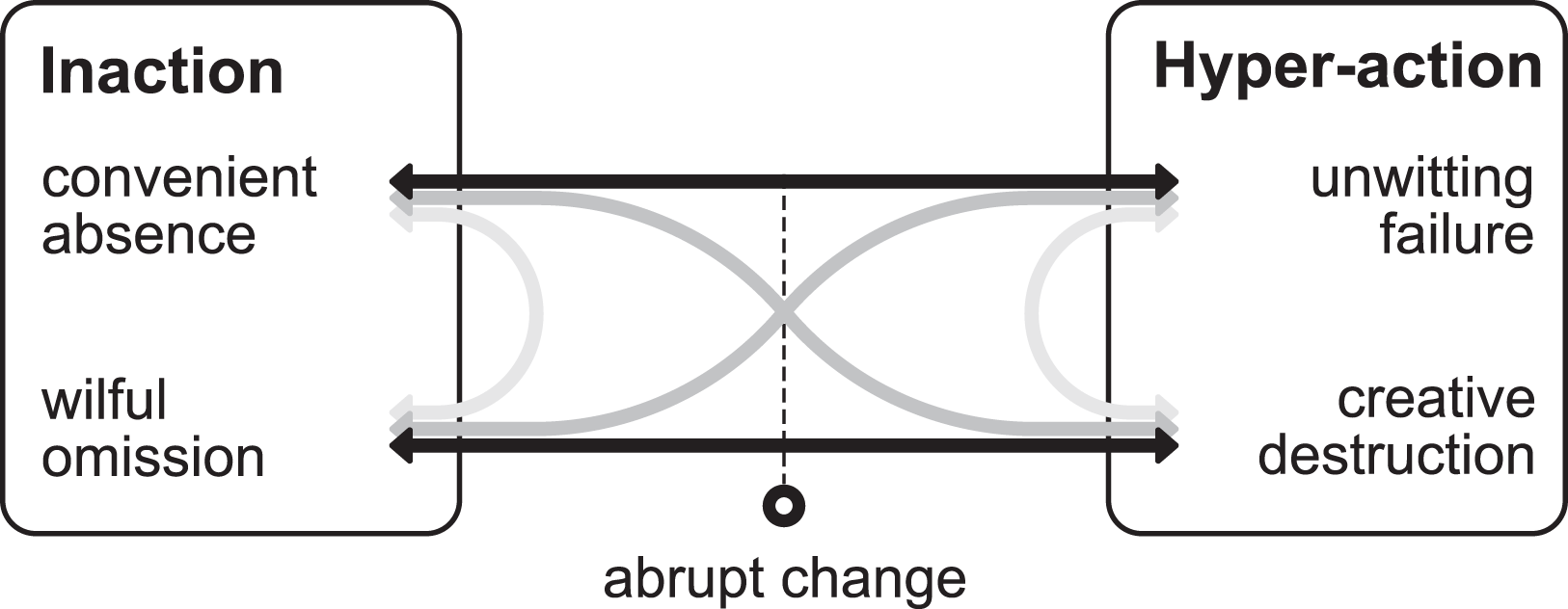
Climate adaptation and urban development dynamics.
Drawing on the emergent field of climate justice (e.g. Kim et al., 2018; Robinson and Shine, 2018; Routledge et al., 2018; Smith and Patterson, 2019), we argue that adaptation scholars should first and foremost interrogate local governments’ inaction/hyper-action in the context of informality and climate risk as convenient absence/unwitting failure. Convenient absence refers to the historical economic and political processes that (re)produce vulnerabilities as local governments are unable to address growing socio-economic and spatial inequalities amid exogenous pressures (Gore, 2015; Satterthwaite et al., 2018), including regional and global market dynamics (Warner and Kuzdas, 2017). Unwitting failure draws attention to the so-called improvement programs that fail to materialise and makes visible how local governments’ piecemeal and inadequate interventions can exacerbate old and create new vulnerabilities for disenfranchised groups.
Such an analytical focus places these dynamics, as well as the inability of many governments in the Global South to address their burgeoning urban challenges, in relation to global political economies. It draws attention to the triple injustices of global environmental change whereby communities who produce the least emissions (Dodman, 2009) disproportionately face the local impacts of global climate change while having the fewest resources to adapt (Klinsky and Winkler, 2018; Porter et al., 2020; Roy et al., 2018; Shi et al., 2016; Solecki et al., 2018). It also adds empirical nuance to debates on global climate justice and shared responsibilities (Patterson et al., 2018; Robinson and Shine, 2018) by bringing to the fore the limited institutional and financial capacity of local governments to cope with the simultaneous and compounding effects of rapid urbanisation, growing inequality and exacerbated climate risks in the urban South.
Second, contributions from the critical social sciences also embolden us to question if, how and when political authorities and other powerful actors employ inaction/hyper-action as wilful omission/creative destruction to dispossess marginalised groups. Drawing from the field of critical race and science studies, the notion of wilful omission challenges the idea that ignorance is a simple lack of knowing or a passive state. Instead, it positions ignorance as often constructed, maintained and disseminated through discursive and material practices that systematically discriminate and marginalise certain groups (Mills, 1999, 2007; Proctor, 1996; Proctor and Schiebinger, 2008; Sullivan and Tuana, 2007; Tuana, 2004, 2019). At this end of the spectrum, wilful omission as a lens thus probes the intricate ways in which the neglect of local governments (and other entities in positions of authority) towards informal communities may be actively produced. It assesses whether the underlying (problematic) rationale is to cement existing power asymmetries and political economies of exploitation and thereby render the poor and the spaces they inhabit amenable to capital-driven government action, leading to climate gentrification (Porter et al., 2020). Such a critical approach sheds light on how neglect becomes valuable, for whom and at what cost for others.
With respect to hyper-action, we draw on the Marxist concept of creative destruction, to question the deployment of forced evictions currently part and parcel of adaptation to climatic hazards in cities of the Global South (see section IV Adaptation in Practice). Marxist creative destruction refers to the process where existing institutional and territorial arrangements are destroyed to create new spaces for capital (re)production (Brenner and Theodore, 2002; Harvey, 2004, 2007, 2012). The concept has been employed to disclose the hidden agendas of government interventions wherein low-income areas are demolished and replaced with ‘more desirable’ urban development (e.g. infrastructure and high-end real estate) (Ahmed, 2011; Ortega, 2012; Weber, 2002). Creative destruction as an analytical entry point examines the relationship between climate adaptation and capitalist urbanisation processes, adding yet another layer to the analysis of accumulation by dispossession and differentiated displacement in cities of the Global South (see also Desai, 2012; Doshi, 2013). It interrogates how adaptation measures are produced and spatially distributed, who profits from these arrangements and how these profits are collected.
These dynamics are never clear-cut. The messy realities of the urban South demand situated research to disentangle the intricate ways local governments’ inaction/hyper-action simultaneously corresponds to convenient absence/unwitting failure and wilful omission/creative destruction (or else). They require nuanced examinations to trace when, where and how, in the context of climate adaptation and informality, these dynamics become dialectical.
2 Locating Openings for Contesting and Reshaping Government–Community Interactions
Coming to grips with pervasive authoritative ruling in adaptation decision-making processes constitutes a vital prerequisite for locating strategic entry points for deliberation, contestation, resistance and cooperation wherein the ‘possibilities for transformation lie’ (Nightingale, 2018: 705). As Kull (2002: 929) suggested nearly 20 years ago, governments are not monolithic entities but rather a ‘complex constellation of practices and institutions constituted through struggles over rights, legitimacy, and authority’. Such constellation is populated by a plurality of individuals with their own personal interests and political views. According to Kull, this plurality manifests not only horizontally but also vertically: the government that the poor and marginalised encounter in everyday interactions is significantly different from that of high-level policymaking. It is precisely at this juncture between struggle and possibility that counter-hegemonic spatial practices and governance arrangements can emerge, and citizens can bring governments ‘into a space of engagement and negotiation rather than domination’ (Routledge et al., 2018: 84; see also Ernstson and Swyngedouw, 2018; Swyngedouw, 2017) to (re)articulate their rights to produce, inhabit and transform their urban space (Routledge, 2010; Routledge et al., 2018).
Important scholarship in African cities and with disenfranchised urban residents highlights the role of deliberation, negotiation and contestation in locating openings for action. The goal is to thrust more inclusive governance structures between state and local governments and the urban poor to enable transformative adaptation and inclusive development trajectories and work toward climate justice (Ajibade et al., 2016; Harris et al., 2017; Mahlanza et al., 2016; Morchain et al., 2019; Pelling et al., 2018; Ziervogel, 2019; Ziervogel et al., 2017). Drawing upon lessons learned through the Urban Africa: Risk Knowledge Programme, Pelling and colleagues (2018) propose to identify context-specific pathway blockages (e.g. fragmented city governance) and pathway enablers (e.g. locally accountable leadership). In Kenya, innovative multilevel governance strengthened relations between civil society and the Nairobi City Council to update informal settlements and reduce risk exposure to climatic hazards (Pelling et al., 2018). In urban areas in the Western Cape of South Africa, a mix of authentic deliberation and genuine contestation manifest through experimental governance arrangements between local authorities, disenfranchised citizens and youth groups supported not only the recognition of the poor’s everyday realities but also more democratic decision-making practices (Ziervogel, 2019). Together, these pressures from below can indeed tilt the uneven playing field towards more inclusive adaptation plans and policies.
In these and other cities in the Global South, the key impetus for citizens, planners and policymakers alike is to surmount the challenges of pervasive inequalities, high levels of informality and fragmented governance that stem from maladaptive trajectories produced through absent, ineffective and/or perverse government action (identified above). At the core of cross-scalar efforts to reconfigure local government–community relations and build inclusive decision-making models lies the recognition of genuine deliberation. Deliberation often concerns trade-offs along multiple potential pathways and whether they are desirable or undesirable, and to whom, reflecting the diverse values, needs, aspirations, rights and agency of stakeholders and social actors involved (Gajjar et al., 2018; Jones and Tanner, 2017; Roy et al., 2018).
Successful inclusive urban governance models do exist, for example, in India, drawing upon the Asian Cities Climate Change Resilience Network (Harris et al., 2017), and in Uganda where the National Slum Dwellers Federation promotes community-driven projects in partnership with local and international agencies to simultaneously achieve service accessibility and citywide climate action (Dobson et al., 2015). In each case, negotiation occurs in specific places and across scales and is attentive to locally situated processes, knowledges and norms, opening up possibilities for just transformations. However, where deliberation and contestation are stifled and social cohesion and solidarity undermined, dominant pathways are likely to persist, with burdens borne disproportionately by the least privileged members of society, with evidence from Lagos to London (Ajibade et al., 2016; Pelling et al., 2018).
Locating openings for contesting and (re)shaping interactions between communities, governments and other authoritative entities requires on-the-ground engagements with affected populations to generate situated knowledge about desirable futures and co-produce adaptation and development pathways to realise them (Barnett et al., 2016; Tschakert et al., 2017). With social justice as an orienting principle, it becomes possible to navigate inclusive adaptation and just transitions, even in politically volatile contexts (Patterson et al., 2018). Yet, more work is needed to draw linkages between individual experiences and catalyse broader transformational trajectories to engender a transformational adaptation theory from the Global South. This, we argue, would make it easier for just climate-resilient development pathways to become the new norm.
3 Disavowing Human Exceptionalism in Pathway Thinking to Overcome Multiple, Concurrent Exclusions
The regressive role certain local governments, as well as nation states and multinational industries, play in implementing urban adaptation pathways towards just transformation is, of course, neither restricted to contexts in the Global South nor inevitably tied to the dynamics of rapid urbanisation and the challenges of increasing inequalities. Indeed, there are numerous ways of perpetuating persistent exclusions, legacies of erasures, and material, discursive and embodied violence, all of which have become normalised and continue to be reinforced by the state (Pellow, 2017).
Such erasures and violent ruptures range from urban climate resilience efforts that propagate structural racism (Ranganathan and Bratman, 2019) and climate justice advocacy that glosses over histories of colonial oppression among indigenous peoples (Whyte, 2017) to human and non-human extinction in cities. The latter focuses on loss across space and time, not just of what can be counted but also of the cultural, political and biological reverberations of such loss. For instance, Houston (2019), building on work by van Dooren and Rose (2012) on ‘the entangled zones of life and death in more-than-human cities’, draws attention to such entanglements and the many practices of non-recognition, dispossession and loss to which disenfranchised citizens and myriads of other urban dwellers continue to be subjected. Being blind to these violences, and the institutionalised political authority that perpetuates them, means being complicit in ‘climate apartheid’ wherein certain people and ecosystems, and the complex ways in which they entwine, are driven out of sight and rendered disposable (Tuana, 2019).
Today, the human-centric adaptation model is obsolete as it constricts climate action to and within an exclusionary space that feeds human exceptionalism. Rethinking inclusivity in urban development trajectories inevitably forces us to counter the thus far blatant absence of more-than-human agency in envisioning adaptation pathways by turning to the ontological question: ‘how are we to live in the world’? (Head and Gibson, 2012: 700). This requires a critical engagement not only with the hierarchies within ‘the human’ that label millions of people as less-than- or not fully human (Marhia, 2013) and hence unworthy of protection. It also requires us to reject the sticky human nature dichotomy that transfers processes of othering to the non- or more-than-human world and accepts plants, animals, microbes, lakes and more to be just as expendable, thereby legitimising sacrifice and death zones.
Human geography has had a long-standing interest in dismantling this problematic human/nature dualism, embracing instead relational ontologies and hybrid assemblages. This well-established scholarship appreciates hybrid cities (Swyngedouw, 1996), the social and the natural as being co-constitutive and enmeshed in a multiplicity of networks (e.g. Castree, 2002), more-than-human geographies (e.g. Whatmore, 2002), and ‘throwntogetherness’ and negotiations between human and non-humans (Massey, 2005). These and other critical advances, including those grounded in feminist political ecology and ecologies of care (e.g. Doshi, 2017; Elmhirst, 2015), have helped frame how to approach climate change, climate action, and climate politics and governance, ranging from Hulme’s (2008, 2010) work on cosmopolitan climates to emancipatory urban political ecology in Ernstson and Swyngedouw’s (2018) ‘Antropo-obScene’.
When applied to climate adaptation and pathways to urban transformations, the growing literature on relational, post-human ontologies and new orderings of socionatural relations – inspired by canonical work in the social sciences and critical social theory (Haraway, 2008; Latour, 2004; Plumwood, 2002; Stengers, 2005, e.g. 2010) – compels us to reject hegemonic Eurocentric and anthropocentric models and decolonise adaptation planning and practice. As Porter et al. (2020) argue, such a decolonising lens makes it possible to contest forms of sovereignty enshrined in the colonial-capitalist status quo and bestow authoritative power to a more diverse collective of dwellers to deliberate what lives and ‘lifeworlds’ are valuable and to whom. By decentring and broadening the so-called human experience of the city, urban planners can make space for multispecies encounters, stories, responsibilities and flourishing (Houston, 2019). In the context of urban environmental hazards, such a lens advances a relational understanding in which human, more-than-human and abiotic entities – including water, sand and concrete (and emissions, pollution and debris) – become entangled in the production of and responses to socio-environmental disturbances (Gesing, 2019).
Such disturbances and experiences with irreversible loss are without doubt devastating and, in most instances, inherently unjust. At the same time, they also hold the potential to mobilise knowledge controversies that challenge existing authoritative frameworks and practices and generate a collective ‘space for reasoning differently’ within which new political and technical possibilities can flourish (Whatmore, 2014: 91). They often galvanise citizen action because, or despite, of government inaction. In Australia, for example, in the absence of progressive climate policies, a multitude of engaged citizen efforts have emerged that embrace bodily encounters and political entanglements with the multispecies worlds – also known as ‘climate cosmopolitics’ (Latour, 2004; Stengers, 2005, 2010) and ‘alternative urbanisms’ (Houston et al., 2016: 265). These entail ‘affective ecologies’ and grounded ways of knowing among Indigenous and ethnic minority migrants in Darwin (Lobo, 2019) and new means of embracing relational and inclusive approaches, for instance, through the Climate Justice Exchange in Melbourne or similar initiatives (Porter et al., 2020).
In the Global South, likewise, more explicit attention to relational and hybrid entanglements within and between the human and the more-than-human worlds will help unmask daily practices of non-recognition, colonial biopolitics and environmental racism. Recognition of such life-sustaining human–non-human interdependencies, even if so far under-represented in the scholarly literature, adds yet another analytical layer to the embodied hardship of inequalities, injustices and dispossession while opening spaces for co-resistance and coexistence. Examples include nourishing human–snake relations in species-inclusive cities in India (Narayanan and Bindumadhav, 2018); reconnecting to life support systems in the Fostering Local Wellbeing project with urban youth in South Africa (Ziervogel et al., 2016); animal rescue efforts during the 2015 floods in Chennai, India (Rao et al., 2018); the cultivation of diverse medicinal plants in urban home gardens in northern Brazil (Palheta et al., 2017) and efforts to foster bird-friendly cities across Latin America (Piratelli et al., 2017).
Ultimately, disavowing human exceptionalism goes hand in hand with enacting new epistemologies to pursue climate justice. Such a fundamental shift requires pathways to just urban futures that foreground our entangled lives and obligations to all kinds of ‘Others’, both human and non-human – including migrants, refugees, homeless people, racial and ethnic minorities as well as threatened animals and plants – that are often denigrated as ‘strays’, unwanted yet persistent in the ‘liminal shadowy space’ in today’s urban fabrics (Steele et al., 2019: 412). Novel spaces for ‘liveability, survivability, and justice’ (Houston et al., 2016: 264), with multispecies entities at the decision-making table, will make it possible to bear witness to unseen experiences, hear otherwise silenced voices and deliberate over what lives should and could be secured. It is precisely through the recognition of divisions and exclusions between ourselves and others, between those in power and those dispossessed, that the political unfolds and conflicts emerge (Kenis, 2019). Yet, understanding conflicts as part of inclusive transformational trajectories allows contestation and resistance to occur and to affect change while honouring difference.
VI Conclusions
The past 12 months, from mid-2019 to mid-2020, have been marked by multiple, concurrent extreme events and crises, some regional and others global, and their very real and embodied on-the-ground effects. These occurrences stretch from the hottest July ever recorded (in 2019) and the devastating Australian bushfires in the southern summer of 2019/2020 to the deadly 2020 floods in Eastern Africa and now the global COVID-19 pandemic. These simultaneous crises and unfolding disasters, compounded by multiple failures in governance, have brought to the fore and, in many cases, exacerbated existing development challenges, systemic insecurities and entrenched inequalities. They have also made visible the nefarious and pervasive nature of a neoliberal system where corporations and powerful elites are able to capitalise on the same crises that trap the poor, racialised and otherwise disenfranchised minorities within cycles of discrimination and dispossession and may well aim to render their lives disposable. These cycles are being directly confronted and challenged as thousands of citizens unite in transnational networks of radical solidarity (from global climate marches to protests against racial inequality) to proclaim that ongoing development trajectories are not only unsustainable but also perverse and unacceptable. Together, they demand a global call for transformation, reiterated in the collective plea for justice.
In the context of climate adaptation and urban climate justice, with a deliberate focus on the Global South, we identify emerging opportunities to chart inclusive and pro-poor transformational trajectories. These trajectories challenge exclusionary, capitalist-driven solutions, reshape government–community relations to broaden engagement and create spaces for recognition, and reject human exceptionalism to nurture ethical responsibilities towards human and more-than-human others who all belong. We advance these as core propositions for enacting egalitarian, emancipatory urban ecologies as a means to listen to and learn from those so far silenced, excluded or annihilated. This is a challenging yet morally vital and scholarly overdue task that requires concerted and coordinated efforts between individual citizens, communities, planners, policymakers, researchers, educators and the non-human actors that make up the urban fabric in which we live, each with their own stories, skills and strategies. Transitioning from dispossession to climate justice will inevitably be place-specific, political and messy in every context, yet also a process committed to deliberation and contestation. For human geographers, charting these inclusive and transformational trajectories within and across many different cities offers not only a timely and pivotal opportunity to envision just climate futures in urban spaces and beyond. It also provides a real-world obligation for critical academics to sketch and preconfigure these other worlds and demonstrate they are indeed possible.
Footnotes
Acknowledgements
We would like to thank Sarah Prout Quicke for stimulating conversations and insightful comments in the development of this article, as well as the editor and three anonymous reviewers for their careful and productive feedback. Their thoughtful engagement with our ideas has significantly improved our manuscript.
Declaration of conflicting interests
The author(s) declared no potential conflicts of interest with respect to the research, authorship, and/or publication of this article.
Funding
The author(s) disclosed receipt of the following financial support for the research, authorship, and/or publication of this article: This research was carried out with support from an Australian Government Research Training Program Scholarship and University Postgraduate Award at the University of Western Australia, Australia.
