



Abstract
Research on the integration of the human-environment system has been an important part of Chinese human geography for over a century, constituting the distinctive academic nature of the field. Human geography has been established as an interdiscipline of natural science and social science, highlighting the combination of academic inquiry and decision application, and exploring the interaction mechanisms and sustainable development model between the human sphere and natural sphere at different spatial scales. The development of the discipline is in line with the basic concepts advocated by the global research platform “Future Earth”, which has promoted the strong development of human geography in China, and has produced important societal influences. By selecting some of the most influential academic achievements, this paper briefly describes theoretical methods and social contributions to reflect the development process of human geography in the study of integrated human and environment systems in different stages in China. It also demonstrates the influence of the following elements on the adherence of Chinese human geography to the integration of human and environment systems: classical Chinese philosophical thinking on harmony between people and land, western theories of the human-environment relationship, Soviet economic geography research methods, the science of sustainability, the social demands of the construction of contemporary Chinese ecological civilization, ever-improving mathematical models and big data methods for studying enormous and complex systems, and management system reform and special scientific research system and background in China.
Keywords
I Introduction
In China, the study of human and environment systems has long been known as the study of human-land systems, where “land” refers to the environment. Integrated research on human-environment systems has been one of the most important fields in human geography research in China more than a century. The study of modern human geography began in China in the 1920s. Since then, the integration of human and environment systems has sought to combine the natural and social sciences, using academic research to support policy and management (Fan, 2012; Lu, 2017). Especially in the 21st century, while focusing on national and local sustainable development goals, integrated research has introduced modern scientific methods to investigate complex territorial systems, and revealed natural and social phenomena by remote sensing data and big data. Thus, integrated research has assisted to push forward human geography’s development in China, and has given Chinese human geography a unique development trajectory and academic characteristics in the wider world of Geography (Fan, 2016b). This is consistent with the concepts of the Future Earth research program (Future Earth, 2013) and the merger of the Global International Science Council (ICSU) and the International Social Science Council (ISSC) into the International Science Council (International Science Council). In this sense, Chinese human geography research has been a step ahead globally.
The social contribution of the Chinese human geography suggests it was fruitful to focus on integrated research into human-environment systems over the past century. Four human geographers have visited Zhongnanhai (i.e. the office site of the Central Committee of the Communist Party of China) to advise the Political Bureau on land use, urbanization and regional development issues so far. 1 In addition, eight human geographers have been invited to join the expert committees of the national 5-year development plans. 2 Their suggestions about national and local sustainable development, urbanization and rural revitalization, regional strategies and policies, ecological civilization 3 , and territorial spatial planning, have been implemented in four of China’s 5-year plans. Human geography can affect social development and central decision-making in China because of its unique academic and applied values in the research field of human-environment systems integration, as well as its relatively high academic and applied achievements. Firstly, the research progress of the integration of human and environment systems in China is closely related to the progress in human geography and sustainability science abroad (Lin, 2009; Zhang, 2013). Among of them, the emergence of western sustainability science has significantly influenced the scientific understanding of human-environment interaction and enhanced the cognition of “human” -- social system in human geography in China (Liu et al., 2007; Clark and Harley, 2020). Secondly, some Chinese human geographers do not just stay at the philosophical level to discuss human and environment relationship, but insist on carrying out huge scientific research projects to deepen the exploration of the basic characteristics and causes of human and environment systems under different development stages and regional conditions in China, as well as the major conflicts and coordination (Fan, 2004, 2008; Lu, 2011). It reflects the changing human and environment systems in China in terms of knowledge creation, which develops the sustainable development model across different spatial scales, so as to fill the gap of sustainability science in China. Thirdly, progress in the study of human and environment systems is closely related to the changing of the Chinese society. After 1949, research on agriculture and rural territorial system with agricultural regionalization as the core achievement met the needs of agricultural distribution under China’s planned economy system (Zhou, 1993). After the reform and opening up in 1978, research on land use in China (Wu and Guo, 1994) satisfied the requirements of urban and regional planning transformation during the exploring of market mechanism (Gu, 2009; Lin, 2020; Liu et al., 2016a). In the 21st century, research on the integration of human and environment systems focuses on solving the problems of sustainable development, which also meets the needs of China’s accelerated construction of an ‘ecological civilization’. It can be seen that the research objectives are more complicate from agricultural regionalization to territorial spatial planning and regional sustainable development. Meanwhile, the Chinese government pay more attention to scientific evidence as the basis for decision-making. Due to the formed institutional environment and objective demand, Chinese human geographers have developed the research on integration of human and environment systems, and transformed the research results into decision-making.
In China, human geography involving the integration of human and environment systems have been around for over a century, and has produced the different representative scientific research results in different stages of development. First of all, in solving the most significant social needs in the coordination between human and environment faced by the country, compared with the scientific and technological contributions of other branches of geography, earth science, resources and environment science, economic and social science, planning and management science, the scientific and technological achievements of human geography are the most outstanding. This shows that human geography in China has the strongest ability to solve the integration of human and environment systems in the past hundred years, and its academic level is leading in all disciplines. The second is the application of scientific evidence for decision making, which are the innovative scientific research outcomes, and have significantly affected the long-term social and economic development in China. This paper reviews some of the most representative studies on the integration of human and environment systems in different stages of human geography in China (Figure 1), rather than the whole progress of Chinese human geography. This paper focus on the background and motivation of the strong development of Chinese human geography, the influential scientific and technological achievements in the study of human-environment system integration, the coping strategies and research priorities of the discipline, the characteristics and progress of theoretical methods. The integrated research of human and environment systems is significance not only for the future development of other branches of human geography in China, but also human geography abroad. The articles published in Acta Geographica Sinica and reprehensive achievements in research progress of human-environment system in Chinese human geography.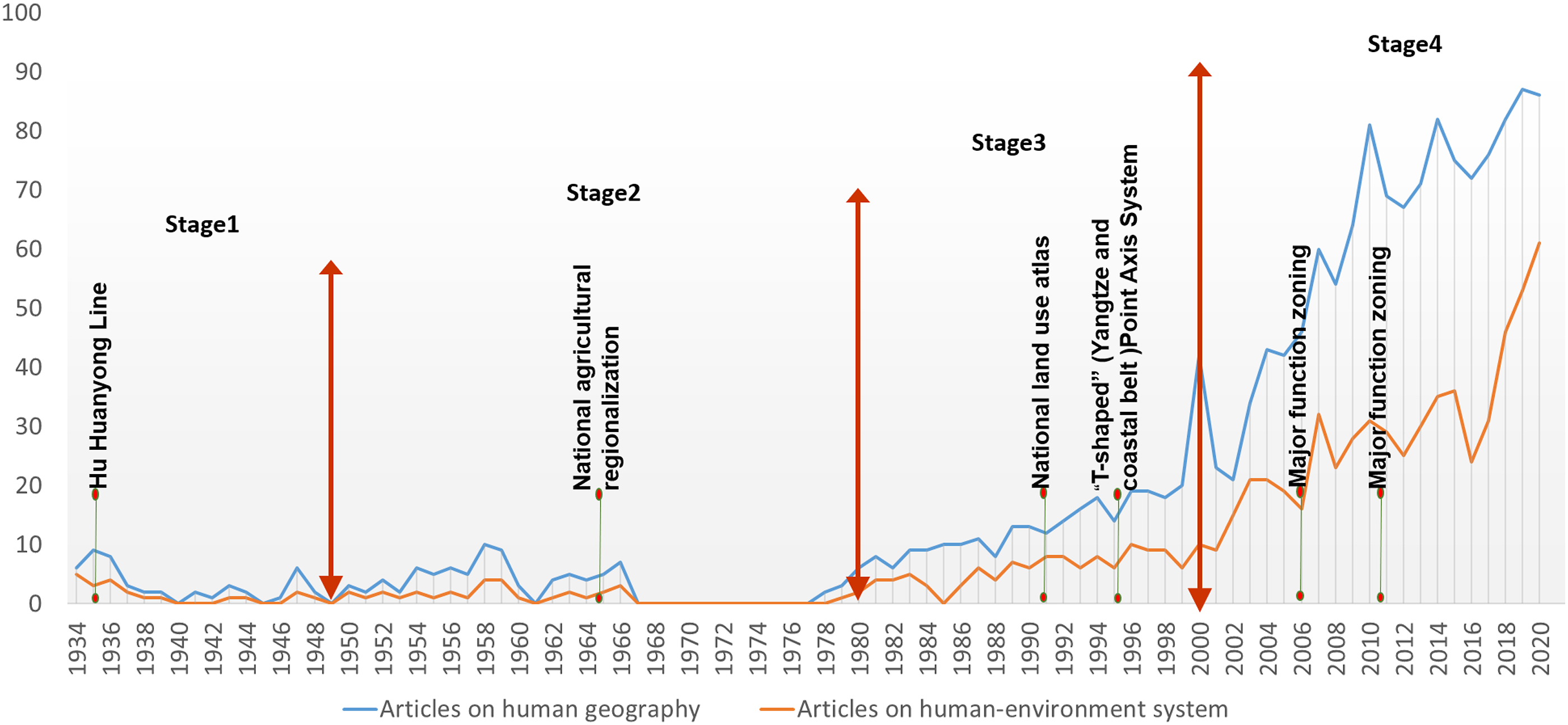
II 1920-1949: Introduction of Interdisciplinary and applications-led approach
Integrated research of the human-environment system is a common research area in geography. In fact, early Chinese geographers have employed a comprehensive research paradigm that combined natural and social factors to explain the emergence of physical and human geographical phenomena and characterize their distribution. After 1949, physical geographers stopped extending their research on natural sphere to human sphere. Hence, the integrated research of interactions between human and environment became a unique domain of human geography in China. Until recently, with the influence of international discipline development frontiers represented by Future Earth research program, some Chinese physical geographers started to regard human sustainable development as a new research direction. As a result, integrated research on the human-environment system might become a popular research topic shared by both human and physical geographers again (Qin, 2014; Xu et al., 2013; Fu and Liu, 2014). This would benefit the unity of geography, improve the level of integration, and applications of research on human-environment interactive mechanisms and sustainable development.
From the very beginning of modern human geography in China (1920s), China was an agricultural society. Industrialization and urbanization were still in its infancy, and so were modern science. Modern geography in China, developed gradually mainly through the introduction of modern science by Chinese scholars returned from Europe and United States. Chinese human geography, including cultural and social geography, and other branches have been developed in an all-round way. Back then, scholarly works of modern western human geography, such as Principles of Human Geography by American geographers Huntington and Cushing (1924), La Geographie Humanina written by French geographer Brunhes (1935), and Environment and Race by Australian geographer Thomas Griffith Taylor (1937) were being translated into Chinese. Among them, the thought about the interaction relationship of humans and the geographical environment described in La Geographie Humanina by Brunhes were considered as consistent with China’s classical philosophical ideas of “the unity of man and nature” and “adapting to local conditions”. This thought was widely recognized and applied by Chinese human geographers (Zhu, 1936). It has led to a century of continuous integrated research on the human-environment system in Chinese human geography.
Exploring the relationship between human and environment provides human geography as a discipline with the intersection of natural and social sciences objectively. Due to the sense of social responsibility to serve the country and the humanistic sentiment of serving society among the Chinese scholars, modern Chinese human geography emphasized on rural issues and other major needs of the country from the beginning (Zhu, 1926; Ren, 1946). As a result, the study of Chinese human geography adopted an interdisciplinary approach and demand-led applications until this day. The studies of some Chinese human geographers back then have influenced the development of Chinese human geography for a century. These studies were Hu Huanyong’s The distribution of population in China, with statistics and maps (1935), Li Xudan’s Observations on geographical landscapes along the Peilungkiang (1941), Zhou Lisan’s Agricultural Geography (1942), Wu Chuanjun’s Grain Geography of China (1946), and Huang Guozhang’s The Situation in Yunnan’s Southern Borderland and Points for Attention in the Future (1943). They were local and practical studies that focused on the influence of natural environment on the formation and evolution of human geography. Among of them, by analyzing the population density of China, Hu (1935) proposed the Heihe (Aihui)-Tengchong Line and presented China’s population distribution for the first time. Hu plotted a straight line from Aihui (in Heilongjiang Province) to Tengchong (in Yunnan Province) at about approximate 45° angle and indicated that the 36% of China’s land area to the southeast of the line contained 96% of the country’s population, while 64% of the land to the northwest of the line contained only 4% of the population. In fact, Hu’s population line is highly consistent with the natural geography characteristics of China, with the southern parts consistent with the first topographical elevation ladder, and the northern parts consistent with the second topographical elevation ladder and the 400mm isoline of mean annual precipitation. Based on the principles of the interactions between human and environment, Hu’s line can reveal the characteristics of human geography. It is relatively stable and has not changed significantly over the past 80 years (see Figure 2). As one of the most important geographical achievements, it becomes a classic reference widely adopted by decision-makers and its application profoundly affects the development and protection of Chinese territory. Despite the financial constraints of the Nationalist government in China back then, the Institute of Geography was established in 1940. It was due to the urgent need of geographic surveys and plans to develop national defense, industry, transportation, agriculture and other undertakings in Southwest and Northwest China to aid the War of Resistance against Japan (Zhan et al., 2014). Hu Huanyong line.
III 1950s-1970s: Adoption of the Soviet theory and methods of economic geography
When the people’s Republic of China was founded in 1949, similar with the Chinese economy which developed in accordance with the economic construction model of the Soviet Union, Chinese human geography also developed according to the Soviet model. From 1949 to 1978, Chinese geography, like geography in the Soviet Union, was composed of physical geography and economic geography. The “economy” category of economic geography was simply the material production sectors recognized by the socialist economy (Wu, 1951; Pavlichev and Zhu, 1988), which created conditions for human geography to pay attention to the research of nature and economy as well as service to the national economic strategy focusing on how to develop agriculture and heavy industry. Whilst Chinese human geography considered the human-environment relationship as its object of academic research, it lacked scientific research methods. Empirical method developed based on long-term research experience became the common methods for exploring the human-environment relationship in the early days.
Human geography research aims to reveal the principles behind the spatial distribution of human production and activities. It analyzes the relationship between human activities and natural geographic environment, such as resources, environment, ecology, and natural disasters. It also studies the economic and social laws, and the influence of ideology, institutional mechanism, social culture and behavior psychology on the formation of human geographical patterns. The combination of natural and human environment increase not only intensifies the complexity of human geography, but also leads to the development of human geography in China been profoundly affected by its political situation and ideological changes.
Learning from the Soviet Union made it clear that human geography was class-based, and China must completely abandon social geography, cultural geography, and political geography introduced from the western society (Zhang, 1956). Afraid of the class nature of human geography, many Chinese human geographers who had been successful before 1949 changed their specialty to physical geography. 4 The decoupling of human geography and physical geography in China due to its political environment undoubtedly weakened the development of human geography and integrated geography in China. It caused the scientific credentials of human geography being questioned by the natural scientific community.
The achievements of Soviet economic geographers were important in shaping the modern methodology of Chinese human geography research, supporting the research theme of the human-environment relationship, and reinforcing the value orientation facing social needs. The theoretical methods expressed in the works of Soviet economic geographers translated and published during this period, such as Soviet Industrial Geography (Stepanov, 1955), Economic Geography of the Soviet Union (Baransky, 1956), and Transportation and Industrial Configuration (Probst, 1960), were fully applied in the research practice and discipline construction of the new generation of economic geographers who grew up in old China and the new generation of economic geographers who took up scientific research and teaching positions in New China. First, economic geography focused on the needs of socialist production layout, highlighting that the objective function of production layout is to maximize the overall benefits to the national economy (Li, 2008). The second is to emphasize the role of factors such as natural geographic environment, transportation, and technological progress in production layout, so that the integrated and interdisciplinary nature of economic geography can be maintained (Probst and Hao, 1959; Li, 1990). Third, using the research methods of economic geography zoning and territorial production complex (Lu, 1986; Wu, 1960a), economic geography has realized the scientific understanding of the complex system of regional development from integrity and regional heterogeneity perspectives. Fourth, the application of technical and economic analysis methods significantly enhanced the ability of economic geography to quantitatively explain the internal mechanisms of production layout and the pros and cons of plans (Lu, 1988).
Since most leading economic geographers in China had initially been influenced by the scientific research methods used in western geography, Chinese economic geography did not simply copy from Soviet Union’s. On the basis of the definition of Soviet economic geography, Professor Wu Chuanjun put forward a new understanding. “Economic geography focuses on the formation process, relevant conditions, types, zoning, and development laws of the geographical system of production layout” (Wu, 1960b). This was recognized by Chinese economic geographers and they fully integrated the classical western economic geography with the theoretical methods of Soviet socialist economic geography to produce two significant achievements. The first area was the research on productivity distribution, including a plan for evaluating and zoning natural conditions for China’s land transportation (Yang, 1964), technical and economic demonstration methods of industrial layout and industrial bases (Hu and Hu, 1965), and the organizational principles of regional specialized division of labor. They focused on analyzing natural conditions (especially energy and mineral resource conditions) to understand the distribution of productivity (Li, 1957), and the research results served the industrial economic construction at that time. The other area of study was agricultural regionalization. The most systematic, innovative, and practical studies of agricultural natural conditions and layout by Chinese economic geographers in the period include Deng Jingzhong’s preliminary discussion on the current situation and methodology of agricultural regionalization (Deng, 1963), the Preliminary Opinions on Agricultural Regionalization in China written by Zhou Lisan, Wu Chuanjun, and others under the Ministry of Agriculture, and Zhou Lisan’s research on the evolution, internal structures, and agricultural regionalization system (Zhou, 1993).
Based on the above research, in 1981, Zhou Lisan completed the research on agricultural regionalization in China (National Commission on Agricultural Regionalization, 1981), which systematically revealed the principles of regional differentiation in Chinese agriculture. It comprehensively reviewed the characteristics of agricultural resources in China, and divided China into 10 first-level zones and 38 second-level zones (see Figure 3). By referring to the research and advice of China’s economic geographers, the State Council established the National Agricultural Zoning Committee in 1979, and established agencies within government (from the central to county levels) to prepare and complete agricultural regionalization for achieving the rational layout of agricultural production. The scheme of agricultural regionalization in China.
As a result, Chinese agricultural geographers made significant contributions to China’s agricultural rapid development in the light of local conditions in the early days of the founding of the People’s Republic of China (Zhong, 1980; Zhou, 1993). Learning from the academic achievements of Soviet economic geography has played an important role in improving the methodology of Chinese human geography, improving the comprehensive research on nature and economy, and serving the country’s strategic needs. Notably, regarding the academic progress of global human geography, the contribution of knowledge creation of human geography research in the Soviet Union and Russia rarely received much attention.
IV 1980s-1990s: Influenced by western research on sustainable development
It is meaningful and interesting to discuss the research paradigm of integration of human and environment systems formed by human geography in China from the perspective of geopolitical and social economic changes in the past century. Before 1949, it was inevitable for the political system and backward social and economic development stage to accept the western modern scientific system. The consistency between the thought of human-environment relationship and the concept of respecting nature in classical Chinese philosophy resulted in its popularity. In 1949, from the perspective of geopolitics, China’s socialist system is opposite to western, which labels Chinese human geography with class nature that induce many scholars turning to natural geographical research. The remains who insist on the study of economic geography undoubtedly highly recognize the socialist system and are willing to make academic contributions to the establishment of this system. Imitating the paradigm of Soviet Economic geography was an inevitable choice for Chinese political system to full copy the Soviet Union in the academic field, and it was also a conscious choice for Chinese scholars to continue the study of human geography. The academic achievements of economic geography in the Soviet Union provided a systematic plan for the planned economic system in productivity layout, especially on the basis of economic geography studies (such as the evaluation of natural resources and geographical environment conditions, the formation of reasonable division of labor and cooperation among enterprises, and the saving of transportation costs). It provided human geographers who growing up from old China a scientific method of studying economic geography (He and Zhao, 2004). At that time, the whole geography in the western society, including human geography, was wandering and chaotic. In 1948, Harvard University took the lead in abolishing the department of geography, marking the decline of western geography (Ye et al., 2019). By combining the academic thought of human-environment relationship from the western society and the theoretical method of economic geography from the Soviet Union, China’s integrated study of human and environment systems progressed forward. China’s reform and opening up in 1978 and the transformation of its geopolitical relationship with the western society allowed its academia to connect with the world’s leading edge. In the context of globalization, China is accelerating the process of urbanization, and a group of Chinese human geography scholars copy western academic ideas to carry out research on globalization and localization, social and cultural transformation, trade and finance, thus, a group of new branches of human geography emerged (Yeung and Zhou, 1991; Li, 1997; Gu and Chen, 2004; Fan et al., 2006; Du et al., 2016; Wang, 2019). The traditional economic geographers (i.e. human geographers who adhere to the study of the integration of human and environment systems) timely captured the international concept of sustainable development and research progress, and investigated China’s sustainable development locally and nationally. Due to the socialization and humanization of a large number of emerging branches of human geography, the studies on the integration of human and environment systems with the theme of sustainable development failed to meet the main needs of China’s pursuit of rapid GDP growth at that time. China’s geography was once faced with the same dilemma as the western society in the 1950s and 1960s. At that time, urban geography was still valuable in serving urban planning and tourism (Pannell, 1990; Cui, 1992; Xu et al., 1997; Fang et al., 2011; Gu, 2011; Bao and Ma, 2011; Lu et al., 2016), so famous universities such as Peking University and Nanjing University changed the name of the department of geography into the department of city, tourism etc. In the 21st century, China’s social and economic development is entering a new stage, and sustainable development gradually becomes a national strategy. Therefore, accumulated studies on the integration of human and environment systems have become the biggest advantage to serve the needs of the country. In China, not only has the science of sustainability not emerged, but the science of cities and regions has not really taken shape. One important reason is that China has significant regional differentiation and development differences. To serve the country’s decision-making in the field of sustainable development, it needs the accumulation of studies on the integration of human and environment systems that have been formed for a long time at different spatial scales and types of different regions, such as national, regional, urban and rural areas, as well as relatively mature and powerful disciplinary strength (Gu et al., 2008; Jin et al., 2008; Chen et al., 2011; Zhang, 2014; He et al., 2016; Zhong et al., 2016). In China, only human geography could fulfill this responsibility, which was difficult to be replaced by other disciplines. It is precisely because of the academic achievements and social contributions of the research on the integration of human and environment relationship that have strongly promoted the revival of human geography and even geography in China. In the past decade, some universities that gave up geography have restored the geography department again. The policy of reform and opening-up introduced in China in 1978 caused profound changes to the development of Chinese human geography, as integrating western human geography became both convenient and fashionable within the discipline. This led to the diversification of Chinese human geography. Urban geography, tourism, geography, social culture geography and political geography began to develop (Wang, 1996; Guo, 1997; Ning, 2008; Zhu et al., 2009; Bao, 2009; Zhou and Dai, 2014; Du et al., 2015; Liu et al., 2018). Economic geography has largely absorbed western economic geography theoretical and methodological exploration of new factors and mechanisms such as globalization and informatization, company and innovation space, social and cultural transformation, etc. (Liu and Li, 1998; He and Liang, 1999; Li and Miao, 2004; He, 2017; Wang, 2018; Li, 2018). As more and more overseas students returned to China and Chinese scholars took up positions abroad, socialization and humanistic trends in Chinese human geography gradually became more pronounced, and changes in human geography were discussed in isolation of the natural geographical environment. The value of the subject lying in its ability to serve the state also came into question and was even refuted, as scholars considered the west, and especially the United States, as representing the frontier of academic research. This negatively affected the development of integrated human and physical geography research and the value orientation oriented to national needs during that period of evolution of Chinese human geography.
During the new round of Chinese and western academic integration, the older generation of leading human geographers in China still adhered to research on the integration of human and environment systems, and reversed the overemphasis of the role of cultural and social transformations. When Li Xudan, the founder of modern human geography in China, called for a revival of human geography at the beginning of the reform and opening-up period, he advocated making the human-environment relationship as the key of contemporary research (Guo, 1994). Wu Chuanjun constructed his regional system theory of the human-environment relationship, which “focuses on the interplay and feedback between human and environment in the human-environment system”. The aims of this research were to coordinate the human-environment relationship (Wu, 1991; Wu and Shi, 1999; Mao, 2018). Wu Chuanjun first proposed the theory in 1979 and constantly improved it (Wu, 2006). It played a fundamental and decisive role in preserving and advancing the academic progress of Chinese human geography (Lu and Fan, 2009).
Following Wu Chuanjun’s regional system theory of the human-environment relationship, a group of Chinese human geographers seized the opportunity presented by profound changes in China’s urbanization, land development, and regional development to explore a development path for the discipline construction consisting of refining key scientific propositions while responding to real-life needs, achieving innovation and promoting the development of the discipline while solving problems, and improving the discipline’s ability to serve the country needs while developing the discipline (Hu, 2008; Li, 2017). As a result, Chinese human geography has been a fundamental academic force in territorial planning serving the Chinese government over the past four decades since the introduction of the reform and opening-up policy (Fan, 2011), which also led to the Chinese Academy of Sciences and the National Planning Commission (now the National Development and Reform Commission, previously a department in charge of national land and space planning) implementing dual leadership over Institute of Geographic Sciences in China. Nonetheless, the fate of human geography fluctuates with the importance of territorial spatial planning in China. During this period, Wu Chuanjun completed a 1:1,000,000 land use map of China, the world’s first nationwide small-scale land use atlas, which shows the features and distribution of regional land use in China. It has been used for territorial spatial planning, highlighting human geography’s role in applying fundamental and regional differences. Research on the coordinated development of regional PRED (population, resources, environment, and development) led by Mao Hanying used the integrated research method to explore ways to optimize the human-environment system, and provided a quantitative measurement for territorial spatial planning in China with the goals, priorities, theoretical models of PRED (Mao, 1991; Mao and Yu, 2001; Mao, 2008).
In view of the chaotic characteristics of regional pattern evolution caused by the multiple factors affecting sustainable development, Lu Dadao adopted the structured research method and proposed the point-axis system theory 5 in 1984 to reveal the objective laws of spatial structure evolution in the process of regional development (Lu, 1995). It has become the most effective theoretical model to guide the construction of general layout in China’s territorial spatial planning. Lu also proposed the “T” shaped strategy for China’s territorial development and economic layout, i.e. the strategic pattern along the coastal zone and the Yangtze River constitutes the primary axis of China’s territorial space development, which still profoundly affects China’s regional development strategy (Lu, 2001, 2003).
V 2000s-2020s: Beginning research in territorial comprehensive system
In the 21st century, systematic and in-depth research in the key areas of the human-environment relationship and regional sustainable development led Wu Chuanjun, Lu Dadao etc., has progressed further, which significantly improve its roles in decision-making and social applications. The human geography research in China mainly involves two aspects: the research unit based on the Chinese Academy of Sciences (CAS) and the provincial academies of sciences, and the team combining scientific research and teaching based on universities.
The centennial persistence and significant achievements in the research of human-environment system integration is mainly derived from the human geography research team of the CAS (Fan, 2011). CAS is an academy of natural sciences, with resources and environment science as an important research area. The research in the field of resources and environment provides data base and cooperative research power for the study of human-environment system integration in human geography. The research paradigms of natural sciences and the organization of research projects also have a profound impact on human geography research in CAS, such as large-scale funding support, participation of scholars from multiple research fields, long-term research cycle, and sample studies at different spatial scales. The above characteristics are not only rare in western human geography, but also rare in Chinese university. CAS is regarded as a national team in the field of scientific research. First, researchers in CAS have more opportunities to report prospective research results and submit consulting suggestions on major issues facing China’s development to the central government. Once adopted by the central government, these consulting suggestions will be translated into decision-making actions, such as, the suggestion of agricultural regionalization proposed by human geographers in the early stage in response to China’s strategic focus on agricultural development, the report to the central government about the research results of major function zoning in view of the Chinese government’s exploration of regional sustainable development model in recent years. Second, the prevailing operation mode of the Chinese government management system is that CAS undertakes the research projects and consulting tasks that serve the major national sustainable development decision-making issues. Human geographers of the CAS were appointed to lead and organize multi-disciplinary forces to jointly undertake major projects, and the achievements of these projects were directly applied in decision-making, e.g. optimizing the territorial pattern of the country, implementing of major regional development strategies such as Beijing-Tianjin-Hebei and Yangtze River Belt (Fang et al., 2016), carrying out basic evaluation of natural carrying capacity, proposing the scientific plan for the layout of national parks in the scientific investigation of the Qinghai-Tibet Plateau deployed to promote the construction of ecological civilization, etc. Following the practice of the central government, local governments entrusted similar work to local human geographers. In this way, human geography of the CAS drives the development of human geography across the country and plays a leading role as an academic research center (Liu, 2015; Long et al., 2018). In addition to the special scientific research system and management system behind the integrated research of Chinese human geography, Chinese human geographers grasp scientific laws and conform to the forefront of scientific and technological development, which are also the important reasons why they can play a key role in China’s social and economic development and serve China’s national construction strategy at different stages of development (Fu, 2017; Liu et al., 2016b; Wang et al., 2015). Recently, Chinese human geographers advocate the application of database and model in the analysis and optimization of regional sustainable development research nationally and locally, and perform scientific investigation on territorial complex system combined with the research principle of “open special complex giant system”. Meanwhile, during this period, the research direction of human geography advocated by two American monographs (Rediscovering Geography Committee, 1997; National Research Council, 2010) on the disciplinary development strategy and its historical background also helped promoting the research on the integration of human-environment system in Chinese human geography.
The research target of human geography is the spatial distribution of human activities. The human-environment relationship is the most basic relationship in the pattern and evolution of human geography (Fan, 2014; Li et al., 2017; Liu, 2018), especially in China which is a large country with rapid urbanization and industrialization and significant differences in the natural environments of different regions (Wu, 1998b). Human-environment interactive mechanisms, dynamic mechanisms, roles, and influences all share the characteristics of being comprehensive and complex, with obvious regional differences. The integrity of surface systems determines the horizontal interdependence between regions and the vertical interdependence between regional subsystems and the regional overall system. In this way, the human-environment relationship changes due to complexity, regional differences, inter-regional interdependence, and temporal and spatial scale conversion, which constitute the overall territorial system (Wu, 1991, 1998a; Sayre, 2005; Lu and Fan, 2009; Fan, 2018). Obviously, in national and local sustainable development, different regions perform different functions, and the evolution of the human-environment relationship in their territorial systems creates different economic, ecological, and social benefits. Having grasped the changing patterns of the human-environment system, Chinese human geographers pursued objective functions (e.g. better overall national benefits, better comprehensive economic, social and ecological benefits, and strong long-term sustainability). They explored scientific ways to regulate the human-environment system and optimize the development of China’s territorial space. There is now an urgent strategic need for China’s development to shift from development at the cost of the resource environment to trying to build an ecological civilization (Wu, 2006; Fan et al., 2009; Lu et al., 2011; Liu, 2014). The systematic study of natural carrying capacity and major function zoning 7 and their applications in decision-making are an important aspect of the development history of Chinese human geography, and their impact on China’s sustainable development process has been unprecedented.
Research on natural carrying capacity in human geography is based on traditional research on resource carrying capacity and environment carrying capacity. It focuses on determining the basic relationship, and quantitatively expresses the interactions, between human and environment. It has inspired the development of feasible methods for studying territorial systems in the human-environment relationship and regional sustainable development, and it has had practical value for decision-makers. Research in this area mainly included the following three aspects. The first is systematic studies of natural carriers, starting with natural elements, and focusing on the role of each element in achieving sustainable development of the nature-society system, and the research on the irreversible or irrecoverable damage to the four attributes of natural carriers (resources, the environment, ecology, and disasters) as another expression of natural carrying capacity, which have enhanced the objectivity and relative stability of carrying capacity. The second is systematic research on human activities as the carried object. Human production and activities in a certain area and a certain time period are defined as territorial functions. The mechanism of action between the carried object and the natural carrier is determined by different territorial functions, which provides a carrying capacity calculation model. Obviously, carrying capacity index systems differ due to different territorial functions, and carrying capacity calculation models differ for the same territorial function due to different spatial scales. The third type of research defines the carrying capacity (of the carried object or the carrying entity) by the original value (i.e. the original carrying capacity under natural zone and region conditions), the surplus value(i.e. the remaining carrying capacity after being utilized by human activities) and the potential value (i.e. the expected increase in carrying capacity as a result of technological progress, production and lifestyle adjustments, restoration of nature, better management). The results in the carrying capacity calculation and the optimization model for achieving sustainable development (without exceeding the carrying capacity) become a function of time, and dynamic optimization becomes necessary (Fan et al., 2017a, 2017b).
The in-depth integration of natural carrying capacity system research with national and local sustainable development policy applications in China is unprecedented in previous carrying capacity research. The opportunity of adopting natural carrying capacity in decision-making merged due to the reconstruction after the Wenchuan earthquake in 2008. It was used by the central government to solve major decision-making issues, such as site selection and reconstruction scale and methods (Fan et al., 2009). The Chinese central government recently announced that a carrying capacity evaluation method developed by human geographers shall be used in territorial spatial planning at the national, provincial, and prefectural levels. All the above studies led by human geographers set off a new upsurge in the study of natural carrying capacity in China. The reason is that human geographers have a better way of thinking and knowledge system when discussing the carrying capacity index system and calculation model, which are different due to the different functional orientation of human activities and different development stages and industrial structures. Hence, territorial functions have become the new problem that need to be solved in system research.
The territorial function is the main role that a region should play in achieving national sustainable development based on its comparative advantage (Fan et al., 2019). This research covers the following areas. The first is to develop a territorial general equilibrium model to balance the overall benefits (consisting of ecological, social, and economic benefits), which are the driving forces for stabilizing changes to human geography pattern on the Earth’s surface. This thought realizes the scientific way to understand and implement the concept of sustainable development from a geographical perspective. The second is to divide territorial functions at the national scale into four categories (i.e. urbanization, agricultural security, ecological security, and heritage protection). To facilitate decision-making and the application of scientific research results, the territorial units are county-level administrative districts. Since county-level administrative districts contain complex functions, the “major function” of a territorial unit is used to express how to achieve a sustainable geographic pattern at the national scale. To this end, we construct an index system that combines natural carrying capacity and territorial function suitability and perform a nationwide evaluation and classification. The third is to construct a downscaling territorial functional spectrum that started from the country level. The smaller the spatial scale, the more function types there are, and the more specific territorial functions become (Fan, 2019c, 2019b, 2019a; Fan et al., 2019). Based on the natural carrying capacity of the function spectrum and territorial function suitability algorithm, we establish a model library and database to assist land and space planning at different spatial levels. To enable timely adjustments of regional policies, we establish a monitoring and early warning indicator system, which identifies changes in sustainability of different regions through dynamic monitoring of the natural carrying capacity and the suitability of territorial functions (using an integrated monitoring system and statistical system). The theory and method of territorial function are also applicable to regard urban and rural areas as territorial types performing different functions. Our preliminary results on the regional differentiation of carbon neutrality in China based on territorial functions are more accurate than the results of previous studies based on administrative regions and natural regions. Major function zoning has been confirmed by China’s president, Xi Jinping, as a “grand strategy” and designated by the central government as a basic system (Figure 4). The regionally differentiated performance evaluation systems for officials, the allocation of construction land, water resources, environmental capacity and other indicators, the negative list of industrial development in different regions, and the transfer payment of central finance between regions are determined according to the major function zoning. In short, human geography research on major function zoning has played a fundamental and strategic role in China’s sustainable development, with a significant impact on decision-making and society. Major function zoning of China.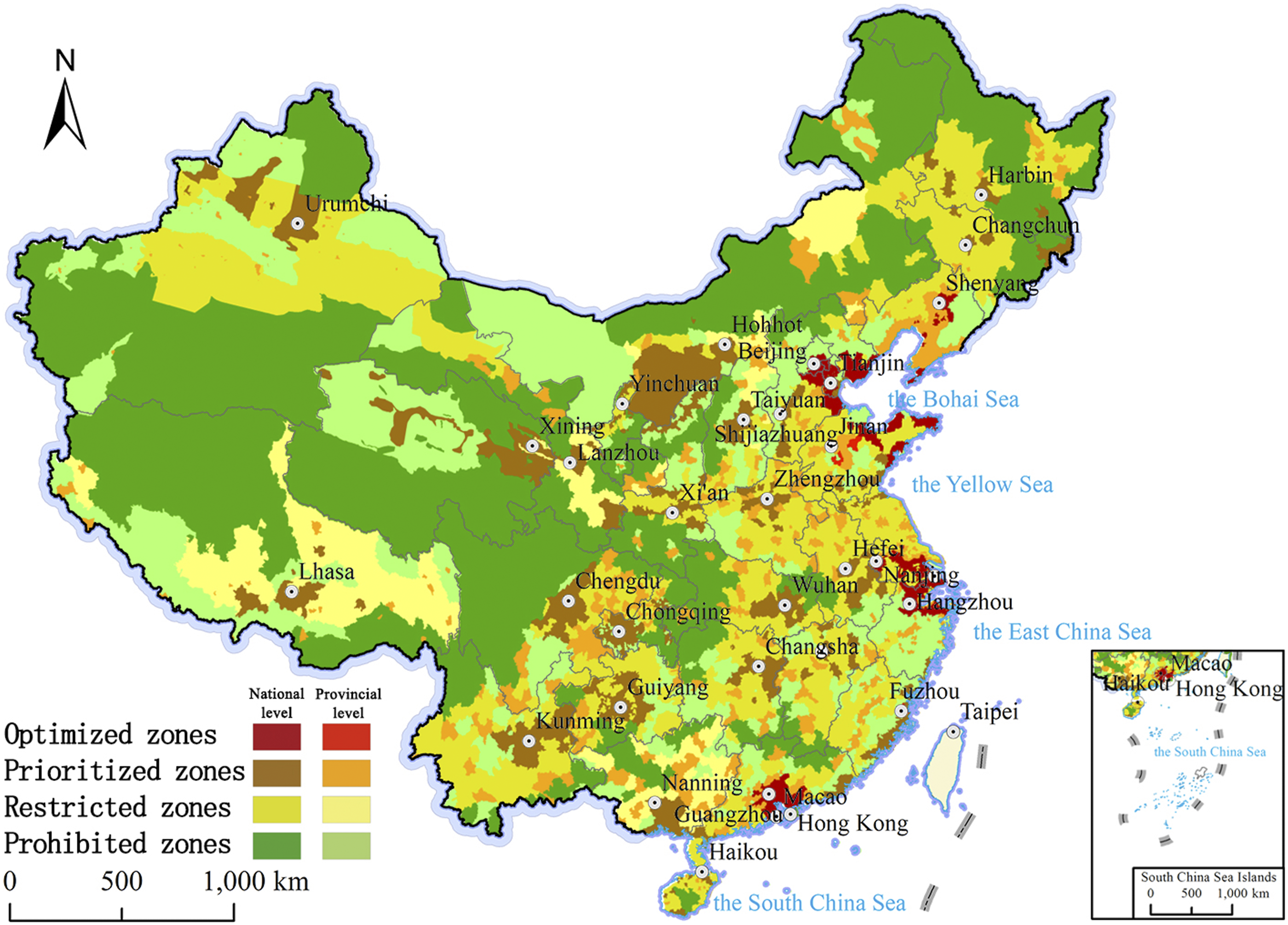
VI Discussion and conclusions
China’s modern cultural geography concept and basic principle was initially introduced by the Chinese scholars in Europe in the 1920s-1930s. Hence, the research thoughts on integration of human and environment systems were influenced seriously by European geography. Among the numerous thoughts of European human geography, the thought of human-environment relationship has been accepted by more scholars in China because of its compatibility with ancient Chinese culture and philosophy, such as “feng shui”, “the unity of man and nature” and “adaptation to local conditions”.
Research progress of human-environment system in Chinese human geography.
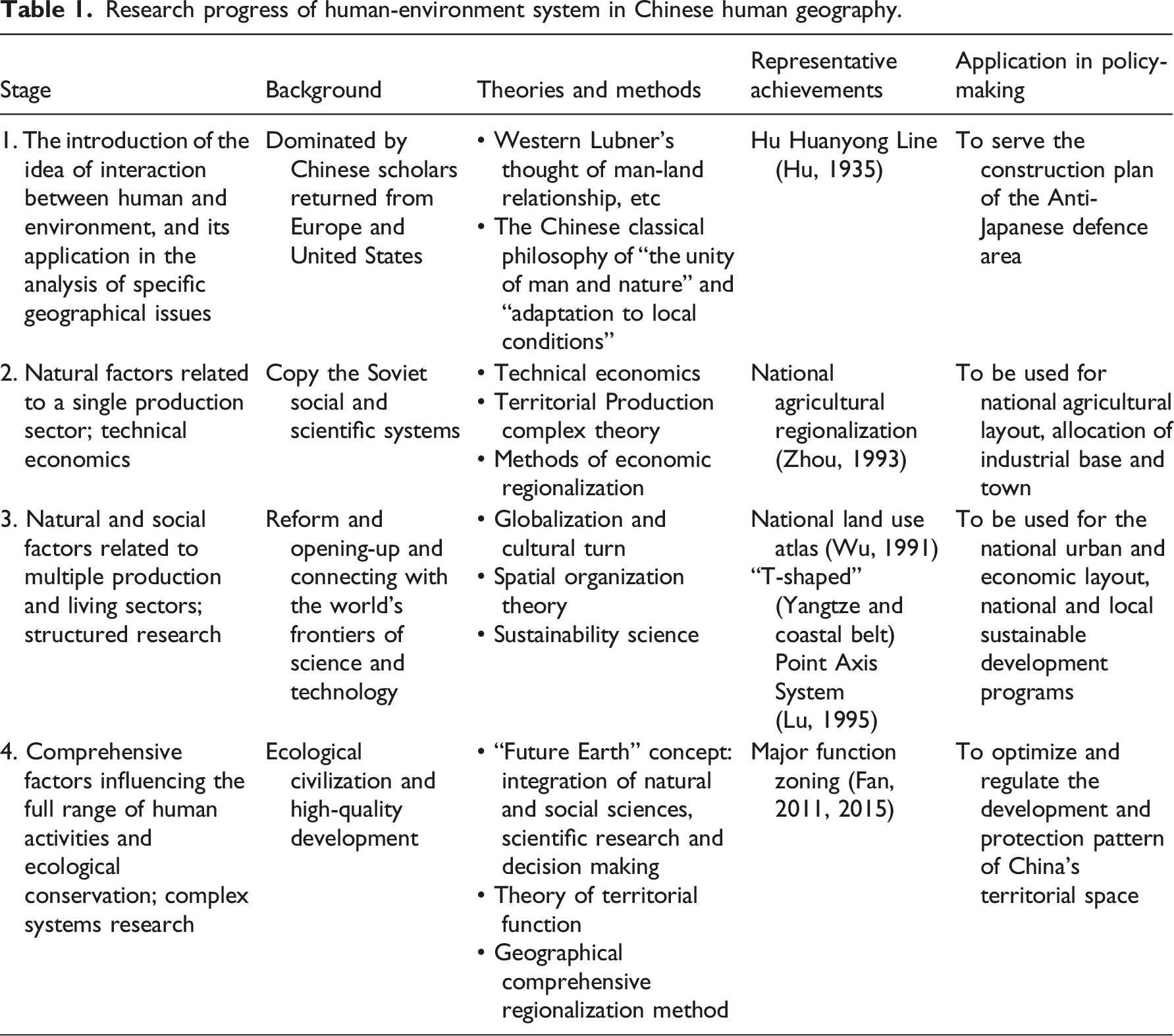
At present, the subject of human geography in China are diverse. The discussion here merely touches an aspect of the research on the integration of human-environment system that Chinese human geography has insisted on over the past century. The main features of this research are summarized below. First, we focused on the geographical exploration of the relationship between human and environment through the combination of natural science and social science. Second, we concentrated on the combination of academic research and practical decision-making in order to better support sustainable development locally and nationally. Third, we adhered to the combination of disciplinary theoretical innovation with modern technology and methods (including the application of big data) (Zhen and Wang, 2015), which improved the scientific nature and application through databases and model libraries. There are four reasons which made it possible to continue integrated research in Chinese human geography. First, among the first generation of human geographers who returned from the western society before 1949, some of them, who persisted to study of human geography after 1949, always adhered to the integrated research of human and environment. They basically dominated the development vein of human geography in China for nearly a century. Second, the second generation of human geographers who grew up after 1949 received good scientific training in the Soviet model, and became the practitioners and academic leaders of the integrated research in human geography advocated by the first generation. Third, with the rapid development of China since the reform and opening-up in 1978, decision makers have extended their attention from sustainable development to territorial spatial planning and ecological civilization construction, which resulted in strong social demands and new scientific propositions for human geography. Fourth, instead of sustainable scientific development abroad, Chinese human geographers enabled comprehensive integration of human and environment in Chinese human geography on the basis of adhering to regional research.
During the 33rd IGU (Global Geographic Association) Congress in China in 2016, I presented a book called “How Chinese Human Geographers Influence Decision Makers and Society” (Fan, 2016a). Foreign scholars began to have a preliminary understanding about the characteristic of development path, academic achievements and social impact of human geography in China. Ronald F Abler 8 , a foreign scholar, commented on the book “... is a landmark statement of the power of human geography that should stand as an example of good practice for countries around the world”. Whether these evaluations are suitable for the future of human geography in China remains to be seen. Chinese human geography encounters three major challenges. The first challenge comes from the scientific community. The integrated research direction held by human geography is gradually becoming the common direction of geography and even the whole earth science. Human geography lacks the infrastructure construction of database, model base, information collection and observation system, human-environment system simulator etc. Besides, human geography has not yet formed the theoretical system, technical method system and branch discipline system of comprehensive and integrated research. Therefore, the research on the integration of human and environment systems is not firmly locked in the category of human geography, and the comparative advantage in this field of human geography is not strong. The second challenge comes from human geography itself. The new generation of scholars from the discipline of human geography might be losing their focus on integrated research due to the increasingly fragmented scientific research organization, and the increasingly prominent SCI/SSCI article oriented individual evaluation system in China. The third challenge is arising from scientific management mechanism. Government departments tend to hand over major scientific research projects to the emerging scientific research units subordinate to government departments to complete. The opportunities of serving government directly for human geography may be reduced. Faced with these challenges, Chinese human geography can only move towards a broader comprehensive integration. On the one hand, Chinese human geography needs to draw new nutrients from the frontiers of international human geography, e.g. the frontier issues in the geographic research of the “human” subsystem in developed countries (Cote and Nightingale, 2012; Adams, 2021) may be new issues that China will face in the future, and also forward-looking issues sin the future research on the integration of human and natural systems. On the other hand, Chinese human geographers need to develop comprehensive human geography theoretical methods based on integrated space-ground system, social surveys and economic statistics, as well as computer simulation and optimization system developed from big data and artificial intelligence. Chinese human geographers continue to focus on the interaction between the two subsystems of human and environment, and further decomposes the “human” subsystem into different sub-subsystems. Through in-depth analysis of the comprehensive effects between the changes in the human spiritual world, the social cultural geographic pattern, and the evolution of production and activities, human geography will realize the integration of social cultural space and real economic space, realize the integration of virtual space and material space, and improve the degree of scientific explanation of the changing process and spatial pattern of future human and environment systems. To ensure the further development of human geography in China, it is essential to pay additional attention to the study of the integration of human and environment systems. In the future, the advantages of human geography in the study of the integration of human and environment systems should be based on the in-depth study of the evolution and distribution of human sub-subsystems. It is a better strategy for the development of human geography in China to further promote the integration of foreign or global geography and Chinese native human geography, to learn from the advanced academic thoughts and theories of human geography from developed countries, and to learn from the research progress of related disciplines (including sustainable science) from developed countries.
Footnotes
Acknowledgements
We thank three anonymous reviewers for very helpful comments.
Declaration of conflicting interests
The author(s) declared no potential conflicts of interest with respect to the research, authorship, and/or publication of this article.
Funding
The author(s) disclosed receipt of the following financial support for the research, authorship, and/or publication of this article: This study was supported by National Natural Science Foundation of China; 41630644.
