




Abstract
One of the most prominent American geomorphologists, Neil E. Salisbury, passed away in May 2015. This paper examines his legacy in geomorphology over the course of his career, and hopefully will be seen as honoring his memory.
Keywords
I Introduction
One of the real giants in American physical geography, Neil E. Salisbury, passed away on 29 May 2015. Neil spent his career on the faculties of two doctoral-granting geography departments—at the University of Iowa from 1955–1979, and at the University of Oklahoma, where he was on faculty from 1979 until his retirement in 1996. He served as chair of that department from 1979–1984.
Born in New Orleans, LA, on 27 October 1928, Neil went to high school in Minneapolis, MN, graduating in 1946. From there, enamored of the upper Midwest, he enrolled at the University of Minnesota where he majored in geography, with minors in geology, sociology, and anthropology. He studied at Minnesota until entering the US Army in January 1951, where he served as a platoon sergeant in the combat engineers. He was honorably discharged from the army in May 1952. Upon his return to Minnesota, he completed his undergraduate studies and received his BA in Geography in August 1952. He then immediately entered graduate school at Minnesota, from which he graduated with his PhD in Geography, with geology minor, in 1957. His doctoral advisor at Minnesota was Professor John R Borchert—a distinguished physical geographer and eventual president of the Association of American Geographers (AAG*)—in 1968. Neil was also heavily influenced at Minnesota by the teaching and research of Professor Herb Wright. Neil’s doctoral dissertation was entitled “A Generic Classification of Landforms in Minnesota” (AAG, 2015).
II Salisbury at the University of Iowa
While still a graduate student at the University of Minnesota, Neil Salisbury became an instructor in the Department of Geography at the University of Iowa, where he progressed through the ranks from instructor to full professor over the period 1955–1979. While at Iowa, Salisbury encouraged students to pursue interests in geomorphology through coursework in the departments of geography, geology, and the Hydraulics Laboratory. His training under Herb Wright was reflected by his own students becoming well versed in Quaternary geology, paleoclimates, and quantitative methods, in addition to geomorphology.
During his time at the University of Iowa, Salisbury became friends with geographers from nearby states and often taught field seminar courses in collaboration with them, regardless of whether they were physical geographers or not. One of Salisbury’s field course collaborators was the well-known cultural and agricultural geographer, John Fraser Hart. Together, Salisbury, Hart, and others produced a classic AAG publication on “The Field Seminar in Geography” (Hart, 1968; Salisbury, 1968) that is still valuable reading today. Also while at Iowa, Salisbury brought his training in quantitative methods to bear in collaborative efforts with his human geography colleagues at Iowa and elsewhere. These efforts manifested themselves in some of Salisbury’s most widely cited scholarly papers; works that were not physical geography, but which showed the importance Neil placed on collaboration and cooperation across the discipline of geography (e.g. Hart and Salisbury, 1965; Hart et al., 1968; Salisbury and Rushton, 1963).
Neil’s work in geomorphology at Iowa resulted in two papers published in the annual collection of papers from the Binghamton Geomorphology Symposium series, arguably North America’s most important annual gathering of geomorphologists from across academic disciplines. His examination of the development of trends in quantitative geomorphology (Salisbury, 1971) provides an outstanding overview of how trends in the field developed in both geography and geology, and how they at times remained separate while at other times merged into a shared tradition. Students of geomorphology are still well served in becoming familiar with this historical overview. His second Binghamton presentation and resulting paper (Salisbury, 1980) summarized much of his quantitative fluvial geomorphology research that he had carried out with his Iowa students prior to his move to the University of Oklahoma in 1979.
III At the University of Oklahoma
In 1979, Salisbury left Iowa and moved to Norman, Oklahoma, where he remained on faculty until his retirement in 1996. During his time at Oklahoma, Salisbury continued to mentor doctoral students, served as an administrator, and became increasingly appreciated by his geomorphology colleagues for his foundational role in providing a solid basis for geomorphology within the discipline of geography in the United States following a period of decline from the 1930s to the 1950s (Figure 1). He also became increasingly legendary for his travels, along with his colleague and former student John D (Jack) Vitek. A few words along those lines are in order.
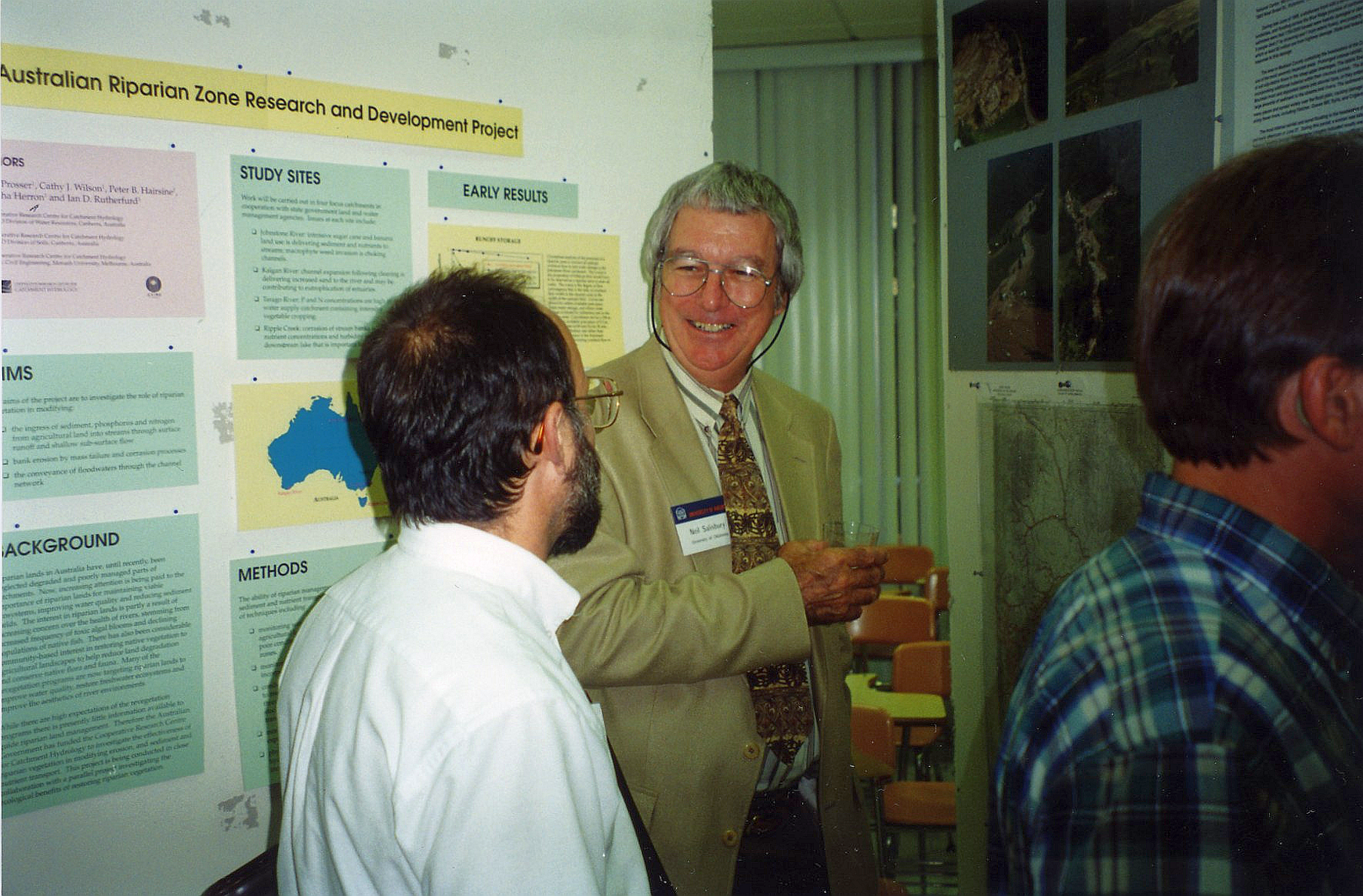
Neil Salisbury (center) in conversation with conference attendees at the 1995 Binghamton Geomorphology Symposium in Charlottesville, Virginia, USA, on the campus of the University of Virginia.
In the early to mid-1980s, Jack Vitek and David Butler were on the faculty at Oklahoma State University, about an hour-and-a-half drive from Norman, Oklahoma, where Neil Salisbury taught. On several occasions, the three of them would drive together to geography and geomorphology conferences—but those meetings were rarely closer than 500 miles away and often more than 1000 miles away! In 1982, the trio drove from Oklahoma to Laramie, Wyoming, to attend a regional geography conference (Figure 2); in 1984 they drove from Oklahoma to Binghamton, New York (look at the distance on a map!), to attend the annual Binghamton Geomorphology conference on the theme of tectonic geomorphology; and in 1985 they drove to Buffalo, New York, on the topic of hillslope processes. These “road trips” were done without stopping overnight, but rather by simply changing drivers and having one person (usually Neil) sleep in the back seat of the car while Jack and Dave switched off driving and chatting to keep each other awake. Neil always insisted, in those pre-Starbucks days, that all coffee stops be at a McDonald’s restaurant because he was firm in his belief that McDonald’s had the best, or at least the most reliable, coffee of any national-brand fast food franchise. Many a cup of McDonald’s coffee was consumed by Neil and Dave (Jack doesn’t drink coffee) on those 24-hour marathon drives from and back to Oklahoma!
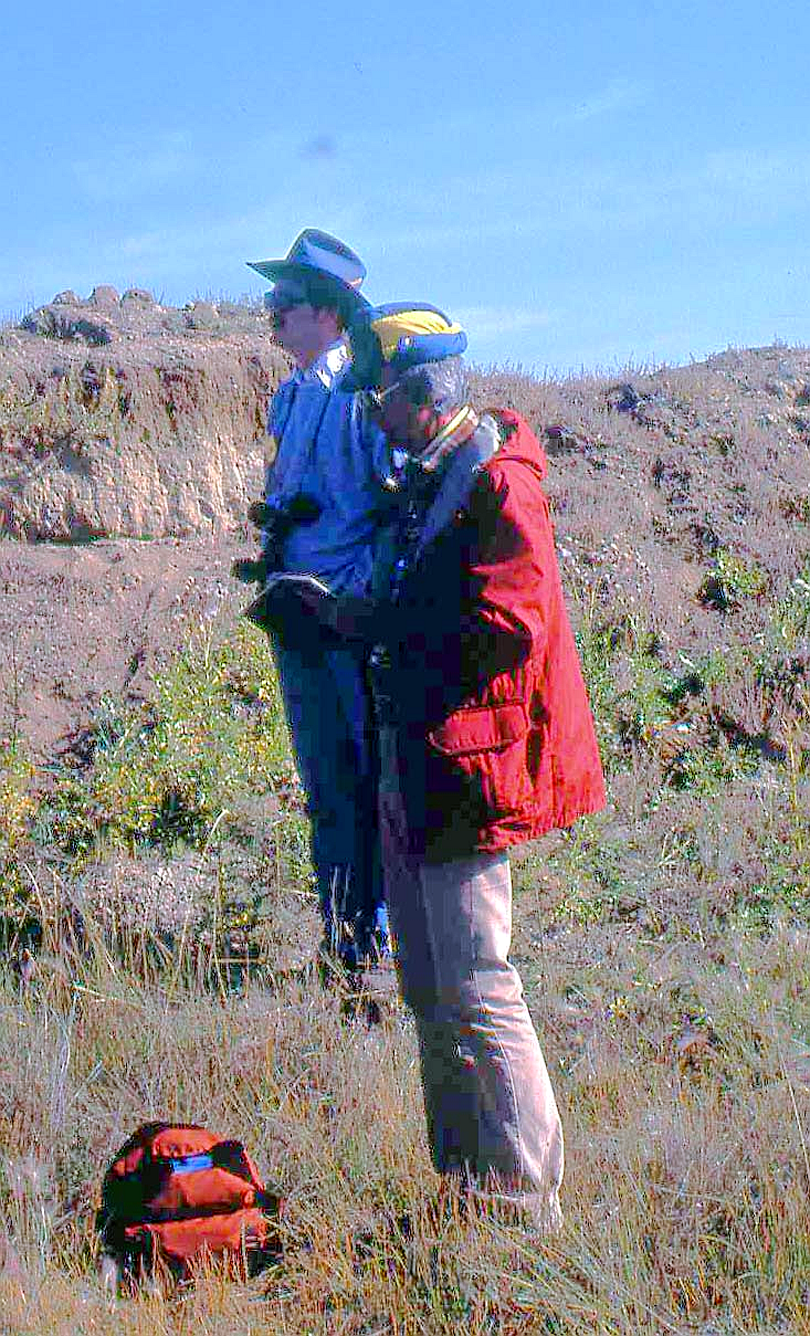
Neil Salisbury in the field (closer to camera) with senior author David R Butler, on a field trip during the 1982 annual meeting of the Great Plains–Rocky Mountain Section of the Association of American Geographers. The location was the Laramie Basin outside Laramie, Wyoming, USA. Salisbury, Jack Vitek, and David Butler drove from Oklahoma to Wyoming for the meeting.
IV Neal Salisbury’s contributions and legacy
Over the course of his career, Neil Salisbury was the advisor and mentor to 22 doctoral students, including James C (Jim) Knox at the University of Iowa, whose own AAG memorial tribute (AAG, 2012) noted: There is likely no living physical geographer who has produced more students who have gone on to assume positions of influence in the discipline than Jim Knox—so much so that one often hears reference to the “Knox School.”
Neil Salisbury’s influence on generations of American geomorphologists was noted and honored in 1992 by the Geomorphology Specialty Group of the AAG, when they awarded him their highest honor, the Distinguished Career Award (now known as the Melvin G Marcus Distinguished Career Award of the Geomorphology Specialty Group). In its award citation, it was noted that Neil (and a very few others) in effect “saved” American geomorphology from becoming a descriptive afterthought by participating in the quantitative revolution and insisting on a scientific approach for the discipline. His efforts in assisting with the founding of the Geomorphology Specialty Group was also noted, and particular note was also made of his “powerful but subtle” influence through his mentoring of the aforementioned 22 PhD graduates. The citation closed by noting how Neil made such a large difference in so many careers at the personal level, through “support for students and colleagues, his thoughtful advice and guidance from behind the scenes” and by his “friendship and irreverent good humor” that “made a material and positive difference in the careers” of so many members of the group. His good friend, John Fraser Hart, referred to him as “one of the finest field geographers of our time” (Hart, 2001: 322) and we suspect that Neil would be happy to be remembered that way, even though in so many ways he was much, much more to us.
Footnotes
Acknowledgements
We thank Bret Wallach of the University of Oklahoma, for tracking down a copy of Neil Salisbury’s CV and other background information, and Jack Vitek, for the use of the photographs of Neil.
Authors’ note
Declaration of Conflicting Interests
The authors declared no potential conflicts of interest with respect to the research, authorship, and/or publication of this article.
Funding
The authors received no financial support for the research, authorship, and/or publication of this article.