



Abstract
This Classics Revisited paper examines the contribution of Geikie’s seminal paper, presented to The Royal Society of Edinburgh in 1880, to physical geography as part of geomorphology, weathering, and necrogeography. From this standpoint, physical geography is approached as interdisciplinary, housing geomorphology and cross-disciplinary and applied research in the areas of climate and the environment affecting urban settings. Mortuary evidence is specifically addressed here, as Geikie presented observations and discussion of older churchyards situated in Edinburgh, Scotland. His emphasis permitted a focus on rock-air interactions of funerary remains carved from calcareous materials, sandstones and flagstones, and granites. The former (marbles and limestones) represent the main content of the paper, with an emphasis on superficial solution, internal disintegration, and curvature and fracture affecting calcareous rocks. Geikie’s areas of research interest are still prevalent in the literature today and can be construed as a pioneering work, representing a formative part of rock weathering affected by both climatic and environmental geomorphology in an urban setting.
Keywords
I Introduction
In the late 19th century, Professor A Geikie (Figure 1), Fellow of the Royal Society, presented an account of rock weathering in the Victorian period. His article (‘Rock-weathering, as illustrated in Edinburgh Churchyards’) was published in the Proceedings of the Royal Society of Edinburgh (Vol. 10) in 1880. The address was of older ‘burial-grounds’ in Edinburgh, which included a variety of rocks: (i) calcareous, including limestones and marbles; (ii) sandstones and flagstones; and (iii) granites. His contribution is critical for physical geography within weathering research, itself part of geomorphology, as it touches upon landforms and processes in landscape development. His study also contributes to applied geomorphology, as it examines rock-air interactions, and his discussion is relevant to climatic geomorphology through microclimatic analysis as well as environmental geomorphology because of the focus on air pollution and its impacts on rock weathering. Because of his examination of the weathering of various rock types in upright headstones (referred to in his article as ‘slabs’ and tombstones or tombs) at two Edinburgh churchyards, namely Canongate and Greyfriars, Geikie inadvertently addressed necrogeography as part of weathering research and, therefore, geomorphology and, ultimately, physical geography.
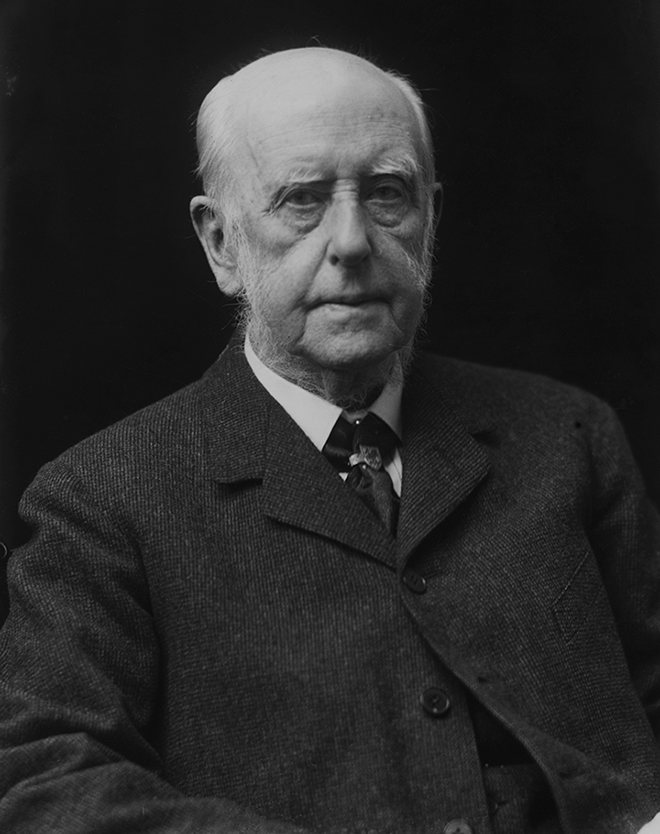
Portrait of Sir Archibald Geikie by Walter Stoneman, negative, 1917 (NPG x20733) © National Portrait Gallery, London.
This paper begins by presenting a summary of the major observations made by Geikie (1880), with a focus on calcareous rocks. It progresses to consider the disciplinary contribution of his work as physical geography, including geomorphology and weathering as well as environmental, climatic, and urban geomorphology, before delving into the ramifications for establishing cross-disciplinary necrogeography as part of physical geography.
II Geikie’s (1880) contribution
2.1 Geomorphology
2.1.1 Environmental geomorphology
Geikie (1880) attributed chemical weathering to sulphuric acid produced by coal smoke emerging from thousands of chimneys, polluting the urban atmosphere and affecting chemical change and the disintegration of rock surfaces. In addition to sulphuric acid, he referred to the begriming of stones with dust and smoke, with the formation of in/organic crusts covering surfaces and perhaps offering them some protection from acid rain. In this environment, he found a weathering signature comprising fine cracking and fissuring as well as encrustation and exfoliation, blistering, and curvature, that developed through exposure to a polluted urban environment at rates of decay or disintegration affected by properties of rock fabric impounding stone durability. He also recognised the effect of radiation in moderating daytime and night-time temperatures and, thereby, affecting urban climate by blocking daytime radiation and lowering temperature during the day, but insulating night-time temperature.
2.1.2 Climatic geomorphology
In addition to considering urban climate affected by pollution, Geikie (1880) also addressed the microclimate by noting the importance of sheltering effects attributable to the orientation (or aspect) of headstones. For example, he observed exposure to be especially pronounced on the west and north sides, which are most impacted by wind and rain, as he said that in Edinburgh the wind is westerly. Geikie (1880) considered the influence of organic crusts that may act protectively against the acidity of urban rainfall: Surfaces of stone are apt to get begrimed with dust and smoke, and the crust of organic and inorganic matter deposited upon them may in no small measure protect them from the greater chemical activity of the more acid town rain. (519)
Besides affecting biological colonisation, orientation also influences patterns of soiling through rainwashing, impacting on the colouration of crusts (as grey or black). Rainwater over grimy, soot-covered surfaces will dislodge particulates, thereby whitening those parts exposed to runoff (e.g. Davidson et al., 2000; Etyemezian et al., 2000; Fassina, 1988; Fassina et al., 2002; Tang et al., 2004). Headstone shape will affect rainwater drainage over headstone surfaces, as recognised by Geikie (1880) when he stated that form along with position affect weathering. It is not enough, however, to consider only orientational effects, especially of headstones that are rectangular, and obelisks are perhaps more appropriate monuments to study, as their inscriptions appear on all four sides rather than just on the front panel. Because of the predominantly eastward-facing panels of headstones in churchyards in the direction of the rising Sun, aspect studies become difficult where headstones are concerned.
2.1.3 Urban geomorphology
Much of Geikie’s (1880) paper was concerned with the urban environment as a setting for rock weathering. In this way, it was possible for him to present the environmental factors responsible for stone decay, including coal smoke and its ability to chemically alter rock surfaces in contact with a sulphurous atmosphere (and sulphuric acid through rainfall). Importantly, however, is what he calls the superficial solution (surface dissolution) of limestones and marbles, causing them to roughen through exposure to mineral acids (carbonic and sulphuric acids). He noted that this impacted inscription legibility, especially towards the centre of headstones, where they could lose material up to an inch. He addressed the internal disintegration of these calcareous materials, focusing on crusts of varying colours (dirty grey to deep brown-black) that are normally up to a mm thick. This, too, he linked with acid rain, leading to the formation of gypsum crusts that became sooty in the dirty town air.
III Weathering research
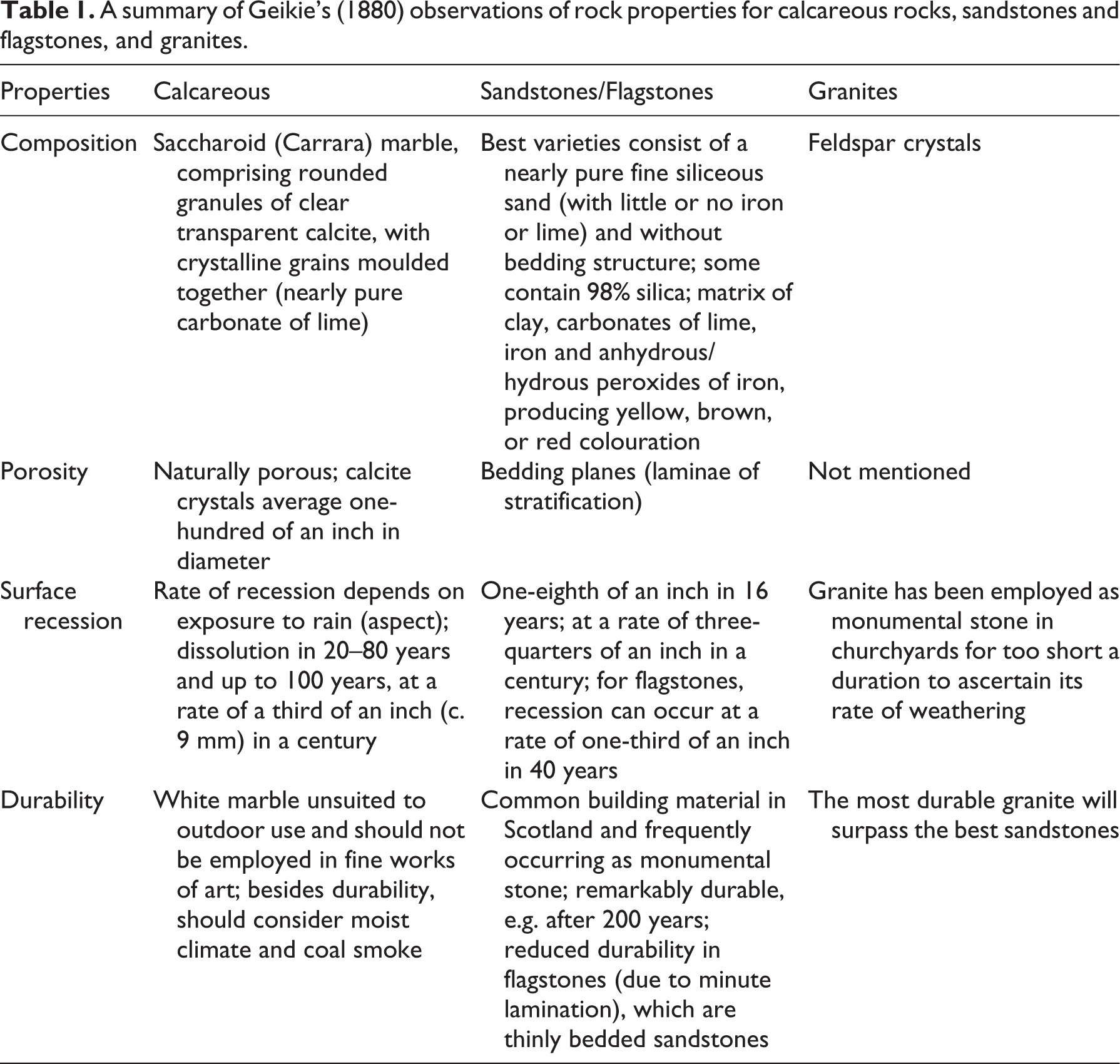
In his paper, Geikie (1880) examined different rock types of those represented in the churchyard assemblages of Canongate and Greyfriars. Table 1 contains details of the different rock types that he identified and considered in his paper, including their composition, porosity, surface recession, and durability. He expected dissolution to occur within 80–100 years of exposure at a rate of a third of an inch in a century. White marble, he felt, was completely unsuited to outdoor use and should not be incorporated into artistic works that would be exposed in an urban setting like Edinburgh, which has a moist climate and where an abundance of coal smoke is released from chimneys. In comparison, sandstones and flagstones, of which some comprise 98% silica, experienced surface recession rates of three-quarters of an inch in a century. Nevertheless, hard (pyrite-rich) sandstones can endure 200 years, although this is reduced in bedded flagstones. As for granites, they had been used for less time when Geikie wrote the paper, so that it was then difficult to discern their rate of surface recession. They were noted, however, to lose their surface polish within 15–20 years of exposure, although granites were observed to surpass the best of sandstones in durability. He identified such weathering timeframes, so that after 40 years of exposure there was reduced legibility, with complete illegibility occurring after a century of exposure in an urban atmosphere. Rocks that were in good condition after a century were either located in a relatively unpolluted setting (in the countryside) or were resistant to weathering due to their rock fabric, such as hard sandstones containing pyrites.
A summary of Geikie’s (1880) observations of rock properties for calcareous rocks, sandstones and flagstones, and granites.
Recent studies in stone decay and conservation have referred to Geikie’s (1880) paper as a ‘pioneering’ investigation in stone decay research (e.g. André and Phalip, 2010; McNeill, 1999; Schellewald et al., 2013). Roberts (2000), for instance, referred to it as the first published scientific paper on the weathering rates of headstones, and used it as a basis to frame the advantages of doing this type of research: accessibility in all seasons; datability; measurable change within a century; creating a large dataset comprising hundreds of measurements; published research; to quantitatively inform weathering research; and the low cost associated with doing such research. Geikie (1880) was recently cited by Inkpen (2013), alongside the work of Goodchild (1890) that examined headstones at Kirkby Stephen churchyard in Cumbria, as early research linking decay form and rates in marble and sandstone gravestones and buildings in association with atmospheric pollution in Edinburgh. According to Livingston and Baer (1990), Goodchild’s was the first known quantitative study performed in 1875, but it did not convey the impacts of air pollution on general weathering rates, whereas Geikie’s study was the first to explicitly deal with the issue of air pollution affecting stonework (Goodchild, 1875). He was joined by Julien (1880) in New York to examine durability based on stone type. Evidently, as an early (pioneering) study, the work has influenced research around the world (e.g. Dragovich, 1978, 1986 for Australia; Klein, 1984 for Israel; Paradise, 1998 for Jordan) and is considered to be part of the field of quantitative studies to align cultural stone research with landscape weathering and erosion (Pope et al., 2002).
Even though Geikie’s (1880) study addressed much of what has been investigated in weathering research since his time, he neglected to sufficiently consider the influence of biological and salt weathering, which have elements of both physical and chemical weathering. He did write about the influence of frost, causing physical weathering leading to disintegration, but chose to focus on chemical weathering associated with atmospheric pollution from coal smoke. Research on the impact of acid rain on monuments is vast in the literature since his article, with much attention going to ‘sulphation’ and the formation of gypsum crusts (e.g. Török, 2002a, 2002b, 2004), but this has mostly been performed on building walls (e.g. Antill and Viles, 1998) rather than headstones, with some research examining wall orientation (e.g. Thornbush, 2014; Török, 2002b; Williams and Robinson, 2000).
Nevertheless, the study fits into building stone research more generally, as is apparent in Rob Inkpen’s site on gravestone weathering bibliography included in: http://www.envf.port.ac.uk/geo/inkpenr/graveweb/biblio.htm, which mentions his own contributions (e.g. Inkpen, 1998; Inkpen and Jackson, 2000) as well as the classic Geikie paper. It is also included in American research by Meierding (e.g. 1981, 1993; see also Feddema and Meierding, 1987), which assessed the impacts of air pollution in New England on marble weathering (dissolution). Since Geikie, authors such as Cooke et al. (1995) continued to investigate the effects of rainfall and pollution on gravestones at sites located in Portsmouth and Wolverhampton, UK, finding similar rates of weathering in the last 100–150 years.
Most recently, authors (e.g. Inkpen et al., 2017) have examined the rate of gravestone weathering to trace atmospheric levels of sulphur, finding the highest levels in industrial locations, such as in Swansea compared with Birmingham, Portsmouth, and Oxford, with rural and suburban sites having very low sulphur concentrations. Moreover, the research by Mooers et al. (2017) has indicated the increased deposition efficiency of SO2 on Carrara marble gravestones since 1980 due to oxidation reactions with ammonia. Such chemical reactions involve complex interactions that are seldom conveyed in the contemporary literature, even though rock weathering can be construed as a complex system. Perhaps the reaction of stone to solar radiation depends on stone type, as for instance greenschist, which shows more weathering with exposure to salts in a humid environment and reduced weathering with direct exposure to solar radiation (Mottershead, 1997). So, there are interactions or interlinked variables that still need to be addressed in contemporary weathering research.
IV Cross-disciplinary necrogeography
Because of his subject matter, addressing rock weathering in two urban churchyards, Geikie (1880) contributed to research related to ‘necrogeography’, defined by Muzaini (2016) as ‘the study of deathscapes, [that] is the inquiry into spaces associated with death, dying, and the dead’. Keywords provided by Muzaini (2016), in addition to deathscapes, have included burial, cemetery, corpses, cremation, dying, and memoryscapes. This definition of necrogeography remains firmly embedded in human geography, but this could be altered by physical geographers through the introduction of research into taphonomic processes involved in deposition and erosion, rock decay, and relevant conservation studies. The decay of landforms and entire landscapes is a tenable part of ‘necrogeography’ that involves burial and not just burial practice, such that geomorphologists as physical geographers should be involved in this subfield, as they could constitute necrogeography as involving both burial practice as well as burial itself and the taphonomic processes (burial, decay, and conservation) involved in landscape change (cf. Thornbush, 2001). Recent research by Thornbush and Thornbush (2013, 2015, 2017, 2018) at urban churchyards located along the British East Coast can attest to this type of fieldwork being suited to necrogeography as entailing studies that address the stone decay of burial monuments.
V Landscape change as ‘necrogeography’
According to Beckinsale (1976), during the time of William Morris Davis (1850–1934) there was a shift within geography in the later part of the 19th century from classical to embracing a ‘new’ geography. This entailed, among technical advancements, uniformitarianism and the spread of evolutionary concepts, which Davis incorporated into his theory of landscape evolution, namely Davis’s cycle of erosion, that parodied the stages of a human life cycle – from youth, to maturity, to old age, and, ultimately, to death in a plain without relief or ‘peneplain’ before a final rejuvenation was possible (e.g. Davis, 1899, 1902; Leighly, 1974). Among fluvial geomorphologists, for instance, Davis was recognised for his cycles of river erosion and landscape evolution as well as the ‘peneplain’, which Morisawa (1989) considered to be base-level erosion in fluvial studies. Davis is mentioned here because of his theory of a cycle of erosion, which, according to Oldroyd and Grapes (2008), was at least partly based on the work of John Wesley Powell (1834–1902), who was an American contemporary of Archibald Geikie’s and an advocate of base level as the lower limit of subaerial denudation (based on the Colorado River; Powell, 1875), which Davis accepted as being responsible for landform rejuvenation (Orme, 2007). According to Oldroyd and Grapes (2008), German geomorphologists challenged Davis’s idealised theory and disagreed with discrete upward Earth movements involved in topographic rejuvenation, believing that erosion could also wear back surfaces as well as downward movements – among them, Albrecht Penck (1858–1945) and his son, Walther Penck (1888–1923). The latter, Penck (1924), acknowledged crustal mobility. According to Orme (2007), Dutton’s concept of isostacy had been resurrected and with it the acknowledgement of a more complex model, where landforms respond to ongoing interactions between tectonics, denudation, and isostatic compensation governing landscape rejuvenation (Schumm, 1963). Rather than focus on isostacy, however, most scholars recognised the importance of tectonic uplift to counter denudation (Orme, 2007), and Penck’s slope model, for instance, incorporated tectonic crustal uplift.
Of course, there would not be any landscape change without landforms changing across time, including human constructions made from building stone, such as funerary memorial stones that comprise necrogeography within the context of physical geography as part of weathering studies of such commemorative monuments (e.g. Thornbush and Thornbush, 2018). These ‘tombstones’ became of interest to geologists, such as Rahn (1971), as part of the investigations into the surface reduction rates of different rock types – which Rahn attributed to, instigated by Geikie’s (1880) work on tombstones in Edinburgh. This work has grown in popularity in recent years, particularly in urban settings where the cultural resource is at risk due to pollution, vandalism, and so on (e.g. Thornbush and Thornbush, 2015, 2018). As with other cultural monuments, including churches, these stone monuments have become part of cultural heritage studies by weathering scientists examining stone decay in burial settings as well as in other settings on a comparative basis in studies of air pollution impacting the conservation of gravestones (e.g. Cooke et al., 1995; Mooers et al., 2017). One of the greatest contributions of such studies has been dates inscribed into headstones that enable the researcher to quantify cross-temporal change at scales up to the centennial in older churchyards. In Greyfriars, for instance, the oldest headstone dates back to the 17th century, representing almost 400 years of landform weathering. Authors, such as Sohbati et al. (2018), have identified the challenge of quantifying hard rock erosion rates at centennial to millennial timescales, so the deployment of such a resource could be useful in this regard.
VI Concluding remarks
Geikie’s (1880) article based on his work in older Edinburgh churchyards addressed all vital aspects of weathering research and is relevant to subfields within geomorphology, including environmental, climatic, and urban geomorphology. It also inadvertently conveys how churchyard studies can be construed to be within the scope of necrogeography as part of physical geography through geological links with geomorphological subfields and weathering research. His is one of the few existing studies that examines urban churchyards in Edinburgh so holistically, with findings relevant across different academic disciplines and subdisciplines. His evidence-based approach using upright headstones has been captured in contemporary research by the authors and will continue to be targeted in coming studies, particularly impacting studies on the rates of weathering based on headstone markers. More work is needed to address sandstone and granites, as, for instance, polish on granite headstones and its rate of decay in these urban Scottish churchyards. Nevertheless, stone memorials located in burial settings, including cemeteries, but not exclusively, remain a vital part of necrogeography. As dated markers, they offer great potential to temporally track weathering and landscape change relevant to a variety of disciplines, particularly in the physical and environmental sciences.
Footnotes
Declaration of conflicting interests
The author(s) declared no potential conflicts of interest with respect to the research, authorship, and/or publication of this article.
Funding
The author(s) received no financial support for the research, authorship, and/or publication of this article.