



Abstract
One of the problems of wind energy development is the icing of blades of wind turbines. The devices for melting ice on the surface of blades of wind turbines with the use of external light sources in the form of mirrors, a paraboloid mirror, and a system of projectors are proposed. Simple economical mobile devices use renewable solar energy or a small amount of standard electrical energy.
Introduction
Wind energy confidently increases its contribution to the total amount of electricity produced in the world. Wind turbines are operated in different climatic regions of the globe. One of the problems for the development of wind power engineering in cold climatic regions is the icing of blades of wind turbines. The icing can change the profile of the blade, which worsens its aerodynamic properties, and uneven icing leads to an asymmetric load on the wind turbine designs (Etemaddar et al., 2014; Sunden and Wu, 2015). The icing of wind turbine blade leads to problems with its normal operation and can significantly reduce the productivity of the wind generator (Alsabagh et al., 2015; Makkonen, 2001).
Many works are devoted to the study of the features of ice formation on blades of wind turbines, its influence on the operation of the turbine, and ways to struggle against icing both at the stage of ice formation and after ice formation (Farzaneh and Ryerson, 2011; Siefert et al., 2003). Methods to struggle against icing are divided into passive and active techniques. Passive methods use the physical properties of the blade surface to prevent ice formation or it eliminate, while active methods use external pneumatic, chemical, or thermal effects (Parent and Ilinca, 2011).
Accordingly, many ingenious patents have been proposed in the field of anti-icing blades of wind turbines with the help of warm air (Bahuguni et al., 2015), mechanical pulses (Levin et al., 1974), vibrator (Libergren and Libergren, 2011), eddy currents (Safai et al., 2011), electric heating elements (Hallander et al., 2012; Mullen and Schroeder, 2014; Nordin and Strindberg, 2011), and microwave generators (Grabau, 1998). All of them seriously complicate the structure of the blade and require its constant monitoring and repair. Our task was to create a simple economical mobile device for liquidation of ice formations on the surface of the blades of the wind turbine, which spared blade constructive simplicity as much as possible.
Experiment details procedures
The idea of effective joint exposure of several mirror reflections of solar radiation to the object was proposed and implemented by Archimedes in 212 BC. Now this idea can be used to remove ice on the blades of the wind generator. On the basis of a truck or a tower crane, a mobile device is constructed from several light sources to melt the ice formed on the blades of the wind generator.
Figure 1 shows a device 1 (Lytvynenko, 2016b) of this type. The mobile platform 3 with the control panel 4 and the bracket 5, on which the mirrors 6 and 7 are fixed, approaches to the generator tower 1 with the rotor 2. The device operates as follows. The rotor 2 with the blades turns its back on the sun. Platform 3 with mirrors 6 and 7 is taken to a position opposite the sun and the rotor 2. With the help of the guidance and tracking mechanisms for the sun (not shown in Figure 1), the mirrors 6 and 7 are oriented so that the solar radiation reflected by them falls on the same surface area of the blade. The ice that has been heated to a certain temperature melts and the heating zone is moved to a neighboring portion of the blade surface.
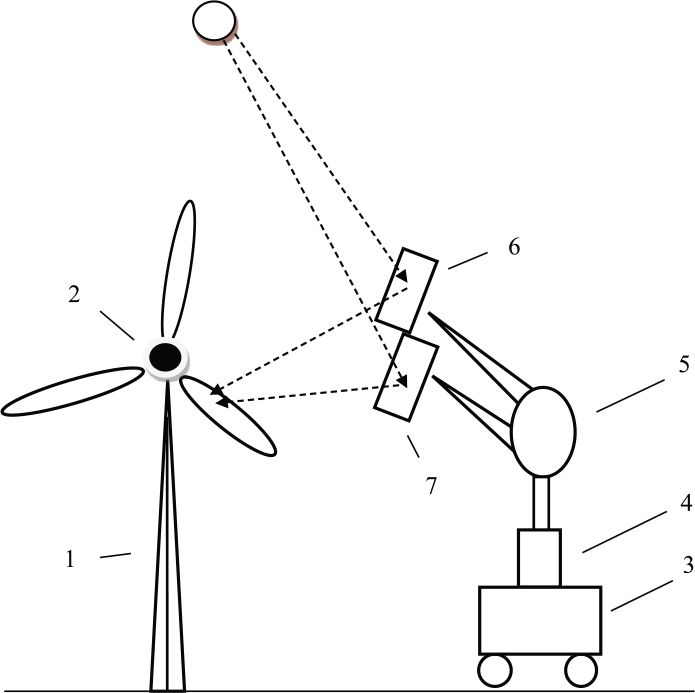
Device 1 to melting the ice formed on the blades of the wind generator.
This removes the ice from one blade. Then the second blade is transferred to the mirror area and then the third one. Each mirror must be equipped with a control mechanism and guided by the guidance program commands. Also, the bracket with mirrors should move in the right direction and at the proper height. After carrying out the operation of removing ice from the rotor blades, the platform with mirrors moves away from the tower and can be directed to the service of another wind generator. If necessary, you can make an individual device for a separate wind generator and attach it with special movable brackets to the generator tower. Then, after carrying out the operation of removing ice from the rotor blades, the platform with mirrors is lowered down and attached to the site of basing.
Figure 2 shows the device 2 (Lytvynenko, 2016a), where there is a paraboloid mirror 8 with a variable focus instead of plane mirrors. The operator of the control panel directs the mirror reflection of the sun to the blade surface and optimally focuses it by manipulating both the bracket and the device for the variable focus of the mirror. Further operations for melting ice are conducted in the same manner as in the previous case.
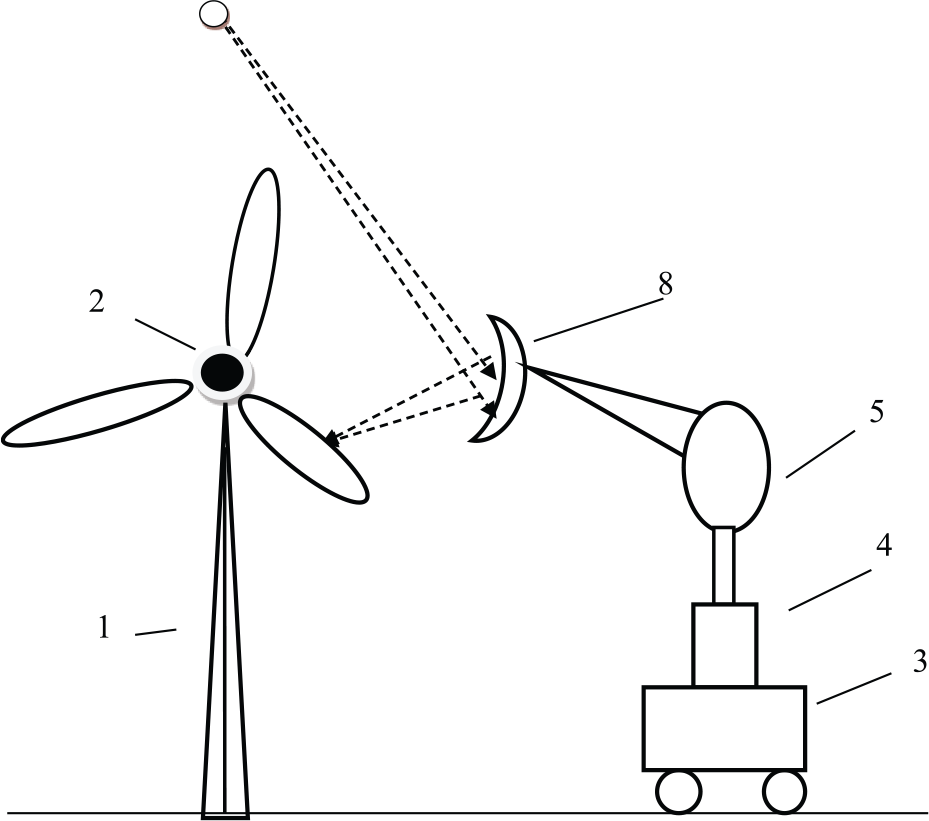
Device 2 to melting the ice formed on the blades of the wind generator.
Device 3 (Lytvynenko, 2017) is shown in Figure 3. Here spotlights 9 and 10 are attached instead of the mirrors.Each of the spotlights is guided to the same area of the blade. The light streams concentrated in this way from several floodlights melt the ice in a certain area of the blade surface. This device can work in any weather and at any time of day.
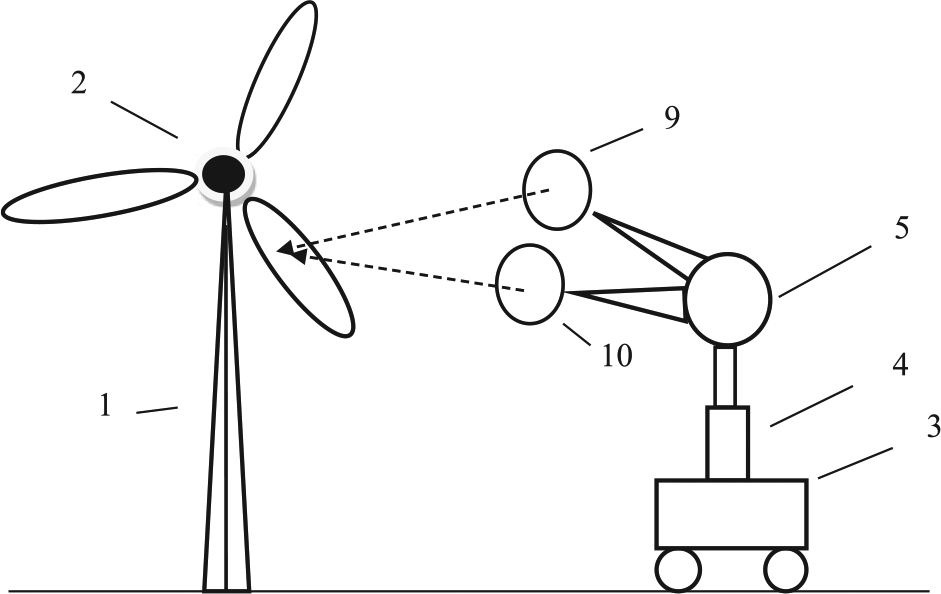
Device 3 to melting the ice formed on the blades of the wind generator.
Results and discussion
Blades with a length of 0.7 m of the rotors of the wind turbine W2 were fragmentarily covered with ice during operation in February and March. Therefore, it was necessary to stop the rotor and apply various devices for melting ice on the surface of the blades. On a sunny day, the turbine was turned in the back to the sun. Platform with four mirrors set against the lower blade of the rotor. Each mirror had the shape of a rectangle with dimensions of 20 by 40 cm. Each mirror in the manual mode was exposed so that the reflected sun’s rays from each mirror fell on the same portion of the blade surface. After 30 s, the ice spot of 1.5 mm thick was melted. Then the entire surface of the blade was gradually illuminated by the mutual movement of the platform and the blades of the rotor. After this, the other two blades were moved to the lower part and thus cleared of ice. The entire operation to remove the blades of the wind turbine took not more than 10 min, after which the rotor earned normal operation.
Another time, a platform with a long-focus paraboloid mirror with a diameter of 40 cm was exposed to the lower blade of the rotor and focused the sun’s rays on the portion of the blade surface. The ice cover of 1.5 mm thick was destroyed after 20 s. Next time, a platform with three spotlights such as UX-AMY with an individual power of 150 W was put up against the lower blade of the rotor. Each spotlight was exposed so that the light streams from each spotlight fell on the same section of the blade surface. After 20 s, the ice spot of 1.7 mm thick was melted. The models of working units have different values of the energy density and the dimensions of the illuminated areas, but they can be brought out to an approximately equal level of the effectiveness of the action on the ice cover.
Conclusion
The proposed devices for melting ice on the surface of blades of wind turbines with the help of external light sources are original all over the world. Devices consist of simple standard cheap items (maybe with the exception of a computer program for controlling mirrors or searchlights—but you can also control the mirrors or searchlights in manual mode). In this case, it is possible to apply various tactics of the effect of radiation on the ice cover—from the melting of significant areas of the surface to point destruction of ice. At the same time, the design and manufacturing technology of the blades remain in a primitive form and do not require any additional inserts and artifices. The devices operate without noise and dust, use renewable solar energy or a small amount of standard electrical energy. The total operation of such devices requires minimal electrical energy consumption.
Footnotes
Declaration of conflicting interests
The author(s) declared no potential conflicts of interest with respect to the research, authorship, and/or publication of this article.
Funding
The author(s) received no financial support for the research, authorship, and/or publication of this article.