




Abstract
Due to the variable nature of wind resources, the integration of wind power into electric power system has been a relevant issue. Recently, pumped hydro energy storage can be used to balance the unstable output of wind farm, as it can adjust its production to compensate wind power fluctuation. This article investigated the combination of a wind farm and a pumped hydro energy storage facility from the point of view of a generation company in a market environment. A joint operation model between the wind farm and pumped hydro energy storage is proposed. An algorithm of energy management system is proposed to identify the daily operational strategy to be followed in order to (1) minimize the penalty cost resulted from wind-pumped hydro energy storage output imbalances and (2) maximize the daily revenue profit taking into consideration all constraints of joint operation. Simulation results under MATLAB/Simulink® environment are presented and discussed.
Keywords
Introduction
Renewable energy sources are becoming an important portion of the electricity generation in many countries. Particularly wind energy becomes one of the fastest growing renewable energy technologies in the world. However, integrating of high level of wind power generation presents a considerable challenge to power system operators and planners. It can adversely affect the reliability of power system and brings changes in power system operation procedures. Thus, the inclusion of energy storage system (ESS; batteries, flywheels, ultra-capacitors, pumped hydro energy storage (PHES), etc.) allows improving wind system’s stability and performances (Katiraei et al., 2008; Pan and Das, 2015). In the case of high wind penetration, the PHES is recognized as one of the most promising storages that faces wind energy’s fluctuation in a large scale. In addition, the PHES can improve the reliability of the power system, and due to their performance, the PHES benefits the grid operator to make more financial revenues. Management of electrical ESS is an important research topic, in particular, in combination with intermittence wind energy. In this case, there is a wide variety of works handling different methods in terms of modeling and energy management system (EMS) strategy of the joint operation of a wind farm and a PHES. Parastegari et al. (2013) analyzed the optimal scheduling of the joint operation and uncoordinated operation of a wind farm and a PHES and studied the ancillary service market. The scheduling problem is modeled by a stochastic optimization problem. The results show that the profit is increased with the joint operation in comparison with their uncoordinated operation. Gao et al. (2018) dealt with an optimization model of a photovoltaic-wind-pumped storage system. An approach based on complementary objectives has been discussed for ensuring the maximum economic benefits. The results indicate that the pumped storage can effectively increase power benefits and access capacity of photovoltaic and wind power. Hozouri et al. (2015) tried to investigate the effects of PHES usage along with the local network reinforcement as a long-term solution to wind energy curtailment in power systems. In this regard, through a multi-objective optimization algorithm, a planning method is proposed. In addition, the proposed approach aimed to maximize the wind power capacity. It takes into account the wind energy curtailment cost, total social cost, and energy of PHES units’ revenues as objectives’ functions. Shi et al. (2016) studied the day-ahead optimal dispatching model of power system containing wind generator-hydro-thermal-pumped storage units. The particle swarm optimization algorithm used in this study aims to define the operational strategy of the system including wind generators, thermal generators, and PHES, and to reduce the production costs and the carbon devastating emissions. García-González et al. (2008) investigated the combined optimization of a wind farm and a PHES in a day ahead. Two stages stochastic programming approach has proven to model the decision-making process that the wind park operator faces in a spot-market framework under uncertainty. Castronuovo and Lopes (2004) proposed the utilization of water storage ability to improve wind farm operational economic gains and to attenuate the active power output variations due to the intermittence of the wind energy resource. An hourly discredited optimization algorithm is proposed to identify the optimum daily operational strategy in a day ahead to be followed by the wind turbines and the hydro generation pumping equipments. In addition, Luu et al. (2015) proposed an optimization of combining wind energy with the pumped-storage hydro plant. This study proposed an approach that includes three complementary functions to optimize the power of pumped hydro storage, maximize the revenues, and minimize the penalty costs. Duque et al. (2011) presented a dynamic programming method to build the optimal energy management of a wind farm, gas turbines, and PHES to reduce the imbalance between wind energy production and the demand load. Anagnostopoulos and Papantonis (2007) studied the optimization of the combination of PHES and wind farm. They aim to utilize the excess energy from the grid during off peak hours or the excess energy produced by the wind farms or solar photovoltaic power plants to pump the water from the lower reservoir to the higher one and then release the water from the higher reservoir to the lower one through the hydraulic turbines to produce energy. Kumar et al. (2016) studied the scheduling optimization of joint operation of a wind farm and a PHES. A linear programming method is used to make the decision of using energy of PHES and to maximize the revenue of joint operation. In addition, Nguyen Ngoc et al. (2009) used mixed integer linear programming method to obtain the optimal hourly thermal, hydro, and pumping power in a day ahead to enhance the cost lowering process of the entire system. Castronuovo et al. (2014) analyzed the integration of wind farms with PHES in a market environment. In this study, a strategy of management was developed to reduce the penalty cost from the imbalanced energy. Bayón et al. (2013) presented a tool to design the optimal configuration of a wind farm combined with PHES. Moreover, Angarita et al. (2009) proposed two methods to minimize the penalties in the wind farm’s power output. The first of these methods considered a wind farm bidding alone in the day-ahead market. It attempted to minimize the wind fluctuation based on a statistical analysis of the expected production probability. The second one coupled a PHES containing a water reservoir with the wind farm to minimize the imbalanced costs incurred by the wind farm owner. Furthermore, Bueno and Carta (2006) dealt with the optimal sizing of the wind farm and some elements of the water pump station were calculated. Godina et al. (2015) considered the optimum sizing as well as the design of a pump station unit for a combined operation with the wind farm. Their work aimed to find the optimal net present value for the investment in a 1-year simulation by varying the number of pumps used in the station. All the previous papers studied some algorithms of the EMS including wind farm and PHES in the framework electricity market. They developed EMS strategy to schedule power in a day ahead under economic criteria. While these works have been investigating the effect of PHES on the optimal scheduling of wind energy in power system in a day ahead, it still needed to have representative and simple models for joint operation of a wind farm and a PHES. In addition, the developing of real-time EMS is also crucial to instantly following day-ahead planning. Thus, in this article, a comprehensive modeling of joint operation of a wind farm and a PHES is proposed to explain the behavior of the system. A real-time strategy of EMS is developed in order to minimize the penalty cost and to maximize the revenue profit. This article is structured as follows: system is described in the “System description” section. In the “Model of joint configuration” section, the modeling of joint operation is presented. In the “EMS” section, the EMS strategy is described. In the “Results and discussion” section, simulation results in MATLAB/Simulink are presented. Finally, the “Conclusion” section contains the conclusion (Figure 1).
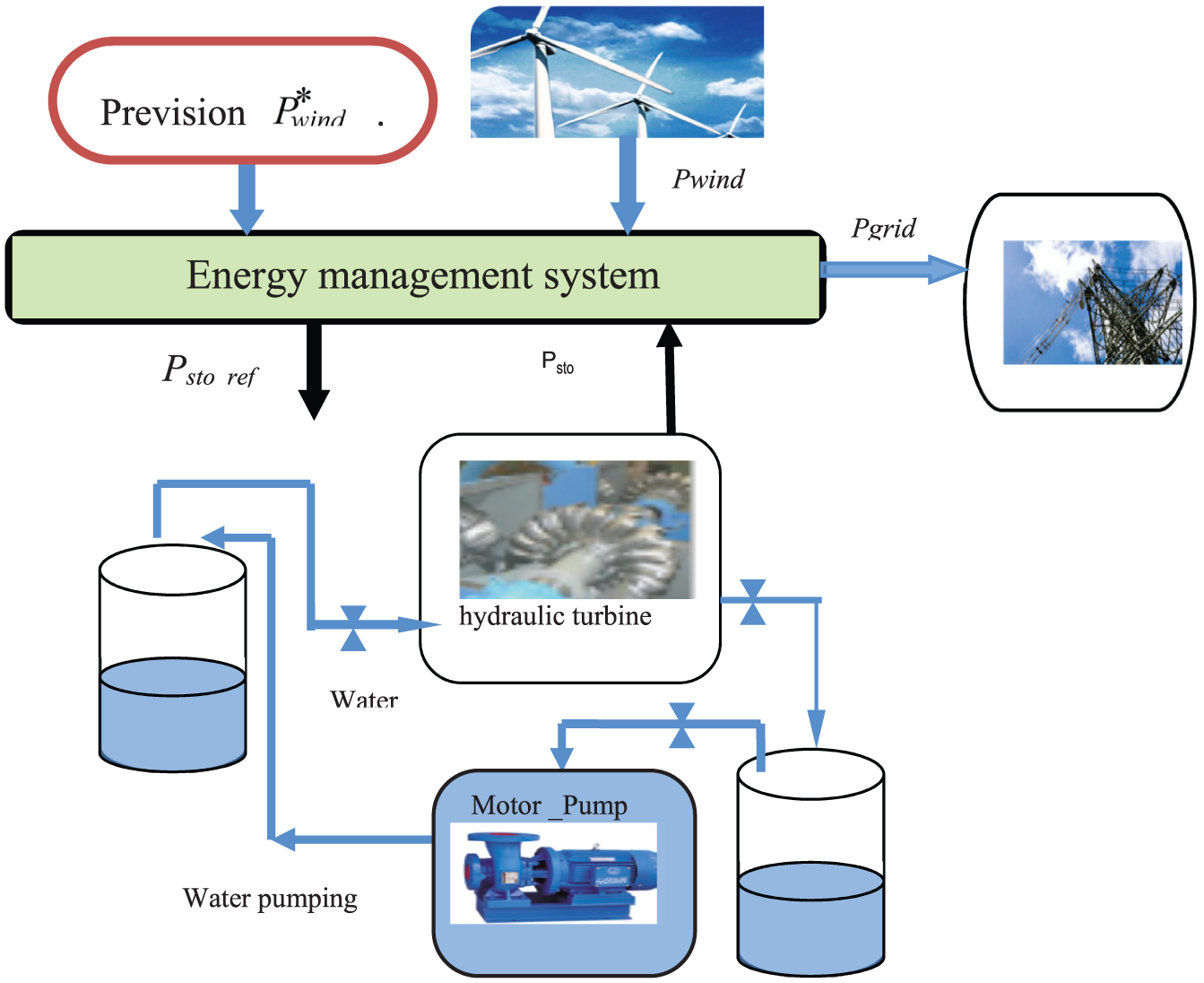
Configuration of joint operation including a wind farm and a PHES.
System description
The study developed in this article is carried out for grid-connected renewable energy systems in electricity market context. This system is located in Spain. It is called El Hierro station, which is composed of a wind farm and a PHES. The wind farm is composed of a set of five aero generators (Enercon E-70), each with 2.3 MW of power, so makes a total power of 11.5 MW. The pumped station contains two 1500-kW and six 500-kW pumps, so makes a total power of 6 MW. Four Pelton groups of each 2.38 MW of power make the hydraulic turbine capacity, the total power equals to 11.32 MW. The maximum flow generation equals to 2 m3/s with a gross head of 655 m (MathWorks, 2015). The joint operation between elements of station (Wind-PHES) makes it possible to match grid power requirements and generate the required revenues. As shown in the literature, the study of wind integration in electricity market is summarized in three main parts as represented in Figure 2. In the first part, the forecasting of wind power as well as the prediction of the grid power requirements is developed. The forecasting power on a time proportion can help to define the planning of energy production. In this study, we consider no wind forecasting error. Second, a joint configuration model is described. In other part, an EMS is developed to satisfy economic criteria.

Description of the system.
The wind farm has the priority to generate electricity and inject it to the grid. The PHES ensures the balance between wind power production and required power. The PHES recovers the excess of energy by pumping water from lower to higher reservoir through an induction motor pump and centrifugal pump. Then, it generates electricity by using hydraulic turbine PELTON and permanent magnet synchronous generator.
Problem formulation
The problem is formulated with a time step of half an hour (30 min) to find a daily operating strategy of both wind farm and PHES. Performances indicators are designed to measure the effectiveness of the management algorithm. Two indicators are proposed. The first is dedicated to production planning satisfaction and the second to cost minimization.
Indicator of program production satisfaction: this indicator is based on the mean absolute percentage error (MAPE) score evaluated each 30 min with the formula expressed as follows

Einj is the 30 min average energy injected to the grid and Epg is the planned production, N is the number of samples used during the period of time.
Financial indicator: financial indicator is based on minimizing of the penalty as well as maximizing the revenue profit during 1 day, as expressed in the following equation


In this article, the available wind power is assumed similar to the wind power forecasting, which implicates no wind forecasting error

The power injected to the grid is expressed as follows






where ηpump is the efficiency of pumped station, ηhyd is the efficiency of hydraulic turbine, Δt is the time period, ρ (kg/m3) is the density, g (N/kg) is the acceleration, vol (m3) is the volume of reservoir, ΔQ (m3/s) is the variation of flow rate, and S (m2) is the surface of reservoir.
The constraints of joint operation are expressed as follow





Likewise, the water reservoir has a limit of head and flow rate, which are expressed as follows


Model of joint configuration
Model of wind turbine
The mathematical relationship between the wind power generation and the wind speed to cube is expressed as follows (Wu, 2016)

where



Cp is a very important coefficient since it describes how much mechanical power can be extracted from the incoming aerodynamic power. Cp is a function of the tip speed ratio
Model of PHES
The PHES is composed of an upper reservoir and a lower reservoir. Typically, PHES allows the storing of energy during the over wind power production and generating electricity during lower wind production. Indeed, the PHES operates as a turbine when water is released from the upper reservoir to the lower one and generates electricity through a synchronous generator. Likewise, when pumping is taking place, typically at night, the energy is stored in the upper reservoir through an induction motor pump.
In pumping mode
During the over production of wind farm energy, the PHES operates as a pumping station which is based on an induction motor pump. Consequently, a model of induction motor and centrifugal pump is investigated (Figure 3).
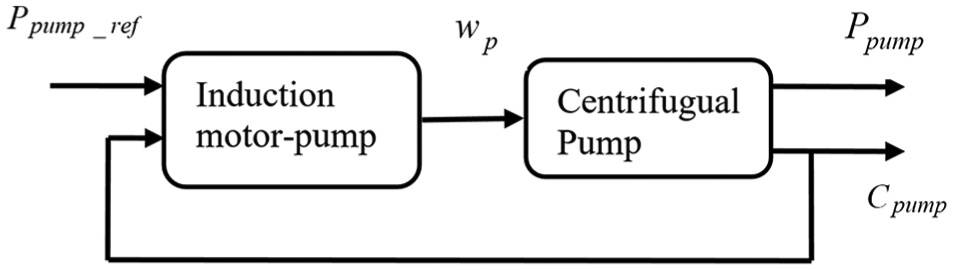
Pumping mode.
The expression of pump torque is expressed as follows

The expression of speed induction motor pump is expressed as follows

The equation of nominal power of the pump is formulated as follows


Ppump is the pump torque,
Ingenerating mode
This is also called discharging mode. In this mode, PHES unit generates power and injects it to the grid. The modeling of hydraulic turbine is based on a turbine speed governor and a servomotor in order to define the wicket gate position. As a function of wicket gate, the mechanical power is determined.
The servomotor is modeled by the transfer function which is expressed by

The mechanical power of hydraulic turbine is simplified as a transfer function, which can be formulated as (Wozniac, 1990)

Tw is the constant hydraulic time

where L (m) is the length of the penstock, U0 (m3/s) is the initial speed water, g is the acceleration, H0 (m) is the initial head, and G is the gate opening.
The reference speed is calculated as a function of nominal power flow

or the power exploited from hydropower at a particular site is proportional to the product of flow rate and head as given in the following equation (Kaunda et al., 2012)

By using equation (27) and equation (28), the mechanical hydropower is expressed as follows

The reference of hydraulic speed is calculated as

whyd (rad/s) is the speed of hydraulic generator, G is the gate opening, Pm (W) is the mechanical power, and D is damping coefficient.
EMS
The EMS is designed in order to smooth the power injected into the grid. It is also developed to guarantee the robustness against uncertainties of renewable energy and to balance the energy in the power system, concurrently satisfying at any time the grid power requirements. It aims to follow the daily operational strategy in real time of and to maximize the profit revenues. Once the objectives are identified, it is necessary to define the structure of EMS. It is therefore necessary to identify the right inputs in order to establish the right management rules for the output set point. Two representatives input variables are considered as the imbalance power between wind power production and required power and volume of the reservoir.
The EMS proposed is based on if-then rules. The objectives, the constraints, and all actions on the power system by the EMS are given in Table 1.
Objectives, constraints, and actions of EMS.

EMS: energy management system.
As represented in Figure 4, through the strategy of EMS, the reference power of PHES can be determined according to the head of reservoir H and the imbalance power

Generating mode.
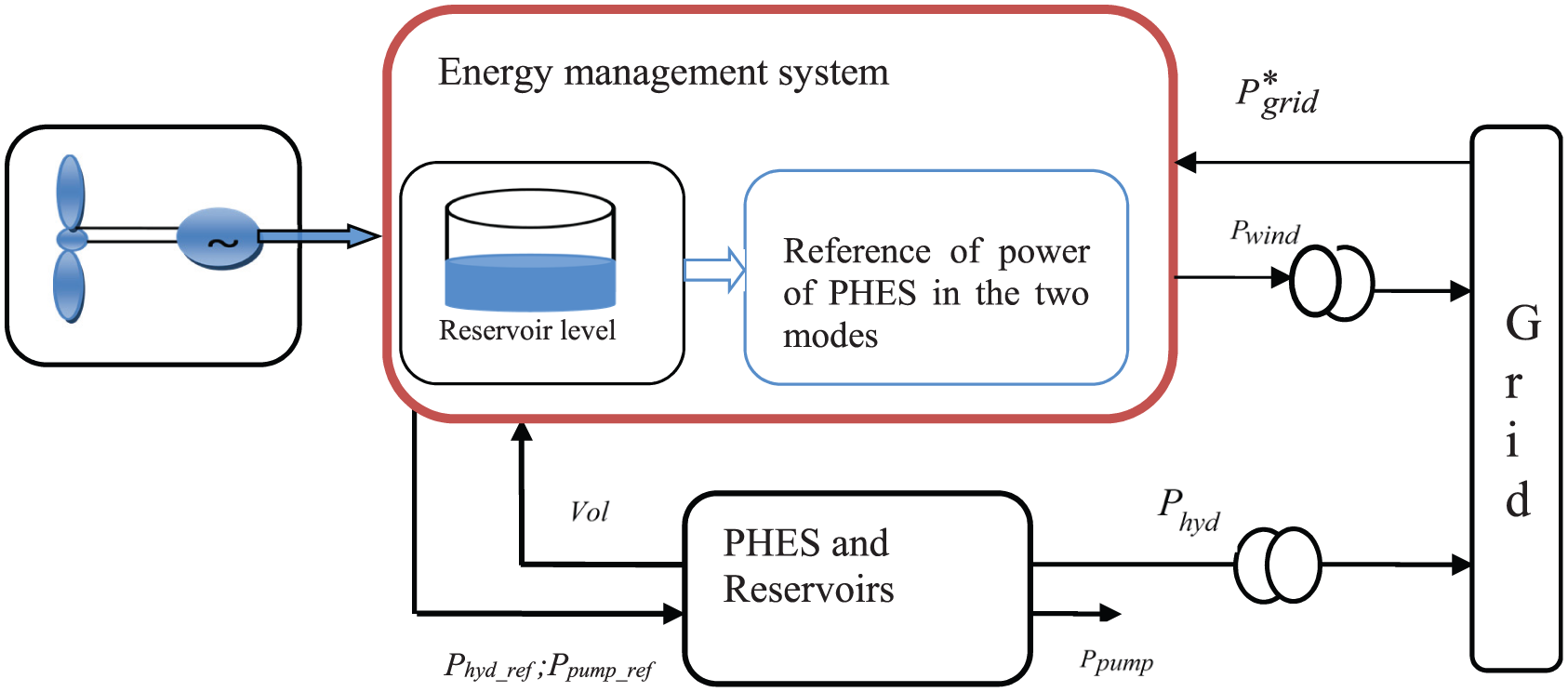
Energy management system of the wind farm and the PHES.
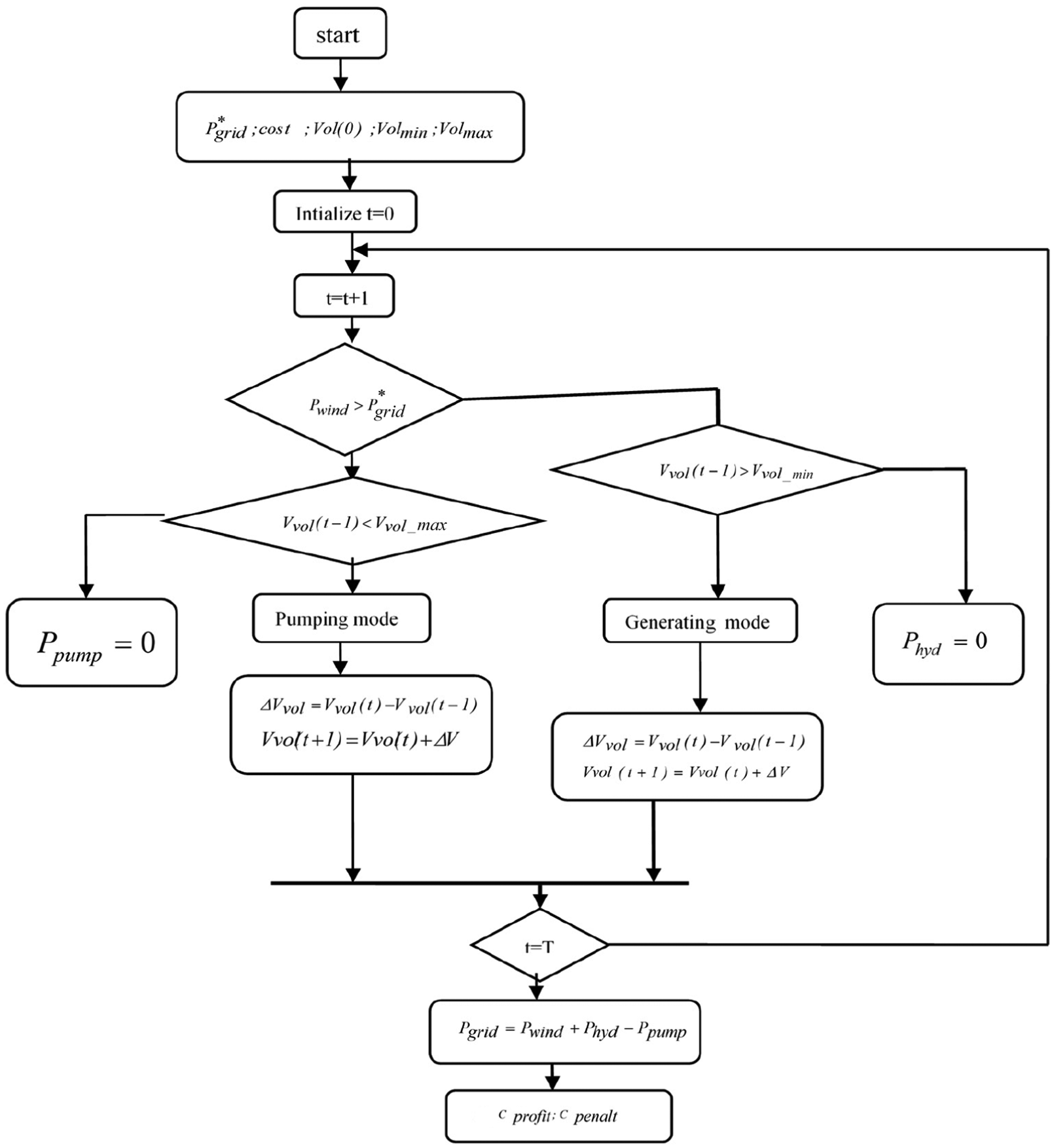
Flowchart of energy management strategy.
Results and discussion
The simulation of the EMS described above is performed by MATLAB® using the parameters described in Table 2. It is run with a time step of half hour (30 min) over a period of 1 month (1440 data points).
System’s parameters.

Figure 7 represents the evolution of wind speed for half an hour for a period of 1 month.

Wind speed.
In addition, Figure 8 represents the profile of grid requirement,with maximum power 12 MW and minimum power 5 MW, also maximum wind power 11.5 MW.

Wind power and grid requirement power.
As shown above, the reference power of PHES is calculated by the imbalance between wind power production and the requirement of grid power, which is represented in Figure 9.
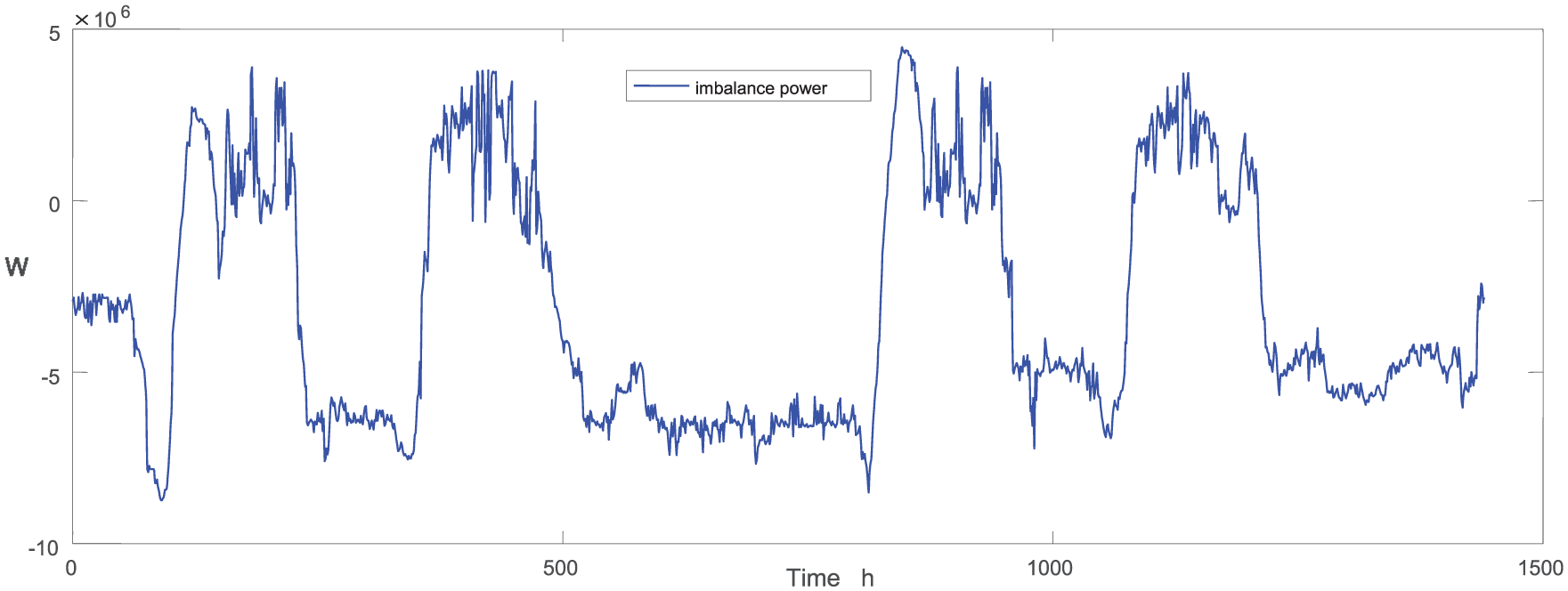
Imbalance power.
Figures 10 and 11 demonstrate the daily power of the PHES in two modes:
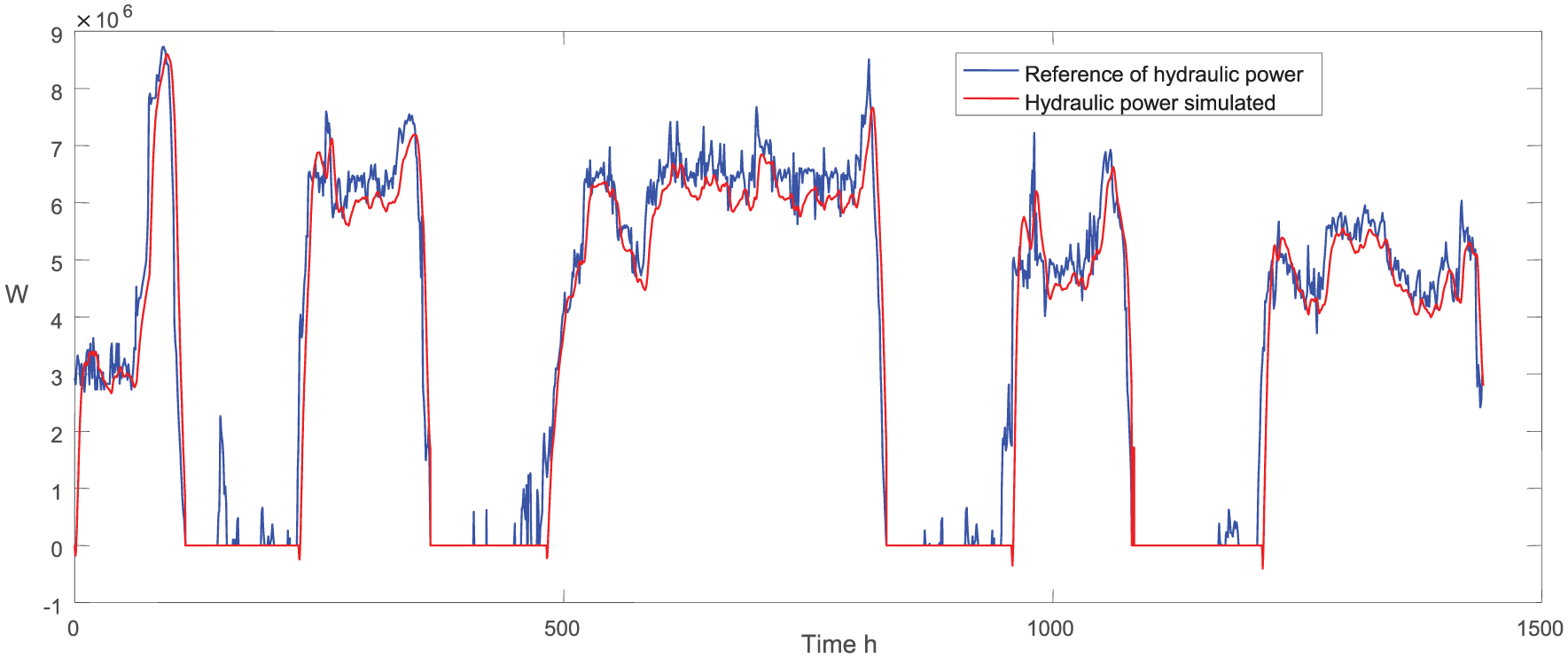
Power of PHES in generating mode.
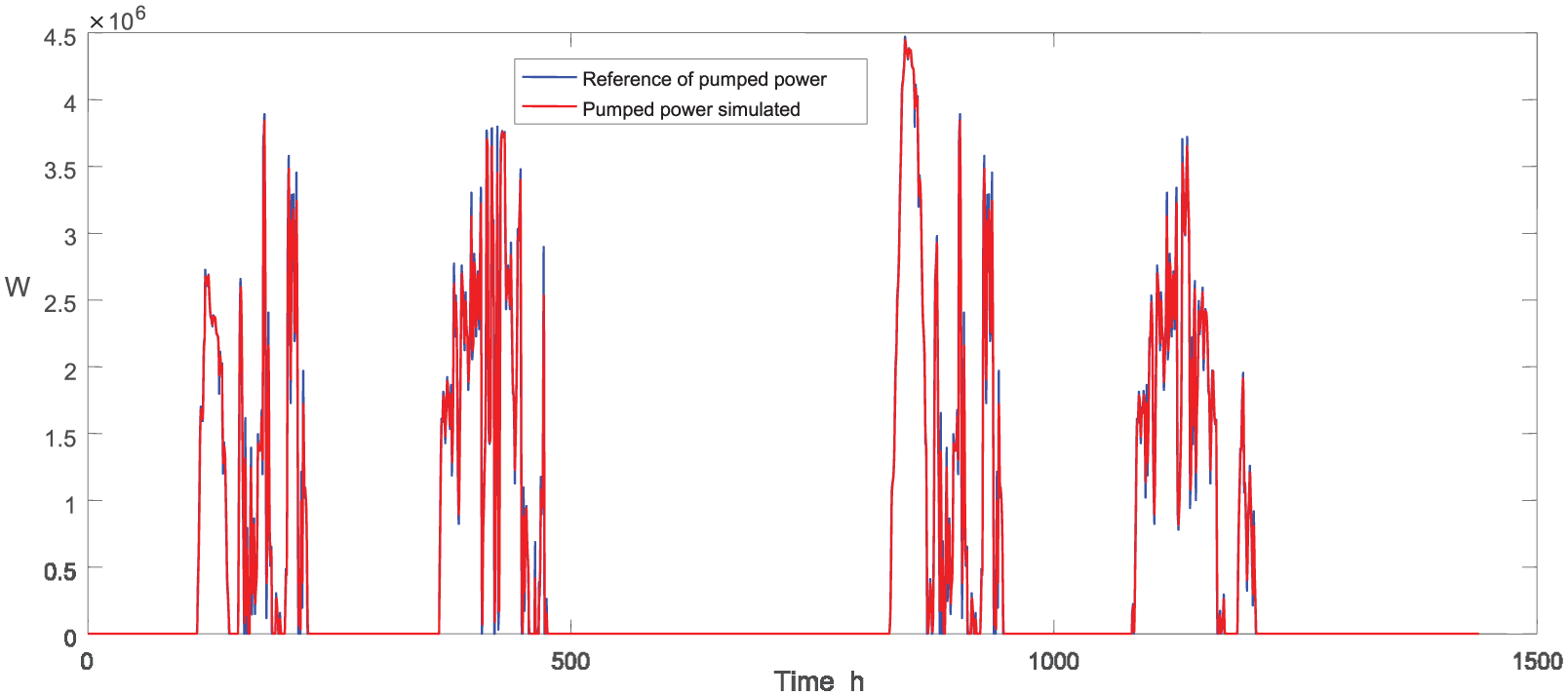
Power of PHES in pumping mode.
As shown in the simulation results, we have obtained five cycles of pumping and generating during month. Then, the PHES is operated in generating mode at 1 h < t < 24 h, 115 h < t < 184 h, 250 h < t < 414 h, 477 h < t < 546 h, and 614 h < t < 720 h to recover the imbalance energy with maximum 8.8 MW. However during 59 h < t < 113 h, 182 h < t < 241 h, 423 h < t < 459 h, and 546 h < t < 614 h, the PHES operates in pumping mode to pump water from lower reservoir to higher reservoir.
Figure 12 shows the filling of the reservoir during the pumping cycle.

Volume of reservoir.
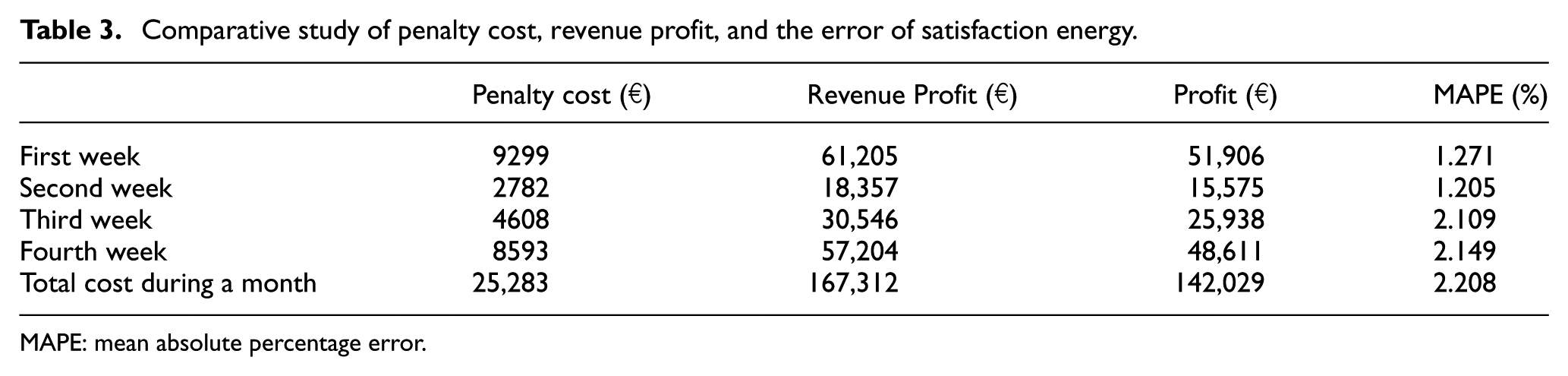
In Figures 11 and 12, the pumped-storage hydro plant operates coordinately with the wind farm. Generally, the wind farm will sign an electricity contract with the pumped-storage hydro plant, saying that the pumped-storage hydro plant should compensate 97% of the deviations from wind power output. In addition, the effectiveness of the proposed EMS is also verified by the computing of power planning satisfaction criteria defined in the “Problem formulation” section. Results are summarized in Table 3.
Comparative study of penalty cost, revenue profit, and the error of satisfaction energy.
MAPE: mean absolute percentage error.
In brief, the effect of the participation of PHES on balancing energy in power system is obtained either in pumped storage mode or in generating mode. In addition, the PHES participates in ancillary services market. In fact, as shown in Table 3, the suggested EMS achieves a remarkable reduction in the penalty costs of the system coupled with an improvement in the revenues.
Conclusion
In this article, the modeling of wind farm/PHES has been investigated. The proposed system is composed of wind turbine, hydraulic turbine, centrifugal pump, and two reservoirs. We have modeled all elements of system. Also, we described an approach to achieve two objectives: the minimization of penalty cost and maximization of the revenue profit. We propose an algorithm of EMS based on if-then rules to reach to the objectives predefined. However, an optimization of EMS in a day ahead must be developed in the future research.
The proposed algorithm can guarantee the requirement power, which is shown by the minimization of MAPE. In this case, we obtained an MAPE of 2.2% so that the satisfaction energy is ensured to be more than 97.8%. As results, the using PHES is a primordial solution to minimize the wind fluctuation and guarantee the grid stability.
Footnotes
Declaration of conflicting interests
The author(s) declared no potential conflicts of interest with respect to the research, authorship, and/or publication of this article.
Funding
The author(s) received no financial support for the research, authorship, and/or publication of this article.
