



Abstract
The customary energy assets are progressively draining, and the quest for using sustainable power source for power generation is picking up ubiquity for a safe energy demand. Energy recovery thought is introduced to use the pressurized wind caused because of water flow from the spillway of the hydel generating station. The fast wind is caused because of water flow from the supply at higher head to catchment zone at lower head. By appropriate demonstrating the structure parameters of the wind turbines, this fast wind can be used to create power by introducing it in reasonable areas. The consequences of two contextual investigations have been analyzed, and the capability of wind power in those areas has been evaluated. The produced wind power is taken back to the main system and can either be used for charging the batteries or can be used for auxiliary equipment.
Introduction
Wind energy systems play a vital role producing clean and green energy. The development of wind power systems in the ongoing years has brought many competitors to gather at a single platform which results in a tremendous amount of investment whereas intensive research is being conducted to improve the existing energy sector and enhance the overall efficiency of the system. The energy generation from conventional fossil fuels is responsible for higher CO2 emission causing serious health issues (Xu et al., 2017; Yan et al., 2017). Renewable energy resources can play a vital role to resolve the above mentioned issues (REN21, 2019). Power generation through solar, wind, and biomass are the abundantly available renewable energy sources that can compensate for the depleting conventional energy sources. Among these, wind energy is the most attractive option for energy alternative. Different countries of the world are utilizing wind energy in their energy generation mix, and it is estimated that wind power system can fulfill the 35% of the total electricity demand (51.3 GW of global wind capacity installed in 2018—Global Wind Energy Council, n.d.). In 2018, it has been estimated that the overall electricity production from wind is increased by 9.6% to 591 GW, China in the leading position with installed capacity of more than 22 GW (Sahu, 2018).
The potential of wind energy generation is more as compared to hydro energy in the context of Pakistan but because of lack of expertise in the field this potential is not fully utilized. The total capacity of commercial scale wind power plants in Pakistan is 1237 MW (U.S., 2017) which is estimated to be 6% of the total energy mix and planned to add 3500-MW capacity by 2019 (CleanTechnica, 2015). Many studies have estimated different sites for having a great potential of wind electrical power generation, including Hawkes Bay Karachi (Aman et al., 2013; Khahro et al., 2013), Keti Bandar (Ullah et al., 2010), Gharo and Jhimpir (Mirza et al., 2010), Jamshoro (Siddique and Wazir, 2016), and Babur (Khahro et al., 2014).
Electrical power generated from wind depends on wind speed, height of the installed system, and angle of attack at which the wind strikes the blades of the turbine (Billinton and Bai, 2004; Wan et al., n.d.). In most of the cases, horizontal axis wind turbines are used as compared to vertical axis wind turbine because of higher efficiency, ease of operation, and maximum energy extraction from wind (Luhur et al., 2016; Shengbai et al., n.d.). Electricity generated from wind can be integrated with the electricity produced by the hydroelectric turbine-generators, resulting in hybrid wind–hydropower system (Acker, 2011; Clement et al., 2014). This can be done by capturing the wind created from the water fall from an upstream height of a dam spillway gates. In Warsak Hydroelectric Power Station, high flow of water is observed during monsoon season, resulting in the spillway gates to continuously stay open from April to August (157 days) of the year causing the availability of wind in this duration. This available wind can be utilized to generate electricity by installing wind turbines near the spillway result in extracting extra energy. The extra energy can be consumed in different ways such as to charge station batteries; can provide excitation to the field winding of synchronous hydroelectric generator; can be connected to the national grid for net metering, can be used to drive local lightening loads of power house, can be used as a backup or cold reserve, can be used to store electricity by digging pits, using the technique of compressed air energy storage system (Alami et al., 2017; Nelson, 2013).
In this research, the focus of the study is to explore the wind generation potential at the spillways of the hydro power plant due to high-speed wind caused from water fall from upstream to downstream channel. This wind energy generation system can be used as peak load power plant as the energy demand increases during this summer duration (April, May, June, July, August) in Pakistan. The design parameters for the wind turbine have been estimated for efficient utilization of this proposed scheme. The extra generated energy from this hybrid wind-hydro system can be feed-back for the auxiliary supplies as well as feed into the main grid. Section “System modeling and parameters” discussed the system modeling parameters for the designing of the wind turbines considering various environmental and technical factors. Discussion on the results has been done in section “Results and discussion” estimating the amount of energy that can be generated through this proposed scheme. Conclusion has been discussed in section “Conclusion.”
System modeling and parameters
Wind turbines can be placed near spillway in such a way that it captures maximum wind speed for the electrical power generation as shown in Figure 1(a) and (b).
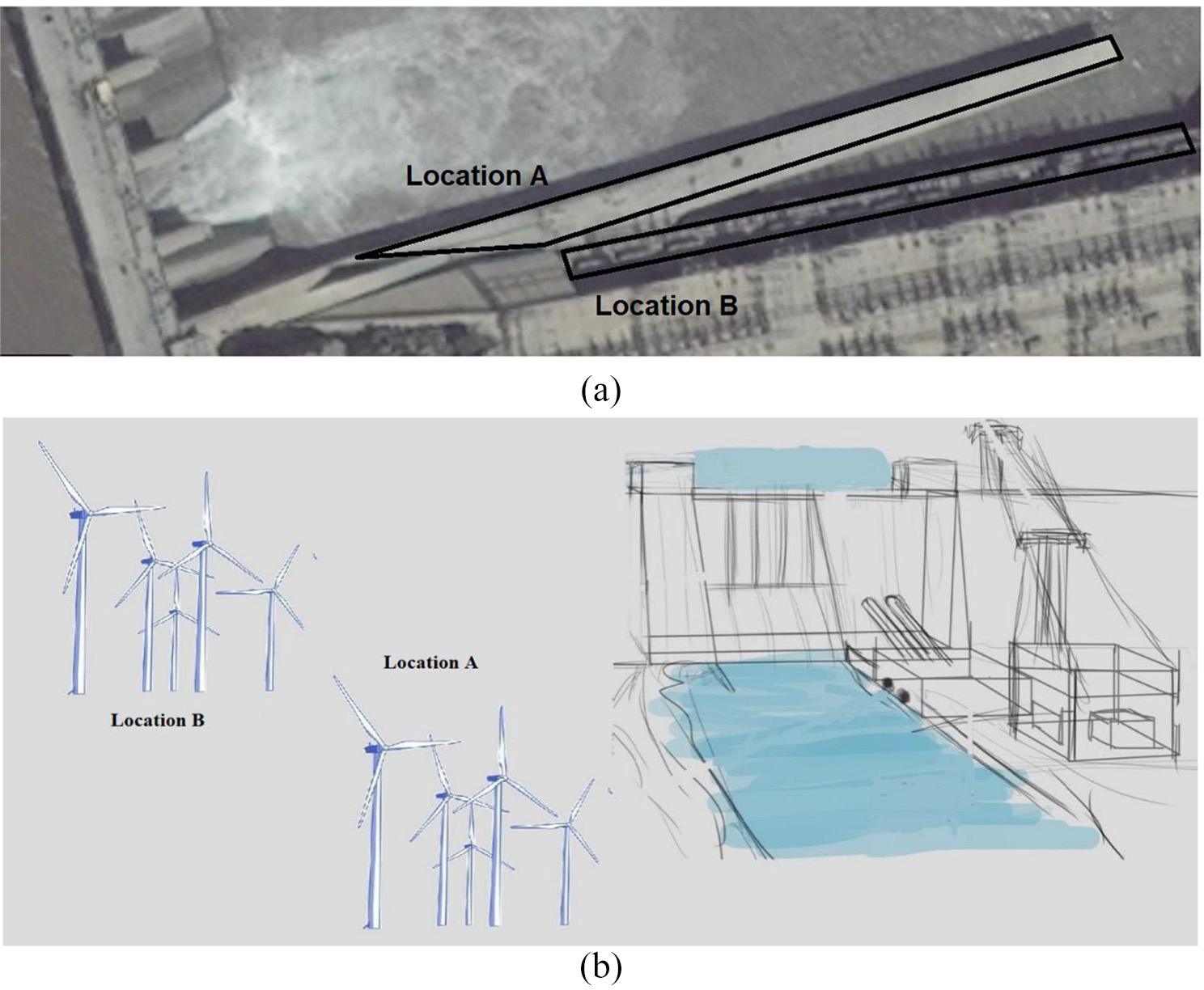
(a) Top view of the proposed location of wind turbines near spillway of Warsak Hydroelectric Power Station; (b) sketch of a proposed wind turbines location near the spillway of Warsak Hydroelectric Power Station.
For the implementation prospective, a group of wind turbines with each wind turbine having a diameter of 2- and 0.5-m distance between consecutive turbines have been assumed as shown in Figure 2.
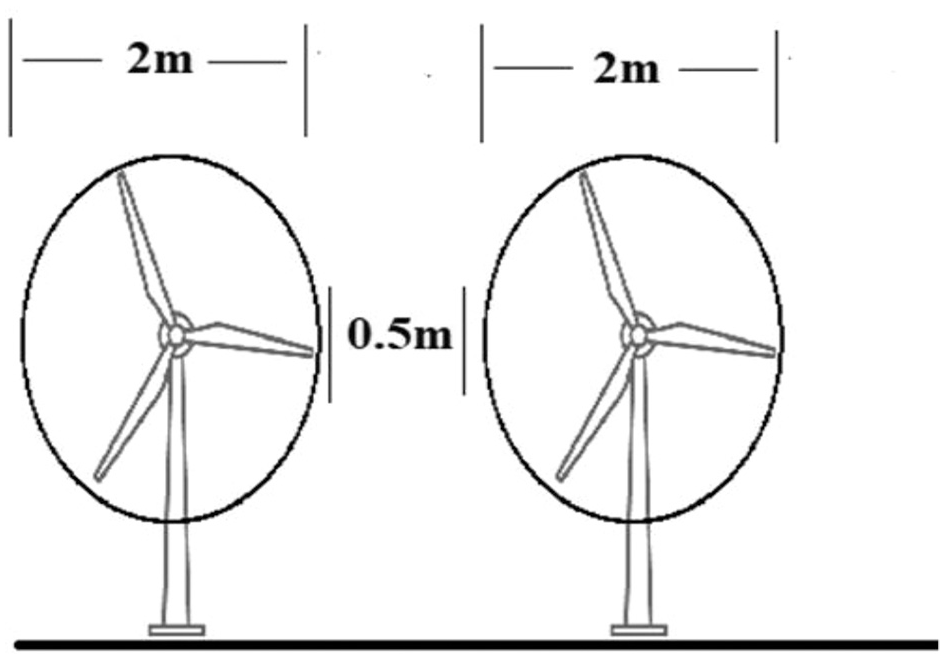
Wind turbine dimensions.
Wind speed can be calculated using equation (1) at different distance and height. Wind speed at the desired location is measured using power law method (Albani and Ibrahim, 2017)

where n is the roughness factor and it varies from 0.1 for flat terrain, ice, or water to more than 0.250 for junked trees and forest (Pishgar-Komleh et al., 2015). Two different locations (Locations A and B) have been considered in this study, and the different design parameters with respect to these locations are given in Table 1.
Height and speed at location A and location B.

The number of wind turbines to be installed at each specified location is calculated using equation (2)

For detail analysis, the results for two locations have been discussed under two different case studies. The detail about the length of the path with the number of wind turbines that can be accommodated is shown in Table 2.
Path length, number of wind turbines at location A and B.

One of the most crucial steps in the field of wind power system manufacturing is the designing of external features of a wind turbine, including the number of blades, inertia, pitch angle control mechanism, and yaw angle control mechanism. Inertia of wind turbine depends on the number of blades, density of a material used, and dimensions of wind turbine blade. It is calculated using equation (3)

Rotational speed of a wind turbine blade also plays an important role in the designing process, and it mainly depends on the radius, air density, inertia, and wind speed. It is calculated using equation (4)

Tip speed ratio (TSR) is the ratio of the speed tangential to the blade tip of wind turbine to the actual speed of wind. It is the main factor which determines the efficiency of wind turbine. It is calculated using equation (5)

Efficiency of the wind turbine can be calculated by means of TSR using equation (6). If the TSR of wind turbine having three blades is in between 2.950 and 5.400, then its efficiency can be calculated (Letcher, 2017)

Electrical power generated by a wind turbine is calculated using equation (7) which is a function of its efficiency, air density, swept area, and wind speed

The electrical power generated by the wind turbines at locations A and B is calculated using equation (8).

Total electrical energy generated by the wind turbine is the product of total electrical power and the total time of operation. It is calculated using equation (9)

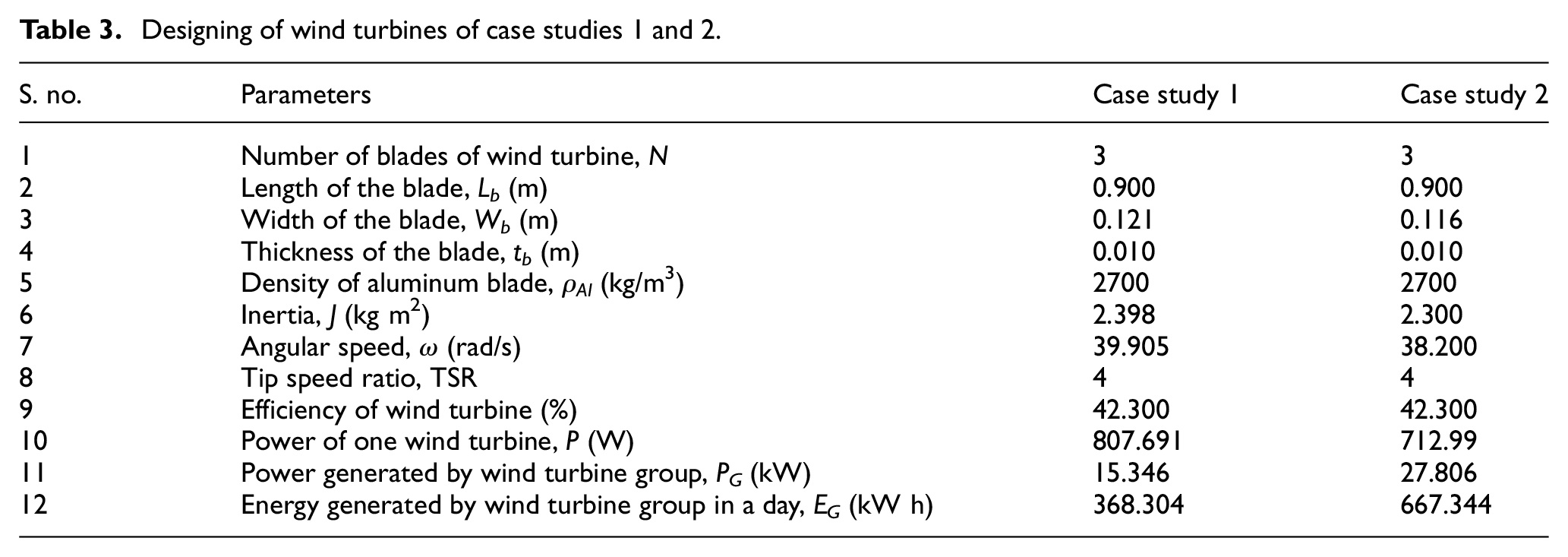
The details of the different parameters for the designing of wind turbines have been summarized in Table 3.
Designing of wind turbines of case studies 1 and 2.
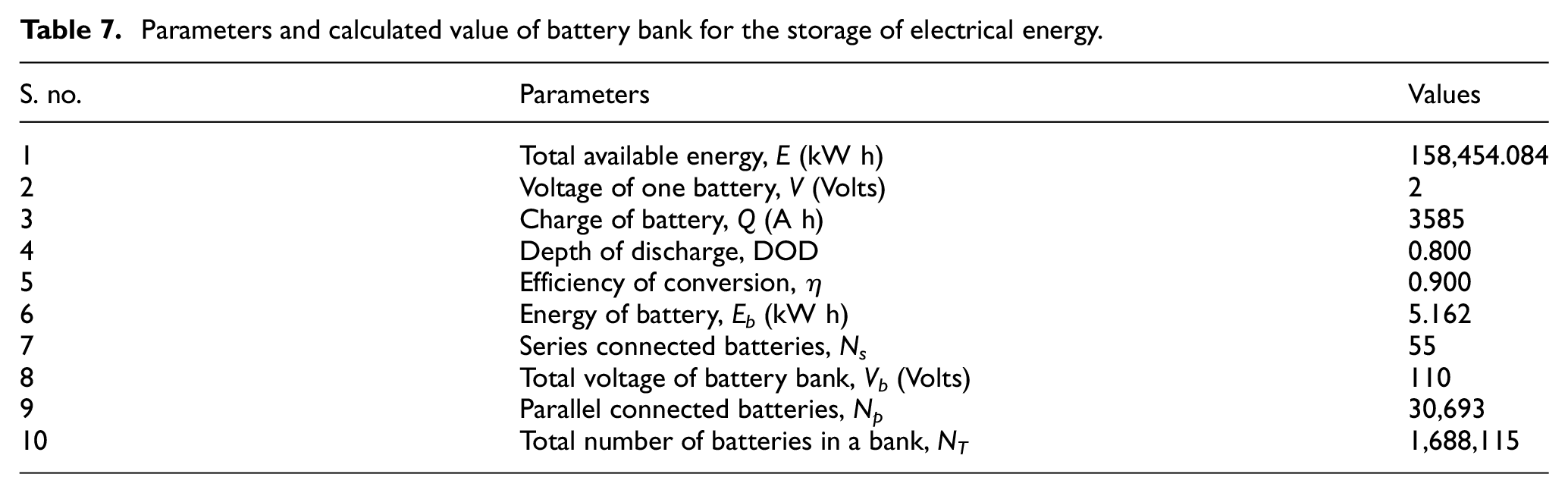
Wind energy that has been extracted through this scheme can be stored in the batteries. Storage of electrical energy in batteries depends on the charge storing capability, voltage, depth of discharge, and conversion efficiency. Energy storage in the battery is calculated using equation (10)

Total number of batteries (NT) to be connected for the storage of electrical energy is calculated using equation (11)

where NS is the number of batteries connected in series in order to get higher voltage which is calculated using equation (12)

The number of batteries connected in parallel (NP) for getting higher charging capacity is calculated using equation (13)

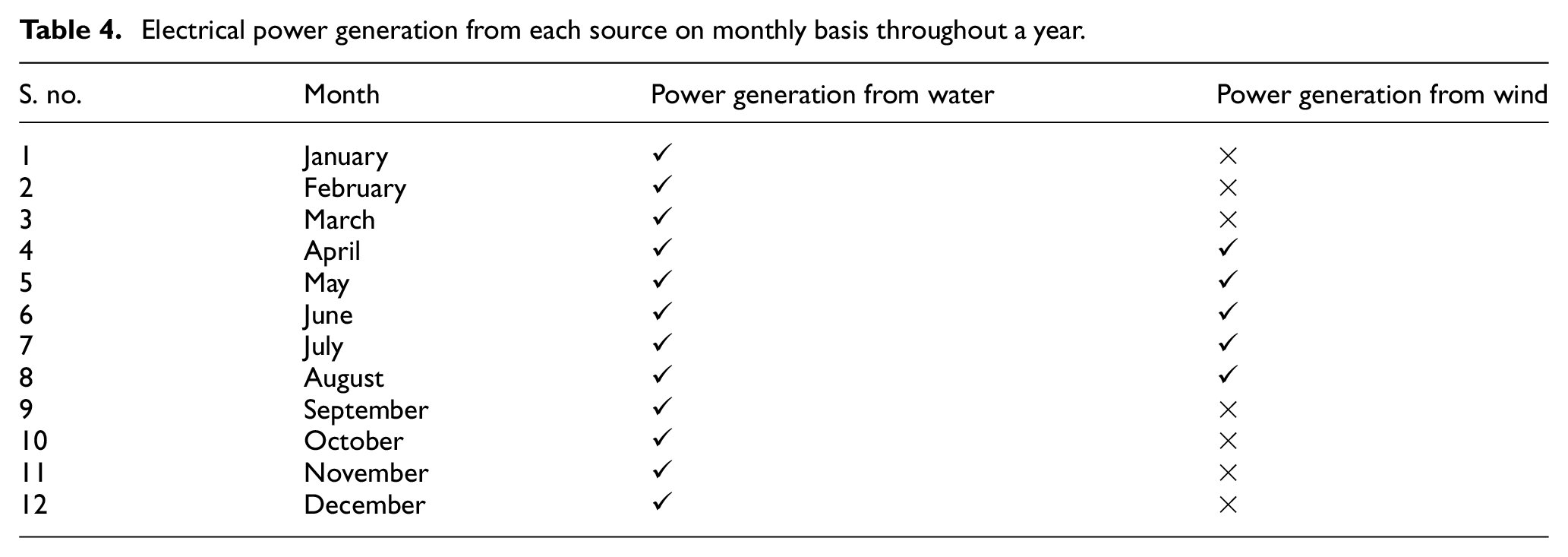
The capability of electrical energy generation from hydro and wind sources on a monthly basis throughout a year is shown in Table 4. The hybrid system of wind and hydro collectively generates electricity from April to August, whereas in remaining months, only hydroelectric system will produce electricity and wind will not, because of closing of spillway gates.
Electrical power generation from each source on monthly basis throughout a year.
Results and discussion
At the Warsak Hydroelectric Power Station, due to seasonal variations, wind is available for about 157 days of a year and spillway gates of the dam remain close due to low availability of water in Kabul River in remaining days. The detail for the wind speed availability of each month can be represented in Table 5.
Velocities of wind on monthly basis in a year.
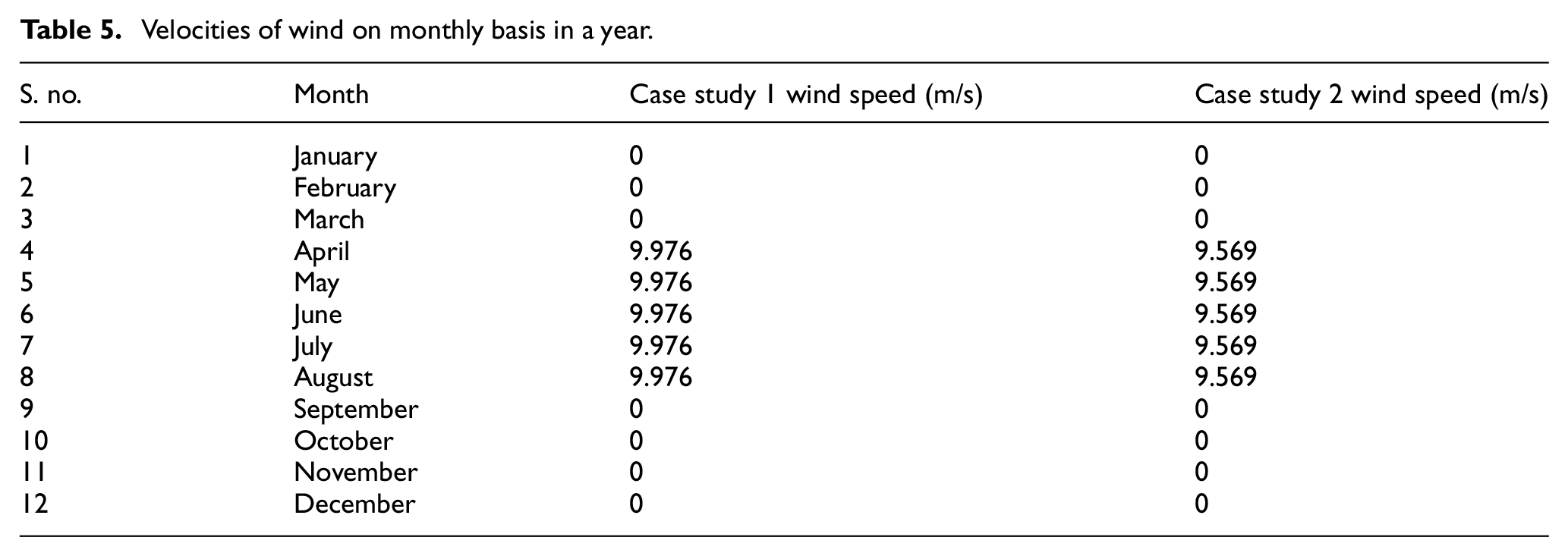
Wind speed at location A is more than that of location B . The graphical representation of wind speed on monthly basis in a year is shown in Figure 3.
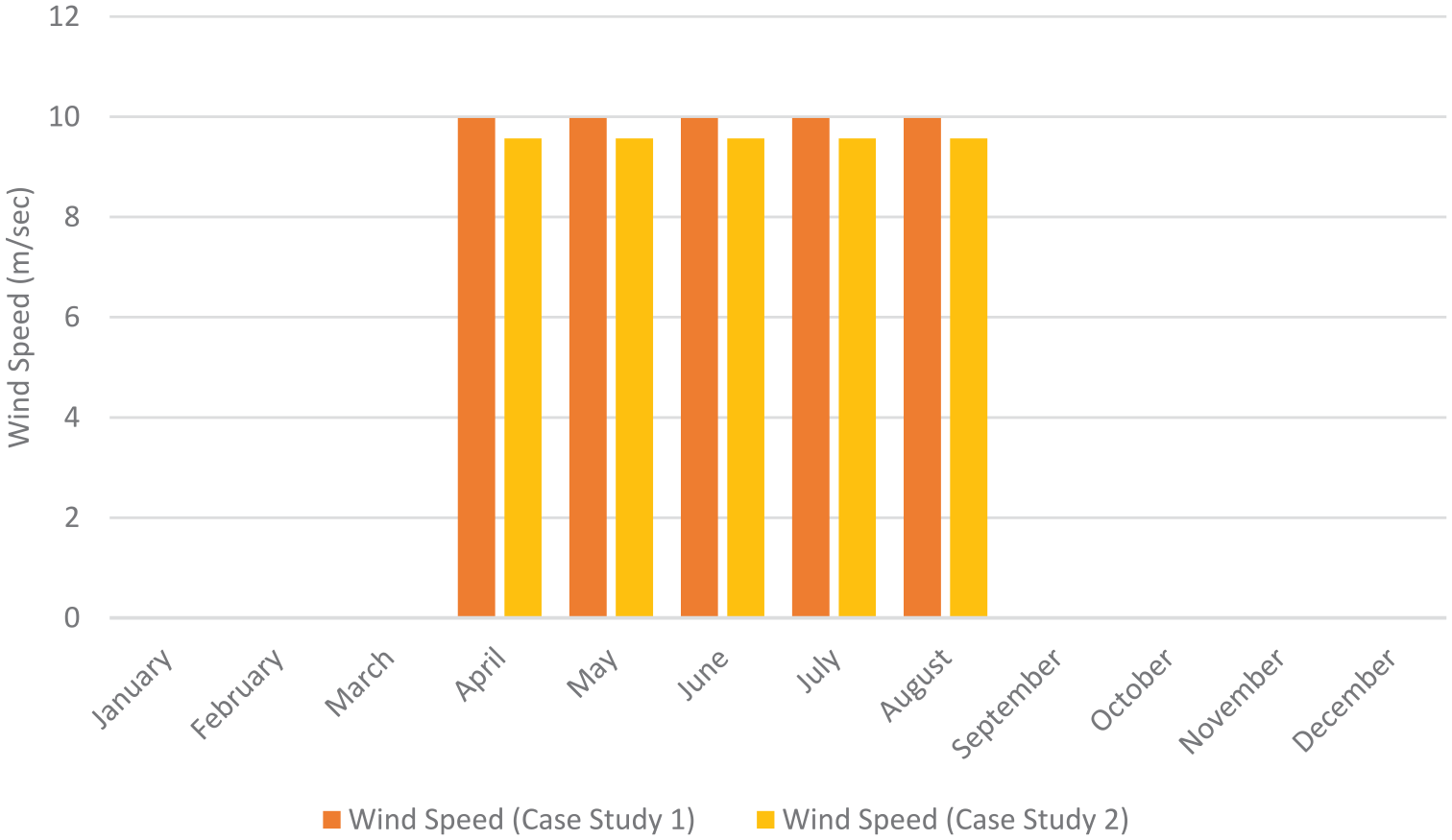
Velocity of wind on monthly basis throughout a year.
The energy generated through this scheme can be utilized either in an on-grid mode and directly feed into the main grid or in the off-grid mode depending upon the availability of energy storage mechanism (Siegfried, n.d.).
On-grid mode calculations
In this mode, the wind energy generated at both the cases which corresponds to the wind speed is injected into the main grid. The detail of energy generated for each month is shown in Table 6.
Monthly electrical energy production (case study 1 and case study 2) for on-grid mode.
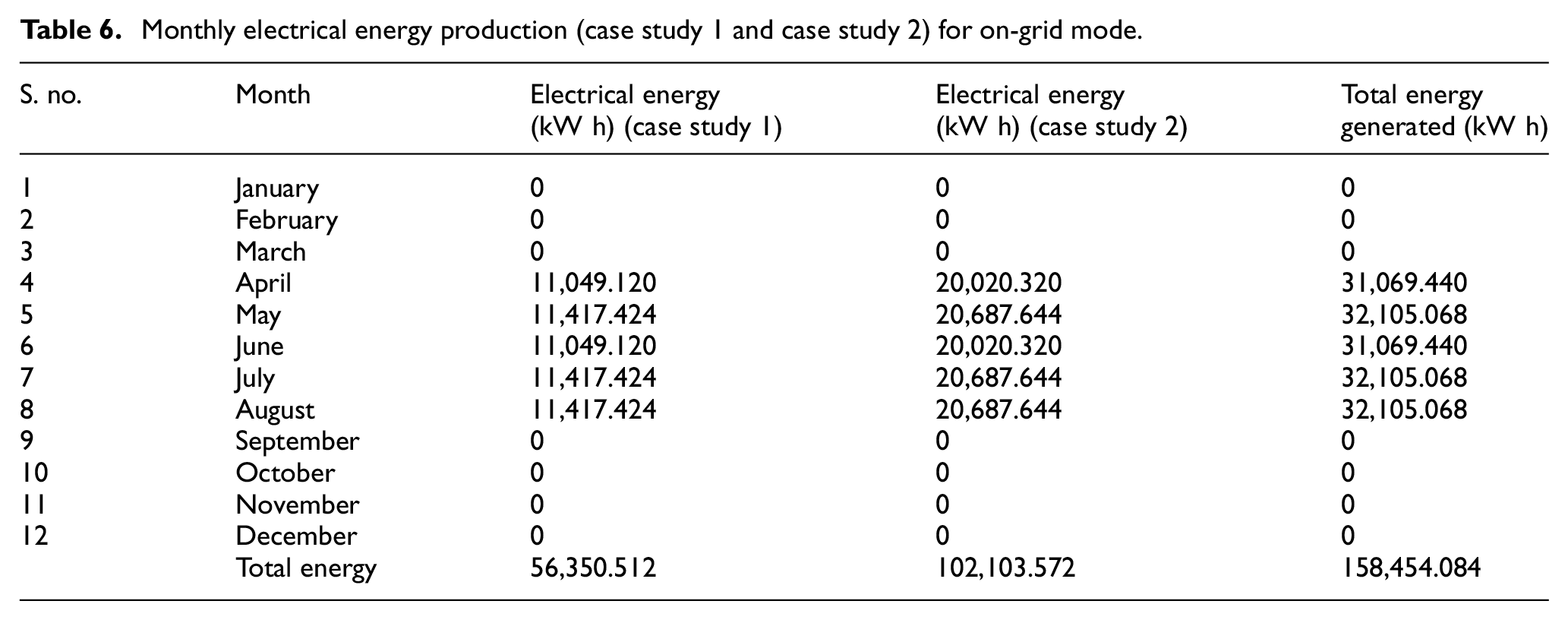
The variation of electrical energy generated by wind turbines at a specified location with the variation of wind speed and total energy generation in different months of a year is shown in Figure 4.

Electrical energy generated by case studies 1 and 2 wind turbines on monthly basis in a year.
From the results, the maximum energy is generated in May, July, and August whereas no wind energy is generated due to the absence of wind from January to March and September to December. The share of total energy generated in both the cases is shown in Figure 5.
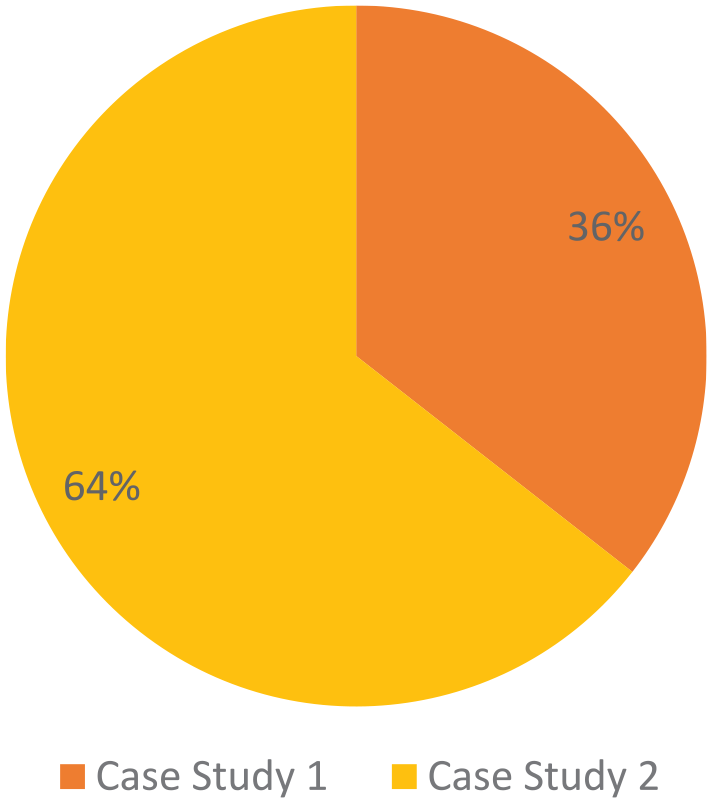
Contribution of total electrical energy generated in each case study.
Off-grid mode calculations
In the off-grid mode, the energy generated is feed into the auxiliary supply and different parts of the power station. The extra energy can be stored by means of any storage mechanism such as battery bank. In this study, the details of energy stored in a battery bank, voltage, efficiency, depth of discharge, and number of batteries connected in series-parallel are shown in Table 7.
Parameters and calculated value of battery bank for the storage of electrical energy.
Many other storage techniques can be employed for storage of extra produced energy and utilizing that energy at off-peak duration. Those storage techniques are inexpensive and efficient if properly implemented such as compressed air energy storage system.
Conclusion
This article represents an idea of hybrid wind and hydro energy generation by utilizing the wind generated due to flow of water at spillway of hydro power station. A detail design parameter for the wind turbine is discussed, and two case studies have been carried out to estimate the energy produced by utilizing this scheme. The electrical power generated can be fed to the main grid or can be utilized for auxiliary supply of the power station. From April to August, wind and hydro power system collectively generates power whereas in remaining months of a year only hydropower plant generates electricity. Furthermore, energy storage mechanism can be used to store the extra energy generated and utilizing it at off-peak duration. Inexpensive alternate storage sources such as compressed air energy storage system can be used to store and generate electrical energy.
Footnotes
Declaration of conflicting interests
The author(s) declared no potential conflicts of interest with respect to the research, authorship, and/or publication of this article.
Funding
The author(s) received no financial support for the research, authorship, and/or publication of this article.
