




Abstract
This paper applies Marx’s concept of immiseration to the mining communities of Cape Breton Island, Nova Scotia, in an attempt to conceptualise the consequences of de-industrialisation. We identify and explore a series of specific social, economic, historical, political and geographic circumstances that have militated against the radicalisation predicted by Marx, but nonetheless conclude that the concept of immiseration continues to have contemporary relevance. Economic hardship, out-migration on an unprecedented scale and a collapse of confidence at both an individual and collective level are the consequences of de-industrialisation and reveal the contemporary experience and purpose of immiseration. First, it is a process through which a geographically isolated population of workers have become conditioned either to accept poor work in terms of lower wages and conditions, or to become economic migrants. Second, it is a process through which new opportunities for profitability and investment are established for new investors.
‘People suggest that regions collapse, but they don’t. It’s a long drawn out process that is inevitably downward.’ (Senior administrator, CBRM)
Introduction
In his reaffirmation of Marx’s concept of immiseration, Trotsky offered a sociological caveat to its predicted outcomes: that the sharpening of the contradictions between the classes would not be sufficient in themselves to produce revolutionary social change. The responses of the degraded class would be contingent upon the social, political and historical conditions shaping the working class’s experience and understanding of immiseration – what he defined as ‘the concrete historical conditions’ (1938: 54). The availability of social and political leadership offering feasible alternative forms of social organisation would also be central to this revolutionary process.
Since the re-emergence of neoliberal governments in the 1980s, we have seen major declines in primary industries, increased levels of long-term unemployment, a reduction in the social protections available to workers (Espring-Anderson, 2004), and an increasingly embattled and declining trade union movement (Kelly, 1998). Despite critical voices (Strachey, 1956; Galbraith, 1998; Fukuyama, 2006), we believe that the economic and social realities of de-industrialisation are such that that the concept of immiseration remains a useful theoretical framework. This has been recognised elsewhere: in his forward to Braverman’s (1974) seminal work, Sweezy talks of immiseration thus: ‘far from being the egregious fallacy which bourgeois social science has long held it to be, [it] has in fact turned out to be one of the best founded of all Marx’s insights into the capitalist system’ ( 1974: xii).
It is our belief that Marx’s concept of immiseration continues to have relevance to the understanding of the consequences of de-industrialisation, particularly in geographically isolated, single occupational communities created to serve the needs of extractive industries. The now redundant mining communities of New Waterford, Sydney Mines and Glace Bay, all located within the Cape Breton Regional Municipality (CBRM) on the Atlantic seaboard of Canada, will be the case-study focus of this claim. The economic, social and political conditions of de-industrialisation have clearly imposed an identifiable process of immiseration on these populations. However, in contrast to Marx’s prediction of a radical response, we identify historical, social, political and economic conditions which, intensified by spatial isolation, have proved to be significant barriers to a collective class based response.
Methods
This research project, covering the years 2005 to 2009, was designed to identify the enduring consequences of de-industrialisation in the isolated mining communities of Cape Breton Island. Taking a longitudinal view, we sought to identify how the closure of the mines impacted over time, allowing us to present an in-depth evaluation from the perspective of a range of individuals living and, in some cases, working in the case-study communities. The three communities in the case study were chosen because they were domicile to the largest number of miners in the declining years of the coal industry in Cape Breton. This longitudinal case study approach allows the researcher to examine how significant events, and their consequences, develop over time (Kitay and Callus, 1998).
Throughout the research, qualitative data was collected through interviews with a broad section of individuals living or working in the case-study communities. In order to gain a wide range of views, we approached individuals offering opinions from different perspectives. The members of the first group were chosen for their positions within the administration of the CBRM: they were councillors (3); the mayor of the CBRM; the MP representing the case-study communities in the regional government of Nova Scotia; and senior administrators in the CBRM bureaucracy (2). The second group was composed of individuals of importance in their communities: teachers (2), community workers (2), trade union officials from the United Mine Workers of America (UMWA) (2), and clergy (1). In this group we also interviewed people who held no official position, but nevertheless possessed standing and influence in their communities (6). Mayo, in his work in communities in the UK, describes such individuals as ‘community godmothers and godfathers’ (1997: 4) – people with no formal position, but who are active in community affairs. The third group was made up of former miners and their families (8). Access to these individuals was gained through the services of three initial ‘gatekeepers’ who we recruited during our first visit to the CBRM: the MP from the regional government of Nova Scotia; the head of the UMWA in Canada, who is located in the CBRM and is himself a former miner from New Waterford; and a community activist introduced to us by an academic from St Mary’s University, Halifax, who we met at a conference at that university in 2003. All respondents were interviewed during each period of the fieldwork, which consisted of annual visits to the CBRM, timed to coincide with the Miners’ Memorial Day celebrations (see below) attended annually by the respondents. This continuity with respondents allowed us to build up trust relationships with those involved and, as a consequence, provided us with richer data than would have been available through one-off interviews. Indeed, some respondents were proactive in that they collected useful data in the form of CBRM internal publications, newspaper cuttings, and taped TV documentaries that kept us abreast of the events and issues in Cape Breton. As part of these initiatives, some arranged interviews with individuals outside of the original cohort, who provided contemporary insights into issues of concern to themselves and their communities.
All interviews were semi-structured in nature, allowing the respondents the opportunity to provide reflective insights into the issues that were most relevant to their own experience. Initial interviews were informed by the wide literature on the experiences of de-industrialised mining communities in the UK, with all subsequent interviews informed by our growing understanding of the situation in Cape Breton. Interviews were primarily face-to-face, although clarification was sought, when required, through telephone interviews.
Quantitative data was sourced from Community Counts (www.gov.ns.ca), the website of the Canadian quintenial census, with the data on projected population numbers coming from a report undertaken for the CBRM by a private company (Terrain Group Incorporated: 2004)
Coal mining in Cape Breton
In 1999, the Legislature of the Canadian Province of Nova Scotia declared 11 June Miners’ Memorial Day, formally recognising an annual event long celebrated across the mining communities in the province, organised by the UMWA. On that day in 1925, in New Waterford, during a strike against a 10 per cent wage reduction, union activist William Davis was shot and killed by the security force of the British Empire Steel Corporation (BESCO). At the outbreak of the dispute, the general manager of BESCO replied, when asked about the likely outcome of the strike, ‘Let them stay out for six months, it matters not. Eventually they will come crawling back to us. They cannot stand the gaff.’ When asked what he meant by ‘the gaff’, he replied ‘the privation and attendant hunger’ (William Davis Memorial Park, New Waterford.)
In 1893, the Dominion Coal Company was formed and following several transformations caused by market depression, merger and worker unrest (including a period as BESCO, from 1921-1928), the organisation finally became the Dominion Steel and Coal Corporation (DOSCO) in 1930 (Schwartzman, 1955).
Despite the abundance of coal reserves, DOSCO continued to struggle to the extent that by 1960, the mining industry in Cape Breton was on the verge of collapse (Frank, 1999). In response, the federal government set up a commission to seek a way forward not just for the industry, but for the region as a whole. The resultant Donald Report recommended the creation of the Cape Breton Development Corporation (DEVCO) to take the remnants of the mining industry into public ownership (Donald, 1966). Established in 1967, DEVCO was tasked with the orderly and gradual closure of the four remaining mines; the introduction of an early retirement plan for miners; the diversification of the local economy; the development of alternative employment for the soon-to-be-redundant miners; and, finally, the establishment of education and training programmes to develop local human resources (Kent, 2001).
However, DEVCO’s mission was overtaken by the oil crisis of the early 1970s, when it was given the responsibility of meeting an expanding demand for coal, opening three new mines in the process. This industrial expansion was soon overtaken by the recession in the 1980s, and in 1987, the federal government divested DEVCO of responsibility for the economic regeneration of the CBRM, establishing the Enterprise Cape Breton Corporation (ECBC) to undertake that role instead. This was a tacit acknowledgement of the inevitable end to the coal industry in the CBRM, with DEVCO again left with overseeing the closure of the industry (Bickerton, 1990). The closure of the Prince mine in 2001 brought an end to an industry that had lasted for more than 200 years. As victims of the economic and social devastation caused by the closure programme, the now de-industrialised mining communities of Cape Breton were once more forced to ‘stand the gaff’.
The statistics of immiseration
The social consequences of de-industrialisation became apparent long before the closure of the Prince mine, and can clearly be seen in the population figures for the CBRM. In 1996, the total population of the CBRM stood at 117,840 – a level lower than it had been in 1951. (See Table 1)
Figures: Statistics Canada & CBRM Planning Department
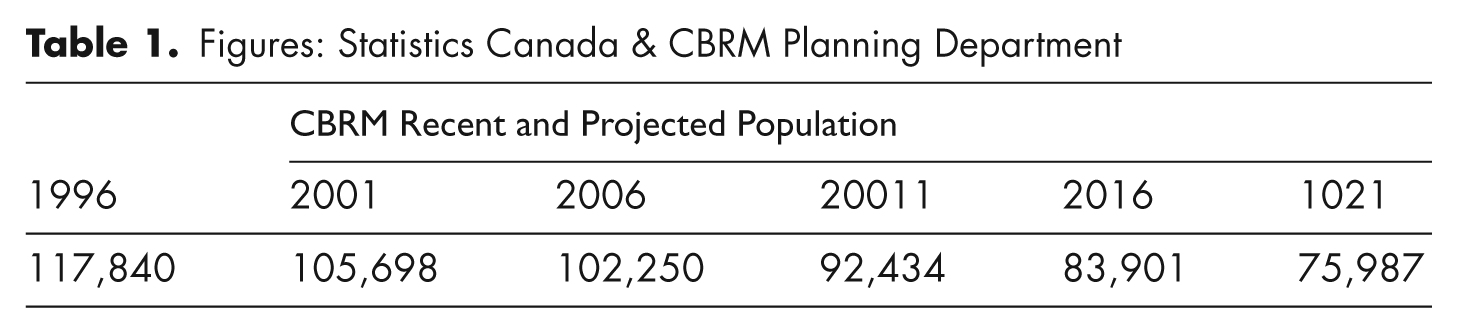
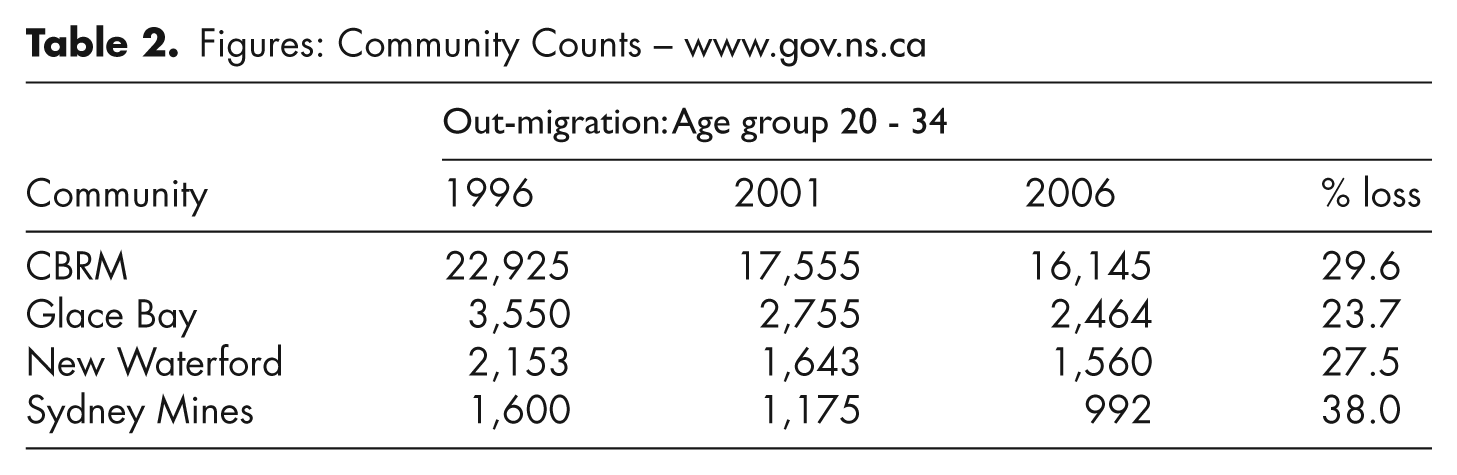
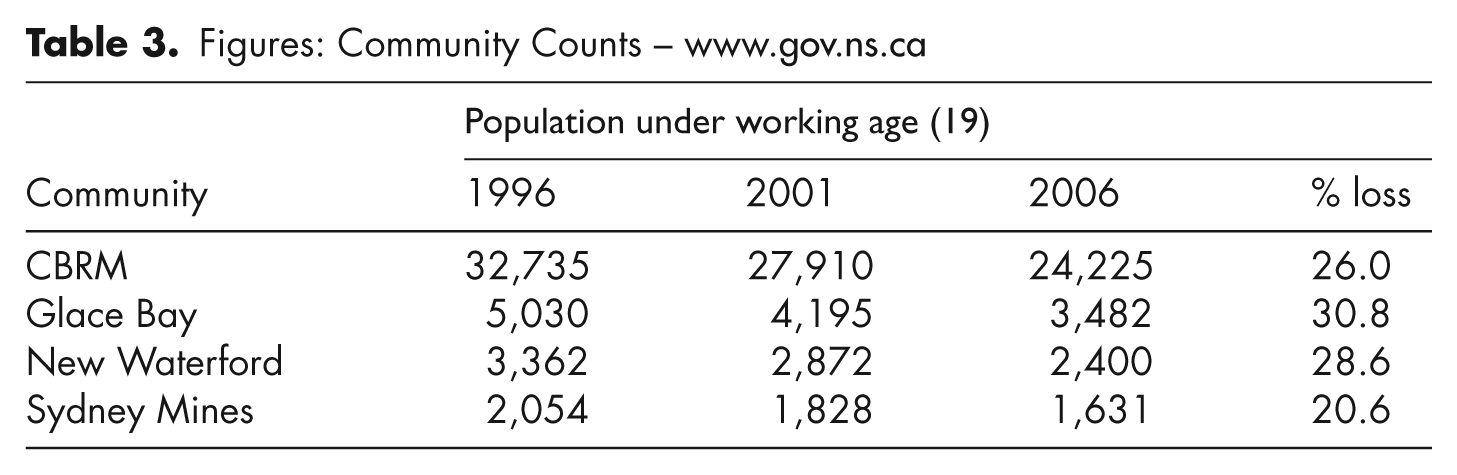
This decline increased dramatically after 1996, with a reduction in population of 12.2 per cent in the years between 1996 and 2006, and a projected loss of 35.5 per cent by 2021. The Population Projection Report (2004) commented that the level of out-migration from Cape Breton was remarkable. Given these statistics, the use of the word ‘remarkable’ understates a serious problem for the communities involved. The significance of these figures become apparent when viewed demographically. (See Tables 2, 3 and 4).
Figures: Community Counts – www.gov.ns.ca
Figures: Community Counts – www.gov.ns.ca
Figures: Community Counts – www.gov.ns.ca
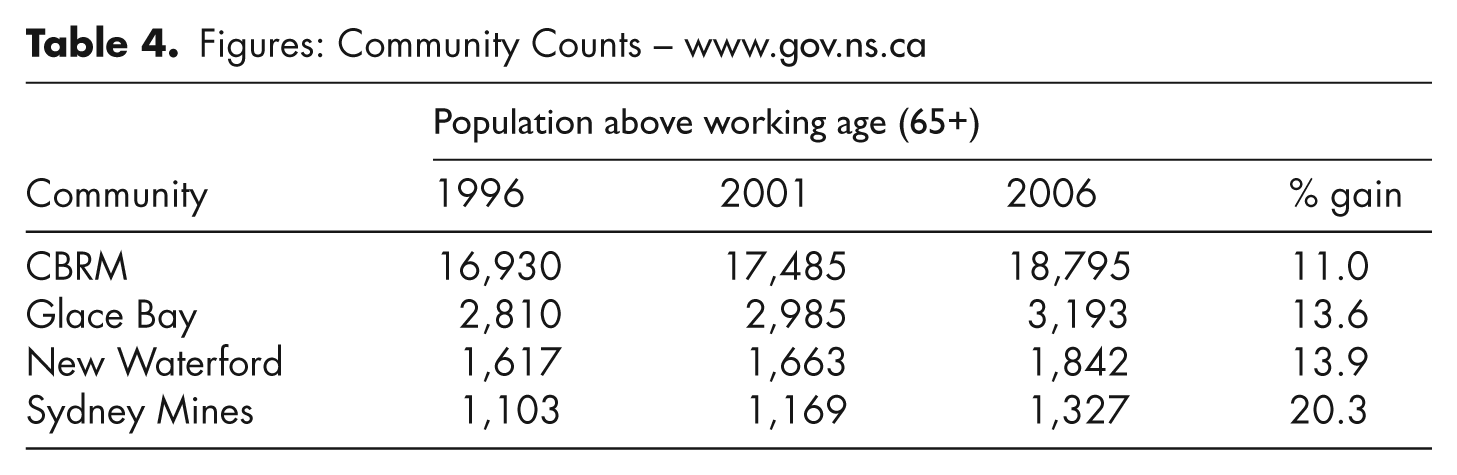
With what we know about the numbers and age groups of those involved in out-migration, we can extrapolate that this problem will have a significant and long-lasting effect. For example, Table 3 identifies the reduction in numbers of the population below working age, and Table 4 presents figures for the only age group that is increasing in numbers: those over working age.
The figures in Table 4 suggest an increasing ageing population, with all the associated health and social-care costs that will present increasingly serious fiscal problems for these communities.
The consequences of de-industrialisation, in terms of unemployment, have also been severe, with the figures offered in Table 5 seen within the context of out-migration. The reduction in unemployment identified is more a reflection of the decline in numbers of the working-age population than it is of an increase in employment. Irrespective of demographic change, these figures provide convincing evidence of seriously high levels of long-term employment.
Figures: Figures: Community Counts - www.gov.ns.ca
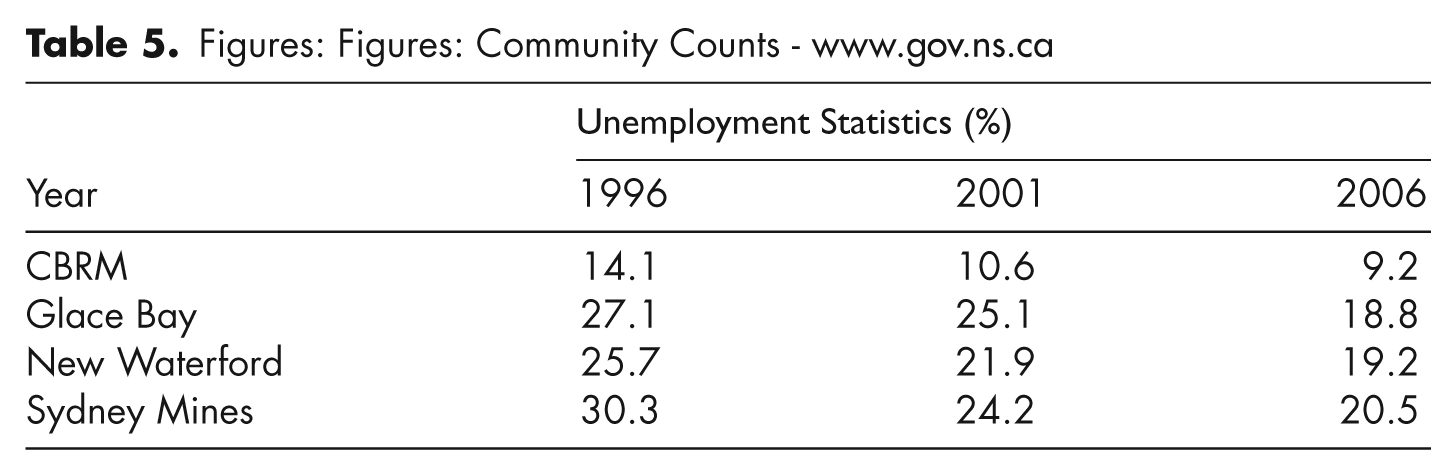
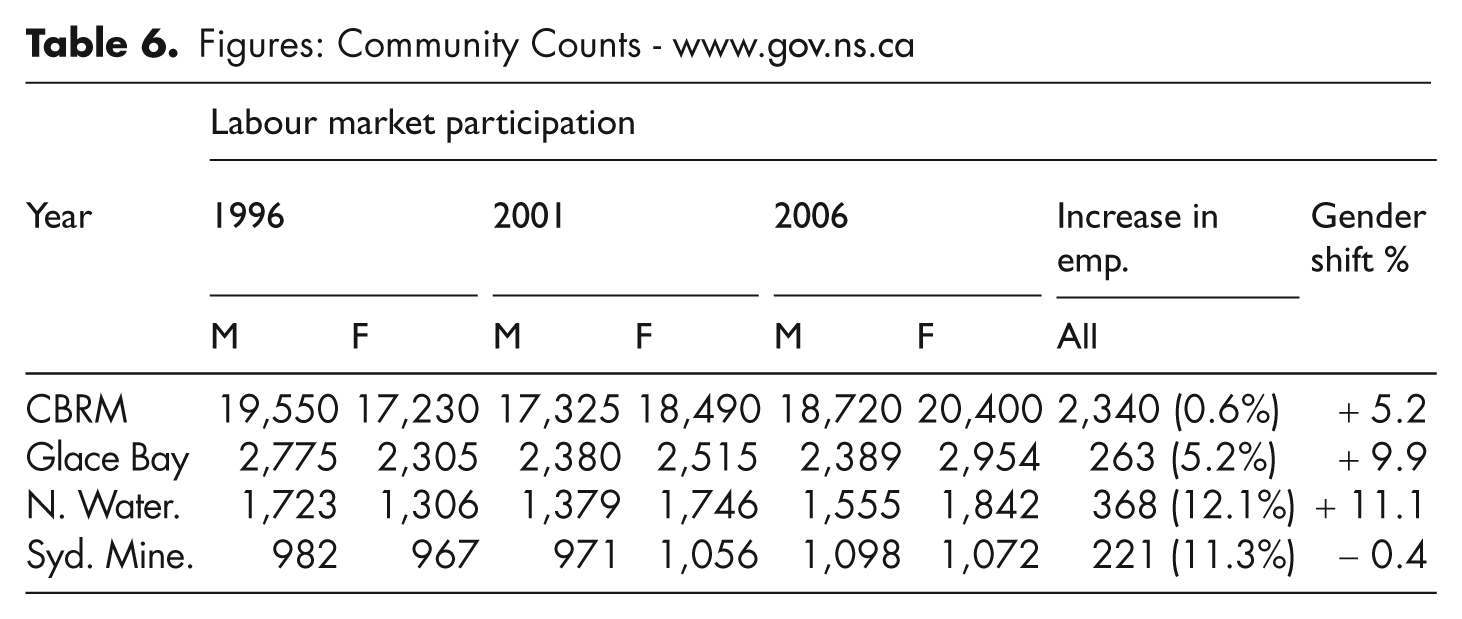
Table 6, while identifying a rise in the number of those employed, also indicates a significant shift in the gender balance of the working population, as much of the new employment has gone to women, who now represent the majority of the workforce.
Figures: Community Counts - www.gov.ns.ca
The ECBC has been instrumental in bringing in some new employment to the CBRM, the majority of which has been in call centres, with six centres collectively employing 3,595 workers. It is unlikely that federal and regional aid will rectify this worsening situation, as policy makers divert funding toward what are seen as ‘“winning regions” rather than aim[ing] at dealing with economic disparities between regions. Given the funding we receive, the problems are now way beyond the existing capacity of the CBRM to solve’ (senior administrator: CBRM).
The other main sources of employment are also in the service sector, in healthcare and retail. In terms of the reward packages available, these jobs in no way compensate for those lost in the mining industry, nor for the wages lost to the local economy. Employment in the mines prior to the last closure in 1991 paid C$27 per hour, with full ancillary benefits. The majority of services-sector jobs are at minimum wage levels (currently C$8.10 per hour), with few ancillary benefits.
‘Standing the gaff’ once more
The social, political and cultural consequences of de-industrialism have been identified elsewhere (Waddington and Parry, 2003; Waddington, 2004; Stephenson and Wray, 2005). Collectively, these works identify the social, economic and political decline associated with industrial closure, specifically in single-industry communities. Coal-mining communities, in particular, have faced the considerable depravations caused by de-industrialisation and the challenges of community decline. High unemployment rates, exacerbated by poverty and social exclusion, have resulted in the disintegration of the social infrastructure around which such communities traditionally coalesced. The increased incidence of anti-social behaviour, drug and alcohol abuse, underachievement and poor motivation among school children is commonplace, as is the increased incidence of what Waddington and Parry describe as ‘acquisitive and expressive criminality’ (2003: 49). Gilbert, commenting on what he describes as the ‘destruction of fixed relations between locality and work’, identifies a state of ‘contemporary anomie’ among individuals living in de-industrialised communities (1995: 49), and in our UK research we describe the loss of confidence within such communities as a process of emotional degeneration, where depression and loss of self worth and confidence was apparent at an individual and collective level (Stephenson and Wray, 2005: 178).
In Cape Breton, the problems associated with the demise of the coal industry became apparent during the phased closure programme of the mid-1980s. The decline remained steady until the mid-1990s, when it became obvious that mining, as a viable source of employment, was finished.
When the pits began to close it was like being told you had cancer. You knew you were going to die, you just didn’t know when. (UMWA official)
It was at this point that the out-migration of younger working people became a serious concern, exacerbated by the facts of geographical isolation and few local alternative sources of employment. The subsequent social and economic consequences of out-migration have accelerated the demise of the infrastructures and social cohesion of the communities. For those choosing to stay, or for those without the resources to leave, the closure of the last remaining mine left the communities traumatised:
The people in these communities were left psychologically terrified by the closure of the Prince mine. What had been feared for so long was now a reality, and people did not see any future for themselves or their communities. (NS Legislative Assembly member)
Those best placed to see the hidden consequences of population decline and poverty are those individuals possessing knowledge, influence and standing in their communities. The principal of a New Waterford school tells of the number of pupils at his school halving in eight years, with the consequence that schools are being merged. He also reports on a survey of parents organised by the school: to the question ‘Have you, in the last 12 months, cut back on food spending to pay bills?’, 92 per cent answered ‘Yes’. This is substantiated by evidence from the four local food banks, which report significant increases in the numbers of people coming for food handouts. As a result of this food poverty, health problems are on the increase.
‘Overall, health in these communities is poor, mainly due to poor diet. Poor income equals poor diet and poor diet equals poor health. Obesity, with all its health problems is on the increase. (NS Legislative Assembly member)
Others report psychological damage, with the communities existing
in a state of collective depression due mainly to problems of the spirit. People in these communities have lost their sense of possibilities. For some individuals, this has manifested itself in suicide due to a lack of self-esteem. Families have been broken either by enforced separation or poverty. (Community worker)
Problems of addiction are present including drug and alcohol abuse, and gambling addictions 1 described by a senior administrative officer in the CBRM as ‘the addictions of hope’, as people seek an alternative reality to their present predicaments. This resonates with the point made by Orwell (1937) that gambling is the one of the few forms of expenditure that rises during an economic depression. The UMWA, through a small network of local ex-officials, provides evidence of what it calls the ‘hidden consequences’ of poverty: inter-family violence, family breakdown and social isolation, as individuals and families try to hide their situation by withdrawing from their community in avoidance of the stigma associated with extreme poverty.
With a population declining by more than 1 per cent per year (a decline predicted to rise to 2 per cent per year), this is a situation which, without major political and economic intervention, can only get worse. Only the federal government can provide the level of investment required to reverse this decline, but there appears to be little discourse between the CBRM and federal government.
The Mayor has realised that the Federal Government only want to be seen as partners in success, and that they are only paying lip service to the regeneration or the CBRM. If they believe that communities like these cannot survive, then they should be honest with everyone. Playing games in this situation is unfair, and the question is how regional economies can respond to that’. (Senior administrator, CBRM)
Divided by a common cause
In their discussions on the reserve army of labour in the UK, Byrne and Parson (1982: 128-129) describe de-industrialisation as a process that has ‘taken the form of the reinforcement of the divisions within the working class with the associated transfer of an even larger proportion of the class to the immiserated side of the divide’ (emphasis in original). This suggests that the process identified by Marx as being instrumental in the creation of a proletarian class consciousness is, in contemporary post-industrial societies, complicated and complex, as predicted by Trotsky, and one with the potential to create division instead of unity. Byrne and Parson (1982: 129) identify the likelihood of a fragmented working class, both spatially and through intra-class divisions which they define as ‘ waged—unwaged, central—peripheral, etc.’, with the consequence that some communities are little more than collections of households with little or no contact with each other; and other communities have ‘strong solidaristic relationships’ (1982: 141). The circumstances in the CBRM represent a significant obstacle to the creation of the solidaristic communities that have been found elsewhere, however partial (see Waddington, 2004: Author B and Author A, 2005). In these communities, the working class is indeed divided, as a direct consequence of the de-industrial process. Almost every aspect of that process created frictions and fractures that left the remaining inhabitants at odds with each other, rather than united in the common cause of social regeneration.
The most divisive of all contributing factors was the retirement and severance payments scheme introduced by DEVCO. During the 1970s, when DEVCO was expanding production and opening new mines, the scheme was introduced in an attempt to retain and, more importantly, recruit the manpower required to expand the industry. The criteria for entitlement was based on a points scale made up of time served added to age, with 75 being set as the number required to achieve what subsequently became known throughout the communities as ‘the pension’. Those not making the full target of 75 would, based upon a pro-rata system, receive a maximum severance pay equal to two years’ wages. This opportunity of a retirement package was offered, and accepted, in the form of a psychological contract between DEVCO and the workforce: workers committing to the industry were guaranteed employment with a retirement package in place if they were made redundant before the normal retirement age. However, that psychological contract was broken when the closure programme began again in the mid-1980s, and many were left short of the required 75 points.
As a result of those premature closures, those with the requisite years of service and age left the industry financially protected by ‘the pension’. Those not meeting the target of 75 left with severance packages. In some instances, men missed the retirement target by a matter of weeks; with some older men with shorter service leaving on ‘the pension’, and younger men with longer service leaving only with the severance pay. These circumstances were exacerbated by the fact that those in receipt of ‘the pension’ retained the full health benefits they had enjoyed while working, while those with severance lost those benefits along with their job. This retirement/severance situation exposed, if not created, a fractured community. The consequence for those in receipt of severance pay was an increased exposure to poverty. The Canadian system of welfare payments is such that severance pay excludes welfare payments, so no redundant miners could claim benefits for two years after redundancy. Inevitably, many families were unable to budget for the two years and were reduced to levels of poverty seldom previously experienced in the CBRM. Those in receipt of ‘the pension’ were protected against the worst aspects of poverty, as ‘the pension’ today is in the region of $2000 dollars per month, payable even if the recipient takes up other employment.
The former mining communities of Cape Breton are also fractured politically, with little party loyalty identifiable and what political allegiances that do exist in the CBRM are not differentiated along class lines, with differing party allegiances identifiable within the communities and even within streets. This fractured political climate has been described by one community worker as resulting from ‘the politics of fear’.
Allegiances to political parties are passed on through families like religion, and they divide communities. It works against collectivism. Cape Breton should vote the day after everyone else because we always get it wrong, by voting against the party that wins. There is a vindictiveness of party leadership here in Canada, toward those who vote against them. Some people vote for the oppressors because they think they will get a few crumbs if they do’. (Sister of Charity)
The idea of ‘the politics of vindictiveness’ was substantiated for those of this opinion during the general election of 1997, when the sitting member for the Bras d’Or riding of the CBRM, a minister in the national government, was voted out of office by the miners’ vote. Many in the CBRM believe that the increased momentum of mine closures was due to retaliation by the federal government. Whatever the veracity of these views on vindictive politics, they are widely held locally.
Prior to the creation of DEVCO, the UMWA was affiliated to the NDP (formally the Labour Party). Following the creation of DEVCO, the UMWA dropped this affiliation because it did not want to be seen as partisan, when DEVCO was controlled by the Liberal Party. The perceived view of the political climate in the CBRM is best summarised by a former leader of the UMWA in the CBRM: ‘What happened in Cape Breton, and the closure of the mines, can only be described as dirty politics, the Federal Government taking revenge for Dingwall losing his seat’.
While the UMWA represented its members on employment-related matters, it offered little political or social leadership, and while they retain a small membership located in the docks where coal is unloaded to fuel the local power station, the main focus of UMWA activity in the CBRM is the proposed re-opening of the Donkin mine. With the final decision to begin production not yet taken, the UMWA has negotiated a recognition agreement with the firm, providing parity with wages in deep mines elsewhere in North America, but without achieving an agreement on the working practices and manning levels previously enjoyed under DEVCO. Outside of the annual Miners Memorial Service, and individual casework undertaken with ex-miners on health and welfare issues, there is little activity organised by the UMWA in the communities.
Local political leadership also appears to be divided, particularly over the extent of the problems facing the communities, though again, the split is not along party lines. Some elected members of the CBRM are fully aware of the situation and are challenging the federal and provincial governments, demanding regenerative funding. Others, arguing that the social and economic data are inaccurate, see the other faction as dangerous doomsayers, portraying the CBRM in a negative way that has, and will continue, to deter inward investment. The elected mayor of the CBRM is politically independent, a fact that most local commentators believe to be responsible for his massive ongoing electoral support; a support that is seen as a repudiation of sectarian politics in the face of such social and economic decay.
Given the fractured political system outlined above, with no communal political affiliation to one party, and with the UMWA politically unaffiliated out of a fear of reprisals, it can be concluded that class-based politics are non-existent in Cape Breton. The consequences are such that there is no culture of, nor leadership in, the collectivist politics that could offer a focus for community-based solutions to the problems outlined above.
Barriers to a collective response to immiseration
Byrne (2002: 208) argues that ‘industrial populations have always believed in their own transformational capacities’, and evidence from the recent literature on de-industrialisation in mining communities elsewhere would support this view. Waddington et al. (2001), Waddington (2004), Stephenson and Wray (2005) and Wray (2009), while identifying similar social and economic problems as those experienced in the CBRM, all describe communities that have come together to confront these issues and, in some measure, been successful in those attempts.
The situation in Cape Breton is at odds with the UK experience, due, in part, to the fact that many of the ‘industrial population’ have left Cape Breton, taking with them valuable social capital and their transformational capacities, with them (Bourdieu, 1972; Putnam, 1995):
In the past the leadership of these communities came from within. These leaders were never elected, but they ran everything. These people have been lost to the communities through out-migration, and those that are left are so beaten down by their circumstances that all they look forward to is the old age pension. (School principal, New Waterford) We have lost many of our young people, and with them we have lost their energy. Many of these people would have gone on to be community leaders if they had stayed. (Community worker)
Given the geographic isolation of this area, and the limited employment opportunities available, it is unlikely that ‘new blood’ and with it new social capital will be attracted to the area. At the same time, the deficit in social capital associated with mass outward migration has both stifled the building of a consensus aimed at the redevelopment of the community, and undermined the support networks the communities might have previously relied on for support.
Within these communities, a strong religious culture is apparent, with Catholic, Protestant and Presbyterian churches throughout the CBRM generally. The presence of religious leaders in the communities, and the connections between inhabitants and their particular churches were described by one schoolteacher as being ‘almost at cult levels’. Clergy of all denominations were ubiquitous in the communities they represented, teaching in faith schools and active as coaches in sports groups. Since the closures and the reduction in population and congregations, their presence, and therefore their influence, is much reduced. In the community of New Waterford, the previous four Catholic churches have been amalgamated, leaving just one in the community. At a time of social and spiritual crisis, the churches have withdrawn clergy and community workers, further reducing the possibility of grassroots-based regeneration:
The Churches of all denomination have retreated from these communities, leaving their congregations bereft of the civic and community leadership they so desperately need. (Sister of Charity)
The voluntary base across the CBRM is very small, mainly organised by and around older people. However, these groups are not motivated to create partnerships for mutual support, nor to provide a focus for local regenerative initiatives. A recent research project, funded by the ECBC and directed toward identifying local organisations working collectively to increase their ‘voice’ on local issues, was unable to find any groups even willing to consider working together. The conclusions drawn from this research were that two main causal factors are involved. First, the groups were, in the main, organised by and for older people, who had succumbed to an apathy brought about by the social and economic conditions of their communities. Second, and related to the first factor, fundraising was a major problem. In such community-based groups, the traditional source of funding has been bingo. The existence of two casinos in the CBRM offering bingo with greater prize money, allied to the closure of many community facilities in which the fundraising events had been held, has seriously affected the financial health of these groups. The report concluded that far from working together, they saw themselves as competitors for decreasing funding resources (Getto, 2008). The lack of collective, community-based activity has inevitably resulted in a power shift from the communities to the regional and national state, with serious consequences for those communities. As one community activist puts it,
People here have always believed that the government is there to do good things for them, and some here still labour under that impression, when in actual fact the Federal Government, like most other institutions, has retreated from Cape Breton and we have been left more or less to our own devices. (Sister of Charity)
Discussion and conclusion
If we return to our original thesis that Marx’s concept of immiseration is central to any understanding of the consequences of post-industrialism, we must first address the criticisms of this concept. Critics have tended to see immiseration as an absolute condition, with the immiserated classes living in absolute poverty, which is therefore not present within developed economies. However, a more nuanced view of immiseration sees it as a relative condition rather than in absolute terms, defined by the growing disparity between the distribution of income between the core, peripheral, and redundant labour forces (Braverman, 1958). It would appear that the case-study communities, while not immiserated in absolute terms, can be described as such in terms relative to the national economy within which they continue to survive.
In Marxist terms, the residual populations of the CBRM represent a stagnant reserve army of labour that is characterised, at best, by marginal and low-paid employment; and at worst, by high levels of long-term unemployment. Described as ‘the hospital of the active labour army’ (Marx, 1977: 592-593), this army is stagnant in the sense that those who remain are maintained in stagnation because they do not possess the skills, opportunities or will to move out in order that they may then move up economically.
One response to the problem of such communities was developed in the UK, where Durham County Council, faced with post-industrial mining communities in the 1970s, developed a policy of targeted economic redevelopment. The policy was aimed at relocating redundant populations to places where employment was available, rather than creating employment where it was needed. Communities were categorised from A through to D, with ‘A’ communities targeted for investment and ‘D’ communities denied further investment, and the communities allowed to die (Pattison, 2004). Under this model, the three communities that are the focus of this discussion would come under the ‘D’ category, receiving no further investment, and the residual populations would be encouraged to follow their more proactive neighbours and migrate toward areas offering employment. It would seem from the statement above that the federal government appear to be following a similar regenerative model, although on a covert basis.
Pattison (1999, 2004) and Byrne ( 2002), in their studies of the consequences of post-industrialism, recognise what Byrne describes as ‘an industrial structure of feeling – the sentiments which inform and construct “ways of life” – remain a feature for many social groups . . . beyond the period of industrialism’ (2002: 287). Pattison’s (1999, 2004) studies of the reactions to Category ‘D’ status by the residual populations of such communities in County Durham demonstrate their strong commitment to ‘place’, which was underestimated and misunderstood by the external policy makers, and which ultimately saved many such communities from extinction. Many within the residual populations of the communities we are discussing here also demonstrate a clear commitment to their communities, and while they may not have developed what Byrne describes as ‘social groups who seek to challenge the character of capitalism’ (2002: 279), they identify a determination to remain.
The pattern of outward migration within Cape Breton cannot be read simply as an abandonment of community. In the face of severe economic pressure, many have migrated away with their families, but for many these have been forced and reluctant decisions. Some have chosen to commute 2 rather than uproot their families, and many plan to return should circumstances change. Rather like the category D communities of the UK, and other similarly deprived communities (MacDonald et al., 2005) our research reveals a more solid commitment to kinship, community as ‘place’ and community as ‘common interest’ than has been suggested by those who herald the emergence of a more liquid engagement with community (Bauman, 2001).
Other individuals and families lack the resources, both human and financial, to move, and therefore have little choice but to continue to make the best of a worsening situation. This lack of choice is identified by Castells (1998) in his discussions of the ‘Mega City’ in which he raises issues that are fundamental to all distressed communities. While the issues and solutions between the ‘Mega City’ and the CBRM may differ in terms of size and the process of developing and implementing policy, they are fundamentally the same: the lack of political influence of local populations in the development and implementation of policy. Castells’s study identifies that significant numbers of people have moved from being exploited in their work to ‘a position of structural irrelevance’ (1998: 4), and that irrelevant people have no influence. No democratically elected government can abandon communities such as those in the CBRM if they represent an electoral threat. Given the lack of support offered, we can only conclude that the federal government sees the population of the CBRM (and the problems confronting them) as structurally irrelevant and, by inference, democratically impotent.
The immiserated working class of Cape Breton finds itself deeply divided, and facing heightened social problems, having lost or losing the support of the institutions upon which it previously relied. Many are without employment, while others work harder and longer to maintain lower standards of living than previously due to the reduced wage rates in new employment. Others are forced into economic migration. The availability of well-paid employment many thousands of miles away has provided opportunities for those willing and/or able to either migrate or commute. Economic migration has diminished the pool of talent that might have contributed both bonding and bridging social capital (Putnam, 2000) to the regeneration process, and the dispersal and breakdown of families has exacerbated problems for those that remain. Institutions that were once the bedrock of working-class life in the CBRM (the family, the Church, sports, the schools and voluntary organisations) have been placed under intolerable strain or have broken down, leaving the populations of these communities, to all intents and purposes, immiserated.
In contradiction to Marx, the immiseration process in these communities has failed to produce collective class-based radicalism. Rather, the process has been divisive, with little evidence to suggest even the potential for the community-based action that Byrne and Parsons (1982: 151) describe as ‘the collective power of the reserve community’. This study reveals how a series of interconnected factors have presented significant challenges to the development of collective organisation and power within this reserve army, which can only be understood through reference to the particular spatial, political, social and economic contexts within the CBRM. We believe, however, that immiseration continues to have credence for our understanding of the conditions in deindustrialised communities. First, it has explanatory powers in that it reveals processes that occur as a consequence of a crisis in capitalist profitability, resulting in unemployment, reduced wage rates and the general degradation of working people and the communities within which they live. Second, it provides an opportunity for capital to further exploit the working class, a definition of immiseration that has been most useful to our thinking. The ‘psychologically terrified’ population with no ‘sense of possibilities’ suggests a state of immiseration which has handed significant opportunities to capital in the form of incoming employers. Here there is resonance with Klein’s (2007) argument that capitalism brings about change through shock tactics which seek to undermine working-class communities, breaking and belittling collective memories and practices of self reliance and resilience, all initiated to achieve a new social, political, and economic order that better suits the needs of the new capitalist enterprise. The assault on self and community confidence resulting from the process of immiseration should not be seen as an aberration, but rather as functional consequence creating a fertile environment upon which new opportunities can be established. We can locate these circumstances within Schumpeter’s thesis that capital imposes a ‘creative destruction’ (1976: pp83), sweeping away the old to create a new and more beneficial environment of exploitation. Evidence of this can be seen in the fact that deindustrialisation in Cape Breton has created conditions of dependence to the point that any work will be willingly grasped.
We can conclude that, at least in terms of the evidence found in the geographically isolated deindustrialised communities of the CBRM, Marx’s theory of immiseration stands the test of empiricism. The withdrawal of support by the regional and federal governments for mining in the CBRM and their failure to support those ‘losing’ communities has produced the social, political and economic conditions of immiseration. As a result, the individuals left in these communities can be seen as the detritus of an economic system that consumes human resources in equal measure to material resources.