



Abstract
What makes a good director? How does a librarian know she has the competencies needed to be an effective manager-leader? How does the library board or community know what to look for in a director? What should the library profession look for in their rising managers? There are not clear answers to these questions right now. But development of a set of research-based competencies will give answers to these questions, and will give a foundation for other research-based ideas to be developed to assist manager-leaders in the library. The research objective for this study is to refine a set of competencies, identified from the literature, through the opinions of current public library directors. The development of manager/leaders in the library world is too important to be left to chance. Using a research-based set of competencies as a foundation should help in the development of training opportunities for librarians who wish to be successful in their positions as directors.
Keywords
Introduction
The speed of change in society seems to be constantly increasing all around us, and public libraries need to keep pace with those changes to serve their communities as effectively as possible. New technologies, new services, and new demands all combine to make the job of a library more complicated than it was a generation ago, or even 5 or 10 years ago. To continue to not only keep pace with the speed of these changes in service, but to get out ahead of them and ensure the value of public libraries is not overlooked in a community, that library needs to have a good director helping them to meet these challenges. Public libraries in too many communities are in danger of losing staff, resources, hours, or of closing entirely. Without capable directors, they will be unable to overcome the current problems and to sustain a library for the future.
But, what makes a good director? How does a librarian know she has the competencies needed to be an effective manager-leader? How does the library board or community know what to look for in a director? What should the library profession look for in their rising managers? There are not clear answers to these questions right now. But development of a set of research-based competencies will give answers to these questions, and will give a foundation for other research-based ideas to be developed to assist manager-leaders in the library. The research objective for this study is to refine a set of competencies, identified from the literature, through the opinions of current public library directors. The development of manger/leaders in the library world is too important to be left to chance. Using a research-based set of competencies as a foundation should help in the development of training opportunities for librarians who wish to be successful in their positions as directors.
Looking at the literature
Just what can be considered a competency differs from author to author. The language used in Dole, Hurych, and Liebsts's definition seems to be very common in discussions defining competencies: “… competencies are skills and knowledge that can be learned and can be measured” (2005: 125). This definition would exclude a number of ideas referred to as competencies in the literature, but gives clarity to the process of competency development: if something cannot be learned it is not helpful, and if it cannot be measured it cannot be evaluated and is likewise not helpful to the process of training. Another definition is “the combination of knowledge, skills, and abilities which are relevant to a particular job position and which, when acquired, allow a person to perform a task or function at a high level of proficiency” (Osa 2003; 37). Again, the idea of improving these attributes plays a key role in defining what is a competency and what is not. “Competencies can include both personal and professional aspects – personal competencies may include skills, attitudes and values that underlie our work… professional competencies address the ways we apply our knowledge to our work” (van Wert 2004: 10). So while there may be some differences in the specifics, the idea that competencies encompass more than an easily defined skill is important to a full understanding of ideas necessary for a good set of competencies.
This is specifically different from traits as discussed in older leadership literature. A trait would be something that is inherent in an individual; it is either present or not – it is not something that can be improved with training. In some of the literature, looking at any type of personal skill or personal trait is confused together, and the entire idea of looking at competencies is discarded as foolishness (Suwannarat 1994: 20). Older literature looking at leadership traits often measured things like height, gender, weight, health, or personal appearance, things which were believed to be important for leaders. These may or may not be relevant for manager-leaders, but do not provide useful information as competencies, because there can be no training and no improvement or it may not be applicable to our understanding of a good leader. It is not possible to train someone to be taller, for example.
Not all authors make the fine distinction between competencies, traits, and the ideas they believe important to leadership success; this lack of precision in vocabulary hinders the search for competencies. For the purposes of this research study, competencies will be understood to be knowledge, skills, and abilities; but will also expand to include less tangibly measurable attainments important for a manager/leader in public libraries. Improvement may exist on a sliding scale and may not ever achieve perfection in an individual, but the possibility of awareness of and progress toward the idea will be sufficient for a concept to be included in this study and called a competency.
While it may be difficult to create one standard list that will detail the competencies required to become a successful director, that does not mean the profession can ignore the need to struggle toward this ideal. “Librarians have listed, debated, revised, and negotiated lists of competencies for 125 years, since the beginnings of formal education for librarianship” (Helmick and Swigger 2006: 62). Looking through some of the lists created by practitioners and researchers will help to discover if any consensus exists in those most frequently mentioned.
There is tension between LIS academics and practitioners in several areas, but one consistent issue is competencies – their development and use (Lester and Van Fleet 2008: 60). This study is designed to provide a bridge between research and the literature of the profession, and those actually working as directors. Looking at the opinions of both the literature and current public library directors should help to make the final set of competencies useful and acceptable to both groups. Gathering input from different sources on any decision-making process is always helpful to ensure the best outcome. In this study a final set of competencies was refined to give the best answers to the LIS community on competencies necessary for public library directors.
Method
This work began with a previous study done by the researcher, using content analysis with a group of coders to identify those most frequently mentioned in the literature as important for library leaders and managers. (See Appendix A for this complete list of competencies and their definitions.) To further refine these ideas into a usable set, a Delphi method was used to bring in the opinion of experts on the subject. Delphi methodology is based on the idea of structured interviews or surveys, and uses the opinions of experts (as defined by the researcher) to gather information. Delphi studies ask experts to share their ideas in an open-ended discussion to discover information (Brill, Bishop and Walker 2006: 120). Through repeated rounds of thought, giving participants the opportunity to see material contributed by others, each of the experts is able to bring their ideas and experience to the issue at hand. The method is also helpful for focusing in on the most significant aspects of a research topic, and can be used to address a wide variety of issues.
In this method there are two or more opportunities (rounds) for the participants to share their opinions on the topic of the research, giving each the possibility of building on his/her answers in the second (and/or later) rounds, and taking into account the responses from their fellow participants/experts. “In a sense, the Delphi method is a controlled debate…More often than not, expert groups move toward consensus…” (Gordon 1994: 3). Even if consensus does not develop around the research topic, other ideas arising during disagreement or polarized opinions from members of the expert group which could be valuable to the researcher.
Selection of the participants is important in obtaining good results. Since the group is deliberately not representative of a population, identifying people who are knowledgeable about the issue is the key to ending up with the best results. Many Delphi studies use 15 to 35 people (Gordon 1994: 6), but some use larger numbers. In a group that is too large, it may be more difficult to reach agreement without a focused topic to guide the discussion. Answers provided by the participants are anonymous, which should facilitate providing their responses, including those which may be controversial or go against the group consensus. Anonymity can provide for not only more honest answers, but also a wider potential selection of responses. Participants should not feel as though they had to go along with the group’s responses, but should be free to contribute their own ideas, regardless of agreement with the group.
In a Delphi study, the participants should be experts in the area under consideration. In this case, the subject is competencies for public library directors; so successful public library directors would be the best group to discuss the topic. In the public library field, there is no standard measurement for excellence in library directors; nor is there any official rating agency for directors. However, there is a yearly rating of all public libraries across the country, published each year in the American Libraries journal: The Hennen’s Annual Public Library Ratings (http://www.haplr-index.com/index.html). This index uses Institute of Museum and Library Services (IMLS) data to rank libraries on 15 criteria, primarily on circulation, staffing, materials, reference service, and funding levels. The index is widely known in the public library field, and has rated libraries for more than 10 years.
The top ten libraries are identified in ten different population categories, to ensure libraries from across the country can be recognized and to avoid overemphasizing libraries with large populations and large budgets. The best directors presumably lead this set of 100 best libraries. While it is impossible to definitely identify the most successful directors in the country, it is reasonable to assume that if this group is not the best 100 public library directors in the country, they are likely still at the top of their profession. There are other ways to measure success as a director, but the HAPLR index of libraries is an objective, identifiable group of directors. While not a perfect identification system, this is the best strategy for identifying successful public library directors to serve as experts in identifying competencies for the purposes of this study.
These 100 directors were invited to participate in this research study. The geographic and population size diversity should also help to make the study stronger by utilizing data from directors of reasonably diverse libraries. However, these directors were not selected as representative of all directors; they were specifically being selected as being successful.
Anonymity was preserved in the individual answers and individual participants, as required by a Delphi. The total population of 100 potential participants was known, but those who chose to participate (or not) will not be identified at any time during or after the study. In a Delphi, the individual responses are not as important as the consensus of the group, so identification of any specific individual is not necessary.
Study instrument and data collection
Round One
The entire study was done online, to encourage both anonymity and participation from these busy directors who are spread across the country. In the initial round of the Delphi, demographic information was collected about the participants, and the initial set of competencies was identified. Then they established their initial ideas about the most important competencies for public library directors for the next decade. The definition of competency used in this study was on the online form: knowledge, skills, and abilities, but also less tangibly measurable attainments important for a director in public libraries. They were given the set of competencies identified in the content analysis research done for this study, along with definitions established for each to ensure clarity among participants about each idea. They were asked to identify (with a checkmark) those competencies most important to the profession for the next decade, according to their own professional opinions. There was an emphasis on choosing only the most important competencies. Several participants commented all were useful, but that they did restrict themselves to selecting only the most important as requested. They were then given the option to suggest any other competencies they believe will be important which may be missing in the list from the literature. No justification of their individual choices was required, but they were provided with space to elaborate on the process, to share their reasoning, or just to share more information on each competency.
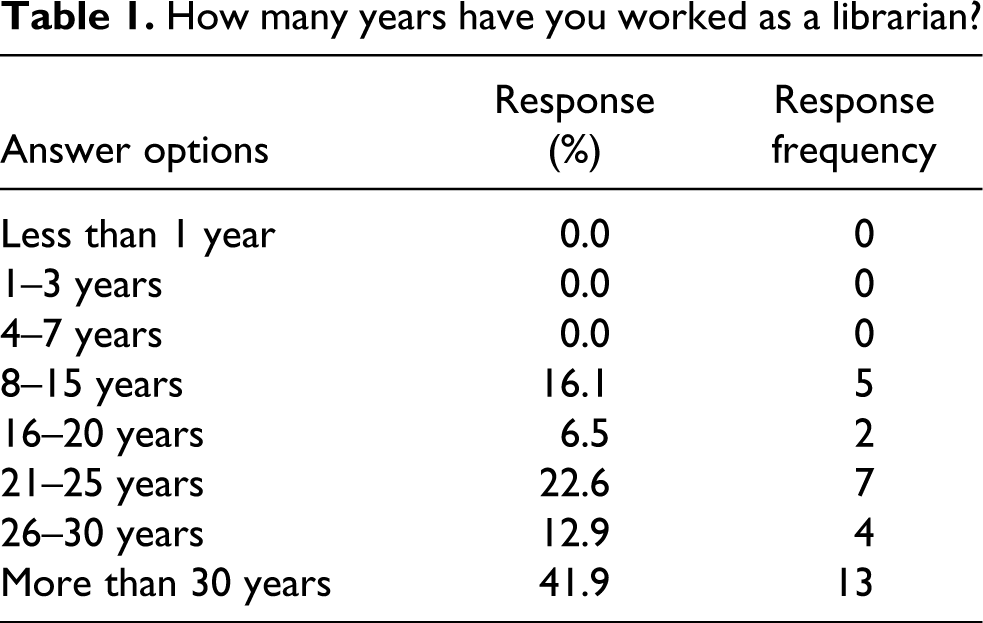
Thirty-one directors responded to this round of the Delphi. Twenty-six (83.9 percent) of them were female; five were male (16.1 percent). Two other demographic questions were asked: years worked as a librarian, and years spent as a director (see Tables 1 and 2).
How many years have you worked as a librarian?
How many years have you been a public library director? (total years, not just at this library)

Eighteen of the initial 34 competencies were selected as important in this round, and moved on to Round Two. This was defined by a selection of the competency by 60 percent or more of the participants. The most-selected competencies, those identified as important by 80 percent of the participants or more, were:
Vision 93.5 percent
Communication skills 87.1 percent
Customer service 87.1 percent
Credibility 83.9 percent
Interpersonal skills 80.6 percent
Creativity 80.6 percent
The least selected competencies, those selected by fewer than 40 percent of the participants, were:
Employee centered 38.7 percent
Previous experience 35.5 percent
Intelligence 35.5 percent
Emotional intelligence 32.5 percent
Ambition 22.6 percent
In addition to the 18 competencies selected from the initial group to move to the next round, the expert directors added five additional competencies (listed here, with the definitions of each):
Round Two
In Round Two of the study, the list of 18 competencies identified by more than 60 percent of the participants was sent out to the participants from Round One, along with the five competencies suggested by participants in Round One. This time each competency had a Likert scale, allowing the participants to rate each from 1 to 7. (1 is defined as “not at all important,” 2 as “rarely important,” 3 as “not too important,” 4 as “neutral,” 5 as “pretty important,” 6 as “quite important,” and 7 as “absolutely necessary.”) Participants were asked to rate each individual competency on the scale, and encouraged to think about the most important needs of the profession over the next decade. This comment was inserted as a way to again encourage them to think carefully about their ideas, and not to automatically rate all competencies as equally important. They were also given the opportunity to again comment freely on their choices, the list as a whole, or other ideas they may wish to share about the process and about competencies for public library directors. The group added no additional competencies to the list under consideration, as the focus was to hone the existing list. Twenty-three people responded to this round.
When these answers were returned, the mean and standard deviation of each competency’s Likert score across all participants was calculated. The competency set for the third round of the Delphi was drawn from this data analysis. The focus of this study is to identify the most important competencies; therefore, the group eliminated any low-scoring competencies from further consideration. To ensure only the competencies most important to this group were carried forward to the next round, any competency with a mean score below 6.0 was removed. Standard deviations for each competency rating will be discussed in the analysis of the study, below.
The highest rated means for the competencies in this study (on the 7-point scale), with their standard deviations, are shown in Table 3.
Competency scores, Round Two
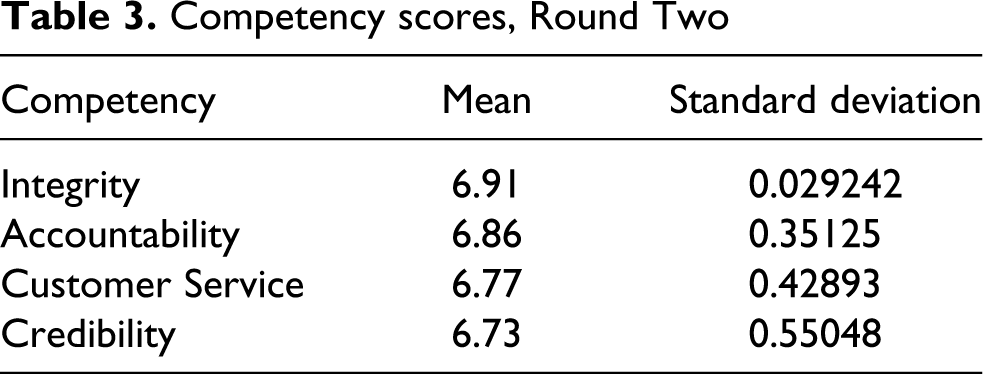
These items also had the lowest standard deviations of this round, indicating a high degree of consensus on the importance of each of them.
Four of the 23 competencies (see Table 4) were eliminated after this round, because the expert participants rated them lower than an average of 6.0 on the Likert scale.
Competencies eliminated after Round Two

These competencies had some of the highest standard deviations of the round, indicating there was not a lot of consensus here. Two of them, library knowledge/value and accounting/budgeting, had just been added in on the first round by participants – who presumably felt strongly about them continuing while others did not recognize their value.
Round Three
In Round Three, this further-refined set of competencies was sent out to participants from Round Two, with the same instructions as that round: rate each competency on the Likert scale according to the participant’s opinion of its importance to the profession over the next decade. All 23 participants returned answers in this round. The same data analysis process of these answers was used here as in Round Two. Based on other Delphi work with similar populations, it was anticipated at this point that all the competencies would be rated at a mean of 6.0 or higher; and that proved to be the case, so the data collection was finished.
All 19 of the competencies given to the expert participants in this round were rated with an average of 6.0 or higher, indicating they were “quite important” to “absolutely necessary” for public library directors in the view of this Delphi group. The lowest average was 6.00: enthusiasm, risk taking, resource management, and creativity. The highest average score was 6.57 for integrity and customer service. Two other competencies were rated 6.52: accountability and credibility. See Table 5 for the final set of competencies, their mean ratings, and their standard deviations for this round.
Final set of competencies and their mean rating after Round Three
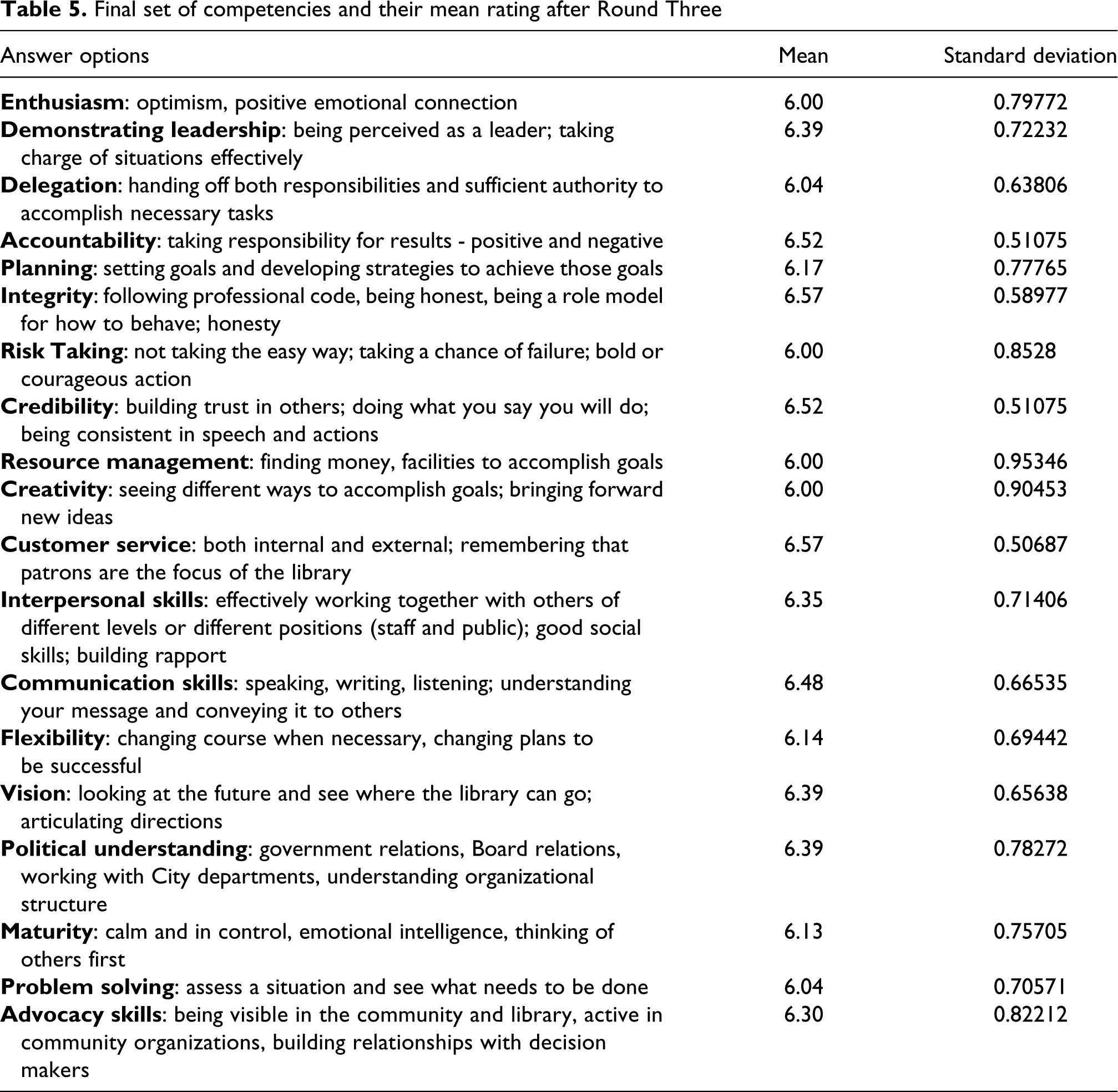
While all the means on the Likert scale averaged 6.0 or higher, keeping them in the study, none of the standard deviations for each competency were as low as in Round Two. While participants agreed this was the final set, there was less unanimity on the importance of each than had been shown previously.
In this third round, several statistical tests were performed on these data to see what kinds of demographic information might be drawn out to make these data more valuable. An ANOVA test was done comparing the means of the years of service as a librarian each of the participants had completed, for each of the individual final competencies. There were no significant differences between people’s ratings of the individual competencies based on their years of working as libraries, except for one competency: Enthusiasm (Table 6).
Enthusiasm ANOVA
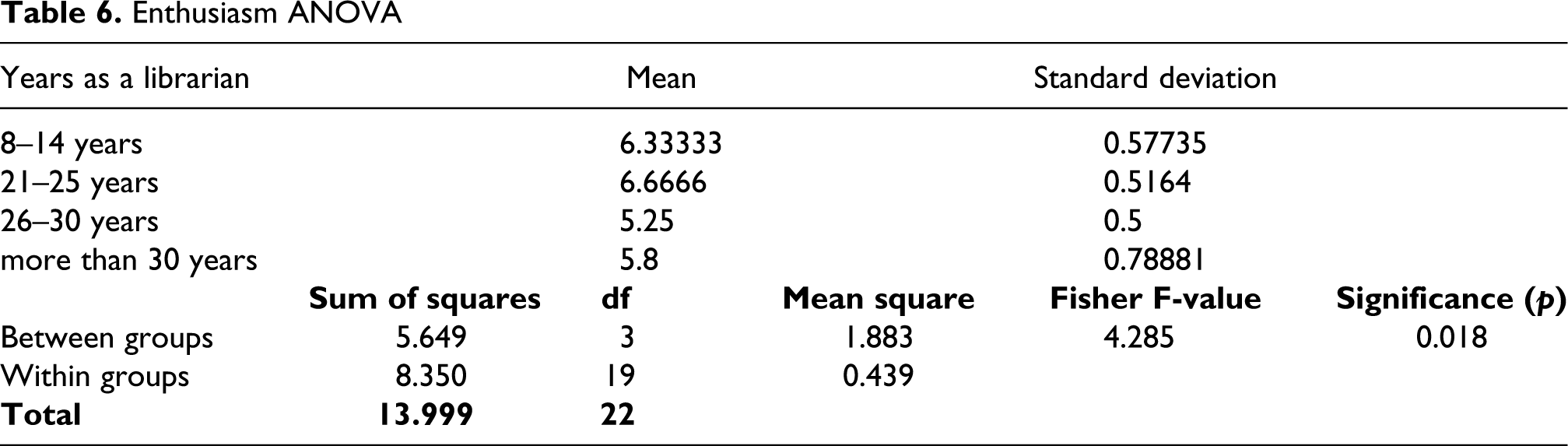
Based on this chart, those directors who had been librarians for 25 or fewer years were more likely to rate this competency as of a higher importance than those working longer than 25 years. It could be speculated those directors spending many decades in their jobs could still derive personal and professional satisfaction, but feel less need for enthusiasm at work than newer directors.
Another ANOVA was performed comparing the individual competencies based on years worked as a library director. Only one competency emerged as having a significant difference in this comparison of means across the years of work: Maturity (Table 7).
Maturity ANOVA
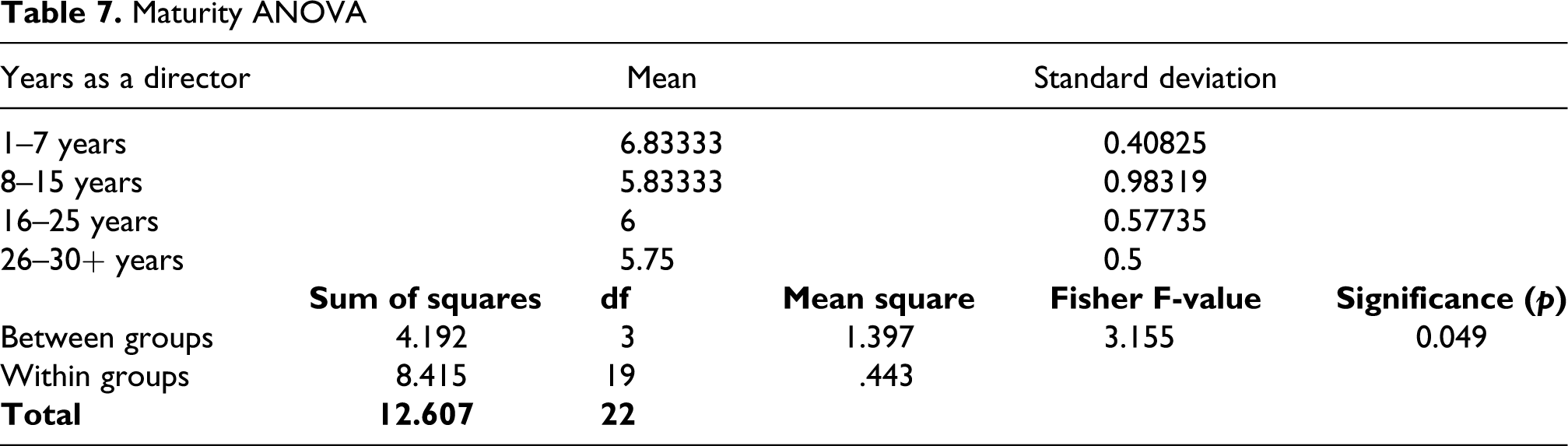
From these data, it appears that the directors with the least amount of experience value the competency of maturity by far the highest; those valuing it least are those working as directors for 26 or more years. Here it may be that newer directors value the maturity – or experience or wisdom – of directors who have spent years doing the job these directors are just beginning. It would be understandable that maturity would be seen as more helpful in this group.
Another ANOVA was done comparing each of the final competencies by the gender of the participants. Both genders were similar on their ratings of the importance of all items, except their ratings of Vision (Table 8).
Vision ANOVA
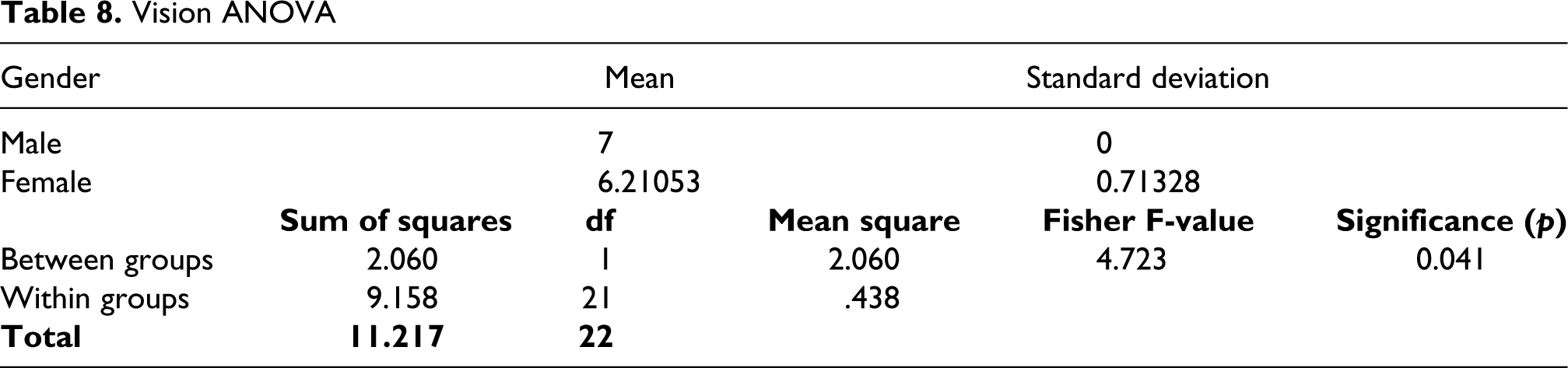
The males in this study unanimously rated this with the highest rating of seven “absolutely necessary,” while females rated it much lower – still important, but less so.
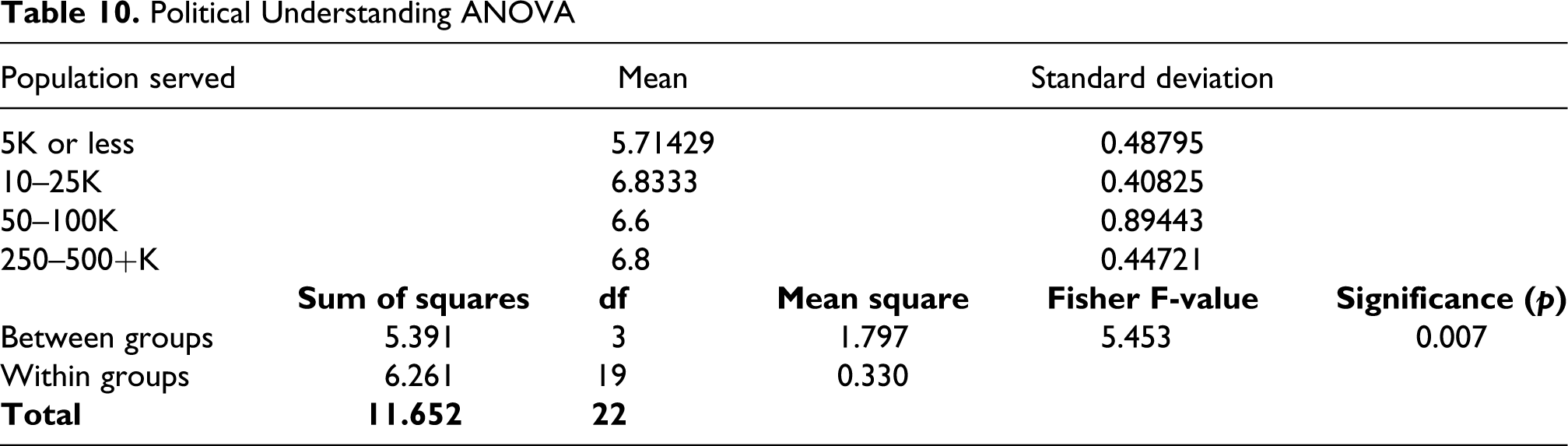
The final ANOVA testing was done looking at the demographic grouping of population size served by the libraries. When these groups were examined, there were three competencies with significant differences between the ratings applied by each of the groups: Risk taking (Table 9), Political understanding (Table 10), and Advocacy skills (Table 11).
Risk taking ANOVA

Political Understanding ANOVA
Advocacy Skills ANOVA
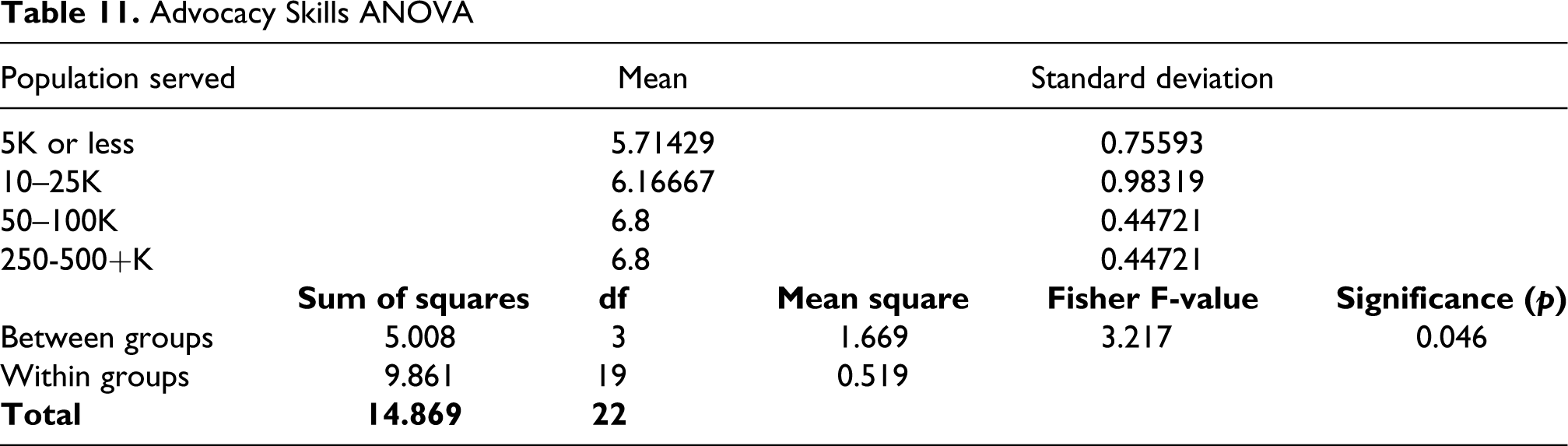
For the competency of Risk taking, those library directors serving in communities of 5000 people or fewer rated this competency significantly lower than did all other directors. This same group also rated Political understanding significantly lower than did the other population groups. With the competency of Advocacy, the 5000 or less population group rated this significantly lower than did all the other groups. But the 10,000 to 25,000 population served group also rated it quite a bit lower than did the upper two population groups.
Those directors who are newer may see less value in taking risks with a job they may not be entirely comfortable in yet, in contrast to those who have been doing their job for a long time. Directors who have more experience are also rating advocacy and political skills higher than new directors, possibly because they have the experience to know the basic of their job and can look out to the potentially less obvious, but still important, competencies necessary for success in their jobs.
Discussion and recommendations
The set of competencies developed in this study should be useful to the LIS profession, and specifically to new and aspiring public library directors looking for information on their own competency development. Using a set of research-based competencies, instead of those without an objective reason for including them in a training program, will help librarians to focus on those skills, knowledge, abilities, and attainments most important for them to learn to achieve success in the profession.
Having a set of research-based competencies is an important first step in developing better-trained directors for public libraries, but it is only one step in the process. Using this list as a starting point, training programs can be built to help new and aspiring directors develop these competencies. This set gives trainers a place to begin in setting goals for libraries, or gives the librarians themselves some direction for their self-education process. In an education program, it is important to begin with a defined set of goals, and this list can comprise some or all of those goals. There is no consensus yet in the LIS profession on the competencies necessary for library directors, leaving librarians disadvantaged when they attempt to climb into the managerial positions available within the library (Mackenzie and Smith 2009: 140). While this set of competencies is of necessity directly applicable to a narrow group, it is a place to start in defining training goals to meet the needs of that group. Future studies will expand on the ideas learned here.
Training programs could involve the entire set of competencies, if there was a long enough time to devote to all 19 individual ideas. Or, for a more focused training opportunity, specific collections of these competencies could be singled out for the training, in small groupings. For example, one group of competencies could consist of interpersonal Skills, Customer Service, Communication Skills, and Advocacy Skills. This could give librarians a suite of competencies to help them build their comfort level and skill level in working successfully with other people.
Once the training goals are established, they should be defined to provide participants with a clear idea of the goals they will be obtaining. To make the training as useful as possible, specific skills identified in each competency should be taught. For example, in a training program to help librarians improve their communication skills, the definition derived in this research is “speaking, writing, listening, understanding your message and conveying it to others.” So specific training items should include practice in each of these areas, such as writing a press release, speaking in front of the group, listening to someone speaking without interrupting, etc. Once the training has been completed, it is important to evaluate whether it produced any result in the participants. Setting up clear goals at the beginning of the program will help in developing a post-training evaluation process.
Enhancing and expanding the profession’s knowledge of competencies for library managers and directors will require more work to build on the ideas here. More research is needed to ensure library managers at all levels are given the tools they need to be successful, especially as libraries continue to struggle with the economy and the pace of change in society. This study looked only at public library directors. Other research should look at academic, school, corporate, or special library directors and managers at other levels. Paraprofessionals are another group who are given responsibility for supervision and management of staff, but are less likely to receive training than are degreed librarians. This group would also benefit from further study and training opportunities directed at their individual needs.