



Abstract
This paper examines re-training of librarians for the digital work environment by the Nigerian Library Association (NLA). In addition to personal observation a documentary analysis of the contents of NLA Information Technology Section workshops training Compact Disc (CD) for the period 2007 to 2011 was used to collect data for this study. Findings from the analysis revealed that the Information Technology Section of the Nigerian Library Association has been playing a vital role in re-training librarians for the digital work environment in their annual Library and Information Technology Today workshops. Recommendations include streamlining the topics covered in the annual workshops for effectiveness.
Keywords
Introduction
The infusion of information technology in the academic library has resulted in a digital work environment, an environment in which information is increasingly being created and offered in a digital format, either locally or remotely. This has changed the way the library offers its services and requires librarians to acquire new skills in addition to traditional library skills. It can also be argued that the most crucial element in developing a successful library in the digital work environment is having the right staff with the appropriate information technology skills in place.
Library and information services in this digital era are increasingly technologically driven, thereby changing the way library provides its services. To effectively work in the digital work environment, librarians require re-training with the skills, knowledge, and experience that will enable them to manage digital information resources and services. The importance of staff re-training in the provision of library and information services in the digital environment cannot be over-emphasized. Tennant (1995) posits that adequate staff training requires a firm commitment from library administrations. He went further to assert that it is essential to allow and encourage staff to take the time to learn and utilize new skills. Any investment made in re-training staff skills to meet the challenges and opportunities of the electronic age will be repaid many times over in facilitating access to information to increasingly digitally knowledgeable library patrons in Nigeria.
The knowledge and skills that are relevant for librarians to effectively work in the digital environment must include a certain degree of knowledge and skills in information technology. While library schools train librarians in the traditional school setting, professional associations have a basic role in retraining and updating librarians already in the workforce to be efficient. With the emergence of the digital work environment it becomes mandatory for practicing librarians to acquire new skills that will make them more effective in providing library and information services that are relevant to the digital work environment. There is a need, therefore, to examine the extent to which the Nigerian Library Association has repositioned its members to new challenges.
Objective and methodology
The objective of the study is to examine the role played by the Nigerian Library Association, particularly its Information Technology Section, in the re-training of Nigerian librarians for the digital work environment through an annual series of Library and Information Technology Today (LITT) workshops. The paper goes further to identify the themes and topics covered by the Information Technology Section of the Nigerian Library Association and their relevance to the information technological skills needed for the digital work environment.
At the end of each annual LITT workshop a CD-ROM containing all the papers presented and a list of registered participants with their addresses is produced and distributed to participants. For the purpose of this study, documentary analysis of each of the CD-ROMs for the years 2007 to 2011 was carried out. Documentary analysis was deemed the most appropriate method to adequately analyze the themes, topics covered, lists of resource persons and participants. In addition, personal observations were carried out by the researcher during the period covered for this study.
The Nigerian Library Association
The Nigerian Library Association (NLA) is the professional body for all librarians in Nigeria. It started as a Division of the West African Library Association (WALA). WALA itself was established in 1954 as an offshoot of a UNESCO seminar on the development of public libraries in Africa held at Ibadan in 1953. With the political independence from colonial rule of Anglophone West African countries in the late 1950s and early 1960s, the WALA national division for Nigeria transformed into the Nigerian Library Association (NLA) in 1962 (NLA Website, 2010: http://www.nla-ng.org). Individual members of the Association, now numbering about 5000, are drawn from various types of libraries throughout the country. Every librarian would normally belong in the first instance to one of the 37 States/Federal Capital Territory Chapters and one or more of the 11 interest groupings. One of the interest groups is the Information Technology Section.
The NLA holds an annual conference and general meetings. The conference provides a platform for its members to present papers on current trends in library and information services within a selected theme and sub-themes. Even though not clearly stated as one of its objectives, the Nigerian Library Association, like all other professional associations, plays a vital role in the professional development of its members. Most of the interest groups hold annual workshops at the national level for re-training of their members. The Information Technology Section of the association has, over the past 5 years, organized Library and Information Technology Today (LITT) training workshops to re-train its members with information technology skills for the digital work environment.
Emerging technologies in Nigerian libraries
Policies of the Federal Government of Nigerian, such as the Nigeria Information Technology and Telecommunication Policy have facilitated the emergence of library patrons who are knowledgeable about information technology and who prefer digital information services. According to Internet World Statistics there were over 44 million Nigerians using the Internet as at 2011.
Offline CD-ROM technology providing access to both bibliographic and full text databases and integrated library systems was the earliest information technology that appeared in Nigerian libraries. TinLib, an integrated system, with modules for search, cataloguing, circulation, acquisitions, periodicals and serials control, network communication, and selective dissemination of information, was made available in 1991 to academic libraries by the Nigerian Universities Commission (NUC) through a World Bank credit facility. The University of llorin, Ahmadu Bello University, Zaria, the University of Ibadan and the University of Lagos were some of the few universities that were able to implement and use TinLib and eventually migrate to other library management software.
The deregulation of the telecommunication industries in the last decade and increasing funding for libraries by the Nigerian Tertiary Education Fund (Tetfund) has made Internet access affordable to many libraries in Nigeria. This opens the door to real-time access to resources and services located throughout the world and maintained by numerous libraries, vendors and consortia (Dahl et al. 2006). Burke (2009) also asserts that the Internet continues to stimulate library staff to re-training and acquire skills for delivery of services to patrons. Libraries have a website with links to the library catalogue, database and other value added-websites. Gbaje (2007) reported that some academic libraries in Nigeria have already started using the Internet for provision of information resources and services through their websites.
In addition to deploying Integrated Library Systems and maintaining a library website, many academic libraries in Nigeria are currently in the process of digitizing their indigenous collections for preservation and wider access. These libraries have adopted different digital asset management software such as Greenstone, DSpace, Eprint, Fedora, bepress, etc., to manage their digitized collections. For example, while Ahmadu Bello University, Zaria and the University of Jos have adopted DSpace open source software, Covenant University adopted Eprint for the digital repository.
Any implementation of electronic information sources in the digital work environment needs to be accompanied by intensive staff training. This training should be aimed at how staff members can help educate patrons who have questions about the new resources or how to use them.
According to Saleh (2011), Nigeria has over 50 institutions including universities, polytechnics and colleges that offer library and information science programs at certificate, Ordinary National and Higher Diploma, degree and higher degree levels. Many of these library schools have recently incorporated information technology-related courses to enable them to train information professionals who will work in the digital environment. However, the re-training of practicing librarians for the digital work environment is carried out mainly by the Nigerian Library Association (NLA).
Re-training for the digital work environment
The use of technology requires a significant investment in time, money, and training of both staff and patrons. Hanson and Levin (2003) stated that the evolution of information technology requires that staff skills and competencies be continually upgraded and maintained to make the best use of these technologies. Supporting this assertion, Burke (2009) argued that training is crucial to the successful use of electronic resources in the library.
The enabling technologies for the digital work environment include: open source Apache Web Server, web scripting languages, such as PHP, ColdFusion, and Microsoft's Active Server Page. They also include relational databases such as MySQL and PostgreSQL and other general purpose tools for storing, searching and manipulating information.
The use of library integrated systems for the automation of libraries requires IT skills which include:
Developing web-related applications to create personal or library web pages and content.
The use of HTML, MARC, OCLC, Z39.50 and World Wide Web formats.
The deployment of websites by the library to anchor various online library services requires special IT skills, some of which include:
Web design skills using web authoring tools such as Dreamweaver, Content Management Software, FrontPage and HTML.
Programming with PHP, JavaScript.
Construction and maintenance of databases for dynamic websites.
Online information services such as online reference services, blogs, online and offline database search, wiki and document delivery and emails are also popular services libraries provide to their patrons.
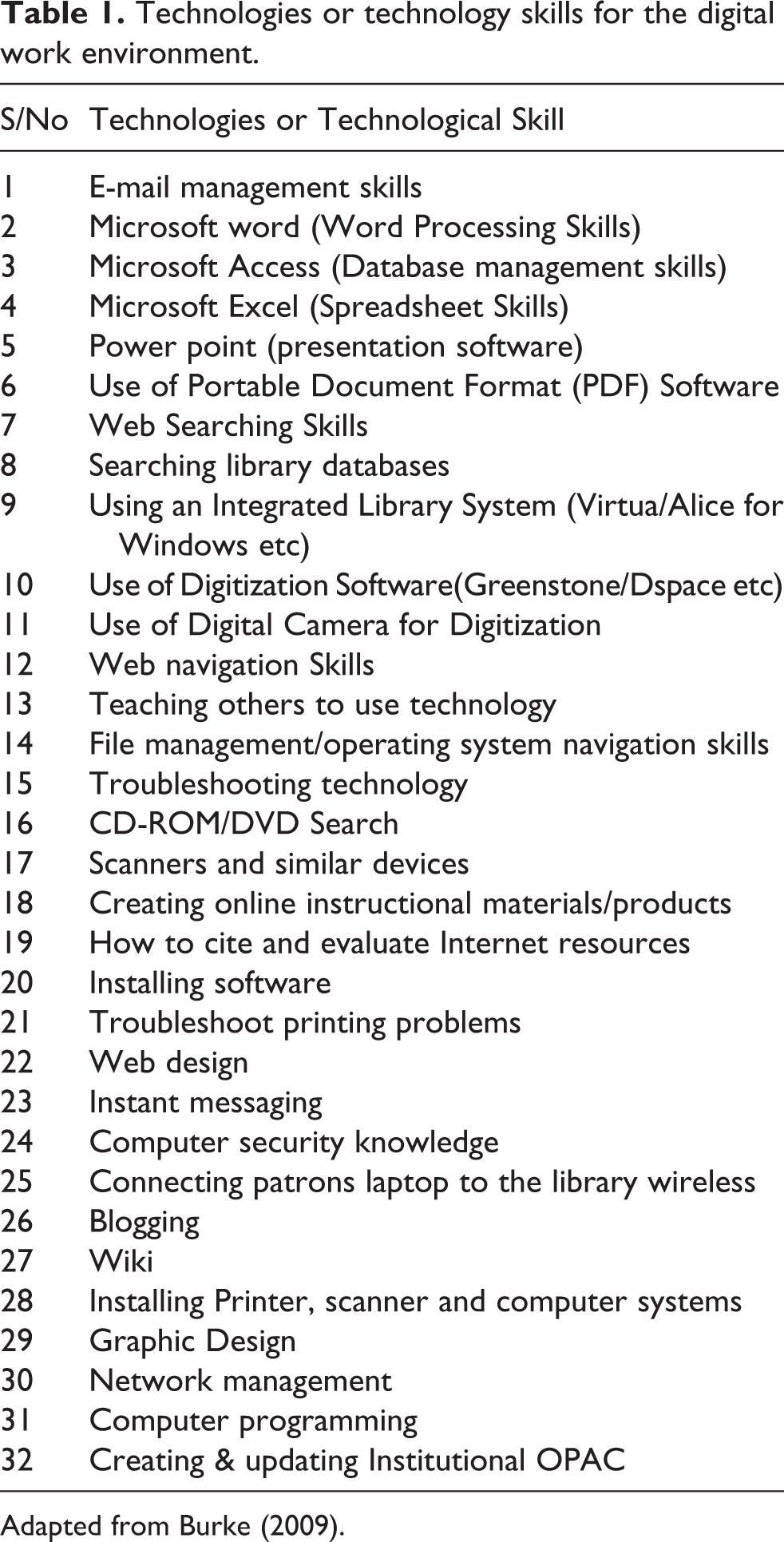
Information technology knowledge must be continually upgraded and maintained to make the best use of these technologies. One might argue that the above technology skills are for systems librarians, digital services librarians, IT librarians, etc. However, the baseline technology skills for every librarian to be effective in the digital work environment include one or more of the skills listed in Table 1.
Technologies or technology skills for the digital work environment.
Adapted from Burke (2009).
In general all librarians should be familiar with installing, configuring, and using a browser and should be able to discuss intelligently their favorite search engines on the Web and explain why they use each one. Librarians should also be able to discuss when a Web search is preferable to a print search, and vice versa. Librarians have explored the use of email beyond just communications to include online document delivery services and selective dissemination of information. Due to the evolving nature of operating systems, all staff should be familiar with whichever version of operating system is run within the organization, how to navigate through it (with and without a mouse), and how to manage files associated with them.
Information Technology Section Workshops
The study sought to identify the themes and topics covered in the annual Library and Information Technology Today (LITT) workshops organized by the IT Section of the NLA, as shown in Table 2.
NLA Information Technology Section LITT Workshops 2007–2011.
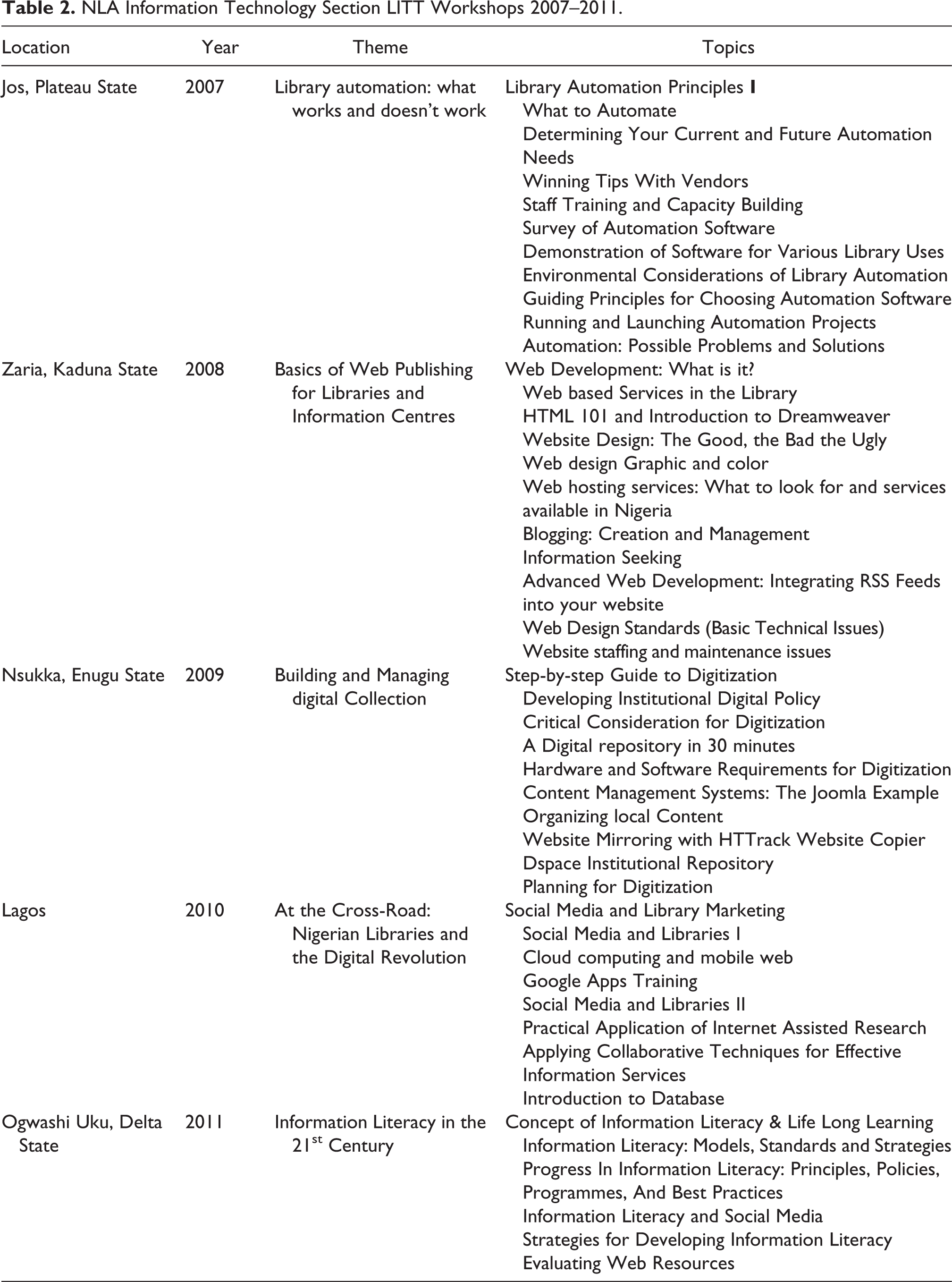
From Table 2 it is obvious that over the past few years the Information Technology Section, through its annual Library and Information Technology Today (LITT) workshops, has provided members of the Nigerian Library Association with a platform to equip them with the necessary technological skills relevant to the digital work environment. The themes and topics for each year’s workshop were selected based on the suggestions of members. The suggested topics are further analyzed and streamlined for effective teaching and learning by the executive of the Information Technology Section, taking the current trends in the library and information profession into consideration.
Table 2 reveals that during this period under study, no subthemes or topics on email management, word processing, spreadsheet and Power Point presentation skills were considered. This is an indication that the majority of NLA members had sufficient knowledge and skills to work with these packages effectively in the digital work environment. Topics like computer programming, network management, creating online instruction materials are yet to be covered by LITT workshops.
In Table 1 creating online instructional materials/product and Web design are listed as technology skills for the digital work environment: these skills were the focus of the LITT 2008 workshop with the theme, ‘Basics of Web Publishing for Libraries and Information Centres’ and topics discussed under this theme included: ‘Web development: what is it’; ‘HTML 101 and Introduction to Dreamweaver’; ‘Web design graphics’; ‘Web design standards,’ etc. Technical skills such as use of digitization software and use of digital cameras for digitization were also addressed in the LITT 2009 workshop under the theme ‘Building and managing digital collection’ as shown in Table 2.
Creating and using social media like blogs, wikis, social bookmarking and RSS feeds/readers were the focus of LITT 2010 under the subthemes of social media and library marketing, and social media and libraries, as shown in Table 2. These topics are also some of the skills required in the digital work environment as listed in Table 1.
Although the Nigerian Library Association currently has over 5000 members, analysis of the lists of workshop participants shows that fewer than 75 members attended any workshop, as shown in Figure 1.
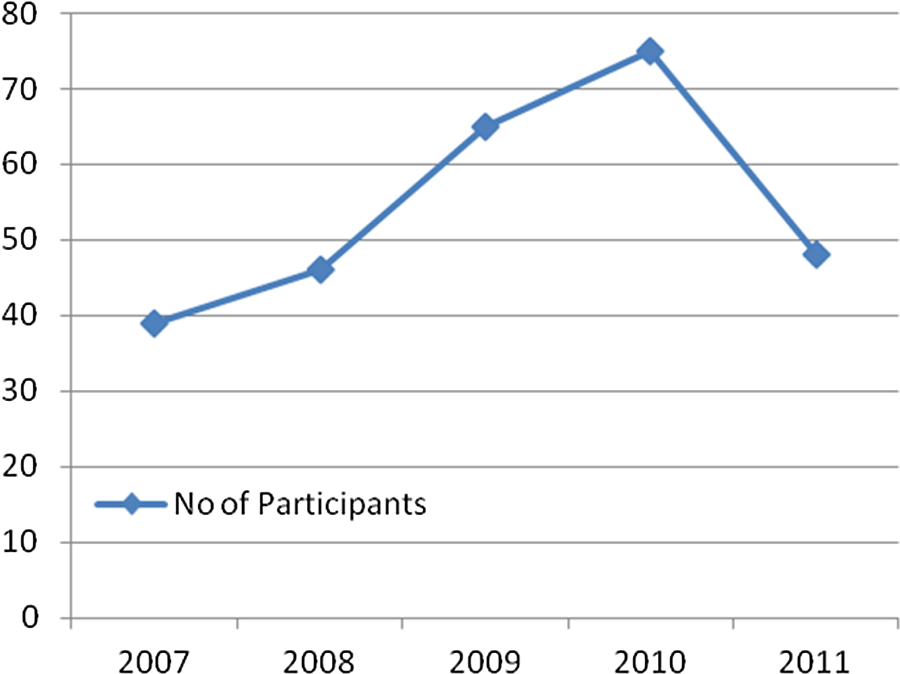
2007-2011 LITT No of Participants.
Table 3 presents amore detailed breakdown of the attendance figures, and shows that a total of 272 participants registered and participated in LITT workshops during the period under study – an average of 54 per year. Participants from special libraries, which comprise libraries from government agencies like the Nigerian Petroleum Company, the Nigerian Civil Aviation Authority, the Nigerian Press Council, the Nigerian Nuclear Regulatory Authority, the Federal Radio Corporation of Nigeria, Ibadan and the National Population Commission, Abuja, to mention just a few, provided the highest number of participants, accounting for 44 percent of the total. Universities provided the second highest number of participants (40 percent), while the National library of Nigeria only sent two participants – less than 1 percent of the total – to the first workshop in 2007. There were apparently no participants from public libraries.
LITT Workshops, 2007–2011. Number of participants and type of institution.

The attendance sheets for each workshop reveal that the University of Lagos Akoka Lagos State, the American University of Yola, the Kaduna State University, the Nigerian National Petroleum Company Library, the University of Nsukka, and Ahamdu Bello University Zaria sent the same people as participants in the 2008, 2009 and 2003 LIT workshops . The data also reveal that participants during these workshops came from all six geopolitical zone of the country.
There was a sharp decline in the number of participants who attended the LITT workshop in 2011 as compared to 2010, as depicted in Figure 1 and Table 3. Through personal interaction, some participants revealed that the low turnout for the 2011 workshop was because many felt that the theme and topics for that year were not technologically related.
Having participated in four of the workshops, the researcher observed that the workshops were all practically based, even though very little time was allocated for the hands-on sessions. The researcher also observed that during these workshops Internet access was erratic.
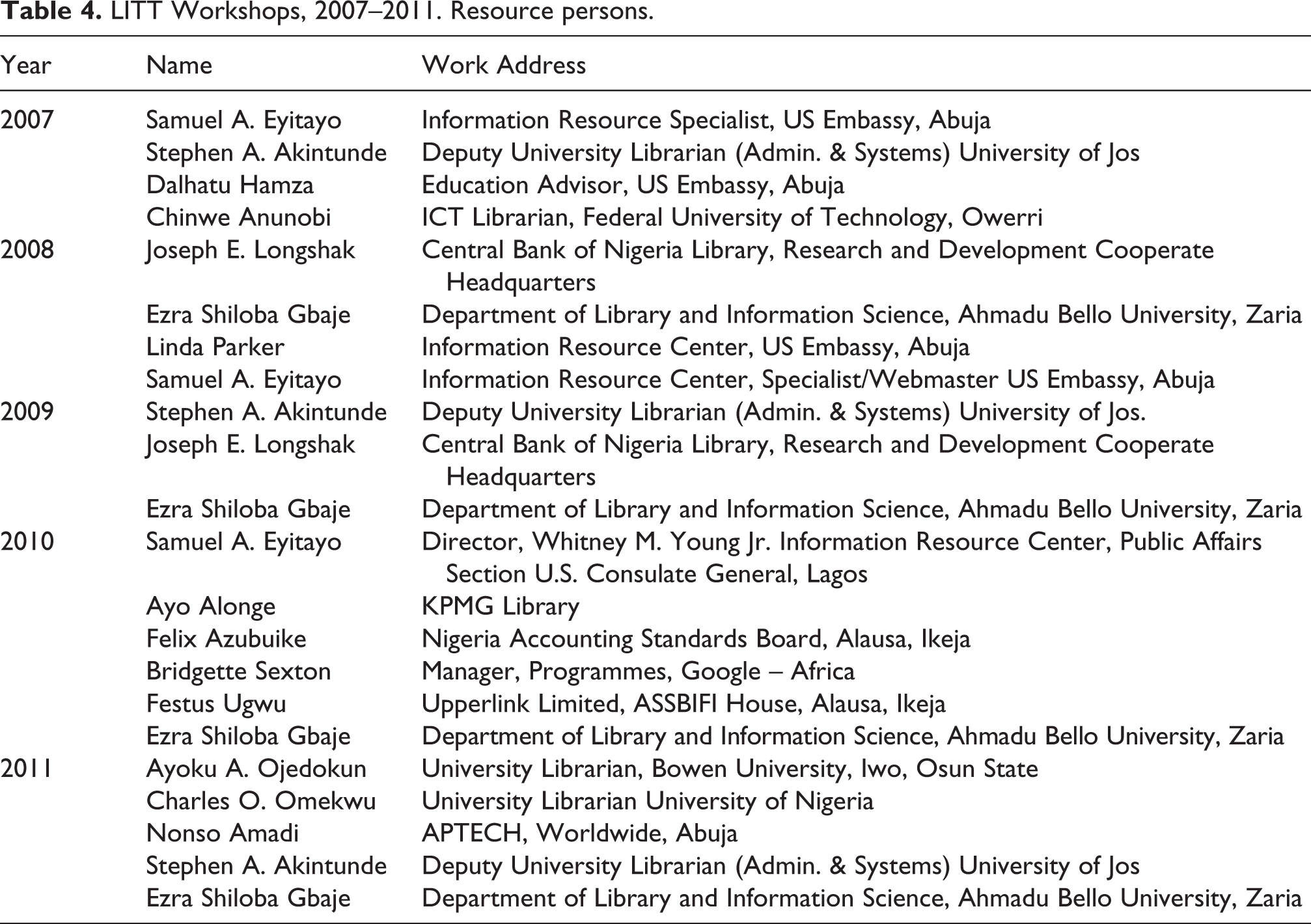
The resource persons for these workshops were experts knowledgeable in the application of information technology in libraries. Table 4 lists the resource persons for LITT workshops during the period understudy, and shows that Samuel A. Eyitayo and Ezra Shiloba Gbaje (PhD) served as resources persons four times, while Stephen A. Akintunde (PhD) and Joseph E. Longshak were resource persons three times and twice respectively . The repeated use of these resource persons is largely due to the high rating of their teaching skills and level of knowledge by the participants, as recorded in the evaluation forms distributed at the end of each workshop. Further examination of the evaluation forms also reveals a persistent request for more time for the hands-on session and complaints about the slow Internet speed at the various training locations.
LITT Workshops, 2007–2011. Resource persons.
Conclusion and recommendations
To work in a digital environment, the information professional needs basic fluency in information technology. The re-training of Nigerian librarians for the digital work environment has been a task undertaken by the Information Technology Section of the Nigerian Library Association. Workshops on library automation, digitization of library resources, website design and use of Web 2.0 for library services have been the focus of the LITT workshops for the past 5 years. The spin-off from these workshops can be seen in the few libraries currently providing online services and digitizing their materials and which had ensured that they sent their staff to the LITT workshops. Examples include Ahmadu Bello University Library (www.abu.edu.ng/library/index), the University of Nigeria Nnsuka Library (http://www.unn.edu.ng/library), the University of Lagos Library (http://library.unilag.edu.ng/) and the University of Abuja Library (http://uniabujalibrary.net/) to mention just a few.