



Abstract
The objective of this study was to gather the views of training providers and library employees on the continuing professional development opportunities available in Cambodia and the associated barriers. In total, 26 semi-structured interviews were conducted – 14 with training providers and 12 with library employees. Four key barriers were identified: the lack of continuing professional development opportunities; the inability to meet real training needs; the challenges associated with attending programmes in other cities, such as travel, accommodation and study leave; and a lack of resource personnel to conduct continuing professional development programmes. Four areas of improvement are suggested: offering regular training programmes; conducting a training needs assessment study; organising a national-level meeting to discuss library staff development issues; and developing a library and information science ecosystem to support the continuing professional development framework. The findings of this study are expected to provide some background information for the development of a continuing professional development plan for the library and information science sector in Cambodia.
Keywords
Introduction
The increasingly digitised library and information ecosystem is redefining the library and information science (LIS) profession, requiring individuals to reskill and upskill, and to learn how to use new tools and technologies to stay relevant and effectively meet users’ growing expectations. The COVID-19 pandemic, where face-to-face interactions were restricted, has demonstrated in no uncertain terms that currently the most viable option for library staff to acquire new skills is through participation in continuing professional development (CPD) activities. The availability of strong CPD programmes is therefore a means to facilitate LIS employees to keep up to date with emerging trends. Several library stakeholders – such as professional associations, employers, library vendors and library donors – play a role in offering CPD programmes. In addition, LIS schools are deemed an important source for CPD programmes as they have pools of highly trained academic staff, resources and facilities (Majid, 2004).
According to Majid (2004), Shonhe (2020) and Varlejs (2016), there has been little research devoted to CPD in the LIS field in South East Asia and it has mostly focused on academic libraries. Two of the studies cited by Varlejs (2016) are doctoral research conducted by Nguyen (2008) and Maesaroh (2012) on academic library staff development in Vietnam and Indonesia, respectively. Examples of more recent studies out of the region include research conducted in Pakistan by Hamid and Soroya (2017) and Rafiq et al. (2017), a study on Sri Lanka by Masroofa (2021), and a study on CPD for the capacity-building of LIS employees in the Republic of Maldives (De Alwis Jayasuriya et al., 2021a, 2021b). Two studies that discuss the perspectives of LIS CPD providers are those by Majid (2004) and Rafiq et al. (2017). Shonhe (2020) further states that the low research output may inhibit informed decision-making to develop a skilled and relevant LIS workforce to meet the needs of 21st-century users, specifically in developing countries.
Varlejs (1999) observes that most LIS employees lag behind other professions due to the limited CPD opportunities available in several regions of the world. From a South East Asian perspective, Majid (2004) notes that, compared to training needs, the level of CPD activities for LIS professionals in the region is quite low. Given the varying standards of LIS schools in the South Asia and South East Asia regions and the absence of strong national professional associations, the need for CPD programmes is more critical in these countries (Majid, 2004, 2018; Sturgess, 2012). As such, it is desirable to investigate the availability, frequency, adequacy and quality of CPD programmes for LIS employees in these countries.
Cambodia was considered a suitable site for this study due to the lack of research on CPD in the country (Hickok, 2020; Mao, 2011). The only exception is a report by Jarvis et al. (2006), who note that although libraries were included in a 2002 study of the publishing industry, certain useful data collected through a survey and interviews was not adequately analysed or reported due to resource constraints. This article reports selected findings from a study conducted on the status of formal CPD activities available to library employees in Cambodia from the perspective of both library employees and training providers.
The Cambodian LIS sector
The Royal Kingdom of Cambodia, located in South East Asia, has a long and rich history, and is known for the famous ruins at Angkor Wat. Cambodia has undergone significant transition over the last two decades, reaching lower-middle-income status in 2015 and aspiring to attain upper-middle-income status by 2030, thus making it one of the fastest-growing economies in the world (World Bank, 2021). Unfortunately, the COVID-19 pandemic has slowed down the speed of progress. Khmer is the official language and mother tongue of Cambodians. Although English is the most widely learned second language in the country, Cambodia is still ranked 97 out of 112 countries on the English Proficiency Index (Education First, 2021).
The civil war in the 1970s, the Khmer Rouge regime from 1975–1979 and the civil conflict throughout the 1980s were devastating for Cambodia (Chandler, 2008). During the 1990s, the country underwent political, economic and cultural reforms, which included a major overhaul of the education system in 1996 that helped improve literacy and the availability of books (Jarvis et al., 2006). Early in the 2000s, Cambodia experienced a boom in the higher education sector, leading to the growth of a private university industry (Jarvis et al., 2006). Many non-governmental organisations (NGOs) and development partners also started contributing significantly to Cambodia’s primary and secondary education sector. In 2016, the Ministry of Education, Youth and Sport (MoEYS), in collaboration with Kampuchea Action to Promote Education (KAPE), launched the New Generation Schools (NGS) reform with the objective of providing 21st-century learning environments in schools (Kampuchea Action to Promote Education, 2020; Ministry of Education, 2016, 2020). 1
The library sector in Cambodia is still developing and includes the National Library of Cambodia and school, academic and special libraries (Hickok, 2020). The term ‘library’ is used loosely in schools to refer to a collection of books, a single shelf of books or a storage room with a few shelves of books (Hickok, 2019). A positive outcome of the engagement of NGOs in primary and secondary school education is the incorporation of school library development in their programmes (Hickok, 2019; Mao, 2011). The academic libraries in the public and private universities are of varying capacity and quality (Hickok, 2019), although the Accreditation Committee of Cambodia’s (2010) ‘Minimum standards for accreditation of higher education institutions’ stipulates the provision of adequate resources to support teaching, learning and research. However, Hickok (2020) is of the opinion that academic libraries in Cambodia, although still far behind many other South East Asian academic libraries, are more developed than the other types of libraries in the country. The special library sector comprises a large number of libraries in government institutions and NGOs (Suon, 2009). The network also includes around 27 prison libraries and 23 library education centres in garment factories (Sipar, n.d.). A network of temple libraries originated in the 9th and 10th centuries and some of these still hold manuscripts (Mao, 2011; Plathe, 1993).
A government-supported public library system is non-existent in the country (Hickok, 2019, 2020; Plathe, 1993) and the National Library of Cambodia has attempted to address this gap by opening its collections and services to the public (D’Amicantonio, 1997; Hickok, 2019). The Alliance Française Library and the library at the Center for Khmer Studies in Seam Reap also serve as public libraries (Center for Khmer Studies, 2004–2005, 2014–2015; Hickok, 2019; Plathe, 1993). Many NGOs have been actively engaged in addressing the absence of public libraries by establishing a series of library services in the form of community and mobile libraries (Hickok, 2019; Mao, 2011; Sipar, n.d.).
CPD in Cambodia
The beginnings
During the period from the 1980s to 2010, library professionals and consultants who visited Cambodia on missions for international organisations highlighted the low level of training of library employees and the need for human resource development (D’Amicantonio, 1997; Plathe, 1993). Many funding agencies attempted to address this gap by awarding overseas fellowships (Bywater, 1998; Conference of Directors, 2001; Plathe, 1993). In addition, in-country workshops were conducted by library professionals visiting Cambodia on consultancy or volunteer attachments, and professional librarians working at Alliance Française (Plathe, 1993). Library employees based in Phnom Penh were the main beneficiaries of this training (Conference of Directors, 2006; Jarvis, 1995; Plathe, 1993).
The first training programme organised for library employees in Cambodia was conducted in English and French for National Library of Cambodia staff prior to the library’s reopening in January 1980 (Jarvis, 1995). In 1987, Margaret Bywater (1998), a professional librarian from Australia who was with the Royal University of Phnom Penh (RUPP), conducted a workshop for a small group of librarians with the Ministry of Education. Bywater was later contracted as a library resources advisor by the Asia Foundation to provide training for almost all types of libraries (D’Amicantonio, 1997; Jarvis et al., 2006). These training programmes focused on collection development, and specifically on how to assess donated materials, which was particularly useful for the librarians given that most of the collections were donor-driven. A collaboration with John D’Amicantonio (1997) to hold a workshop on reference services was also useful to address gaps in Cambodia’s service culture. Dean (1999) refers to the training sessions on library preservation conducted under the auspices of the Cornell Library Overseas Conservation project in 1989 and 1991.
Workshops conducted by the IFLA Advancement of Librarianship in Developing Countries Programme (1994) and other related organisations in the region were also avenues that Cambodian academic librarians made use of for exposure to and opportunities to network with librarians in the South East Asia region who faced similar development issues.
The Cambodia country reports of the Conference of Directors of National Libraries in Asia and Oceania (2006, 2007, 2008, 2009) note the training initiatives of the Cambodian Library Association (CLA) and the RUPP. These events are an indication that the LIS profession recognised the importance of CPD and attempts were made to provide training opportunities to library employees despite resource constraints. According to Suon (2009), the only training available to library employees locally was occasional workshops or short courses, and travelling to nearby countries to attend short courses. Overseas training was not an option due to resource constraints.
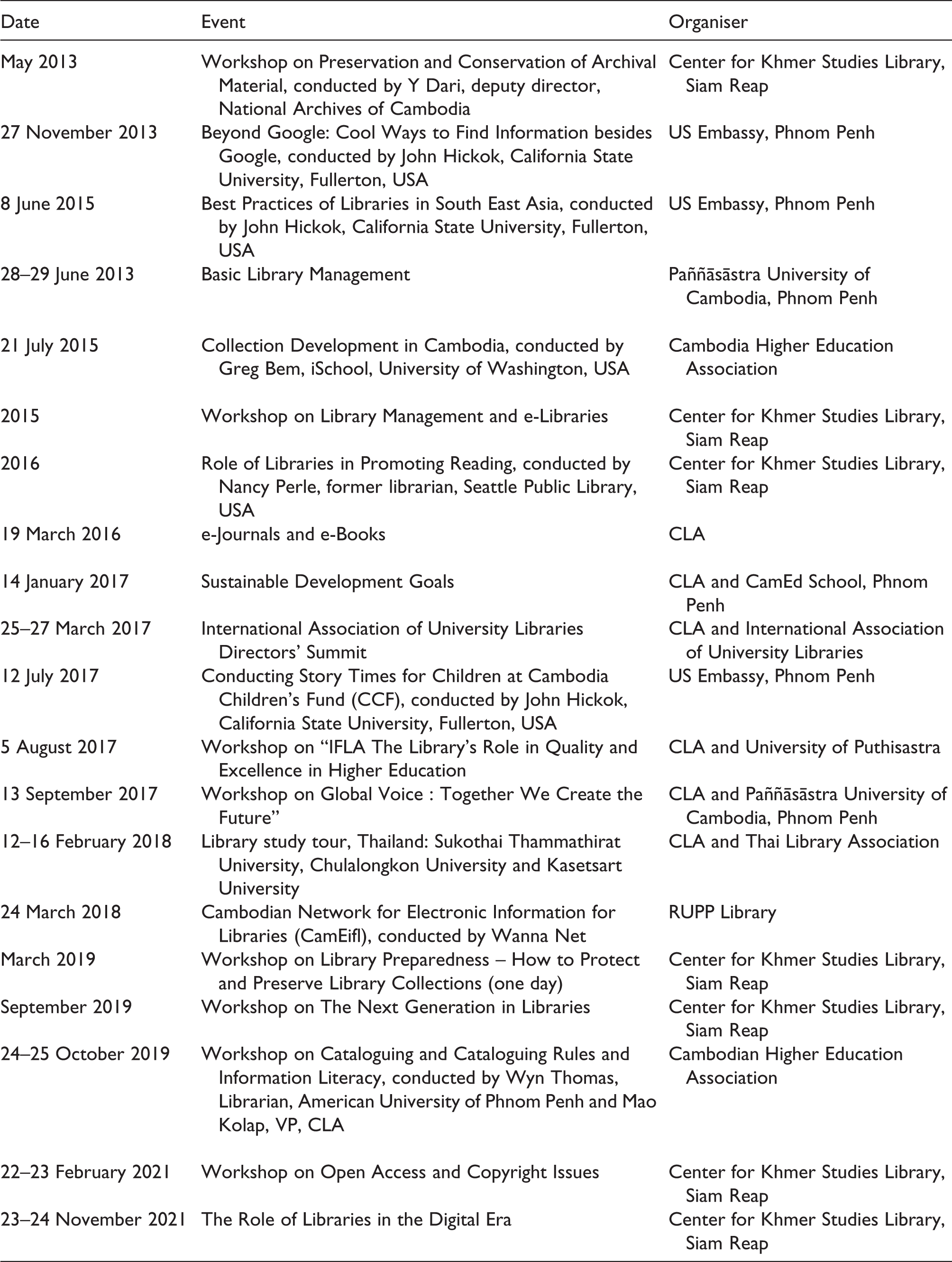
The CLA, which was established in 1996 as the Cambodian Librarians and Documentalists Association, was relaunched in 2013. 2 The association’s goals recognise the need for the continued capacity-building of library professionals in the country, and it has focused on conducting training programmes locally (see Appendix 1), as well as sending some members overseas for training (Hickok, 2019, 2020; Mao, 2011).
Training for school library employees
In the early 1990s, Plathe (1993) noted that appropriate training was not extended to trainee-teachers at teacher training colleges to become school librarians as the library at the Ministry of Education in Phnom Penh lacked trained librarians. A study by the MoEYS (Pedagogical Research Department, 2007) revealed that secondary school libraries were showing little progress in capacity-building. The reasons stated were that some library staff had not received any training as they were appointed after the training was conducted; the duration of the training was less than a week; and, most importantly, the staff’s low educational attainment impacted their ability to learn the needed skills. In 2010, the Hun Sen Ning Lok Chomteav Library (Ministry of Education, 2010) highlighted that although it was mandated to collaborate with development partners to improve school librarians’ and directors’ skills and knowledge through short-term training programmes, the limited capacities of its staff did not permit it to fulfil this mandate.
Some developments have since been introduced to enhance the school library sector, including the adoption of the ‘Standards for primary school libraries’ (Ministry of Education, 2011), which incorporated a training component of basic training (nine days), continued training (six days) and special training (of flexible duration), and the ‘Education strategic plan, 2014–2018’ (Ministry of Education, 2014), which identified the need to train school librarians and update the curriculum to support early childhood education.
According to the Cambodia Development Resource Institute, the curriculum for trainee primary school teachers includes 43 hours allocated for library training (Sothy et al., 2015). Despite these developments, a World Vision (2016) study, which assessed the status and use of libraries in public schools through a survey of 20 librarians, highlighted that only a small number of the librarians had received any library-related training and that the duration of this training was confined to just one or two days (compared to the stipulated nine days). The overall conclusion of the study was that most librarians had received inadequate training, which seemed to resonate with the 2007 MoEYS study (Pedagogical Research Department, 2007).
To summarise, CPD training has been ad hoc and informal, except for a few years since the relaunch of the CLA (Hickok, 2020). Although Plathe (1993) highlighted that fellowships for overseas training and training workshops offered locally were useful to nurture a core group of professionals for the short term, a more concerted approach was needed to develop the resource pool. As the government’s priority at that time was on development and the rebuilding of infrastructures following the years of Khmer Rouge rule, and Plathe’s recommendations were not realised (Bywater, 1998; UNESCO Cambodia, 1997).
Current status
The training activities of the CLA appear to have been in a lull since pre-COVID-19 times. The National Library of Cambodia has been unable to take a lead role in training activities for many years.
One organisation that has taken an active role in contributing to the capacity-building of library employees in the last decade has been the Center for Khmer Studies Library. 3 Since 2013, the library has conducted annual workshops targeted at the academic and special library sectors in the country (Center for Khmer Studies, 2021). These workshops, which are held over two to three days, cover a cross section of themes (see Appendix 1). Due to the COVID-19 pandemic, the 2021 workshop was conducted as a hybrid event.
Sipar (n.d.) is the only LIS training provider that currently offers fee-based training programmes in the country. These include Basic Training in Library Management, Level 1 (five days) and Level 2 (four days), targeted at special libraries, which include pretests and post-tests to assess the participants’ performance. In addition, it offers training on facilitating reading.
Hickok (2019) underlines the absence of a national training programme for school librarians and highlights that almost all school libraries are run by a teacher or school staff member without any formal library training. However, Hickok hastens to add that the situation in private and international schools may be better as they may have more resources.
Barriers to CPD
The primary LIS continuing education providers in Cambodia are the CLA and the National Library of Cambodia. However, the literature review revealed that the LIS CPD ecosystem in Cambodia has been relatively inactive for several reasons. The CLA has been in hiatus in the recent past and the training of the National Library of Cambodia has been limited for many years due to severe resource constraints – both financial and owing to the unavailability of professionally qualified staff.
Although different stakeholders have at different times sought to establish a professional LIS education programme that could also take up CPD responsibilities in the country, it is yet to materialise (Hickok, 2020; Mao, 2011). As a result, Cambodia is the only country in the South East Asia region that is yet to establish a professional LIS education programme (Sacchanand, 2015). There is hence a severe lack of LIS professionals who can serve as resource persons in the country. In 1997, there were only two librarians in the country with a Master’s in Library Science (D’Amicantonio, 1997). Almost a decade later, in 2010, the number of professionally trained librarians with a Master’s in LIS or equivalent had increased to just four (Hickok, 2019). The only LIS training providers that are actively contributing to the CPD ecosystem are the Center for Khmer Studies, Sipar and NGOs that support school libraries.
The barriers to CPD that school library employees have to cope with include the lack of a component on libraries in the teacher training curriculum; the short duration of training programmes (approximately one to three days due to the lack of or limited funding); the lack of funding to meet the travelling and accommodation expenses of participating in training programmes; and the need to attend training during one’s vacation as leave is not given to attend training during work hours.
Research objectives and design
The literature review suggests an absence of research on the LIS sector overall, as well as the state of CPD opportunities available to LIS employees in Cambodia (Hickok, 2020; Mao, 2011). This study will provide insights into the formal CPD programmes available to library employees in Cambodia, as well as contribute to the sparse body of knowledge on Cambodia’s LIS sector. For the purpose of this study, CPD is defined as follows: learning activities undertaken by individuals to fill knowledge gaps and enhance their professional capabilities to manage their career pathways more effectively.
Cambodia currently does not offer any academic library science programmes and the number of professionally qualified librarians in the country is just five – three hold a Master’s in LIS, one holds a Master’s in Conservation and one is an associate of an overseas national professional body. As the number of professionally trained librarians is limited to five individuals, the population for this study also included library staff who were responsible for library operations but had no formal LIS education. The scope of the CPD activities in this study was limited to formal learning activities offered by different stakeholders.
The purpose of the study was to explore and understand the opinions, thoughts and feelings of the participants. Given the nature of the enquiry, interviewing – a qualitative research approach that involves engagement with participants – was adopted as it would enable the development of a holistic account of the research question.
Following discussions with two local contacts, a short Google Docs survey was sent to six known training providers. The intention was to develop an initial understanding of the local situation to help develop interview questions. Initially, only two local training providers responded. After a few reminders, two more training providers agreed to participate. It was later learned that the other two training providers had initially failed to respond to the Google Docs survey due to Internet bandwidth issues. Thus, a Word document was sent to them and their responses elicited. A follow-up discussion with the contacts revealed that Cambodians mostly use Telegram, a cross-platform instant messaging service. Thereafter, all further communication with the potential respondents was via Telegram.
Two sets of interview questions were prepared for the two groups of participants – that is, the training providers and the library employees. The guiding research question for this study was: What are the views of training providers and library employees of the CPD opportunities available in Cambodia? The semi-structured interview format enabled the interviewer to enter the participants’ space and, through discussion, obtain their perspectives on the research topic. Additionally, the interviews facilitated the interviewees’ reflections on other related issues, especially their views on the benefits of undertaking CPD and possible barriers impacting training providers and library employees. The final question to both groups aimed to solicit suggestions for improving CPD programmes for LIS employees in Cambodia. Probes were used to go deeper into a particular line of enquiry or to bring the participant back to the main line of enquiry. Certain key points raised by some of the participants during the interviews were verified by subsequent interviewees. The purpose was to validate the previous responses as well as seek their input on these points. A simple interview guide was prepared for the school librarians to help them understand the scope and purpose of the study.
The interview schedule was pretested on a professional librarian/trainer via Zoom, which enabled the interviewer to rehearse the interview, assess if the participant was able to understand and respond to the questions appropriately, determine if the questions elicited the intended information, and estimate how long the interview would take (McIntosh and Morse, 2015; Vinci et al., 2017). Based on the pretesting, some questions were rewritten to improve clarity and comprehension.
A purposive sampling technique was used for the selection of the participants to ensure better representation and facilitate in-depth discussion on the research topic. The initial interviewees also provided referrals to additional potential participants, who in turn were encouraged to supply information about other potential participants. The challenge was to ensure adequate representation, as well as find people with sufficient language proficiency to participate in the interviews effectively.
The sample population for the interviews comprised two categories: (1) active LIS training providers – trainers within state organisations, the private sector and NGOs; academic librarians/trainers; library management system consultants; and the chief executive officer of a state organisation – and (2) library employees from institutes of higher education and schools, both in the public and private sectors, and special libraries operated by NGOs.
The interview questions were emailed to the participants ahead of their interviews for two reasons: first, to give them sufficient time to reflect on the questions and, second, to allow the individuals who were less proficient in English to first think through their answers in their mother tongue and then try to translate them into English. This was desirable as, initially, some individuals were reluctant to participate due to their limited English proficiency. In addition, a few of the participants said that they would obtain the assistance of a colleague to act as an interpreter to translate and communicate their responses.
In total, 26 one-on-one interviews were conducted by the first author via Zoom from August to October 2021; the interviews typically lasted from 45 minutes to one hour. The interviews included 14 with training providers and 12 with library employees. Two participants, both school librarians, obtained the services of a colleague to act as an interpreter during the interview. A few of the participants prepared written notes, which they used during the interviews.
At the beginning of the interviews, the participants were assured that their identities and responses would remain anonymous and that they were allowed to withdraw from the study at any time without any consequences. None of the participants withdrew. Given the very small number of professionally trained librarians in the country and the fact that the same individuals, in addition to holding a full-time job, could hold office in a few different voluntary organisations, some variations were incorporated into the interview questions to cater for the nature of the organisation(s) represented, offices held and individual experiences. However, each interview was counted as one, regardless of the number of offices held by the interviewee.
With the participants’ permission, the interviews were audio-recorded to help with transcription. The thematic analysis technique was used to categorise and develop common themes from the interview transcripts. However, formal coding practices were not adopted as the study was more in the nature of applied research to understand the landscape and not designed to develop a theory.
Findings
This section presents the findings from the study and the discussion is substantiated with quotes from the interviews, which are identified by participant number.
The sample of 26 study participants included 14 training providers and 12 library employees. One participant, a library employee, was a non-Cambodian academic librarian who had been researching the LIS sector in South and South East Asia for over 15 years. It was perceived that his perspectives would add value to the research.
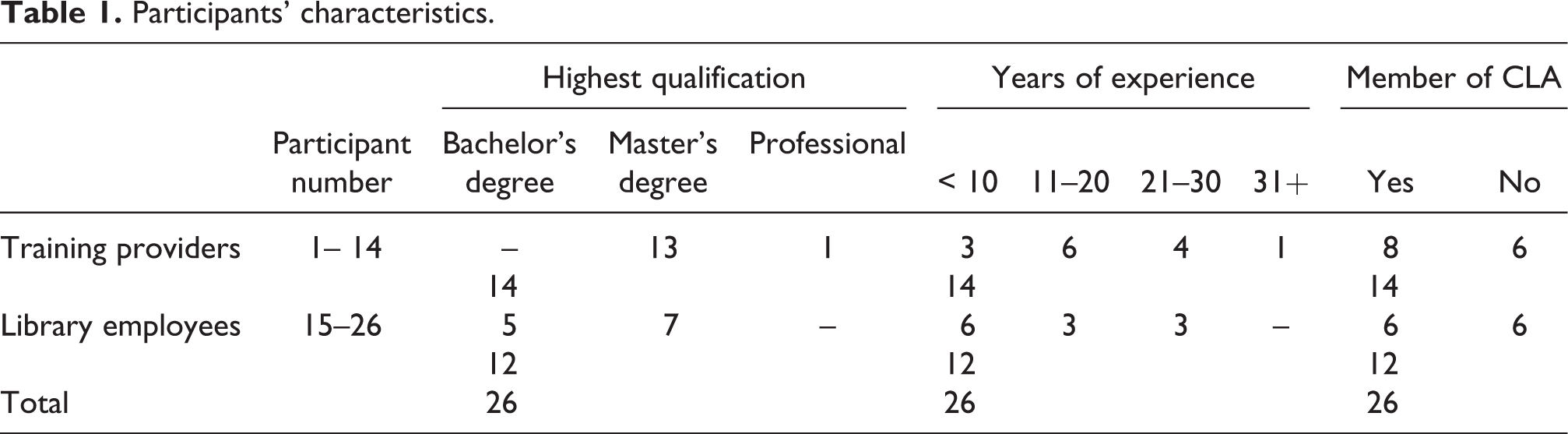
An analysis of the participants’ characteristics (see Table 1) reveals that the training providers included 13 individuals with a Master’s degree or higher qualification and one participant with an associateship of a foreign national LIS body. Their years of work experience extended from less than 10 years to over 30. Eight training providers had institutional or personal membership of the CLA. Of the 12 library employees, seven held a Master’s and five a Bachelor’s qualification. Their library experience ranged from less than 10 years to over 30. Membership of the CLA, either personal or institutional, was held by six employees and the remaining interviewees were not CLA members.
Participants’ characteristics.
Availability of CPD programmes
The participants were asked about their views on the state of the CPD programmes available to library employees in the country. Reflecting on the CLA’s role, Participant 2, a chief executive officer at an NGO with over 20 years’ experience, noted that ‘it is the association’s role to develop librarians and provide them training’. Acknowledging the CLA’s role, Participant 26, a librarian with over two decades of experience, observed: ‘The training workshops arranged by the Cambodia Library Association have been very good’. Several other participants also confirmed that most of the local training or workshops were organised by the CLA.
However, Participant 12, a trainer of many years’ standing, highlighted that: ‘Although there were many different opportunities for CPD provided by numerous groups, it was mostly with little coordination…but at that time each activity was useful for individual libraries and individual staff’. Examples of CPD opportunities offered by other local organisations included short seminars by the Cambodia Development Resource Institute and annual training courses by the Center for Khmer Studies Library since 2013. However, some of the participants also observed that most of the time the training opportunities available were only for academic library employees.
Other training options that were available for the library employees included employers of foreign organisations based in Cambodia sending them for training at the parent organisation overseas. Similarly, senior library staff representing their library at regional library network meetings also attended some follow-up training sessions.
Several of the training providers shared their perspectives on their experiences. Participant 12 revealed: the first seminar for librarians working in the education sector was held in Phnom Penh in 1987. In 1997, the new purpose-built RUPP library offered a facility for training which was very useful. With Asia Foundation funding, training was extended to staff of all types of libraries for over 10 years. Some of the training was in Khmer and some in English language. Later on, targeted training was provided mostly in the provinces for school librarians, in association with the Ministry of Education. This was followed in 1991 by a series of seminars arranged by Dr Helen Jarvis of the School of Librarianship, University of New South Wales. In 1999, some 20 Cambodian librarians attended the IFLA conference in Bangkok, one of the biggest contingents ever from Cambodia. many workshops were organised by the Cambodian Library Association between 2010 to 2017 mostly for academic library staff in Phnom Penh. However, since around 2017, there has been less training activity, and it seems to have slowed down or almost stopped. NGOs focused mostly on training school library employees.
Participant 11, a senior library professional who was actively involved in the training of library employees, described the type of training offered: What is taught are basic skills…it is still very hard for the librarian to do advanced-level work. So, we just make sure they can meet their immediate needs. A proper trainer is needed to provide advanced skills. We will have to spend a lot of time on designing the course if we are to teach advanced skills.
In the absence of a professional LIS academic programme and regular CPD training opportunities for library employees, it was refreshing to find one employer who had initiated an innovative approach to ensure that his employees received the necessary training. Participant 9, who had supervised a state-level library for just under two decades, shared the following: In Cambodia there is no library school. So, since 2016, I have arranged annual staff training as a part of the capacity-building programme for the organisation. I have engaged outside trainers and the training is not only for the library staff, but for all organisational staff. I have also arranged training on soft skills. An memorandum of understanding (MOU) with an organisation helps to sponsor the funding.
Other training that was available to library employees included programmes initiated by Sipar for garment-factory workers who were serving as library employees for one hour a day during lunch breaks and for prison officers.
The interviews also revealed initiatives undertaken by library employees to overcome the lack of CPD programmes in the country. These included taking up the challenge of joining the coaching programme of the International Association of University Libraries’ Special Interest Group for the Advancement of Library Services in Emerging Countries, which was channelled through the CLA. Two participants, both heads of academic libraries, had participated in this programme. Two school library employees alluded to accessing YouTube clips to learn about libraries.
CPD for school library employees
Recognising the substantial investments that have been made by the government and NGOs in school library development and the training of school library employees, it is imperative that a separate section be allocated to the discussion of CPD for school library employees.
According to the ‘Standards for primary school libraries’ (Ministry of Education, 2011), the teacher or person in charge of a library is required to attend six days of basic training, followed by a six-day refresher course after a period of six months. Many of the participants observed that these workshops covered topics such as the basics of library management and cataloguing, which were perceived to be sufficient and not likely to overburden the school librarians.
The school librarians in some public schools had received library training from local NGOs or donors, and the duration of the training sessions varied based on the available budget. Participant 1, a training provider with over 21 years of training experience, offered more insights into the nature of these NGO-funded training programmes: ‘The NGOs have their budget, their training plan, and when they have to conduct the training, they notify the library at the Department of Curriculum Development, MoEYS, of their training needs’. NGOs collaborate with the MoEYS as it has staff with the library skills needed to conduct the desired training sessions. Three-day training programmes are conducted by two teachers using the ‘Standards for primary school libraries’ (Ministry of Education, 2011). Additionally, they focus on national policy related to promoting reading. However, it was highlighted that the MoEYS’s annual budget allocation is sufficient to only conduct two training sessions per year.
Additional input on the nature of the training offered by NGOs was provided by some of the participants. Two referred to a tripartite agreement that two NGOs signed with the MoEYS in 2018 to have the latter train school librarians. The collaboration also includes guidance on developing a training needs assessment. The training, which is of two days’ duration, is offered to 15–20 core school library employees selected from 200 schools each year. The training that is provided to teachers in the provinces is also limited to two days.
In comparison, Participant 6, a trainer with over 15 years’ experience, stated that his organisation offered a five-day training course on library management that was targeted at school directors and the school librarians in their project, and five days of training to teachers on conducting activities during the library period. In order to support the MoEYS-approved child-friendly library programme, a national team is also scheduled to undergo train-the-trainer sessions to facilitate the delivery of training to school library employees.
Participant 8, who had coordinated a corporate social responsibility project that was launched by a company in Cambodia in 2011 jointly with the MoEYS to support school libraries, provided some insights into the training component of this programme, which incorporates: three-year support for each library…as most teachers have only teaching skills, the company partners with MoEYS to provide training for three years, so the librarian has time to learn how to manage operations, how to encourage and motivate students to read, and to prepare the timetable for all the students to have a chance to use the library. Besides the training, they also have follow-up activity to allow the librarian to talk with MoEYS staff if they have a question. So that is also one way to improve the capacity of the librarians.
The perspective of the beneficiaries was provided by three school library employees (Participants 22, 23 and 24). Participant 24 had received two days of one-to-one training and, as an employee of a New Generation School (NGS) library, visited schools in Thailand to observe their libraries and attend training on the 21st-century library with other schools in the programme. Participant 22, with two years of school library experience, reported receiving eight days of training through an NGO. However, she stated that she had not received any training from the MoEYS. In comparison, Participant 23, who had been employed in a private school for over seven years, had her training confined to a seven-day workshop conducted by her former employer and seven days of training on library management systems, which was offered by an NGO in her province. She had attended this training as it was an opportunity to learn about the features of library management systems. It was noted that whilst Participants 22 and 24 had received coordinated training through the NGOs supporting their schools, Participant 23 had not received any relevant training since taking up her library position over seven years earlier.
Benefits of undertaking CPD programmes
The participants were asked about the possible benefits of undertaking CPD programmes. Several of the participants, while sharing their views on the benefits of training, confirmed that CPD was critical for them to keep up to date. This was especially important considering the impact of digital technologies on libraries and the need for librarians to innovate in the provision of new information products and services to meet changing customer expectations. The benefits identified included the opportunity to acquire basic skills as early career librarians; being given the means to support libraries in promoting reading skills and literacy in the community; networking with like-minded professionals; and learning about the practices and benchmarks adopted by libraries overseas.
From the training providers’ perspective, the key benefit for school librarians was the acquisition of skills to effectively manage their libraries and make them child-friendly. In order to avoid overburdening trainees, they were not provided with comparatively less important skills. It was also noted that teachers were required to complete assessment forms before and after training, and that they mostly rated it as ‘satisfactory’ because they had acquired new knowledge. However, it is doubtful whether the acquired skills were applied.
Whilst recognising that undertaking CPD was beneficial, the library employees were more anxious about the lack of and/or limited LIS-related CPD programmes in the country and the barriers to participating in CPD programmes.
Barriers to undertaking and organising CPD programmes
Both the library employees and the training providers were asked about the barriers they faced when undertaking or organising CPD programmes. Tables 2 and 3 reflect the barriers perceived by the library employees and training providers, respectively. Their responses are grouped thematically by category for ease of reference.
Library employees’ perspectives of the barriers to undertaking CPD programmes.

Training providers’ perspectives of barriers to organising CPD programmes.

The interviews with the library employees revealed that situational barriers, both professional and personal, followed by institutional barriers were the key concerns of the majority of the participants. The major concern was associated with the non-availability of CPD programmes. Other important barriers were the seeming hiatus of the CLA and non-existence of a professional LIS education programme or school in the country which can act as a CPD provider and advisor.
Professional barriers: LIS CPD availability
The key barriers identified included the lack of regular CPD training; the limited number of CPD programmes, which were mostly the same, such as courses on the Koha open source integrated library management system; the lack of programmes on the latest trends in LIS; the tendency to focus on traditional topics; the lack of awareness of the training needs of library employees; and the lack of a proper training schedule.
During the interviews, the desperate need for CPD resonated in the views of a cross section of the LIS employees. Commenting on the demand for CPD, Participant 19, who was the head of an academic library at a private university and had over 40 years of experience in the library field, stated: ‘at the Workshop on Cataloguing and Information Literacy organised by the Cambodian Higher Education Association in 2019, I was astonished by how many people came from all over Cambodia’.
Some of the participants highlighted their concerns regarding the limited number or lack of CPD programmes available in the country, and observed that there were many library staff who desperately wanted to get more training. However, these individuals held back as they were not sure of who they needed to approach.
Reference was also made to a lack of CPD programmes on the latest trends in LIS, particularly the challenges faced by library employees due to the evolving library landscape and the need to provide users with access to online resources, including open educational resources. As such, workshops were needed on topics such as how to use, cite and share information, and certain limitations on information use. Many of the participants were also of the opinion that training providers needed to make an effort at the planning stage to evaluate the level of the potential trainees. This would help to make training programmes more effective for the participants.
With regard to the availability of CPD programmes for school library employees, the participants voiced their dissatisfaction with the limited availability of such programmes and expected the MoEYS to offer more training.
Professional barriers: a LIS CPD association
The CLA has unfortunately not been able to fulfil its role due to its inactivity. Whilst Participant 16, a senior library officer with over 20 years’ experience, observed that ‘[t]o my understanding, the CLA was very active at the beginning’. Participant 26 noted: [The] CLA has tried offering CPD programmes. The workshops are very good…but these are conducted in Phnom Penh. They do the best they can, but it is frustrating as they do not have the budget and the resources, especially volunteers…Too little progress, not enough programmes.
Professional barriers: LIS CPD resource constraints
The main resource constraints were perceived to be the lack of resource personnel in Cambodia who could conduct CPD programmes and the lack of a professional LIS education programme. Some of the participants attributed the absence of CPD programmes to a lack of resource persons and observed that the few potential trainers available were too busy with their day-to-day responsibilities and thus unable to devote time to training.
Professional barriers: LIS education
It is not surprising that there were many comments on the lack of a professional LIS education programme in the country that could also act as a CPD provider and advisor. As such, most employees in libraries have had no proper training and have acquired skills on the job – that is, learning by doing.
One participant observed that in the absence of a professional LIS education programme, there is an extreme shortage of professional librarians in the country. As a result, library employees lack skills and knowledge with regard to the latest library technologies, digital literacy skills and many new trends relating to the LIS field. Many of the participants agreed with the need to establish an accredited and state-recognised LIS academic programme. Similar sentiments were expressed by some of the school library employees.
Personal barriers
The personal barriers that were identified were associated with inconvenience and the inability to travel; the various challenges when trying to learn online; and a lack of proficiency in the English language, which impacted not only following programmes online but also face-to-face programmes conducted in English by visiting trainers.
The travel-related barriers encountered included the challenges associated with training programmes held in distant provinces or Phnom Penh. When events are scheduled in Phnom Penh, in addition to a long journey, employees have to cope with issues such as paying for accommodation out of their own pocket. However, a librarian-cum-trainer, who had interacted with many library employees over the years, suggested that financial concerns were associated with a family’s financial status. Since many of the individuals who are employed in the LIS sector are in junior positions, they need to hold more than one job concurrently in order to support their families. As a result, they are unable to devote time or energy to their training and development.
On trying to learn online, some of the concerns alluded to were: a poor Internet connection; the lack of a space that was conducive to learning, such as an office, as it could be very difficult to concentrate at home; the inability to attend live online sessions due to time differences; and the difficulty in understanding foreign accents.
Another major challenge that many of the participants identified was the lack of English-language proficiency. As most of the programmes conducted overseas are in English, the language barrier is a major obstacle for many Cambodian librarians. The use of many technical terms and the different accents in online training videos make them even harder to understand. The CLA overcame this hurdle when holding in-house programmes by having a professional librarian to act as a translator.
Institutional barriers
The institutional barriers included the fact that many employers usually do not fund CPD activities; the lack of employer commitment to formal staff development programmes; the lack of employer recognition of the value of CPD activities; heavy workloads; and the inability to get colleagues to cover when library staff attend CPD activities.
A funding-related concern was the decrease in training budgets during the past one to two years. To overcome the lack of funding, some employees now tend to source free courses. Conversely, it seemed that not all libraries faced funding challenges. For example, Participant 20, who was head of a library in a private institute of higher education, disclosed that her organisation requires all departments, including the library team, to submit an annual staff development plan and training budget. Elaborating on the nature of the training funded to date by her employer, she revealed that the school has sent the library team to participate in local training and workshops on library management, mostly organised by the CLA, and four library staff attended the IFLA 2018 conference and went on a tour of libraries in Singapore, Malaysia and Thailand. The school also pays for membership of the American Library Association and Association of College and Research Libraries. Membership of the International Association of University Libraries helps them to keep up with trends and network with professionals in the field.
The interviews with the training providers revealed that a number of situational and institutional barriers were of major concern (see Table 3).
Professional barriers: LIS CPD availability
The barriers associated with the availability of CPD programmes included the non-availability of training; the training providers’ lack of awareness of the training needs of LIS employees; and training programmes being mostly limited to traditional LIS topics, especially given that the MoEYS is advocating for school libraries to create digital libraries.
Several of the participants expressed concerns related to a lack of training opportunities for school library employees. Unfortunately, in the current situation, schools will be considered lucky if they can get even one training session a year for their school librarians. Regrettably, many school librarians do not receive any training at all; if they do, it is very basic.
Participant 26, highlighting the importance of understanding training needs, observed: ‘As much as I enjoyed speaking, I don’t think that’s what the school librarians in the provinces need. They need the basic building blocks, to acquire the fundamentals of librarianship’. Participant 5, with nearly two decades of training experience, also provided some insights into the challenges that training providers must overcome when scheduling training for school library employees: Some of the school employees are delegated by the school director to oversee the library…most of them have never worked in a library, have never attended library training, and do not know how to manage a library…so they are not motivated and dislike working as librarians. Most Cambodian teachers, when they become a librarian teacher, stay for one to two years and move. Then the school has to select a new teacher and the new teacher needs to be trained again. So, there is no continuity.
Professional barriers: a LIS CPD association
A key concern of some of the participants was the inactivity of the CLA and the lack of regular training programmes that would help library employees to improve their knowledge and skills. This was attributed to the lack of volunteers due to its small membership base and a lack of funding for this purpose.
Professional barriers: LIS CPD resource constraints
A key barrier that was identified was the lack of resource persons in the country to conduct CPD programmes on the latest LIS trends, which is an understandable outcome of the lack of a professional LIS education programme in Cambodia. The team at the Center for Khmer Studies Library conducted a two-day workshop in 2021 covering topics such as research tools, copyright rules, how to research, how to find open access resources, and how to create a digital library. However, they were challenged when looking for resource persons to cover different topics and had to rely on the same few individuals they brought in every year.
Professional barriers: LIS education
One key situational concern was the lack of a professional LIS education programme in the country. Several of the participants expressed their concern that none of the universities were offering a degree in LIS. Due to this, most of the librarians in Cambodia learn basic library skills like cataloguing, front-desk operations and circulation on the job. The only option available to them to learn the desired skills is through attending workshops and webinars, and other sources. However, these learning opportunities are not sufficient to understand library work in depth and, as a result, library services in Cambodia are still very basic. Hence, it is not surprising that staff working in libraries and the Department of National Archives of Cambodia are yet to acquire the qualifications to become professional librarians or document curators. Although several of these staff possess degrees in other fields, they work in libraries without any professional qualifications. Participant 1, a training provider who had been associated with school libraries for over 20 years, lamented his lack of a LIS qualification: I have been working in the library field so many years but I don’t have a diploma in LIS…only one to two weeks’ training…right now, we need to make our library a digital library, but we don’t know how to proceed…We watch clips on YouTube and we ask RUPP library [and others] to help us.
Several of the participants observed that it was very encouraging that more national leaders, including the current Minister for Education, are very supportive of libraries. It was also promising that one NGO was exploring the possibility of developing a professional LIS education programme, to be offered within the next five years.
Institutional barriers
One of the key institutional barriers was associated with funding: the inability of training providers to attract aid agencies and other organisations to fund CPD for LIS employees; the limited financial resources available to training providers; the inability to recruit resource persons from outside the organisation as the honorarium was not attractive; and the inability to get library employees to attend training due to lack of funds for accommodation, travel, etc. Another key institutional barrier was associated with employers and management – that is, the lack of support from employers and library management. Two other barriers of concern were the lack of proficiency in English, which was a drawback when overseas speakers were deployed, and the inability to offer live online learning programmes as library employees lacked the required skills to use mobile technology for learning.
In addition to financial constraints and lack of management support, staff in the state sector need to obtain ministry approval to attend training programmes, which is usually difficult and can take time. Another issue is that, in the higher education sector, the limited recognition of the value of CPD activities was linked to the low demand for training amongst library employees. This is probably due to employers’ low expectations of library jobs.
As already mentioned, a key setback regarding training school library employees was the lack of funding. In the past, NGOs such as Sipar worked directly with schools and their libraries and offered regular training. However, the MoEYS has been unable to offer training due to a lack of funds and resource persons.
The lack of funds impacted not only the frequency of training but also the number of days allocated for most training programmes, which in turn affected the extent of the content covered. According to the MoEYS’s 2011 ‘Standards for primary school libraries’, it is recommended that teacher librarians receive nine days of basic training. However, given the heavy expenses that NGOs incur, this training has since been reduced to six days, and in some instances cut down to two or three days. The training that is offered is therefore basic: I don’t think they can become librarians with three days’ training. It is not possible. (Participant 2) They train school librarians in one day. How can a librarian work effectively after training for one day, cover two years’ work in one day? (Participant 4)
In addition to facing the challenge of poor English-language proficiency, technical terms were a major concern. One step that was taken to help trainees manage the language barrier was to form trainee groups with at least one person who could translate or summarise the training content. Another option adopted for English-language presenters from overseas was to summarise their points and explanations in the local language.
On the inability to offer online programmes during the COVID-19 outbreak, Participant 7 commented: We needed to move online, and that too was a challenge for the librarians. They needed to access Telegram to complete the training needs assessment using the Google Form and then type the list of books…but they were unable to complete this task. So that became a challenge and we had to postpone the library training…and it is adding to the delay in project implementation…it is a big loss to capacity-building of librarians.
The setbacks faced due to the outbreak of COVID-19 that delayed project implementation included the inability to meet face-to-face to conduct training and the inability to monitor the construction of a library building, as site visits were not permitted.
Based on these findings, it can be concluded that, during the 1990s, many initiatives were undertaken by individuals and organisations to pioneer the establishment of a CPD ecosystem for library employees in Cambodia. However, these efforts were ad hoc, based more on the availability of resource persons than the needs of the employees. Despite these drawbacks, some employees benefited from undertaking such programmes. It is also demonstrated that, following its establishment, the CLA was committed to the provision of CPD, particularly from 2010 to 2017, and basically targeted academic library employees. Additionally, the school library employees and training providers provided insights into the training opportunities extended by different NGOs annually to schools within the purview of their projects.
The three barriers that strongly resonated with both the library employees and the training providers were the challenges associated with the lack of and gaps in CPD programmes; the inactivity of the CLA; and the lack of a professional LIS education programme in the country. The latter two barriers were seen as contributing to the inability to maintain a steady CPD offering for LIS employees, mainly due to the lack of a pool of professionally qualified resource persons. Common institutional concerns included the lack of employer or library management support. Two other barriers of common concern were the lack of proficiency in English and school library employees’ inability to use technology for online learning.
Suggestions to improve CPD programmes
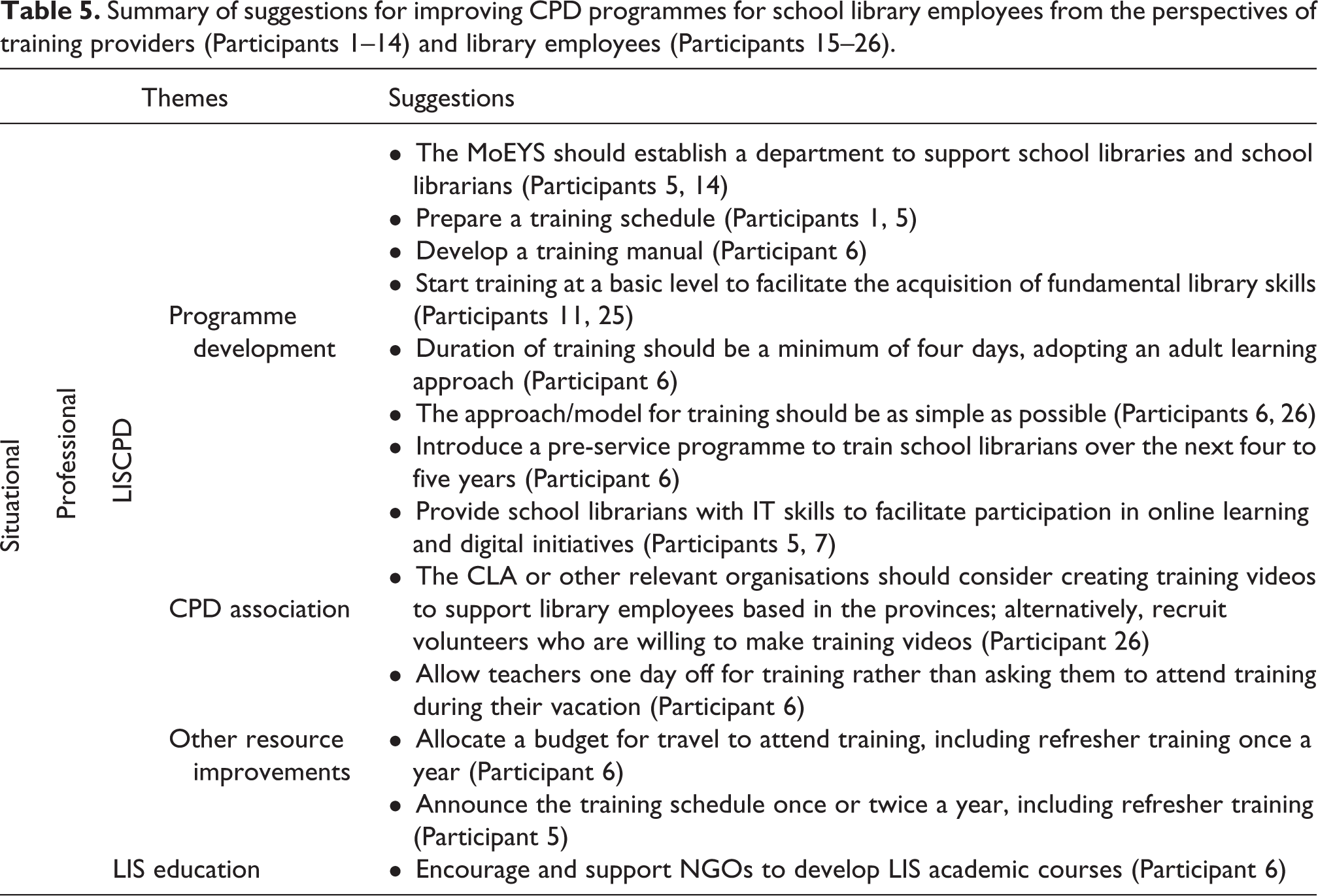
The final interview question solicited three suggestions from each participant for improving CPD programmes for LIS employees in Cambodia. Many of the suggestions resonated with earlier interview responses; however, several new suggestions were made. The suggestions are grouped thematically and reflect the frequency of occurrence. Table 4 represents the suggestions targeted at improving CPD for library employees in general and Table 5 is specifically aimed at school library employees.
Summary of suggestions for improving CPD programmes in Cambodia from the perspectives of training providers (Participants 1–14) and library employees (Participants 15–26).
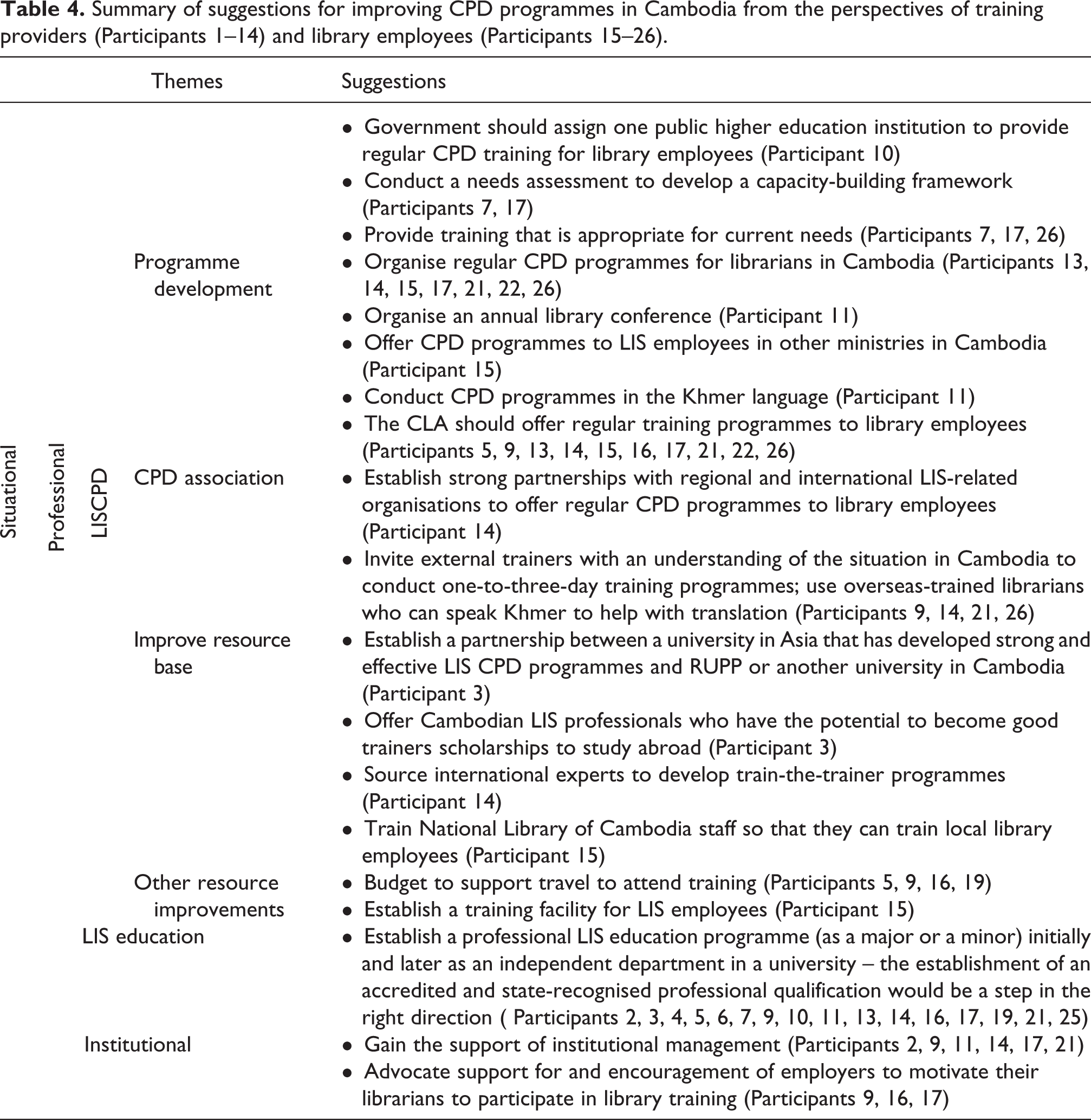
The suggestions that were targeted at strengthening the CPD needs of school library employees included the identification of one public education institution to coordinate the planning and execution of CPD programmes. Another important suggestion was to encourage and support interested NGOs in developing LIS academic programmes.
Summary of suggestions for improving CPD programmes for school library employees from the perspectives of training providers (Participants 1–14) and library employees (Participants 15–26).
The majority of the suggestions were notably focused on addressing gaps to improve CPD programmes in the country to meet the needs of all types of library employees. An important suggestion was the identification of a public higher education institution to take on a leading role in organising CPD activities. Other suggestions included the steps that the national library association could take to strengthen CPD programmes in the country; strategies to develop a LIS resource pool; and the establishment of a professional LIS education programme to offer an accredited and state-recognised qualification.
Discussion
The findings reveal a shortage of training providers and the non-existence or lack of CPD opportunities, which may also be repetitive, restricted to traditional topics and often not meet the real needs of library employees. These are common concerns that the LIS profession in many other countries faces (Alkatheeri, 2019; Chan and Auster, 2005; De Alwis Jayasuriya et al., 2021a; Ma, 2017; Maesaroh, 2012; Nguyen, 2008; Rafiq et al., 2017; Robinson, 2019).
Inactivity or hiatus is a phenomenon that is usually experienced by LIS professional bodies in developing countries, which tend to be weak because of their small membership base (Sturgess, 2012). It seems that Cambodia is no exception as its national library association has faced similar setbacks. The strong presence of the national library association is critical for Cambodia not only because it ‘is one that promotes and supports CPD’ (Sturgess, 2012: 49), but also because it can better advocate for the library profession. Other researchers have also alluded to the important role of professional bodies in the CPD ecosystem and the need for them to work closely with other stakeholders to develop a viable CPD plan (Moonasar and Underwood, 2018). The absence of a lead professional organisation was also seen as the major reason for the unavailability of CPD programmes in Vietnam (Nguyen, 2008). At an individual level, membership of professional associations has been deemed a factor that motivates participation in CPD activities (Chan and Auster, 2005).
Previous studies have suggested that library schools can also play an important role in offering CPD programmes as they have the necessary expertise, resources and infrastructure (Majid, 2004; Rafiq et al., 2017). Furthermore, the tendency for alumni to maintain their connections with their alma mater gives library schools a strategic advantage in getting regular feedback and developing appropriate CPD programmes (Rafiq et al., 2017). Therefore, the lack of a professional LIS education programme is perceived as a major barrier to the development of a comprehensive CPD programme (Ocholla, 2008).
The key institutional barrier that Cambodian library employees are confronted with is the lack of employer or library management support for library employees to pursue CPD activities. Previous studies from Ireland, Jamaica, South Africa, Uganda, the United Arab Emirates and Vietnam have found similar barriers. Examples of such barriers include the lack of or limited budget for accommodation and travel, and not granting leave to attend CPD activities (Alkatheeri, 2019; Corcoran and McGuinness, 2014; Ma, 2017; Moonasar and Underwood, 2018; Namaganda, 2019; Nguyen, 2008; Robinson, 2019); the lack of employer commitment to a formal staff development programme (Alkatheeri, 2019; Nguyen, 2008); and the reluctance of management to allow staff time off due to the inability to find colleagues to cover duties (Moonasar and Underwood, 2018).
The issue of limited English-language proficiency was another barrier to training participation and learning. Varlejs (2016) has also highlighted that poor language skills prevent many from learning and following programmes offered online and in person. Library employees in Vietnam and Indonesia pointed out that English proficiency was one of the most critical learning barriers, thus compelling them to learn the language (Maesaroh, 2012; Nguyen, 2008). Elaborating further, Nguyen (2008) suggests that it is useful to improve one’s language proficiency as most of the professional online literature is in English; to learn IT skills; to apply for scholarships to obtain higher professional degrees or attend professional internships overseas; and to connect with professionals overseas.
Another barrier that the findings reveal is the lack of technology skills, which continues to hold school library employees back in their CPD efforts. Although Varlejs (2016) observes that due to technological developments, geographical and financial barriers are no longer hurdles to undertaking CPD activities, many previous studies demonstrate otherwise. The lack of IT and digital literacy has been seen as a key barrier to learning, as well as performing effectively at work (Alkatheeri, 2019; Moonasar and Underwood, 2018; Nguyen, 2008; Rafiq et al., 2017; Robinson, 2019; Warraich and Ameen, 2015). The importance of acquiring IT skills is also underlined in the ‘IFLA school library manifesto’ (IFLA, 2021), which states that school library employees need to be competent in teaching IT and digital literacy.
The primary providers of CPD programmes for library employees are professional associations and educational institutions (Pan and Hovde, 2010, quoted in Corcoran and McGuinness, 2014:181). It is therefore in the interests of the library profession to coordinate CPD efforts in Cambodia and connect with like-minded organisations in the region (Majid, 2004; Rafiq et al., 2017). Improving the CPD ecosystem and encouraging library employees to undertake CPD learning will enhance the quality of libraries in their service delivery. The recent COVID-19 pandemic has acted as a catalyst for change and highlighted the need for library employees to adopt new service models to ensure business continuity (Elize, 2021). The pandemic saw library employees scrambling to sign up for CPD programmes to update their skills – specifically their digital literacy – through self-learning and online CPD programmes.
The findings reveal some commonalities and differences between the opinions of the two participant groups. The common concerns highlighted by both groups included the lack of awareness of the training needs of library employees; a shortage of adequately qualified resource persons to conduct CPD programmes; the unavailability of CPD on current trends; and the inactivity of the CLA in offering regular training programmes. Conversely, the differences of opinion between the two groups were associated with personal and institutional matters. The library employees were more concerned about issues such as a lack of proficiency in English preventing them from benefiting from international online events and limited travel funds to attend CPD programmes in other cities. In comparison, the training providers faced the challenges of attracting funds from donors to hold training sessions; getting funding to provide accommodation and transport support for trainees; the lack of a component on libraries in the trainee teachers’ curriculum; a lack of recognition by employers of the value of CPD programmes; and the inability of employees to attend CPD programmes on weekdays.
The findings also reflect differences in how mid-career Bachelor’s degree holders who were the head of or supervised a library reacted to the existing gaps in CPD compared to older employees whose education was limited to secondary school level. Examples of the efforts made by educated mid-career employees include taking on the training provider’s role to offer an annual two-day workshop for library employees in the country; implementing an annual in-house staff training schedule as part of the capacity-building programme of the organisation; participating in mentoring programmes offered by an international NGO; and utilising free CPD opportunities, such as attending webinars and consulting YouTube video clips to learn new skills. In comparison, a lower demand for CPD programmes was observed amongst older library employees in higher education institutions. Similar behaviour was observed in younger school library employees, who were perceived to be more open to various training opportunities than older school library employees.
More broadly speaking, staff development will lead to organisation development and serve as a conduit to realise the United Nations Agenda 2030 Sustainable Development Goals (European Bureau, 2020; IFLA, 2017; Konrad, 2010; Moonasar and Underwood, 2018). Once library practitioners are able to demonstrate their proficiency and usefulness, society will view the library profession more positively (Nguyen, 2008). It will also enable the LIS profession to get stronger and be recognised by other professions, and, ultimately, be positioned as a promising profession (Hornung, 2013). Eventually, it will lead to a redefinition of the identity of the library profession, eradicating the stigma and low esteem associated with it and serving as a pull factor for employees not to leave the profession for more lucrative jobs elsewhere (Fraser-Arnott, 2019; Nguyen, 2008).
Limitations of the study
Due to resource constraints and the unavailability of qualified local researchers, it was difficult to get a local study collaborator. Instead, the researchers relied on a few key individuals who volunteered to provide the requisite support via Zoom meetings. Language limitations may have also hampered the research as the interviews were conducted in English. The interviewer did not speak the local language and, because of resource constraints, it was not possible to recruit a person with proficiency in both languages, as well as the professional competency to assist with interpreting. With regard to the two interviews conducted with the aid of two non-professional interpreters, it is possible that the quality of data might have been compromised during translation. However, given that only two study participants relied on the interpreters, it can be safely concluded that there was no major impact on the study findings. Due to the COVID-19 pandemic, it was difficult for the researchers to travel to Cambodia to establish initial connections and have discussions with key individuals in the LIS sector. Despite these limitations, this study provides the first ever insights into the state of the CPD opportunities available to LIS employees in Cambodia.
Conclusion and future directions
This study, the first on CPD for LIS employees in Cambodia, reveals that the CPD ecosystem in the country is sparse and calls for immediate measures to address the many related concerns. The findings of this study are expected to provide some basic data about the current state of affairs, as well as some insights for developing a comprehensive CPD plan for the LIS sector. Based on the findings, the researchers have identified some potential areas for improvement of the CPD ecosystem in Cambodia.
Possible measures for improving CPD activities in the country include conducting regular training programmes for library employees on a wide range of topics with an emphasis on the latest trends; conducting a training needs assessment study to provide relevant and useful training programmes; and organising an annual national-level meeting to discuss library staff development issues. It is also recommended that all library employees be encouraged to take courses to develop an adequate level of proficiency in English (Education First, 2021) and IT skills in order to be able to effectively participate in face-to-face as well as online learning initiatives. The Cambodian government has recognised the need to address the gap in IT human capacity development (Wiley, 2022) and take appropriate measures to address this issue (Korea International Cooperation Agency, 2014; National Economic Council, 2021). Additionally, collaboration is recommended with local trainers to offer training programmes in soft skills such as communication skills, team building and problem solving.
However, the CPD ecosystem in Cambodia cannot be sustained in isolation and is dependent on a strong LIS support system, including the existence of a LIS education programme and a dynamic LIS professional body, and support from the National Library of Cambodia. Additionally, due to limited resources, NGOs are unable to comply fully with the training requirements for school library employees outlined in the MoEYS’s ‘Standards for primary school libraries’ (Ministry of Education, 2011).
One critical criterion for the development of Cambodia’s school library programme is the availability of a pool of well-trained school library employees. This will entail the establishment of a department in the MoEYS to coordinate all matters pertaining to school libraries. Capacity-building through regular training will motivate school library employees to provide a quality school library programme to enhance teaching and learning. The department will need to pay immediate attention to the development of a training and development plan, policies and procedures to support school librarians.
An overarching factor that is needed to ensure that the measures and approaches identified address real needs is buy-in from stakeholders. It is therefore vital that decision-makers in state organisations, as well as user communities, are alerted through education and awareness campaigns to the critical role of libraries in societal growth and transformation. A useful reference point here could be the Republic of Indonesia, where community literacy has been decreed a national priority under the National Medium-Term Development Plan 2020–2024 and implemented through socially inclusive library programmes. Interestingly, the National Library of Indonesia reports directly to the country’s president (Bando, 2019). Given the absence of a government-supported public library system in Cambodia, decision-makers may want to take note of a model adopted by PRASAC Microfinance, which extends school library facilities to the general public in the locales under the library project. 4
Despite the many gaps revealed in this study, it is encouraging to note that the situation is improving somewhat, with some investment from the government in recent years. For example, the five-year project between Kampuchea Action to Promote Education (2020), the MoEYS and the Asia Foundation to develop school libraries is seen as a definite step in the right direction.
Given that the Cambodian LIS sector has the opportunity to build parts of the CPD ecosystem from scratch, one key area for future research would be to explore the training needs of different levels of staff and for different types of libraries. Other possibilities for future research include exploring the potential for using technology for CPD, the willingness and preparedness of staff with regard to IT-based training, and the adoptability of different training approaches used in other countries. It would also be useful to expand on the current research by conducting interviews in Khmer, which would facilitate the use of a more representative sample.
Footnotes
Acknowledgements
The authors are very grateful to Beatrice Montariol (consultant for project development at Sipar) for connecting them with key LIS personnel in Cambodia to help make the research project a reality. To the interview participants goes a very special thank you for making time to participate in the study and sharing invaluable insights. The authors also acknowledge the support offered by Hok Sothik (chief executive officer of Sipar and president of the CLA). A very special thank you to Wanna Neth (deputy director of the Hun Sen Library, RUPP), Mao Kolap (Project Manager of Youth Empowerment and Reading Development at Sipar and vice-president of the CLA), Sin Sothea (formerly Library Program Coordinator at Sipar and currently in ILS a consultant at the Education Support Center at Kizuna), and Chandraboth Kim (library manager at the Royal University of Law and Economics) for their valuable guidance and unstinted support throughout the project. The authors also acknowledge the assistance of Socheata Sann (programme director at the Asia Foundation), Mok Rasy (library director in the Department of Curriculum at the MoEYS), Pich Sophoeun (project manager at Books for Cambodia, Kampuchea Action to Promote Education), and Chhor Sivleng (head librarian at the Center for Khmer Studies, Seam Reap).
Declaration of conflicting interests
The authors declared no potential conflicts of interest with respect to the research, authorship and/or publication of this article.
Funding
The authors received no financial support for the research, authorship and/or publication of this article.

Notes
CPD learning activities conducted in Cambodia, 2013–2021
| Date | Event | Organiser |
|---|---|---|
| May 2013 | Workshop on Preservation and Conservation of Archival Material, conducted by Y Dari, deputy director, National Archives of Cambodia | Center for Khmer Studies Library, Siam Reap |
| 27 November 2013 | Beyond Google: Cool Ways to Find Information besides Google, conducted by John Hickok, California State University, Fullerton, USA | US Embassy, Phnom Penh |
| 8 June 2015 | Best Practices of Libraries in South East Asia, conducted by John Hickok, California State University, Fullerton, USA | US Embassy, Phnom Penh |
| 28–29 June 2013 | Basic Library Management | Paññāsāstra University of Cambodia, Phnom Penh |
| 21 July 2015 | Collection Development in Cambodia, conducted by Greg Bem, iSchool, University of Washington, USA |
Cambodia Higher Education Association |
| 2015 | Workshop on Library Management and e-Libraries | Center for Khmer Studies Library, Siam Reap |
| 2016 | Role of Libraries in Promoting Reading, conducted by Nancy Perle, former librarian, Seattle Public Library, USA | Center for Khmer Studies Library, Siam Reap |
| 19 March 2016 | e-Journals and e-Books |
CLA |
| 14 January 2017 | Sustainable Development Goals |
CLA and CamEd School, Phnom Penh |
| 25–27 March 2017 | International Association of University Libraries Directors’ Summit | CLA and International Association of University Libraries |
| 12 July 2017 | Conducting Story Times for Children at Cambodia Children’s Fund (CCF), conducted by John Hickok, California State University, Fullerton, USA | US Embassy, Phnom Penh |
| 5 August 2017 | Workshop on “IFLA The Library’s Role in Quality and Excellence in Higher Education | CLA and University of Puthisastra |
| 13 September 2017 | Workshop on Global Voice : Together We Create the Future” | CLA and Paññāsāstra University of Cambodia, Phnom Penh |
| 12–16 February 2018 | Library study tour, Thailand: Sukothai Thammathirat University, Chulalongkon University and Kasetsart University | CLA and Thai Library Association |
| 24 March 2018 | Cambodian Network for Electronic Information for Libraries (CamEifl), conducted by Wanna Net | RUPP Library |
| March 2019 | Workshop on Library Preparedness – How to Protect and Preserve Library Collections (one day) | Center for Khmer Studies Library, Siam Reap |
| September 2019 | Workshop on The Next Generation in Libraries | Center for Khmer Studies Library, Siam Reap |
| 24–25 October 2019 |
Workshop on Cataloguing and Cataloguing Rules and Information Literacy, conducted by Wyn Thomas, Librarian, American University of Phnom Penh and Mao Kolap, VP, CLA |
Cambodian Higher Education Association |
| 22–23 February 2021 | Workshop on Open Access and Copyright Issues | Center for Khmer Studies Library, Siam Reap |
| 23–24 November 2021 | The Role of Libraries in the Digital Era |
Center for Khmer Studies Library, Siam Reap |