



Abstract
The purpose of this study is to review the published literature and highlight the situation of prison libraries around the world. The study strives to adopt a comprehensive approach while reviewing the literature in order to survey the present status geographically. The available published literature on prison libraries in local and international library and information science journals has been reviewed. The researchers also consulted other sources, such as books, theses, dissertations, conference proceedings, library websites, individuals and professional organizations, including the American Library Association, Association of College and Research Libraries, and IFLA. The databases used included Library and Information Science Abstracts, Library, Information Science and Technology Abstracts, Emerald, JSTOR, Google Scholar and ResearchGate. The keywords used for searching can be categorized as ‘prison libraries’, ‘jail libraries’, ‘correctional institution libraries’ and ‘rehabilitation centres’. Overall, findings suggest that the situation of prison libraries in USA, UK, Europe and Asia (only urban areas) is much better as compared to the other regions of the world. This situation is because of the availability of resources, access to the Internet, technology, automated catalogues, cooperation with other libraries such as public libraries, and regular budgets to run library affairs smoothly. A lack of professional staff, the unavailability of library space, limited collections, censorship issues, a poor budgetary situation, the absence of library associations in developing countries, and a lack of cooperation among prison libraries and public libraries are the major causes of the current situation of prison libraries. The study is unique in nature as it highlights the situation of prison libraries worldwide through a wide lens, focusing on standards, services and difficulties, as well as recommendations made by the researchers.
Introduction
Humans are different in their nature and behaviours; for intentional or unintentional reasons, they commit serious crimes without realizing the consequences (Emasealu and Popoola, 2016b). To counter such behaviour, organizations and institutions formulate rules and regulations to mitigate crime and penalize, as well as reform, culprits. Albert (1989) comments that people consider prisoners to be societal enemies and, due to this prevailing perception, prisoners are not receiving due attention from people in the free world. Like other human beings, prisoners have similar fundamental rights, including getting a good education. In early times, prisons were established solely for punishment and to counter criminal activities. This perception is slowly changing around the world. It is strongly felt that instead of punishing prisoners, prisons could also be used as places where inmates are rehabilitated and then sent back into society as functional human beings (Doyle, 2013; Floch and Casey, 1955; Fyfe, 1992). It is generally accepted that learning and keeping up to date with current information is a continuous practice, regardless of sex, age, religion, ethnicity and colour. Everybody wishes to make reasonable and informed personal decisions, even if they are held in confinement (Busayo, 2012). When a convict enters prison, his first thought, ‘as he sees and hears the gates close around him, is of escape’ (Sullivan, 1998: 113). Entering the world of reading is a basic technique to help prisoners escape from the closed gates. It equips individuals with sufficient skills to live in the free world (Glaser and Glacier, 1958).
Worldwide, prison libraries provide inmates with equal access to educational, recreational and rehabilitation programmes. The global literature evidences other related terms for ‘prison’ libraries, such as ‘jail’, ‘correctional facility’, ‘detention centre’ and ‘house of correction’. Knudsen (2000) argues that inmates consider libraries as their friend, despite this terminology. Reflecting on his experiences, he states that he would not have tackled difficult life situations without the help of a library. London (2000) established that inmates believed that people moved ahead with advanced technology in the outside world. They thought that they would not be able to fill this gap in their lives without libraries. Prison libraries provide the opportunity to complete an education and for personality growth, and simultaneously fulfil leisure needs (Sulé and Comalat, 2008). Reading – specifically leisure reading – is a sign of freedom for prisoners. Leisure as well as academic reading helps prisoners to forget about their miseries and caged life (Little, 1998). The library can play a vital role in reducing prisoners’ isolation while connecting them to the information world and positively changing their lives (Casey, 1958; Clark and MacCreaigh, 2006; Marshall, 2011). The prison library links prisoners and the outside world, ultimately benefiting society (Kaiser, 1993). Moreover, better services for inmates in prison libraries can improve their behaviour and public safety (Stearns, 2004). Catering to the information needs of inmates may help with their re-entry into society (Eze, 2016). Previous studies have found that inmates’ information needs relate to their continuing professional training, career opportunities, family relationships, housing and sources of income (Emasealu and Popoola, 2016; Jacintha, 2016).
Stevens and Usherwood (1995) have shown that library services engage prisoners with information, provide an opportunity to acquire practical skills, and change their attitudes and behaviours in a positive way. Furthermore, researchers (Coyle, 1987; Dixen and Thorson, 2001) consider prison libraries as valuable societal institutions and rehabilitation centres that help prisoners strengthen their character and reduce the rate of recidivism (returning to prison).
Statement of the problem
The role of a library in today’s society is vital as it is considered as a third place between home (first place) and work (second place), and people like to spend time in a third place for entertainment, information seeking and research (Houpert, 2020). Much literature was found regarding the importance of libraries (especially public libraries) and the development of these important (third) places for members of society. Library professionals have made efforts to transform prisons into more effective places for society members. These efforts include preparing marketing plans for library services and helping users find literature on different social issues, including the psychological needs of patrons (Wahler et al., 2019). A marketing plan for library services ensures linkages between libraries, patrons and society members (Idrees and Rehman, 2009). That being said, prison libraries require a unique set of characteristics, facilities and services for their members, and different marketing plans for their services. The patrons of such libraries have different issues and information needs (Fasae and Folorunso, 2020), but comprehensive literature is not available to understand prison libraries’ worldwide infrastructure and issues. The current study will shed light on this area and open avenues for more research in this domain.
The study’s main objective is to review the literature and establish prison libraries’ goals, and to describe the status, issues and challenges these libraries face worldwide. A thorough reading of the literature enabled the researchers to discover the everyday practices of prison libraries worldwide.
Methodology
A systematic literature review requires a transparent and defined protocol (Gough et al., 2017). There are three main advantages of a systematic literature review: It reduces biases and errors, thereby increasing the quality of the review process (Drucker et al., 2016). It safeguards the validity of the findings because the steps can be replicated by others (Siddaway et al., 2019). It synthesizes the knowledge in a particular field (Fisch and Block, 2018).
The majority of researchers use the preferred reporting items for systematic reviews and meta-analysis (PRISMA) strategy to investigate a specific issue in the literature. It is widely used in different fields, such as medical science (Levay and Craven, 2019), environmental science (Wimbadi and Djalante, 2020), education (Davies et al., 2013), computer science (Kolajo et al., 2019) and social sciences (Safdar et al., 2020). For this study, seven steps were adopted from Xiao and Watson (2019) for the review: (1) formulating the research problem; (2) developing the review protocol; (3) screening the literature found; (4) assessing the quality of the literature; (5) retrieving the literature; (6) analysing and synthesizing the literature; and (7) reporting the results.
The selected articles and theses/dissertations were published in local and foreign library and information science research journals. The researchers collected available literature from libraries, the websites of individuals, prison libraries and professional organizations working in this domain, such as the American Library Association, Association of College and Research Libraries, and IFLA. Various indexing services, such as Library, Information Science and Technology Abstracts, were consulted to find the literature.
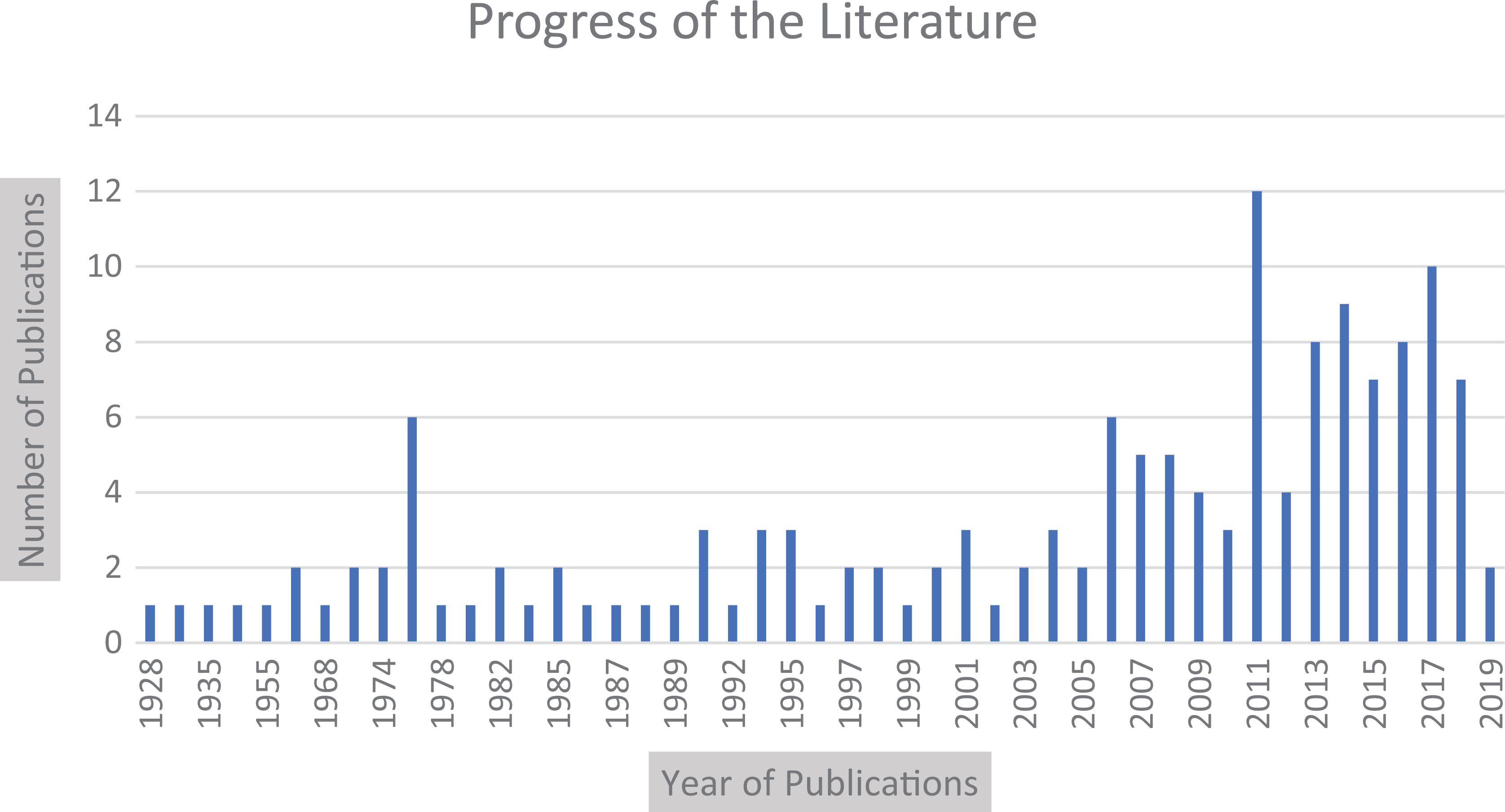
Progress of literature on prison libraries.
Once the review strategy was set, a five-step process was performed. In the first stage, a search was carried out in electronic databases such as ProQuest, Emerald Insight, Science Direct, EBSCOhost, Taylor & Francis, SAGE Publications, JSTOR, Eric, ResearchGate, Google Scholar and the Google search engine. The second stage included assessing the studies related to the review strategy. The researchers refined the search based on the types of document, such as journal articles, conference papers, reviews and books. In this stage, the strategy of keeping studies with keywords allintitle was adopted. In the third stage, documents other than those written in English were excluded. Only those studies relevant to the subject area (prison libraries) were included in the fourth stage. And lastly, the researchers excluded duplicate and non-English studies manually from the list. Through this process, a total of 147 studies were selected to review in this study (Figure 2).
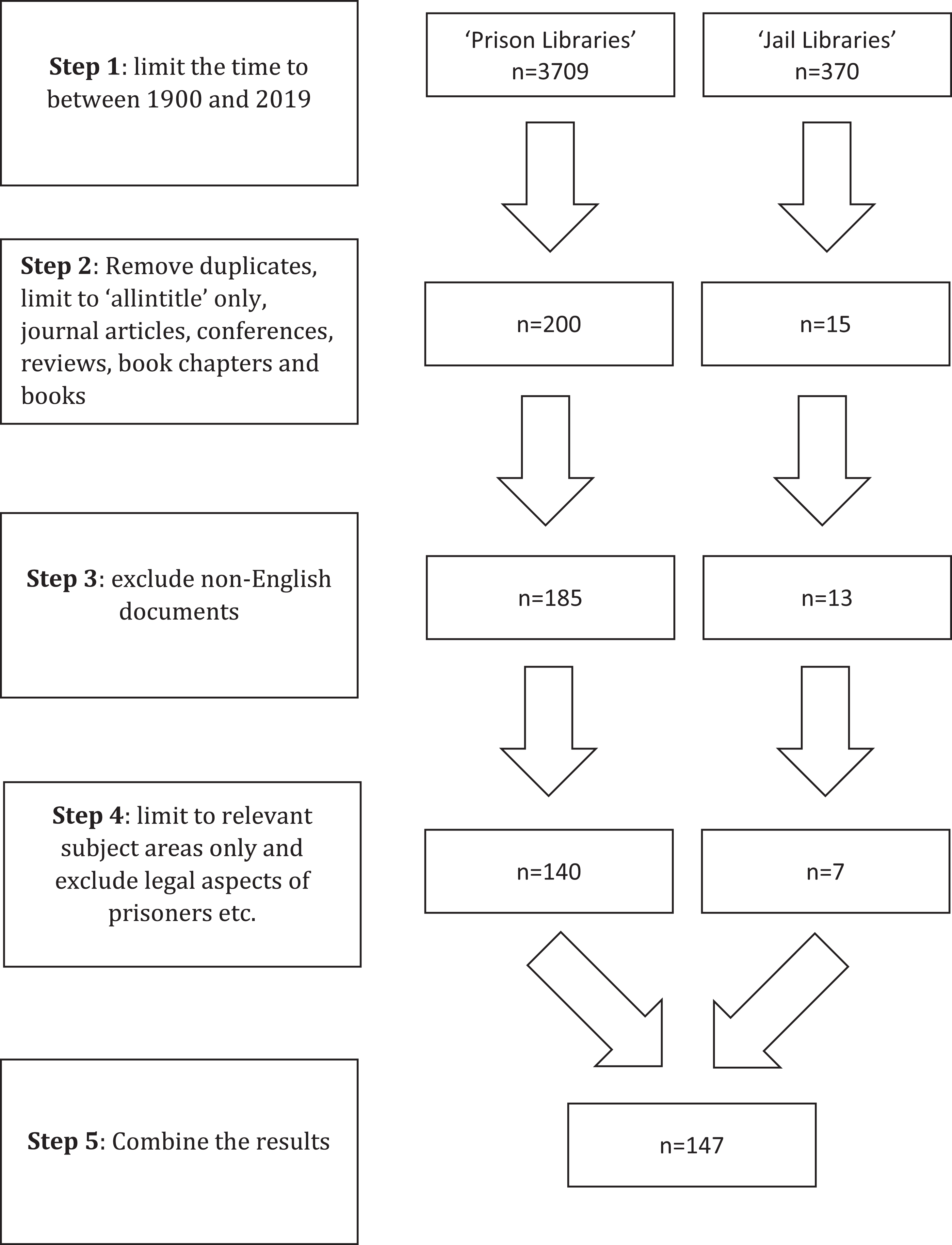
Flow diagram of the systematic review process (the preferred reporting items for systematic reviews and meta-analysis (PRISMA) approach).
Inclusion and exclusion criteria
Studies describing the current status of prison libraries in different areas of the world were included in this research. Another criterion for the inclusion of studies was the publication date – that is, studies published from 1900 to 2019. Two keywords – ‘prison libraries’ and ‘jail libraries’ – in the title of studies were searched and, additionally, only English-language studies were selected. Finally, duplicate articles and studies other than journal articles, conference papers, reviews, books and book chapters were excluded.
Findings
Philosophy and goals of prison libraries
A review of the literature concerning prison libraries’ goals and objectives shows that prison libraries serve five primary purposes worldwide: rehabilitation, education, the provision of information sources and services, health awareness, and the provision of healthy sports activities. As shown in Figure 3, the goals of prison libraries can be categorized into four major groups: personal development, literacy instruction, a peaceful environment and education. Moreover, according to the studies, prison libraries are mainly concerned with the rehabilitation of inmates. These libraries also provide education and desired information sources to fulfil their information needs. In addition, few studies mentioned that health awareness programmes and the provision of healthy sports activities should also be part of prison libraries’ services.
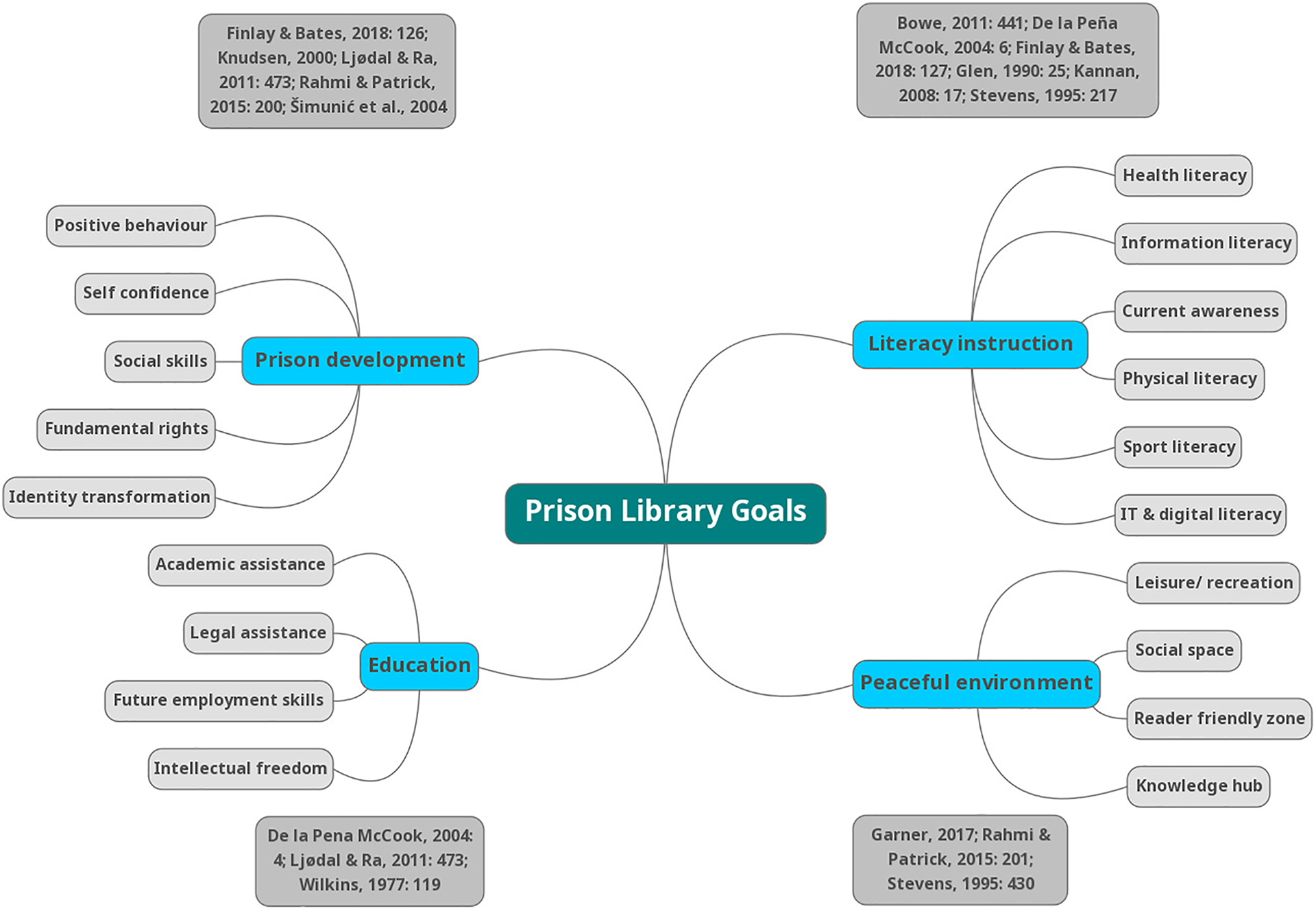
Philosophy and goals of prison libraries.
History of prison libraries
According to Wilkins (1977), the first prison library service in the USA was established in the mid 19th century. The states that initiated this early development were Iowa, Illinois, Nebraska, New York, Ohio and Massachusetts. Their libraries were limited in their collections. Similarly, Stevens and Usherwood (1995) state that the early British prison libraries forced inmates’ rehabilitation through religious and moral texts.
Analysis shows that the purpose of prison libraries was to provide reading materials to inmates. Initially, clergy offered these services to inmates for religious reform. The primary aim was to support moral reform through religious material (Collis and Boden, 1997; Garner, 2017; Glenn, 1990). In the 17th century, books were given to American and European prisoners for moral reform. Prisoners were only permitted to read the Bible and other religious books. The prison libraries were staffed by clergy, guards, substitute teachers or bookish inmates, with little or no support from the prison administration (Conrad, 2017; Coyle, 1987; Fyfe, 1992; Garner, 2017).
Heaney (1973) identifies that a prison library was established in Ireland at Richmond General Penitentiary, Dublin, in March 1827. There were 21 books over 2 feet of shelf space. In 1820, the Lord Lieutenant appointed church chaplains to issue appropriate publications to prisoners free of charge. Adkins (2010) points out that, in 1834, the Quaker missionary James Backhouse highlighted that a small library had been established at Port Arthur from donations by private individuals. The government also established a similar library at Point Puer, a neighbouring settlement for juveniles. The regulations of 1843 recommended that stations houses should not assume that libraries would be established for staff. The books were for the use of both the convicts and their goalers.
The literature has established that prison libraries provided religious material to prisoners for their development until the early 19th century (Conrad, 2017; Garner, 2017). This was when the focus shifted towards the public library type of model. By the beginning of the 20th century, many prison libraries had been closed. In 1915, the American Library Association published the Manual for Institution Libraries (Scott 1916) and stated that prison libraries should be developed with the character and purpose of the institution in mind. These prison libraries were run by a teacher with an undergraduate or postgraduate degree. Stout and Turitz (1977) point out that, in 1963, the American Library Association created the Social Responsibilities Round Table, and that illiteracy was a social issue to be addressed for Americans inside or outside of prison walls. It has been recognized that library services should not stop at the prison gates. Lehmann (2011) states that, in 2000, some of the correctional agencies in the USA began converting their print-based legal material into electronic format and made it available on CD-ROMs and DVDs. Today, web-based legal information products are available under a secure network infrastructure in prison libraries.
Kabir (1982) identifies that some attention was being given to jail reforms by the third quarter of the 19th century. By 1892, the prisoners in Bengali jails were being provided with better housing and amenities. In 1890, the government agreed to grant sanction some money to buy books and form a library for the European and Eurasian inmates of the Presidency Jail. The chaplain of the Presidency Jail wanted to utilize the funds to ensure best library practices. His effort to set up a jail library was a small beginning, yet it may be considered of great significance in order to create awareness towards prison libraries. Its importance was that it initiated such institutional libraries. Over time, the government took increased measures to provide reading facilities for certain classes of prisoner in Bengali jails.
Regional distribution of prison libraries
The USA
In the USA, all 50 states have a Department of Corrections which monitors libraries and state correctional facilities. According to the Directory of State Prison Librarians (2010), the total number of prison libraries in all states is 950. Two-thirds of these libraries have professional library staff (Lehmann, 2011). The library facilities, services and collections in the Federal Prison System are controlled by the Federal Bureau of Prisons of the United States Department of Justice. For over 200 years, American prisons have operated library programmes. The challenges of providing resources to the incarcerated are well documented and, today, the American Library Association maintains many resources for those in charge of prison libraries (Tait, 2018).
Men’s prisons have a much larger inmate population than women’s prisons. Men’s prison libraries have more books, magazines and journals than women’s prison libraries. Despite this, the state of prison libraries in the USA is different from that in other countries. In the USA, prisoners have access to various books, the Internet and audiovisual material in a few libraries (Glenn, 1990). A survey conducted in 10 major US states highlights that most libraries provide books, magazines and newspapers, and a few are equipped with audiovisual material (Conrad, 2012).
As far as problems are concerned, US prison libraries face budgetary issues similar to libraries in other regions of the world. In Illinois, prison libraries have faced funding, collection development, access, legal material, staffing and many other problems that are common to institutional library services. The majority of the North Carolina state prisons working under the Department of Corrections have sufficient legal and recreational library collections and services (Burt, 1977; Campbell, 2005; Cohen, 1968; Conrad, 2012; Rubin, 1983). Purifoy (2000) reveals that the prison library at the Oshkosh Correctional Institution provides educational and recreational facilities for inmates. The librarian provides inmates with a supportive atmosphere and encourages them to benefit from the services offered. However, this kind of services were missing in rural jails in USA.
Sawyer (1979) notes that correctional institution libraries in Ohio had been growing in number since the early 1970s. He conducted a study of major adult correctional facilities and revealed a need for libraries in prisons, and that most inmates would like to use library materials either for reading for pleasure or educational research. According to Hart (2015), prison libraries and librarians were severely neglected in the library community in Ohio. Public and academic library communities were unaware of the needs and goals of prison libraries. There were eight correctional facilities under the Ohio Department of Youth Services. The prison librarians managed collection development, maintenance, evaluation, networking inside and outside the institution, and daily operations. The Circleville Juvenile Correctional Facility library had 7000–8000 books. Inmates could not use the Internet, but one of the officers helped the librarian to provide Internet access for the youth. The collections included fiction and non-fiction, biographies, foreign languages, science titles, reference books, vocational materials and periodicals. Some libraries managed to subscribe to magazines and newspapers.
Canada
Ings and Joslin (2011) reviewed the literature related to prison library services in Canada from 1980 to 2010. In light of the Canadian mission and goals, several legislative changes have been made over recent years. These changes have directly affected the prison population and libraries in social and technological contexts. Still, the Canadian libraries are not according to the standards suggested in 1981 by Nason. Curry et al. (2003) surveyed Canada’s 51 correctional institution libraries and note that prison administration staff, guards, visitors and inmates’ families used the libraries; later, inmates’ families and visitors were not allowed to use the libraries. A few of the staff members had a Master’s degree in Library and Information Science, while others had a Bachelor of Arts degree in Psychology or a technician, correctional educator or teacher-librarian diploma. Every library had books, magazines, newspapers and video collections. Due to security concerns, none of the prison libraries were equipped with Internet access. Most of the libraries acquired books through new purchases and donations. The library collections included general fiction, horror, mystery, science fiction, historical fiction, romance and gay/lesbian fiction.
The UK
Bowe (2011) notes that prison libraries in the UK had seen significant changes and developments over the previous 30 years. As prisoners were not allowed to use local public libraries, the nearest public libraries were contacted to provide adequate library services to prison inmates. However, Coyle (1987) highlights that the use of public libraries was unsuitable for the prison environment. Public libraries meet user needs regardless of censorship issues. However, prison libraries have strict censorship policies for inmates. In the UK, privately managed prisons were introduced in the 1990s. Private companies ran 11 private prisons. Private prisons controlled their library collections and staff. The books needed for the libraries were mainly purchased independently rather than through the library management (Bowe, 2011).
Turner (1973) examined the four prison libraries in the West Riding of Yorkshire. Of the four prisons analysed, only Thorp Arch had a purposeful library. At Wakefield, the library collection was divided between libraries in four wings, consisting of two or at most three cells knocked into one. The prisoners could only use the library in their wing. The library premises were full of dirt, dull and unattractive. The existing collection was minimal. At Askham Grange, the problem of space was much the same as that at Wakefield. At Armley, the library was open each evening, but the men were only allowed one visit a week. All four prison libraries received most of their book supplies through public libraries. Of all four prisons, only Wakefield had a library officer who had received 10 days of training in library procedures. The prison governor monitored the censorship policy in the libraries.
Field (2008) points out that many UK prison libraries were managed by a librarian and contained some literacy material in central display units. This material was used for inmates’ formal Individual Learning Plans, governed by the Department for Education. These resources were loaned to literacy teachers from the Department for Education and staff members. He further elaborates that the provision of library services was affected by different factors such as the turnover of prisoners and the quality of collaboration with partners and managers.
Northern Ireland
According to Finlay (2018), access to library services is a legal requirement for each prison in Northern Ireland. The researchers identified some publications on prison library services in the UK but no research has been carried out on prison libraries in Northern Ireland. The limited published work is often based on the researchers’ opinions rather than empirical evidence. We cannot blame prison librarians for this as they cannot undertake research alone, and they might not have enough time or resources to carry out such studies.
Prison libraries in Europe
Greece
Villioti and Vassilakaki (2015) investigated prison libraries in Greece and note that the libraries did not operate effectively. These libraries were not staffed by professional librarians but social workers. There was no proper space for users and not even basic furniture in the libraries. There was no organization and classification system for the library material. There was no written policy available about library operations. Only prison staff were allowed to borrow books from the libraries, therefore prisoners did not visit the libraries often. The collections and services provided by the prison libraries did not sufficiently meet users’ needs and the libraries were not meeting their educational role appropriately.
Belgium
According to Brosens et al.’s (2015) study, Belgian prisoners were allowed to use the prison library once a week. They could borrow books, CDs, DVDs, video games and comics. The study mentions that the libraries provided opportunities for the prisoners to participate in other lifelong learning programmes such as vocational training and sports.
The Netherlands
Reijnders (1996) notes that, in the Netherlands, many prison inmates were unable to understand Dutch. This isolated them from other prisoners. In contrast to most prison libraries around the world, the Netherlands has legalized the prison library system. In 1841, the Minister of Home Affairs presented a law suggesting libraries for prisoners. This law was amended in 1952 and 1971, granting inmates the right to use a library once a week. As of 1996, the Netherlands had successfully established 70 prison libraries, with 113 librarians working in 52 correctional facilities, 8 forensic hospitals and 16 juvenile detention centres. The number of foreign books in a prison library depends on the percentage of foreign inmates. All the libraries had foreign prisoners, as their circulation statistics showed that members borrowed books in eight different foreign languages. Moreover, the prisons where more than 50% of the inmates were from foreign countries had a library collection with publications in 15–20 foreign languages. Some prison libraries were equipped with even more foreign language publications (up to 36) to meet users’ needs.
Spain
There are 84 correctional facilities in Spain, 11 of which are in the autonomous community of Catalonia. All prison libraries in Spain have professional librarians. The prisoners fulfil their information needs by consulting library resources, prison staff, family and friends. They spend their time watching television, reading books and listening to the radio. The main goal of prison libraries is to promote a reading culture and support educational programmes. In Catalonia, the machine readable catalogue (MARC) Instruction Programme for Catalan Prison Libraries was developed in January 2002 to standardize the operations of prison libraries – such as technical services, working hours and staff assignments (Pulido and De Angelo, 2011).
Poland
Zybert (2011) notes that the director general of prison services governed all matters relating to libraries in correctional institutions, such as the allocation of library funds for space, equipment, materials and collections. The main aim of the Polish prison library was to provide services for prisoners’ education and rehabilitation. According to a 2008 survey, there were 1,635,466 volumes held in prison libraries. Prisoners could visit the libraries in person but only had indirect access to the library collections due to the lack of library space; they could select books from the short holding lists brought to their living area. There were prison educators or library educators in the libraries instead of librarians, who performed all librarian duties, such as collection development, circulation policies, record maintenance, reporting and the organization of the library space.
Turkey
Dilek-Kayaoglu and Demir (2014) reveal that the Ministry of Justice’s directive of 2005 regulates prison libraries in modern-day Turkey. According to this directive, prison libraries can only be established with senior managers. The libraries remain open five days a week but prisoners cannot use them physically due to security concerns. They can only borrow books for up to 15 days from a list of books arranged alphabetically by author. The prison libraries lack professional staff and sufficient reading material, and do not have specific or sufficient budgets for library material.
Croatia
The studies from Croatia show that most of the prisons in Croatia offered primary library services to their inmates. These libraries were not well established and required new organizational and financial infrastructures. In a few libraries, staff members and prisoners could use computers, but without Internet access (Perryman, 2016; Šimunić et al., 2014).
France
Prison libraries in France can be traced back to the mid 19th century. The French Penitentiary Administration regulates their overall structure, the collection of books and other reading material. In 1999, according to the Criminal Procedure Code, a library was the only place designated as a ‘cultural space’ inside a prison. This code also gave directions in relation to a library’s place, functions and access system. However, the code did not specify the location of the libraries. Prison libraries started improving when public library staff began to work inside prisons, reorganizing their book collections (Cramard and McLoughlin, 2011).
Bulgaria
According to Tsvetkova and Andrekova’s (2016) study, almost all prison libraries in Bulgaria reported outdated collections. The primary source of their collections was poor-quality donated books. These books were collected from libraries that had closed in various state institutions and publishers. The prison libraries did not have sufficient funds to buy new books. Except for Sofia Prison, all of the prison libraries in the country needed fiction and other types of material. Six of the thirteen prisons – in Belene, Burgas, Bobov Dol, Varna, Pleven and Stara Zagora – needed specialized publications. Except for Sofia, all of the prison libraries wanted new information and communications technologies. The prison library at Sliven also requested an e-book reader.
Portugal
Sequeiros (2018) investigated the status of Santa Cruz do Bispo Prison (a woman prison) in Portugal. It was revealed that reading services provided by library help them in developing a sense of escape, a source of entertainment and building knowledge. The library contained 8000 publications, including books, magazines, monographs and newspapers. The majority of the inmates loved to read popular romantic novels. Instead of browsing the books, the library users sought help from the library staff. The library did not have a book catalogue for searching; the books were arranged on the shelves under subject headings.
Italy
Costanzo et al. (2011) note that the prison library system began in Italy in the 20th century when, in 1933, the librarian Ettore Fabicitti mentioned the existence of prison libraries in a public libraries manual. Turin was one of the first cities to have a prison library, which was established by the city government. In 1988, a library was opened with a limited collection of books in La Valette Prison, with a professional librarian. Today, the professional aspects of prison library services are monitored by the University of Milan and Associazione Italiana Biblioteche. Due to the new Association of Prison Libraries (Associazione Biblioteche Carcerarie), the new prison libraries enjoy more autonomy than the older facilities. Several new libraries have been established in the prisons at Como, Milan, Monza and Volterra.
Scandinavia
Ljødal and Ra (2011) highlight that, in the Scandinavian countries, the existing national policy monitored the services offered in correctional institutions. In Norway, a new penitentiary was introduced in 1851. New reforms in Norway aim to minimize the negative effects of isolation with the help of reading material. Under these reforms, Norway’s prison libraries are today functioning within clear statutory parameters. Moreover, appropriate and regular funds have been allocated for prison library collections, services and staff at the national level.
In Denmark, the first prison library was established during the 1860s at Værløse, and a teacher was appointed to manage it. The collections were limited and based on pietistic religious publications from the middle of the 18th century. The libraries continued offering these religious works until the latter half of the 19th century when extensive collections of fiction and non-fiction were introduced.
In 1949, public library experts highlighted that prison libraries were the most neglected area of modern library services in Sweden. In 1958, Sweden introduced a new service structure. According to this structure, municipal public libraries provide their services to prisoners in the jails.
Russia
The libraries in Russian prisons seem to follow the tradition of tsarist prison libraries. These libraries were formed using the old model. The library facilities vary from prison to prison and depend on the interrogator’s attitude towards the inmates. According to Mäkinen (1993), the size of the prison libraries’ collections was between 2000 and 10000 volumes. Taganka Prison in Moscow had 12,000 volumes and Kresty Prison in Leningrad 7000 volumes. There was more demand for the fiction collection in the Leningrad Prison library. In Lubyanka Prison, the inmates verbally requested new books from the librarian. In Vladimir and Yaroslavl Prisons, a complete catalogue of books was shared with the cells, and the prisoners could order their desired books from the catalogue.
Prison libraries in Asia
Pakistan
The researchers found fewer research articles in this domain from an Asian perspective. Hussain et al. (2019) conducted a study on prison libraries in Lahore and reveal that members of the clergy are the caretakers of prison libraries. Their leading role is to offer prayers as an imam masjid (the title given to the leader of worship in a mosque in a Muslim community). They lead Islamic worship services, serve as community leaders, provide religious guidance and education, and offer rehabilitation programmes to inmates. According to Shinji (2009), 99% of convicted children committed crimes due to poverty in Pakistan. Most young prisoners belonged to the deprived sectors of society and did not have access to education. The literature identifies a great need for formal and informal education and learning opportunities that build literacy, creativity and technical skills among inmates. The lack of professional staff, unavailability of library space, lack of funds, limited collections and censorship issues are the main issues faced by Pakistani prison libraries. The majority of prisoners visit the libraries to seek help in relation to legal matters.
India
In India, few prisons have libraries. These libraries have limited collections and provide poor services to inmates. Thane Central Jail has two small prison libraries for men and women (Mahale, 2016). Anupama’s (2001) work provides a history and account of 14 prisons in each of the districts of Himachal Pradesh. Researchers stated that some prison libraries, such as those in the districts of Kangra and Kullu, worked in coordination with the state district libraries and allowed prisoners access to material; however, many others did not.
According to Singh (2014), few prisons in Punjab had good libraries, and most of the libraries had not even subscribed to a single newspaper. He states that Viyyur Central Jail, Kerala, had a separate library building with a collection of over 10,000 books, in addition to newspapers and periodicals, for 800 inmates. The Central Prison library at Poojappura contained 15,000 books. The Noida library in Dasna Jail was stocked with over 4000 titles. Singh (2014) further states that, in Madhya Pradesh, the SC Bose Jabalpur Central Prison library contained history, fiction and law books, among books in other areas. The prisoners could borrow books for 15 days. The officials at the Hoshiangabad Prison stated that the prison sent requests for unavailable books when prisoners asked for them. Amaravathi (2019) notes that the Central Prison was initially established in 1997 at Gandhinagar, Bangalore. Later, in 2000, it was moved to Parappana Agrahara. The library had over 4000 items in its collection, including storybooks, novels, newspapers and magazines.
Sri Lanka
Navaneethakrishnan and Arulanantham (2013) suggest that Sri Lanka should follow the IFLA guidelines to establish prison libraries. The policy should be made at the national level for prison libraries by the National Library of Sri Lanka.
Malaysia
Rafedzi et al. (2016, 2018) point out that juvenile prisoners can avail themselves of the same educational opportunities that anyone can expect in the free world in Malaysia. Male prisoners can acquire formal education and take public examinations under a special programme offered by the Ministry of Education and the Malaysian Prison Department. Prison libraries were used by juvenile delinquents taking national-based examinations. They used the libraries to fulfil their information needs with the help of prison staff, although the prison libraries had limited and outdated collections, and lacked professional library staff. Rafedzi and Abrizah (2014) comment that Malaysian male juveniles considered libraries an ineffective source of information, regardless of their information needs. They preferred the Internet and informal networks among inmates for acquiring the information they needed.
Japan
Nakane and Noguchi (2011) note that there were no functional library spaces or professional library staff in Japanese prisons. The reading material in correctional institutions was placed in several areas, such as the prisoners’ living units, work areas and library work areas. The collections ranged in size from 5000 to almost 26,000 items. Inmates were allowed to borrow reading material during their work breaks. Book racks were brought into the living units in movement-restricted areas twice a week. Reference and special materials were present in the libraries and controlled by library staff. It was observed that the libraries provided limited access to reading material. Most of the prison libraries had outdated and irrelevant content. There was no interlibrary loan agreements between prison libraries and public libraries.
Korea
Kwon and Yoon (2009) revealed that there were 47 prison libraries in Korea. These libraries had a limited budget for human and material resources. The prison libraries did not provide enough room for accessing material, with the majority being situated in small spaces. The libraries built their collections with the help of donations from several donor agencies. They had an insufficient number of regular library staff to handle daily library operations. The duties of the non-regular library staff were to carry out simple tasks, such as the circulation of library books. The librarians searched educational resources to meet the needs of the library users. The prison libraries did not have automated systems for library operations such as circulation, acquisitions and book processing. Moreover, there was no policy on borrowing books from external libraries such as local public libraries.
Prison libraries in Australia
The literature revealed that prison libraries were acquiring religious books in Australia (Carroll, Hussain et al. Examining the status of prison libraries around the world 7 2013). The purpose of acquiring these types of books for inmates was to refine their moral character and return them to society. Kern (2007) identified that prison libraries in Austria completely followed article 19 of Human Rights and provide services and full access to learning material which enable them to utilize their leisure time positively.
Prison libraries in Africa
Nigeria
Nigerian prison libraries are in a state of deterioration. The reform process was initiated with the advent of Nigeria’s democracy in 1990; however, it has not achieved much in providing library resources for inmates to enhance their psychological well-being (Emasealu and Popoola, 2016a). The libraries contribute to the acquisition of skills and to addressing both the psychological problems and attitudinal adjustment of inmates by helping them to manage their time (Omolola and Roseline, 2018).
Bamgbose (2018) points to the importance of law-related collections – an essential component of prison libraries. The purpose of the prison law library is to provide access to legal information for prisoners. Currently, this kind of library does not exist in Nigeria. Nigerian prison libraries have limited space and are located in small apartments. The poor funding for the libraries, long distance between the inmates’ living areas and the libraries, uncomfortable nature of prison and long delays before trial are significant hurdles to accessing the desired information sources. The existing library services, and other facilities such as tables, chairs, shelves and books, do not meet acceptable standards (Adeagbo et al., 2016; Emasealu and Popoola, 2016a, 2016b; Eze, 2015, 2016; Eze and Dike, 2014; Joseph and Olayinka, 2019; Okwor et al., 2010; Oluwadare and Elaturoti, 2016; Omagbemi and Odunewu, 2007; Sambo and Ojei, 2018; Sambo et al., 2017).
Uganda
Two women’s prisons Luzira and Kigo had small libraries situated outside the perimeter fence (Asiimwe and Kinengyere, 2011).
Ghana
The prisons in Ghana do not have state-of-the-art libraries. According to Mfum (2012), these libraries had basic religious and preparatory reading material. The prison authorities were working on delivering standardized library services to the prison population. The collaboration of prison libraries with public libraries was one of the main tasks to raise the status of prison libraries.
Prison libraries in the Middle East
Jordan
According to Jadallah et al. (2019), there were 17 prison libraries in Jordan. Prison inmates needed different libraries to obtain information and improve their knowledge. Currently, these libraries face a shortage of financial support and a lack of qualified and trained clerks. They are using automated systems for the circulation of library materials. The librarian must prepare a daily list of the library assets, indicating the borrowed books, and send a copy to the secretaries of the internal gate for acquittal of prisoners who are good library users can get early release based on their good behaviours.
Prison libraries in other countries
The Brazilian penitentiary system has limited library collections and space for meeting the needs of the inmates (Andreoli et al., 2014). Uganda also lacks developed prison library services. According to the office of the auditor general, Uganda prisons service (2010), 80% of the 222 prisons had inappropriate educational facilities, including libraries.
Like Malaysia, in Indonesia, the main aim of correctional services is to work for youth development. As reported by Rahmi (2015), the prison libraries in Indonesia contained comprehensive library collections. However, these libraries helped prisoners to improve their reading skills in collaborated with public libraries. Indonesian prison libraries did not permit prisoners to borrow library books because inmates damaged books and used them for illegal purposes, such as hiding tobacco.
Navaneethakrishnan and Arulanantham (2013) suggest that Sri Lanka should follow the IFLA guidelines to establish prison libraries. The policy should be made at the national level for prison libraries by the National Library of Sri Lanka.
In New Zealand, the small North Island town of Whanganui provides services to inmates in two different ways. A mobile library service visits inmates twice a week and also a self-care unit. Whanganui inmates have direct access to the Whanganui District Library (Vaccarino and Comrie, 2010).
Major issues and challenges for prison libraries around the world
Library collections
Prison libraries should not rely on donated or gifted material. The authorities of correctional institutions should realize that prison libraries must acquire specialized selected materials to cater for the needs of today’s prisoners (Albert, 1989). Collection development should be based on the prisoners’ particular needs and interests. It has been found that prison libraries are consulted more than public libraries in the free world (Kaiser, 1993). Usually, prison library users come from diverse backgrounds and have different interests when reading library material. For this reason, libraries have to acquire library material in different subject areas – for instance, prisoners want to read fiction. Professional library staff should fulfil their information needs (Dalton, 1988; Heie, 1986). Another important type of library material is ready reference sources: almanacs, encyclopaedias, dictionaries, directories and law-related databases such as LexisNexis. The general reading collection should include fiction, non-fiction, newspapers and magazines. The non-fiction material should be in the areas of biography, art, medicine, psychology, religion, true crime, sports, writing, bodybuilding and self-help. If English is the official language, the collection and services will cater for English-speaking prisoners. This is no doubt a major barrier to improving the status of non-English-speaking prisoners (Conrad, 2012; Shirley, 2006). Dalton (2013) points out that library services or resources for legal purposes were not mentioned clearly in collection development policy.
According to Bowe (2011), a library collection should be based on the needs and interests of the inmates. In the Netherlands, for example, many prisoners cannot understand Dutch, which isolates them when they are behind bars (Reijnders, 1996). However, prison authorities, religious organizations, non-governmental organizations and related individuals put efforts into meeting prisoners’ information needs by acquiring needs-oriented material (Emasealu and Popoola, 2016b; Eze, 2015, 2016; Eze and Dike, 2014; Oluwadare and Elaturoti, 2016). Library material such as books, magazines and newspapers should be in various formats according to the requirements of the prisoners.
In 2012, Conrad surveyed the US prison library sector. He notes that 24% of libraries had not established a written collection development policy, and at least 53% of libraries had no circulation policy statement. As a result, these libraries were running with non-standardized local policies and procedures of the prison department. According to Lehmann (2011), in the USA, the Wisconsin Department of Corrections policy was established in 2009 to formulate uniform guidelines for acquiring, selecting and weeding library collections in institutional libraries. These guidelines monitor the relevance of library collections for prisoners’ needs and interests around the security needs of the institution. Perryman (2016) notes that only two libraries had established a collection development policy in Croatia, and almost half of the prison libraries contained donated reading material.
Haymann-Diaz (1990) explored how the Hispanic and African Ethnic Collection was developed in the library at Greenhaven Correctional Facility in Stormville, New York. The first criterion in selecting material was to represent the historical and cultural context of the various nationalities that comprise Black and Hispanic cultures in the USA. The second criterion was to choose books suggested by the prisoners. The general collection also contained periodicals related to current Hispanic and Black matters. Moreover, the prison library requested material other than books, including posters, maps, paintings, and pictures of artefacts and historical sites.
According to Purifoy (2000), patrons could borrow two books through interlibrary loans for one week at the prison library in the Oshkosh Correctional Institution. The library collection included reference books, audiovisual material, newspapers and magazines. Knudsen (2000) points out that some inmates used the prison library for reading newspapers and books to keep themselves informed and up to date with the outside world. This library contained western literature, and publications in science fiction, religion, adventure, romance, fantasy and even self-help. London (2000) found that at Oakhill Correctional Institution in Oregon, Wisconsin, prisoners read various ethnic periodicals. The library helped them to connect with their culture of origin. According to Ljødal and Ra (2011), most prisoners, including the illiterate, requested audiobooks in Norway. In Denmark, the Ministry of Justice appointed individuals who suggested that prison libraries should be structured as branches of local public libraries, and that the existing book collections should be replaced by deposit collections given by the public libraries. However, handbooks, reference works, magazines and books on hobbies should remain in the collection at the permanent sites.
Prison libraries in Brazil have small collections of books and cannot be considered libraries (Da Costa, 2003). He also revealed that the correctional institution in the state of Rio de Janeiro (Brazil) had no library in Japan, most of the prison library material is acquired by inmates or through gifts (Nakane and Noguchi, 2011). In Uganda, prison libraries have inadequate African literature. The material includes the Bible, novels, storybooks, syllabus books, Uganda National Examination Board textbooks, teacher guidebooks, reference material and pamphlets (Asiimwe and Kinengyere, 2011). In prison libraries in western North Carolina, USA, the books include romantic novels, popular fiction and the Bible. Many of the books are donated by the friends and families of the inmates, library groups and prison staff (Ellern and Mason, 2013). In Turkey, a limited collection of books is available in prison libraries for prisoners (Dilek-Kayaoglu and Demir, 2014). The material in Nigerian prison libraries includes books, magazines, newspapers and audiovisual material, and the available information resources are outdated (Eze and Dike, 2014). Prison libraries in Ghana mainly house arts, science and technology, business, technical and vocational material (Mfum, 2012).
In Indonesia, prison libraries acquire books in the form of gifts or donations. Most of the prison libraries contain books in both print and electronic formats. The major reason for the poor condition of prison libraries is the absence of improved standards for libraries. There are no written selection policies for gifted or donated books to offer guidance to library officials in establishing a library with a relevant and balanced collection (Rahmi, 2015). According to Singh (2014), Indian prison libraries have a limited number of gifted books. The Thane Central Jail library contains books in Marathi, Hindi and English (Mahale, 2016). In Pakistan, prison libraries have gifted books in Urdu, English, Punjabi and Arabic (Hussain et al., 2019). Like other countries, Sri Lanka’s public libraries are formulating policies to provide mobile libraries and reading camps for prisoners in order to improve their access to information (Navaneethakrishnan and Arulanantham, 2013).
It has been identified that the collection situation is better in those regions where prison library legislation has been passed (e.g. in some states in the USA and some European countries). Worldwide, most prison libraries, including in the USA, Europe, Asia and Africa, do not have updated collections and are equipped with religious, fiction and non-fiction collections. Similarly, due to budgetary issues, libraries lack audiovisual material globally.
Staffing
There are clear guidelines for prison library staffing levels and their qualifications in the British Guidelines for Prison Libraries, US Library Standards for Adult Correctional Institutions and the ‘IFLA guidelines for library services’. According to the ‘IFLA guidelines’, a prison librarian must hold the required library and information science qualification. They should have the necessary capabilities and skills to work on prison premises, and be aware of the immediate and potential needs of the prisoners (Lehmann, Vibeke and Joanne Locke, 2005). Bowe (2011) highlights that, according to the Library Association’s 1997 Guidelines for Prison Libraries, a professional librarian, prison officer and library ordinals should be included in the library staff. The 2005 Offender Library, Learning, and Information Specification recommended the minimum staffing levels for prison libraries. It was later updated in May 2010 as the Prison Library Specification. Bowe (2011) also mentions that the minimum qualification for a librarian in public libraries or prison libraries in the UK is to possess a degree in Librarianship or Information Management affiliated with the Chartered Institute of Library and Information Professionals. According to Northwestern University’s Pritzker School of Law (1943), the librarian played the role of mentor at the library in the penitentiary of New York City.
The presence of a professional librarian had a noticeable positive impact on libraries, according to Lucas (1990) and Rubin (1982). It has been observed that ambitious library professionals avoid joining prison libraries because of the poor working conditions, isolation, lack of job mobility or career ladders, poor pay and salary inequities, stigma within the profession and their ambiguous role. According to Finlay (2018), prison librarians have the added challenge of providing services in institutions where policies constantly change. In Northern Ireland, the prison libraries are short-staffed and under-resourced; censorship is often a necessity; and inmates rarely have enough access to the information they want or need.
Shirley (2006) describes that, in the USA, the majority of prison libraries have one library professional, who performs all the duties in the library such as library management, services and processes. According to the instructions of the prison officials, a professional librarian should hold a degree in Library and Information Science or an undergraduate degree. King (2006) identifies that library professionals were motivated to pursue a career in prison librarianship with the Ohio Department of Rehabilitation and Correction – 65% of the participants were satisfied with their job.
According to London (2000), the United States Standards provide particular specifications for the education and experience of prison library staff. The library director should hold a Master’s in Library and Information Science or equivalent with an American Library Association accreditation and have two years of professional experience in a library. This individual should be familiar with all aspects of library management. According to the Standards, the number of prison library staff should be in accordance with the size of the institution, and they should have the skills to work in a prison environment. The British guidelines stipulate that the librarian must be an authorized member of the Library Association and Prison Libraries Group of the Library Association (Lehmann, 2011). The head librarian must be a member of the prison management team, and their duty is to supervise library affairs. The prison library officer should have the capacity to handle security issues while performing library functions.
Rubin (1983) identifies some of the qualities of a professional librarian, such as being highly sophisticated, adaptive in nature and able to act as a change agent. They should be open to new information and concerned with the library service’s goals. They should possess patience, maturity, emotional security, good communication skills and professionalism. Ljødal and Ra (2011) describe that, in Norway, the prison librarian identifies the information needs of the prisoners. The clergy must provide library services while prison inmates work as supporting staff to guide readers. In Denmark, professional librarians from the public library sector provide library services, especially lending services. Ellern and Mason (2013) reveal that the western North Carolina prison libraries had qualified librarians.
Dilek-Kayaoglu and Demir (2014) reveal that the Ministry of Justice (2005a) provides clear directions for library staff in Turkey. According to these directions, the librarian is accountable for all library affairs. If a librarian is not available, a prison teacher will look after all library affairs; in their absence, one of the correctional personnel will be in charge of all library affairs. The Ghana Prisons Service does not have professional librarians (Mfum, 2012). In Japan, professional librarians do not work in prison libraries. The reason behind this is that the current Japanese law does not have clear instructions for prison libraries and their services for inmates (Nakane and Noguchi, 2011). The majority of Canadian prisons have professional librarians. However, it was also found that these librarians, on the whole, appear to be poorly informed about existing selection tools and the use of selection criteria (Ings and Joslin, 2011). Da Costa (2003) mentions that Brazil does not have qualified library professionals in prison libraries. Rahmi (2015) reports that professional library staff are available in Indonesian prison libraries. In Croatia, prison libraries are not managed by professionals (Šimunić et al., 2014). According to Singh (2014), prison libraries are run by non-professionals in India. It is a similar situation in Pakistan, where members of the clergy are in charge of libraries (Hussain et al., 2019).
The major hurdles to pursuing a career in prison libraries, as discussed above, are limited opportunities for innovation and advancement, the lack of financial resources to establish libraries, fewer library staff positions in prison libraries and the absence of technology. Again, the question of prison library legislation is essential here. Countries with regulations are bound to hire professional staff to run their prison libraries – good examples are Norway and Spain. Initially, clergy and religious leaders were considered suitable for prison library management, and this situation is still prevalent in most Asian countries.
Funding
Funding plays a vital role in delivering prison library services to inmates (Dalton, 1988). Shirley (2006) reveals that, in US prison libraries, the library programmes are funded by the Inmate Welfare Fund, but whenever there are budget constraints, officials cut inmates’ library and education budgets. This approach has directly affected existing library services. In several cases, librarians have demanded additional funds for their libraries, and succeeded. Kaiser (1993) notes that there should be an annual budget for prison library collections. There must be a separate budget for facilities, associated personnel and library equipment.
Several studies highlight that one of the major causes of the poor nature of services in Turkey, Japan, Nigeria, Ghana, Pakistan and India is the absence of vital resources such as budgets or funding on an annual basis. The Indonesian government provides funds to prison libraries but this budget is still not enough to fulfil their needs (Rahmi, 2015). Another major hurdle in Indonesian law is that government organizations cannot receive donations. Šimunić et al. (2014) report that prison libraries are not being funded regularly by the government in Croatia. According to Liggett (1993), an adequate budget is available for prison libraries in Ohio.
Bowe (2011) notes that prison library services are being provided by 64 local authorities in England and Wales. This arrangement is accomplished through a service level agreement with each prison, using on-site local authority librarians financed by ring-fenced funding by the Department for Business, Innovation and Skills via onsite emergency team (OSET). Additional funding is used to purchase books and other library materials, as well as associated off-site services to maintain and update the stock. Ljødal and Ra (2011) noted that in 1976, the Prison Board and the Norwegian Directorate for Public Libraries commissioned a national survey on library services in Norwegian prisons, which was to serve as the basis for new proposals to reorganize these services. The survey showed that 77,000 Norwegian kroner were allocated for the purchase of books for the libraries. At the largest institutions, however, the funds were also used to pay inmate library workers, which left no money to update the collections. The majority of libraries had a large number of books but they were mainly outdated titles (Ljødal and Ra, 2011). Almost all parts of the world, including the USA and Europe, are suffering from financial challenges, specifically in the context of prison libraries.
Censorship
Censorship is a very sensitive issue in prison libraries, and a primary concern of the American Library Association. Prison libraries cannot afford to stock books that may create problems for institutional security, such as those with content featuring martial arts, prison escapes, information on making bombs, violating rules, pornography and material that could lead to violence (Lehmann, 2011). Prison libraries do not acquire books on such topics. Sometimes, prison libraries have to face strict inspections of their material by prison security staff (Shirley, 2006). Lehmann (2000) also identified censorship as a sensitive issue in prison libraries. The librarians at correctional institutions have to maintain a balance when providing access to information. They must be vigilant because certain material can create security issues for the institution. The professional librarian must carefully examine any library material acquired.
According to Arford (2013), in the USA, censorship is exercised in several areas within the prison, such as reading material and its sender, and incoming mail. Secondly, prison libraries are subject to the censorship policies made by prison librarians. The third site of censorship is the educational and occupational programmes available in some prisons, where the teachers cannot freely choose course content and materials. Bowe (2011) highlights that prisoners are not allowed to read banned books. The governor or security staff have the authority to check library material on a case-by-case basis. The Prison Libraries Training Pack 6 provides guidelines on dealing with sensitive material. Sullivan (2008) states that, in the USA, library rights for prisoners are severely limited. The Federal Bureau of Prisons reserves the right to remove any religious literature that it finds offensive or a threat to security. Prison libraries are responsive to inmates’ information needs. However, the censorship of reading materials hinders staff in effectively providing library services to inmates (Eze, 2015; Harrington, 2020).
Technology
In some states in the USA, inmates have access to a computer with applications and software to use for educational purposes. In Alaska, the Department of Corrections provides access to the LexisNexis digital law library for prisoners over the Internet (Bowden, 2002). Ellern and Mason (2013) reveal that the frequent use of computers could be seen in almost all prison libraries in the USA. In western North Carolina prison libraries, books are issued on an electronic library card system. Greenway (2007) states that technology needs to be present in all prison libraries. Shirley (2006) notes that most librarians reported that they had Internet access on computers, but its use was not for prison inmates. Payne and Sabath (2007) reveal that many prison librarians had adopted the latest automated technologies for their services over the previous 20 years.
Purifoy (2000) identifies that the prison library at the Oshkosh Correctional Institution had a computerized barcode system to issue and return library material. There was a television in the library’s reading area. The library issued CDs and video players to the inmates so that they could listen to music or watch a movie in the library. Lehmann (2011) reports that prisoners could study for basic information technology qualifications. Most prison libraries had stand-alone desktop systems containing CD-ROMs and other software for prisoners’ use. The primary purpose of these systems was to promote research and informal learning among inmates. In some European countries, prisoners and library staff have access to the Internet. Prisoners use the Internet to send and receive emails, visit websites and search public library catalogues. In Indonesia, prison libraries are providing online audiobooks to their users. The libraries’ main goal is to provide more personal computers or iPads to inmates, and allow them to share their own stories with other prisoners in the digital environment (Rahmi, 2015). Prange (2001) points out that computers were required to meet the information needs of Canadian prisoners. In a few cases, computers were the only option to acquire the information needed. The use of computers in prison libraries invited security issues for the administration and policymakers. Although the importance of computers in providing education for citizens could not be denied, there had to be policy dealing with the various issues associated with computer use in Canadian prisons.
The Internet and related technologies such as automated catalogues, barcode scanners and online interlibrary loan services are used in prison libraries in western countries. However, correctional administrators are still less than responsive to providing Internet services in prison libraries because of several security concerns. Such technological services are most common in urban prison libraries in selected regions. The majority of prison libraries worldwide lack audiovisual and Internet facilities due to financial burdens and security issues.
Collaborations
Shirley (2006) states that partnership between prison libraries and public libraries could be seen in the USA. In 2003, Maryland Correctional Education Libraries started a programme where imprisoned adults could read material from the Enoch Pratt Public Library. Maryland Correctional Education Libraries also took the initiative to conduct group discussions among prison librarians and public librarians. Unlike the USA, the situation in other world regions is different. Most prison libraries aim to provide public library services in prisons. Prisoners not only require legal information, but need a variety of other information for their return to society.
Along with prison libraries, public libraries should establish outreach programmes for inmates within their detention centres (Omagbemi and Odunewu, 2007). The study conducted by Mfum (2012) reveals that cooperation among prison libraries and public libraries was absent in Ghana. According to Ellern and Mason (2013), in western North Carolina, most prison officials agreed to enhance their library services and form a partnership with public libraries.
In his study, Kannan (2008) discusses the significance of public libraries and their systems and services in both rural and urban areas of Bhutan. He highlights the importance of the public library as a local centre for information for users. Fundamentally, public library services are for everyone, regardless of their age, sex, race, nationality, language, religion or social status. This study concludes that particular services and collections must be provided to those who cannot access regular services and collections, such as people with disabilities, linguistic minorities, or people in prison or hospital. Furthermore, Asher (2006) points out that academic libraries can develop interlibrary loan programmes with prisons to allow inmates access to research material from their collections. Billington (2011) stresses the shared reading of literature such as poetry, fiction, plays and short stories in prison communities. Billington’s article demonstrates the strong relationship between such intervention and the current recommendations regarding the mental health needs of prisoners.
Contraband
Another threat to prison libraries is vehicles for contraband. Bouchard and Winnicki (2008) note that a prison librarian provides users with information and works as an agent seeking and reporting on contraband in the library. The four means of smuggling in contraband that a library professional deals with are through library books, library furniture, mail and other library supplies. The illegal items sent via the pages of books are tobacco, stamps, love notes and betting slips.
Significance of the findings
This study highlights the current status of prison libraries around the world. It is an attempt to study the topic with a broad perspective and figure out the strengths and weaknesses of these special types of libraries. This will help readers to understand the difference between the library services of prison libraries and other types of libraries. It will also help researchers to consult and understand the literature published in this area of study.
Conclusions
The literature highlights prison libraries’ purposes, practices and challenges across the globe. The findings show that staffing, budgeting and poor policies challenge prison libraries in working effectively in different parts of the world. The studies describe better inmate services in some states of the USA, the UK and some European countries than in other parts of the world. These libraries have some audiovisual material, limited access to the Internet, automated catalogues, cooperation with other libraries such as public libraries, and a regular budget for library materials. Moreover, a few libraries in the USA, the UK, Europe and Asia (including Japan and Malaysia) are broad in their scope and goals, and mainly work for prisoners’ rehabilitation, vocational skills and lifelong learning.
Prison libraries can open the door to rehabilitation, education and socialization for prisoners. Consulting different information sources may teach prisoners to understand complex life issues and find guidance for their continuing education to prepare them for the outside world. Properly designed information literacy programmes may help them to become independent learners and, ultimately, these steps may be helpful in their rehabilitation. Previous research evidences that prison libraries worldwide are working with limitations for the welfare of their inmates. It was also found that the services of prison libraries are not the same – the situation varies in different countries. Based on a comparative lens, our literature review has established that a few prison libraries in the USA, the UK, Europe and Asia are far better than the prison libraries in other regions of the world. It has been suggested that inadequate prison libraries can replicate the model of ideal prison libraries (in countries that have proper legislation) located in different parts of the world to face their issues and challenges. These libraries will then be able to play an active role in society, fulfilling the needs of their potential users and also helping in the socialization and rehabilitation process of prison library users.
Footnotes
Declaration of conflicting interests
The authors declared no potential conflicts of interest with respect to the research, authorship and/or publication of this article.
Funding
The authors received no financial support for the research, authorship and/or publication of this article.
