



Abstract
The discovery of relevant research in the field of international education can be difficult due to the nature of the field and how scholarly work is indexed. This article presents a review of published international education literature to identify key topics and publication patterns, along with potential gaps and inequities in current scholarly discourse. Using the keywords “international education” and “global education,” the analyses focus on records retrieved from Web of Science. Of the 1492 peer-reviewed journal articles reviewed (published from 1991 to 2017), the analyses revealed only 705 articles relevant to the field of international education. Additional analyses of bibliometric data show a significant increase in international education publication over the past two decades; evolving trends regarding topical foci and methods; and publication disparities regarding national contexts and languages outside the Global North/anglophone-dominated discourse. The article concludes with recommendations to improve discoverability, better connect various areas of international education research, and expand scholarly discourse to include more diverse representation.
Keywords
Introduction
International education is an extraordinary field, bringing together researchers, scholars, and practitioners from a variety of disciplines. As Mestenhauser noted: my field is untraditional; that it is not a disciplinary “specialty”; that it does not reside in its own “box” but that it is found in many boxes; that it is a composite of borrowings from virtually every academic discipline and every culture; and that international education is therefore multidimensional, multidisciplinary, and cross-cultural. (Mestenhauser, 2012: vii)
In order to better understand the state of knowledge in the field of international education, this article examines existing academic scholarship and is guided by the following research questions: What are the primary and emergent topical focus areas in international education research? Where is the majority of international education research being published? How have these trends changed over time?
The significance of this review is threefold: (1) reflecting on existing knowledge and understanding the state of the field is important; (2) identifying and integrating the multiple dimensions of international education provides for a more holistic discussion of existing and emerging scholarship, as well as gaps in the field; and (3) by addressing the field holistically, this review offers insights into how both scholars and practitioners can find relevant research, as well as suggestions for how future research may be better identified and classified within the field. By mapping the features of the existing literature, we can hope to address a more inclusive landscape of understandings and provide insights into current progress in the field.
Literature review
The breadth of the field of international education results in a wide variety of topics that have warranted systematic reviews, and each scholarly contribution has recommendations for additional research to expand the field further.
Dolby and Rahman (2008) aim to provide an “introduction to the field” by focusing their review of literature produced between 1990 and 2008 on six research approaches in international education: comparative and international education, the internationalization of higher education, international schools, international research on teaching and teacher education, the internationalization of K–12 (kindergarten through Grade 12) education, and globalization and education. Within the article, they discuss the history of each approach before examining major theories and research trajectories, expounding on the intended audience and orientation, and outlining the associated strengths and weaknesses. In setting the context for what they consider to be international education, Dolby and Rahman (2008) note their exclusion of several areas of research: language education, technology, intercultural education, multicultural education, and “research from fields such as cross-cultural psychology” (679). They also consider two paths for the development of international education: “(a) the ascendance of the globalization and education approach as an increasingly important theoretical framework and (b) with that, the increased convergence and perhaps consolidation of some of the approaches” (710).
Bedenlier et al. (2018) provide a content analysis of titles and abstracts for articles published in the Journal of Studies in International Education, tracing the development of the field of international education by dividing their data into five-year increments. The major concepts that permeate the time periods include mobility, teaching, studies, faculty, students, and education. From the 406 articles published from 1997 to 2016, two strands of research on internationalization are identified, focusing on (1) the applied aspects of managing institutional internationalization and (2) the experiences and perspectives of the actors of internationalization. The findings also note global representation issues in authorship as “research in the field has so far been largely Anglo-Saxon and Western European driven” (Bedenlier et al., 2018: 128). In the article’s conclusion, a suggestion is also made for future research to extend the analysis to include other journals.
Although there have been other studies that utilize systematic approaches to examine distinct facets of international education literature—such as international higher education (Kuzhabekova et al., 2015), transnational higher education (Kosmützky and Putty, 2016), international comparative higher education (Kosmützky and Krücken, 2014), and international student mobility (Gümüş et al., 2020)—these are limited in not considering a wider scope of relevant international education literature. Even among the two more extensive reviews summarized above, there are noted limitations. Bedenlier et al. (2018) focus only on articles and themes published in one journal, whereas Dolby and Rahman (2008), although more comprehensive, exclude literature from multicultural education, intercultural education, and language education, while incorporating comparative education literature and history. It can be reasonably assumed that much has changed in the field over the past decade, and that this topic is worth revisiting more broadly.
What is “international education”?
One of the issues that emerges from examining previous reviews (and continues to confound many in international education) regards terminology, and a lack of consistent agreement between researchers and practitioners as to what terms should be used for which concepts. As noted by Marshall: Teachers and global educationalists are currently drowning in a sea of seemingly similar terms. Global citizenship education, global learning, international education, education with a global or international dimension, development education, world studies, education for an international understanding—and the list goes on. (Marshall, 2015: 108)
Acknowledging the noted limitations of previous research syntheses and the parameters set forth above, this research seeks to explore international education research more holistically while also acknowledging the nuance between topics. Research was purposely not excluded based on study populations (K–12, community/technical colleges, higher education), national contexts, research methods (quantitative, qualitative, mixed methods, reviews), and academic disciplines (including language education with English as a foreign language and other foreign language studies). This study also utilizes a non-US-specific definition of what international education research includes by also including “global education” terminology. In developing the codebook for this research, we wanted to recognize the links between international education as both a scholarly field and a profession of practice (De Wit, 1997; Streitwieser and Ogden, 2016). As such, the initial overarching topics were defined using the five distinct professional knowledge communities of NAFSA: Association of International Educators (2020): education abroad (to include study, work, internship, volunteering, and research abroad), international education leadership (to include internationalization efforts), international enrollment management (to include recruitment), international students and scholar services (to include programming and services), and teaching and learning (to include curriculum development and teacher/learner experiences). These five topical areas provided an initial starting point for coding, with the potential for additional topical focus areas to emerge during the content analysis.
Theoretical framework
In order to gain a greater understanding of the discourse patterns in international education publications, we considered Foucault’s theories of power and knowledge related to discourse along with Wallerstein’s world-systems analysis. Foucault (1980, 2002) posited that there is a distinct relationship between knowledge and power, as what is valued by those who hold power will be reproduced in the discourse and knowledge of disciplines and wider society, while what is not valued as knowledge by those in power will be subsequently discarded. In addition, Wallerstein’s (2004) world-systems analysis emphasizes the complexity of modern social systems and considers the world system (rather than national systems) as a primary unit of analysis, dividing the world into core, semi-periphery, and periphery countries with established mechanisms to benefit the core. As this research focuses on current academic discourse recognized in the field, and much of the research and scholarship in international education may be dominated by core (i.e. Global North, anglophone) countries, these theories can help us to critically examine issues of power in international education scholarly discourse by identifying where the research comes from and what topics the research focuses on, which can subsequently reveal areas that may deserve more attention.
Method
A systematic quantitative approach
A systematic quantitative approach to reviewing literature is systematic as the review process is clearly articulated, reproducible, and structured to follow a series of explicit steps with justifications for the inclusion or exclusion of articles. The approach is quantitative as it quantifies and synthesizes patterns from the literature in terms of topical focus areas, locations, research methods, and other variables relative to focusing on the boundaries of knowledge evidenced in the literature (Liberati et al., 2009; Moher et al., 2009). In this review, a systematic quantitative approach was utilized consisting of a five-step process: (1) defining the research aim and objectives; (2) identifying keywords and databases, and establishing the literature selection criteria; (3) searching databases, screening search outcomes against the selection criteria, and refining the inclusion and exclusion criteria; (4) extracting relevant materials from the search outcomes and structuring summary tables; and (5) synthesizing and presenting the findings. The PRISMA (Preferred Reporting Items for Systematic Reviews and Meta-Analyses) flowchart, adapted from Moher et al. (2009; see also Liberati et al., 2009), was utilized in the search process (see Figure 1). Bibliometric analysis was utilized to synthesize and analyze the initial metadata (i.e. publication types, publication dates, journal titles, keywords), which was followed by content analysis of the titles and abstracts of individual articles (i.e. focus areas, research methods, national contexts, study populations). Basic bibliometric analysis enabled the generation of quantitative holistic information from a larger data set (Wallin, 2005), whereas content analysis enabled us to designate and derive content categories with specific characteristics from large amounts of text. This combination of methods allowed for the sifting of a large volume of data to extract more meaningful patterns and examine trends in the field.
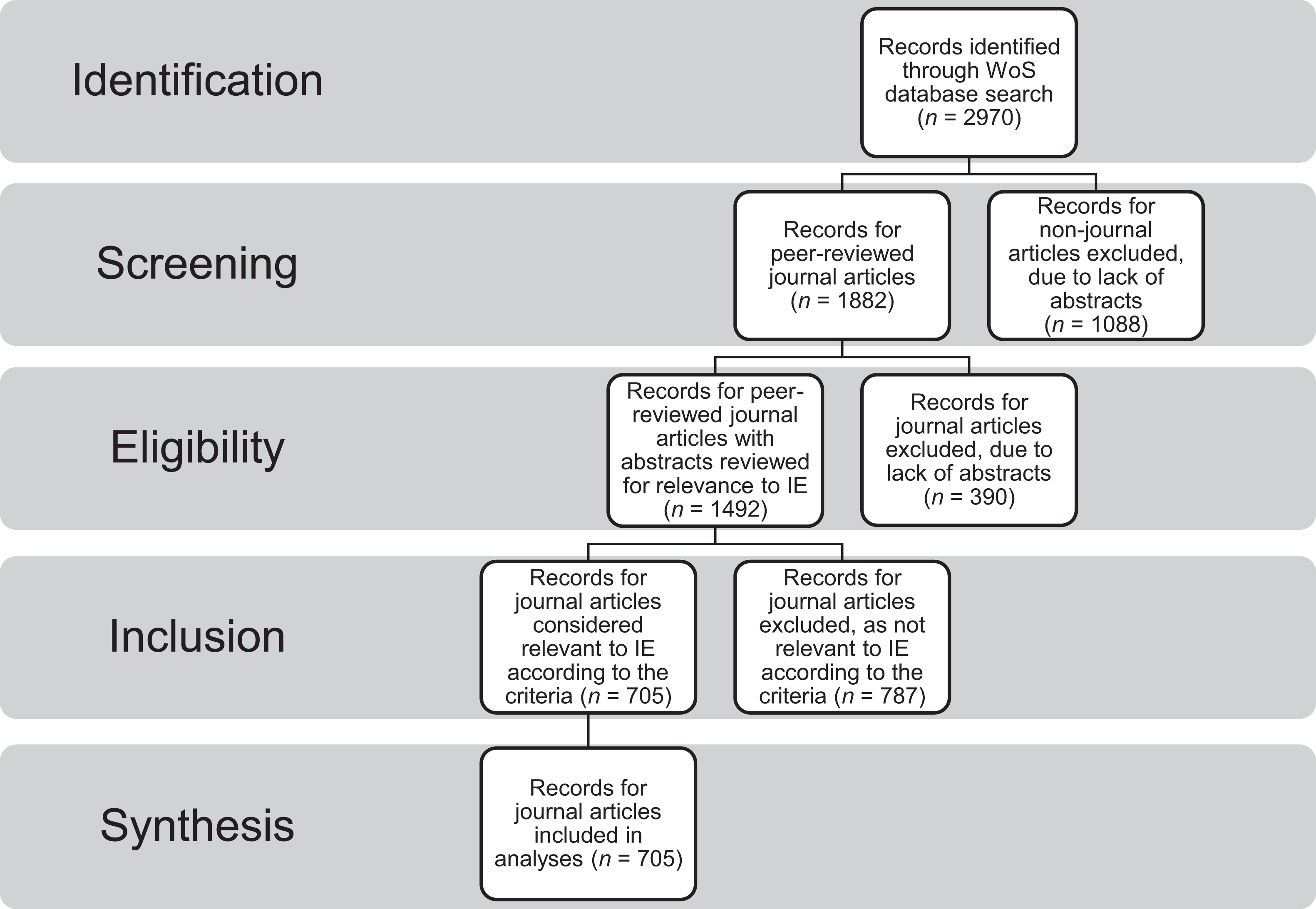
PRISMA flow diagram describing the literature search and the selection of eligible records for analysis (adapted from Moher et al., 2009). Note: PRISMA = Preferred Reporting Items for Systematic Reviews and Meta-Analyses; WoS = Web of Science; IE = international education.
Bibliometric and content analysis
In March 2018, we conducted a comprehensive search using the Web of Science (WoS) Core Collection index database. WoS was chosen as it is one of the most well-respected search tools for identifying research from key scholarly journals in disparate areas (Brint, 2017), and the WoS Core Collection is touted as “the standard data set for ‘bibliometric’ analysis for identifying and monitoring research trends” (Clarivate, 2020c). As Brint (2017: 639) states: “WoS is a particularly valuable source because it features tools to automatically aggregate publications and citations by authors, disciplines, and institutions.” We used the WoS Basic Search to search the Topic field with the search string (“international educat*” OR “global educat*”) for all years through 2017. The specific search terms used were chosen as they have the longest history of use and encompass most of the subtopics in the field (Knight, 2012). Truncation symbols were incorporated in the search terms in order to include alternative forms of the terms “education” and “educator(s).”
A total of 2970 publications, with publication dates from 1948 to 2017, were identified from the WoS search. Full citation information, including abstracts, was exported from WoS to Microsoft Excel, which allowed the information to be analyzed both quantitatively (i.e. bibliometrics for publication dates, journal titles, etc.) and qualitatively (i.e. coding for relevance, focus areas, methodologies, etc.). A quick review of WoS-provided bibliometric analyses for the 2970 publication records provided two insights worth noting. First, the publications were produced from 94 countries, yet 95% were produced in English, with a large majority from anglophone nations—the USA (n = 975), the UK (n = 285), Australia (n = 265), and Canada (n = 167)—and noticeable contributions from China (n = 193), Russia (n = 125), Germany (n = 98), Spain (n = 79), Japan (n = 56), and the Netherlands (n = 55) rounding out the top-10 producing nations. Second, the publications were diffused across formats, with over 60% (n = 1882) classified in WoS as articles. After articles, the most common formats included proceedings papers (n = 640), book chapters (n = 282), editorials (n = 177), and book reviews (n = 153).
Abstracts were required for the content analysis, and WoS only provided abstracts in the records for journal articles after 1990. Therefore, all items without abstracts were removed during the screening process, and our final data set was limited to the 1492 articles published from 1991 to 2017. Screening for the eligibility of the 1492 articles involved reviewing their titles and abstracts to determine whether they were relevant to this research and should be included in further analyses. Studies were excluded if the article’s topic was not about international education as defined. Of the 1492 articles, 705 were considered specifically relevant to international education and examined in the further analyses. As mentioned previously, a coding scheme was developed to code the retrieved articles for relevance (or not), primary and secondary focus areas (initially using NAFSA’s (2020) knowledge communities: Education Abroad, International Education Leadership, International Enrollment Management, International Student and Scholar Services, and Teaching and Learning), and national context(s). Additional analyses, which are beyond the scope of this article, involved coding for research focus (or not), specified research methodology (quantitative, qualitative, mixed methods, etc.), and research population (K–12, higher education, vocational education, or professionals). In coding, each of the authors independently coded half of the research records identified in the search and then employed cross-checking to confirm intercoder agreement on the analysis of the articles. In cases where the main focus of the articles diverged from the initial five codes for the focus areas, the researchers consulted each other for appropriate and consistent terms for coding. We acknowledge that the coding and categorization utilized in the review process was dependent on our backgrounds and interpretations as researchers.
Findings
As mentioned, of the 1492 journal articles identified through WoS, there were 705 articles relevant to international education as defined for this research. As Figure 2 shows, the number of published international education articles increased significantly after 2004. Whereas there were fewer than 50 international education articles published from 1991 to 2002, there has been a sharp rise, with over 100 articles published in both 2016 and 2017.

Publication pattern of international education articles, 1991–2017 (n = 705).
Focus areas
In examining the articles’ focus areas, we coded for both primary and secondary focus. Among the 705 articles, there was strong evidence of alignment with the five initial professionally designated foci, as evidenced in Table 1.
Foci of international education articles (n = 705).
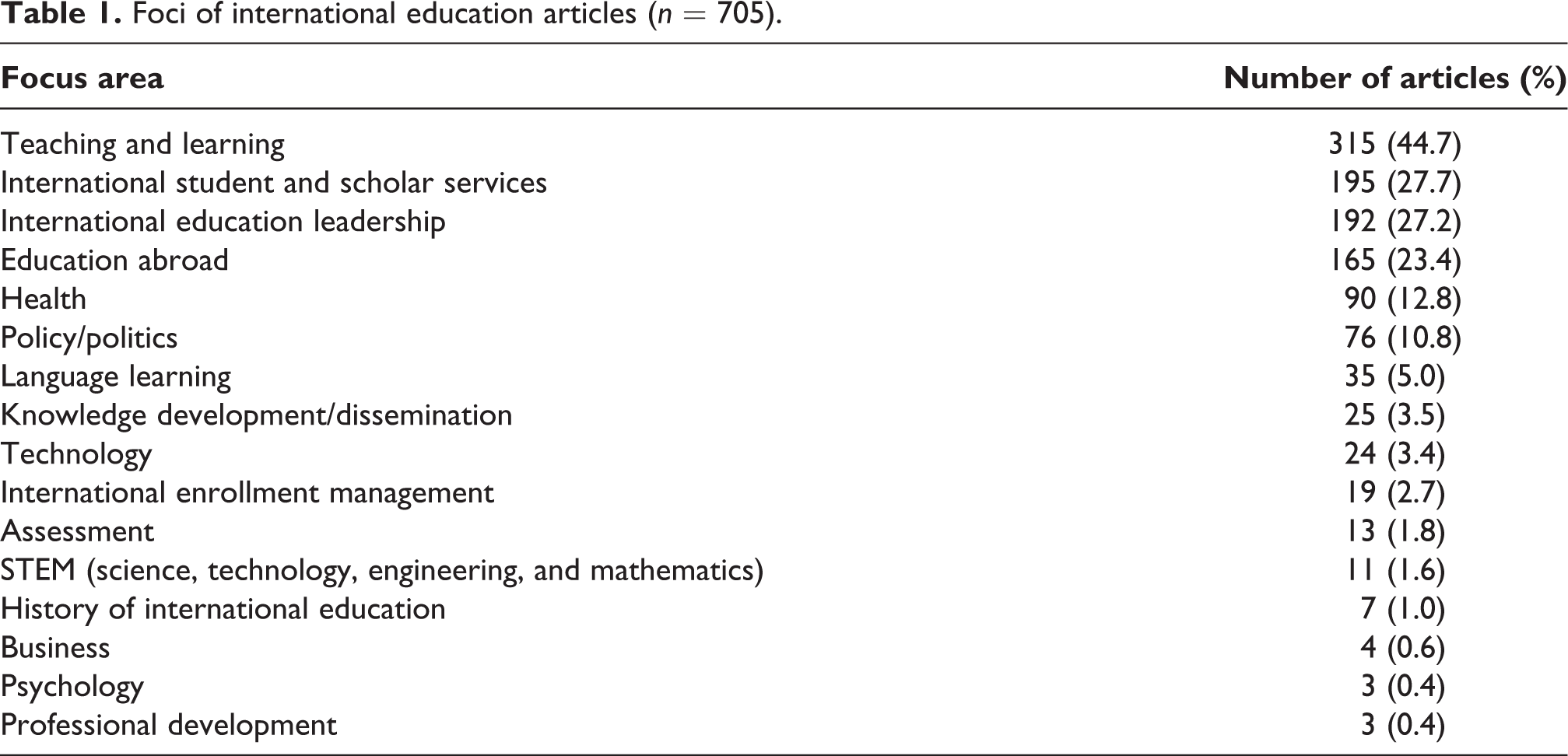
Nearly half of the articles focused on aspects of teaching and learning, and a high number were found to be related to other international education professional areas of responsibility—international student and scholar services, international education leadership, and education abroad. One exception to this was the comparatively low number of articles that touched on international enrollment management. Additional codes show the prevalence of articles focused on health, policy/politics, language learning, knowledge development/dissemination, technology, assessment, the history of international education, and professional development. There were also three codes related to international education for specific academic disciplines (i.e. STEM, business, and psychology).
The findings from further analyses indicate changing trends regarding international education topics over the past couple of decades (see Figure 3).
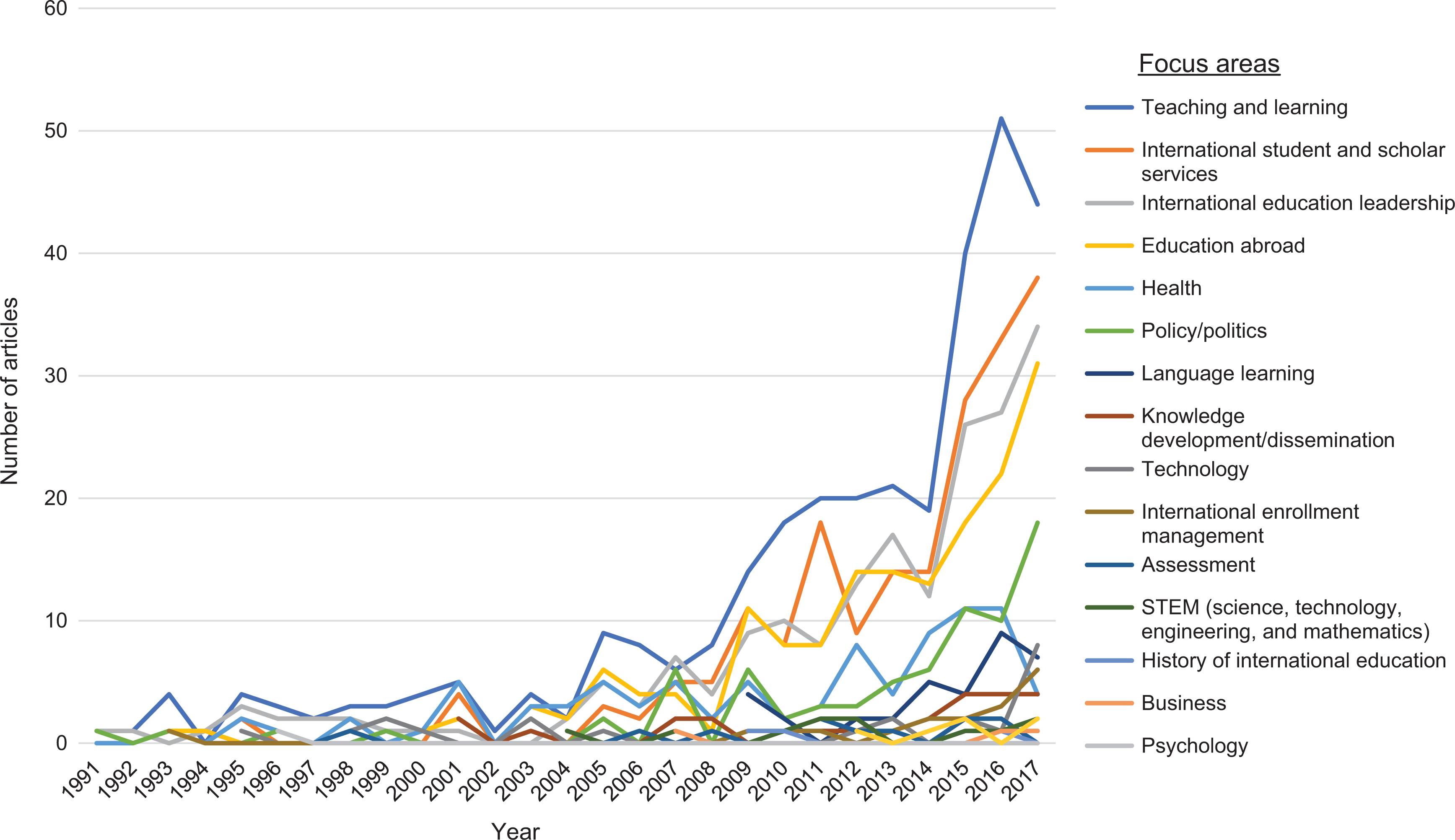
Trends in the foci of international education articles, 1991–2017 (n = 705).
Before 2009, there were never more than 10 articles published each year with any one focus. However, from 2009 to 2017, there were significant increases for certain areas. Starting in 2009, the number of articles related to teaching and learning, international student and scholar services, international education leadership, and education abroad consistently hovered around or above 10 each year, peaking with 51 articles related to teaching and learning in 2016. Articles on health (e.g. as a discipline and mental and physical health during international education experiences) and policy/politics (e.g. national and institutional policies related to international education, including immigration and internationalization) remained consistent but low annually until 2015, when each had 11 articles (jumping to 18 articles related to policy/politics in 2017). Technology (e.g. online and distance learning, and using technology for programs and curricula) became a primary subject for articles in 1995, with consistently few articles on the topic until 2017. The expansion of knowledge development/dissemination articles started in 2001, considering international education as a field and with additional theoretical contributions and discussions. None of the articles reflected language learning (e.g. learning foreign languages, including English) until 2009, yet there was noticeable growth in this area of scholarship in subsequent years. Comparatively few articles were published annually which focused on assessment (for programs and students), international education in academic disciplines (i.e. STEM, business, and psychology), the history of international education, and professional development.
National contexts
In coding for national contexts, we looked at how the authors presented their perspective (i.e. developing programs for international students/scholars in a specific country/region or focusing research on individuals going abroad from a specific country/region). In cases of transnational and online or distance learning, there were often multiple countries mentioned within the articles’ titles and/or abstracts. Of the 705 articles reviewed, 431 referenced a national context. As shown in Figure 4, the majority of these articles had a national context centered in anglophone countries—the USA (n = 96), Australia (n = 77), the UK (n = 36), Canada (n = 28), and New Zealand (n = 12). The highest number of articles in a non-anglophone national context came from China (n = 24), Malaysia (n = 13), and Russia (n = 12), followed by fewer numbers of articles spread across 69 other countries. These findings are explored more in relation to the relevant theories of power and world systems within the discussion.
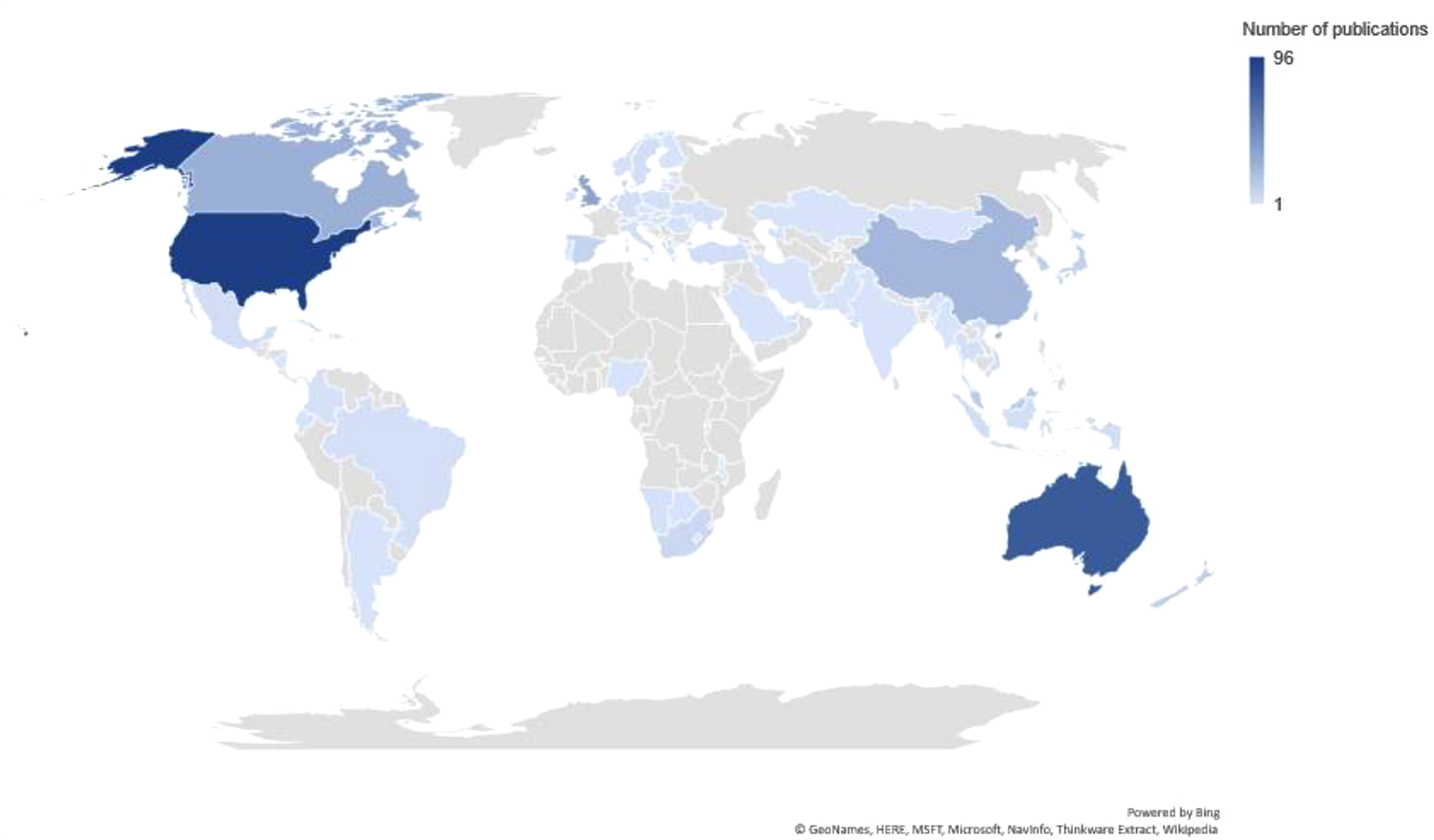
Distribution of national context perspectives of international education articles (n = 431).
Journals
The 705 international education articles were published in 359 different journals. The journals with the highest number of international education articles were the Journal of Studies in International Education (n = 49), Higher Education (n = 23), and the International Journal of Educational Development (n = 21). The other 612 articles were spread across 346 other journals, including Compare: A Journal of Comparative and International Education, the Journal of International Students, the International Journal of Intercultural Relations, and Studies in Higher Education.
We reviewed the websites of the 56 journals that published more than three relevant articles. We found that 84% were produced by the major scholarly publishers: Taylor & Francis (n = 23), Wiley (n = 7), Elsevier (n = 6), Springer (n = 6), and SAGE (n = 5). Twelve were easily identifiable as being the official journal of a society, association, or organization. Related to disciplinary focus, 32 were focused on education—for example, education generally (n = 19); education related to development, globalization, or comparative education (n = 6); higher education (n = 4); and international education (n = 3)—and 24 were related to another discipline—for example, nursing/medicine (n = 10), geography (n = 4), language (n = 2), and politics/migration (n = 2). We also found that only a few journals were focused on scholarship about a particular country or geographical region—the Asia-Pacific (n = 6), Europe/UK (n = 2), and Russia (n = 1).
The copyright and archiving policies of the 56 journals that published more than three articles were also reviewed using the Sherpa Romeo website, https://v2.sherpa.ac.uk/romeo/. Four of the journals were fully open access—the Journal of International Students, the American Journal of Pharmaceutical Education, BMC Medical Education, and Tomsk State University Journal—while a majority had “green” archiving policies. There was no pattern to the impact factors and rankings of these journals; some had high impact factor rankings, others had low rankings, and many were in the middle for their disciplinary category.
Discussion
The findings of this study indicate interesting trends regarding publication in the field. There were also unexpected results, especially in relation to Foucault’s (1980, 2002) theories of power and knowledge, and Wallerstein’s (2004) world-systems analysis.
More publications
From this research, it is clear that more work is needed to index publications properly from before 1991 (and even more recently) to include all abstracts and keywords. The noticeable rise in the sheer number of publications over the past three decades means that even when access may be available, it can be extremely difficult to sift through and identify appropriate publications. Many factors have contributed to this rise in the number of publications. First, there has been an increase in the number of academic publications due to the growth of higher education in general and the resulting “academic machine” (Abbott, 2015). There are now more PhD-granting degree programs, producing ever more job-seeking academics, causing increased competition, and raising expectations for the number of publications graduate students and early career professors should publish. This has led to new frameworks in universities and organizations that encourage higher rates of publication (Altbach and De Wit, 2018). In addition, the worldwide economic recession in 2008 contributed to an increase in the number of individuals obtaining higher-level academic credentials (Parker, 2015).
As higher education has expanded, the societal value placed on higher education degrees and certifications has changed (Horowitz, 2018). Using the field of international education as an example, there are now many entry-level positions that require a Master’s degree, when not long ago they did not (Friedman and Reza, 2019; Woodman and Punteney, 2016). There has also been a rise in the number of international-education-related graduate programs—including majors and concentrations—at both the Master’s and doctoral levels in the past three decades (Friedman and Reza, 2019; Heyl, 2016; Woodman and Punteney, 2016). In addition, many seasoned international education professionals are now earning doctorates while working full-time, in order to advance in the field (Friedman and Reza, 2019; Streitwieser and Ogden, 2016; Woodman and Punteney, 2016). This rise in academic credentials in international education has occurred alongside an increase in publication venues for scholarly discourse in international education over recent decades (Heyl, 2016; Saubert and Ziguras, 2020; Streitwieser and Ogden, 2016), including academic journals, books, professional publications, and online outlets. This results in noticeable patterns (as shown in Figure 2), for, as more journals are created each year, more journals are indexed in databases such as WoS, increasing the relative number of more recent articles to older articles. In addition, publications from other areas of the world and in other languages, as well as a growth in the number of open-access publications, have also contributed to this rise in the number of publications (McNaught, 2015). Publications are now being churned out at such an alarming rate, and from such varied sources and in so many languages, that it is nearly impossible to keep up with everything that is published related to international education.
Expanding topical focus areas
Based on our analyses, Dolby and Rahman’s (2008) six approaches are not sufficient to cover scholarly discourse in the field of international education. We utilized broader categories for this study to align with separate professional aspects of the field and recognize the connections between disparate areas of scholarship, and remained open to additional topics for different niche areas of international education research.
Our findings indicate that nearly half of the international-education-relevant articles reviewed were related to teaching and learning. This is not surprising as it could be considered the most general code and it is more common (and expected) for scholars and faculty members to publish than those in practitioner roles, whether in their discipline or more generally. The frequency of coding for different areas of global/international education offices—international student and scholar services, international education leadership, and education abroad—was also quite high. It is interesting to note, however, that comparatively few articles referenced the recruitment and admissions of international students/scholars (e.g. international enrollment management). Following the broad professional categories, we identified a high number of articles overall that were relevant to both health and policy/politics. These findings have important ramifications, as research efforts and collaborations will undoubtedly rise in these areas in relation to COVID-19. Several distinctive topics were also noted during coding as emerging in international education scholarship over the past decade: student identities and experiences (including issues of inequality and discrimination), institutional policies and national politics, partnerships and transnational education, and education in the neo-liberal environment (considering assessment, global citizenship, and workforce development). Such topics are critical to advancing the knowledge of the field and worthy of further inquiry.
This study addresses a small portion of all the academic and professional publications that are relevant to the field of international education. This is due to a combination of (a) authors not including “international education” or “global education” in their abstracts or as keywords for their work; (b) search engines such as WoS, Scopus, and Google Scholar not assigning metadata for works on international education experiences and programs; and (c) tools such as WoS not including much scholarship produced outside the Global North. For example, a quick search of WoS for the terms “international student*” and “study abroad” reveals thousands of results that were not included and analyzed in this study’s data set; yet, in relation to these international education subfields, it should be recognized that study abroad and international students both involve student mobility and are integral parts of international education, and efforts should be made to tag articles with appropriate subject headings and keywords that could help to make this relationship clear. Further research is needed as to why authors and bibliometric databases have not made such necessary connections to the larger field. Some authors may also be focused on international education topics in their own academic disciplines (i.e. study abroad for business students or international students in STEM disciplines) and miss connecting to the wider scholarly discourse in international education. With this in mind, it would be beneficial to consider how authors and journals tag content for relevance in order to make content more discoverable for all.
Inequality
As knowledge is power and what is valued by those who hold power is reproduced in the discourse and knowledge of disciplines and wider society (Foucault, 1980, 2002), our findings have implications regarding inequality in power and knowledge across the published discourse in international education. Being aware of the focus areas in international education publications allows us to more easily analyze what is being proffered and valued in the scholarly discourse, and what is being obfuscated and discarded. For example, our analysis demonstrates the clear delineation of international education scholarly discourse worldwide between countries from the core, semi-periphery, and periphery (Wallerstein, 2004). As expected, much of the research and scholarship in international education is dominated by core (i.e. Global North, anglophone) countries, whereas comparatively little scholarship is identified from non-core countries. This is troubling, as it is important to consider perspectives from across the world and in languages other than English, especially in a field such as international education, which is interdependent on both national and global interests.
One factor that is contributing to this problem is that the WoS database, like most research databases, primarily indexes anglophone scholarship created in Global North countries. Scholarly journals from (semi-)periphery countries are not always included in major indexing tools (Brint, 2017; Gray, 2010). This has led to a movement in different regions to develop home-grown search tools that address this disparity (e.g. SciELO–Scientific Electronic Library Online and Redalyc in Latin America and Africa Journals Online in Africa). In 2015, WoS launched the Emerging Sources Citation Index and incorporated it into the WoS Core Collection in order to extend coverage beyond core countries to “cover all disciplines and range from international and broad scope publications to those that provide deeper regional or specialty area coverage” (Clarivate, 2020b). However, according to data presented on the WoS website (Clarivate, 2020a, 2020b), as of 2020, this accounts for only approximately 4% of the database’s records.
A limitation of this study is that it was conducted and written in English. Although we tried to include publications from other languages by using a search tool such as WoS, which includes languages other than English, search tools in general tend to be heavily biased towards anglophone scholarship from the Global North. Over a decade ago, Dolby and Rahman (2008: 679) noted that much of the available research is published between core anglophone nations, and anglophone scholars tend to “contribute disproportionately to journals and books published in English.” More recently, others (Bedenlier et al., 2018; Jooste and Heleta, 2017; Kudo et al., 2017; Tight, 2017) have made similar mention of the biased tendency towards scholarship from the Global North and research written in English, even as “there has been a recent increase of information being disseminated from Asia, Latin America, and Africa” relevant specifically to international education (De Wit and Urias, 2012: 101). Our research demonstrates that this bias continues. Therefore, it is especially important when using reference databases such as WoS to acknowledge their limitations in providing access to scholarship from a truly broad range of countries and languages.
Our findings also have implications related to the accessibility of information. Although technology has had an enormous impact on the accessibility of scholarship, and more information is now available to more people in more places, inequality still exists, and many still do not have access to publications that could be essential to their work. For example, content being locked behind subscription paywalls inhibits access to information for individuals and institutions that cannot afford access. This is especially true in many countries outside the Global North. The fact that a majority of the articles analyzed in our study were published by the major commercial scholarly publishers demonstrates the dominance of for-profit academic publishers, as well as the dominance of the Global North and anglophone discourse in the discipline of international education, and the predominance of this content in search engines such as WoS. Although many of these publishers have “green” open-access archiving policies, most also enforce an embargo of 12–48 months on authors posting to institutional or open-access repositories. In reviewing the journals in our study that published the most articles, only four were open-access journals, available to anyone in the world to access. As international education is an international field, colleagues across the globe should be able to access each other’s work from any country or any institution, no matter their economic resources. Fortunately for those seeking wider accessibility to scholarly publications, the importance of open access is rising in higher education, and publishing in an open-access journal is now more desirable and sometimes required by institutions and funding agencies (McKenzie, 2019; Nelson, 2013).
Conclusion
As international education is a field which is both practical and theoretical, practitioners and scholars need to be aware of the state of scholarship for both current topics and emerging trends. Therefore, it is important for authors and citation indices to code international education scholarship appropriately in order for everyone to be able to identify relevant international education research. This article has reviewed published international education literature indexed in WoS to identify key topics and publication patterns, and has identified potential gaps and inequities in current scholarly discourse. The findings reveal that there has been a significant increase in international education publications over the past two decades, with evolving trends regarding topical foci and methods. Yet there are also publication disparities regarding national contexts and a dearth in representation of publications in languages outside the Global North and anglophone-dominated discourse.
Based on this research, the following recommendations could enhance scholarship in the field of international education. Some of these recommendations focus on discoverability and are achievable by an individual, while others would require significant coordination among institutional stakeholders. At the individual level, authors need to be more intentional when crafting titles and abstracts, and assign author keywords that clearly connect to the broader field and highlight the international education aspects of their work. If an author does not self-identify their work as international education research, instead choosing to utilize only disciplinary or praxis-based terminology, it can be difficult to find relevant research and make necessary connections. At the institutional level, international education needs to create a thesaurus of controlled-vocabulary subject headings that could be consistently applied to the literature in order to make scholarship in journals and databases more discoverable. Taking this even further would be an initiative to create a searchable index and/or repository of international education literature to bring related scholarship together and help solidify international education as a field. Both of these initiatives would require significant resources and coordination among institutional stakeholders, but would also greatly enhance the field. Additionally, the field of international education would benefit from increasing the visibility of scholarship produced outside the Global North and in languages other than English. This could be achieved by pressuring more databases and indexes to include publications from these regions. It could also be achieved by the creation of an international education repository or index that specifically places a priority on including these publications.
Considering the insights gained from this analysis, a number of suggestions for areas of future research have emerged, including examining and clarifying the conceptual links in scholarly discourse across the different subfields of international education (e.g. How does research on international students overlap and differ from research on education abroad?); looking at how power structures of knowledge can both resituate and challenge the primary themes and dominant scholarly discourse in international education; examining the positions and institutions of authors (e.g. Are articles more practice-focused or more teaching/learning- and scholarship-focused based on the professional identities of authors?); and comparing scholarly discourse in international education from different areas of the world (outside the Global North and anglophone contexts). Furthermore, although a great deal of scholarship has been produced since the end of World War II, with significant increases after the end of the Cold War (De Wit and Merkx, 2012; Dolby and Rahman, 2008), comparatively few meta-analysis studies and systematic reviews have included scholarly discourse in the field from before the mid 20th century to go beyond focusing on the history and initial development of the international education field (De Wit, 2002; Sylvester, 2002, 2015). All of the previously identified systematic reviews were focused on articles published over the past two decades, and this study was similarly limited by the range of data available from WoS. Examining how bibliometrics can be used to reflect both current and long-term themes across the field of international education over a longer period of time could be useful.
Enhancing the visibility of international education research and connecting the disparate threads of past and ongoing scholarly inquiry is imperative to building up the field of international education as an academic discipline in its own right. One of the challenges for international education is connecting with other international education scholars and research. This difficulty arises not only because of geography and the international scope of the field, but also because scholars often belong to separate academic disciplines, just as there are long-standing professional divisions among practitioners. By not connecting on a larger level, the scholarly discourse for international education remains fragmented, and it is difficult to identify the larger trends and needs of the field. By better understanding the interrelationships between different areas of international education research, researchers and practitioners can be more purposeful in learning from and contributing to both the academic and professional sides of the field.
Footnotes
Declaration of conflicting interests
The authors declared no potential conflicts of interest with respect to the research, authorship, and/or publication of this article.
Funding
The authors received no financial support for the research, authorship, and/or publication of this article.
