



Abstract
Library and information science professionals are considered to have appropriate skills and competencies with regard to copyright and related issues. Using a quantitative survey at the provincial level (Khyber Pakhtunkhwa), the copyright literacy of library and information science professionals was investigated in Pakistan. Out of 311 respondents, 279 participated in the survey. The results indicate that library and information science professionals are somewhat familiar with copyright and related issues. The majority of them (94%) mentioned that published materials such as books and articles are under the protection of copyright. Similarly, 73% were aware of local copyright laws; however, they were less familiar with international copyright legislation. Library professionals mentioned that the current library and information science curriculum is not providing adequate knowledge about copyright, therefore, most (94%) expressed the need to include copyright legislation and basic concepts of copyright in the library and information science curriculum at all levels. The findings suggest practical measures to enhance the level of the copyright literacy of Pakistani library and information science professionals.
Introduction
The close relationship between copyright law and the development of library activities has become more intense and complex in recent years due to the impact of the digital setting. For this purpose, library professionals must have adequate knowledge about copyright, whether it be to carry out their own functions and tasks or to help co-workers and users as efficiently as possible (Fernández-Molina et al., 2022). The digital paradigm presents new challenges for the fundamental copyright doctrines that are the legal cornerstones of library services (American Library Association, 2019). At present, intellectual property and copyright issues are increasingly important, among other issues, in the academic arena (Arias Coello et al., 2020). The importance and impact of copyright in the development of academic activities, and therefore in the proper functioning of academic libraries, has grown steadily. This growth is not due to the fact that most intellectual works are copyright-protected but reflects the rapid development of the digital setting, which means an increase in both the relevance and complexity of copyright issues (Fernández-Molina et al., 2022). Traditionally, libraries have been leaders in trying to maintain a balance of power between copyright holders and users, or at the very least have advocated for intellectual freedom and promoted access to information (Nilsson, 2015). But the proliferation of digital information has caused serious issues in information accuracy, relevancy and ethical use. Library professionals are continuously facing the problem of maintaining a balance between providing access and protecting authors’ rights (Nawazish and Batool, 2022). These developments have brought with them complications in the roles of library professionals (Fernández-Molina and Muriel-Torrado, 2018).
The diversity and complexity of the relations between copyright and open access has been the main source of uncertainty and conflict among members of the academic community. They range anywhere from the possibilities of using scientific articles already published and whose rights were transferred to publishers – and the possibilities of recovering these rights – to the conflicts between the free availability of theses and dissertations and the justified explanation of their results in other publications, going through the question of ownership and management of research data (Fernandez-Molina et al., 2022). Resolving such conflicts without copyright infringement or creating obstacles for academic and research activities calls for sound knowledge of copyright legislation.
In the area of copyright protection, library and information science (LIS) professionals are expected to have the appropriate skills in copyright and related issues, and therefore expected to resolve such issues through appropriate knowledge of and literacy in copyright (Eye, 2013; Patel and Hanumappa, 2019).
The studies by Arias Coello et al. (2020), Fernández-Molina and Muriel-Torrado (2018), and Tella and Oyeyemi (2017) identify that students and even teaching faculty whose knowledge is considered to be at a high level lack copyright literacy. Fernández-Molina et al. (2022) mention that this situation has been acknowledged by library professionals, who have taken on new roles to educate their users, faculty and students about copyright and related issues. In this regard, it is worth underlining the recent appearance of the concept of ‘copyright literacy’, which was coined by Tania Todorova in a multinational survey of the copyright literacy of specialists from libraries and other cultural institutions (Todorova et al., 2017). Secker et al. (2019) regard the term to mean knowledge about copyright. Kortelainen (2015) calls it the ability to identify copyright-protected materials, navigate fair use and fair dealing, obtain permissions and licences where necessary, and recognize infringement of copyright law. The IFLA (2018a) states that copyright literacy includes understanding the structure, functioning and implications of the copyright system as laws, practices and user expectations evolve. As a result of recent developments in information formats and the open access movement, everyday copyright law affects the way libraries provide information to their users, and every outcome can directly affect the future of libraries (American Library Association, 2019).
As the traditional skills and aspects of librarianship have changed – partly due to the complex development of scholarly communication, digital collections, and the demands of new services related to e-resources, publishing and copyright – librarians often do not feel confident in their knowledge about copyright, and are therefore hesitant to take on this new role (Nilsson, 2015). Not only are librarians, as professionals, bound to uphold the values of our profession, of which copyright is one, but it is our role to protect the copyright of those who allow us, as a public service, to lend their property to others (Hossain, 2021). Consequently, librarians and other information management professionals need to be copyright literate in order both to carry out their own functions and duties and to support colleagues and users in the most effective way possible (IFLA, 2018b). Hence, there is a need for basic knowledge and to stay up to date with new developments about copyright, and it is crucial to continue to address the emerging challenges posed at the intersections of technology, society and the law (Hossain, 2021).
The literature suggests that there has been a wide range of international studies undertaken in this area of knowledge (e.g. Arias Coello et al., 2020; Boustany, 2014; Eye, 2013; Hossain, 2021; Kelly, 2018; Kortelainen, 2015; Fernandez-Molina et-al., (2022); Patel and Hanumappa, 2019; Terra, 2016; Todorova et al., 2017), but in Pakistan copyright literacy is a somewhat less-researched area. In this context, the current study has been undertaken to fill this literature gap by investigating the copyright literacy of LIS professionals in Pakistan, which is a potential area of research.
The Pakistani context
In Pakistan, the first law on copyright was the Copyright Act, 1914. It was modelled after the UK Copyright Act, 1911. The Copyright Ordinance, 1962 replaced the earlier Copyright Act, 1914 (Bashir and Khan, 2016a). However, in order to extend the scope of protection to new material and ensure stringent enforcement of copyright, different provisions have been made in the ordinance, which determine when a work is in violation of copyright (Mahmood and Ilyas, 2005).
In Pakistan, registering a work with the registrar of copyrights is not a requirement for obtaining copyright protection. Rather, copyright protection is vested in the original creator as soon as a work is created and recorded in a material form. The term of copyright is 50 years after the death of the author (Chaudhry and Iqbal, 2005).
The Constitution of the Islamic Republic of Pakistan gives assurances about the protection of all types of rights (Bashir and Khan, 2015). From time to time, different ordinances and acts have been passed to protect the intellectual property rights of creators (Bashir and Khan, 2017a). The Copyright Ordinance 1962 (III of 1962) is still enforced with many amendments in it since its promulgation in the form of ordinance in Pakistan. (Bashir and Khan, 2015, 2016a, 2016b, 2017a, 2017b; Chaudhry and Iqbal, 2005; Khan and Bashir, 2019).
The Intellectual Property Organization of Pakistan (IPO-Pakistan) was established as an autonomous body on 8 April 2005 under the administrative control of the Cabinet Division for integrated and efficient intellectual property management in the country. On 25 July 2016, the administrative control of IPO-Pakistan was transferred from the Cabinet Division to the Commerce Division. The Trade Marks Registry, Copyright Office, and Patent and Design Office became part of the new organization under a unified and integrated management system. 1
All intellectual property rights laws are administrated and managed by three different ministries of the federal government: the Ministry of Education, Ministry of Industries and Production, and Ministry of Commerce. The central Copyright Office is located in Karachi in the province of Sindh, and functions under the administrative control of the Ministry of Education (Chaudhry and Iqbal, 2005).
The international copyright treaties to which Pakistan is a signatory include the Berne Convention for the Protection of Literary and Artistic Works and the Agreement on Trade-Related Aspects of Intellectual Property Rights. Under the protocols of these conventions, Pakistan is bound to comply with the rules and regulations envisaged in their manifestos (Bashir and Khan, 2017a). There has been tremendous pressure from the European Union and USA on Pakistan to look into the issue of piracy, as it is a signatory to international conventions to protect the rights of foreign authors (Khan and Bashir, 2019).
The concept of copyright in Pakistan is not common and is often misunderstood, which results in the violation of copyright laws (Khan et al., 2021). Pakistan is considered to be a hub for book piracy, with certain markets in Karachi and Lahore being the source of most of the pirated books in the country. Although there are various laws in the Copyright Ordinance, 1962, to combat piracy, the enforcement of these laws is weak (Bashir, 2015).
Literature review
In order to collect information on copyright and the copyright literacy of LIS professionals in Pakistan and at the international level, an extensive literature review was carried out using Google, Google Scholar, the Emerald Insight databases, JSTOR, EBSCO Host, Science Direct, IFLA standards, and conference proceedings of national and international library associations (including the Pakistan Library Association, American Library Association, Library Association, and Association of College and Research Libraries), World Intellectual Property Organization, local copyright laws, Publications of IPO-Pakistan, and the Intellectual Property Rights Toolkit of the American Embassy in Pakistan.
Previous literature reports that numerous studies have been conducted at the international level but the concept of copyright literacy remains briefly addressed in the local literature, and there was no identifiable primary literature specifically on the copyright literacy of LIS professionals in Pakistan.
Knowledge of and familiarity with copyright and related rights
A better understanding of copyright can reduce concerns about fair use and fair dealing. Library professionals need to be copyright-aware, given the widespread use and licensing of online contents. This is most important at a practical level, so that they can answer copyright and licence-compliance questions on a daily basis. The literature includes several studies on the copyright literacy of LIS professionals. Nawazish and Batool (2022) investigated the copyright literacy levels and awareness of academic librarians in Pakistan and found that a large number of their respondents were moderately aware of intellectual property rights. The study suggests that intellectual property rights need to be included in the LIS curriculum. In another recent study, Reddy (2021) assessed the copyright trends and level of copyright awareness among academic librarians in India. The study found that the majority of LIS professionals were aware of the copyright law. The findings of the study further show that 63% of the LIS professionals rated their level of awareness as beginner, which indicates a minimum level of knowledge of the law.
Hossain’s (2021) study highlights the need for an applied approach regarding intellectual property and copyright literacy in Bangladesh. He found that the knowledge of LIS professionals was good with regard to copyright law. However, in order to update their knowledge, they were not aware of the many copyright organizations that could provide training on related issues.
Secker et al. (2019), after giving a detailed account of experiences of copyright literacy in Norway, Turkey, Romania, the UK and Sweden, conclude that the present situation of the librarians in these regions in respect of copyright literacy is not up to the mark. Patel and Hanumappa’s (2019) study found that LIS professionals’ level of understanding about copyright was not ideal, although they were somewhat aware of the issues involved. According to Fernández-Molina et al. (2017), comparatively, librarians have a higher degree of awareness of the validity of copyright, Creative Commons licences and the public domain. However, Naheem’s (2017) research on the copyright literacy levels of Indian LIS professionals notes that the majority were only slightly familiar with copyright-related issues.
Fernández-Molina et al. (2017) assessed the level of awareness of LIS professionals about copyright in their day-to-day business in Brazil. The study found gaps in the knowledge of LIS professionals. In order to bridge these gaps, they suggest the need for the proper training of LIS professionals. In Schmidt and English’s (2015) study, it is revealed that the level of knowledge of LIS professionals about copyright was intermediate. Charbonneau and Priehs (2014) report the results of a national survey of LIS professionals in the USA about their literacy with regard to various copyright policies and training needs. The survey shows that less than 50% of LIS professionals perceived their literacy as appropriate for providing copyright-related information to users. Overall, the review of the literature indicates that most LIS professionals, from both developed and developing countries, lack the required level of knowledge about copyright and related issues.
Copyright in the LIS curriculum
Copyright information is an integral part of the services provided by academic libraries, which indicates the importance of copyright and its related issues in LIS education. There is a continuous increase on the topic of copyright in the LIS literature (Schmidt, 2019). Arias Coello et al. (2020) note several studies that have analysed the inclusion of copyright in the LIS curriculum. Secker et al. (2019) recommend professional development and the inclusion of copyright literacy and correlated knowledge in LIS curricula with the aim of equipping LIS professionals with advanced knowledge and preparing them for future challenges.
Various other studies also indicate that copyright is often not a part of the curriculum in accredited library schools. In a study of 49 American Library Association-accredited library schools, Dames (2006) notes that only two schools were offering copyright-related courses. Similarly, Chu (2010), after analysing the courses of 45 American Library Association-accredited schools, found that none of the required courses were focused on copyright or intellectual property. Cross and Edwards (2011), in their study of American Library Association-accredited Master’s courses, also found that many programmes listed few or even no courses related to copyright. These studies conclude that the instruction related to copyright in the accredited schools was not enough to prepare LIS graduates for the current demands of the workplace.
Several scholars (Adu and Van der Walt, 2021; Arias Coello and Simón Martín, 2018; Kelly, 2018; Naheem, 2017; Todorova et al., 2017) stress that copyright should be included in the LIS curriculum. These researchers argue that knowledge of copyright can enable LIS professionals to deliver information services in a better way.
Sources of information about copyright and related rights
Reddy (2021) discovered that various sources of information were consulted by LIS professionals to enhance their knowledge about copyright issues. These sources included conferences, workshops, seminars, books and articles. Hossain (2021) conducted a survey to investigate the copyright literacy of LIS professionals in Bangladesh. He found that, in most cases, LIS professionals consulted experts from the academic and scientific community (69%), national library and other professional associations (59%), and the International Council of Museums (49%) at a time of need. The findings of the studies by Arias Coello et al. (2020) and Saunders and Estell (2019) reveal that, in Spain and the USA, the majority of LIS students preferred to use websites, books, articles and librarians to learn about copyright and related rights. Patel and Hanumappa (2019) examine copyright and its legal aspects, and discuss the many dimensions of copyright literacy, concluding that the majority of their respondents consulted e-learning sources, journals and their professional counterparts to gain knowledge of legal issues. Gastinger and Landøy (2019), in a study on the copyright literacy of LIS students in Norway, found that they sought copyright-related advice from websites, books and articles. Hatch et al. (2017) carried out a study of copyright specialists in the UK. They discovered that the majority of their respondents used JiscMail lists, LIS-COPYSEEK, and government websites on copyright and intellectual property as sources of information. The studies by Boustany (2014), Hobbs et al. (2007), Kortelainen (2015), Naheem (2017), Schmidt and English (2015), and Terra (2016) show the tendency of LIS professionals towards the use of websites as a source of information about copyright and related issues.
Research objectives
The main objectives of the study are to (1) describe the knowledge and familiarity of LIS professionals with regard to various aspects of copyright and related rights; (2) examine the opinion of library professionals about the inclusion of copyright and related courses in the LIS curriculum; and (3) determine the preferred sources of information that can improve LIS professionals’ knowledge about copyright and related rights.
Methodology
To explore the copyright literacy of LIS professionals in Pakistan, a quantitative web-based survey was conducted using a Google Form adapted from the multinational research project ‘Copyright Literacy in Spanish Library and Information Sciences (LIS) Students’ by Arias Coello et al. (2020). Permission to use the questionnaire was sought from the principal author. Major modifications were made to the questionnaire, keeping to the fore the requirements of the local environment.
The data collection instrument was divided into four parts. Each part contained different questions, most of which had closed response options. The first part gathered demographic information, including the age, gender, professional experience and qualifications of the respondents. The second part of the survey aimed to establish the knowledge and familiarity of the respondents with regard to copyright. Part three then explored the opinions of the respondents on various issues of copyright and its inclusion in the LIS curriculum. Finally, the last part dealt with the preferred sources of copyright and related issues. The survey included closed, semi-open (utilizing a 5-point Likert scale) and open-ended questions.
The online questionnaire was then shared with the target population – the LIS professionals of Khyber Pakhtunkhwa, Pakistan – via their mailing addresses, WhatsApp groups and Facebook groups. The completed responses were received, automatically recorded and tabulated through Google Forms. Descriptive statistics were used to analyse the findings. Some of the target population did not participate in the survey (n = 32).
Study population
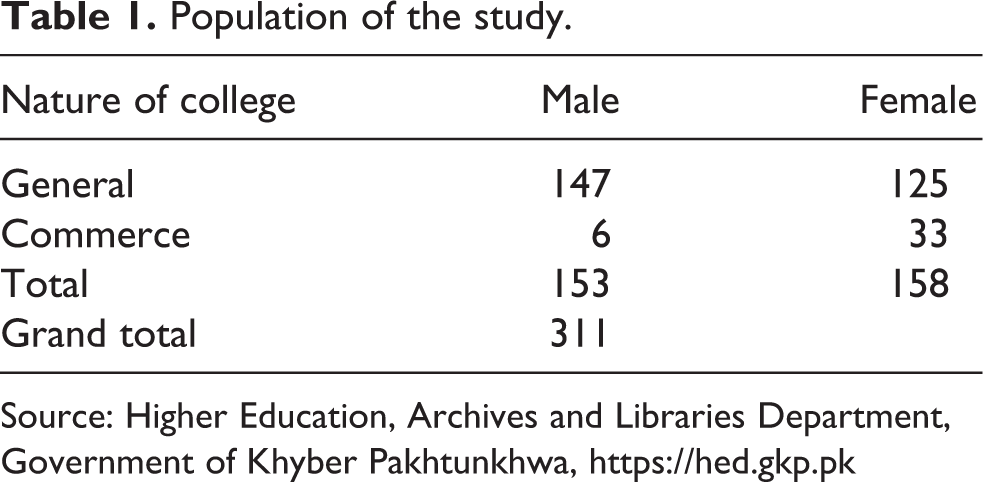
The population of this study was LIS professionals working in male and female colleges in the province of Khyber Pakhtunkhwa, Pakistan. There are 311 colleges in the province, which are under the administrative control of the Higher Education, Archives and Libraries Department of the Government of Khyber Pakhtunkhwa (Table 1). The survey was completed in the second half (June–December) of 2022.
Population of the study.
Source: Higher Education, Archives and Libraries Department, Government of Khyber Pakhtunkhwa, https://hed.gkp.pk
Results and data analysis
Profile of respondents
The survey, which targeted one person from each institution to avoid duplication, produced 279 responses. Moreover, there was only one budgeted position for a library professional in each college of the province. Therefore, the 279 respondents in this survey represented 279 institutions. A higher number of the survey respondents were male (175) compared to female (104). Many studies (e.g. Hossain, 2017, 2019, 2021) have observed that such figures are opposite to the gender ratio of LIS professionals globally, as library positions are predominantly held by females. However, another possible reason might be the low number of female colleges in Khyber Pakhtunkhwa. With respect to age, the largest number of respondents (157, 56%) was in the age range of 31–40. Regarding qualifications, the vast majority held Master’s degrees in LIS (244, 87%). Most of the participants had work experience of up to 14 years.
Knowledge of and familiarity with copyright
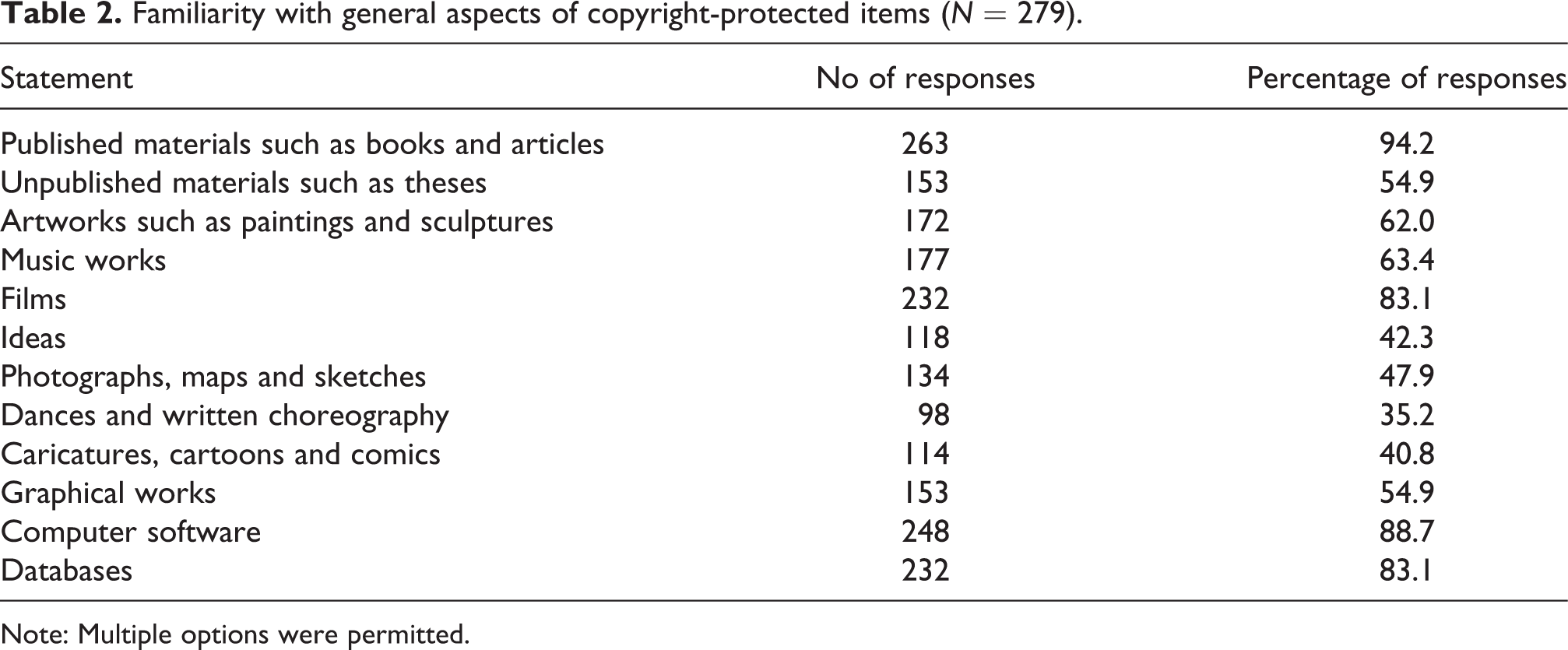
This section of the survey explored the general knowledge of and familiarity with a variety of copyright-protected works (as shown in Table 2). The respondents were asked to comment on their overall familiarity with copyright issues using a 5-point Likert scale ranging from very poor to very good. Their opinions regarding national and international copyright legislation, agreements and related issues were also explored in this section.
Familiarity with general aspects of copyright-protected items (N = 279).
Note: Multiple options were permitted.
General knowledge of and familiarity with copyright-protected items
In order to check the general knowledge and familiarity of the respondents with regard to different copyright-protected items, they were provided with multiple topics that fall under the legal protection of copyright. The respondents were asked to mark the statements according to their familiarity with and knowledge of copyright-protected items. The data in Table 2 indicates that the highest number of respondents (263, 94%) mentioned that ‘published materials such as books and articles’ were under the protection of copyright, followed by ‘computer software’ (248, 89%), ‘databases’ and ‘films’ (232, 83%). The respondents seemed dubious about the inclusion of ‘dances and written choreography’, ‘caricatures, cartoons and comics’, and ‘photographs, maps and sketches’ in the domain of copyright protection. However, their responses were correct for more than 50% of the topics. The findings indicate that ‘published materials such as books and articles’ were familiar among the LIS professionals because the majority of them gave a correct response in this regard. On the other hand, ‘caricatures, cartoons and comics’ were the least familiar to the respondents because the highest number of incorrect responses was recorded for this item. A possible reason for the poor response of the LIS professionals in this area could be that they are rarely confronted with these topics in their day-to-day work. In a nutshell, the LIS professionals were more familiar with traditional and literary works than emerging items. These results indicate that the LIS professionals’ knowledge of and familiarity with copyright was limited.
Self-reported knowledge level about copyright
The respondents were asked to comment on their overall familiarity with copyright, using a 5-point Likert scale ranging from very poor to very good. Out of the 279 respondents, 32% indicated a good awareness level of copyright, 45% indicated a moderate awareness level and 21% indicated a poor awareness level. It is worth noting that none of the respondents rated their level of knowledge as very good (see Figure 1).

Responses regarding self-reported knowledge level of copyright law (N = 279).
These results once again establish the fact that the level of knowledge of LIS professionals about copyright is not up to the mark. This self-reported survey revealed that the majority of the library professionals rated their level of knowledge about copyright as poor and neutral, which indicates their limited knowledge about copyright. These results may be due to the fact that there was not enough space for copyright-related issues in their courses, or they may not have received any training on copyright at their colleges that could boost their knowledge to the desired level.
National and international copyright legislation, agreements and related issues
To explore the familiarity of the respondents regarding national and international copyright legislation, agreements and related issues, they were provided with a set of multiple options. The data in Table 3 shows that 73% of the respondents were aware of the Copyright Ordinance, 1962. However, the respondents were less familiar with international copyright legislation like the Berne Convention (18%), Universal Copyright Convention (26%) and World Intellectual Property Organization (28%). It is encouraging to know that the respondents were more familiar with the concepts of book piracy (83%) and plagiarism (75%). Piracy is the deliberate infringement of copyright laws and plagiarism constitutes a breach of academic integrity and represents substandard scholarship. Both piracy and plagiarism can have a lasting impact on the future careers of students and researchers. It is good to know that the respondents were well aware of these concepts. The data in Table 3 also reflects that the respondents were less familiar with new trends and emerging topics like fair use, the public domain and copyright infringement.
Opinions regarding national and international copyright legislation, agreements and related issues (N = 279).

Note: Multiple options were permitted.
Copyright and LIS education
Beyond nurturing creativity and its broad diffusion, which lie at the heart of copyright, there are a number of compelling reasons to support copyright education programmes in libraries and academia. First and foremost, a high level of copyright awareness makes it possible to avoid legal challenges and, when they do arise, to better respond to them (Harris, 2012). Therefore, the survey respondents were asked to give their opinion on LIS education and its connectedness to copyright. In this section, the survey participants’ opinions were sought on, first, the appropriateness of the existing LIS curriculum in providing adequate knowledge and awareness about copyright to students; second, the inclusion of copyright-related topics in LIS education and the appropriate level for introducing copyright topics in LIS programmes; and, third, the importance of librarians’ knowledge about copyright.
The results in Table 4 indicate a serious situation: 193 respondents (69%) were of the opinion that the existing LIS curriculum does not provide adequate knowledge and awareness of copyright for students. It seems that the current instruction related to copyright in the LIS curriculum is inadequate. This might also be the reason why the majority (263, 94.4%) of the respondents expressed the need to include copyright legislation in the LIS curriculum. Moreover, 96% of the survey respondents also stressed the importance of librarians’ knowledge about copyright-related issues. This would help to respond better to any legal challenge when they arise.
LIS education, the inclusion of copyright topics and its importance for librarians (N = 279).

Note: Multiple options were permitted.
Nowadays, libraries are continuously facing the problem of maintaining a balance between providing information access and protecting authors’ rights. This situation makes it necessary for library professionals to know about, understand and practise copyright law in their day-to-day business.
Copyright-related topics for inclusion in LIS education
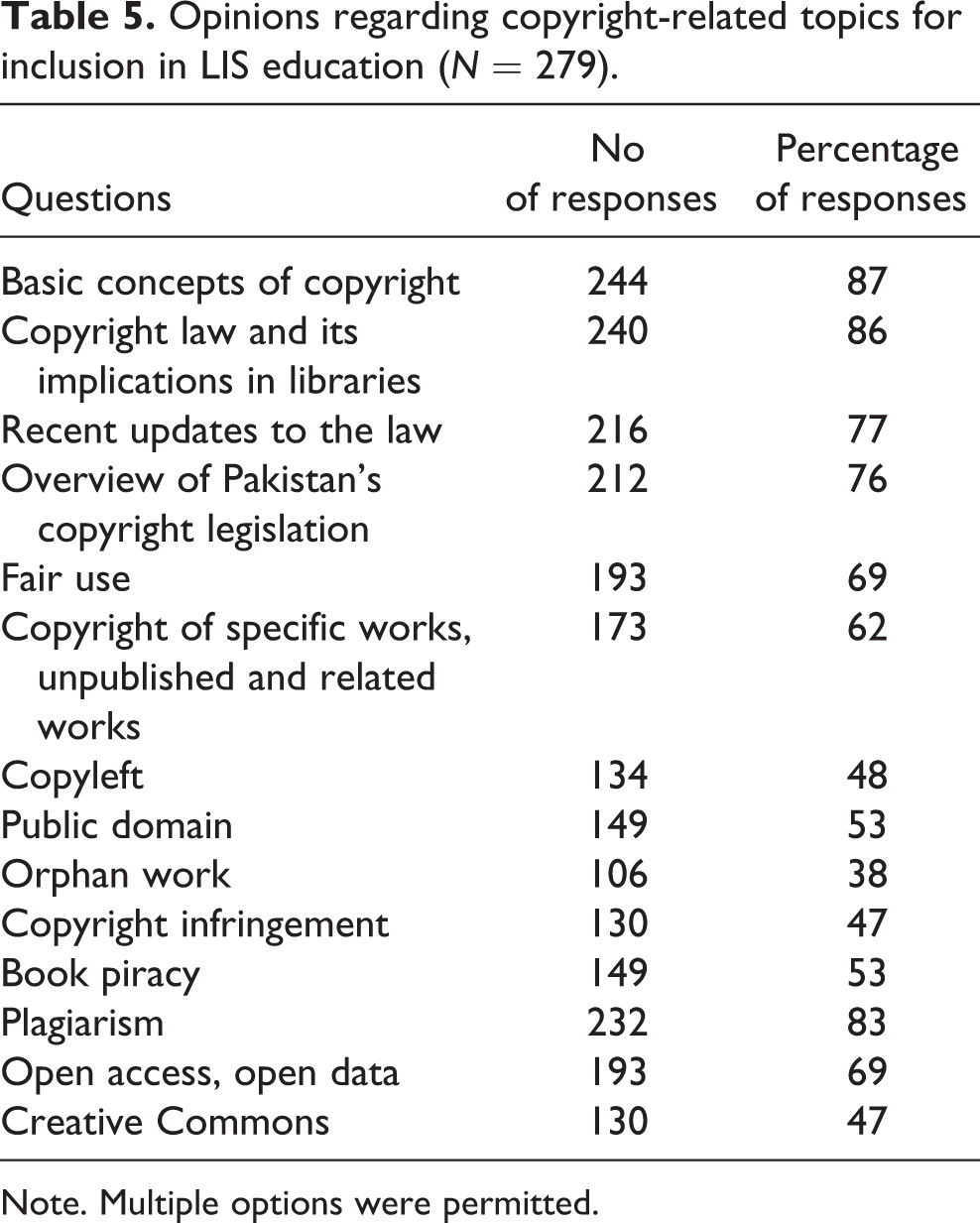
In this section, the survey participants’ opinions were sought on the inclusion of copyright-related topics in LIS education. In closed-ended questions, the survey asked which topics should be included in LIS education. The majority of the respondents were in favour of including copyright-related issues in the LIS curriculum. About 87% were in favour of including ‘basic concepts of copyright’, followed by 86% in favour of ‘copyright law and its implications in libraries’. The inclusion of ‘plagiarism’ in the LIS curriculum was suggested by 83% of the respondents. An equal number proposed that ‘fair use’ and ‘open access, open data’ be included. However, the LIS professionals showed the least interest in ‘copyleft’, ‘orphan work’, ‘Creative Commons’ and ‘copyright infringement’ being included in the LIS curriculum (see Table 5).
Opinions regarding copyright-related topics for inclusion in LIS education (N = 279).
Note. Multiple options were permitted.
Appropriate level to introduce copyright issues in the LIS curriculum
With regard to the appropriate level of LIS education to introduce copyright, the majority of the respondents (42%) considered the Master’s level to be the most appropriate, followed by ‘All’ (undergraduate, Master’s, Master of Science (MS), Master of Philosophy (MPhil) and PhD) LIS education levels (34%), undergraduate (18%) and MS, /MPhil /PhD (6%), as illustrated in Figure 2.
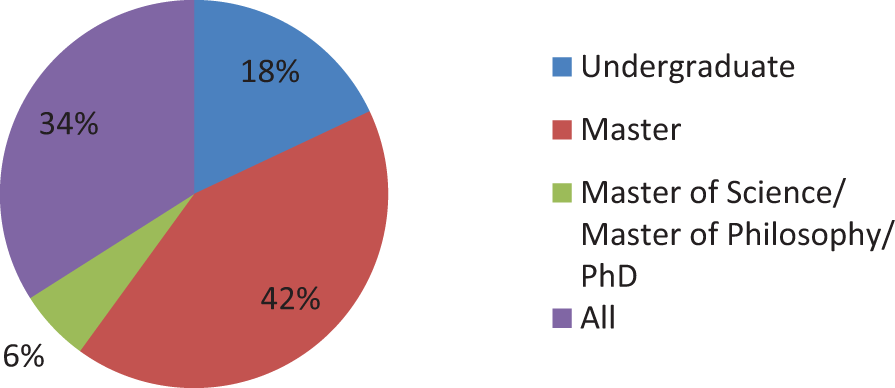
Opinions regarding appropriate level to introduce copyright issues in the LIS curriculum (N = 279).
Despite its obvious importance, the current study identified that instruction related to copyright in the LIS curriculum is inadequate for the needs of the field. Saunders and Estell (2019) observe that copyright issues affect nearly every aspect of library services, from circulation and reserves of materials to the digitization of materials, negotiating licensing agreements and establishing institutional repositories. Librarians are routinely called on to answer copyright-related questions, guide patrons in the appropriate use of materials, provide instruction on copyright, and even set local policy. Indeed, Crawford (2005) suggests that no policy area affects libraries and technology as much as copyright, and few policy areas are as complex as copyright. In order to meet the demands of the field, and to ensure that LIS graduates are prepared for their professional roles, LIS programmes must integrate instruction on copyright-related topics in their curricula.
Preferred sources of information on copyright-related issues
The survey explored how the respondents kept themselves up to date with copyright-related issues in the context of their work. The data in Table 6 confirms that, in Pakistan, for copyright-related advice, the LIS professionals primarily relied on ‘websites’ (78%), ‘books and articles’ (63%) and ‘colleagues’ (47%). In general, the respondents seemed to be much more interested in getting advice from websites than lawyers, the World Intellectual Property Organization, IPO-Pakistan, or national and international library associations (such as the Pakistan Library Association, American Library Association, Library Association, Association of College and Research Libraries or IFLA). However, results from other countries like India, the UK and France show that LIS professionals in those countries also used websites as a primary source of information for copyright-related issues (Reddy, 2021; Hatch et al. 2017; Boustany, 2014).
Preferred sources of information on copyright-related issues (N = 279).
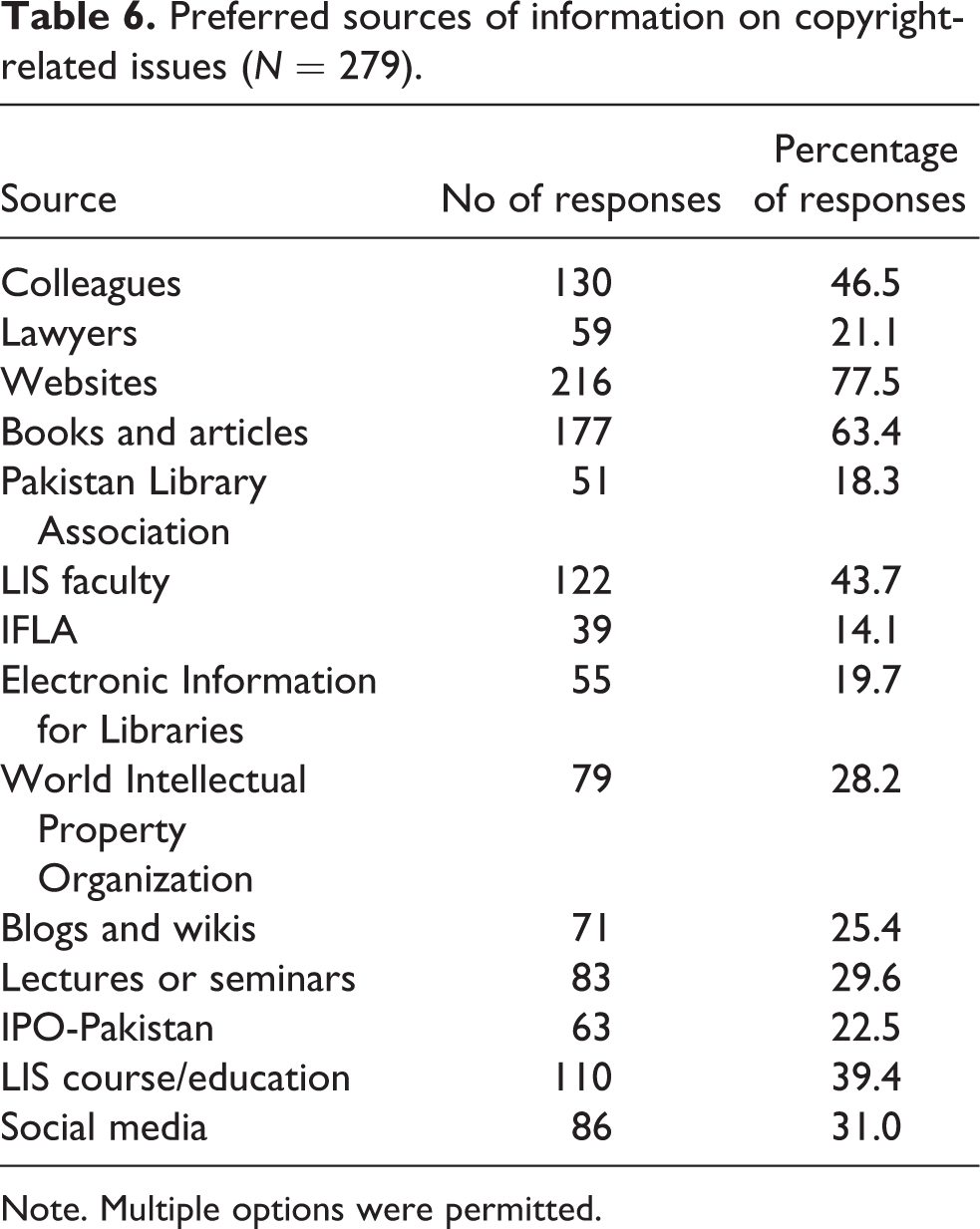
Note. Multiple options were permitted.
Discussion and comparison with other surveys
The findings of this study reveal that, in general, LIS professionals in Pakistan lack knowledge and awareness about copyright and related issues. The self-reported survey revealed that the majority of the library professionals rated their level of knowledge about copyright laws as poor or neutral, which indicates their lack of knowledge about copyright laws. The data reveals that the respondents were able to identify published materials, computer software, databases, films and music works under the domain of copyright. However, they were unsure about recognizing photographs, maps, sketches, dances, written choreography, cartoons, caricatures and comics as copyright-protected materials. The respondents were somewhat more familiar with national copyright laws than international copyright laws. However, their level of confidence in the various components of national copyright was weak. About 70% of the respondents considered the current LIS curriculum to be inappropriate in meeting the requirements of professionals. They suggested an upgrade of the LIS curriculum at all levels of library education and the inclusion of copyright-related issues like Creative Commons, infringement, piracy and orphan work. The results indicate that LIS professionals in Pakistan used websites as their primary Hossain (2021) narrates that LIS professionals often act as default copyright mavens at their institutions and, therefore, must have an awareness of copyright law and practices. This is the reason why 96% of the survey respondents stressed the importance of librarians’ knowledge of copyright-related issues in order to conduct their day-to-day business.
The results of this study support the findings of Nawazish and Batool (2022) and Arias Coello et al. (2020). The findings of these studies indicate that the majority of the items (except for ‘caricatures, cartoons and comics’) were correctly placed under copyright-protected materials by the respondents. The majority of the respondents in both studies were of the view that librarians must have knowledge of copyright and suggested the inclusion of copyright in LIS courses. The results of this study are also similar to the findings of Kortelainen’s (2015) research, in which the majority of the respondents rated themselves as somewhat familiar with copyright and related issues. Moreover, the same results were found in Terra’s (2016) study, where the respondents were more familiar with national copyright laws than international laws and agreements. ‘Book piracy’, ‘plagiarism’, ‘open access, open data’ and ‘protection for published works’ were the most familiar items, while ‘Section 108 of the US Copyright Act’, ‘copyright infringement’, ‘orphan work’, ‘the public domain’, ‘protection for unpublished works’ and ‘fair use’ were the least-known topics among the respondents. These results are also similar to the findings of the study by Hossain (2021).
Conclusion and recommendations
The current study provides empirical evidence about the copyright literacy of LIS professionals in Pakistan. The findings suggest the need for improvement and practical measures to enhance the level of copyright literacy among LIS professionals. Viewing copyright as part of information literacy and scholarly communication is significant for LIS professionals, therefore they should regard it as an integral part of their profession. This study also suggests that the level of copyright literacy among Pakistani LIS professionals is far from satisfactory, therefore additional efforts are needed to embed copyright education. This requires the attention of LIS schools, especially faculty across Pakistan, to include copyright education in their curricula in a wider context, both in theory and in practice.
The unprecedented growth in the shape, frequency and reproduction of information has brought with it complex legal issues, as well as complications, for the activities of library professionals. This has had a major impact on how libraries function, the public services they provide and librarians. Today, libraries face more complicated intellectual property and copyright issues than in the past. Practical knowledge of copyright laws provides a sound basis and tactical direction for library professionals. Without adequate copyright training, library professionals cannot fulfil the requirements of the field or users’ needs, since they are the first port of call for advice on copyright. Therefore, there is an emerging need for LIS professionals to know, understand and practise copyright law. The study reflects a general lack of copyright training on the part of LIS professionals, which causes major problems for libraries in fulfilling users’ needs effectively. The digital environment has created multiple opportunities for the inauthentic and illegal reproduction of information, resulting in infringement of copyright. But a copyright-trained and well-versed intellectual-property-literate library professional can avoid such issues. Without copyright and intellectual property training, library professionals in Pakistan cannot fulfil the requirements of the field in emerging areas such as fair use, Creative Commons, open access, the public domain and licensing. For this purpose, the study suggests the development of copyright and intellectual property training programmes for LIS professionals. This training should be organized collaboratively by LIS schools, the National Library of Pakistan and the Pakistan Library Association.
The findings of this study also indicate that LIS professionals were not aware of national and international copyright organizations, including the World Intellectual Property Organization and IPO-Pakistan, which can also provide support and training opportunities. With better marketing, these copyright information organizations can become trusted sources for librarians in Pakistan. The purpose of copyright is not only in protecting the intellectual property rights of authors, but also in building awareness about it. Government organizations (including IPO-Pakistan and the Federal Investigating Agency), the publishing industry, academia, the media and non-governmental organizations can play a major role in national capacity-building and awareness for the effective utilization of the copyright system.
The establishment of the Higher Education Commission’s National Digital Library in 2004 was a milestone in the development of digital libraries in Pakistan. A number of digital library projects have been undertaken, including the United Nations Digital Library, Pakistan Research Repository and Iqbal Cyber Library. However, the digital information paradigm is still in its infancy in Pakistan. Library professionals, academics, higher education authorities and users are confused regarding their perceptions, creation, ownership, content management, collection management, usability, access, needed skills, infrastructure and copyright issues (Ameen and Refique, 2009). A major challenge for digital libraries is complying with copyright, intellectual property rights and related issues like plagiarism (Wairrach and Tahira, 2009). This study suggests the creation of effective copyright literacy instruction for LIS professionals, which will help them to become familiar with digital resource subscription, fair use, open access, scholarly communication, research data-sharing and institutional repositories. This will be equally beneficial for library users, publishers and authors.
The literature produced in Pakistan has only briefly addressed the copyright literacy of LIS professionals, whereas a huge body of literature can be found on this subject in the developed countries of the world. To keep pace with the current changing environment, there is a dire need for literature on the copyright literacy of library professionals in Pakistan. This study could be replicated at the national level, which would yield more authentic results to guide policymakers in planning effective strategies for library professionals at the national level. The results of this study also provide an opportunity for the Pakistan Library Association to devise copyright literacy standards at the national level.
This research can offer multiple benefits for IPO-Pakistan and stakeholders in the higher education sector – including the Higher Education Commission, provincial higher education departments and higher education regulatory authorities – in the planning of curriculum-based strategies regarding copyright literacy for LIS professionals in Pakistan.
Footnotes
Declaration of conflicting interests
The authors declared no potential conflicts of interest with respect to the research, authorship and/or publication of this article.
Funding
The authors received no financial support for the research, authorship and/or publication of this article.
