



Abstract
Traditionally, librarians have been limited to a physical facility either because their role demanded face-to-face interaction or because they had their work materials housed in the building. With the work of libraries and librarians increasingly becoming more mobile, a lot of work can conveniently be done from a laptop at any location. This study assessed the points of view of academic librarians in Ghana on telecommuting and its feasibility in the Ghanaian landscape. It employed an exploratory case study design to sample a total of 57 respondents through the administration of a questionnaire. The findings reveal that the academic librarians were in favour of telecommuting and were willing to telecommute at least once a week. Additionally, there was the improved benefit of having flexible working hours and reduced travel time. A major challenge that was expected to be encountered was the resistance of management to formally adopting telecommuting.
Introduction
In December 2019, there were news reports of the rapid spread of the COVID-19 virus in China. Within a few months, the virus had spread to many more countries across the globe and much of the world’s population was forcibly quarantined in their homes in a bid to stop the spread (Ali and Gatiti, 2020; Chigwada, 2021; Rajapakshe, 2021). Additionally, offices, schools and day-care centres had to be shut down, increasing the need for parents to be at home and launching us into a more virtual world (Bontrager et al., 2021). Davis et al. (2020) describe the situation as the ‘new normal’, where there was a transition from having to wear business attire to working at home in casual clothes; in-person meetings to online meetings; and face-to-face teaching to online assignments and virtual lessons. One important feature that arose in the wake of the COVID-19 pandemic was telecommuting. Doyle (2020) describes telecommuting as an arrangement between an employer and an employee whereby the employee works outside of the employer’s office with the aid of technologies to assist them in carrying out their duties and connecting with colleagues.
However, the concept of working from home is not a new development. ‘Telecommuting’ has been in existence as a means to ensure some flexibility in organizations since the 1970s (Haddon and Lewis, 1994). The rapid development of the Internet, coupled with a multitude of digital tools and systems, has greatly influenced the trend of organizations to allow alternative work arrangements where staff undertake their tasks remotely. Additionally, it seems to have suddenly experienced a rebound as a result of some of the measures put in place to protect citizens from the ravaging effects of COVID-19 (Belzunegui-Eraso and Erro-Garcés, 2020). On the other hand, while world economies took a dip, there was the need for organizations to do all that they could to continue progressing and, as a result, many employees found themselves working from home and changing their work to completely virtual environments (Bontrager et al., 2021).
Academic libraries in Ghana were not spared from this development. For instance, in a bid to curtail the spread of the virus, the initial response of the government was to order the closure of all schools, including universities, in March 2020 (Arhinful, 2020). Social distancing and stay-at-home orders compelled universities to switch immediately, mid-semester, from traditional face-to-face learning to remote learning through virtual classrooms in an attempt to keep up with their academic calendars. The switch was quite abrupt and had a great impact on service delivery, especially from libraries. Although Ghanaian academic libraries were known to provide some online services to customers – such as access to electronic databases – the majority of users were conversant with visiting physical library buildings for their needs since most library services needed to be accessed in person. The provision of virtual services was almost non-existent in pre-COVID-19 times as libraries were providing the majority of their services face-to-face.
The COVID-19 pandemic, however, brought about some growth and change in the mode of service delivery in academic libraries. For example, Martzoukou (2020) describes academic libraries as being at the forefront of the provision of online learning materials and services, and aiding librarians in supporting staff and students to develop digital literacy skills via virtual means. During this period, the provision of services online was common in libraries, and it has led to an increase in the use of cloud-based systems that do not require library work to be done using specific library staff computers (Connell et al., 2021). Despite the increasing availability of telecommuting opportunities in various sectors, there is limited research on its viability and implementation in academic libraries in Ghana post-COVID-19. The traditional constraints of a physical presence and the need for face-to-face interaction have restricted the exploration of telecommuting as a feasible work arrangement for librarians. With the advancements in information technology and the shift towards virtual library services, there is a need to examine the points of view on and feasibility of telecommuting among Ghanaian academic librarians. Additionally, despite the numerous benefits – including job flexibility and increased productivity – the literature on why it is not being readily adopted is limited. This study seeks to assess the possibility of academic librarians telecommuting in some roles and the opportunities and challenges associated with it. To this end, the study seeks to find answers to the following research questions:
What are the appropriate units for telecommuting?
What opportunities are available to academic librarians with the integration of telecommuting?
What challenges are expected to be encountered with the introduction of telecommuting?
Literature review
Definitions of telecommuting
Telecommuting or telework is a term that emerged in the 1970s relating to the use of computer and telecommunication components that allow employees to work in locations other than their office (Nilles, 1975). Even though there is no universally accepted definition of telecommuting, it can be described as a work arrangement where employees work with the aid of some computer technologies outside an office (typically at home) to complete set tasks (Gajendran and Harrison, 2007). Ameer et al. (2021) argue that telecommuting involves an employee working outside an office and in most instances at home, although it can be some remote location, with the use of technologies. Behrens et al. (2021) add that telecommuting involves work tasks that are performed from home or satellite offices and may be for several days a week, cutting the time spent in traffic and contributing to a better work life. Also, it can be described as a work schedule that allows a lot more flexibility for employees to work from remote locations rather than moving to a centralized location (Kelly and Shoemaker, 2021).
Belzunegui-Eraso and Erro-Garcés (2020) confirm that telecommuting refers to working outside the employer’s premises with the aid of information and communications technologies, and can occur using different technologies from varying locations. Although the definitions suggest that telecommuting can be practised part-time aside from normal work conventions, a review of the literature suggests that most workers work away from an office on a full-time basis (Bailey and Kurland, 2002). In reality, however, most workers who do telecommute only do so for a few days each month (Azami et al., 2018; Manoochehri and Pinkerton, 2003). Parajuli (2020) further describes telecommuting as the use of personal computers fitted with applications to work for an organization from home. Even though there is no one accepted definition of telecommuting, its meaning is quite consistent among scholars in the field. What is intrinsic about the definitions is that telecommuting involves the use of technology to perform a task outside the original workplace environment. In this study, telecommuting is defined as a work arrangement where an individual working for an organization completes work assignments outside the organization using telecommunication tools such as email, a phone and other video-conferencing facilities.
Factors that affect telework
As postulated by Baruch and Nicholson (1997), four factors are imperative for the success and effectiveness of telecommuting: individual, organizational, technological, and home and family (Figure 1).
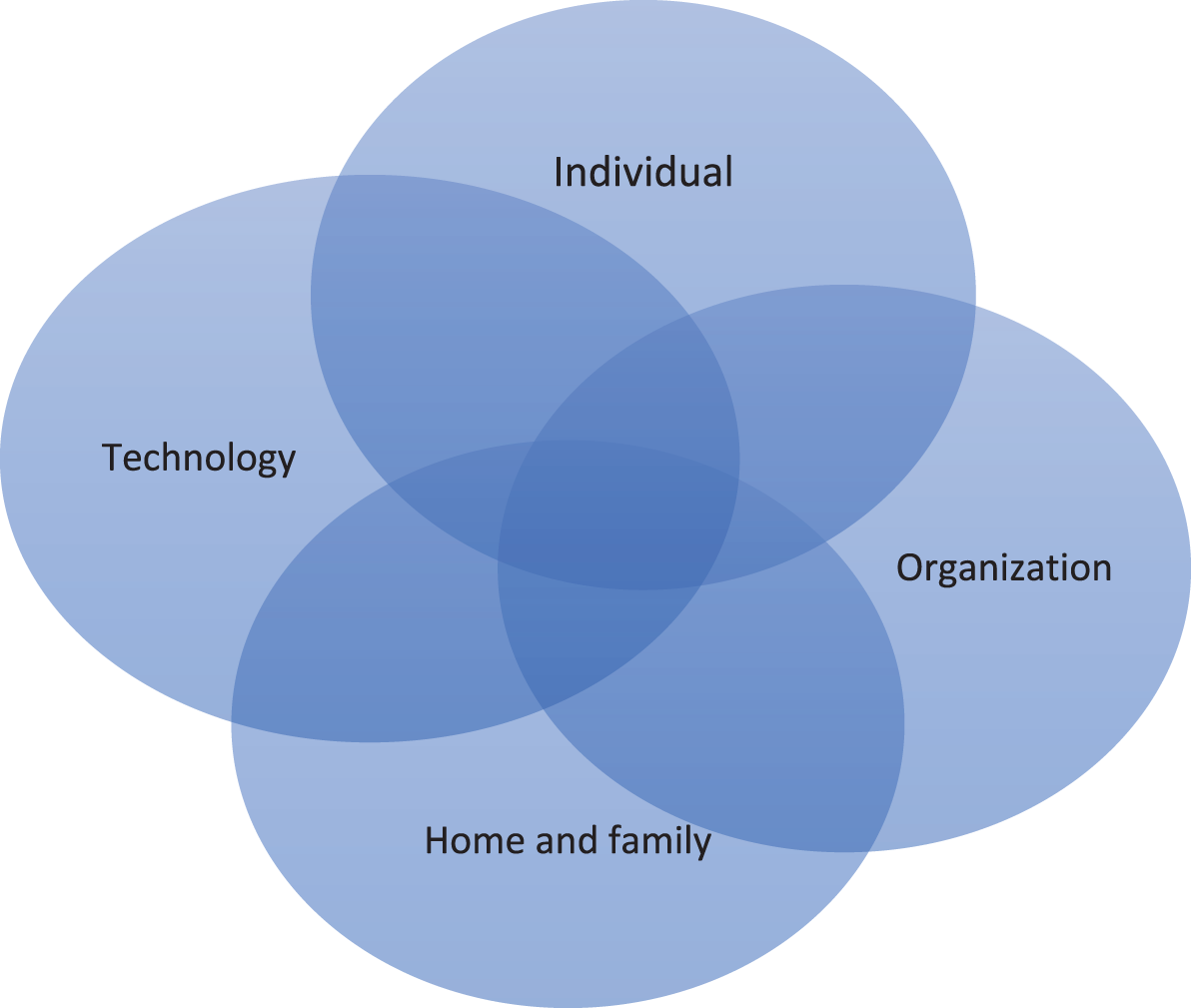
The four factors of telecommuting.
Individual
For telecommuting to take place, the individual plays a crucial role. This is because the individual is at the centre of telecommuting, and its success or otherwise is dependent on the drive and willingness of the individual. Baruch and Nicholson (1997) highlight self-motivation, the ability to work alone, tenacity, being organized, effective time management and computer literacy as the top factors required of an individual to be able to telecommute effectively. Since human beings have different personality types, knowledge of what works best for each individual is necessary to ensure the success of telecommuting. Additionally, Hannay (2014) reiterates that, although technical skills are a primary consideration in successfully fulfilling telecommuting, personality factors must also be carefully considered, especially if the individual will be away from the workplace for a long period of time. Linked to this are the specific roles that can allow for telecommuting. Although teleworking provides some solutions to work-related problems, it is not found to be suitable for all occupations, particularly those requiring face-to-face relations (Azami et al., 2018). Likewise, not every employee will function well in the telecommuting environment, and this makes it imperative to select employees who can function well in such an environment – particularly those who can work with little or no supervision (Manoochehri and Pinkerton, 2003).
Meanwhile, issues such as gender and educational attainment might also influence the choice of telecommuting and its intended success. For example, a policy report published in response to COVID-19 by the Organisation for Economic Co-operation and Development (2021) reveals that workers with higher qualifications, as well as women, are more likely to telecommute. Similarly, Azami et al. (2018) found that female librarians were more inclined towards telecommuting compared to their male counterparts. This may be due to the demands of the home and family that most women are dealing with alongside work in most corporate environments. Parajuli (2020) mentions some advantages of telecommuting for the individual, including flexibility in supervising dependents, less travel time and expenses, flexible working hours and independence. Also, Manoochehri and Pinkerton (2003) report a lower rate of absenteeism, reduced time spent commuting, the ability to balance family needs and lower turnover as factors that ensure high job satisfaction among telecommuters.
Organizational and technological
In addition to individual factors, the role of the organization and the technological infrastructure that has been put in place are essential to the overall success of telecommuting. This includes, but is not limited to, technological training, adequate communication, information technology support from the organization, supporting the demands of employees while they work at home, and support with the cost of facilities related to telecommuting (Vyas and Butakhieo, 2021). Since telecommuting will have an effect not only on employees but also on the organization as a whole, Rajapakshe (2021) reiterates the importance of a high-speed Internet connection, detailed planning and appropriate software for telecommuting to take place.
Also, in considering remote work, an important element is to decide how team members will stay in touch and how customers will be served. To solve this issue, Boudinet (2020) highlights five major technology needs to ensure the success of telecommuting: email, broadband, video conferencing, chats and messaging, and a phone. Similarly, for companies seeking to initiate telecommuting, Pearce (2008) identifies three main technical issues that need to be taken into consideration: connectivity, information sharing and communication. Specifically, issues relating to a high bandwidth, virtual private networks, content sharing, file sharing, online conferencing, audio conferencing and instant messaging need to be well thought through to ensure the success of telecommuting (Pearce, 2008).
A seemingly valid challenge that faces most organizations wishing to implement telecommuting is the security of data and how confidential information will be protected. Common security threats, including stolen laptops, hackers, phishing emails, the use of weak passwords and unencrypted file sharing, need to be carefully considered. Carnahan and Guttman (1998) mention some of the threats to organizations that decide to telecommute: intruders having access to the organization’s systems without being present on-site; hackers watching employees as they enter their passwords; people trying to steal or misuse corporate information; the possibility of corporate information being read or potentially modified while in transit; and the risk of losing corporate information outside the organization’s protective shell. In the same vein, Redcentric (2021) highlights the top-five security concerns of teleworking as phishing attacks, weak passwords, unsecured home devices, unencrypted file sharing and open home Wi-Fi networks. To be able to quickly recover lost data or mitigate the possibility of threats, organizations need to put in place well-established security options, such as antivirus software, firewalls, limiting access to sensitive information, disallowing the use of flash drives, the use of fingerprint readers and content monitoring programmes that can reduce the rate of attack (Pearce, 2008).
Furthermore, an element of trust is necessary to allow telecommuting within an organization. Trust, as highlighted by Baker et al. (2006), can be a somewhat problematic issue and involves both parties – the individual trusting another and the person being trusted. Feelings of uncertainty or doubt on the part of the organization (management) about employees working from home and meeting targets will not allow for telecommuting in the first place. Additionally, employees knowing that they are not being monitored, like they are when working in an office, may tend to be lackadaisical in regard to the tasks assigned to them. Felstead and Reuschke (2020) affirm that a major issue of concern among employers is the belief that without physical oversight, some employees will neglect the duties originally assigned to them, leading to a fall in productivity. Similarly, telecommuting has a greater likelihood of being implemented in settings where there is a high level of trust between employees and employers – where through their actions and performance, managers place a high degree of trust in their employees (Beňo, 2021; Daniels et al., 2001). This suggests that strict measures are put in place to guide telecommuters working in different locations in the interest of a company. The importance of the necessary organizational structures, including innovation and top management being in support of telecommuting, cannot be overemphasized (Bose and Luo, 2011). Manoochehri and Pinkerton (2003) add that telecommuters will have to prove themselves worthy by ensuring an increase in productivity to dispel the notion of no work being done when there is no supervision.
Harpaz (2002) identifies some of the benefits of telecommuting for an organization: a decrease in staff absence levels, savings on expenses, increased productivity, a positive image of the organization and increased staff motivation. Similarly, Madsen (2003) sees telecommuting as an advantage for both the organization and the employee that makes it possible to motivate workers and reduce the costs involved with travel. Some examples of the savings that can be made by an organization include the costs of water, electricity, Internet bills, cleaning and security, and salaries (De Graaff and Rietveld, 2006; Radcliffe, 2010). With the increasing costs of housing and the geographical spread of workers, employees are being compelled to adopt telecommuting to ensure productivity, retention and job satisfaction (Pearce, 2008). Despite the perceived benefits, Beňo (2021) mentions some of the questions that managers still ask themselves about the viability of telecommuting: Is it a realistic option? Will the potential cost saving outweigh the perceived risks? Is it in line with the business culture? Moreover, Diab-Bahman and Al-Enzi (2020) highlight some limitations of telecommuting, including professional isolation, poor manager–employee relationships, a lack of feedback, poor communication and poor employee–employee relationships.
Home and family
Closely linked to the success of telecommuting is the setting in which it takes place. The definitions of telecommuting indicate it to be a location other than the employer’s premises. One place that has been identified as being useful when telecommuting is the home (Diab-Bahman and Al-Enzi, 2020; Madsen, 2003; Pearce, 2008; Rajapakshe, 2021). Despite being a safe abode, the use of the home has its share of advantages and disadvantages. For example, Parajuli (2020) found that telecommuting makes it difficult to differentiate between work and home, and also alludes to a sense of over-availability on the part of the worker. Tremblay and Thomsin (2012) add that with the flexibility in working hours that comes from telecommuting, it is not always that easy as there are the intrusions and crossing of boundaries that come with it. Beňo (2021) highlights the tendency of having the workplace invade the home and cause one to work much longer than may be desired. Similarly, Vyas and Butakhieo (2021) identify some of the setbacks relating to telecommuting as a difficulty in distinguishing between work and family, employees having to bear costs relating to telecommuting, social isolation and distractions that may affect the output of the worker.
The presence of family members (especially young children) is a significant factor in the success of telecommuting. Rajapakshe (2021) affirms that in situations where family members (especially children) are present, there is a likelihood for them to cause disturbances that will affect the overall output of employees. In a similar study by Khan and Hasan (2020), a poor Internet connection and having children at home served as a source of great distraction, which was not helpful for telecommuting. Women, in particular, have been found to face many more difficulties, balancing home life and fulfilling other domestic duties together with completing work tasks (Basak, 2021; Friedman et al., 2021; Kazekami, 2020). Similarly, Azami et al. (2018) note that female librarians were found to be more interested in teleworking than their male counterparts since they were better able to handle family responsibilities while telecommuting. However, Diab-Bahman and Al-Enzi (2020) note that telecommuting may help men to be more involved in family issues and remove the bias associated with women and families. To mitigate some of the challenges experienced, Rajapakshe (2021) suggests staff training on how best to manage family responsibilities, as well as the provision of incentives that can take care of the cost of data, for example, and serve as a source of motivation.
Impact of COVID-19 on libraries
The COVID-19 pandemic left an indelible impression on a variety of sectors around the world, including libraries. Beyond the issues of health and safety, the pandemic had a profound impact on libraries, ushering in a paradigm shift in the way libraries function, engage with their communities and deliver services. The closure of physical library facilities was a common response (Harris, 2021) and forced the need to plan for how to continue providing and disseminating information to library patrons (Omeluzor et al., 2022). It compelled libraries to be more innovative in their traditional functions and quickly transition towards digital alternatives, including the use of electronic resources, electronic books and digital magazines (Becker et al., 2022; Sujood et al., 2023; Wakeling et al., 2022). Again, during lockdowns, academic libraries were critical in providing remote learning options to their patrons. The switch to the use of digital services not only demonstrated libraries’ versatility but also emphasized the importance of their function as dynamic information hubs capable of fulfilling customers’ changing requirements in a time of crisis.
Similarly, librarians used a range of strategies and platforms to cope with the unexpected shift to remote learning and teaching, recognizing that working in virtual and remote environments was critical to their success (Kaufmann and Miller, 2020). In Nigeria, for example, it was found that most university libraries provided online materials for their patrons because most students and faculty members were working at home owing to library closures (Fasae et al., 2020). Martzoukou (2020) affirms that, even before the pandemic, librarians played an important role in encouraging students and faculty to improve their information and digital literacy skills through various online projects, underscoring the importance of libraries in the educational transition to the digital age. Confirming libraries’ status as trustworthy information hubs, De Groote and Scoulas (2021) highlight the increasing rate of reference queries during the pandemic, as well as the virtual assistance offered to patrons in the form of email and chat reference exchanges. Libraries, more than ever, were seen to be accountable for assisting their communities with access to credible information to meet their varying needs.
In response to the changing learning dynamics and student needs, library facilities are being remodelled to maximize patron welfare. Hitherto, library spaces were made available to users for requesting, reviewing and reading printed content (Vassilakaki and Moniarou-Papaconstantinou, 2021). Because of the need for social distancing and maintaining sanitary conditions during the COVID-19 era, physical library areas were reconfigured. Libraries reacted by introducing safety standards, relocating furniture and rethinking rooms to meet the changing demands while guaranteeing patron and staff safety and limiting the spread of the virus (Chigwada, 2021; Garner et al., 2022). Beyond the pandemic, however, modern university libraries have taken the cue and are growing into informal learning spaces that encourage active involvement and collaboration among users (Kim and Yang, 2022). Students, who are the major users of academic libraries, are engaged in various activities, including group learning and collaborative work, which are not conducive to ‘traditional’ library settings, emphasizing the need for more learning spaces.
Research methodology
The exploratory case study research method was used in this study to analyse the developing interest in telecommuting among academic librarians, with special attention to academic librarianship in Ghana. As highlighted by Babbie (2014), exploratory studies aim to satisfy a researcher’s curiosity and provide a better understanding of a phenomenon. Head librarians from academic libraries in Ghana were carefully chosen as the target population for this study. The listserv of the Consortium of Academic and Research Libraries in Ghana served as the primary medium for communicating with this specific set of respondents, ensuring that the questionnaire was sent to its target audience. To extend the scope of opinions and deepen the research, the participants were urged to share the electronic survey with suitable peers who met the inclusion criteria but were not members of the Consortium. This strategy was an attempt to gain a more comprehensive grasp of the subject matter by embracing several points of view, hence increasing the depth and completeness of the research. Altogether, 57 respondents completed the electronic survey. Data collection was through the use of a semi-structured online survey questionnaire, designed by the researcher with Google Forms, between the months of April and May 2022. The respondents were duly informed about the objectives of the study and were assured of the confidentiality of their data. They were asked not to disclose any personal information, such as their names. Also, all of the respondents were assured that their responses were intended solely for academic purposes, and were encouraged to answer as freely and honestly as possible.
Findings and discussion
The raw data was used to generate a descriptive analysis and draw conclusions with respect to the arguments of the research. Each question was analysed using the Microsoft Excel application to help shed more light on the study’s objectives.
Areas best suited for telecommuting
To put the study in a proper perspective, the respondents were asked to explain how they understood the term ‘telecommuting’. This was necessary to help provide insights into how telecommuting is viewed amongst academic librarians. It was evident from their responses that the respondents were familiar with the term or had a little knowledge of it. For example, one respondent understood telecommuting as follows: ‘Performing the duties of a librarian outside the workplace with the use of technology’. Another respondent asserted that telecommuting is ‘working from home with the use of computers, email or telephone’. Additionally, telecommuting was seen to be ‘completing work assignments outside the conventional work environment using technological tools’.
The respondents were also asked if they believed there were enough resources available to meet the needs of library users outside library buildings. The majority of the respondents (37, 64.9%) affirmed that there were enough resources available outside the four walls of library buildings for users to access. The most mentioned resources were electronic resources and journal databases. Other resources cited were past questions, library catalogues and reference services. Academic libraries keep reinventing themselves by using different techniques in a bid to meet the needs of their users. Studies in Ghana have affirmed the increasing number of subscriptions to electronic resources by academic libraries to help enhance their collections and also widen access to scholarly materials (Baayel and Asante, 2019; Bentil, 2020; Okyere-Kwakye and Nor, 2020; Tetteh, 2018). In Ghana, access to electronic resources is provided through the Consortium of Academic and Research Libraries in Ghana, a body that was set up to facilitate resource sharing among its member institutions (Asamoah-Hassan, 2014). Baayel and Asante (2019) report that the University of Cape Coast, a public university in Ghana, pays as much as $10,000 in subscription fees per year. Through the Consortium, access to electronic resources has been made easier than it would have been if each institution were subscribing on its own. Additionally, access is provided both on-campus and off-campus (on request), enabling access by a far wider audience beyond the actual library building.
Another question posed to the respondents was whether their work could support telecommuting and also which areas of library work they believed could easily support telecommuting. Fifty-two respondents (91.2%) affirmed that their roles could conveniently be carried out outside the library building, with 5 (8.8%) disagreeing with this assertion. With regard to the areas of library work that could easily be supported by telecommuting, the provision of electronic resources was the most mentioned service (51, 89.5%), with information literacy and reference services receiving response rates of 44 (77.2%) and 43 (75.4%), respectively (see Figure 2).

Areas best suited for telecommuting.
Carr (2006) concurs with this finding and mentions some areas within libraries that are best suited to telecommuting: acquisitions, reference services, reservations, interlibrary loans, library instruction and cataloguing. For Carr, telecommuting is a viable option for any library in Jamaica. Similarly, information retrieval, cataloguing, collection development and research were found to be effectively performed outside the library building in Azami et al.’s (2018) study.
Opportunities available to librarians
Again, telecommuting was seen to be highly acceptable among academic librarians in Ghana. When asked if they would like to be involved in some form of telecommuting, the majority (51, 89.5%) of the respondents indicated that they were willing to telecommute. This finding affirms earlier studies (Azami et al., 2018; Carr, 2006; Diab-Bahman and Al-Enzi, 2020) that indicate the willingness of staff to be involved in some form of telework. It further indicates that when given the opportunity, employees, including library staff, will be more inclined towards working from home.
On the main motives for wanting to telecommute, the respondents were presented with several options. The topmost reasons indicated by the respondents were flexibility of work hours (46, 80.7%) and the reduced need for travel (45, 78.9%). Other reasons identified were improved quality of work life (32, 56.1%), high volume of work possible (21, 36.8%), easier childcare arrangements (19, 33.3%) and high quality of work possible (19, 33.3%). The least important reasons were the reduced cost of transportation (1, 1.8%) and reduced cost of doing work (1, 1.8%) (see Figure 3). The average time spent commuting was 2 hours 30 minutes daily.
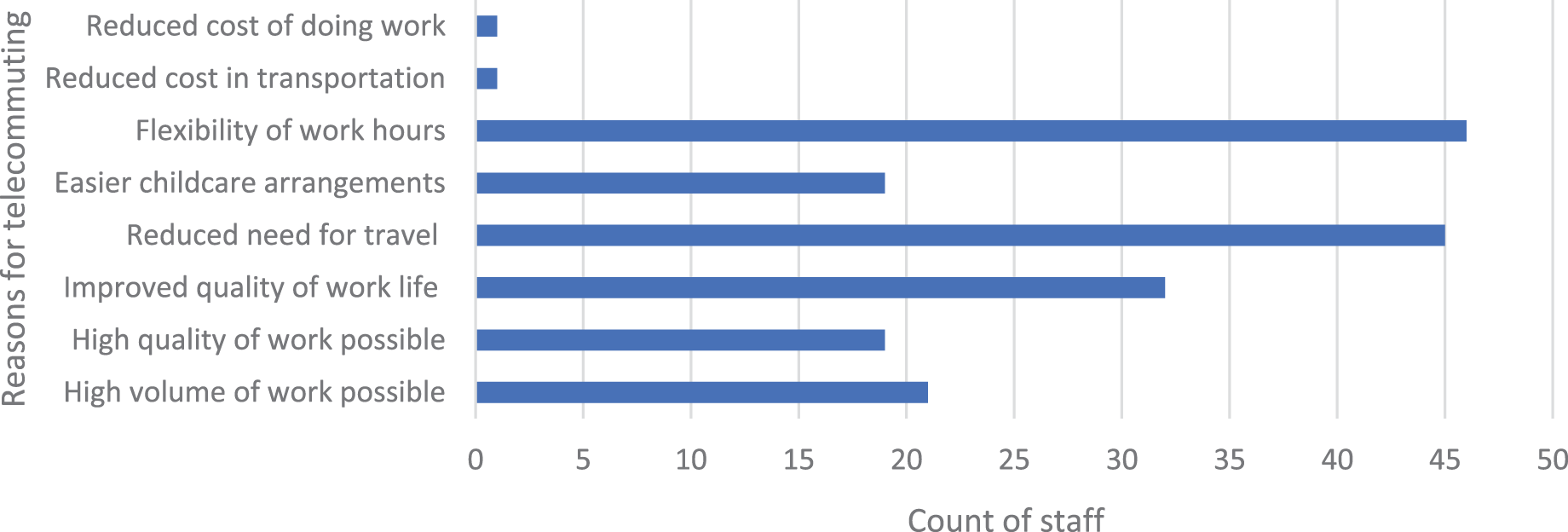
Main reasons for telecommuting.
The flexibility of work hours has been cited in numerous studies (Ansong and Boateng, 2018; Bose and Luo, 2011; Kelly and Shoemaker, 2021; Parajuli, 2020). Giving an employee the opportunity to work within a less rigid schedule enables employees to be more critical and analytical due to reduced interruptions and better time management, and, in some instances, allows for extra work to be completed. Additionally, with the increasing rate of mobility in urban areas, the amount of time spent commuting to work is continually climbing. An important finding on why library staff would like to telecommute highlighted by this study is the reduced need for travel. Carr (2006) reports that 100% of the respondents surveyed in Jamaica believed that there would be a huge decrease in their commuting time if they were allowed to telecommute. Similarly, Diab-Bahman and Al-Enzi (2020) reiterate a reduction in the costs of fuel and ultimately travel leading to greater employee satisfaction.
The majority of the respondents (41, 71.9%) also indicated that they would like to telecommute once or twice a week if given the opportunity. Another group of respondents (6, 10.5%) were in favour of telecommuting once a week. Other responses, chosen by one respondent each (1, 1.8%), were once a month, twice a month, three times a week, as much as allowed, based on work schedule and every day (see Figure 4). Browne (2018) comments that a study conducted by a Switzerland-based office, IWG, indicated that 70% of professionals telecommuted at least one day a week.

Number of days library staff would like to telecommute.
Relating to the organization, the respondents were asked whether they believed academic libraries are suitable for telecommuting. There was overwhelming agreement (53, 93%) that academic libraries are currently well positioned to allow some form of telecommuting: We can serve our patrons without necessarily meeting them face-to-face. Most libraries have invested in digital/electronic resources and have systems that support remote services. Besides, the current tech-savvy users prefer remote services. Telecommuting and working from the office can complement each other to provide seamless and uninterrupted service to our patrons. Libraries are increasingly becoming digital and are making their products and services easily accessible outside campus. Library staff do not necessarily need to be on campus to serve the needs of users. We have not yet developed the necessary telecommunication tools. We don’t have the technology to do such. We lack the logistics to work from home, e.g. high cost of Internet bandwidth, computer/laptop.
Challenges
Another question sought to find out whether the respondents’ libraries allowed some form of telecommuting. The respondents had divided opinions, with 29 (50.9%) indicating some form of telecommuting taking place in their libraries and another 28 (49.1%) not being aware of any form of telecommuting activities. Regarding the probability of management allowing library staff to telecommute, the majority of the respondents (31, 54.4%) believed that management would be willing to allow some form of telework if the option was presented to them: Yes, if the right policies are in place. Library management is cognizant of the changing trends in library service provision. They may be more liable to allow some personnel to telecommute. This is because it will lead to cost-saving and job satisfaction if library management can explain it very well. Most are conservative. It will require a lot of education for these old professors to buy in. We advocated it during the COVID-19 period but it was not agreed upon. Once you are not on campus, you are not seen as working.
Regarding the setting in which telecommuting will take place, the respondents (40, 70.2%) further affirmed that they had an adequate infrastructure in place at home should the need arise for them to telecommute. Additionally, even though the majority (30, 52.6%) had children aged 10 or younger, there were adequate mechanisms in place to prevent any form of intrusion by either their children or other external factors. These findings support Rajapakshe’s (2021) study, which states that for telecommuting to be successful, appropriate software and a technological infrastructure, such as a high-speed Internet connection, need to be available. Further, even with the presence of children, adequate measures had been put in place to forestall any form of disturbance, as highlighted by Khan and Hasan (2020).
Conclusion
Telecommuting has become more relevant in recent times due to advances in communication and the communication tools that are constantly being developed. Additionally, the impact of the COVID-19 pandemic has left all organizations, including academic libraries, strategizing on how best to keep functioning in the case of an emergency. A rapid digital transformation is currently being experienced in all sectors of the economy, including academic libraries, and they are striving to make their presence felt outside the four walls of the library building. The findings of this study indicate that academic librarians in Ghana are very much aware of teleworking and are ready to telecommute at least once a week. The most significant benefits that telecommuting can offer the Ghanaian academic library system are flexibility in working hours and a reduced amount of time, and ultimately money, spent on travel. The rapid increase in the urban population has placed overwhelming pressure on transport services. Due to the increase in the number of cars and people with cars, lack of urban planning and low capacity of the transport infrastructure, commuters spend long hours travelling to and from work, which affects their productivity. The increasing cost of fuel is impacting workers, and spending some time at home working will help relieve already overburdened workers. Additionally, having staff do some of their work at home on certain days may be more motivating and reduce the rate of absenteeism and costs for the employer associated with a worker being physically present in an office.
Telecommuting in Ghana’s academic libraries presents a cost-effective solution to addressing staff shortages and improving service delivery. By leveraging technology and implementing telecommuting policies, academic libraries can expand their reach and provide more convenient and accessible services to their users. Telecommuting is a workable solution but it will require that both employers and employees fully understand the process and be willing to participate. Those individuals who are to be involved must go through a careful selection process to make sure that they are able to work with little or no supervision. Ultimately, telecommuting in Ghana’s academic libraries is a step forward in modernizing and improving the library system, and has the potential to significantly benefit both library staff and users. As long as the rules are followed, telecommuting will succeed and be beneficial for the entire Ghanaian academic library system. A workable solution in Ghana will set a benchmark for other academic libraries to emulate, and will be an advantage within the entire university environment, especially in terms of operating expenses. Overall, it will aid in promoting a greener and safer environment with a reduction in the gasses emitted by moving vehicles daily.
Recommendations
In order to realize the full benefits of telecommuting, the following measures should be put in place:
Development of a telecommuting policy: the development of a detailed policy guiding both employers and employees will help communicate and address any concerns that may arise at any point in time. Issues regarding who qualifies to telecommute, security and equipment use, technology and what is expected of a telecommuting employee should be spelt out to help eliminate issues of trust among both employers and employees.
Investments in technology: solid investment in appropriate technology, such as computers, fast and reliable Internet connections and a network infrastructure, will be useful in ensuring the success of telecommuting. This will provide staff with all the tools that are needed to ensure productivity and efficiency, and reduce the possibility of some staff making excuses for not doing their work. Additionally, academic libraries need to be well structured to meet the needs of their users outside the library building. Digitization efforts need to be encouraged and also expanded to support more library services and products that will reach a broader range of people.
Staff training: ongoing professional training for all staff will help ensure the full benefits of telecommuting. Continuous training, not just one-off sessions, will help to keep staff abreast of new technologies and clarify any concerns that may arise on a daily basis. It will provide an avenue for staff to share their experiences, any challenges they have faced, and how they have overcome these challenges. The training may also focus on the use of technologies, as well as topical areas that may be identified as peculiar to a particular library.
Monitoring of progress: the regular monitoring of the progress of staff who telecommute is essential to ensure that the set goals and objectives are met in the same way as if they were physically present in the office. A detailed monitoring and evaluation assessment mechanism should be designed to keep track of staff based on their specific roles and responsibilities. Additionally, supervisors can institute regular checks and feedback mechanisms that will enable them have real-time information about the work being done.
User surveys: surveys will be useful in determining the success, or otherwise, of telecommuting. It is important to get feedback from users who benefit from the areas of library work that are telecommuted to help address any shortfalls and improve services. Surveys will also be useful in identifying products and services that will most likely be accepted and patronized by users, thereby ensuring value for money.
Suggestions for future research
Future studies could focus on assessing the effects of telecommuting on staff well-being with a focus on stress levels, the work–life balance and general job satisfaction, and assessing the sustainability of telecommuting in the Ghanaian academic library landscape.
Footnotes
Declaration of conflicting interests
The author declared no potential conflicts of interest with respect to the research, authorship and/or publication of this article.
Funding
The author received no financial support for the research, authorship and/or publication of this article.
