



Abstract
This article describes the Purdue University Libraries mandatory co-mentoring program. Surveys with all Purdue University Libraries faculty librarians and select follow-up interviews were conducted. This program supports all faculty librarians and differs from other mentoring programs since it is team-based, includes the supervisor, and advises on promotion. These Faculty Review Committees integrate performance reviews with progress toward promotion and have the responsibility to prepare written annual reviews and evaluations, and represent the candidate at the promotion review. The program is considered very effective at Purdue University Libraries and a unique model. This program is also compared to four other ARL co-mentoring programs using a survey and follow-up interviews.
Introduction
The search for a new librarian is completed. The job offer has been made and accepted; the new librarian’s first day has arrived. After the effort to attract a high quality applicant, everyone from the Dean on down wants the new librarian to succeed. In the background is the pending decision of continuing contracts, and possibly promotion and tenure. A crucial step in the career advancement of faculty librarians is mentoring. The literature is clear: mentoring helps, especially for newly hired (Nankivell and Shoolbred, 1997). At Purdue University Libraries, the new librarian would receive mentoring and evaluation for promotion decisions from a group of mentors, referred to as a co-mentoring program in the mentoring literature.
This article is a case study reporting the mentoring team approach at Purdue University Libraries that was designed and implemented in 2009 based on a review of the needs of the Purdue University Libraries rather than on any other existing programs. It is different from many traditional mentoring programs, which are usually one mentor to one mentee (Goodsett and Walsh, 2015). First, it is a co-mentoring program, one that has more than one tenured librarian, including the supervisor and a full professor, serving as the mentors for one mentee. The second distinctive feature is that the mentoring teams formally advise on contract and promotion decisions.
The first research question for this article is whether this program is unique or distinctive when compared to other ARL Libraries. The second question is whether it is effective in providing feedback and mentoring for career development for librarians at Purdue University Libraries, and the third question is whether the program has had an impact on promotion rates and scholarly productivity. The research method is surveys and follow-up interviews.
For this paper, we view a mentoring program as a support program to the peer review process that is standard at universities for all faculty members. Most libraries with faculty status develop some support for newly appointed untenured librarians, in either formal or informal ways. If the program is unstructured, even if well-established through tradition, it is an informal program. The program at Purdue University Libraries discussed in this paper is a formal mentoring program that provides support for the peer review process and career guidance at the Purdue University Libraries. It was established by library policy, with further guidelines to provide a framework for the process. The Faculty Review Committees (FRCs) are accountable and write reviews. Both mentors and mentees are assigned initially and can be changed after the new librarian’s first year.
Literature review
The number of articles, chapters and books on mentoring in libraries is large. An influential early article conducted by the Association of Research Libraries (ARL) in the 1980s surveyed ARL directors who mentor junior librarians. This article defined the role of mentors as developing talent, opening doors, and being a positive role model and teacher/coach. It began a trend in mentoring programs in North American libraries as it found “an analogous correlation between mentoring experience and career success among the leaders of large research libraries in USA and Canada” (Ferriero, 1982: 363). Over 30 years later, a follow-up survey of the ARL members indicated that 83% of the institutions with tenure were offering a mentoring program; however, it is important to note that neither of these two surveys asked questions related to the type of mentoring (Smigielski et al., 2014).
Earlier literature review articles
Mentoring was a relatively new subject in the library literature in the 1990s and the research literature on mentoring that did exist was further developed in the USA than in the UK and Australia at that time (Golian and Galbraith, 1996, Nankivell and Shoolbred, 1997).
The1999 ARL Spec Kit survey of 113 libraries on mentoring found 26% of academic libraries have mentoring programs. The main focus was to support librarians who were working towards promotion and reappointment or tenure (Wittkopf, 1999).
Mentors had significant experience in the organization, and they volunteered for the role (Osif, 2008). The problem of having enough good mentors in organizations was an issue, and mentors with no publication record were less effective than those who published. Institutional commitment to mentoring contributed to its success, and formal mentoring was found to be more effective than informal or unstructured programs (Goodsett and Walsh, 2015). Mentoring structures are different among institutions and they take the form of one-on-one mentoring, group, or co-mentoring programs; and the length of the mentoring relationship also varies among institutions (Osif, 2008).
Mentoring programs: Statistics and methods
Librarians generally do not have the training that PhD students receive to prepare them for research, tenure and promotion in the academy and library schools do not prepare librarians for promotion and tenure. This makes academic library mentoring programs even more compelling (Osif, 2008, Wilson et al., 2009).
The number of academic libraries providing formal mentoring programs has risen; however, despite the clear evidence of its effectiveness, the presence of formal mentoring programs in academic libraries is surprisingly low. Most of the surveys have indicated that only half of the institutions that responded have formal mentoring programs. Oud (2008) reported that only 40% of respondents had a formal program to help them transition to a new job and she stressed the importance of having a mentor early on in a new job. Robbeloth et al. (2013) reported that 46% of the libraries they surveyed had formal mentoring programs. Goodsett and Walsh (2015) reported that only 40% of the librarians who participated in their study had mentoring programs available to them at their institutions.
The timeframe for mentorship commitments varied greatly. Some had definite predetermined termination points, for example a six-month program for orientation mentoring, while others lasted until the promotion and tenure decision (Osif, 2008). While mentoring can be as brief as three months or last for three years, Lorenzetti and Powelson (2015) found that two-thirds of the 15 one-on-one and co-mentoring programs in their scoping review had time limits between six months and two years, and that only two programs continued until the mentee received tenure. Many programs specifically limit the timeframe in order to encourage mentors to commit and participate.
Overall, of the mentoring methods used in academic libraries, the most well known and most traditional method is one-on-one mentoring by a senior ranking member for a newer librarian. Many other variations have been developed, and many of them show a greater success rate than this traditional method (Goodsett and Walsh, 2015). The scoping review study by Lorenzetti and Powelson (2015) found 40 academic library mentoring programs and defined four mentorship models: the most common (53%) was one-on-one, either between a junior and senior librarian. The second most common was a peer mentoring (35%); third was the co-mentoring program (8%); the fourth and least common, was group mentoring by one senior librarian with several mentees (5%). There is research evidence that formal co-mentoring programs are more effective than one-on-one informal mentoring (Knievel et al., 2017).
Benefits
The literature suggests that there are demonstrable benefits to mentoring programs and that it positively impacts the mentors, mentees, and the organization itself. Major benefits for the organization are better retention and enhanced integration of new employees. It also has a positive impact on communication and productivity in the workplace ( Goodsett and Walsh, 2015; Osif, 2008). For new librarians mentoring can foster a work environment where they have an influence and impact on their own professional development, and thereby gain more confidence quickly. Other benefits include an enriched professionalism in the workplace and other avenues beyond the supervisor to receive career path support ( Knievel et al., 2017; Oud, 2008; Ross, 2013; Wittkopf, 1999). Mentors also benefit by the opportunity to develop and sharpen their leadership experience and to enhance their relationship with newer employees. In addition, they have an opportunity to take a fresh look at their career objectives, and they can learn about new advancements in the profession from people who recently graduated (Goodsett and Walsh, 2015).
Mentoring is a positive factor not only in enhancing retention, but also in supporting promotion. The research points out that employees who have been mentored have higher salaries, get more promotions, and have a higher level of satisfaction in their careers (Harrington and Marshall, 2014). It also enhances scholarly productivity and successful promotion and tenure. Lorenzetti and Powelson (2015: 186) state that: “Mentoring has been linked to outcomes such as tenure, career development, job satisfaction, and organizational and professional connectedness.”
Mentoring enhances personal satisfaction and the fostering of relationships. It also helps in the adoption and cultivation of organizational values and goals, which in turn fosters positive attitudes. Employees are more likely to be successful when they understand the organizational culture (Harrington and Marshall, 2014). It also provides psychosocial support as the mentor can be a role model for mentees, which requires a strong commitment on the part of the mentor to create an environment that fosters this positive experience (Goodsett and Walsh, 2015).
Matching of mentor and mentee
The success of a mentoring relationship does depend on the compatibility and rapport between the participants. When mentees and mentors have some input in the matching, it can facilitate this, and there does seem to be a trend toward mentees having some choice in the match. In the ARL study by Wittkopf (1999) only 2% of mentors selected their own mentee and 29% of mentees selected their own mentor. Other research supports the finding that at many university libraries the appointment is made by committees, yet, many libraries do provide options for mentees to change their mentor if the relationship is not productive (Goodsett and Walsh, 2015).
Supervisor as mentor
The trend to include the supervisor seems to have changed since the recent library literature suggests that supervisors are not and should not be part of a mentoring team. In the ARL study, Wittkopf (1999) reported that at 57% of the libraries the mentor was a supervisor or department head. Additionally the study found that the supervisor was kept informed of the mentoring relationship and the activities of the mentee and mentor at 43% of institutions.
Nine years later, Osif (2008) reported that it was very rare for supervisors to be a mentor for employees under their direction, stating that, if supervisors were to become formal mentors, it could create a conflict of interest. Hicks et al. (2010) supported the view that the role of the supervisor was at cross-purposes with mentoring and that there was the potential for direct conflict between these roles. Similar advice was given in the Novara et al. (2010) article; they explicitly stated the purposeful lack of involvement of the supervisor and advised against supervisor involvement. In the Lorenzetti and Powelson (2015) scoping review study, four out of the 40 libraries specifically stipulated that the supervisor could not play the role of mentor since that might inhibit risk-taking and forthright communication. Additionally the study found only one article where an institution required communication between the supervisor and the mentor. Counter to this trend of excluding supervisors from mentoring, in a major survey in Canada, Harrington and Marshall (2014) asked university and college librarians to select appropriate mentors, and, while they preferred library colleagues, they also selected supervisors as appropriate mentors.
Factors leading to success of programs
Certain organizational factors contribute to successful mentoring programs. The first is that there has to be a commitment and organizational engagement so that the program is sustained over time (Goodsett and Walsh, 2015). There must also be a big enough pool of mentors and a willingness to participate. The willingness often is enhanced when the organization has a clearly articulated investment in the program and a demonstration that it is as important as other performance expectations (Lorenzetti and Powelson, 2015). A plan or program for matching mentors and mentees needs to be developed. Mentors and mentees must be able to work well together and have mutually understood goals. If not, there needs to be a process for finding a better match (Novara et al., 2010). If the pairing is not mutually beneficial or if they are not invested in the relationship, it cannot be successful (Goodsett and Walsh, 2015).
Case studies of co-mentoring programs
The literature includes several case studies of co-mentoring programs. California State University, Long Beach developed a co-mentoring system called the “Resource Team Model” where three senior librarians mentor a new librarian for a period of six months. The scope of this mentoring includes acculturation and training in the job of librarianship, i.e. collection development, reference, instruction, professional development, and research (Bosch et al., 2010). Texas A&M University Libraries established a mandatory mentoring program in 2005, which required that every untenured librarian be paired with two tenured librarians as mentors. The focus of the mentoring group was specifically on supporting the librarian in research, publication, and progress towards tenure. The tenured librarians received a small amount of money that could be used for meals or in support of a research project. In the annual review process, both the mentor and mentee evaluated the mentoring experience (Stephens et al., 2011).
Purdue University Libraries mentoring program history
Purdue University is a major research institution, a land grant college with a predominant emphasis on engineering, technology, science, agriculture and business, and strong liberal arts and education colleges. The majority of the professional positions in the Purdue University Libraries are tenure-track. These librarians have full faculty status; they are reviewed under the same policy and expectations of the teaching faculty and have the same three-committee review structure, typical of other research universities. Tenure is granted automatically upon promotion to associate professor.
At the Purdue University Libraries, there has been a long-term recognition of the importance of mentoring. The initial mentoring program was started over 25 years ago. Each assistant or associate professor was matched with a full professor based on common interests or area of responsibility in a one-on-one relationship. All the full professors were encouraged to meet on a regular basis to establish rapport and assist the mentees in all aspects of professional development, especially to guide the mentee along the path to promotion. Each mentor had clearly defined responsibilities: to represent the mentee at all promotion committee meetings, to write the promotion document with input from the mentee librarian, and to present the mentee’s case at the first promotion review level. The program had a clear focus on mentoring and a strong involvement and responsibility in the peer evaluation process for promotion and tenure.
Despite a true desire and sincere effort on the part of all librarians, this program was not successful. Two driving forces precipitated a total revamp of the mentoring and the promotion review process. First, the pre-tenured librarians, as a group, expressed their dissatisfaction. They felt that they were not receiving the assistance, encouragement, and the mentoring needed to succeed, and that they lacked understanding of the expectations and control of their promotion preparation. They also expressed frustration with the frequency of the reviews. The second driving force for a change came at the university level: the membership of all first level promotion committees on campus was expanded from only the full professors to include all tenured full and associate professors. The impact in the library was that instead of a review by five to seven full professor librarians the committee expanded in size to nearly 30 librarians.
Developing the Purdue University Libraries model: Faculty review committees (FRCs)
As a result of the feedback from the pre-tenured professors and the change in the membership of the first review committee, the Libraries faculty established a task force in late 2007 to review the responsibilities, structure, and membership of the Libraries’ promotion committee. The task force reviewed the literature, surveyed other departments on campus, and held open meetings with the librarians. The Purdue University Libraries was using two review evaluations: an annual review toward promotion conducted by the full professors and a separate annual supervisor’s review. This parallel process was identified as a problem and the resulting solution was to combine these two processes. The greater challenge was to find a solution to using such a large committee to review all candidates annually. The solution was to create a “Faculty Review Committee” (FRC) for every faculty member that would review the librarian for performance and progress toward promotion. This FRC Program was designed as a formal and mandatory program with the supervisor as a member and coordinator, and the FRC is responsible for guidance and mentoring. In addition to the supervisor, every committee would have a full professor to counsel and guide on promotion questions, and a third tenured faculty member to provide balance and perspective to the team. The Task Force had found no other library or department at Purdue University doing reviews by small committees; rather the concept of “co-mentoring” was developed organically, based on the articulated needs of Purdue University librarians. The program was approved and instituted by the library faculty in August 2009. Since its inception, the program has had only minor changes.
Research questions
Three research questions surfaced. The first question is whether the Purdue University Libraries mentoring program is similar to programs at other academic research libraries. The second question is whether the program meets the faculty members’ needs for mentoring for career development. The third question is whether the FRC program has had an impact on promotion and scholarly activity. To evaluate these three questions, the authors used a mixed method approach: surveys and follow-up interviews. In addition, the authors did an analysis of the promotion rate and the research output productivity of Purdue University librarians. The first survey investigated mentoring at other ARL Libraries. The second survey evaluated the faculty members’ assessment of the Purdue University Libraries FRC program. IRB approval was granted for the study. This paper reports the results of this investigation.
Comparing the Purdue University Libraries FRCs to other mentoring programs at ARL libraries
To investigate the distinctiveness of the program, the authors surveyed the ARL University Librarians/Deans and Associate University Librarians/Deans about mentoring programs at their institutions. A survey of 28 questions was sent out by Jim Mullins, Dean of Purdue University Libraries, on 15 December 2017 to a list of 101 ARL Deans and Directors in the USA and Canada, and a follow-up direct mail invitation was sent to all the Associate Deans of Libraries for those institutions that had not responded. A total of 59 responses were received, for a response rate of 58%. Of the 55 academic research libraries that responded to the survey only 53% of libraries stated that they had a formal mentoring or career development program for their librarians. This percentage is similar to findings in other research studies ( Goodsett and Walsh, 2015; Osif, 2008; Oud, 2008; Robbeloth et al., 2013)
Co-mentoring – team approach
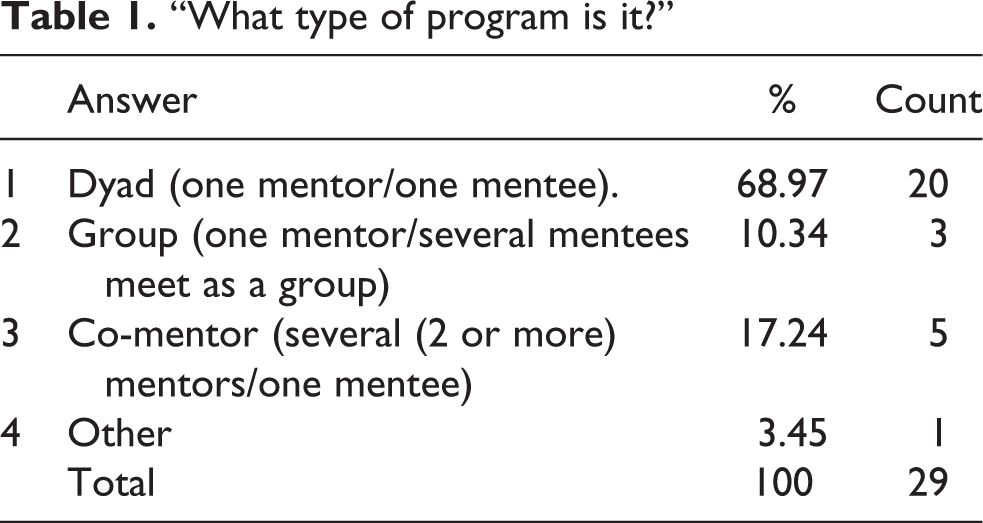
This survey of ARL libraries revealed that Purdue University Libraries FRC mentoring program, as a co-mentoring program (one mentee and several mentors), is unusual and distinctive, but not unique among the ARL libraries that responded to this survey. Five research libraries in this study, 17% (including Purdue University Libraries), have co-mentoring programs, they are: Texas A&M University, University of Illinois at Urbana-Champaign, State University of New York at Buffalo, University of Washington, and Purdue University Libraries. The majority of libraries that responded have a one-on-one mentoring program (see Table 1).
“What type of program is it?”
Co-mentoring team comparison
To dig deeper into the comparisons of co-mentoring programs, the authors conducted follow-up phone interviews with the four Associate Deans of other ARL programs. The interviews revealed three differences among the co-mentoring teams. First is that none of the other four have supervisors on the committee. A second difference is that at the other institutions the mentoring committee is not involved in contract renewals or promotion decisions. The third difference is that at the other four institutions there is no effort to appoint a full professor on each mentoring team. These three differences make the Purdue University Libraries FRC mentoring program unusual and distinctive.
Supervisor’s role in mentoring
A major aspect of the Purdue University Libraries FRC mentoring program, compared to these four other programs, is that the supervisor is on the mentoring team at Purdue University Libraries and excluded at the other institutions. One interviewee qualified this by stating that they would allow a supervisor to be a mentor, if the mentee requested the supervisor. Another interviewee stated that at their institution the supervisor is viewed as part of the administration and intentionally not appointed to the mentoring team. They are following the normal model as expressed by the Hicks et al. (2010) article, which states that the supervisor’s role is to manage staff to meet organizational goals without regard to career development of the employee.
Advising on contract renewals and promotion
Another major difference between the Purdue University Libraries program and the other programs is that the Purdue University Libraries FRCs advise the Dean on contract renewals by submitting a written recommendation for two contract reviews, one at year three and the second at year five. However, since all tenured faculty librarians participate in the formal recommendation for each promotion by voting on each candidate’s case, the FRCs do not write promotion recommendations. Instead the FRC members advise and assist the candidate in writing the promotion dossier, and the FRC presents the candidate case at the promotion meeting, where FRC members orally provide their input. Following this presentation, all tenured librarians, as members of the promotion committee, cast their votes. This written decision is sent to the Dean who forwards it to the next review committee for their vote.
The survey indicated that at only one other institution does the co-mentoring team have some input on contract renewals or promotion decisions. To investigate this, the authors specifically asked the four Associate Deans about reports and responsibilities of the co-mentors in the follow-up interviews. The level of input at the other institutions varies, although at none of them is the mentoring committee as involved as at Purdue University Libraries. Three of them have no reports produced by the committee at all. One interviewee stated that they do not ask for reports or hold mentors accountable. Another interviewee stated that their philosophy is that requiring letters would make the mentors more like supervisors, although the mentors can and usually do write a separate letter of support at the time of promotion. At that institution, all tenured faculty members are invited to write a letter, so the letter from a mentor is just one of these internal letters. At another institution the mentor can and often does act in an advocacy role and can have a “little bit” of input at the promotion meeting. However, there is discussion at this institution at the provost level to change the policy and to ask mentors to recuse themselves from promotion decision meetings. At the fourth institution, the mentors’ responsibilities are much more involved. They meet with faculty in liaison department, write up a summary of these meetings omitting names, and submit this report to the promotion committee.
Full professor on mentoring team
At the Purdue University Libraries, every FRC has three members, including a full professor to guide and to advise specifically on promotion. Programs at the other four institutions have smaller teams: only two mentors for each mentee and no effort is made to appoint a full professor on each mentoring team. At one library, the full professors are not serving on any mentoring committees. The interviews of the Associate Deans identified that there are not enough full professors to serve on the committees. At Purdue University Libraries, there are sufficient full professors available for FRCs. The full professors take this responsibility seriously and serve willingly. It is part of the expectations of their rank.
Evaluation of the Faculty Review Committee program
Purdue University Libraries evaluated the FRC program in 2011 and 2017. This research paper reports the findings of the 2017 evaluation of the FRC program. The 2011 evaluation found that the FRC program was very effective in meeting the mentoring and promotion needs of the faculty from both the mentors’ and mentees’ perspectives. Overall, the FRC mentoring review process was positively received by mentees; they indicated that they received better feedback than in the past, and that the feedback was more specific to that individual. In addition, there was a sense of better communication and fewer mixed messages from the supervisor and the promotion committee. Based on the overall opinion in 2011, the program was considered effective and was continued.
In 2017, the authors evaluated the FRC mentoring program again. This evaluation was motivated because the 2011 survey results were never published and a follow-up to that evaluation was needed for a more robust assessment, which the Dean supported. This time the evaluation was conducted using two surveys, one for all faculty members in their role as mentee and one just for the senior librarians in their role as mentor. These surveys were followed by five interviews with individual librarians from each of the three ranks, assistant (untenured), associate and full professor.
Survey results of all faculty members (in the role of mentee)
The 2017 survey was sent to all 34 faculty members; 30 useable responses were received for a response rate of 88%.
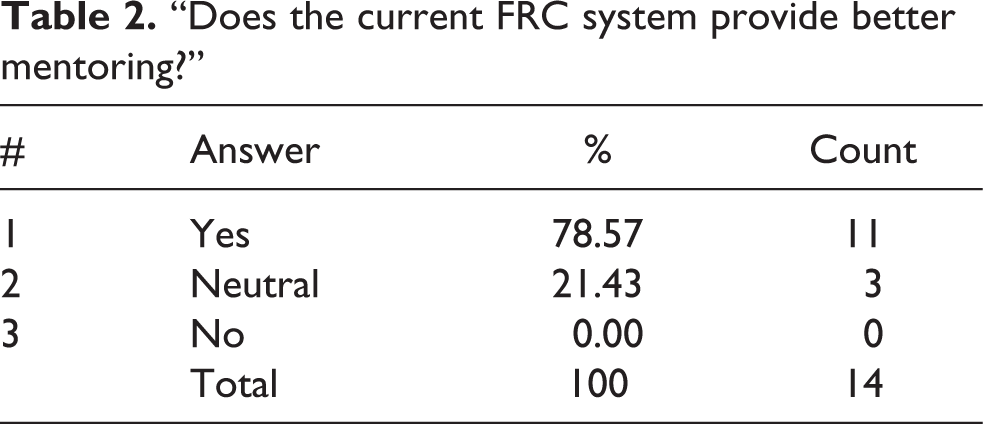
Fourteen of the librarians were on the Purdue University Libraries faculty before the change to the FRC. All but one of these librarians, who have been evaluated under both procedures, felt that the current program was an improvement; one person was neutral; no one felt it was less effective. Of the mentees surveyed, 79% felt that the program provided better mentoring and guidance than the older procedure (see Table 2).
“Does the current FRC system provide better mentoring?”
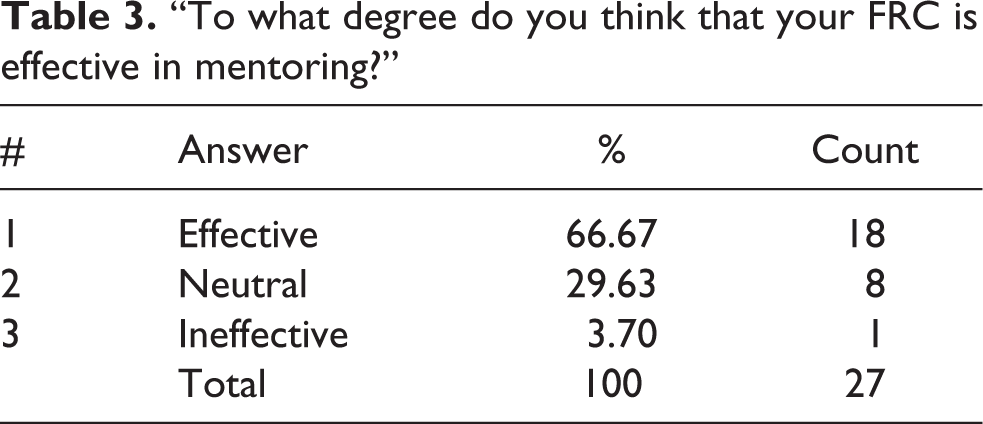
All faculty members said the program was goal-based and combines evaluation of all areas of responsibility (job performance/professional service/research and publication.) When asked specifically about the mentoring provided via the FRC, two-thirds of those who answered this question said it was effective (see Table 3).
“To what degree do you think that your FRC is effective in mentoring?”
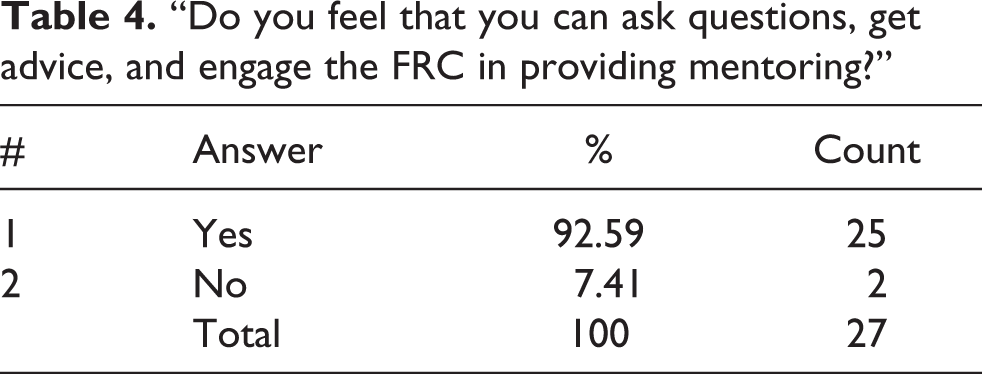
Of those who answered the question, about whether they could ask questions and get advice and mentoring, 93% said they could (see Table 4).
“Do you feel that you can ask questions, get advice, and engage the FRC in providing mentoring?”
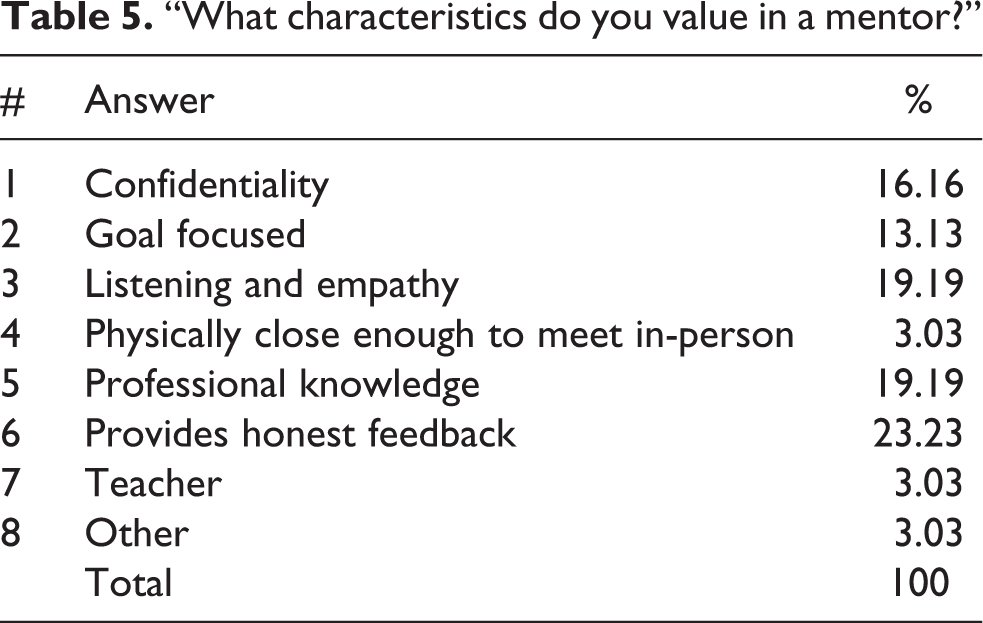
When the mentors and mentees were asked what characteristics they valued in a mentor, the librarians chose “provides honest feedback” as the top choice, followed by “professional knowledge” and “listening and empathy” (see Table 5).
“What characteristics do you value in a mentor?”
Survey of FRC members (in the role of mentor)
A different survey was sent to the 16 FRC mentors (supervisors, full professors, and third tenured members), and the response rate was 81%. There is an even distribution of associate professors and full professors. All members said that the annual performance evaluation statements included progress toward promotion; but only 60% of them also said they included evaluation of job responsibilities. Several of the FRCs have provided written reports to the Dean for contract reviews, but no one reported any consensus issues on these contract renewals. Comments indicated that the committees reached consensus easily, even though there was at least one contract that was not renewed during this time period. Similar results were received about promotion reviews. Eight faculty members have been on FRCs during a promotion decision. Seven of them assisted in writing the promotion dossier, and six of them provided verbal input at the promotion decision meeting. The FRC members were unanimously supportive in their response to the question of the effectiveness of the FRCs in providing performance review and progress towards appointment renewal.
The FRC members reported that acceptable mentoring was occurring for all mentees, with 70% answering yes and no one saying no (see Table 6). This is similar to the response in the survey sent to all faculty members (see Table 3) where two-thirds of those surveyed said acceptable mentoring was occurring, one-third were neutral, and one person said that mentoring via the FRCs was not effective.
“Do you feel that the FRC provides acceptable mentoring?”

Survey follow-up interviews with five Purdue University librarians
The surveys were followed by five interviews with Purdue University librarians: one full professor, two associate professors and two assistant/untenured professors. The interviews clarified that a change could improve the program. The mentees, especially the pre-tenure librarians, wanted more control over who was on their FRC. They felt that the membership was “sort of the luck of the draw,” and they did not have control over this. Since this was an easy change to make, the Libraries Promotion and Tenure Policy was amended during the spring of 2018 to give the candidates the responsibility for changing their full professor and/or tenured member after the first year of employment. Most faculty serve on mentoring teams, and those who are effective mentors seem to enjoy the responsibility and are willing to serve on multiple FRCs. Based on informal discussions, it seems that since this is a team approach, less effective mentors are able to learn from those who are more effective, and reluctant mentors are more willing to try it.
Assessment of the FRC’s impact on promotion of tenure-track librarians
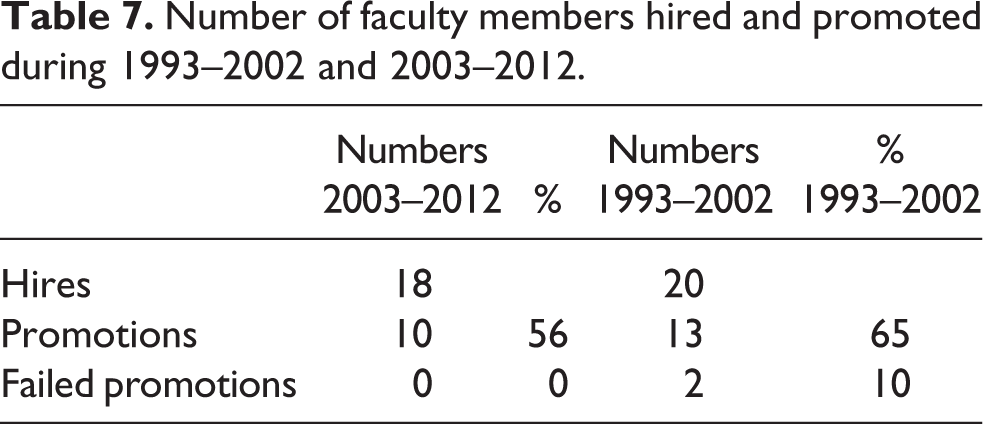
Faculty satisfaction with the FRC program is evident from the surveys. However, another corollary to the program’s success is the reduction of failed promotions. To investigate this we used the years 2003 and 2012 as the pivotal study years. 2003 was the first year of possible impact of the FRC program, because the 2003 hires were the first cohort to have an FRC working directly with them during their last year before promotion. The 2012 hires were reviewed for promotion in 2018 which is why the cutoff for reviewing publications is 2012. The promotion data from the 10 years between 2003 and 2012 was compared to the promotion data for the 10 years before that date, 1993–2002.
Table 7 shows the percentage of successful promotions and failed promotions during the last 10 years compared to the 10 years before the FRC program. Those faculty members who joined the faculty in 2003 were reviewed for promotion in 2010; they were the first cohort to have an FRC working directly with them during their last year before promotion. The most important statistic this chart reveals is that there has not been an unsuccessful promotion case since the FRCs have been working at least one year with untenured faculty members. In the 10 years prior to the FRC program, there were two unsuccessful cases (see Table 7). The written responses in the survey and the follow-up interviews suggest that untenured faculty members who are unlikely to be promoted receive better and earlier guidance, which leads to a job search and a resignation prior to the promotion review.
Number of faculty members hired and promoted during 1993–2002 and 2003–2012.
Assessment of the FRC’s impact on research and publications of all Purdue University librarians
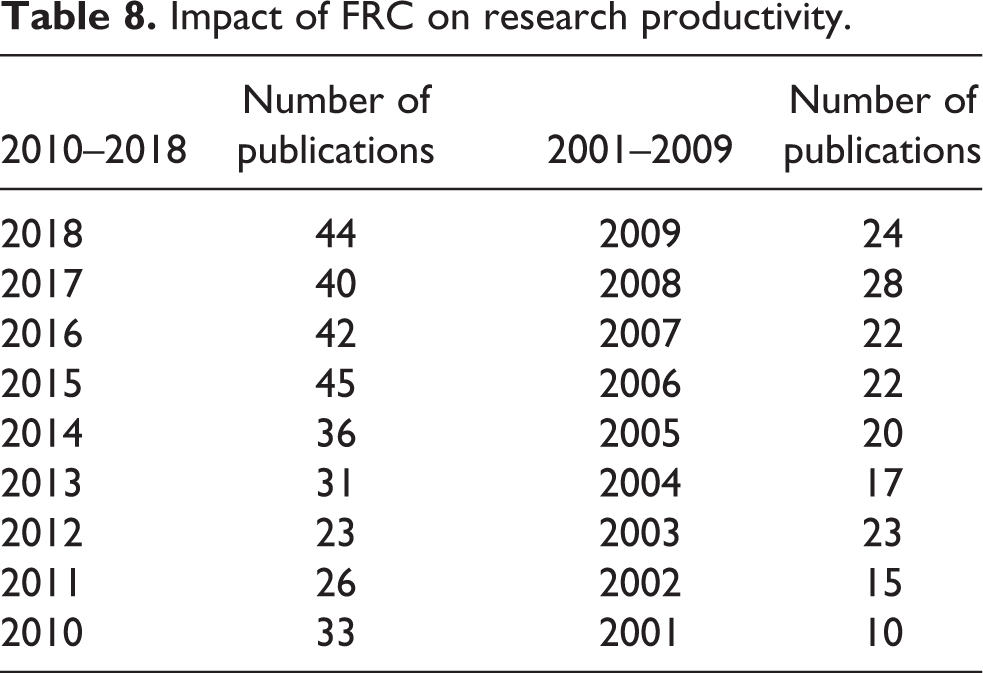
Scholarly productivity is a major component of the assessment for promotion, and an increase in the productivity of the libraries’ faculty members could be evidence of the FRC program’s success. Faculty publications are self-reported by all faculty members; however the authors are confident in these figures because of the strong encouragement to report publications. The FRC program has been in place for nine years. For this evaluation, the authors considered scholarly publications from all faculty, not just un-tenured, because all faculty have an FRC that encourages scholarly output. Comparing productivity of all scholarly articles produced by all Purdue University librarians (both mentors and mentees) between 2010 and 2018 with the nine years prior, 2001 and 2009, indicates a significant increase in scholarly productivity. It is important to note that the number of faculty employed at Purdue University Libraries has been relatively consistent during the years of 2001–2018. The table shows there has been a rather steady increase over this 18-year period. The authors recognize that certainly not all of the increase can be contributed to the FRC program. Other possible influences include the increase in funding for travel to present at conferences and financial support to hire graduate assistants. However, this trend does provide inferential support of the positive impact of the FRC program (see Table 8).
Impact of FRC on research productivity.
Conclusion
The answer to the question whether the Purdue University Libraries program is distinctive and has unique elements is yes, based on those ARL libraries that responded to the survey. Most ARL libraries, that have a mentoring program, have a one-on-one program similar to the program Purdue University Libraries had prior to 2009. Our survey only identified four other ARL libraries with co-mentoring programs; none are structured similarly to Purdue University Libraries program. A more important difference is that the Purdue University Libraries program includes the supervisor on the mentoring team. The literature review indicates a drop in the acceptance of the supervisor as a mentor since the ARL study in 1999 (Wittkopf, 1999). In general, the articles in the literature review do not recommend that the supervisor be a mentor. However, at Purdue University Libraries, this is considered one of the strengths, and mentoring a direct report is a major part of the supervisor’s responsibilities. Including the supervisor on the mentoring team makes the conversation and recommendations to the mentee an open discussion. The mentee is not in the position of receiving multiple, sometimes conflicting directives from the supervisor and other mentors. If there are different opinions, they can be discussed openly at the FRC meeting.
A second difference between the Purdue University Libraries program and the other four co-mentoring programs is the responsibility of the FRC to advise on contract renewals and promotions. This responsibility of the FRCs increases the status and formality of the committee, and the Purdue University librarian surveys and the interviews indicated satisfaction with the integration of the mentoring in the review process.
A third difference is that at Purdue University Libraries every FRC has a full professor. Prior to the FRC program, a significant amount of the full professors’ time was devoted to the review process. The FRC program distributes this workload among the full professors and the associate professors. The authors did not include a question in the survey about workload; however, no-one mentioned this in either the survey or the follow-up interviews.
To summarize, the FRC mentoring program at Purdue University Libraries is distinctive because it is a formal co-mentoring team approach with three mentors for every mentee and because the membership includes the supervisor and a full professor. These FRC committees have formal and clear responsibilities to guide and mentor the career development of every librarian and the authority to recommend contract renewals and to provide oral evaluation at the promotion meeting. FRCs are accountable; they write recommendations for the mentee and the Library Dean. Purdue University Libraries has discovered during this investigation of the FRC program that it is important that the committee membership be flexible. The flexibility of the teams was recently enhanced based on the 2017 study to give every mentee control over the choice of full professor and third member.
The Purdue University Libraries Faculty Review Committee was specifically designed to meet the needs and resources available at Purdue University Libraries. Some of the aspects of the program could be adapted by other libraries, while other aspects might not work in every setting. Our recommendation is that other libraries assess their needs and mine our program for ideas that might be implemented.
Supplemental material
Supplemental Material, Authors_Response - Designing a mentoring program for faculty librarians
Supplemental Material, Authors_Response for Designing a mentoring program for faculty librarians by Erla P. Heyns and Judith M. Nixon in IFLA Journal
Supplemental material
Supplemental Material, FRC_evaluation_for_all_librarians_as_mentees - Designing a mentoring program for faculty librarians
Supplemental Material, FRC_evaluation_for_all_librarians_as_mentees for Designing a mentoring program for faculty librarians by Erla P. Heyns and Judith M. Nixon in IFLA Journal
Supplemental material
Supplemental Material, FRC_evaluation_for_FRC_committee_members_mentors - Designing a mentoring program for faculty librarians
Supplemental Material, FRC_evaluation_for_FRC_committee_members_mentors for Designing a mentoring program for faculty librarians by Erla P. Heyns and Judith M. Nixon in IFLA Journal
Supplemental material
Supplemental Material, Mentoring_Reviews_Justification_for_IFLA - Designing a mentoring program for faculty librarians
Supplemental Material, Mentoring_Reviews_Justification_for_IFLA for Designing a mentoring program for faculty librarians by Erla P. Heyns and Judith M. Nixon in IFLA Journal
Footnotes
Declaration of conflicting interests
The authors declared no potential conflicts of interest with respect to the research, authorship, and/or publication of this article.
Funding
The authors received no financial support for the research, authorship, and/or publication of this article

Supplemental material
Supplemental material for this article is available online.
References
Supplementary Material
Please find the following supplemental material available below.
For Open Access articles published under a Creative Commons License, all supplemental material carries the same license as the article it is associated with.
For non-Open Access articles published, all supplemental material carries a non-exclusive license, and permission requests for re-use of supplemental material or any part of supplemental material shall be sent directly to the copyright owner as specified in the copyright notice associated with the article.
