



Abstract
A central theme of U.S. transportation planning policies is to reduce single-occupancy vehicle (SOV) trips and promote transit and non-motorized transportation by coordinating land-use planning and transportation demand management (TDM) programs. Cities often implement TDM programs by intervening with new development during the municipal permit review process. Seattle’s Transportation Management Program (TMP) under a joint Director’s Rule (DR) requires a commitment from developers to adopt select strategies from six TDM element categories: program management, physical improvements, bicycle/walking programs, employer-based incentives, transit and car/vanpooling, and parking management. TMP targets new developments and requires some TDM elements, recommends others, and leaves the rest to negotiation. The result is an individualized TMP agreement that is site-specific, reflecting both city policy and developer needs. This case study presents a qualitative analysis of the guiding eight DRs and 41 site-specific TMP agreements in Seattle’s Downtown and South Lake Union (SLU) area since 1988. Overall, a content analysis of TMP documents reveals that the average number of elements adopted in an agreement falls short of requirements set by DRs (34%–61%). Major findings include developer preference toward non-traditional TDM measures such as physical improvement of frontage and urban design features, as well as parking management. High-occupancy vehicle (HOV) elements showed higher adoption rates (59%–63%) over biking/walking programs (< 1%). It is concluded that future TDM policies could benefit if future research includes examining the effectiveness of the range of management options stemming from the real estate trends toward green buildings, tenants’ values in sustainability, and city policy to reduce automobile trips.
Keywords
Cities have traditionally emphasized employers and commute trip reduction to manage traffic congestion and transportation demand. In the U.S., some studies focusing on the intersection of transportation with land-use planning suggest a new arena for transportation demand management (TDM) strategies intervening at the individual site level ( 1 , 2 ). It is often called “travel plans,”“workplace travel planning,” or “mobility management measures” in the U.K., Europe, and Australia ( 3 – 5 ). These studies conclude that site-specific TDM elements—end-of-trip facilities, parking management, high-occupancy vehicle (HOV) programs, and so forth—contribute to single-occupancy vehicle (SOV) trip reduction. As transportation planning encompasses strategic coordination with land-use decisions, opportunities arise within the permitting and design review process for city planning and transportation departments to advocate for site-specific TDM strategies by working with developers in highly congested areas.
From the passage of the Intermodal Surface Transportation Efficiency Act (ISTEA) in the U.S., transportation planning policies added weight to issues concerning sustainability, accessibility, and multi-modal options. In return, the role of developers and site design has likewise shifted, reflecting tenant desires for alternative transportation options. Developer-driven site-specific TDM—transportation strategies selected and managed at the site-level—has a role in the future of transportation planning ( 2 ). However, to the authors’ knowledge, the role and popularity of site-specific TDM strategies in the municipal review process of proposed commercial development have not been explored in depth.
This case study aims to elucidate understanding of developers’ perspectives on preferred TDM measures. The evolution of the policy context of the site-specific TDM strategies for new development in two commercial core areas of the City of Seattle (see Case of Seattle section) is investigated, and the recent trends in developer preferences that may shed light on guidelines for future site-specific TDM strategies or similar efforts in other cities in the U.S. are analyzed. This paper examines how the Seattle Department of Transportation (SDOT) and Department of Construction and Inspections (SDCI) harness developer influence for TDM by looking at the city’s TDM program administrative Director’s Rules (DRs) and the final adopted measures per new development from 1998 and 2015. For others interested in developing or implementing a site-specific TDM program, the study provides a methodology that can serve as general guidance.
Literature Review
Transportation and Land-Use Planning
A well-established compendium of research has explored the close relationship between transportation mode choice and land-use development patterns and concluded, in short, that densely developed mixed-land-use patterns lead to fewer vehicular travel trips ( 6 – 10 ). Researchers found that travel plans can achieve 10%–20% trip reduction plans for new developments. In the U.K., the scale is larger than the U.S. because of the national planning policy and guidance to regional and local governments. Planning Policy Guidance 13 requires coordinating land-use and transport planning for the sake of sustainable development: some of the measures are discussed in the site-specific TDM measures section in this paper ( 3 – 5 ).
Growth Management and Environmental Impact Mitigation in Washington State
Guided by regulations such as the 1970 National Environmental Policy Act (NEPA), the 1971 Washington State Environmental Policy Act (SEPA), and the 1990 Washington State Growth Management Act (GMA), many larger cities in Washington require proposed new development to undergo a review of potential environmental impacts caused by the construction and future use of the project. These environmental impact evaluations represent a shift in the contractual relationship between municipalities and developers away from heavy reliance on general land-use zoning regulations to a model where the individual project is evaluated by the city for impacts on a case-by-case basis ( 11 ).
The standard permitting process, in which conditions for developers are placed on projects, reflects an underlying system of norms that guide the expectations of both the developer and the government and influence the characteristics of the conditions ( 11 ). Norms of transportation sustainability, understood as lowering vehicle miles traveled (VMT) and promoting accessibility, influence the mitigation strategies implemented as a result of the impact review.
Sustainability and Development
With the push for a stronger focus on sustainability in transportation practice, an increase in the amount of effort and attention paid to sustainability has occurred at the individual site level of commercial development ( 12 , 13 ). Driven by regulations, reputation, and financial benefits, environmental and social concerns have risen significantly in prominence in the decision-making process and calculation of the real estate industry ( 12 , 13 ). Additionally, increased demand is visible for sustainable, environmentally efficient buildings and services from the professional firms that lease urban commercial real estate ( 13 ). For developers and tenants, TDM strategies built into the design of the building signal value of sustainability as well as provide a potential magnet for talent attraction.
Transportation Demand Management
Most TDM strategies include the “implementation of short-term incentive and disincentive programs that incorporate, directly or indirectly, the external social and environmental costs of individual travel decisions” ( 14 ). The exact mix of disincentives and incentives depends on the scale of implementation. TDM at the regional scale includes coordinated efforts such as growth management strategies, HOV lanes, and trip reduction ordinances, while TDM at the site-specific scale may include efforts such as transit subsidies, parking policies, and alternative working hours ( 15 ). A successful TDM strategy for a growing urban center is one which allows for increasingly dense development without impeding the mobility options for travelers, and without requiring the construction of additional transportation facilities to serve the increased demand ( 14 ).
Private development has a stake in successful TDM based on self-interest. As early as 1991, transportation planning scholars identified benefits for the development community in embracing TDM strategies in site design, namely as a cost-effective alternative to impacts fees and other exactions required of new development by municipalities to mitigate traffic impacts and maintain levels of service standards on existing infrastructure ( 2 ). If the transportation system is not able to adequately absorb an increase in travel demand caused by the new development, local land-use regulations may limit the scale of that development to a size that can be served by the existing infrastructure ( 14 ). Developer-driven upstream TDM that knowledgeably addresses new travel demand as part of the project’s design avoids costly delay, re-design, and downsizing that government regulation will require downstream in the development review and permitting process. The marketability of private development is also subject to public opinion, and as the “social awareness of mobility management” increases, the expectation for private developers to engage in TDM strategies increases in turn ( 16 ). Purely private TDM efforts such as organized transportation management associations exist; however, most cities with serious TDM goals and a well-established culture of sustainability rely on local ordinances to enact change in the private sector. Historically, these regulations have targeted employers via commute trip reduction ordinances ( 14 ). Private development, especially office developments that host a workforce commuting during peak demand hours, have a stake in successful TDM based on self-interest, although local regulations may push the level of engagement even further.
Public actors set out in planning documents the long-range transportation goals for the region, sometimes in vague, principle-based terms, but the strategic direction of local TDM efforts is actually reflected through site-specific TDM practices adopted and promoted by the private sector. In other words, the planning documents set out desired outcomes but it is a mix of carrots and sticks, the “microlevel land use changes” in the form of on-site amenities and services that could directly influence individual travel mode choice ( 1 , 15 ).
Site-Specific TDM
There are three main types of TDM strategy for private development adopted at the site-specific level:
Built features and on-site facilities, such as bike repair rooms and shower and locker facilities
Management of existing parking through pricing policies and space allocation
Ongoing programs, and service requirements placed on tenants through lease terms such as ridesharing programs or telework policies
Although each type of strategy may be further categorized by targeted travel mode or implementing authority, they all contribute to trip reduction, encourage mode-shift, and increase overall accessibility.
As transportation planning has shifted to accommodate and promote active transportation options, individuals are looking for services that reflect these modes in their built environments ( 17 ). Research supports the connection between the availability of on-site facilities and mode shift from personal vehicles to active transportation modes (1, 18–20). At sites, end-of-trip facilities such as bike rooms, adequate secure bike parking, and enhanced pedestrian walkways for connections to transit are desirable amenities for future tenants and an asset to developers.
The availability of inexpensive parking is a significant influence on an individual’s decision to drive. Effectively managing the pricing structure of a site’s parking supply to reflect the true cost of personal vehicle travel allows for trip makers to make informed decisions and weigh the benefits of alternative transportation modes ( 21 – 23 ). Additionally, limiting the amount of parking available to SOVs encourages commuters to consider HOV, transit, or active transportation modes ( 24 ). Maximum parking measures, also, led to major impact on travel plans to reduce SOVs in the U.K. ( 5 ).
Moreover, programmatic elements and service offerings serve as further inducements to change transportation behavior. Employer-based incentives, such as telecommuting or flexible work schedule policies, allow employees to work from home or commute outside of peak hours, reducing overall VMT and peak travel demand ( 25 ). On-site transportation representatives for office developments and information distribution via central kiosks, transit maps, or a centralized webpage provide additional support to tenants in understanding their options when planning their commute.
As the timeline of transportation impacts extends past construction, the responsibility for sustainable behaviors extends from the developer to the future tenants. While the city is responsible for the successful management of infrastructure, the individual travel behaviors of tenants are better managed on site through programmatic efforts such as commuter benefits and active transportation amenities. Transportation Management Program (TMP) agreements are one transportation planning tool that extends the responsibility of TDM to individual sites and establishes a precedent for ongoing management.
Case of Seattle
Seattle plans to reduce SOV trips using a combination of land use, TDM policies, and a Commute Trip Reduction (CTR) program for larger corporations with over 100 employees. The city has a reputation for being among the largest cities in the U.S. successfully reducing SOV trip rates. Downtown Seattle shows signs of success: between 2010 and 2017, while the number of employees increased by 60,000 (from 202,000 to 262,000), the SOV rate decreased by 10 percentage points (from 35% to 25%) ( 26 ). This paper will focus on two selected areas in the Downtown area where the job growth is rapid but SOV rates are declining.
Seattle’s land-use and growth strategy has contributed to the city’s transportation management success. Seattle’s Comprehensive Plan, required by the 1990 Washington State GMA, established the urban village (UV) strategy with higher residential and employment targets to accommodate future growth, increase mixed-use density, and promote non-motorized transportation. It has four hierarchical categories: Urban Centers (large-scale job centers), Hub Urban Villages (satellite housing and employment centers), Residential Urban Villages (neighborhood-scale residential/shopping centers), and Industrial Centers.
TDM in Seattle
One of the TDM programs managed by the City of Seattle targets the mitigation of congestion impacts from new developments on a site-by-site basis: TMP requires new development sites of a certain size (typically those > 100,000 ft2) to create a plan for how the site’s transportation demand will be managed. Thus, an individual TMP is an agreement between the city and the building owner, addressing a series of elements that an individual site will provide/perform to manage the impact to the transportation system generated by the operations of the new building throughout its lifetime.
The TMP is guided by the decisions outlined in SDOT and SDCI’s joint DRs. These DRs are binding administrative rules following the Seattle Municipal Code Chapter 3.02—Administrative Code. The DRs provide an official interpretation of the contemporary city codes on land use and housing, among other areas of municipal interest, as well as prescribe rules and standards for the administrative application of programs such as the TMP ( 27 ). In doing so, the city is able to not only make some requirements of new developments through the TMP, but also to encourage developers to adopt additional, recommended TDM elements that promote the vision for the city based on the comprehensive and transportation plans. Under the TMP, each site-specific TMP document is an agreement that represents the iterative negotiation between the two parties—the outcome shows a compromise of value of both parties. There is a limitation in using TMPs as documents of record in that the stages, details, and nuances of the negotiation process are not known; however, positioning the DRs and TMPs within a development and planning timeline helps to ground each document in context. While the elements in DR outline the starting point for negotiation, the contents of the final product depend heavily on the discretion of the city officials in determining if the sum impact of the elements would be sufficient in mitigating the expected transportation impacts, most often expressed as a goal SOV trip rate. One method is through an environmental review and a transportation impact analysis that estimates traffic volumes generated by a new project, as well as assessing the impact of the project on transit, pedestrian, and bicycle facilities. One benefit of the TMP, specifically the developer requirements, allows city planners to define/manage how buildings will contribute to the infrastructure assets of the city. Because the building features are critical elements of the walking/biking/transit environment, they play an important role in changing transportation demand. TMP agreements allow the city to place on the commercial development market the responsibility to support multi-modal transportation options at the site level.
Evolution of the Director’s Rules
The eight DRs that have defined the rules and standards for site-specific TDM element adoption in Seattle’s TMP since the start of the program in 1988 have varied in both the number and type of TDM elements required of or recommended for new development projects.
The 1988 DR was the first TMP DR issued by the city and effectively set up the formal standards and processes for implementing the TMP and establishing site-specific TMP agreements with building owners. The 1998 DR had only a handful of loose requirements and was written to allow for flexibility in the negotiation between developers and city officials in determining the appropriate amount of mitigation based on the location and proposed use of the building.
Washington State’s 1991 CTR law influenced the 1991 DR. It included TDM elements targeting workplace programs with more than 100 employees that would later be required of many employers under a 1993 CTR ordinance. The 1991 DR expanded the required program elements to include demand management measures that could be best carried out by employers as incentives for employees, such as shuttle services, telecommuting programs, and coordination of ridesharing programs with other employers. The 1994 DR continued to focus on employer-based incentives, but also substantially expanded the city’s official definitions of each TDM element of building and frontage features.
After the growth of the 1990s and the uncertainty of the economic recession in the early 2000s, the 2002 DR was issued to make the TMP process less burdensome to developers. It only listed required elements and allowed applicants to have several elements waived by the director in the final document.
The 2008, 2010, and 2012 DRs adopted three tiers of TDM elements that could be included in a TMP agreement: required for all projects, highly recommended, and location-dependent. Because of the success of the UV strategy and the concentration of development within urban centers, the location-dependent category—which considers accessibility to nearby alternative transportation network—was particularly important for mitigating new congestion impacts on surrounding areas outside the UV boundary. However, it is important to note that no data were available for adopted TMP agreements that met the criteria of the study under the 2008 DR. The lack of potential sites with TMP agreements is likely due in part to the lull in new development applications that need review because of the oversupply of commercial office space beginning construction immediately before the 2008 housing market crises and subsequent recession.
The 2015 DR returned to the original format of listing both a set of required elements applicable to all TMP building sites and a list of recommended elements that would be included in the TMP agreement at the discretion of the city official in negotiation with the developer. Recommended elements outnumber required elements, providing the opportunity for developers to self-select the options best suited for their development location, proposed use, and scale of projected impact.
The growth of Seattle’s TMP since 1988 mirrors the evolution of TDM as a transportation and land-use planning tool in the city. The program began with a focus on promoting HOV programs and additional employer-based SOV reduction incentives associated with the local CTR ordinance. During the development boom of the early 1990s when the commercial real estate market substantially increased the number of projects participating in the development review process, the program showed an early shift in preference for TMPs to include physical elements incorporated into the design of the project. As developable land in the commercial core has become even more limited, the most recently finalized TMPs suggest a trend for adopting an increased number of parking management strategies. DRs reflect the changing market conditions and reflect developers’ acceptance of managing transportation demands. Overall, the development of the program was gradual—an apparent melding of public policy with private interests for developers.
Additionally, the average number of TDM elements adopted through the history of the TMP by commercial development projects in Downtown and South Lake Union (SLU) falls short of expectations set by the baseline required elements outlined in the controlling DRs of the time. Downtown Seattle and SLU are two commercial neighborhoods categorized under the urban village strategy with a high development capacity; however, SLU grew at a rapid pace after an initial investment from the biomedical and technology industries in the early 2000s. Despite differences in development patterns and transportation resources, the TDM elements adopted in the two neighborhoods did not significantly differ.
Methodology
Purpose of this Research and Site Selection
The aim of the case study is to analyze Seattle’s TMP agreements and developer preference among the TMP options, outlined in the DRs, in the past two decades. The review of Seattle’s historical TMP documents responds to two questions: (1) How have the TDM elements required by the city evolved over time from the first TMP DRs in 1988 to the most recent in 2015, with consideration for each development context? and (2) How do the elements required and recommended by TMP DRs compare with the adopted TMP elements for office development? Site-specific TMP elements are those selected during the negotiation process and included in the final TMP agreement for an individual site, which is recorded with the King County Recorder’s Office, considered valid for the life of the building, and require full implementation. A total of 41 site-specific TMP agreements of two cases in Seattle’s Downtown (the Belltown, Commercial Core, and Denny Triangle neighborhoods) and SLU areas were analyzed (Figure 1). Downtown is an Urban Center and SLU is a Hub Urban Village according to Seattle’s UV strategy. Downtown is the commercial heart and the primary job growth center (> 320,000 jobs, 49.4 million ft2, 18.1% SOV in 2019, > 50% of Seattle jobs that year). SLU, abutting Downtown and Lake Union is a former industrial area turned high-tech/biotech hub led by Amazon’s headquarters and the other technology industry giants that followed, as well as various medical research institutions (9.2 million ft2, 28.1% SOV). The two areas show a markedly low proportion of SOV trips despite the rapid expansion.

Map of commercial office development sites with transport demand management (TMP) agreements in Downtown and South Lake Union (SLU).
Methods and Data Collection
TMP agreements and City of Seattle DRs are publicly available documents tied to the Master Use Permit of a development. This research employs a qualitative, document review analysis of Seattle’s more than 200 site-specific TMP agreements and eight DRs written since the start of the formal program in 1988 through 2019. For research purposes, the contents of the TMP agreements and the eight DRs were coded and digitally transcribed. After filtering by validity of the available documents, land use, and location, a total of 41 commercial office sites were chosen in Downtown Seattle (20 sites) and SLU (21 sites) shown in Figure 1. Agreements lacking the signatures of all required parties (the property owner or their representative, SDOT, and SDCI) were considered drafts and not included in the research.
For coding TDM elements of all TMP DRs, the following six TDM categories were used, which were established first time under the 2008 DR:
Building and frontage features (physical improvements)
Program management and encouragement activities
Bicycle/walking programs
Additional employer-based incentives
Transit, carpool, and vanpool programs
Parking management
A seventh category of “Other” was added as a catchall for requirements at the start of the program that did not neatly fall under one of the above six categories.
TDM elements were further classified as required, recommended, or location-dependent according to the directions outlined in the 2008–2012 DRs. Under the TMP DRs, required elements are those which must be included in all agreements regardless of the site’s size, location, or land use, while recommended elements are those which are up for negotiation between the developer and city official. The location-dependent category that emphasizes adjacent non-vehicle transportation infrastructure only appears in the 2008, 2010, and 2012 DRs. For the purposes of the paper, all location-dependent elements are treated as recommended elements.
The definition of elements as recommended rather than required offers a view into the TDM strategy of the City of Seattle. The recommended elements adopted by individual sites speak to how the commercial real estate market evaluates the value of TDM. The variation in both element requirements and adoption of the six static TDM categories over time reflects the city’s varied response to TDM strategies and development pressures in Seattle. As a case study, an analysis of the contracts and policies guiding the Seattle TMP program catalogue the evolution of TDM policy and its adoption by stakeholders in commercial real estate in an urban center experiencing rapid commercial growth.
Findings
Under-Adoption of Required Elements
A comparison of the required elements listed in TMP DRs with what was ultimately adopted by individual sites from 1988 to 2019 reveals that the average TMP agreement does not commit to adopting the full roster of required elements, especially before 2010 (Figure 2). By 2010, the average TMP agreement adopted 67% of required elements. Developers are able to have required elements waived by city officials if the elements are considered inapplicable or unnecessary for the site to achieve SOV trip reduction based on the use and design of the proposed project. There are many reasons for a required element to be waived. For example, the element may not be applicable given the land use, design, and location of the site; however, the TDM requirement must not also be required elsewhere in the land-use code. While required elements have been waived throughout the program, the data suggests officials were less likely to waive requirements in recent years. The results show that categorizing an element as required does not guarantee the element will be included in the final TMP agreement. Based on the available sample sites, the average agreement did not adopt the full roster of required elements until the 2012 TMP DR. By 2012, the city had implemented additional growth management policies such as transportation impact mitigation requirements and substantial parking reform, such as increased bicycle parking requirements and reduced parking minimums, in response to the increase in commercial development spurred in large part by the biomedical and technical companies’ relocation to SLU.

Required versus adopted Transport Management Programs (TMPs) by transport demand management (TDM) category.
Limited Neighborhood Differences
A comparison of the adopted TMP elements for office sites in Downtown Seattle with SLU illustrates a difference in the transportation context as well as developer motivation. To start, no TMP agreements were available for office development sites in SLU until the 1994 DR—after the neighborhood was first designated as a Hub Urban Village. At that time, the average TMP agreement for office developments in SLU included more recommended employer-based incentives, and program management and encouragement activities (1.25 and 4.25) than those adopted for a similar site in the Downtown Urban Center (0.43 and 3.43), reflecting the city’s willingness to favor specific program requirements based on the location of the project and expected tenants (Figure 3).

Average transport demand management (TDM) elements adopted in Transport Management Program (TMP) agreements at office sites in Downtown and South Lake Union (SLU).
Under the 2002 DR, when all TDM elements were considered required, more than four times as many parking elements were adopted on average in SLU per TMP agreement (2.2) compared with Downtown (0.5) (Figure 3). At the time, SLU had not fully emerged as a commercial center (SLU Hub UV designation in 2004), although it was on track to become a biomedical and technology center. Parking management strategies including preferential parking for carpools/vanpools and the unbundling of parking charges from tenants’ leases, which were the two most popular parking management strategies during this period and were readily adopted by developers of single-tenant buildings and urban campuses set to house thousands of workers. The most recently finalized TMP agreements suggest a trend for adopting an increased number of parking management strategies—a program high of 2.9 elements per agreement under the 2015 TMP DR (Figure 4) which jumps to 3.57 per agreement when limiting results to sites in SLU.

Transport demand management (TDM) categories in Director’s Rules (DRs) versus Transport Management Programs (TMPs), 1998–2015.
Bicycle and walking programs show the lowest TMP adopted element count across DRs, with one notable peak in Downtown sites (2) under the 2012 TMP agreement. For both neighborhoods, program management and encouragement and building and frontage features were the two most popular elements under the most recent 2012 and 2015 TMP DRs.
Building and Frontage Features (Physical Improvements)
Excluding the 2002 DR, building and frontage features peaked in popularity as required TDM elements early in the program under the 1994 DR. During this period, the city was focused on concentrating development in the Downtown Urban Center via the UV strategy and adapting to the construction boom of the early dot-com era. The ability to encourage site access improvements beyond existing urban design requirements in the land-use code and influence the design of the structure to better support desired transportation behaviors is a success of the TMP, not replicable by the other major TDM regulations. Some of these required physical improvements include site improvements beyond those required by code, off-site mitigation, and shower and locker facilities (Table 1).
Building and Frontage Features (Physical Improvements) Listed in Transport Management Program (TMP) Director’s Rules (DRs)
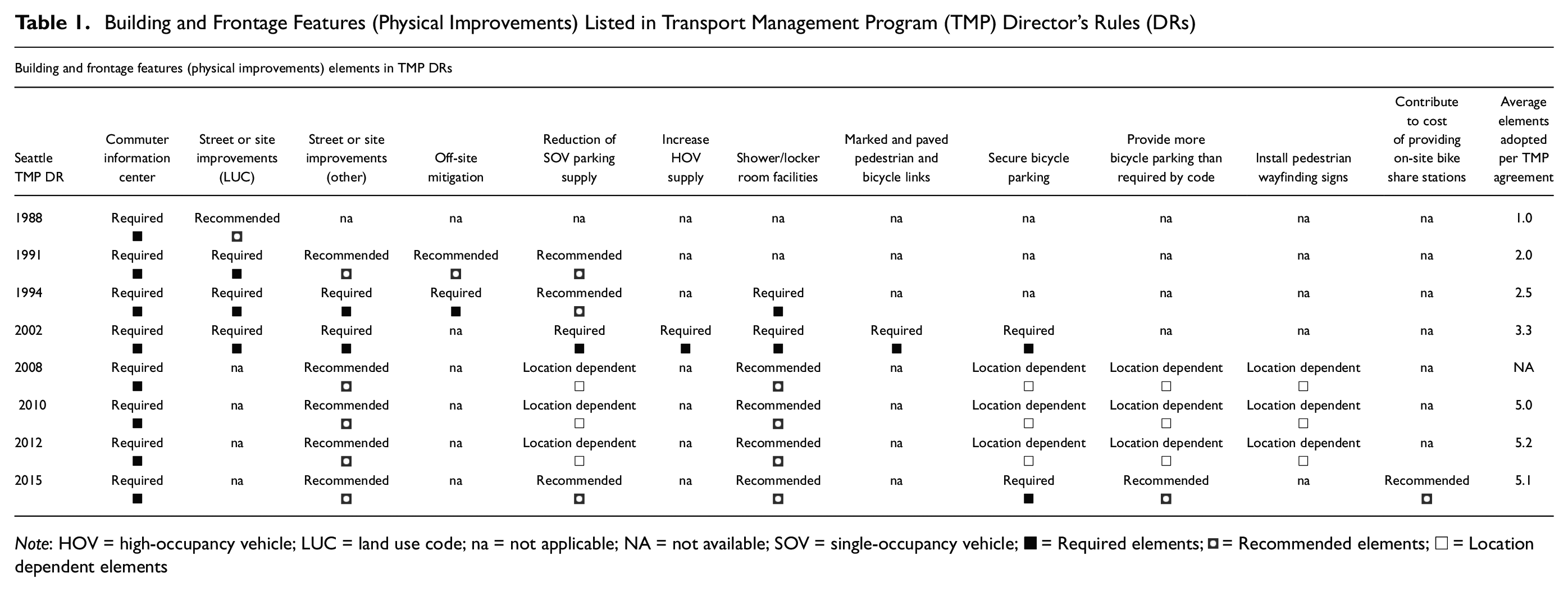
Note: HOV = high-occupancy vehicle; LUC = land use code; na = not applicable; NA = not available; SOV = single-occupancy vehicle; ■ = Required elements;  = Recommended elements; □ = Location dependent elements
In 2002, when all elements were required, there were notable additional physical features as TMP elements with long-term impacts, such as paved pedestrian and bicycle links to nearby public transit and reduction of SOV parking supply. Because these elements involve the physical assets of a building, they require coordination with the developer early on in the permit review process, as well as a willingness from developers to incorporate permanent TDM features into their site designs. The number of required built elements in DRs dropped reflecting the 2008 market crash and subsequent lull in development—it appears that the ability or desire of the city to require physical elements under a demand management program fell. The likely explanation is twofold: requiring additional physical design elements further delays the permitting process, and developer resistance to the implicated additional costs for these elements increased. While fewer physical features were required after 2002, an increasing number of recommended physical improvements continued to be adopted in TMP agreements. Under the 2015 DR, there were a total of 14 TMPs, and developers chose to adopt an average of two required, and three+ recommended physical improvement elements per TMP.
Conclusions
The growth of Seattle’s TMP mirrors the evolution of TDM as a transportation and land-use planning tool in the city. The program began with a focus on HOVs and additional employer-based incentives associated with local legislation focused on growth management in the commercial core and commute trip reduction policies. After the market crash of 2008, required physical improvement TDM elements were reduced in TMP DR guidelines. However, elements under this category were adopted with increased popularity throughout the recovery of the 2010s—under the 2015 DR an average of 63% (3.14) of recommended physical improvement elements were adopted in final agreements compared previous average high of less than 1% (0.18) during the downtown boom of the early 1990s.
The average number of TDM elements adopted through the history of the TMP by commercial development projects in Downtown and SLU falls short of expectations set by the controlling DRs of the time. The distribution of required and recommended versus adopted elements across the TDM categories conveys both the strategies of the city as well as the preferences for certain TDM measures by developers. An early period of strength in the program after the CTR law and GMA in the beginning of the 1990s was weakened by a struggling commercial real estate market throughout the rest of the decade. Strict requirements under the 2002 DR helped the TMP regain its strength and set firm expectations for developers and their role in TDM implementation. After a lull in the pace of office development following the 2008 recession, the number of TDM elements required of the few new development projects in Downtown fell below early program standards. The increase in the number of adopted recommended parking management, HOV programs, and building feature elements under the 2012 (12.0) and 2015 (10.9) DRs demonstrates a willingness of developers to incorporate TDM into their site designs. These developers were likely motivated in part by their own benefit—tenants and lessees increasingly embraced sustainability, while the conditions of real estate market conditions grew more robust.
Despite differences in development patterns and transportation resources, the TDM elements adopted in the two cases did not significantly differ. However, SLU sites adopted more location-dependent elements than Downtown under the 2012 DR (6.6 versus 4). The results show that as SLU up-zoned to support the emerging biomedical and technology hub, sites adopted more parking management efforts, and used building feature elements TDM more than Downtown sites at the time. One possible explanation could be the perceived value from developers in promoting HOV and active transportation through parking management strategies to appeal to sustainability and image-focused biomedical and technology industry tenants. At the time, SLU sites tended to prohibit price reductions for all-day parking (e.g., “early bird” specials).
From the findings, it is clear that a connection exists among the category of site-specific TDM element, public policy, and developer preference. However, the research does not delve into the potential cost analysis or value-based decision-making done by developers during the TMP negotiation or site design process. It would be inappropriate to assign causation to trends between an increase in TDM elements and developer decision-making without further investigation.
The TMP emerged in step with similar national and state TDM efforts focused on reducing SOV trips and congestion impacts. Moreover, Seattle’s TMP demonstrates that the decisions made during the permit review process apply for the life of the building. This long lifetime of TMP decisions underscores the potential inherent in the program for city officials to make permanent decisions that will support transportation mode-shift in the long term. Other U.S. cities may learn from the case study of Seattle: make use of the regulatory authority they currently hold in the permit review process by favoring physical elements as a TDM strategy for individual sites to build a positive cumulative impact on mode-shift or other policy objectives. However, a categorical review of the TDM strategies included in TMP DRs reveals a significant amount of variability between rules based on the development context and consequently variability between individual TMP agreements, even among those in the same neighborhoods.
Physical TDM elements require significant buy-in on behalf of the developer, because of cost calculations and variations in appeal to potential tenants. On the whole, it was found that the developers respond better to the physical improvements than the conventional TDM measures addressed elsewhere. Recommended physical improvement elements were adopted by developers and included in TMP agreements more often across DRs than other element categories. One lesson which surfaced in this research suggests that, by weighing physical TDM elements more significantly than other conventional TDM categories, cities may encourage developers to make costly investments in the success of future multi-modal transportation options. The results suggest that developers favor physical design elements, which increasingly signal sustainability value to prospective clients and require fewer resources from city officials for management and evaluation than programmatic demand management initiatives. It indicates the underlying milieu of favoritism toward point-based Green Building designations and the sustainable and healthy lifestyle of millennial tenants. The latter is better-known than the former. For developers, an added benefit exists: once the building receives the higher Green Building certification, rents and occupancy rates increase and there is some positive effect on the selling prices ( 28 ). The range of the points is higher for the Alternative Transportation elements in the Green Building certification process ( 29 ). However, how these elements affect TDM measures is not yet researched in the literature. In the future, transportation planners and policymakers could be more proactive to track the real estate sustainable building trends closely via Green Building Council, Urban Land Institute, and similar interest groups, and design more effective TDM measures to attract developers and tenants. It is also recommended that future research on the types of TDM and development programs in other cities and countries—for example, the District of Columbia—emphasizes built-parking reduction as a part of form-based design review and their impact on transportation behavior.
Footnotes
Author Contributions
The authors confirm contribution to the paper as follows: study conception and design: M. McKnight-Slottee, C. Bae, E. McCormack; data collection: M. McKnight-Slottee; analysis and interpretation of results: M. McKnight-Slottee, C. Bae, E. McCormack; draft manuscript preparation: M. McKnight-Slottee, C. Bae, E. McCormack. All authors reviewed the results and approved the final version of the manuscript.
Declaration of Conflicting Interests
The author(s) declared no potential conflicts of interest with respect to the research, authorship, and/or publication of this article.
Funding
The author(s) received no financial support for the research, authorship, and/or publication of this article.
