



Abstract
Forecasting pavement performance condition is essential within the pavement management system to optimize decisions with regard to planning maintenance and rehabilitation projects. Accurate forecasts facilitate timely interventions and assist in formulating cost-effective asset management plans. Data-driven machine learning models that utilize historical data to improve forecasting precision have gained attention in the field of asset management. Although numerous studies have employed regression-based models to forecast pavement condition, transportation asset management often operates according to condition index ranges rather than exact values. Therefore, classification models are suitable for predicting pavement condition grades and determining the appropriate maintenance type for pavement assets. This research focuses on developing five machine learning classification models to predict pavement condition: random forest; gradient boost; support vector machine; k-nearest neighbors; and artificial neural network. To enhance prediction performance, these models are integrated using ensemble methods, including voting and stacking. The classification models are developed using a dataset from the Georgia Department of Transportation that documented the condition of asphalt pavements for predefined maintenance sections between 2017 and 2021. A voting ensemble model constructed with the two best-performing individual classification models reached the highest accuracy rate at 83%. Although the performance of individual models fluctuates, ensemble models consistently produce a top-tier performance regardless of the variations in data sampling. Therefore, ensemble methods are recommended for developing pavement condition prediction models to improve accuracy and achieve a more consistent quality of predictions. The findings of this research will provide transportation agencies with information to help them strengthen their forecasting practices in relation to pavement condition, thereby improving their maintenance planning and cost savings.
Keywords
Forecasting pavement performance condition is a crucial procedure in a pavement management system because it guides decision-making with regard to maintenance and rehabilitation projects ( 1 ). Pavement condition has been measured using various indices, including the pavement condition index, pavement serviceability index, and international roughness index (IRI) ( 2 ). Regardless of the index prioritized to rate pavement condition, precise projections of condition promote timely and necessary maintenance interventions, possibly leading to a more economical asset management plan.
Data-driven machine learning models have gained attention for predicting pavement condition, leveraging historical data to enhance forecasting accuracy ( 3 ). Machine learning is a branch of artificial intelligence that enables computers to learn and behave through input of data derived from observations. These sophisticated algorithms are capable of processing substantial amounts of data and resolving nonlinear challenges to extract patterns, trends, and insights from the data ( 4 ). Such machine learning models have been explored for drawing relationships between future pavement condition and independent factors, such as pavement attributes, traffic volume, and weather conditions.
Most previous research has focused on developing forecasting models using regression analysis, thereby estimating the exact condition index values ( 4 – 9 ). However, in practice, transportation asset management plans tend to cite maintenance projects based on ranges of pavement condition indices rather than their precise values. For example, the Georgia Department of Transportation (GDOT) adopted a pavement management measure, that is, the overall condition index (OCI), to quantify the serviceability and condition of predefined maintenance sections ( 10 ). The OCI for asphalt pavements is calculated by integrating six distress measurements: load cracking; edge cracking; block cracking; reflective cracking; rutting; and raveling. Based on the pavement condition classes (in ranges of OCI) of the predefined maintenance sections, the GDOT transportation asset management plan suggests a specific maintenance type: no treatment; light treatment; minor preservation; major preservation; minor rehabilitation; and major rehabilitation. Thus, the required maintenance expenditure for assets can be estimated according to the anticipated cost of each maintenance type. Therefore, making accurate predictions of condition classes is crucial for determining the correct maintenance type and allocating the necessary time and budget.
As a result, classification models are suitable for facilitating streamlined asset management strategies by predicting pavement condition levels and determining the correct maintenance treatment for transportation pavement assets. This research aims to develop pavement condition classification models using machine learning classifiers. Furthermore, ensemble methods are utilized to illustrate their potential application to forecasting pavement condition and to highlight the potential advantages they can offer.
Literature Review
In recent years, studies have covered pavement performance prediction models. Traditional pavement deterioration models, such as linear regression, have been attempted for forecasting pavement condition indices but had limitations when it came to producing promising results because of the complex nature of the data ( 11 ). More advanced machine learning algorithms were then employed as an enhanced alternative to the traditional models.
In that they are regarded as a transition from traditional statistical methods to machine learning, more attention has been paid to the improved accuracy and practicality of prediction models. Attoh-Okine ( 5 ) demonstrated that employing an artificial neural network (ANN) for roughness prediction was feasible and could serve as the basis for developing a pavement deterioration process. Yang et al. ( 9 ) predicted pavement condition for one to five years using an ANN and compared this with autoregressive models. The ANN model exhibited a higher R-squared value compared with autoregressive models, and the outperformance was more emphasized with longer forecasting intervals. Bashar and Torres-Machi ( 4 ) also illustrated the capabilities of machine learning algorithms in pavement performance models that forecast the IRI. The authors compared the correlation coefficients of three machine learning algorithms (ANN, random forest [RF], and support vector machine [SVM]) with traditional approaches including linear regression, multiple linear regression, quadratic linear regression, and others. The machine learning techniques showed better performance in that on average the models captured 15.6% more variability than traditional techniques.
Kargah-Ostadi and Stoffels ( 7 ) used long-term pavement performance (LTPP) data for building and comparing pavement prediction models using ANN, SVM, radial basis function (RBF), and the exponential form of the nonlinear regression model. All three machine learning models showed better performance than the regression model in quantitative analysis in which they produced a lower mean square error and standard deviation of the error. Qualitative evaluation found that a model using Bayesian regularization of an ANN best captured the measured values.
Mazari and Rodriguez ( 8 ) used a hybrid technique, which combined gene expression programming based on an ANN to predict the IRI. Georgiou et al. ( 6 ) also predicted pavement roughness with an ANN and an RBF kernel-based SVM. Data were collected annually for seven years for a high-volume motorway. Both models were capable of predicting with high accuracy despite the variation in data. Ziari et al. ( 1 ) employed SVM to predict IRI using nine variables from LTPP, and through 10-fold cross-validation, the results exhibited that the Pearson VII universal kernel of SVM is capable of prediction in both the short and long term.
The majority of previous studies have developed prediction models using regression analysis and evaluated the performance of models using R-squared, mean square error, or both. However, there is a gap in the knowledge as far as employing machine learning classification models for predicting pavement condition levels is concerned. Because transportation asset management plans are often structured according to the intervals of pavement condition indices instead of their exact values, classification models are suitable for determining the specific maintenance type required for each asset, leading to a more streamlined development of asset management strategy. Additionally, previous studies demonstrated the potential for improving forecasting abilities in the traffic monitoring and project planning domain by integrating multiple machine learning models through the formulation of ensemble models ( 12 , 13 ). Nonetheless, a gap in the research has been identified in that ensemble approaches to enhance pavement performance predictions have not been utilized. This study seeks to formulate pavement condition classification models utilizing machine learning classifiers and explores the benefits of employing ensemble techniques to enhance pavement performance predictions.
Methods
This research analyzed the performance of supervised machine learning classification models and ensemble models in predicting pavement condition classes. The flowchart showing the research methods can be seen in Figure 1.

Flowchart of research methods.
Supervised learning is a type of machine learning in which a model is trained using labeled data, meaning the input data is paired with the correct output. The primary aim is for the model to learn patterns or relationships from training data so it can make accurate predictions on unseen data ( 14 ). Five classification models including RF, gradient boost, SVM, k-nearest neighbors (KNN), and ANN were investigated in this study based on their verified performance in previous studies. Furthermore, two ensemble methods, that is, voting and stacking, were employed to improve the prediction performance.
Machine Learning and Ensemble Models
RF
RF is a machine learning algorithm that capitalizes on the strengths of multiple decision trees for improved accuracy and robustness. RF seeks to make a collective decision based on the outputs of multiple decision trees to ensure higher accuracy and a lower risk of overfitting compared with just one tree ( 14 ). The technique uses bootstrap aggregating, commonly known as “bagging.” In this process, for each of the trees in the forest, a random sample of the training data is selected with replacement, ensuring that every tree gets trained on a varied dataset ( 4 ). When making a prediction, for classification tasks, the RF model looks at the class predictions from each tree and chooses the most common class.
Gradient Boost Classification
Gradient boosting is an iterative technique aimed at reducing model error by continuously adding weak learners, predominantly using the gradient descent method. The model constructs a collection of weak predictive models, often decision trees, in a sequential manner ( 15 ). A decision tree, serving as the weak learner, selects the best split points according to metrics such as Gini impurity or minimal loss, yielding real-valued outputs for each split. The gradient boosting process starts with a single weak model that makes predictions on the dataset. The residuals or errors from this model’s predictions are then used to build the next model, which aims to correct the mistakes of its predecessor. The algorithm increases the importance weights of instances that were incorrectly predicted by the previous model, ensuring they are more likely to be correctly classified in the next model ( 16 ).
KNN
The KNN algorithm is a nonparametric, instance-based learning model predominantly used in classification tasks ( 17 ). The algorithm is structured to make predictions by determining distances, ranking them, and then making decisions based on the number of neighbors chosen. KNN locates the k-nearest instances to make predictions without actually establishing a function through model fitting, and lacks a distinct training phase ( 14 ). The distances between instances are typically measured with Euclidean, Manhattan, or Minowski distances. The strengths of KNN are its simplicity and high accuracy; however, the model demands significant memory because of its need to compute and compare distances with each instance in the training dataset.
SVM
SVM seeks to find a hyperplane that best divides a dataset into classes, ensuring that the hyperplane has the maximum possible margin between it and the data points from each class ( 1 ). One of the benefits of SVM is its ability to handle nonlinearly separable data. If data points cannot be separated by a straight line (or hyperplane in higher dimensions), SVM utilizes kernels to map the data into a higher-dimensional space to find a separating hyperplane in this transformed space ( 6 ). Common kernel functions include polynomial, RBF, and sigmoid.
ANN
An ANN is adept at discerning patterns and relationships in sample data, matching inputs to corresponding outputs, and draws inspiration from the structure and functioning of the human brain’s nervous system. An ANN consists of a series of interconnected neurons organized into layers that process data by transmitting signals between these neurons using mathematical activation functions. Each connection has a weight, signifying its importance. During training, these weights are initially set to be random and are then iteratively adjusted so that the errors between the predicted and actual outputs decreases along the direction of the steepest gradient ( 7 ).
Ensemble Classification Models
As will be discussed in the Results section, the analysis results suggest that it is challenging to determine definitively which classification model described above outperforms the others in predicting pavement condition classes. To ensure enhanced predictive accuracy, this research employed ensemble methods, specifically, voting and stacking approaches, to integrate multiple classification models for generating predictions. Selecting a response based on a combination of models can mitigate the risk of choosing from an unfavorable hypothesis ( 18 ).
Voting is an ensemble method that aims to boost overall accuracy by aggregating results from multiple learning algorithms ( 19 ). Two primary voting strategies are hard voting and soft voting. In hard voting, the class label that receives the majority of votes from individual models is chosen as the final prediction. In soft voting, each model provides a probability for each class label, and these probabilities are averaged across all models. Then, the final prediction is made by selecting the class that has the highest average probability ( 20 ). This study used soft voting because it tends to offer a better performance than hard voting.
Stacking is an ensemble learning approach in which the outputs of individual models serve as the input for a final estimator, typically logistic regression, to make the concluding prediction. This process leverages the strengths of each individual model, aiming to capture various patterns that some models might detect better than others. This hierarchical structure of leveraging predictions from various models to train another model potentially allows stacking to achieve greater accuracy than any single model alone ( 21 ).
Data Collection and Preprocessing
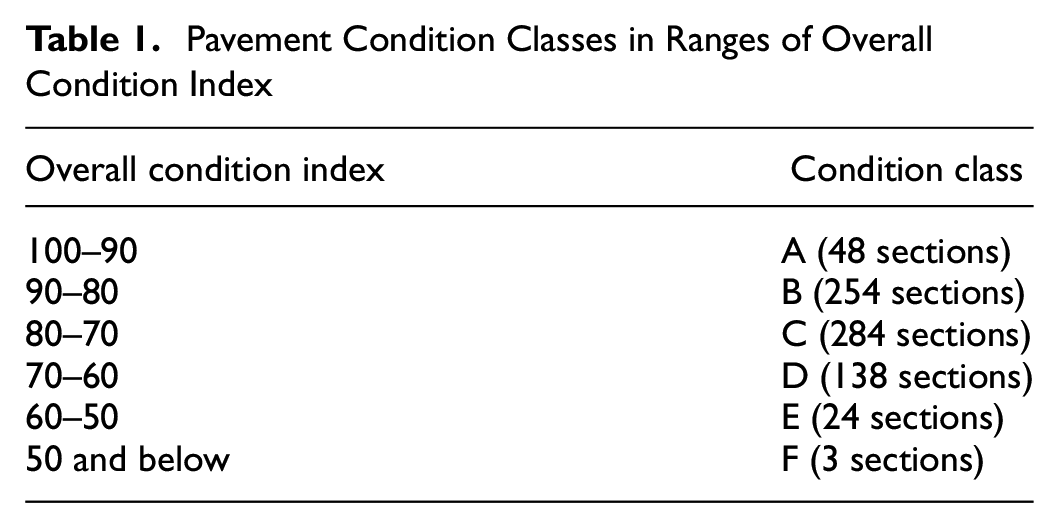
A dataset from the GDOT asphalt pavement condition recorded for predefined maintenance sections from 2017 to 2021 was utilized to develop the classification models. GDOT uses the OCI to indicate pavement condition, an index that ranges from 0 to 100 and is calculated according to the severity of distresses including load cracking, block cracking, edge cracking, reflective cracking, raveling score, and rutting score. The GDOT transportation asset management plan recommends different maintenance types depending on the range of OCI, which can be expressed in classes as shown in Table 1. Pavement sections marked for maintenance but which have not yet undergone maintenance or rehabilitation were analyzed to demonstrate the ongoing deterioration relative to time. A total of 751 observations of yearly changes in pavement condition, along with a set of variables from the GDOT maintenance section management system were gathered to formulate the classification models. Additionally, precipitation and temperature information for Georgia from the National Weather Service was included because climatic conditions affect the way in which pavement deteriorates ( 22 ). Descriptions of variables used in this study can be found in Table 2.
Pavement Condition Classes in Ranges of Overall Condition Index
Variable Descriptions
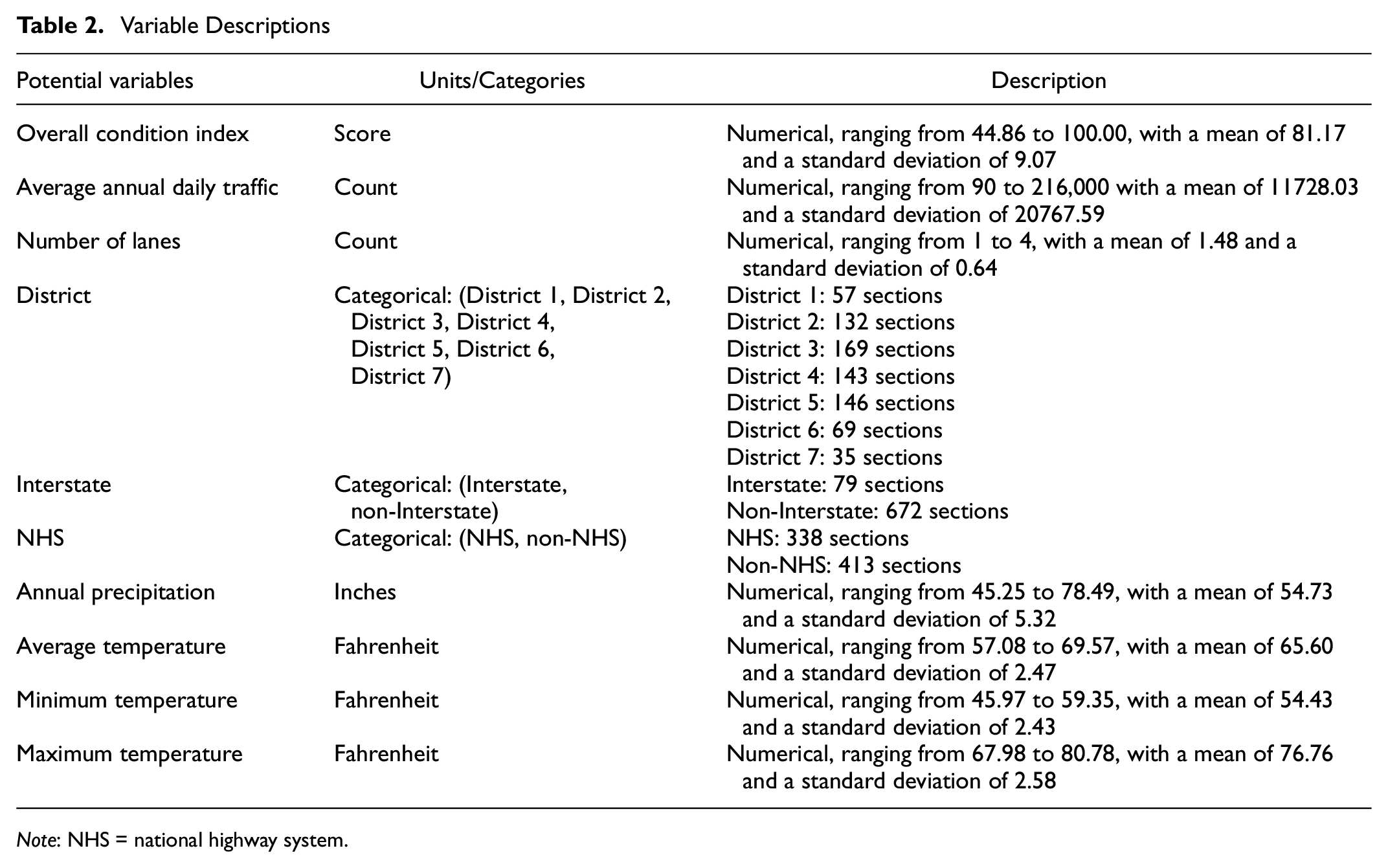
Note: NHS = national highway system.
Data preprocessing was performed to convert categorical variables into numeric form and scale the continuous variables. It is essential to transform categorical attributes into numerical values to enable arithmetic operations during model training ( 23 ). This was achieved by randomly allocating distinct numerical identifiers to each category before initiating the model training. Additionally, the continuous variables were assigned a value of 0 or 1 according to each variable’s minimum and maximum values. Scaling continuous variables increases the speed of the machine learning training process ( 24 ).
Then, five-fold cross-validation was performed to select hyperparameters for each classification model and evaluate the performance of the models. The cross-validation technique helps to prevent overfitting and reduces bias that might arise from arbitrary data splits ( 16 , 25 ). In k-fold cross-validation, the training set is partitioned into k equally sized subsets. During each iteration, one subset is used as the test set, and the other k-1 subsets form the training set. This ensures that every data point is tested exactly once and is part of the training set k-1 times. Furthermore, for each training set, the synthetic minority oversampling technique was applied to imbalanced pavement condition data. Rebalancing the imbalanced data is crucial in classification modeling to mitigate bias toward the majority class, improve the performance metrics for the minority class, and help to build a more generalizable model ( 26 ).
Results and Discussion
To evaluate the performance results, the accuracy metric was measured considering that every class is equally important. The accuracy is measured as in Equation 1.

The accuracy metric was measured for every classification model using the test set derived from every cross-validation set. Subsequently, four of each voting and stacking ensemble classification models were constructed and analyzed, the first using the two best-performing models, the second the top three, the third the top four, and the last all five of the classification models. Table 3 shows the accuracy metrics of individual and ensemble classification models retrieved from taking the average of results from cross-validation sets.
Accuracy of Classification Models

Among the individual classification models, the SVM model was found to have the highest accuracy followed by the gradient boost and KNN models. However, the differences were small, so it would be unwise to assert that one model is distinctly superior. Ensemble models generally demonstrated higher accuracies and lower variance compared with single machine learning models, aligning with previous research highlighting the advantages of ensemble models ( 18 ).
Of all the models assessed, the voting classification model, which was constructed using the two best-performing classification models, was identified as the most accurate, predicting the correct class with an 83% accuracy rate. This was an improvement of 5.2% over the best-performing standalone model, the SVM, and 11.8% over the least accurate model, the ANN. The stacking ensemble model, created using the top two best-performing classification models, was identified as the second most accurate model. The advantages of the ensemble method were evident not just in the accuracy measurements but also in the consistent top-tier performance they offered across all cross-validation sets. Although the accuracy ranking of individual models fluctuated according to the sampling variations from the cross-validation, ensemble models consistently achieved a top-tier performance as shown in Figure 2 (for clarity in visualization, only ensemble models constructed using the top two highest-performing individual models are illustrated). This finding indicates the advantage of ensemble approaches in ensuring top-tier performance for pavement condition classification models, alleviating concerns that other individual models might outperform ensemble approaches with the use of varying datasets.
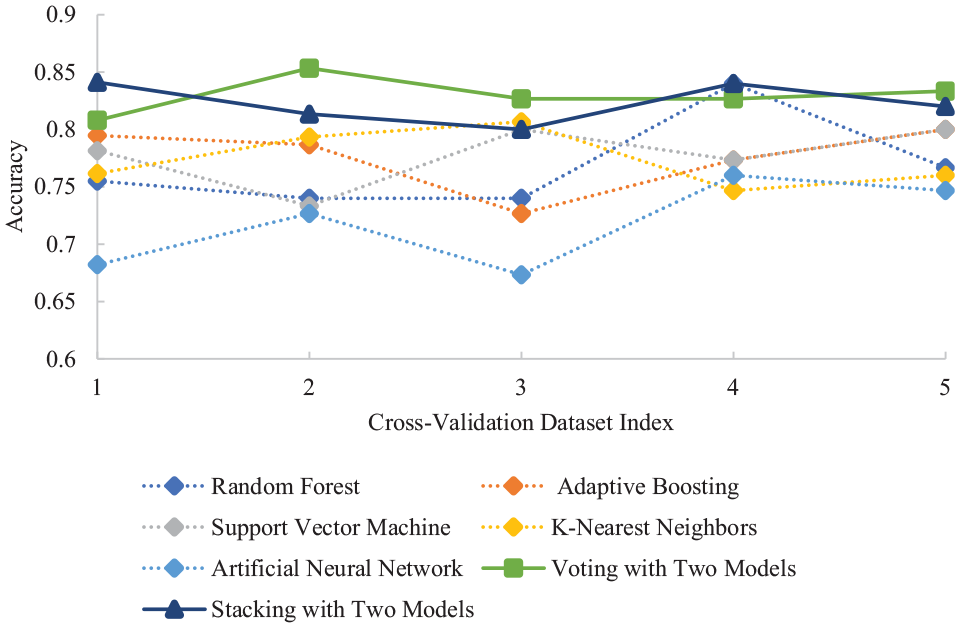
Accuracy of individual and ensemble models for each cross-validation set.
As described earlier, ensemble models achieved the best performance when developed using the top two best-performing individual models. Figure 3 illustrates the variations in accuracy of ensemble models depending on the count of individual models incorporated. As more individual models were integrated into the voting model, the accuracy tended to decrease. This trend could be the result of each individual model being given equal importance in the voting process, allowing models with lower accuracy to sway the final predictions toward incorrect classifications. In future work, exploring methods of assigning appropriate weights to votes from each individual model could be beneficial in enhancing the accuracy of voting ensemble models built using multiple classifiers. On the other hand, the performance of stacking models decreased when the models were developed with three and four individual models, but improved as five individual models were involved. Further research is needed to determine whether stacking models benefit from a greater number of individual models or if specific combinations of classification models enhance predictions for pavement condition classes.

Accuracy of voting and stacking models based on number of classifiers integrated.
The voting and stacking ensemble models demonstrate enhanced predictive capabilities over singular machine learning models. Ensemble models leverage the combined strengths of multiple machine learning approaches, improving their ability to make predictions. Integrating diverse machine learning models allows for a variety of hypotheses to inform predictions, promoting the unique ability of each model to detect different patterns within the data ( 18 ). This multifaceted approach can be particularly beneficial when the amount of data is limited, because it helps to prevent overfitting ( 27 ), which occurs when a model is excessively tailored to the training data but whose predictive accuracy on unseen data is unsatisfactory. By balancing out the weaknesses of individual machine learning models and reducing the likelihood of relying on a biased hypothesis, ensemble models are better equipped to provide reliable predictions and mitigate overfitting ( 28 ).
Although ensemble models have the potential to deliver superior performance, developers must be aware of the challenges inherent in constructing such models. Involving multiple individual learners adds complexities to developing ensemble models. First, the heightened computational resources needed for training ensemble models, along with the time it takes for these models to make predictions on new data, are critical considerations, particularly with stacking models that involve training an additional meta-learner. Moreover, the complexity of ensemble models can hinder the interpretability in relation to the effects of explanatory variables. The multilayered interaction between various predictors can make it difficult to discern the effects of independent variables on the predicted outcome. Furthermore, creating ensemble models demands a more profound knowledge and greater effort than is required for implementing a single machine learning model. Model developers are tasked with careful preprocessing of data to ensure compatibility with each base learner and must also dedicate time to fine tune the hyperparameters for each model ( 27 ).
Therefore, in practice, the employment of ensemble models for producing more reliable and consistent predictions should take into account factors such as the available data, computational resources, the requirement for model interpretability, and the proficiency of the modelers in training and tuning multiple machine learning models.
Conclusions
This study advances the body of knowledge on predicting pavement condition levels through machine learning classification algorithms and illustrates ensemble approaches for enhancing prediction performance. The research analyzed empirical pavement condition records retrieved from the maintenance section of the GDOT management system to develop classification models and evaluate their capabilities for predicting pavement condition classes.
Although individual machine learning models have advantages with regard to recognizing patterns and relationships within data, integrating them via ensemble techniques such as voting and stacking elevates their performance in relation to predicting pavement condition levels. This combination mitigates the errors of individual models, leading to more consistent and accurate pavement condition predictions. Through performing cross-validation, it is evident that ensemble models generally achieve higher accuracy with lower variance than individual machine learning models for predicting pavement condition classes. Based on the findings of this research, the authors suggest utilizing ensemble approaches in pavement condition prediction models to generate more reliable and consistent predictions. Transportation agencies are advised to be proactive in exploring which ensemble methods are suitable based on the availability of data.
It is anticipated that the findings of this research will provide transportation asset management practitioners with information on how to improve their practices in relation to predicting pavement condition levels accurately. Accurate prediction of pavement condition will facilitate better planning and timely maintenance interventions, both of which can lead to substantial savings in maintenance costs.
Footnotes
Author Contributions
The authors confirm contribution to the paper as follows: study conception and design: F. Chung, A. Doyle, E. Robinson, Y. Paik, M. Li, M. Baek, B. Moore, B. Ashuri; data collection: F. Chung, A. Doyle, E. Robinson, Y. Paik, M. Baek, B. Ashuri; analysis and interpretation of results: F. Chung, Y. Paik, M. Li, B. Ashuri; draft manuscript preparation: F. Chung, Y. Paik, B. Moore, B. Ashuri. All authors reviewed the results and approved the final version of the manuscript.
Declaration of Conflicting Interests
The author(s) declared no potential conflicts of interest with respect to the research, authorship, and/or publication of this article.
Funding
The author(s) received no financial support for the research, authorship, and/or publication of this article.
