




Abstract
Eccles et al.’s Expectancy-Value Model posits that the stereotypes endorsed by parents may influence their children’s participation in leisure-time activities. This influence is presumed to occur through the mediating role of children’s perceived competence and value given to the activity, predicting in turn drop out. Previous research is scarce relative to (a) the parent–child transmission of gender stereotypes and (b) the relationships among stereotypes, self-perceptions, and decision to drop out from an activity. We present three studies that examined gender stereotypes in the sport context to test these underexplored aspects of the model. Study 1 revealed significant links among perceived gender stereotypes in the social environment (i.e., general and parental beliefs), personal endorsement of stereotypes, and dropout behavior among 347 adolescents. Study 2 revealed no bound between stereotypes assessed among parents and 104 adolescent athletes. It further indicated that self-perceptions may mediate the relationship between 155 adolescents’ gender stereotypes and intentions to drop out from sport. Study 3 involved 23 parent–adolescent dyads and revealed that parents’ and adolescents’ endorsement of gender stereotypes were not significantly related when assessed with explicit measures, but significantly correlated when assessed through an implicit test. Taken as a whole, the results of this set of studies suggest that gender sport stereotypes are conveyed from social environment to adolescents and that they can lead to drop out. The implications for parents and practitioners are discussed.
Keywords
Adolescence is a key period with regard to choices involving both vocational orientations and extracurricular activities (Boyd & Bee, 2008). Social psychologists advance that these decisions are partly influenced by stereotypes, that is, shared beliefs concerning the characteristics—both personality traits and behaviors—of social groups (Leyens, Yzerbyt, & Schadron, 1994). More particularly, young women’s and men’s choices could be differentially encouraged by their parents depending on their sex. For instance, sport is conceived as a male arena in Western societies (Jacobs, Lanza, Osgood, Eccles, & Wigfield, 2002), and the social environment, notably parents, is thought to play a key role in the transmission of such beliefs. Indeed, parents may provide experiences and opportunities to engage in the sport context that differ between their daughters and sons. One of the most fruitful theoretical frameworks devoted to the understanding of such differentiated socialization is the Expectancy-Value Model (EVM) of Eccles, Freedman-Doan, Frome, Jacobs, and Yoon (2000; Fredricks & Eccles, 2004).
In the next section, we focus on the reasons why these gender-based socialization processes are detrimental to girls and women in the sport context. Then, we present the mechanisms through which parents treat boys and girls differentially from an EVM perspective, focusing specifically on parents’ transmission of pervasive gender stereotypes to their children. We review empirical support of this model to date, and we point out the tenets in need of further investigation.
Sport Participation in Youth
Gender differences in sport are often perceived as resulting from natural biological factors. During pubescent development, physical capacities develop more among male than female adolescents, leading to a significant gap in physical abilities between them (Eagly, 1995). However, these gender differences can also be explained by social processes. Indeed, since childhood boys participate more in motor activities than girls (Hines, 2004), and sport dropout rates are more important among adolescent girls, compared to boys (Dumith, Gigante, Domingues, & Kohl, 2011; French Minister for Youth and Sport, 2001).
This absence of involvement or increased drop out among girls, female adolescents, and women is preoccupying, considering the benefits associated with regular sport participation. First, this kind of extracurricular activity has been shown to foster positive youth development (Mahoney, Harris, & Eccles, 2006). In particular, it has been associated with improved academic functioning (Marsh & Kleitman, 2003) and development of positive peer relationships (Smith, 2007). Also, sport participation could represent an effective way to buffer the potential sexual objectification of girls—a phenomenon appearing during puberty due to physical changes, in particular breast growth. Recent theorization on embodying experiences indicates that competitive athletics may be a source of positive body image, which in turn is likely to lead to less objectification inside and outside sports (Menzel & Levine, 2011). Additionally, insufficient exercise may have detrimental health consequences, such as increased risks of suffering from Type-2 diabetes, certain cancers, and cardiac conditions (Bauman, 2004). Although these pathologies mostly concern adults, it is noteworthy that optimal physical development during childhood and adolescence is conditioned by regular energy expense and that sport participation during these periods is a significant predictor of adopting an active lifestyle during adulthood (Perkins, Jacobs, Barber, & Eccles, 2004). Given that more boys than girls reach adequate levels of daily physical activity (Knisel, Opitz, Wossmann, & Keteihuf, 2009), gender-differentiated socialization in the sport context is concerning.
Expectations of Success and Value
According to the EVM, the two most proximal variables determining a young individual’s sustained participation in an activity are (a) his or her expectations of success in the activity and (b) the value he or she places into it. Expectations of success are the chances of success estimated by the individual in a given situation. This variable is assumed to be directly related to perceived ability or competence, as well as the perceived difficulty of the task (Fredricks & Eccles, 2004). Numerous studies have observed a significant link between children or adolescents’ expectations of success or perceptions of competence and their physical activity or sport involvement. For example, researchers reported significant correlations between such perceptions and the time spent being physically active (Bois, Sarrazin, Brustad, Trouilloud, & Cury, 2005; Eccles & Harold, 1991; Kimiecik, Horn, & Shurin, 1996). Similarly, others observed that perceived competence negatively predicted drop out from the activity (Guillet, Sarrazin, Fontayne, & Brustad, 2006; Sarrazin, Vallerand, Guillet, Pelletier, & Cury, 2002).
The second key variable, namely the value accorded to the activity, comprises four distinct components: (a) the attainment value or importance of doing well in the activity; (b) the intrinsic value or inherent interest in the activity; (c) the utility value, which refers to the potential positive outcomes of the activity; and (d) the costs or negative aspects of engaging in the activity. This last variable emerged as a strong predictor of motivation in past research (Weiss & Weiss, 2003), whereas the attainment, intrinsic, and utility values were found to be positively associated with sport involvement (Eccles & Harold, 1991). Attainment and utility components are also negatively associated with drop out (Guillet et al., 2006). Other studies on interest or intrinsic motivation indicated similar results (e.g., Fontayne, Sarrazin, & Famose, 2002; Sarrazin et al., 2002). The EVM posits that a child’s gender is one of the most central variables contributing to such context-specific perceptions.
Gender, Expectations of Success, and Value of Sport
Past research has consistently observed gender differences in the levels of perceived competence and value in sport across age and culture. For example, Eccles and Harold (1991) reported that, compared to boys, sixth-grade girls rated themselves as significantly less able in sports, and girls conceived this domain as less important, useful, and enjoyable. Similar gender differences in perceived sport competence and value have been observed among American kindergarten and elementary school students (Fredricks & Eccles, 2005) and Malaysian adolescent athletes (Chin, Khoo, & Low, 2009). Finally, gender differences in perceived sport competence have been replicated among a sample of French children (Bois, Sarrazin, Brustad, Chanal, & Trouilloud, 2005).
The EVM suggests that these differences are partly due to the endorsement of sport stereotypes (Fredricks & Eccles, 2004). Several studies brought empirical support to this hypothesis. Chalabaev, Sarrazin, and Fontayne (2009) observed that the more female adolescents agreed with the stereotype that soccer is masculine (in accordance with stereotypes existing in France with regard to this activity), the less they felt competent in this sport. In another study, Chalabaev, Sarrazin, and Fontayne (2009) compared adolescents’ self-perceptions and motivations in a masculine (soccer) and in a feminine activity (dance). It appeared that students felt more competent and were more autonomously motivated when the stereotypes associated with the activity were favorable to their gender (i.e., dance for girls and soccer for boys). Taken together, these studies indicate that gender stereotypes in sport are likely to impact self-perceptions and behaviors in the athletic area (for a review, see Chalabaev, Sarrazin, Fontayne, Boiché, & Clément-Guillotin, 2013). However, no study to our knowledge has specifically investigated the mediating role played by self-perceptions in the relationship between stereotype endorsement and actual participation (albeit in sport or in other contexts).
The Transmission of Gender-Sport Stereotypes
The EVM posits that stereotypes are socially transmitted by the cultural milieu in which children and adolescents grow up (Fredricks & Eccles, 2004). Several members of the social environment may contribute to the transmission of gender-sport stereotypes, such as teachers (Chalabaev, Sarrazin, Trouilloud, & Jussim, 2009) or peers (Wachs, 2005). However, the EVM more specifically focuses on the crucial role played by parents in this regard. Several studies examined the links between parents’ and their children’s perceptions in sport. For example, parents’ perceptions of their child’s ability were consistently found to be positively related to their child’s self-perceptions of ability, either directly (Jacobs & Eccles, 1992) or indirectly through reflected appraisals (Bois, Sarrazin, Brustad, Chanal, et al., 2005). In the same vein, the value attached to sport participation of children, according to parents, was positively correlated with sport value reported by children (Fredricks & Eccles, 2002; Jodl, Michael, Malanchuk, Eccles, & Sameroff, 2001).
In addition, past studies reported differentiated perceptions of parents according to their child’s gender, with boys being perceived as more competent than girls (Jacobs & Eccles, 1992) and more value of sport being perceived for boys compared to girls (Jodl et al., 2001). However, recent articles do not report such differences among parents (Bois, Sarrazin, Brustad, Chanal, et al., 2005; Bois, Sarrazin, Brustad, Trouilloud, et al., 2005). Several potential explanations could account for these results. First, due to the time lag between those various studies, it is possible that gender stereotypes related to sport are less pro-masculine now than in the early 1990s. On the other hand, it can be advanced that antisexist norms are currently more subtle, leading certain scholars to question the validity of self-report scales to assess socially sensitive issues such as gender stereotypes (Greenwald & Banaji, 1995).
Regarding the social transmission of stereotypes per se, Jacobs and Eccles (1992) observed that the more mothers tended to see sport as a masculine domain, the more they tended to display lower ability beliefs for their daughters and higher ability beliefs for their sons. Similar processes emerged in mathematics, an educational field that is socially perceived as masculine (see Gunderson, Ramirez, Levine, & Beilock, 2012, for a review). However, no study to our knowledge has examined whether parents’ gender stereotypes are perceived by children and whether children adopt similar gender stereotypes in return, albeit in sport or other domains.
The Present Studies
Gender stereotypes represent a core variable of the EVM (Fredricks & Eccles, 2004). However, to date, very few studies have investigated gender stereotypes per se, and the results available from past research conducted in sport failed to provide empirical support for the hypotheses of (a) parent–child transmission of those beliefs and (b) their potential consequences on self-perceptions and behavioral involvement. The aim of the present article was thus to examine those underexplored aspects of the EVM in order to provide a comprehensive understanding of the role played by stereotypes in the gender differences observed in sport. Gender-sport stereotype endorsement is considered as a key variable in the socialization of gender stereotypes and is measured in all three studies—among adolescents, parents, and/or both. More particularly, based on Eccles’ model, we investigated two gender stereotypes: the belief that sport is more important for boys than for girls (the attainment component of value) and the belief that boys are more competent in sport than girls (competence).
The purposes of our studies are 2-fold. First, our aim was to examine the role played by parental stereotypes in the transmission of gender-sport stereotypes among adolescents. More particularly, we tested the mediational role of perceived parental stereotypes in the relationship between perceived social stereotypes and adolescents’ stereotypes (Study 1), as well as the link between parents’ and adolescents’ stereotypes using both explicit (Studies 2 and 3) and implicit methods (Study 3). Next, we explored the mechanisms through which adolescents’ gender-sport stereotypes may be accompanied with sport drop out. More precisely, in Study 1, we examined the links between gender-sport stereotypes and dropout behavior, whereas in Study 2 we focused on the mediational role potentially played by self-perceptions of sport value and competence in the relationship between gender-sport stereotypes and intentions to drop out. Figure 1 summarizes the constructs and relationships under the scope of the present article.

Overview of the constructs and relationships related to gender-sport stereotypes in adolescents (normal lines refer to Study 1, dotted lines to Study 2, and boldface lines to Study 3).
Study 1
No known study of the EVM has explored whether the level of adolescents’ stereotype endorsement is associated with the stereotypes they perceive in their social environment nor whether such general beliefs are associated with sport participation or drop out. The purpose of Study 1 was thus to examine (a) the links between adolescents' perceived gender-sport stereotypes—general and parental—and stereotype endorsement, and (b) the link between stereotype endorsement → sport drop out (see Figure 1). We hypothesized that the level of stereotypes perceived in the social environment would be positively associated with the level of stereotype endorsement in adolescents, for both value and competence. Path analysis examined more particularly whether perceived parental endorsement mediated the bound between perceived stereotypes in the cultural milieu and athletes’ personal endorsement of stereotypes. Regarding the second purpose, a logistic regression analysis tested whether endorsing stereotypes in favor of the other gender was significantly associated with drop out.
Method
Participants
The sample comprised 347 adolescents (131 young women, 216 young men; M age = 15.39, SD = 4.19, range = 12–20 years) currently or previously involved in one of the most popular activities practiced by adolescents in France, more particularly team sports such as soccer, basketball, handball, rugby as well as individual activities such as skiing, judo, gymnastics, horse riding, cycling, climbing, tennis, and table tennis. This sample included two groups: (a) persistent participants who completed questionnaires in their sports clubs (n = 249) and (b) dropout athletes (i.e., athletes who did not enroll back in their club at the beginning of the season; n = 98). A significant t-test for independent samples indicates that participants in the dropout sample were significantly younger (M = 15.07, SD = 2.38) than those in the persistent group (M = 16.25, SD = 2.53), t(326) = −3.89, p < .001. This can be explained by the fact that the participants’ postal addresses were chosen to match the age categories concerned at the time of their practice. Also, there were more female participants in the dropout sample (49%) compared to the persisting sample (33%), χ2(1) = 484.25, p < .001. This is due to the fact that the choice of dropout participants purposively overrepresented female participants compared to their actual rate of participation. Given the retrospective design of the study, it cannot be concluded that age or gender are determinants of sport drop out.
Procedure and Measures
Our study was conducted during the 2003/2004 season in collaboration with one local Olympic Sport Committee in France. The research team was in contact with sports committees and clubs interested in participating. The committees helped in selecting a list of dropout athletes and communicating their postal address. The clubs welcomed the first author during practice so that the study could be presented. All participants received a similar questionnaire including measures of gender stereotypes, demographic variables (date of birth and sex), and a few questions regarding sport practice (activity, years of experience, hours of weekly practice). A letter explaining the purpose of the study (understanding how certain perceptions can influence the sport experience of adolescents) was addressed to the athletes and their parents, who had the possibility not to consent to their child’s participation. In that case, adolescent athletes simply did not return the anonymous questionnaire. Persistent athletes were asked to give back their sealed envelope at practice, whereas dropout athletes were given a stamped return envelope. As a whole, 600 questionnaires were distributed to persistent athletes in 22 clubs, and 600 questionnaires were mailed to dropout athletes from 48 clubs. The participation rate was higher for persistent athletes (43%) than for dropout athletes (16%).
The Personal Endorsement of Gender Stereotypes Scale developed by Bonnot and Croizet (2007) was used to measure gender stereotypes indirectly. This scale assesses beliefs about boys and girls separately, contrary to more direct scales measuring beliefs about one gender relative to the other. The score attributed by a respondent to girls is then subtracted to the one given by that respondent to boys. Two personal stereotypes were assessed using this scale (i.e., for each stereotype, 1 item targeted boys and the other targeted girls): (a) a stereotype relative to sport competence (“Personally, I think that performance of boys/girls in sport is… ”)—with answers ranging from 1 (very poor) to 7 (very good)—and (b) a stereotype relative to the attainment component of sport value (“Personally, I think that for boys/girls doing sport is… ”)—with answers ranging from 1 (not important at all) to 7 (very important). 1 The same 2 items (targeting boys and girls separately) were used to assess athletes’ perceptions of the stereotypes held (a) by the general population (“In general people think that performance of boys/girls in sport is… ”) and (b) by their parents (“My parents think that for boys/girls, doing sport is… ”).
As a whole, participants provided 2 (1 item targeting boys and 1 item targeting girls) × 2 (stereotypes of competence and value) × 3 (personal, general, and parental) or 12 answers. These 12 responses were then used to calculate six scores of stereotypes: personal endorsement of gendered stereotypes for competence and attainment value, perceived general endorsement of both, and perceived parental endorsement of both. Across all measures, a positive score indicated a pro-masculine stereotype, a negative score a pro-feminine stereotype, and a null score the absence of stereotype. For all measures, scores could range from −6 to +6, and they did span this full range in our sample.
Data Analysis
First, in order to examine the determinants of personal gender stereotype endorsement, two separate path analysis models—relevant to sport value and competence—were tested using Amos 4.0. Because they are saturated models (df = 0), the fit indices are not relevant and the focus was only on the bounds observed between the variables. Following Preacher and Hayes (2008), a bootstrapping method with 5,000 resamples was used, along with a 95% corrected bias and accelerated confidence interval (CI), in order to test the significance of indirect effects.
Next, in order to examine the predictors of sport drop out, a logistic regression analysis was conducted, with dropout behavior as the dependent variable, and sex, age, and personal stereotype endorsement as independent variables. Continued participation was considered as the null result, whereas drop out was coded 1. Stereotype endorsement scores were recoded so that positive scores indicated stereotypes in favor of one’s gender, whereas negative scores indicated stereotypes in favor of the other gender.
Results
Table 1 presents the levels of personal as well as perceived general and parental endorsement of competence and attainment value sport stereotypes among young men and women. A multivariate analysis of variance (MANOVA) conducted on the three scores of stereotypes of sport competence (personal, general, and parental) indicated a significant effect of sex, F(3, 341) = 10.48, p < .001, Wilks’s λ = .92, but both the main effect of drop out, F(3, 341) = 0.42, p = .737, Wilks’s λ = .99, and the interaction were not significant, F(3, 341) = 2.48, p = .061, Wilks’s λ = 98. The univariate tests indicated that the multivariate effect was accounted for by gender differences in both personal, F(1, 345) = 96.43, p < .001, η p 2 = .10, and perceived parental, F(1, 345) = 24.95, p < .001, η p 2 = .07, stereotypes of sport competence. Specifically, male participants held stronger gender stereotypes than female athletes, and young men believed that their parents’ gender stereotypes were stronger than those perceived by young women (see Table 1).
Means, Standard Deviations, and Correlations Among the Variables of Study 1.
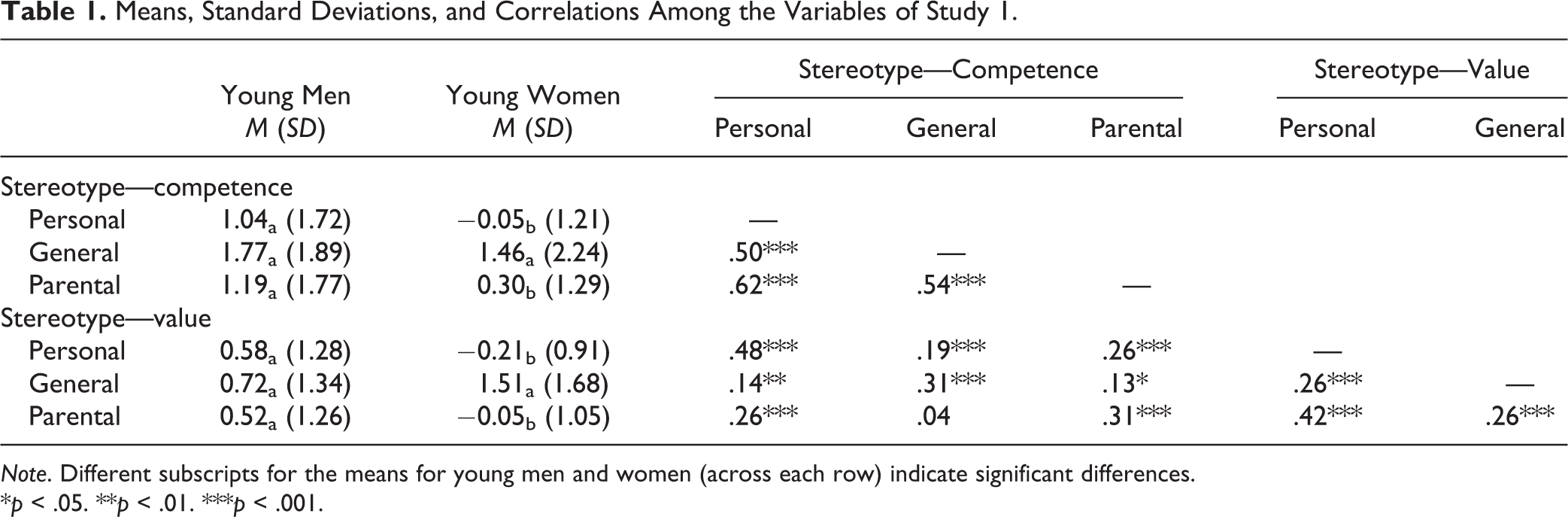
Note. Different subscripts for the means for young men and women (across each row) indicate significant differences.
*p < .05. **p < .01. ***p < .001.
A MANOVA conducted on the three scores of stereotypes of sport attainment value (personal, general, and parental) indicated a significant effect of sex, F(3, 341) = 8.86, p < .001, Wilks’s λ = .93, but no significant effect of drop out, F(3, 341) = 0.60, p < .614, Wilks’s λ = .99, or the interaction, F(3, 341) = 1.59, p < .192, Wilks’s λ = .98. The univariate tests indicated that the multivariate effect was accounted for by gender differences in both personal, F(1, 345) = 38.18, p < .001, η p 2 = .10, and perceived parental, F(1, 345) = 19.30, p < .001, η p 2 = .05, stereotypes of sport value. Specifically, male participants held stronger gender stereotypes than female athletes, and young men believed that their parents’ gender stereotypes were stronger than those perceived by young women (see Table 1).
Table 1 also reports the correlations among the variables of the study. There were significant correlations for each stereotype among the three levels of assessment: The more participants held strong gender stereotypes, the more they perceived strong gender stereotypes both in general and in their parents, similarly for both competence and attainment value. Additionally, participants’ answers were significantly correlated at each level of assessment: The more they held strong gender stereotypes of sport competence, the more they tended to hold strong gender stereotypes for value, and the same was true concerning perceived general and parental stereotypes endorsement.
Prediction of Stereotype Endorsement
Our first model was aimed at predicting sport competence gender stereotypes. As depicted in Figure 2, all the hypothesized paths were significant. More specifically, adolescent gender stereotype of sport competence was significantly predicted by perceived general stereotype (β = .25) and gender (β = .19), even after controlling for the indirect effect of perceived parents stereotype (β = .43; significant indirect effect of general stereotype, 95% CI = [.171,.287], and gender, 95% CI = [.059,.143]). Furthermore, the model predicting adolescent sport value gender stereotype showed similar results. Stereotype endorsement of attainment value was significantly predicted by perceived general stereotype (β = .16) and gender (β = .23), even after controlling for the indirect effect of perceived parents stereotype (β = .33; significant indirect effect of general stereotype, 95% CI = [.046,.125], and gender, 95% CI = [.046,.125]).
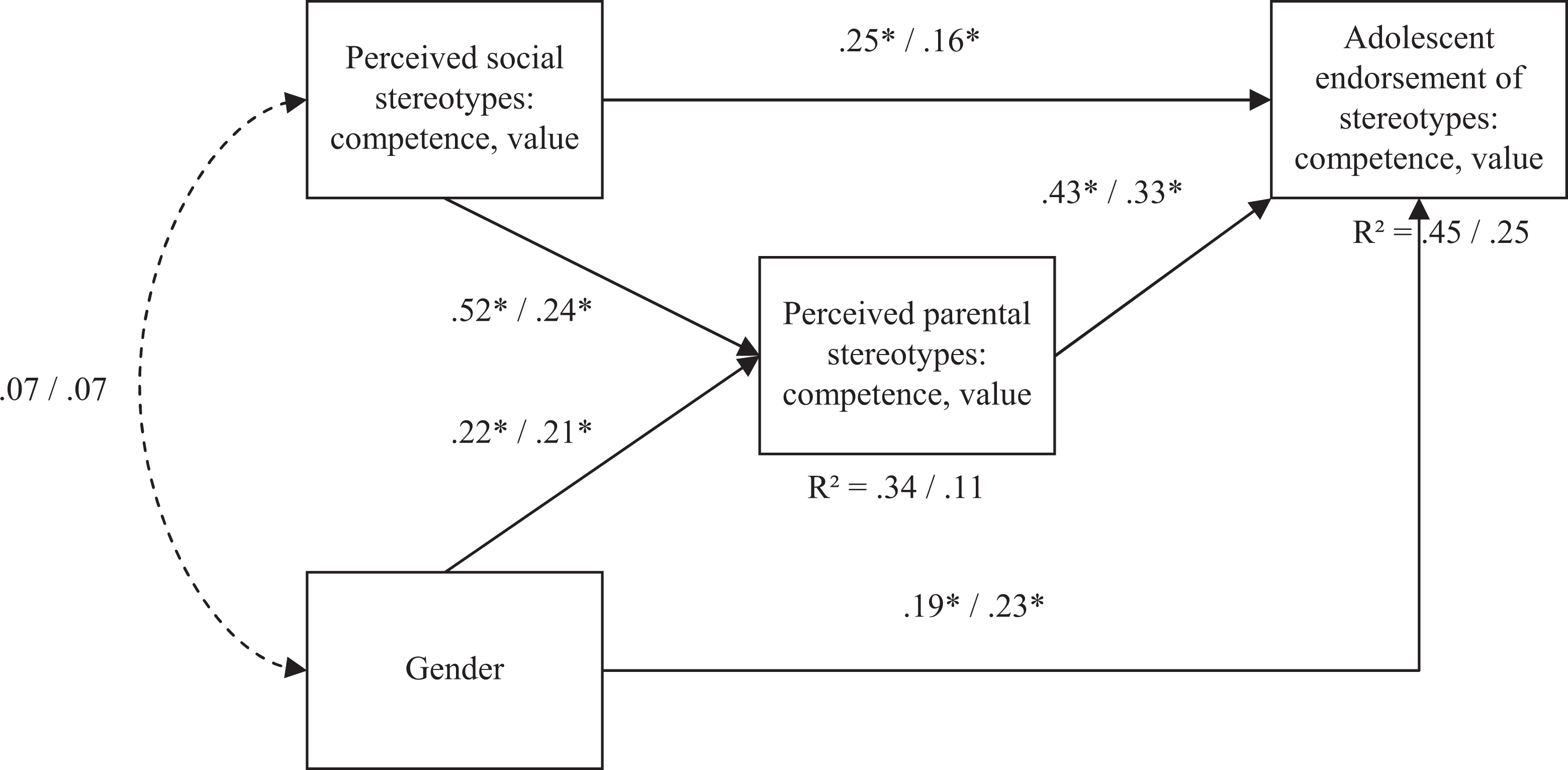
Path analysis of the predictors of stereotype endorsement in the two models relative to sport competence/sport value in Study 1. *p < .05.
Stereotype Endorsement and Drop out
Table 2 summarizes the results of the logistic regression analysis carried out with sport drop out as the outcome variable. The test of the full model with the four predictors against the constant-only model was statistically significant, χ2(4) = 32, p <.001. The Nagelkerke R2 was equal to .14. The Hosmer–Lemeshow test produced a fail-to-reject decision: χ2(8) = 12.2, p = .143, a result consistent with the assumption that the specified logistic model was correct. Independent significant predictors of behavior included age and competence stereotype, whereas importance stereotype and gender were not significant. Given the retrospective nature of the design, the effect of age can be seen as a sampling effect rather than as an explanatory process. On the other hand, it appeared that endorsing a pro-masculine stereotype of competence decreased the probability to drop out from sport among boys, whereas it increased this probability among girls (odds ratio = .843; 95% CI = [.623, 1.141]).
Logistic Regression of Sport Drop out on Stereotype Endorsement Regarding Sport Competence and Value (Study 1).

Note. CI = confidence interval.
Discussion
No known previous study using the EVM examined whether the level of gender-sport stereotypes of young individuals is associated with the stereotypes they perceive in the social environment, as well as the relationship of those beliefs to sport drop out. In our study, we observed that the more adolescent athletes perceived gender-sport stereotypes in their social environment, the more they tend to adhere to such stereotypes. It is also noteworthy that adolescents’ perceptions of their parents’ attitudes, as proximal socialization agents, seemed to exert a particularly important role in gauging these kinds of perceptions. This finding is in line with the conception of parents as a primary source of socialization (Fredricks & Eccles, 2004).
The second purpose of our study was to examine whether gender stereotype endorsement is linked to sport drop out. Our findings showed that endorsing a sport-competence stereotype that is in favor of one’s gender (a pro-masculine stereotype for boys or a pro-feminine stereotype for girls) was a significant predictor of persistent participation, but that endorsing a stereotype in favor of the other gender (a pro-masculine stereotype for girls or a pro-feminine stereotype for boys) was associated with dropping out. This result can be interpreted as consistent with the EVM, which posits that the integration of general beliefs can in turn affect self-perceptions and motivation (Eccles et al., 2000; Fredricks & Eccles, 2004). However, given the retrospective nature of our design, another interpretation can be advanced. It is indeed possible that adolescents adjusted their gender beliefs so that they are in line with the behavior adopted—that is, drop out or persistent participation.
Study 1 adds to the literature by showing the mediational role played by perceived parental stereotypes in the relationship between perceived social stereotypes and adolescents’ stereotype endorsement, which in turn may affect sport drop out. However, it does not inform us on the bounds between actual parents’ gender-sport stereotypes and their child’s level of endorsement. Study 2 was aimed at investigating this question.
Study 2
The purpose of Study 2 was 2-fold. First, no known previous research with the EVM has examined whether parents’ gender-sport stereotypes are correlated to their child’s level of stereotype endorsement. The first aim of Study 2 was thus to examine the link between athletes’ levels of gender stereotypes relative to sport competence and value and their parents stereotypes (see Figure 1). Next, although past research indicated that gender perceptions of sport activities were associated with perceived competence and motivation among adolescents (Chalabaev, Sarrazin, & Fontayne, 2009), and Study 1 showed that gender stereotypes could be associated with sport drop out, no known study has examined the mediational role of self-perceptions in this process. The second purpose of Study 2 was thus to examine whether adolescents’ gender-sport stereotype endorsement would be linked to lower self-perceptions of sport value and competence, which in turn should be associated with higher intentions of sport drop out among adolescent athletes (see Figure 1).
Method
Participants and Procedure
For this study, 155 (82 female and 73 male) adolescent athletes aged between 12 and 16 years old (M age = 13.8, SD = 1.77) and their parents volunteered to participate. Adolescents were involved in one of the three athletic activities: gymnastics, tennis, and judo. An envelope containing three questionnaires was given to all athletes in their sport clubs. The letter explained the purpose of the study (i.e., looking at young athletes’ feelings in their sport and the opinion of their parents). One questionnaire was addressed to athletes, and another questionnaire was addressed to their mother and father, respectively. It was indicated that the questionnaires were aimed at being filled out by the persons with whom athletes spent most of their time (i.e., parents and/or stepparents). Fully 134 mothers (M age = 42.8, SD = 5.93, range = 34–55 years) and 114 fathers (M age = 44.3, SD = 4.30, range = 35–65 years) participated. As a whole, 104 data sets were complete (i.e., comprising the athlete’s questionnaire and a questionnaire from each parent).
Athlete’s Questionnaire
Endorsements of gender-sport stereotypes for both competence and attainment value were assessed using the same scales as in Study 1. Each participant’s answer to the item targeting girls was subtracted to their answer to the item targeting boys, so that a positive score indicated a pro-masculine stereotype. Regarding the gender stereotype of sport competence, the scores for our sample ranged from −5 to +3, whereas for the gender stereotype of sport value, they were between −2 and +3.
Perceived personal competence was evaluated with the 4-item subscale of the Intrinsic Motivation Inventory (McAuley, Duncan, & Tammen, 1989). Respondents are asked to rate themselves on items such as “I feel I’m capable of learning new things in this activity” on a 6-point scale ranging from 1 (strongly disagree) to 6 (strongly agree). We then calculated an average score, so that higher scores indicated higher levels of perceived competence. This full four-factor scale was initially developed in the experimental setting to assess motivational states of participants regarding a task (Plant & Ryan, 1985) and was subsequently adapted to the sport setting (McAuley et al., 1989). Factor analyses confirmed the presence of four factors, including perceived competence (α = .80), which was significantly associated with intrinsic interest toward the activity. In the current sample, the scores ranged from 1.8 to 6.0, and the internal consistency was satisfactory (α = .75).
Sport value was measured with the 4-item scale used by Fredricks and Eccles (2002). Respondents are asked to assess the extent to which individuals consider sport as a useful and important domain along a 7-point scale ranging from 1 (not at all) to 7 (very much). The items were constructed crossing one of the two anchors (“In general/Compared to most of your other activities”) with one of two sentences (“how useful/important is tennis?”). An average score was calculated so that higher scores indicated higher levels of perceived value.
A larger scale was initially used by Eccles and collaborators in the longitudinal Childhood and Beyond study, in which they confirmed the uniqueness of the value subscale (Eccles, Wigfield, Harold, & Blumenfield, 1993). This 10-item scale was used with success in past studies conducted among French adolescents by Guillet, Sarrazin, Fontayne, and Brustad (2006) who reported adequate reliability (α = .81) and higher mean levels among persisting athletes compared to drop outs. Wigfield et al. (1997) proposed to separate the importance/usefulness versus interest aspects of sport. Fredricks and Eccles (2002) reported acceptable consistency of such an abridged version of importance/usefulness subscale among children (4 items; αs between .61 and .92). In the current study, the mean scores ranged from 2.2 to 5.0, and the internal consistency of the scale was satisfactory (α = .71).
Athletes’ behavioral intentions to pursue participation in their sport were assessed through a 4-item scale derived from Ajzen and Driven (1992). Respondents used a 7-point scale from 1 (not at all) to 7 (completely) to rate items such as “I intend to play tennis again next season.” An average score is then calculated, so that higher scores indicate higher levels of behavioral intentions. This scale was used in past research conducted among French adolescents in which it was found to be reliable (α = .87) and significantly predicted dropout behavior 8 months later (Guillet et al., 2006). In the current study, scores ranged from 2.5 to 6.0, and the internal consistency was satisfactory (α = .80).
Parents’ Questionnaire
The procedure described above was also used to measure parents’ level of gender stereotype endorsement. The scores of gender stereotype of sport competence ranged from −1 to 1 among both fathers and mothers. The scores of gender stereotype of sport value ranged from −1 to 2 among fathers and from −1 to 1 among mothers.
Data Analysis
The first aim of Study 2 was to examine the correspondence between parents’ and athletes’ levels of gender-sport stereotypes. Correlations were calculated between the scores obtained by fathers and athletes, as well as between those of mothers and athletes. Next, we used path analysis to examine the personal correlates of gender-sport stereotypes among athletes (Figure 1). In the hypothesized model, the levels of gender stereotypes of sport competence and value were considered as predictors of the levels of perceived competence and value in sport. In turn, perceived competence and value were expected to positively predict athletes’ intentions to maintain their participation. Finally, perceived competence was assumed to positively predict the perceived value of the activity. Indeed, these two perceptions were found to be consistently linked in previous studies (Fredricks & Eccles, 2002, 2005). It has been shown in frameworks other than the EVM that when individuals face recurrent negative information relative to their competence in one domain, they can be prone to psychologically disengage themselves through a devaluation of this domain (Major & Schmader, 1998). Such a process has for example been observed in education when self-esteem is threatened by negative feedback (Régner & Loose, 2006). Given that adolescence represents a key developmental period in terms of construction of the self, it could be assumed that a similar process occurs in another achievement area such as sport and that young athletes will tend to value their activity as long as they feel successful at it. On the other hand, adolescents who have lower self-perceptions of athletic competence could be prone to see less value in their activity. In the path analysis model, stereotypes scores of girls were reversed, so that positive value indicated a stereotype in favor of one’s gender within the whole sample. It was tested using path analysis with Amos 4.0, with a bootstrapping technique to estimate indirect effects (Preacher & Hayes, 2008).
Results
Preliminary Analyses
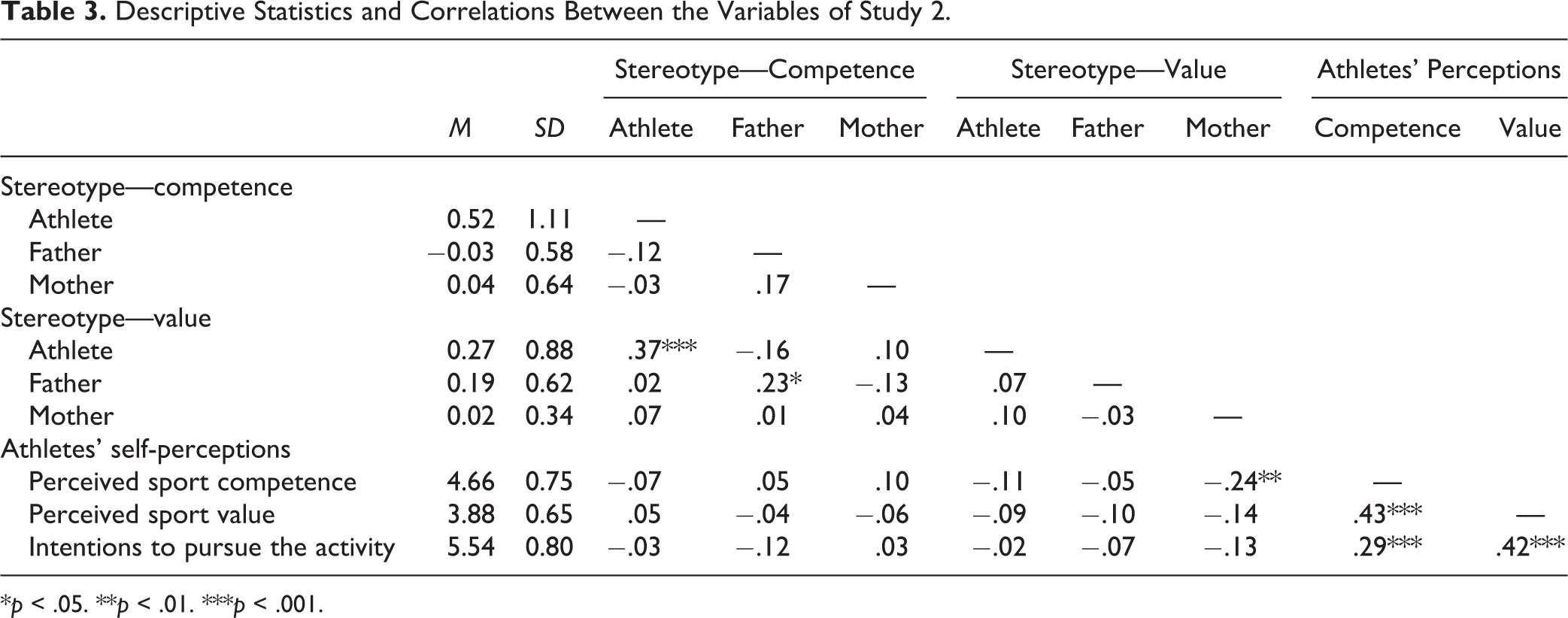
Descriptive statistics and correlations between the variables of the study appear in Table 3. A series of paired t-tests was run in order to compare the level of stereotype endorsement (a) among athletes and their fathers and (b) among athletes and their mothers. The level of gender stereotype related to sport value was not significantly different between athletes and fathers, t(267) = 0.83, p = .41. The level of gender stereotype related to sport competence was significantly higher in athletes compared to their fathers, t(259) = 4.63, p <.001, η p 2 = .07. Similarly, the scores of gender stereotypes were higher in athletes compared to their mothers both for sport value, t(285) = 2.89, p < .001, η p 2 = .03, and for sport competence, t(279) = 4.27, p < .001, η p 2 = .06.
Descriptive Statistics and Correlations Between the Variables of Study 2.
*p < .05. **p < .01. ***p < .001.
An examination of Table 3 reveals that no correlation was significant between fathers’ or mothers’ levels of gender-sport stereotypes and athletes’ level of gender-sport stereotypes, regarding neither value nor competence. This pattern does not support our hypothesized expectation that the beliefs held by parents would be transmitted to their children. Interestingly, competence and value ratings were significantly correlated for both the athletes themselves and their fathers, but not for their mothers.
Mediation of Self-Perceptions
Our proposed model, in which athletes’ self-perceptions were expected to mediate the relationship between stereotypes and intentions, globally yielded a satisfactory fit with the data: χ2(4) = 7.77, p > .10; χ2/df = 1.943; comparative fit index = .97; incremental fit index = .97; Tucker–Lewis index = .92; standardized root mean residual = .04; root mean square error of approximation = .08 (see Figure 3). The results indicate that gender stereotype of sport competence was significantly associated with perceived sport competence (β = .31). In other words, endorsing a stereotype in favor of one’s gender leads to higher self-perception of competence in sport. In turn, perceived sport competence was associated with significantly higher levels of sport value (β = .43). However, perceived sport competence was not significantly related to intentions to drop out (β = .13), whereas perceived sport value significantly predicted lower intentions to drop out from sport (β = .36). There were two significant indirect effects. The first one was an indirect effect of gender competence stereotype on perceived sport value, through the mediation of perceived sport competence, 95% CI = [.31, .57]; the second one was an indirect effect of perceived sport competence on intentions, through the mediation of perceived sport value, 95% CI = [−.14, .42].
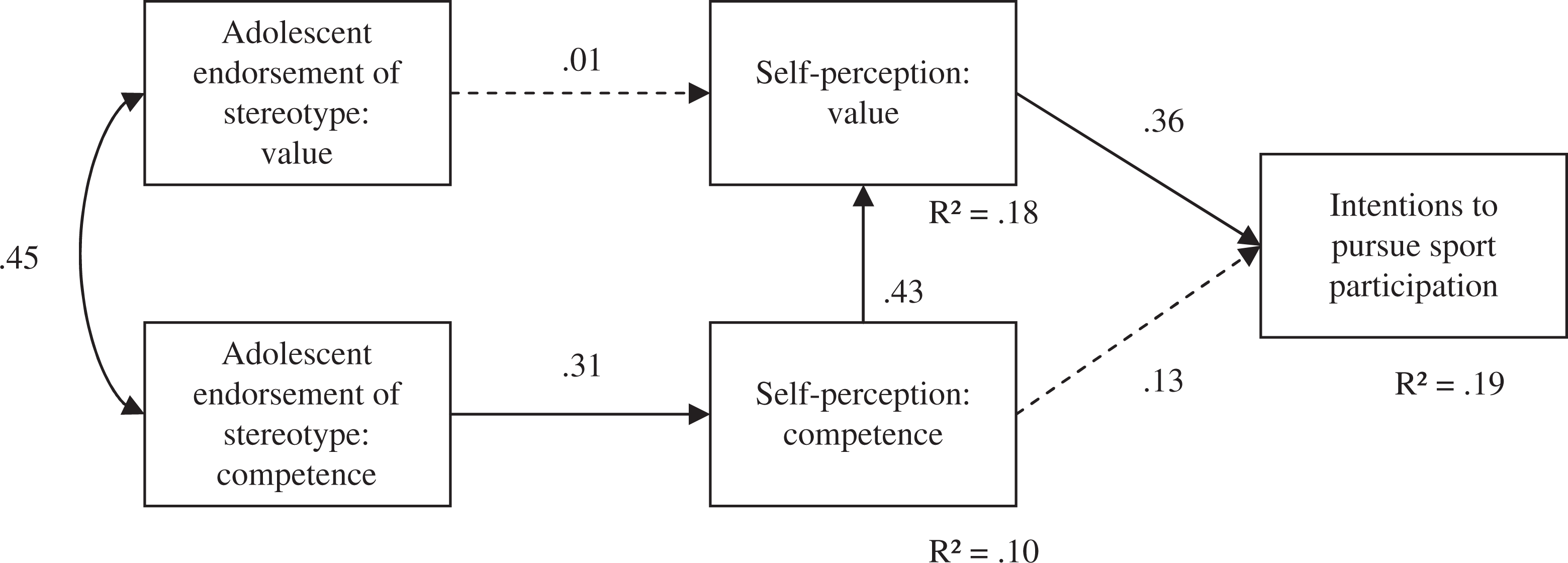
Path analysis of stereotype endorsement outcomes in Study 2. *p < .05.
Discussion
The first purpose of our second study was to examine the bound between each of the parents’ levels of gender-sport stereotypes and young athletes’ levels of gender-sport stereotypes. No significant association was observed: neither for mothers nor for fathers, and neither for value nor for competence stereotype. A likely explanation is that parents adopted a neutral attitude because a declarative measure of stereotype, even subtle, is prone to social desirability among adults (Riemer & Visio, 2003). Indeed, in the current sample, from 79% up to 91% of null scores were obtained among parents on the stereotypes measures, and the range for these measures was quite restricted. The use of an implicit method could represent a means to diminish such socially desirable responding.
The second goal of Study 2 was to examine the mediational role played by self-perceptions in the relationship between the level of adolescents’ gender-sport stereotypes and their intention to drop out from sport. It appeared that endorsing stereotypes of competence in favor of the other gender (pro-masculine stereotype for girls, pro-feminine stereotypes for boys) was significantly related to higher intentions to drop out through a complex chain of processes involving decreased levels of personal competence and value regarding the activity. This pattern of results is thus in line with the hypothesis according to which, among adolescents, adopting gender stereotypes could lead girls to leave the athletic area in greater proportions, compared to boys (Dumith et al., 2011; French Minister for Youth and Sport, 2001) because girls are more prone to consider themselves as less able and to attach less value to sport participation. Although the overall patterns in our data are consistent with this reasoning, the current subsamples of male and female participants were too small to test this specific gendered hypothesis.
Study 3
Study 2 failed to provide empirical support for the hypothesis of parental transmission of stereotypes using explicit measures. The aim of Study 3 was to further examine the link between the level of parents’ gender-sport stereotypes and their child’s level of endorsement (see Figure 1). Unlike Study 2, this relationship was examined not only through explicit measures (i.e., questionnaires) but also via a Single-Category Implicit Association Test (SC-IAT; Karpinski & Steinman, 2006). This test measures answers that participants cannot consciously control, allowing direct access to their cognitions without social desirability biases.
Method
Participants and Procedure
Twenty-three adolescents (14 girls and 9 boys, M age = 15.0, SD = 1.1, range = 14–19 years) as well as one of their parents (14 mothers and 9 fathers, M age = 45.3, SD = 4.7, range = 40–58 years) volunteered to participate. Child–parent dyads were quite well distributed: seven mother–daughter dyads, seven mother–son dyads, seven father–daughter dyads, and two father–son dyads. All the adolescents were regular sport participants (M = 5.13 hours of practice per week; range = 1–8 weeks). With the exception of two participants, all parents had practiced or continued to practice a sport on a regular basis. 2 The study took place at the participants’ house. Adolescents and parents participated separately in a quiet room and did not have the possibility to communicate with each other before both had completed the tasks. All participants first answered to the questionnaire and then did the implicit test on a computer (HP 584037-001) equipped with Inquisit 3.0.
Measures
The explicit measure of gender stereotype, both sport competence and value, was the same as in Studies 1 and 2. The SC-IAT (Karpinski & Steinman, 2006) was used as our implicit measure. This computer-based test measures the strength of cognitive associations via a simple categorization task of verbal stimuli. It requires the sorting of words belonging to three conceptual categories: one target category (in our case, “Sport”) and two attribute categories (i.e., “Masculine” and “Feminine”). Participants were asked to categorize the words that appeared in the middle of a computer screen as fast and as accurately as possible, using the “e” and “i” keys of the keyboard.
The six-step sequence described by Karpinski and Steinman (2006) was followed. The different blocks presented to the participants appear in Table 4. The first part of the test is devoted to familiarization with the words belonging to each conceptual category. Then, the assessment part of the test is composed of two steps that participants carry out in a counterbalanced way. Each step consists of 23 test trials immediately followed by 72 evaluation trials. In one of the steps, words from the “Sport” and “Masculine” categories need to be categorized in the upper-left screen, whereas words from the “Feminine” category need to be categorized in the upper-right screen. This step represents the “compatible” association. In another step, words from the “Masculine” category need to be categorized in the upper-left screen, whereas words from the “Feminine” and “Sport” categories need to be categorized in the upper-right screen. This step thus evaluates the “incompatible” association. The SC-IAT effect corresponds to the difference of performance (expressed through mean reaction time) realized for the compatible and incompatible association.
Blocks of Presentation During the Implicit Test (Study 3).
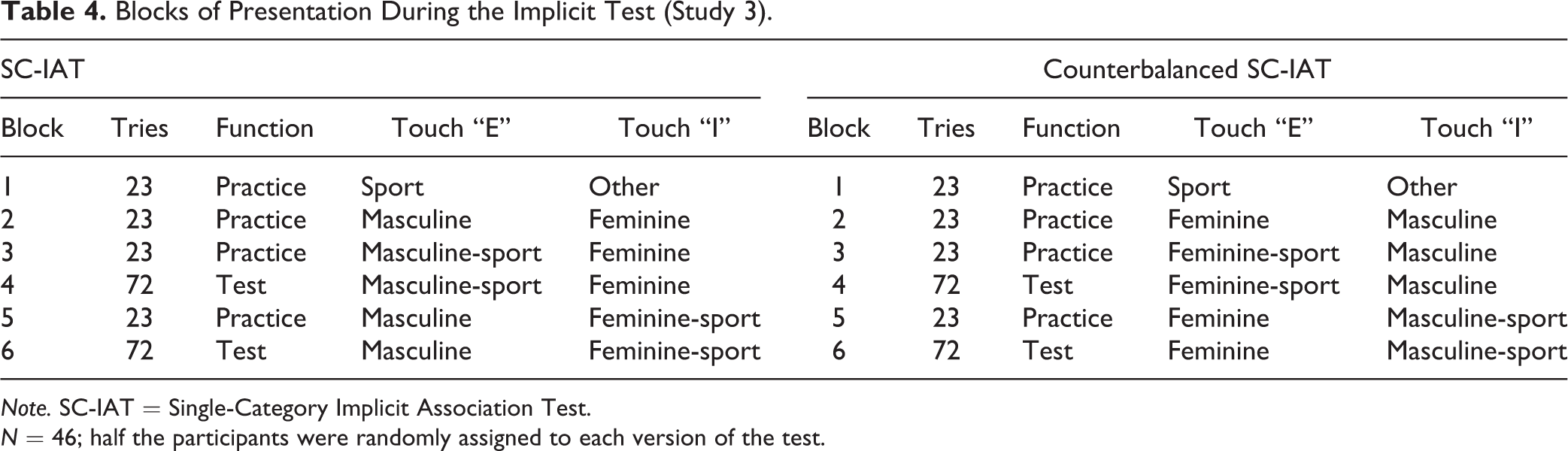
Note. SC-IAT = Single-Category Implicit Association Test.
N = 46; half the participants were randomly assigned to each version of the test.
For each category, eight stimuli were used. Concerning sport, the list of words used by Clément-Guillotin, Chalabaev, and Fontayne (2012) in their study on psychological gender was retained (namely, team, locker, stadium, competition, game, sweat, stopwatch, and running shoes). For the “Masculine” and “Feminine” categories, the lists were based on those of Greenwald et al. (2002). The properties (length and lexical frequency) of the French words belonging to the “Feminine” (girl, woman, mother, sister, misses, she, her, and they-female) and “Masculine” (boy, man, father, brother, mister, he, his, and they-male) categories were comparable. 3
Data Analysis
Regarding our explicit measures, the procedure used to compute the two stereotypes scores was identical to the one used in Studies 1 and 2. Concerning the implicit test, following the procedure proposed by Karpinski and Steinman (2006), all the reaction times lower than 300 ms and those higher than 3,000 ms were deleted as outliers. In case the participant gave a wrong answer, a penalty of 400 ms was added. On average, the participants made as many mistakes in the “compatible” block (M = 3.12, SD = 2.51) as in the “incompatible” block (M = 3.10, SD = 2.90), t(81) = .10, p < .92.
Then, the SC-IAT score was calculated using the modified algorithm proposed by Greenwald, Nosek, and Banaji (2003). The steps to calculate the D score are (a) calculation of the “inclusive” standard deviation including every time response of every trial in Steps 4 and 6, (b) calculation of the mean time response in the set of answers from Steps 4 to 6, (c) calculation of the difference between the mean of “compatible” block and the mean of “incompatible” block, and (d) division of the difference by the “inclusive” standard deviation. The more important absolute value of D score reflects a strong implicit association. A positive D score reveals an automatic association between the categories “sport” and “feminine,” whereas a negative D score reveals an automatic association between the categories “sport” and “masculine.” The block signing order did not have a significant effect on the implicit score for compatible (M = 0.14, SD = 0.30) and incompatible (M = 0.14, SD = 0.26) pairings, t(81) = 0.02, p < .985. Thus, all participants were considered simultaneously, and the analyses were run without controlling this parameter.
Results and Discussion
The means and standard deviations across the sample are presented in Table 5, along with correlations among the variables. A series of paired t-tests was run to examine whether athletes’ levels of stereotypes endorsement significantly varied from their parents’ levels. Regarding explicit gender stereotype of sport competence, athletes had significantly higher scores than their parents, t(44) = 3.12, p = .003, η p 2 = .18. Regarding explicit gender stereotype of sport value, there was no significant difference between athletes’ scores and their parents’ scores, t(44) = −0.76, p = .453. Finally, athletes’ scores on the implicit test were not significantly different from their parents’ scores, t(44) = 0.38, p = .706.
Descriptive Statistics and Correlations Among the Variables of Study 3(N = 23).
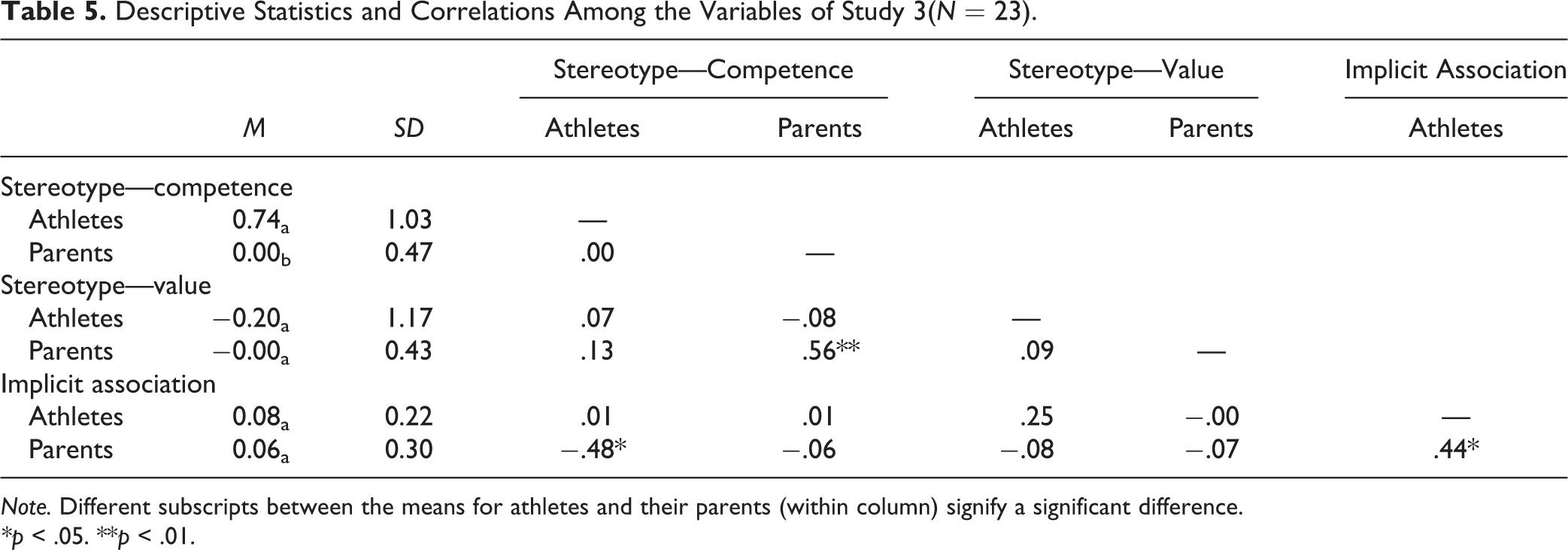
Note. Different subscripts between the means for athletes and their parents (within column) signify a significant difference.
*p < .05. **p < .01.
Regarding the relationships between athletes’ and parents’ scores, consistent with Study 2, no significant relationship appeared between adolescents’ and parents’ scores considering explicit measures of gender-sport stereotypes for value or competence (see Table 5). In other words, no significant link between parents’ and their children’s answers to explicit questionnaires was observed. In contrast, a significant correlation was observed regarding the implicit D score such that the more parents reported a strong implicit association between “sport” and “masculine,” the more their child did as well. Conversely, the more parents reported a strong implicit association between “sport” and “feminine,” the more their child also did. Thus, a significant bound between parents’ and adolescents’ scores emerged when considering implicit scores. Taken as a whole, this pattern of results reinforces the increasing interest observed in social cognition for implicit measures, given that they could represent a means to access cognitive constructs subject to social desirability biases.
Although not the main focus of the present study, another significant result emerged: namely, a significant relationship between explicit adolescent competence stereotype and implicit parent stereotype (see Table 5). This result indicates that the more parents implicitly associate sport and masculine, the more their children tend to declare that boys were more competent than girls in sport. This result suggests that parents could exert a social influence on their children without being conscious of it (e.g., by offering more sport opportunities of reinforcing more often boys than girls), which in turn may result in a stereotype explicitly assumed by their children. This interpretation remains speculative given the cross-sectional design of our study, but future research combining implicit tests and observations of parents could shed light on this unexpected result.
General Discussion
The EVM of Eccles and her collaborators represents one of the most widely used contemporary theoretical frameworks interested in parental socialization, especially regarding the sport area (Eccles et al., 2000; Fredricks & Eccles, 2004). This model assumes that gender stereotypes present within the cultural milieu may facilitate differentiated developmental patterns between boys and girls because they are transmitted by parents to their children through the construction of general schemas and specific self-perceptions. Even though the main hypotheses of the model have received support from empirical research in the last decades, within a sport context aspects of the model remain underexplored or studied indirectly (i.e., as part of the general social environment). The aims of the present article were thus to examine (a) the social antecedents of adolescents’ gender stereotypes relative to sport competence and value (both perceived by children and assessed in parents) and (b) the outcomes of the gender-sport stereotypes on adolescent athletes’ self-perceptions, intentions, and dropout behavior. In order to reach those purposes, a series of three empirical studies involving adolescent athletes and their parents were conducted.
Social Antecedents of Gender Stereotypes
According to Eccles’ model (Eccles et al., 2000; Fredricks & Eccles, 2004), a child’s beliefs are likely to be influenced by several sources in his or her social environment, but a particularly important role is attributed to parents. We thus assumed that the degree of gender stereotypes displayed by adolescents would be related primarily to the beliefs they perceive in their cultural milieu, and notably in their parents. This hypothesis was supported in Study 1 for stereotypes of both competence and attainment value, with higher coefficients observed for adolescents’ perceived parental stereotypes than stereotypes in general. Although this result fits the postulates of the EVM, it is not sufficient to empirically support the hypothesis of a social transmission of stereotypes. Indeed, those results do not indicate that actual beliefs shared in the society or in parents predict adolescents’ personal endorsement, but only that adolescents tend to hold stronger gender stereotypes when they perceive their social environment to do so.
As a consequence, in Studies 2 and 3, we further explored the degree of endorsement of stereotypes, both among adolescents and their parents. Indeed, if certain beliefs related to sport (e.g., value) revealed significant links between parents’ and their child’s answers, no known study of this kind has examined stereotypes. In Study 2, no significant relationships were observed. This absence of significant relationships can be accounted for by the very low variance in parents’ answers, reflecting a potential social desirability response bias more marked among parents than among adolescents (Tobin et al., 2010). This interpretation was strengthened by the results obtained in Study 3 because, in this additional study, no significant association was observed with explicit measures, whereas the predicted bound emerged for implicit scores.
Taken together, this pattern of results across studies lends significant empirical support to the EVM hypothesis of social transmission of gender stereotypes during adolescence. It also underlines the methodological difficulties encountered in this field and, more particularly, regarding the use of explicit scales among adults. The development of implicit measures appears as an efficient strategy to capture subtle sexist opinions. Future research should as a consequence rely on both explicit and implicit measures, for instance in order to compare the behaviors observed among parents or reported by their children, depending on their pattern of answers. (Potentially three profiles could emerge: one with neutral scores on both explicit and implicit measures, another with stereotypes on both explicit and implicit measures, and a third with neutral scores on explicit scales but stereotypes on implicit tests.)
Outcomes of Gender Stereotype Endorsement
Past research relative to gender differences and self-perceptions of value and competence is well documented, in particular regarding the sport context. However, previous studies investigating directly the role played by gender stereotypes in the motivational processes are scarce. In the current article, we thus explored how gender stereotype endorsement could impact self-perceptions of competence and value and, in turn, intentions to drop out from one’s activity (which ultimately may result in actual dropout behavior). The results obtained in the present work can be seen as quite pioneering with this regard. A significant link between the adoption of a view in disfavor of one’s gender category and actual sport drop out was shown in Study 1. Although this result was only observed regarding the stereotype of sport competence, it is the first known to actually test this specific hypothesis.
Study 2 enriches the results by supporting the existence of potential mediators in this relationship. Indeed, it appeared that adopting a gender-biased view of sport could significantly predict intentions to drop out from sport, through indirect effects of self-perceptions (regarding competence and attainment value) in the sport context. As a whole, the different paths suggested by the EVM to lead from stereotype endorsement to behavior were empirically supported in our samples.
Future research may refine our results by including other variables such as sport or gender identity. Indeed, the interactions between those identity components and gender stereotype potentially account for behaviors such as maintained sport participation or drop out. In this vein, certain individuals may adopt sexist views, but those general beliefs may not affect their self-perceptions because they conceive themselves as atypical, or because gender is not a central component of their self-schema. For example, a girl who adheres to pro-masculine stereotypes relative to sport could protect her self-views, if at the same time, she considers herself as exceptional for a girl, or if being a girl does not appear as a central core of who she is (Tobin et al., 2010). This minimized gender identification could in turn prevent her from disengaging in contexts socially seen as masculine, such as sport. Conversely, young women whose athletic identity is very important, and who also strongly identify as feminine, could be motivated to challenge the context of masculinizing sport. As a consequence, they should be likely to put a lot of effort and commitment in this context.
Limitations and Perspectives
A first limitation of the present series of studies is linked to potential stereotype accuracy. Indeed, the differentiated views according to gender in the athletic area may actually reflect real differences between both social groups. For example, Jacobs and Eccles (1992) have shown that mothers’ beliefs in their child’s athletic competence were positively predicted by their achievement on physical tests. It thus seems particularly fruitful to include such objective data in order to examine more thoroughly the role of stereotypes, conceived as an exaggeration of real intergroups differences. In addition, the results must be taken cautiously, given the respective retrospective or cross-sectional nature of the studies. A prospective design involving several points of measurement across time and an examination of persistence/dropout behavior would strengthen the empirical support to the processes hypothesized by the EVM. Moreover, whereas sport was treated as a generally pro-masculine area, it is noteworthy that certain activities carry more specific stereotypes and that some sports may be considered as strongly appropriate for one gender or carry on a more neutral social perception (Fontayne et al., 2002). Due to the size of our samples, it was not possible to distinguish the different activities in this way, but this seems a promising avenue for future research on sport stereotypes.
Finally, sport value appears as a key variable in the dropout process among adolescents. However, the reasons why sport is valuable for adolescents is not detailed within the EVM. Another framework addresses this question more specifically, namely self-determination theory (Deci & Ryan, 2002), which posits that different kinds of motives animate individuals. These motives can be distinguished as intrinsic (closest regulation from the intrinsic component of value in the EVM) or extrinsic when individuals do not act because of inherent interest but rather to reach a specific goal. Self-determination theory also posits that extrinsic motives vary in their degree of self-determination—from high, when personal goals are identified such as friendly relationships or health, to low, when external pressures such as popularity dominate. Past research consistently indicated that self-determined motives such as intrinsic or identified regulations were associated with the maintenance of sport participation, whereas low self-determined motives led to drop out (Sarrazin, Boiché, & Pelletier, 2007). However, more research could explore if the combinations of such motives could account for dropout prevention in sport among adolescents.
Practice Implications
Considering the short-term stakes of sport participation in terms of positive youth development, as well as the long-term health-related outcomes of regular physical activity, gender-differentiated patterns of sport socialization appear as a potentially discriminating phenomenon and thus should be fought. The current research supports the idea that adolescents rely on their social environment to shape—or not—general beliefs relative to the appropriateness of the athletic context for young women and men. More particularly, our work indicates that adolescents tend to endorse gender beliefs related to sport competence and value that are related to the beliefs they perceive in the cultural milieu and in particular their parents and that parents could transmit such beliefs in an implicit way. In turn, it appears that endorsing stereotypes in favor of the other gender leads to lower self-perceptions in sport, lower intentions to practice, and more drop out from sports. Parents should as a consequence be careful as to how their children are exposed to gender stereotypic messages or situations, and ultimately communicate to contradict them. They should also be aware of their own responsibility in the transmission of such belief. For example, they should question themselves about the opportunities (such as the propositions of watching sports events, trying certain activities, playing sports games with them) and encouragement they deliver to their children (regarding their effort and accomplishment), depending on their child’s gender. Physical education teachers and coaches should also be aware of the impact of language implying gender differences and avoid it, as well as be careful about the reinforcement they provide to female and male children and adolescents.
Conclusion
Eccles’ EVM (Eccles et al., 2000; Fredricks & Eccles, 2004) proposes that gender-based beliefs relative to achievement contexts are transmitted to young individuals by their cultural milieu and especially by their parents. The set of studies presented here bring empirical support to such a hypothesis in the sport context, which is still conceived as a male domain. The results indicate that this social transmission might operate both through explicit processes and unconsciously. They also point to the mechanisms through which adolescents’ endorsement of such beliefs may in turn lead to lower self-perceptions and behavioral disengagement from organized sport, which can lead to a sedentary lifestyle and poor health consequences in the long term.
Footnotes
Declaration of Conflicting Interests
The author(s) declared no potential conflicts of interest with respect to the research, authorship, and/or publication of this article.
Funding
The author(s) declared receipt of the following no financial support for the research, authorship, and/or publication of this article: The realization of Study 1 was facilitated by a grant from two French sport organizations: the `Direction Départementale de la Jeunesse et des Sport 26' and the ‘Comité Départemental Olympique et Sportif de la Drôme.’