



Abstract
Despite the burden of sexual assault on college campuses, few effective prevention programs exist. Understanding the socio-ecological context in which sexual assaults occur may illuminate novel pathways to augment prevention. We examined data from 349 students at two inter-connected urban universities who completed a population-based survey (N = 1,671) and described at least one incident of sexual assault victimization. Using latent class analysis of 13 incident, relationship, and social context characteristics, we identified three types of sexual assaults: Incapacitation, Known Assailant, both Drinking; Verbal Coercion, Partner/Friend, Private; and Unwanted Touching, Stranger, Public. Incapacitation, Known Assailant, both Drinking incidents often involved survivor incapacitation with someone known to the victim following a party. Verbal Coercion, Partner/Friend, Private incidents often involved verbal coercion and intimate partners, with others rarely present prior to the assault. Unwanted Touching, Stranger, Public incidents often involved unwanted touching and strangers in a public place. Findings suggest three distinct sexual assault types, defined by different incident, relational, and socio-contextual factors, and reinforce the importance of disaggregating sexual assault to tailor prevention programs more effectively. Campus policy-makers and providers should be aware that each type of assault may require different prevention approaches. Online slides for instructors who want to use this article for teaching are available on PWQ's website at http://journals.sagepub.com/doi/suppl/10.1177/0361684320964452
Sexual assault is a significant problem on college campuses, with 20%–25% of women and 8%–12% of men reporting at least one experience (Banyard, Ward, et al., 2007; Fedina et al., 2018; Meuhlenhard et al., 2017). Such experiences can include unwanted/non-consensual sexualized touching (e.g., fondling someone’s private parts on the dance floor), attempted sexual penetration (e.g., oral, anal, or vaginal intercourse), or completed sexual penetration (i.e., rape). A recent analysis of 71,421 undergraduate students from 120 U.S. colleges (Coulter et al., 2017) found that cisgender women and transgender students had higher odds of sexual assault compared to cisgender men. Among cisgender students, gay men had higher odds of sexual assault compared to heterosexual men, and bisexual students had higher odds of sexual assault compared to heterosexual students. Among transgender students, Black students had higher odds of sexual assault compared to White students (Coulter et al., 2017). In addition to variability in who is most at risk of sexual assault during college, the aftermath of being assaulted often includes a wide range of mental health sequelae (Dworkin et al., 2017). Sexual assault also has been associated with a substantial economic burden on society (Peterson et al., 2017). Given the adverse impact and prevalence of sexual assault, there is a need to develop more effective prevention programming.
Current sexual assault prevention programming, which includes bystander training (Banyard, Moynihan, et al., 2007; Cares et al., 2015; Gidycz et al., 2011; Salazar et al., 2014), consent education (Borges et al., 2008), social norms campaigns (Gidycz et al., 2011), and sexual assault resistance programs (Senn et al., 2015), has shown promise for reducing sexual assault. To maximize the potential for prevention, expert recommendations involve a combination of primary prevention and resistance programming strategies (Basile, 2015; Holtzman & Menning, 2019; Orchowski et al., 2020). However, rates of campus sexual assault have remained consistent for decades (Cantor et al., 2015; Koss et al., 1987; Krebs et al., 2007; Meuhlenhard et al., 2017), highlighting that better understanding sexual assault and its correlates may enable more effective tailoring of prevention programming. For example, sexual assault is often treated as a singular construct despite growing recognition that types of assault may be characterized by different socio-ecological contexts and individuals may be rendered vulnerable by a range of risk factors (Khan et al., 2020; Krebs et al., 2007, 2009; Lindquist et al., 2013; Mokma et al., 2016) that may require different interventions.
Recognizing that sexual violence is determined by multiple factors, the Centers for Disease Control (CDC, 2004) recommends that prevention programming addresses individual, relational, community, and societal risk factors for sexual assault, as defined in social ecological models such as Bronfenbrenner’s (1989) socio-ecological model. A review of 67 individual, relational, and societal/community risk factors for sexual violence perpetration found consistent and significant support for 35 factors (Tharp et al., 2013); however, community and societal risk factors were underrepresented in the literature (comprising only two of the 67). More recent studies highlight the importance of considering risk environments for sexual assault. For example, among college men followed prospectively over five semesters, frequency of bar and party attendance was a stronger predictor of sexual assault perpetration than was heavy episodic drinking (Testa & Cleveland, 2017). Similarly, our group previously found that the risk environments for incapacitated and non-incapacitated assaults differ not only by the use of substances but also according to relationship to the perpetrator and who is present immediately prior to the assault (fellow partiers for incapacitated assault; only the perpetrator for non-incapacitated assault; Gilbert et al., 2019). These findings suggest the importance of considering an environmental context (where the participant and perpetrator met, where the assault took place, whether others were around immediately prior to the assault), in addition to relationship variables when formulating prevention programs.
Incident-specific, individual, and relationship factors have been more extensively studied but are also important to consider in conjunction with environmental factors. For example, among college women, incapacitated assaults are more likely to be perpetrated by acquaintances, while non-incapacitated assaults are more likely to be perpetrated by romantic partners (H. Littleton et al., 2009). Additionally, greater substance use has been associated with increased risk of experiencing incapacitated rape during college (Eshelman et al., 2015; Krebs et al., 2009; McCauley et al., 2009).
The current analysis seeks to use a data-driven approach to disaggregate college sexual assault experiences according to incident, relational, and socio-contextual characteristics. Latent class analysis (LCA) is a form of cluster analysis that allows for the classification of incidents into mutually exclusive types (latent classes) based on shared patterns of associations among variables characterizing the incident. LCA has been used to understand the relationship between substance use and sexual risk behavior (Connell et al., 2009), as well as mental health outcomes (Au et al., 2013) and trajectories of mental health symptoms (Steenkamp et al., 2012) following sexual assault. LCA also has been used to identify trajectories of sexual assault over time (Swartout et al., 2011) and to identify types of sexual assault at a single time point (French et al., 2014). However, classes typically have been derived based solely on assault tactics (e.g., manipulated or forced fondling/intercourse; e.g., French et al., 2014). In one study that went beyond tactics, Macy and colleagues (2007) found four latent profiles in a sample of 415 college women with sexual assault experiences that were differentiated by individual-level factors such as prior victimization experiences, alcohol consumption, relationship expectancies of the perpetrator, and assertive precautionary habits. More recently, Yeater and colleagues (2018) found three latent profiles in a sample of 481 first year undergraduate women that were reliably distinguished by individual alcohol consumption and sociosexuality (i.e., the degree to which they were oriented towarsd and participated in uncommitted, casual sexual relationships in the absence of emotional closeness). However, the social and environmental context in which assault occurs has largely been absent from this work.
The primary aim of the current study was to build on these findings by incorporating incident-specific factors as well as relational and socio-contextual elements of Bronfenbrenner’s socio-ecological model (Bronfenbrenner, 1989) into an LCA of sexual assault. This study used data on the self-defined “most significant incident” of sexual assault experienced by a population-representative sample of undergraduates at two inter-connected institutions of higher education in an urban city in the Northeast United States. Based on prior work highlighting the importance of understanding relationship and substance use variables (Macy et al., 2007; Yeater et al., 2018), we predicted that distinct classes of sexual assault would emerge defined not just by the assault characteristics (e.g., acts that occurred such as sexualized touching or penetration and tactics used such as force, incapacitation, or coercion) of the self-defined most significant incident but also by a number of other factors key to prevention efforts including (a) relationship to assailant, (b) environment in which assault occurred, (c) where the assailant and participant met, (d) who was present prior to the assault, and (e) whether the participant or assailant had been using alcohol or drugs. Because this was an exploratory data-driven procedure and we included novel variables compared to prior research, we did not have specific hypotheses about the number or nature of the classes. Our second aim was to explore differences between classes relative to the aftermath of the assault: (a) telling someone about the assault and (b) whether the assault affected some area of their life. Finally, there is a critical need to better understand sexual assault experiences and perceptions among marginalized groups (Brubaker et al., 2017). Thus, based on findings suggesting that female, transgender, particularly Black transgender, and sexual minority (i.e., non-heterosexual) students are disproportionately impacted by sexual assault (e.g., Coulter et al., 2017), we explored whether sexual assault types based on the most significant incident differed according to race/ethnicity, gender, and sexual orientation.
Method
Participants
Data were drawn from a cross-sectional, population-based survey that formed one component of a mixed methods study examining risk and protective factors affecting sexual health and sexual violence among college undergraduates from two inter-connected institutions in New York City (Mellins et al., 2017). Survey participants were selected via stratified random sampling from the March 2016 population of 9,616 undergraduate students aged 18–29 years, as defined by administrative records of enrolled students. The sample was constructed by inviting 2,500 students via email to participate in the web-based survey, of which 1,671 (67%) consented to participate. The analytic sample used in the present study consisted of the subset of survey participants who responded to a slightly adapted version of a well-validated sexual assault questionnaire (see Measures), indicated experiencing at least one incident of sexual assault since enrolling at either school, and answered a number of follow-up questions about their most significant incident. Among the 350 students reporting an assault, 349 answered the follow-up questions about their most significant incident.
Approximately 74.8% of participants were female (n = 261), 22.3% male (n = 78), and 2.9% (n = 10) gender expansive (e.g., trans-male/trans-female, gender queer/gender-non-conforming). Most participants (70.9%; n = 244) identified as heterosexual. Slightly less than half of the participants (47.5%; n = 161) identified as White, with Black (10.6%; n = 36), Asian (16.2%; n = 55), Hispanic (16.2%; n = 55), and multiracial (9.4%; n = 32) participants roughly evenly distributed across the remaining half.
Procedures
Study procedures and methods were informed by the literature and both a faculty and undergraduate student advisory board (Hirsch et al., 2018; Mellins et al., 2017; Wolferman et al., 2019). This study was approved by the local institutional review board and obtained a federal certificate of confidentiality to legally protect the data from subpoena given the assessment of sexual assault perpetration and drug use, which are both illegal behaviors. Additionally, the researchers obtained a study-specific waiver from the institution of the obligation to report individual sexual assaults in order to protect student privacy and also promote willingness to participate. All students who participated in the research were offered information about referrals to health and mental health resources during the consent process and at the end of the survey.
All students in the selected sample of 2,500 were sent an email inviting them to participate with a unique link for them to access the survey at a location of their choosing (84% of participants) or at our on-campus research office if they wished (16% of participants). Students who completed the survey in the office received snacks and a US$40 cash incentive, while students who completed the survey elsewhere received a US$40 electronic gift card incentive. Participants were also entered into a lottery to win an additional US$200 gift card. On average, the survey took between 35 and 40 minutes to complete.
Measures
The survey included behaviorally-specific measures of sexual assault as well as measures of social and sexual relationship factors, and risk environment characteristics in addition to standard demographics. Grounding our work in Bronfenbrenner’s (1989) socioecological framework (Bronfenbrenner, 1989) and CDC (2004) recommendations, survey variables chosen for the LCA represent incident, relational, and socio-contextual characteristics of the most significant incident.
LCA Indicator Variables
We broadly classified the 13 LCA indicator variables into three groups: incident characteristics that describe the acts that occurred and tactics used during the most significant assault, relationship characteristics that describe the relationship between assailant and participant during the most significant assault, and social context characteristics that describe the social and physical environment prior to and during the most significant assault.
Incident Characteristics
Sexual assault victimization was measured using a modified version of the widely-used revised Sexual Experiences Survey (SES-R; Koss et al., 2007). Three primary sexual assault acts were assessed, including unwanted sexual touching (kissing, fondling, grabbing in a sexual way), attempted sex (oral, anal, or vaginal penetration), and penetrative sex. In response to emphatic urging from our undergraduate advisory board to reduce re-traumatization and burden, we slightly modified the SES-R by combining questions about different acts of penetration (oral, vaginal, etc.) rather than asking about each separately.
For each act of assault, participants were asked about six perpetration tactics. Two tactics reflect verbal coercion: “Telling lies, threatening to end the relationship, threatening to spread rumors about me, making promises I knew were untrue, or continually verbally pressuring me after I said I didn’t want to,” and “Showing displeasure, criticizing my sexuality or attractiveness, getting angry but not using physical force, after I said I didn’t want to.” The remaining methods included the use of physical force, threats of physical harm, incapacitation (“Taking advantage when I couldn’t say no because I was either too drunk, passed out, asleep or otherwise incapacitated”), and “other.” For each act, participants could endorse multiple perpetration tactics. As a second modification to the SES-R, participants were asked to report whether these incidents occurred since starting college and could respond: no; yes, during the current academic year; or yes, prior to the current academic year but since entering college.
The SES-R has adequate test–retest consistency (k = .33–.69), and 80% of reports reflect true positives when compared with written descriptions (H. Littleton et al., 2019). Participants who endorsed any SES-R items were asked to think about their sole incident or (if they experienced more than one) their most significant incident and respond to follow-up questions. Of the 349 participants who reported any assault, 321 described only one incident in detail and 28 described more than one. To ensure that findings were not biased by sampling from the same participant more than once, only incident characteristics from the 349 subjectively described most significant assault were included in the present analysis. The most significant wording was at the urging of our undergraduate advisory board. Incident characteristics derived from follow-up questions regarding the most significant incident included acts of sexual assault that occurred (unwanted sexual touching, attempted sex, penetrative sex) and tactics used during the assault using the six perpetration tactics described above in the SES-R description. Participants could endorse multiple tactics during the same incident. The tactics were recoded into three yes/no variables reflecting any verbal coercion, incapacitation, or use of threats/force. Along with acts that occurred, these three yes/no tactics variables made up the four incident characteristics entered into the LCA.
Relationship Characteristics
The follow-up questions also included relationship variables: whether the assailant was a student (yes, no/don’t know) and the type of relationship between the participant and the assailant at the time of the assault. For the latter, participants were given 13 options, which were grouped into five categories based on low numbers in some groups and conceptual similarities across certain groups (friend/acquaintance/hookup [defined by the participant], current partner or spouse, former partner or former hookup, stranger, or other [boss/supervisor/professor/teaching assistant/relative/co-worker/other]).
Socio-Contextual Characteristics
The follow-up questions asked how the participant first met the assailant (at the current university, in high school, off-campus work, through family, at an off-campus event, at a bar or nightclub, on the street, or through an internet dating app). Those who reported that they met the assailant at the current university were asked a follow-up question about where they met (in class, my dorm, social circle, party, on-campus event, extracurricular activity, or other). Responses to both questions were then grouped based on conceptual similarity into the following four categories: through social network or activity, at an event or public space, through an internet dating app, or on campus by some other means. Participants also were asked where they were just prior to the incident (had not been with assailant, with assailant on a date, with assailant at a party, with assailant somewhere else), whether others were around right before the incident (yes, no), where the incident occurred (dorm, fraternity house or sorority house, bar or party, somewhere else), whether the incident occurred during freshman year (yes, no), whether the participant was drinking or using drugs/alcohol (yes, no), and whether the assailant was drinking or using drugs/alcohol (yes, no, don’t know).
Sexual Assault Aftermath
The aftermath of the assault was examined in relation to the classes and included two items derived from the SES-R follow-up questions: telling someone either immediately or at any point since about the incident (yes/no) and noting that some aspect of life (academic, monetary, mental health, residential/housing, employment, extracurricular activities, social life, health, other) was affected (yes/no).
Data Analysis Plan
Descriptive proportions of all assault incident-specific factors and consequences were calculated. LCA was used to empirically identify clusters of incidents for which similar patterns of 13 incident-specific characteristics (i.e., incident characteristics, relationship characteristics, and social context characteristics) were reported. As is standard, we fit varying numbers of classes, ranging from 1 to 4, and selected the model with the smallest Bayesian information criterion (BIC) and a significant Lo–Mendell–Rubin (LMR) likelihood ratio test (LRT), which indicates that the model was a better fit than the model with one fewer class. The BIC is a relative fit statistic wherein lower values indicate a better fitting model (Burnham & Anderson, 2004). The LMR test statistic is a comparative fit statistic; significant values indicate how many groups should be extracted by testing the parsimony of the current model against the model with one less group (Nylund et al., 2007). We also examined entropy for the best fitting model, which indicates how well the model identifies separate latent classes; values above .80 are considered to provide good separation (Berlin et al., 2014). Each model was fit using maximum likelihood with robust standard errors in Mplus Version 7.11. Unordered categorical indicators were modeled with a multinomial logit link and binary indicators with a logit link. Full-information maximum likelihood was used to account for missing data in the LCA model. Posterior probabilities of latent class membership were derived using Bayes’s Rule, and incidents were classified for subsequent analysis according to their most likely class.
We examined differences among classes relative to two experiences of “aftermath”: telling someone about the incident and whether some aspect of the participant’s life was affected. We also explored whether there were differences in class membership according to gender, sexual orientation, and race/ethnicity. To reduce the likelihood of Type I error inflation, we only interpreted significant pairwise comparisons if omnibus tests were significant. All LCA correlates were categorical, and all differences between latent assault types were assessed with χ2 tests using SAS Version 9.4.
Results
LCA
The three-class LCA model best fit the data as indicated by the lowest BIC and significant LMR LRT p-value (see Table 1). The three-class solution had an entropy value of .849, indicating good separation among the classes. Thus, incidents were grouped into three types based on their defining characteristics: (a) 47.9% (n = 167 incidents) were labeled “Incapacitation, Known Assailant, both Drinking” (IKAD); (b) 31.8% (n = 111 incidents) were labeled “Verbal Coercion, Partner/Friend, Private” (VCPP); and (c) 20.3% (n = 71 incidents) were labeled “Unwanted Touching, Stranger, Public” (UTSP). Within these groups, the average posterior probabilities of membership to the corresponding class of sexual assault types were 93.7%, 95.9%, and 93.9%, respectively, indicating high confidence in the separation of the three classes. Classes were labeled based on interpretation of the most strongly-distinguished and qualitatively meaningful incident, relationship, and social context variables that comprised the LCA indicator variables (see Table 2 and Figure 1).
Class Fit Statistics for Solutions 1–4.

Note. AIC = Akaike information criterion; BIC = Bayesian information criterion; LMR LRT = Lo–Mendell–Rubin likelihood ratio test; N/A = not applicable.
Differences Between Types of Assault on LCA Indicator Variables.

a Type 1 versus 2 post-hoc comparisons significant at p < .05. b Type 1 versus 3 post-hoc comparisons significant at p < .05. c Type 2 versus 3 post-hoc comparisons significant at p < .05.
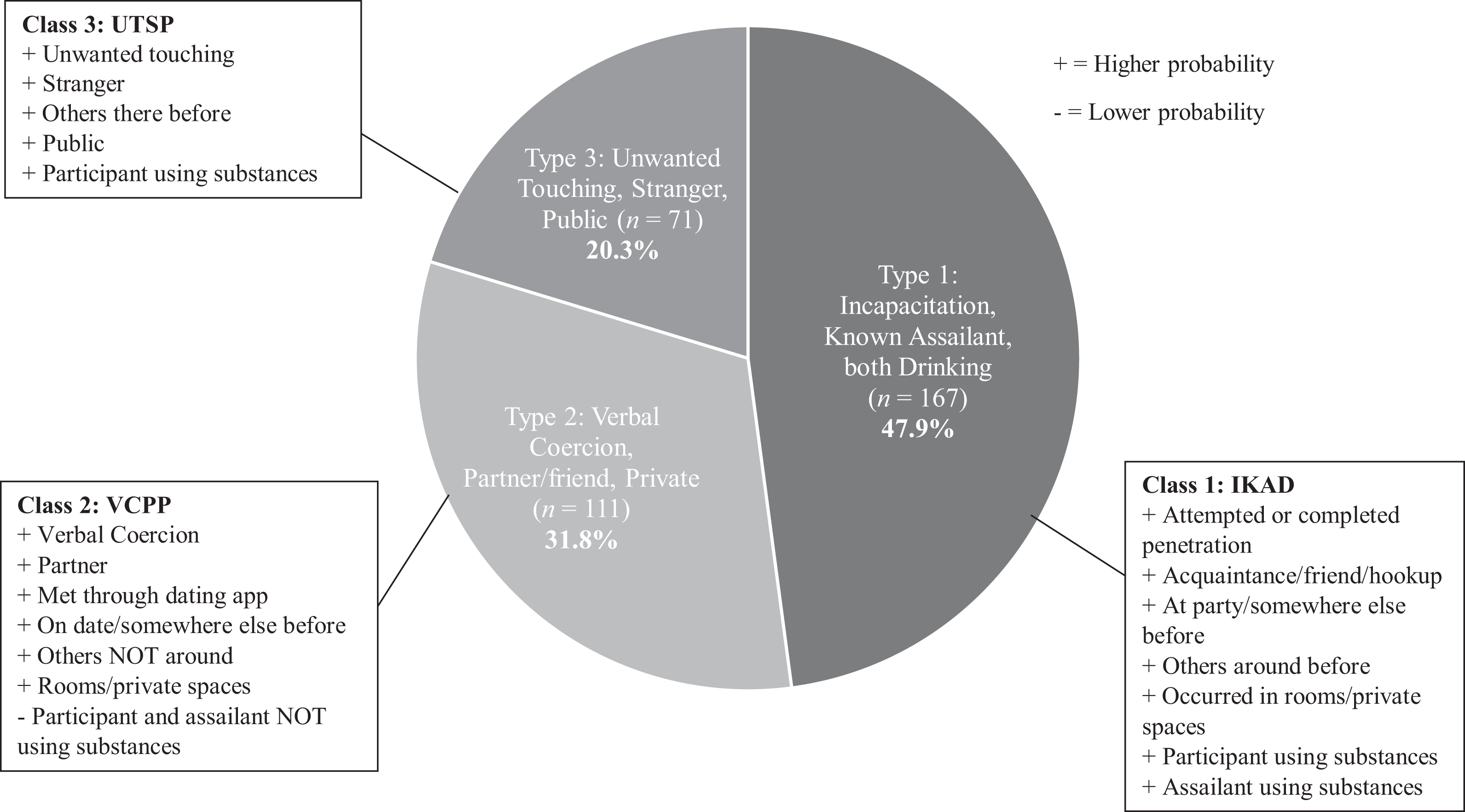
Descriptive Characteristics of Different Assault Types.
IKAD Characteristics
Nearly all IKAD incidents (97.5%) involved the participant saying they had been drinking or using drugs, and 90.0% reported the assailant also had been using substances prior to or during the incident. Relative to the other two classes, IKAD incidents were more likely to involve penetrative sex (48.4% vs. 38.1% for VCPP, p < .001; 48.4% vs. 10.3% for UTSP, p < .001) and the assailant taking advantage while the participant was incapacitated (85.0% vs. 23.1% for VCPP, p < .001; 85.0% vs. 68.1% for UTSP, p < .003). Relationally, 75.8% of IKAD incidents involved a fellow student. IKAD incidents were more likely than VCPP (78.8% vs. 52.7%, p < .001) and UTSP (78.8% vs. 13.0%, p < .001) incidents to involve a friend, acquaintance, or hookup partner as the assailant. Contextually, those who experienced IKAD as their most significant assault were most likely to have met the assailant through their social network (65.2%) or at an event (31.1%) and to have been with the assailant at a party (57.1%) prior to the assault. Among those experiencing IKAD as their most significant assault, 82.4% reported that others were around before the assault, and 60.9% reported that the assault happened in a dorm room.
VCPP Characteristics
Incidents of VCPP were most likely to be perpetrated by verbal coercion including the use of lies or criticism (73.1%). VCPP incidents were more likely to involve an assailant who was a current partner or spouse compared to the other two classes (25.5% vs. 3.8% for IKAD, p < .001; 25.5% vs. 0.0% for UTSP, p < .001). Contextually, VCPP incidents were less likely to involve substance use by the assailant (24.8% vs. 90.0% for IKAD, p < .001; 24.8% vs. 48.6% for UTSP, p < .001) or the participant (22.9% vs. 97.5% for IKAD, p < .001; 22.9% vs. 71.4% for UTSP, p < .001), and were less likely to occur at a fraternity or sorority compared to UTSP (2.8% vs. 20.3%, p < .001). Compared to the other types of assault, VCPP incidents were more likely to occur where others were not present immediately before (16.5% vs. 82.4% for IKAD, p < .001; 16.5% vs. 90.1% for UTSP, p < .001).
UTSP Characteristics
Finally, incidents of UTSP were most likely to involve unwanted sexual touching (82.4%) and the assailant being a stranger (85.5%), compared to the other two incident classes. These incidents were perpetrated most commonly by taking advantage of the participant’s incapacitation (68.1%), although other means also were used in a non-trivial number of incidents (lies/criticizing: 23.2%; threats/force: 29.0%). Relative to VCPP, UTSP incidents were more likely to occur in contexts where others were present (90.1% vs. 16.5%, p < .001), including at fraternities or sororities (20.3%), bars (39.1%), and after the participant met the assailant at an event or in a public space (95.6%). Finally, consistent with the assailant being a stranger, the participant and assailant were not together before the incident in 69.0% of UTSP cases.
The Aftermath of Sexual Assault
Disclosure of Assault
The majority (74.1%) of the 349 students who experienced a sexual assault and described a significant episode had told someone about that episode (see Table 3). Students who experienced VCPP as their most significant sexual assault were less likely to tell someone compared to students who experienced IKAD (62.4% vs. 80.4%, p = .003) or UTSP (62.4% vs. 78.3%, p = .026) as their most significant incident.
Differences in Aftermath by Sexual Assault Type.

a Although a potentially important part of the response to assault, telling the perpetrator may reflect a different underlying process than disclosing to others; therefore, we have excluded the 19 participants who reported only telling the perpetrator from this variable. b Type 1 versus 2 post-hoc comparisons significant at p < .05. c Type 2 versus 3 post-hoc comparisons significant at p < .05.
Life Affected by Assault
Approximately 57% of students who experienced sexual assault noted that some aspect of their life was affected; however, omnibus tests did not reveal a significant difference between the assault types on this outcome.
Exploratory Analyses on Class Membership by Demographics
Students who described IKAD as their most significant assault were more likely than those who described VCPP as their most significant assault to identify as White (p < .001), and students who described UTSP as their most significant assault were more likely than those who described IKAD as their most significant assault to identify as Black (p = .006). There were no other race/ethnicity differences. Students who described UTSP incidents as their most significant assault were more likely to identify as gender-expansive compared to students who described IKAD (p = .033) or VCPP (p = .005) incidents as their most significant assault (overall p = .006); however, there were no differences in most significant assault type for men or women. There also were no significant differences in class membership based on sexual orientation.
Discussion
The current findings add to a growing literature suggesting that sexual assault varies not only according to the acts that occurred and the tactics that were used but also according to relational and socio-contextual factors. We extended prior analyses of this kind with female survivors of sexual assault (e.g., Macy et al., 2007; Yeater et al., 2018) by focusing on sexual assault types within a population-representative sample of male, female, and gender-expansive undergraduate students. Using data from participants’ self-identified most significant incident, we found three distinct types of assault that were differentially constituted by incident-specific, relationship, and social context characteristics. These assault types were differentially associated with assault disclosure, and exploratory analyses suggested some preliminary differences by race and gender. These findings also contribute to work emphasizing the importance of understanding a combination of factors including alcohol and relationship to perpetrator (H. Littleton et al., 2009; Yeater et al., 2018) but also other socio-contextual factors (e.g., where the assault occurred, where the participant and perpetrator met, whether others were present before the assault)—dimensions that may have important implications for prevention.
Findings suggest that some assault types (i.e., IKAD, UTSP) may be more amenable to traditional bystander interventions, as they are characterized by others being present immediately prior to the assault who could potentially intervene. Despite this necessary ingredient, IKAD and UTSP assaults in this sample were both more common when the participant had been using substances; thus, there may be concerns about whether intoxicated bystanders in these environments are able to detect sexual assault or its warning signs and subsequently intervene (Ham et al., 2019). Among those who described VCPP as the most significant incident, very few participants reported the presence of others around beforehand to intervene. Rather, these assaults occurred mostly in the context of intimate relationships and contribute to growing literature documenting interpersonal violence among university students (e.g., Fair & Vanyur, 2011; Fass et al., 2008; Moore et al., 2011; Nabors, 2010; Prather et al., 2012; Shorey et al., 2011). Among students reporting VCPP as their most significant assault, verbal coercion was the most frequent perpetration tactic, which suggests the importance of programming that not only focuses on sexual assertiveness but also on the affective experience of mutual respect and recognition in romantic and sexual relationships to reduce rates of VCPP. Additionally, these data underline the importance of “proactive” approaches to bystander intervention, which go beyond stopping someone at a party or social gathering and include talking to friends about their relationships (Bennett & Banyard, 2016).
Although perpetrators alone are responsible for sexual violence, resistance training—including efficacy to refuse unwanted sex—may be effective for combating the risk of VCPP (H. Littleton & Decker, 2017; Santelli et al., 2018). For example, a sexual assault resistance program that focuses on identifying the risk of assault by an acquaintance, overcoming emotional barriers to acknowledging risk, and practicing verbal and physical resistance strategies has shown promise for reducing rates of sexual assault victimization among college women (Senn et al., 2015).
Preliminary analyses indicated that some groups observed to have a higher risk of sexual assault in prior research (e.g., Coulter et al., 2017) describe different types of assault as their most significant incident. For example, students who described UTSP as their most significant incident were more likely to identify as Black compared to students who described IKAD as their most significant incident. Similarly, although only 10 students identified as gender-expansive, six of the 10 described UTSP as their most significant incident. Although we were underpowered to undertake analyses examining the intersection of these demographic variables, Coulter and colleagues (2017) found that Black transgender students had significantly higher odds of sexual assault relative to other groups. Our findings suggest that Black and gender-expansive students may consider UTSP an important form of assault, which is notable as there are few targeted interventions, with perhaps the exception of self-defense programs tested exclusively among women (e.g., Hollander, 2014; Orchowski et al., 2008), to address this form of assault. These findings fit with other research suggesting gender and racial differences in the experience and perception of sexual assault (Coulter et al., 2017; Hirsch & Khan, 2020; H. L. Littleton & Dodd, 2016) and highlight a need to attend to different elements of diversity (see Brubaker et al., 2017, for a review) when developing sexual assault prevention programming.
Several limitations of the current research should be noted. First, results pertaining to demographics must be interpreted with caution since they involve the analysis of person-level variables in the context of classes derived entirely from characteristics of a select incident. The majority of students had experienced more than one assault during college (Walsh et al., in press); thus, these analyses cannot speak to individual differences in the likelihood of experiencing certain types of assault. Second, it is unknown why students may have described certain incidents of assault as the most significant. It is possible that these were the assault types students felt most comfortable describing in detail, or they could have been the student’s sole experience. It will be important for future studies to collect detailed information on all assaults experienced to clarify marginalized students’ experiences with and perceptions of different types of assaults. Third, analyses involving certain sociodemographic factors (e.g., race, gender identity) had small sample sizes, which precluded examining the intersection of various sociodemographic factors (e.g., race/ethnicity and sexual orientation or gender identity). Fourth, although we employed a random population-based sample, the survey was only conducted at two inter-linked institutions in a large urban environment, and thus, the data are likely not representative of all undergraduate institutes of higher education. Finally, we reiterate that the LCA was exploratory in nature, and the large number of tests used to describe patterns of sexual assault between classes in the current study should not be interpreted as confirmatory. Future research should attempt to replicate and extend these findings.
Practice Implications
There are important implications of this work for campus providers. This study amplifies the call for multi-level prevention programs. Consistent with CDC recommendations (Basile et al., 2016; CDC, 2004), understanding individual, relational, and socio-contextual factors that define different forms of assault can aid in the development of tailored prevention programs to reduce overall rates of sexual assault. Perhaps the clearest example of this is reflected in the differences between the IKAD and the VCPP classes. Fraternity houses and bars are frequently assumed to be spaces of danger for sexual assault in a way that friendships and other kinds of relationships are not. Although there are promising avenues for the prevention of substance-related sexual assault on college campuses (e.g., Clinton-Sherrod et al., 2011; Gilmore et al., 2015), other forms of sexual assault have been less studied. In the case of UTSP, for example, it is unclear whether prevention programs designed for women that focus on self-defense training (e.g. Hollander, 2014; Orchowski et al., 2008) would be effective at combating this particular type of assault and whether it would work equally well for students of all backgrounds. Our findings emphasize the need for multiple different environmental-level approaches to respond to and prevent the variation of experiences all too frequently collapsed under the label of campus sexual assault.
Supplemental Material
Supplemental Material, Walsh-et_al - Socio-Ecologically Constituted Types of Sexual Assault
Supplemental Material, Walsh-et_al for Socio-Ecologically Constituted Types of Sexual Assault by Kate Walsh, Aaron L. Sarvet, Shamus Khan, Tse-Hwei Choo, Melanie Wall, John Santelli, Patrick Wilson, Louisa Gilbert, Leigh Reardon, Jennifer S. Hirsch and Claude Ann Mellins in Psychology of Women Quarterly
Footnotes
Authors’ Note
Kate Walsh and Aaron Sarvet share equal first authorship on this paper.
Acknowledgment
The authors thank our research participants; the Undergraduate Advisory Board; Columbia University, and the entire SHIFT team who contributed to the development and implementation of this ambitious effort, including survey research staff members Karimata Bah and Stephanie Benson.
Declaration of Conflicting Interests
The author(s) declared no potential conflicts of interest with respect to the research, authorship, and/or publication of this article.
Funding
The author(s) disclosed receipt of the following financial support for the research, authorship, and/or publication of this article: This research was funded by Columbia University through generous support from multiple donors.

References
Supplementary Material
Please find the following supplemental material available below.
For Open Access articles published under a Creative Commons License, all supplemental material carries the same license as the article it is associated with.
For non-Open Access articles published, all supplemental material carries a non-exclusive license, and permission requests for re-use of supplemental material or any part of supplemental material shall be sent directly to the copyright owner as specified in the copyright notice associated with the article.
