




Abstract
This study examined college women's ability to detect aggression and intimate partner violence (IPV) perpetration risk in unknown men's dating profiles across three samples. Across studies, women accurately distinguished profiles characterized by high, moderate, and low levels of aggression, but showed greater difficulty differentiating between moderate and low levels of IPV perpetration risk. Women's IPV victimization histories and childhood maltreatment exposure were each independently associated with greater accuracy in identifying both aggression and IPV risk. These findings align with trauma-informed frameworks of risk perception, which propose that lifetime interpersonal adversity may shape sensitivity to relational danger cues in early impression-formation contexts. Together, results highlight the complexity of early risk detection in online dating environments and underscore the importance of prevention and education efforts that support women's recognition of both overt and subtle indicators of risk.
Intimate partner violence (IPV) is a pervasive public health crisis and a profound violation of human rights, characterized by a range of abusive behaviors, including physical and sexual violence, stalking, and psychological aggression with coercive tactics, perpetrated by current or former intimate partners (Breiding et al., 2015). Nationally representative data indicate that 47.3% of U.S. women experience sexual violence, physical violence, and/or stalking by an intimate partner in their lifetime (Leemis et al., 2022). Importantly, emerging evidence suggests that nearly half (45.2%) of women victims experience their first IPV relationship between the ages of 18 and 24, underscoring young adulthood, and for many, the college years as a particularly vulnerable time for IPV victimization (Leemis et al., 2022; Smith et al., 2018).
The consequences of IPV reverberate far beyond immediate harm, leading to devastating health, social, and economic outcomes for victims (Gilbert et al., 2022; Johnson et al., 2022). Perhaps most concerning is IPV's cyclical nature: experiencing IPV increases the risk of revictimization threefold (Bellot et al., 2024; Ørke et al., 2021), and 23% to 56% of survivors report abuse by multiple partners across their lifetimes (Ørke et al., 2018, 2021). Although multiple factors likely contribute to this elevated risk (Yakubovich et al., 2018), one potential mechanism involves how prior interpersonal victimization shapes the perception and evaluation of threat in future relationships. Survivors of violence, whether experienced in childhood or adulthood, may show alterations in threat sensitivity, which can manifest in different, sometimes opposing ways. For some, repeated exposure to harm may contribute to blunted or distorted threat perception, making it more difficult to differentiate safe from unsafe partners (Clauss & Clements, 2021). For others, victimization may heighten vigilance to interpersonal tension or danger, facilitating earlier detection of warning signs (Aadnanes & Gulbrandsen, 2018; Jaffe et al., 2019). These divergent patterns are consistent with social information processing models, which posit that early and repeated adverse experiences shape how individuals attend to, interpret, and respond to social cues (van Reemst et al., 2016).
Given the significant risk of revictimization, clarifying how risk perception—an individual's ability to assess potential threats in specific situations—is shaped by prior victimization is especially critical in romantic relationship contexts. Accurate risk identification may reduce the likelihood of victimization and promote healthier relationship dynamics (Logan & Walker, 2021). For individuals with a history of abuse, the initial stages of partner selection are particularly critical, as they may face significant challenges in recognizing and extricating themselves from harmful relationships (Cravens et al., 2015). Despite this importance, few studies have explored individuals’ ability to detect risk for abuse in potential partners. Most existing research focuses on perceptions within current relationships, where survivors of IPV can identify risk of revictimization (Bowen, 2011), often based on behavioral cues or signs of tension in their partners (Bell et al., 2008; Bowen, 2011). This gap raises important questions about how people assess risk in unknown partners, where behavioral patterns have yet to emerge and people often rely on different judgment processes compared to when they have established familiarity with someone (Joel et al., 2013).
Although IPV perpetration represents a specific form of interpersonal violence within romantic relationships, it often occurs within broader patterns of aggressive behavior (Leemis et al., 2022), making it important to examine both general aggression and IPV-specific risk. When considering risk perception in the context of partner selection, several questions arise: Are individuals able to accurately detect risk for aggression (i.e., hostile attitudes directed at another person; Buss & Perry, 1992) or IPV perpetration risk (i.e., risk of harm from an intimate partner) upon their first encounter with a potential dating partner? Additionally, are all people equally skilled at detecting propensity for aggression and IPV perpetration, or does this vary as a function of personal history factors, such as their IPV victimization history and child maltreatment exposure? Addressing these questions is essential for understanding the nuance of risk perception in new dating partners and can inform the development of interventions that empower women to recognize and respond effectively to IPV in their dating experiences.
Person Perception Methodology
To investigate these questions, we utilized the person perception methodology, an experimental framework derived from personality psychology (Gosling et al., 2002). This approach examines how naive observers (individuals with no training in person perception) form impressions based on limited information. Drawing on a Brunswikian lens (1956), this methodology emphasizes the connection between objective behaviors and perceived emotions and cognitions (e.g., a cluttered desk may suggest disorganization, leading to perceptions of unreliability). Naive observers can reliably judge others’ mental states and personality traits from minimal cues, such as social media content (Linkov et al., 2014), physical environments (Graham et al., 2011), and discussions about romantic partners (Borelli et al., 2019). In romantic contexts, individuals often rely on immediate judgments to assess values and intentions (Joel et al., 2013), and although limited research has used this methodology in such settings, evidence suggests that observers can accurately evaluate relationships with minimal information (Borelli et al., 2019).
Accuracy in Person Perception
In person perception research, accuracy refers to how effectively naive observers assess the traits of others in comparison to self-reports, commonly evaluated through self-other agreement (Bernieri et al., 1994; Borelli et al., 2019). Discrepancy scores—differences between observer and self-ratings—are used to determine whether the observer overestimates or underestimates the target's traits (Kim et al., 2019). Several factors, such as the quality and quantity of information, trait visibility, and the target's characteristics are known to affect observers’ accuracy (Funder, 2018; Graham et al., 2011; Letzring et al., 2021).
In the context of dating, overestimating potentially harmful traits, such as aggression or IPV perpetration risk, is often more adaptive than underestimating them, as the latter may lead to greater personal risk. In an initial study using this paradigm (Russo & Borelli, 2024), women college students were able to accurately differentiate between men characterized as low, moderate, and high in aggression after viewing their unidentified online dating profiles; however, they were only able to distinguish between low and high IPV perpetration risk, highlighting the complexity of assessing potential danger in new dating partners. In this pilot study, we also examined attachment orientation and IPV victimization history as predictors of accuracy. Attachment orientation was associated with accuracy in perceptions of men's aggression, but not their IPV perpetration risk, such that higher attachment anxiety was linked to increased accuracy whereas greater attachment avoidance was associated with decreased accuracy. In contrast, IPV victimization history was not associated with accuracy for either. These findings indicate that the role of IPV victimization in early risk detection remains unresolved and warrants continued examination. At the same time, these findings call into question whether sensitivity to aggression or IPV perpetration risk cues may also be shaped by other forms of interpersonal adversity, such as childhood maltreatment exposure—which encompasses physical, emotional, and sexual abuse as well as neglect—pointing to the importance of considering how different victimization histories may shape the interpretation of relational threat.
IPV and Child Maltreatment Exposure as Predictors of Perceptions of Unknown Men
Although our understanding of which individual-level factors shape accuracy in perceiving aggression and IPV perpetration risk in unfamiliar others remains limited, existing research suggests that personal histories, particularly experiences of IPV victimization and child maltreatment exposure, may play a critical role in shaping how relational cues are interpreted (Capaldo & Perrella, 2018; Hehman et al., 2017). Importantly, however, victimization does not appear to influence risk perception in a single, uniform direction. Instead, trauma research points to competing pathways through which lifetime exposure to interpersonal harm may shape sensitivity to threat. One pathway reflects normalization and desensitization processes, wherein chronic exposure to aggression in childhood or intimate relationships recalibrates what is perceived as typical or acceptable behavior (Ardizzi et al., 2015; Mrug et al., 2016). As a result, early indicators of coercion, volatility, or emotional abuse may appear familiar, ambiguous, or insufficiently concerning to register as warning signs (Funk et al., 2004; Rosenfield et al., 2014; Silvestri et al., 2025). In contrast, a second pathway reflects heightened vigilance, in which adversity sensitizes individuals to cues of hostility, dominance, or unpredictability, lowering the threshold for detecting potential threat (McLaughlin et al., 2015; Romens & Pollak, 2012; van Reemst et al., 2016). Although this hypervigilance may increase detection accuracy when genuine risk is present, it may also amplify perceived threat in ambiguous or low-risk contexts (Abramowitz & Blakey, 2020).
Evidence for both patterns has emerged across IPV and child maltreatment literatures. Among IPV survivors, some report minimizing or rationalizing abusive behaviors and becoming desensitized to controlling dynamics (Cravens et al., 2015; Smyth et al., 2024), whereas others demonstrate heightened sensitivity to interpersonal danger (McLaughlin et al., 2015; Romens & Pollak, 2012). Similarly, child maltreatment exposure has been linked to both enhanced detection of threat-related cues (Assed et al., 2020; Bérubé et al., 2023; van Reemst et al., 2016) and the normalization of violence as a conflict-resolution strategy (Ardizzi et al., 2015; Dunlap et al., 2009).
Together, these minimization and hypervigilance pathways reflect the complexity of how IPV victimization and child maltreatment exposure may shape risk perception of unknown men. Notably, child maltreatment is also associated with greater likelihood of later IPV victimization (Handley et al., 2021; Li et al., 2019), suggesting that early and adult victimization experiences may jointly contribute to patterns of risk detection across the life course. Yet, despite the relevance of these mechanisms to women's vulnerability to revictimization, they have not been examined in controlled, ecologically relevant first-impression contexts, such as evaluating unknown men's online dating profiles. This gap is particularly important given that early partner selection often occurs before behavioral patterns have emerged and rely on rapid judgments based on limited information (Shanteau & Nagy, 2014). Online dating represents a central context in which these judgments are made: Approximately half of adults under the age of 30 report using online dating platforms (53%; Pew Research Center, 2023), underscoring the ecological validity of examining risk perception within this medium. Understanding how lifetime interpersonal adversity shapes women's impressions in these initial encounters has direct implications for intervention, as identifying whether victimization contributes to reduced sensitivity or heightened sensitivity can inform efforts to support women in navigating early romantic interactions more safely and effectively.
The Present Studies
In three studies, we replicated and extended an established protocol (Russo & Borelli, 2024) by presenting data from three new samples of college women who evaluated de-identified online dating profiles of men (N = 30). Notably, this represents a substantial expansion of the stimulus set from the nine men's profiles used in the original pilot study to 30 profiles in the current investigation. Each study employed a within-subjects design, such that every participant rated multiple male targets, allowing us to examine how accurately women differentiate among low-, moderate-, and high-risk men based on minimal information. Conducting three studies using the same experimental paradigm is particularly important in person perception research, where accuracy effects can vary across samples and rely on the stability of both perceiver and target characteristics (Biesanz & Wallace, 2020). Replication strengthens confidence in observed accuracy patterns, clarifies the generalizability of effects, and allows for a more precise examination of the conditions under which women can detect aggression and IPV perpetration risk from minimal information. Given the novelty of applying person perception methods to IPV risk detection, and the inherent challenges of assessing accuracy from thin slices of social information, multiple studies offer essential evidence that any consistent findings reflect meaningful trends rather than sample-specific characteristics.
Beyond replicating prior accuracy patterns, the present studies extended this work by examining how lifetime victimization, including IPV victimization and child maltreatment exposure, relates to women's perceptions and accuracy. In doing so, we emphasize that victimization is not the victim's fault, and that individual differences in risk sensitivity operate alongside broader interpersonal dynamics (e.g., perpetrators’ targeting or manipulation) and sociocultural forces that can normalize, obscure, or romanticize harmful behaviors (e.g., Maas & Bonomi, 2021). Situating risk perception within this wider context underscores that women's interpretations of potential partners reflect not only internal processes shaped by adversity, but also the relational and cultural environments in which these judgments occur.
This extension allowed us to test theoretically grounded competing trauma pathways (i.e., reduced sensitivity due to normalization/minimization vs. heightened sensitivity due to hypervigilance) within an ecologically relevant first-impression setting. Evaluating these pathways across three independent samples provided a rigorous test of whether adversity meaningfully shapes women's impressions of unfamiliar men. Together, the studies reported here addressed the following research questions: whether women accurately differentiate among men who report high, moderate, and low levels of aggression (RQ1a) and IPV perpetration risk (RQ1b) when forming impressions (i.e., whether they rate high-aggression men as more aggressive than moderate- or low-aggression men, and show parallel differentiation for IPV perpetration risk); and whether women's own IPV victimization histories and child maltreatment exposure are associated with their accuracy in identifying men reporting higher aggression (RQ2a) and more IPV perpetration history (RQ2b). By examining the interplay between personal history factors and judgment accuracy, we aimed to identify key elements that inform women's assessments of potential partners.
Pre-Study Procedures: Developing Men's De-Identified Dating Profiles
First, we recruited men participants to create de-identified dating profiles and self-report their aggression and IPV perpetration history (see Russo & Borelli, 2024 for a full overview of this process). Eligibility included being over 18 years of age, identifying as men, identifying as heterosexual, currently being in a romantic relationship or previously being in a romantic relationship, and being able to read and write in English. Men who met eligibility criteria were recruited from the online social science subject pool at a 4-year research university (n = 20) and through social media (n = 10; e.g., Instagram, Twitter) to complete the online survey and create de-identified dating profiles modeled after popular dating platforms (e.g., Tinder, Hinge). Dating profiles were created by asking each participant to respond to a series of mostly open-ended prompts designed to reflect personal attributes, such as “About Me” (e.g., “I am reserved at first but warm up quickly”) and “Perfect First Date” (e.g., “all the first ones are bad ones, just wait”). They also selected a profile image from a curated list of culturally relevant options (e.g., memes, TV characters, nature photos) to further personalize their profiles while maintaining anonymity. Men's race and ethnicity were not reported on the profiles. This decision was intentional, as these initial studies were designed to isolate whether women could detect aggression and IPV perpetration risk from minimal, non-demographic cues. Including racial or ethnic indicators in early-stage work could have introduced confounds related to stereotypes or bias, making it difficult to determine whether accuracy reflected sensitivity to behavioral risk cues or reliance on social category information rather than the content of the profiles themselves.
Aggression was assessed using the Buss-Perry Aggression Questionnaire (BPAQ; Buss & Perry, 1992), a 29-item scale measuring physical aggression, verbal aggression, anger, and hostility (e.g., “if I have to resort to violence to protect my rights I will”) on a 5-point scale from 1 (extremely uncharacteristic) to 5 (extremely characteristic). The total score, which ranges from 29 to 149, reflects self-reported aggression, with higher scores indicating greater aggression. IPV perpetration risk was evaluated using the Conflict Tactics Scale-2-Short Form (CTS2S; Straus & Douglas, 2004), which assessed self-reported history of physical, psychological, and sexual abuse perpetration, as well as injuries inflicted on partners. Responses were dichotomized (i.e., no = 0 or yes = 1) and summed (0 to 4) prior to standardization. To conduct analyses, we computed scores for each profile's aggression/IPV perpetration rating. These scores were standardized for comparison, as men used the BPAQ and CTS2S to assess aggression and IPV perpetration risk while women observers used a rating scale of 1 (not at all) to 7 (very) to assess these risks.
The men who created the dating profiles (N = 74, Mage = 22.53, SD = 3.78) had a mean aggression score of 57.45 (SD = 26.75) and a mean IPV perpetration score of 0.98 (SD = 1.23). Because the majority of these 74 men reported no IPV perpetration history, only a subset of profiles provided sufficient variability to form meaningful risk groups. Accordingly, we categorized the profiles selected for use in the study into low, moderate, and high aggression/IPV perpetration levels based on the men's self-reported scores, consistent with person-perception and accuracy research in which targets’ self-reports serve as the criterion characteristics (Bernieri et al., 1994). Prior research has also shown that BPAQ aggression scores are positively associated with IPV perpetration behaviors (Cunha et al., 2024), underscoring the relevance of dispositional aggression as a construct linked to, but distinct from IPV perpetration risk.
Specifically, 10 profiles were classified as low aggression and low IPV perpetration, defined as no history of IPV perpetration and low aggression scores (Mlow = 46.41, SD = 21.24; range = 32.00–68.00); within this group, 3 men identified as White, 3 as Latino, 2 as Asian, and 2 as multiracial. Another 10 profiles fell into the moderate category, defined by a history of two forms of IPV perpetration and moderate aggression scores (Mmod = 76.90, SD = 9.22; range = 69.00–86.00); this group included 1 White man, 5 Asian men, and 4 Latino men. Lastly, 10 profiles were categorized as high aggression and high IPV perpetration, characterized by a history of all four forms of abuse (physical, emotional, sexual, and injury) and high aggression scores (Mhigh = 112.50, SD = 14.43; range = 98.00–141.00); this group included 6 Asian men, 2 Black men, and 2 Latino men. This process yielded a final set of N = 30 dating profiles.
Within these selected profiles, IPV perpetration levels were identical within each category (0, 2, or 4 forms), and aggression scores varied naturally. We examined each aggression category for univariate outliers using the interquartile range criterion and found none. The three aggression groups (low, moderate, high) also differed significantly in their mean aggression levels, F(2, 27) = 254.76, p < .001, confirming that the categorization reflected meaningful distinctions in men's self-reported aggression. Among the selected profiles, no man who reported high IPV perpetration had low or moderate aggression, and vice versa; thus, profiles classified as low, moderate, or high aggression also corresponded to profiles with low, moderate, or high IPV histories. Importantly, aggression and IPV were retained as analytically distinct constructs, and women observers provided separate ratings of each. From the larger repository, each woman was randomly assigned a counterbalanced subset of nine profiles (three low-risk, three moderate-risk, and three high-risk) for evaluation.
On average, the 30 men with selected profiles were 22.85 years old (SD = 3.54), had overall mean aggression score of 79.73 (SD = 23.15), a mean IPV perpetration score of 2.00 (SD = 2.00) and were in 3.06 total relationships (SD = 1.55). The mean aggression level for this selected group was somewhat higher than that reported in a previously published sample of non-clinical college men (M = 70.96; Tremblay & Ewart, 2005), yet lower than levels observed among male violent offenders (M = 82.34; Pettersen et al., 2018), aligning with our intentional selection of higher-risk profiles to capture a broader range of aggression levels. In terms of racial/ethnic identity, most of the selected men self-described as Asian (43.3%) or Latino (30%), with 13.3% White, 6.7% multiracial, and 6.7% African American. This racial/ethnic distribution closely matched the demographics of the women who later rated the profiles. Additionally, 90% of men reported preferring to date one person at a time rather than multiple partners concurrently. Supplemental Table 1 provides descriptive statistics on men who created profiles (N = 74), as well those who were selected for the study (n = 30). Men whose profiles were retained did not significantly differ from the larger pool in age, number of past relationships, or dating style. In addition, a chi-square goodness-of-fit test indicated that the racial/ethnic distribution of the 30 retained profiles did not differ significantly from that of the full sample of 74 men, χ2(5) = 1.20, p = .94, Cramer's V = .09.
Study 1
Method
Participants
All study procedures were approved by the Institutional Review Board (HS#2456). Women undergraduate students were recruited from the online social science subject pool at a 4-year university and through flyers posted on additional 4-year college campuses to participate in a study focused on romantic relationships. Recruitment occurred between December 2022 and June 2023. Eligibility criteria included being 18 years or older, identifying as a heterosexual woman, currently or previously being in a romantic relationship, and having the ability to read and write in English. We focused on heterosexual women to ensure a more uniform set of dating experiences and relational norms when evaluating men's profiles, allowing clearer interpretation of first-impression processes. A total of 563 women began the study, though 29 participants were excluded for not completing the rating activity or demographic information (i.e., they started the survey but did not finish), and 34 were removed for completing the survey in under 15 minutes, suggesting inaccurate responses, given that the average completion time was 47 minutes. Consequently, the final sample for analysis consisted of N = 500 women with no missing data. On average, women participants had a mean age of 20.51 years (SD = 2.38), reported having been in 1.81 relationships (SD = 0.88), and most (98%) reported a preference for dating one person at a time. Racial/ethnic identities were diverse: 43.8% identified as Asian; 28.2% as Latina; 18.4% as White; 4.0% as Black; 3.0% as Multiracial; and 2.6% as Middle Eastern. See Table 1 for demographic information for all three studies. Power analysis conducted using G*Power indicated that a sample size of 107 participants would be sufficient to detect a small to medium effect size (f2 = 0.15) with 95% power and an alpha level of .05. The final sample of 500 participants exceeded this recommendation, ensuring sufficient power for the analyses.
Women Participants’ Demographic Information and Victimization/Maltreatment Rates Across the Three Studies.
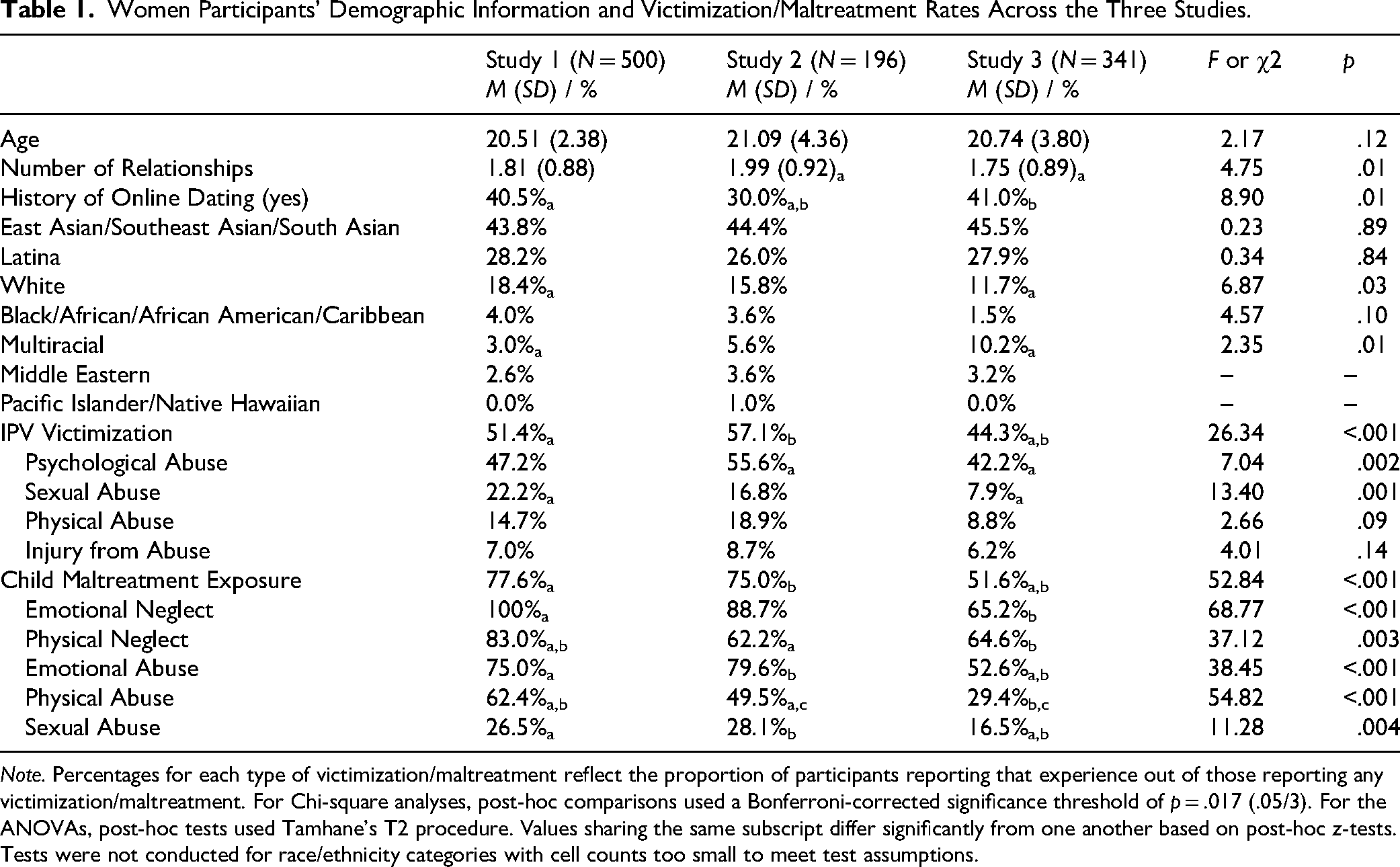
Note. Percentages for each type of victimization/maltreatment reflect the proportion of participants reporting that experience out of those reporting any victimization/maltreatment. For Chi-square analyses, post-hoc comparisons used a Bonferroni-corrected significance threshold of p = .017 (.05/3). For the ANOVAs, post-hoc tests used Tamhane's T2 procedure. Values sharing the same subscript differ significantly from one another based on post-hoc z-tests. Tests were not conducted for race/ethnicity categories with cell counts too small to meet test assumptions.
Procedure
Participants who met eligibility criteria completed an activity followed by a survey about their personal experiences, including their history of IPV victimization, child maltreatment exposure, and demographics. As part of the activity, each woman observer was assigned 9 out of the 30 de-identified dating profiles, randomized and presented in counterbalanced order to avoid order effects. After viewing each profile, participants rated the man on a scale from 1 (not at all) to 7 (very much) on seven traits related to romantic relationships, including aggression and perceived dangerousness (e.g., “Based on the dating profile, how would you rate X on the following characteristics?”), which we conceptualized as IPV perpetration risk. We selected “dangerousness” as the proxy for IPV risk because the term aligns closely with the widely used Danger Assessment measure (Campbell et al., 2009). This term also offers a more precise and clinically grounded cue compared to more general terms such as “risky,” which may introduce unnecessary ambiguity in participant judgments. Our previous study (Russo & Borelli, 2024) established that reviewing nine profiles was feasible, with the full activity and survey taking around 40 minutes. All procedures were administered online using Qualtrics.
Measures
Aggression & IPV Perpetration Risk Rating. Women were instructed to form an impression of the men based on their de-identified dating profiles and then rate the men's perceived risk for engaging in aggression and IPV perpetration on a scale of 1 (not at all) to 7 (very). These ratings were embedded within a broader set of trait evaluations (e.g., financially responsible, romantic, funny), reducing the likelihood that participants would infer the study's focus on aggression or IPV perpetration risk. This approach was used in place of having women complete the same standardized measures of aggression and IPV perpetration used with men (e.g., BPAQ, CTS2S), as doing so for each of the nine randomly assigned profiles would have made the study aims more readily identifiable. Additionally, including extra distractor surveys would have required extra time, risking participant fatigue. This procedure was established in Russo and Borelli (2024).
IPV Victimization History. Women's IPV victimization history was assessed using the victimization scale from the CTS2S (Straus & Douglas, 2004; α = .84). This self-report scale assessed history of physical abuse victimization (e.g., “my partner pushed, shoved, or slapped me”), psychological abuse victimization (e.g., “my partner insulted or swore or shouted or yelled at me”), sexual abuse victimization (e.g., “my partner used force [like hitting, holding down, or using a weapon) to make me have sex”), and injury by a partner (e.g., “I had a sprain, bruise, or small cut, or felt pain the next day because of a fight with my partner”). Consistent with the authors’ scoring recommendations, each item was dichotomized to indicate the presence (1) or absence (0) of each abuse type. Because our research question concerned overall exposure rather than frequency, we created a summed count variable by adding the four dichotomous indicators (range: 0–4), which reflected the number of abuse types experienced. This approach provides an index of cumulative IPV exposure that parallels how cumulative adversity is operationalized in related trauma research (e.g., ACEs scoring). This measure has been extensively used with college students (e.g., Kim et al., 2018).
Childhood Maltreatment Exposure. Women completed the Childhood Trauma Questionnaire—Short Form (CTQ-SF; Bernstein et al., 2003; α = .75), a widely used retrospective screening tool for child maltreatment in adults that consists of 28 items (total), including five subscales of five items each; that is, Emotional Abuse, Physical Abuse, Sexual Abuse, Emotional Neglect, and Physical Neglect. All items are constructed as statements beginning with the phrase “When I was growing up…” and scored on a 5-point rating scale, ranging from 1 (never true) to 5 (very often true). The total maltreatment score was summed and ranged from 25 to 125, with higher scores indicating more maltreatment. The CTQ-SF has demonstrated strong psychometric validity across diverse samples, including undergraduate student populations (e.g., Daly et al., 2017).
Data Preparation Plan
Levels of Aggression/IPV Perpetration Risk. To examine whether participants rated more aggressive profiles and those of men with higher IPV perpetration histories as significantly more aggressive or dangerous compared to less aggressive or risky profiles (RQ1), mean ratings for aggression and IPV perpetration were calculated according to profile levels of aggression/IPV perpetration history (low, moderate, high).
Discrepancy/Accuracy Score Computation. To evaluate the accuracy of participants’ ratings of men's aggression and IPV perpetration risk (RQ2), we computed directional discrepancy scores by subtracting each man's standardized self-rating of aggression/IPV perpetration from each participant's standardized rating of that same profile (Dimler et al., 2017). Scores were reversed so that the direction was more intuitive: positive values indicated overestimation of the man's aggression/IPV perpetration risk, whereas negative values indicated underestimation relative to the man's self-reported risk. This procedure was applied to all profiles rated by each participant and then averaged to yield a mean discrepancy score.
Data Analytic Plan
To test the study research questions, we conducted ANOVAs and hierarchical linear regressions using SPSS Statistics for Mac, Version 26.0. We conducted two separate ANOVAs: one examining participants’ differentiation among low, moderate, and high aggression profiles (RQ1a), and a second examining differentiation among low, moderate, and high IPV perpetration risk profiles (RQ1b). For the hierarchical linear regressions, two models were estimated: one with mean aggression discrepancy scores as the outcome (RQ2a) and one with mean IPV perpetration discrepancy scores as the outcome (RQ2b). In both models, covariates were entered in Step 1 and included participant age, number of relationships, and dichotomized race/ethnicity variables, created as separate binary indicators for each group (Asian, Latina, White, Black). Age and number of relationships were included to account for differences in relational and dating experience that may shape how participants interpret partner risk cues. Race/ethnicity variables were included to examine whether demographic background predicted ratings, consistent with patterns observed in our pilot work suggesting differences in accuracy across groups (Russo & Borelli, 2024). In Step 2, women's IPV victimization history and child maltreatment exposure were added to evaluate whether these experiences predicted accuracy above and beyond covariates. Data for all three studies are available from the first author upon request.
Results
In Study 1, IPV victimization rates mirrored the national average for college women (Cho et al., 2020), with over half of the participants (51.4%; n = 267) reporting IPV victimization history. Most also reported child maltreatment exposure (77.6%; n = 388). Table 1 presents prevalence rates, while Table 2 provides descriptive statistics and bivariate correlations.
Descriptive Statistics and Bivariate Correlations for Women Participants’ Key Study Variables.
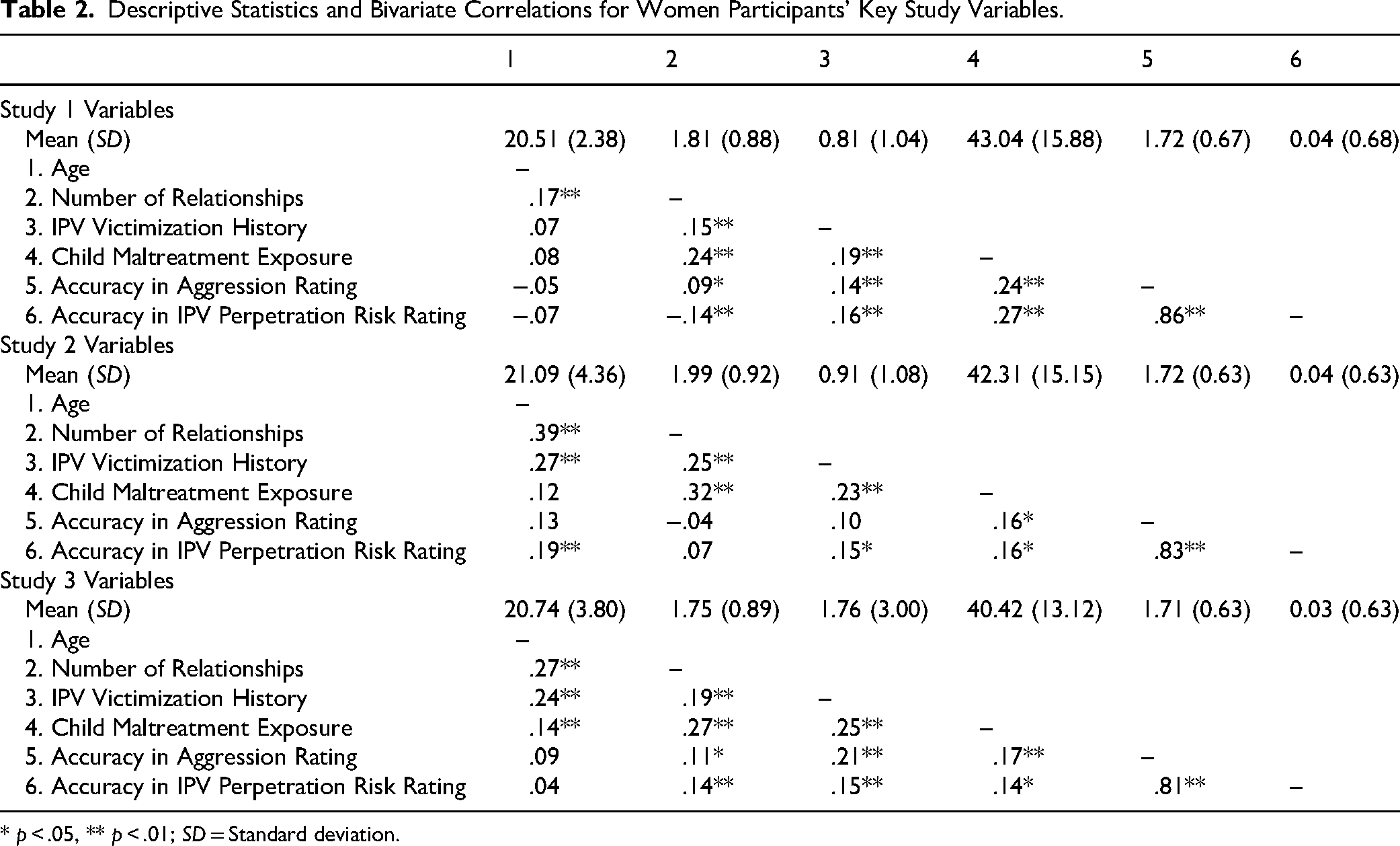
* p < .05, ** p < .01; SD = Standard deviation.
Research Questions
Study 2
Method
Participants
Women undergraduate students were once again recruited from the same online social science subject pool at a 4-year university used in Study 1 and through flyers posted on the same 4-year college campuses to participate in a study focused on romantic relationships. Recruitment occurred between February 2023 and December 2023. Eligibility criteria remained the same as in Study 1. Two-hundred and thirty-two women started the study procedures, but after reviewing the data, 26 participants were removed for not completing the rating activity or providing demographic data (i.e., they opened the survey and quit), and 10 participants were removed for completing the survey in under 15 minutes, indicating that they were not providing accurate data (average survey completion time was 38 minutes). As such, the resulting sample for analyses consisted of 196 women. On average, women participants had a mean age of 21.09 years (SD = 4.36), reported having been in 1.99 relationships (SD = 0.92), and most (98.5%) participants reported a preference for dating one person at a time. The sample reflected substantial racial and ethnic diversity, with participants identifying as Asian (44.4%), Latina (26.0%), White (15.8%), Multiracial (5.6%), Black (3.6%), Middle Eastern (3.6%), and Pacific Islander (1.0%; see Table 1 for demographics). Power analysis conducted using G*Power indicated that a sample size of 196 women was more than sufficient to detect a small to medium effect size (f2 = 0.15) with 95% power and an alpha level of .05.
Regression Analyses Examining Women's IPV Victimization History and Child Maltreatment Exposure as Predictors of Accuracy in Rating Men's Aggression and IPV Perpetration Risk.
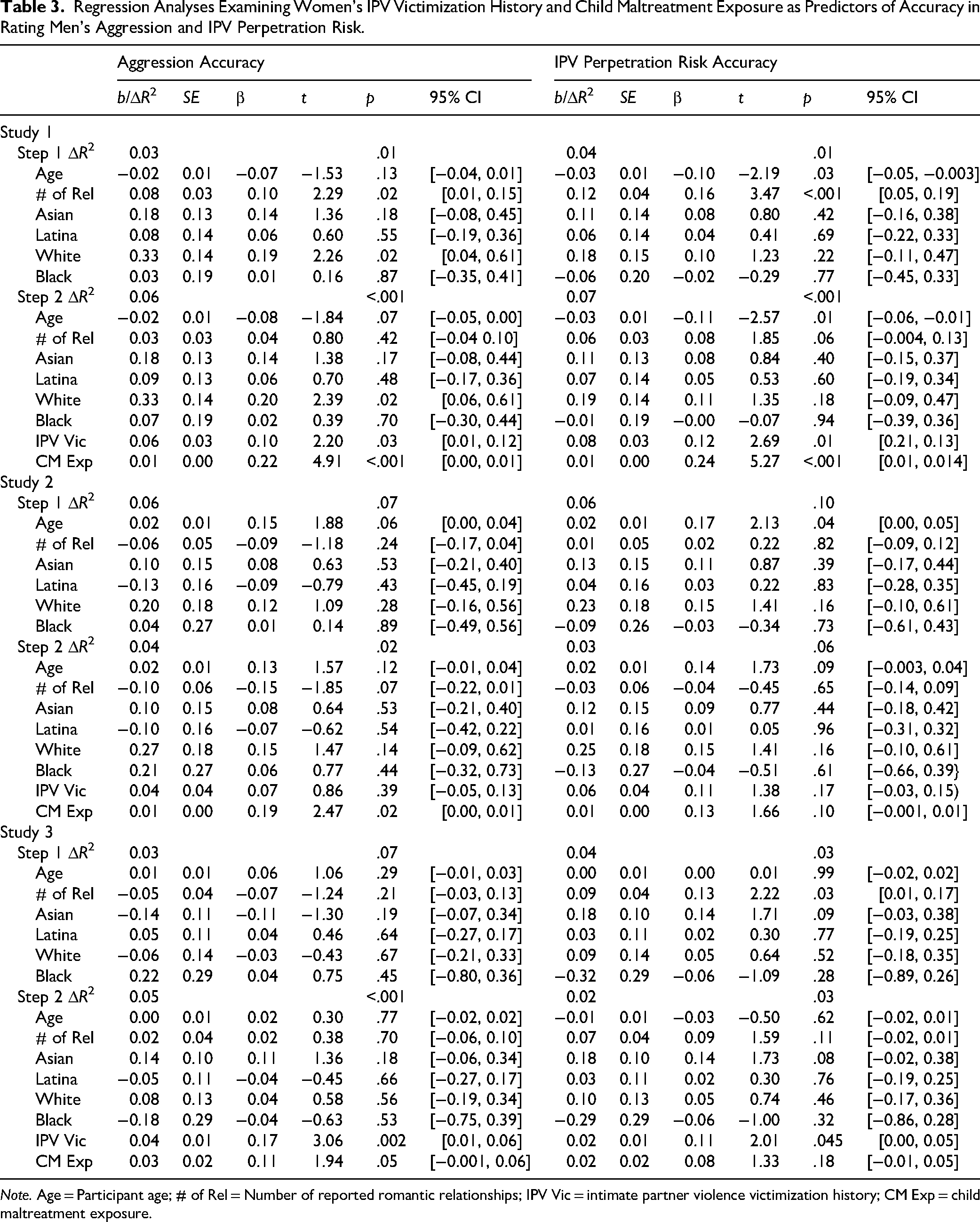
Note. Age = Participant age; # of Rel = Number of reported romantic relationships; IPV Vic = intimate partner violence victimization history; CM Exp = child maltreatment exposure.
Procedure
The procedures for Study 2 were identical to those described in Study 1. This includes participant procedures, measures, data preparation, and analysis methods. For a comprehensive overview, please refer to the Method section in Study 1. As with Study 1, both the CTS2S (α = .79) and the CTQ-SF (α = .78) demonstrated acceptable reliability in this sample.
Results
Consistent with the findings of Study 1, more than half of the women in the sample reported a history of IPV victimization (57.1%; n = 112) and child maltreatment exposure (75%; n = 147). See Table 1 for prevalence rates and Table 2 for descriptive statistics and bivariate correlations.
Research Questions
RQ1a: Do women's perceptions of men's aggression systematically differ across dating profiles classified as low, moderate, and high in their aggression ratings? ANOVAs revealed that there was a significant difference between how women rated low, moderate, and high aggression profiles, F[2,585] = 27.29, p = .001, η2 = .09, indicating that approximately 9% of the variance in aggression ratings was explained by profile classification (moderate effect). A Tukey post-hoc test revealed that the women rated the high aggression profiles (M = 3.01, SD = 1.13) as significantly more aggressive than the low (M = 1.68, SD = 0.77, p < .001) and moderate aggression profiles (M = 2.12, SD = 1.10, p < .001), and moderate aggression profiles as significantly more aggressive than low aggression profiles (p < .001).
RQ1b: Do women's danger ratings systematically vary across dating profiles classified as low, moderate, and high in IPV perpetration history? ANOVAs revealed that there was a significant difference in danger ratings across dating profiles, F[2,585] = 10.95, p = .001, η2 = .04, indicating that approximately 4% of the variance in danger ratings was explained by profile classification (small effect). A Tukey post-hoc test showed that the women rated the high IPV history profiles (M = 2.98, SD = 1.26) as significantly more dangerous than the low (M = 1.85, SD = 0.91, p = .001) and moderate IPV history profiles (M = 2.07, SD = 1.05, p = .02). The ratings between moderate and low IPV perpetration profiles were not significantly different (p = .14).
RQ2a: Are women's histories of IPV victimization and child maltreatment exposure associated with their accuracy in rating men's aggression? After controlling for covariates, R2 = 0.06, p = .07, the step containing victimization history was significantly associated with women's ratings of men's aggression, ΔR2 = 0.04, p = .02, indicating that victimization history accounted for an additional 4% of the variance in aggression accuracy (small effect). However, only child maltreatment exposure (b = 0.01, SE = 0.00, p = .02), not IPV victimization (b = 0.04, SE = 0.04, p = .39), was associated with greater accuracy in perceiving men's aggression (see Table 3).
RQ2b: Are women's histories of IPV victimization and child maltreatment exposure associated with their accuracy in rating men's IPV perpetration risk? After controlling for covariates, R2 = 0.06, p = .10, the step containing victimization history was not significantly associated with women's ratings of men's IPV perpetration risk, ΔR2 = 0.03, p = .06, indicating that victimization history accounted for an additional 3% of the variance in IPV risk accuracy (small and non-significant effect). Neither IPV victimization (b = 0.06, SE = 0.04, p = .17) nor child maltreatment exposure (b = 0.01, SE = 0.00, p = .10) were significantly associated with participant accuracy in rating men's IPV perpetration risk.
Study 3
Method
Participants
As with the previous two studies, women undergraduate students were once again recruited from the online social science subject pool at a 4-year university and through flyers posted on 4-year college campuses to participate in a study focused on romantic relationships. Recruitment occurred between February 2023 and January 2024. Eligibility criteria remained the same as Study 1 and 2. Four-hundred and five women started the study procedures, but after reviewing the data, 46 participants were removed for not completing the rating activity or providing demographic data (i.e., they opened the survey and quit), and 18 participants were removed for completing the survey in under 15 minutes, indicating that they were not providing accurate data (average survey completion time was 54 minutes). As such, the resulting sample for analyses consisted of 341 women. On average, women participants were 20.74 years (SD = 3.80) of age, reported having been in 1.75 relationships (SD = 0.89), and most (98.5%) reported a preference for dating one person at a time. The sample was racially and ethnically diverse, including Asian (45.6%), Latina (27.9%), White (11.7%), Multiracial (10.2%), Black (1.5%), and Middle Eastern (3.2%) participants (see Table 1 for demographic information for all three studies). A power analysis using G*Power indicated that a sample size of 107 participants would detect a small to medium effect size (f2 = 0.15) with 95% power and an alpha level of .05. The final sample of 341 participants exceeded this requirement, ensuring adequate power for the analyses.
Procedures
Study 3 procedures were identical to those in Study 1, including participant procedures, measures, data preparation, and analytic approach; full details are provided in the Study 1 Method section. Responses to survey items were consistent: CTS2S (α = .83) and CTQ-SF (α = .80).
Results
In study 3, nearly half of the women reported IPV victimization (44.3%; n = 151), primarily psychological abuse. Over half also experienced child maltreatment (51.6%; n = 176). See Table 1 for prevalence rates, and Table 2 for descriptive statistics and bivariate correlations.
Research Questions
RQ1a: Do women's perceptions of men's aggression systematically differ across dating profiles classified as low, moderate, and high in their aggression ratings? ANOVAs revealed that there was a significant difference between how women rated low, moderate, and high aggression profiles, F[2,1020] = 50.48, p = .001, η2 = .09, indicating that approximately 9% of the variance in aggression ratings was explained by profile classification (moderate effect). A Tukey post-hoc test revealed that the women rated the high aggression profiles (M = 3.01, SD = 1.23) as significantly more aggressive than the low (M = 1.78, SD = .97, p < .001) and moderate aggression profiles (M = 2.23, SD = 1.17, p < .001), and moderate aggression profiles as significantly more aggressive than low aggression profiles (p < .001).
RQ1b: Do women's danger ratings systematically vary across dating profiles classified as low, moderate, and high in IPV perpetration history? ANOVAs revealed that there was a significant difference between how women rated profiles with low, moderate, and high IPV perpetration history, F[2, 1020] = 45.79, p = .001, η2 = .07, indicating that approximately 7% of the variance in IPV risk ratings was explained by profile classification (moderate effect). A Tukey post-hoc test showed that the women rated the high IPV perpetration history profiles (M = 2.98, SD = 1.36) as significantly more dangerous than low (M = 1. 9, SD = 1.01, p < .001) and moderate IPV perpetration history profiles (M = 2.18, SD = 1.34, p < .001), and moderate IPV perpetration history profiles as significantly more dangerous than low IPV perpetration history profiles (p = .001).
RQ2a: Are women's histories of IPV victimization and child maltreatment exposure associated with their accuracy in rating men's aggression? After controlling for covariates, R2 = 0.03, p = .67, the step containing victimization history was significantly associated with women's ratings of men's aggression, ΔR2 = 0.05, p < .001, indicating that victimization history accounted for an additional 5% of the variance in aggression accuracy (small-to-moderate effect). Specifically, IPV victimization was associated with greater participant accuracy in rating men's aggression (b = 0.04, SE = 0.01, p = .002), whereas child maltreatment exposure showed a marginally significant association with aggression accuracy (b = 0.03, SE = 0.02, p = .05; see Table 3).
RQ2b: Are women's histories of IPV victimization and child maltreatment exposure associated with their accuracy in rating men's IPV perpetration risk? After controlling for covariates, R2 = 0.04, p = .03, the step containing victimization history was significantly associated with women's ratings of men's IPV perpetration risk, ΔR2 = 0.02, p = .03, indicating that victimization history accounted for an additional 2% of the variance in IPV risk accuracy (small effect). However, only IPV victimization (b = 0.02, SE = 0.01, p = .045), not child maltreatment exposure (b = 0.02, SE = 0.02, p = .18), was significantly associated with participant accuracy in rating men's IPV perpetration risk.
Post-Hoc Analysis
One-way ANOVAs were conducted as a post-hoc check to ensure that profiles within each risk category were perceived in a relatively consistent manner across studies (i.e., that low-, moderate-, and high-risk profiles were rated similarly within their respective groupings rather than being driven by a single profile). For low-risk profiles, ratings differed significantly for both aggression, F(9, 3101) = 9.95, p < .001, range = 1.42–2.04, and IPV risk, F(9, 3101) = 9.84, p < .001. Tukey post-hoc comparisons indicated that Profile 7 (Maggression = 2.04; MIPVrisk = 2.05) was rated significantly higher than the other profiles in the group (e.g., Profile 1 Maggression = 1.44; MIPVrisk = 1.48), suggesting that this profile may have contained cues that elevated perceived risk relative to other low-risk profiles. However, there were no significant differences for moderate-risk profiles (aggression: F[9, 3101] = 1.12, p = .14; IPV risk: F[9, 3101] = 0.94, p = .19) or high-risk profiles (aggression: F[9, 3101] = 0.88, p = .09; IPV risk: F[9, 3101] = 1.03, p = .15).
Discussion
Women face elevated risk for IPV victimization during their college years (Leemis et al., 2022; Smith et al., 2018) and remain vulnerable to revictimization throughout their lives (Bellot et al., 2024; Ørke et al., 2021). Across three studies, IPV victimization rates among college women (44–57%) closely mirrored national estimates, underscoring how common such experiences are in this population. Given these risks, understanding how women perceive and assess potential partners during the selection process is critical, as these judgments can both illuminate decision-making processes and inform strategies aimed at preventing and addressing IPV within this demographic. Accordingly, we used a replicated person-perception paradigm to examine how accurately college women perceive aggression and IPV perpetration risk in unfamiliar men based solely on viewing their de-identified online dating profiles, and whether women's own IPV victimization histories and child maltreatment exposure are associated with accuracy. Examining these processes across multiple samples strengthens confidence in observed patterns and clarifies their relevance for prevention and intervention efforts.
Women's Ability to Identify Aggression and IPV Perpetration Risk in Unknown Men
Across all three samples, women were able to distinguish among profiles reflecting low, moderate, and high levels of men's self-reported aggression, suggesting that aggression may be a readily identifiable interpersonal tendency even from minimal information (Russo & Borelli, 2024). Notably, these differences were associated with small-to-moderate effect sizes, indicating that profile-based cues provide meaningful, but not definitive information for identifying aggression. In contrast, patterns for IPV perpetration risk varied across studies. In Study 1 and Study 2, women reliably differentiated high IPV perpetration risk profiles from both low- and moderate-risk profiles, but did not significantly distinguish between low and moderate levels of IPV perpetration risk. However, in Study 3, women differentiated across all three levels, identifying significant differences between low, moderate, and high IPV risk profiles. These differences were also characterized by small-to-moderate effect sizes, suggesting that although participants were sensitive to variations in IPV risk, the magnitude of these distinctions was modest. This pattern suggests that although women are generally able to identify profiles clearly signaling high IPV perpetration risk, their ability to make more nuanced distinctions—particularly between low and moderate levels—may be less consistent and context-dependent. Subtle markers of IPV may only emerge through direct or prolonged interaction (Black et al., 2015; Stewart et al., 2021). As such, although women may be adept at identifying profiles that signal clear high or low IPV perpetration risk, they may struggle with profiles that do not present overt markers of violence. These findings highlight that identifying IPV perpetration risk during early stages of partner selection, particularly in online environments where judgments must be made from limited information, may involve both sensitivity to clear risk cues and greater variability in detecting more subtle indicators.
Importantly, we also examined whether some profiles were more identifiable, or extreme, than others within a given risk category. Women's perceptions of aggression and IPV risk did not differ within categories in a manner suggesting that any single profile disproportionately influenced the results. As expected, women's ratings differed significantly across the low, moderate, and high groups, consistent with the intended category structure. The only exception was one profile (profile 7) in the low aggression/IPV perpetration category that was rated significantly higher than the other profiles in its group. We speculate that this deviation may be attributable to the profile's explicit mention of a conservative political affiliation, which may have shaped participants’ perceptions independent of the assigned aggression and IPV risk level (Scheffer et al., 2022). Future research should more directly examine how political, ideological, or other salient identity cues embedded within dating profiles may intersect with perceptions of aggression and IPV risk, independent of individuals’ actual histories of violent behavior.
In addition to the focal predictors examined in this study, several covariates were associated with accuracy. Across Studies 1 and 2, younger age was associated with less accuracy in identifying IPV perpetration risk. Relationship history also showed some associations: women reporting more past romantic relationships demonstrated greater accuracy in identifying both aggression and IPV perpetration risk in Study 1 and greater accuracy in identifying IPV perpetration risk in Study 3. Because these patterns were not entirely consistent across studies, they should be interpreted cautiously; however, they may suggest that relational experience and developmental factors shape how individuals interpret risk cues during early partner evaluation.
Intimate Partner Violence Victimization History Predicting Accuracy
Across Studies 1 and 3, women with greater IPV victimization histories demonstrated greater accuracy in identifying both aggression and IPV perpetration risk in unknown men. These findings suggest that prior IPV exposure may, for some women, be associated with increased sensitivity to relational danger cues. This pattern is consistent with vigilance-based trauma frameworks that propose that repeated exposure to interpersonal harm can heighten attention to and detection of threat-related information in subsequent relationships (McLaughlin et al., 2015; Romens & Pollak, 2012; van Reemst et al., 2016). From a clinical perspective, this heightened sensitivity may also reflect hypervigilance, a core feature of posttraumatic stress responses following IPV, which can amplify monitoring for potential threat and increase responsiveness to subtle behavioral warning signs (Pill et al., 2017). In this sense, past IPV experiences may shape how women attend to and interpret subtle cues of hostility, dominance, or unpredictability when forming first impressions from limited information.
At the same time, these findings should be interpreted alongside the broader trauma literature, which documents both heightened sensitivity and normalization or desensitization following victimization (Ardizzi et al., 2015; McLaughlin et al., 2015; Mrug et al., 2016; van Reemst et al., 2016). Trauma does not affect all individuals in the same way, and different pathways may emerge depending on context, timing, and individual differences. Our results suggest that, within the specific task of evaluating online dating profiles, IPV victimization history was more often linked to greater perceptual sensitivity rather than reduced sensitivity. This aligns with prior work showing that individuals with IPV victimization history may be more attuned to threat-related cues, such as anger or unpredictability (Romens & Pollak, 2012).
Importantly, greater perceptual accuracy should not be interpreted as evidence that women are responsible for preventing their own victimization. A victim is not responsible for the violence perpetrated against them. Perpetrators’ choices, along with broader interpersonal and sociocultural forces that shape dating dynamics, remain central drivers of IPV (Clare et al., 2021). Moreover, the present studies assessed only whether women could detect aggression and IPV perpetration risk in a controlled, first-impression task. We did not examine whether women would act on these perceptions in real-world dating situations or the many factors that can shape those decisions (e.g., attraction, attachment orientation, mental health), although these are important avenues for future research. Even when risk is correctly identified, social pressures, fear of retaliation, emotional connection, financial dependence, or prior experiences of being dismissed may constrain women's ability to disengage or trust their own intuition (Heron et al., 2022).
Notably, IPV victimization history was not associated with greater accuracy in Study 2, indicating that the relation between prior victimization and risk perception was not consistent across all samples. One possible explanation for this divergence is that women in Study 2 differed from those in Studies 1 and 3 in their dating behavior: They reported significantly more prior romantic relationships and significantly less experience with online dating. Greater offline dating experience may shape how women learn to evaluate risk through direct interaction rather than through profile-based cues, while lower familiarity with online dating may make it more difficult to interpret the limited, text-based information presented in profiles (Finkel et al., 2012). Additionally, Study 2 had a smaller sample size, and effect sizes were small, which may have limited power to detect associations between IPV victimization history and accuracy. Together, these factors may have weakened the extent to which prior IPV experiences translated into heightened sensitivity within this specific digital judgment context. It is also possible that unmeasured factors—such as differences in trauma symptom expression (e.g., hypervigilance vs. emotional numbing), attachment patterns, or confidence making rapid judgments—moderate how IPV history is related to greater accuracy. These findings highlight the importance of considering context and individual differences, rather than assuming a single pattern across all groups.
Child Maltreatment Exposure Predicting Accuracy
In all three studies, greater child maltreatment exposure was consistently associated with greater accuracy in identifying men's aggression, but it was not consistently associated with accuracy in identifying IPV perpetration risk. This pattern provides additional support for a sensitivity-based pathway (Ardizzi et al., 2015; Hayes et al., 2012), suggesting that child maltreatment exposure may heighten perceptual attunement to aggression-related cues even when information is limited. Prior research indicates that children exposed to physical or emotional abuse detect anger and threat more quickly and with less information (Bérubé et al., 2023), and this heightened sensitivity may persist into adulthood (McLaughlin et al., 2019). This enhanced threat detection may, in part, reflect hypervigilance associated with trauma-related adaptations following early maltreatment, particularly among individuals who develop posttraumatic stress symptoms (Hayes et al., 2012; Pill et al., 2017). Because child maltreatment frequently involves direct experiences of physical, emotional, or sexual violence, repeated exposure to such cues may calibrate attention toward overt forms of hostility or volatility in others (Capaldo & Perrella, 2018). However, child maltreatment exposure did not predict improved accuracy in identifying IPV perpetration risk, which may reflect the more subtle and relationally embedded nature of IPV compared to overt aggression. IPV perpetration risk factors, such as coercion and manipulation, may not be as readily identifiable without more direct interpersonal engagement or clearer behavioral cues, making it more challenging for women to recognize these forms of risk based solely on online profiles. This distinction highlights the need to better understand the ways in which child maltreatment exposure shapes risk perception of unknown potential dating partners.
If extended through experimental research, these correlational findings may have implications for the prevention of dating violence. For instance, these results may suggest that interventions aimed at women with a history of child maltreatment could benefit from a dual focus: enhancing their ability to identify not only overt aggression, but also more subtle, manipulative forms of control or coercion that characterize IPV. Future research should examine whether specific trauma-related processes help explain when child maltreatment exposure translates into heightened sensitivity versus when it does not. For example, hypervigilance may facilitate rapid detection of aggression-related cues (Hayes et al., 2012), whereas dissociation or emotional avoidance may attenuate sensitivity to more ambiguous relational risk (Carlson et al., 2012; Tursi et al., 2022). In addition, examining whether specific forms of child maltreatment (e.g., emotional vs. physical abuse or neglect) and judgment contexts (e.g., profile-based vs. interactive or video-based assessments) alter these processes represents a natural next step for extending the present findings. Clarifying how trauma-related mechanisms operate across different child maltreatment profiles and dating contexts is necessary to refine theoretical models of risk perception and to guide more precise, developmentally informed prevention efforts.
Limitations and Future Directions
Although these studies provide valuable insights into college women's ability to identify aggression and IPV perpetration risk, several limitations warrant consideration. First, the studies relied on a within-subjects, profile-based (vignette-like) design in which participants rated multiple profiles that varied in aggression and IPV perpetration risk. Although this approach allows for controlled comparisons across conditions, it does not permit strong causal inference regarding how individual differences (e.g., prior victimization) shape perceptual accuracy. Second, although the reliance on online dating profiles as stimuli enhances the internal validity of the study, it may limit the generalizability of findings to real-world interactions, where non-verbal cues and more nuanced dynamics play a critical role. Future research should examine how women assess risk in face-to-face encounters or across longer periods, when more subtle forms of coercion or manipulation may become apparent. Relatedly, future work would benefit from differentiating forms of IPV (e.g., physical, psychological, sexual, and coercive control) to determine whether detection accuracy varies as a function of specific victimization experiences. Additionally, because these studies capture judgments at a single point in time, they do not address how women's ability to assess risk evolves over time. Longitudinal research is needed to clarify how women's ability to assess risk evolves over time and whether victimization or trauma exposure predicts not only perceptual accuracy, but also downstream protective actions across different contexts. Finally, our reliance on men's self-reported aggression and IPV perpetration risk as the criterion (“ground truth”), although consistent with standard practice in person perception research, constrains interpretation because individuals may underreport socially undesirable behaviors. Future studies would benefit from integrating multiple sources of information to more robustly triangulate assessments of aggression and IPV perpetration risk.
An additional limitation is the exclusion of broader individual and contextual factors that may shape women's attention to and interpretation of aggression and IPV risk cues. In particular, future research should examine minimization- and denial-related processes that may lead some women with victimization histories to downplay or normalize coercive, controlling, or aggressive behavior (Holland et al., 2021), potentially undermining perceptual accuracy. Future work would also benefit from differentiating specific dimensions of aggression (e.g., verbal, psychological, physical) to better understand which forms of aggressive behavior women most readily attend to and how these dimensions differentially contribute to judgments of risk. Critically, future research should also more directly examine trauma-related pathways as mechanisms underlying these processes by assessing posttraumatic stress symptoms alongside risk judgments. In particular, hypervigilance-related symptoms may facilitate enhanced detection of threat-relevant cues and be associated with greater perceptual accuracy (Hayes et al., 2012; Pill et al., 2017), whereas dissociation, emotional numbing, or experiential avoidance may interfere with the processing of ambiguous relational risk and be linked to reduced accuracy (Carlson et al., 2012; Tursi et al., 2022). Evaluating these competing trauma pathways in relation to specific PTSD symptom clusters would provide crucial insight into when victimization enhances versus impairs women's ability to identify aggression and IPV perpetration risk in contexts where impressions must be formed based on limited information.
Furthermore, the samples in this study consisted exclusively of heterosexual college women, which is not representative of all women at risk for IPV, particularly those from sexual and gender minority communities (Decker et al., 2018). Expanding the sample to include individuals from different age groups, cultural backgrounds, sexual orientations, and relationship histories could offer a more nuanced understanding of how individual differences influence the ability to identify and respond to IPV risks. Given the diverse experiences of IPV victimization and child maltreatment exposure, examining how these factors intersect with broader sociocultural variables, such as race, ethnicity, and socioeconomic status, is critical in informing prevention strategies. Finally, the focus on IPV victimization history, child maltreatment exposure, and trauma-related variables is critical, but future studies should also consider the role of social and environmental factors in shaping risk perception. Research exploring how social support, peer influences, and media portrayals of relationships contribute to women's assessments of aggression or IPV risk could further illuminate the complex array of influences guiding their judgments. Ultimately, although this study advances our understanding of how college women assess aggression and IPV perpetration risk, further research is necessary to explore the broader, more dynamic factors influencing these perceptions and to develop more targeted prevention that can effectively enhance women's ability to protect themselves in dating contexts.
Practical Implications
The present findings highlight several implications for prevention and education efforts aimed at reducing IPV risk among college women. Given that women were better able to identify overt aggression than more subtle indicators of IPV perpetration risk, educational interventions may benefit from extending beyond the identification of clearly aggressive behaviors. Although women may detect high-risk behaviors in online profiles, these judgments do not always translate into protective actions or confidence in real-world situations (Senkans et al., 2020). Interventions should therefore not only enhance women's ability to recognize aggression in its various forms but also address cultural beliefs that normalize abusive behaviors in relationships, such as the notion that love requires sacrifice or the acceptance of controlling behaviors (Christopher et al., 2014). Challenging these deeply rooted norms may help individuals feel more confident acting on their perceptions and support healthier relationship dynamics.
Our findings also suggest that improving individuals’ ability to recognize risk, while valuable, is likely insufficient on its own. Accuracy in perception and the ability to act on that perception represent related but distinct processes. Even when individuals correctly identify potential warning signs, relational and structural constraints, including emotional attachment, social pressures, or fear of retaliation, may limit their ability to disengage from risky relationships. Prevention efforts may therefore benefit from also focusing on strengthening confidence in one's judgments, reducing self-blame, and addressing the contextual factors that constrain protective action. Future research might also consider whether providing individuals with feedback on their accuracy in identifying risk cues could support greater confidence in their perceptions and decision-making, though this possibility warrants empirical evaluation.
Conclusion
Across three studies, college women were able to distinguish between men reporting different levels of aggression, but showed more variable differentiation across levels of IPV perpetration risk based solely on online dating profiles. Women consistently identified profiles reflecting high IPV perpetration risk, though distinctions between low and moderate levels of risk were less reliable. IPV victimization history and child maltreatment exposure were also associated with greater accuracy in identifying men's aggression level, suggesting that prior experiences of interpersonal harm may shape how individuals interpret signs of relational risk when forming impressions of unfamiliar partners. Together, these findings highlight both the possibilities and limitations of relying on minimal information when evaluating potential partners and underscore the importance of continued research on how individuals recognize and respond to relational risk in contemporary dating contexts.
Supplemental Material
sj-docx-1-pwq-10.1177_03616843261454693 - Supplemental material for Detecting Aggression and Intimate Partner Violence Perpetration Risk in Unknown Men: Predicting Women's Accuracy
Supplemental material, sj-docx-1-pwq-10.1177_03616843261454693 for Detecting Aggression and Intimate Partner Violence Perpetration Risk in Unknown Men: Predicting Women's Accuracy by Lyric N. Russo and Jessica L. Borelli in Psychology of Women Quarterly
Footnotes
Acknowledgments
The authors would like to acknowledge the Foundation for the Contemporary Family for their research grant which funded this project.

Ethical Approval and Consent to Participate
This study was approved by the UCI Institutional Review Board (HS#2456) and informed consent was obtained from all participants.
Funding
The authors disclosed receipt of the following financial support for the research, authorship, and/or publication of this article: This work was supported by a grant from the Foundation for the Contemporary Family (#FCF-5696716).
Declaration of Conflicting Interests
The authors declared no potential conflicts of interest with respect to the research, authorship, and/or publication of this article.
Data Availability
The data that support the findings of this study are available upon request from the first author.
Supplemental Material
Supplemental material for this article is available online.
References
Supplementary Material
Please find the following supplemental material available below.
For Open Access articles published under a Creative Commons License, all supplemental material carries the same license as the article it is associated with.
For non-Open Access articles published, all supplemental material carries a non-exclusive license, and permission requests for re-use of supplemental material or any part of supplemental material shall be sent directly to the copyright owner as specified in the copyright notice associated with the article.
