



Abstract
This examination of north central Indiana between 1890 and 1940 offers a unique insight into the historic response to stillborn and newborn infant deaths. With a remarkable record of those interred, as well as local newspapers from these communities, the records of families who endured these losses allow us to discover their public responses to stillbirths. This examination also considers the broader social and cultural forces that shaped how families and communities responded to stillbirths, including advertisements for the famous patent medicine, Dr. Pierce’s, which promised that women taking their pills would prevent a stillborn baby, and the heavily reported Canadian Great Stork Derby.
Keywords
On the front page of a small-town Indiana newspaper in 1914, a headline alerted the community to a “Stillborn Infant.” The announcement reported that “The sympathy of their many friends goes out to Mr. and Mrs. T. E. Burrin who are sorrowing” and noted that Mrs. Burrin was convalescing. Publicly memorializing a stillborn infant was a common event in Howard County, Indiana, between 1890 and 1940. Families shared their sorrow with notices in their local newspaper, with some alerting friends and family to the burial of the stillborn in the local cemetery. In their day-to-day lives, in newspaper notices, obituaries, and gravestones in their local ceremony, along with advertisements for a patent medicine and newspaper coverage of a Canadian baby derby, residents in the rural communities and small cities that comprised this Midwestern county encountered stillborns. 1
Howard County, located in north central Indiana, and its largest city, Kokomo, in the years between 1890 and 1940, offer unique insight into how married, heterosexual families mourned their stillborn infants in a public fashion. Through an examination of a remarkable statistical and photographic record of those interred in Kokomo’s thirty-two cemeteries, as well as the digitization of local newspapers from these Howard County communities, we can consider the experiences of some families who endured these losses and their public response to stillbirths. While families undoubtedly reacted in a variety of ways over this fifty-year period, this study aims to understand how this community would have encountered stillborns in both their lived experiences and the discourse of the time. 2
The families who shared their heartaches publicly in the newspaper did so in the midst of broader twentieth-century debates surrounding efforts to reduce infant mortality, including losses that occurred as miscarriages, stillbirths, and fatalities that occurred during infancy and the early stages of childhood. While doctors and government bureaucrats strove to understand, document, and prevent these losses, the families who experienced stillborn deaths in Howard County offered public acknowledgment of grief. These familial and communal experiences should be understood apart from but informed by the larger state, and national bureaucratic responses to stillbirths.
Nationally, guidance on how to interpret stillbirth deaths has varied across time and place: the question of when to distinguish between a fetus and a person necessitating a death certificate, as well as registration with the state, was both a state and national concern. An analysis of the census and the public discourse in these years reflects the uncertainty with which American society approached the many questions regarding how to understand a pregnancy that did not result in a live birth. Meanwhile, the end of a pregnancy has long been fraught with contentious questions of timing, intentionality, and personhood, which continue to enflame American communities. Howard County residents responded to the clarity of Indiana’s determination that all stillbirths at seven months or later gestation should be considered infants who died by identifying stillborns with public notice of their existence, with burial in community cemeteries, and increasingly, by naming them. Some mourned their loss publicly, while others may have just shared their loss privately, including with family and friends. 3
Historically, state and federal governments, along with the medical and social reform communities, defined a pregnancy that ended prior to birth as a miscarriage, an abortion, or a stillbirth. Occurring in the first weeks or months, miscarriages were understood to be the earliest end to a pregnancy. Thereafter, medical officials and others defined abortion as pregnancies that ended at four, five, and six months. In this time period, most generally defined stillbirths as those pregnancies that ended without a living child from the twenty-eighth week on to a full-term pregnancy, although these definitions remained fluid and were often contested, as most women did not know how long they had been pregnant. To characterize the length of pregnancy and inform the language they used to define the experience, medical professionals typically relied on the length and weight of remains but only when required to do so. Of course, most births in Howard County, especially early on this time period, were not necessarily attended by a doctor. 4
Despite the efforts of medical officials to establish clear terminology, defining a stillbirth remained a challenge. In a 1917 article on how to best implement a national stillbirth registry, for example, Dr. Lee Thomas sought to clarify the definition of a stillbirth. According to Dr. Thomas, the medical profession entertained “a wide diversity of opinions as to what constitutes a stillbirth, as practically no two answers were the same.” Writing nearly one hundred years later, historian Robert Woods concurs, noting that “devising a practical definition that can be used to recognize such a category by parents, medical professionals, and the registrars of vital events has proved troublesome, a source of continuing uncertainty and conflict among the parties concerned.” 5
Part of the difficulty of arriving at a consensus regarding what constitutes a stillbirth involved individual states attempting to formulate their own parameters to distinguish when they would identify remains as a fetus or as an infant and then passing laws governing whether those remains had to be reported. In a 1922 federal census report, for example, a table defining stillbirths noted that two states, Maine and Ohio, required state involvement with pregnancies of four months or more. Meanwhile, Washington state did not require action before the eighth month. A few states offered no legal guidance on the question, but Maryland directed their doctors, “The law requires you to make a report of all products of conception no matter how early.” However, most states fell in the range of requiring documentation when the pregnancy ended at five, six, or seven months. Indiana’s law required that the state receive notification for “stillbirths of seven months’ gestation and over” as both a birth and a death. 6
By defining a stillbirth as delivery at seven months and over, the clarity that Indiana provided perhaps encouraged its residents to have a more clearly defined sense of the dead infant as a person. Pregnancy losses that occurred earlier were not viable, but the child of a late-term pregnancy proved medically viable. The individuals and community evaluated in this study understood the losses described herein to be stillbirths. Reflecting the time period and the complexity of the definitions, this analysis does not expect that all mourned losses analyzed in this study were born with at least seven-month gestation or were born dead but may have lived minutes or hours after birth. To capture the experiences of those who had a stillborn child, this study accepts the written and visual record as recorded. It does not distinguish the losses on the margins as markedly different. 7
Map produced by the Dept. of Interior based on the 1880 census, show number of stillbirths nationally per 1000.
https://www2.census.gov/library/publications/decennial/1880/vol-11-12-mortality/1880v12-map-18.pdf

The commemoration of stillborns occurred against a national backdrop of the federal government struggling to reduce high rates of pregnancy losses in Indiana and across the country. One important effort toward affecting change came in acquiring national data it could analyze and use to formulate a response. In their attempt to catalogue and analyze statistics, the Departments of Interior and Commerce, which organized and compiled the census in this time period, strove for both consistency and thoroughness. These agencies sought to capture meaningful information, although they struggled with what questions to ask. The 1890 federal census, for example, included a section on infant mortality that offered statistics about stillbirths in both terms of births and deaths. Across the next fifty years, they changed tack in their questions and reporting on stillbirths. The census, for example, previously asked women about the number of births they had had but failed to provide clarity about whether that meant children “ever born including stillbirths” or children “ever born alive.” Analysts found they could not really evaluate the meaning of the data. Regional differences and ever-changing times further complicated the data. While the census did initially record stillbirths as births, officials eventually removed stillbirths as a category of analysis. The reports included consistent reminders that the births data were “exclusive of stillbirths.” However, from 1890 up until 1937, separate reports still captured this information, first in a report titled “Vital and Social Statistics, Part II” and then in the “Birth, Stillbirth, and Infant Mortality Statistics.” In a further quest to simplify (and hence encourage) reporting and to “supply more information,” in 1938, the federal government issued a “Standard Certificate of Stillbirth.” 8
The census and other reports help to reveal the degree to which government officials struggled to understand and identify who was most likely to suffer a stillbirth. For instance, included in their analyses were statistics that referred to a woman’s age, nationality and/or state of birth, race, marital status, the number of children she birthed, whether or not she gave birth to twins, triplets, and so on. The reports also detailed the family income, which, combined with the other categories, pointed to the ongoing uncertainty around the causes of stillbirths. One 1900 article in Doctors’ Magazine speculated that the mother’s physical and mental health likely impacted her ability to carry a healthy pregnancy to term. The increased attention among medical officials reflected the concern that gripped the country, as government agencies struggled to understand why the nation had so many stillbirths and, perhaps more importantly, how they might prevent them. Experts had no handle on the exact number of stillbirths taking place but hoped the census might offer clues as to whether geography mattered: Were stillborns more common in rural or urban areas? Small or large cities? Was race or ethnicity a factor? Did the mother’s age at the time of delivery have any bearing? Questions about stillbirths were asked and answered in these reports and demonstrate that the United States sought to strengthen its data collection by expanding the number of participating cities and states and by tailoring questions in ways that measured variations in individual regions. 9
Scholars have rarely included the death of the late-term fetus in their studies. Whatever pregnancy complications authors anticipated, the focus of works on pregnancy was still on life and not death. For those seeking to understand death, it was incongruous to have death be the conclusion of an anticipated life. Only a handful of scholars have taken on fetal mortality, most notably Robert Woods. In Children Remembered: Responses to Untimely Death in the Past, Woods considered fetal mortality, along with the responses of the expectant parents by examining poetry, portraiture, and literature. In a subsequent work, Death before Birth: Fetal Health and Mortality in Historical Perspective, he offered a comparative medical and demographic approach to European and American experiences. In addition, Woods’s work, Judith Walzer Leavitt’s attention to grieving fathers of stillborns in Make Room for Daddy: The Journey from Waiting Room to Birthing Room, and the thoughtful historiography of stillborns by legal scholar Carol Sanger’s “‘The Birth of Death’: Stillborn Birth Certificates and the Problem for Law” offer unusual considerations of stillborns. By and large, most scholars have not included stillbirths in their consideration of pregnancy, delivery, or death. 10
The example of Howard County, Indiana, proves critical in helping us to understand how some families responded to pregnancies that end in death. In Kokomo, for example, the topic of stillbirth was only covered sporadically, usually in newspaper coverage regarding the problem of stillborn animals. Notably, the community newspapers never reflect a suspicion that women who delivered stillborns had intentionally terminated their pregnancies. Instead, the commemoration of loss pervaded community newspapers. Indeed, there is a shared, public response even before the advent of the earliest, somewhat rudimentary hospital in Howard County, Indiana. 11
Historians Nancy Schrom Dye and Daniel Blake Smith contend that “by the turn of the twentieth century,” women began “to turn infant death—once seen solely as a private tragedy—into a major social and political issue.” However, in examining the stillborn discourse in Howard County, the evidence suggests that a family’s personal response to loss, shared in public, stood apart from the loss being a “social and political issue.” While mothers no longer endured a stillborn birth “silently in the privacy of the home,” there is no evidence that Howard County women transformed their personal loss into “a matter of serious public, political concern” nor did they call on “doctors, public health officials, and the state to take action.” 12
Although it is impossible to definitively state how families responded to stillbirths with memorialization between 1890 and 1940, the available evidence in Howard County, Indiana, suggests that many did respond publicly to their loss. Drawing on other studies, including comparative ones, the census, cemetery records, obituaries, and newspaper coverage of stillborns, enables a social and cultural understanding of the broader discourse surrounding these losses. While one might anticipate the ability or desire to honor stillborn deaths as a prerogative of the wealthy, freed from physical labor and financial constraints that burdened others who suffered the same loss, this study finds that fundamentally, there was a social awareness of the existence stillbirths across class lines. Moreover, suffering multiple stillbirths did not necessarily lead to an acquiescence to death. Some families still mourned and buried the remains with the family. The coverage of stillborns in the newspapers made it a part of the fabric of these Indiana communities and ensured that mourning a stillborn child was not a taboo. 13
One variable governing the visible responses was race. Howard County’s population was almost exclusively white in this period. For example, the census reveals only 364 African Americans living in Kokomo in 1900, with 10,327 whites residing there. By 1940, the white population of Kokomo had nearly tripled and so had that of African Americans. A 1931 report on national stillbirth statistics makes clear that most families reporting stillbirths were native-born whites and from all evidence the vast majority in Howard County were, too. 14
The stillborn commemoration by members of the rural county, along with the smaller cities such as Peru, Logansport, and Kokomo, was not dependent on those who had the time and ability to write as a form of mourning. These communal, emotional responses came in the form of short announcements, obituaries, and gravestones. Moreover, the reaction to the stillbirth was not limited to women’s responses but was shared by men too.
The evident mourning is consistent with the findings of sociologist Viviana Zelizer who traced the increasing sentimentalization of children across American (and European) history, concluding that the “domestic grief of all parents for their dead child was gradually defined as a public concern.” Scholars such as Zelizer, who examines the increasing outrage about children killed by cars, and historian Kriste Lindemeyer, who analyzes the importance of children to America society by exploring the development and efforts of the US Children’s Bureau, have contributed to a better understanding of the historical responses to children’s deaths, but this study aims to go further in considering the reaction to the deaths of children before they could live. 15
While medical advances, including the introduction of hospitals, improved prenatal care, and treatments to start the heart in stillborns, helped reduce the number of Howard County stillborns by 1940, community members read of the poorest, most overworked women, and the wealthiest, most privileged women all delivering stillborns. In 1900, the Waterloo Press reported with great compassion on the deaths of both John Smith’s wife and a stillborn child, attributing Mrs. Smith’s failing health and vulnerability to consumption and pneumonia to the hard, physical labor she took on “to keep the wolf from the door.” The well-to-do Burrin family of Advance, Indiana, owned the town’s drug store and would go on to send a daughter to college in the midst of the Great Depression; the notice of their stillborn child appeared on the front page of their local paper in 1914. Although the impoverished and the wealthy had stillbirths, most reporting did not include class markers as a significant, causal variable in determining whether or how families mourned stillbirths. 16
Admittedly, however, the ability to be able to afford a funeral, including its trapping of casket and flowers and the burial, perhaps with a headstone, in the community cemetery can also be “widely perceived as indicators of social status.” It is difficult to know how that shifting status, from being something that few could afford to an increasingly necessary part of modern mourning, played out among these Indiana families from 1890 to 1940. As one study noted of neighboring Kentucky, as people could afford it, burials went from a gendered experience in the late nineteenth and early twentieth century, with men building coffins and digging the graves and women preparing and dressing the body and lining the coffin, to a more standardized, commercial experience. Nationally, by the 1920s, funeral homes “became the primary location for carrying out the responsibilities associated with burial,” and from the 1930s on, in rural areas, “death experts became more widely available,” and it is evident in some stillborn notices that professionals in Howard County were helping to prepare the body, provide the casket and bring it to the cemetery, and oversee the burial. Moreover, many families continued to select and pay for engraved headstones to memorialize their loss. 17
One significant way that families claimed their stillborn as a person was to bury them in local cemeteries in family plots. This action had meaning, signifying not only that they were understood to be in need of formal burial but also that the infant was part of the family. Indeed, this decision to formally bury stillborns in this manner appears to be a late nineteenth- or early twentieth-century phenomena in the United States. As families did so, they discovered that registration of death was necessary for burial in a cemetery, which meant the formal categorization of the loss. Dr. Lee, in 1915, for example, called for the United States to emulate the Scandinavian support of those medical professionals who found themselves “called upon to dispose of the remains.” He maintained that financial support for this process would encourage cooperation among doctors and health authorities and encourage better registration along the way to ensuring the proper disposal of the remains, since they were not being captured bureaucratically in a cemetery. What is clear is that for Howard County families, theirs was not solely or even principally a medical or bureaucratic response; they formally grieved their loss with ceremony, including at times both funeral and burial. 18
Furthermore, the ways families buried stillborns highlight the degree to which they viewed them as part of the family. While Carol Sanger contends that in the United States, stillborn children were “segregated in death,” the Kokomo area experience offers insights into a markedly different experience. Nationally, cemeteries frequently created separate burial grounds for infants, which Marilyn Yalom contends was historically a cost-efficient way to organize the space. She found in some cemeteries that did individualized burials that they could “bury twenty-four children in the space required for six adults.” Of course, there were also cemeteries that did not individualize the infant burials, instead creating a “baby pit,” with no markers. Babylands or “special baby sections” with gravestones usually existed alongside or separately within an existing cemetery and “were established at a time when mortality rates for children were much higher than they are today.” According to the Howard County cemetery expert Debra Beheler, only one “babyland” existed at this time in Kokomo, in the Memorial Park cemetery, which was used by both Protestant and Catholic families. However, in spite of its existence, most burials of stillborns in Howard County in this period do not appear to have been in babylands but instead continued to be interred in their family plots in cemeteries across the county. 19
Nationally, while some cemeteries appear to have excluded stillborn infants, informed perhaps by a Catholic denial of a burial on church grounds to those who had not been baptized, this ideology had little bearing in a part of Indiana dominated by white Protestants. The Ku Klux Klan fostered strong anti-Catholic support in Kokomo. In fact, the Women’s Ku Klux Klan branch, the state’s largest, pledged $1,000 to the Howard County hospital in 1923, so that the community could have an alternative to the only hospital in town, the Catholic-run St. Joseph’s Hospital. 20
In spite of this widespread bigotry, many of Kokomo’s stillborn infants died in the local Catholic hospital, and newspaper accounts reflect that stillborns received burial and funeral rites in their community cemeteries, regardless of religion. For example, one Catholic family called upon the assistance of a priest, who led services for their stillborn daughter at a nearby funeral home, after which time the family buried her in the Crown Point Cemetery. Unnamed in an obituary, which simply announced to the public, “Granson Child Dead at Birth,” the headstone helped to personify the deceased child as “Veronica.” Additionally, when Veronica’s mother died thirty-three years later, the obituary included the infant when it noted that the mother had been predeceased by three daughters. While there were many who undoubtedly grieved more privately and buried stillborns in unmarked graves, there were also others who, like the Gransons, explicitly used these rituals to assert that their stillborn infants were part of their families. 21
Increasingly in the 1930s, there were more accounts of stillborns delivered in hospitals in larger cities, such as Logansport, Peru, and Kokomo, although obituaries continued to report stillbirths occurring at home. This pattern of stillborn deliveries shifting from the home to hospitals is consistent with the national trend of pregnant women seeking medical attention in hospitals for their births. According to historian Judith Walzer Leavitt, “Although half of all American women delivered in a hospital by 1938, the numbers varied widely by race and geographic area. In rural areas during the 1930s, it was still common practice to deliver babies at home.” Indeed, according to historian Charlotte Borst, in 1940, at the end of this study, “only 36.6 percent of white rural women had hospital births.” Moreover, for those who gave birth to a stillborn in a hospital, it did not necessarily isolate grieving families and may have allowed them to publicly assert that by embracing modernity and science that they had done everything in their power to avoid the dreaded outcome. 22
While historian Phillipe Ariès contended that “Death in the hospital is no longer the occasion of a ritual ceremony,” his focus on a “dying person” stands in direct contrast to a family expecting to bring life into the world, only to confront death. The death of the stillborn was not ritualized, given that it was unanticipated, but families still ritualized the burial of their stillborn child. Carol Sanger also argued that the removal of births and deaths to hospitals made mourning less public and more private. While she maintained that “the dominant attitude throughout most of the twentieth century was that stillbirth was an event that had best go unspoken,” public notices and cemeteries in Howard County reveal that families did not necessarily mourn alone in private. 23
It may be possible that, like families in Appalachian Kentucky, the residents of Howard County, Indiana, had “an intensity of social interaction within the family and circle of significant friends which could make the extent of interactional evasiveness and distance” unlikely. Moreover, as anthropologists Thomas Garrity and James Wyss speculated about Kentucky, high rates of “perinatal deaths” may have “made it difficult to hide death.” While the response to a stillborn child may have been handled privately, there is evidence that many sought public accounting and support. 24
In addition to their public newspaper notices of funerals and burials, another way that families mourned their stillborn infant was by commissioning a headstone. In photographs of carved stones for stillborn burials in Howard County, Indiana, cemeteries dating up until the 1890s, it appears that it was most common in the nineteenth century to designate the marker with the descriptor: Infant Dau, Infant Son, Infant, or Baby. The use of the abbreviated form for daughter and the use of the term baby reflect an economy of scale, perhaps with carvers charging by the letter and the small size of the marker leaving a limited amount of space. There were, of course, exceptions to the naming patterns, as with a 1830s tombstone for a boy, John H., who was perhaps named for his father J. H. Moore. Most common, however, was the more general descriptor instead of individual names. Even babies who were born alive but succumbed to death within a few hours or days usually went unnamed in this period, perhaps reflecting an awareness of their tenuous hold on life. One marker for Rachel Martz, a mother who appears to have died in childbirth, had inscribed below her information “Also infant son.” Another large marker reflected an unnamed infant daughter of J. T. and S. J. Wood, who lived just three days in November 1869. Small markers on the ground in the Northern Union Cemetery simply stated “GIRL” and “BOY” to commemorate the short-lived or stillborn children lost to the Salmons family, while a larger memorial offered more detailed information and paid further tribute to the family’s losses between 1876 and 1883. 25
Thereafter, in the 1890s and in the early twentieth century, tombstones reflected a mix of the continued general terms, Infant Dau/Son, or Baby, joined by the introduction of more named infants. Infants who lived at all appear to have been more likely to be named than the stillborn ones, but even stillborns became more likely to have been named. In one family, they identified their stillborn daughter as Elma Jean in the newspaper notice and called her their infant daughter on her tombstone, foregoing their last name. The Marino family suffered the loss of two stillborn infants. In 1923, they named their stillborn daughter Rose and then in 1930 bestowed upon their stillborn son the name Vincent. Sometimes, the public record in the newspaper only stated that an unnamed child was stillborn, but the parents then decided to name the child, as the cemetery record and the tombstone both reflected a named infant. 26
For those named stillborn infants, one striking practice speaks to the love and connection the parents felt. Naming a stillborn son with the father’s full name acknowledged the infant as a part of their family and did so in spite of knowing that the male child would never pass on the family name. Comprising a statistically larger portion of the stillborn deaths, male infants presented the opportunity to claim the child as their own in a distinctive way. Naming a stillborn child a junior, in honor of his father, appears to have become more common in the 1920s. In a 1928 delivery that killed the seventeen-year old mother, Dessie, the stillborn infant received the name of his father, recorded in death as Lloyd Jones Jr. In 1930, Oral and Opal Purvis named their stillborn son Oral Jr., and in 1934, John and Elsie Carter named their stillborn son John Jr. One family named a stillborn son for the father, Benjamin Harrison Ridenour in 1920, and decided in 1928 to name a son as a 3rd, but he would only live one year. The father listed all three of his predeceased sons on his own 1955 tombstone. 27
The stones reflect the importance of permanently commemorating the dead infants by naming them and marking their existence. Some of the symbols that appeared on markers between 1890 and 1940 included flowers, lambs, and angels, often kneeling or carrying a lamb. Rarely, stones appeared in the shape of a heart. Also unusual were stones that included sweet calls to their children, such as “Baby,” “Our Baby,” and “God Bless Our Baby.” Most stones were small, rectangular, undecorated, and spare in design. 28
The largest exception to this pattern came when parents included their stillborn or short-lived children in their own family headstones. Included in between the parents’ information or at the base of the large stone, families like Roxy and Fred Shoemaker, who died in the 1960s, still remembered an infant daughter and an infant son. Although they had buried their infant son in 1939 when he was stillborn, when Melvin M. and D. Helen Eikenberry died in their 1980s, they also commemorated Melvin Carl in their joint headstone. In the case of the Durr family, they commemorated their stillborn son Johnny with his own stone in 1925 and recorded him along with his parents John S. and Rosa Mae Durr’s stone when his mother and father died in the late 1970s and early 1980s. 29
Rosa Mae Durr’s obituary also reflects a long-standing trend, found in the accounting of the lives of both women and men. Along with listing her age (eighty-two), parents, her husband, and her living children and grandchildren, Durr’s 1977 obituary also noted that “a son and two grandchildren had preceded her in death.” As with the decision of whether or not to name or bury stillborns, the practice of memorializing ones’ loss in an obituary also varied. In the case of Ira and Madge Grogan, their obituaries in 1973 and 2001 each commemorated their son (Donald Wayne) who had been stillborn in 1932. With husbands more likely to die before their wives, it is possible that the mothers were the authors of both the father’s and the mother’s obituaries. However, men could have determined the contents of their own obituary. There is also evidence that fathers like Elmer W. Gillam, who survived his wife Dorothy, independently included, as she did, the fact that three young sons, two of whom were stillborns, Jimmy (1930), Billy (1931), and Junior (1935) had preceded them in death. Fathers and mothers memorialized their stillborn and young infants in their accounting of their lives. As with the Gillams, parents included stillborns along with adult children who died before them. Fathers and mothers alike mourned their loss and commemorated the stillborn and short-lived children who predeceased them until the end of their lives. 30
One of the unusual reflections of coverture in American society appears in the late nineteenth- and early twentieth-century practice of listing deaths and interments in the local, Kokomo-area newspapers. Instead of listing both the mother and the father, month after month, year after year, the accounting of stillborns and short-lived infants recorded them only in connection to their fathers. In this time period, it was not uncommon for these records to appear on the front page of the newspaper, sometimes monthly or in early January, offering an accounting of the year passed. The Sexton or other local official submitted the death notices for publication in a public record. While the cultural discourse about the loss of a stillborn child is generally connected to grieving mothers, publicly in newspaper notices, it was men who were designated as the principal parent with these notices. 31
The legal record appears to have initially accounted for these fetal deaths in the father’s name. An 1893 accounting listed the deaths that occurred, by day, for the month of June and appeared on the front page of the Kokomo Daily Tribune. Five of the fourteen deaths in that month were stillbirths and of those four were boys. These fetal deaths were reported by date (of June): “14- Infant son of Albert Fisse, city. Stillborn.” In quick succession on the 16th, 17th, and 18th, the infants of H. L. Smith, John Straughn, and Frank Wilcox were stillborn. At the end of the month, the infant son of Charles Burns was stillborn. It was most common that stillbirth announcements in the newspaper only identified the father in the late nineteenth century. 32
In the early twentieth century, there began to be more entries with “Mr. and Mrs.,” or as in one 1901 announcement, “Arthur and Mrs. Runyan.” In these type of entries, however, the name was still the man’s. Increasingly, there was an acknowledgment of the mother. Although the itemized reports began to include the mother’s first name, including one in 1916 that referred to the parents as Harry and Edith Voorhis, by the 1920s, the listings were mostly phased out as a common element of the newspapers. 33
Newspaper accounts of stillbirths increasingly, thereafter, were found in itemized reports and brief obituary announcements. These announcements often included information about the grieving family, the recovering mother, the name of the infant, where and when the delivery occurred, and the funeral arrangements. These brief accounts still described families by the husband’s name, with the titles Mr. and Mrs., perhaps only later alerting the reader to the mother’s name before marriage. For example, in a stillborn announcement for “Mr. and Mrs. Everett Lowe,” they let reader know that “The mother was Miss Precious Startsman, daughter of Mr. and Mrs. Leroy Startsman.” 34
The categorization of the stillborn announcements varied throughout. In 1920, for example, a listing in the Lebanon Pioneer had two entries under Deaths for stillborns who died in April and listed the date and the parents’ names. However, in both the listings and in the small paragraphs of detail, newspaper editors did not consistently report the announcements with the “Deaths.” This placed the reader in the jarring experience of the parents, expecting to find oneself as the parents of a living child; the notice instead revealed that the infant was stillborn. In one 1923 newspaper report on the happenings of Noble, Indiana, an entry read, “To Mr. and Mrs. Walter J. Smith, Jan. 13, a daughter.” Just below, the next one read, “To Mr. and Mrs. Chaster Minthorn, Jan. 14, a still-born son.” In a 1939 Kokomo Tribune “Births” section, readers first took note of a newborn girl named Brenda Jean; the following entry was for a stillborn boy. This entry differed from other stillborn announcements in listing the weight at delivery. However, the inclusion of the hospital name, the infant’s name, the parents’ and grandparents’ names, and where and when the burial had taken place were all standard parts of stillborn reporting. The intermingling of the brief paragraphs, not just with births but also with more banal visits and illnesses, speaks to the acceptance and understanding of this type of death in the community. Communities shared this information with each other publicly, varying only in how they categorized it. 35
Those analyzing stillbirths nationally took note of first-time mothers, commonly believed to be highly correlated with stillbirths. Some obituaries pointed to the mother’s status as a new mother, while others took note of past losses, as with one from 1930 that reported that the stillbirth was their second child and that the first had “lived only a few days after birth.” But of course all women could and did suffer stillbirths, not just those pregnant for the first or second time. Many reports of surviving siblings existed, although few were as dramatic as a 1931 announcement in the Tipton Daily Tribune, which reported that a stillborn infant was the twenty-first child born to the Crails who lived near Groomsville and of those seventeen were still living. 36
Sometimes, the report of a stillborn was subsumed in an announcement regarding the mother’s ill-health or in an obituary for the infant’s deceased mother. A 1924 death announcement for a thirty-seven-year-old mother living in Windfall shared that Jennie Seeley’s stillborn baby died on Friday and that she died the following day, leaving behind five living children. A 1935 notice reported that Lavona Miller, the mother of a stillborn daughter, was “very critically ill.” These types of updates, not just of the stillborn but also accounting for the dead or ailing mothers, allowed a community to know what was happening and to be able to respond with care and support. One such announcement of a stillborn infant included the parents’ thanks “to their neighbors and friends for the many kindnesses shown during their bereavement.” 37
Occasionally, tender language accompanied the reports of a stillborn infant. As with the appreciative parents who thanked others in their time of grief, the use of the obituary as a broader opportunity to communicate the weight of emotion is apparent in some of the announcements. Necessarily brief, the expressions and wording leant meaning to their descriptions. An 1890 announcement of a stillbirth in the Creason family noted that this was “the second death in this sadly afflicted family within a month.” A 1913 announcement told the news of a stillbirth softly: “Last Thursday night the stork left a sweet little baby with Mr. and Mrs. John Brubaker but no sooner had the stork come than the death angel called the little one to other realms.” A 1915 report of an infant who died after just two days used similarly gentle language, “The little one was born Sunday morning.” In 1935, an obituary reported that “Joy turned to sorrow in the home of Mr. and Mrs. Verlin Miller.” That same year, an account headed “Baby Daughter Dies” reported “The mother, who before marriage was Miss Madge Cooper, is getting along as well as can be expected.” While acknowledging that she was recovering from the delivery, it quietly spoke to her grief. 38
While the stark headlines may have jolted some people, they served to ensure that readers took note of them, as notices of stillbirths appeared nestled amid canned good ads, cattle prices, and the listings of the varied comings and goings of the town, with various papers and editors adopting different styles. An 1899 paper organized their reports by day, breaking down their Local Summary of the “Doings of Logansporters and Their Friends in the Past Week.” The Monday entry included the announcement of the burial of a stillborn infant born the day before. 39
It is clear, however, that while some families recorded their stillbirth others did not. Even within one family, reporting did not happen consistently. The Creason family, for example, who suffered two losses in a month, later experienced more losses, but the newspaper does not have any record of the later fetal deaths. It is also apparent from matching the cemetery records with the newspaper reports that it was common to bury stillborns without making an announcement. A one-sentence report in January 15, 1907, read, “Mrs. Daily Creason, who has been dangerously ill, has been recovering steadily.” Unlike the reported 1890 stillbirth, the newspaper did not record, as the cemetery did, stillborn twins born to her days earlier on January 10, 1907. The effort to standardize reporting and burials was an uneven effort nationally. Particularly for home deliveries and in rural areas, families might have foregone the cemetery and buried the stillborn remains on a family plot of land. Even when it was legally required that the remains of stillborns be registered, it is likely that some were buried with no record to commemorate them. It is reasonable to speculate that the financial strain of medical costs combined with lost labor, compounded by the poor health of the mother, may have deterred commemoration. Ultimately, we do not have evidence of how or whether all families recorded their grief, only a sense of how some did so. 40
In addition to religious and bureaucratic guidance and rules, there were a number of social and cultural forces that played a part in shaping how families and communities responded to stillbirths. One of the significant cultural forces shaping the discourse about stillborns for residents of Howard County was found in advertising. A nationally famous patent medicine, Dr. Pierce’s Favorite Prescription, tapped in to the growing national discourse about the dangers of delivery and the preciousness of children. Their ads promised that women taking their pills could prevent a stillborn baby. The company advertised general health claims to women and men in the 1870s, but starting in the 1890s, the company moved beyond broad assertions of health and doctor’s vouching for its efficacy. Instead, they appealed to women’s fertility concerns, with promises to help “‘Run-down’, debilitated, and overworked women.” An 1897 ad went well beyond the vague, standard patent medicine assertions of regulating “the stomach, liver, and bowels.” The ad relied on detailed language and stated, The woman who kills her babe by neglect of the health and vigor of her womanly organism during the period preceding motherhood, is innocently and without realizing it, as much responsible for her child’s death, as the mad woman who slays her babe after its birth. Thousands of babes are still-born every year because women innocently and ignorantly neglect, during the expectant period, to take proper care of the delicate and important organs that bear the burdens of maternity.
41
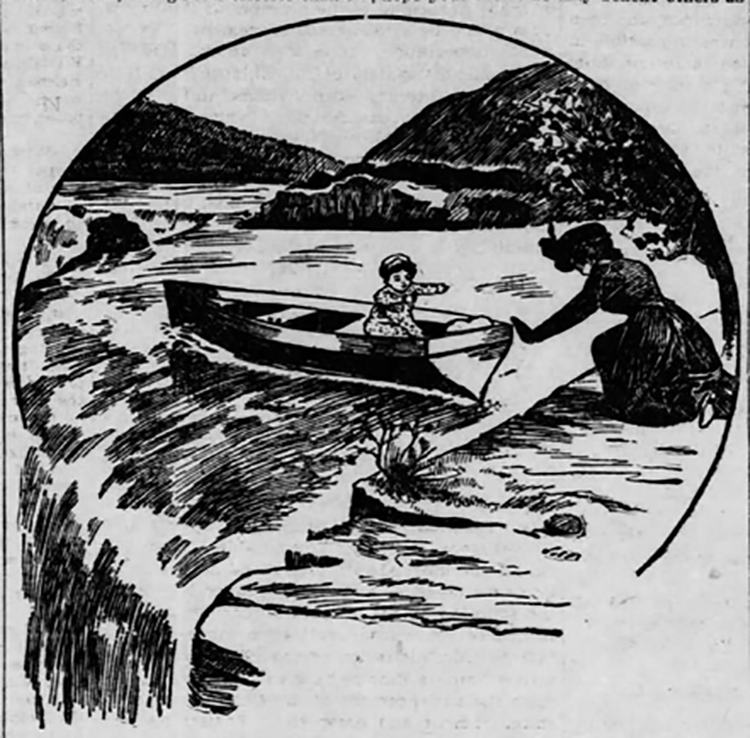
In 1900, the company took out large ads in media designed to look like articles. The title of one advertorial was: “INFANTICIDE,” with the subtitle, “How Children Are Sent to Destruction.” The accompanying line drawing was of a small tot in a canoe, arms outreached to a woman, but in danger of going over the waterfall if the woman was unable to save them. Unsuspecting readers found themselves reading an ad that threatened women that they would be killing their own chances at healthy, living children if they did not consume several bottles of Dr. Pierce’s medicines. 42
While Lydia Pinkham is more renowned for appealing to women’s menstrual problems, Dr. Pierce’s Favorite Prescription was more explicit in threatening women with bearing stillborn children if they did not take their pills. Their ads frequently featured the crafted testimonial from a woman they identified as Mrs. Euphemia Falconer of Trent, Muskegon County, Michigan. Instead of a multitude of successful mothers who could attest to healthy, living children, one story appeared across the years accompanied by a variety of formats, contexts, and drawings. Establishing Mrs. Falconer as a reputable, honorable woman, the company shared that she was twenty-seven years old and had been married for ten years. Falconer contended that reading their advertising brochure changed everything: My first two babies were still-born and I suffered everything but death. I was reduced to only 109 pounds. When I was three months along for my third child I was taken with hemorrhage or flooding and came near having a miscarriage from female weakness. For two months I was under the care of our doctor, but was getting weaker all the time until one day I happened to come across one of your little books…. I improved so fast I continued to take your medicine until baby was born, and he is healthy and all right.
43

After establishing this kind of reputation, the company ran an ad that showed a large, healthy newborn in a scale and shared the story of a woman who used their medicine to bring forth six healthy children. Mrs. C. A. Briggs of Millwood, Douglas County, Oregon, claimed in a 1902 ad that all of her children “were large—they all weighed more than eight pounds and I am not a large woman; weigh about 115 pounds.” She claimed of Dr. Pierce’s pills, “They are all the medicine one needs, if taken in time, to keep one in perfect health.” The following year another ad had a woman, arms open, awaiting an infant from the stars. Even though her doctor had told her she could never have a child, that was because doctors had not realized that “Many times the hindrances to motherhood are to be found in womanly diseases or weaknesses, which are perfectly and permanently cured by ‘Favorite Prescription’.” The ads anticipated the medical and professional communities dismissing their concoction as illegitimate science, which they did. However, when the editor of the Ladies’ Home Journal criticized the pills for containing opium, cocaine, and alcohol, the magazine was legally bound to recant their claim and acknowledge that Dr. Pierce’s did not have those ingredients at that time. Lost in the mix, however, were the false assertions by the company that sought to persuade women that to get and stay pregnant, and avoid having a stillborn infant, they needed to buy and take the pills. 45
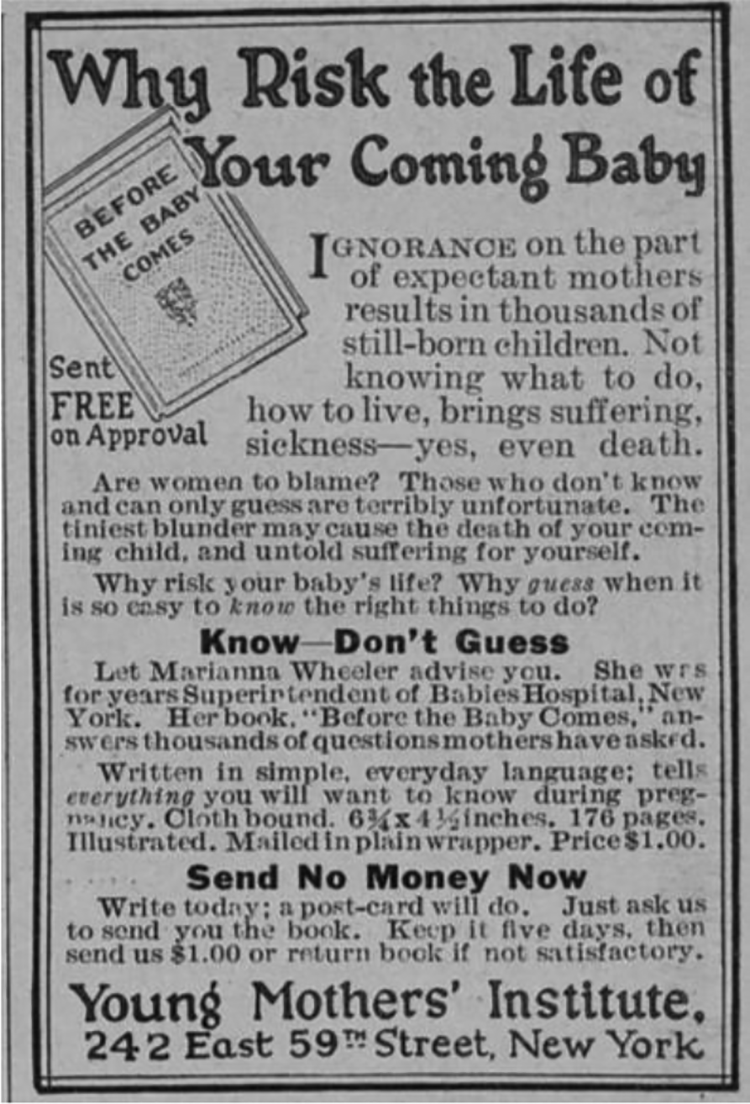
Howard County families that had a stillborn child did so in a place and time that was culturally aware of the possibility of prenatal and infant mortality. Not only did the professional discourse around fetal mortality promote reforms and strategies for prevention in publications of the time but advertisers like Dr. Pierce’s promoted their own solutions as well. One organization that sought to capitalize on both advertising and social reforms was the Young Mothers’ Institute. Their ads, appearing in Good Housekeeping in 1921 and 1922, promised that Marianna Wheeler, a former superintendent of Babies’ Hospital in New York, would save women by answering thousands of questions in her book Before the Baby Comes. Using threatening language, familiar from Dr. Pierce’s entreaties, the ad read, “Ignorance on the part of expectant mothers results in thousands of still-born children. Not knowing what to do, how to live, brings suffering, sickness—yes, even death.” It asked explicitly, “Are women to blame?” and answered, effectively, yes. “Those who don’t know and can only guess are terribly unfortunate. The tiniest blunder may cause the death of your coming child and untold suffering for yourself.” The leading professional journal for advertisers included the Institute ads as an example of taking a topic previously unseen in magazines and by the 1920s featured in advertisements. Far from hidden, stillborn infants were an understood and feared part of the fabric of people’s lives. 46
One unusual and unsettling way that stillborns were visible was as a humorous foil in Indiana newspaper fictional stories. Their presence served to normalize the possibility that a pregnancy could end in death. An 1895 account of a family with twelve children, reflected on their trepidation for the future of a thirteenth child, given the number's connection to bad luck. The family found “miserable comforters in all their friends, so they were driven in the forlorn hope that the child might be stillborn and thus escape this world.” Instead, the mother suddenly gave birth to twins. “The joy of the parents in the possession of fourteen children instead of the dreaded thirteen was exuberant.” Even more bizarrely, a local paper carried an 1899 Tennessee story of a stillborn that was “Half Human, Half Bear.” Describing the animalistic features of the stillborn daughter, it seemed to suggest that a stillbirth could be a desirable outcome to delivering a “remarkable monstrosity.” 47
A 1900 entry in the Fort Wayne Sentinel’s “Humorous Selections” section cautioned that people should not read their offerings “upon an any empty stomach.” It was good advice because the “joke” was callous. Recounting a dialogue between a lively child and their mother, the youngster read in the paper that a woman had delivered a stillborn child and inquired what it meant. The mother replied that the woman in question had a baby that never cried. The next day on a train trip, the young girl saw a quiet baby, nursing on a bottle. She proclaimed her intention to kiss the stillborn child, “To the horror and consternation of the mutual mothers, and immense amusement of the other passengers.” 48
Another way that stillborns existed in the culture was as a medium. They made an appearance in a 1925 critique of a spiritualist camp in Chesterfield, Indiana. The reporter noted that stillborns were often put forward by mediums as a guide because they were believed to be “on a high plane because of their purity.” As one of the three most common guides, which also included Native Americans and Asians, the stillborn played a vital role in helping mediums dupe people out of their money. Again, the ease with which stillborns were visible is noteworthy. 49
Finally, the importance of reading that wealthy Americans also delivered stillborns reinforced an important message that this was not necessarily a damning indictment of one’s socioeconomic status. Reading in 1937 that the wife of the President’s son, Mrs. Anne Roosevelt, had delivered a stillborn in the hospital served to underscore that wealth and science could not always prevent the outcome. Moreover, the headline was stark in its assertion, “Child Born Dead to Mrs. John Roosevelt.” The statement, released by First Lady Eleanor Roosevelt, who herself suffered the loss of a stillborn named for her son seventeen years earlier, offered a clear, direct account of the loss. 50
Newspapers also sought to profit from reporting scandalous or salacious stories that included stillborns as part of the plotline. One of the most outrageous of these stories and one heavily reported in Indiana concerned the Great Stork Derby, held in Toronto, Canada, between October 31, 1926, and October 31, 1936. A wealthy lawyer, Charles Vance Millar, used his will to create a contest that financially incentivized Toronto area women to have as many children as possible in a ten-year window. From 1936 to 1938, as the contest wound down and the court battles heated up, people sought to determine how to count up the children to see who would inherit the Millar fortune. In addition to questions of morality and legitimacy, one of the complicating issues was how to count the births. Like countless laws and policies that preceded the contest, the court was left to wrestle with defining life and death. Judges, doctors, lawyers, and parents weighed in with their evaluation of how to categorize births. 51
There was a lot at stake for the contestants, with a $500,000 fortune, in 1930s value, on the line. In addition to determining whether children born outside of marriage would count (they did not), the judge deciding the case also had to determine whether stillborn children would be included in the women’s totals. It seemed, as one September 1936 Indiana newspaper headline proclaimed, “Stork Marathon May Be Decided by Unborn Babes.” 52
In this early twentieth-century period, one of the most significant variables came not only in an abstract or philosophical question of when human life begins and whether or not it was a “legitimate” birth but also with the more fundamental question of bureaucracy: was it recorded? In the case of one of the contestants, Mrs. Kenny, who would eventually be denied, even though she claimed to have “given birth to eleven children in the ten-year competition,” the court would not count all of her claimed children. One reason was that Mr. Tilley, a lawyer for a competing contestant, argued against the eligibility of two of Kenny’s children based on the fact that they were not registered at birth. For contestants like Mrs. Kenny, registering their newborn within thirty days after delivering them at home would likely not have been a top priority nor would paying money for the birth certificate have been feasible. Coping with both grief and abject poverty meant that many parents of stillborns may not have registered their births. 53
For those keeping count of the competing babies in the Stork Derby, the court disregarding two unregistered children put even greater pressure on the remaining nine Kenny children, three of whom had been stillborn. At their birth, there was no sense that being stillborn would disqualify them as part of the women’s entries. As one reporter put it in a 1936 account in Toronto’s Evening Telegram, “What may have been a half-million dollar baby was still-born at seven o’clock last night to Mr. and Mrs. Kenny.”. “Though the baby did not live, the voluble little French-Canadian woman moves up one in the bizarre ‘stork derby.’” As historian of this event, Elizabeth Wilton noted in her 1994 study, the coverage of this contest was horrifically insensitive to the lives of the competing women, many of whom lived in poverty teeming with rats and flies and hunger and suffered repeated losses, not just of stillbirths but of infants and older children as well. At one point, Mrs. Kenny fled the courtroom objecting that the experience made her feel like they were treating her “like a dog.” She had reason to be surprised by the turn of events. 54
According to an early 1938 Associated Press report, and reflecting the popular sentiment of the time widely reported, “Under an interpretation of the will, dead infants count as much as those who are alive.” However, the contentious trial, with six different women vying to claim the money based on their fecundity, found these delicate questions that American statisticians, lawmakers, and grieving family members have thoughtfully contemplated treated with complete dismissal. The same Mr. Tilley who argued that unregistered babies should not count also maintained that Mrs. Kenny was disqualified because she could not provide “proof of the death of her children…we are unable to say how many of her children were stillborn” and therefore should not be counted. 55
Her lawyer, Mr. Weldon, “presented birth certificates for her nine children” and “contended that a stillborn child was a child and was not excluded from the will. He based his arguments on the Vital Statistics Act.” However, one of the ways that the opposing lawyer, Mr. Tilley, battled their legitimacy was to assert that the stillborn infants were “not given names.” Even though the Kennys attempted to follow the legal procedures and adhered to custom in coping with their loss, they found their claims in court coming up short.
Not even the testimony of Mrs. Kenny’s obstetrician, Dr. Frank O’Leary, was able to sway the judge on the complexity of evaluating the births. O’Leary reported on the three Kenny children who died, asserting that there were “three types of births, live born, stillborn, and deadborn.” Judge Middleton refuted the existence of “deadborn.” Although O’Leary maintained its validity as a medical term, he acquiesced that “authorities disagreed over the meaning of stillborn.” In part, perhaps, he was trying to differentiate between the two children that had been born with pulsating hearts but not breath from the stillborn that never breathed. The Kennys had named the stillborn that never breathed, born just nine months before the contest ended (February 3, 1936) and seemingly the exclamation point on her victory lap toward the prize Charles Vance Millar Kenny. She had started the contest as a clear front runner with fifteen total children, and eleven of those born since the contest started in 1926. She claimed her mother had given birth to twenty-two children and that she was going claim the prize and go on to match her mother’s record. However, instead of acknowledging that medical authorities, government bureaucrats, and politicians struggled with these definitions and meanings, the judge disqualified Mrs. Kenny, and in laying out his rationale stated that, “a child born dead is not in truth a child. It was that which might have been a child.” 56
A Canadian courtroom drama reported on in Indiana reflected the same uncertainty that has shaped American responses to stillborn infants. Government bureaucracies and courts have wrangled with the question for more than one hundred years, but for some families in the early twentieth century in Indiana, faced with the loss of a wanted child, they knew the answer. A seven-month pregnancy that ended with a stillbirth was understood by all to be a dead child and families cared for and cherished their lost family member. Some named their stillborn and some buried them, sometimes with a headstone, and they remembered them to the end of their lives. Far from separated and invisible, stillborn children in Howard County were publicly mourned by their family and visible in a culture that advertised fear of loss to sell their products.
Footnotes
Acknowledgments
The author would like to thank Margaret Marsh, Hillary DelPrete, Debra Beheler, Melissa Ziobro, Trish Maloney, Marilyn Parkin, Julie Berebitsky, and Richard Veit for their helpful suggestions and feedback.
Declaration of Conflicting Interests
The author declared no potential conflicts of interest with respect to the research, authorship, and/or publication of this article.
Funding
The author received no financial support for the research, authorship, and/or publication of this article.
