



Abstract
Based on oral histories and diaries of women who lived in the Japanese colonial period, this article analyzes the role and transformation of “mothering” in Taiwan, examining how the Han Chinese patriarchal society in Taiwan responded to colonialization and modernization in the early twentieth century. It reveals that most Taiwanese women at that time married in their teens and began to take on the tasks of mothers before the age of twenty. Difference in social class served as a key element affecting mothering practices. Rural and lower-class mothers had no choice but to prioritize productive labor over physical childcare; women of the traditional upper class could afford nannies; the emerging group of “new women” hired lower-class women to help with household tasks and childcare while they developed their professional careers. In addition to the physical care of children, Taiwanese mothers put great emphasis on the education and future development of children, especially sons. However, as the custom of “daughters-in-law-to-be” was quite common, from an early age many girls faced only their “mothers-in-law-to-be” instead of their biological mothers. “Mothering” was thus absent in these women’s lives, complicating the meaning of “motherhood.”
Introduction
“Mothering” means work undertaken in the process of motherhood, as well as ideologies related to a mother’s work, including the role, status, responsibility, and expectations assigned by a particular society and culture to a woman recognized as a mother. 1 The definition of and activities involved in mothering have changed in the past century and become closely associated with factors ranging from a gendered division of labor, race, and class to the social status of children. 2 Viewing mothering and motherhood as historically and culturally constructed concepts, this study examines changes in the activities involved in “mothering” in Taiwanese society during the period of Japanese colonial rule (1895–1945), when the traditional Han Chinese patriarchal society in Taiwan encountered industrialization, a modern education system, and new ideas of motherhood.
The Taiwanese population is composed mainly of Han Chinese whose ancestors emigrated from the Chinese mainland to Taiwan during the period from the early seventeenth to the late nineteenth century. 3 Traditional Han Chinese patriarchal social norms were thus dominant in nineteenth- and twentieth-century Taiwanese society. Confucian teachings about filial piety put emphasis on the continuance of the family as the main task, and sons were hence valued. For women, who were often viewed as just a means of acquiring sons, marriage and giving birth to sons were essential to their status in the home and in the broader society. At least until the early twentieth century, Chinese females were normally viewed as adult women after getting married; and they could acquire a relatively secure position in the marital family after bearing children, particularly sons. If a woman became a mother-in-law, she might enjoy a higher status in the family; she rose a step higher in the patriarchal system. 4
Historical studies of Taiwanese women have also shown that a woman’s status in the patriarchy originated from marriage. The status of women was generally low, and this further resulted in phenomena such as female infanticide and child brides, as well as the adoption of girls into a family as adopted daughters or future daughters-in-law (the so-called daughter-in-law-to-be). The adopted daughters and daughters-in-law-to-be were often taken into the families of their future husbands in childhood and forced to do housework as well as farm work. Some of them were sold on to other families or into prostitution, and some were abused and even killed, though a lucky few who could even go to high school also existed. 5 The customs associated with daughters-in-law-to-be and adopted daughters lasted until the 1960s. Given the existence of such practices, mothering must have been more complex in terms of psychology and actual interaction; thus, it cannot be understood only by means of current theories on mothering or motherhood.
However, in Taiwan, the roles of mothers went through transformations with the beginning of Japanese colonial rule, during which Taiwanese agricultural society moved toward industrialization and modernization. Along with colonialism and the Western ideas brought by the Japanese, drastic changes took place in various parts of Taiwanese society, including education, family, and industry, and so influenced mothering practice. 6 For example, since 1909 a Taiwanese woman had the legal right to reject a demand of divorce from her husband. This was transplanted from Japanese law, but it was indirectly an influence from Western ideas that had appeared in Japan. 7 In short, the traditional Han Chinese patriarchal social norms faced challenges from new systems of laws, policies, and education that were introduced in the process of modernization during the Japanese colonial period.
As a Japanese colony where the idea of “nation” was questionable, the political regimes, traditions, education, and responsibilities given to Taiwanese mothers were different from those in Japan or China in the early twentieth century. For example, although public schools had been set up for girls since 1896, few Taiwanese families sent daughters to receive an education. 8 In 1921, the rate of school attendance for Taiwanese girls was only 10 percent, and the rate rose to 20 percent in 1933; however, about half these girls dropped out before graduation. 9 In the context, it was difficult for the government to train “ideal women” and “future mothers” through education as happened in Japan, 10 and it is also difficult to analyze the influence of public education on girls who, in general, could not read. Thus, this research analyzes the subjective cognition and thoughts of mothers across different social classes under colonial rule. The subjective category of motherhood, as O’Reilly has argued, was interconnected with the institution and experience of motherhood. 11 The consciousness of “being a mother” and “the way presented to be a mother” are shaped by policies, laws, social customs, and personal experiences of mothering.
To understand the differences among diverse social classes in mothering practices, I analyze oral histories, autobiographies, memoirs, and diaries of twenty-four Taiwanese women from various social classes who became mothers during the period of Japanese rule (Appendix Table A1), along with historical archives. Of these women, four belonged to the upper class, twelve were career women or shop owners who had received an education, and the other eight came from peasant families or the lower class. In addition, eight of them were adopted daughters or daughters-in-law-to-be, including both upper-class and lower-class families. The analysis starts from the social conditions and family structure of the colonial period, followed by the mothering practices in terms of their physical, educational, and emotional aspects, as well as the subjective consciousness of being a mother.
Marriage Types and Family Structure
Analyzing the continuity and change of mothering during the period of Japanese rule requires an understanding of the changing social conditions and regulations, particularly the main types of marriage and family structure, which were key factors in the role of mothers. As to marriage types, historical demographic data obtained through large-scale analyses of household registration information from the colonial period facilitate the outlining of the overall situation and of social conditions that existed around women entering into marriage at that time.
Wolf first used household registration information from the period of Japanese rule to analyze the marital system of Han Taiwanese society. He divided marriage into three types, including major marriage, minor marriage, and uxorilocal marriage, but the ratio of each type differed according to region. 12 Major marriage refers to the traditional form of marriage, in which adult men marry adult women; normally, more than half of all marriages were major marriages. Minor marriage refers to adopting girls as daughters-in-law-to-be; uxorilocal marriage involves a married couple residing with or near the wife’s parents for a time period that is usually limited. According to large-scale studies by Chuang and Wolf, the ratio of daughters-in-law-to-be in northern Taiwan (23 percent to 48.5 percent) surpassed those in the central and the southern regions (3 percent to 15.5 percent). This was related to the prosperity of the north, which attracted a largely male labor force and produced a gender imbalance. 13 Adopting daughters-in-law-to-be not only guaranteed a source of spouses for the sons but also allowed the family to enjoy the benefits—both in terms of family livelihood and housework—created by possession of a labor force of daughters-in-law from a young age.
The marriage age was quite early, resulting in young mothers. Chuang’s research reveals that the age of first marriage during the colonial period was 18.65 in major marriage, 16.97 in minor marriage, and 19.3 in uxorilocal marriage. 14 Yang’s research shows a similar outcome, and further pointed out that almost 20 percent of girls were married by age 15, and more than 80 percent were married by the time they were 20. As a result, the age of giving birth started from 15; most girls continued to have babies steadily in their 20s, and the rate of giving birth decreased after the age of thirty. 15 In other words, women under Japanese rule usually married in their teens and played the role of mother from around 20 years old, often simultaneously providing the main source of domestic labor.
In addition to generational succession, the purposes of marriage and giving birth were also to increase household labor. In this context, marital choice was largely a strategic consideration; the value of a wife was often measured by the amount of labor she carried out and the economic value she created. Although the new law issued in 1919 suggested that marriage should be decided by the willingness of both the man and the woman, not by their parents or grandparents as in traditional Chinese society, it had little influence on the actual practice of marriage in an agrarian society. 16 Similar to Japanese society before industrialization, the critical task of marriage was to maintain the household’s survival through hard physical labor both in the fields and kitchen. 17 Therefore, the aim of most marriages was to increase the labor force of the household, and it was still the parents who decided whom their children would marry.
In addition to marriage types, family structure was also crucial to the role of women in the household. Family structure could be divided into three main categories: the nuclear family (a couple and their unmarried children), the stem family (a couple, one married son and his family, plus other unmarried children), and the extended family (a couple, and more than one married son living together with their children). 18 Although the ratio of each category changes according to region and historical period, it is clear that the nuclear family and stem family were the mainstream in the Japanese colonial period. Yang’s research in north Taiwan reveals that the percentage of nuclear families among all families decreased from 48.3 percent in 1906 to 35.3 percent in 1941, and the ratio of stem families rose from 25.8 percent in 1906 to 32 percent in 1941. Further analysis shows that households of lower social class were mostly nuclear families because of the lack of large houses and farms. 19 Mothers in nuclear families of the lower classes bore the heaviest responsibility for feeding the family and raising children.
For example, Kao Chang-Chi, a young daughter-in-law-to-be, dropped out of school at seven years old to work on a farm with her foster father, and became a factory worker when she grew up. After getting married, as her husband worked in other towns and could not feed the family, she learned sewing and worked in coal mines to pay for a sewing machine so that she could open a seamstress’s shop. She had to return home to take care of her children after working in the mine, and no other adults could help. 20 Similarly, Yeh Bian, from the age of 16 years old, lived with the family of her future mother-in-law, who ran a restaurant, and began to cook, do laundry, and so forth. After her first son was born, she had to care for four children, including her brother(s)-in-law and sister(s)-in-law by herself in addition to managing various affairs in the restaurant of her husband’s family. While her husband was a soldier during the World War II, she carried her son on her back and walked thirty two kilometers every day, requesting seafood products from her mother’s family to feed her husband’s family as well as smuggling these products to sustain her family. 21 Yeh Bian’s brother(s)-in-law and sister(s)-in-law were of a similar age as her own children because her mother-in-law was still in her 30s and continued to give birth to babies. As indicated by the aforementioned historical demography, women married and gave birth at young ages. Relatively long periods of procreation meant that some mothers-in-law had young children, yet the eldest daughter-in-law was likely to have young children in addition to being responsible for domestic labor, meaning that she would have had to juggle motherhood with other responsibilities. Similar examples were common in farming villages around Taiwan.
However, women in upper-class extended families might also experience financial pressures. For example, Chen Lin married into the prominent Lin family in Taichung, but her husband Lin Chi-Tang died early in 1922, with most of his legacy existing in the form of real estate. Chen’s diary indicated how she, a concubine, kept accounts, managed properties, and tried to control her sons’ expenses. 22 The diary of her sister-in-law Yang Shui-Shin also noted that her children could not spend money as they wanted despite the wealth of the whole family. All expenses ranging from the trivial, such as train tickets and luggage, to larger sums, such as for a piano or a trip to Europe, required parental approval. 23 Finances thus became an important arena of matriarchal control, leading to clashes between mother and son.
The statistics about marriage types and family structure provide an outline of Taiwanese mothers during the colonial period: they became mothers by around 20 years old and started to provide the main labor force of the family, engaging in various productive and reproductive work. However, the work involved differed largely by social class, particularly in terms of the physical care of children.
Mothering in Terms of Physical Care and Social Class
Previous Western scholarship on “mothering” has revealed that race and social class have decisive influences on mothering practices. Collins holds that the priority for many black mothers is to assure the survival of themselves and their families; thus family and work cannot be divided in such circumstances. 24 It was similar among the lower classes in Taiwan in that farm work could not be clearly distinguished from other housework such as cleaning and cooking. Yet, upper-middle-class women were more easily able to differentiate professional work from housework, including childcare, because they worked mostly outside of the home as teachers, midwives, and pharmacists to sustain the family. This also foregrounds social class differences as a key element affecting mothering practices in a society.
For farming families, “housework” covered both tasks inside the house and farm work. Young mothers had to manage all jobs, sometimes with her mother-in-law, until her children became old enough to help. For example, Yen Xiu-Feng’s mother, who came from a fishing village in south Taiwan, was married into a family in Tainan City due to her height (6 feet) and robust physique, which was favored by her husband’s family. Predictably, her married life consisted of incessant hard work. According to her: I woke up every morning, earlier than anybody. After preparing breakfast, I immediately began carrying water till the afternoon. Then, in the afternoon, I washed clothes for others, and glued joss paper in the evening, till midnight or 1 or 2 o’clock in the morning. I worked like this the whole year through. I could not rest even when I had children.
25
The need to manage both housework and paid productive work was arguably common among Taiwanese women in general. In many farming families or working-class families, housework such as cooking and laundry was assigned to children under 10 years old; adults undertook heavy labor of other kinds.
Since the main task of young mothers was to do productive work and contribute to the household’s economic survival, childrearing was not necessarily the preeminent obligation. Mothers in farming families or working-class families mostly took children with them to perform various kinds of housework and labor. Otherwise, other female family members, neighbors and elder children often helped take care of small children. For example, Tseng Lin A-ju started to help take care of babies from the age of six because the adults were working outside; she needed to carry babies on her back all day except when eating; the babies even urinated on her. 26 Tseng’s case was not special; similar stories can be found in autobiographies and anthropological research. In an interview, a mother with five children said, “I did not take care of children after they could walk,…my mother-in-law would help.” Occasionally when no one could take care of the children, the adults just left them at home alone and locked the door so as to work outside. 27 During the years from 1905 to 1942 (the period for which we have statistics), it is observed that the mortality rate of children between 0 to 5 years old in Taiwan was almost 300 per thousand before 1921, occupying about 40 percent of the whole number of deaths per year. Such a high mortality rate was double that of the rate in Japan. 28
Although mothers in agrarian families did not have the luxury to take care of their children personally, the survival of children was still regarded as the responsibility of mothers. To reduce the high mortality rate, the government promoted forums locally to teach methods of taking care of children. 29 However, the effect of these programs was limited in rural regions. Under great pressure to make a living, rural mothers had no choice but to prioritize earning over physical childcare, relying on seniors or elder children to take care of small children.
In addition to family members, the social networks built locally by mothers provided important assistance and constituted a major survival strategy for rural mothers. Mothers in agricultural villages normally established networks based on a sense of sisterhood with other village women developed during daily work such as washing clothes together, exchanging news, and comforting each other when beaten by a husband or mother-in-law. For example, Fan Li-Ching’s foster mother left her first husband, whose gambling had led him into debt, and went to Yilan with a new husband. By working with other peasant women on the farm, she managed to obtain recognition from local women. These village women became her interpersonal network; they provided significant help by caring for Fan Li-Ching while her foster mother worked deep in the mountains for weeks. Fan Li-Ching herself and other adopted daughters of the village also developed their own sisterhood when they were young. 30 Such a “women’s community” might work well for mothers in taking turns to mind each other’s children, serving as an extended mothering practice.
By contrast, women in traditional upper-class families such as those of landlords or gentry could afford nannies and servants to help with childrearing. For example, among the four cases of upper-class women in this research, none of them needed to work for a living or physically care for children themselves. They hired wet nurses and nannies for each child. In addition to the traditional rich families, a new group of women, the so-called “new women,” emerged during the colonial period. They also hired helpers for childcare and other household tasks so that they could concentrate on working as teachers or in other professions.
Hong’s research suggests that these “new women” emerged in the 1920s and 1930s. Born in the colonial period, they got rid of the foot-binding customs popular in the Qing Dynasty and received a modern education from the schools established in the early twentieth century; therefore, they could work outside the home, possessed independent incomes, and developed new ideas about free love. They thus present quite different images from those of traditional women in Han Chinese society. 31
As this new generation of women who had received a higher level of education began to work outside of the home, their methods of physically caring for children also changed. They depended on the assistance of other adult female family members or hired people to do housework when they could not manage these responsibilities as well as working. For example, Liu Yu-Ying decided to stay in her husband’s extended family to raise her four sons when her husband died in 1940. As she worked as a librarian and a kindergarten teacher, the work of caring for her children and other housekeeping duties was shared by family members. 32 Similarly, Su Liu-Shin worked as a midwife and often had to leave home to deliver children. Her own children were cared for by her sister(s)-in-law. 33 In the case of Lin Tsai-Mian, who worked as a pharmacist, when she was studying in Japan, her mother-in-law even brought two adopted daughters to Japan to share the work of childcare. 34 Evidently, in addition to family wealth, mothers required family members’ consent and aid to develop personal vocations and professional careers. Nor, in general, was “personally looking after children” regarded as a criterion for being a “good mother.” For people other than mothers to perform childcare tasks was permissible, in contrast with expectations of mothers now in Taiwan.
For this new generation of career women, another common means to manage childcare, in addition to help from relatives, involved hiring domestic helpers to share housework. 35 This was a relatively common practice among women who worked outside the home. By outsourcing childcare tasks to women of a lower social class, women from higher social classes exchanged money for labor and earned more for livelihood maintenance. It was still women who were responsible for childcare; the work was just transferred from women of the higher classes to those of the lower classes.
Female domestic helpers included adopted daughters, daughters-in-law-to-be, or hired helpers. Moreover, a phenomenon existed that resembled the “pledging” of objects at pawn shops. As Hsieh Huang Ju-hao from Tainan describes, several “pledged” girls in her family helped with cooking, sweeping, and domestic cleaning when she was young. Such “pledges” lasted for a limited period; the families of the pledged girls would then pay for their daughters to be returned. Poor families in need of money would “pledge” their daughters for a longer time. 36 The inferiority of women’s status is indicated by the pledging of daughters and the exchange of paid domestic labor for money.
In summary, mothering practices in terms of their physical aspects differed largely depending on social class. Mothers who were economically lower or middle class spent more time at productive labor than at childcare. They often took babies to work, or relied on help from family members and elder children. Mothers in rich landlord or traditional gentry families who did not receive a new-style education depended on servants and nannies to care for children. Finally, among the “new women” who had their own jobs, it was considered normal that female family members and hired women, who mostly came from a lower social class, could provide good care to their children.
Mother-Child Relationships and Mothers’ Self-cognition
Mothering practices consist not only of physical care of children but also of emotional or psychological care, although the social expectations of mothering practices vary by historical period and region. This study finds that Taiwanese mothers during the Japanese colonial period put a higher emphasis on children’s education and future development, with suitable jobs and marriages included among mothers’ key responsibilities, than on physical care. This is particularly evident in mothers’ understanding of “mothering.”
Farming families and working-class families could not easily provide schooling for children. In financially poorer families, where food provision could be problematic, for women to wish to study was an overly extravagant request. In the late period of Japanese rule, the ratio of female students remained relatively low in spite of the proliferation of public schools. For example, in 1940, only 3,187 Taiwanese women attended public high schools. 37 Among the cases of women studied here, most of those from farming families indeed did not attend school or dropped out after a few years or just several months in public schools.
However, as opportunities of schooling increased, more and more mothers, given adequate economic conditions, considered themselves responsible for their children’s future development and provided children with opportunities to study. This indicates that the notion of women’s education was gradually changing. Fan Li-Ching, an adopted daughter, studied until graduation from elementary school in Yilan; therefore, she was called “adopted-daughter queen” by her neighbors and friends. Her foster mother insisted that “you have to study hard and show people a brave face so that I can work hard without concern.” 38 Similarly, Yen Hsiu-Feng’s mother was illiterate; she worked hard from early morning to late night day after day to make a living and support her two sons. Like most Taiwanese parents, she and her husband believed that a better education would bring a good life. She admitted, “My husband could not receive an education, and he could only speak Taiwanese but not Japanese, resulting in many misunderstandings in society.” 39 Their own lack of knowledge and schooling pushed Yen’s parents to put all their resources into their children’s education. When Yen’s parents looked at their sons wearing the uniforms of the best high school at that time, they felt so proud that their faces looked bright, because it fulfulled “the most important wish in our whole life.” 40
Anthropologist Margery Wolf’s analysis of the “uterine family” is useful to understand the high expectations of higher education. Wolf defines the uterine family as a domestic unit consisting of a mother and her children that excludes the father. 41 As women faced changing “families” in their own childhoods and in their husbands’ families, they needed to build own families with close connections with their children. Education was a crucial means for a mother to strengthen her uterine family, particularly in sons. In other words, education for children was viewed as an important way to empower the mother. If the children could not satisfy the expectation of their father, it was often considered the failure of the mother but not of the father. Therefore, although parents both emphasized the educational achievement of children, it was the mother that subjected the children to higher expectations.
However, the high expectation and extension of motherhood might lead to tensions in mother-child relationships. For example, although Yen Hsiu-Feng’s elder brother did enter a good university, he rejected the marriage arranged by his mother. Yen’s mother mourned his decision, saying, “I struggled for my children for all these years; my only wish was that I could select their wives or husbands when they were grown up.” 42 Such a wish demonstrates the persistence of “mothering” in relations with adult children. She recalled that when she was beaten almost to death by her mother-in-law, she thought about her young children aged three, five, and six years old, and it was their faces that supported her to survive. For her, family was her entire life. Getting married, being a mother, and taking care of the whole family was her fate; and her responsibility was to transmit such values to the next generation. Being a mother, for her, meant to maintain the household and to preserve the values in which she believed. Following this belief, she put education as the core task of mothering, and the meaning of education extended to teachings on and instruction for marriage.
Moreover, the failure of the mother-child relationship might result from the social conditions of colonialism. During the colonial period, due to scant education facilities and opportunities in the colonies, many upper-class families sent their children to Japan for study if they had enough financial resources. Children’s experience of separating from their mothers for a long time also deeply affected mothering practices and parent-child relationships. For example, Chen Lin’s two sons resided in Japan from childhood. They received news from one another only through letters. Because Chen Lin did not understand Japanese and her sons were not familiar with the Taiwanese language, her communication with her sons required translation. The difficulty of the basic communication process resulted in a parent-child relationship characterized by alienation. 43 The difficulty for children of maintaining psychological intimacy with their mother also affected the function of motherhood.
The “new women” often kept a close eye on their children’s studies in the modern education system. As they were part of the first generation that received a modern education in Taiwan, it is not surprising that in their oral histories they mostly emphasized how they valued their children’s schoolwork and often monitored this personally. It was particularly significant in mothers who had graduated from a girls’ high school. For example, Chiu Yuan-Yang graduated from the Taihoku Third Girls’ High School, the best girls’ high school in Taiwan at that time; she was a teacher in a primary school and raised four children. She hired three nannies and one servant to take care of her children and to help with other domestic work so she did not have to worry about household tasks. However, she emphasized that “I taught the children myself. We kept eyes on our children’s education…sometimes we taught until midnight. However, they had great families because they got great grades at school.” 44 Such a discourse relates the happy marriage of children to their good achievements at school, showing Chiu’s belief that good education could bring success and happiness, and how she regarded education as her sole responsibility.
Despite the emphasis on education, it should be noted that the expectations of daughters and sons were different. With the popularity of the “daughter-in-law-to-be” custom, many girls were sent to another family as a child or even as a baby. For them, “mother” was invisible because they often faced endless demands or even torture from their “mothers-in-law.” Even if they had the chance to visit their original families, their biological mothers could offer little help. The main reason for this is that a married woman was ideologically considered part of her husband’s family, and no longer belonged to her natal family. Whatever the fate of their daughter in her married life, the parents could only accept it. In the case of Li Wu Hsien-Mei, although her parents’ family was wealthy, she could only obtain extra resources and materials during Chinese New Year; she led a difficult life during the rest of the year. Li’s daughter recalled: Only during the Chinese New Year would our maternal grandmother and two aunts make new clothes for us…Visiting Grandmother was like visiting a mountain of gold and a village of silver…When Grandmother saw us off, she always secretly stuffed refined medicine ingredients like expensive ginseng and monkey penis into the two big sacks carried back by Mother, urging Mother to stew them and boost our health.
45
This observation by a child revealed the apprehension of daughters married into poorer or lower-class families despite having well-off parents; their mothers even had to act in secrecy when handing over expensive ingredients for medicine to avoid encouraging gossip.
Tseng Lin A-ju’s example shows the powerlessness of a mother in the lower class even toward her own children. She had three sons and seven daughters. All the daughters, except the first, were sent to other families as “daughters-in-law-to-be” by her mother-in-law and other senior family members. When her fifth daughter was three, her aunt-in-law sent this daughter to another family without her consent while Tseng Lin A-ju worked outside. When Tseng Lin A-ju met this aunt-in-law and her fifth daughter on her way home, she just kept quiet and even stood aside because “it would bring bad luck to my daughter if I stopped them on the way.” She confessed that she felt sad when seeing her daughters sent out and even having a bad life in another family, “but it was her fate,” and “daughters could not marry twice; after she got married (as a daughter-in-law-to-be), I was not supposed to say anything about her life.” 46
The above two examples reveal that the break that came in the mother-daughter relationship with the custom of sending girls out as daughters-in-law-to-be could take place as early as babyhood. Young mothers were powerless in this respect even if they came from wealthy families. Li Wu Hsien-Mei’s mother and Tseng Lin A-ju came from different social classes but both could do little to prevent their daughters from being poor or suffering misfortune. As they understood the world, mothers could not act against fate, and the demands of senior family members as well as the marriages of their daughters were interpreted as the fate of daughters. Only when women become “mothers-in-law” themselves were they empowered to decide the fate of other women of the next generation.
Conclusion
The study has explored changes in mothering during the period of Japanese rule. Its findings indicate that Japanese colonialism and the modernization it brought in the early twentieth century did influence practices of mothering in Taiwan, but mainly among the higher social classes. The most significant change for Taiwanese women was the emergence of “new women” during the 1920s and 1930s. Such women received a modern education, could work outside the home, and earned their own income; to allow this, physical childcare and domestic work were shifted to hired helpers, who were often women from a lower social class. Despite not concentrating on domestic affairs, “new women” took the education of their children as a core responsibility, considering educational success to be a promise of a good future for the children. As many of these “new women” received education in official high schools or through education in Japan, the influence of the “Good Wife, Wise Mother” (ryôsai kenbo) policy in Japan is obvious. But as Nolte and Hastings argued, “Good Wife, Wise Mother” was the guiding aphorism only for middle-class women. For lower-class women, the “cult of productivity” was the mainstream. 47
Given that Taiwanese women in that period married in their teens, they began to take on the tasks of mothers early. To support the survival of the whole family, young mothers had to undertake productive work and manage childrearing at the same time. It was also common that the mother-in-law, the elder children, or other mothers from local sisterhood networks would take care of babies on occasion. In farming families and working-class families, as the status of women mainly came from their ability to create economic value, productive labor was more important than physical childcare, though the high mortality rate was still regarded as the fault of mothers. By contrast, for women from higher social and economic classes, childcare and daily housework was mostly done by hired servants and nannies. Differences in social class were thus crucial in shaping mothering practices.
In terms of the parent-child relationship and mothers’ self-cognition, many mothers prioritized their children’s education; such emphasis on education applied to all social classes but was subject to noticeable gender differences. Education for women remained limited. Parents’ expectations of changing the family’s destiny through education still relied on sons rather than daughters. Education in Taiwanese families often extended beyond childhood, encompassing future choices of profession and spouses. Many mothers considered choices of spouse and profession to be part of the education of their children, even as those children entered adulthood, arguably extending mothering to matriarchy.
Finally, the customs of daughters-in-law-to-be and adopted daughters further complicated the meaning of “mothering practice” during this period. From childhood, these girls faced “mothers-in-law-to-be” instead of biological mothers, and biological mothers did little to help their daughters due to the early rupture of the relationship. In this sense, “motherhood” was actually absent among quite a few people whose lives were influenced by such customs. Only with the development of the women’s movement and the expansion of the population of “new women” after the colonial period did the notion of motherhood become more defined.
Footnotes
Appendix
Twenty-Four Oral Histories/Autobiographies/Memoirs/Diaries of Taiwanese Women Analyzed in this Study.
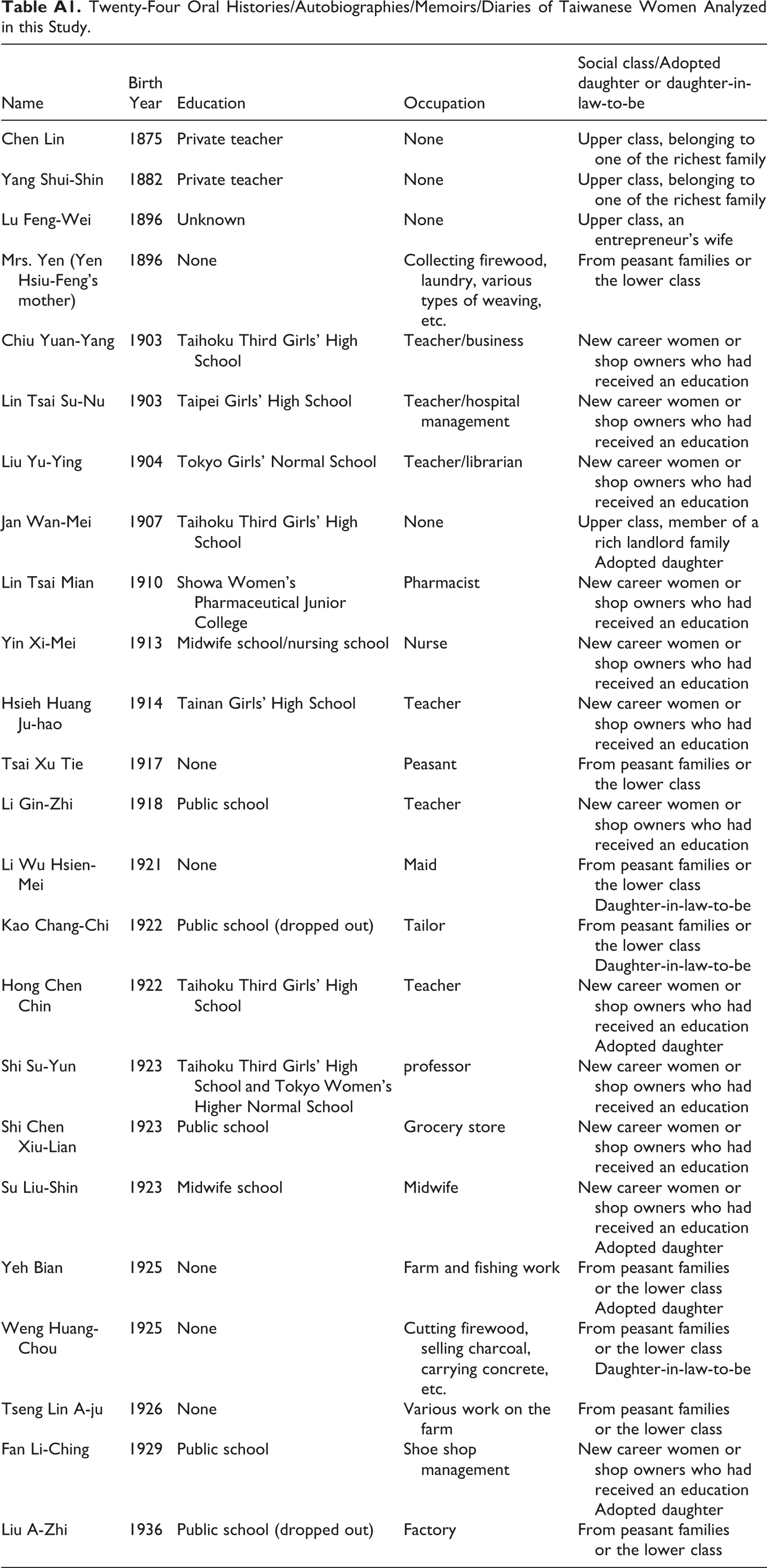
| Name | Birth Year | Education | Occupation | Social class/Adopted daughter or daughter-in-law-to-be |
|---|---|---|---|---|
| Chen Lin | 1875 | Private teacher | None | Upper class, belonging to one of the richest family |
| Yang Shui-Shin | 1882 | Private teacher | None | Upper class, belonging to one of the richest family |
| Lu Feng-Wei | 1896 | Unknown | None | Upper class, an entrepreneur’s wife |
| Mrs. Yen (Yen Hsiu-Feng’s mother) | 1896 | None | Collecting firewood, laundry, various types of weaving, etc. | From peasant families or the lower class |
| Chiu Yuan-Yang | 1903 | Taihoku Third Girls’ High School | Teacher/business | New career women or shop owners who had received an education |
| Lin Tsai Su-Nu | 1903 | Taipei Girls’ High School | Teacher/hospital management | New career women or shop owners who had received an education |
| Liu Yu-Ying | 1904 | Tokyo Girls’ Normal School | Teacher/librarian | New career women or shop owners who had received an education |
| Jan Wan-Mei | 1907 | Taihoku Third Girls’ High School | None | Upper class, member of a rich landlord family Adopted daughter |
| Lin Tsai Mian | 1910 | Showa Women’s Pharmaceutical Junior College | Pharmacist | New career women or shop owners who had received an education |
| Yin Xi-Mei | 1913 | Midwife school/nursing school | Nurse | New career women or shop owners who had received an education |
| Hsieh Huang Ju-hao | 1914 | Tainan Girls’ High School | Teacher | New career women or shop owners who had received an education |
| Tsai Xu Tie | 1917 | None | Peasant | From peasant families or the lower class |
| Li Gin-Zhi | 1918 | Public school | Teacher | New career women or shop owners who had received an education |
| Li Wu Hsien-Mei | 1921 | None | Maid | From peasant families or the lower class Daughter-in-law-to-be |
| Kao Chang-Chi | 1922 | Public school (dropped out) | Tailor | From peasant families or the lower class Daughter-in-law-to-be |
| Hong Chen Chin | 1922 | Taihoku Third Girls’ High School | Teacher | New career women or shop owners who had received an education Adopted daughter |
| Shi Su-Yun | 1923 | Taihoku Third Girls’ High School and Tokyo Women’s Higher Normal School | professor | New career women or shop owners who had received an education |
| Shi Chen Xiu-Lian | 1923 | Public school | Grocery store | New career women or shop owners who had received an education |
| Su Liu-Shin | 1923 | Midwife school | Midwife | New career women or shop owners who had received an education Adopted daughter |
| Yeh Bian | 1925 | None | Farm and fishing work | From peasant families or the lower class Adopted daughter |
| Weng Huang-Chou | 1925 | None | Cutting firewood, selling charcoal, carrying concrete, etc. | From peasant families or the lower class Daughter-in-law-to-be |
| Tseng Lin A-ju | 1926 | None | Various work on the farm | From peasant families or the lower class |
| Fan Li-Ching | 1929 | Public school | Shoe shop management | New career women or shop owners who had received an education Adopted daughter |
| Liu A-Zhi | 1936 | Public school (dropped out) | Factory | From peasant families or the lower class |
Declaration of Conflicting Interests
The author(s) declared no potential conflicts of interest with respect to the research, authorship, and/or publication of this article.
Funding
The author(s) received no financial support for the research, authorship, and/or publication of this article.
