




Abstract
This article discusses the results of ethnographic case studies on female cross-border experiences in the Paraná Tri-Border Area (between Argentina, Brazil, and Paraguay) conducted in 2018 and 2019. Reclaiming the life histories of thirty Paraguayan women, we will analyze the tensions that lie between family trajectories, female transgenerational acquisition of cultural and social capitals, rural-urban and transborder mobility, and labor insertion. Our analysis will explore more in-depth the impact that productive and reproductive work overloads have on different generations of women who share family bonds, showing how their care responsibilities are intrinsically related to their agency strategies.
Keywords
Introduction
From 2018 to 2019, we carried out ethnographic case studies on the transborder experiences of Paraguayan women between the cities that make up the Paraná Tri-Border Area (TBA): Puerto Iguazú (Argentina), Foz de Iguazú (Brazil), and Ciudad del Este (Paraguay). This article addresses a specific part of these women's testimonies: their recounting of their mothers’ and grandmothers’ life histories. It focuses on a topic that repeatedly appeared in their narratives: the entangled relationship that productive responsibilities, family care, and territorial mobility strategies represented for the ascendant female generations of their families.
We aim to analyze this relationship through Bourdieu's sociological concepts, observing how they relate to the women's acquisition of gender-based social and cultural capitals. Furthermore, this article inquiries into how gender mandates regarding females’ productive and reproductive responsibilities are transmitted and/or transformed through different generations and their impact on the families’ trajectories in this TBA. Our research perspective and goals turn to Bourdieu's theorization regarding a specific concern: overcoming analytical perspectives that excessively focus on individuals’ biographies. These perspectives tend to ignore the contradictory relationship between the social actors’ possibilities to develop their agency and the structuring limitations they face in doing so.
Given the above, the reading of this article demands some familiarity with key categories that configure Bourdieu's view on the social field. In order to provide a quick guide to readers unfamiliar with these debates, the third section of the text offers a thematic synthesis devoted specifically to the terminology adopted in this study. However, it is not our intention to simply return to theoretical discussions that have already been covered in various publications. Recovering Bourdieu's theories in the following pages also allude to another of the article's objectives. While these theoretical proposals have supported debates on social networks in transnational migration studies in the past 30 years, their application in border territories is still incipient. Consequently, this text also proposes exploring the uses of these perspectives in transborder territories, testing their relevance for investigating female experiences in these areas, and thus, promoting a “bridge” between analytical fields whose debates address common themes that have not yet been sufficiently articulated. The hypothesis that framed our study “interweave” these fields through three analytical conjectures.
The first derives from the use of Bourdieu in migration studies. Based on Massey et al. 1 and Portes 2 , we conjectured that the Paraguayan families’ transborder mobilities in this TBA are based on their members’ active participation in social networks of collective support and sustenance (social capital), as well as their knowledge about mobility processes and strategies (cultural capital). However, it is mainly women who are responsible for cultivating and maintaining these capitals, which end up “engendering” them. That is, they become endowed with gender-based specificities. In that sense, women's work is the primary resource for family projects shared by both men and women, and it guarantees that mobility is a viable, profitable, and possible strategy for them.
Second, based on feminist approaches on border territories, we presumed that the gender relationships in our interviewees’ families would demarcate women's opportunities, limiting them due to their overload of productive and reproductive tasks. Thus, we supposed that, even in those families in which men and women perform productive work, the reproductive tasks would be predominantly a female responsibility. The latter pushes women into sustained patterns of overload, hindering their possibility to improve their life conditions (e.g., frustrating their access to education, better jobs, and social rights).
Third, and derived from the above, we presumed that care work among Paraguayan transborder families is a tacitly female task: carried out mainly by mothers, sisters, aunts, and grandmothers. Therefore, the families’ social reproduction depends on female members being “forced to care.” This obligation exposes women to unequal gender relations in which male violence is naturalized.
Our case studies focused on Paraguayan women carrying out their activities in Foz de Iguazú (popularly known as “Foz”) and Ciudad del Este. This sample design was chosen for four main reasons. First, previous studies show that Paraguayan women are historically exposed to patterns of vulnerability in this territory (as will be explained in the section “Conceptual Framework”). Second, empirical evidence shows that female mobility in this region is more intense between the Brazilian and Paraguayan sides of the border. This intensity is due to the well-known lax nature of the border checks carried out by Brazilian and Paraguayan authorities 3 and also because these border cities are interconnected in productive and commercial terms and through the labor market. The most important commercial neighborhood in Foz (known as Vila Portes) is connected by the “Friendship Bridge” (crossed daily by thousands of people) to the center of Ciudad del Este, thus forming a conurbation. Third, ethnographical studies had verified that this intense interconnection stimulates two principal niches of Paraguayan female employment in the TBA: (i)legal and (in)formal transborder commerce and domestic work.
The work dynamics set up by Paraguayan women imply several crossings to the Brazilian side. Many of them travel daily to Foz to work in commercial businesses in Vila Portes. In this area, they make up the bulk of the workforce in small shops; warehouses that import and sell second-hand clothes; self-managed street stalls that sell accessories, clothes, and shoes; restaurants both serving or cooking; and on the street selling vegetables, garlic, and herbs. In addition, many women cross the border to work as domestic workers in Brazilian homes. It is usual practice for these work dynamics, both commercial and domestic, to be complemented by small-scale smuggling of various goods.
In Ciudad del Este, the Paraguayan women are responsible for an enormous spread of small-scale commerce on the streets that lead off from the way to Brazil. They do this through their role as saleswomen, administrators, or stallholders, from where they sell bed linen, home goods, clothes, and an assortment of accessories. They also work as sales assistants in the big Paraguayan department stores, whilst medium-sized stores tend to be staffed by males. In all these commercial spaces, Paraguayan women specialize in serving a predominately Brazilian clientele. This implies not only learning Portuguese but also the cultural habits of their consumers who come from the other side of the border. Most Brazilians neither understand Spanish or Guaraní (official Paraguayan languages) nor want to be served in a language that is not their native one: a position that harks back to the conflicts and identity hierarchies of the border that, as we will explain later, originate with the war-like conflicts involving the countries that conform this TBA. As Brazilians are the absolute majority among the clients, Paraguayan saleswomen learn Portuguese. All of those we interviewed on this border were proficient in Portuguese, Spanish, and Guaraní.
Fourth, in talking to these women, we bore witness that their intense productivity activities and mobility had to be juggled alongside their overload of social reproduction tasks. Women working 14-h-long days in productive activities explained to us that they were also responsible for all the family care. According to their stories, the sexual division of work in their families was based on the naturalization of the female overload, while, at the same time, the absence of any male responsibilities regarding family care was taken for granted.
Considering these four aspects, we asked ourselves if women's agency to resist gender inequalities would entail transgenerational strategies transmitted through the female ascending and descending branches of their families. In search of an answer to this concern, we asked the thirty Paraguayan women interviewed to start their biographic narratives by sharing the life experiences of their grandmothers and mothers. This methodological strategy permitted us to locate transformations and continuities of gender mandates in the light of the mobility logics of their male and female family members. In addition, it allowed us to recover the memories these women had about their sisters, brothers, mothers, fathers, grandfathers, and grandmothers. Our findings identify the importance of women's agency in constructing the border contexts and social processes and observe the constitution of a particular form of embodied female cultural capital that inspired the title of this article: Paraguayan women “carry the family in the body.”
The section “Methods and Materials” will explain the methodology used in our case studies to clarify these findings. The third sets out the theoretical concepts based on Bourdieu's debates on the social field, cultural and social capitals, and family trajectories. These concepts will be articulated with key feminist debates on social reproduction, care, gender mandates, and female experience on border territories. This section also describes the Paraná TBA, synthesizing its historical, social, and economic processes. The section “Rural origins, mobility strategies, and labor insertions” discusses the empirical data. By drawing on the accounts given by our interviewees, we will analyze their families’ rural origins, mobility strategies, and insertion into the labor market. The section “Female overload, gender mandates, and sexual division of labor” will analyze female narratives on their work overload, gender mandates, and the sexual division of labor. Finally, we will conclude by showing how the transgenerational obligation of sustaining family care is, contradictorily, a factor that impinges on the women while simultaneously being an element of female agency.
Methods and Materials
Author 1 has been developing ethnographic observations on Paraguayan women's experience in the Paraná TBA since 2018. Authors 2 and 3 joined this research agenda in 2019 through a comparative ethnographic project on South American Borders led by author 1.
These projects are linked through two central methodological aspects. First, ethnography is understood as the systematic observation of social contexts in order to participate in them, register and analyze social experiences, and build narratives. It is an approach, method, and exercise of intersubjective narrative. Therefore, the research strategies adopted in our projects seek critical interaction between the study subjects and researchers. 4 Second, they follow the delimitations of the Extended Case Method. This ethnographic approach was developed by Gluckman, 5 who proposed a reorientation of classic anthropological methodology by focusing on the study of potentially conflictive social interactions. 6
This article will analyze material that stems from the ethnographic inroads made under the guidelines of these ethnographic perspectives. These inroads registered the interactions with the transborder women in field diaries, photographs, and film recordings. In addition, as said before, thirty biographical interviews with Paraguayan women were carried out. 7
All of the interviews were transcribed and later categorized using the speech analysis software MaxQDA. To carry out this codification, we built an analytical matrix composed of six macro-categories: (1) constructions of the border; (2) trajectories of border migrants; (3) insertion of border migrants; (4) configurations of border care; (5) experiences of violence; (6) connections between South American borders. Each of these was then sub-divided into several micro-categories, giving a total of 130 codes. The topics we will deal with here are those that were categorized as linked to the macro-categories (2) and (3). Before we analyze this empirical material, let us set out our conceptual framework and describe the TBA context.
Conceptual Framework
Our theoretical approach combines Bourdieu's sociological contributions by establishing a dialogue between their use in the following fields of studies: transnational migrations, transborder territories, and gender relations. In this section, we offer a synthetic guide to these debates.
The first debate that supports us refers to Pierre Bourdieu's use of the concept “trajectory” and its application to migration studies. Bourdieu develops his reflections from two initial orientations: (1) the search to define the limits to and opportunities for social mobility for class groups or subgroups 8 ; and (2) investigations on the role of subjects in these movements. 9 With that in mind, Bourdieu progresses towards a dialectic perspective between the subjects “external” and “internal social structures.” 10 He considers that the former make up the social fields where the agents transit and the latter refer to the embodiment of the knowledge, experiences, and potentialities that they access from their trajectories in and through these fields (what the author refers to as habitus). 11
Bourdieu understands the field “as a sphere of social life that has gradually become autonomous” throughout history, which revolves around certain relationships, interests, and resources. 12 That field is crossed by struggles and forces aimed at transformation, and simultaneously, conservation. Social fields function given that agents invest in them, “in the different meanings of the term, their resources [capitals],” in a fight to “win” positions. 13 These fields are, consequently, crossed by different forms of capital—social, cultural, symbolic, economic—which subjects appropriate according to the possibilities and limitations that their social position in this same field (with its distinct hierarchies and structures) allows them.
The use of these debates on migration and transborder mobilities considers that subjects who move territorially—whether in their own country, between distant countries or in daily border crossings—simultaneously renegotiate their assignment to the social fields of two or more localities (in two or more countries). This implies that they intersect and connect the capitals of at least two different social fields, 14 from their agency. Several authors have worked on this idea of the migration field, focusing specifically on how male and female migrants articulate two types of capitals: social (usually identified as migration networks) and cultural. 15 , 16 Migrant social capital is defined as “the aggregate of the actual or potential resources which are linked to possession of a durable network of the more or less institutionalised relationship of mutual acquaintance or recognition.” 17 This network is woven from strategies orientated to the institutionalization of group relations and could be defined as (1) the social relations of these migrants in themselves, when given access to the knowledge and resources of the network's members, and (2) the quantity and quality of resources. 18
Cultural capital corresponds to the knowledge and resources incorporated by the migrants and spread through their networks. According to Bourdieu, 19 it can exist in three states: (1) incorporated, (2) objective, and (3) institutionalized. The first is linked to the notion of habitus, related to the agents’ embodiment (their bodily ascription of cultural capital). In the context of our study, this state involves historical notions of otherness regarding the phenotype or ideological constructions of the race/ethnicity of Paraguayan women, either because of their “ontological/national” condition or other conceptual associations regarding their identity or cultural practices that they display daily in the TBA.
The type of social capital and the ways of incorporating cultural capital are not experienced nor developed by the subjects voluntarily. 20 They do not depend solely on their desire, conscience, nor effective action: they suppose a social history that, on the one hand, pre-dates the subjects; they live and transform it with their social experience, and also, it surpasses them. 21 Far from indicating the subjects’ lack of agency, this inference indicates that this agency is not entirely free. Bourdieu points out that the subjects’ trajectory implies there are at least three dimensions to their possibilities of incorporating cultural capital: (1) that which comes from the history of their class subgroup, often given by the family unit they belong to (or from which they left); (2) the history of the social spaces or the social fields where they transit; and (3) their itinerary and personal history through these fields.
These definitions lead us to consider the personal trajectories as framed in family histories that are crossed by large-scale political, economic, and social processes that, in turn, are influenced by the local, daily, and micro-scale characteristics of these realities.
22
So, our quest to pick up the women's narratives about their families stems from our interest in overcoming what Bourdieu
23
calls “the biographical illusion,” alluding with this to the methodological individualism that restricts us to thinking of the subject as locked up in a fragmented existence, a-historical, a-collective. It is worth clarifying that when we talk of family, we do so from the perspective of anthropological, feminist debates, according to which: Families are complex social units of extensive structural, social, and economic diversity, whose individual members fulfil a variety of sexual, economic, reproductive, socialising functions within their relationships, making it not that easy to classify them in practice. These complex and diverse social units and the members that make them up intervene in, and are intervened upon, by the global context in which they are inserted […]. These interdependencies between family and society create changes in the way of “making families,” but above all in the permanence of the meanings and practices of masculinity and femininity, of motherhood and fatherhood, amongst others. In short, they create multiple connections that sustain the family and its widest social networks. They are reflected in tensions created between the public and the private, the biological and the social, nature and culture, altruism, and personal interest, amongst other dichotomies with ever more diffuse links.[
24
]
This implies considering the family as one of the central spaces of social reproduction, 25 where elements are disputed that allow the conservation or breakdown of power asymmetries, being gender one of the most fundamental. The concept of social reproduction comes from the feminist reinterpretation of Marxist debates from the 70s. 26 According to Marxist arguments, the capitalist mode of production must not only produce conditions for its existence but also its historical continuity. So, capitalist production implies the reproduction of mechanisms that maintain divisions, inequalities, and asymmetries between classes. 27 The feminist argument questions the gender subalternization that underlies these same strategies. 28 It denounces the continuity of the production mode resting on women, who inevitably take on the lion's share of caring for new generations.
However, what does this notion of care allude to in feminism? The concept refers to a range of practices, both paid or unpaid: regulated or not by a work contract, within domestic or public spaces and that may even cross-national borders and establish themselves in different countries.[ 29 ] These practices include direct care of individuals (bathing, feeding, cleaning, dressing); emotional care (chatting, consoling, talking, looking after); and those services that are indispensable for the previous two groups (food shopping, buying clothes, paying bills, buying medicine) and maintaining spaces where they live (cleaning, tidying). 30 Another additional item of care consists of developing family and community relationships, that is to say, “kinship work.” 31 All of these activities are central to social reproduction.
It is important to point out that gender mandates imply the construction of female experience, 32 and women's social trajectories as framed by a moral, emotional/affective, social, and economic duty to care for the family. Women incorporate this duty through habitus: hence the relevance of the expression used in the title of our article: women “carry the family in the body.” This is part of the limits and possibilities of their movements in the social field, a particularly important aspect in the case of the Paraguayan women in the TBA, given the context of the historical war that defined these national limits. This war almost annihilated the entire Paraguayan male population triggering a national reconstruction—as we will argue later—which relied on naturalized practices/discourses of female overload.
Reflections on gender mandates and transborder mobility began to gain analytical importance in the 80s when the Mexico/USA border emerged as a significant place to research the concentration of gender relations. From these studies, border regions began to be defined as spaces of symbolic negotiation of political processes and cultural identities (gender being amongst them). 33 Since then, the contribution from female Latin American researchers has been central in combatting the invisibilization of ethnic/racial discrimination in border territories.[ 34 ], 35
These studies reach four fundamental conclusions. First, the labor vulnerability of the border women is extended to (and often originates in) the domestic sphere, in their relationships with parents, partners, and male relatives. 36 Second, in the context of economic globalization and growing work flexibility, women have had more job opportunities but this is because they are considered easier to exploit. Simultaneously, male unemployment has displaced men from their role of the provider. This has led to outbreaks of gender violence in border territories. 37 Third, undocumented transborder women face a greater number of human rights abuses at the borders. 38 Fourth, they play a dialectical role in these territories: they embody and reproduce gender submission in their daily contexts, and, simultaneously, they are active agents of resistance to these mandates. 39
The Context
A detailed historiographic review goes beyond our purpose; however, we will synthesize some key aspects to understand the gender inequalities in the Paraná TBA (Map 1).
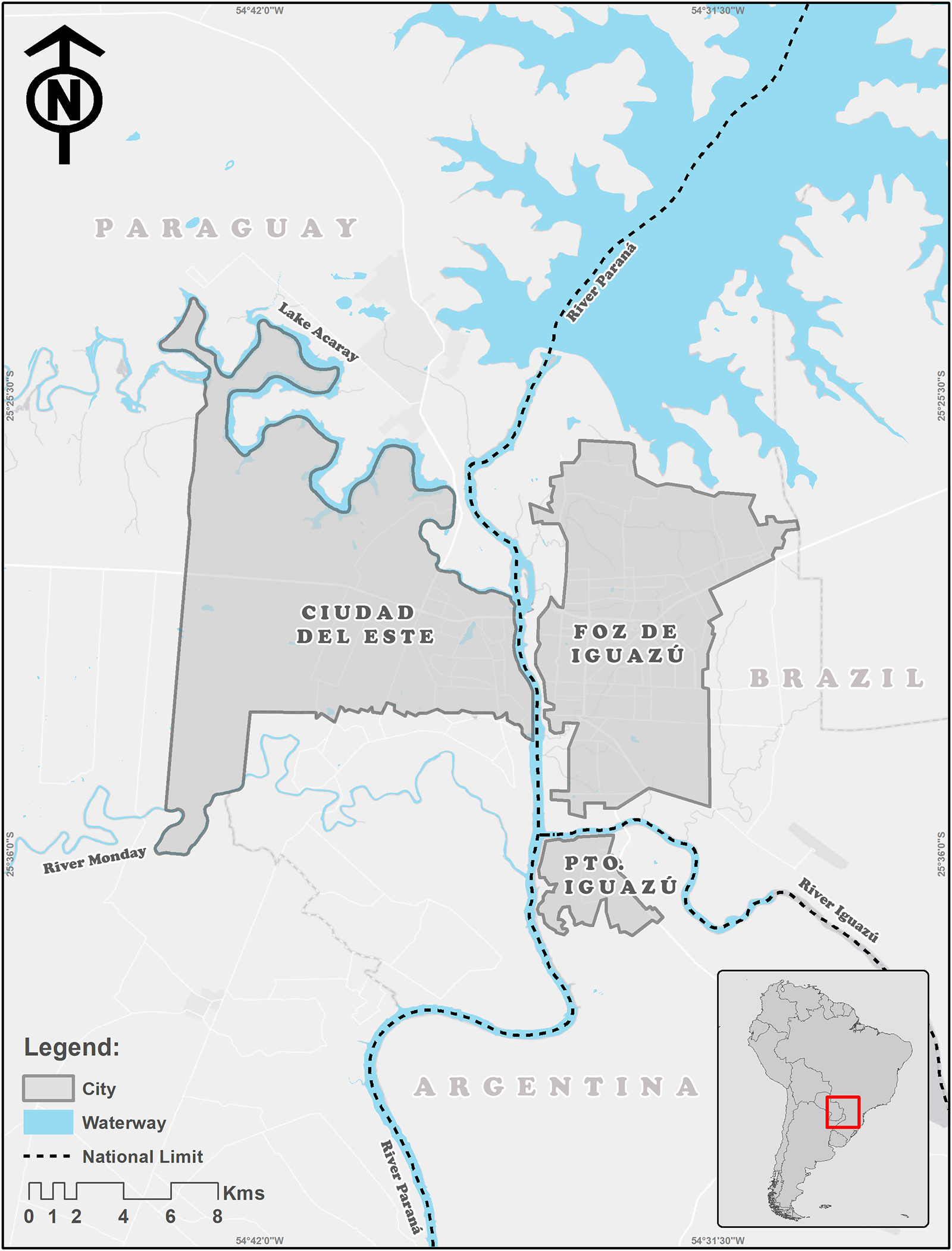
The Paraná Tri-Border Area. Cartographer: Paulo Contreras Osses.
The War of Paraguay (1864–1870) marked a turning point in this area. This conflict brought about the Triple Alliance (Brazil, Argentina, and Uruguay, with British support), which pitted itself against the Paraguayan army. The Alliance's victory fed the area with military and racial symbolism: Brazilian and Argentinians, each in their own way, projected their victory as proof of a supposed racial, moral, and civilizing superiority. Frequently, this idea of superiority reduced down to the association of the Paraguayan identity as Indian, supposing a juxtaposition between this condition and that of Paraguayan national inferiority. 40 This ideology justified the violent exploitation of riches from Paraguayan territory and endorsed the genocide of its population. 41
The war profoundly changed the lives of Paraguayan women. Almost the entire male population was recruited by the Paraguayan army. 42 In 1869, the national average ratio was four women to each man; but, it was as high as twenty women per man in some localities. 43 This forced the women to take on fundamental tasks for the country's economic reproduction during and after the conflict. 44 , 45 Indeed, many women followed the troops to provide the soldiers with food, medical care, and sex. 46 They confronted the difficulties of war, and in defeat were systematically raped by the enemy armies. 47 The construction of the borders and powers between the three nations was intertwined with the legitimization of this violence. The war impacted on the configuration of social representations that intersect the ideology of the Brazilian-Argentinian national-identity superiority with the appropriation of female Paraguayan bodies as objects of national and male violence. All of these imaginaries are still valid today.
As we explained in the introduction, the Triple frontier is made up today of a conurbation that includes three cities. Puerto Iguazú (Argentina) was founded in 1902 and is part of the Misiones Province; it registered a Paraguayan migrant population of 27,799 in the 2010 census. The same census numbers its total population at 42,849 people. Tourism is its primary industry, and it is connected to Foz by the “Fraternity Bridge,” inaugurated in 1985. 48 Foz de Iguazú (Brazil) was founded in the nineteenth century as a small military settlement. Its population and economic growth began to boom in 1965 after the construction of the “Friendship Bridge,” which connects it to Ciudad del Este. In the last Brazilian census (2010), it registered 256,081 inhabitants. 49 Finally, Ciudad del Este (Paraguay) was founded by a presidential decree in 1957 to connect by land with Foz through the bridge (inaugurated six years later). In the 80s, it became a Free Trade Zone (FTZ), turning it into a vast international (il)legal commercial center. This has spawned a large economy together with Foz and Puerto Iguazú. The FTZ consolidated an important niche of female work: legal commerce and small-scale smuggling. It is the city with the most significant demographic growth in the TBA. In the last Paraguayan census (2012), it had 312,652 inhabitants. 50 , 51
In the last four decades, this territory has gained importance in economic and political terms for these neighboring countries. The two biggest hydroelectric plants in South America are found there, providing energy for Argentina, Brazil, Paraguay, and Uruguay. 52 Also, it boasts one of the best-connected transport infrastructures in terms of cargo, merchandise, and people and has created the busiest business pole in the Southern Cone: The FTZ of Ciudad del Este. 53 Its commercial potential was reinvigorated in the 90s with the signing and implementation of Mercosur.[ 54 ] At that stage, the neighboring countries agreed that this area should be a neuralgic point in the economic integration of the block and concentrated resources to revitalize it. 55 , 56
From 2008 onwards, this trade has been deaccelerating, which led the economies of Puerto Iguazú and Foz to focus on tourism. 57 , 58 Even so, the three cities making up this transborder area have the biggest flow of humans, 59 merchandise, 60 tourism, 61 and illicit activities, especially the trafficking of drugs and merchandise 62 and organized crime 63 in all of South America. 64 Several authors agree and highlight the peculiar dynamism of the Tri-border that is characterized by mobility circuits and (economic, social, and cultural) relationships in which legality and illegality and belonging and being uprooted do not constitute antagonistic pairs. 65 , 66 , 67 , 68 , 69
The TBA continues to be a particularly violent space for women, even more so if they are Paraguayan: this is one of the most active territories for transnational sex traffickers in South America. 70 , 71 Diagnoses show that the phenomenon is linked to tourism and border commerce and that most victims are Paraguayan women. 72 On the other hand, these women are exposed to the intersectionality of different forms of discrimination and social marginalization (class, nationality, ethnicity/race). This intersectionality has profound consequences on the territory's economic and political organization, which is spatially due to the agricultural industrialization model (of soy) that has been taking over small-holdings and expulsing peasant families from the Paraguayan side of the border. 73 The break-up of the productive family unit and the lack of job opportunities for males have pushed Paraguayan women to take responsibility for their families both productively and reproductively. Consequently, their insertion into the commerce of Ciudad del Este and Foz and their presence in the domestic service of the latter are ways they have found to deal with these circumstances.[ 74 ],[ 75 ]
Results
Rural Origins, Mobility Strategies, and Labor Insertions
Amarena, a young transborder Argentinian resident in Puerto Iguazú (interviewed on July 15, 2019), used the expression “carrying the family in the body,” which gave this article its title when we asked her about her perceptions of Paraguayan women. She affirmed, at that time, that Paraguayan women were the most vulnerable in the region: whether because of racism or discrimination at the hands of Brazilians and Argentinians, or because of Paraguay's difficult economic situation, or because of gender inequality and sexism which, as far as she understood, were stronger in that country. In addition, she said that they worked extremely hard to “keep their families’ heads above water”: they had so much responsibility, she reflected, that they seemed to carry the weight of the family network on their shoulders.
Other Argentinian and Brazilian women shared these reflections about Paraguayan women, and they fitted in with our ethnographic observations. To corroborate these representations, we asked the Paraguayan women if they considered them relevant. Their answers were decisive: they perceived them as extremely precise descriptions of their everyday lives and life projects. In our interviews, we delved deeper into this topic. We observed that this sort of “embodiment” of family responsibilities was an experience shared by grandmothers, mothers, and sisters, and that family mobility was related to that.
To explain these elements, let us pick up Paloma's accounts of her family trajectories. She is a young Paraguayan businesswoman who was 35 years old when we interviewed her (on July 27, 2019). Together with her brother, she ran one of the many tin and iron stalls selling clothes on the central streets of Ciudad del Este, near the bridge that connects it to Brazil. Her family's experience represents several of the stories that we heard from other interviewees. Through her narrative, we will begin to describe the processes of labor insertion and the sexual division of work in our protagonists’ family trajectories.
Paloma told us that her maternal grandmother lived in the city of Caacupé, in the Paraguayan province of Cordillera (273 km from Ciudad del Este). She admitted that she was extremely fond of her grandmother: she valued her untiring dedication to work and the care of her fifteen children (two of whom died still babies). But what she admired most was her character: that of a strong woman who took control of her family's direction: “My grandmother was born in the countryside and had to migrate to give her children a better quality of life. My grandmother was the one who took charge by saying: ‘alright, you know what? We’re leaving! […]. My grandfather, well, he had no choice but to obey!’” [Laughing]. 76
Her story sets it out clearly. First, the rural beginnings: most of our interviewees were born in rural areas or are the first generation of urban dwellers in their families. 77 It relates the story of migration from the countryside to Ciudad del Este, marked by a family's quest not only for better economic conditions but also for better access to state services (health, education, and transport). In many of the accounts, this mobility implied a change in labor insertion: from working in the countryside, in small-scale agriculture and livestock, to commerce in the urban transborder area. None of these jobs requires formal certifications, but even so, as we will see, they do require a specific knowledge set—cultural capital—that is gained through experience and family living. What differentiates rural and urban labor insertion is the economic stability, better living conditions, and access to basic services offered by the intense border commerce when compared to agrarian jobs. Having moved to the city, Paloma's maternal grandparents began by selling “orfebrería” (metalwork and jewelry) and clay products. Then, “they moved up in the world” until they established a clothes stall, which they still have today.
Her paternal grandparents, who live in the countryside, represent another possible family configuration amongst the women interviewed: they did not migrate to the city. Her grandfather was dedicated to the farm, while her grandmother was responsible for looking after the home. In rural Paraguay, this “looking after the home” implies bringing up the children, feeding the family, and keeping the home clean. But it also includes micro-scale production from small vegetable gardens or farms aimed at family consumption and some sales.
Thus, Paloma's father and his siblings became part of the rural exodus, displaced to Ciudad del Este. It was in this city that Paloma's parents’ paths crossed. Her mother had previously migrated to Asunción, where she had married for the first time, to the father of Paloma's older brother. When that relationship ended, she migrated to Ciudad del Este (the mid-80s), just when border commerce “was beginning to grow strongly.” Taking advantage of this new opportunity, her mother left her son with Paloma's maternal grandparents and began working as a clothes salesperson in Ciudad del Este. Every month she sent back remises for her son, “as appropriate”: One son, who she had with her husband. And then, when things weren't going well, my older brother stayed with my grandfather when she separated from her husband. He stayed with my grandmother, and she had to come and work here and send money back, as was appropriate […]. Because my mother, when she left, she was grown up. She was already an adult woman. She moved to Ciudad del Este because business was beginning to boom, and she started working in a shop. My mother was married to another man, and this man ended up going off with another woman. He left her, and she stayed there, working in a business called “Comercial Co,” the shop was very well-known in its time.
78
Here, we see how the care of Paloma's older brother is divided between two female figures (mother and grandmother) after Paloma's mother's first husband abandons and disregards his care responsibilities (or the economic maintenance of his son) to start a new relationship. Also, we see the validity of a mandate that implies that when the mother leaves for production purposes, this entails the obligation of sending money to her child.
Paloma's father is a taxi-driver in Ciudad del Este. He arrived in this border city in the previous decade, thanks to the creativity of one of his brothers. This brother convinced him to sell some of the family's flock to pay for the trip to Ciudad del Este and allow them to explore their economic possibilities there (and later bring their parents). Once again, the rural environment is seen as a space that expulses, that offers few opportunities to grow economically or improve living conditions. Her uncle managed to establish himself and get a job, and with his support, Paloma's father followed in his footsteps, saved money, and bought a taxi. The family functions here as social migratory capital, as defined in the theoretical section.
As in Paloma's case, all our interviewees have relatives with rural origins and recent family stories (within one generation) of rural-urban migration.
79
There are at least two mobility models that characterize the movements of their families. On the one hand, in the cases of Antonia, EA, Guerrera, Lirio Blanco, and María 1, the movement is internal, within Paraguay, from the countryside to the city, and it is a family project. Their stories illustrate the reality of country life before migration, characterized by pressing problems related to access to education, transport, and economic and productive shortcomings: We lived in Tres Corrales [Caaguazú Province, Paraguay]. We moved to Choré [Province of San Pedro, Paraguay]. Choré, saline terrain, it was … that's where I grew up. There, when I was eight or nine years old, that's when we moved. And I grew up there, and there, that's where we all started school. Because before that, when we lived in Tres Corrales, there was no school. It was so far away; everything was countryside. You had to walk, only walk; there wasn't one single vehicle. You could only take a cart to travel in groups; you went by cart for kilometres. After a while, the oxen had to rest, and then the other days, we would travel once again, really far. That's how we got to another place. It wasn't easy.
80
The migration of siblings also falls within these logics. However, these migrations reach beyond Paraguayan territory. Our interviewees clearly explained how their brothers and sisters migrated before them to different localities in Argentina (mainly Buenos Aires) and some places in Brazil (those most mentioned are Foz and São Paulo). Acting as pillars of the migration network (as articulators of social migrant capital), brothers and sisters arrived at a place first; they sought labor insertion and then would send resources that allowed for other family members to migrate and settle: “my siblings came first; they were settled, all of them still single. Then the rest of us came, along with Mum and Dad” (María 2, July 29, 2019). Or even: It was 2002–2003, around then, I think. 2008, around then, that's it. That was when my sister told us she wanted to leave. Because she wanted to work, and she didn't want to keep living like that. Because she wanted to get out. Because she had finished her primary and secondary school, and she didn't know what to do. Because she was still in my mother's home, and that was never going to be her home. So, she decided to go, and my mother gave her permission to go. She was older than me, So, she left, and my other siblings already had their own families. Then, the two of us were left alone. Three had married, they had their own lives, they had children. And the rest of us were left with my mum. And my older sister decided to go to Buenos Aires. After that, I finished school; I finished secondary also. But it was difficult because my father said that studying wasn't important. In their days they didn't study, at most they reached third year but, only to learn how to read, how to sign papers. So, my father wasn't interested in studying. The most important thing was reading, signing.
81
We can see here the difference in access to schooling for the parents and women: the sisters and the women themselves want to go to school, an opportunity which had been very limited in previous generations.
On the other hand, a second model of mobility is expressed as a tacitly female project, headed by women (mothers, sisters, grandmothers). This was Avril's case, whose grandmother traveled to Spain to look for work. It is also the case of EPM's mother, who works in Foz as a street-seller, or Mía and Shakira, whose mothers, went to Buenos Aires. These movements mean that children were left with maternal grandmothers, who brought them up, using the remises sent by their mothers. On the contrary to what happens with the fathers, in only one case did a mother cut ties with her children, establishing a new family in a migratory context.
Female Overload, Gender Mandates, and Sexual Division of Labor
The interviews confirm our hypothesis that care work falls exclusively to women in our interviewees’ families of origin. We found this overload expressed in three ways. The first corresponds to a model where grandmothers, mothers, and sisters do the housework without male participation.
Did your mum and granny work on the farm?
Yes
And did they also work in the house?
Also
And what did they do in the house?
Cook, clean the house, wash, all of that.
And your dad and your grandfather too? Did they help out in the house?
No, no! They didn't help in the house. Only on the farm. 82
In the second model, women and men share the care work, but managing, coordinating, administrating, and directing this work falls unreservedly on the former. So, even though the male contribution appears like “help” the responsibility is female: “Yes, my father helped, too. He still does. He cooked, cleaned, washed, looked after us, bathed us.” 83
The third model refers to those families where the father oversees the domestic work, but it is outsourced to a woman, hired for such purposes: And in your home, when you were a girl, who did the housework? My dad. Your dad? My dad. Did your dad wash, iron, do the housework? No! All he did was look after us; my mum was the one who did most of the work. But did he cook? He did. And did he clean? No! Only with us: all he did was stay with us [the children]. And there was somebody who came to work in the house. Did a woman come to do the housework? Yes.
84
The concentration of productive and reproductive work represents an important overload for the interviewees’ grandmothers and mothers. This impacts strongly on female imaginaries, establishing limits and desires for change as well as expectations in personal and educational development. In this sense, the stories regarding Paloma's grandmothers and mother also represent other elements that are repeated in several stories.
The first element is the assessment of work and effort as a gender mandate and a definer of female identity. Paloma confesses that even though she did not know her grandmother that well, she values her effort enormously considering the overload of working in business, administering care, and bringing up children. So too does Antonia (62 years old, clothes seller), who points out that her mother was always the pillar of the home; she was the one who was dedicated to the care work, the farm, and business. Águila (31 years old, a domestic worker in a private household in Foz) called her mother a “warrior” for the same reasons. Rosa 2's case is similar (52 years old, clothes seller); she also values the effort her mother made as a worker for her family: “I missed my mum very much because I knew that she worked very hard. She came here to Ciudad del Este; she brought cassava, charcoal, whatever. Whatever she found in her path, she brought it here to sell. And I came back with her to help, to help her sell.” 85 Furthermore, Rosa 2 stresses the horizontal sense of solidarity between women with family ties down through the generations and how accompanying mothers constituted a way of socialization for the new female generations into commercial work.
On the other hand, in the women's stories about their grandparents and parents, the countryside appears as a far-off place, both in time and space, with regards to the city. Urban areas are portrayed as offering better conditions and economic possibilities for families. We can see economic precariousness and even malnutrition in Águila's experience: And sometimes … Let's see, for example: now that we are settled in my mum's house. As time goes by, my mum doesn't want to remember. Me neither, nor my siblings, even less so. Because, in truth, the saddest thing was we didn't even know what flour was. We didn't know what beef was; because instead of giving us meat, my father would sell it. There weren't any leftovers for us to eat. It was only to be sold […]. It was dangerous. For example, they [her parents] have livestock, so. And, nowadays, you can't trust anyone anymore because anybody can come and steal cows, any of the animals. Because there is so much poverty, that's why.
86
And Rojo too: “It was quite difficult, Always, in the countryside, everything was … For example, you earned little money, so you didn't eat so well. We didn't live so well. We ate, but there were a lot of us: we had to work. You have to go to the farm, and we had to help, we helped each other. And that's how we lived.” 87
Time and again, these accounts mark the difference between work in the rural and urban spaces. They also show, in glimpses, how even though the city is a space of precarious female work, inequalities in this sphere are worse in the countryside. As we mentioned earlier, the work associated with taking care of the home in rural contexts involves small-scale agricultural and livestock production (female family care work extends to looking after animals and crops).
One characteristic of the sexual division of rural work on small family holdings is that everyone must pull together and work to ensure that the nuclear family is fed, as Rojo explained. This is also borne out by Águila, who details the complexity of the gender differentiation of rural family tasks. This sexual division of labor implies a series of symbolic checks on the corporal attributes of each gender, on their limits/possibilities of action. However, it also implies making the female capabilities invisible.
We, the women, were in charge of making starch. My dad and my brothers, herbal mate. Yes, divided. Because making starch is more women's work; because it's easier. Making herbal mate is harder. My father cut the herb, and my brothers would bring it from the farm and place it like this so … I don't know how to say that in Spanish. And the same, when a pig was slaughtered. With my mum, we would go out and sell the pork to bring money back to the house for buying, to sustain the house. 88
Águila narrates how her father constantly traveled for work and was absent from the farm for months. During these times, her mother took charge of all the tasks, male and female: which her father would never have done. Her mother was perfectly capable of doing all these activities: the animals and crops were always more profitable when she was in charge. However, when her father returned, her mother was relegated to those tasks with less prestige. For example, he would not let her prepare herbal mate because that job carried community recognition. He justified this by claiming that “women aren't capable of working mate,” “of slaughtering animals.” According to Águila, this seemed unfair to her, both she and her siblings had accompanied their mother throughout their father's absence, and they knew full well that not only was she capable of doing this work, but she worked better than their father. And so, the narratives reveal how, in the countryside, fathers, mothers, and children make up an interconnected productive unit where women oversee productive and reproductive tasks. But social recognition and economic profitability appear only as male privileges.
On the other hand, this sexual division of labor implies the reproduction of the female work overload and relies on the socialization of the older sister through mandates of care and work without the right to rest. As we see in María 2's story (46 years old, clothes seller in Ciudad del Este), older sisters were responsible from an early age for all of the care work, while the rest of the family members, in particular, the men, worked in agriculture: The housework … from a very early age we do all the housework. The girls got up very early to make mate for the parents. The breakfast to be taken to the farms, we prepared everything. Then, mum and dad would get up, have their mate and grab the materita [yerba mate drinking container] and take breakfast and lunch to the farm. [The brothers] accompanied my father, as they were already older.
89
Rojo reiterates these realities: And we [brothers and sisters] only did the laundry, tidied the house, helped on the farm too; we did everything. All of us, all of us, worked together. It wasn't so much, but we had work to do: we cooked, we lit a fire with firewood, on the floor, stuff like that, everything. My oldest sister, she organised everything. She was in charge of everything; when my mother wasn't there, my sister took charge of it all.
90
We see how the sexual division of the work implies extra work for the first-born daughters: they get up even before their parents, and from an early age, they prepare everything for the working family group. They would continue to work, just like the rest, all day long: but when the others came back from the fields, they would keep cleaning and tidying the house. First up, last to bed. This organization persists throughout the lives of most of the interviewed women. When we asked them when they rested, the question surprised most of them. Most of them answered that “women don't rest.”
In addition, all of this extra load implies that they were impeded from accessing formal education, an opportunity restricted to the men: “That is what I asked him [her father] on numerous occasions: Why wouldn't he let me study? And he said: ‘you are a woman; you have to stay at home. I’m going to send your brothers to school’. My brothers, yes.” 91
The interviews show us that the migration of parents or grandparents to Ciudad del Este implied a diversification in family labors and a new organization of the sexual division of work, given that the women inserted themselves in the productive market outside the nuclear family. So, in the urban environment, fathers began to work as builders and drivers and mothers as sellers (street sellers or in established businesses) or domestic workers.
Commerce was an important transformative feature in the family experience of mothers and grandmothers. This is not to say that they had not been involved in business dealings in the countryside (indeed, at times, they played an important role in alleviating conditions of family poverty), but in Ciudad del Este, commerce gave these women better economic conditions and capitalization. It is possible to establish three models of family commercial insertion.
The first, as in Paloma's case, refers to those families that migrate and reorient themselves in commercial activities, leaving rural work behind. The second, as in Guerrera's case, is where the family unit decides that some members of the family will migrate and work in commerce to complement the income from the farm. But there is a third way, as told by Sonia (26 years old, clothes seller). For her mother, working as a street seller in Foz represented the chance to escape domestic violence and lift her family out of poverty: Yes, she [her mother] began working [as a street seller] because my dad wasn't a very good person. And, so, life was very difficult for her. At first, she lived a hellish life; you could put it like that. So, her life was far from easy. I grew up with my mum, selling in the streets. Later on, I learned to become a seller: how to give people what they want, how to interact with them. Our needs were growing, and I had to find a job. So, I started looking, and I found one [in Foz]. My bosses gave me the chance to be the saleswoman I am today because it's not easy to be a saleswoman. It's very difficult: when you are a saleswoman you have to put up with a lot. Some people come, and they insult you, talk to you, there are lots of things, so you need to be extremely patient to be a saleswoman. But thank God, so far, that's me got three years of experience behind me now.
92
Sonia's mother's work insertion in Brazil is described in this narrative as a vital alternative. As said before, even though informal commerce does not require qualifications, it does require cultural capital that must be learned by the women who carry out this job. By accompanying their mothers, they get experience in terms of the knowledge, codes, and dispositions needed to work as saleswomen. The same happens in care work: the practice and knowledge passed on by mothers or older sisters in family environments can then later be capitalized in jobs as domestic workers. All of this is closely related to the strategies of female mobility used between the Paraguayan and Brazilian sides of the border.
Discussion
The narratives analyzed led us to various considerations on the relationship between the family trajectories and female overload as experienced by the women interviewed, their mothers, and grandmothers. We saw that the gender relations in our interviewees’ families of origin demarcated women's possibilities of displacement in the social field and their access to social, economic, symbolic, and cultural capitals. We observed that the sexual division of labor in their families of origin was characterized by female overload; that care was tacitly a feminine task, carried out by mothers, sisters, aunts, grandmothers, and, logically, the interviewees themselves. In most cases, the productive work of mothers and grandmothers was the primary source of income for the household. Our interviewees learned about their own feminine condition from these examples of overload.
Nevertheless, as we saw with Sonia, maternal teachings also implied border-crossing strategies. Sonia learned to sell with her mother from an early age, crossing the bridge daily, carrying garlic and green vegetables to Foz. So, she learned to deal with and talk to Brazilian customers. She also learned to subordinate herself with “patience” to their mistreatments. The latter shows the dialectical dimension of labor and economic empowerment that commerce gives to the Paraguayan border women.
On the one hand, it allows them to do a job that does not need formal qualifications, lets them manage their free time, and facilitates the balance of productive activity with family care (children can even go with them). This possibility was crucial to Sonia's mother in that it allowed her to confront her husband's violence, giving her an escape from an abusive relationship. But simultaneously, the women must bear in mind the violence that they can suffer in the public space at the hands of their clients. Here, we see how overcoming domestic violence can be part of an empowering process of female agency, however, the experience of violence is transferred to the public sphere, to productive relations. In this shift, aggression undergoes an important change: it goes from gender violence inflicted by males with whom the women share identities and family connections to violence that singles them out for their Paraguayan nationality. So, we noted how the border crossing allowed the intensity of the violence to diminish, displacing it from the domestic to the public; but metamorphosing itself into ethnic-national and racial discrimination. In parallel, the entrance into the productive world reorganizes the overload: by crossing the border daily, women are less implicated in care work, but there are two simultaneous costs: (1) this overload is transferred onto other women; (2) the women are worn down in other ways (crossing the border every day with all the tensions that involve).
The dialectic that this commercial insertion implies for the mothers and grandmothers of our interviewees—allowing them, on the one hand, to break certain gender mandates whilst contradictorily reproducing them—, is also verified in the act of migrating. In all of the stories, the movements and mobilities (rural-urban, transborder, or long-distance transnational) appear as female strategies to put a stop to unequal processes of gender or violence. These women talked of a decisive moment for their family when their grandmothers or mothers “took charge of the situation” regarding mobility. This “taking charge” constitutes a process of agency motivated principally by family mandates. So, the family's social reproduction—the female overload in this sphere—pushes women to develop their own specific empowerment in territorial mobility. This empirical finding requires an analytical perspective that overcomes the bipolarity between agency and structure (which exceeds the deterministic reading of social processes, of the relationship between domination and agency in female trajectories).
Therefore, although these decisions did not allow a complete break from the violations or domination suffered by their female ancestors, they did constitute a turning point in the family trajectory. And these turning points represent a starting point for the new female generations. Thus, there is a trajectory of female agency linked with the founding decision of the mothers/grandmothers to move. This founding act establishes a transgenerational female agency. However, it is a winding empowerment: with comings and goings, ups and downs and some backslides. And the women are fully aware of that.
In summary, the various forms of spatial mobility constitute female cultural capital that anchors a form of agency, resistance or an irruption strategy by different generations of women against certain structures of domination. However, they still frame this agency with part of their family mandate. These considerations led us to confirm the three hypotheses of this study: (1) the verification of the transgenerational persistence of a female productive/reproductive overload; (2) the women constitute their spatial mobility as a response to overcome this overload; and (3) the transborder strategies allow, simultaneously, the breakdown and reproduction of violation patterns. These three elements are very closely related to a particular expression of female cultural capital: Paraguayan women “carry the family in the body,” reproducing as habitus the group of strategies they use to confront their emotional, affective, and economic obligations in their families. This is a sense of responsibility for the present and the future of their family networks that the women “carry in the body.”
Footnotes
Appendix
See Table A1.
Acknowledgments
The authors thank Christine Ann Hills for the translation of this article from Spanish to English. They also thank the National Research and Development Agency of Chile (ANID) for funding the studies that gave rise to this chapter through the Fondecyt Project no. 1190056, “The Boundaries of Gender Violence: Migrant Women's Experiences in South American Border Territories” (2019–2023).
Declaration of Conflicting Interests
The authors declared no potential conflicts of interest with respect to the research, authorship, and/or publication of this article.
Funding
The authors disclosed receipt of the following financial support for the research, authorship, and/or publication of this article: This work was supported by the Fondo Nacional de Desarrollo Científico y Tecnológico of the Agencia Nacional de Investigación y Desarrollo de Chile (grant no. Fondecyt 1190056).
