



Abstract
In the patriarchal lineage management system in China, only men possess the right to run a lineage. However, by analyzing the power and status of the wives of the Dukes for Fufilling the Sage in the management of the Kong lineage in Qufu since the Qing Dynasty, this study finds that these women played an important role in lineage management. They performed the duties of the dukes under special circumstances and became the highest decision makers of the lineage. This study further analyzes the reasons why the duchesses could exercise management power in the Kong lineage.
In ancient China, the governance models of the lineage and state have the same structure, and grassroots social governance was built based on lineage management. The lineage which was generally called the “large family” or the “expanded family” was the most common group of Chinese society; the smallest lineage can be equal to a nuclear family. 1 A family is the basic social space of men and women in China, and it is the starting point of realistic understanding of gender and power relations. 2 Lineage management in the feudal society of China has always been a patriarchal system. Strictly speaking, only men possessed the right to run a lineage. Grandmothers and mothers were excluded. Even after the death of the father, if the son was still a minor, the closest male relatives bore the responsibility of upbringing and guardianship, acting like fathers. 3 If women were in charge of household affairs, this was considered a manifestation of abnormal “yin and yang” that marked the decline of lineage affairs. 4 Therefore, the ideal lineage management method in ancient China was that men should take care of the outside while women should take care of the inside. Female parents could only manage the women in the lineage; they only managed household chores and were not allowed to interfere in the space of men’s activities.
However, in actual fact, the family is an organic whole. The areas inside and outside the family and between men and women are interrelated and interact with each other; inside and outside can also be converted in different environments and perspectives, and the boundary is difficult to define clearly; second, absolute patriarchy is not a perfect management system, and its defects still require the participation of women to compensate for them. As Pierre Bourdieu points out, the male monopolizes the “formal power”, while the female frequently exercises the “dominated power”; although the power exercised by the female is a limited power acquired through another’s agency, however, it is still real. 5 Specific to a certain family, the extent of women’s power and their influence on the family will vary greatly with family characteristics. For ordinary Chinese families, the discussion of women and property power is undoubtedly a key and indeed hot issue, and the relevant research of historians has provided us with many important references; 6 Women’s management of their little families were also taken for granted while their husbands and sons were constantly on travels. 7 But for a large noble lineage, management and operational issues are more complex, comprehensive, and difficult. This paper will analyze women’s managerial power in a large hereditary aristocratic lineage, in order to show the actual situation of Chinese patrilineal family management in the Qing Dynasty.
The Kong lineage in Qufu, headed by the “Dukes for Fulfilling the Sage” (the Kong dukes, Yansheng Gong, 衍圣公) and formed by the direct descendants of Confucius, is known as “the first lineage in the world” due to its long history, special status and vast scale. 8 The management of the Kong lineage has always maintained a system of hereditary primogeniture. After continuous development and improvement, the patriarchal lineage’s management system and mode of the large lineage became more mature and typical in the Qing Dynasty. The Dukes for Fulfilling the Sage are both the eldest son and the patriarch, who oversaw lineage sacrifices and property and controlled the management of the lineage. In addition, several Kong duchesses (wives of the Kong dukes) appeared from the Qing Dynasty to the Republic of China, such as Yu, Peng, and Tao, who had a great influence on the Kong lineage. On the question of the involvement of duchesses in Kong lineage management, Yao Jindi, an expert on the Kong lineage, believes that they simply reflected individual behaviors. 9 This paper holds, contrariwise, that it was a common phenomenon for the duchesses to participate in lineage management. This article uses the genealogy and private archives of the Kong lineage to further clarify the real situation of the operating power of the Kong lineage and the lineage management system by sorting out the power and status of the wives of Kong dukes in the Kong lineage, as a reference for studying lineage history and lineage management in China.
Important Role in a Primogeniture Aristocratic Lineage
“The couple is the beginning of human relations; the ritual values the eldest son’s wife (zongfu 宗妇).” 10 In the primogeniture aristocratic lineage, the duchesses, as the wives of the eldest son of the Kong lineage, had always been valued. From the Qing Dynasty to the Republic of China, there were 21 wives of 12 Kong dukes. The marriage characteristics of the duke couples fully reflect the importance of the Kong duchesses.
First, the duchess all came from senior official families and famous literate lineages. According to the principle of matching families, the Kong dukes who held the highest rank of official selected their wives from the families of senior officials and famous literate lineages. From the Qing Dynasty to the Republic of China, there were 21 wives of 12 Kong dukes. They came from 19 famous literate lineages in China which have given birth to many celebrities and senior officials. 11 These lineages provided good feudal orthodox education and Literary accomplishment for the duchesses. 12
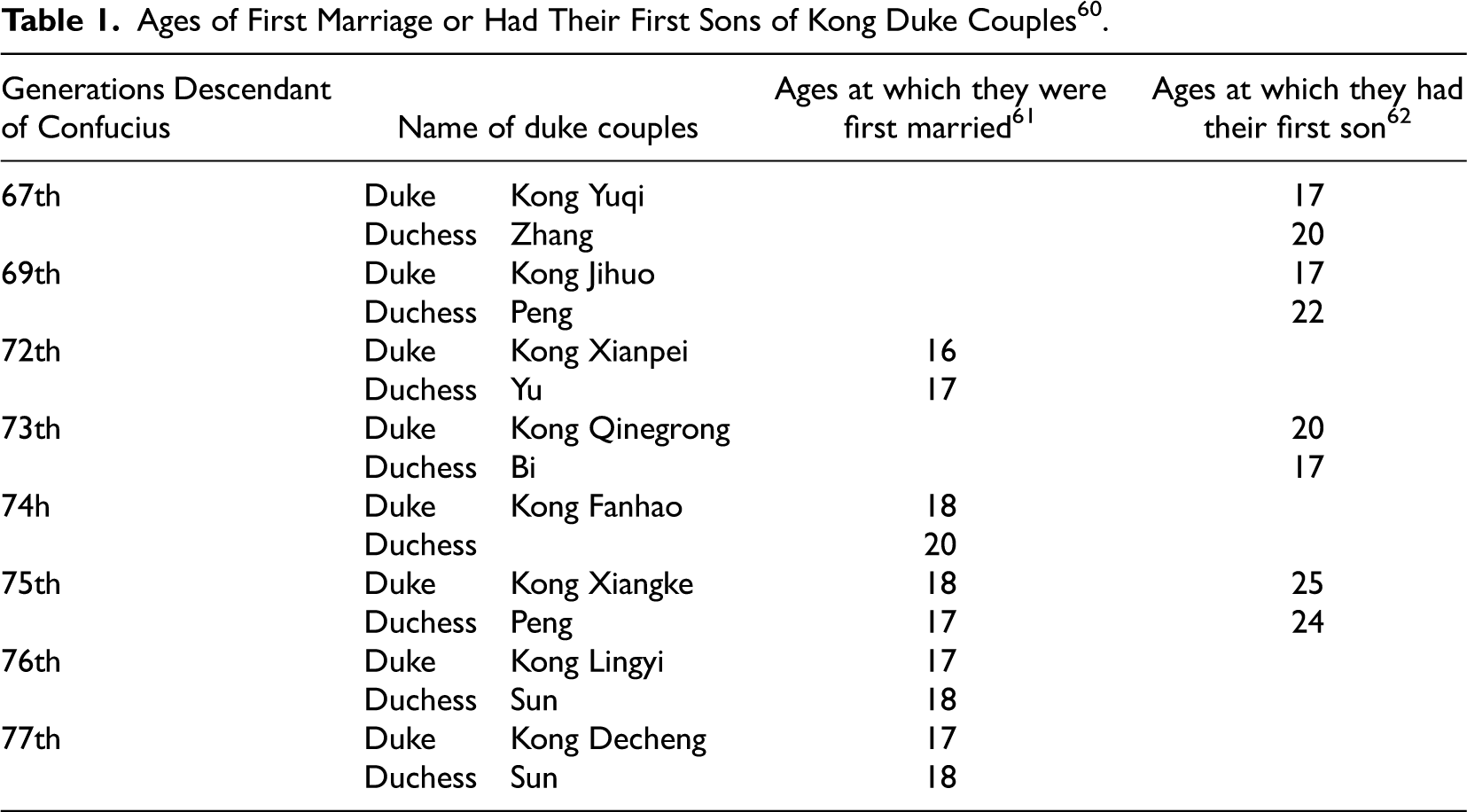
Second, early marriage is a common characteristic of the duke couples in the Kong lineage. At present, there are few direct historical materials on the marriage age of duke couples, so it is impossible to obtain detailed figures, but we can infer rough statistics from relevant materials (see Table 1). It can be inferred that the marriage age of Kong dukes was generally between 16 and 17 years, and that their wives’ age was between 16 and 18 years. According to the “Universal Etiquette of the Qing Dynasty,” (《大清通礼》) the legal age for marriage was set at 16 and above for men and 14 and above for women. 13 The age of first marriage of the Kong duke couples was closer to the earliest age limit stipulated by the government. In addition, compared with the marriage age of women in the whole country and Shandong Province in the Qing Dynasty, which was generally between 17 and 19 years, Kong dukes engaged in early marriage. 14
Ages of First Marriage or Had Their First Sons of Kong Duke Couples 60 .
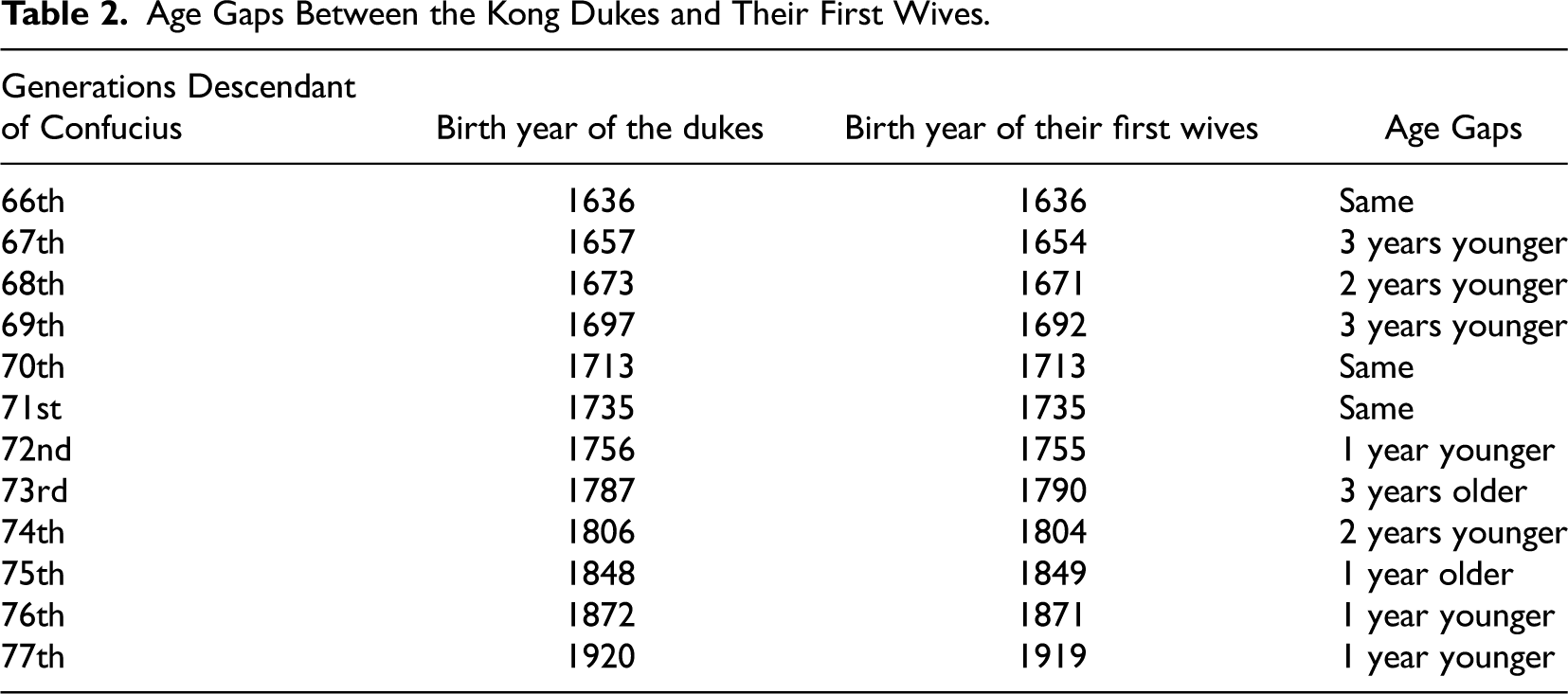
The third characteristic of these duke couples is that the first wives of dukes were usually older than the dukes. As Table 2 shows, among the 12 couples married during the Qing Dynasty, the age gaps between the dukes and their first wives were generally less than three years. 15 There were six couples where the woman was older than the man, three couples of the same age, and only two couples where the man was older than the woman. Duke Kong Jihuo was five years younger than his wife. This set of data contrasts sharply with the findings of Professor Liu Cuirong’s investigation of the age difference between husbands and wives in the Ming and Qing Dynasties. According to the statistics of 46,680 first-time marriage couples in the Ming and Qing Dynasties, Professor Liu concluded that 17.66% of the couples were of the same age, in 62.82% of the couples the husband was older than the wife, and in 19.52% the wife was older than the husband. 16 The fact that the Kong dukes were younger than their first wives in many cases clearly did not fit the social trend of the Ming and Qing Dynasties.
Age Gaps Between the Kong Dukes and Their First Wives.
The fourth characteristic of the marriage of these duke couples is that the Dukes for Fulfilling the Sage would remarry when their wives died, but when the Dukes died, their wives stayed with the Kong lineage rather than remarry. The Confucius lineage genealogy states the following: “The ritual–legal eldest son should have a wife even at the age of 70, but the other sons can have none.” 17 which means that the duchess was indispensable in the lineage. When the duchesses died earlier than the dukes, even if the dukes had concubines, who could not be raised to wives because of the need to comply with etiquette system and lineage interests, they would marry again. Among the 12 dukes that inherited the dukedom from the Qing Dynasty to the Republic of China, 6 dukes married after their wives died, of whom Kong Yuqi, Kong Chuanduo, and Kong Fanhao remarried twice. The successor wives were married at the right age for marriage, so they were all younger than the remarried Kong dukes. The third wives, Huang, Xu, and Bi, were 20 years younger than their husbands.
The four characteristics of these marriages of duke couples since the Qing Dynasty provide sufficient evidence on the indispensable position and function of the role of duchesses in the Kong lineage. The wives came from senior official families and famous literate lineages ensured the high quality and the ability to manage the lineage of them. Early marriage could allow duke couples to learn and assume the responsibility of lineage management as soon as possible. Duchesses were older than dukes, not only because of the duke’s reproductive needs, but also because an older duchess was more capable of managing the entire Kong lineage with the dukes. The dukes remarried with younger successor wives after their first wives died. However, after the death of the dukes, the duchesses chose to value women’s chastity and stayed in their husband’s lineage. This phenomenon made the duchesses the most stable members of lineage management, especially after the father duke died and the son became a minor duke. Furthermore, among the other lineage members who coveted the dukedom and the management rights of the lineage, the duchess became the best candidate to stabilize the lineage order and support the minor duke.
Duties of the Duchesses in the Lineage Administration
For more than 2,500 years, the Kong lineage was granted titles, fiefs, gold, and silver, and mansions by the rulers of successive dynasties to show their respect for Confucius and the promotion of Confucianism. The lineage not only held approximately 91,000 acres of “sacrificial fields” (sitian祀田), 18 but also a large number of private farmlands, temples, manors, and cemeteries under Qing Dynasty, and the number of male lineage members have exceeded 20,000 in Qufu. 19 The Kong dukes and duchesses were in charge of this great lineage and were responsible for the state’s worship of Confucius in Qufu and for receiving the emperors and officials who came to offer sacrifices.
Since the Ming Dynasty, as Kong dukes were appointed as first-level officers, the duchesses were also given the title of “Yipin Mandate Madame” by the emperor after marriage. As hostesses of the Kong lineage, the duchesses were in charge of the seal of the Kong lineage and Kong dukes’ personal seal of finance to assist the dukes in managing the affairs of the lineage. The seals symbolized lineage power, especially financial power and command power. Although there was a special seal official in the ducal mansion, usually the power of keeping and controlling the seals was in the hands of the duchesses. Whenever the seal was used, the Duke signed the official document, and then the seal official took it to the duchess’s office to report and to use the seal. 20 This means that, first, the duchesses could exercise the duke’s rights while the duke was away; second, it was natural that when the duke died, the duchess could hold the seal and support the young successor as his ritual–legal mother (嫡母). This is illustrated later in this article.
The Kong duchesses also undertook many internal affairs that were considered to be the responsibility of a leader wife of Kong lineage. They Participate in various sacrifices in the lineage temple, and led the wives of Kong lineage to salute in the temple after the sacrificial ceremony. 21 They served the elders, 22 managed the large group of servants, dealt with household chores, 23 and worship various Taoist gods and Buddha statues. 24 During the Qing Dynasty, the emperors visited Qufu many times to worship Confucius. The Kong duchess assisted her husband in preparing meals, inspecting tribute offerings, and accompanying the emperor on his travels. She also provided lodging, drinks, and food for the accompanying senior officials in a thoughtful and meticulous manner to made the duke “had no worries inside.” 25 They are also free to control the land in their dowry and decide on the ownership of the land after their death. 26
Key Figures in Stabilizing the Lineage During the Transition Period
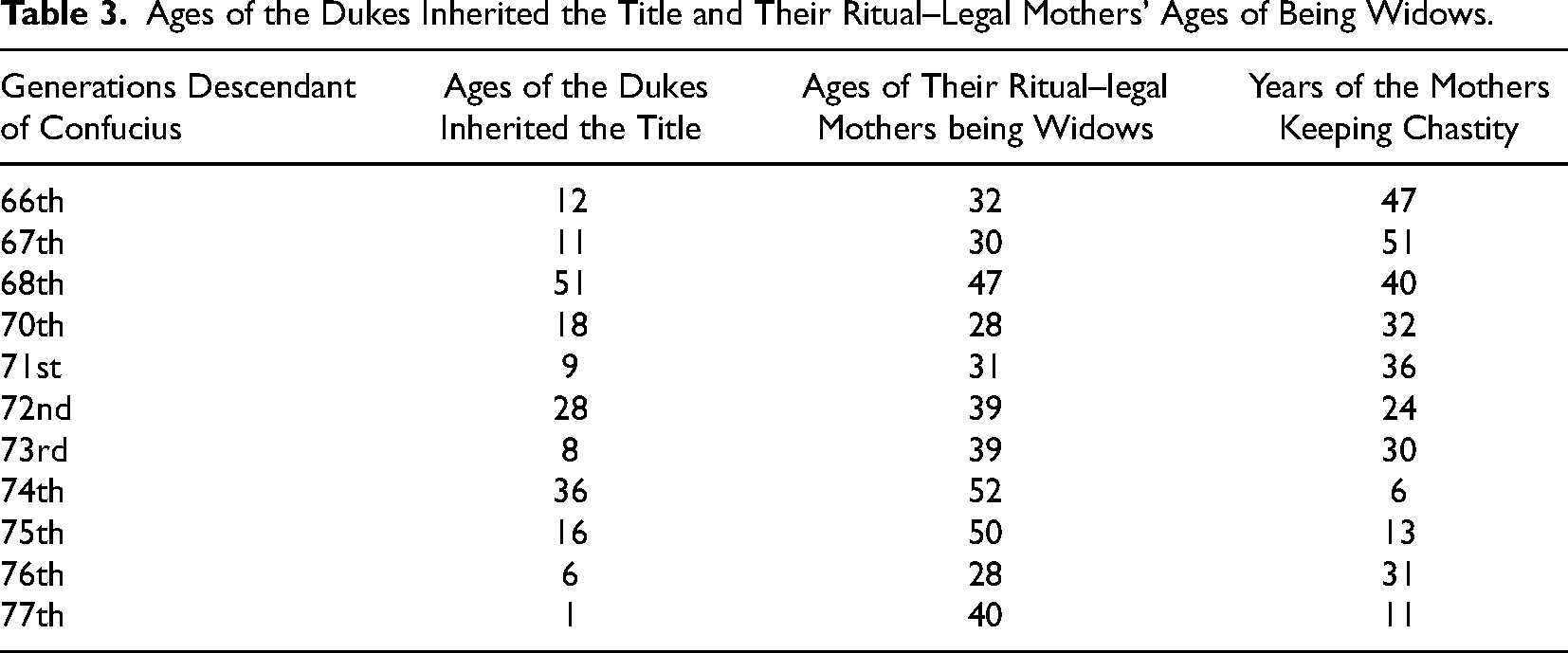
From the Qing Dynasty on, most of the Kong dukes were young men. Duke Kong Yanzhi, the 65th-generation descendant of Confucius, died in the third year after the establishment of the Qing Dynasty. According to the lineage pattern whereby the “father died following the son,” 11 descendants inherited the title; 27 only 3 of them inherited the title after the age of 20, and the other 8 inherited the title at the ages of 12, 11, 18, 9, 8, 16, 6, and 1 in that order. After the death of the dukes, the duchesses stayed in the Kong lineage as a widow for 30 to 50 years until they died (see Table 3). 28 Whenever the title of duke was transmitted between generations to a young successor, the Kong lineage was prone to disorder, and the other branches fought for power and benefits, giving rise to crisis. The duchess thus became a key force to stabilize the lineage and support the young duke.
Ages of the Dukes Inherited the Title and Their Ritual–Legal Mothers’ Ages of Being Widows.
The Transformation of the Role and Power of the Duchesses
After the death of the dukes, the seals were maintained by the duchesses until the successor became an adult and married, and the duchesses’ role was changed from comanaging to directly managing the lineage, which meant that the duchess became the actual manager of the lineage.
In 1875, the mother of Duke Kong Xiangke passed away. The next year, Kong Xiangke also passed away, and his son Kong Lingyi was only four years old. All the burden of the lineage was placed on Duchess Peng, who was 37 years old. Mrs. Peng suffered many misfortunes, sank into grief, and did not eat for many days. It was a sudden disaster in the Confucius Mansion. While some in the lineage helped, others sought to take advantage of the crisis to seize the title of duke. Duchess Peng drew herself together, handled the funeral matters, called on honest clansmen to help with domestic matters, and solved the problems in person. 29 Finally, with the strong support of Peng, Duke Kong Lingyi was able to successfully take the title and avoid chaos in the Kong lineage. Duchess Peng became the most stable force in the lineage and played a key role in supporting the young Duke and securing a smooth transition for the lineage in the critical period.
When the duke was young, the scope of contention for the management power of the lineage was limited to the mother-in-law and daughter-in-law. A good example is the case of Duchess Cheng who sued her daughter-in-law Duchess Yu for control of the government seal and allowed her nephew to intervene in public affairs in 1799. Duke Kong Xianpei, the 72nd-generation descendant of Confucius, died at the age of 38 in 1793. He had no children and had taken Kong Qingrong, the eight-year-old son of his younger brother, Kong Xianpei, as his son. Duchess Yu, his wife, and was in charge of the ducal seals. In 1799, Duchess Yu’s mother-in-law Duchess Cheng filed a lawsuit against Yu with the governor of Shandong, claiming that Yu’s nephew sold land secretly and embezzled money. Finally, the emperor learned this to be true and gave the order that Kong Xianzeng replace Kong Qingrong in the management of the lineage until Kong Qingrong reached age 20, and Yu was placed under the control of Cheng. 30 However, as the duchess and ritual–legal mother, Yu still had a greater influence in the lineage. Just as what she stated to Kong Qingrong: “You came over with me at the age of seven. I taught you every great and small event in the lineage.” 31 A few years later, Kong Qingrong’s grandmother Cheng and his biological father Kong Xianzeng died one after the other, and Yu became the most important elder of the lineage. It can be seen that despite the interference of her mother-in-law, Yu was always the actual manager of the Kong lineage after her husband’s death. 32
The First Lady Fully Performing the Duties of the Kong Duke
It can be seen from the private archives of the Kong lineage in Qufu that the eight dukes who inherited the title in their infancy from the Qing Dynasty to the Republic of China all had records of their mothers who managed the Kong lineage before they were 20 years old. For example, in 1670, the governor of the temple recommended staff to the “Old Lady.” 33 According to the Kong lineage history, it can be inferred that at that time, the duke was 17-year-old Kong Yuqi, and the “Old Lady” refers to his mother Duchess Lv. In 1862, the land officer of the Kong lineage reported the situation of rent collection to the “Old Lady and the Duke.” 34 At that time, the “Old Lady” referred to Duchess Bi Jinghuan, the third wife of Duke Kong Fanhao, who died in 1862, and his son Kong Xiangke received the title of Duke for Fulfilling the Sage at the age of 16. In 1881, Li Chengxu, the steward of Xicang, asked for instructions from the “Old Lady and Duke” (i.e., Peng and the 10-year-old Duke Kong Lingyi) to specify the boundaries of the lineage farmland. 35 In 1796, the emperor Jiaqing ascended to the throne. Mother-Duchess Yu personally brought 10-year-old Duke Kong Qingrong to Beijing to celebrate, and under her command, Kong Qingrong received the emperor’s appreciation. 36 In 1887 and 1906, Duchess Peng led Kong Lingyi to meet the Empress Dowager Cixi and was even appointed by the Empress Dowager general director of a school of nobles and daughters. 37
When Duke Kong Decheng was still a child, Tao, the ritual–legal mother, took charge of the Kong lineage. The Daily Diary of Tao recorded the main affairs of Tao’s life every month: “In July of the 9th year of the Republic of China (1920), the Old Lady let the leader Kong Zhaozheng select 40 excellent persons from the Kong lineage as deacons. On the sixth of August the mason carried the stones to the cemetery and began to repair them. The Old Lady went to the cemetery from time to time to watch over everything. On September 8, the Old Lady sorted out ancient music, hired teachers, and enrolled 20 people. In October, the Old Lady convened a public discussion to draft the words of every Kong generation. On the eighth day, the Old Lady led the officials of the Kong lineage to receive the emperor’s appointment document, and called a lineage council to discuss the funeral of the old duke. In December, the old lady ordered the people in the Confucius Mansion and the neighborhood to stop gambling. In June of the ten years of the Republic of China (1921), the old lady renewed the musical instruments in the Confucian Temple and added 84 sacrificial garments. She also ordered the guard officer to investigate and estimate the buildings of the Mansion, Temple and Cemetery of Confucius. In September, the Old Lady ordered the manager of the Ziyang factory to find out whether the factory had lost ground and truthfully reported. In May of the 11th year of the Republic of China (1922), the Old Lady ordered the heads of 60 households to investigate the lineage of each household, submit a catalog, and prepare for compiling the genealogy. In June, the Old Lady consulted with the clansmen to establish the ancestral hall and reconstruct the three halls of the East School. In February of the 12th year of the Republic of China (1923), the Old Lady went to Beijing with the duke to see the president report the sacrifice of farmland and rent tax, and secured an engagement for the eldest daughter. …… In September of the 14th years of the Republic of China (1925), because of the civil war, the Old Lady asked the governor of Shandong Province for protection of the Mansion, Temple and Cemetery of Confucius.
38
Thus, we can see that the duchesses had taken the dukes’ places in charge of the entire lineage and were deputies for the dukes in public office. Their scope of management went beyond the Kong lineage, and they had direct or indirect involvement in national and local affairs.
Extension of the Influence of Duchesses
Even after the Duke came of age at 20 and took power himself, 39 the duchesses continued to participate in the management of lineage affairs.
During the reigns of Xianfeng and Tongzhi, Hongze Lake was flooded and the farmland of the Kong lineage was lost. The rent returns could not support the sacrificial needs, but the officials in charge perfunctorily handled the situation. Duchess Peng had to report to the Empress Dowager Cixi during her 60th birthday celebration in 1894 and let the ministers of Jiangnan rearrange the survey and regulation. At that time, Duke Kong Lingyi was 23 years old, but Duchess Peng could still participate in the management of lineage affairs. 40
In 1819, Duke Kong Qingrong presented gifts for the 60th birthday of Emperor Jiaqing. It was an important matter to the Kong lineage, so the mother duchess helped to prepare the gifts. 41 Even though the 36-year-old Kong Qingrong had personally been in charge of the Kong House for many years, before the Mother Duchess Yu died in 1823, she still told Kong Qingrong the following: “From now on, be careful you’re your words, drink less, do not be promiscuous…Handle official business and lineage affairs carefully, follow all the old rules, and be cautious in employing people. I can die in peace.” 42
During the reign of Emperor Daoguang, Kong Qingrong, the 73rd generation descendant of Confucius, was ordered to refurbish the Confucius Mansion, but the project had not yet been completed when Kong Qingrong died. Although his son Kong Fanhao was already 35 years old at that time, he was still at a loss at such a critical moment. Finally, under the guidance of his mother, Duchess Bi Huaizhu, he simultaneously completed the repairs of the mansion project, held the funeral of Kong Qingrong, and participated in a new duke’s inheritance and other events. 43
It can be inferred from the above that, under the influence of the inertia of management and the authority of the mother, the administration of the mother duchess could extend to the adulthood of the dukes and even until the duchesses’s death.
Reasons Why the Duchesses Dominated the Kong Lineage
We can see the reasons for such authority of the duchesses by analyzing the unique Kong lineage culture, the social background at that time, and the duchesses’ original families.
Unique Culture of the Kong Lineage
As descendants of Confucius, the Kong lineage in Qufu had lasted for more than two thousand years and had a special identity in ancient times. The lineage culture inherited ancient traditions, maintained the mode of old lineage management of primogeniture, practiced the theory of ideal lineage ethics of Confucianism of the times, and constituted a prototypical representative of the Chinese lineage under the guidance of Confucianism. In this lineage structure, the elder brother leads the younger brother, the husband and wife are one, and wives and concubines are different.
First, the lineage management of the primogeniture system not only endowed the duchesses with high status, but also required their participation in lineage management. Until the Qing Dynasty, the Kong lineage always maintained the conventional management mode of the lineal primogeniture system (dazongzhi大宗制), Meanwhile, the emperors showed special attention to Kong dukes by giving them some special treatment, such as allowing them to retain their title and lands from the previous dynasty, protecting the Kong dukes’ position from other heirs, meeting them regularly, and giving them a lot of rewards. 44 The ancient lineal primogeniture system of the Kong lineage was strictly implemented under the intervention and protection of the emperors. 45 Furthermore, under the ancient system of management, under the influence of the gender concept of husband and wife as one, the eldest son and his wife ruling together in the lineage. 46 Influenced by this tradition, the Kong dukes and their wives all had the highest power and status in the Kong lineage in Qufu.
In this inheritance system, when the successor was not yet of age, in order to prevent the power of the successor from being seized by other heirs, it was inevitable for the wives, who had no right of succession but had high lineage status, to exercise the power of the dukes. This model whereby leadership and authority devolved to the matriarch had been applied in the imperial lineage since ancient times. That is, when an emperor dies and the heir is too young or there is as yet no designated heir, or when the emperor or heir is unfit or incompetent, it was common practice for the empress to step in as regent so as to prevent the emperor from being framed by other heirs. In some cases, she continued ruling even when the heir assumes the throne (as in the case of Dowager Cixi at the end of the Qing). 47 To prevent the struggle between male heirs caused by the patrilineal inheritance system, maternal interference was inevitable.
Second, marriage in the Kong lineage was expected to follow Confucian ethics. That is, there were strict hierarchical differences between wives and concubines and the duchesses had an inviolable position in the lineage. According to the lineage rules (KongshiZuXunZhenGui), the Kong lineage should respect Confucian morality and advocate Confucian etiquette, and Confucian ethics were the priority in marriage. 48 Under the guidance of these rules, the duchesses were respected and trusted by the Kong lineage, and the hierarchical difference between wives and concubines was shown everywhere. For example, the concubines could not wear red clothes; when they are with the duchesses, they could only stand behind the duchesses and could not sit down; only the duchesses can receive guests, and concubines cannot attend all kinds of banquets. they can only receive guests by the Duchess, and concubines could not attend any banquets. 49
In addition, a concubine could not be promoted to a wife in Kong lineage. A typical example is Jiang, a concubine of Duke Kong Hongxu. Although Jiang gave birth to six sons of the duke, one of whom was confirmed as the duke’s heir, her identity and status as a concubine could not be changed, and she had to obey Duchess Yuan, the successor wife of Duke Kong Hongxu. 50 In this respect, the Kong lineage showed the characteristics of a general lineage in the Qing Dynasty, which was different from the imperial lineage. Emperors could and did raise concubines to empress if the empress died or he rejected her. Because the wives and concubines in the Kong lineage had very different backgrounds; the wife came from a lineage of equal status, while the concubine came from a lower lineage. When the wife died, it was conducive to the expansion of lineage interests to marry another wife of equal status. As a result, the duchesses could not be disturbed by the concubines in the Kong lineage, and their position in the lineage was stable and respected.
Joint Effect of Emphasis on the Concept of Chastity and Filial Piety in Qing Dynasty
The emphasis on women’s chastity reached its peak during the Ming and Qing Dynasties. 51 The country legally restricted upper-class women from remarrying. The Ming Dynasty’s Great Ming Hui Dian (《大明会典》) stipulated that “any woman who is granted a title by her husband or son is not allowed to remarry. If she does not comply with it, she will be relegated to the court and divorced.” 52 Mark Elvin states that in order to promote Confucian ethics among the people, the Qing court took the long-established system of chastity to an extreme. 53 The Great Qing Code (《大清律例》) stipulates the following: “A remarried woman shall not be titled. This is for the sake of honor. Women on a mission should remain righteous, and not marry again to disgrace their honor.” 54 For the wives of the dukes, these provisions meant that it was almost impossible for them to remarry after the death of their husband. However, as the mothers of the Kong duke of the next generation, with the emphasis on filial piety in feudal China, they gained a higher position in the Kong lineage. They could exercise their maternal rights to control their sons, and their power and status in the lineage became more stable.
Realistic Benefit Support Provided by Political Marriage
In the Qing Dynasty, although the government’s policy of emphasizing Confucianism made the Duke for Fulfilling the Sage a senior official, he was “originally just a major local official in Qufu.” 55 His actual power was limited to the lineage sacrifices and management of the descendants of Confucius, and he was not allowed to interfere in government affairs.
In order to maintain and expand their political and economic rights and interests, the ruling class or various vested interest groups often regarded marriage as a play on the political chessboard, and marriage circles of different classes and levels emerged having a common destiny and a stake in power. 56 The Kong duke, who was above the first rank of official, also had the advantage of marriage ties with high officials in the imperial court. Therefore, it was necessary to pay special attention to the selection of marriage partners.
Through an analysis of the official ranks of the fathers and grandfathers of the wives of Kong dukes, we can see that they were mainly officials in the Ministry of Rites and the administration of Shandong Province, which were both closely related to the Kong lineage. Since the Qing Dynasty, among the 12 original wives, there were five wives whose fathers or grandfathers were secretaries of rites, three wives whose fathers were governors of Shandong, and four wives whose fathers were national secretaries of engineering, population and military. Seven of the nine successor wives’ fathers or grandfathers were officials of the Ministry of Rites or the administration of Shandong Province. 57
These departments, mainly the Ministry of Rites and the governorship of Shandong, had frequent contact with the Kong dukes and had interests related to them. For example, Chen Shiguan, a famous official of the Qing Dynasty, came from a literate family of Haining City, Zhejiang Province. His father, Chen Xian, served as secretary of the Ministry of Industry and the Ministry of Rites. During the reign of Emperor Yongzheng, when Chen Shiguan was the governor of Shandong, his son Chen Keguang married Zhenxiu, the granddaughter of Duke Kong Chuanduo, who was the 68th-generation descendant of Confucius. He had a good relationship with the Kong lineage and had been punished by the emperor because he cooperated with Kong Chuanduo to establish private farmhouses in Yanzhou. 58 In 1750, he became a Wenyuange Bachelor and the head of the Ministry of Rites. During this period, Duke Kong Zhaohuan married Chen Zhu, the eldest granddaughter of Chen Shiguan. In 1756, Emperor Qianlong once stated why Kong Zhaohuan dared to cover up for employees and interfere in government affairs: “They just relied on the marriage relationship with Chen Shiguan to intervene in local government affairs. Most of the Kong duke’s reports were discussed by the Department of Rites, which was managed by Chen Shiguan. They can rely on each other.” 59 This just was the reason why the wives of the Kong dukes came from the lineage of the officials of the Ministry of Rites. The close contact between the lineage from which the Kong duchesses came and the Kong lineage brought many practical benefits for the Kong lineage and increased the importance of the duchesses in the Kong lineage.
Conclusions
By analyzing the rights and status of the Kong duchesses in the Kong lineage of Qufu since the Qing Dynasty, this study finds that there was a huge difference between the nominal and the actual patriarchal system during the Qing Dynasty in China. As the wives of the dukes, the duchesses had great power in the Kong lineage. They took charge of the official seals in the Kong lineage and controlled the Kong ducal seals, which symbolized lineage power, and fully participated in the management of lineage affairs. This was especially true in the critical periods when the title of Kong duke was transmitted to the succeeding generation and the next duke was not yet of age in the Qing Dynasty, at which time the duchess took the place of the duke and became the highest decision maker of the lineage. Although the decisions of the duchesses only appeared in the name of the dukes in the official documents, indicating great concealment, their existence should not be ignored.
Through an analysis of the reasons why the duchesses had great power in the Kong lineage, this paper argues the following three aspects: First, hereditary patriarchal lineages gave women lineage management rights in order to prevent other male heirs from competing for lineage power. Second, the state’s emphasis on chastity plus the corresponding system of constraints made them choose to voluntarily remain widowed after the death of their husbands, and they became a reliable force in their husbands’ lineages; the concept of filial piety made them the authority of the next generation of descendants; as a result, the emphasis on filial piety and chastity of women in China helped to improve the status of women in the lineage. Third, political marriage highlighted the importance of women and provided realistic support for the promotion of women’s status in the lineage.
From the perspective of women, the Chinese upper-class women represented by the Kong duchesses were more constrained by the system and morality in the Qing Dynasty. They served the interests of the lineage, pay more attention to the concept of chastity and played an irreplaceable role in the husband’s lineage. At the same time, striving for the status and influence within the lineage also became their lifelong direction.
Footnotes
Declaration of Conflicting Interests
The author(s) declared no potential conflicts of interest with respect to the research, authorship, and/or publication of this article.
Funding
The author(s) disclosed receipt of the following financial support for the research, authorship, and/or publication of this article: This work was supported by the The National Social Science Fund of China (grant number 18BZS131).
