



Abstract
The son-in-law of the Qing emperor was given the title of “efu.” Taking Han-Jun bannerman Sun Cheng-yun, the son-in-law of Emperor Kangxi, as the starting point, this paper explores the status of his family in the early Qing dynasty based on archival materials and biographies. Marrying up into the royal family through a princess had a certain impact on Sun's family in terms of his inheritance of a niru, the tenure of family members, and the family's hereditary titles. The examination of this family also provides some insights into the political status of the Han-Jun banner sons-in-law of the early Qing emperors.
Introduction
The Qing emperors controlled the royal marriages of princesses and clan women through the Zhi-Hun system, and the designated husbands were called “Efu” (额驸, Ma. efu). The selection of royal sons-in-law reflected the Qing emperors’ individual inclinations, which changed according to different political needs in different periods of the Qing dynasty. In the early Qing, the royal women's marriages were primarily to the Mongolian princes, but with the stability of Qing rule in the Mongolian area, this phenomenon started to change. In Emperor Qianlong's period, the number of princesses married to Mongolian princes decreased, yet the number of those married to Manchurian noble bureaucrats increased. 1 However, under the influence of the “Manchu-Mongol intermarriage” policy, this tendency in the middle and late Qing did not change the fact that the majority of the efu group were still Mongol princes; therefore, most researchers have given attention to the Mongol “Efu” group. These researchers include Oka Hiroki on the efu family of Sangjaidorji, 2 Du Jiaji on the family of Senggerinchin and the princes of Kerchin; and Uniulaγan, 3 Wang Shengjiang, 4 and Du Jiaji 5 on Oirat Mongolian efu Abao (阿宝额驸). In addition, Evelyn S. Rawski argues that Qing emperors managed to absorb Mongolian efu into their social network by letting them pay visits to the court and giving their sons the opportunity to live and study in capital. 6 Du Jiaji also conducted a more comprehensive study on “Manchu-Mongolian marriage” and the Mongolian efu group. 7
However, what cannot be ignored is that there are also many Ming generals who, after surrendering to the Qing dynasty, turned into Manchu royal sons-in-law. For example, during the early period under Nurhaci when the Manchus had not yet marched to Shanhaiguan, Li Yongfang, although regarded as a Han, was still married to Nurhaci's granddaughter, so that he could be effectively used to fight against the Ming Dynasty. This decision made Li Yongfang the earliest royal Han son-in-law in the Qing dynasty. After the Qing dynasty claimed the Central Plains, the surrendered generals of The Three Feudatories (“三藩,” territories in southern China bestowed by the early Manchu rulers on the three generals), and their descendants also successively became the royal sons-in-law of the Qing ruling family. In this regard, Liu Xiaomeng discusses the selection, ranking, and status of those sons-in-law in the early Qing dynasty and argues that the Qing court married clan women to the first descendants of the Three Feudatories to enlist and control the governing families of those regions. Moreover, exceptional promotions were also granted to make them occupy the most prominent position among the Han officials of the court at that time. This intention was aiming at profound changes in power and allegiance, yet it did not effectively erase the conflicts between the court and the Three Feudatories. 8 In terms of the studies on other Han Efu, Watanuki Tetsuro describes the relationship between Sun Kewang and the royal family. In the discussion of Shang Kexi's clan and the process of their banner compilation, Hosoya Yoshio makes a point that one of the reasons why Shang Zhilong and Geng Zhaozhong's five niru were affiliated with the top three Han-Jun banners is because they have the title of “hošoi Efu.” 9 Yang Zhen believes that Wu Yingxiong, one of the leaders of the Three Feudatories, was eventually executed not only because of the rebellion of Wu Sangui but also because of his planned participation in Yang Qilong's uprising. 10
Among the abovementioned studies, however, few give perspectives in terms of Han-Jun (汉军, Ma. ujen cooha, Chinese bannermen) bannerman Sun Chengyun. In discussing Han-Jun's Xunjiu Zuoling (勋旧佐领, Ma. Xunjiu Zuoling, a category of niru organizations, which is usually given to the founding family by the emperor), Watanuki Tetsuro noticed that Sun was rewarded as with the title Xunjiu niru after marrying up into the royal family, but the development of Sun's family remains unexplored. 11 Yun Limei studies nine Efus during Emperor Kangxi's reign, as all of them or their ancestors contributed to pacifying the rebellion of Zunghar. Yun then believes the standard for Emperor Kangxi's selection of efu is tied closely to the war. 12 Zheng Tianting, 13 Yang Xuechen, 14 and Qiutang 15 use the marriage of Sun Chengyun to explain that the Qing dynasty did not fully prohibit interracial marriage between Manchus and the Han. However, importantly, both Manchu and Han efu not only have the title of royal sons-in-law but also have strong backgrounds including support for royal marriages and military exploits, representing the great families and nobles that belong to the Eight Banners. Regarding the great families of Han-Jun in the Qing dynasty, Lei Bingyan includes some discussion on the royal marriages of Han-Jun families in the early Qing dynasty as represented by Tong Yangxing, Li Yongfang, Shi Yanzhu, and Li Jixue, without further introduction to Sun Chengyun and his family. 16 Mark C. Elliott used ethnic group theory to analyze different ethnic groups in the Eight Banners and attempted to explain the boundary between the “Manchu” and “Han” ethnic groups from the perspective of rulers. This provided inspiration for this article examining how Sun transformed from a Ming dynasty general to a Qing dynasty bannerman, although the final conclusion seems to have some deviation from his earlier research. 17
The above summary gives a brief review of the research on efu family history and the case studies of the Eight Han-Jun Banner families in the Qing dynasty, which may not be comprehensive but strongly shows the insufficiencies in current research. These lacunae may be because of the lack of a genealogy book or the relatively weak political background of Sun Chengyun's family, but regardless of the historical reasons we perceive for this absence, the research on political marriage or the history of the Eight Han-Jun Banner families does not have enough coverage of Sun's family, especially the strong influence they gained in privilege and political status from marriage with a princess. Therefore, as one side of the royal marriage, as well as one of the great families in the early Qing dynasty, Sun Chengyun and his family are the focus of this thesis. The thesis discusses how the Han-Jun efu Sun Chengyun and his descendants who also married clan women changed their identity from a surrendering family of the Ming Dynasty to imperial sons-in-law of the Qing rulers. Along with the royal marriages, their personal political life and family privileges have also been deeply affected. To explore the inheritance of titles in Sun's family, reference use is made of the First Historical Archives of China through the microfilm collection The Genealogy Archives of Hereditary [Succession] in the Eight Banners and the family members’ appointments are analyzed based on Qingshi Liezhuan and Qing Shilu (veritable records of the Emperor). It is believed that by summarizing and analyzing the features of Sun Chengyun's family, it will be easier understand the efu group in the early Qing dynasty.
Sun Chengyun's Father's Merits
Sun Degong, the ancestor of Sun Chengyun, was born and raised in Guangning. Sun Degong started his career in the military of Wang Huazhen, the governor of Liaodong in the Ming Dynasty. As the vice commander of the main force, Sun Degong was responsible for the defense of Guangning City and was recognized as Wang Huazhen's most trusted and bravest soldier. However, Sun secretly betrayed the Ming Dynasty. In 1627, while Nurhaci was about to attack Guangning city, Sun Degong lied to Wang Huazhen that the enemy had arrived at the city gates, which caused Wang to lead his army from the city in an escape to the Daling River in disorder. At the same time, Sun Degong led his subordinates to the Wang Chang Hillock, which was miles away from the city, lined up his chariots and beat drums to welcome the emperor Nurhaci's occupation. 18 Because of Sun Degong's surrender, the Houjin Dynasty took Guangning so easily that not even a soldier was lost; hence, Sun was rewarded with the title ilaci jergi jalai janggin (lieutenant colonel) 19 and promoted to Yizhou governor. During Sun's governance, he executed Mongolian robbers and captured Ming Dynasty spies who tried to lure Yizhou officials and civilians into rebellion. Sun Degong's efforts to express loyalty helped him gain deeper trust from the Houjin rulers. In 1634, Sun Degong was incorporated into Han-Jun plain white banner and promoted to ilaci jergi meiren i janggin (lieutenant general). 20 In the great battle of Songjin when the Qing army was entering the country, Sun Degong was in charge of supervising the red cannon team; because of his outstanding battle service, he was promoted to jai jergi meiren i janggin (2nd class of lieutenant general) in 1644. As a member of the Han who capitulated to the Qing dynasty, Sun Degong was mostly responsible for handling Han affairs. He mainly governed as the deputy general over the Shangyangbao people. In addition, Sun Degong also served as the emperor's eyes and ears. Zhang Cunren, who was also an important Han official, suggested to the Manchu emperor that he should “appoint more censors to broaden information sources, promote more loyal people like Sun Degong to focus on impeachment, so that we could better spread his majesty's benevolent government and national laws.” Compared to Sun Degong's achievements on the battlefield, his all-out allegiance and years of service by the side of Nurhaci are what affected his privilege profoundly. Not only was he promoted to a higher rank in the court but he also possessed the power to govern the niru (佐领, Ma. niru, the basic organizational unit of the Eight Banners). These factors all constituted the basis for his family's elevation to one of the founding nobles of the Qing dynasty.
If Sun Degong's allegiance was responsible for the rise of the family, his son Sun Sike is the member who expands it and gains the favor of the Qing emperor. Sun Sike, the second son of Sun Degong, played an important role in the major battles in the northwest and the pacification of the “Three Feudatories” rebellion in the early Qing dynasty. In 1656, Sun Sike was deployed in Hunan and triumphed many times on the battlefield. In 1662, northwestern Oirat Mongol invaded the Hexi area, and Sun Sike was then promoted to serve as the general officer of Gansu in 1663, together with Zhang Yong and others, to manage northwestern border affairs. In 1674, Pingliang Governor Wang Fuchen rose up in support of the rebellion of Wu Sangui and placed the Lanzhou area in crisis. Sun Sike led an army with the cooperation of Zhang Yong to first take back Lanzhou, then conquer Pingliang. In 1676, along with General Tuhai, Sun Sike broke the rebel army of Wang Fuchen and successfully pacified the rebellion in Shanxi and Gansu provinces. Emperor Kangxi was so pleased that he praised Sun Sike as “such a loyal and righteous man who always leads from the front. All enemies will be swept away wherever he goes. I'm so proud of him!” 21 . Sun also participated in the military operation of Emperor Kangxi against Galdan in 1695 and achieved some success. After the great victory, Sun Sike had the chance to present himself before Emperor Kangxi in Changchun Garden, Beijing. Emperor Kangxi rewarded Sun with personal poetry, a commemorative plaque, an official uniform and other clothes, which was a supreme honor for any of the Han-Jun generals in the early Qing dynasty. In addition to his excellent performance on the battlefield, Sun Sike also contributed to the governance of the frontier during his tenure as governor of Gansu. At that time, the Gansu region was located in the extreme northwest, facing problems from both Oirat Mongol invasions and a lack of crops. In response to the weakness of the military defense in the Suzhou area, he put forward constructive opinions on the state of military and production readiness in the Gansu region. In 1691, Sun Sike was awarded the title of Zhenwu General for his excellent performance in border management and military affairs.
The Qing dynasty was founded on the basis of military accomplishments, with special emphasis on battlefield achievements. As one scholar has stated, “The development of these noble families' power and privilege is due to two aspects: distinguished family backgrounds and their allegiances and their unparalleled achievements during the initial stage of the Qing dynasty.” 22 The achievements of Sun Chengyun's ancestors at different stages of the early Qing dynasty not only paved the way for the Sun clan to become one of the great families of the Han-Jun but also gained a solid foundation of trust from the Qing emperors, which set the grounds for the emperors to marry off princesses several times to the Sun family in the future.
The Royal Son-in-Law of the Family
Before the Qing dynasty entered the country, royal women were often seen by Manchurian rulers as a tool for political alliances. As Ding Yi Zhuang elaborates, “The chiefs, who competed with each other for prestige, found that women had another role to play and could be used as very effective tools when they needed to achieve certain purposes.” 23 The Ming surrender is another case in point; Nurhaci married his granddaughter by his son Abatai to the surrendered Fushun city guerrilla Li Yongfang, giving him the title “Fuxi efu (抚西额驸, Ma. fusi efu, because Li came from Fushun city),” the first Han efu in the Qing dynasty. After the establishment of the Manchurian reign of the country, this kind of marriage-based power-sharing regime was continued in the early days of the Qing emperors, with imperial princesses frequently married to nobles in Mongolia to maintain the Manchurian-Mongolian alliance. Other princesses were married to Manchu bannermen and the descendants of the surrendered Ming dynasty generals. According to the Qing dynasty royal family tree “Xing Yuan Ji Qing,” the Qing dynasty strategically married a total of 58 princesses, including the emperor's adopted daughter, including 31 women sent to Mongolia, 22 women to Manchuria, and 5 people to the Han-Jun bannermen. The five Efus were married to the 14th daughter of Emperor Hongtaiji Heshuo Quechun Princess Wu Yingxiong; the Shunzhi emperor's brother Prince Shuosai's daughter Heshuo Heshun Princess Shang Zhilong; Prince Yuele's daughter Heshuo Ruojia Princess Geng Juzhong; the Kangxi Emperor's ninth daughter Gulen Wenxian Princess Shun Anyan; and the Kangxi Emperor's 14th daughter Heshuo Quejing Princess Sun Chengyun. The grooms were each given the title of Gulun efu (固伦额驸, Ma. gurun i efu, the first rank in the efu title) or higher depending on the rank of the princess they married.
In the Kangxi period, in addition to the royal princesses, the daughters of the princes were also married by the Qing emperor to the Hans as well as to the Han-Jun banners. For example, Li Yonggfang's grandson Li Shengzong married a heshuo gege (和硕格格, Ma. hošoi gege, Qing dynasty princess title of the second rank) and was awarded the title heshuo efu (和硕额驸, Ma. hošoi efu, the second rank in the efu title). 24 Li Shuao, son of Li Shengzong, married a junzhu gege and was awarded the title of heshuo Efu. 25 After surrender, Li Jixue's grandson Nomutu married Prince Dai Shan's daughter, and in 1665 the emperor conferred the title of heshuo efu on him. 26 Li Jixue's fourth-great grandson Li Di married the eldest daughter of Prince Yabu and was awarded the title of heshuo efu in 1699. 27 Shi Tingzhu's son Huashan married Prince Duoduo's daughter and was awarded the title of heshuo efu. Sun Kewang's son Sun Zhengchun married in 1669 and was awarded the title gushan beizi (固山贝子, Ma. gūsai beise, the third rank of the Qing dynasty's peerage). The husband of Fu Lata's daughter was awarded the title of gushan efu (固山额驸, Ma. gūsai efu, the seventh rank in the efu title). 28 Sun Kewang's subordinate Wang Lin married gusai beise Shang Shan's daughter in 1662 and was awarded the title of gushan efu. 29 In the Kangxi period, to confer the efu title on Han men was mostly beyond the customs of the period, and consequently, these titles marked the beginning of the entry of the offspring of Han meritorious officials into Qing nobility. The Han efu are basically the descendants of the Han generals who surrendered early to the Qing. In this political context, Sun Chengyun, as the eldest son of Sun Sike, a meritorious Han-Jun bannerman during the Kangxi period, was also favored with the dowry of the imperial daughter.
In 1706, Sun Chengyun married the Kangxi emperor's daughter the heshuo quejing princess and was awarded the title heshuo efu. In the two sides of this marriage, or “the four genealogies of the Qing royal family,” the princess's mother was gui ren (贵人, the emperor's concubine) Yuan, who gave birth to her in 1689; the princess married Sun Chengyun at the age of eighteen. Sun Chengyun's birth year is unknown, but according to the description in the Sun Sike Xing Shu, Sun Sike died in 1700 when Sun Chengyun was just twelve years old. 30 The princess was presumed to have been born in 1689, which made her the same age as Sun Chengyun. However, this is only the age at the time of marriage; in fact, Sun Chengyun was designated as an efu much earlier. Fangbao, a famous literary scholar of the Qing dynasty, wrote a lament for Sun Chengyun after his death, saying, “Sun Gong, the son in law, was a native of Liaodong…. When he was a child, he was summoned to meet someone, that is, he was betrothed to a princess.” Thus, he was appointed as an efu when he was very young. Fangbao and Sun Chengyun had a good personal relationship, and this lament also recorded Sun Chengyun's character and conduct: “The efu was born noble, but his character was simple and natural.” 31
Following Sun Chengyun becoming a royal son-in-law, the Kangxi emperor married another royal granddaughter, his eldest son's daughter, to Sun Chengyun's brother Sun Cheng'en in February 1710. 32 Unfortunately, she died in 1711. Five years later, Sun Cheng'en remarried the Kangxi Emperor's grand-niece, the daughter of Haishan. 33 In addition, dowry gifts for the imperial daughter continued to enrich the next generation of Sun Chengyun's family. When Kangxi was sixty-one years old (1722), in the first month of that year, Kangxi again betrothed a royal granddaughter to Sun Chengyun's family, this time his son Wufu. 34 In June of that year, “Prince Lian's daughter was awarded the title of Xiangjun gege (乡君格格, Ma. gūsai gege, Qing dynasty princess of the last rank), and his son-in-law, Wufu, was awarded the title of heshuo efu.” 35 Thus far, in less than twenty years, three people in two generations of Sun Chengyun's family married royal daughters and granddaughters. Such a situation in the Qing dynasty Han-Jun banner was very rare, and it is clear that the Kangxi emperor deeply favored the Sun family.
In the Qing dynasty, marriages between large families were always valued for their social status; how much more so were the marriages to the royal family thus valued. In terms of the family background of the five Han Chinese efu mentioned above, Wu Yingxiong, Shang Zhilong, and Geng Juzhong were the sons of three federal kings with different surnames in the early Qing dynasty, and they were all granted titles as royal sons-in-law between Shunzhi and the early Kangxi years when the court still relied on the power of their fathers and families to pacify the remaining rebel forces in the south. Thus, granting them the title of efu contains an obvious intention to gain support. Efu Shun Anyan was born to the Tong family in Liaodong. His grandfather, Tong Guowei, was the brother of Emperor Kangxi's birth mother, Empress Xiao Kangzhang, and his sister was Empress Xiao Yiren, which meant that the Tong family itself was part of the imperial house. However, Sun Chengyun had neither a family background as great as the Tongs “half court” nor a political background as important as the three federal princes. The reason why Emperor Kangxi chose Sun Chengyun, a Han-Jun bannerman to be his son-in-law, with successive marriages of granddaughters to Sun's family, may be because he intended to unite the meritorious Han-Jun family. To be more specific, this thesis argues that there are two main reasons for Emperor Kangxi's choice. First, as indicated by Yun Limei, the standard of Emperor Kangxi's selection of efu ties in closely with the pacification of Zunghar's rebellion. 36 Furthermore, among the “Four Han Generals in Hexi” who served in the northwest in the early Qing dynasty, only Sun Sike is from the Han-Jun Banner that surrendered before the Qing entered the country. As far as we know, Sun Sike's father, Sun Degong, belongs to the “old Han,” affiliated with the “White Banner Han-Jun.” In addition to this banner identity, Sun Sike also served as the guardian of the regent Duergun in 1644. Considering the fact that Zhang Yong, Zhao Liangdong, and Wang Jinbao, the remaining three of the “Four Han Generals in Hexi” were not members of the banners, Sun Sike apparently exceeded them all in gaining the favor of Manchu emperors. If Emperor Kangxi intended to marry off royal women to these four Han families, Sun Sike was supposed to be the first choice because of his solid military achievements and ancestor's early allegiance. Second, Sun Chengyun is not the first person in his family to have royal marriages. In fact, Sun Sike's second wife is the daughter of Emperor Taizong's eldest princess. “The second wife, Ye, is the daughter of Emperor Taizong's eldest princess and gulun efu bandi.” 37 This means that before Sun Chengyun married the daughter of Emperor Kangxi, royal connections by marriage already existed in Sun's family, which could also be a favorable reason for Emperor Kangxi to continue to marry off royal women to members of Sun's family.
Family Privileges and Political Status
The gift of a princess in a marriage below her station to an efu was considered a great grace from the emperor in the Qing dynasty. As a husband of the royal family, after being given the title of “efu,” the groom's treatment would also be greatly improved in terms of official salary and political ritual. Taking Sun Chengyun's title “Heshuo efu” as an example, according to the regulations during the Kangxi reign, heshuo efu had a yearly salary of 255 ounces of silver and 157.5 piculs (1 picul = 107 liters) of rice. 38 In 1700, it was stipulated that the belt, uniform, and crest that heshuo efu used in ritual should share the same level as that of zhen guo gong (the fifth class of noble of the imperial lineage of the ninth rank), which may be said to be highly respected treatment. 39 However, compared to the privileges he received in the system, the more important thing to Sun was becoming the son-in-law of the emperor, which gave him the identity of a royal in-law. This identity shift had a profound impact on his family's political and economic privileges, which were deeply reflected in the family's political status.
Niru and Lands Awarded from the Marriage with Princesses
“Niru” are the grassroots unit of the Eight Banners. Originally, during Nurhaci and Hong Taiji's reigns, a large number of “niru” were established and allocated to royals and meritorious families as a reward. As one scholar noted, “No matter whether it is the royal relatives, or the meritorious families with different surnames, the foundation of their power lay deeply in the hereditary jurisdiction over their subordinates.” 40 Sun's family has two hereditary nirus, including one established in Tiancong eight years after Sun Degong's surrender to the Qing dynasty and inherited by Sun Degong's grandson Sun Youguang. Notably, the other niru came from the marriage of Sun Chengyun to the princess, which is rare in the transmission of niru. Another scholar stated, “Niru's formation, classification and development, as well as its inheritors, can reflect the master family's status in different periods.” 41 Therefore, Sun Chengyun's niru has a certain particularity from the perspective of family study. In Baqitongzhi Chuji and Qinding Baqi Tongzhi, it can be found that this niru is the eighth of the third Jiala (甲喇, Ma. jala, the upper organization of the niru, with five nirus within one jala) in the Han Jun plain white banner 42 , but records stop at the history of its inheritor, and no further details can be found regarding the context of its establishment and people structure. The thesis referred to the First Historical Archives of China for more details, and the status of Sun Chengyun's niru until the first year of Emperor Jajing is found in Baqi Shixi Pudang.
Regarding the initiation and people structure of Sun Chengyun's niru, the register includes the memorial from Niulu Zhangjing (牛录章京, Ma. nirui janggin, chief of a niru) WuFu (Sun Chengyun's eldest son) to Emperor Qianlong, which says that “In 1706, given that efu Sun Chengyun, the grandson of Sun Degong, cannot afford the cost of maintaining the princess's dowry which includes relatives and servants numbering more than 500 people, we here report to the court to discuss the establishment of a niru under Sun Chengyun's management.” 43 Since the princess was highly honored, her dowry often included a large entourage, including officers, guards, and servants. This file indicates that efu should supply the cost of living for the entourage; however, Sun Chengyun apparently was not able to afford it. After the discussion with court officials, “Sun Chengyun can have a niru made up of 297 idle people, which are selected out of the princess's entourage of 453 people and 146 individuals from Sun's family.” 44 The enormous disparity between Sun Chengyun and the princess can be seen in the people structure of this niru.
The character of the niru in the Qing dynasty was basically divided into hereditary Shiguan Zuoling (世管佐领, Ma. jalan halame bošoho niru, a category of niru organizations), Xunjiu Zuoling, and nonhereditary Gongzhong Zuoling (公中佐领, Ma. sidan niru, a category of niru organizations). In 1731, while defining the categories of niru, it was agreed that “the niru would be the Xunjiu Zuoling, as it was made up of the family of the princess and the people who belonged to the efu.” 45 Sun Chengyun's eldest son, Wufu, also received official recognition when he was granted the right of succession. In 1720, “Wufu requested that he be able to inherit the niru, and after checking the archives, it is true that this niru is a Xunjiu Zuoling, which reports to the Emperor for this purpose.” 46 Therefore, it can be further determined that this niru is Xunjiu Zuoling. The Xunjiu Zuoling was formed in the early Qing dynasty by tribal ministers who led their clansmen to defect to Nurhaci and were grouped into a niru, whose dependents were managed by the family for generations and which was inherited by the family of the original owner of the niru for generations.
The inheritance of this niru is recorded in the Baqi Shixi Pudang. This register records the succession of the niru from their formation from 1706 to 1802. The line of succession of this niru is found to be relatively stable, with no inheritors other than Sun Chengyun's first son, Wufu. According to the principle of “inheritance by the descendants of the person who first administered this niru,” 47 Sun Chengyun was succeeded by Wufu after his death in 1719 and subsequently by his grandson Sun Weizhen after Wufu's illness in 1774. In February 1779, Weizhen was dismissed from his post for cause, and in March, he was enjoined to continue managing the retinue. He was succeeded by his son, Qingcheng, in February 1802, after his death in 1801. The author has added the succession of Qingcheng in 1821 to the list of managers of the niru until 1821, based on the Weiyi Jinglice (Sun Weiyi's biographical profile). 48 Notably, after Sun Weixing's son Qingcheng inherited the niru in 1802, it was not inherited by his descendants but passed to his younger brother Qingchang. (For details, see Figure 1, the order of succession is indicated by the numbers in brackets.)
When the princess married Sun Chengyun, she brought a large number of people, in addition to the fields that had been allocated to her. In 1799, Sun Chengyun's great-grandson Qingcheng was suspected of having taken bribes in the army and had his assets liquidated, referring to the property here. Situated in Jizhou, the property covered an area of 31 hectares, 60 acres, and 5 min and 4 cents. 49 The field was owned by the princess and was inherited by the efu's family after her death. This is the economic privilege of the family from marrying the princess.
Official Positions and Their Characteristics
Due to the lack of genealogical information, there is no detailed information on the official positions held by members of the family. The author has compiled information on the positions held by members of the Sun Chengyun family from historical sources such as the Qing Shilu and biographical manuscripts. Family members held official positions: Sun Chengyun was sanzhi dachen (散秩大臣, an officer in the imperial guard); Sun Cheng'en served as luanyiwei (銮仪卫, the emperor's ceremonial guard) 50 ; Wu Fu served as toudeng shiwei (头等侍卫, the emperor's personal guard) 51 and hubu youshilang (户部右侍郎, deputy ministry of finance). 52 Sun Weiyi served as lanling shiwei (蓝翎侍卫, a type of imperial guard). 53 Qingchang served as sandeng shiwei (三等侍卫, a third-class guard), Minister of Hetian, and Minister of Hami. 54 Qingcheng also served as hubu youshilang (户部右侍郎, deputy ministry of finance), Zhili Tidu (直隶提督, governor of Zhili province), Chengdu Jiangjun (general of Chengdu city), Zongguan Neiwufu Dachen (总管内务府大臣, Ma.dorgi baita be uheri kadalara yamun i booi amban, chief steward of royal affairs), and Fuzhou jiangjun (general of Fuzhou). 55
An examination of the appointments of members of the Sun Chengyun family from the Kangxi to the Jiaqing periods reveals a number of features. First, from their starting point, almost all of Sun Chengyun's descendants had experience serving in the inner court. Among them, the main ones served as inner court guards, and there were even those who served in front of the imperial court as the imperial guard. Sun Chengyun was a sanzhi dachen (officer in the imperial guard); his son, Wu Fu, served as a toudeng shiwei 56 and was then promoted to the emperor's bodyguard. 57 Two sons of Wufu were members of the guard, one of whom served as a guard at the Qianqing Gate of the Royal Court, 58 while the other became a Lanling guard. 59 According to the Qing system, the inner court guards were selected from the Manchu and Mongol princes and nobles, and their sons and daughters were mostly close to the royal relatives. 60 The imperial guards were favored for their ability to serve close to the emperor and held the highest position in the guard system. Second, in terms of promotion to the post, it was easier to enter the central government or to serve as a frontier official as the starting point for the post of chamberlain. Both Sun Chengyun and his descendants obtained high office in this way. Third in importance was dealing with royal affairs. Many of Sun Chengyun's descendants served in the royal service, such as the guanli Yuanmingyuan shiwu dachen (管理圆明园事务大臣, the minister who manages the Yuanmingyuan) and zongguan neiwufu dachen. As an imperial guard, he was sometimes assigned by the emperor to deal with private royal matters. Emperor Qianlong sent his imperial guard Wu Fu to visit his mother, the empress dowager, in the Summer Palace on his behalf. 61
The experience of the sons of the Eight Banners serving at the inner court was very common in the Qing dynasty, and it was one of the ways in which they could go on to serve as local officials and stay in the capital to serve in the ministry, a manifestation of the privilege of the sons of the noble families of the Eight Banners. However, of Sun Dekong's four sons, only one, Sun Sike, continued this privilege. The descendants of Sun Sike's brothers had no significant role in Qing dynasty politics, and their deeds do not appear in Qing dynasty history. This is not unrelated to his status as a royal in-law. Some scholars have noted the inevitable link between “serving as guards” and “political alliances” in the development of the Qing dynasty, arguing that this was a political means for the Manchu rulers to unite the power of the tribes. 62 This explains not only the phenomenon whereby members of the Sun family frequently serve as guards in the inner court, which is the intended result of the Manchu rulers using marriage to associate the royal clan with meritorious subjects, but also that this “service as guard” and “marriage” was not limited to the Manchu-Mongol alliance and the Manchu nobles in the early Qing dynasty, but also included enlisting and uniting the Han-Jun banners. In addition, the family members who served as high-ranking officials mentioned above were all descendants of Sun Chengyun and his younger brother Sun Cheng'en, who had son-in-law status. The author found through searching the biographical historical materials of the Qing dynasty that other descendants of Sun Sike did not serve as high-ranking officials. Thus, it can be concluded that descendants of members of this family have special advantages in their official career, and this advantage has a clear directionality—only enjoyed by the descendants of the efu and the princess in the family.
Rank of Nobility
The hereditary nature of noble titles reflects the political status of the family. In the early Qing dynasty, official names and titles borrowed their names from the Ming Dynasty. The system of conferring hereditary titles in the Qing dynasty is a kind of military merit reward system, which is mainly aimed at those who have achieved merit whether in routine service or in the military.
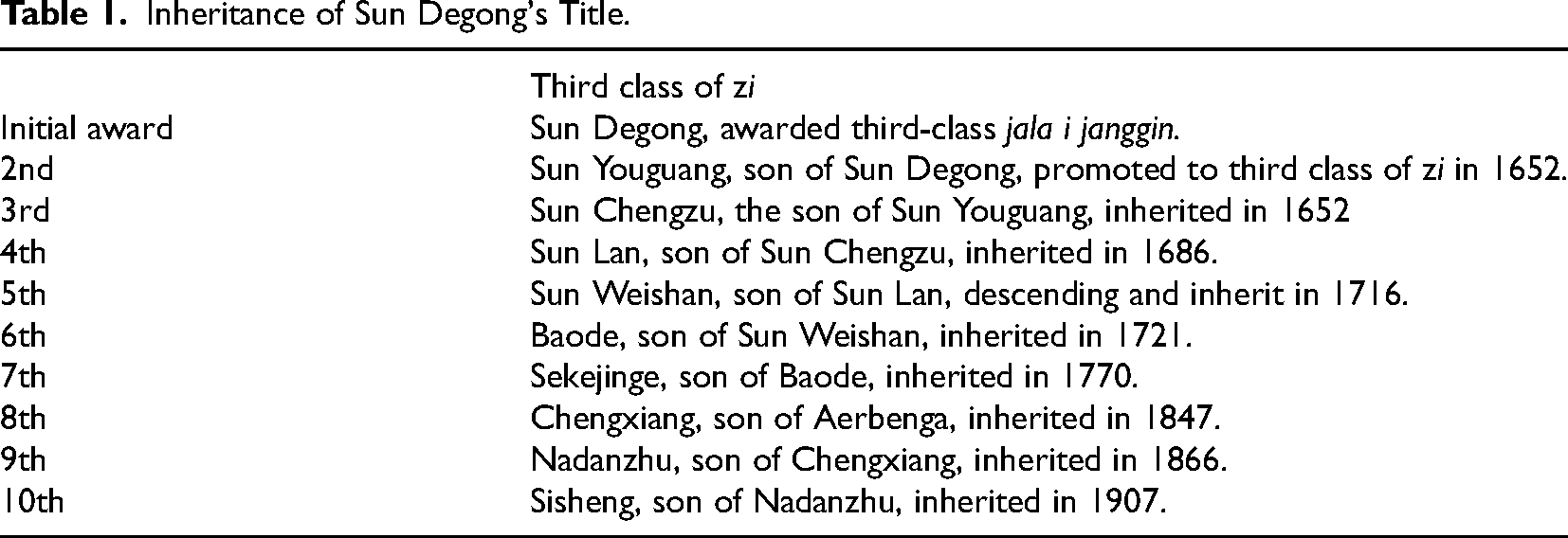
The Sun family was given two peerage titles for Sun Degong and Sun Sike. In 1621, Sun Degong was attached to the emperor and was immediately granted the title of third-class jala i janggin. After two years (in 1623), he was granted the title of third-class meiren i janggin for meritorious service in defending Yizhou city. In November, because of his old age, his eldest son Youguang inherited this title 63 and was promoted to the third class of zi (子, fourth class of noble of nonroyal members of the ninth rank) in 1652. Afterward, the title was inherited by Sun Youguang, the eldest son of Sun Degong.
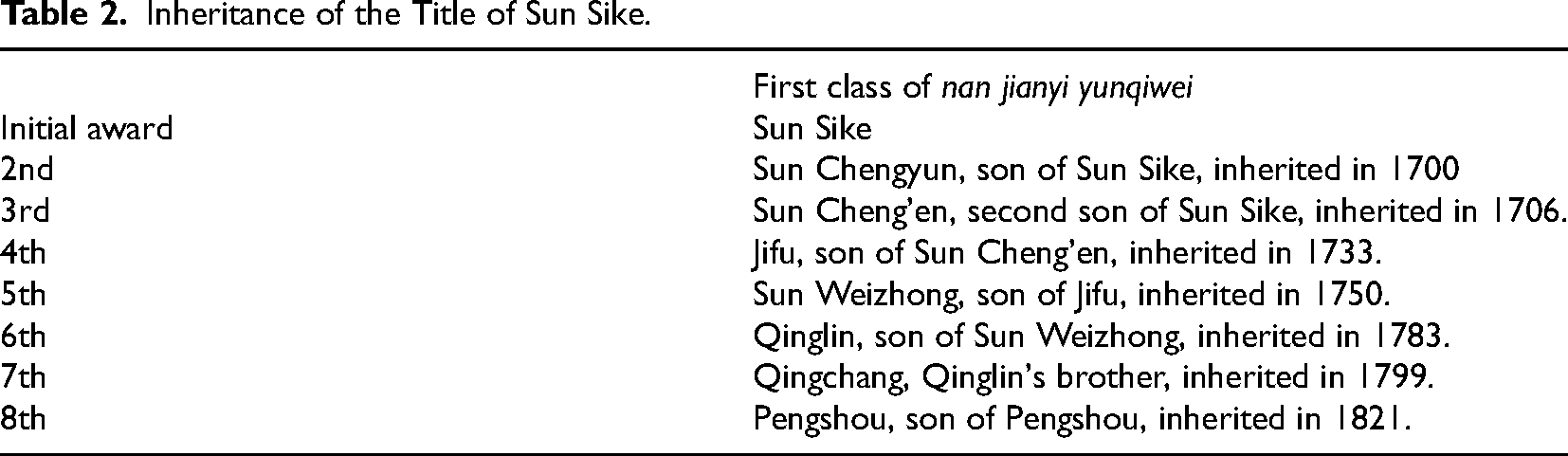
The First Historical Archives of China maintain records of Sun Sike's rank in the Zhengbaiqi Shiguanzuoling Xizhice (正白旗世管佐领袭职册, official documents of the Qing dynasty recording the internal situation of the Eight Banners organization). During his service in the northwest, Sun Sike was highly appreciated by Emperor Kangxi and was awarded the title of baitabure hafan (seventh class of noble of nonroyal member of the ninth rank) in his thirtieth reign year (1691). After his death in 1700, the emperor showed his respect by promoting his title to the first class of nan plus Yunqiwei (云骑卫, fifth class of noble of nonroyal member of the ninth rank). Subsequently, this was inherited by his son Sun Yun and was allowed to be passed on ten more times. However, after Sun Chengyun married the princess in 1706, the title was transferred to his younger brother Sun Cheng'en and later inherited by Sun Cheng'en's descendants. By 1767, the title could be inherited from generation to generation without being reduced. 64
Although the Sun family established a certain family political status in the early Qing dynasty through peerage and royal in-laws, similar to many Han-Jun families, the Sun family also inevitably experienced a decline in family talent after the middle of the Qing dynasty. In the thirty-ninth year of Qianlong's reign (1774), banditry broke out in Linqing, Shandong Province. Sun Weiyi, then the chief soldier of Yanzhou town, Shandong Province, went to Linqing as part of reinforcements to suppress bandits, but because he was “timid and retreated” in the battle, 65 Emperor Qianlong executed him. 66 After the Qianlong period, only Sun Qingcheng, the grandson of Wufu, had great military achievements in the family. After this generation, there was almost no record of the family's important deeds in the historical data of the Qing dynasty. Although the niru and the rank of nobility were still passed on, there were no outstanding talents in the family that could be compared with Sun Sike and Sun Degong, which meant that the influence of the family could not be expanded. This became the subjective reason for the gradual decline of the family status.
Conclusion
Being a multiethnic state with Manchus as the main ruling body, the Qing dynasty differs from other minority regimes in the choice of royal sons-in-law, which reflects the characteristics of multiethnic groups. The Liao dynasty's royal interethnic marriages were basically from the clan of the queen's family. 67 The Jin dynasty's royal marriages only happened within the great families of the Jurchen. 68 The choice of royal sons-in-law by the Qing emperors was not limited to Manchus. Some scholars believe that “Manchu-Han integration” was only a political slogan of Emperor Kangxi. 69 The Kangxi Emperor did not mind marrying their royal women to Hans, which objectively caused the fusion of Manchu and Han bloodlines. The descendants born to the efu and princess became mixed Manchu and Han. Although they were still under the Han Jun banner, these mixed ethnicity lines did show a tendency toward “Manchurianization”—the descendants of the Sun family changed their names to Manchu (Table 1 and Table 2). The changes in bloodline and cultural identity were a crucial part of the Sun family's transition from a Ming dynasty military family to a Qing dynasty Han Jun bannerman and an important characteristic that sets this family apart from other Han Jun families.
Inheritance of Sun Degong's Title.
Inheritance of the Title of Sun Sike.
The Qing dynasty successfully brought the Suns into the political structure by incorporating them into the Eight Banners and marrying them off the royal women. Sun Chengyun, as a representative of Han-Jun bannermen, having inherited his ancestors’ merit of allegiance, and his father's merits from battlefield achievements in the northwest, gave his descendants the opportunity to marry into royal family and inherit the political title for generations. In charge of a niru, the Suns served the state as high officials among their other privileges. Finally, they completed the transformation from the descendants of the surrendered Ming dynasty generals to the royal sons-in-law of the Qing dynasty. In this process, the relationship with the royal in-laws had a decisive influence on the privileges of efu families and the formation of their political status.
Watanuki Tetsuro believed that the royal daughters who married Hans under Nurhaci's reign were all daughters of concubines, reflecting the low political status of Hans in that period. This situation changed in the Taizong period, and the family of the royal woman who married Hans changed from the general branches of the imperial family to include the noble leaders of the Eight Banners, reflecting the rise in the political status of Han-Jun banners from Hong Taiji's reign. The marriage of royal women in the Qing dynasty was completely controlled by the emperor, which means that the emperor had his own political considerations for the selection of efu. Ministers regarded the ability to marry royal princesses as a special reward from the emperor. The second part of this article shows that there were only five Han Jun bannermen who were able to marry the emperor's daughter throughout the Qing dynasty, and all of them were descendants of the “Jiu Hanren (旧汉人, Ma. fe nikan, a group of Hans who surrendered earlier to Nurhaci and had closer ties with Manchus).” This kind of “bounty” is not granted as casually and frequently as ordinary material rewards. It was precisely due to the emperor's cautious choice of the princess's marriage partner that he did not consider “becoming a son-in-law” as an incentive policy for ministers to increase their meritorious deeds. In contrast, as a “non-Manchu,” Sun was able to become the son-in-law of the Manchu emperor, highlighting the special rewards and recognition from the emperor himself. It is undeniable that objectively, this approach indeed elevated the political status of the Sun family. Although the Rebellion of the Three Feudatories deepened the estrangement between the Manchu nobles and the Hans, afterward, the marriages between the royal family and the descendants of the “Jiu Hanren” were not curtailed; indeed, the political status of the Han-Jun bannermen, as sons-in-law, did not seem to be impacted by the rebellion. In contrast, Sun Chengyun's father also won merits for military service because of his participation in quelling the rebellion, which became an important basis for the development of his family status.
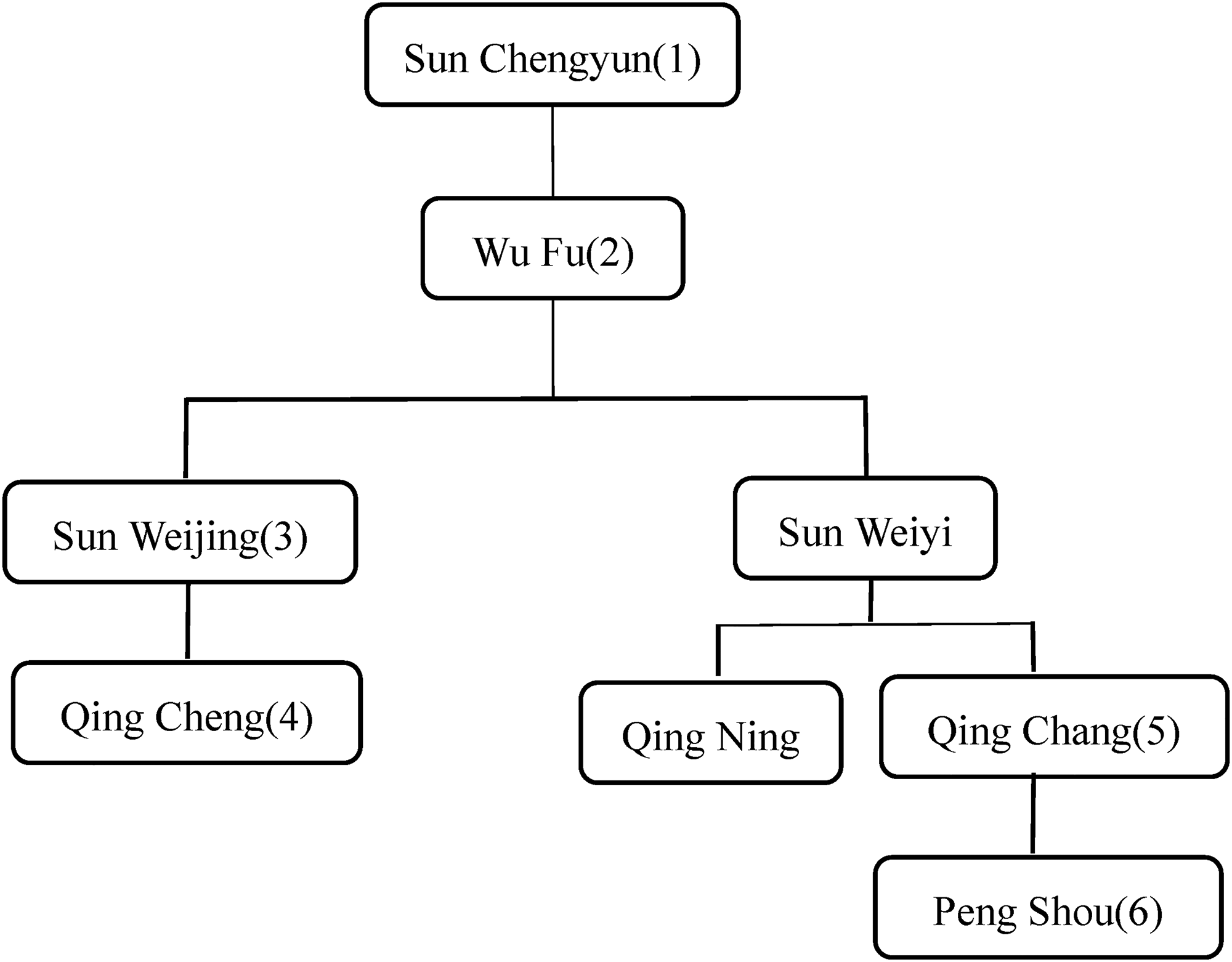
The order of succession of the Sun Chengyun family's niru.
Footnotes
Declaration of Conflicting Interests
The author declared no potential conflicts of interest with respect to the research, authorship, and/or publication of this article.
Funding
The author received no financial support for the research, authorship, and/or publication of this article.
