




Abstract
With the establishment of tea plantations in Assam in the first half of the nineteenth century, colonial tea planters and scientists began to examine ways to profitably produce tea for a growing global market. Apart from the visible landscape alterations through mass deforestation, tea monocultures also surreptitiously effected considerable transformation on its immediate physical environment, particularly on the soil. This paper highlights how the question of soil came under the purview of the colonial tea scientists when over the years, consequently and inevitably, these plantations showed a decline in the quality and quantity of tea produced. As a result, the initial conviction in the fertility of Assam’s soil within the tea discourse began to be replaced with discussions that revealed how plantation cultivation of tea itself was at the root of these problems in the late nineteenth and early twentieth centuries.
Introduction
Tea plantations, since their very inception by the British colonisers in the first half of the nineteenth century, have been affecting irreversible transformations in the landscape of Assam, located in the north-eastern part of India. Conversion of large acres of forest lands into plantations, human-induced modifications of the wild tea plant to suit the needs of perpetual production and the perennial nature of monoculture led to the exhaustion and alteration of the soil in these plantations. An examination of nineteenth and early twentieth-century manuals, treatises and reports prepared by botanists, entomologists, chemists, geologists and planters involved in tea cultivation in Assam, reveals the priorities and the motivations behind scientific investigations in tea conducted during this period. Such enquiries began to develop as early as the 1830s, and once the initial doubts regarding the feasibility of growing tea in Assam were put to rest, various questions emerged which compelled a closer look at the immediate environment. Soil gradually emerged as a significant component of the tea plantation environment which had interlinkages with the productivity of the tea crop. This paper aims to trace how a narrative surrounding soil emerged in connection to concerns regarding the decline in the productivity of tea in the Assam plantations in the nineteenth and early twentieth centuries among the colonial tea experts and how these discourses exposed flaws in the cultivation process that impoverished the plantations’ soil. The paper defines colonial tea experts as those engaged in envisioning, recommending, commissioning, analysing and generating environmental transformations in the process of establishing Assam’s tea industry and included agricultural experts, field experts, chemists, botanists as well as planters. This expertise was neither always unanimous nor disseminated through a fixed hierarchy but was a trial-and-error exercise at best. The scope of this paper remains limited to examining the opinions of the colonial experts, which mostly included Europeans at the time and does not include indigenous or local knowledge systems in these discourses. This limitation is mainly due to the lack of explicit visibility and voice of the small section of emerging local people who were only slowly beginning to engage in plantation pursuits during the period under study.
In Search of Good Soil
Assam tea planters, in the nineteenth century, often deliberated about the types of soil and the proportion of constituents in the soil that made it suitable for tea. 1 The Assam soil, on which tea was grown, was mostly alluvial and acidic, but tea experts assumed the province’s soil to be ‘intrinsically poor’ in European standards (except the bheels or peatlands). However, they maintained that the combined effect of temperature, rainfall and humidity made the soil fertile and suitable for tea to flourish. 2 Planters and scientific experts naturally turned to compare the constitution of soil in China, the then indomitable producer of tea, with that of Assam. As the prospect of supply of tea from China was under threat during the period due to the increasing conflict between the Chinese and the British trading companies, the stakes of producing a similar quality of tea in the British colony of Assam in India were very high.
There was apparently an adage that the Chinese grew tea in poor soil which was unfit for any other crops; however, the Assam planters by the late nineteenth century univocally opined that this advice would be detrimental in the Indian context. 3 In China, tea was grown by almost all farmers at a much smaller scale and these meagre quantities of tea did not fetch a great price either. Since numerous people were engaged in producing small quantities of tea, even with great demand, there was no incentive for the farmers to produce tea in their best lands or in higher quantities. 4 But this was not the case in Assam as the scale of production here was much grander and intensive, thus planters realised that inferior soil would not work as it did in China. As a plant and a manufactured product, the indigenous tea plant of Assam was eventually claimed to be superior to Chinese tea by the planter community. The greater care taken in identifying good quality land and the dedication and involvement of the planters in the process of tea making, unlike the Chinese, were posited as key features of the superiority of the tea grown in Assam. 5
In the early years of tea, before the 1840s, geologists engaged with the British East India Company like John McClelland analysed the soil and the surrounding landscapes of Assam, where tea trees were found growing abundantly in the wild. These surveys, while trying to understand what conditions were essential for tea to flourish, identified high levels of humidity and dense forest cover to be common in many tea growing regions in Assam which ensured a ‘lightness of the soil’. 6 According to an account published in 1841 by William Robinson, then Principal of the Gauhati Seminary and Inspector of Schools, most lands in the Assam province had very fine soil and even the hills were free from rocks for the most part and cultivable. 7 The soil of eastern Assam’s erstwhile Sibsagar district, which later housed numerous tea plantations, was identified by Robinson as distinct from the rest of the province. He opined that the subsoil of this region was of a higher quality with ‘a stiff retentive clay, abounding in iron nodules’. 8 With the river Brahmaputra flowing through the heart of the Brahmaputra valley, sediments of about 200–300 m thickness had accumulated over the last two million years which characterised the fertile alluvial soils of the province. 9
Early tea planters of Assam, such as Samuel Baildon and Edward Money in the 1870s, opined that it was impossible to identify a single type of soil that could be deemed to be perfect for tea cultivation as tea could grow fairly well in a variety of soils. However, they identified a few characteristics of soil crucial for tea to flourish such as porousness, friability, etc., as evident from the following quotes:
10
It loves soils friable, that is, easily divided into all their atoms. This argues a fair proportion of sand, but this should not be in excess, or the soil will be poor. The soil should be porous—imbibing and parting with water freely. The more decayed vegetable matter on its surface the better. To be avoided are stiff soils of every kind, as also those which when they dry, after rain, cake together and split. Avoid also black coloured, or even dark coloured earths. All soils good for the Tea plant are light coloured. If, however, the dark colour arises from decayed vegetation that is not the colour of the soil, and, as observed, vegetable matter is a great advantage.
11
Similarly, claiming that both mountainous and plains tracts were equally suited for the growth of tea bushes, J. Sumner, a nineteenth-century tea trader based in Birmingham, opined that ‘a light, rocky, ferruginous soil’ which occurred in slopes so as to allow rain water to flow off ‘the rocky substratum’ and in the vicinity of springs produced the finest tea. 12
Dispelling initial doubts, early planters and experts in the nineteenth century were convinced about the rich and fertile characteristics of Assam’s soil for the cultivation of tea. 13 In an attempt to locate the best lands to grow tea, the notion of a freshly cleared ‘virgin’ forest land began to entice the planters. With legislations encouraging Europeans to take up large amounts of lands for tea cultivation, to the virtually unchecked appropriation of forest resources both from within and even outside the tea land grants, clearances of large areas began to take place in the 1830s. 14 The early planters were fortunate to have a claim to freshly cleared forest lands topped with the highly extolled rich layer of the vegetable mound. The logic behind this obsession can be found in the writings of planters of the nineteenth and early twentieth centuries. Most planters opined that the soil most suitable for tea consisted ‘of a surface layer of rich vegetable mould on a bed of deep loam’ which only soil underneath forest cover could provide. The rationale behind this was twofold. First, forest lands consisted of soil that was more permeable and porous due to the action of the expanding roots of the numerous trees and shrubs which forced the soil upwards. Second, such soil was laden with abundant vegetable mould that was essential for the nourishment of the tea seedling. In addition, the friable loam of such lands provided an easy access for the tap root to obtain the required support and moisture from the soil. 15 The terms most commonly used to define soil that was suitable for tea, since the early days of tea in Assam, were ‘light and porous’, with ‘yellow or reddish hue’. 16 Upon digging the freshly cleared forest lands, a dark mould of extremely fertile super-stratum of about 5–8 inches deep was exposed which consisted of years of vegetable deposit and acted as the most fertile manure for the tea bushes and assured good growth for many years. 17 The surface soil, of about 9 inches of thickness, was hidden underneath this super-stratum of vegetable mould and was ideally ‘light, friable, and rich’; and once the area was made cultivable, these two layers mixed and created the ideal soil for tea. 18 That wasn’t all; the subsoil beneath the above-mentioned upper stratum and surface soil also had an important role. The tea plant’s long tap roots invariably extended into this subsoil and therefore the plant could thrive only if the subsoil too could provide enough moisture and nourishment. 19 The presence of iron in the subsoil which lent the soil a reddish hue was deemed to be essential for tea and ideally, the subsoil possessing the same characteristics as the surface soil was the most desirable. 20 Many regions in the Assam province such as the Doom Dooma area, Tezpur bank area and Jorhat were cited as regions where such uniformity between the surface and subsoil was seen and therefore considered ideal for tea cultivation by colonial tea experts. 21
Moving towards a more specialised comment on the soil of Assam, Henry Piddington, curator of the museum of Economic Geology of India and of the Geological and Mineralogical Departments in the Asiatic Society Museum of Calcutta, published his individual findings in 1836 on the composition of soil in Assam. Piddington admitted that this attempt was to attract attention to the importance of examining the soil, before anything else, for any agricultural success. 22 He gave a comparative soil analysis of samples from the Bohea hill in China, brought by G. J. Gordon, Secretary to the Tea Committee and samples of Assam soil, provided by Francis Jenkins, the first Commissioner and Agent to the Governor General for Assam, and marvelled at their similarity, as evident from Table 1 below. Piddington revealed that the Assam soil was deficient in carbonate of lime, whereas phosphate and sulphate were available only in traces and the iron content in these soils was in the form of carbonate of iron. In accordance with these findings, Piddington identified the soil as poor yellow loam which was not suitable for cotton, sugarcane or tobacco but was surprisingly suitable for tea. 23
Although such nascent analyses and examination of soil were beginning to proliferate, Harold H. Mann, the Chief Scientific Officer of India Tea Association appointed in 1900, opined that the chemical composition of the soil and what the tea plant needed from soil was not well researched until the early twentieth century. He also revealed that, in most instances, planters operated on cliché hearsay when it came to identifying suitable soil for tea cultivation, with common identifiers being ‘friable’, ‘light’, etc. Mann credited the work published in the 1890s by M. K. Bamber, a chemist appointed by the tea enterprise in the late nineteenth century, of being the first and most crucial work in bringing the chemistry of tea soils to the forefront. 24
In the pursuit of tea, scientists and planters alike thus began to define the soil and its components, dissecting the microenvironment on which the plantations were to stand for hundreds of years. These early examinations and discussions on Assam soil were highly optimistic about the calibre of producing good tea for many decades in the region without a fall in quality and quantity. 25 However, the soil was the most affected by such long-standing mono-cultivation, and manuring and replenishing it became a necessary step in these plantations. But what compelled this shift in attitude?
Constituents of Tea Soils (in Percentage)Analysed by Henry Piddington.

Distress over Soil
The initial optimism of the tea planters regarding the unceasing fertility of Assam’s soil was slowly marred with a gradual decline in tea production and consequently, planters claimed that only the newly established tea estates were able to produce good quantities of tea and the older gardens saw a gradual decline in produce. The following remark by an Assam planter, George Barker, in the 1880s highlights the anxiety regarding declining productivity:
In the competition between the old and new gardens there can be only one result—the failure of the old gardens. A fair average to take per acre for old tea is four maunds (approx. 329 lbs or149 kgs); for modern gardens seven (approx. 576 lbsor 261 kgs) or eight maunds (approx. 658 lbs or 298 kgs) would not be an excessive computation. How is it possible, therefore, for old tea gardens to compete, with a chance of success, against new.
26
(Italics mine)
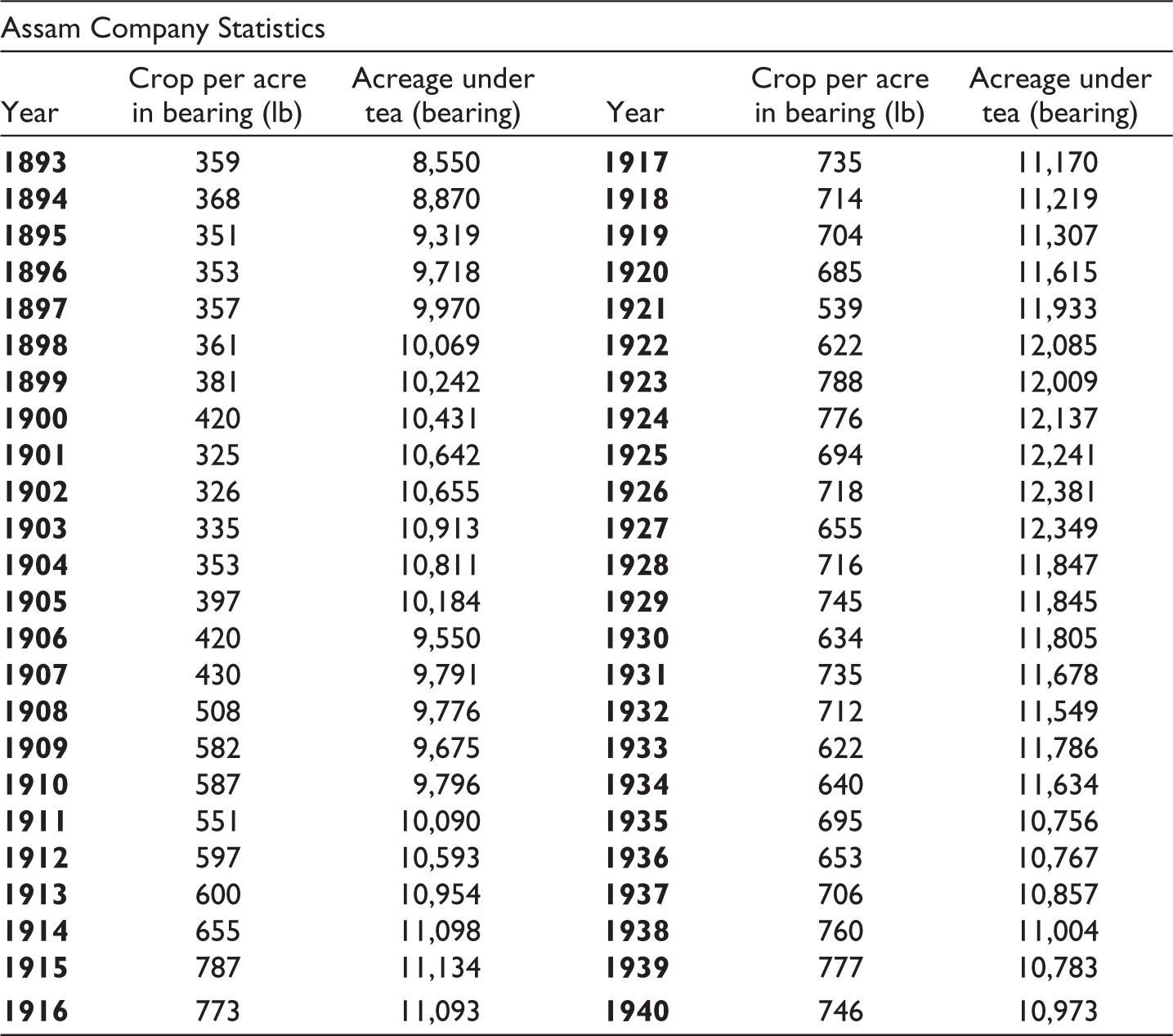
Was there a major per acre yield crisis by the late nineteenth century that compelled a systematic investigation into questions of tea production in Assam as implied by Barker in the above excerpt? In this regard, we take the case of the Assam Company, the oldest tea company established in 1839, and try to see if there were any major trends in its production that could buttress Barker’s statement.
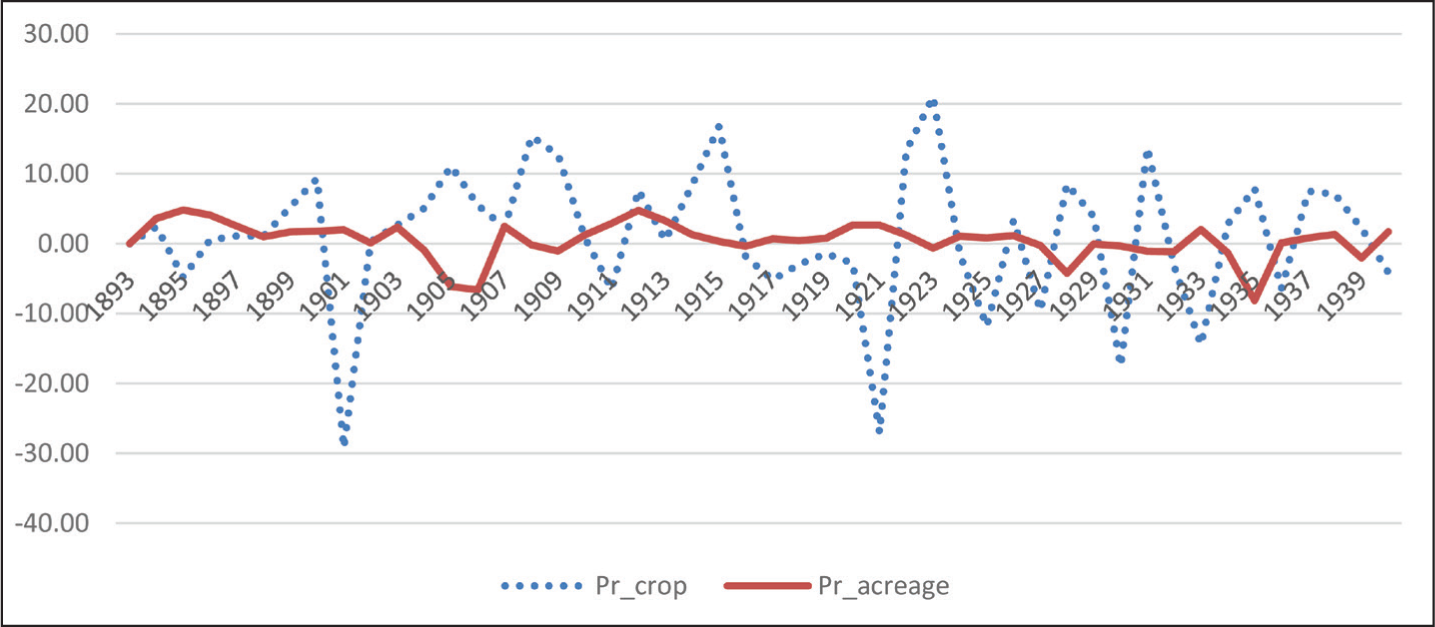
In Figure 1, the x-axis shows the annual percentage change in tea yield (represented by the dots) and the annual percentage change in acreage under tea (represented by the line) over the period of 1893–1940. The percentage of change in crop yield was much more volatile than the changes in the acreage under tea. Notably, by the 1880s, the production of tea in Assam was quite favourable in terms of lower production costs with an overall improvement and efficiency of machinery, cheaper transportation costs, more skilled garden labourers with many years of experience, extension of new tea cultivation in the best soils available as well as with the best class of plants. 28 Therefore, the concern that George Barker had of lower productivity in older garden lands should have been masked with more efficient usage of the other means of production as well as with the newer lands being acquired each year in the overall yield per acre. Since the 1890s, even with lower production costs, the yield per acre barely rose and the prices of tea were gradually decreasing in the global market, which continued till the twentieth century. This phenomenon was attributed by the chairman of the Indian Tea Association (ITA), the earliest association of tea producers in India, to the tea being ‘common in quality’ and the out markets of tea being captured by Ceylon. 29 The figure indicates that even with an almost steady acreage under tea and the gradually increasing attention given to maximise profits, tea production in the Assam Company tea gardens was extremely volatile, which was probably a cause of concern for the planters.
Encountering Change: Scientific Beginnings
Is it too much to expect that, in the course of time, to the monotonous report of ‘greyish, fair tip, brisk, little flavor’, may be added the more desirable information of ‘fairly gummy, potash 2–13 per cent only, good trace of Essential Oil’? We could then, with our knowledge of manures, supply after a while the lacking Potash and do our best to keep up the desired proportion of essential oil. 30
In matters of tea, historians have shown that over-arching scientific know-how was not always available and ‘ambivalences and dissonances beset science’. 31 The hierarchy between Western scientific knowledge and practical field knowledge was not always fixed, and more often than not, field experiences were accorded more importance. Scientific officers too acknowledged the crucial role played by the planters, with seemingly no formal training, in experimenting with their tea crops which aided the scientific beginnings of the industry to a large extent. 32 This was true in the case of other colonial plantation crops as well, be it tea, coffee, or indigo; moreover, in the majority of cases, a myopic aspiration for profits superseded scientific sensibility. 33
Against this backdrop, a brief engagement with some of the discussions in the nineteenth and twentieth centuries pertaining to issues of soil by planters and scientific experts aids us in locating how soil and its replenishment began to occupy a central position in the Assam tea plantations. As evident from the quote at the beginning of this section, planters were eager to receive specific recommendations about the tea that they were producing and the subject of fertilising and manuring gradually began to attract scientific attention. 34
In 1889, samples of oilcake were sent to the Agricultural and Horticultural Society of India by Jardine, Skinner & Company on behalf of a tea company to ascertain its value as a fertiliser for tea. The Jardine, Skinner and Company, a trading company based in Calcutta, opined that tea planters and managers were unaware of the richness of manures yet spent a great deal of money on fertilisers. Notably, almost one lakh rupees was annually spent on organic fertilisers in Cachar 35 alone during the late 1880s. 36 In response, the Agricultural and Horticultural Society took the guidance of Surgeon-Major Warden, a professor of chemistry employed in the Calcutta Medical College. Warden stressed the need to analyse the soil of the gardens before any advice on fertilisers could be given, and although he undertook this task for a while, the necessity of appointing a full-time soil chemist for Assam tea was felt. 37
To fill this requirement, in 1891, M. K. Bamber was appointed as chemist by a joint committee of the ITA and the Agricultural and Horticultural Society. Bamber began his investigations on the soil of different tea gardens and liberally made use of the laboratory at the Calcutta Medical College to perform his soil analyses.
38
Bamber, having taken up another job with the Government of India in 1893, the research on soil and manures also came to a halt for some time.
39
By 1896, the need to appoint a special scientific officer dedicated to thorough investigations into the chemistry of the tea plant and its cultivation and manufacture under the control and supervision of the colonial government was strongly felt.
40
J. Buckingham, then Chairman of the Assam branch of the ITA, led this discussion and also proposed ways to acquire the requisite funds for this appointment:
In order to attract a really first-class man, a salary of at least₹1,500 a month would have to be guaranteed for five years. Mr Buckingham thinks that the money could easily be raised by a voluntary tax or subscription of one anna per acre under cultivation, and the Committee is also inclined to the opinion that this would probably be the best mode of obtaining the funds necessary, provided planters are unanimously agreed on the necessity for the appointment of such an officer. In this event, the Government could then fairly be asked to provide the necessary laboratory in Calcutta, and also any camp laboratories and instruments needed, in view of the importance of the tea industry as a source of revenue both to the Indian and Imperial Governments.
41
Harold H. Mann was, thus, engaged as the scientific officer for three years in 1900 with the above-estimated expenditure collected through contributions from the Lieutenant Governor of Bengal, the Chief Commissioner of Assam, the Assam as well as the Cachar Branch of the ITA, the Dooars Planters’ Association, and the Terai Planters’ Association. 42 After a preliminary tour, Mann identified a few main aspects that warranted immediate investigations in the Assam tea gardens, among which the ‘fundamental investigation was that of the soil, the means of retaining fertility and suitability for tea for an indefinite time, and the methods possible for improving the quality of tea obtained from it’. 43
Eventually, at Mann’s insistence in 1902, it was realised that the science department that he kick-started needed to be expanded both in terms of infrastructure as well as manpower. 44 With annual contributions from the government of Bengal and Assam, the government of India, various planters’ associations and the rest contributed by the ITA, amounting to around ₹27,000, Mann’s proposal was put into effect. 45 Mann carried out his experiments in various parts of Assam, Darjeeling-Terai and also visited Calcutta from time to time to work on the results obtained in his tours. 46 He also proposed the establishment of an experimental station for dedicated research on tea, effort for which began in 1904, eventually taking concrete shape in the form of the Tocklai Experimental Station in the year 1911. 47 Thus, investigations on manurial requirements, pruning, pests, plant diseases and many other aspects began to take place. 48 The Advisory Officers who worked closely with the scientists at Tocklai were stationed at various tea districts which helped them disseminate the knowledge that Tocklai produced. 49 And by the early 1930s, in the realm of departments maintained by industries similar to tea, the scientific department of the ITA emerged as one of the largest in the world. 50
Average Tea Yield per Acre in Assam from 1885 to 1929.

With greater emphasis on organised scientific investigations on Assam tea since the last decade of the nineteenth century, there were indeed discernible hikes in the production per acre figures of tea as evident from Table 2. However, Mann believed that although greater scientific knowledge played its part, this increase was also, in part, due to the extension of tea cultivation in newer lands and, in consequence, the new tea bushes yielded greater produce, thus increasing production rates. 51
Within this background of increasing scientific expertise developing in the province to make tea cultivation successful and to understand its environmental specificities, we move on to see how some of these experts and also their earlier counterparts and planters connected issues of tea output with that of the soil in the plantations.
Depleting the Ground: Exhausted and Eroded Soil
Monocropping had proved to be an extremely unsustainable form of cultivation and over the years such industrialised and intensive farming, including plantation cultivation, had done enough damage to soil fertility worldwide, which gave a push towards thinking about alternative cultivation techniques. 52 Similar to the tea plantations of Assam, soil, water, land and labour were characteristically altered as well as exploited in the nineteenth and early twentieth centuries in the pursuit of colonial commodity production like cotton, cocoa and sugar in the other colonial tropics as well, causing immense ecological imbalances. 53 A common characteristic of almost every mono-plantation is the constant pressure imposed on the soil resulting in its exhaustion; be it in the colonial tobacco plantations in the American South where the planters moved from one plot to the other as continuous cultivation sucked all the nutrients from the soil, or sugar plantations which resulted in extreme soil exhaustion in Brazil and Caribbean by the mid-seventeenth century. 54 The root of such soil exhaustion can be found in the cultivation processes of such plantations.
The naturally tall and bushy indigenous Assam tea plant was slowly modified through human intervention to stay as a low-branched bush densely covered with a number of small branches. The plant’s capacity to flower and bear fruit too had become limited, and in its place the plant’s entire energies were forced towards producing a complete new set of shoots every 7–10 days, which facilitated plucking. 55 Pruning to keep the plant low and accessible and continuously plucking off tender leaves for the greater part of the year drained the plants’ nutrients. Estimates made by planters and scientists confirmed that the Assam indigenous tea plant could produce around four or five flushes during a season; however, since the late nineteenth century, the yield increased to facilitate around 30–35 flushes a year with adequate labour. 56 Thus, through constant tweaking of the natural processes of the plant to serve the capitalist interest of the British Empire, the tea plant was forced to produce a disproportionate amount of leaves without being offered any rest to allow natural and healthy growth. 57 The extreme strain that the tea plant was constantly put through and its resultant effect on the soil were indeed acknowledged by many planters and scientists.
Exhaustion of soil, in the case of the Assam tea plantations, was aptly pointed out by Edward Money, a military official turned planter, as early as in the 1870s. 58 He wrote, ‘The tea plant is being continually denuded of its leaves; nothing is returned to the soil; and consequently in process of time that soil is exhausted.’ 59 Planter Samuel Baildon, writing in the early 1880s, discerned a fall in flavour and strength of tea in older gardens of Assam which he attributed to exhaustion of the soil. 60
Similar sentiments found expression in the scientific discussions of Kelway Bamber and Harold H. Mann.
61
Bamber published his findings based on the investigations that he conducted on soil samples from almost all tea-growing districts of Assam, Dooars, Cachar and Darjeeling in 1891.
62
Interestingly, while observing a few samples of bheel or bhil (peatlands) soil of Central Cachar, Bamber opined that ‘it is a curious fact that the longer the different portions had been under tea, the less organic matter and nitrogen they contained’.
63
In addition to the bheels, other lands under tea for longer periods too showed signs of waning productivity in Bamber’s investigation of soil samples. The following quote from Bamber’s treatise, after observing a plantation in the Hailakandy district of Cachar portray how this depletion of nutrients from plantation soils was perceived:
This was a heavy clay loam of average fertility that had been under tea for several years. It was exceedingly poor in organic matter and nitrogen, and required drainage and the application of a good general manure, or the hoeing in of large quantities of green jungle to lighten the soil, and increase the amount of humus matter.
64
Similarly, Mann’s work, specifically concentrating on the tea soil of Assam published in 1901, also touched on soil exhaustion. Echoing Bamber, he too noticed a widespread deterioration of the older portions of tea plantations which he believed was the result of either exhaustion of soil or the old age of the bushes, or a combination of the two. 65 Mann was convinced that the exhaustion of soil played a crucial role in deteriorating the tea plant, and he demonstrated a way to discern the nutrient loss in soils under tea in his research. By taking soil analyses of ‘virgin’ lands vis-à-vis lands under 10 years of tea in various tea-growing districts of Assam, Mann calculated the loss of nutrients in both categories. 66 He found that in plantations that were extensively cultivated, almost 2% of the total nitrogen originally present could be lost per acre under tea in a year. This loss, however, was not solely due to the regular plucking of leaves from the tea bushes; but partly due to ‘leakages’ which Mann attributed to the long-standing deep and constant cultivation with incessant weed removal and a lack of green manures to retain the loss of nitrates. This, Mann believed, intensified in soils under tea with each passing year. 67 Manuring of the plantation soil seemed imperative to Mann on all but the youngest gardens. Yet, he still believed that very small amounts of artificial manure would be required by the plantation soil of Assam as organic hummus and the inherent fertility of the soil were enough to sustain good production of tea for many years to come. 68
An Assam tea planter, G. Sherrard, writing in the 1920s, also hinted at a connection between exhaustion of soil under tea and the manufactured landscape of the plantations. For instance, in one of his writings in the periodical The Assam Review and Tea News, he argued that as soon as forests were uprooted to facilitate the establishment of tea plantations, the nitrogen that such forest-covered soils had accumulated over the years began to degrade rapidly. He estimated that in the soils under tea cultivation, the loss of nutrients was from 60 to 100 pounds per acre per annum. Sherrard too stressed the importance of correct manuring to remedy this deterioration. 69
The other grave concern regarding soil in the Assam plantations was the problem of erosion or the whittling away of a land’s top soil. Similar to tea, by the 1930s, British colonies of East, Central and Southern Africa were also witnessing grave soil erosion as evident from the importance this problem was given in their colonial environmental policies. 70 In Assam, the issue of erosion particularly plagued the tea plantations in Cachar. Here, initially, plantations were established in the teelas or hillocks which, coupled with intense cultivation and weeding practices, often posed an increased and a more visible form of erosion by loosening the top soil which washed off during the rains as evident from the following notes penned by M. K. Bamber. 71
The sites and soils first selected in Cachar were the small teelas, which are prevalent throughout most of the district….. Most of these soils have little adhesive power, and cultivation together with the heavy rainfall of the district, soon caused the fine portions of the soil to be carried away and deposited in the bheels and valleys between them. With this wearing away of the soil, the plants also deteriorated, and it became necessary for planters to adopt some means of renovation. 72
…from a teela that had been under tea for several years, and from which the original surface soil had been largely removed by drainage. It is exceedingly poor in almost every plant constituent, and would require the frequent application of large quantities of general manures to increase the outturn of leaf. 73
Even if we assume that these soils were already friable and prone to erosion irrespective of the establishment of tea plantations, a close reading of Bamber’s account reveals that earlier these teelas were, in fact, covered with forests and would probably not have suffered the fate of grave erosion:
Some of these soils when first cleared must have been fairly rich and strong, from the appearance of the jungle and forest growing on uncleared teelas at the present time, but they have in almost every case rapidly deteriorated, more from the amount removed by wash and heavy rainfall than from what has been removed by the tea itself. When protected from direct rainfall by the jungle growth they gradually increased in richness and value in the same way as other forest soils, but after the jungle was cleared away and the surface soil loosened by cultivation, they were washed down from the summit and slopes of the teelas.
74
Conclusion
In order to accommodate plantations of various sizes in Assam since the mid- nineteenth century, the British colonisers brought about many changes to its surrounding natural environment, in terms of both visible transformation of such spaces and unintended, invisible modifications to the lands on which the plantations stood. The paper discussed how the initial faith in the productivity of Assam’s plantation soil without any heed to improving cultivation techniques and replenishing the soil was connected to lower yields in tea produce in the Assam tea plantations.
An enquiry into the centrality of soil in the narratives and discourses of tea plantations in Assam also throws light into the environmental sensibilities of the colonial experts who were involved in examining the plantation environment. A close reading of these discourses shows the growing consciousness of the scientific community towards the effects of such monocropping. Discussions concerning lower produce and deterioration of the tea plants coupled with a fall in flavour and quality of tea in Assam, towards the late nineteenth century, opened the eyes of the planters and experts to the importance of keeping the soil under the tea bushes replenished and healthy. However, scholars such as Richard Grove and Vinita Damodaran have emphasised that environmental consciousness and effects of degradation on the tropics as a result of colonial plantations by the Dutch, English and French trading companies were discernible to the early scientists and naturalists as early as in the mid-seventeenth century. 75 Yet, it is interesting to note that, in the case of the Assam plantations which commenced in the nineteenth century, these sensibilities that arose almost two centuries ago among the colonial scientific discourses did not particularly translate into conscious attempts on the part of the planters to attempt more sustainable cultivation practices in the Assam plantations that could have resisted or at least delayed the inevitable degradation of its environments.
Questions of degrading soil quality coupled with problems of soil erosion increasingly necessitated discussions on the effect of plantation practices on the tea plant itself and the soil. Since the late nineteenth century itself, research and experiments associated with higher and better quality yield of tea were fully at work and markets saw the emergence of chemical manures designed specifically for the Assam tea plants. 76 With the gradual acceptance of the planting community regarding the inevitability of applying manures and fertilisers came the trouble of discerning what and how much of such substances were required and their consequences in the plantation environment, which paves the way for further research in this area.
Footnotes
Declaration of Conflicting Interests
The author declared no potential conflicts of interest with respect to the research, authorship and/or publication of this article.
Funding
The author received no financial support for the research, authorship and/or publication of this article.
Appendix
Assam Company Statistics Table.
| Assam Company Statistics | |||||
| Year | Crop per acre in bearing (lb) | Acreage under tea (bearing) | Year | Crop per acre in bearing (lb) | Acreage under tea (bearing) |
|
|
359 | 8,550 |
|
735 | 11,170 |
|
|
368 | 8,870 |
|
714 | 11,219 |
|
|
351 | 9,319 |
|
704 | 11,307 |
|
|
353 | 9,718 |
|
685 | 11,615 |
|
|
357 | 9,970 |
|
539 | 11,933 |
|
|
361 | 10,069 |
|
622 | 12,085 |
|
|
381 | 10,242 |
|
788 | 12,009 |
|
|
420 | 10,431 |
|
776 | 12,137 |
|
|
325 | 10,642 |
|
694 | 12,241 |
|
|
326 | 10,655 |
|
718 | 12,381 |
|
|
335 | 10,913 |
|
655 | 12,349 |
|
|
353 | 10,811 |
|
716 | 11,847 |
|
|
397 | 10,184 |
|
745 | 11,845 |
|
|
420 | 9,550 |
|
634 | 11,805 |
|
|
430 | 9,791 |
|
735 | 11,678 |
|
|
508 | 9,776 |
|
712 | 11,549 |
|
|
582 | 9,675 |
|
622 | 11,786 |
|
|
587 | 9,796 |
|
640 | 11,634 |
|
|
551 | 10,090 |
|
695 | 10,756 |
|
|
597 | 10,593 |
|
653 | 10,767 |
|
|
600 | 10,954 |
|
706 | 10,857 |
|
|
655 | 11,098 |
|
760 | 11,004 |
|
|
787 | 11,134 |
|
777 | 10,783 |
|
|
773 | 11,093 |
|
746 | 10,973 |