



Abstract
Inspired by the interplay between social structure of accumulation theory and labor process theory, this paper is to specify the particular mechanism that labor institutions take in accomplishing China’s rapid capital accumulation in the reform era. The paper starts by proposing a framework to understand the relation among overtime work, labor process, and the wage gap and presents the puzzling contradiction between low wages and the need to sustain the reproduction of labor power for Chinese workers. The paper then details the bi-directional determination between the subordination of labor in the workplace and the wage gap, and further analyzes the critical conditions for the stability of the current labor institutions and sustaining capital accumulation.
1. Introduction
Social structural of accumulation (SSA) theory has been developed since the late 1970s to analyze the development and contradictions of capitalist economies. It emphasizes the complex of institutions supporting capital accumulation, among which the labor process is crucial in extracting surplus value (Kotz et al. 1994). A similar concern has been more specifically addressed in labor process theory, which focuses on the managerial efforts to coordinate, motivate, and control workers at the site of production for labor’s real subordination to capital (Marx 1867; Braverman 1974; Edwards 1980).
While SSA theory explains capitalist dynamics from a middle-range perspective, labor process theory explores the contested terrain in the workplace from a micro perspective. Labor process theory contributes to our understanding of class contestation embedded in the SSA framework, while the latter provides a structural and institutional setting for the labor process. Inspired by the relationship between SSA theory and labor process theory, this paper intends to apply the theoretical framework to the Chinese economy and explore the distinct labor institutions comprising China’s SSA. We also attempt to understand the implications of the labor process to the sustainability of the current SSA.
Given the fact that China’s growth has increasingly depended on investment and export (Zhu and Kotz 2010), a full vision of China’s SSA should, at least, be composed of investment institutions, foreign trade institutions, and labor institutions. Investment institutions sustain the high rate of accumulation through massive investment led by state-owned enterprises and supported by the state-dominated financial system. Foreign trade institutions sustain export-led growth by stabilizing exchange rates and ensuring the foreign supply of crucial raw materials. Although both institutions are important, this paper will focus on the labor institutions of the SSA.
As shown in Figure 1, labor institutions are featured by the relationship between the wage gap and the labor process. The wage gap refers to the gap between wages received by workers within a normal length of a working day and the living wages that are necessary for the reproduction of labor power. Focusing on these labor institutions, the paper illustrates the following viewpoints: first of all, due to the wage gap, workers have to depend on overtime work and the rural economy in order to accomplish labor power reproduction, thus the wage gap produces the combination of high labor productivity and low wages; second, the wage gap results from the power relations in the labor process featured by skill polarization; third, the wage gap further weakens workers’ bargaining position in the labor process.
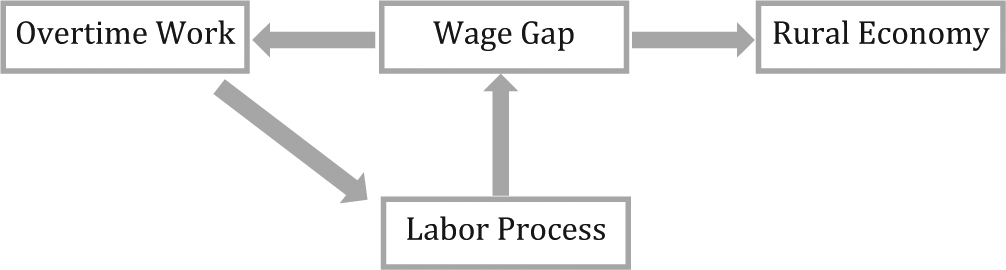
Labor Institutions of the SSA.
The rest of the paper is organized as follows. Section 2 presents the distinct contradiction with the wage gap and its temporary solutions. Sections 3 and 4 go parallel to address the bi-directional determination between the subordination of labor in the workplace and the wage gap. Section 5 discusses the stability of the labor regime within the current SSA. Section 6 concludes.
2. The Contradiction of the Wage Gap and Its Temporary Solutions
Along with China’s market reform since 1978 and the march into global competition, the wage level in China has been significantly low by international comparison. Even as China ascends as a major economic player in the global economy, China’s manufacturing wage level has been far below that of Japan, Korea, and Taiwan in their respective fast growth periods (Hung 2009). The hourly labor compensation even lagged noticeably behind those of other developing countries like Mexico and Brazil (Baister and Cook 2011). More important, the wage level is lower than a living wage level. Here the wage level refers to the wages workers receive by working within a normal working time. According to China’s labor law, weekly working time shall not be over 44 hours, which can be considered as a normal working time. A living wage level is defined as the wage sufficient for the reproduction of labor power; hence a living wage should be sufficient for the basic needs of workers and their families, including food, clothing, housing, education, medical care, and necessary social services.
Although one can hardly observe the wage level for a normal working time given the prevalence of overtime, the minimum wage level can be taken as a proxy, because the dominant wage system in the private sector divides total wages into basic wages and overtime wages and pegs the basic wage rate on the minimum wage level. Thus in practice, if workers do not work overtime, they often only receive basic wages at the minimum wage rate. A recent study found that Chinese workers were largely paid below the living wage standard measured by the disposable income of low-income urban households. As shown in Figure 2, in 2009, workers in the western, central, and eastern regions only received 60 percent, 57 percent, and 54 percent of their living wage rates, respectively (Li et al. 2012).
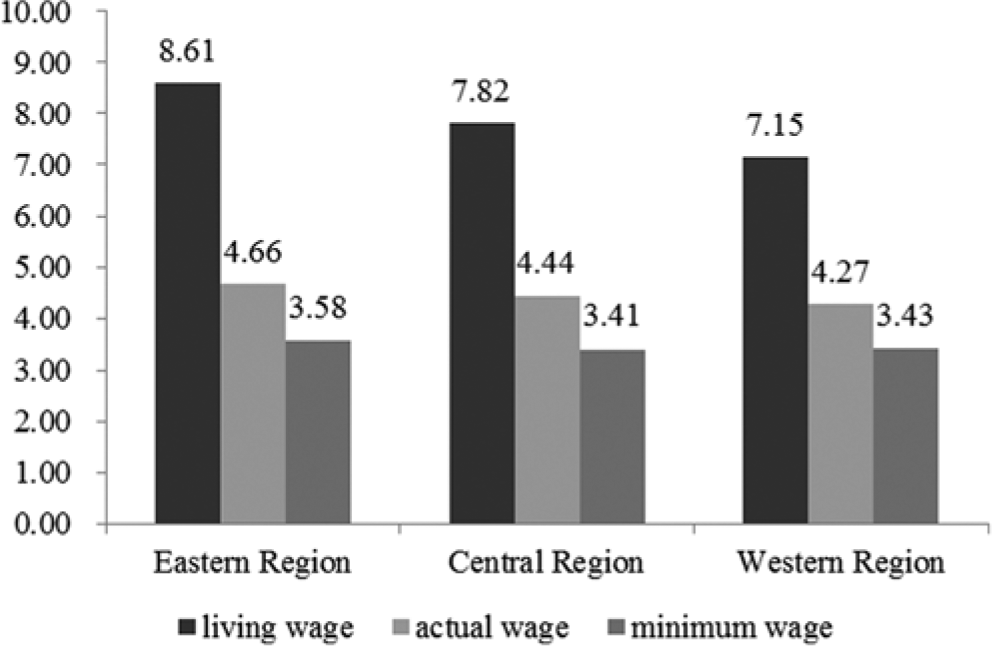
Living Wages, Actual Wages, and Minimum Wages in the Eastern, Central, and Western Regions (yuan/hour).
The existence of the wage gap reveals a puzzling contradiction: if workers are paid lower than a living wage, how can they complete the reproduction of labor power? The fact that workers have to complete the reproduction through other channels in addition to normal wages implies that capitalists have transferred a significant amount of cost burden to the working class by failing to pay a living wage.
So far, one way for workers to maintain a basic living standard is to perform excessive amounts of overtime work. According to China’s labor law, workers shall be paid 50 percent more for overtime work. It is ironic that workers are forced by the wage gap to voluntarily perform overtime work. A 2009 survey by National Bureau of Statistics found the weekly working time for migrant workers reached 58.2 hours in manufacturing, 59.4 hours in construction, 58.5 hours in social services, 61.3 hours in hotel and catering services, and 59.6 hours in wholesale and retailing, far beyond the overtime ceiling stipulated in China’s labor law (NBS 2010).
The other way to supplement their normal wage income is to rely on the rural economy, given that migrant workers from the countryside take a large share of the urban working population. 2 Migrant workers leave their dependents in the countryside since the costs of living are much lower in the rural areas compared to the urban areas and since their living can be subsidized by agricultural income. In this regard, these workers’ proletarianization is stuck in a state of incompleteness (Pun and Lu 2010).
These two temporary solutions support workers’ reproduction of labor power by forcing them to endure long work-day hours and by sacrificing their happiness with families. However, the contradiction with the wage gap persists despite the solutions. In the following sections, we will focus on the overtime solution to see how it is rooted in and further affects the power relations in the labor process and how it relies on critical conditions within the whole SSA.
3. Why the Wage Gap Exists: A Labor Process Explanation
It is a recognized fact that cheap labor is one of the driving forces behind China’s spectacular economic growth, especially the export sector, over the last few decades. While the conventional argument for China’s low labor cost usually focuses exclusively on the excessive labor supply over demand, we find the pure market argument is fatally inadequate. It attributes relative bargaining power only to the market force and stops short of examining the contested terrain where exploitation and the fight over control originate. In contrast, we argue that the organization of the labor process, or a “factory regime,” has also powerfully shaped the interest and capacity of the Chinese working class, especially their bargaining position in defending a decent living standard. It is the key features of the labor process that safeguard China’s capital accumulation in the global production chain at the expense of workers’ interests and rights.
The first feature of the dominant labor process in China is simplicity and repetitiveness. China is still in the low end of the global value chain (Koopman et al. 2008; Dedrick et al. 2010). Millions of workers end up in the labor-intensive manufacturing export sector located in coastal regions, now gradually proliferating to the inner land, to hand, fast-paced, and repetitive assembly work in short cycle times (Kilian et al. 2012). This feature effectively concentrates the power of control to the hands of management. Workers can only gain dexterity by repeating particular tasks under simplified instructions, without comprehension of the underlying technical reasoning. The constrained “learning by doing” effect renders workers vulnerable to claim their importance to the factory. Thus, capitalists have an upper hand to “cherry-pick” workers and to manipulate employment relations. In 2010, more than nine million students from vocational schools were forced to work in factories as interns to fulfill the requirement of their education. Foxconn, the largest global electronics manufacturer, has disclosed that one-third of workers on some production lines were student workers with minimum skill and working experience, which yields some evidence of the low-skill component of jobs (China Labour Bulletin 2010). Another piece of evidence is the remarkably high turnover rate. Recent studies have found 30-40 percent was a fairly mid-range figure for China’s labor turnover, and for companies with foreign investment, the turnover rate was estimated to be between 30 and 90 percent (Hurtgen et al. 2009; Kilian et al. 2012). While the high turnover rate could be due to low job satisfaction, it at the same time implies that a large amount of workers are easily interchangeable.
The second feature of that labor process is the rare job-specific training and the difficulty to accumulate skill in the workplace. For instance, a recent job dissatisfaction survey in Guangdong found 65 percent of workers complained “I did not learn any useful skills for my future” (Jiang et al. 2009). The overt form of low skill required can be illustrated by the general reduction of the training and mentoring period along with the introduction of more sophisticated equipment and the takeover of training by vocational schools. The widely adopted computer numerical control (CNC) equipment is representative of certain key features, processes, and trends relating to industrial skills occurring within China’s manufacturing sector.
The CNC program has become an integral part in response to flexible specialization in the post-Fordist era. The program produces a computer file that is interpreted to extract the commands needed to operate a particular machine via a post processer and then loaded into the CNC machines for production. The managerial choice of the CNC program has produced a polarizing effect on the skills involved in production. A few early studies found while programming workers and machinists are regarded as skilled, the large amount of operators are deskilled to only “moving the component from machine to machine” because of the highly automated procedures (Kelley 1986; Zicklin 1987). As many front-line operators become a homogeneous grouping of “interchangeable parts,” this tendency serves as a contemporary echo of Harry Braverman’s sharp observation of polarization of skills as a general trend inherent in the development of capitalism.
Meanwhile, even skilled programming workers and machinists have increasingly become replaceable. The programming and mechanical component of the job has been easily generalized and largely taught in the growing vocational education system. From 2007 to 2011, the annual number of graduates from vocational schools increased from 5.3 million to 6.6 million, and 90 percent of vocational school students were subsidized by the state. 3 Almost all of China’s vocational schools have a training program for CNC technology. In other words, traditional workplace training has been largely outsourced to the schooling system and job-specific skills have been successfully mass-produced.
In general, the simple, repetitive, and declining job-specific training labor process in China radically oriented workers towards a weak bargaining position to demand a living wage. The prevalent adoption of new technology in production, as David Noble argues, tends to reinforce rather than subvert the exploitative social relations (Noble 1985). It does not only trap many workers in the conceived Dickensian conditions by the systematic degradation of their human labor, but also inevitably forces them to resort to overtime work to supplement their basic wages.
4. The Impact of the Wage Gap on the Power Relation in the Labor Process
The wage gap has been rooted in the power relation in the labor process; however, the wage gap in turn deepens workers’ subordination to capital on the shop floor, because employers have the power to determine whether workers can overcome the wage gap and complete the reproduction of labor power.
Overtime work is crucial for overcoming the wage gap for individual workers. Figure 3 shows the share of overtime payment in total wages in March 2009 for 29 workers in a mechanical factory in Guangdong Province. Each worker worked for 246 hours in that month on average, and 22 percent of the working hours were counted as overtime, while the overtime payment of all the workers took 45 percent of their total wages since overtime work was paid 50 percent more than normal working hours. From Figure 3 one can see that for nearly two-thirds of workers the share of overtime payment in total wages was over 30 percent.
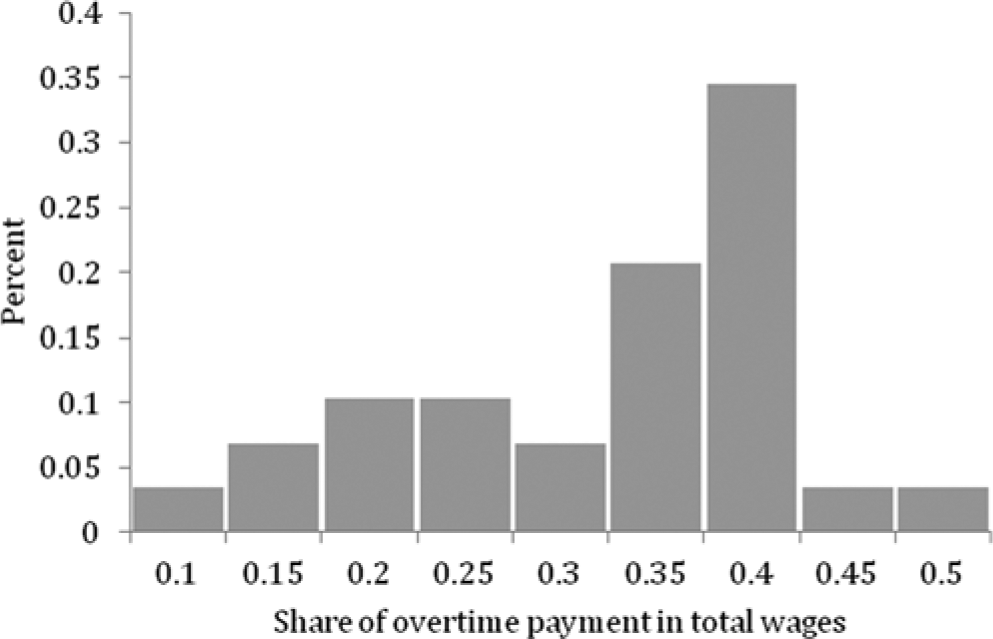
Share of Overtime Payment in Total Wages for 29 Workers in March, 2009.
As employers control the allocation of overtime work, they can use it as a carrot-and-stick strategy to reward and punish workers. Only disciplined workers are allocated sufficient overtime work to fill the wage gap. Under these circumstances, the power of workers is constrained by the wage gap. The obedience of workers results from the joint effect of the reserve army, the features of the labor process, and the wage gap.
The wage gap as a disciplinary tool has historically evolved during the reform period. With the beginning of market reform, “politics in command” as a distinct management system under the Maoist period was replaced by a system that emphasized material incentives, such as bonuses and piece-rate wages. While “politics in command” encouraged workers’ participation in management, material incentives strengthened the power of management since they could decide how to distribute bonuses among workers. Material incentives benefited workers in the short run at the expense of their long-term interests. As workers’ income increasingly relied on bonuses, workers had to be more obedient to management. From 1978 to 1990, the share of bonuses and piece-rate wages in total wages boomed from 2 percent to 19 percent. 4 This structure of dividing total wages into basic wages and bonuses was the prototype of the current wage system that divides total wages into basic wages and overtime payment.
In addition to taking advantage of workers’ need to overcome the wage gap, the current wage system also disciplines workers through the ideology of “distribution according to work” which was also advocated under material incentives of the early reform period. As for workers, the direct determination of overtime payment by the length of overtime work appears to be a fair reward; they usually only demand a higher overtime wage rate, rather than challenge the whole legitimacy of this wage determination system. Therefore, capitalists can easily transfer the higher-wage demand to the state which sets the overtime wage rate. As a result, it appears to be workers’ own responsibility to earn sufficient wages via performing overtime work, rather than the employers’ responsibility to raise wages as high as the living wage level.
The wage gap makes workers not only obedient to employers but also to the rhyme of capital accumulation. If production stagnates due to cyclical fluctuations of capital accumulation, opportunities for overtime work would automatically decline, which would reduce the total wage bill and eventually contribute to the recovery of profitability. Workers with fewer opportunities for overtime work may ironically strike for more overtime work, while employers do not have any responsibility to provide sufficient opportunities for overtime work. 5 Under these circumstances, workers would have to leave their current jobs without employers’ layoffs. Thus, the wage gap forces workers to bear the burden of economic downturns by producing a flexible supply of labor power. This flexibility further undermines the power of workers in the labor process.
5. Stability Conditions of Labor Institutions
The wage gap produces a combination of relatively high labor productivity and relatively low wages. Meanwhile, workers have to heavily rely on excessive overtime work and subsidies from the rural economy to barely reach the living wage level. The labor institutions facilitate the rapid accumulation of capital, but at the same time challenge its own stability which depends on a couple of conditions.
The first condition is the reproduction of labor power. Overtime payment and subsidies from the rural economy must be sufficient to overcome the wage gap; otherwise mounting workers’ struggle for a living wage must follow, as the recent booming labor protests have already shown. However, the cyclical fluctuation of capital accumulation would threaten capitalists’ demand for overtime work. Meanwhile, in contrast to the migrant workers in the 1990s, the second generation of migrant workers are increasingly separated from the rural economy; thus the supportive role of the rural economy tends to be marginal in the long run.
The second condition is the labor process. Excessive overtime work occupies a lion’s share of workers’ life and challenges the limits of labor capacity. It is not only necessary to maintain the wage gap to ensure the performance of overtime work, but also necessary to impose rigorous management to push workers’ labor capacity to an extreme. Thus, no matter how voluntary workers may appear to work overtime, they are still fundamentally in conflict with management. This tension may destroy management’s effort to maintain industrial peace and lead to workers’ struggle against long working hours and harsh management.
The third condition is the pro-capital state. On the one hand, the state does not intervene in the overtime work “consensus” in the labor process. In reality, since both workers and employers accept overtime work, the legal overtime ceiling is left to be futile. The way to implement the labor law illustrates how the state serves as a pillar of support to capital accumulation. On the other hand, while withdrawing from the labor process, the state intervenes actively in the labor market by promoting the supply of skilled labor, as the example of vocational education shows in section 3.
6. Conclusion
This paper has examined the specific form that labor institutions have taken in comprising China’s social structure of accumulation. We have identified the distinct function of the wage gap in the Chinese economy and traced the weak position of the Chinese working class to the labor process where exploitation and antagonistic relations originate. The paper has also underscored the importance of the wage gap as a crucial mechanism by which Chinese workers have to perform excessive overtime work and further subordinate to management.
We argue that the high labor productivity resulting from the long working day and the low wage compared to the living wage level have together facilitated the high profitability of Chinese capitalism and safeguarded rapid capital accumulation. The remarkable economic growth during recent decades is at the expense of workers’ living standards and their bargaining power. While workers, in order to reproduce their labor power, have relied on working overtime and the subsidies from the rural economy, capitalists have gained strong bargaining power both in the work place and in the labor market. At the end of the paper, we have analyzed the stability conditions for the working of this specific set of labor institutions. The current combination of high labor productivity and cheap labor cost is conditional on sufficient rural support and sustaining capital accumulation, the relative tolerance of long exploitation, and pro-capital state interventions. Any of the weakening condition tends to pose a serious challenge to the stability of capital accumulation and the sustainability of economic growth in China.
Footnotes
Declaration of Conflicting Interests
The author(s) declared no potential conflicts of interest with respect to the research, authorship, and/or publication of this article.
Funding
The author(s) received no financial support for the research, authorship, and/or publication of this article.
1
This paper was presented in the URPE session “New Labor Process Research in the SSA Tradition” at the ASSA conference on January 4, 2014. We are grateful to Don Goldstein, Jim Devine, Michele Naples, Thomas Herndon, Gilbert Skillman, Victor D. Lippit, and David M. Kotz for constructive comments and suggestions.
2
Migrant workers took 44 percent of urban employment in 2011. Data sources: NBS (2012,  ).
).
4
China Statistical Yearbook, various issues.