



Abstract
This article analyzes the role of the incentive system in driving China’s economic transition. The reform of the incentive system during the late 1970s and early 1980s led to the abuse of material incentives. Changes in the incentive system led to recurrent inflation and squeezed profits. The state thus launched a series of reforms that commoditized labor power and divided cadres from workers, substantially weakening workers’ power and promoting China’s economic transition.
We really admired the artists at Shanghai Animation Film Studio, but we were so disappointed that the managers of the studio were only interested in Japan’s piece wage system!
1
1. Introduction
In a recent interview, Japanese animation director Isao Takahata recalled his disappointment when he visited Shanghai Animation Film Studio in 1984. At that time, China was reforming the incentive system used in factories by introducing bonuses and piece wages to reflect the “distribution according to work” principle. Takahata maintained that the piece wage system discouraged artistic innovation, arguing that artists were willing to adopt new techniques for every movie under the Chinese studio’s pre-reform fixed-wage system, which was impossible under Japan’s piece wage system.
What incentive system should a socialist economy adopt? Karl Marx’s discussion of the distribution system in a communist society in Critique of the Gotha Programme is relevant to this question. He states that “the individual producer receives back from society—after the deductions have been made—exactly what he gives to it. What he has given to it is his individual quantum of labor” (Marx 1978: 530). In practice, however, it is very difficult, if not impossible, to measure the labor contribution of an individual worker given the collective nature of most production. Moreover, as Marx (1978: 530) argued, “equal right here is still in principle—bourgeois right.” How distribution according to work is related to “bourgeois rights” as well as the capitalist relations of production was always controversial in China’s state-socialist era.
In this article, I discuss the relationship between the incentive system and China’s transition from a state-socialist economy to a capitalism-dominated one from 1978 to the early 2000s. 2 I focus on the state-owned enterprise sector, because the incentive system within this sector experienced major changes as the economic transition proceeded and seek to identify the role the incentive system played during the economic transition. The main findings are summarized below.
First, the reform of the incentive system in the late 1970s and early 1980s ostensibly followed the distribution according to work principle; however, Chinese academia at that time generally had a narrow understanding of this principle; moreover, due to the power relations among the state, cadres, 3 and workers, the reform failed to follow the principle and led to the abuse of material incentives instead.
Second, the first stage of the reform era, from 1978 to the early 1990s, featured still-powerful workers and only slight economic inequality between cadres and workers. As a result, cadres tried to increase wages and benefits for workers and themselves, whereas the state was less able to control distribution. This power structure led to recurrent inflation and squeezed profits, threatening accumulation in the first stage.
Third, the state attempted to resolve the problems of the first stage by launching a series of reforms to reshape the power structure, resulting in the commodification of labor power and the division between cadres and workers, which substantially reduced workers’ power and promoted the economic transition during the second stage of the reform era, from the mid-1990s to the early 2000s.
This article should further the understanding of China’s economic transition by analyzing the role of the incentive system in driving it. Orthodox economics explains the transition as a shift from an inefficient to an efficient allocation of resources (Brandt, Hsieh, and Zhu 2008; Z. Song, Storesletten, and Zilibotti 2011; World Bank 2013). In heterodox economics, Lo and Zhang (2010) challenge orthodox views about China’s transition and propose analyzing class relations to understand why the Chinese state abandoned the path in the first half of the reform era and pursued rapid marketization in the 1990s. Many heterodox studies explain the transition as a result of class struggle, in which an emerging capitalist class increased its power against the working class (Hart-Landsberg and Burkett 2005; M. Li 2008; Piovani 2014). However, this class struggle explanation must be reconciled with the facts of the distribution between wages and profits. During the reform era, labor’s share in the value added of the nonagricultural sector changed in an inverted-U manner: it had a rising tendency from 1978 to the early 1990s followed by a falling tendency from the mid-1990s to the 2008 outbreak of the global crisis (Qi 2014, 2015). 4 The class struggle hypothesis needs to explain why labor’s share changed in this inverted-U manner. I argue that the incentive system amid the power relations among the state, cadres, and workers brought serious problems to accumulation; the state’s attempts to resolve these problems substantially altered those power relations and promoted the economic transition.
The rest of this article is organized into four sections. Section 2 reviews the relevant historical background. Section 3 discusses the incentive system and power relations in the first stage of the reform era and their impacts on distribution and accumulation. Section 4 discusses the reforms in the second stage, aimed at resolving the problems of the first stage, and their impacts on China’s economic transition. Section 5 concludes the article.
2. Historical Background: The Incentive System in the Maoist Era (1949–1977)
China’s state socialism was distinctive in that it shifted from simulating the Soviet model to forming institutions according to its own understanding of socialism. China’s incentive system was an example of this process. By 1956, China’s labor productivity had grown considerably over the previous few years; China launched its first wage reform to create a Soviet-style incentive system across the country. This system was composed of a skill-based wage system for workers and a title-based wage system for cadres and technicians. Similar to the Soviet model, workers’ wages were determined according to an eight-grade scale that varied across industries.
At the time of China’s 1956 wage reform, the Soviet wage system featured material incentives. In the United States, incentives such as bonuses were adopted in the steel industry after employers had suppressed the unions and taken control of the production process (Stone 1974). Similarly, Murphy (2005) found that during its first five-year plan period (1928–1932), the Soviet Union pursued rapid industrialization by dramatically depressing workers’ real wages and managing their grievances effectively, leading to worker atomization; an emphasis on central control and scientific management, along with a high rate of labor turnover, created a reliance on material incentives to motivate workers to stay and improve their skills.
In contrast to the Soviet Union, China attempted to build a new incentive system that used politics and nonmaterial incentives to promote workers’ enthusiasm for production. Hoffmann (1967) observes that material and nonmaterial incentives played different roles in different periods: during the first five-year plan period (1953–1957), the system emphasized material incentives; during the Great Leap Forward (1958–1960), nonmaterial incentives such as competitive contests and mass meetings dominated; and in the economic adjustment period (1961–1965), material incentives were restored. 5 Hoffman suggests that China was pursuing rapid accumulation and thus favored more material incentives for workers, while the state had to restrain growth in the income gap between peasants and workers for political reasons; therefore, the state had little opportunity to use material incentives, and nonmaterial incentives had to be used instead. 6
The debate about incentives during the Great Leap Forward shows that Hoffman’s argument might be incomplete. This debate was about what kind of incentives should dominate in factories. The “politics in command” principle (as opposed to “bonuses in command”) argued that workers would put more effort into production only if they recognized the importance of socialist industrialization, as the interests of the working class as a whole, in improving the living conditions of individual workers in the long run.
In 1958, after the first five-year plan was successfully completed, Zedong Mao (1998: 430) criticized the Soviet textbook of political economy for overemphasizing material incentives:
[The textbook] does not say that, if the interests of all the people are realized, then the interests of individuals can also be realized; the material interests emphasized by the textbook are in fact the most short-sighted individualism. . . From each according to his ability, to each according to his work: the first part of the sentence means people should try all their best in production. Why do people understand this sentence without the first part and always emphasize material incentives?
During the Great Leap Forward, China began to modify the management system in factories. The new system featured cadres’ participation in manual labor and workers’ participation in management. Andors (1977) argues that given the new management system, the incentive system could not rely on material incentives alone because workers would distribute too many bonuses to themselves; after the Great Leap Forward, however, material incentives were restored because the economic recession made the state reverse its decentralization of planning and production, whereas more state control over production led to less worker participation in management, which undermined the foundation of politics in command.
In general, the new incentive system, which I refer to as the “Maoist incentive system,” could function only on a particular institutional basis.
First, the state constrained material incentives because reliance on them undermined the incentives generated by politics in command 7 ; bonuses would also lead to antagonism among workers because objective conditions of production (except skills and effort) such as the quality of materials and conditions of machines might also affect performance; thus, a reliance on bonuses would inevitably cause contradictions among workers.
Second, the state established a high-benefit system to complement the low-wage system because workers’ living conditions were crucial for maintaining enthusiasm in production. The state provided various benefits instead of raising wages. Due to the economy of scale in the provision of benefits, it was more rational for the state to provide benefits than to raise wages.
Third, factories were not allowed to fire workers because job security was a necessary condition for workers to contribute more effort in production. Why would workers care about the long-term interests of the working class if their future was uncertain due to the lack of job security?
Fourth, the state attempted to make workers recognize that they were the “masters of the factory.” 8 To this end, the state contained economic inequality between cadres and workers 9 and weakened the division of labor through workers’ participation in management and cadres’ participation in manual labor. In addition, the political inequality between cadres and workers was also narrowed because workers could publicly criticize cadres during political movements. 10
Under politics in command, the low-wage and high-benefit systems, job security, and “masters of the factory” were the necessary conditions for the Maoist incentive system. Compared with the Soviet system, the Maoist incentive system was an innovation designed to develop both productive forces and socialist relations of production. This incentive system could exist thanks to the power relations among the state, cadres, and workers in the Maoist era: the state endorsed workers’ power by launching political movements and establishing key institutions as the foundation of the incentive system; cadres’ power was repressed by both the state and the workers. 11
The Maoist incentive system lasted for less than two decades. 12 It was unable to fix its deficiencies before being repudiated by reformers at the end of the Maoist era. One of those deficiencies was wage stagnation. 13 As shown in Figure 1, the real wage in the Maoist era was almost stagnant. After the 1956 wage reform, wages increased three times only (in 1963, 1971, and 1977) before the reform era. At Tonghua Steel Company (“Tonggang” hereafter), only 14 and 30 percent of workers received wage increases in 1963 and 1977, respectively. Due to this wage stagnation, workers had few opportunities to have their wages adjusted as they gained work experience; as a result, workers with different levels of work experience might be paid the same wage, undermining their unity. In fact, these deficiencies became the entry point for the reformers’ overthrow of the Maoist incentive system.
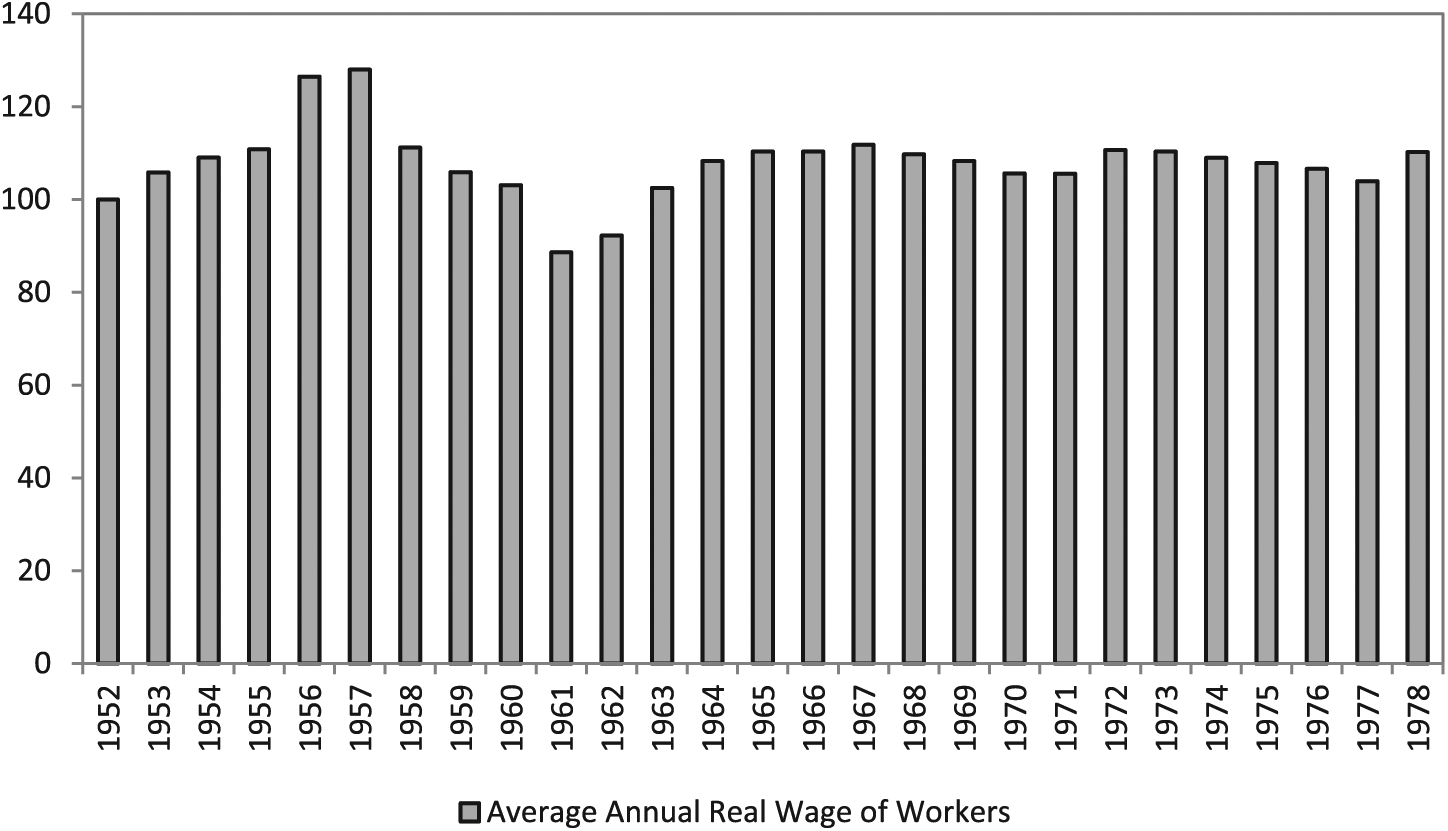
Average Annual Real Wage of Workers, 1952–1978 (1952 = 100).
3. Rising Wages, Profit Squeeze, and Powerful Workers in the First Stage of the Reform Era
The structural wage system, in which a worker’s total wage comprises a “basic wage” and an “efficiency wage,” is used widely among China’s state-owned enterprises. The efficiency wage actually consists of material incentives to provide extra effort. This system resembles the wage system for migrant workers in China’s private enterprises (Z. Li and Qi 2014). By reducing the share of the basic wage out of the total wage, management can impel workers to contribute more effort because workers have to attain the desired total wage to maintain decent living conditions. This structural wage system originated from the rejection of the Maoist incentive system and the abuse of material incentives in the early years of the reform era.
3.1. 1977 conferences on distribution according to work
After the members of the “Gang of Four” were arrested, the new leadership began to expose and criticize their “crimes.” Amid this atmosphere, Chinese economists held three conferences in 1977 on distribution according to work to criticize the incentive system used during the Cultural Revolution, which was labeled “egalitarianism,” “big pot rice,” 14 and “doing more work is the same as doing less work.”
While the 1977 conferences were ostensibly academic, few debates actually took place. One debate occurred between Marxian economists Xu He, Su Shaozhi, and Feng Lanrui, however, on whether distribution according to work was the economic base for the generation of capitalists and capitalism in a socialist society.
15
This debate derived from Mao’s 1974 statement that:
China is a socialist country. Before liberalization, China was almost capitalism. Now China still has the eight-grade wage system, “distribution according to work,” and monetary exchange, which is not very different from the old society. The difference is that the ownership has changed. (Su and Feng 1978: 33–34)
Referencing Mao’s words, Xu argued that the economic relations reflected by distribution according to work were internally related to capitalist economic relations and thus that, under certain conditions, the distribution system could generate capitalism. Therefore, Xu suggested that China should limit “distribution according to work.” Su and Feng disagreed; however, their only argument was that Mao said “the ownership has changed.” Su and Feng, along with most of the economists at the 1977 conferences, believed that China could never generate capitalism because China had established public ownership of the means of production (Su and Feng 1978).
Two features of the 1977 conferences and debates are particularly noteworthy.
First, the economists in the 1977 conferences generally had a much narrower understanding of distribution according to work than did the Chinese economists who were critical of “politics in command” during the economic adjustment period of the 1960s. In 1962, Luo Gengmo (1978), a well-known Chinese Marxian economist, suggested that the nature of distribution according to work in a socialist society was different from that in a capitalist society in four ways: in terms of the right to work, under socialism, everyone who has labor power has the right to work and to participate in distribution; in terms of the lack of exploitation, under socialism, anyone who does not work cannot get paid; in terms of the correlation between pay and production, under socialism, wages are increased as labor productivity grows; and in terms of equal pay for equal work, under socialism, managers are not paid more than are manual workers. However, most of the economists at the 1977 conferences focused on the view that workers should be paid differently for different levels of effort.
Second, most of the economists at the 1977 conferences believed that public ownership guaranteed that China was a socialist society and thus that encouraging material incentives would never change the socialist nature of the economy. This view ignored, however, that politics in command was a necessary condition for the Maoist incentive system; encouraging material incentives was not merely a minor change but a major undermining of the incentive system, which led to consequences relevant to the economic transition.
3.2. Undermining the foundation of the Maoist incentive system
After the 1977 conferences, a series of changes fundamentally undermined the foundation of the Maoist incentive system. In 1978, the state encouraged enterprises to use bonuses and piece wages in distribution (see Labor Bureau of Sichuan Province 1980: 1023). Figure 2 shows that the share of bonuses and piece wages out of total wages increased substantially in the first stage. Initially, the state still advocated the integration of politics in command and material incentives, but politics in command was replaced in the official discourse a few years later by “socialist spiritual civilization,” which had an entirely different meaning and was much less important (Wage Reform Office of Guangxi Zhuang Autonomous Region (1990: 545). In 1981, the state described the Congress of Worker Representatives as the basic institution for workers’ participation in management. The Congress met, at most, twice a year, preventing daily participation in management and thus greatly limiting the degree of worker participation (see Tonghua Steel Company 1989: 39).
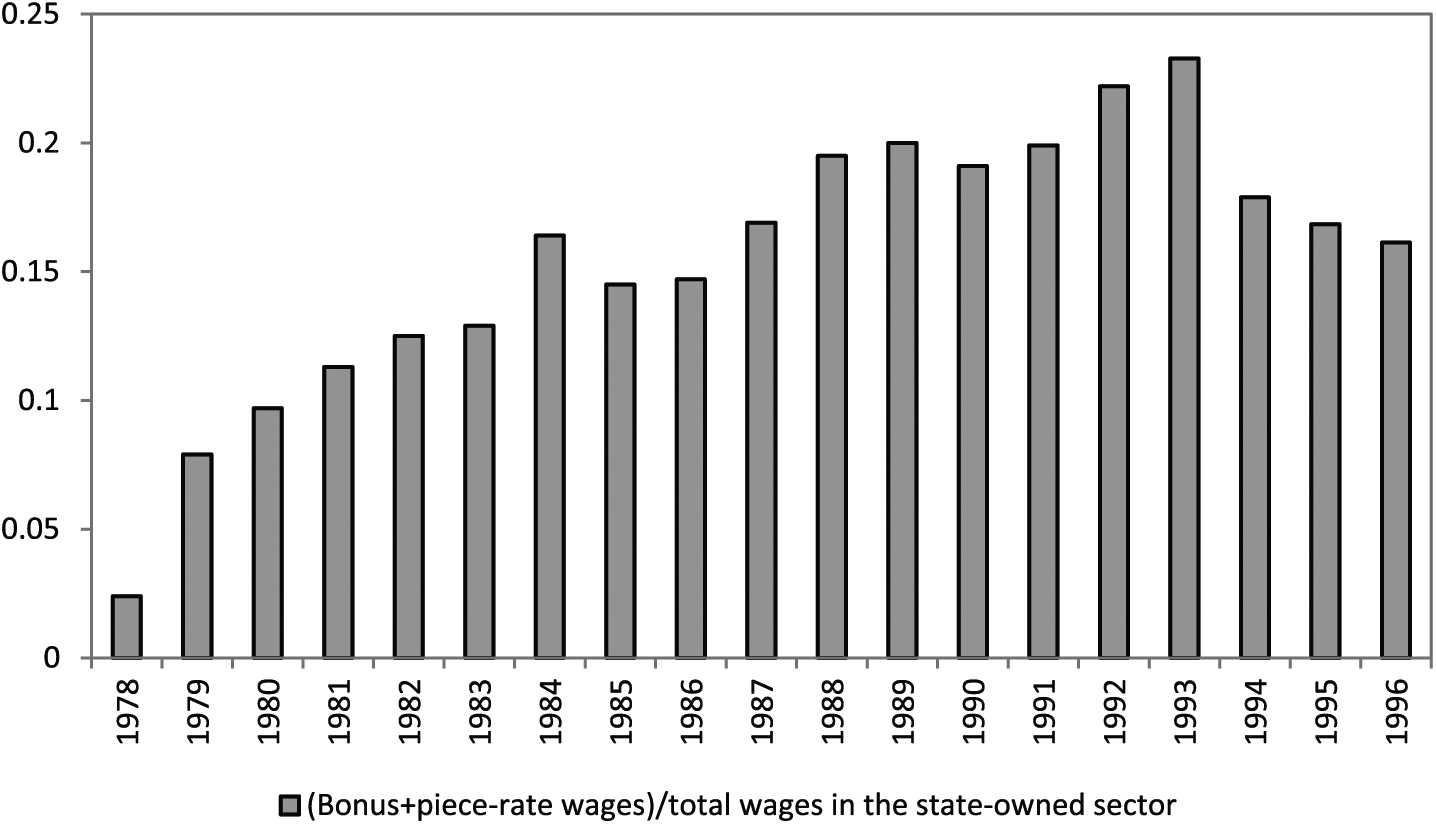
Share of Bonuses and Piece Wages Out of Total Wages in the State-Owned Sector, 1978–1996.
One telling example of the consequences of undermining the foundation of the Maoist incentive system is the abuse of bonuses that occurred immediately after the state allowed enterprises to use them in 1978. The bonuses were not distributed as rewards for extra effort, due to the power relations between workers and cadres. In 1979, the State Council issued an emergent notice observing that “some enterprises” followed overly high standards in the distribution of bonuses regardless of the effort contributed. 16 The same problem had arisen in 1962 when the state allowed enterprises to use bonuses for economic recovery (see Labor Bureau of Hebei Province 1964: 71). These examples show how necessary politics in command was for the Maoist incentive system: one could not undermine its foundation without creating problems. 17
Only the high-benefit system and job security remained as institutions. The question is whether the reform era created a new incentive system that successfully replaced the Maoist incentive system. The facts answer that question negatively.
3.3. Contradictions of the incentive system in the first stage
China’s profit share declined continuously and significantly throughout the first stage, as shown in Figure 3. As we see, a profit squeeze occurred during this period. In addition, the 1980s and early 1990s witnessed several rounds of inflation. Many studies argue that inflation occurred partly due to rising wages (Dai and Li 1989; Fan 1990; X. Li 1994; Liu 1989; Y. Song 1989; Xie 1994). The reform logic held that material incentives would encourage workers to contribute more to production. Given well-designed material incentives, the growth of profits should not be slower than the growth of wages. How, then, could a profit squeeze happen?
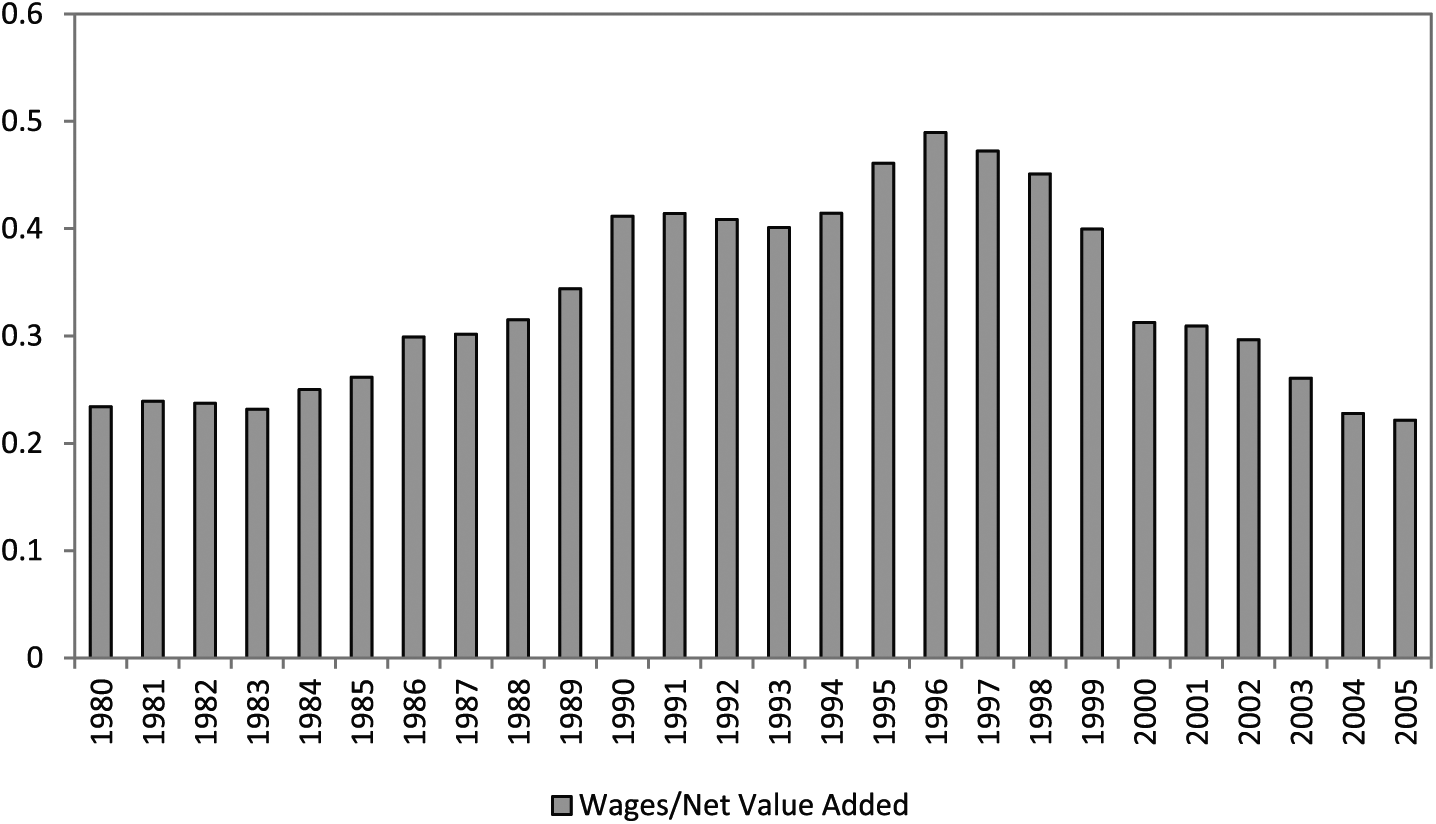
Wage Share in the State-Owned Industry, 1980–2005.
I argue that the rise in wages and the profit squeeze in the first stage of the reform did not result from the deficiencies in the design of material incentives but from the contradictions of the incentive system. Workers were still powerful at that time due to the high-benefit system and job security. The reform deprived workers of political rights and strengthened the rights of cadres in management, but workers and cadres were still economically similar. Cadres tended to increase the interests of both workers and themselves. 18 Workers and cadres collaborated to raise their joint interests. Faced with the collaboration between workers and cadres, the state tried to improve the design of material incentives to suppress the growth in wages relative to the growth in profits; however, these efforts failed. To illustrate, consider the following evidence.
3.3.1. Restricted economic inequality between cadres and workers
In the early 1980s, economic inequality between cadres and workers was still minimized. A 1983 survey conducted by the All-China Federation of Trade Unions (ACFTU) shows that the living conditions of worker households were similar to those of cadre households, as shown in Table 1. The rows of Table 1 show how living conditions were related to position (worker or cadre), controlling for work experience: (1) looking at the “relatively rich” column, workers’ and cadres’ proportions were close if they began to work after 1957 and (2) looking at each row, the largest proportion for cadres was also largest for workers if they began to work after 1949 (ACFTU 1983). 19 Table 2 compares the housing conditions of workers and cadres, showing that the housing differences were even smaller than were the income differences (ACFTU 1983).
Living Conditions in Workers’ and Cadres’ Households in 1983.
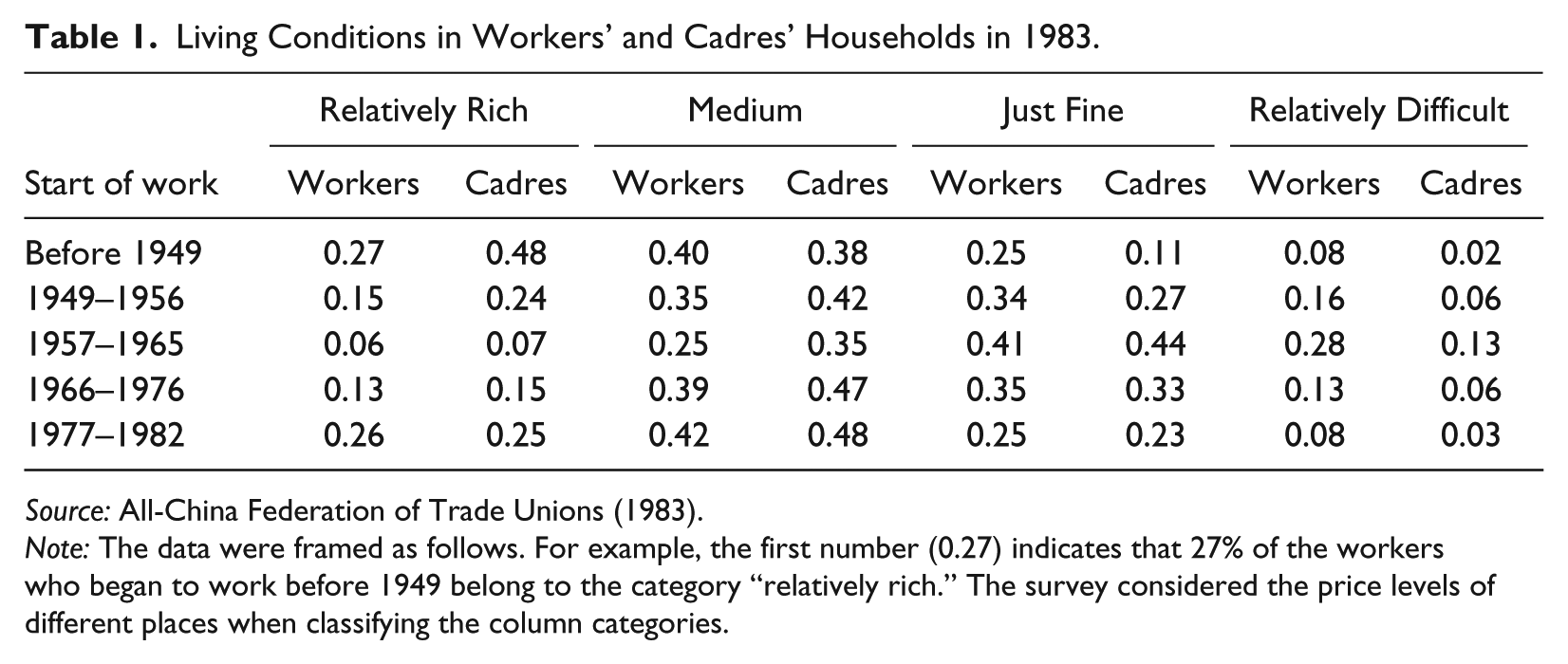
Note: The data were framed as follows. For example, the first number (0.27) indicates that 27% of the workers who began to work before 1949 belong to the category “relatively rich.” The survey considered the price levels of different places when classifying the column categories.
Housing Conditions of Workers and Cadres in 1983.
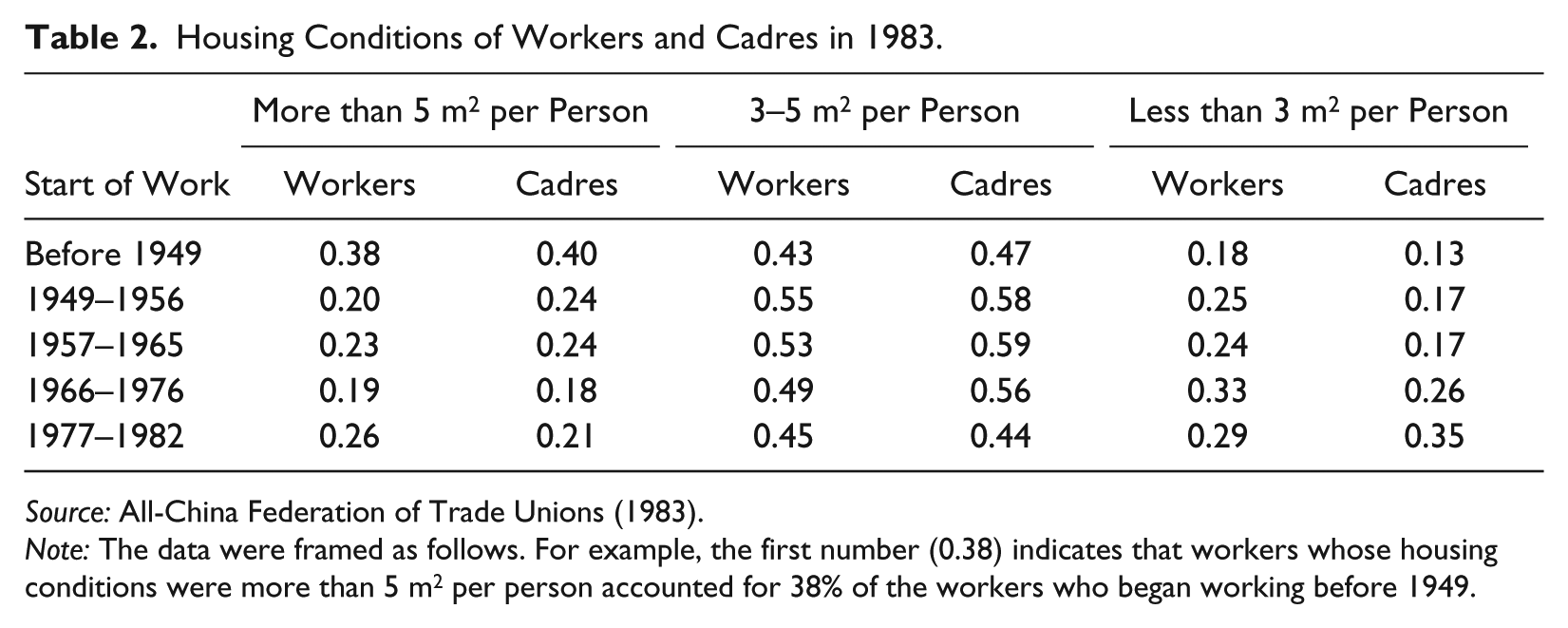
Note: The data were framed as follows. For example, the first number (0.38) indicates that workers whose housing conditions were more than 5 m2 per person accounted for 38% of the workers who began working before 1949.
The limited economic inequality did not imply that there was no contradiction between cadres and workers. In fact, according to the same survey, 43 percent of workers suggested that the main problem at that time was that some special benefits were available only to cadres (ACFTU 1983).
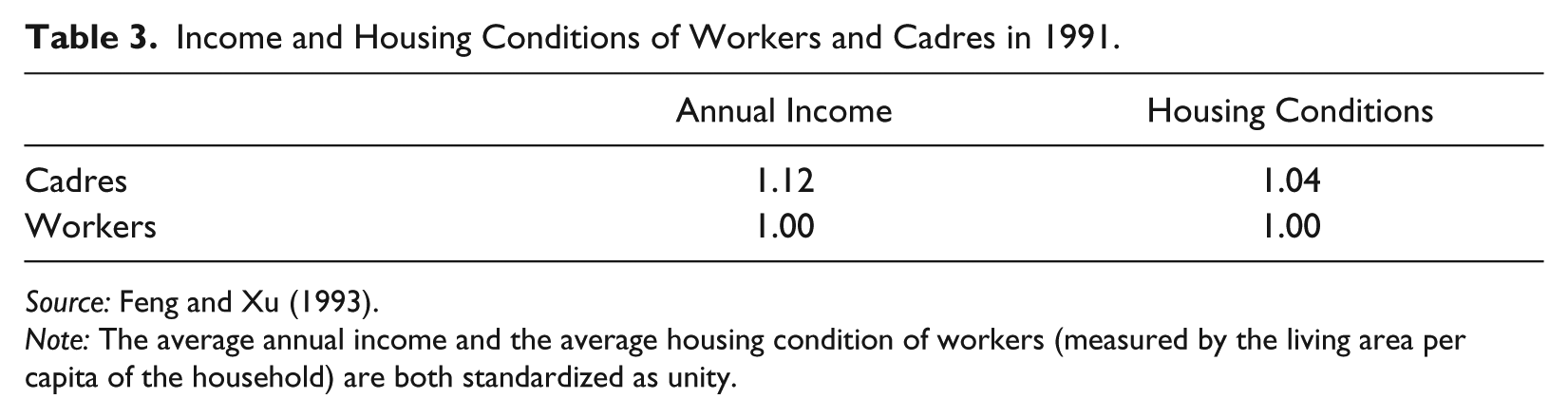
In 1991, the ACFTU conducted a similar survey, which shows that the gap between workers and cadres was still small, as shown in Table 3. Notably, however, 46 percent of workers and 51 percent of cadres suggested that the relationship between cadres and workers was not as good as was that in 1984. The survey also shows that cadres controlled almost all the power in the distribution of bonuses, housing, and opportunities for promotion (Feng and Xu 1993).
Income and Housing Conditions of Workers and Cadres in 1991.
Source: Feng and Xu (1993).
Note: The average annual income and the average housing condition of workers (measured by the living area per capita of the household) are both standardized as unity.
3.3.2. The high-benefit system and job security
As workers still enjoyed the high-benefit system and job security, they did not have to respond to material incentives with effort that was sufficient from the cadres’ perspective.
Workers’ benefits were provided by enterprises through two channels: annual expenditures on a variety of benefits (including pensions, medical services, education, and subsidies for food, heating, housing maintenance, cultural services, dining services, and helping poor households) and the “unproductive investment” used for housing construction and other facilities for the provision of benefits. Workers enjoyed better benefits from both these channels in the first stage of the reform era than they had in the Maoist era. From 1978 to 1990, the ratio of annual expenditure on benefits to total wages increased from 0.14 to 0.32. 20 The share of unproductive investment out of total investment increased from 21 percent in 1978 to 46 percent in 1982 and then gradually fell to 26 percent in 1990. 21
In terms of job security, although the state tried to expand the share of temporary workers relative to permanent workers, the latter were still the majority in 1990. 22 The state considered full employment as one of its objectives. At the beginning of the reform era, the unemployment problem arose when the state allowed the school graduates who had moved to the countryside through the Shangshan Xiaxiang (“up to the mountains, down to villages”) movement to return to cities. The state carried out a variety of policies to increase employment, such as encouraging state-owned enterprises to establish affiliated collective enterprises and allowing children to take their retired parents’ positions; as a result, unemployment quickly dropped from 5.3 million in 1978 to 2.4 million in 1984. 23
3.3.3. Workers’ responses to national wage adjustments
The version of distribution according to work discussed at the 1977 conferences was hardly realized through the national wage adjustments launched by the state during the early years of the reform era because the state had to take workers’ responses to the adjustments into account; as a result, these adjustments were shaped by the power relations among the state, cadres, and workers.
In 1977, concerned about the conflicts among workers, the state adopted work experience as the standard used to decide which workers would obtain wage increases; however, this standard did not reflect workers’ effort (Huang and Shu 1991: 223).
In 1978, the state decided to raise wages for workers who “had a good performance, made a great contribution, but were paid low wages”; however, many enterprises used this round of wage adjustments to compensate workers who had not obtained wage increases in 1977 (Huang and Shu 1991: 225). Again, distribution according to work did not play its proper role.
In the 1979 wage adjustment, the state was more determined and claimed that only workers who made great efforts in their work would obtain wage increases. In each enterprise, a committee composed of cadres and workers evaluated workers’ contributions (Labor Bureau of Sichuan Province 1980: 956). However, more than ten workers committed suicide after not receiving wage increases. Partly in response, the state increased workers’ wages in the 1982 wage adjustment, regardless of the distribution according to work (Wang 1998: 206). After 1982, the state no longer initiated national wage adjustments but relied on enterprises to reform the incentive system.
These examples from the early years of the reform era show that the incentive system depended on workers’ responses but not on the preferences of the state or cadres. By contrast, wage increases were gradually institutionalized in the early 1980s by linking wage increases with profits and other indices (e.g., taxes, revenue, and output), and most employees benefited. From 1983 to 1995, the proportion of rank and file Tonggang employees who obtained wage increases varied from 58 to 96 percent (Tonghua Steel Company 1996: 206).
3.3.4. State improvements of the incentive system
The state tried to improve the design of the incentive system in the mid-1980s but failed because cadres used a variety of methods to increase wages and benefits for workers and themselves.
Abandoning national wage adjustments, the state established a double-level incentive system: on the macro level, for some enterprises, the state fixed the proportion of the growth of total wages relative to the growth of profits (or the sum of profits and taxes), while the state allowed other enterprises to retain a fixed proportion of profits for reproduction, technical innovation, benefits, and bonuses; on the micro level, an enterprise had the autonomy to determine how to distribute the total bonuses (or total wages) and benefits. 24 This attempt failed for two reasons.
First, the fixed proportions used on the macro level were flexible because cadres could negotiate with the state over them. If the living conditions of workers and cadres were undermined by inflation, cadres could easily legitimize their bargain for a higher proportion (Huang and Shu 1991: 290). Figure 4 shows the share of retained profits out of total profits for North China Pharmaceutical Factory from 1979 to 1990, indicating that this share rose over time.
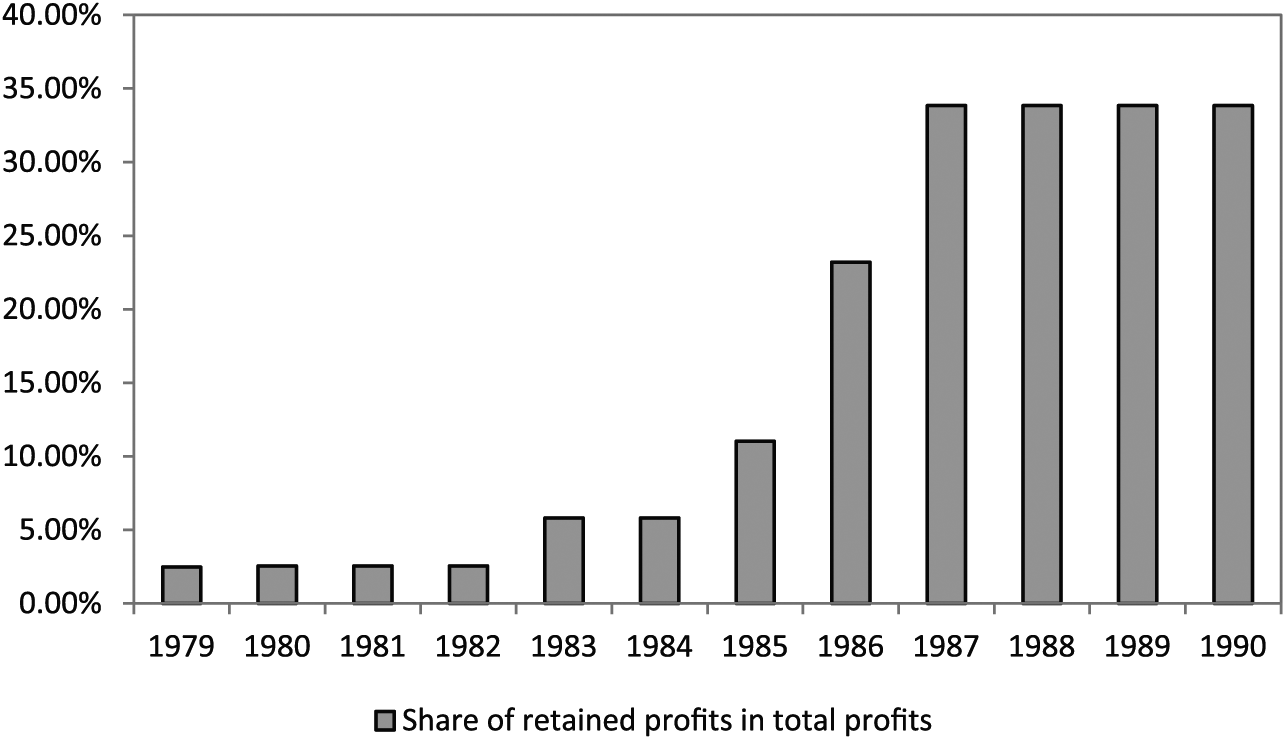
Share of Retained Profits Out of Total Profits, North China Pharmaceutical Factory, 1979–1990.
Second, under the high-benefit system, benefits were distributed mainly according to needs. The state set up the ratio of retained profits to total profits but did not regulate how many retained profits were used as benefits; thus, distributed benefits also took an increasingly large share out of retained profits, through which the profits obtained by the state and enterprises (after benefits deducted) decreased. 25
He Ping (1993: 277), former Ministry of Labor official, said that:
there is a phenomenon called “two faces,” which means the state’s regulation of total wages mismatches the actual situation of enterprises. An example is that, at the beginning of the year, enterprises obey the state, but at the end of the year, the state has to obey enterprises. . . In the past decade, total wages stipulated in the state’s plan were surpassed by the actually distributed wages by nearly 100 billion yuan.
In fact, the state faced difficulties due to the failure of the incentive system after the destruction of the Maoist system. This new incentive system relied heavily on the “carrot” strategy of material incentives. As He Ping (1993: 278) puts it, “Wages have to be raised; otherwise, the production has to be paralyzed.” However, continuous material incentives brought only a short-run effect on production. Wang Rong (1998: 196), an official who participated in wage adjustments, said that “a round of wage adjustment is only effective [in promoting production] for half a year—from the time when the wage adjustment is announced to begin, to the time when the adjustment is finished.” As a result, the growth of wages was faster than the growth of labor productivity. In 1989, Jiang Zemin, future general secretary of the Chinese Communist Party (CCP), emphasized that the growth of wages should be slower than the growth of labor productivity (J. Xu 1989: 156), which implies that the relationship between wages and labor productivity was not well-handled.
In addition, the first stage of the reform era witnessed recurring inflation. Given the limited production capacity of consumption goods in the 1980s, if total wages exceeded what was set in the state’s plan, the prices of consumption goods would increase. As a response to the rise in prices, enterprises distributed more wages and benefits to workers and cadres, which imposed further pressures on the supply of consumption goods. This spiral was relieved only when the state was determined to control total wages and benefits by reducing the number of bank loans distributed to enterprises. Dong and Putterman (2003) find that hardening budget constraints, without, at the same time, relieving state-owned enterprises from their social burdens, was a major proximate cause of redundant labor in the early 1990s.
4. Class Division and the Commodification of Labor Power in the Second Stage of the Reform Era
The failure of the incentive system in the first stage of the reform era was a crucial aspect of the economic transition in China, amid other aspects such as the collapse of the Soviet Union, neoliberal globalization, and so on. The problems with this system led to a series of reforms aimed at reshaping the power structure among the state, cadres, and workers. Cadres became capitalist managers and no longer pursued wage increases for workers; workers were deprived of high benefits and job security and thus had to be more obedient to managers. The state supported this transition through reforms favorable to the emerging capitalist managers.
4.1. Commodification of labor power
In the first stage of the reform era, workers were deprived of most of the political rights they had in the Maoist era, but they were still different from workers under capitalism, given their job security and access to benefits. In 1992, the Fourteenth Congress of the CCP proposed establishing a socialist market economy, which also initiated the commodification of labor power. 26
During a 1993 conference, Li Weiyi (1993: 6), former Ministry of Labor and Personnel official, said:
At present, the state determines the amount and growth of total wages, and with this limit, enterprises carry out distribution autonomously. Does this fit the requirements of a market economy? I think we need do some research on it. Some people suggest that wages should be determined by the market in the socialist market economy.
At the same conference, Central Party school professor Dong Guoying argued that if labor power is not a commodity under the socialist market economy, it is impossible to improve the allocation of labor forces (Dong 1993).
These examples imply that a theoretical foundation was laid for the commodification of labor power. Commodification requires the destruction of the high-benefit system and the formation of a reserve army of labor. Because workers will ask for more bonuses for less effort, material incentives are unsustainable in the long run without the “stick” of unemployment.
4.2. Destruction of the high-benefit system
In the high-benefit system, the distribution of benefits depended on workers’ needs. If benefits are linked to wages, and if wages are further linked to workers’ job security and firm profitability, the role of benefits as the workers’ fallback position is severely undermined.
Housing was the most important benefit for workers at the end of the first stage. Under the public housing system by the end of the first stage, the state and enterprises were responsible for investing in the construction of public-owned houses, and workers paid only minimum rents. The public housing system distributed houses to workers and cadres according to work experience, position, family size, and age of children.
By the end of the 1980s, housing subsidies had become a heavy burden for the state and enterprises. In 1988, the state decided to raise rents to encourage workers and cadres to purchase public-owned houses. However, this attempt failed to challenge the domination of the public housing system because paying rent was still cheaper than buying a house. In 1994, the state raised rents again, encouraged the privatization of houses, and established a housing provident fund system through which workers had to share the costs of purchasing and maintaining their houses. The state did not formally terminate the public housing system until 1998. Afterward, all workers had to purchase houses with their own savings, mortgage loans, and the housing provident fund, the amount of which was linked to the wages that workers could earn (J. Chen 2012).
As with housing, retirement pensions and medical services were also entirely provided by the state and enterprises in the first stage; in the 1990s, these benefits were transformed into insurance schemes (retirement pensions in 1991 and medical services in 1998) funded by the enterprises and workers themselves. Workers’ insurance also depended on their wages.
With all the key benefits linked to wages, workers confronted serious difficulties when housing prices boomed and costs related to retirement and medical services increased relative to wages. The reform transferred the burden of providing benefits from the state and enterprises to workers themselves. Workers had to work harder and be more obedient to managers to afford the necessary expenditures for decent living conditions.
4.3. Formation of the reserve army of labor
In the Maoist era and in the first stage of the reform era, factories could hire labor forces from the countryside only with the state’s permission. In the early 1990s, the state began to gradually loosen these constraints on migrant workers (Lü 2012). Initially, most migrant workers were hired by private-owned enterprises. In the mid-1990s, state-owned enterprises began to replace urban workers with migrant workers. One example is the labor outsourcing at Tonggang. In 1996, Tonggang began to outsource work to migrant workers. The wage of a migrant worker was, on average, only half the wage of an urban worker. Tonggang could also fire migrant workers freely. In that year, Tonggang paid 13 million yuan to migrant workers, which saved the company 9 percent of its total wage expenditure (Tonghua Steel Company 1997: 93).
In 1997, the Fifteenth Congress of the CCP launched a drastic reform of state-owned enterprises; one of the objectives was “increasing efficiency by reducing employment.” In fact, workers had begun to be laid off even earlier; from the mid-1990s to the early 2000s, more than 30 million workers were laid off by state-owned enterprises.
The creation of the reserve army was not only a policy consequence but also an intentional action by enterprises to restore profitability. To this end, enterprises even manipulated labor contracts. In 1995, the labor contract system gave all Tonggang workers long-term contracts, which, according to the Labor Law, prevented Tonggang from laying off workers freely. In 2000, Tonggang management claimed that the contract system established in 1995 was outdated. Thus, management required workers to replace their long-term contracts with three-year contracts (Tonghua Steel Company 2001: 207). Sacrificing the interests of laid-off workers, the profitability of Tonggang did recover in the 2000s; total profits increased from 105 million yuan in 2002 to 852 million yuan in 2004 (Tonghua Steel Company 2004: 270; 2005: 255).
4.4. Division between workers and managers
To address the problems in the first stage of the reform era, the reform transformed cadres into capitalist managers with their own interests and economic conditions separate from those of workers.
Economic inequality within enterprises grew after the reform underscored that distribution should reflect the contribution of managers. An official document issued by the Ministry of Labor in 1992 clearly stated that “The income gap between managers and workers should be properly enlarged” (Labor Bureau of Shandong Province 1993: 275). In 1993, Li Weiyi (1993: 7) quoted an article from a newspaper, saying that:
we have never actually carried out the principle of “distribution according to work” and thus this principle is the emperor’s new clothes to us. . . . Distribution should follow the contribution of different factors of production and. . . enterprises should pay compensation to the owners of these factors.
27
After the drastic reform initiated in 1997, the income gap between workers and managers was openly discussed. In 1999, Tonggang carried out a wage reform emphasizing that distribution should reflect the contribution of managers, which prepared the legitimacy of huge bonuses paid to managers. In 2004, a low-level manager at Tonggang received an annual bonus of 15,000 yuan, 60 percent more than the average wage for all employees in 2003 (Tonghua Steel Company 2005: 179). In 2005, Tonggang established an annual basis salary system for middle-level managers according to which a middle-level manager would be paid a salary equivalent to six times the average wage (Tonghua Steel Company 2006: 414). In the same year, to reward their promotion of the privatization of state-owned assets, top managers received shares in the joint-stock company equivalent to 100 million yuan. 28
Thus, the destruction of the high-benefit system, the formation of the reserve army, and the division between workers and cadres resolve the contradictions of the incentive regime in the first stage by substantially suppressing workers’ power. Through these changes, the state-owned sector, the core of the state-socialist system, became capitalist in terms of labor institutions and management-labor relations, thus completing the economic transition.
5. Concluding Remarks
In this article, I argue that the reform of the incentive system undermined the foundation of the Maoist incentive system and led to rising wages, squeezed profits, and recurrent inflation. This occurred because, first, workers were still powerful under the high-benefit system and their job security, and second, workers and cadres had similar economic conditions, and cadres tended to negotiate with the state to pursue increases in wages and benefits for both workers and themselves. In the second stage, a series of reforms reshaped the power structure by suppressing workers’ power and separating managers from workers. As a result, workers became sellers of the commodity of labor power and cadres became capitalist managers.
The narrow perception of distribution according to work at the beginning of the reform era helped overthrow the innovation in coordinating the living conditions of individual workers and the long-term interests of the working class pursued during the Maoist era. Despite gains in distributive shares, workers under material incentives were increasingly weak, which finally led to the total loss of power through a series of reforms. The history of the incentive system in China’s state-owned sector may help us answer the question of how to realize distribution according to work in a socialist economy. Distribution according to work requires institutional complementarity, whereby the incentive system cooperates with systems of distribution, employment, and accumulation. This principle is important for achieving the balance between the interests of individual workers and those of the working class, between the living conditions in the short run and economic development in the long run. Thus, a socialist economy following this principle should continuously generate work incentives and promote a sustainable accumulation model while maintaining the socialist orientation of the society.
Footnotes
Acknowledgements
I would like to thank David Kotz, Deepankar Basu, and Sigrid Schmalzer for their very valuable comments and suggestions on earlier versions of this paper. I would also like to thank the three referees of this paper for their helpful comments. The usual disclaimers apply.
Declaration of Conflicting Interests
The author declared no potential conflicts of interest with respect to the research, authorship, and/or publication of this article.
Funding
The author received no financial support for the research, authorship, and/or publication of this article.
2
As we see, all the major changes (commodification of labor power, the formation of a reserve army, destruction of the high-benefit system, and division between workers and cadres) happened before 2005. In this sense, China accomplished the economic transition in the early 2000s.
3
Before the reform of state-owned enterprises in the mid-1990s, “cadres” in China referred to both government officials and managers in enterprises. Here, “cadres” refers only to managers.
4
Here, labor’s share is the same as the wage share, which equals total wages divided by value added (i.e., the sum of wages, profits, and taxes). Self-employment income is excluded from both wages and value added.  argues that the labor share inclusive of agriculture is better than the nonagricultural labor share because peasants are engaged in both household agricultural production and capitalist production. The analysis here is not contradictory to that argument because it focuses on the power relations between workers and cadres within state-owned enterprises, rather than the power of the working class in the entire economy.
5
6
7
8
9
Data on the average wages of cadres are hard to find, but data on wage standards are available. The 1963 standards show that a seventeen-grade cadre (almost the highest grade for enterprises) at Baotou Steel Company could earn 77 yuan per month, while a medium-skilled smelter worker (grade 4) could earn 61.76 yuan per month (Labor Bureau of Hebei Revolution Committee 1973). Because China implemented a complex but unified system of wage standards during the Maoist era, the data for one enterprise may reflect the national situation. In addition, during the Maoist era, the state reduced cadres’ standard salaries three times (: 72).
10
One of the most important documents of the Cultural Revolution, “The Central Committee of the Communist Party of China: Ten Points on Grasping Revolution and Promoting Production,” clearly states that “leaders of factories shall not retaliate against workers, reduce workers’ wages, or dismiss workers on the grounds that workers raise critiques and uncover facts” (: 2).
11
discusses the rise and fall of cadres and experts at Tsinghua University in great detail. Antagonism arose between cadres and experts before the Cultural Revolution due to the cadres’ lack of cultural capital relative to that of experts; however, the Revolution weakened the positions of both groups.
12
One may consider the Great Leap Forward as the starting point and 1977 as the end, excluding the economic adjustment period.
13
From 1958 to 1976, the average wage (adjusted by urban consumers’ price index) for workers and cadres was reduced by 4 percent. This does not stand in contradiction with the improvements in the living conditions of workers and cadres because, as the labor participation rate was growing, the average (price-adjusted) wage per household was increasing substantially (: 282).
14
Another similar expression is “iron rice bowl,” which refers to high job security, while “big pot rice” refers to egalitarianism in distribution.
15
This debate was related to the 1975 article, “On the Social Basis for the Lin Piao Antiparty Clique” written by Yao Wenyuan, a member of the “Gang of Four,” who argued that the bourgeois rights are the economic base for the generation of capitalists and capitalism in a socialist society. Xu He’s article in the 1977 conferences was published before the end of the Cultural Revolution. In that article, Xu criticized Yao’s opinion by arguing that the bourgeois rights should belong to superstructure rather than economic base. In another article, Xu suggested that one should not regard bonuses as bourgeois rights; on the contrary, with deliberate design, bonuses could be used to limit the bourgeois rights ().
16
See Labor Bureau of Sichuan Province (1980: 1049). In fact, the State Council issued more notices on the abuse of bonuses from 1980 to 1982, which shows that this problem was not merely a short-term one. Tang (1982) and : 185) confirm that the abuse of bonuses was serious.
17
Similar problems happened in the Soviet Union. After the 1956–1962 wage reform, enterprises were allowed to distribute bonuses from a part of their retained profits. As a result, bonuses as a proportion of total wages increased from 8.2 percent in 1965 to 15 percent in 1971. Bonuses were distributed according to production above quotas; consequently, production became much greater than the quotas, reducing the quotas’ significance as thresholds. Bonuses also undermined the function of the standard wage in accordance with the six-grade scale, which was designed to motivate workers to enhance their skills (Chapman 1979). A similar development occurred in the Soviet Union in 1988–1989, when the new Law on State Enterprise gave enterprises the right to determine wages, while workers had the right to replace the top managers. There followed a period of rapid wage increases (: 81).
18
Walder (1991) suggests that cadres became representatives of the interests of their enterprise, including, to a considerable extent, the interests of their employees. also observes that in the 1980s, workers’ ability to influence the wage bill was increased and suggests that low-wage productivity and lax work discipline remained major problems in state industry.
19
20
See China Labor Statistical Yearbook 1999. Here, “total wages,” a category used in the data sources, does not include enterprises’ expenditure on benefits.
21
See China Statistical Yearbook, various issues.
22
The share of permanent workers out of total workers was 87 percent in 1990 (China Statistical Yearbook 1991).
23
See China Statistical Yearbook, various issues.
24
See Wage Reform Office of Guangxi Zhuang Autonomous Region (1990: 533). This program was proposed as early as 1979 (: 1070).
25
26
It is noteworthy that in the first stage, the Contract Responsibility System adopted in 1987 began to erode the “iron rice bowl”; however, the commodification of labor power in practice started with the second stage.
27
The article was originally published by Southern Weekly, which supports neoliberal ideas and policies nowadays.
28
See Tonghua Steel Company (2006: 122). Jilin provincial government initiated this privatization program and made the decision to distribute bonuses to top managers.